
S H O R T R E P O R T
Open Access
Wolbachia
detection in insects through LAMP: loop
mediated isothermal amplification
Daniela da Silva Gonçalves
1, Anna Paula Alvim Cassimiro
1, Caroline Dantas de Oliveira
1, Nilton Barnabé Rodrigues
2and Luciano Andrade Moreira
1*Abstract
Background:The bacteriumWolbachiais a promising agent for the biological control of vector-borne diseases as some strains have the ability to block the transmission of key human disease-causing pathogens. Fast, accurate and inexpensive methods of differentiating between infected and uninfected insects will be of critical importance as field-based trials ofWolbachia-based bio-control become increasingly common.
Findings:We have developed a specific and sensitive method of detectingWolbachiabased on the isothermal
DNA amplification. This technique can be performed in an ordinary heat block without the need for gel-based visualisation, and is effective for a wide variety of insect hosts.
Conclusion:Here we present the development of a rapid, highly sensitive and inexpensive method to detect
Wolbachiain a variety of insect hosts, including key mosquito disease vectors.
Keywords:Wolbachia, LAMP-loop mediated isothermal amplification, Mosquito, Insect
Findings
Vector-borne diseases (e.g. malaria, dengue, filariases and Chagas disease) occur in more than 100 countries, primarily within the tropics, with the annual, global death rate in the millions. Despite the existence of a variety of vector control measures disease incidence is generally increasing, and consequently there is an urgent need to develop new and effective control strategies [1]. Ideally these strategies should be able to be used in conjunction with existing control methods, and in this context the bacterium Wolbachia pipientis has proven to be a promising alternative, given its ability to restrict pathogen development in many different mosquito-pathogen combinations [2-5], and recently being applied in the field in Australia, Vietnam, Indonesia and soon in other dengue endemic countries (www.eliminatedengue.org).
Wolbachiais a vertically-transmitted bacterial endosym-biont of arthropods that is able to manipulate its host’s reproductive system and consequently spread rapidly through wild populations [6]. Wolbachiawas originally
identified in the ovaries of the mosquitoCulex pipiens[7], and recent studies have estimated that 40% of terrestrial arthropod species are infected with the bacterium [8]. Critically, infections do not occur in key vector species including the dengue mosquito Aedes aegyptior in the Anophelesgenus [9].Wolbachiais typically detected within the host by PCR against genes such aswsp (Wolbachia surface protein) [10], ftsZ (cell division protein) [11], and 16S ribosomal protein [12], or through fluorescence-based assays [13]. These techniques can be expensive to perform for large numbers of samples, and require the use of laboratory equipment.
The LAMP (loop mediated isothermal amplification) technique utilizes BstDNA polymerase to create stand-displacement amplification, and operates at a constant temperature [14]. Examples of its use are very broad, ranging from the detection of pathogenic microorganisms to sex determination in embryos [15]. The LAMP product can be detected by the visualisation of turbidity, fluores-cence or a metal ion indicator producing a colorimetric change [16] without the need to run a gel. These character-istics make LAMP a suitable method to detectWolbachia under circumstances where minimum infrastructure is available. Here we report the use of LAMP to detect * Correspondence:[email protected]
1Grupo: Mosquitos Vetores: Endossimbiontes e Interação Patógeno Vetor, Centro de Pesquisas René Rachou - Fundação Oswaldo Cruz, Av. Augusto de Lima 1715, 30190-002 Belo Horizonte, MG, Brazil
Full list of author information is available at the end of the article
Wolbachia in a diverse range of insect species, which will prove beneficial to monitoring the progress of field-based trials utilising the bacterium.
Methods
We examined many different species including laboratory-reared mosquito lines ofAedes fluviatilis, naturally infected by theWolbachiastrainwFlu, A. aegyptitransinfected with the wMelPop and wMel strains [17-19], and uninfected Anopheles aquasalismosquitoes. These lines were reared at FIOCRUZ Minas as previously described [20]. We also examined field-captured mosquitoes includingA. aegypti, A. albopictus, andCulex sp.Furthermore, insects belong-ing to a diverse range of orders, which were known to be Wolbachia-infected (unpublished results) were also included.
Specimens were stored in 96% ethanol until DNA extraction. Whole insect specimens were homogenized for 1.5 min using a Mini-Beadbeater-16 (BioSpec), in 1.5 mL tubes containing one 3 mm glass bead and 80μl of homogenization buffer (10 mM Tris, 1 mM EDTA, 50 mM NaCl [pH 8.2]), and were then centrifuged at 4°C for 30s at 13,000 rpm [21]. The samples were then incubated at 97°C for 10 min, placed on ice for 15 min, and centrifuged for 10 min (4°C, 13,000 rpm). The supernatant was diluted 1:10. Primers for the Wolbachia16S ribosomal sequence [12] were designed using the LAMP Designer 1.02 software (PREMIER Biosoft International) (Table 1).
Each LAMP reaction (Vtotal= 25 μl) contained 1×
ThermoPol Reaction Buffer (20 mM Tris–HCl, pH 8.8, 10 mM KCl, 10 mM (NH4)2SO4, 2 mM MgSO4, 0.1%
Triton X-100), 0.32 mM of each dNTP, 0.64μM of each internal primer (FIP/BIP), 0.32μM of LoopF and LoopB, 0.16 μM of each external primer (F3/B3), 0.64 M of Betaine, 6U ofBstDNA polymerase, large fragment (New England Biolabs), and approximately 30 ng of DNA. 1.2 mM of the metal ion indicator Hydroxy Naphthol Blue (HNB) was added to the ThermoPol Reaction Buffer. The mixture was incubated at 63°C for 90 minutes on a thermocycler or heat block, to determine if the reaction
could be performed with a simpler setup. To check the sensitivity of the assay we cloned the external primer amplicon (F3/B3) into the pGemT-Easy (Promega) plasmid, and observed the efficacy of the assay on serial dilutions of the product.
Results and discussion
Loop mediated isothermal amplification has been used to detect different organisms, such asLeishmania[22], Toxoplasma gondii [23] and also bacteria belonging to the same class as Wolbachia(Alphaproteobacteria); Brucella spp [24], Anaplasma ovis [25] and Ehrlichia ruminantium [26].We designed a LAMP-based assay to detect Wolbachia in different hosts using the bacterial 16S rRNA sequence [12]. Initially we designed the four basic LAMP primers (F3, B3, FIP and BIP) but due to low specificity we then included the extra Loop primers [14].
[image:2.595.305.539.351.651.2]To optimize the LAMP reaction forWolbachia,samples ofA. fluviatilisandwMel-infectedA. aegyptiwere used to conduct a time course assay where we determined that
Table 1 Loop-mediated isothermal amplification (LAMP) primers based onWolbachia16S sequences, designed using LAMP designer 1.02 software
Primer Sequence (5′-3′)
F3 CTCGTGTCGTGAGATGTTG
B3 GAACGTATTCACCGTGGC
FIP CCCACTCCATAAGGGCCATGAGGGACTTTAAGGAAACTGCC
BIP CAATGGTGGCTACAATGGGCTGGCAGAGTACAATCCGAACTG
LoopF CCACCTTCCTCCAGTTTATCAC
[image:2.595.56.293.637.733.2]LoopB CGCGAGGCTAAGCTAATCC
amplification first occurred after 60 minutes of incubation (at 63°C using a thermocycler – Additional file 1). This was subsequently standardized at 90 minutes in order to account for samples with low bacterial density.
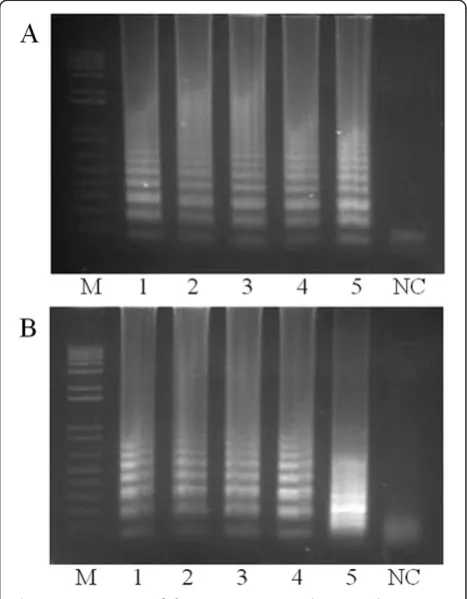
Assay sensitivity was assessed by serially diluting plasmid DNA containing the target sequence. Dilutions containing 107, 105, 103, 101and 10° copies of the target gene were incubated for 90 min, using a thermocycler (Figure 1A) or heat block (Figure 1B). Sensitivity was high using either method, with amplification observed from as little as 10° copies of the target sequence, although it should be noted that amplification from plasmids is more effective than from genomic DNA.
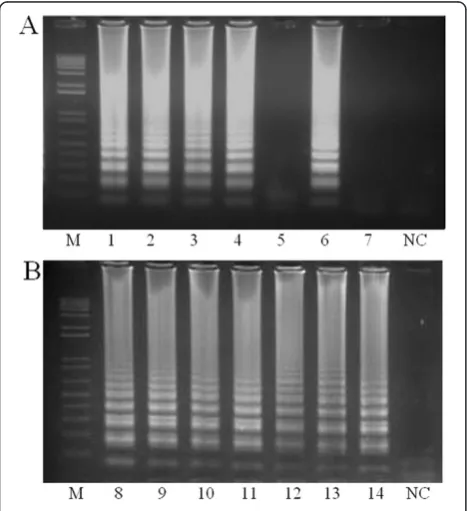
To check the specificity of our assay we analyzed mos-quito specimens (Diptera: Culicidae) both infected and uninfected withWolbachia. No amplification was observed in uninfected specimens, suggesting that the assay was highly specific and did not react to other bacteria infecting the mosquito gut [27]. We were also correctly able to identify Wolbachia infection in insect specimens from
other orders (Figure 2B). It is important to mention though, as lateral gene transfer events are quite common in Wolbachia [28] further confirmation of the pres-ence of this bacterium (MLST strain typing or in situ hybridization for instance) will likely be appropriate in specific studies, where the high throughput screening for positive individuals is not the main objective.
The assay included the metal ion indicator Hydroxy Naphthol Blue [16] (which reacts with the pyrophosphate ion by-product of the reaction) to check whether we could detect Wolbachia without running agarose gels. We were able to clearly visualise a difference in colour after incubating the samples of A. fluviatilis (infected with wFlu) andA. aegypti(wild type and infected with wMel), besides the negativeA. aquasalis,for 150 min at 63°C in the thermocycler (Figure 3). This step could be utilized when access to laboratory equipment is limited and also has an advantage of reducing the risk of contamination (no need to open the tubes).
[image:3.595.57.291.344.600.2]In terms of the cost per reaction, LAMP is approxi-mately half as expensive as conventional PCR. If the cost of equipment is also included, LAMP becomes compara-tively even cheaper given that it can be performed using only a heat block. As a further cost-saving measure, or if required in the field, homogenization of specimens could be performed using micro-pestles rather than a beadbeater.
Figure 2Specificity and reliability of the LAMP assay in different insects.To determine the specificity and reliability of our assay we amplified the DNA from different mosquito species (Diptera), including those naturally infected withWolbachia:(A)Ae. albopictus(1),Ae. fluviatilis(2),Culex sp.(6) those with transinfections;Ae. aegypti–wMel (3),Ae. aegypti–wMelPop (4), and those with no infection;Ae. aegypti (5),An. aquasalis(7).We also examined insects from a range of different orders that were known to be infected withWolbachia: (B)Hymenoptera (8), Hemiptera (9), Lepidoptera (10), Orthoptera (11), Siphonaptera (12), Coleoptera (13), Isoptera (14). M = 1 Kb Plus, Invitrogen. NC = negative control. AllWolbachia-infected specimens amplified, while no amplification was observed for uninfected specimens indicating that the assay was both highly reliable and highly specific.
[image:3.595.304.539.431.635.2]We have demonstrated the reliability and sensitivity of using LAMP to detect Wolbachia, with detection possible for low-density infections, and the results easily visualized by the naked eye. Consequently, this technique could be readily applied in the field, without the need to use expensive laboratory equipment. This is the first report of the use of LAMP to detectWolbachiainfection in different hosts. The technique could potentially be applied to differentiating between multiple strains that could potentially occur within the same host species.
Additional file
Additional file 1:Standardization of the LAMP assay incubation time. To determine the optimal incubation time for the assay, LAMP reactions were performed using; (1)Ae. fluviatilisnaturally infected withWolbachia(wFlu), and (2)Ae. aegyptiartificially infected withwMel. Samples were incubated at 63°C in a thermocycler and the tubes were removed at different times: 30 min (a), 60 min (b), 90 min (c), 120 min (d), 150 min (e). The products were visualised on a 1.5% agarose gel stained with EtBr. Visible products were present after 60 minutes of incubation. NC = negative control.
Competing interests
The authors declare that they have no competing interests.
Authors’contributions
DSG participated in the design of the study, carried out all experiments and drafted the manuscript. APAC helped to conduct the experiments. CDO collected and screened infected insects. NBR and LAM participated on the study design. LAM coordinated the work, critically reviewed the manuscript and contributed to obtaining the results. All authors read and approved the final version of the manuscript.
Acknowledgements
We thank Constancia Ayres for providing mosquito samples. We are in debt to Fernanda Rezende for technical and Alice Guimarães for administrative support, as well as Eric P. Caragata for critical reading. DS Gonçalves and LA Moreira are CNPq fellows. NBR is a CAPES fellow (BEX 11603/13-5).
Financial support
This work was supported by FAPEMIG, CNPq, the Brazilian Ministry of Health (DECIT/SVS), and a grant to Monash University from the Foundations for the National Institutes of Health through the Vector-Based Transmission of Control: Discovery Research (VCTR) program of the Grand Challenges in Global Health Initiatives of the Bill and Melinda Gates Foundations.
Author details
1Grupo: Mosquitos Vetores: Endossimbiontes e Interação Patógeno Vetor, Centro de Pesquisas René Rachou - Fundação Oswaldo Cruz, Av. Augusto de Lima 1715, 30190-002 Belo Horizonte, MG, Brazil.2Entomologia Médica, Centro de Pesquisas René Rachou - Fundação Oswaldo Cruz, Av. Augusto de Lima 1715, 30190-002 Belo Horizonte, MG, Brazil.
Received: 25 March 2014 Accepted: 6 May 2014 Published: 19 May 2014
References
1. McGraw EA, O’Neill SL:Beyond insecticides: new thinking on an ancient problem.Nat Rev Microbiol2013,11:181–193.
2. Kambris Z, Cook PE, Phuc HK, Sinkins SP:Immune activation by life-shortening
Wolbachiaand reduced filarial competence in mosquitoes.Science2009,
326(80):134–136.
3. Bian G, Xu Y, Lu P, Xie Y, Xi Z:The Endosymbiotic BacteriumWolbachia
induces resistance to Dengue Virus inAedes aegypti.PLoS Pathog2010,
6:e1000833.
4. Glaser RL, Meola MAC-P:The nativeWolbachiaendosymbionts ofDrosophila melanogasterandCulex quinquefasciatusincrease host resistance to West Nile virus infection.PLoS One2010,5:e11977.
5. Bian G, Joshi D, Dong Y, Lu P, Zhou G, Pan X, Xu Y, Dimopoulos G, Xi Z:
WolbachiainvadesAnopheles stephensipopulations and induces refractoriness toPlasmodiuminfection.Science2013,340(80-):748–751. 6. Werren JH, Baldo L, Clark ME:Wolbachia: master manipulators of
invertebrate biology.Nat Rev Microbiol2008,6:741–751.
7. Hertig M, Wolbach SB:Studies onRickettsia-like micro-organisms in insects *.J Med Res1924,44:329–374.7.
8. Zug R, Hammerstein P:Still a host of hosts forWolbachia: analysis of recent data suggests that 40% of terrestrial arthropod species are infected.PLoS One2012,7:e38544.
9. Kittayapong P, Baisley KJ, Baimai V, O’Neill SL:Distribution and diversity of
Wolbachiainfections in Southeast Asian mosquitoes (Diptera: Culicidae).
J Med Entomol2000,37:340–345.
10. Zhou W, Rousset F, O’Neil S:Phylogeny and PCR-based classification ofWolbachiastrains usingwspgene sequences.Proc Biol Sci1998,
265:509–515.
11. Werren JH, Zhang W, Guo LR:Evolution and phylogeny ofWolbachia: reproductive parasites of arthropods.Proc Biol Sci1995,261:55–63. 12. Simoes P, Mialdea G, Reiss D, Sagot F, Charlat S:Wolbachiadetection: an
assessment of standard PCR Protocols.Mol Ecol Resour2011,11:567–572. 13. Casper-Lindley C, Kimura S, Saxton DS, Essaw Y, Simpson I, Tan V, Sullivan
W:Rapid fluorescence-based screening forWolbachiaendosymbionts in
Drosophilagerm line and somatic tissues.Appl Environ Microbiol2011,
77:4788–4794.
14. Notomi T, Okayama H, Masubuchi H, Yonekawa T, Watanabe K, Amino N, Hase T:Loop-mediated isothermal amplification of DNA.Nucleic Acids Res 2000,28:e63.
15. Fu S, Qu G, Guo S, Ma L, Zhang N, Zhang S, Gao SSZ:Applications of loop-mediated isothermal DNA amplification.Appl Biochem Biotechnol 2011,163:845–850.
16. Goto M, Honda E, Ogura A, Nomoto A, Hanaki K-I:Colorimetric detection of loop-mediated isothermal amplification reaction by using hydroxy naphthol blue.Biotechniques2009,46:167–172.
17. Moreira LA, Iturbe-Ormaetxe I, Jeffery JA, Lu G, Pyke AT, Hedges LM, Rocha BC, Hall-Mendelin S, Day A, Riegler M, Hugo LE, Johnson KN, Kay BH, McGraw EA, Van den Hurk AF, Ryan PA, O’Neill SL:AWolbachiasymbiont inAedes aegypti
limits infection with Dengue, Chikungunya, andPlasmodium.Cell2009,
139:1268–1278.
18. McMeniman CJ, Lane AM, Fong AW, Voronin DA, Iturbe-Ormaetxe I, Yamada R, McGraw EA, O’Neill SL:Host adaptation of aWolbachiastrain after long-term serial passage in mosquito cell lines.Appl Env Microbiol2008,
74:6963–6969.
19. Walker T, Moreira LA:CanWolbachiabe used to control malaria?Mem Inst Oswaldo Cruz2011,106:212–217.
20. Baton LA, Pacidônio EC, Gonçalves DDS, Moreira LA:wFlu: characterization and evaluation of a nativeWolbachiafrom the mosquitoAedes fluviatilis
as a potential vector control agent.PLoS One2013,8:e59619.
21. Fu Y, Gavotte L, Mercer DR, Dobson SL:Artificial tripleWolbachiainfection inAedes albopictusyields a new pattern of unidirectional cytoplasmic incompatibility.Appl Environ Microbiol2010,76:5887–5891.
22. Khan MGM, Bhaskar KRH, Salam MA, Akther T, Pluschke G, Mondal D:
Diagnostic accuracy of loop-mediated isothermal amplification (LAMP) for detection ofLeishmaniaDNA in bufft coat from visceral leishmaniasis patients.Parasites & Vectors2012,5:280.
23. Kong QM, Lu SH, Tong QB, Lou D, Chen R, Zheng B, Kumagai T, Wen LY, Ohta N, Zhou XN:Loop-mediated isothermal amplification (LAMP): early detection ofToxoplasma gondiiinfection in mice.Parasites & Vectors2012,5:2. 24. Song L, Li J, Hou S, Li X, Chen S:Establishment of loop-mediated
isothermal amplification (LAMP) for rapid detection ofBrucellaspp. and application to milk and blood samples.J Microbiol Methods2012,
90:292–297.
25. Ma M, Liu Z, Sun M, Yang J, Guan G, Li Y, Luo J, Yin H:Development and evaluation of a loop-mediated isothermal amplification method for rapid detection ofAnaplasma ovis.J Clin Microbiol2011,49:2143–2146. 26. Nakao R, Stromdahl EY, Magona JW, Faburay B, Namangala B, Malele I,
27. Minard G, Mavingui P, Moro CV:Diversity and function of bacterial microbiota in the mosquito holobiont.Parasit Vectors2013,6:146. 28. Dunning Hotopp JC, Clark ME, Oliveira DCSG, Foster JM, Fischer P, Muñoz
Torres MC, Giebel JD, Kumar N, Ishmael N, Wang S, Ingram J, Nene RV, Shepard J, Tomkins J, Richards S, Spiro DJ, Ghedin E, Slatko BE, Tettelin H, Werren JH:Widespread lateral gene transfer from intracellular bacteria to multicellular eukaryotes.Science2007,317:1753–1756.
doi:10.1186/1756-3305-7-228
Cite this article as:Gonçalveset al.:Wolbachiadetection in insects through LAMP: loop mediated isothermal amplification.Parasites & Vectors
20147:228.
Submit your next manuscript to BioMed Central and take full advantage of:
• Convenient online submission
• Thorough peer review
• No space constraints or color figure charges
• Immediate publication on acceptance
• Inclusion in PubMed, CAS, Scopus and Google Scholar
• Research which is freely available for redistribution
![catena Poly[[bis(imidazole κN)copper(II)] μ succinato κ2O:O′]](data:image/gif;base64,R0lGODlhAQABAIAAAP///wAAACH5BAEAAAAALAAAAAABAAEAAAICRAEAOw==)