The same fight, a different story
A comparative media framing analysis of the Battle
of Raqqa in the online coverage of CNN and RT
by
Lennard Johannes Henricus Swolfs
A thesis submitted to the Journalism, Media and
Communications Discipline
Presented in partial fulfilment of the requirements for the
Degree of Bachelor of Arts with Honours
University of Tasmania
Abstract
‘The first casualty when war comes is truth’
Acknowledgements
Table of Contents
Abstract ... ii
Epigraph ... iii
Acknowledgements ...iv
Table of Contents ... v
List of Tables ...vi
Chapter 1 - Introduction ... 1
Chapter 2 – Literature review ... 4
2.1 The Battle of Raqqa ... 4
2.2 Media, democracy and foreign policy ... 6
2.3 Media framing theory ... 8
Chapter 3 - Methodology ... 12
3.1 Approach ... 12
3.2 Application ... 14
Chapter 4 - Analysis ... 16
4.1 Articles analysed... 16
4.2 Framing ... 17
4.3 The valence of the news articles ... 19
4.4 Sources... 22
Chapter 5 - Discussion ... 26
5.1 The same battle, different narratives ... 26
5.2 The influence of the government’s foreign policy and ideology... 27
5.3 The watchdog ideal under pressure ... 29
Chapter 6 - Conclusion ... 32
References ... 35
Appendices ... 40
Appendix A – Measuring the generic frames... 40
Appendix B – Code sheet ... 42
List of Tables
Chapter 1
Introduction
The terrorist organisation Islamic State of Iraq and Syria (ISIS) started conquering more and more land in Syria and Iraq from 2014 and the organisation has been a stability and security threat to the entire world since then (Gonchar 2014). With Raqqa as its self-declared capital, ISIS had the power to build its own government and rule their de facto Islamic State (Caris & Reynolds 2014). However, its heyday came to an end when the Syrian Democratic Forces (SDF), backed by the United States (U.S.), started a military offensive against the organisation in its self-declared capital on 6 June 2017, known as the Battle of Raqqa (Said & Perry 2017). After a five-month battle, the SDF officially announced the recapture of Raqqa on 20 October 2017. Although the Battle of Raqqa is known as a significant defeat for ISIS, in a wider context it can also be seen as part of the ongoing proxy war between the U.S. and Russia in Syria (Micallef 2016; O’Connor 2017). Even though Russia was also fighting ISIS in its capital Raqqa, it was the U.S.-led coalition that would claim the recapture of the city and the victory over ISIS. As a result of this proxy war, there is a clear difference between how official sources from the U.S. and Russia describe the battle. For example, the U.S. government described it as a ‘liberation’ (Tillerson 2017), whereas Russian officials emphasised the civilian casualties and destruction of the city (Osborn 2017). So, government officials from both countries present the Battle of Raqqa emphasising their own agendas.
reason for the different coverage is that news outlets serve as a propaganda tool for the state and reflect its foreign policy and ideology (Herman & Chomsky 2008).
Given the different presentation of the Battle of Raqqa by the U.S. and Russian government officials and the close relationship between media and state which can sometimes occur, this study examines how the Battle of Raqqa was framed by the countries’ two largest international news channels: CNN and RT. Although several scholars have extensively studied the media framing of ISIS (Al-Majdhoub & Hamzha 2016; Vadhavkar 2016; Zhang & Hellmueller 2016), a framing analysis on the defeat of the terrorist organisation has not been done yet. The Battle of Raqqa was a significant defeat because the organisation lost its self-declared capital. Moreover, given that both the U.S. and Russia are important global powers in determining the ongoing Syrian Conflict, directly comparing their largest international news channels provides a further understanding of some of the dominant narratives within each country. Additionally, there is just one study (Ali & Omar 2016) which directly compares CNN and RT during the conflicts in Syria and therefore further analysis is needed.
Therefore, the purpose of this study is twofold. Firstly, to examine and compare the framing of the Battle of Raqqa in the online coverage of CNN and RT, which leads to the first research question:
RQ 1: How did CNN and RT frame the Battle of Raqqa in their online coverage and what are the differences between both news channels?
Secondly, this study explores the relationship between CNN and RT and their respective governments by comparing the online coverage of both news outlets with the narratives preferred by their respective government officials, which leads to the second research question:
RQ 2: To what extent does the coverage of the Battle of Raqqa of CNN and RT reflect the narratives of their respective government’s foreign policy an ideology?
been done on the online coverage of the Russian news broadcaster (Yablokov 2015). Finally, this thesis provides an opportunity to reflect on media practices by showing how journalists cover stories in hard-to-access areas – such as Raqqa – and the possible influence of a government’s foreign policy and ideology on this coverage. Therefore, besides resolving the two research questions, this thesis will also discuss the media practice of both news outlets and what their coverage means for the idealised role of journalists as watchdogs of society.
Chapter 2
Literature review
This chapter starts with explaining the Battle of Raqqa and the related conflicting interests of the U.S. and Russia to get a better understanding of the case and relevance of this study. It then describes the watchdog ideal of journalism and the related concerns about the symbiotic relationships between media, democracy and foreign policy. Finally, it discusses the scholarly work on media framing theory and previous framing studies on conflicts in the Middle East.
2.1 The Battle of Raqqa
This study explores how CNN and RT framed the Battle of Raqqa in their online coverage. The Battle of Raqqa is part of a broader history of recent conflict and escalation in the Middle East wherein the Arab Spring is of key importance. This revolutionary wave – advocating for democracy – began in Tunisia in December 2010 and found its way to Syria in March 2011 (Lundgren-Jörum 2012, p. 11; Pollack et al. 2011, p. 16), which marked the beginning of the Syrian Civil War (Taleb et al. 2015, pp. 63-64). Due to the power vacuum in Raqqa during the Syrian Uprising, the city fell into hands of several moderate rebel groups led by Ahrar al-Sham and Jahbat al-Nusra in 2013 but was conquered by ISIS in 2014. The latter declared Raqqa as the capital city of their de facto Islamic State (Caris & Reynolds 2014, p. 11; Hassan 2017, p. 2). ISIS built its own government in the city which included ‘religious, educational, judicial, security, humanitarian, and infrastructure projects’ (Caris & Reynolds 2014, p. 4). After years of oppression, torture and murder, the SDF decided to recapture the city of Raqqa from ISIS (Said & Perry 2017). The SDF is a Kurdish-dominated militia equipped and supported by the U.S. to fight ISIS alongside other local militias (Casagrande 2016; Hassan 2017, p. 2). It turned out that the SDF was the most efficient partner the Americans could hope for to defeat ISIS in northeast Syria (Casagrande 2016, pp. 2-4; Hassan 2017).
understood that the Battle of Raqqa would still be a long and deadly battle (Hassan 2017, p. 6; Said & Perry 2017). The presence of 4,000 ISIS fighters and the use of snipers and suicide bombers slowed down the U.S.-backed Kurdish offensive (Hassan 2017, pp. 5-7; Said & Perry 2017). The five-month Battle of Raqqa was eventually concluded after the conquest of the National Hospital (Davison & Rodi 2017). The SDF declared the official recapture of the city and victory over ISIS on 20 October 2017.
U.S.-Russian proxy war
However, the fight against ISIS in Raqqa was not only fought by the U.S-backed SDF, but also by President Bashar al-Assad’s Russian-backed Syrian Army (Micallef 2016; O’Connor 2017). In the months prior to the official military offensive of the SDF, the Syrian Army was attempting to advance on Raqqa from the southwest, while the SDF were advancing from the northwest of the city (Micallef 2016). In this context, the lead up to the Battle of Raqqa can be seen as a race between the U.S.-backed SDF and the Russian-backed Syrian Army in order to claim the liberation of the terrorist organisation’s de facto capital Raqqa (Micallef 2016; O’Connor 2017). Therefore, in a broader context, this race can be seen as a proxy war between the U.S. and Russia. A victory for the Syrian Army would accentuate the success of the Kremlin’s intervention during the Syrian Civil War and the fight against ISIS and undermine the U.S. foreign policy in Syria, whereas a victory for the SDF would make it possible for the U.S. to claim that they have successfully defeated ISIS in their war on terror, and justify their military presence in Syria (Micallef 2016).
As described earlier, it was the U.S.-backed SDF that would claim the recapture of the city and the victory over ISIS. Following the rivalry between the U.S. and Russia, government officials from both countries responded differently on the takeover of Raqqa. On 20 October, the U.S.’s former Secretary of State Rex Tillerson expressed the outcome of the battle positively in an official statement:
On the other hand, chief spokesman for the Russian Defence Ministry Major-General Igor Konashenkov stressed the civilian casualties and destruction of the city inflicted by the U.S.-led airstrikes (Osborn 2017). He also compared Raqqa with the fate of Dresden in 1945, as cited by Osborn (2017): ‘wiped off the face of the earth by Anglo-American bombardments’.
The conflicting interests of the U.S. and Russia are obvious and government officials from both countries talk about the Battle of Raqqa in a different way. By identifying the frames and classifying the sources in the online coverage of CNN and RT, this study will show how these two important news channels of both countries presented the Battle of Raqqa and to what extent their coverage reflects the statements of their respective governments.
2.2 Media, democracy and foreign policy
However, the watchdog ideal can come under pressure when journalists become loyal to their political leaders and serve as a propaganda tool for their government (Hanitzsch 2007, p. 374). This can happen when the equal balance of symbiotic relations between media and foreign policy becomes one-sided. Within the scholarly literature around the role of news media, democracy and foreign policy, there are concerns about the objectivity of journalists covering political conflicts and how this affects media practice, democracy and foreign policy. Many scholars have written about media in relation to foreign policy. A popular theory in this field is the CNN-effect. CNN’s live coverage of the Gulf War in 1991 was a turning point in the history of the media (Gilboa 2005, p. 28). By providing information and showing real-time images of the Gulf War, the American news media’s coverage was seen to influence U.S. decision-makers to take action and change policy (Gilboa 2005). As result, the so-called ‘CNN-effect’ was born, which states that media have the power to influence the government foreign policy, especially in the case of humanitarian crises (Gilboa 2005; McPhail 2006, pp. 156-157). A well-known socio-economic theory contesting the CNN-effect is the so-called ‘propaganda model’, developed by Herman and Chomsky (2008). The propaganda model is the opposite of the ‘watchdog model’ and details how news media are used in the service of the state as a tool to shape an mobilise public support for government policy and actions (Herman & Chomsky 2008, pp. 1-33). One important structural factor that enables this to occur is when news media heavily rely predominantly on information from government or proxy-government institutions and spokespeople (Herman & Chomsky 2008, p. 2). In this way, news organisations can be influenced by a government’s foreign policy and ideology.
acknowledge that objectivity is always contextualised within the environment in which a news network is broadcasting. Researching this ‘contextual objectivity’ is important because it highlights the question of how journalists report on political conflicts and how various biases may affect journalism practice, as I will show in the case of the Battle of Raqqa.
As described, previous scholars have highlighted the increasingly close relationship between state and news media that can sometimes occur in shaping the meaning and significance of overseas conflicts which are geographically and culturally remote from the intended audience. This thesis will explore these complex relations between media, democracy and foreign policy in case of the Battle of Raqqa by examining how CNN and RT framed the battle and to what extent their coverage reflects the agendas and narratives of their respective governments in power. Furthermore, this study will reflect on the media practice of both news outlets and how their coverage affects the idealised role of journalists as watchdogs of society.
2.3 Media framing theory
This thesis builds on the media framing theory by exploring which frames CNN and RT adopted in their online coverage of the Battle of Raqqa. Gitlin (1980, p. 7) defines news frames as ‘persistent patterns of cognition, interpretation, and presentation, of selection, emphasis, and exclusion, by which symbol-handlers routinely organize discourse, whether verbal or visual’. Although the classic starting point for news media practice is objectivity, in practice journalists present events and issues in a certain way by using such frames to understand the events they are reporting on and to present large amounts of information efficiently and understandable to their public (Brewer, Ryan & Gross 2010, p. 159; Gitlin 1980, p. 7). This process of emphasising certain issues and topics while omitting or marginalising others is called ‘frame-building’ (De Vreese 2005, p. 52).
Previous scholarly work shows that related to ‘frame-setting’ is the valence of the news frames (De Vreese 2005; De Vreese & Boomgaarden 2003; Nelson, Clawson & Oxley 1997). Valence refers to the overall tone of voice of a news story, which can be positive or negative (De Vreese & Boomgaarden 2003, p. 363). Nelson, Clawson and Oxley (1997) and De Vreese and Boomgaarden (2003) conclude in their studies that news stories that are inherently valent by using positive frames lead to a significantly higher level of support for government policy than negative frames. Although it is beyond the scope of this study to examine how the frames affected the public’s support for government policy during the Battle of Raqqa, this study will reveal the valence of the frames used by CNN and RT and discuss its appearance.
Typology of news frames
The exploration of news and conflict that I will be presenting here involves a typology of news frames based on the most common generic frames in framing literature today (An & Gower 2009; De Vreese 2005; Neuman, Just & Crigler 1992; Semetko & Valkenburg 2000). By analysing over 2,500 Dutch newspaper stories and more than 1,500 Dutch television news stories, Semetko and Valkenburg (2000) concluded in their study about the framing of European politics in Dutch media that the five most common generic frames are the conflict frame, the human interest frame, the economic consequence frame, the morality frame and the responsibility frame.
News sources
Since news sources affect media framing, exploring sourcing is of key importance to this study. On the one hand, journalists can frame a news story by making certain sources more salient than others (Entman 1993, p. 52). On the other hand, sources can influence the frames adopted by the journalist (Cozma 2015, p. 437; Entman 1993, pp. 56-57; Liebler & Bendix 1996; Shoemaker & Reese 1996, pp. 169-173). This is especially evident in conflict reporting because every counterparty tries to promote his own view of the conflict in the news media in order to mobilize political support and understanding (Wolfsfeld 1997, p. 2). Careful selection of sources is therefore important for the final news product (Cozma 2015, p. 437).
Although many scholars state that source diversity is important (Cozma 2006; Entman 1993, pp. 56-57; Gitlin 1980; Hansen 1991; Liebler & Bendix 1996), previous research has found that news media often rely on the same kind of government sources and public officials (Bennett 1990; Gans 1979, pp. 144-145; Sigal 1973). The reason for this is the ‘regular flow of authoritative information’ (Shoemaker & Reese 1996, p. 171). More related to the case of this thesis, Wolfsfeld (1997, p. 4) argues that in conflict reporting the antagonists that succeed in getting the power and control over the political environment are more likely to dominate the news stories and influence the frames adopted by journalists.
Since Raqqa has been one of the most isolated places on earth for the past few years, it is interesting to see which sources CNN and RT relied upon to cover the Battle of Raqqa. Therefore, this study analyses and categorises the sources and their frequency in the online coverage of both news outlets.
Recent framing studies on the Syrian Civil War
Previous scholars have extensively researched media framing during the Arab Spring and conflicts across the Middle East, such as the Iraq War, the Israeli-Lebanon war and smaller conflicts in the town of Jenin in the West Bank (Dimitrova & Connolly-Ahern 2007; Evans 2010; Ha 2015; Kara & Atabey 2013; Melki 2014). More related to this study, scholars have also extensively studied the framing of ISIS (Al-Majdhoub & Hamzha 2016; Vadhavkar 2016; Zhang & Hellmueller 2016). Both differences and similarities have been found in the presentation of ISIS in newspapers in America, Europe, the Middle East and Asia.
Chapter 3
Methodology
To examine how CNN and RT framed the Battle of Raqqa in their online news coverage, a frame and content analysis were conducted. Frame analysis was used as the primary method to analyse how both news channels framed the battle in their online coverage. After the frame analysis, a content analysis was undertaken to examine the overall trends and patterns in the online coverage of CNN and RT. This chapter describes and justifies both methods and explains the coding categories in its application and the choices behind the research design.
3.1 Approach
Frame analysis
Frames in the news can be analysed by using an inductive or deductive approach (De Vreese 2005, pp. 53-54; Semetko & Valkenburg 2000, p. 94). Whereas an inductive approach allows the researcher to reveal the presence of possible frames without a clear definition of the frames in advance (Semetko & Valkenburg 2000, p. 94), a deductive approach is based on a priori defined generic frames to investigate which of them are present in a news story (De Vreese 2005, p. 53; Semetko & Valkenburg 2000, p. 94). Since an inductive approach is too broad and subjective, hard to replicate and often consists of a small sample size, many scholars have argued in favour of applying a deductive method using generic frames (Cappella & Jamieson 1997, p. 47; De Vreese 2005, p. 53; Tankard 2001, p. 98). To enhance the objectivity, replicability and validity of this study, a deductive approach was chosen based on the most common generic frames in the literature today, which are the conflict frame, the human interest frame, the economic consequence frame, the morality frame and the responsibility frame (An & Gower 2009; De Vreese 2005; Iyengar 1991; Neuman, Just & Crigler 1992; Semetko & Valkenburg 2000). Another reason for the deductive approach based on generic frames is that it makes cross-national differences visible (De Vreese 2005, p. 59). Since the purpose of this study is to examine the differences in framing between the two largest international broadcasters in the U.S. and Russia – CNN and RT – a deductive approach was most suitable for the analysis.
inductive approach was chosen to simultaneously examine the valence of the news frames. By using loosely defined preconceptions of positive, negative and neutral frames, the articles were extensively read and analysed, and notes were taken. Although it is not a fully-fledged inductive approach, it still makes it possible to examine new patterns and trends. The measurement of the news valence will be further elaborated in the application section below.
Content analysis
After the frame analysis was conducted, a content analysis of the news frames, valence and sources was undertaken to examine overall trends and patterns in the online coverage of CNN and RT. Content analysis is a research technique for studying and analysing mass media and other communication content in a systematic, objective and quantitative way to measure and compare characteristics in texts (Berelson 1971, p. 18; Krippendorff 2004; Weerakkody 2009; Wimmer & Dominick 1983). According to Wimmer and Dominick (1983), content analysis is useful to identify what exists in mass media content and to describe trends and patterns over time, which makes it a relevant method to this thesis to examine the overall presentation of the Battle of Raqqa in the online coverage of CNN and RT and how this presentation has changed during the battle. Even more relevant is the quantitative character of content analysis, which makes it possible to compare media representations of certain events (Weerakkody 2009, p. 144). In this way, it is possible to make the differences in the online coverage of the Battle of Raqqa between CNN and RT visible.
3.2 Application
News outlets
This study examines how the Battle of Raqqa was framed by the U.S. and Russian news media and to what extent this coverage reflects the agendas and narratives of the respective governments in power. CNN and RT were chosen as the most representative international news channels of both countries because of their large global reach and impact (CNN 2018, pp. 142-157; McPhail 2006; RT 2018; Yablokov 2015).
CNN was established by Ted Turner on 1 June 1980 as America’s first 24-hour all-news channel (McPhail 2006, p. 143). It reaches over 350 million households in more than 200 nations (CNN 2018; McPhail 2006, p. 143). Even though the U.S. now has more international all-news broadcasters – such as MSNBC and FOX News – CNN was chosen for this study because of its large reach around the world and great impact on government foreign policy and citizens (Gilboa 2005; McPhail 2006, pp. 142-157; Shoemaker & Reese 1996, p. 48).
RT – formerly Russia Today – is a 24-hour global news network based in Moscow, launched on 10 December 2005. According to its own website, the broadcaster is transmitted in over 100 countries and is available to more than some 700 million people (RT 2018). Although critics say that RT is known as the Kremlin’s ‘propaganda machine’ and important international broadcasters such as CNN and BBC mistrust the channel (Bloomfield 2014; Yablokov 2015, p. 301), RT positions itself as absolutely independent and not reflecting Russia’s political views (RT 2013). Moreover, with its large reach, it has a significant impact on audiences around the world (Yablokov 2015, p. 312). Therefore, the Russian broadcaster was chosen for this study.
Sampling
editorials and commentaries. Besides the articles that were primarily about the Battle of Raqqa, articles about events related to the battle were also coded.
Frame coding
The five common generic frames identified by Semetko and Valkenburg (2000) were counted for each article: conflict, human interest, economic consequences, morality and responsibility. The coding criteria for the presence of a frame were based on a questionnaire developed by Semetko and Valkenburg (2000) and adapted for this study, which can be found in Appendix A. Moreover, the framing mechanism structured by Entman (1993, p. 52) and Tankard (2001, p. 100) were also used to measure the frames, which includes headlines, subheads, leads, quotes, pull quotes, sources and paragraphs.
Valence coding
As described earlier, the valence was measured by using very loosely defined preconceptions of positive, negative and neutral frames in order to explore new trends and patterns. The valence in this study represents the general sentiment of an article towards the Battle of Raqqa. Positive frames were defined as expressing approving variables towards the Battle of Raqqa and focus on positive outcomes and developments, using keywords such as ‘liberation’ and ‘victory’. Negative frames were defined as focusing on the negative outcomes and developments and include news about casualties, bombardments and refugees, using keywords such as ‘obliteration’ and ‘destruction’. Neutral frames do not expose a judgement of the battle.
Source coding
As discussed in chapter two, sources play a crucial role in the media framing theory. To measure the sources in this analysis, sources are defined as an individual, group or object to whom information is attributed (Berelson 1971; Gans 1979, p. 80). The coding included direct quotes and paraphrases and was done on paragraph level. Not only the type of source was counted but also how often they were cited. To count the sources, it was deliberately chosen not to use predetermined categories of variables. This has been done to prevent important sources or categories from being overlooked. All sources, and their frequency, were counted and written down by name in the code sheet and were later defined and divided into categories, as will be presented in the next chapter.
Chapter 4
Analysis
This chapter presents the data and results from the analysis. It starts with describing and explaining which articles have been analysed and then gives a review of the frames and valence employed by CNN and RT. Finally, it categorises the news sources drawn upon by the news channels. It will become clear that both CNN and RT both framed the Battle of Raqqa differently. While CNN positively framed the importance of the battle, RT framed the battle negatively by emphasising the impact on the city and its citizens. Whereas the statistics of the frames, valence and sources are presented in tables, the most significant findings are described and discussed more in-depth.
4.1 Articles analysed
Using the keywords ‘Battle’ and ‘Raqqa’, a total of 45 articles from CNN were retrieved via the LexisNexis Academic database, while a total of 51 articles from RT were retrieved from RT’s website’s search engine. After reading the articles extensively several times, a total number of 19 articles from CNN and 34 articles from RT remained which were primarily about the Battle of Raqqa or about events related to the battle. A total number of 11 articles from CNN primarily focused on the Battle of Raqqa against 23 articles from RT. Articles about events related to the battle include topics such as the fight against ISIS in Syria and Iraq in general, the U.S.-Russian proxy war and the aftermath of the battle.
While 3 of the 19 stories from CNN put the Battle of Raqqa in the wider context of the fight against ISIS in Syria and Iraq in general, 4 of the 34 articles from RT were about the same related topic. However, it is striking that CNN merely focused on the defeat of ISIS, whereas RT emphasised the civilian casualties made by U.S.-led airstrikes during the fight against ISIS in Syria and Iraq. This is part of an overall pattern in the coverage of CNN and RT in which CNN emphasised the positive aspects of the battle, while RT stressed the negative consequences such as the civilian casualties. This difference in coverage will be further elaborated in the following subchapters.
the responsibility for the destruction to the U.S.-backed SDF, CNN framed the U.S.-backed SDF as ‘liberators’ and primarily blamed ISIS for the destruction and negative consequences of the battle.
4.2 Framing
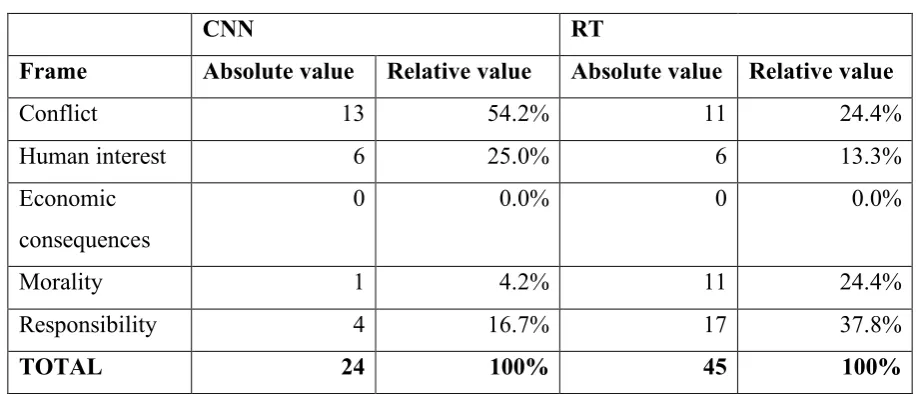
[image:23.595.67.526.417.614.2]First of all, Semetko & Valkenburg’s (2000) frame taxonomy was coded for each article. The most widely employed frame in the online coverage of CNN was the conflict frame, present in more than 50% of the news articles. This corresponds with previous scholarly work which states that in the foreign news coverage media favour the conflict frame over other frames (Cozma & Kozman 2015; De Vreese 2005; Neuman, Just & Crigler 1992; Semetko & Valkenburg 2000). The most widely employed frame in the online coverage of RT, however, was the responsibility frame, apparent in a major third of the news articles. The conflict frame and the morality frame were present in a quarter of the online coverage, followed by the human interest frame. It is striking that the economic consequences frame was not dominant in any of the online coverage of both CNN and RT.
Table 1 – Applying Semetko & Valkenburg’s (2000) frame taxonomy
CNN RT
Frame Absolute value Relative value Absolute value Relative value
Conflict 13 54.2% 11 24.4%
Human interest 6 25.0% 6 13.3%
Economic consequences
0 0.0% 0 0.0%
Morality 1 4.2% 11 24.4%
Responsibility 4 16.7% 17 37.8%
TOTAL 24 100% 45 100%
Note: In some articles more than one frame was present. It was not always possible to determine which frame was more dominant and therefore two frames were coded as dominant. That is the reason why the table shows more frames than articles.
in Raqqa, framing ISIS as a ‘brutal regime’. The conflict frame was also used to write about the advances made by the U.S.-backed SDF in Raqqa to defeat ISIS. Even though the conflict frame was the second most used frame in RT’s online coverage, almost half of these stories were short, one-paragraph articles. This suggests that the conflict frame was of less importance in the online coverage of RT.
More striking is RT’s preference for the responsibility frame, which was mainly used to attribute the responsibility for the civilian casualties that were made during the Battle of Raqqa to the U.S.-led airstrikes. In almost every article, RT blamed the U.S.-led coalition for making civilian casualties and not doing enough to protect the citizens. Related to the focus on civilian casualties is the use of the morality frame, which was dominant in a quarter of RT’s online coverage. In 7 articles the morality frame was even complementary present to the responsibility frame. In the articles in which the morality frame appeared, the authors focused on the human rights of the citizens and promoted the importance of helping them. The morality frame was also used to talk about the ‘hypocritical behaviour’ of the U.S. in Raqqa.
A good example of an article with both a responsibility and a morality frame in which the behaviour of the U.S. in Syria is condemned is the article ‘"Staggering loss of civilian life" during US-backed siege of Raqqa – UN’ (RT 2017e), in which the author stresses the civilian fatalities inflicted by the U.S.-led coalition by citing United Nations officials. Moreover, the author cites human rights group Human Rights Watch that expresses its concerns about the humanitarian situation in the city. Later in the article, the author writes that ‘the US-led coalition is showing “extraordinary hypocrisy” by not abiding by the so-called “red line” it sets for other countries’, citing journalist Vanessa Beeley who is very sceptical about the U.S.’s role in Syria. It is striking that the author does not cite any dissenting opinions, which may invite concerns that RT just shows one side of the story.
CNN, on the other hand, employed the morality frame just once. In this article, ‘Hundreds of civilians killed since Raqqa offensive began, Amnesty says’ (Sirgany & Smith-Spark 2017), the authors focus on the casualties inflicted by the U.S.-led airstrikes. However, they contextualise these casualties by emphasising the gruesome and violent actions of the ISIS rebels, such as its use of citizens as human shields, booby traps and snipers. By doing this, the authors emphasise how important it is to defeat the terrorist organisation and retake Raqqa.
and RT’s use of the human interest frame. CNN mainly used the human interest frame to describe how the citizens in Raqqa were negatively affected by the ISIS rebels and to show the strength of the citizens in resisting and fighting these rebels to get their freedom back. A good example that illustrates this is the article ‘In the heart of Raqqa, the impact of ISIS is all around’ (Abdelaziz 2017), in which a 15-year-old boy says that he could not take the injustice under ISIS control anymore and thus joined the SDF to fight the rebels. At the end of the article, Abdelaziz (2017) cites another citizen fighter who is happy about the arrival of the first CNN journalists: ‘"You are Americans?" a smiling soldier asks in broken English. "I love the Trump!"’. In this case, the human interest frame presents the Battle of Raqqa as a just war.
RT, on the other hand, primarily quoted local citizens to emphasise how the U.S.-led coalition bombed civilians and the city’s infrastructure. For example, in the article ‘"Areas with civilians most bombed out": Raqqa refugees on surviving US-led coalition strikes (VIDEO)’ (RT 2017a), the author quotes a refugee who talks about the U.S.-led bombings in the city:
The coalition…it has destroyed the country for sure, this is what has happened, what can I say brother, it killed a lot of civilians, I lost friends and their children, what can I say?
Instead of presenting the Battle of Raqqa as a just war, RT stresses the citizen’s condemnation of the U.S.-led coalition’s presence in the city.
These findings show that CNN and RT clearly try to emphasise different aspects of the Battle of Raqqa, not only by using different frames but also by using the human interest frame differently. These findings would also seem to confirm that both news channels covered the Battle of Raqqa in favour of their respective government’s foreign policy and ideology, which I will further develop in the next chapter.
4.3 The valence of the news articles
government policy than negatively framed news stories (De Vreese & Boomgaarden 2003; Nelson, Clawson & Oxley 1997). However, it is beyond the scope of this study to examine how the frames affected the public’s support for government policy during the Battle of Raqqa. Nevertheless, given that there was a higher positive framing of the battle by CNN, it is significant that the CNN readers might have a more supportive attitude towards the involvement of the U.S. government in the Battle of Raqqa, while readers of RT might be more critical about the U.S.-led operation in the city. Finally, the difference between the articles with a neutral valence is small. While CNN used a neutral frame in 26% of its online stories, RT framed 32% of its online articles neutrally.
Table 2 – The valence of the news frames
CNN RT
Valence Absolute value Relative value Absolute value Relative value
Positive 10 52.6% 1 2.9%
Negative 4 21.1% 22 64.7%
Neutral 5 26.3% 11 32.4%
TOTAL 19 100% 34 100%
4 negatively framed articles stressed the actions from ISIS and how this affected the citizens in Raqqa, another 2 articles were about the related U.S.-Russian proxy war.
RT, on the other hand, primarily stressed the negative aspects of the battle. The Russian news channel often emphasised the civilian casualties. RT attributed the responsibility for these casualties to the U.S.-led airstrikes and blamed the U.S.-led coalition for not doing enough to protect civilian lives. A total of 19 of the 22 negatively framed articles were about civilian casualties. A good example is the article ‘Kids were playing outside as coalition strike "directly targeted" Raqqa civilians – witness to RT’ (RT 2017d), in which the author quotes several citizens who blame the U.S.-led airstrikes for directly targeting civilians and the use of white phosphorus which is, according to Amnesty International, against international law. The author also quotes Nicolas Davies, author of the book Blood on our Hands, who states that the U.S.-led coalition is not taking responsibility for the civilian casualties. Overall, the article sketches a very negative framing of the Battle of Raqqa and clearly directs blame towards the U.S.-led coalition for casualties and the destruction of infrastructure.
Besides the angle of the news articles, the keywords that CNN and RT used to refer to the Battle of Raqqa also play an important role in the news outlet’s positive and negative framing. Although CNN and RT both used neutral words such as ‘offensive’, ‘campaign’ and ‘operation’ to describe the battle, both news outlets also used loaded language. While RT preferred negatively loaded words, CNN more often employed positive keywords. For example, RT described the battle as a ‘siege’ in 14 articles and even used the words ‘assault’ and ‘attack’ sometimes, while CNN preferred to write in terms of ‘liberation’ and ‘victory’. Even though RT also used the keyword ‘liberation’ to refer to the Battle of Raqqa, they often employed it in a sarcastic way. A good example is the article ‘"Dogs eating bodies": Witnesses recall the horrors of US-led liberation of Raqqa’ (RT 2017b), in which the author writes about the ‘horrors’ of the ‘liberation’. The author cites citizens who fled Raqqa, describing the ‘grim’ fight between the U.S.-led SDF and ISIS. Later in the article, the author emphasises the civilian deaths inflicted by the U.S.-led airstrikes. While the author refers to the battle as a ‘liberation’, given that the overall tone of the article is negative, the reader could be easily left with the impression that the author is being cynical or sarcastic in his use of the word ‘liberation’.
declared the ‘total liberation’ of the city. The authors merely quote U.S. and SDF officials who speak in positive terms about the recapture of Raqqa, referring to it as a ‘liberation’, ‘celebration’ and ‘historic victory’. The authors also cite the U.S.’s former Secretary of State Rex Tillerson who congratulates the SDF and the Syrian people on the ‘liberation’ of Raqqa and calls the defeat a ‘critical milestone’ in the fight against the terrorist organisation. Two days later, RT published a story showing a completely different aspect of the defeat. In the article ‘Victory through annihilation: Ruin, death & discord left after US-led coalition takes Raqqa’ (RT 2017g), the author emphasises the ‘virtual annihilation’ of Raqqa after the U.S.-backed SDF recaptured the city. The author also emphasises the civilian casualties and displaced people caused by the U.S.-led coalition. Furthermore, the author quotes the Russian Major-General Igor Konashenkov who calls the ‘victory’ of Raqqa an ‘obliteration’ – further emphasising the negative association. It is noticeable that the article does not name any positive aspect of the defeat of ISIS in Raqqa.
It is striking that CNN and RT framed the defeat of ISIS totally differently. To put it simply – while CNN emphasised the positive outcomes, RT preferred to write about the negative aspects. Such a polarising contrast may invite accusations that both news outlets lacked balance in their coverage of the Battle of Raqqa. Furthermore, while both news outlets primarily used quotes from their respective government officials to write about the defeat of ISIS in Raqqa, these resulted in starkly contrasting value statements between CNN and RT which tended to reflect government foreign policy and ideology. This will be further elaborated in the next chapter.
4.4 Sources
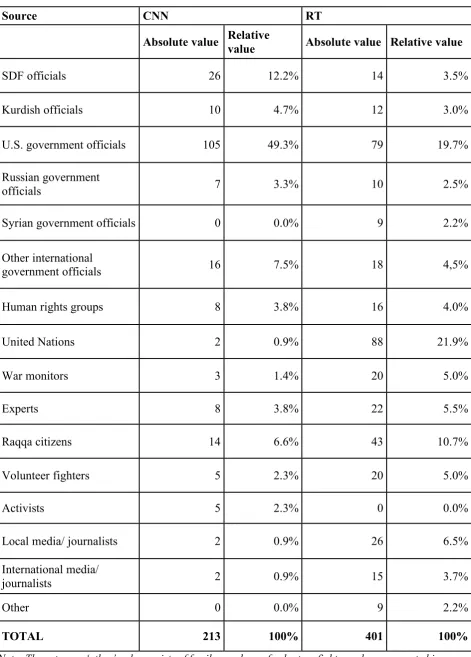
Table 3 – Appearance of the types of news sources and their frequency
Source CNN RT
Absolute value Relative value Absolute value Relative value
SDF officials 26 12.2% 14 3.5%
Kurdish officials 10 4.7% 12 3.0%
U.S. government officials 105 49.3% 79 19.7%
Russian government
officials 7 3.3% 10 2.5%
Syrian government officials 0 0.0% 9 2.2%
Other international
government officials 16 7.5% 18 4,5%
Human rights groups 8 3.8% 16 4.0%
United Nations 2 0.9% 88 21.9%
War monitors 3 1.4% 20 5.0%
Experts 8 3.8% 22 5.5%
Raqqa citizens 14 6.6% 43 10.7%
Volunteer fighters 5 2.3% 20 5.0%
Activists 5 2.3% 0 0.0%
Local media/ journalists 2 0.9% 26 6.5%
International media/
journalists 2 0.9% 15 3.7%
Other 0 0.0% 9 2.2%
TOTAL 213 100% 401 100%
Both CNN and RT heavily relied on official sources, which corresponds with previous scholars who found that news media and journalists often rely on the same kind of government sources and public officials (Bennett 1990; Gans 1979, pp. 144-145; Sigal 1973). However, there is a difference in the type of official sources they used. While CNN preferred to quote U.S. government officials, the most cited source in the coverage of RT is United Nations officials, used in over 20% of its online coverage. It is striking that CNN only used the United Nations in less than 1% of its total coverage. A possible explanation for this significant difference in information attribution patterns is the different aspects of the Battle of Raqqa that both news outlets try to emphasise. While CNN primarily used U.S. government officials to write about the importance of the Battle of Raqqa and the advances made by the SDF, RT often cited United Nations officials to write about civilian casualties inflicted during the U.S.-led airstrikes and to emphasise the concern of the United Nations about the toll the Battle of Raqqa is taking on civilians. The almost total exclusion of United Nations officials in the coverage of CNN raises some serious concerns about the objectivity of the news channel. Even though journalists are limited in covering a story by, among other things, time, money, safety and accessibility of sources, the United Nations is an easy source to reach. The fact that CNN almost completely excluded this type of source may invite accusations of biased reporting and put the watchdog ideal of journalism under pressure, which will be further discussed in chapter 5.
Furthermore, the heavy reliance on U.S. government officials of both news outlets makes sense in the case of the Battle of Raqqa. Since Raqqa has been one of the most isolated places on earth and journalists were not allowed to enter the war zone, information inevitably came from mainly U.S. government officials who led the offensive in the city. However, an important note to make here is that RT often used U.S.-government officials to emphasise negative aspects of the battle instead of emphasising the importance of it, as CNN did. A good example is the article ‘"If US aerial bombings don’t kill Raqqa citizens, ISIS snipers will"’ (RT 2017c), in which the author interviews former Pentagon official Michael Maloof who criticises the U.S.-led airstrikes in Raqqa. He says that the U.S. is not taking the ‘necessary precautions’ when they perform airstrikes in the city. He blames the Pentagon for being willing to accept civilian casualties in pursuit of ‘high-value targets’, such as ISIS rebels in Raqqa. He also states that the Pentagon does not do enough to investigate the airstrikes in which civilians lose their life. All these quotes emphasise the negative behaviour of the U.S. in Raqqa.
Chapter 5
Discussion
The previous chapter presented the data and results from the analysis and showed how CNN and RT both framed the Battle of Raqqa differently by emphasising different aspects. This chapter will discuss the significance and broader concerns of these results. It starts with answering the first research question about the differences in framing between CNN and RT by summarising the results of the previous chapter. To answer the second research question, I will then show that it is highly likely that the coverage of both news outlets reflects the narratives of their government’s foreign policy and ideology. Finally, I will reflect on the media practice of both CNN and RT and discuss how their online coverage affects the watchdog ideal of journalism.
5.1 The same battle, different narratives
The first aim of this study was to identify and compare how CNN and RT both framed the Battle of Raqqa in their online coverage, as formulated in my first research question:
RQ 1: How did CNN and RT frame the Battle of Raqqa in their online coverage and what are the differences between both news channels?
Although the importance of the frames and valence of the stories, one of the most noteworthy contributions and a key finding of this study is the difference in source choice between both news outlets. While CNN most often relied on U.S. government officials to talk about the Battle of Raqqa and the advances made by the U.S.-backed SDF, RT most often relied on United Nations officials to emphasise the casualties and the destruction of the city. Even though the United Nations is an easy source to reach, CNN excluded this source in almost its entire online coverage. Without asking the journalists and editors involved in the stories as to why the United Nations officials were not approached, it is difficult to know why this is the case. One guess could be that this type of source is not in line with CNN’s narrative about the battle. If this is indeed the case, it raises some serious concerns about the watchdog ideal of journalism and may invite accusations of biased reporting, which will be further discussed in subchapter 5.3.
As I have shown, even though both news outlets covered the same battle, they were not telling the same story. While CNN emphasised the importance of the battle and mainly excluded the civilian casualties, RT stressed the civilian casualties and primarily excluded the importance of the defeat of ISIS. In this way, the ‘frame-building’ process of emphasising certain issues and topics while omitting or marginalising others, as described by De Vreese (2005, p. 52), is very obvious in the online coverage of CNN and RT. These differences in reporting on the Battle of Raqqa can be explained through the one-sided symbiotic relationship between media and foreign policy which can sometimes occur.
5.2 The influence of the government’s foreign policy and ideology
The second aim of this study was to explore the relationship between the coverage of CNN and RT and their respective government’s foreign policy and ideology, as formulated in my second research question:
RQ 2: To what extent does the coverage of the Battle of Raqqa of CNN and RT reflect the narratives of their respective government’s foreign policy an ideology?
Secretary of State Rex Tillerson emphasised the importance of the battle and talked about ‘liberation’ (Tillerson 2017), chief spokesman for the Russian Defence Ministry Major-General Igor Konashenkov stressed the bombardments and civilian casualties (Osborn 2017). By comparing these government statements with the online coverage of both news outlets, it seems highly likely that the coverage of both news outlets reflects the narratives of their respective government’s foreign policy and ideology. While CNN, just like Tillerson, emphasised the importance of the battle in defeating ISIS and used keywords such as ‘liberation’ and ‘victory’, RT stressed the civilian casualties and the destruction of the city, which is more in line with the statement of the Russian Defence Ministry. The source choice of CNN and RT plays a key role. Both news channels relied on sources that often articulated their respective government’s foreign policy and ideology. While CNN most often relied on U.S. government officials to emphasise the importance of the battle, RT preferred to use United Nations officials to talk about civilian casualties and the destruction of the city’s infrastructure.
The similarities between the official statements of the U.S. and Russian government and the online coverage of CNN and RT become even more obvious in the source choice of both news outlets after the defeat of ISIS in Raqqa. Both news channels merely quoted government officials from their own country, excluding any counterargument. In the CNN article ‘Raqqa: US-backed forces declare "total liberation" of ISIS stronghold’ (Damon, Balkiz & Smith-Spark 2017), the authors quote the official statement of Rex Tillerson (2017), in which he expresses himself positively about the battle and calls the retake of Raqqa a ‘liberation’ and a ‘critical milestone’ in the global fight against ISIS. It is striking that the authors do not use the statement of the spokesman for the Russian Defence Ministry Major-General Igor Konashenkov or any other source that is negative or sceptical about the battle. RT, on the other hand, does the exact same thing. In the article ‘victory through annihilation: Ruin, death & discord left after US-led coalition takes Raqqa’ (RT 2017g), the author quotes Major-General Igor Konashenkov who calls the ‘victory’ in Raqqa an ‘obliteration’ of the city. In another article a week later, ‘US-led coalition celebrates Raqqa "liberation" over the bodies of their victims – Damascus’ (RT 2017f), the author, again, quotes Konashenkov when he compares the Battle of Raqqa with the fate of Dresden: ‘"Raqqa’s fate calls to mind that of Dresden in 1945, leveled by the US-British bombings," the Russian Defence Ministry said earlier, referring to the controversial WWII campaign.’ Just like CNN, RT does not quote any sources that put the Battle of Raqqa in a positive light.
this theory seems unlikely in the case of the Battle of Raqqa. Since Raqqa was one of the most isolated places in the world and journalist were not allowed to enter the city, these findings suggest that CNN and RT reflect the agendas and narratives preferred by their respective governments. This is more in line with the propaganda model developed by Herman and Chomsky (2008). This socio-economic theory contests the CNN-effect by stating that the news media serve as a tool to mobilize support for the government policy (Herman & Chomsky 2008, pp. 1-33). One of the structural factors on which the propaganda model is based on is the heavy reliance on government sources (Herman & Chomsky 2008, p. 2), which became particularly obvious in the online coverage of CNN. It became even more obvious in the coverage of CNN and RT after the defeat of ISIS in which both news outlets merely quoted government sources from their own country to write about the defeat of the terrorist organisation in Raqqa. However, it is beyond the scope of this thesis to talk about ‘propaganda’ since no propaganda model analysis has been carried out. For this reason, I prefer to talk in terms of ‘contextual objectivity’ as described by El-Nawawy and Iskandar (2003, p. 209). In this context, journalists try to be as objective as possible in their coverage but colouring it with the perspective of the medium they work for, which explains why the coverage of the same conflict can differ between each country’s news organisation. In the case of the Battle of Raqqa, both CNN and RT presented the battle differently, reflecting the dominant narratives and biases of their respective governments. Therefore, the ‘contextual objectivity’ in this case may invite accusations of biased reporting which raises concerns about the watchdog ideal of journalism.
5.3 The watchdog ideal under pressure
‘factual’ and ‘critical’ and whether the reporters were really ‘neutral’ and ‘detached’. This raises some serious concerns about the sustainability of the watchdog ideal and may change the way we should think about foreign journalism and conflict reporting.
Although both news outlets lacked balanced reporting during the battle, it was especially the source choice of CNN that raises concerns about the watchdog ideal and may even invite accusations of biased reporting. As I already noted, a key finding of this study is that CNN most often relied on U.S. government officials, while RT preferred to quote United Nation officials. Whereas RT’s second most cited source is U.S. government officials, CNN only cited the United Nations twice. Although it is difficult to know why CNN almost totally excluded United Nations officials in their coverage without asking the journalists and editors involved in the stories, a conceivable reason may be that it does not fit the news outlet’s narrative about the Battle of Raqqa. The United Nations stressed the civilian casualties and destruction of the city, while CNN preferred to exclude this aspect of the battle. An important note to make related to this accusation is that the United Nations is an easily accessible source of information. While journalists in conflict zones are limited in covering a story by source accessibility which can make it hard to cover both sides of a conflict, this is not the case with the United Nations. Their reports are easy to access online and therefore not hard to include in a story. Therefore, it seems highly likely that CNN consciously has chosen to exclude the United Nations and to use other sources that fit its narrative better. As a consequence, it opens up this coverage to accusations of biased reporting. However, this does not mean that the online coverage of RT is more objective, critical or balanced. On the contrary, the Russian news channel also just emphasised one aspect of the conflict and even went beyond that by demonizing the U.S.’s role in Raqqa.
The U.S. as the culprit
(RT 2017e). In the article, the author writes that ‘the US-led coalition is showing “extraordinary hypocrisy” by not abiding by the so-called “red line” it sets for other countries’, quoting journalist Vanessa Beeley who is very sceptical about the U.S.’s presence in Syria and accuses the U.S. of destroying Raqqa because they try to hide something from the Syrian Army. While the article stresses negative aspects of the U.S.’s role in Raqqa, the author does not cite any dissenting opinion or counterargument, which raises concerns about the objectivity of RT and the underlying goal of its coverage.
Chapter 6
Conclusion
The liberal conception of journalists as watchdogs of society emphasises the importance of objective, factual and critical coverage to impart knowledge and protect the democratic process and its citizens. However, this watchdog ideal can come under pressure when the equal balance of symbiotic relations which can form between media and state becomes one-sided. As I have shown in the reporting of the Battle of Raqqa of CNN and RT, the coverage of political conflicts overseas can differ between nations and possibly reflects the agendas and narratives preferred by the government in power.
The purpose of this study was twofold. The first aim was to examine how the Battle of Raqqa was framed by the two largest international news outlets in the U.S. and Russia – CNN and RT – and what differences there were between both broadcasters. Secondly, this thesis explored to what extent the coverage of both news channels reflects their respective government’s foreign policy and ideology. The analysis found that both news outlets framed the Battle of Raqqa differently. While CNN framed the battle positively by emphasising how important the battle was to defeat ISIS, RT used a negative tone of voice by primarily stressing the civilian casualties inflicted by U.S.-led airstrikes and the destruction of the city. This way of framing the Battle of Raqqa corresponds to how government officials from both news outlets’ countries talked about the battle. Since hardly any journalist was allowed to enter the war zone, inevitably these findings suggest that CNN and RT relied upon a limited pool of sources which often articulated their government’s foreign policy or preferred narratives of the conflict. As a consequence, it opens up this coverage to accusations of failing to cover the battle in an objective, balanced and neutral way. Even though this thesis consists of a small case study and much more research will have to be done, the results implicate a certain degree of subjectivity and government dependency in foreign and conflict reporting which contradicts the idealised role of journalists as watchdogs of society.
scholarly work. This study fills that gap and shows how both news outlets operate, and it proves that CNN and RT both framed the battle in a different, unbalanced way. Directly comparing the media practice of U.S. and Russian media is especially relevant nowadays, given the current tendencies and proxy wars between the U.S. and Russia in Syria in particular and the Middle East in general. Secondly, this study fills the gap of research on RT. Even though there is a lot of criticism on the coverage of RT in the journalistic field, little academic research has been done. Therefore, this study is important since it reveals some interesting, preliminary findings about the online coverage of the news channel. For example, RT’s preference for the responsibility frame which is surprising because it deviates from earlier scholarly work which indicated that in the foreign news reporting journalists favour the conflict frame over other frames (Cozma & Kozman 2015; De Vreese 2005; Neuman, Just & Crigler 1992; Semetko & Valkenburg 2000). The most striking expression of this is the continuous emphasising of the U.S.’s ‘hypocritical behaviour’, earlier described by Yablokov (2015, p. 312) as the channel’s ‘anti-American stance’, which might implicate a certain degree of subjectivity or even propaganda in the coverage of RT. However, it would be going too far to define this as propaganda since no rigorous propaganda model analysis has been carried out. Therefore, I would like to make a note about RT’s ‘anti-American stance’ to differentiate the possible significance and implication of it. Although Western media negate RT’s credibility by stating that it is the Kremlin’s propaganda channel, this thesis is not intended to feed any anti-Russian bias. Indeed, I would argue that RT could do better. Nevertheless, this also applies to the coverage of CNN and its heavy reliance on U.S. government sources and exclusion of United Nations officials. I feel that I have equally applied my framing matrix to both CNN and RT as transparently as possible. As I have shown, neither news channel comes out as reflecting the watchdog ideal. Related to this, future research should analyse the Battle of Aleppo in which a Russian-led coalition recaptured the city instead of a U.S.-led coalition. It is interesting to examine how CNN and RT both covered this conflict to explore if the patterns found in this analysis might turn around and whether a possible ‘anti-Russian stance’ appears in the coverage of CNN.
the stories to explore how the framing of the Battle of Raqqa came about. A second limitation of this study is that the analysis merely focused on one U.S. and one Russian news medium. It would be useful, however, to analyse more U.S. and Russian news media to find out whether the argument remains intact. Future research should also include Russian language media and compare their coverage to the coverage of RT and other U.S. news media. Another recommendation for future research is to analyse news media from more nations that were involved or had interest in the Battle of Raqqa – such as France, Germany, United Kingdom, Syria, Turkey and Iran – and extend the analysis to more battles, such as the battles in Deir ez-Zor in Eastern Syria and Mosul in Iraq. Finally, it was out of the scope of this study to examine the effects that the differences in coverage possibly have on the citizens. Given that the frames and sources that are employed by journalists may influence people’s knowledge about an event and the way they think about political institutions and their policy, future research should organise interviews and focus groups to find out how U.S. and Russian citizens think about the Battle of Raqqa and how they think about each other’s countries. This moves the scope of the research from ‘frame-building’ to ‘frame-setting’.
References
Al-Majdhoub, FM & Hamzha, A 2016, 'Framing ISIL: Content Analysis of the News Coverage by CNN and Aljazeera', Malaysian Journal of Communication, vol. 32, no. 1, pp. 335-364.
Ali, MA & Omar, A 2016, 'Discourse and Manipulation in the Representation of the Russian Military Intervention in the Syrian Civil War', International Journal of Linguistics, vol. 8, no. 3, pp. 129-140.
An, S-K & Gower, KK 2009, 'How do the news media frame crises? A content analysis of crisis news coverage', Public relations review, vol. 35, no. 2, pp. 107-112.
Bennett, WL 1990, 'Toward a theory of press-state relations in the United States', Journal of communication, vol. 40, no. 2, pp. 103-127.
Berelson, B 1971, Content analysis in communication research, Hafner Publishing Company, New York.
Bloomfield, S 2014, 'Ofcom should be looking again at Putin's TV news channel', The Guardian, 25 April, viewed 22 March 2018,
<https://www.theguardian.com/commentisfree/2014/apr/24/ukraine-russia-putin-news-reporting>.
Brewer, P, Ryan, G & Gross, K 2010, 'Framing the Economy: Effects of Journalistic News Frames', in P D'Angelo & JA Kuypers (eds), Doing News Framing Analysis: Empirical and Theoretical Perspectives, Routledge, New York, pp. 159-185.
Cappella, JN & Jamieson, KH 1997, Spiral of cynicism: The press and the public good, Oxford University Press, New York.
Caris, CC & Reynolds, S 2014, ISIS governance in Syria, Institute for the Study of War, viewed 18 February 2018,
<http://www.understandingwar.org/sites/default/files/ISIS_Governance.pdf>.
Casagrande, G 2016, The Road to ar-Raqqah: Background on the Syrian Democratic Forces, Institute for the Study of War, viewed 12 February 2018,
<http://www.understandingwar.org/sites/default/files/The%20Road%20to%20ar-Raqqah%20ID.pdf>.
CNN 2018, CNN Worldwide Fact Sheet, CNN Press Room, viewed 22 March 2018, <http://cnnpressroom.blogs.cnn.com/cnn-fact-sheet/>.
Couldry, N 2012, Media, society, world: Social theory and digital media practice, Polity Press, Cambridge.
—— 2015, 'Were the Murrow Boys warmongers? The relationship between sourcing, framing, and propaganda in war journalism', Journalism Studies, vol. 16, no. 3, pp. 433-448. Cozma, R & Kozman, C 2015, 'The Syrian Crisis in the News: How the United States' elite newspapers framed the international reaction to Syria's use of chemical weapons', Journalism Practice, vol. 9, no. 5, pp. 669-686.
Damanhoury, KE & Saleh, F 2017, 'Is it the same fight? Comparative analysis of CNN and Al Jazeera America’s online coverage of the 2014 Gaza War', Journal of Arab & Muslim Media Research, vol. 10, no. 1, pp. 85-103.
Davison, J & Rodi, S 2017, 'Islamic State defeated in its Syrian capital Raqqa', Reuters, 17 October, viewed 21 February 2018, <https://www.reuters.com/article/us-mideast-crisis-syria-
raqqa/islamic-state-defeated-in-its-syrian-capital-raqqa-idUSKBN1CM0VC?feedType=RSS&feedName=topNews>.
De Vreese, CH 2005, 'News framing: Theory and typology', Information Design Journal & Document Design, vol. 13, no. 1, pp. 51-61.
De Vreese, CH & Boomgaarden, H 2003, 'Valenced news frames and public support for the EU', Communications, vol. 28, no. 4, pp. 361-381.
Dimitrova, DV & Connolly-Ahern, C 2007, 'A tale of two wars: Framing analysis of online news sites in coalition countries and the Arab world during the Iraq war', The Howard Journal of Communications, vol. 18, no. 2, pp. 153-168.
El-Nawawy, M & Iskandar, A 2003, Al-jazeera: The Story Of The Network That Is Rattling Governments And Redefining Modern Journalism Westview Press, Boulder.
Entman, RM 1993, 'Framing: Toward clarification of a fractured paradigm', Journal of communication, vol. 43, no. 4, pp. 51-58.
Evans, M 2010, 'Framing international conflicts: Media coverage of fighting in the Middle East', International Journal of Media & Cultural Politics, vol. 6, no. 2, pp. 209-233. Gans, HJ 1979, Deciding what's news: A study of CBS evening news, NBC nightly news, Newsweek, and Time, Northwestern University Press, Evanston.
Gilboa, E 2005, 'The CNN effect: The search for a communication theory of international relations', Political communication, vol. 22, no. 1, pp. 27-44.
Gitlin, T 1980, The whole world is watching. Berkeley, University of California Press, Berkeley.
Gonchar, M 2014, 'The ISIS Threat: Teaching About the Complex War Raging in Iraq and Syria', The New York Times, 17 September, viewed 27 March 2018,
Ha, JS 2015, '“Arab Spring is Wake-Up Call for Kim Jong-Il” A framing analysis of South Korean opinion pieces', Journalism Practice, vol. 9, no. 5, pp. 741-759.
Habermas, J 1991, The structural transformation of the public sphere, The MIT Press, Cambridge.
Hachten, WA & Scotton, JF 2011, The world news prism: Challenges of digital communication, Wiley-Blackwell, Malden.
Hanitzsch, T 2007, 'Deconstructing journalism culture: Toward a universal theory', Communication theory, vol. 17, no. 4, pp. 367-385.
Hansen, KA 1991, 'Source diversity and newspaper enterprise journalism', Journalism Quarterly, vol. 68, no. 3, pp. 474-482.
Hassan, H 2017, 'The Battle for Raqqa and The Challenges After Liberation', CTC Sentinel, vol. 10, no. 6, pp. 1-34.
Herman, ES & Chomsky, N 2008, Manufacturing Consent: The Political Economy of the Mass Media, Random House, New York.
Iyengar, S 1991, ls anyone responsible? How television frames political issues, The University of Chigago Press, Chicago.
Kara, N & Atabey, M 2013, 'Too close and too far: Framing the Iraq and Lebanon wars in the media of North Cyprus', International Communication Gazette, vol. 75, no. 2, pp. 174-187. Krippendorff, K 2004, Content analysis: an introduction to its methodology, Sage, Thousand Oaks.
Liebler, CM & Bendix, J 1996, 'Old-growth forests on network news: News sources and the framing of an environmental controversy', Journalism & Mass Communication Quarterly, vol. 73, no. 1, pp. 53-65.
Lippmann, W 1922, Public opinion, Harcourt Brace, New York.
Lundgren-Jörum, E 2012, 'Discourses of a Revolution: Framing the Syrian uprising', Middle Eastern Studies/Ortadogu Etütleri, vol. 3, no. 2, pp. 9-39.
Matthes, J & Kohring, M 2008, 'The content analysis of media frames: Toward improving reliability and validity', Journal of communication, vol. 58, no. 2, pp. 258-279.
McNair, B 2009, 'Journalism and democracy', in K Wahl-Jorgensen & T Hanitzsch (eds), The handbook of journalism studies, Routledgde, New York, pp. 237-249.
McPhail, TL 2006, Global communication: Theories, Stakeholders, and Trends, 2nd edn, Blackwell Publishing Ltd, Oxford.