Reliability-Based Preference Dynamics:
Lexicographic Upgrade
∗
Fernando R. Velázquez-Quesada
11Institute for Logic, Language and Computation, Universiteit van Amsterdam.
Abstract
This paper models collective decision-making scenarios by using a priority-based aggregation procedure, the so-calledlexicographicmethod, in order to represent a form of reliability-based ‘deliberation’. More pre-cisely, it considers agents with a preference ordering over a set of objects and a reliability ordering over the agents themselves, providing a logical framework describing the way in which the public and simultaneous an-nouncement of the individual preferences leads to individual preference upgrade. The main results are the definitions of thislexicographic upgrade
for diverse types of reliability relations (in particular, the preorder and to-tal preorder cases), a sound and complete axiom system for a language describing the effects of such upgrades, and the definitions for non-public variations.
Keywords: multiagent systems; preference; reliability; preference change; lexicographic; modal logic; dynamic epistemic logic; aggregation; deliberation.
1
Introduction
Suppose four friends want to watch a movie, with the options being 1, 2 and 3. As it frequently happens in similar situations, the preferences of the friends are different. So, what can they do in order to fix a ranking of the three options, and thus decide which movie they will see? More generally, what can a set of agents do in similar collective decision making scenarios?
The friends might try to put together their individual preferences. This can be done by looking for anaggregationprocedure: a process through which the individual preferences are combined into a single one. As stated in Endriss [42],
“when a group needs to make a decision, we are faced with the problem of aggregating the views of the individual members of that group into a single collective view that adequately reflects the ‘will of the people’ ”. Finding appropriate aggregation procedures is the fundamental aim of research fields as social choice theory [4;5;6] as well as preference/belief change/merge/aggregation (e.g., Konieczny
∗
and Pino Pérez [75,76]; Grüne-Yanoffand Hansson [64]; Gabbay et al. [49]; Liu [88]; Konieczny and Pino Pérez [77]). Examples of such procedures are the different voting systems used across different countries.1
Another alternative the friends have is to allow each one of them to argue for her preferences, trying in this way to change the opinions of the others. This is called deliberation, a process through which the individuals share publicly not only their own preferences but also the justifications they have for them, aiming at influencing one another’s opinions. Several authors have pointed to the merits of the deliberative process, which makes people reflect on their preferences and thus influences possible changes [41;67; 65;23; 37; 30; 66]. Some authors have even argued that with such a public debate “there would not be any need for an aggregation mechanism, since a rational decision would tend to produce unanimous preferences”[41]. The campaign process that takes place in most countries before an election might be seen as some form of deliberation, as it allows some form of public debate through which ideas and reasons for supporting the candidates are exposed.2
In some sense, the deliberative process is the ideal one: agents share not only their own preferences but also the justifications they have for them, thus putting all the available information ‘on the table’, and then proceed to a thoughtful weighing of options based on the use of logic and reason. Even if the repetition of such sharing and discussing process does not lead to full unanimity (an obvious possibility), it has been argued [94;93; 38;56] that the deliberative process can lead to preference profiles whose properties allows/facilitates the use of aggregation procedures.
However, in real-life scenarios, different circumstances are combined to guarantee that ideal deliberative processes occur rarely. One of these cir-cumstances is the fact that, even though agents might get to know one an-other’s preferences, certain limitations prevent them from knowing the rea-sons/justifications for them. Another is that typically, and for diverse reasons, different agents might influence a specific individual in different ways.
Because of these and other ‘real-life’ constrains, attempts to carry out a deliberative process might actually end up in situations in which an indi-vidual’s thoughts, opinions, feelings, and behaviours are influenced by (the actual, imagined or implied presence of) others. Examples of such phenom-ena include not only the famousinformational cascades[11;21;104;40] (cf. the bandwagon effect; Leibenstein [83]; Nadeau et al. [95]; Altman [1]), but alsopeer pressure[39],pluralistic ignorance[73;78],false consensus[97] and others stud-ied in economics, computer science and social and behavioural sciences. All these different ways in which the preferences/beliefs/behaviour of a group of agents influence the preferences/beliefs/behaviour of an individual might not be completely ‘rational’, but nevertheless describe the way ‘real’ agents behave in ‘real-life’ situations.
This paper provides a formal logical framework for studying a process that
1It should be noted, however, that the aim of a typical voting system is to collectively select one option, and not to create a full collective preference.
deals with collective decision making scenarios following a ‘deliberative’ ap-proach, but incorporating the two limitations described above: a knowledge of the preferences but not of its reasons, and some agents having more in-fluence than others on each individual.3 The reason for incorporating these particular limitations is that they reflect very common real-life circumstances. For the first, indeed in most cases we only get to know one another’s ac-tions/opinions/preferences/beliefs without knowing the reasons behind them, typically because of restrictions in the ‘communication channel’ (i.e., lack of time and/or space). A famous consequence of this is that, paraphrasing a pop-ular quote, even though we tend to judge ourselves by our intentions, we tend to judge others only by their actions. For the second, the fact that some agents might have more influence than others is also a common feature that ideally can be seen as agents acknowledging the different expertise individuals might have, but which also allows to describe ‘irrational’herd behavioursituations in which emotions (“I likeabetter thanb, so I prefer whatachooses over whatb
chooses”) come into play.4
More precisely, the goal of the present proposal is the formal study of the way individual agents might change their preferences based not only on the preferences of one another but also on the reliability ordering each one of them assigns to the group. Technically, the models used here will then consist, be-sides a domainWand a set of agentsA, of both apreferencerelation≤i⊆(W×W) for each agenti∈Aand areliabilityrelation4i⊆(A×A) for each suchi. While
≤i represents the preference ordering ihas over the available options W, 4i represents the reliability orderingihas over the involved agentsA.5 In this way, the procedure through which the announcement of the individual preferences leads each agentito change her preferences can be seen as a function f whose parameters are not only the (current/announced) preferences (≤1, . . . ,≤|A|) but
also her own reliability relation (4i). In this sense this proposal can be
un-derstood as a qualitative version of DeGroot [31], where the author presents a quantitative model describing how a group might reach a consensus and form a common subjective probability distribution by revealing their individual dis-tributions to one another and pooling their opinions. In such model, each individualihas not only a subjective probability distribution (corresponding to this work’s preference relation) but also a weight she assigns to the distribu-tion of each individual when she carries out her revision (corresponding to this work’s reliability relation).
As the reader has surely noticed, the definition of the mentionedf will play the most important role through this work. Again, it represents intuitively the way an agentiwill adjust her own preferences according to all the individual preferences and the reliability she assigns to them. Again, technically it can be defined as a function which takes as parameters|A|preference orderings overW
3There might be additional limitations: for example, the communication might not be public, or the preferences might not be fully announced. Some of these situations can be seen as particular cases of the framework that will be introduced, and they are briefly explored in Section4.
4Some people have pointed out that, because of this difference in influence, not all agents are equal, contrary to what should happen in ideal deliberative procedures. However, the degree of influence of each agent is not global but rather individual: the most influential agent for a given individual might not be the most influential agent for a different one. Thus, there is no ‘most important agent(s)’; only ‘most important agent(s)’from a given agent’s point of view.
and a reliability ordering overA(i.e.,|A|orderings overWand a priority order-ing over them), returnorder-ing then a preference orderorder-ing overW. This function can be defined in many different ways: for example,icould adopt directly the pref-erence ordering of her most reliable agent, or she might keep her old ordering, using that of her most reliable agent to ‘break ties’ in equally-preferable zones. She might even put her most reliable agent’s most preferred worlds above the rest, using her old ordering to break ties in both zones.
In cases as the present one, a typical choice is to use thelexicographic method. This method consists, roughly speaking, in using the order with the highest priority first, then using the order with the second highest priority to ‘break ties’ in equally-preferred zones, then using the order with the third highest priority to ‘break ties’ in the equally-preferred zones that still remain, and so on; it is similar to the method used for ordering words in dictionaries. The lexicographic method has been used not only in social choice theory [46;47;22; 80;81] but also in artificial intelligence (preferential logics: Ryan [100]; Grosof [61]; Schobbens [102]; Ryan [101]; defaults in the setting of circumscription: Lifschitz [85, 86]; beliefs: Brandenburger et al. [24]; Dekel et al. [32]; belief revision: Ryan [101]), and it is the most natural one for defining a function that
aggregatesa collection of orders based on a priority order over them. Indeed, the first two examples mentioned before (adopt the preference ordering of the most reliable agent, keep the old ordering using that of the most reliable agent to ‘break ties’) are particular instances of the lexicographic method in which the priority ordering only considers a subset of agents [53]. The third example is not lexicographic in the strict sense, as it cannot be defined as a lexicographic aggregation of the original preferences [52], but it still has a lexicographic flavour: it is the lexicographic aggregation of, first, an ‘arbitrary’ preference relation (the one placing her most reliable agent’s most preferred worlds above the rest) and then the agent’s original preference relation.
Summarizing, this proposal studies non-completely rational but neverthe-less realistic situations in which, after the public announcement of all the agents’ individual preferences, each individual agent might change her own prefer-ences based not only on what has been announced but also on the reliability order she assigns to the members of the group. All agents will change her indi-vidual preferences using the described lexicographic method, but even though all of them will use the just announced preferences as input, each one of them will useher ownreliability ordering for prioritizing the preferences to be aggre-gated, thus potentially producing different results. This approach for studying collective decision making scenarios borrows some ideas from the deliberative tradition, as it acknowledges that the preferences of individuals can be influ-enced by the preferences of the rest (albeit with the mentioned limitations). Still, ideas from the aggregation literature are also clearly present, the main one being the use of the lexicographic method for defining each individual’s preferences after each announcement.
method for the cases in which the reliability ordering is a total order (a straight-forward variation of the one presented in Ghosh and Velázquez-Quesada [53]) and a partial order [2], Section 3 introduces its preorder and total preorder versions. The section also presents a modality for describing the model after all agents have upgraded their preferences according to the method, together with recursion axioms for its axiomatisation. Section4 explores ‘non public’ variations of the lexicographic upgrade operation, and Section5connects this proposal with related works. Finally, Section6closes by summarizing the work and discussing possible ways to extend it.
Within the text, proofs of propositions and theorems are sometimes only sketched; in such cases, the formal proof can be found in theAppendix.
On preference change Despite the fact that diverse preference influence phe-nomena have been studied extensively in the literature, not only in social and behavioural sciences, but also in economics and in computer science (see Section
5), there might be still a conviction among some people that human preferences ultimately do not change. In this respect, this paper’s best strategy is to re-fer the interested reader to the discussion in Grüne-Yanoffand Hansson [63]. But even if the reader remains skeptic about the preference-change idea, this paper’s proposal might still be meaningful, as agenta’s revised ‘preferences’ can be also understood not asa’s ‘new’ preferences but rather simply as some preferences she decides to announce in order to keep the ‘discussion’ ongoing. Accordingly, the reliability ordering, singling out the agents whose preferences
atrusts the most, can be rather understood as a ‘pleaseability’ ordering, singling out the agentsawants topleasethe most.
2
Basic definitions
Throughout this paper, letAbe afinite non-emptyset of agents with|A|=n. The following is the basic definition of this framework: the structure representing each agent’s relative preferences and reliability over, respectively, worlds (i.e., the available options) and one another.
Definition 2.1 (PRframe) A preference and reliability (PR) frame F is a tuple hW,{≤i,4i}i∈Aiwhere
• Wis a finite non-empty set of worlds;
• ≤i⊆(W×W) is a preorder (a reflexive and transitive relation), agenti’s
preference relationover worlds inW(u≤ivis read as “ for agenti, worldv is at least as preferable as worldu”);
• 4i⊆(A×A) is a preorder, agenti’sreliability relationover agents inA(j4i j0
is read as “ for agenti, agentj0
is at least as reliable as agentj”). J
In the context of aggregation and deliberation it is common to assume at least two different agents; this proposal follows such assumption.
Here are further useful definitions. First, given any domainD, any element
d∈Dand any binary relationR⊆(D×D), the set[Ri(d) contains those elements
inDthat areR-reachable fromd, that is,
Then,
Definition 2.2 Let≤ ⊆(W×W) be a preference relation (preorder) overW.
• The relation< ⊆ (W×W), withu < vread as “uis less preferred than
v” (“v is more preferred thanu” or, simply, “v is preferred overu”), is defined asu<viffdef u≤vand vu.
• The relation∼ ⊆(W×W), withu∼vread as “uandvare comparable”, is defined asu∼viffdef u≤v orv≤u.
• The relation ' ⊆ (W×W), with u ' v read as “u and v are equally preferred”, is defined asu'viffdef u≤v andv≤u.
Then, one more definition. For any setU ⊆ W, the binary relation IdU ⊆ (W×W) is the identity relation onU, that is, IdU:={(u,u)∈(W×W)|u∈U}.J
Definition 2.3 Let4⊆(A×A) be a reliability relation (preorder) overA.
• The relation≺ ⊆(A×A), withj≺kread as “jis less reliable thank” (or as “kis more reliable thanj”), is defined as j≺kiffdef j4kandk$j. • The relation≈ ⊆ (A×A), withj ≈kread as “jandkare comparable”, is
defined asj≈kiffdef j4kork4 j.
• The relationu⊆(A×A), withjukread as “jandkare equally reliable”,
is defined asjukiffdef j4k and k4j.
• The set Mnl4 ⊆ A, containing those elements in A that are4-minimal, is defined as Mnl4 := k∈A|there is noj∈Asuch that j≺k. As it is
well-known, when4is also total6, Mnl
4actually contains those elements
in A that are 4-minimum, i.e., those that are 4-below all elements in
A(formally, Mnl4 = k∈A|for allj∈A, k4 j); in such case, Mnl4 will
be denoted by Mnm4. If4is additionally antisymmetric7, then Mnm4
becomes a singleton whose single element will be denoted by mn4.
• The set Mxl4 ⊆A, containing those elements inAthat are4-maximal, is defined as Mxl4:=k∈A|there is noj∈Asuch that k≺ j. Similar to the
previous case, when4is also total, Mxl4actually contains those elements
in A that are 4-maximum, i.e., those that are 4-above all elements in
A(formally, Mxl4 = k∈A|for allj∈A, j4k); in such case, Mxl4 will
be denoted by Mxm4. If4 is additionally antisymmetric, then Mxm4
becomes a singleton, whose single element will be denoted by mx4.
• A setB⊆Ais an4-clusterwhen4is a maximal universal relation overB,
that is, when
(i) i 4 jfor alli,j∈ B(or, in other words, the restriction of4toBis a universal relation,4∩(B×B)=B×B), and
(ii) for alli∈A\B, the setB∪ {i}does not satisfy the previous point (or, in other words,B⊂B0impliesR∩(B0×B0),B0×B0). J
Example 2.1 The situation described in this work’s opening paragraph can be represented by aPRframe in which the set of agents isA= {a,b,c,d}and the set of worlds isW = {w1,w2,w3}(with each world representing one movie). Suppose the individual preferences are as described in the following diagrams, with reflexive and transitive edges omitted.
w1
w2
w3 w1
w2
w3
w2
w1 w3
w2
w1
w3
≤a ≤b ≤c ≤d
Observe how, for example, whilew1andw3are not comparable fora(w1/aw3),
the latter is more preferred than the former forb(w1 <b w3), they are equally
preferred forc(w1'c w3) and the former is more preferred than the later ford
(w3<dw1). Moreover, suppose reliability is given as in the following diagrams
(again, omitting reflexive and transitive edges).
c a b d
d
a
b c a b c
d
a
b
d c
4a 4b 4c 4d
Now observe how, for example, whilecis less reliable thanaforaherself (c≺aa), they are incomparable forbandd(c0baandc0d a) but equally reliable forc
(cuc a). Note also how Mxl4a =Mxm4a ={d}, as4ais total. This is not the case
for4b, and thus Mxl4b ,Mxm4b, as Mxl4b ={b,c,d}but Mxm4b =∅. Moreover,
while{b,c}is not a4a-cluster (its elements are not pairwise4a-equally reliable), it is a4b-cluster; nevertheless, it is neither a4c-cluster (its elements are pairwise 4c-equally reliable, but so are those of its strict super set{a,b,c}) nor a4d-cluster
(same reason as for4a). Finally,[4ai(b)={b,d},[4bi(b)={b,c}, while[≺ci(b)=∅
and[≺di(b)={a,d}. J
2.1
On preference and reliability
As mentioned earlier, this work models situations in which, after individual preferences are announced, each agent changes her preferences according to what has been announced and the relative reliability she assigns to all the agents (including herself: she might consider herself as more reliable than some agents but also as less reliable than some others).
with options u and v, each agent i can give one of four answers: (i) she prefers v overu,u <i v, (ii)she prefers u overv, v <i u, (iii)she considers
both equally preferable,u'iv, or(iv)she considers them incomparable,u/iv (i.e., she abstain from any judgement). Note how, since incomparability is an option, maximum worlds (those that are at least as preferred as any other element) might not exist; nevertheless, given the finiteness of the domain, there are always maximals ones (those that are not less preferred than some other element). An analogous statement is true for minimums and minimals.
The concept ofreliabilitybetween agents requires a deeper discussion. It is related to the notion of trust, which has been important within artificial societies (e.g., Falcone et al. [44,45]; Golbeck [55]), and for which there are several proposals for its formal representation. It is worthwhile to discuss, albeit briefly, howreliabilityas discussed here relates totrust.
Though there are proposals that define trust as an attitude of an agent who believes that another agent has a given property [27;33; 34; 43], a common understanding of this concept is as “agentitrusts agent j’s judgement about ϕ” (called “trust on credibility” in Demolombe [33]). And, while there are approaches that define trust in terms of other attitudes, as knowledge, beliefs, intentions and goals (e.g., Demolombe [33]; Herzig et al. [70]), others define it as a semantic primitive, typically by means of aneighbourhood function Ni,j :
W → ℘(℘(W)) that assigns, to every pair of agentsi,j in every world w, a set of sets of worldsNi,j(w). In such frameworks, it is said that agentitrusts
agent j’s judgement aboutϕat worldwif and only if the set of worlds inW
whereϕ holds is inNi,j(w) [84].8 The notion of trust is not represented with normal modal semantics in order to avoid closure under logical consequence: that agentitrusts agentj’s judgement about some formula does not imply that
ialso trusts jon the formula’s logical consequences.
In contrast, reliability as discussed here is closer to the notion of trust of Holliday [71], where it is understood as an ordering among sets of sources of information (cf. the discussions in Cantwell [26]; Goldman [59]). One noticeable difference between the more standard representation of trust (on credibility) and what is called reliability here is then that the former parametrises trust with a formula (which can be understood as a topic or area of expertise). Nevertheless, the key distinction is that the latter does not yieldabsolutejudgements (“irelies on j’s judgement [about ϕ]”), but onlycomparative ones (“for i, agentkis at least as reliable as agent j”). For the purposes of this work, such comparative judgements will suffice, as the main goal is to describe the way the relative reliability/trust in a collection of sources affects the way the information the sources provide is assimilated.9
In this proposal, the reliability relation is asked to be a reflexive and tran-sitive relation. As mentioned, these are the two natural requirements for an ordering, but when the ordering is intended to represent some form of priority, two other properties are frequently chosen: totality and antisymmetry. Asking
8Some variants deal withgraded trust, as Demolombe and Liau [35]; Lorini and Demolombe [90]; Lorini et al. [91].
9Note how it is also possible to define reliability relative to a particular topic by requiring a relation4U
for these two extra properties would amount to force every agent to select, among any pair of agents, a single most reliable one. This paper’s choice is, instead, a more realistic setting that allows for any two agents not only to be incomparable (as the relation does not need to be total) but also to be equally reliable (as the relation does not need to be antisymmetric).
Finally, note how the approaches mentioned above as well as the present one consider reliability/trust as a concept that is part of the system’s definition. This is because, again, the aim is to understand how the announcement of the agents’ preferences and the relative reliability/trust they assign to one another affects individual preferences. There are, of course, other possibilities. For example, one could understand reliability/trust as a concept that arisesfrom the system’s behaviour, using then the way the information is assimilated in order to define the absolute/comparative trust in the sources. Such approach would understand this notion not statically, but rather dynamically.
2.2
A formal language
Throughout this paper, letPbe a countable set of atomic propositions.
Definition 2.4 (LanguageL) Formulas ϕ, ψ (Lf) and relational expressions
π, σ(Lr) of the languageLare given by
ϕ, ψ::=> |p| jvik| ¬ϕ|ϕ∨ψ| hπiϕ π, σ::=1| ≤i| ≥i|?(ϕ, ψ)|−π|π∪σ|π∩σ
with p ∈ P and i,j,k ∈ A. Other propositional constants (⊥), other Boolean connectives (∧,→,↔) and the dual modal universal operators [π] are defined as usual ([π]ϕ := ¬ hπi ¬ϕfor the latter). Define also, for any relational ex-pressionπ, the modal operator π as π ϕ :=[−π]¬ϕ. All these abbreviations will simplify both the writing of formulas and the presentation of the axiom
system. J
The set of formulas of L contains the always true formula (>), atomic propositions (p) and formulas for describing the agents’ reliability relations (jvik), and it is closed under negation (¬), disjunction (∨) and modal operators of the formhπiwithπa relational expression. The set of relational expressions contains the constant 1 (the global relation, as it will follow from its semantic definition), the preference relations (≤i) and their respective converse (≥i; Prior [96]; Burgess [25]; Goldblatt [57]) and an additional construction of the form
?(ϕ, ψ) with ϕ and ψ formulas of the language [52], and it is closed under Boolean operations over relations (the so-calledBoolean modal logic; Gargov and Passy [50]; Lutz and Sattler [92]).
The following two definitions establish what a model is and how formulas ofLare interpreted over them.
Definition 2.5 (PRmodel) APR model Mis a tuplehF,ViwhereFis aPRframe and V : P→ ℘(W) is avaluation function. The domain of a modelMwill be
denoted sometimes asDM. J
Definition 2.6 (Semantic interpretation) For the semantic interpretation, let
formulas inLto subsets ofW, and the functionhh·iiM:Lr →℘(W×W), from
relational expressions inLto binary relations overW, are defined inductively and simultaneously in the following way.
~>M:=W jvikM:=
W ifj4ik
∅ otherwise
pM:=V(p) ¬
ϕM:=
W\ϕM
ϕ∨ψM:=ϕM∪ψM h
πiϕM:=nw∈W|hhπiiM w∩
ϕM
,∅
o
withhhπiiM
w the set of worlds reachable fromwviahhπii M
,10and
hh1iiM:=W×W hh−πiiM:=(W×W)\hhπiiM
hh≤iiiM:=≤i hhπ∪σiiM:=hhπiiM∪hhσiiM
hh≥iiiM:={(v,u)∈(W×W)|u≤iv} hhπ∩σiiM:=hhπiiM∩hhσiiM
hh?(ϕ, ψ)iiM:=ϕM×ψM
Note, in particular, howhh?(ϕ, ψ)iiMis the set of those pairs (u,v) ∈ (W×W) such thatusatisfiesϕandvsatisfiesψ.11 As usual, a formulaϕistrueat world
win modelMwhenw∈ϕM, and it is true atMwhenϕM=DM. As usual, ϕisvalidwhenϕM=DMfor every modelM. J
As a consequence of the previous definition,
h
1iϕM=
W ifϕM,∅
∅ otherwise
and henceh1iis the global existential modality. Moreover,
[π]ϕM=nw∈W hhπii
M
w ⊆
ϕMo
, π ϕM=n
w∈W
ϕM⊆hhπiiM w o
Thus, while [π] is a standard universal modality for the relation hhπiiM, the
modality π is the window operator [58;20;51].
On the language’s operators First, note how reliability formulasjvi kcan be combined with Boolean operators to express more complex reliability relations:
• (j≡ik) :=(jvik)∧(kvi j)
• (j.ik) :=¬(j≡ik)
• (j@ik) :=(jvik)∧ ¬(kvi j)
• (jv/wik) :=¬(jvik)∧ ¬(kvi j)
Similarly, with relational expressions it is possible to define modalities for relations that can be defined from≤i(see Definition2.2). For example,
10Formally,hhπiiMw :=[hhπiiMi(w).
11Comparehh?(ϕ, ψ)iiM
with the relationhh?ϕiiM :={(u,u)∈(W×W)|u∈ϕM}for the
• i:=−≥i
• i:=−≤i
• <i:=≤i∩i
• >i:=i∩≥i
• 'i:=≤i∩≥i
and hence
• hiiϕ:=h−≥iiϕ
• hiiϕ:=h−≤iiϕ
• h<iiϕ:=h≤i∩iiϕ
• h>iiϕ:=hi∩≥iiϕ
• h'iiϕ:=h≤i∩≥iiϕ
Moreover, the operator?(ϕ, ψ) allows the construction of relations connect-ing worlds that satisfy the specified formulas. All these relations, modalities and formulas will be useful not only for describing the agents’ preferences and reliabilities, but also for simplifying formulas and also for providing axioms for the lexicographic upgrade operation to be introduced in Subsection3.3.
Example 2.2 Consider the frame described in Example2.1; letP=
p1,p2,p3 be the set of atomic propositions, and take a valuationVsuch that
V(p1) :={w1}, V(p2) :={w2}, V(p3) :={w3}
(i.e., eachpirepresents the moviei). The languageLcan be used to describe the
situation. For example, the following formulas are true at the model, as each one of them is true in all the model’s worlds:
• p2→[<a]⊥: worldw2is one ofa’s maximals.
• [1]h≤aip2: worldw2is one ofa’s maximums.
• p3 ↔ [<b]⊥: world w3 is b’s unique maximal (and, as≤b is total and antisymmetric, it is also her unique maximum).
• p2→[>c]⊥: worldw2is one ofc’s minimals.
• (p2∨p3)↔[>d]⊥∧
(p2→ h'dip3): worldsw2andw3ared’s minimals, and she considers them are equally preferred.
• (c @a a)∧(c vw/
b a)∧(c ≡c a)∧(c v/wd a): each agent’s opinion about the
relative reliability ofaandc. J
Digression: from preference over objects to preference over properties A
PR frame represents the agents’ preferences over worlds. Such preference over objects can be lifted to an ordering over sets of such objects (i.e., an ordering over object’sproperties) in different ways, as it has been discussed by
ϕ≤∃∃ψ iff
def there isaϕ-objectwandthere isaψ-objectusuch thatw≤u
ϕ≤∀∃ψ iffdef for everyϕ-objectw there isaψ-objectusuch thatw≤u ϕ≤∃∀ψ iff
def there is aϕ-objectwsuch thatw≤u for everyψ-objectu
ϕ≤∀∀ψ iff
def w≤u for everyϕ-objectwandeveryψ-objectu
which, by using a first-order language and indexing the original preference relation over objects, can be also defined as
ϕ≤∃∃
i ψ iffdef ∃w.
ϕ(w)∧ ∃u.(ψ(u)∧w≤iu) ϕ≤∀∃
i ψ iffdef ∀w.
ϕ(w)→ ∃u.(ψ(u)∧w≤iu) ϕ≤∃∀
i ψ iffdef ∃w.
ϕ(w)∧ ∀u.(ψ(u)→w≤iu) ϕ≤∀∀
i ψ iffdef ∀w.
ϕ(w)→ ∀u.(ψ(u)→w≤iu)
The languageL is expressive enough to define formulas depicting such orderings. The first two cases, taken from the aforementioned references, are straightforward: besides the global modalities, they only require modalities for the agent’s preference relation.
Proposition 2.1 Let M=hW,{≤i,4i}
i∈A,Vibe a PR model. Then, • h1i(ϕ∧ h≤iiψ)M=W iff ϕ≤∃∃
i ψ
• [1](ϕ→ h≤iiψ)M=W iff ϕ≤∀∃
i ψ
Proof. See theAppendix(page35).
Thanks to the defined relational operators (in particular, thanks to the ex-istence of modalities for<iand>i), the remaining cases can be also expressed
within Lwith a caveat: both ϕ ≤∃∀
i ψ and ϕ ≤
∀∀
i ψ imply that the original
preference over objects istotal, as the first requires foreveryψ-object to be≤i -reachable from the givenϕ-one, and the second requires foreveryψ-object to be ≤i-reachable from everyϕ-one. Thus, one possibility is simply to assume that indeed the givenPRmodel is based on a frame in which every preference relation is total.
Proposition 2.2 Let M=hW,{≤i,4i}i∈A,Vibe a PR model in which each≤iis a total
preorder. Then,
• h1i(ϕ∧[>i]¬ψ)M=W iff ϕ≤∃∀
i ψ
• [1](ψ→[<i]¬ϕ)M=W iff ϕ≤∀∀
i ψ
Proof. See theAppendix(page35).
Another alternative is to modify the definitions of≤∃∀
i and ≤
∀∀
i to make
them suitable for the more general case of non-total preference relations.
Proposition 2.3 Let M=hW,{≤i,4i}i∈A,Vibe a PR model. Define
ϕ≤∃∀0
i ψ iffdef ∃w.
ϕ(w)∧ ∀u.((ψ(u)∧w∼iu)→w≤iu) ϕ≤∀∀0
i ψ iffdef ∀w.
Then,
• h1i(ϕ∧[>i]¬ψ)M=W iff ϕ≤∃∀0
i ψ
• [1](ψ→[<i]¬ϕ)M=W iff ϕ≤∀∀0
i ψ
Proof. See theAppendix(page36).
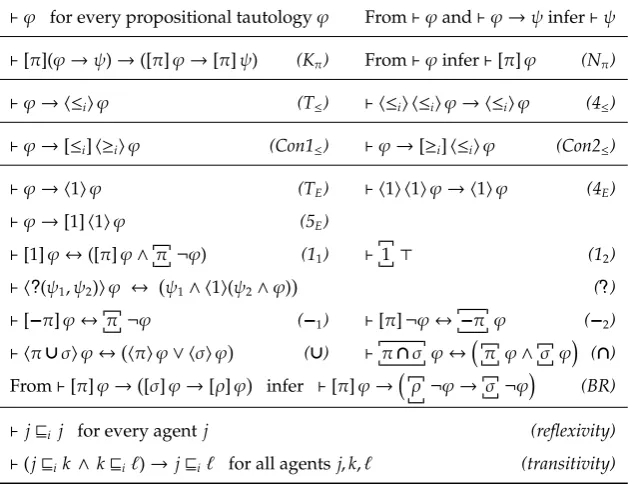
Axiom system Here is an axiom system characterising formulas ofLvalid in
PRmodels [52].
Theorem 1 Table1 provides a sound and complete axiom system (with i any agent andπany relational expression) forLwith respect to PR models.
Proof. The first five blocks of the table are known to be sound and complete for the fragment of the language they take care of: (i)axioms and rules in the first block take care of propositional validities;(ii)those in the second establish that every modality is normal; (iii)axioms in the third state that≤i is a reflexive and transitive relation;(iv)those in the fourth establish that≥iis the converse of≤i[96;25];(v)axioms and rules of the fifth characterise validities involving Boolean relational operations [50], with (?) the axiom for the relational test operator [52]. Showing that axioms in the sixth block characterise reflexivity
and transitivity for the relations4iis straightforward.
`ϕ for every propositional tautologyϕ From`ϕand`ϕ→ψinfer`ψ
`[π](ϕ→ψ)→([π]ϕ→[π]ψ) (Kπ) From`ϕinfer`[π]ϕ (Nπ)
`ϕ→ h≤iiϕ (T≤) ` h≤ii h≤iiϕ→ h≤iiϕ (4≤)
`ϕ→[≤i]h≥iiϕ (Con1≤) `ϕ→[≥i]h≤iiϕ (Con2≤)
`ϕ→ h1iϕ (TE) ` h1i h1iϕ→ h1iϕ (4E)
`ϕ→[1]h1iϕ (5E)
`[1]ϕ↔([π]ϕ∧π ¬ϕ) (11) ` 1 > (12)
` h?(ψ1, ψ2)iϕ ↔ ψ1∧ h1i(ψ2∧ϕ) (?)
`[−π]ϕ↔ π ¬ϕ (−1) `[π]¬ϕ↔ −π ϕ (−2)
` hπ∪σiϕ↔ hπiϕ∨ hσiϕ (∪) ` π∩σ ϕ↔π ϕ∧ σ ϕ (∩)
From`[π]ϕ→ [σ]ϕ→[ρ]ϕ
infer `[π]ϕ→ρ ¬ϕ→ σ ¬ϕ (BR)
`jvi j for every agentj (reflexivity)
[image:13.595.140.455.420.662.2]`(jvik∧ kvi`)→jvi` for all agentsj,k, ` (transitivity)
3
Preference dynamics via lexicographic upgrade
In collective decision scenarios, a public announcement of the agents’ indi-vidual preferences might induce each agent to change her own preferences according to what has been announced and the reliability ordering she assigns to the set of agents. As mentioned in theIntroduction, this section studies a par-ticular method for performing this change: thelexicographicmethod. The study is carried out in different phases, according to the properties of the reliability ordering that defines the priority of the preferences to be aggregated.
3.1
Reliability as a total order
Suppose the reliability relation, the one defining the priority of the preference orderings to be aggregated, is a total order (a total, reflexive, transitive and antisymmetric relation). In such cases, any preference orderings ≤0
and ≤00
can be compared, and one of them will be strictly more reliable than the other. In such cases, the result of the preferences’ lexicographic aggregation can be defined in the following way.
Definition 3.1 (Lexicographic upgrade, total order version) Let{≤i}i∈A be a fi-nite collection of binary preference orderings over a domainW; let4⊆(A×A) be a total order overAand recall that, in such cases,4has a unique minimum mn4. The preference ordering≤4⊆(W×W) is defined as
u≤4v iffdef u≤mn
4 v ∧
^
i∈A\{mn4}
u'iv
| {z }
1
∨ _
j∈A\{mn4}
u<jv ∧ ^
k∈[≺i(j)
u'kv
| {z }
2
Thus,u≤4vholds if this agrees with the least prioritised ordering (≤mn
4) and
for the rest of them u and v are equally preferred (part 1), or if there is an ordering≤jwith a strict preference forvoveruand all orderings with strictly higher priority (those with indexes in[≺i(j)) seeuandvas equally preferred
(part 2). J
As the reliability ordering is a total order, the effect of a lexicographic up-grade can be summarised in a single sentence: the preference ordering with the highest priority is taken as the starting point, and the rest of the orderings are used, hierarchically, to ‘break ties’ between equally preferred worlds.
In Ghosh and Velázquez-Quesada [53] the authors define a similar oper-ation, called general lexicographic upgrade (glu), and used for situations in which the reliability relation is a total order. In aglu, both the preference or-derings to be aggregated and the priority ordering with which the aggregation will take place are given by what is called alexicographic list. Using such list allows thegluto represent other natural lexicographic upgrades, as those that arise when the preferences of some agents inAare not used for building up the new preference ordering.12 The just defined lexicographic upgrade is in fact an instance of thisgluin which the lexicographic list is given directly by the agent’s reliability relation.
Example 3.1 Consider the preference relations≤a,≤band≤cfrom Example2.1 (≤aslightly modified), shown below on the left, and consider the application of the lexicographic upgrade of Definition3.1following the reliability ordering4
shown below on the center.
w1
w2
w3 w1
w2
w3
w2
w1 w3
a b c
w2
w1
w3
≤a ≤b ≤c 4 ≤4
The resulting preference ordering,≤4, appears above on the right. Following the discussion, it can be seen as the result of refining the preference ordering with the highest priority,≤c, by using the preference ordering with the second highest priority, ≤b. Since the use of the two topmost preference orderings already makes the resulting relation≤4antisymmetric, the preference ordering
with the lowest priority,≤a, is never consulted. J
3.2
Reliability as a partial order: lexicographic rule
Suppose now that the reliability relation is a partial order (a reflexive, transitive and antisymmetric relation). In such cases, two given preference orderings might not be comparable, but if they are, one of them will be strictly more reliable than the other. In such cases, one can rely on thelexicographic ruleof Andréka et al. [2]. Using this paper’s notation, the rule is defined as follows.
Definition 3.2 (Lexicographic rule (cf. Andréka et al. [2])) Let {≤i}
i∈A be a fi-nite collection of binary preference orderings over a domain W; let4 be a partial order overA.13 The preference ordering≤lr
4⊆(W×W) is defined as
u≤lr
4v iffdef
^
i∈A
u≤iv
|{z}
1
∨ _
j∈[≺i(i)
u<jv
| {z }
2
Thus,u≤lr
4 vholds if and only if every agent inAagrees with this, or else for
every agent who does not agree there is an agent with both a higher priority
and a strict preference forvoveru. J
This lexicographic rule, which requires for4 to be a partial order, looks different from the lexicographic upgrade of Definition3.1for cases in which
4is a total order. Nevertheless, as Proposition3.1below shows, the two are equivalent when the priority ordering is afinite totalorder.
Proposition 3.1 Let{≤i}i∈Abe a finite collection of binary preference orderings over a
domain W; let4be a total order overA. Then, for all u,v∈W,
u≤4v iff u≤lr
4v
Proof. Here is a sketch; for the formal proof, see theAppendix(page36). From left to right,u ≤4 v is given by a disjunction (Definition3.1). If the first disjunct holds, all agents in Aconsiderv at least as preferable asu, and hence every element ofAsatisfies part 1 of Definition3.2. If the second disjunct
holds, there isj∈Awith a strict preference forvoveruand with all orderings
with higher priority seeinguandvas equally preferred. Hence, while those elements ofAlying≺-below jsatisfy part 2, jand those≺-above it satisfy part 1. Since4is a total order, the previous sentence deals with all elements ofA, and henceu≤lr
4v.
From right to left, assumeu≤lr
4v. According to Definition3.2, every agent
either considersv at least as preferable asu, or else can≺-see a more reliable agent with a strict preference of v overu. Suppose every agent considers v
at least as preferable asu; if, additionally, every agent inA\ {mn4}considers
u at least as preferable as v then, by part 1 of Definition3.1,u ≤4 v. If the additional assumption fails, then there is at least an agent inA\ {mn4}who does not consideruat least as plausible asv. GivenA’s finiteness and4’s properties, among such agents there is a single one with the highest priority, and she satisfies the requirements in part 2 of Definition3.1; hence,u ≤4 v. Suppose now otherwise, i.e., suppose u ≤i v does not hold for alli ∈ A; then there is at least one element inAwhich does not considervas at least as plausible as
u. Let j be, among such agents, the one with the highest priority, so agents ≺-abovejconsidervat least as plausible asu. From Definition3.2, there should be at least one agent with higher priority that prefersv strictly overu; let j0
be, among such agents, the one with the highest priority, so agents≺-above j0 do not prefervstrictly overu. But such agents are also≺-above j; then, they considervanduequally preferable, and therefore j0
satisfies the requirements
of part 2 of Definition3.1; hence,u≤4v.
Example 3.2 Consider the preference relations≤a,≤band≤cfrom Example3.1, shown below on the left. Consider now the application of the lexicographic upgrade of Definition3.2with the reliability ordering4shown below on the center.
w1
w2
w3 w1
w2
w3
w2
w1 w3
c
a b
w1
w2 w3
≤a ≤b ≤c 4 ≤4
The resulting preference ordering,≤4, appears above on the right. Note how there is an edge fromw1tow3because all preference orderings agree with this (i.e.,w1 ≤a w3,w1 ≤b w3,w1 ≤c w3). On the other hand, there is an edge from
w1tow2because (i)aagrees,(ii)bagrees and(iii)whilecdoes not agree, there is someone with a strictly higher priority than that ofc(namely,a) who places
w1 strictly beloww2. There are no further edges (besides the reflexive ones) because eitheraorbdoes not agree with them, and none of them has someone
3.3
Reliability as a preorder
In Definition3.2, the priority ordering is assumed to be a partial order, i.e., a reflexive, transitive and antisymmetric relation. Thus, even though this allows for two different agents to be incomparable, it does not allow for them to have equal priority. Since the reliability relations in aPRframe allow equal reliability (as antisymmetry is not required), the main focus of the present work will be the following generalisation.
Definition 3.3 (Lexicographic upgrade, preorder version) Let {≤i}i∈A be a fi-nite collection of binary preference orderings over a domain W; let4 be a preorder overA. The relation≤4⊆(W×W) is defined as
u≤4v iffdef ^
i∈A
u≤iv
|{z}
1
∨ _
B⊆[≺i(i)
2.1
z }| { ^
j1,j2∈B
j1u j2 ∧
2.2
z }| { ^
k∈A\B
_
j∈B
j6k ∧
2.3
z }| { ^
j∈B
u<jv
| {z }
2
According to this definition,u≤4vholds if and only if every agent inAagrees with this relative position betweenuandv(part 1), or else for every agent who does not agree there is a non-empty4-clusterBcontaining agents with higher
priority for whomvis preferred overu(part 2). J
The generalisation takes place in part 2. According to Definition3.2, in order foru≤lr
4vto hold, for every agentiwho does not considervat least as plausible
asuthere should be an agent jwith higher priority (j∈ [≺i(i)) for whomvis
preferred overu(u ≺jv). But in Definition3.3the reliability ordering is just a preorder, so besides incomparable agents there might be also sets containing different but equally reliable agents. Thus, in order foru≤4vto hold, for every agenti who does not considerv at least as plausible asu there should be a
set of agentsB, with all its members equally reliable (j1,j2 ∈ Bimplies j1 u j2; part 2.1) and no other equally reliable agent being left out (for everyk∈ A\B
there is a j∈Bsuch thatj6k, from which it also follows thatBis non-empty;
part 2.2) —that is, acluster— such that all agents inBhave higher priority than
i (B ⊆ [≺i(i)) and all of them agreein thatv is preferred overu(u <j vfor all
j∈B; part 2.3). Of course, a different alternative for a generalisation is to stick
with Definition3.2, asking for the existence of just a single agent with higher priority who placesvaboveu. This proposal’s choice, to ask for the existence of aclusterwith higher priority whose agents all placevaboveu, emphasises the fact that all agents in a cluster have the same priority, and thus in order for them to make a ‘final’ decision, they all should agree in their opinion.
This lexicographic upgrade for preorders is indeed a generalisation of the lexicographic rule (for partial orders): when4is antisymmetric, the clusterB
is forced to have at most one element (part 2.1) and to be non-empty (part 2.2), and therefore Definition3.3boils down to Definition3.2. Formally,
Proposition 3.2 Let{≤i}i∈Abe a finite collection of binary preference orderings over a
domain W; let4be a partial order overA. Then, for all u,v∈W,
u≤lr
Proof. From left to right, ifisatisfies part 1 of Definition3.2, then it satisfies part 1 of Definition3.3, and if it satisfies part 2 of Definition3.2, then the required
j defines a set
j which, by 4’s reflexivity and antisymmetry, is a 4-cluster satisfying part 2 of Definition3.3. Hence,u≤4v. From right to left, ifisatisfies part 1 of Definition3.3, then it satisfies part 1 of Definition3.2, and if it satisfies part 2 of Definition 3.3, then from 4’s antisymmetry the required 4-cluster
Bmust be a singleton whose single element satisfies part 2 of Definition3.2.
Hence,u≤lr
4v. For the formal details, see theAppendix(page37).
Example 3.3 Consider the preference relations ≤a,≤b and ≤c from Example
3.1, shown below to the right. Consider the application of the lexicographic upgrade of Definition3.3with the reliability ordering shown below to the left.
w1
w2
w3 w1
w2
w3
w2
w1 w3
a
b c
w3
w1 w2
≤a ≤b ≤c 4 ≤4
The resulting preference ordering,≤4, appears above on the right. Again, there is an edge fromw1tow3because all preference orderings agree with this. On the other hand, there is an edge fromw2tow3becausebandcagree with this and, moreover, the fact thatadoes not agree is overruled by the opinion of all the members of the4-cluster{b,c}, which lies≺-abovea. J
Some properties Here are some interesting properties of this lexicographic upgrade (and thus all the others it generalises). The first is that it respects unanimity about the relative position of any pair of worlds.
Proposition 3.3 Let{≤i}
i∈Abe a finite collection of binary preference orderings over a
domain W, and let4be a preorder overA. Take any u,v in W.
(i) If u'iv for all i∈A, then u'4v.
(ii) If u<iv for all i∈A, then u<4v.
(iii) If u/iv for all i∈A, then u/4v.
On the other hand, unanimity on the ‘comparability’ relation∼is not pre-served: even ifuandvare comparable for all agents inA, the reliability ordering
4might divideAinto two disconnected regions with different opinions with
respect touandv’s relative position (e.g., one of them a singleton whose ele-ment prefersuoverv, and the other a singleton whose element prefersvover
u). In such case, neitheru≤4vnorv≤4uwill hold. Still, comparability can be preserved when the reliability ordering satisfies extra requirements, as shown below when discussing the preservation of totality.
Proposition 3.4 Let{≤i}i∈Abe a finite collection of binary preference orderings over a
domain W; let4be a preorder overA. If every≤iis reflexive (transitive), then so is
≤4.
What about antisymmetry and totality, the two other properties typically required for relations representing orderings? For antisymmetry, the answer is straightforward: thanks toA’s finiteness, such property is indeed preserved.
Proposition 3.5 Let{≤i}i∈Abe a finite collection of binary preference orderings over a
domain W; let4be a preorder overA. If every≤iis antisymmetric, then so is≤4.
The fact that antisymmetry is preserved relies onA’s converse well-found-edness, a consequence of its finiteness: if an infinite ≺-ascending chain of
4-clusters were possible (e.g., i1 ≺ i2 ≺ . . .), then while for every i ∈ Awith
u <i vthere might be ani0strictly≺-aboveisuch thatv<i0 u, for everyi0∈ A
withv<i0uthere might be anistrictly≺-abovei0such thatu<
iv(e.g.,u<i` v
for`odd, andv<i` ufor`even). In such case,u≤4vandv ≤4uwould both
hold, even ifuandvare different.
For totality, the answer is more elaborate. First, as it has been mentioned, the lexicographic upgrade does not respect unanimity on comparability; thus, it does not preserve totality. Moreover, assuming that4is atotalpreorder is not enough. Take any pairu,v, and suppose not only that the single element of every singleton cluster considersuand v equally preferable, but also that all remaining (i.e. all non-singleton) clusters are ‘not unanimous’, i.e., each contains at least one element preferringuovervand one preferringvoveru. If there is at least one non-singleton cluster, then neitheru≤4vnorv≤4uholds: there is at least one agenti ∈A(in the non-singleton cluster) for whichui v
and there is no cluster whose elements all agree onu<v, sou4 v, and there
is at least one agent i ∈ A(in the non-singleton cluster) for whichv i uand
there is no cluster whose elements all agree onv<u, sov4u.
When looking for conditions guaranteeing that totality is preserved, the work of Andréka et al. [2] is helpful once again: as it is shown in its Theorem 4.1, the lexicographic rule of Definition3.2preserves totality when the reliability ‘priority’ relation is also total. Hence, as such upgrade is the particular case of the lexicographic upgrade in which4is antisymmetric (Proposition3.2), it follows that the lexicographic upgrade of Definition3.3preserves totality when
4isboth total and antisymmetric. Indeed, when4is antisymmetric, every cluster is a singleton, and therefore it has a single ‘unanimous’ opinion aboutuand
v’s relative position. This forbids situations as those described in the previous paragraph, as if the single element of every singleton cluster (i.e., every agent) considersu and v equally preferable, there is unanimity on both u ≤ v and
v ≤u, and thus bothu≤4 vandv≤4 uhold. If, on the other hand, there is a cluster whose element prefers eitheruor elsevabove the other, simply pick, among such clusters, the one with the highest priority (which exists, as 4is both total and antisymmetric): its single element will make the final decision if unanimity fails, making then eitheru≤4vor elsev≤4utrue.
Definition 3.4 Let{≤i}i∈A be a finite collection of binary preference orderings over a domainW; let4be a preorder overAand takeB⊆A.
• The setCi
4contains those non-empty4-clusters inAthat lie≺-abovei∈A:
Ci
4:=
B⊆A|B
is a4-cluster withB,∅and j∈Bimpliesi≺ j
• The relation<B ⊆ (W×W) is the intersection of all the relations<jwith
j∈B:
<B :=
\
j∈B <j
Note how this isnotequivalent to define≤BasT
j∈B≤jand then, following
Definition2.3, define<Bas≤B∩B.14 J
Then, the definition.
Definition 3.5 (Lexicographic upgrade, alternative definition) Let{≤i}
i∈Abe a finite collection of binary preference orderings over a domain W; let4be a preorder overA. The relation≤4⊆(W×W) is defined as
≤4:=\
i∈A
≤i∪[
B∈Ci 4
<B
J
Frame and model operations When the reliability ordering 4is a preorder and the preference orderings in{≤i}i∈Aare preorders, the resulting (preference) ordering≤4is also a preorder (Proposition3.4). Thus, consider anyPRframe hW,{≤i,4i}
i∈Ai: if each agentiupgrades her own preference ordering≤iusing
her own reliability ordering4i, the resulting structurehW,{≤i0,4i}i∈Ai, with each ≤0
i given by ≤4i, is a PR frame too, as both its reliability and its preference
relations are preorders. Here is the formal definition of the new structure.
Definition 3.6 (Frame and model operations) Let F = hW,{≤i,4i}i∈Aibe a PR frame; letM=hF,Vibe aPRmodel. ThePRframeFlx, differing fromFonly in the agents’ preference relations, is the result of upgrading the preferences ofall
agents according to the lexicographic upgrade (Definition3.3) and each agent’s reliability relation. Formally,Flx =hW,{≤0i,4i}i∈Aiis such that, for everyi∈A,
≤0
i :=≤4i
Accordingly, the modelMlxis formally defined asMlx=hFlx,Vi. J Naturally, it is also possible to define frame/model operation in which the lexicographic upgrade is applied to the preference ordering of a single given agent (but see Subsection4.1for an alternative representation of such situa-tions).
14For a simple counterexample, suppose the described definitions and takeW := {w,u}with ≤1:=W×Wand≤2:=≤1\ {(u,w)}. Then,<1=∅and<2={(w,u)}, and therefore<1∩<2=∅, but
Caveat The lexicographic policy is not the only ‘reasonable’ policy an agent can use for upgrading her preferences. For example, an agentacan upgrade her preferences by placing her most reliable agent’s most preferred worlds above the rest, then using her old ordering within each zone. This upgrade, calledlexicographicin Rott [98]; van Benthem [15] andconservativein Ghosh and Velázquez-Quesada [52], has been shown in Ghosh and Velázquez-Quesada [53]notto be an instance of theirglu(which is ‘equivalent’ to the lexicographic upgrade of Definition3.1for totally ordered reliability relations), as there are cases in which the output of the former cannot be reproduced by any instance of the latter. The example below shows how this conservative upgrade is neither an instance of the more general lexicographic upgrade (Definition3.3) that is central to this proposal.
Example 3.4 Suppose agentais agentb’s most reliable agent,b≺ba, and their individual preferences are as below (reflexive and transitive arrows omitted).
w2
w1 w3
w4
w3
w4 w1
w2
≤a ≤b
A conservative upgrade onb’s preferences will create two zones, the upper one with a’s most preferred worlds (w3 andw4), and the lower one with the remaining worlds (w1 and w2). Within each zone, b’s old preferences will apply, thus placingw4strictly abovew4andw2strictly abovew2. The resulting ordering≤0
bis, then,
w1
w2 w3
w4
≤0
b
Clearly, a direct application of the lexicographic upgrade will produce a different outcome, asw2 ≤4b w1 because not only w2 ≤a w1 but also the4b
-cluster {a} lies ≺b-above b and satisfies w2 <a w1. Moreover, ≤0
cannot be recreated, even if the reliability ordering changes:(i)botha0bbandaubbfail
as, in such case,w1 4b w2because agentais such thatw1aw2and there are no
cluster of agents≺b-abovea;(ii)a≺bbfails as, in such case,w4 ≤4
b w1because
not only there is a4b-cluster{b}lying≺b-aboveaand satisfyingw4 <b w1, but
alsow4≤bw1. J
The conservative upgrade is not lexicographic: it does not create a prefer-ence ordering following a priority list of orderings. Instead, it uses a partition of the domain to create an ordered collection of ‘clusters’, using then a default ordering to sort the worlds within each ‘cluster’. When working with pref-erence relations that are total preorders and reliability relations that are total orders, this conservative upgrade and thegluare shown to be instances of the