Int. J. Electrochem. Sci., 6 (2011) 2058 - 2071
International Journal of
ELECTROCHEMICAL
SCIENCE
www.electrochemsci.org
A Study of Copper(II) Hexacyanoferrate-PEDOT Films and
Their Sensitivity for Ascorbic Acid and Acetaminophen
Tsung-Hsuan Tsai, Tse-Wei Chen, Shen-Ming Chen*, Kuo-Chiang Lin
Electroanalysis and Bioelectrochemistry Lab, Department of Chemical Engineering and Biotechnology, National Taipei University of Technology, Taipei 106, Taiwan (ROC). *
E-mail: [email protected]
Received: 11 April 2011 / Accepted: 15 May 2011 / Published: 1 June 2011
The conducting polymer (PEDOT) modified electrode was used to investigate the formation of copper(II) hexacyanoferrate by adjusting molar ratio of ferricyanide and copper(II) chloride with 20 scan cycles of 0-1 V. Three film types of copper(II) hexacyanoferrate/PEDOT have been successfully prepared and discussed using PEDOT film modified electrodes in [K3Fe(CN)6]:[CuCl2] = 1:1, 1:5, and 1:10, respectively. The copper(II) hexacyanoferrate/PEDOT films exhibit significant voltammograms and can be classified from Type I to Type III due to their different CuHCF content. All of these films exhibit specific fiber-like structure due to the doping of ferricyanide and copper(II) hexacyanoferrate on PEDOT surface. Furthermore, these films could simultaneously determine AA and AP. Particularly, the film with higher CuHCF content could provide much higher sensitivity. The current response can be expressed as Ipa1(μA) = 25.93[AA](mM) + 147.2 (R2 = 0.9946) and Ipa2(μA) = 19.79[AP](mM) + 189.6 (R2 = 0.9972). The linear range is found in 0.18–1.810−2 M and 0.16– 1.610−2
M for AA and AP, respectively.
Keywords: Copper(II) hexacyanoferrate (CuHCF), poly(3,4-ethylenedioxythiophene) (PEDOT), ascorbic acid (AA), acetaminophen (AP)
1. INTRODUCTION
other modification methods because of their adsorption and covalent bonding, in that they usually involve multilayers as opposed to the monolayers that are frequently encountered for the latter methods. Conductive/electroactive polymers, such as polypyrrole, polyaniline, polythiophene, etc., were prepared through an electropolymerization procedure and used as modifiers for the construction of chemically modified electrodes [3-5].
Among various conducting polymers, poly(3,4-ethylenedioxythiophene) (PEDOT), which is a relatively new and well-known p-conjugated conducting polymer of the polythiophene class, has received much attention because of its high electrical conductivity, moderate band gap, and excellent environmental stability [6-9]. Moreover, PEDOT thin films can vary from light to dark blue. These unique properties mean that PEDOT can be applied in many fields, such as chemical and biochemical sensors, antistatic coatings, electrically switchable windows, and polymer light-emitting diodes [10-12].
Ascorbic acid (vitamin C, AA), a water-soluble vitamin, is widely present in many biological systems and in multivitamin preparations. AA is commonly used to supplement inadequate dietary intake and as an antioxidant. Its deficiency leads to the development of the well-known syndrome called scurvy. It is administered in the treatment of many disorders, including Alzheimer’s disease, atherosclerosis, cancer, infertility, and in some clinical manifestations of HIV infections. Because of its importance, many modified electrodes have been developed and reported for the electrochemical determination of this compound [13-16]. However, AA is considered to be a major interferent both to an on-line sensor and to an in vivo probe because of a combination of its high concentration and low oxidation potential. The differences in the redox behavior and specific chemical interactions allow one to achieve selectivity for several particular analytes. For example, voltammetric detection of redox-active compounds was used for the detection of ascorbic acid [17-22].
In this report, copper(II) chloride (CuCl2), ferricyanide (FCN), and PEDOT were selected to investigate the film formation of metal hexacyanoferrate/conducting polymer. The electrochemical behaviors and morphology of these films were studied with prepared molar ratio of FCN and copper(II) chloride in [K3Fe(CN)6]:[CuCl2] = 1:1, 1:5, and 1:10, respectively. The electropolymerization formation of PEDOT film was first performed on GCE electrodes before studying the electrochemical behavior and morphology of the proposed film. Then, the PEDOT/GCE was transferred to 0.1 M KNO3 (pH 5.6) solution and the concentration ratio of CuCl2 to FCN was adjusted to form metal hexacyanoferrate/conducting polymer film using repeated cyclic voltammetry. The formed films were classified and recognized by cyclic voltammograms and SEM images. They were compared with bare GCE, PEDOT/GCE, and FCN-PEDOT/GCE at the same time. Furthermore, simultaneous determination of AA and AP by FCN-CuHCF-PEDOT/GCE is also discussed and compared.
2.MATERIALS AND METHODS
2.1. Chemicals
Anhydrous copper(II) chloride (CuCl2) and FCN were purchased from Wako (Japan) and 3,4-ethylenedioxythiophene (EDOT) was purchased from Sigma-Aldrich (USA). Double distilled deionized (DDDI) water was used to prepare all solutions. All chemicals used were of analytical grade. Pure nitrogen was purged through all of the experimental solutions.
2.2. Apparatus
All of the electrochemical experiments were performed using a CHI 1205a electrochemical workstation (CH Instruments, Austin, TX). A conventional three-electrode system, which consists of Ag/AgCl/saturated KCl as the reference electrode, GCE (d = 0.3 cm in diameter) as the working electrode, and platinum wire as the counter electrode, was used for all of the electrochemical experiments. Prior to electrochemical experiments, bare GCE was well polished with aqueous slurries of alumina powder (0.05 m), using a BAS polishing kit, then rinsed and ultrasonicated in DDDI water. Energy dispersive spectroscopy (EDS) was performed using an Oxford EDS (133 eV (Mn Ka: 5.899 keV)).
3. RESULTS AND DISCUSSION
3.1. Preparation of PEDOT and copper(II) hexacyanoferrate/PEDOT films
GCE (PEDOT/GCE) could be further used to prepare copper(II) hexacyanoferrate/PEDOT in different molar ratio of ferricyanide ions and copper(II) ions. To study the film types of copper(II) hexacyanoferrate, the PEDOT/GCE was used and transferred to 0.1 M KNO3 solution (pH 5.6) containing different molar ratio of ferricyanide ions and copper(II) ions ([K3Fe(CN)6]:[CuCl2] = 1:1, 1:5, and 1:10) to do repeatedly potential cycling of 0–1 V with 20 cycles. Hence, three hybrid films were electrochemically synthesized and discussed with their prepared molar ratio of ferricyanide ions and copper(II) ions.
Based on the repeatedly potential cycling (0–1 V) using PEDOT/GCE in the arranged stoichiometry, the electrochemically synthesized copper(II) hexacyanoferrate/PEDOT films can be classified as Type I, Type II, and Type III corresponding to their prepared molar ratio of ferricyanide ions and copper(II) ions in 1:1, 1:5, and 1:10, respectively. For convenient discussion, these three films would be abbreviated as Type I, Type II, and Type III of copper(II) hexacyanoferrate/PEDOT films for prepared condition of [K3Fe(CN)6]:[CuCl2] = 1:1, 1:5, and 1:10, respectively.
3.2. Characterization of copper(II) hexacyanoferrate/PEDOT films
3.2.1. Cyclic voltammogram of different types of copper(II) hexacyanoferrate/PEDOT films with various scan rate
To study the electrochemical behaviors, the different types of copper(II) hexacyanoferrate/PEDOT films were prepared in different molar ratio of [K3Fe(CN)6]:[CuCl2] = 1:1, 1:5, and 1:10, respectively. They were individually examined in the blank solution by cyclic voltammetry.
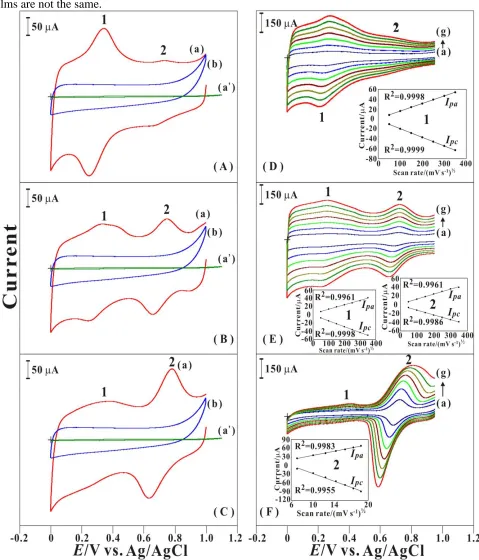
Fig. 1A-C individually shows their significant cyclic voltammograms of Type I-III films examined in 0.1 M KNO3 (pH 5.6). As compared with the voltammetric background of bare electrode and PEDOT modified electrode (a’ & b), all these films (presented as symbol “a”) have characteristic peaks and thick voltammograms.
They exhibit higher current response than bare GCE or PEDOT/GCE in each case (Fig. 1A-C). For Type I film (Fig. 1A(a)), it has an obvious redox couple 1 (E0’ = +0.25 V) relative to that of hexacyanoferrate [37], it means this film has rich ferricyanide doped in PEDOT film so that it shows the sharp redox couple (redox couple 1) similar to ferricyanide in the solution. In addition, it can be seen one small redox couple 2 (E0’ = +0.7 V) relative to that of CuHCF [38]. Therefore, the PEDOT film modified electrode (PEDOT/GCE) could be doped by ferricyanide and copper(II) hexacyanoferrate is verified and found the significant redox couples relative to ferricyanide and copper(II) hexacyanoferrate.
As prepared copper(II) hexacyanoferrate/PEDOT film, most of anions (Fe(CN)63-) and cations (Cu2+) should be spontaneously reacted to generate CuFe(CN)6- in the bulk solution (as shown in equation 1). The formed CuFe(CN)6- will further dope in PEDOT modified electrode (as shown in equation 2 & 3).
[image:5.596.57.536.94.654.2]
molar ratio of ferricyanide ions and copper(II) ions. However, the cyclic voltammograms of these films are not the same.
Fe(CN)63-(aq) + Cu2+(aq) CuFe(CN)6-(aq) (1)
Doping on PEDOT/GCE:
Fe(CN)63-(aq) + PEDOT+/GCE (Fe(CN)6-PEDOT)film2-/GCE (2)
CuFe(CN)6-(aq) + PEDOT+/GCE (CuFe(CN)6-PEDOT)film/GCE (3)
Redox process of copper(II) hexacyanoferrate/PEDOT/GCE:
(FeIII(CN)6-PEDOT)film2-/GCE + e- (FeII(CN)6-PEDOT)film3-/GCE (4)
(CuFeIII(CN)6-PEDOT)film/GCE + e- (CuFeII(CN)6-PEDOT)film-/GCE (5)
This could be further explained as scheme 1(a), which illustrates how the film formation of copper(II) hexacyanoferrate films on PEDOT/GCE. In bulk solution, most of Fe(CN)63- and Cu2+ are reacted to generate CuFe(CN)6-. Then, the formed CuFe(CN)6- would transfer and dope in PEDOT (process 1). In the surface of PEDOT/GCE, some of Fe(CN)63- ions are attracted by positive charge of PEDOT film and they would transfer and dope in PEDOT particularly in positive scan on the surface of PEDOT/GCE. Furthermore, some of Cu2+ ions are attracted by the ferricyanide ions (which have been doped in PEDOT/GCE) to form CuHCF on PEDOT/GCE surface (process 2). In ideal case, both process 1 & 2 would lead to form CuHCF on PEDOT surface. Actually, the process 2 might lead only Fe(CN)63- to dope in PEDOT particularly in positive scan. In the period of potential cycling (0–1 V), PEDOT surface is initially doped by some Fe(CN)63-. The residual Cu2+ (except of Cu2+ reacted with Fe(CN)63- in bulk solution) might not transfer and react with the Fe(CN)63- which have been doped in PEDOT (here means FCN/PEDOT) due to positive scan. Therefore, the process 2 is not always completed to form CuHCF on PEDOT surface. As the result, this film (as Fig. 1A(a)) shows one obvious redox couple 1 of ferricyanide (Fe(CN)63- dope in PEDOT) and one small redox couple 2 of copper(II) hexacyanoferrate (CuFe(CN)6- dope in PEDOT) when the film is prepared from [K3Fe(CN)6]:[CuCl2] = 1:1.
From Fig. 1A-C, these films show more and more obvious redox peaks of CuFe(CN)6- with increase of copper(II) molar ratio. As increasing copper(II) molar ratio in the prepared condition, the Cu2+ ions are getting relatively rich to react with most Fe(CN)63- to form CuFe(CN)6- which will transfer and dope in PEDOT (process 1). At the same time, it will also get more possibilities for the rich Cu2+ ions which were reacted with Fe(CN)6- and doped in PEDOT (process 2) even in the positive scan. The redox couple of CuFe(CN)6- was dependent on Cu(II) molar ratio in the preparation. From Fig. 1B, it is clear that the two redox couples (1 & 2) of Fe(CN)63- and CuFe(CN)6- (doped in PEDOT) exhibits almost identical anodic peak currents (Ipa) when the ratio of [K3Fe(CN)6]:[CuCl2] is 1:5 rather than 1:1.
As shown in Scheme 1 (b)-(d), it illustrates copper(II) hexacyanoferrate/PEDOT films have low, middle, and high compact degree of CuFe(CN)6- doped in PEDOT. The redox peaks of this composite are highly dependent on the CuHCF content resulted from different prepared molar ratio of copper and ferricyanide ions.
These three films were further examined in 0.1 M KNO3 solution (pH 5.6) with various scan rates of 50-350 mV s-1. Fig. 1D–F shows the cyclic voltammograms of these film modified electrodes with various scan rates in the potential range from 0 to 1.0 V. From Fig. 1D & E, the peak currents of redox couples are directly proportional to scan rates up to 350 mV s-1 (as insets in Fig. 1D & E) as expected for surface confined process.
As can be seen in insets of Fig. 1D & E (Type I & II of copper(II) hexacyanoferrate/PEDOT), the regressing equation of peak current and scan rate can be expressed as Ipa1(μA) = 0.1523v(mV s-1
) + 0.63423 (R2 = 0.9998) for Type I; Ipa1(μA) = 0.1523v(mV s-1) + 0.63423 (R2 = 0.9961), Ipa2(μA) = 0.1123v(mV s-1) + 1.2797 (R2 = 0.9961) for Type II; and Ipa2(μA) = 3.6699v(mV1/2 s-1/2) – 1.8708 (R2 = 0.9983) for Type III. Particularly, the linear correlation between peak current and square root of scan rate was found in Type III film as shown in the inset of Fig. 1F. This demonstrates that the process is diffusion control. And the slow diffusion rate might be caused by the more CuHCF content in the film involving mass transfer resistance.
3.2.2. SEM images analysis for Type I-III of copper(II) hexacyanoferrate/PEDOT films
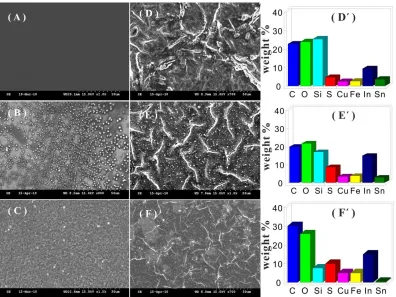
Based on the different electrochemical behaviors of copper(II) hexacyanoferrate/PEDOT films, the morphology of these films were studied by SEM. Unlike the clear image of the bare GCE surface (Fig. 2A), the image of CuHCF/GCE (Fig. 2B) exhibits grain-like structure with an average diameter of 1.5 μm. And, the PEDOT/GCE image (Fig. 2C) shows net-like structure with an average diameter of 1.0 μm.
Fig. 2D–F shows the images of copper(II) hexacyanoferrate/PEDOT films prepared by different molar ratio of [K3Fe(CN)6]:[CuCl2] = 1:1, 1:5, and 1:10, respectively.
Fig. 2D–F displays the images of specific fiber-like structure among these films correlated to the unique cyclic voltammograms of Type I-III shown in Fig. 1A–C, respectively. The fiber-like structure of Type I was found with an average length of 18 μm and an average width of 2 μm.
Figure 2. SEM images of different electrode surface including (A) bare GCE, (B) CuHCF/GCE, (C) PEDOT/GCE, and (D) Type I, (E) Type II, and (F) Type III of Copper(II) hexacyanoferrate/PEDOT/GCE, respectively. EDS element analysis including (D’) Type I, (E’) Type II, and (F’) Type III of Copper(II) hexacyanoferrate/PEDOT/ITO, respectively.
3.2.3. EDS element analysis for different types of copper(II) hexacyanoferrate/PEDOT films
These films were further examined by EDS, Fig. 2D’-F’ shows EDS analysis results for Type I, Type II, and Type III of copper(II) hexacyanoferrate/PEDOT/ITO, respectively. It can be seen, these three films have identical Cu/Fe ratio in their composites even they are prepared from different molar ratio of ferricyanide ions and copper(II) ions. The identical Cu/Fe ratio provides the probably evidence of CuHCF composite in these films (as shown in formula 3). Particularly, Type III film has higher content of Cu and Fe is directly related to its prepared condition of higher copper content. It is concluded that the more CuHCF formation in this film (Type III) resulted in obvious redox couple of CuHCF differs from Type I & II. The higher compact of CuHCF in the copper(II) hexacyanoferrate/PEDOT in Type III film is hence verified. From the EDS results, we confirm that CuHCF content in the film increases with increase in ferricyanide and copper(II) molar ratio and thus optimized as 1:10.
3.2.4. EIS analysis for different types of copper(II) hexacyanoferrate/PEDOT films
[image:9.596.102.498.68.365.2][image:10.596.133.465.352.593.2]
electrochemistry impedance spectroscopy (EIS) was used to investigate the nature of copper(II) hexacyanoferrate/PEDOT film modified electrodes. EIS data were obtained for the modified electrodes at AC frequency varying between 0.1 Hz and 1 MHz in 0.1 M KNO3 solution (pH 5.6). Fig. 3 shows Nyquist diagrams (-Z’’ vs. Z’) of bare GCE (Fig. 3a’), PEDOT/GCE (Fig. 3a), and Type I (Fig. 3b), Type II (Fig. 3c), and Type III (Fig. 3d) of copper(II) hexacyanoferrate/PEDOT/GCE, respectively. PEDOT/GCE exhibits almost a straight line with a much smaller depressed semicircle arc (Ret = 0.12 kΩ) than that of bare GCE (Ret = 0.67 kΩ). The small depressed semicircle of PEDOT/GCE means that the electron transfer resistance is relative smaller than mass transfer resistance in this electrochemical system. In other words, the electron transfer is fast and mass transfer limits the system. This is because of the electron transfer resistance might be lowered by the conducting polymer of PEDOT. The Ret values of copper(II) hexacyanoferrate/PEDOT/GCE are increasing from Type I to Type III and found between bare GCE and PEDOT/GCE except of Type III. By the EDS result, it’s tending much higher CuHCF content from Type I to Type III. Therefore, the electron transfer resistance of copper(II) hexacyanoferrate/PEDOT film increases with increase in the CuHCF composition.
Figure 3. Electrochemical impedance spectra including (a’) bare GCE, (a) PEDOT/GCE, and (b) Type I of Copper(II) hexacyanoferrate/PEDOT/GCE, (c) Type II of Copper(II) hexacyanoferrate/PEDOT/GCE, and (d) Type III of Copper(II) hexacyanoferrate/PEDOT in 0.1 M KNO3 (pH 5.6), respectively.
3.2.5. Simultaneous determination of AA and AP by different types of copper(II) hexacyanoferrate/PEDOT modified electrodes
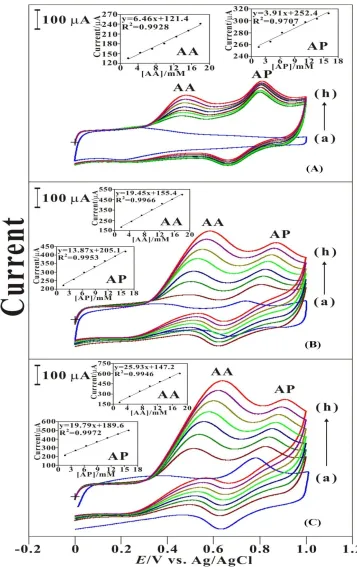
Figure 4. Cyclic voltammograms of simultaneously electrocatalytic oxidation of AA and AP in 0.1 M KNO3 solution (pH 5.6) containing various concentration of: (a) 0, (b) 2.710–3
M AA + 2.410–3 M AP, (c) 5.410–3 M AA + 4.810–3 M AP, (d) 8.110–3 M AA + 7.210–3
M AP, (e) 1.0810–2 M AA + 9.610–3 M AP, (f) 1.3510–2 M AA + 1.210–2 M AP, (g) 1.6210–2
M AA + 1.4410–2 M AP, and (h) 1.8910–2 M AA + 1.6810–2
M AP, respectively. They are examined by (A) Type I, (B) Type II, and (C) Type III of FCN-CuHCF-PEDOT/GCE, respectively. (a) represents the cyclic voltammogram of bare GCE examined in the presence of 1.8910–2 M AA + 1.6810–2
[image:12.596.30.571.346.655.2]
Fig. 4 shows these modified electrodes were individually examined in 0.1 M KNO3 solution (pH 5.6) in the presence of AA and AP with different concentration. All of them could simultaneously determine AA and AP with two obvious anodic peaks of Epa1 = 0.49–0.603 V (for AA) and Epa2 = 0.803–0.88 V (for AP) as increasing reagents concentration. As can be seen in the insets of Fig. 4, the linearity of electrocatalytic current can be expressed as Ipa1(μA) = 6.46[AA](mM) + 121.4 (R2 = 0.9928) and Ipa2(μA) = 3.91[AP] + 252.4 (R2 = 0.9937) (Ipai: the anodic current of peak i; R2: coefficient of determination) for Type I of copper(II) hexacyanoferrate/PEDOT film. For Type II, Ipa1(μA) = 19.45[AA](mM) + 155.4 (R2 = 0.9966) and Ipa2(μA) = 13.87[AP] + 205.1 (R2 = 0.9953). For Type III, Ipa1(μA) = 25.93[AA](mM) + 147.2 (R2 = 0.9946) and Ipa2 = 19.79[AP] + 189.6 (R2 = 0.9972). The linear range is found in 0.18–1.8 10−2 M and 0.16–1.6 10−2 M for AA and AP, respectively. By sensitivity comparison of these modified electrodes, Type III shows the best sensing result for AA and AP. These films can be concluded that the higher CuHCF content the higher sensitivity for AA and AP.
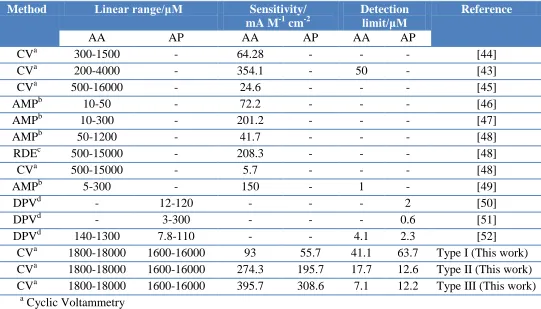
Table 1. Comparison of sensing abilities for AA and AP with different methods. Method Linear range/μM Sensitivity/
mA M-1 cm-2
Detection limit/μM
Reference
AA AP AA AP AA AP
CVa 300-1500 - 64.28 - - - [44]
CVa 200-4000 - 354.1 - 50 - [43]
CVa 500-16000 - 24.6 - - - [45]
AMPb 10-50 - 72.2 - - - [46]
AMPb 10-300 - 201.2 - - - [47]
AMPb 50-1200 - 41.7 - - - [48]
RDEc 500-15000 - 208.3 - - - [48]
CVa 500-15000 - 5.7 - - - [48]
AMPb 5-300 - 150 - 1 - [49]
DPVd - 12-120 - - - 2 [50]
DPVd - 3-300 - - - 0.6 [51]
DPVd 140-1300 7.8-110 - - 4.1 2.3 [52]
CVa 1800-18000 1600-16000 93 55.7 41.1 63.7 Type I (This work) CVa 1800-18000 1600-16000 274.3 195.7 17.7 12.6 Type II (This work) CVa 1800-18000 1600-16000 395.7 308.6 7.1 12.2 Type III (This work)
a
Cyclic Voltammetry b
Amperometry c
Rotaing Disk Electrode d
Differential Pulse Voltammetry
for AA determination, FCN-PEDOT/GCE [43] possesses much higher sensitivity than PEDOT/GCE [44]. By the comparison of EDS element analysis in this work, the higher CuHCF content in Type III means this film type has high CuHCF compact degree. And it shows higher sensitivity for AA than FCN-PEDOT/GCE (Vasantha et al., 2005). It can be confirmed that the sensitivity for AA increases in the increase of CuHCF content in the composites. By the result, copper(II) hexacyanoferrate/PEDOT films would be suitable for the simultaneous determination of AA and AP particularly by Type III.
4. CONCLUSIONS
In this paper, the electrochemical behaviors of copper(II) hexacyanoferrate/PEDOT films regarding to their prepared condition (molar ratio) of ferricyanide and copper(II) chloride, film formation process, and film types were studied. The copper(II) hexacyanoferrate/PEDOT films exhibit significant voltammograms and can be classified from Type I to Type III due to their different CuHCF content. All of these films have fiber-like structure due to the doping of ferricyanide and copper(II) hexacyanoferrate on PEDOT surface. The SEM image of Type III possesses relatively small fiber-like structure since the doping of CuFe(CN)6- with PEDOT is a much slower process. This could be due to the slow diffusion of CuFe(CN)6- ions from bulk solution to the electrode surface. For Type III film, the higher compact CuHCF in the copper(II) hexacyanoferrate/PEDOT is verified by EDS. From the EDS results, we confirm that CuHCF content in the film increases with increase in ferricyanide and copper(II) molar ratio and thus optimized as 1:10. The EDS results provide a supporting evidence for EIS results that higher CuHCF content in the film could be the possible reason for the increased electron transfer resistance. It is also found the proposed film with higher CuHCF content has much higher current response for AA and AP. It discloses copper(II) hexacyanoferrate/PEDOT films would be suitable for the simultaneous determination of AA and AP as compared with other materials. Particularly, the higher CuHCF content in the composites the higher sensitivity for AA and AP.
ACKNOWLEDGEMENTS
We acknowledge NSC (project no. NSC982113M027006MY3), Taiwan (ROC).
Reference
1. T.R.I. Cataldi, R. Guascito, A.M. Salvi, J. Electroanal. Chem. 417 (1996) 83.
2. J. Bacskai, K. Martinusz, E. Czirok, G. Inzelt, P.J. Kulesza, M.A. Malik, J. Electroanal. Chem. 385 (1995) 241.
3. C. Mousty, B. Galland, S. Cosnier, Electroanalysis 13 (2001) 186. 4. M.H. Pournaghi-Azar, R. Ojani, J. Solid State Electrochem. 4 (2000) 75. 5. A.K. Sharma, J.H. Kim, Y.S. Lee, Int. J. Electrochem. Sci. 4 (2009) 1560.
6. L.B. Groenendaal, F. Jonas, D. Freitag, H. Pielartzik, J.R. Reynolds, Adv. Mater. 12 (2000) 481. 7. L.B. Groenendaal, G. Zotti, P.H. Aubert, S.M. Waybright, J.R. Reynolds, Adv. Mater. 15 (2003)
855.
9. H. Meng, D.F. Perepichka, F. Wudl, Angew. Chem., Int. Ed. 42 (2003) 658. 10. K. Kumamoto, I. Fukada, H. Kotsuki, Angew. Chem., Int. Ed. 43 (2004) 2015. 11. M.C. Suh, B.W. Jiang, T.D. Tilley, Angew. Chem., Int. Ed. 39 (2000) 2870. 12. J. Jang, M. Chang, H. Yoon, Adv. Mater. 17 (2005) 1616.
13. D. Ragupathy, A.I. Gopalan, K.P. Lee, K.M. Manesh, Electrochem. Commun. 10 (2008) 527. 14. X. Cao, L. Luo, Y. Ding, X. Zou, R. Bian, Sens. Actuators B 129 (2008) 941.
15. S. Thiagarajan, S.M. Chen, Talanta 74 (2007) 212.
16. A.A. Ensafi, M. Taei, T. Khayamian, Int. J. Electrochem. Sci. 5 (2010) 116. 17. S.S. Kumar, J. Mathiyarasu, K.L. Phani, J. Electroanal. Chem. 578 (2005) 95. 18. S. Lupu, F. Parenti, L. Pigani, R. Seeber, C. Zanardi, Electroanalysis 15 (2003) 715. 19. Q. Wan, X. Wang, X. Wang, N. Yang, Polymer 47 (2006) 7684.
20. B. Shen, M. Chen, Electroanalysis 19 (2007) 1616.
21. J.Y. Heras, A.F.F. Giacobone, F. Battaglini, Talanta 71 (2007) 1684.
22. S. Lupu, A. Mucci, L. Pigani, R. Seeber, C. Zanardi, Electroanalysis 14 (2002) 519. 23. http://en.wikipedia.org/wiki/Paracetamol.
24. http://www.drugs.com/acetaminophen.html.
25. K.G. Kumar, R. Letha, J. Pharm. Biomed. Anal. 15 (1997) 1725.
26. V. Rodenas, M.S. Garcia, C. Sanchez-Pedreno, M.I. Albero, Talanta 52 (2000) 517.
27. N. Erk, Y. Ozkan, E. Banoglu, S.A. Ozkan, Z. Senturk, J. Pharm. Biomed. Anal. 24 (2001) 469. 28. J.L. Vilchez, R. Blanc, R. Avidad, A. Navalon, J. Pharm. Biomed. Anal. 13 (1995) 1119. 29. Eustaquio, M. Blanco, R.D. Jee, A.C. Moffat, Anal. Chim. Acta 383 (1999) 283.
30. J.L. Perez, M.A. Bello, Talanta 48 (1999) 1199.
31. D.J. Speed, S.J. Dickson, E.R. Cairns, N.D. Kim, J. Anal. Toxicol. 25 (2001) 198. 32. M. Li, L. Jing, Electrochim. Acta 52 (2007) 3250.
33. F.S. Felix, C.M.A. Brett, L. Angnes, J. Pharm. Biomed. Anal. 43 (2007) 1622. 34. S.F. Wang, F. Xie, R.F. Hu, Sens. Actuators B 123 (2007) 495.
35. M.L.S. Silva, M.B.Q. Garcia, J.L.F.C. Lima, E. Barrado, Anal. Chim. Acta 573 (2006) 383. 36. M. Boopathi, M.S. Won, Y.B. Shim, Anal. Chim. Acta 512 (2004) 191.
37. M. Ocypa, A. Michalska, K. Maksymiuk, Electrochim. Acta 51 (2006) 2298. 38. S.M. Chen, C.M. Chan, J. Electroanal. Chem. 543 (2003) 161.
39. R. Roto, G. Villemure, J. Electroanal. Chem. 527 (2002) 123. 40. C.A. Gervasi, A.E. Vallejo, Electrochim. Acta 47 (2002) 2259.
41. J.M. Kim, A. Patwardhan, A. Bottc, D.H. Thompson, Biochim. Biophys. Acta Biomembr. 1617 (2003) 10.
42. M.I. V'azquez, J. Benavente, J. Membr. Sci. 219 (2003) 59. 43. V.S. Vasantha, S.M. Chen, Electrochim. Acta 51 (2005) 347. 44. V.S. Vasantha, S.M. Chen, J. Electroanal. Chem. 592 (2006) 77.
45. M.H. Pournaghi-Azar, R. Ojani, J. Solid State Electrochem. 4 (2000) 75.
46. J.M. Zen, D.M. Tsai, A. Senthil Kumar, V. Dharuman, Electrochem. Commun. 2 (2000) 782. 47. Y.C. Wu, R. Thangamuthu, S.M. Chen, Electroanalysis 21 (2009) 953.
48. R. Thangamuthu, Y.C. Wu, S.M. Chen, Electroanalysis 21 (2009) 165. 49. T.H. Tsai, T.W. Chen, S.M. Chen, Electroanalysis (2010) 22 1655. 50. K.S. Ashok, C.F. Tang, S.M. Chen, Talanta 76 (2008) 997.
51. Z.A. Alothman, N. Bukhari, S.M. Wabaidur, S. Haider, Sens. Actuators B 146 (2010) 314. 52. S.F. Wang, F. Xie, R.F. Hu, Sens. Actuators B 123 (2007) 495.