Int. J. Electrochem. Sci., 6 (2011) 289 - 300
International Journal of
ELECTROCHEMICAL
SCIENCE
www.electrochemsci.org
Electrochemical Oxidation of Ascorbic Acid Mediated by Bi
2O
3Microparticles Modified Glassy Carbon Electrode
Mohammed Zidan1,*, Tan Wee Tee1, Abdul Halim Abdullah1, Zulkarnain Zainal1, Goh Joo Kheng2
1
Department of Chemistry, Universiti Putra Malaysia, 43400 UPM Serdang, Selangor D.E., Malaysia
2
School of Science, Monash University Sunway Campus, 46150 Bandar Sunway, Selangor D.E., Malaysia
*
E-mail: [email protected]
Received: 7 August 2010 / Accepted: 15 October 2010 / Published: 1 February 2011
Bismuth oxide (Bi2O3) modified glassy carbon electrode (GCE) was fabricated by mechanical
attachment. Electrochemical performance of microparticles of Bi2O3/GCE shows excellent
electrooxidation of ascorbic acid (AA) in 0.1M KH2PO4 using cyclic voltammetry. The effect of
Bi2O3/GCE is evident by the observation of high peak oxidation current of AA, showing an increase of
2 folds as compared to bare GCE. The detection limit of this modified electrode was found to be 8.1 x 10⁻⁶M. Hydrodynamic method (RDE) was used to determine the diffusion coefficient and rate constant of AA with values of 5.4x10⁻⁶ cm2s-1 and 2.7x10⁻³ cms-1 for unmodified electrode, while the values of 6.2x10⁻⁶ cm2s-1 and 2.3x10⁻³ cms-1 for GCE modified with Bi2O3, respectively.
Keywords: Bi2O3 Microparticles, modified GC electrode, ascorbic acid, current enhancement, cyclic
voltammetry
1. INTRODUCTION
Electrocatalysis is the science of modification of the overall rates of electrochemical reaction so that, modified electrode are widely used in the field of electrocatalysis [1, 2]. In recent years, metallic nanoparticles have attracted much attention in electroanalysis because of their unusual physical and chemical properties including electrodeposition attachment of metal or metal oxides nanoparticles, such as Au [3], Pt [4, 5], Ag [6], Cu [7], Ni [8] and ZnO2 [9], MnO2 [10], SnO2 [11], TiO2 in oxidation
of some organic and biological substances [12]. Since microcrystalline Bi2O3 can offer large surface
transition metals with ligand (eg. porphyrins, phenanthrolines, phthalocyanines ) have been found to catalyze the activity for electrochemical oxidation or reduction of many substances [13-15]. Bismuth oxide modified carbon electrode has been employed for the determination of heavy metal ions in drinking water, mineral water and urine [16]. Bismuth oxide is known to be an important transition metal oxide due to its characteristic parameters such as energy band gap, and photoconductivity that are suitable for large range applications [17]. In recent years, the fabrication of chemically modified electrode (CME) has been widely reported to improve sensitivity and selectivity in the determination of amino acids, vitamins, DNA and many more [18-19]. The mechanical attachment method was employed to modify the working electrode surface by attaching the MWCNT [20] .The analysis of ascorbic acids important because it involves wide area of usage such as in the manufacture of drugs and as chelating agents for heavy metals in human body. Ascorbic acid is essential in human body due to its importance as an antioxidant. It is widely known as vitamin C, a water-soluble vitamin that is commonly required for metabolism and consumed on a large scale. Studies on the catalytic oxidation of ascorbic acid have been extensively conducted [21-27]. In the present work, an attempt is made to describe the electrocatalytic oxidation of ascorbic acid by a Bi2O3 microparticles modified GC
electrode using various voltammetric techniques.
2. EXPERIMENTAL
2.1. Instrumentation and electroanalytical analysis methods
Electrochemical workstations of Bioanalytical System Inc. USA: Model BAS 50W with potentiostat driven by electroanalytical measuring softwares were connected to computer to perform cyclic voltammetry (CV), chronoamperometry (CC) and chronoamperometry (CA). An Ag/AgCl (3M NaCl) and platinum wire were used as a reference and counter electrodes respectively. The working electrode used in this study was 3 mm diameter glassy carbon (GC). Unless otherwise stated, the voltammetric experiments were carried out at 25 ± 2oC using 0.1 M KH2P04 as supporting electrolyte.
Solutions were degassed with nitrogen for ten minutes prior to recording of the voltammogram. Hydrodynamic voltammetry using rotating (carbon) disk electrode (RDE-1) at voltammetric workstation (Model: BAS-100A) was also employed in this study.
2.2. Reagents
Bismuth oxide (Bi2O3 ) was obtained from A Johnson Mattney Company, with 99.9% purity.
Deionized water by reverse osmosis (RO) via Elken’s water filteration system (BIO PURE) was used in the preparation of solutions. Unless otherwise specified, the supporting electrolyte was 0.1 M KH2P04 in aqueous media at room temperature. All solutions were deaerated with oxygen-free
2.3. Procedures
2.3.1. Preparation of a Bi2O3- modified electrode and determination of ascorbic acid in
a vitamin Tablet and juices
The solid compound Bismuth oxide (Bi2O3) was transferred to the surface of glassy carbon
(GC) electrode as follows: Sample amounts of 1-3 mg of microcrystalline Bi2O3 were placed on a
coarse grade filter paper. A clean glassy carbon electrode was pressed and rubbed onto the Bismuth oxides to absorb the microparticles to the electrodes surfaces. The modified glassy carbon surface was cleaned after the measurement by physical removal of the coat/film, followed by polishing with 0.5µm alumina slurry, and ultrasonic cleaning for 1 minute.
Recovery experiments were carried out using commercially available vitamin C tablet (1000 mg of Vitamin C per tablet) dissolved in solution and another source of vitamin C extracted from apple and mango juice. Standard addition method was employed in the presence of 0.1 M KH2P04 solutions
at pH 6.0.
3. RESULTS AND DISCUSSION
3.1. Enhancement study
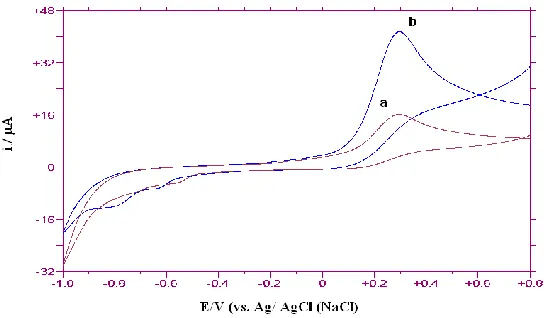
Fig. 1 shows the cyclic voltammograms for the oxidation of 0.5 mM ascorbic acid in 0.1 M KH2P04 supporting electrolyte at pH 6.0 at the GC electrode and Bi2O3 modified (Bi2O3 /GC) electrode
surfaces. It is evident that the Bi2O3/GC electrode exhibits a significant electrocatalytic activity as it
causes the oxidation current of ascorbic acid to increase by as much as 2 times Fig. (1b) as compared to those obtained by a bare GC electrode Fig. (1a). the oxidation of ascorbic acid appears irreversible due to the absence of electroactivity on the reverse scan during cyclic voltammetry for both the electrodes.
Figure 1. Cyclic voltammograms for oxidation of 0.5 mM ascorbic acid obtained at (a) bare GC electrode and (b) Bi2O3/GC in 0.1M KH2P04 ), with potential scanning in the positive direction
[image:3.596.163.435.553.712.2]
3.2. Effect of pH
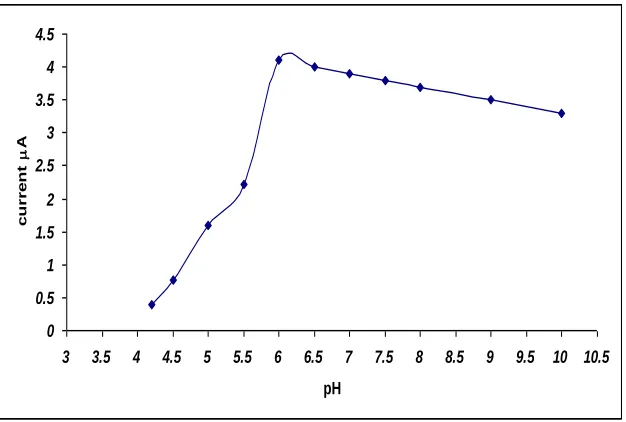
The pH of the solutions was varied from 4.0 to 10.0, in order to determine the optimum pH range with the electrocatalytic oxidation of 0.5 mM ascorbic acid at the Bi2O3/GC modified electrode.
Fig. 2 shows that the oxidation current of 0.5 mM ascorbic acid increases sharply from pH 4.2 to 6.0. Despite the current decreases slightly from pH 6.0 onwards, it remains high until pH 10 (Fig. 2). Therefore, the optimum pH range for current enhancement is between pH 6 to 10 with a maximum enhancement observed at pH 6.0. Consequently, pH 6.0 was employed in subsequent studies.
0 0.5 1 1.5 2 2.5 3 3.5 4 4.5
3 3.5 4 4.5 5 5.5 6 6.5 7 7.5 8 8.5 9 9.5 10 10.5
pH
c
urr
e
nt
m
A
Figure 2. Dependence of the oxidation current on pH using Bi2O3/GC electrode in 0.5 mM ascorbic
acid , 0.1 M KH2P04 with potential scanning in the positive direction from -1000 to +800 mV
vs Ag/AgCl at a scan rate of 100mV/s at 25°C and pH 6.0 .
3.3. Effect of temperature
Effect of temperature on the oxidation process of ascorbic acid was studied. The current increases gradually from 200C to 700C. Fig. 3 shows the plot of log oxidation current of ascorbic acid versus reciprocal of temperature was found to be fairly linear in agreement with thermodynamic expectation of Equations 1 and 2. The conductivity of the Bi2O3 microparticles with the increase in
temperature also played a significant influence on the activation energy for diffusion of the substrate of interest, Ea [28-29] as described by the Arrhennius equation (Eqs.1 and 2) given below.
σ = σ 0 Exp ( - Ea/ RT) (1)
[image:4.596.143.456.229.440.2]
Where σ /D are conductivity/diffusibility and σ 0
/ D is standard conductivity the initial diffusibility. However while use at elevated temperature, it can result to an increase in current, in nanopractical sense application needs to be continued close to ambient temperature. The activation energy (Ea) due to the oxidation of ascorbic acid at Bi2O3 modified GC electrode was found to be equal
to 5 kJ.mol-1.
y = -596.22x + 2.5
R2 = 0.9899
0 0.2 0.4 0.6 0.8 1 1.2 1.4
0 0.001 -1/T 0.002 0.003 0.004
lo
g
i
Figure 3. Arrhenius plot showing dependence of the current on temperature using 0.5mM ascorbic acid in 0.1M KH2P04, pH 6.0 at Bi2O3/GC electrode.
3.4. Effect of varying ascorbic acid concentrations
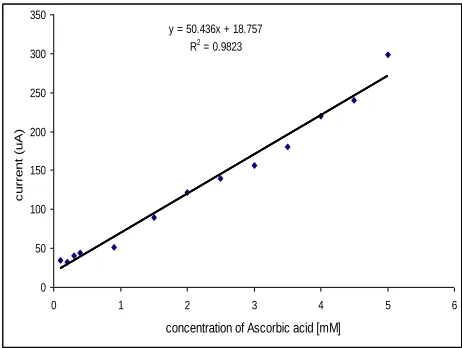
The concentration of standard ascorbic acid was determined using Bi2O3/GC modified
electrode as shown in (Fig 4). Optimization of pH was performed to obtain best sensitivity towards ascorbic acid. Voltammograms shows that peak current increases rapidly and linearly with increasing concentration of ascorbic acid from 0.5 to 5 mM. The relationship shows a strong correlation between the two parameters (R2 = 0.984) with an equation slope of 50.43 mA M-1 (Fig. 4).
y = 50.436x + 18.757 R2 = 0.9823
0 50 100 150 200 250 300 350
0 1 2 3 4 5 6
concentration of Ascorbic acid [mM]
c
u
rre
n
t
(u
[image:5.596.187.409.176.326.2]A)
Figure 4. Calibration graph of various ascorbic acid concentrations at Bi2O3/GC electrode immersed in
0.1 M KH2P04, pH 6.0, with potential scanning in the positive direction from -1000 to +800
[image:5.596.182.413.528.702.2]
3.5. Effect of varying Bi2O3 Dosages
The effect of varying the dosage of Microparticles Bi2O3 attached on the 3 mm diameter glass
carbon electrode surface ranging from 0.1mg to 0.4mg was studied. As shown in (Table 1), the results show that the use of increase Bi2O3 dosages was associated with an increasing oxidation peak current
of ascorbic acid as expected. However, 0.2mg is employed because use of a higher dosage would lead to a higher error due to the small electrode surface area.
Table 1. Effect of dosage Bi2O3 cast onto a GC electrode from a solution on the oxidation of 0.5
mM ascorbic acid in 0.1 M KH2PO4 (pH 6.0) electrolyte.
Dosage of Microparticles 0.1:0.4 mg( Bi2O3)
Oxidation current of Ascorbic acid(µA) Enhancement
0.1 0.2 0.3 0.4
4.11 5.18 5.12 5.52
3.6. Effect of varying scan rate
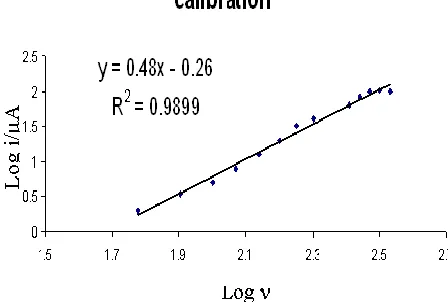
The effect of varying scan rates (v) on the cyclic voltammograms of 0.5 mM ascorbic acid using modified Bi2O3/GC as working electrode in 0.1 M KH2P04 supporting electrolyte was studied
over 5 – 1000 mV/s. Oxidation currents of ascorbic acid was observed to increase with scan rate due to heterogeneous kinetics. Fig. 5 shows the plot of log (peak current) versus log (scan rate, v) for oxidation current of the first cycle, a straight line was obtained fulfilling the equation y = 0.48 x – 0.26 with R2=0.9899. A slope of 0.48, which is comparable with theoretical slope of 0.5 for diffusion-controlled process, was obtained.
Figure 5. Plot of log Ipa versus log v. Effect of varying scan rates of 0.5 mM ascorbic acid using
[image:6.596.185.409.561.712.2]
3.7. Hydrodynamic voltammetry using rotating disk electrode (RDE)
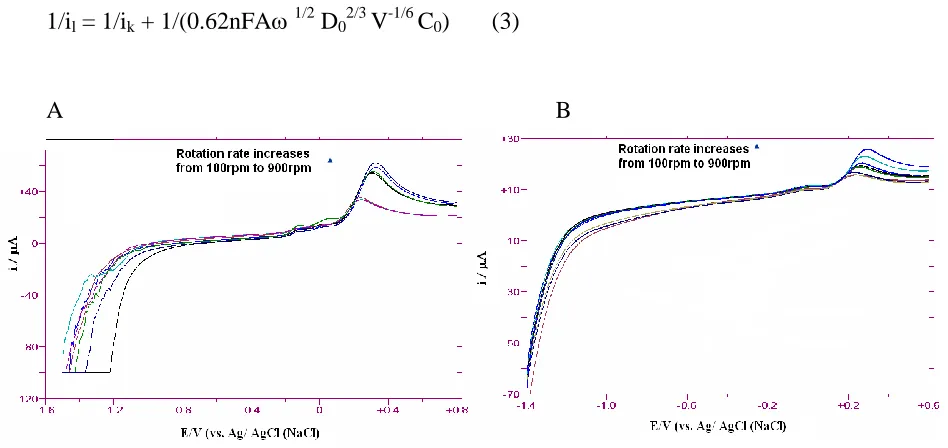
The RDE technique was used to determine the diffusion coefficient and rate constant of ascorbic acid under specified condition. (Fig. 6) shows steady-state voltammograms for the oxidation of ascorbic acid at bare GC electrode and Bi2O3/GC modified electrode. Since the electrode material
used are different the potential of the oxidation of ascorbic acid was observed to shift positively with increasing the electrode rotation rate based on the Kouteckey- Levich equation below,
1/il = 1/ik + 1/(0.62nFA1/2 D02/3 V-1/6 C0) (3)
[image:7.596.63.537.200.424.2]A B
Figure 6. Rotating disk voltammogams for the oxidation of AA (0.5mM) at rotating (a) bare and (b) Bi2O3/GC electrode at various rotation speed of 100- 900 rmp in 0.1 M KH2PO4 at pH 6.
Where ik is the kinetic current and is rotation rate/angular velocity, the other parameters have
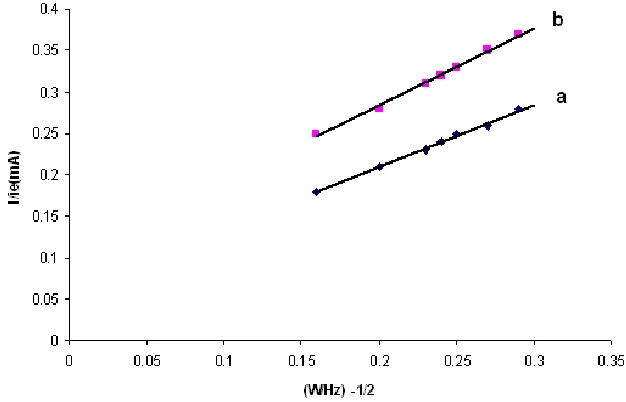
its usual meaning. The value of diffusion coefficient was obtained by plotting a reciprocal graph of limiting current il versus square root of angular velocity [30]. The diffusion coefficients of ascorbic
acid at room temperature obtained experimentally are 5.4 x 10⁻⁶ cm2s-1 and 6.2 x 10⁻⁶ cm2s-1 for bare GC electrode and Bi2O3/GC modified electrode respectively. The value of D was found above which is
in good agreement with that obtained from RDE voltammetry and quite comparable with those earlier in study, where D = (5.5 0.1) x 10-6 cm2s-1[31] . The rate constants for the catalytic reaction kf of the
system were also calculated for both unmodified and modified GC using the equation shown below:
ik= FAkf(E)C0* (4)
where ik is the partition coefficient of the chemical reaction between ascorbic acid and redox
sites of surface confined Bi2O3 as shown in (Fig. 7). The values of kinetic rate constant using the bare
GC and Bi2O3/GC modified electrode are 2.3x10⁻³cm s-1 and 2.7x 10⁻³cm s-1 respectively. A marked
difference of 10-4 s-1 or 18 % increase in kinetic rate value was obtained when the Bi2O3/GC modified
was also observed for the oxidation of methionine in the presence of GC and C60 modified Au
[image:8.596.144.457.149.350.2]electrode [32] . It can be attributed to the catalytic reaction, which becomes dominant with different electrode surface, which would invariably modify the electrochemical rate constant of the analyte.
Figure 7. Kentucky- Levich plots for the oxidation of 0.5 mM ascorbic acid at rotating (a) bare and (b) Bi2O3/GC desk electrode in 0.1 M KH2PO4 at pH 6.0.
3.8. Interference study
The effect of interfering amino acids and paracetamol on oxidation peak of ascorbic acid was studied using (CV) within a working range of -1000mV to +2000mV. It was observed that cysteine, methionine, glutamic acid, and folic acid in the ratio from 1:1 to 1:5 (ascorbic acid: interference substance) posed no interference on the oxidation peak of 0.05mM ascorbic acid. Fig. 8(a) shows that the oxidation peak of paracetamol (PC) concentrations at 0.6V increases in the presence of increasing amount of ascorbic acid at Bi2O3-GC modified electrode. The peak current of ascorbic acid at +0.2 V
was found to remain essentially unchanged with a significant shift in peak potential of 200 mV. While that of (PC) peak increases with a peak shift of 30mV Fig. 8(b), indicating the presence of an unexpected electrocatalytic behavior of AA, in addition to the electrocatalytic effect exerted by Bi2O3/GC electrode. The synergistic effect demonstrated by AA and Bi2O3 microparticles is currently
being explored further in our lab.
3.9. Scanning Electron Microscopy (SEM)
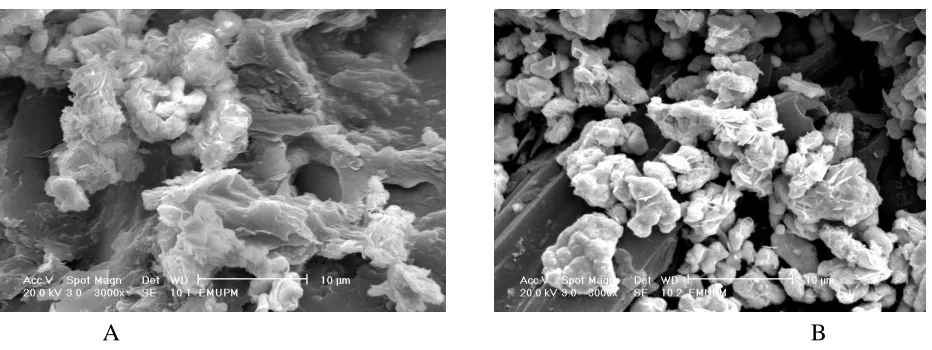
Scanning electron micrographs of Bi2O3 mechanically attached to a basal graphite electrode (5
mm diameter) and immersed in 0.1M KH2PO4 electrolyte (a) before electrolysis (b) after electrolysis
well defined features of solid materials dominated by a 1-3 µm diameter microparticles indicating solid to solid conversion process. The stability of the coat is evident as the solids appear intact dominated by well defined edges of micro sizes solid particles even after 20 potential cycling.
[image:9.596.53.536.155.315.2]A B
Figure 8.Cyclic voltammogram of the oxidation of different concentrations of AA and paracetamol at the Bi2O3-GC modified electrode, with potential scanning in the positive direction from -1000
to +1000 mV vs Ag/AgCl at a scan rate of 100mV/s at 25°C and pH 6.0 .
A B
Figure 9. Scanning Electron Microscopy shows the effect of electrolysis (a-before electrolysis; b- after electrolysis) on the morphology of neutral Bi2O3 microparticles
3.10. Recovery concentration of ascorbic acid in tablet and fruit juices
An evaluation of Bi2O3 modified electrode for determination of ascorbic acid in Cebion vitamin
C tablet of 1000 mg ascorbic acid was diluted to prepare 1.0mM and 0.5mM solution. Five replications were found to give excellent recoveries of 97.6 2.7 for 1.0mM and 98.4 2.3 for 0.5mM ascorbic acid were obtained (Table 2). In summary, the effectiveness of the Bi2O3 / GC electrode for the
[image:9.596.66.532.398.573.2]
Table 2. Recovery rate obtained for Cebion concentration of vitamin C tablet using freshly prepared modified electrode and diluted solution for both 1.0 and 0.5 mM ascorbic acid concentration, determined using Bi2O3 electrode under optimized condition in 0.1M KH2PO4 supporting electrolyte.
Table 3. Recovery concentration of ascorbic acid in Marigold peel Fresh-Tropical Mango juice and Apple juice, determined using Bi2O3 –modified GC electrode under optimized condition in 0.1
M KH2PO4 supporting electrolyte.
Real life sample Unknown
concentration (mM)
Mean (mM) RSD (%)
Marigold peel Fresh-Tropical Mango juice
1 2 3 4 5 0.83 0.88 0.89 0.84 0.84
0.85 2.8
Marigold peel Fresh-Tropical Apple juice
1 2 3 4 5 0.85 0.80 0.81 0.80 0.87
0.82 3.5
Indicated in terms of both reproducibility and reliability are found to be excellent provided a modified electrode is used for each experiment. The feasibility of Bi2O3 /GC modified electrode was further
assessed using fruit juices. The, standard addition method was used to determine the unknown
Real life sample Recovered concentration (mM) Recovery rate (%) Mean recovery (%) RSD (%) 1 .0 0 .5 1 .0 0 .5 1 .0 0 .5 1 .0 0.5
1 1
.0 0 .49 1 00 9 8
2 1
.01 0 .5 1 01 1 00
3 0
.96 0 .51 9 6 1 02 9 7.6 9 8.4 2 .7 2.3
4 0
.94 0 .48 9 4 9 6
5 0
[image:10.596.87.505.404.641.2]
concentration of ascorbic acid in these juices. (Table 3) shows that the ascorbic acid concentration found in mango and orange juices were 0.85 2.8% mM and 0.82 3.5% mM respectively.
4. CONCLUSIONS
Bi2O3/GC electrode was successfully fabricated and has exhibited electrocatalytic effect on the
oxidation of ascorbic acid. The use of 0.2mg dosage of Bi2O3 microparticles with 3mm diameter of GC
electrode resulted in the optimization of the oxidation current, which appeared to be 2.5 times more enhanced compared to bare GC electrode. Based on interference studies, most amino acids with the exception of paracetamol, do not pose serious interference in the analysis of ascorbic acid. Some physical constants such as diffusion coefficient, recovery of ascorbic acid in vitamin C tablet and fruit juices samples were found to be excellent. From the hydrodynamic studies using rotation disk electrode, the values of kinetic rate constant and diffusion coefficient for ascorbic acid were found to be 2.3x10⁻³ cm s-1 and 6.2 x 10⁻⁶ cm2s-1 respectively using Bi2O3/GC modified electrode. Bi2O3 film
appearances of well defined edges remain intact, even after 20 potential cycling. ACKNOWLEDGEMENT
The authors gratefully acknowledge the financial and material support provided by the Faculty of Science, Universiti Putra Malaysia.
References
1. Yaning Cui, Changzhu Yang, Wenhong pu, Munetaka Oyama.Zhang. Analytica Letter 43 (2010) 22-33
2. M.H. Pournaghi-Azar, H. Razmi-Nerbin, J. Electroanal. Chem. 456 (1998) 83-89
3. Nadezda Alexeyeva, Timo Laaksonen, Kyo sti Kontturi, Fakhradin Mirkhalaf, David J.Schiffrin, Kaido Tammeveski, Electrochem. Commun. 8 (2006) 1475–1480
4. Hui Fang Cui, Jian-Shan Ye, Wei-De Zhang, John Wang, Fwu-Shan Sheu, J. Electroanal. Chem. 577 (2005) 295–302
5. Liang Wang, Shaojun Guo, Lijian Huang, Shaojun Dong, Electrochem. Commun. 9 (2007) 827–832
6. Guoyu Gao, Daojun Guo, Ce Wang, Hulin Li, Electrochem. Commun.9 (2007) 1582–1586 7. Keith B. Male, Sabahudin Hrapovic, Yali Liu, Dashan Wang, John H.T. Luong, Anal.
Chimica Acta 516 (2004) 35–41
8. Sheng-Fu Wang, Fen Xie, Ruo-Fei Hu, 2007. Sensors and Actuators B 123 495–500
9. Zifeng Deng, Yang Tian, Xia Yin, Qi Rui, Haiqing Liu, Yongping Luo .Electrochem. Commun. 10(2008) 818–820
10.S.R. Sivakkumar, Jang Myoun Ko, Dong Young Kim, B.C. Kim, G.G. Wallace, Acta 52 (2007) 7377.7385
11.H.L. Pang, J.P. Lu, J.H. Chen, C.T. Huang, B. Liu and X.H. Zhang, .Acta 54(2009 )2610-2615 12.Dong Fang, Kelong Huang, Shuqin Liu, Zhaojian Li. j of Alloys and Compounds 464(2008) L5-L9 13.S.M. Chen, 42. Electrochim. Acta (1997)1663-1669
14.J.H. Zagal, P. Herrera, Acta Electrochim.30(1985) 449-451
16.R. Pauliukaite, R. Metelka, I. Svancara, A. Krolicka, A. Bobrowski, K. Vytras, E Norkus, K. Kalcher,. 374 Anal. Bioanal. Chem. 374 (2002) 1155-1161
17.Lingzhi Li, Bing Yan. . Journal of Alloys and Compounds 476( 2009) 624-628
18.P.R. Roy, M.S. Saha, T. Okajima, S.-G. Park, A. Fujishima, T. Ohsaka,. Electroanalysis 51 (2006) 4447-4453
19.T.P. Gujar, V.R. Shinde, C.D. Lokhande, R.S. Mane, S.-H. Han, Appl. Surf.Sci. 250 (2005)161-167 20.W.T.Tan, A.M.Bond,S.W.Ngooi,E.B.Lim,J.K.Goh. Analytica Chimica Acta 491 (2003)181-187 21.J.K.Goh W.T.Tan, .F.T.Lim,and N.A.M.Maamor. Malaysia.J.of Analytical Sciences12 (2008)
480-485
22.D. Ragupathy, A.I. Gopalan, K.P. Lee, K.M. Manesh, Electrochem. Commun. 10(2008) 527-532 23.X. Cao, L. Luo, Y. Ding, X. Zou, R. Bian,. Sens. Actuators B 129 (2008) 941-948
24.A.J.Bard, L.R.Faulker, 2001.Electrochemistry Methods,Fundamental and Application, Wiley,New York .
25.P.G.Bruce, 1955. Solid State Electrochemistry,Cambridag University Press, Cambridge
26.Protiva Rani Roy, Madhu Sudan Saha, Takeyoshi Okajima, Takeo Ohsaka. Electroanalysis 16( 2004) 289-296
27.W.T.Tan, J.K.Goh,. Electroanalysis 22 (2008) 2447-2453