Kinetic simulations of X-B and O-X-B mode conversion and its deterioration
at high input power
A. V. Arefiev,1, 2I. Y. Dodin,3A. K¨ohn,4 E. J. Du Toit,5E. Holzhauer,6V. F. Shevchenko,7and R. G. L. Vann5 1)
Institute for Fusion Studies, The University of Texas, Austin, Texas 78712, USA
2)Center for High Energy Density Science, The University of Texas, Austin, Texas 78712, USA
3)
Princeton Plasma Physics Laboratory, Princeton University, Princeton, New Jersey 08543, USA
4)Max Planck Institute for Plasma Physics, D-85748 Garching, Germany 5)
York Plasma Institute, Department of Physics, University of York, York YO10 5DD, UK
6)Institute of Interfacial Process Engineering and Plasma Technology, University of Stuttgart, D-70569 Stuttgart, Germany
7)
Tokamak Energy Ltd, 120A Olympic Avenue, Milton Park, Abingdon OX14 4SA, UK
(Dated: 26 December 2016)
Spherical tokamak plasmas are typically overdense and thus inaccessible to externally-injected microwaves in the electron cyclotron range. The electrostatic electron Bernstein wave (EBW), however, provides a method to access the plasma core for heating and diagnostic purposes. Understanding the details of the coupling process to electromagnetic waves is thus important both for the interpretation of microwave diagnostic data and for assessing the feasibility of EBW heating and current drive. While the coupling is reasonably well– understood in the linear regime, nonlinear physics arising from high input power has not been previously quantified. To tackle this problem, we have performed one- and two-dimensional fully kinetic particle-in-cell simulations of the two possible coupling mechanisms, namely X-B and O-X-B mode conversion. We find that the ion dynamics has a profound effect on the field structure in the nonlinear regime, as high amplitude short-scale oscillations of the longitudinal electric field are excited in the region below the high-density cut-off prior to the arrival of the EBW. We identify this effect as the instability of the X wave with respect to resonant scattering into an EBW and a lower-hybrid wave. We calculate the instability rate analytically and find this basic theory to be in reasonable agreement with our simulation results.
I. INTRODUCTION
In spherical tokamaks the plasma frequency usually exceeds the electron cyclotron frequency (ECF) over the whole confinement region, characterizing it as overdense. Electromagnetic waves in the ECF range can therefore not be used directly for heating or current drive. This is a particular disadvantage for spherical tokamaks as they rely on efficient non-inductive current drive mechanisms due to only very little space for a central transformer coil. Electron Bernstein waves (EBWs)1are electrostatic waves which can be used instead, since they are very well absorbed at the ECF and its harmonics and provide an efficient method for driving toroidal net currents2. Un-derstanding the details of the coupling process between electromagnetic waves and EBWs is important for assess-ing feasibility studies of EBW heatassess-ing and current drive and also for interpreting diagnostics involving EBWs.
At low to intermediate power levels, excitation of EBWs and subsequent current drive has been demon-strated successfully in spherical tokamaks3,4. The lin-ear regime has been studied numerically with full-wave codes5 and is well understood. On the other hand, the EBW physics in the nonlinear regime, which is of inter-est in the context of heating and current drive in modern fusion devices, still presents a challenge6,7. A complete
analytical description of the nonlinear regime is not gen-erally feasible and therefore numerical simulations are required.
A self-consistent description of electron kinetics and wave propagation must resolve spatial and temporal scales associated with the electron gyro-motion in order to correctly recover the physics relevant to EBWs. One suitable approach is the particle-in-cell (PIC) framework that uses macro-particles to simulate electrons and ions kinetically. In a recent publication9, we reported results of one-dimensional (1D) and two-dimensional (2D) sim-ulations performed in a linear regime using the particle-in-cell code EPOCH8. (For another relevant project in-volving PIC simulations of upper-hybrid (UH) waves see Ref.10) These simulations successfully reproduce X-B and O-X-B mode conversion, with both the initial electro-magnetic mode and the excited EBW matching the linear dispersion relations. These benchmarking runs confirm that PIC codes are suitable for studies of EBW excita-tion and, most importantly, they identify the simulaexcita-tion parameters needed to correctly reproduce the mode con-version.
In this work, we use 1D and 2D PIC simulations to examine the mode conversion and associated physics in nonlinear regimes where the wave amplitude is suffi-ciently high to appreciably affect the thermal electron
2
motion. We find that the ion mobility has a profound effect on the wave electric field structure in the non-linear regime. Our kinetic simulations show that high-amplitude short-scale oscillations of the longitudinal elec-tric field are excited in the region below the high-density cut-off prior to the arrival of the EBW generated at the upper-hybrid resonance via a mode conversion. Simula-tions performed with immobile ions show no such short-scale oscillations. Using a detailed analysis of the ion dy-namics in the simulations, we have identified the plasma oscillations driven in the nonlinear regime as lower-hybrid (LH) oscillations. This is in agreement with earlier stud-ies11–14 where the X-wave was reported to become un-stable with respect to backscattering into an EBW and an LH wave. Therefore, our present work can be under-stood as the first study where this instability is observed in first-principle PIC simulations. We also compare our numerical results with the theory of this scattering insta-bility. However, an in-depth theoretical analysis is left to a companion paper15.
The rest of the paper is organized as follows. In Sec. II, we describe the setups that we use in our PIC simulations to examine the EBW excitation in the nonlinear regime. Sections III and IV present simulations of the X-B con-version in the nonlinear regime and the corresponding analysis of the ion dynamics. Simulations of the O-X-B conversion in the nonlinear regime are discussed in Sec. V. Section VI provides a theoretical model that we use to explain the origin of the observed instability. Fi-nally, in Sec. VII, we summarize our results and discuss their implication for future experiments with high input power.
II. 1D AND 2D PIC SETUPS FOR STUDYING EBW EXCITATION
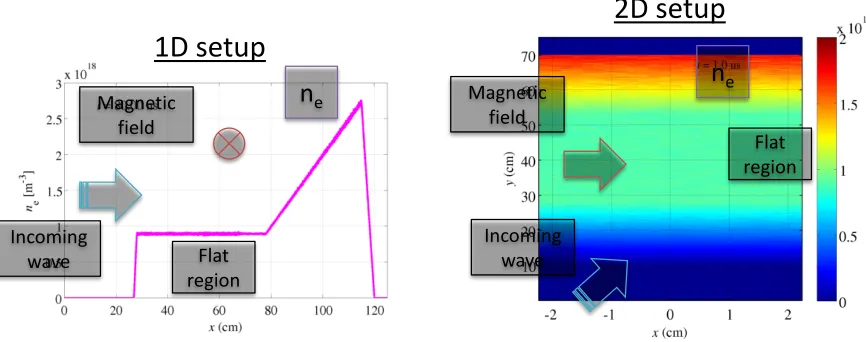
In a recent publication9, we proposed 1D and 2D se-tups that are suitable for simulation and clear identifica-tion of the EBW excitaidentifica-tion using a standard PIC code (Fig. 1). Both setups have common features that need to be emphasized. A plane incoming wave is injected into a vacuum gap that is deliberately introduced between the plasma and the computational domain boundary on the injection side. A uniform magnetic fieldB0 that is par-allel to the injection boundary is initialized throughout the simulation domain. (B0is directed along they-axis in the 1D setup and along thex-axis in the 2D setup.) The plasma density profile has three distinct regions. Region I, which is on the injection side, corresponds to a steep density profile that includes the UH resonance (UHR). Region II, which is in the middle, corresponds to an ex-tended flat density region. Region III, which is on the opposite side, corresponds to a steep density profile that includes a high-density cut-off for an X-mode.
The multi-gradient density profile makes it convenient to both excite and observe EBWs in the X-B and O-X-B conversions in simulations. Region I is where the EBW
excitation takes place. The density gradient in this re-gion needs to be very steep in order to simulate the X-B mode conversion. This scenario relies on X-mode tun-neling past the low-density cut-off and subsequent exci-tation of an EBW in the vicinity of the UH layer. The efficiency strongly depends on the distance between the low-density cut-off and the UH layer and, therefore, it can be dramatically increased by using a steep density gradient. Region II is introduced to aid EBW identifica-tion following its excitaidentifica-tion. There is no density gradient in this extended region, so that the dispersion relation of propagating waves remains unchanged. Finally, Re-gion III is introduced to provide a high-density cut-off for an X-mode. The cut-off reflects an X-mode propa-gating from Region II up the density gradient. We use the steepness of the density profile in this region primar-ily to minimize the size of the simulation domain. There is a vacuum gap between this region and the boundary of the simulation domain in order to eliminate possible numerical boundary artifacts in particle dynamics.
The 2D setup (right panel of Fig. 1) allows for the in-coming waves to be injected at an angle to the applied magnetic field (directed along thex-axis) and to the den-sity gradient (directed along the y-axis). This setup is therefore helpful for achieving and observing an O-X-B mode conversion. Even though a full 2D simulation in which an incoming wave packet has a finite transverse width is possible, it is computationally demanding be-cause the box has to be sufficiently wide to accommo-date the entire path of the wave packet. A “reduced” 2D setup is needed to facilitate multiple runs that are necessary for parameter scans. Such a reduced setup is achieved by using periodic boundary conditions (for par-ticles and fields) on the left and right side of the domain shown in Fig. 1 (right panel). In this setup, the injected wave is a plane wave with given wave-vector components parallel (kk ≡kx) and perpendicular (k⊥ ≡ ky) to the
magnetic field. The transverse size of the domain (along thex-axis) is set to 2π/kk to account for the wave pe-riodicity. We use open boundary conditions at the top and bottom boundaries of the simulation domain. Note that the 1D setup similarly employs open boundary con-ditions.
Ultimately, the following considerations should be kept in mind when choosing the density in the flat region in both setups: 1) if O and X modes are not desired in the flat region (Region II), then its density should be above the high-density cutoff; 2) the wavelength of the EBW that decreases with density must be large enough compared to the grid size in order to resolve the EBW oscillations; 3) the amplitude of the numerical field fluc-tuations that increases with density for a fixed number of macro-particles per cell must be much less than the amplitude of the expected EBW signal.
3
2D setup
Incoming wave1D setup
n
en
e Magnetic field Flat region Flat region Magnetic field Incoming waveFIG. 1. One and two-dimensional setups for PIC simulations of the X-B and O-X-B mode conversion9. High-performance spherical tokamaks are usually overdense
(typically ωpe/ωce ~ 4 in the core) and so regular electron cyclotron emission is blocked. However, electron Bernstein waves (EBW), generated at the local cyclotron frequency (and its harmonics) in the core may be observed outside the plasma via a mode conversion process that takes place typically in the plasma edge between an electromagnetic mode and the (electrostatic) electron Bernstein wave. Understanding the details of this mode conversion process is important in tokamaks with over-dense plasmas both for the interpretation of microwave diagnostic data and to assess the feasibility of EBW heating and/or current drive.
We have performed the first ever 2-D fully-kinetic simulations of O-X-B mode conversion using the particle-in-cell code EPOCH. In addition to benchmarking these numerical results against the linear dispersion relation, we have also investigated nonlinearities associated with a larger incident intensity and the effect of a steeper (and more realistic) density gradient at the mode conversion layer.
Kinetic simulations of X-B and O-X-B mode conversion
A. V. Arefiev
1
, E. J. Du Toit
2
, A. K
ö
hn
3,4
, E. Holzhauer
3
, V. F. Shevchenko
5
, and R. G. L. Vann
2
1
Institute for Fusion Studies, Univ. of Texas, Austin, TX, USA;
2
York Plasma Institute, Dept. of Physics, Univ. of York, York, U.K.;
3
IGVP, Univ. of Stuttgart, Stuttgart, Germany;
4
Max Planck Institute for Plasma Physics, Garching, Germany;
5
EURATOM/CCFE Fusion Association, Culham Science Centre, Abingdon, U.K.
Acknowledgements
This work was funded in part by the US Department of Energy under grant DE-FG02-04ER54742, the University of York, the UK EPSRC under grant EP/G003955, and the European Communities under the contract of Association between EURATOM and CCFE. Simulations were performed on the HELIOS supercomputer at the IFERC-CSC, Rokkasho, Japan and on the TACC supercomputer at the University of Texas at Austin.
Abstract
O-X-B conversion in nonlinear regime
Summary
Setups for studying EBW excitation
21
stTopical Conference on Radiofrequency Power in Plasmas, Lake Arrowhead, California, April 27-29, 2015
O-X-B conversion in linear regime (benchmarking)
We study EBW excitation in 1D and 2D geometry.
The applied magnetic field B0 is uniform.
The wave is launched from the vacuum.
The electron density gradient is perpendicular to B0.
Two mechanisms of EBW excitation can be studied using these setups:
O-X-B conversion
X-B conversion via tunneling
2D setup
1D setup
Incoming wave Incoming wave Magnetic field
ne ne
periodic b. c. periodic
b. c.
Full 2D PIC simulation of O-X-B conversion
We have demonstrated EBW excitation in a full 2D PIC simulation.
A full 2D simulation is computationally demanding, so a periodic setup can be used to reduce the transverse size of the domain.
Key parameters:
B0 = 0.25 T
f = 10 GHz
linear density ramp ne = ncrit at x = 0.5 m
incoming wave = 106 V/m
Te = 1 keV
immobile ions
Ex
Kinetic simulations using particle-in-cell code
Simulations are performed using an open source particle-in-cell (PIC)
code EPOCH developed at the University of Warwick, U.K.
EPOCH is an MPI parallelized, explicit, second-order, relativistic code.
EPOCH key features include: dynamic load balancing; MPI-IO based output;
control of setup and runs through a customizable input deck.
Two main blocks of EPOCH are: 1) particle pusher in given fields and 2) field solver for a given particle current.
A PIC simulation treats wave propagation kinetically, as individual macro-particles that generate the current move according to the full equation of motion.
Numerical accuracy is determined by the number of macro-particles per cell and by the spatial and temporal resolution.
A certain amount of numerical noise due to a limited number of macro-particles per cell is expected.
UHR EBW EBW Slow X-mode O-mode UHR
47 ns 76 ns
47 ns 76 ns
EBW
EBW
Ey Ey
k-spectrum
k-spectrum
To check the EBW dispersion relation in a linear regime, we use a 2D periodic setup with a flat plasma density region.
X-B conversion in linear regime (benchmarking)
X-mode X-mode EBW X-mode EBW
k-spectrum
Key parameters:B0 = 0.25 T f = 10 GHz
To recover the EBW excitation via tunneling, we use a 1D setup with a sharp density gradient at the edge of a flat plasma region.
normal incidence
ne = 2.2 ncrit in the flat region
incoming wave = 105 V/m
Te = 1 keV and immobile ions
Key parameters:
B0 = 0.25 T
f = 10 GHz
40o incidence angle
ne = 0.72 ncrit in the flat region
incoming wave = 5 x 10⁴ V/m
Te = 1 keV and immobile ions
X-B conversion in nonlinear regime
Our objective is to investigate excitation of electron-Bernstein waves in a nonlinear regime where the incoming wave appreciably distorts electron thermal motion.
The nonlinear regime is accessed by increasing the amplitude of the
incoming wave to 8 x 10⁵ V/m.
Tunneled X-mode
EBW
+ 40 ns
+ 40 ns Tunneled X-mode EBW Short-scale oscillations Short-scale oscillations
k-spectrum
k-spectrum
20 ns 20 ns 60 ns 60 ns Tunneled X-mode EBW
+ 40 ns
+ 40 ns Tunneled
X-mode
EBW
k-spectrum
k-spectrum
ne 20 ns 20 ns 60 ns 60 ns EBW Tunneled and reflected EBW Tunneled and reflected 60 ns
Immobile ions
Hot mobile ions
The EBW considerable changes the average electron kinetic energy (x 2).
The basic features are preserved in this nonlinear regime if the ions are immobile.
Perturbations caused by EBW Expected EBW wave front location
Ion motion enables excitation of short-scale oscillations.
The oscillations appear before the EBW can reach the same region propagating from the UHR layer.
17 ns 26 ns
15 ns 28 ns
O-mode
Ey Ey
Slow X-mode
Fast
X-mode X-mode Slow
Short-scale oscillations
Our goal is to determine whether the “instability” also develops in a 2D setup with the O-X-B conversion.
We access the non-linear regime by setting the amplitude of the incoming wave injected at 40o to the density gradient at 8 x 10⁵ V/m.
The deuterium ions are mobile with Ti = 1 keV.
ne critical density UHR
k-spectrum
Ey Ey
O-mode
Slow X-mode
Short-scale oscillations
High amplitude short-scale oscillations are observed in the flat density region.
The oscillations grow on a time scale shorter than the time required for the O-X-B conversion to take place (before the slow X-mode reaches the X-B conversion layer).
We have demonstrated capabilities of a PIC code EPOCH to simulate EBW excitation in 1D and 2D geometry.
We have benchmarked the code by simulating X-B and O-X-B mode conversion in a linear regime (low wave amplitude) and correctly recovering the EBW wave-length.
We have also simulated X-B and O-X-B mode conversion in a
nonlinear regime where field of the driving wave appreciably distorts electron thermal motion.
We find that the ion mobility has a profound effect on the field structure in the nonlinear regime.
High amplitude short-scale electric field oscillations are observed in the region below the high-density cut-off prior to the arrival of the EBW.
800 electrons per cell 800 ions per cell
∆y = 7.1 x 10⁻³ cm
24000 electrons per cell immobile ions
∆x = 7.8 x 10⁻³ cm
Linear dispersion relation High density cut-off UHR Low density cut-off High density cut-off Low density cut-off UHR ne 60 ns High density cut-off Low density cut-off UHR critical density UHR Slow X-mode
Immobile
ions
FIG. 2. 1D PIC simulation of the X-B mode conversion in a nonlinear regime withimmobile ions.
the O-mode, X-mode, and the excited EBW matching their linear dispersion relations9. These benchmarking runs confirm that PIC simulation is suitable for studies of EBW excitation and, most importantly, they identify the simulation parameters needed to correctly reproduce the mode conversion. In this work, we use the 1D and 2D setups to examine the mode conversion in nonlinear regimes, where the wave amplitude is sufficiently high to affect the thermal electron motion.
III. X-B CONVERSION IN A NONLINEAR REGIME
The primary objective of our study is to investigate excitation of EBWs in a nonlinear regime that we access by increasing the amplitude of the incoming wave. In this regime, the wave distorts the thermal motion of electrons. A PIC code simulation is a fully-kinetic simulation that resolves the electron dynamics, which makes it a well-suited approach for this problem. In the present work we use the MPI-parallelized explicit second-order relativistic code EPOCH8.
4 High-performance spherical tokamaks are usually overdense
(typically ωpe/ωce ~ 4 in the core) and so regular electron cyclotron emission is blocked. However, electron Bernstein waves (EBW), generated at the local cyclotron frequency (and its harmonics) in the core may be observed outside the plasma via a mode conversion process that takes place typically in the plasma edge between an electromagnetic mode and the (electrostatic) electron Bernstein wave. Understanding the details of this mode conversion process is important in tokamaks with over-dense plasmas both for the interpretation of microwave diagnostic data and to assess the feasibility of EBW heating and/or current drive.
We have performed the first ever 2-D fully-kinetic simulations of O-X-B mode conversion using the particle-in-cell code EPOCH. In addition to benchmarking these numerical results against the linear dispersion relation, we have also investigated nonlinearities associated with a larger incident intensity and the effect of a steeper (and more realistic) density gradient at the mode conversion layer.
Kinetic simulations of X-B and O-X-B mode conversion
A. V. Arefiev
1
, E. J. Du Toit
2
, A. K
ö
hn
3,4
, E. Holzhauer
3
, V. F. Shevchenko
5
, and R. G. L. Vann
2
1
Institute for Fusion Studies, Univ. of Texas, Austin, TX, USA;
2York Plasma Institute, Dept. of Physics, Univ. of York, York, U.K.;
3IGVP, Univ. of Stuttgart, Stuttgart, Germany;
4
Max Planck Institute for Plasma Physics, Garching, Germany;
5EURATOM/CCFE Fusion Association, Culham Science Centre, Abingdon, U.K.
Acknowledgements
This work was funded in part by the US Department of Energy under grant DE-FG02-04ER54742, the University of York, the UK EPSRC under grant EP/G003955, and the European Communities under the contract of Association between EURATOM and CCFE. Simulations were performed on the HELIOS supercomputer at the IFERC-CSC, Rokkasho, Japan and on the TACC supercomputer at the University of Texas at Austin.
Abstract
O-X-B conversion in nonlinear regime
Summary
Setups for studying EBW excitation
21
stTopical Conference on Radiofrequency Power in Plasmas, Lake Arrowhead, California, April 27-29, 2015
O-X-B conversion in linear regime (benchmarking)
We study EBW excitation in 1D and 2D geometry.
The applied magnetic field B0 is uniform.
The wave is launched from the vacuum.
The electron density gradient is perpendicular to B0.
Two mechanisms of EBW excitation can be studied using these setups:
O-X-B conversion
X-B conversion via tunneling
2D setup
1D setup
Incoming wave Incoming wave Magnetic field ne ne periodic b. c. periodic b. c.
Full 2D PIC simulation of O-X-B conversion
We have demonstrated EBW excitation in a full 2D PIC simulation.
A full 2D simulation is computationally demanding, so a periodic setup can be used to reduce the transverse size of the domain.
Key parameters:
B0 = 0.25 T
f = 10 GHz linear density ramp ne = ncrit at x = 0.5 m
incoming wave = 106 V/m
Te = 1 keV
immobile ions
Ex
Kinetic simulations using particle-in-cell code
Simulations are performed using an open source particle-in-cell (PIC) code EPOCH developed at the University of Warwick, U.K.
EPOCH is an MPI parallelized, explicit, second-order, relativistic code.
EPOCH key features include: dynamic load balancing; MPI-IO based output;
control of setup and runs through a customizable input deck.
Two main blocks of EPOCH are: 1) particle pusher in given fields and 2) field solver for a given particle current.
A PIC simulation treats wave propagation kinetically, as individual macro-particles that generate the current move according to the full equation of motion.
Numerical accuracy is determined by the number of macro-particles per cell and by the spatial and temporal resolution.
A certain amount of numerical noise due to a limited number of macro-particles per cell is expected.
UHR EBW EBW Slow X-mode O-mode UHR
47 ns 76 ns 47 ns 76 ns
EBW
EBW
Ey Ey
k-spectrum
k-spectrum
To check the EBW dispersion relation in a linear regime, we use a 2D periodic setup with a flat plasma density region.
X-B conversion in linear regime (benchmarking)
X-mode X-mode EBW X-mode EBW
k-spectrum
Key parameters:B0 = 0.25 T
f = 10 GHz
To recover the EBW excitation via tunneling, we use a 1D setup with a sharp density gradient at the edge of a flat plasma region.
normal incidence
ne = 2.2 ncrit in the flat region
incoming wave = 105 V/m
Te = 1 keV and immobile ions
Key parameters:
B0 = 0.25 T
f = 10 GHz
40o incidence angle
ne = 0.72 ncrit in the flat region
incoming wave = 5 x 10⁴ V/m
Te = 1 keV and immobile ions
X-B conversion in nonlinear regime
Our objective is to investigate excitation of electron-Bernstein waves in a nonlinear regime where the incoming wave appreciably distorts electron thermal motion.
The nonlinear regime is accessed by increasing the amplitude of the incoming wave to 8 x 10⁵ V/m.
Tunneled X-mode
EBW
+ 40 ns
+ 40 ns Tunneled X-mode EBW Short-scale oscillations Short-scale oscillations
k-spectrum
k-spectrum
20 ns 20 ns 60 ns 60 ns Tunneled X-mode EBW+ 40 ns
+ 40 ns Tunneled
X-mode
EBW
k-spectrum
k-spectrum
ne 20 ns 20 ns 60 ns 60 ns EBW Tunneled and reflected EBW Tunneled and reflected 60 ns
Immobile ions
Hot mobile ions
The EBW considerable changes the average electron kinetic energy (x 2).
The basic features are preserved in this nonlinear regime if the ions are immobile.
Perturbations caused by EBW Expected EBW wave front location
Ion motion enables excitation of short-scale oscillations.
The oscillations appear before the EBW can reach the same region propagating from the UHR layer.
17 ns 26 ns
15 ns 28 ns
O-mode
Ey Ey
Slow X-mode
Fast
X-mode X-mode Slow
Short-scale oscillations
Our goal is to determine whether the “instability” also develops in a 2D setup with the O-X-B conversion.
We access the non-linear regime by setting the amplitude of the incoming wave injected at 40o to the density gradient at 8 x 10⁵ V/m.
The deuterium ions are mobile with Ti = 1 keV.
ne critical density UHR
k-spectrum
Ey Ey
O-mode
Slow X-mode
Short-scale oscillations
High amplitude short-scale oscillations are observed in the flat density region.
The oscillations grow on a time scale shorter than the time required for the O-X-B conversion to take place (before the slow X-mode reaches the X-B conversion layer).
We have demonstrated capabilities of a PIC code EPOCH to simulate EBW excitation in 1D and 2D geometry.
We have benchmarked the code by simulating X-B and O-X-B mode conversion in a linear regime (low wave amplitude) and correctly recovering the EBW wave-length.
We have also simulated X-B and O-X-B mode conversion in a
nonlinear regime where field of the driving wave appreciably distorts electron thermal motion.
We find that the ion mobility has a profound effect on the field structure in the nonlinear regime.
High amplitude short-scale electric field oscillations are observed in the region below the high-density cut-off prior to the arrival of the EBW.
800 electrons per cell 800 ions per cell
∆y = 7.1 x 10⁻³ cm
24000 electrons per cell immobile ions
∆x = 7.8 x 10⁻³ cm
[image:4.612.130.492.53.294.2]Linear dispersion relation High density cut-off UHR Low density cut-off High density cut-off Low density cut-off UHR ne 60 ns High density cut-off Low density cut-off UHR critical density UHR Slow X-mode
Mobile
ions
FIG. 3. 1D PIC simulation of the X-B mode conversion in a nonlinear regime withmobile ions.
can be examined in a 1D simulation. In the simulations presented below, we use a confining magnetic fieldB0= 0.25 T and an incoming wave with frequencyf = 10 GHz. The peak amplitude of the incoming wave that follows a gradual initial ramp-up is set to 8×10⁵ V/m. The size of the computational domain is 2 m (6×10⁴ cells). The wave is injected at the left boundary located at x = 0. The incoming wave is an X-mode whose electric field is polarized along thez-axis.
The initial electron density profile is adopted in the form
ne/ncrit=
0, forx < xb1; 128(x−xb1)/l, forxb1≤x < xL;
0.72, forxL≤x≤xR;
4(x−x2)/l, forxR< x < xb2;
0, forx≥xb2,
(1)
where ncrit≈1.24×10¹⁸ m−3 is the critical density for
the chosen frequency. We have introduced the follow-ing quantities to parameterize the multi-gradient density profile: xL = 0.28 m, xR = 1.58 m, ∆x= 0.005625 m,
xb1=xL−∆x,xb2= 1.95 m,x2= 1.4 m, andl= 1 m. The electron population is initialized using 400 macro-particles per cell. The initial electron temperature is set at Te= 950 eV. We also initialize deuterium ions using
400 macro-particles per cell with the ion number density equal toneand the ion temperature equal toTe.
Our first simulation in the nonlinear regime was per-formed with immobile ions. This was motivated by the fact that the ion mobility has no significant impact on the dispersion relation of EBWs in a linear regime. Snap-shots of transverse (Ez) and longitudinal (Ex) electric
field components are shown in the upper panels of Fig. 2 at 20 ns and 60 ns into the simulation. As the X-mode tunnels into the flat density region, it excites an EBW at the sharp density gradient (upper-left panel of Fig. 2). The corresponding k-spectrum for the longitu-dinal component of the electric fieldEx as a function of
the distance into the plasma is shown in the lower-left panel of Fig. 2. The excited EBW follows the dispersion
0 2
k, m-1
0 4 6 8 am pl it ude , a .u .
0.3 m < x < 0.9 m
500 1000 1500 2000 2500
Ex Ez am pl it ude , a .u . 0 2 4 6
8 Immobile ions
Mobile ions 0.3 m < x < 0.9 m
[image:4.612.330.549.451.675.2] [image:4.612.65.297.475.542.2]5
relation predicted for the linear regime (marked with a dashed vertical line). The right two panels in Fig. 2 show the field profile and the k-space 40 ns later. By this point, the tunneled X-mode has already reflected off the high-density cut-off on the right of the simulation domain and it is moving towards the UH layer. The basic fea-tures of the EBW spectrum however remain unaffected by this large-amplitude reflected wave, similarly to what one would expect in the linear regime.
The second simulation in the nonlinear regime was performed with mobile ions and the results are shown in Fig. 3. The initial stage prior to the X-mode being reflected off the high-density cut-off (left two panels in Fig. 3) is similar to what we observed in the simulation with immobile ions (left two panels in Fig. 2). How-ever, the field structure dramatically changes 40 ns later, as the reflected X-mode starts to propagate through the plasma. As evident from the two right panels in Fig. 3, short-scale oscillations appear throughout the plasma.
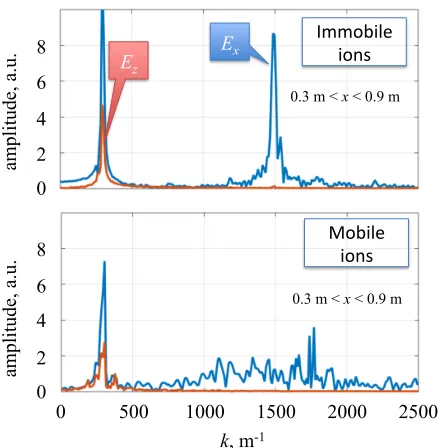
In order to closely examine the differences in the elec-tric field structure for the cases of mobile and immobile ions, we have performed a Fourier analysis of the field in the flat density region at 45 ns into the simulation. It is worth noting that an EBW that is excited in a lin-ear regime at the sharp density gradient would cover less than half of the flat region by this time. We therefore separately consider the left (0.3 m< x <0.9 m) and the right (0.9 m< x <1.5 m) side of the flat density region, with the corresponding spectra shown in Figs. 4 and 5. In the case of immobile ions, short-scale oscillations of the longitudinal electric field are concentrated on the left side of the flat region (compare the two upper panels of Figs. 4 and 5). Their spectrum has a very pronounced
0 0.5
k, m-1 1
1.5
am
pl
it
ude
, a
.u
.
0.9 m < x < 1.5 m
1000 1500 2000 2500
Ex
am
pl
it
ude
, a
.u
.
0 0.5 1 1.5
Immobile ions
Mobile ions
0.9 m < x < 1.5 m
Ex 2
2
FIG. 5. Spectra of the longitudinal electric field at 45 ns into the simulation in the flat region for 0.9 m< x <1.5 m.
peak centered aroundk ≈1500 m−1. This is the EBW mode that is excited at the sharp density gradient and which propagates from left to right.
In the case of mobile ions, the short-scale part of the Ex spectrum (see lower panels of Figs. 4 and 5) has a
qualitatively different structure from that in the case of immobile ions. The two striking differences are: (i) the absence of a sharp peak centered atk ≈1500 m−1 cor-responding to an EBW excited in the linear regime; (ii) strong short-scale oscillations on the right side of the flat density region. It is worth emphasizing that the right side is not accessible on the considered time scale (45 ns) to an EBW propagating from the sharp density gradient on the left. We can then conclude that the ion mobility pro-foundly changes the interaction between different modes, as it enables excitation of short-scale electric field oscilla-tions without the X-B mode conversion. In other words, deep inside the density plateau, the EBW is not produced through mode conversion but rather results from a local instability of the X wave.
IV. ION DYNAMICS IN THE NONLINEAR REGIME
In the previous section, we showed that the ion mobil-ity has a profound impact on the electric field structure in the nonlinear regime. In what follows, we explore in detail the ion dynamics in the nonlinear regime in order to gain a better insight into the observed phenomenon.
We have performed an additional simulation in the nonlinear regime with mobile ions, but in this case we ini-tialized the ions as cold. A comparison of the wave struc-ture between this simulation and the simulation with hot ions shows that the wave structure reported in Sec. III remains for the most part unaffected by the ion thermal motion or the lack thereof. We can then conclude that the observed change in the wave structure in the nonlin-ear regime is primarily related to the ion mobility rather than the ion temperature.
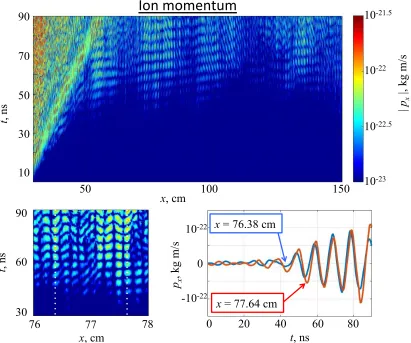
In order to examine the ion dynamics in the nonlin-ear regime, we take a closer look at the evolution of the ion momentum. If the ions are initially hot, then their thermal motion makes it technically challenging to de-couple and visualize collective modes in the momentum space. However, since the thermal motion is not a key factor, we can examine the ion dynamics for the case of initially cold ions instead. In this case, the longitudinal ion momentumpx effectively becomes just a function of
xand t, since ions at the same location have a similar momentum.
6
30
60
90
76
77
78
x
, cm
0
40
80
t
, ns
60
20
t
, ns
p
x, kg
m
/s
0
10
-22-10
-22x
= 76.38 cm
x
= 77.64 cm
10
30
50
t
, ns
70
90
10
-21.510
-2210
-22.510
-23|
p
x|, kg
m
/s
Ion momentum
50
100
150
[image:6.612.104.515.55.398.2]x
, cm
FIG. 6. Ion momentum in a 1D PIC simulation of the nonlinear regime with initially cold ions. The lower-left panel is a zoom-in of the upper panel for 76 cm< x <78 cm and 30 ns< t <90 ns. The lower-right panel gives a time evolution of the ion momentum at two fixed locations,x= 76.38 cm andx= 77.64 cm, marked in the lower-left panel with the dotted lines.
pronounced ion oscillations that seem to originate within the flat density region. The lower-left panel provides a zoomed-in version of the original ion momentum plot. It is evident from this plot that the ions perform periodic longitudinal oscillations whose amplitude grows in time. The lower-right panel gives a time evolution ofpxat two
fixed locations that are marked in the lower-left panel with the dotted lines. It is important to point out that the characteristic time scale of these oscillations is much larger than the period of the incoming wave.
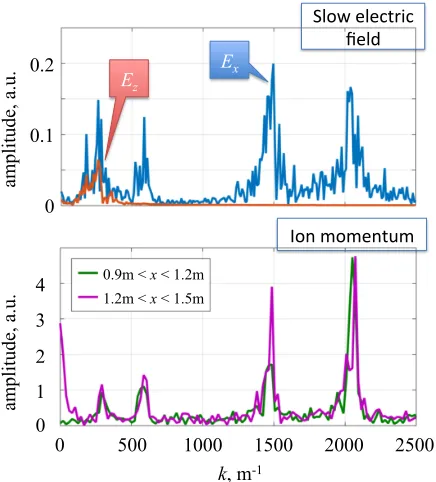
The lower panel of Fig. 7 shows the correspondingk -spectrum of the ion momentum oscillations in the flat density region. In order to isolate the oscillations that originate in the flat density region, the Fourier analysis was performed att= 59 ns for 0.9 m< x <1.2 m and 1.2 m< x <1.5 m. It is instructive to compare the obtained spectrum that has two short-scale modes (k≈1500 m−1 and k≈2000 m−1) and two long-scale modes (k≈300 m−1 and k ≈ 600 m−1) with the spectra of the elec-tric field shown in Figs. 4 and 5 for the cases of mobile and immobile ions. The two pronounced short-scale ion oscillations (k≈1500 m−1andk≈2000 m−1) differ
sig-nificantly from the short-scale longitudinal electric field oscillations shown in the lower panel of Fig. 5. On the other hand, one of the short-scale (k ≈1500 m−1) and one of the long-scale (k ≈ 300 m−1) modes appear to match the k-vectors of the modes that we observed in the simulation with immobile ions.
7
0 1
k, m-1 0
2 3 4
am
pl
it
ude
, a
.u
.
0.9m < x < 1.2m 1.2m < x < 1.5m
500 1000 1500 2000 2500
Ex Ez
am
pl
it
ude
, a
.u
.
0 0.1 0.2
Ion momentum Slow electric
[image:7.612.68.286.53.294.2]field
FIG. 7. Spectra of a slow electric field (upper panel) and of the longitudinal ion momentum (lower panel) at 59 ns into the simulation with initially cold ions. The spectra are calculated in the flat region for 0.9 m < x <1.5 m. The slow electric field is a time-average of the electric field over two periods of the incoming wave (f= 10 GHz).
which enabled us to identify the corresponding modes. It must be pointed out that the units used to normal-ize the vertical scale in Figs. 4 and 5 and in the upper panel of Fig. 7 are the same. The height of the peaks in the slow electric field spectrum is almost an order of magnitude smaller than the height of the peaks in Figs. 4 and 5. It is therefore not surprising that the slow electric field oscillations are not easily visible without the time-averaging. The bottom line is that the ion dynamics in the flat density region that arises without the converted EBW is coupled to four “slow” modes: two short-scale modes and two long-scale modes.
V. O-X-B CONVERSION IN A NONLINEAR REGIME
In order to determine whether the excitation of the short-scale electric fields is a robust feature, we have also carried out a 2D PIC simulation. We access the nonlinear regime by setting the amplitude of the incoming wave, injected at an angle θ= 40◦ to the density gradient, at 8×10⁵V/m. The wave frequency isf = 10 GHz and its electric field is polarized in the plane of the simulation, i.e. it has bothxandy-compoments. We use a confining magnetic field, B0 = 0.25 T, directed along the x-axis. The size of the computational domain is 1 m (1.4×10⁴ cells) along the y-axis and c/fsinθ (25 cells) along the x-axis.
The initial electron density profile is given by
ne/ncrit=
0, fory < yb1; 4(y−yb1)/l, foryb1≤y < yL;
0.72, foryL≤y≤yR;
4(y−y2)/l, foryR< y < yb2; 0, fory≥yb2,
(2)
wherencrit≈1.24×10¹⁸ m−3 is the critical density for
the chosen frequency. We have introduced the follow-ing quantities to parameterize the multi-gradient den-sity profile: yL = 0.28 m, yR = 0.78 m, yb1 = 0.1 m, yb2 = 0.95 m, y1 = 0.1 m, y2 = 0.6 m, and l = 1 m. The electron population is initialized using 400 macro-particles per cell. The initial electron temperature is set at Te = 950 eV. We also initialize cold deuterium ions
using 400 macro-particles per cell with the ion number density equal tone.
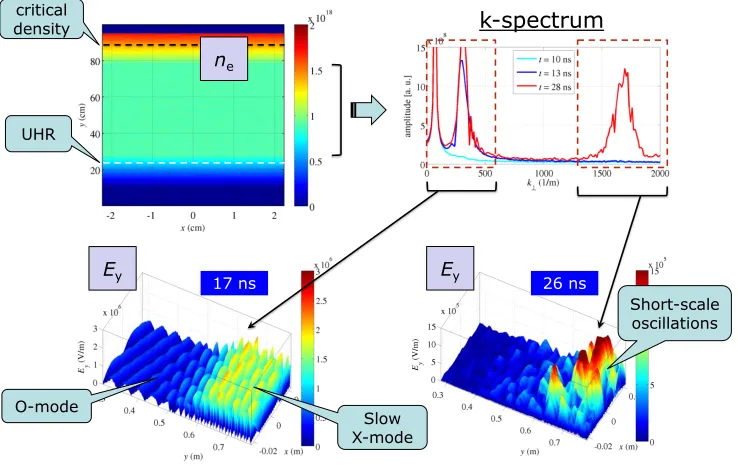
Figure 8 shows snapshots of theEy component of the
electric field (the component directed along the density gradient). The 15 ns snapshot captures the initial stage of an O-mode conversion into a slow X-mode. At 28 ns, the slow X-mode has almost reached the UHR layer where the conversion into an EBW takes place in the linear regime. However, short-scale oscillations have al-ready been excited at this stage on the opposite side of the flat density region (x > 60 cm). This behavior is similar to what is observed in the 1D simulation in the nonlinear regime (see Fig. 3).
In order to better examine the evolution of the field structure, we have computed thek-spectrum of the lon-gitudinal electric field in the flat density region at 10 ns, 13 ns, and 28 ns (see the upper-right panel of Fig. 9). At 10 ns, there is only an O-mode in the flat density region. At 13 ns, a part of the O-mode has already been con-verted into a slow X-mode that shows up as a peak at aroundk⊥ ≈300 1/m. At 28 ns, short-scale oscillations also appear in the spectrum of the longitudinal field.
The lower two panels in Fig. 9 show the field structure corresponding to the long-scale and short-scale parts of thek⊥-spectrum. The left panel presents an expected re-sult with counter-propagating O-mode and slow X-mode. The right panel reveals that the short scale fields are ex-cited not at the UHR, but on the opposite side of the flat density region. Moreover, the short-scale oscillations grow on a timescale shorter than the time required for the O-X-B conversion to take place. They appear in the spectrum before the slow X-mode even reaches the con-version layer located at the UHR. This result is consistent with the excitation of short-scale oscillations in the one-dimensional simulation with mobile ions, which confirms the robustness of the observed phenomenon.
We have performed an additional 2D PIC simulation for the same setup, but this time initializing hot ions (Ti = 950 eV). The short-scale oscillations are again
[image:7.612.335.555.76.143.2]8 High-performance spherical tokamaks are usually overdense
(typically ωpe/ωce ~ 4 in the core) and so regular electron cyclotron emission is blocked. However, electron Bernstein waves (EBW), generated at the local cyclotron frequency (and its harmonics) in the core may be observed outside the plasma via a mode conversion process that takes place typically in the plasma edge between an electromagnetic mode and the (electrostatic) electron Bernstein wave. Understanding the details of this mode conversion process is important in tokamaks with over-dense plasmas both for the interpretation of microwave diagnostic data and to assess the feasibility of EBW heating and/or current drive.
We have performed the first ever 2-D fully-kinetic simulations of O-X-B mode conversion using the particle-in-cell code EPOCH. In addition to benchmarking these numerical results against the linear dispersion relation, we have also investigated nonlinearities associated with a larger incident intensity and the effect of a steeper (and more realistic) density gradient at the mode conversion layer.
Kinetic simulations of X-B and O-X-B mode conversion
A. V. Arefiev
1
, E. J. Du Toit
2
, A. K
ö
hn
3,4
, E. Holzhauer
3
, V. F. Shevchenko
5
, and R. G. L. Vann
2
1
Institute for Fusion Studies, Univ. of Texas, Austin, TX, USA;
2
York Plasma Institute, Dept. of Physics, Univ. of York, York, U.K.;
3
IGVP, Univ. of Stuttgart, Stuttgart, Germany;
4
Max Planck Institute for Plasma Physics, Garching, Germany;
5
EURATOM/CCFE Fusion Association, Culham Science Centre, Abingdon, U.K.
Acknowledgements
This work was funded in part by the US Department of Energy under grant DE-FG02-04ER54742, the University of York, the UK EPSRC under grant EP/G003955, and the European Communities under the contract of Association between EURATOM and CCFE. Simulations were performed on the HELIOS supercomputer at the IFERC-CSC, Rokkasho, Japan and on the TACC supercomputer at the University of Texas at Austin.
Abstract
O-X-B conversion in nonlinear regime
Summary
Setups for studying EBW excitation
21
stTopical Conference on Radiofrequency Power in Plasmas, Lake Arrowhead, California, April 27-29, 2015
O-X-B conversion in linear regime (benchmarking)
We study EBW excitation in 1D and 2D geometry.
The applied magnetic field B0 is uniform.
The wave is launched from the vacuum.
The electron density gradient is perpendicular to B0.
Two mechanisms of EBW excitation can be studied using these setups:
O-X-B conversion
X-B conversion via tunneling
2D setup
1D setup
Incoming wave Incoming wave Magnetic field
ne ne
periodic b. c. periodic
b. c.
Full 2D PIC simulation of O-X-B conversion
We have demonstrated EBW excitation in a full 2D PIC simulation.
A full 2D simulation is computationally demanding, so a periodic setup can be used to reduce the transverse size of the domain.
Key parameters:
B0 = 0.25 T f = 10 GHz
linear density ramp ne = ncrit at x = 0.5 m incoming wave = 106 V/m Te = 1 keV
immobile ions Ex
Kinetic simulations using particle-in-cell code
Simulations are performed using an open source particle-in-cell (PIC) code EPOCH developed at the University of Warwick, U.K.
EPOCH is an MPI parallelized, explicit, second-order, relativistic code.
EPOCH key features include: dynamic load balancing; MPI-IO based output;
control of setup and runs through a customizable input deck.
Two main blocks of EPOCH are: 1) particle pusher in given fields and 2) field solver for a given particle current.
A PIC simulation treats wave propagation kinetically, as individual macro-particles that generate the current move according to the full equation of motion.
Numerical accuracy is determined by the number of macro-particles per cell and by the spatial and temporal resolution.
A certain amount of numerical noise due to a limited number of macro-particles per cell is expected.
UHR EBW EBW Slow X-mode O-mode UHR
47 ns 76 ns
47 ns 76 ns
EBW
EBW
Ey Ey
k-spectrum
k-spectrum
To check the EBW dispersion relation in a linear regime, we use a 2D periodic setup with a flat plasma density region.
X-B conversion in linear regime (benchmarking)
X-mode X-mode EBW X-mode EBW
k-spectrum
Key parameters:B0 = 0.25 T f = 10 GHz
To recover the EBW excitation via tunneling, we use a 1D setup with a sharp density gradient at the edge of a flat plasma region.
normal incidence
ne = 2.2 ncrit in the flat region incoming wave = 105 V/m Te = 1 keV and immobile ions Key parameters:
B0 = 0.25 T f = 10 GHz
40o incidence angle
ne = 0.72 ncrit in the flat region incoming wave = 5 x 10⁴ V/m Te = 1 keV and immobile ions
X-B conversion in nonlinear regime
Our objective is to investigate excitation of electron-Bernstein waves in a nonlinear regime where the incoming wave appreciably distorts electron thermal motion.
The nonlinear regime is accessed by increasing the amplitude of the incoming wave to 8 x 10⁵ V/m.
Tunneled X-mode
EBW
+ 40 ns
+ 40 ns Tunneled X-mode EBW Short-scale oscillations Short-scale oscillations
k-spectrum
k-spectrum
20 ns 20 ns 60 ns 60 ns Tunneled X-mode EBW
+ 40 ns
+ 40 ns Tunneled
X-mode
EBW
k-spectrum
k-spectrum
ne 20 ns 20 ns 60 ns 60 ns EBW Tunneled and reflected EBW Tunneled and reflected 60 ns
Immobile ions
Hot mobile ions
The EBW considerable changes the average electron kinetic energy (x 2).
The basic features are preserved in this nonlinear regime if the ions are immobile.
Perturbations caused by EBW Expected EBW wave front location
Ion motion enables excitation of short-scale oscillations.
The oscillations appear before the EBW can reach the same region propagating from the UHR layer.
17 ns 26 ns
15 ns 28 ns
O-mode
Ey Ey
Slow X-mode
Fast
X-mode X-mode Slow
Short-scale oscillations
Our goal is to determine whether the “instability” also develops in a 2D setup with the O-X-B conversion.
We access the non-linear regime by setting the amplitude of the incoming wave injected at 40o to the density gradient at 8 x 10⁵ V/m.
The deuterium ions are mobile with Ti = 1 keV.
ne critical density UHR
k-spectrum
Ey Ey
O-mode
Slow X-mode
Short-scale oscillations
High amplitude short-scale oscillations are observed in the flat density region.
The oscillations grow on a time scale shorter than the time required for the O-X-B conversion to take place (before the slow X-mode reaches the X-B conversion layer).
We have demonstrated capabilities of a PIC code EPOCH to simulate EBW excitation in 1D and 2D geometry.
We have benchmarked the code by simulating X-B and O-X-B mode conversion in a linear regime (low wave amplitude) and correctly recovering the EBW wave-length.
We have also simulated X-B and O-X-B mode conversion in a
nonlinear regime where field of the driving wave appreciably distorts electron thermal motion.
We find that the ion mobility has a profound effect on the field structure in the nonlinear regime.
High amplitude short-scale electric field oscillations are observed in the region below the high-density cut-off prior to the arrival of the EBW.
800 electrons per cell
800 ions per cell ∆y = 7.1 x 10⁻³ cm
24000 electrons per cell immobile ions
[image:8.612.125.491.51.189.2]∆x = 7.8 x 10⁻³ cm Linear dispersion relation High density cut-off UHR Low density cut-off High density cut-off Low density cut-off UHR ne 60 ns High density cut-off Low density cut-off UHR critical density UHR Slow X-mode
FIG. 8. Snapshots of the electric field transverse to the confining magnetic field from a 2D PIC simulation of the O-X-B mode conversion in the nonlinear regime withmobileions.
High-performance spherical tokamaks are usually overdense (typically ωpe/ωce ~ 4 in the core) and so regular electron cyclotron emission is blocked. However, electron Bernstein waves (EBW), generated at the local cyclotron frequency (and its harmonics) in the core may be observed outside the plasma via a mode conversion process that takes place typically in the plasma edge between an electromagnetic mode and the (electrostatic) electron Bernstein wave. Understanding the details of this mode conversion process is important in tokamaks with over-dense plasmas both for the interpretation of microwave diagnostic data and to assess the feasibility of EBW heating and/or current drive.
We have performed the first ever 2-D fully-kinetic simulations of O-X-B mode conversion using the particle-in-cell code EPOCH. In addition to benchmarking these numerical results against the linear dispersion relation, we have also investigated nonlinearities associated with a larger incident intensity and the effect of a steeper (and more realistic) density gradient at the mode conversion layer.
Kinetic simulations of X-B and O-X-B mode conversion
A. V. Arefiev
1
, E. J. Du Toit
2
, A. K
ö
hn
3,4
, E. Holzhauer
3
, V. F. Shevchenko
5
, and R. G. L. Vann
2
1
Institute for Fusion Studies, Univ. of Texas, Austin, TX, USA;
2York Plasma Institute, Dept. of Physics, Univ. of York, York, U.K.;
3IGVP, Univ. of Stuttgart, Stuttgart, Germany;
4
Max Planck Institute for Plasma Physics, Garching, Germany;
5EURATOM/CCFE Fusion Association, Culham Science Centre, Abingdon, U.K.
Acknowledgements
This work was funded in part by the US Department of Energy under grant DE-FG02-04ER54742, the University of York, the UK EPSRC under grant EP/G003955, and the European Communities under the contract of Association between EURATOM and CCFE. Simulations were performed on the HELIOS supercomputer at the IFERC-CSC, Rokkasho, Japan and on the TACC supercomputer at the University of Texas at Austin.
Abstract
O-X-B conversion in nonlinear regime
Summary
Setups for studying EBW excitation
21
stTopical Conference on Radiofrequency Power in Plasmas, Lake Arrowhead, California, April 27-29, 2015
O-X-B conversion in linear regime (benchmarking)
We study EBW excitation in 1D and 2D geometry.
The applied magnetic field B0 is uniform. The wave is launched from the vacuum.
The electron density gradient is perpendicular to B0.
Two mechanisms of EBW excitation can be studied using these setups:
O-X-B conversion
X-B conversion via tunneling
2D setup
1D setup
Incoming wave Incoming wave Magnetic field
ne ne
periodic b. c. periodic
b. c.
Full 2D PIC simulation of O-X-B conversion
We have demonstrated EBW excitation in a full 2D PIC simulation.
A full 2D simulation is computationally demanding, so a periodic setup can be used to reduce the transverse size of the domain.
Key parameters: B0 = 0.25 T f = 10 GHz linear density ramp ne = ncrit at x = 0.5 m incoming wave = 106 V/m Te = 1 keV
immobile ions
Ex
Kinetic simulations using particle-in-cell code
Simulations are performed using an open source particle-in-cell (PIC) code EPOCH developed at the University of Warwick, U.K.
EPOCH is an MPI parallelized, explicit, second-order, relativistic code.
EPOCH key features include: dynamic load balancing; MPI-IO based output;
control of setup and runs through a customizable input deck.
Two main blocks of EPOCH are: 1) particle pusher in given fields and 2) field solver for a given particle current.
A PIC simulation treats wave propagation kinetically, as individual macro-particles that generate the current move according to the full equation of motion.
Numerical accuracy is determined by the number of macro-particles per cell and by the spatial and temporal resolution.
A certain amount of numerical noise due to a limited number of macro-particles per cell is expected.
UHR EBW EBW Slow X-mode O-mode UHR
47 ns 76 ns
47 ns 76 ns
EBW
EBW
Ey Ey
k-spectrum
k-spectrum
To check the EBW dispersion relation in a linear regime, we use a 2D periodic setup with a flat plasma density region.
X-B conversion in linear regime (benchmarking)
X-mode X-mode EBW X-mode EBW
k-spectrum
Key parameters: B0 = 0.25 T f = 10 GHzTo recover the EBW excitation via tunneling, we use a 1D setup with a sharp density gradient at the edge of a flat plasma region.
normal incidence
ne = 2.2 ncrit in the flat region incoming wave = 105 V/m Te = 1 keV and immobile ions Key parameters:
B0 = 0.25 T f = 10 GHz
40o incidence angle
ne = 0.72 ncrit in the flat region incoming wave = 5 x 10⁴ V/m Te = 1 keV and immobile ions
X-B conversion in nonlinear regime
Our objective is to investigate excitation of electron-Bernstein waves in a nonlinear regime where the incoming wave appreciably distorts electron thermal motion.
The nonlinear regime is accessed by increasing the amplitude of the incoming wave to 8 x 10⁵ V/m.
Tunneled X-mode
EBW
+ 40 ns
+ 40 ns Tunneled X-mode EBW Short-scale oscillations Short-scale oscillations
k-spectrum
k-spectrum
20 ns 20 ns 60 ns 60 ns Tunneled X-mode EBW
+ 40 ns
+ 40 ns Tunneled
X-mode
EBW
k-spectrum
k-spectrum
ne 20 ns 20 ns 60 ns 60 ns EBW Tunneled and reflected EBW Tunneled and reflected 60 ns
Immobile ions
Hot mobile ions
The EBW considerable changes the average electron kinetic energy (x 2).
The basic features are preserved in this nonlinear regime if the ions are immobile.
Perturbations caused by EBW Expected EBW wave front location
Ion motion enables excitation of short-scale oscillations.
The oscillations appear before the EBW can reach the same region propagating from the UHR layer.
17 ns 26 ns
15 ns 28 ns
O-mode
Ey Ey
Slow X-mode
Fast
X-mode X-mode Slow Short-scale
oscillations
Our goal is to determine whether the “instability” also develops in a 2D setup with the O-X-B conversion.
We access the non-linear regime by setting the amplitude of the incoming wave injected at 40o to the density gradient at 8 x 10⁵ V/m.
The deuterium ions are mobile with Ti = 1 keV.
ne critical density UHR
k-spectrum
Ey Ey
O-mode
Slow X-mode
Short-scale oscillations
High amplitude short-scale oscillations are observed in the flat density region.
The oscillations grow on a time scale shorter than the time required for the O-X-B conversion to take place (before the slow X-mode reaches the X-B conversion layer).
We have demonstrated capabilities of a PIC code EPOCH to simulate EBW excitation in 1D and 2D geometry.
We have benchmarked the code by simulating X-B and O-X-B mode conversion in a linear regime (low wave amplitude) and correctly recovering the EBW wave-length.
We have also simulated X-B and O-X-B mode conversion in a
nonlinear regime where field of the driving wave appreciably distorts electron thermal motion.
We find that the ion mobility has a profound effect on the field structure in the nonlinear regime.
High amplitude short-scale electric field oscillations are observed in the region below the high-density cut-off prior to the arrival of the EBW.
800 electrons per cell 800 ions per cell
∆y = 7.1 x 10⁻³ cm
24000 electrons per cell immobile ions
∆x = 7.8 x 10⁻³ cm Linear dispersion relation High density cut-off UHR Low density cut-off High density cut-off Low density cut-off UHR ne 60 ns High density cut-off Low density cut-off UHR critical density UHR Slow X-mode
FIG. 9. 2D PIC simulation of the O-X-B mode conversion in the nonlinear regime withmobile ions: upper left – simulation setup; upper right –k-spectrum of the longitudinal electric fieldEyat 10 ns, 13, and 28 ns into the simulation in the flat density
region. The two lower panels show the long-scale (left) and the short-scale (right) contributions toEy at 17 ns and at 26 ns.
The corresponding ranges ofk⊥are marked with dashed boxes in the upper-right panel and connected to the corresponding lower panels with arrows.
amplitude of the short-scale oscillations reduces as we increase the ion mass. This is consistent with our conclu-sion that it is the ion mobility that enables the excitation of the short-scale oscillations in the plasma.
VI. THEORETICAL INTERPRETATION
We interpret the appearance of the small-scale oscil-lations that were described above as an observation of the X-wave instability with respect to scattering into an EBW and a lower-hybrid wave (LHW). This instability was previously discussed in a number of papers; for ex-ample, see Refs.11–14. However, to our knowledge, we
are first to report an observation of this instability in PIC simulations and explore it in detail.
In order to interpret the structure of the observed spa-tial spectra in the context of this instability in simplest terms, we focus on the explanation of the 2D simula-tions. The scattering can be understood as a three-wave interaction satisfying two scalar resonance conditions:
ω(x)≈ω(ebw)+ω(lh), kx(x)≈k(ebw)x +k(lh)x . (3)
Hereω(q) are frequencies andk(q)
x are projections of the
[image:8.612.125.494.235.468.2]9
the frequency ω(ebw)≈ω(x)−ω(lh). The corresponding wave numbers found from the linear dispersion relation arekx(ebw)≈ ±1750 m−1. Note that the part of the EBW
that is produced through linear conversion (without an LHW being involved) has frequencyω(ebw)=ω(x), so its k(ebw)x must be slightly lower, namely,k(ebw)≈1600 m−3:
this difference can indeed be seen in Fig. 3(d).
As determined by the cold linear dispersion relation, the incident and reflected X waves have wave numbers k(x)x ≈ ±300 m−1, in agreement with simulations. Hence,
Eq. (3) predicts two possible values for k(lh)x , namely, ±1450 m−1 and ±2050 m−1. This is in agreement with Fig. 7, which shows pronounced peaks in the electric field and ion momentum spectra at these expected locations. (Positive and negativekare not distinguished in our fig-ures.) We also point out that, under the specified pa-rameters, 2π/ωLH ≈ 7.9 ns. The temporal oscillations in Fig. 6(c) have approximately this period, so they can indeed be safely identified as LH oscillations. The peak at|k| ∼600 m−1 is due to the beating of the LHWs plus the contribution of the X-wave’s second harmonic. The peak at |k| ∼300 m−1 corresponds to the incident and reflected X waves. (Ion velocities cannot be perturbed by the X waves because such waves have frequencies that are too high; however, ion momenta can be.) The rea-son why the X-wave fields show up on a figure for time-averaged quantities is that the averaging is performed over the period of the unperturbed incident wave. The actual X waves have non-stationary envelopes evolving at rates∼ωLH, so averaging of these fields does not elimi-nate them entirely.
A detailed analytical study of the instability discussed here is somewhat lengthy, so we report it in a separate paper15. Here we present the final answer only. In the regime of interest, the instability rate is expected to be
γ≈ωLHωpeωpi
|ΩeΩi|
rωLH
ωUH
k(lh)E
(x)
x
16πene
. (4)
Here, ωpe and ωpi are the electron and ion plasma
fre-quencies respectively, Ωe and Ωi are the electron and
ion cyclotron frequencies, eis the electron charge, ne is
the unperturbed electron density, andEx(x)is thex
com-ponent of the X-wave electric field. Note that, for suf-ficiently small temperature T, the theory predicts γ to have no dependence onT, while the dependence on the ion mass remains. This is precisely what is observed in our simulations. More specifically, for our parameters, Eq. (4) gives γ−1 ≈7.6 ns. This is in reasonable agree-ment with Fig. 6(c), especially considering that the figure illustrates the already nonlinear regime and that Eq. (4) entirely ignores thermal corrections. The fact that the theory agrees with the simulation results serves as an in-dicator that the underlying physical process is identified correctly: namely that the small-scale oscillations seen in simulations are a result of the X-wave instability with respect to scattering into an EBW and a LHW.
VII. SUMMARY
We have simulated X-B and O-X-B mode conversion in a nonlinear regime where the driving wave apprecia-bly distorts electron thermal motion. We find that the ion mobility has a profound effect on the field structure in this regime. High amplitude short-scale oscillations of the longitudinal electric field are observed in the re-gion below the high-density cut-off prior to the arrival of the EBW. We have additionally performed an exten-sive parameter scan by varying the spatial resolution, the ion mass, and the ion temperature. This scan shows the robustness of the observed effect.
We identify this effect as the instability of the X wave with respect to resonant scattering into an EBW and a lower-hybrid wave. We calculate the instability rate analytically and find this basic theory to be in reasonable agreement with our simulation results.
More generally, the methodology introduced in this pa-per provides the framework for an accurate quantitative assessment of the feasibility of heating and current-drive in next-generation spherical tokamaks by megawatt-level beams.
VIII. ACKNOWLEDGMENTS
This work was funded in part by the US Department of Energy under grants FG02-04ER54742 and DE-AC02-09CH11466, the University of York, the UK EP-SRC under grant EP/G003955, and the European Com-munities under the contract of Association between EU-RATOM and CCFE. Simulations were performed us-ing the EPOCH code (developed under UK EPSRC grants EP/G054940, EP/G055165 and EP/G056803) us-ing HPC resources provided by the Texas Advanced Computing Center at The University of Texas and using the HELIOS supercomputer system at Computational Simulation Centre of International Fusion Energy Re-search Centre (IFERC-CSC), Aomori, Japan, under the Broader Approach collaboration between Euratom and Japan, implemented by Fusion for Energy and JAEA.
1H. P. Laqua, Plasma Phys. Control. Fusion49, R1 (2007). 2J. Urban, J. Decker, Y. Peysson, J. Preinhaelter, V. Shevchenko,
G. Taylor, L. Vahala, and G. Vahala, Nucl. Fusion51, 083050 (2011).
3S. Shiraiwa, K. Hanada, M. Hasegawa, H. Idei, H. Kasahara, O. Mitarai, K. Nakamura, N. Nishino, H. Nozato, M. Sakamoto, K. Sasaki, K. Sato, Y. Takase, T. Yamada, H. Zushi, and Group, Phys. Rev. Lett.96, 185003 (2006).
4V. F. Shevchenko, Y. F. Baranov, T. Bigelow, J. B. Caughman, S. Diem, C. Dukes, P. Finburg, J. Hawes, C. Gurl, J. Griffiths, J. Mailloux, M. Peng, A. N. Saveliev, Y. Takase, H. Tanaka, and G. Taylor, EPJ Web of Conferences87, 02007 (2015).
5A. K¨ohn, J. Jacquot, M. W. Bongard, S. Gallian, E. T. Hinson, and F. A. Volpe, Phys. Plasmas21, 092516 (2014).
6N. Xiang and J. R. Cary, Phys. Plasmas18, 122107 (2011). 7M. A. Asgarian, A. Parvazian, M. Abbasi, and J. P. Verboncoeur,
10
8T. D. Arber, K. Bennett, C. S. Brady, A. Lawrence-Douglas, M. G. Ramsay, N. J. Sircombe, P. Gillies, R. G. Evans, H. Schmitz, A. R. Bell, and C. P. Ridgers, Plasma Phys. Controlled Fusion 57, 113001 (2015).
9A. V. Arefiev, E. J. Du Toit, A. K¨ohn, E. Holzhauer, V. F. Shevchenko, and R. G. L. Vann, AIP Conf. Proc.1689, 090003 (2015).
10J. Xiao, J. Liu, H. Qin, Z. Yu, and N. Xiang, Phys. Plasmas22, 092305 (2015).
11E. Z. Gusakov and A. V. Surkov, “Induced backscattering in an inhomogeneous plasma at the upper hybrid resonance”, Plasma Phys. Control. Fusion49, 631 (2007).
12F. S. McDermott, G. Bekefi, K. E. Hackett, J. S. Levine, and M. Porkolab, “Observation of the parametric decay instability
during electron cyclotron resonance heating on the Versator II tokamak”, Phys. Fluids25, 1488 (1982).
13M. Porkolab, “Parametric decay instabilities in ECR heated plas-mas”, in Proceedings of the Second Workshop of the Hot Electron Ring Physics, San Diego, California, December, 1981, edited by N. A. Uckan, National Technical Information Service, U.S. Dept. of Commerce, Report No. CONF-811203, 237 (1982).
14A. T. Lin and C.-C. Lin, “Nonlinear penetration of upper-hybrid waves induced by parametric instabilities of a plasma in an in-homogeneous magnetic field”, Phys. Rev. Lett.47, 98 (1981). 15I. Y. Dodin and A. V. Arefiev, “Parametric decay instability of