Series Ν Ί
Labour Market Studies
DENMARK
Labour Market Studies
Denmark
By
PLS Consult (Jens Henrik Haahr, Helle Ørsted
and Hans Henrik Hansen) and Peter Jensen
December 1996
A great deal of additional information on the European Union is available on the Internet. It can be accessed through the Europa server (http://europa.eu.int)
Cataloguing data can be found at the end of this publication
Luxembourg: Office for Official Publications of the European Communities, 1997 ISBN 92-827-8760-5
© ECSC-EC-EAEC, Brussels · Luxembourg, 1997
Contents
pageExecutive Summary 6
1. Introduction 18
2. Unemployment in Denmark 21
2.1. Unemployment and its Causes 1980-1995 22 2.1.1. Cyclical and Structural Unemployment 1980-1995 22
2.1.2. Assessments of the Structural Rate of Unemployment in Denmark 24
2.1.3. Real Wage Rigidity 26 2.1.4. Hysteresis - the Persistence of Unemployment 27
2.1.5. Other Explanations of the Rise in Unemployment 28
2.1.6. Conclusions and Assessments 29 2.2. Macroeconomic Policies and Forecasts 30
2.2.1. Current Macroeconomic Policies in Denmark 31 2.2.2. Macroeconomic Targets in Relation to the EMU Criteria 32
2.2.3. The Impact of Present Macroeconomic Policies on Employment 34
2.2.4. Forecasts for Employment and Unemployment 35
2.2.5. Conclusions 36
3. Labour Market Policies 38
3.1. The Historical Development of Danish Labour Market Policy 38
3.1.1. Labour Market Policies until 1993 39 3.1.2. The Labour Market Reform of 1993 40 3.1.3. Changes in Danish Labour Market Policy 1994-1995 42
3.1.4. Measures and Objectives in Recent Danish Labour Market Policy 44
3.2. The Institutions of Labour Market Policy 45 3.2.1. The Administrative System of Active Labour Market Policy 45
3.2.2. The Unemployment Insurance System 47 3.3. Passive and Active Labour Market Measures 49
3.3.1. Passive Labour Market Measures 50 3.3.2. Active Labour Market Measures in Denmark 54
3.4.1. Labour Market Policy, Hidden Unemployment and the Leave Schemes.. 61
3.4.2. Labour Market Policy and Structural Unemployment in Denmark 66
3.4.3. Conclusions 74
4. Industrial Relations and Wage Negotiations 80
4.1. The Organization of the Labour Market Parties 80 4.1.1. The Present Organization of Employers 81
4.1.2. The Organization of Employees 82
4.1.3. Assessment 84 4.2. The Regulatory Framework for Industrial Relations 85
4.2.1. The General Agreement 85 4.2.2. Institutions for Solving Industrial Disputes 86
4.3. The State and Collective Bargaining 87 4.3.1. Direct Government Intervention 88 4.3.2. Indirect Government Intervention 89
4.3.3. Assessment 89 4.4. Collective Wage Negotiations 90
4.4.1. Recent Changes in the System of Collective Wage Negotiations 90
4.4.2. The Flexibility of Wage Formation 92
4.5. Conclusions 93
5. Labour Market Legislation 96
5.1. Employment Protection Schemes 96 5.1.1. Individual and Collective Dismissal 96 5.1.2. Temporary and Fixed Term Contracts 98 5.1.3. The Effects of Employment Protection on Employment 98
5.2. Regulation of Working Time 99 5.2.1. Legal and Contractual Limitations to Working Time 99
5.2.2. Flexibility in Work Schemes 100 5.2.3. Assessments: Working Time Regulation and Employment 101
5.3. Minimum Wage Regulation 102
5.4. Conclusions 102
6. The Tax and Benefit System and the Functioning of the Labour Market 104
6.2. The Unemployment Trap 106 6.3. Assessment of the Effects of Income Taxes on Labour Supply 108
6.4. Conclusions 111
7. The System of Education and Training and the Functioning of the Danish Labour
Market 113
7.1. The Structure of the Education System 113 7.1.1. The Ordinary Education System 114 7.1.2. Adult and Continuing Education 118 7.2. The Relation Between Supply and Demand of Skills 120
7.3. Strengths and Weaknesses in Relation to a Well-Functioning
Labour Market 123 7.3.1. Quality of the Danish Education System 123
7.3.2. Mobility 126 7.3.3. Conclusions 127
8. Industrial Policies, Employment and Unemployment in Denmark 129
8.1. The Level and Nature of State Intervention in the Economy 129
8.2. Recent Trends in Danish Business Policy 133
8.3. The Domestic Services Scheme 137 8.4. Strengths and Weaknesses of Danish Business Policy 139
9. The National Debate on Strategies for Limiting Unemployment 143
9.1. The Direction of Present Policies to Lower Unemployment 143
9.2. The Debate on the Future Direction of Policies 145
9.2.1. Increasing Labour Productivity 145 9.2.2. Reducing Labour Costs 148
Appendix A: Population and Labour Force Developments 156
A.1 Demographic Trends: Changes in the Size and Structure of the Population and
the Labour Force 156 A.1.1 Demographic Trends: The Size and Structure of the
Population, 1980-1995 156 A.1.2 Age and Gender Distribution of the Population 157
A.1.3 Regional Variations in the Development of the Population 157
A.1.4 The Impact of Migration 158 A.1.5 The Size of the Population of Active Age in the Labour Force 159
A.2The Development of the Labour Force 1980 -1995 160
A.2.1 The Size of the Labour Force 160 A.2.2 Labour Force Participation Rates 161 A.2.3 Changes in the Labour Force by Age and Gender 163
A.2.4 Regional Variations in the Development of the Labour Force 164
A.3 Labour Force Projections 1995 to 2005 164
A.4 Conclusions 166
Appendix B: The Structure of the Work Force 168
B.1 Employment in Denmark 168 B.1.1 Employment by Primary, Secondary and Tertiary Sector 169
B.1.2 Employment by Occupational Structure 170 B.1.3 Employment by Qualification Levels 170 B.1.4 Employment by Age and Gender 171 B.1.5 Job Creation by Firm Size 172 B.1.6 Employment by Regions 173
B.1.7 Conclusions 173 B.2 Unemployment in Denmark 174
B.2.1 The Unemployment Rate 1980-1995 174 B.2.2 Unemployment by Age 1980-1994 175 B.2.3 Unemployment by Gender 1980-1994 178 B.2.4 Unemployment by Skill Levels and Education 179
B.2.5 Unemployment by Occupation 181 B.2.6 Unemployment by Region 1980-1994 182
B.2.7 The Rate of Long-Term Unemployment 1980-1994 184
B.2.8 Other Aspects of Unemployment 187
Appendix C: Wage and Salary Trends 189
C.1 The Development in Nominal Wages 189 C.2 The Development in Real Wages 190 C.3 The Development in Wages by Gender 192
Executive Summary
This study describes and analyzes the functioning of the Danish labour market. Unemployment has been the single most important problem which has confronted policy makers during the past two-and-a-half decades. Unemployment has remained high and has displayed an upward long-term trend ever since the early 1970s.
Against this background, the report focuses on the question of unemployment, its nature, its causes and the contents and effects of policies which seek to lower structural or registered unemployment, or which otherwise directly or indirectly affect the functioning of the labour market. The following sections summarize the conclusions of the study.
The Nature of Danish Unemployment
Danish unemployment has remained at a high level during the 1980s and the first half of the 1990s. There are clear cyclical elements in unemployment: The recession of the early 1980s resulted in an unemployment rate of 10.3 per cent of the work force in 1983, after which a brief period of economic recovery caused a drop in unemploy-ment to 8 per cent in 1986 and 1987. In the period from 1987 to 1993, Denmark witnessed a steadily growing unemployment rate, with registered unemployment reaching a record high of 12.3 per cent in 1993. From 1993 to 1995 unemployment started to decrease again at a relatively steep rate, almost reaching 10 per cent during 1995. As of August 1996, the unemployment rate has dropped further to 8.9 per cent.
Notwithstanding the cyclical elements in unemployment, the overall trend in the unemployment rate from 1980 has been upwards, with the unemployment rate unable to return to the level attained in previous economic upswings. This was most clearly illustrated in the economic upswing in the mid-1980s where shortages of skilled labour in specific sectors caused an overheating of the economy and high inflation, even if the overall unemployment rate was never below 8 per cent.
In 1994, structural unemployment, defined as the level of unemployment which is consistent with unchanged wage and price inflation, was estimated to be as high as 8 to 10 per cent, implying that any attempt to reduce unemployment below this level would lead to accelerating inflation and hence be unsustainable.
men, with the result that for women a record unemployment rate in 1993 was almost 14 per cent. Persons in the age groups 20-24 and 25-29 had the highest unemployment rate of all groups in the period 1990 to 1993, the unemployment rate in 1993 reaching 16.5 per cent for 20-24 year olds and 17.3 per cent for 25-29 year olds. Persons with basic schooling only or vocational education experienced an unemployment rate of 14.2 and 14.4 per cent respectively in 1993. In contrast, the unemployment rates of persons with a short-term, medium-term or long-term higher education was between 4.9 and 6.7 per cent. The unemployment rate for blue collar workers is substantially higher than for other occupational groups. Approximately 5.5 per cent of the work force were long-term unemployed in 1993 and 1994. Persons with basic schooling only are overrepresented in this group of long-term unemployed.
The Causes of Unemployment
A number of possible explanations have been suggested for the high and persistent unemployment in Denmark during the 1980s. First, since the mid-1970s, one impor-tant cause of unemployment has been deteriorating terms of trade caused by the two oil shocks. Secondly, macroeconomic policies have since the late 1980s and until 1993 aimed a low level of inflation and build up a surplus on the balance of payments rather than reduce unemployment. There is evidence that from the late 1980s onwards there was room for traditional macroeconomic policy to reduce unemploy-ment without spurring growth in inflation.
However, it is widely agreed today that there is an important structural component in unemployment, and that major reductions in unemployment cannot be obtained without policies aimed to affect the structure and functioning of the labour market. The following structural problems have been emphasized in the functioning of the Danish labour market as partial explanations for high and persistent unemployment:
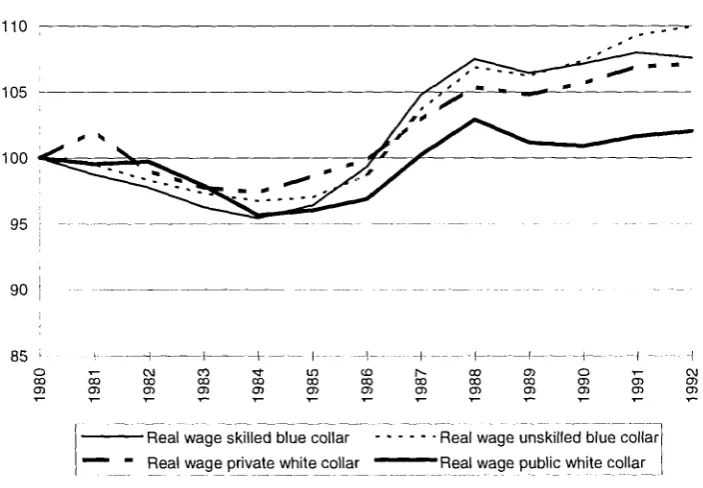
First, the equilibrizing forces between unemployment rates and wage growth rates are weak in Denmark. This real wage rigidity is reflected in the fact that groups with above average unemployment rates have not experienced lower real wage growth rates than other groups. For instance, real wages for unskilled blue collar workers grew faster than for any other occupational group from 1984 to 1992, despite the fact that unemployment for this occupational group is higher than for any other occupational group.
during wage negotations, there are few incentives for the "insider"-group to consider the effects of their wage claims on the smaller, weaker group of "outsiders".
Third, the Danish labour market is characterized by a very compressed wage structure, as the difference between wage levels for high-wage and low-wage groups is very small by international comparison. For some groups of unskilled and low-skilled workers, there is evidence that this wage structure means that wage levels do not correspond to productivity levels. In other words, these groups are priced out of work as they cannot produce a value worth their wage.
Fourth, there is evidence of a self-perpetuating persistence of unemployment, the hysteresis-effect, occurring among other things as the effect of skill deterioration among the long-term unemployed. This skill deterioration may again be ascribed to passive labour market policies, to signalling and sorting mechanisms which come into play when persons become long-term unemployed or to changes in the job search behaviour of the long-term unemployed. One major factor behind all these explanations of skill deterioration is the very long duration of unemployment benefits in Denmark by international standards.
On balance, two factors seem most important in explaining the structural elements in the high and persistent Danish unemployment from 1980: Insider-outsider effects and the long duration of unemployment benefits.
Danish Labour Market Policy and its Effects
The Labour Market Reforms 1994-95
From 1994, new principles have been introduced for Danish labour market policy, and a series of reforms have been enacted. These reforms can be divided into two groups: Reforms of active labour market policy and the introduction of three comprehensive leave schemes.
The reforms of the active labour market policy have comprized the following elements: The benefit entitlement period has been shortened to a maximum of 5 years (plus the possibility of 1 year of Child Care Leave for parents). The link between active labour market measures and benefit entitlements has been removed, creating incentives for effective active measures, i.e. measures which lead to regular employment. A possibility of establishing individually adapted activation programmes has been introduced. From 1996, young unskilled unemployed persons are required to undertake training or education attero months of unemployment.
Furthermore, full-time activation of unemployed persons is gradually being moved forward. From 1998, every person who has experienced more than 2 years of unemployment will be covered by a full-time activation scheme involving subsidized employment, training and education or combinations thereof. Finally, the manage-ment of active labour market policy has been decentralized, and the newly established Regional Labour Market Councils have been given the right to identify vulnerable groups of unemployed who may receive early activation and to initiate targeted training and education as well as job-rotation programmes to prevent shortages of skilled labour in the regional labour markets.
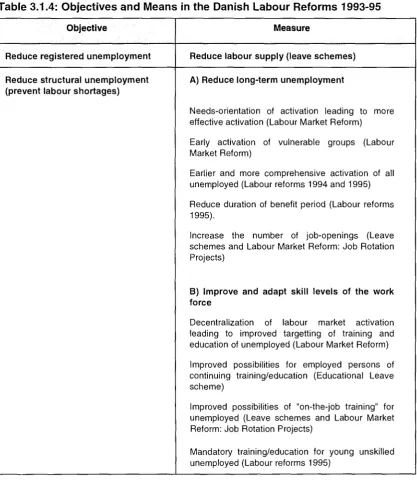
These reforms all aim to reduce structural unemployment, as they seek to lower that rate of unemployment at which shortages of skilled labour occur. This is so in two ways: First, along with the reduction in the duration of the benefit period, earlier, more comprehensive and more individually adapted activation schemes for the unemployed seek to reduce the average duration of unemployment, so as to prevent the deterioration of skills among the unemployed. Second, decentralization of labour market activation and improved possibilities of targetted training programmes and job-rotation projects seek to improve and adapt the skill levels of the workforce to the requirements of the labour market.
scheme and 70 per cent of this rate for the Child Care Leave and the Sabbatical Leave scheme in 1996.
The most important objective of the leave schemes has been to reduce registered unemployment through a reduction in the supply of labour. Thus, unemployed persons obtaining leave in one of the three schemes are removed from the unemployment statistics. At the same time, employed persons who obtain leave may be replaced for the leave period by an unemployed person - indeed sabbatical leave requires that the vacant position is filled by a subsitute.
The Effects of the Labour Market Reforms
Data on the effects of the labour reforms introduced since 1993 is still relatively scarce. As to the effects of the leave schemes, these schemes have indeed reduced registered unemployment in 1994-1995. In 1994, registered unemployment fell by between 32,000 and 40,000 full year persons. In this year, registered unemployment in Denmark was approx. 340,000 full year persons. In 1995 it is calculated that the immediate drop in registered unemployment because of the leave schemes was between 60,000 and 70,000 full year persons. These figures compare to a total number of registered unemployed persons in 1995 of 285,000.
A large part of the leave schemes' effects on registered unemployment is due to the "reclassification" of unemployed persons as persons on leave. More than half of all persons on leave in 1994 and 1995 were previously unemployed. Model calculations of the long-term effects of the leave schemes show that the effect of the schemes on unemployment approaches zero over time, as decreasing labour supply will push up wage increase rates, to the detriment of the enterprises' international competitiveness and thereby employment. However, this conclusion does not take the possible positive structural effects of the Educational Leave into account, as Educational Leave may in the long term further the productivity of the work force. On balance, the leave schemes only appear to contribute significantly to a reduction in registered unemployment in the short term, and only the Educational Leave scheme may contribute to a reduction in structural unemployment. Indeed, the Child Care Leave scheme is seen to contribute to structural unemployment, as this scheme is extensively used by unemployed women. These women risk further marginalization in the labour market, as their skills deteriorate and their connection to the labour market is further weakened.
reforms seek to employ in preventing the deterioration of skills among unemployed. However, a significant part of the decrease in long-term unemployment from 1994 to 1995 is due to unemployed persons' utilization of the leave schemes and the Transition Benefit scheme, which was a temporary extension of the Post Employment Wage scheme allowing the long-term unemployed to retire as early as age 50. If the effects of the leave schemes and the Transition Benefit scheme are excluded, long-term unemployment did not drop faster from 1994 to 1995 than during the previous economic upswing in the mid-1980s. This suggests that apart from the leave schemes and the Transition Benefit, recent labour market reforms have so far had limited effects on the duration of unemployment.
Furthermore, compared to the most recent previous economic upswing, wage increase rates have not yet grown as rapidly as then and shortages of skilled labour have occured only in public sector areas where the effects on wage increase rates and inflation are very limited. Training and education have been given a higher priority in active Danish labour market policy from 1994 onwards, and this may have contributed to the prevention of shortages of skilled labour. However, there may be several other explanations for the lower wage increase rates in the present economic upswing than in the previous.
In summary Danish labour market policy since 1993 has been directed both towards the symptom of unemployment, that is the rate of registered unemployment, and some of the likely causes of unemployment, namely the deterioration of skills among the unemployed and the related mismatch problems of supply and demand in the labour market. In curing the symptoms, policies have been relatively successful, as labour market measures contributed significantly to a reduction in registered unemployment in 1994 and 1995.
In removing some of the causes of unemployment, results so far are mixed. There is no evidence that recent labour market measures have reduced the number of long-term unemployed in a manner which prevents skill deterioriation. Rather, many long-term unemployed have been removed from the unemployment statistics through passive measures. On the other hand it does not seem unlikely that active labour market measures have contributed to the prevention of labour shortages in 1994 and 1995 through targeted improvements in the skills of the work force, but evidence is scarce.
any significant extent: Real wage rigidity, the insider-outsider problem, and the compressed wage structure.
Industrial Relations and the Functioning of the Labour Market
Looking at labour market institutions, the "Danish model", a highly organized and institutionalized systems of industrial relations, remains a key characteristic of the Danish labour market. The Danish model is characterized by the integration of employee and employer organizations into a system of institutionalized balancing of opposed interests. Furthermore, the Danish labour market organizations are to a large extent self-regulating and generally play a considerable role in the management and setting of overall economic policy. However, self-regulation is constrained by the potential for government intervention and the labour market parties' own interest in and responsibility for the long-term success of the economy.
The organization of the labour market parties has been undergoing significant changes since 1989. From the traditional organization along the lines of trades structured in one comprehensive umbrella organization, industry-wide cartels are being formed, both among employer and employee organizations, gradually paving the way for a system of one enterprise-one collective agreement, but the process remains surrounded by controversy, particularly among employee organizations.
The decentralization of organizational structures in the labour market from umbrella organizations to cartels has been paralleled by a decentralization of wage formation in the labour market. The point of balance of wage formation has moved away from the central organizations to the level of individual enterprises. At the same time there are clear limits to decentralization as the central employers organization attempts to control wage formation through decrees about maximum wage increases to its member enterprises.
The Tax System and Structural Unemployment
The Danish tax system, which is characterized by a reliance on income tax and by high marginal income tax rates, among other things affects the supply of labour: High marginal income tax rates may limit labour supply as the marginal growth in disposable income earned through extra work is limited. However, decreases in the marginal income tax rates also correspond to an increase in hourly wages after tax. This may lead some to reduce their labour supply if they are content with their existing level of disposable income.
In adopting the 1994 tax reform, which cut marginal income tax rates replacing lost revenue with a gross labour market tax to be paid by all persons in work and "green" resource consumption taxes, the centre-left coalition government counted on marginal tax rate cuts to increase labour supply. One of the wider objectives of this policy was to decrease the wage pressures of the economy and thereby limit structural unemployment. However, empirical data has revealed a limited potential for increasing labour supply through income tax cuts, as many other factors than pay clearly affect the decision among Danish employees to supply or not supply additional labour.
At the same time, the 1994 tax reform exacerbated the problem of the unemployment trap: It has been demonstrated that the combination of high marginal income tax rates and high unemployment benefits for low income groups results in a less than optimal incentive structure for working in Denmark: For persons earning a gross wage less than DKK 160,000 per annum, the gain in disposable income moving from unemployment to employment is negligible. The unemployment trap was deepe-ned with the tax reform of 1994. Thus, the introduction of a gross labour market tax of (from 1998) 8 per cent in effect serves as an 8 per cent tax on employment.
On balance, it therefore seems doubtful whether recent Danish tax reforms have facilitated a reduction in structural unemployment. At best, the tax reforms have increased labour supply only marginally, at the same time exacerbating the unemployment trap problem.
The Education System and the Functioning of the Labour Market
The education system plays an important role in satisfying the labour market's demands for skilled and well-educated labour. Where the education system cannot supply persons with the right skills, the results are mismatches in the labour market: Above average unemployment for persons with certain skills and qualifications, shortages of persons with others.
mismatch problems is limited. Indeed, analyses of the unemployment-vacancy relation for Denmark leads to the conclusion that the increase in unemployment since the mid-1970s cannot to any great extent be explained by increasing mismatch problems. However, one general problem of mismatch which is reflected in the unem-ployment statistics is the above average unemunem-ployment rates for persons with little or no education. The disparity in unemployment risk between poorly educated persons and well-educated persons has increased over the last decade and is expected to continue to do so. In this connection, the most serious problem of the Danish education systems is seen to be the fact that about one out of three youth never completes an education that qualifies him or her for the labour market, even though a steadily increasing share of each form completes a higher education. A high drop-out rate from vocational training and education programmes has been identified as a problem. One reason may be an inadequate provision of courses for students who prefer practical issues.
Although the quality of the Danish education system is generally assessed favourably, albeit on a weak basis of assessment, other problems have been emphasized in the education system's relation to the labour market. First of all, it is questionable whether adult and continuing education is targeted sufficiently precisely towards the needs of the labour market. In addition, much adult and continuing training is directed towards persons who are already well qualified, whereas fewer opportunities exist for persons with little or no education. The system of adult and continuing training may thus serve to widen the education gap with a large segment of the labour force being relatively well trained and another group with little or no education.
Industrial Policies, Employment and Unemployment
In relation to the functioning of the labour market, it is characteristic of Danish industrial policy that it has not been directed towards the preservation of jobs in threatened or declining industries to the same extent as other European countries. Rather, from its outset in traditional liberal, non-interventionist ideas, where the state intervened only minimally and non-selectively in order to facilitate business develop-ment in a context of free international trade and negligible state ownership of manufacturing industries, industrial policies since the mid-1980s have become increasingly directed towards sector-specific technological development and product development programmes.
services to private enterprises. By international comparison, however, the financial means available for business policy are limited.
Recent trends in Danish business policy include a growing prioritization of support for entrepreneurs and of employment opportunities for persons with little education. In the Domestic Services scheme, which was introduced in 1994 as a business development initiative aiming to create a whole new business area, a state subisidy is provided to private households' purchases of domestic services. As opposed to similar schemes which have recently been introduced in France and Belgium, the Danish Domestic Services scheme does not involve the activation of unemployed persons. Rather, it is intended as a support scheme for the development of professionalized Domestic Services enterprises as a foundation for lasting regular employment of persons with little education. However, the number of persons employed in Domestic Services enterprises is low, 2,300 in June 1995, and the overall importance of the scheme for employment and unemployment is thus very limited.
In attempting to create an overall indicator of the effects of Danish business policy, the Ministry of Business has constructed the "business policy success indicator", which measures a country's structural competitiveness, relating develop-ments in relative wage costs to developdevelop-ments in OECD market shares for each country's exports. The business policy success indicator does not measure the effects of business policy on employment and unemployment. Rather it measures the extent to which competitiveness in the international markets is compatible with high wages. The business policy success indicator for Denmark has developed positively since the mid-1980s, indicating that Denmark has been able to hold on to or increase its market shares in spite of real wage levels above the OECD average.
This suggests that there is scope for employment growth in the Danish economy, even if it is - realistically - assumed that there is a strong preference for high real wage levels among wage earners. Thus, high structural competitiveness in principle opens up the possibility that future real wage increases may be traded for employment growth while upholding a high level of real wages.
The Future Direction of Policies Aimed to Lower Unemployment
strategy which aims to lower labour costs, in particular for low-skill low-productivity groups in the labour market.
As for the first strategty, it aims to make employment of all categories of labour compatible with relatively high minimum wages through training and education. Thus, the Government and the labour movement continuously argues that a qualifica-tions upgrade of the work force will reduce mismatch problems in the labour market and help the long-term unemployed gain stable employment. This strategy has the merit of being uncontroversial. The question is whether it is also a sufficient strategy to reduce structural unemployment to significantly lower levels. This has been disputed, as some segments of the work force cannot realistically be assumed to become so productive as to make them employable at the minimum wage, regardless of the amount of training they may receive.
The second strategy aims to lower labour costs, either directly or indirectly. A direct lowering of minimum wages has been presented as an efficient way to increase the demand for low skill labour, but resistance to this proposal is fierce in the labour movement and the Social Demcratic Party. Furthermore, government economists have argued that a one per cent drop in structural unemployment requires an increase in wage differentials of 10-15 per cent, implying that a bigger reduction in structural unemployment would necessitate quite considerable wage reductions for low income groups. In addition, a lower minimum wage is difficult to enforce, as wage levels are a matter for collective agreements.
A different solution which has been discussed is the introduction of tax reliefs for low income groups. It is argued that this would allow low-income labour to accept a relatively lower-paying job without losing real income. This will dampen wage demands throughout the labour market, in turn increasing the demand for labour. The problem of greater income disparities could therefore be avoided in this strategy. However, the lost revenue following from tax reliefs for low income groups will have to be compensated through significantly higher marginal income tax rates for higher income groups. This would be politically difficult to carry through.
A final proposal which has been debated is the introduction of an employment tax allowance. This allowance will increase incentives for low income groups to work rather than receive unemployment benefits, thereby increasing the supply of labour among low income groups, leading to lower wage increase rates and stronger labour demand. However, as with the proposal for low income tax reliefs, considerable tax revenue would be lost and must be compensated through higher marginal tax rates for higher income brackets.
Danish policies aimed at lowering unemployment will be a continuation and perhaps a further development of those policy measures which have been implemented since
1. Introduction
This report concerns the Danish labour market and the functioning of the Danish labour market since 1980. It constitutes one of fifteen country labour market studies prepared for the European Commission's General Directorate for Employment, Industrial Relations and Social Affairs. The publication series aims to further the exchange of information on labour market policy and labour market practices between the Member States of the European Union and interested parties within the Member States.
One problem has overshadowed all other problems of the Danish labour market throughout the 1980s and the early 1990s: The labour market has been characterized by persistent high levels of unemployment and its causes remains the main focus throughout the report. Danish unemployment is described in Chapter 2, and various prominent explanations for the high level of unemployment are presented and discussed. The second part of the chapter presents an overview of recent macroeconomic policies in Denmark and their consequences for employment and unemployment.
There appears to be evidence that Danish unemployment is to a high extent the result of institutional characteristics of the Danish labour market. Historically, the nature of passive and active labour market policy has by most accounts contributed to structural unemployment. The same goes for the Danish system of industrial relations and of wage formation.
Consequently, Chapter 3 describes and assesses Danish labour market policy in terms of institutions and passive and active policies. Particular attention is paid to recent developments which aim to reduce structural unemployment and registered unemployment. As for registered unemployment, three comprehensive leave schemes were introduced in 1994, creating possibilities for temporary withdrawal from the labour market for both employed and unemployed persons. When unemployed persons obtain leave, they are removed from the unemployment statistics. When employed persons obtain leave, the vacant positions thereby created are frequently filled with a person who was formerly registered as unemployed. The overall impact of the leave schemes has been a considerable reduction in registered unemployment. By most accounts, however, no lasting reduction in unemployment will result from the leave schemes.
programmes. This has been done with a view to lowering the duration of unemployment and preventing the related deterioration of skills. At the same time, possibilities for training and education of both employed and unemployed persons have been improved within the framework of Danish active labour market policies. These reforms have sought to decrease the risks of shortages of skilled labour in the labour market, and thereby to prevent an acceleration of wage increases to the detriment of both the competitiveness of business and employment levels.
In Chapter 4 the system of industrial relations and wage formation is presented, also with a view to assessing the present system's consequences for employment and unemployment in Denmark, as the previous highly centralised system of organization and wage formation moves towards a higher degree of decentralization. So far, the decentralization of wage formation which has occurred since the 1980s has failed to bring about greater wage flexibility in the labour market, as the central employer organisation retains ultimate control with maximum wage increases.
Chapter 5 contains a brief description and analysis of labour market legislation or regulation in Denmark as regards employment protection, the regulation of working time and minimum wage regulation. Again, a main focus is to assess the contribution of labour market regulation to employment and unemployment. The Danish labour market is characterized by a low level of legislative regulation and rather weak rules for employment protection. However, there is no evidence that liberal employment protection rules have affected employment significantly.
In Chapter 6 the Danish tax system is described with a particular view to its effects on the supply of labour. The effects of the 1994 tax reform on labour supply is discussed, as is the "unemployment trap". The unemployment trap occurs where there are no incentives for unemployed persons in low-wage areas to obtain regular employment at the minimum wage level as their disposable income decreases with the move from unemployment to employment due to high income taxes and high unemployment benefits.
recent years appears to have contributed to strong Danish structural competitiveness.
This means that Denmark has retained international market shares in spite of high
real wages. This opens up the possibility that future real wage growth may be traded
for employment growth, even if high real wages are to be maintained.
Finally, Chapter 9 sums up the overall direction of those Danish policies which
are directed towards lowering unemployment. In the second part of the chapter, the
most prominent proposals for further policy reforms aimed at lower unemployment are
presented. The Danish debate in this respect is broadly in line with the overall
European debate, as much attention is being paid to possible ways to reduce labour
costs for low income groups, either by directly reducing minimum wages or by
lowering income tax rates in the lowest wage brackets.
In Appendix A, Β and C, a statistical description of the Danish labour market is
provided. Appendix A describes changes in the size and structure of the population
and the labour force from 1980. In Appendix B, the structure of the work force is
described, in terms of the development of employment and unemployment in the
period from 1980 to 1994. In Appendix C, nominal and real wage developments in the
labour market in the 1980s and early 1990s are described for the different occupa
tional groups.
The report has been prepared by Jens Henrik Haahr of PLS Consult,
Denmark, in cooperation with Associate Professor Peter Jensen, Centre for Labour
Market Studies at the University of Aarhus, Denmark. Helle Ørsted Nielsen and Hans
2. Unemployment in Denmark
In this chapter we analyze the development of Danish unemployment. The main emphasis is on the cyclical and structural components of unemployment, as we review and assess a number of possible explanations for the development of unemployment. A detailed descriptive analysis of Danish unemployment is found in Appendix B.2.
In general, the period 1980-1996 has been characterized by high and persistent unemployment in Denmark. Cyclical variation in economic acticity resulted in a peak in 1983, where 10.3 per cent of the work force was registered as unemployed. From 1987 a gradual increase led to a record-high level of unemployment in 1993, with registered unemployment reaching 12.3 per cent. Recently, unemployment has started to decline again.
Figure 2.1. The Unemployment Rate in Denmark, 1980-1996.
1980 1981 1982 1983 1984 1985 1986 1987 1988 1989 1990 1991 1992 1993 1994 1995 1996
Source: Statistical Ten-year Review 1991 and 1995, Monthly Review of Statistics 1996:3.
On the one hand, it is characteristic of Danish unemployment that it is very widespread in the labour force. Temporary layoffs are quite common in Denmark, and they constitute 40 per cent of all unemployment spells and 16 per cent of total unemployment. The main reason for the high volume of temporary layoff unemployment is the unemployment insurance system, which in effect subsidizes this type of unemployment.
between male unemployment and female unemployment increased significantly from 1980 to 1986, and female unemployment has since then remained clearly higher than male unemployment. Since 1984, the unemployment rate of women has remained 2.5 to 3 percentage points above that of men. This meant that for women the record unemployment rate in 1993 reached almost 14 per cent.
Persons in the age groups 20-24 and 25-29 had the highest unemployment rate of all groups in the period 1990 to 1993, the unemployment rate in 1993 reaching 16.5 per cent for 20-24 year olds and 17.3 per cent for 25-29 year olds. Persons with basic schooling only or vocational education experienced an unemployment rate of 14.2 and 14.4 respectively in 1993. In contrast, the unemployment rates of persons with low, medium and high levels of education was between 4.9 and 6.7 per cent. The unemployment rate for blue collar workers is substantially higher than for other occupational groups. In addition, approximately 5.5 per cent of the work force were long-term unemployed (12 months or more) in 1993 and 1994. Thus, almost half of all unemployment may be considered long-term unemployment. Persons with basic schooling only are overrepresented in this group of long-term unemployed.
Finally, it is characteristic of Danish unemployment that the unemployment rate of the 60-66 age group has been kept down artificially during the 1980s by an early retirement scheme. This indicates that there is a considerable amount of hidden unemployment. Recently this age group as well as the 55-59 age group have had a remarkable increase in unemployment rates.
2.1. Unemployment and its Causes 1980-1995
In this section, estimates of the structural rate of unemployment for Denmark are presented and discussed, and the most prominent possible explanations for the high and persistent structural unemployment in Denmark are analyzed: Deteriorating terms of trade since the first oil crisis, tight macroeconomic policies, real wage rigidity, the hysteresis phenomenon, the insider-outsider problem, a compressed wage structure, and skills deterioration among unemployed in connection with the long duration of unemployment benefits.
2.1.1. Cyclical and Structural Unemployment 1980-1995
shows an upward trend in the level of unemployment, with the unemployment rate unable to return to the level attained in previous upswings. This development indicates that unemployment has become more persistent, or in other words that the structural rate of unemployment has increased over the period.
This change in the character of Danish unemployment also means that the available policy measures addressing unemployment have changed. During the 1980s it was realised that high unemployment was not merely a temporary cyclical phenomenon, but a permanent change in the level of unemployment. Hence, it has become widely agreed that the structural component of unemployment is high and that major reductions in unemployment cannot be obtained without structural policies.
The initial rise in unemployment from 1980 was caused by the second oil price shock in 1979-1980 that had a highly unfavourable impact on the Danish economy. Unemployment increased until 1983 when the upswing caused it to start decreasing, at first slowly but from 1984 to 1986 with a rather sharp decline. As is described in detail in Appendix B.1 this was due to a very high growth in employment.
The upswing in the mid-1980s was followed by overheating of the economy and shortages of skilled labour in specific segments of the labour market, with high wage inflation resulting. Private consumption also increased strongly, mainly as a result of a marked decline in long-term interest rates which caused house prices to go up. This overheating in the real estate market gave rise to a credit-financed increase in private consumption which, in turn, aggravated the balance of payments problems.
During the period from 1988 to 1993 Denmark was hit by a deeper recession than at the international level. This was largely due to domestic economic policy, which was directed towards an improvement of the balance of payments. Economic policy was tightened with the purpose of decreasing private consumption and encouraging savings. Consequently, the economic growth was quite low in Denmark, resulting in increasing unemployment.
The present cyclical upturn has prompted a fall in unemployment, from 1993 first slowly since labour productivity increased instead of employment, but from 1994 a large drop in unemployment occurred. The main reason behind this drop in unemployment is, however, a reduction in the size of the labour force due to the large number of persons temporarily taking part in active labour market measures or leave schemes.
before the upswing started. It was partly spurred by an expansionary fiscal policy with an explicit goal of reducing unemployment.
In summary, the development of unemployment shows cyclical movements but also a clear structural component, most clearly illustrated by the situation in 1986-1987 when high wage inflation occurred although the level of unemployment was around 8 per cent. In addition, the upward trend in unemployment indicates that there is a problem of persistence of unemployment.
2.1.2. Assessments of the Structural Rate of Unemployment in Denmark
Structural unemployment has received considerable attention in Danish economic policy recently. Structural unemployment can be defined as the level of unemployment that is consistent with an unchanged wage and price inflation. The structural rate of unemployment reflects among other things the degree of mismatch between supply and demand for labour and the degree of relative wage flexibility between occupational groups and regions.
If actual unemployment is reduced below the structural rate of unemployment, then there will be an upward pressure on wage and price inflation. In a fixed-exchange rate system, as in Denmark, this will cause a deterioration of compe-titiveness, resulting in increased unemployment which reduces the inflationary pressure. The structural rate of unemployment thus reflects an equilibrium level of unemployment.
Definitions of Structural Unemployment
The structural rate of unemployment cannot be measured directly, but an indicator has to be estimated based on the development of actual unemployment and wage and price inflation. There are several definitions of an indicator for the structural unemployment. One basic assumption relates to the formation of expectations about the inflation.
At present, the Ministry of Finance (1995) uses two different definitions for the estimation of the structural unemployment: NAIRU (Non Accelerating Inflation Rate of Unemployment) and ITRU (Inflation Target Rate of Unemployment).
Estimates of Structural Unemployment in Denmark
Available estimates of the structural unemployment rate (from OECD and the Ministry of Finance) indicate that this is as high as between 8 and 10 per cent in 1994. The implication of these estimates is that any attempt to reduce unemployment below this level will lead to increasing inflation unless it is combined with structural policies that increase wage flexibility and reduce other structural problems in the labour market. This is widely recognized in economic policy in Denmark. Inflation in Denmark has been almost constant since 1990 around 2-2.5 per cent.
Structural employment defined as the non-accelerating inflation rate of unmployment, NAIRU, was almost constant around 8 per cent during the 1980s. During the beginning of the 1980s the NAIRU was thus significantly lower than actual unemployment. At the end of the 1980s and the beginning of the 1990s the NAIRU increased to almost 11 per cent, but it decreased to 10 per cent in 1994. The ITRU has only been calculated by the Ministry of Finance for the period from 1987 and it has been rather constant around a level of 9 per cent.
An analysis by the OECD (1990) supports this view in its estimate of the NAIRU for Denmark. This structural rate of unemployment has been steadily increasing ever since the mid-1970s, while the actual unemployment rate has not exceeded the NAIRU by more than a few percentage points. In fact, the results show that the NAIRU was higher than the actual unemployment rate in 1985-1987. During this period considerable mismatch problems occurred in the Danish labour market, leading to bottle-neck problems and overheating despite an unemployment rate as high as 8 per cent. Much of Denmark's unemployment is thus structural and frictional in its nature.
The OECD survey observes that high structural unemployment can obviously have many causes. It is pointed out, for instance, that the unemployment measure includes temporary layoffs (as a result of the structure of the unemployment insu-rance system), that a compressed wage structure and the unemployment insuinsu-rance system result in an uneven distribution of unemployment across skill and educational categories, and that the general wage level is a factor behind the high unemployment level.
Since the mid-1960s the main factor has been the change in terms of trade caused by the two oil price shocks. In addition, the international real interest rate and the increase in the compensation level of the unemployment insurance benefits have also contributed to the increase in the structural unemployment. The tax system has not played any role in the increasing structural unemployment.
The Unemployment-Vacancy Relation
Another indication of the type of change that occurred during the 1980s can be obtained by considering the UV-curve. This curve shows the relationship between the unemployment rate and the vacancy rate. Since the vacancy rate may be regarded as an indicator of aggregate demand, the curve can be used to distinguish between cyclical and structural variations in the unemployment rate. Movements along the curve are traditionally interpreted as representing cyclical variations, whereas shifts in the curve may be taken as an indication of structural changes in the labour market.
Jackman et al. (1990) present UV-curves for most of the OECD countries. For Denmark their figures show that an outward shift occurred in its UV-curve during the 1980s.1 It is remarkable, however, that the vacancy rate is much lower in Denmark
than in the other OECD countries, including the other Nordic countries. The low vacancy rate suggests that the high unemployment is to some extent due to adverse demand shocks, but at the same time the shift in the UV-curve for Denmark suggests that part of the increased unemployment of the 1980s was due to structural factors that have caused a growing mismatch in the labour market.2
2.1.3. Real Wage Rigidity
The Economic Council (1995) points out that the real wage increases in the 1990s have been higher than the increases in the late 1970s even though the level of unemployment has almost doubled since then.3 Increases in real wages do not seem
to be very sensitive to a high level of unemployment.
A number of macroeconomic studies have analyzed the causes behind the high and persistent unemployment in Denmark. Andersen and Overgaard (1990) present results which point to a high growth rate in wages as an explanation of the high unemployment rates. Andersen and Risager (1990) conclude that unemployment
' We return to the Unemployment-Vacancy relation in Chapter 7 below in connection with the demand and supply of skills in the Danish labour market.
2 As was also noted by Jackman et al. (1990), there are several problems in measuring
vacancies, and these may at least partly explain the low level of the vacancy rate in Denmark in comparison with the other countries.
3 The Economic Council is an independent, government financed, advisory board of
exerts little pressure on wages, which in their view supports an explanation of the high unemployment as a result of wage rigidities.4 Wage rigidities are again to a high
degree attributed to the unemployment insurance system.
A model of the Danish economy has been developed in a recent study (Economic Council, 1990). The analysis of this model shows that a permanent rise in employment requires structural policy measures, such as measures to increase labour market flexibility. Greater flexibility means a greater responsiveness to unemployment in wage formation. Furthermore, an improved international wage competitiveness will have significantly positive employment effects, and will thus bring about a reduction in unemployment. However, a lasting effect again requires greater labour market flexibility, for instance by creating stronger incentives to reduce wage claims in the wage bargaining. The consequences of this would be that those already employed would experience a fall in their real wage, while the unemployed who get work would experience a rising real wage. This illustrates that the problem of labour market flexibility is of an insider-outsider nature.
2.1.4. Hysteresis - the Persistence of Unemployment
The development of unemployment in Denmark over the last 15 years shows symptoms of the phenomenon which has been called "hysteresis". This refers to the situation whereby persistent unemployment occurs because adverse shocks on unemployment have very prolonged effects. In other words current unemployment is highly dependent on past unemployment.
The dynamics and the concentration of unemployment in Denmark points to an insider-outsider explanation of the hysteresis phenomenon, cf. Blanchard and Summers (1986). When wage negotiations are limited to employers and insiders, and the insiders disregard the question of outsider employment, temporary shocks can have permanent effects on the level of unemployment. Adverse demand shocks will swell the numbers of outsiders, but the reduced insider corps will ignore this in the wage bargaining process, thereby giving rise to hysteresis. This could explain why the structural rate of unemployment, or NAIRU, has been increasing along with the actual unemployment rate.5 In this connection, the degree of unionization and the size of
government are factors that tend to increase persistence in economies lacking a centralized structure of wage bargaining, seems to be relevant for Denmark during the 1980s (Barro, 1988). As it is described in more detail in Chapter 4, wage
4 However, they are unable to rule out the possibility that the demand for labour is insensitive to changes in wages.
bargaining in Denmark became less centralized during the 1980s, which may have contributed to the persistence of unemployment.
The persistence effects may also have arisen as a result of various other mechanisms. One explanation which cannot be ruled out in the Danish case is that the persistence of unemployment is due to skill deterioration among the long-term unemployed. The very concentrated distribution of unemployment in Denmark is consistent with a more or less permanent mismatch between the capabilities and desires of workers and the available employment opportunities. The passive labour market policy of the late 1970s and early 1980s may have led to a depreciation of human capital among the long-term unemployed, thereby becoming responsible for hysteresis effects. The persistence of unemployment may also have been encou-raged by signalling and sorting effects of long-term unemployment or by changes in the job search behaviour of the long-term unemployed. A major factor underpinning all these explanations is the long duration of benefits in Denmark. During the 1980s this allowed the unemployed to receive unemployment insurance benefits for an almost indefinite period (in combination with participation in various employment pro-grammes).
2.1.5. Other Explanations of the Rise in Unemployment
Several other possible explanations have been suggested for the high and persistent unemployment in Denmark during the 1980s.6 As mentioned, and as is demonstrated
in detail in Appendix B, Danish unemployment is unevenly distributed across various labour market categories, just as it is concentrated to a relatively small group of people. The labour force is thus divided into a dominant group of insiders who practically never experience unemployment, and a smaller group of outsiders with a much higher risk of unemployment. This split in the Danish labour market means that during wage negotiations there is little or no incentive for the dominant group of insiders to consider the effects of their high wage claims on the smaller, weaker group of outsiders.
Furthermore, because of the way the unemployment insurance system is financed, the cost of marginal unemployment is borne not by the labour market participants but by the State. This means that any additional costs (in terms of unemployment insurance benefits) caused by increased unemployment are completely financed by the State through its general tax-revenue. Hence, the labour market participants may ignore these costs during wage bargaining.
The outsider group consists mainly of unskilled and low-skilled workers, many of whom are women or young people. One of the main reasons for this is the compressed wage structure, which does not allow differences in productivity to be reflected in wage differences, and especially not for the low-skill and low-education levels.
The compressed wage structure is a consequence of a number of institutional elements in the Danish labour market including the minimum wage and the unemployment insurance system, and of the wage bargaining process during the 1960s and 1970s. During this period the labour unions adopted a wage policy of solidarity specifically with a view to reducing wage differences. As will also be shown in Chapter 3, the compensation structure of the unemployment insurance system has contributed to the compressed wage structure, since benefits are relatively more valuable to the lowest paid workers. This wage effect of the unemployment insurance system has been empirically demonstrated in the analysis of the wage formation in Denmark (Andersen and Risager, 1990).7
2.1.6. Conclusions and Assessments
In sum, several possible explanations have been suggested for the high and persistent unemployment in Denmark during the 1980s:
• Deteriorating terms of trade. Since the mid-1970s one important cause of unemployment has been the change in terms of trade caused by the two oil price shocks.
• Macroeconomic policies. Structural unemployment (consistent with trade balance) has been below the actual unemployment since the beginning of the 1980s. This indicates that traditional macroeconomic policy may be able to reduce unemployment without creating balance problems. Since the end of the 1980s this leeway has instead been exploited to build up a surplus on the trade balance.
• Real wage rigidity where a high growth rate in wages explain the high unemployment rates. Thus, the equilibrating forces between unemployment and wage growth rates appears to be weak in Denmark.
• An insider-outsider problem, where the labour force is thus partitioned between a dominant group who practically never experience unemployment, and a smaller group with a much higher risk of unemployment. This split means that during wage
negotiations there is little incentive for the dominant group to consider the effects of their high wage claims on the smaller, weaker group of outsiders. A more decentralized wage formation structure may have contributed to this problem during the 1980s.
• A compressed wage structure, where wage levels do not correspond to productivity levels for some categories of unskilled and low-skilled workers, causing high unemployment for these groups.
• A self-perpetuating persistence of unemployment (hysteresis) due to skill deterioration among the long-term unemployed. This skill deterioration may again be ascribed to the passive labour market policy of the late 1970s and early 1980s, to signalling and sorting effects of long-term unemployment or to changes in the job search behaviour of the long-term unemployed. A major factor behind all these
explanations is the long duration of unemployment benefits in Denmark.
No single explanation can account for all aspects of unemployment, and it is very difficult to draw any definite conclusions about the reasons for the Danish unemployment experience. Furthermore, the explanations above are to a very high extent complementary and not competing explanations.
In conclusion, it is clear that some structural problems do exist in the Danish labour market and that they play a significant role in explaining the high and persistent unemployment. Aggregate demand shocks also play a part in explaining the rise in unemployment, but since NAIRU has also increased they cannot be the whole story. There seems to be a propagation mechanism whereby the shocks of the past have a lasting impact. However, in light of the conflicting evidence and the uncertainty of any conclusions which can be drawn, it is not possible to give any definite answers about the mechanisms which are responsible for the persistence of unemployment in Denmark. Even though much remains unexplained, it seems warranted to conclude that two of the most important factors in explaining Denmark's adverse unemployment experience are insider-outsider effects and the long duration of benefits.
2.2. Macroeconomic Policies and Forecasts
takes a closer look at macroeconomic policies with a special view towards the impact on the labour market.
2.2.1. Current Macroeconomic Policies in Denmark
In recent years macroeconomic policy has been characterized by an expansionary fiscal policy in order to ignite the recovery and reduce unemployment after the long recession. Both in 1993 and in 1994 fiscal policy was eased, but it is now gradually being tightened. In 1995 the contractionary effects were around 0.25 per cent of GDP and in 1996 it is forecast according to the budget agreement to be 0.5 per cent of GDP. The Government's aim is to continue the tightening in 1997. The Government expects the current low growth rate to be only temporary and it expects a revival during late 1996.
It is a declared target of fiscal policy that the budget should be balanced in 1997, and thereafter it should be well in surplus such that the public debt can be reduced. The Government wants the public debt to be removed around 2010-2015. This should, among other things, be seen in relation to the increased burden that can be expected from ageing of the population (see appendix A).
The Government has defined the current challenge for macroeconomic policy in Denmark to be to create high employment growth, while at the same time keeping inflation low, reducing the public and foreign debts, and retaining a socially acceptable income distribution.
It is realized that there is a trade-off between continued reductions in unemployment and consolidation of public finances, and this trade-off might become more important if the moderate international growth does not pick up again in the near future. There is a clear recognition of the need to engage in structural reforms in product and labour markets, with the purpose of easing this trade-off, and thus paving the road ahead for simultaneous improvements in unemployment and public fiscal balances.
The 1996 budget agreement also contains measures aimed at ensuring more flexibility in the labour market and reducing structural unemployment. Several of the specific elements of these labour market initiatives are described in more detail in Chapter 3. The Government expects these measures together with the 1994 labour market reform to bring down the level of structural unemployment from estimated above 10 per cent in 1993 to 8-8.5 per cent in 1997. The long-term goal is a level of structural unemployment around 5 per cent.
continuously been lowering short-term official interest rates during the last years. This is a consequence of the strong inclination to maintain short-term interest rates at a level that is consistent with the exchange rate objective. In practice, the DM is used as the anchor currency, which means that changes in the German interest rate are followed closely by the Central Bank. However, an interest rate differential remains between Denmark and Germany.
During the first half of 1995 the Danish krone first weakened, due to unrest in the international markets, and then strengthened again as a consequence of the monetary policy geared towards maintenance of a stable exchange rate. The real appreciation of the Danish krone in 1995 is an important factor behind the dampening in economic growth. So far, no tendencies have been discovered for inflation to increase.
2.2.2. Macroeconomic Targets in Relation to the EMU Criteria
Denmark has decided not to participate in the third stage of Economic and Monetary Union and has notified the EU about this decision. Nevertheless, the Danish Government strongly relies on the underlying principles of the convergence criteria to create a healthy economic situation. Macroeconomic targets are to a very high degree set according to the EMU criteria. The Government thus pursues a macro-economic policy of fiscal discipline and exchange rate stability.
In 1995 Denmark already satisfied most of the EMU criteria: low inflation, low interest rates, stable exchange rates, and near-balance on the public budget. The main problem for Denmark is the EMU criterion on public debt which was not met.
Inflation is around 2 per cent which satisfies the EMU criterion. The Government expects inflation to remain at this level in the coming years. Its view is that the structural improvements in the labour market and the temporary growth pause have removed the risk that actual unemployment will fall below the structural employment, hence no inflationary pressure will build up. Regarding interest rates and the exchange rate, the EMU criteria are also satisfied and the monetary and fiscal policies are expected to be able to maintain this situation.
Table 2.2.2. Actual and Projected (*) Inflation Rates 1990-1998
Year
Inflation rate
1990
2,6
1991
2,4
1992
2,1
1993
1,0
1994
1,2
1995
2,0
1996*
2,6
1997*
2,4
1998*
Denmark already satisfies the convergence criterion on the public budget, with a deficit of 1.5 per cent of GDP in 1995 and an expected deficit of 1.0 per cent in 1996. However, the Government does not view fulfilment of the convergence criteria for the public budget as sufficient for the desired long-term development in the public debt. Fiscal policy should be designed to provide a surplus in public finances on average over the business cycle, as a prerequisite for reducing the public debt.8
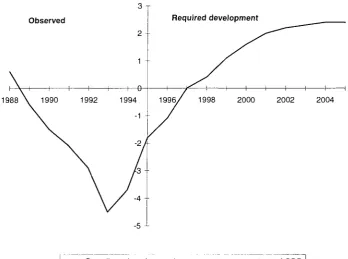
Figure 2.2.2. Required Development in the General Government Budget Surplus as Percentage of GDP, 1988 to 2005.
1988
-Overall surplus of general government as percentage of GDP
Source: Ministry of Finance: Finansredegørelsen 1995.
The public debt has decreased from 80 per cent of GDP in 1993 to 72 per cent of GDP in 1995. To satisfy the EMU criterion on public debt will require a tight fiscal policy in the coming years (similar to what is the case for many other EU countries). The tightening of fiscal policy in 1996 is planned to be 0.5 per cent of GDP. The Government expects the public debt to be reduced to 60 per cent of GDP around the year 2000. In order to achieve this reduction, substantial public sector budget improvements are necessary. Figure 2.2.2 shows the required public sector balance
8 In June 1996 the EU Council of Minsisters reversed its previous decision that Denmark was
as a percentage of GDP if public debt is to be reduced to 60 per cent of GDP by year 2000.
2.2.3. The Impact of Present Macroeconomic Policies on Employment
The Government realizes (expressed e.g. by the budget report from the Ministry of Finance (1995)) that in the years to come continued increases in employment can primarily be attained through structural reforms on the labour market.
The main target of fiscal policy is to reduce public sector borrowing requirements. The tightening of the fiscal policy for 1996 was planned to bring about a reduction in the public deficit, but due to the drop in domestic and foreign growth rates the Economic Council now forecasts a growth in the public deficit from 1995 to 1996. The deficit is, however, expected to decrease in 1997 and 1998 as an increase in growth will lead to growing tax income.
The Economic Council has criticized the Government for not exploiting the reasonably high growth rates in the Danish economy during 1993-1995 to improve public balances sufficiently. It also finds the situation further aggravated by an increase in the structural deficit (i.e. the part of the deficit not depending on cyclical variations), due to the temporary Leave Schemes being made permanent.
According to the most recent forecasts by the Economic Council (1996), Denmark is expected to have an output growth of 0.9 per cent in 1996 and 2.2 per cent in 1997, the fall from growth of 2.6 per cent in 1995 to 0.9 per cent in 1996 being explained by both a drop in the growth rate of domestic demand and a drop in international demand. The current account surplus is expected virtually to evaporate by 1998 due to sluggish international demand.
The Economic Council expects employment to decrease slightly in 1996 and grow moderately in 1997 and 1998. In 1996 private sector employment will decrease, but public sector employment will expand slightly due an expected normalization of labour market job training in the public sector, which suffered a temporary setback at the introduction of the Labour Market reform in 1994.9 Registered unemployment will
continue to decrease in 1996, but only as a result of labour market measures such as the Leave Schemes and Job Training, and remain unchanged in 1997 and 1998.
The labour force is forecast to decrease in 1996 due to the labour market measures and increase in 1997 and 1998, with the main explanation being that a
'J It now seems doubtful whether the expected rise in public job training will materialise in 1996.
decreasing number of persons will participate in the Leave Schemes, (see further below in Chapter 3 regarding the Leave Schemes).
The Labour Movement's Enterprise Council (AER) also expects the increase in employment to level off at the 1995 level. The main reason behind this is the low international growth rates, especially those of the main trade partners, which will cause exports to stagnate. It rules out the balanced budget in 1997 as unrealistic, but expects the goal to be reached instead in 1998.
2.2.4. Forecasts for Employment and Unemployment
The Government has presented a medium-term forecast for the period until the year 2000 as part of the convergence programme for Denmark. It assumes that the structural reforms being implemented in Denmark are sufficient to reduce structural unemployment at a faster or, at least, the same rate as the reduction in actual unemployment. As a result, wage inflation in Denmark will be below foreign wage inflation. In addition, the forecast assumes that the participation rate increases during the projection period by 2 percentage points per year to a level of around 79 per cent by the year 2000. This is consistent with previous experiences and labour market measures implemented in the budget agreement for 1996.
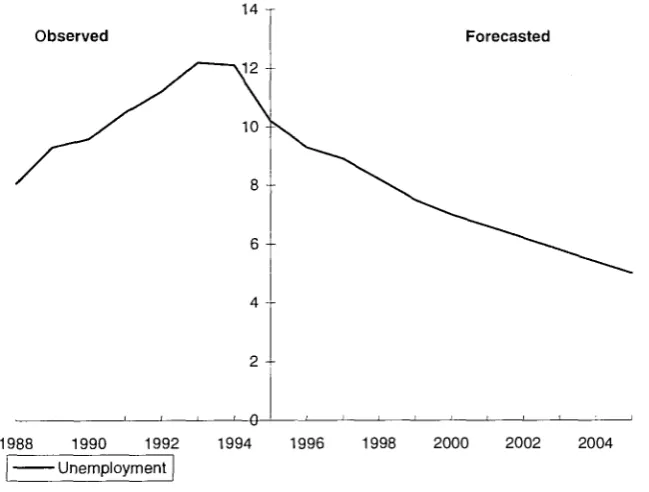
Economic growth is expected to be slightly below 3 per cent per year during the period 1998-2000. Employment is expected to grow at an annual rate of 1 per cent. As a consequence, unemployment will fall to 7 per cent of the labour force by 2000.