PYRIMIDINE HYDRAZONES AS POTENT ANTICONVULSANT
Srivastav Sanchit*1, Shukla Chhama2, Luhach Kanishk3, Pandeya S. N.4
1
IEC Group of Institutions, Greater Noida, Department of pharmacy. 2
Noida Institute of Engineering and Technology, Greater Noida. 3
IEC Group of Institutions, Greater Noida. 4
Saroj Institute of Technology and Management, Lucknow.
ABSTRACT
Pyrimidine constitutes an important class of heterocycles in drug discovery & is very well known for their anticancer, antimicrobial, antioxidant & antiviral activities. Hydrazones is a class of organic compounds with the structure R1R2C=NNH2. They are formed usually by the action of hydrazine on ketones or aldehydes & have efficient CNS depressant, analgesics activity. In the same context, Schiff bases of pyrimidne hydrazones were prepared by the reaction of “4-(4- Chloro-phenyl)-6-methyl-2-oxo-1,2,3,4-tetrahydro-pyrimidine-5-carboxylic acid hydrazide” with citral, camphor, furfuraldehyde & menthone individually by refluxing them in the presence of glacial acetic acid (as solvent) for at least 2hrs to yield their respective derivatives. Some of the compounds shown potent and efficient anticonvulsant action as mentioned in paper. All the drugs were tested on mice at 30mg/kg body weight and reported in the paper. In addition to this, the present studies revealed that the Schiff bases derivatives of Pyrimidine hydrazone could be used to synthesize the compounds having potent biological activities such as anticonvulsants. All the synthesized compounds were evaluated at the dose of 30mg/kg body weight using Isoniazid induced model and Thiosemicarbazide model for their anticonvulsant activity which were found to be pharmacologically active.
KEYWORD: Pyrimidine Hydrazones, Anticonvulsant pyrimidines, Pyrmidine Hydrazones as anticonvulsant etc.
Volume 5, Issue 6, 2101-2108. Research Article ISSN 2277– 7105
*Corresponding Author
Srivastav Sanchit
IEC Group of Institutions, Greater Noida, Department of pharmacy.
Article Received on 19 April 2016,
Revised on 10 May 2016, Accepted on 31 May 2016
1. INTRODUCTION
[image:2.595.74.451.164.404.2]1.1 Pyrimidine: Heterocyclic aromatic organic compound like benzene or pyridine, having two nitrogen atoms at positions 1 and 3 of the six-membered ring;they have isomers in the forms of diazine.[1]
Figure 1
IUPAC Name: 1, 3-Diazine, m-Diazine
Formula: C4H4N2
Molecular Mass: 80.088 g mol-1
Density: 1.016 g cm-3
Solublity: Alcohol, Water
Melting Point: 20-22 °C
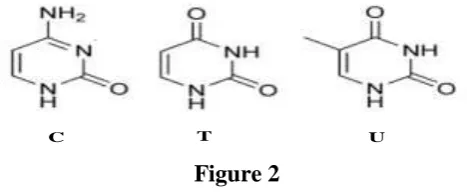
1.2 Types of Pyrimidine: Three nucleobases found in nucleic acids, cytosine (C), thymine (T), and uracil (U), are pyrimidine derivatives.[1]
[image:2.595.179.413.473.571.2]C T U
Figure 2
1.2 Hydrazone: An organic compounds having structure of R1R2C=NNH2 and are associated to ketones and aldehydes by substitution of the oxygen by means of NNH2 functional group. They are designed basically by the feat of hydrazine on ketones or aldehydes.[2]
Hydrazones have antioxidant, antimicrobial, antimalarial, antiviral actions and if they are allowed to fuse with Pyrimidine they produce CNS activity too. Therefore the above data clearly showed that pyrimidine hydrazones are potent biologically active compounds.[3]
1.3 Schiff base: A Schiff base, invented by Hugo Schiff, is a compound with a functional group that consists of a C=N double bond by means of nitrogen atom connected to an aryl or alkyl group and having general formula of R1R2C=NR3, where R is an organic side chain. In this definition, Schiff base is identical to azomethine.[4]
C N R1
R2
R3 C
N R
H
R'
General structure of an azomethine
General structure of a Schiff base
Figure 4
2. MATERIALS AND METHODS
2.1 Synthesis of Pyrimidine hydrazone derivatives
Procedure: Synthesis of Pyrimidine hydrazone derivatives can be divided into following 3 steps.
Step (1): Synthesis of ethyl 6-methyl-2-oxo-4-aryl-1,2,3,4-tetrahydro pyrimidin-5-carboxylates.
Urea, ethylacetoacetate and aromatic aldehyde (0.1 mol) were mixed (equimolar amount) in ethanol (25 mL app.). A catalytic amount of conc. HCl (1ml) was added to the mixture, which was then refluxed for three hours. The contents were kept in refrigerator overnight. The solid separated out was filtered off. The filtrate was further refluxed on a water bath for 1.5 hour. A solid separated out on cooling was filtered and recrystallized from ethanol.
Where aromatic aldehyde used are as 1). Benzaldehyde (C6H4CHO)
Step (2): Synthesis of 6-methyl-2-oxo-1,2,3,4-tetrahydropyrimidin-5-carbohydrazides To 0.1 mol of (i) in ethanol (25 mL), hydrazine hydrate was added, followed by a catalytic amount of conc. H2SO4 (3 drops). The mixture was refluxed for two hours. Excess solvent was removed and, on cooling, a solid was formed. The solid was crystallized from ethanol.
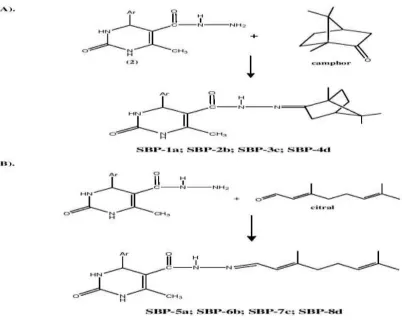
Step (3): Synthesis of various Schiff bases of the above obtained pyrimidine hydrazones On adding the final product of above step 2 with Terpenes like camphor, citral, menthone and furfuraldehyde, we obtain following desired Schiff bases for the derivatives of Pyrimidine Hydrazone (i.e. A, B, C & D) respectively as per proposed scheme which are described & elaborated below on the synthetic scheme part
Step 3: On adding the final product of above step ii with camphor & citral to yield the desired Schiff bases for the derivatives of Pyrimidine Hydrazone respectively as per scheme which are described & elaborated below on the synthetic scheme part
Where: Ar = a: C6H5; b: 4-Br-C6H4; c: 2-Cl-C6H4; d: 4-Cl-C6H4;
[image:5.595.84.487.70.390.2]3. PHYSICOCHEMICAL DATA Table 1
Compound
Name Ar
Ketone Type
M.P. (0C)
% Yield
Molecular Formula
Molecular
Weight Rf Color
SBP-1a C6H5 Camphor 195 65% C22H28N4O2 380.48 0.75 White
SBP-2b 4-Br-C6H4 Camphor 210 73% C22H27BrN4O2 459.38 0.72 Yellow
SBP-3c 2-Cl-C6H4 Camphor 195 61% C22H27ClN4O2 414.93 0.63 Yellow
SBP-4d 4-Cl-C6H4 Camphor 185 65% C22H27ClN4O2 414.93 0.68 White
SBP-5a C6H5 Citral 65 92% C22H28N4O2 380.48 0.63 Black
SBP-6b 4-Br-C6H4 Citral 205 88% C22H27BrN4O2 458.13 0.81 Yellow
SBP-7c 2-Cl-C6H4 Citral 63 76% C22H27ClN4O2 414.93 0.82 Black
4. PHARMACOLOGICAL EVALUATION 4.1 Anticonvulsant activity
(20–25g). PEG-400 & DMSO is used as vehicle for Thiosemicarbazide induced model and INH induced model respectively, whereas Diazepam as a standard drug.
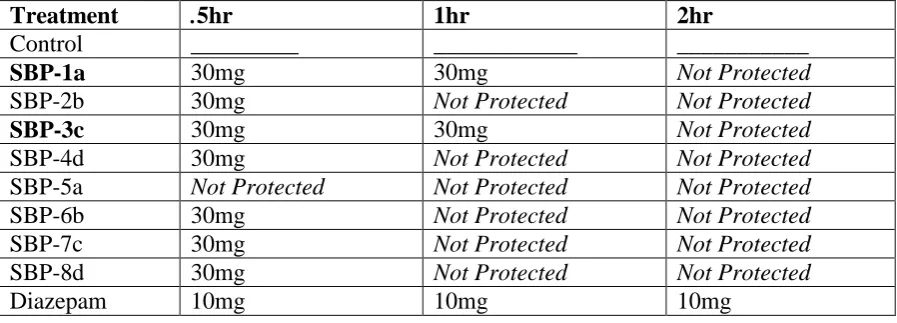
4.1.2 Chemical induced models: 10 mice of either sex with a weight of 22-25g were treated with the test compounds or the standard (e.g. diazepam 10 mg/kg i.p.) by intraperitoneal administration. Controls received the vehicle only. 30 min after i.p. treatment the animals were injected with a subcutaneous dose of 300 mg/kg Isoniazid (isonicotinic acid hydrazide & thiosemicarbazide (20 mg/kg).The occurrence of clonic seizures, tonic seizures and death or recovery was recorded after 0.5hr, 1hr, and 2hr respectively [5-8]. Not Protected means death of the rats occurs at the mentioned time.
[image:6.595.74.523.561.722.2]4.1.3 Evaluation of Anticonvulsant activity: INH induced convulsion model Table 2
Treatment .5hr 1hr 2hr
Control _________ __________ __________
SBP-1a 30mg 30mg Not Protected
SBP-2b 30mg Not Protected Not Protected
SBP-3c 30mg 30mg Not Protected
SBP-4d 30mg Not Protected Not Protected
SBP-5a Not Protected Not Protected Not Protected
SBP-6b 30mg Not Protected Not Protected
SBP-7c 30mg Not Protected Not Protected
SBP-8d 30mg 30mg Not Protected
Diazepam 10mg 10mg 10mg
4.1.4 Evaluation of Anticonvulsant activity: Thiosemicarbazide Induced convulsion model
Table 3
Treatment .5hr 1hr 2hr
Control _________ ____________ ___________
SBP-1a 30mg 30mg Not Protected
SBP-2b 30mg Not Protected Not Protected
SBP-3c 30mg 30mg Not Protected
SBP-4d 30mg Not Protected Not Protected
SBP-5a Not Protected Not Protected Not Protected
SBP-6b 30mg Not Protected Not Protected
SBP-7c 30mg Not Protected Not Protected
SBP-8d 30mg Not Protected Not Protected
5. RESULTS AND DISCUSSION
All the synthesized compounds were evaluated for their anticonvulsant activity using various chemical induced convulsion models on male albino mice (20–25g) and diazepam 10mg/kg body weight as a standard drug. Table no 2 and 3 All the synthesized derivatives were evaluated at the dose of 30mg/kg body weight & have shown good anticonvulsant activity & the compounds SBP-1a and SBP-3c was found to be most active amongst all the screened compounds using both the models i.e. Isoniazid induced model as well as Thiosemicarbazide model.
6. NEUROTOXICITY SCREENING
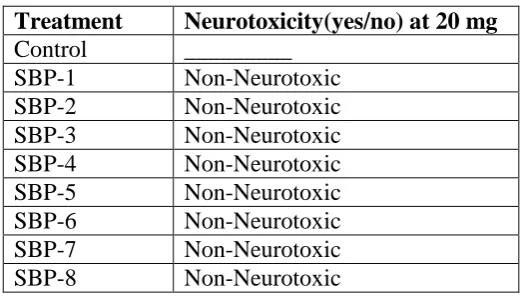
6.1 Rota rod test: Minimal motor impairment was measured in mice by the Rotarod test. The mice were trained to stay on an accelerating Rotarod that rotates at 6 revolutions per minute. The rod diameter was 3.2 cm. neurotoxicity was indicated by the inability of the animal to maintain equilibrium on the rod for at least 1 min in each of three trials. The dose at which the animals were unable to grasp the Rotarod was determined.
[image:7.595.167.430.428.576.2]6.1.1 Evaluation for Neurotoxicity by Rota-Rod model Table 4
Treatment Neurotoxicity(yes/no) at 20 mg
Control _________
SBP-1 Non-Neurotoxic
SBP-2 Non-Neurotoxic
SBP-3 Non-Neurotoxic
SBP-4 Non-Neurotoxic
SBP-5 Non-Neurotoxic
SBP-6 Non-Neurotoxic
SBP-7 Non-Neurotoxic
SBP-8 Non-Neurotoxic
7. RESULT AND DISCUSSIONS
Activity of the drugs interfering with motor coordination was checked by the Rota rod for neurotoxicity test. None of the compounds was found to be neurotoxic at a dose of 20 mg/kg body weight amongst all the tested compounds.
8. CONCLUSION
10mg/kg body weight as a standard drug. The compounds SBP-1a and SBP-3c were found to be most active amongst all the screened compounds.
9. ACKNOWLEDGMENT
My research article is dedicated to my honored (late) Prof. S N Pandeya. All research work was done under him and his great effort.
REFERENCES
1. Joule, John A, Mills, Keith, eds. Heterocyclic Chemistry, Oxford: Wiley, 2010; 250(5): ISBN 978-1-405-13300-5.
2. March, Jerry, Advanced Organic Chemistry: Reactions, Mechanisms, and Structure (3), New York: Wiley, 1985: ISBN 0-471-85472-7.
3. Day A. C, Whiting M C, Acetone hydrazone, Organic synthesis, 1970; 50: 3; (6), 10. 4. http://en.wikipedia.org/wiki/Schiff_base, 2016; (PAC, Glossary of class names of organic
compounds and reactivity intermediates based on structure, IUPAC Recommendations 1995; (67): 1364.
5. Vogel H.G; Drug discovery and evaluation: pharmacological assays, Berlin: Springer Verlag; New York, 2002; 696-716.