White Rose Research Online URL for this paper:
http://eprints.whiterose.ac.uk/1205/
Article:
Zaffanella, E., Hill, P.M. and Bagnara, R. (2002) Decomposing non-redundant sharing by
complementation. Theory and Practice of Logic Programming, 2 (2). pp. 233-261. ISSN
1471-0684
DOI:10.1017/S1471068401001351
[email protected] https://eprints.whiterose.ac.uk/ Reuse
See Attached
Takedown
If you consider content in White Rose Research Online to be in breach of UK law, please notify us by
DOI: 10.1017/S1471068401001351 Printed in the United Kingdom
Decomposing non-redundant sharing
by complementation
ENEA ZAFFANELLA
Department of Mathematics, University of Parma, Italy
(e-mail:[email protected])
PATRICIA M. HILLã
School of Computing, University of Leeds, Leeds, UK
(e-mail:[email protected])
ROBERTO BAGNARA†
Department of Mathematics, University of Parma, Italy
(e-mail:[email protected])
Abstract
Complementation, the inverse of the reduced product operation, is a technique for system-atically finding minimal decompositions of abstract domains. Fil´e and Ranzato advanced the state of the art by introducing a simple method for computing a complement. As an application, they considered the extraction by complementation of the pair-sharing domain PS from the Jacobs and Langen’s set-sharing domainSH. However, since the result of this operation was stillSH, they concluded thatPS was too abstract for this. Here, we show that the source of this result lies not withPS but withSH and, more precisely, with the redundant information contained inSH with respect to ground-dependencies and pair-sharing. In fact, a proper decomposition is obtained if the non-redundant version ofSH,PSD, is substituted forSH. To establish the results forPSD, we define a general schema for subdomains ofSH that includesPSD andDef as special cases. This sheds new light on the structure ofPSD and exposes a natural though unexpected connection betweenDef andPSD. Moreover, we substantiate the claim that complementation alone is not sufficient to obtain truly minimal decompositions of domains. The right solution to this problem is tofirst remove redundancies by computing the quotient of the domain with respect to the observable behavior, and only then decompose it by complementation.
KEYWORDS: Abstract interpretation, domain decomposition, complementation, sharing analysis
1 Introduction
Complementation (Cortesi et al., 1997), which is the inverse of the well-known reduced product operation (Cousot & Cousot, 1979), can systematically obtain minimal decompositions of complex abstract domains. It has been argued that these
ãThis work was partly supported by EPSRC under grant GR/M05645.
decompositions would be useful in finding space saving representations for domains and to simplify domain verification problems.
Fil´e & Ranzato (1996) presented a new method for computing the complement, which is simpler than the original proposal by Cortesiet al.(1995, 1997) because it has the advantage that, to compute the complement, only a relatively small number of elements (namely the meet-irreducible elements of the reference domain) need be considered. As an application of this method, the authors considered the Jacobs & Langen’s (1992) sharing domain, SH, for representing properties of variables such as groundness and sharing. This domain captures the property of set-sharing. Fil´e and Ranzato illustrated their method by minimally decomposing SH into three components; using the words of the authors (Fil´e & Ranzato, 1996, Section 1):
“[. . .] each representing one of the elementary properties that coexist in the elements of Sharing, and that are as follows: (i) the ground-dependency information; (ii) the pair-sharing information, or equivalently variable independence; (iii) the set-sharing information, without variable independence and ground-dependency.”
However, this decomposition did not use the usual domainPS for pair-sharing. Fil´e and Ranzato observed that the complement of the pair-sharing domain PS with respect to SH is againSH and concluded thatPS was too abstract to be extracted from SH by means of complementation. Thus, in order to obtain their non-trivial decomposition ofSH, they used a different (and somewhat unnatural) definition for an alternative pair-sharing domain, calledPS′. The nature ofPS′and its connection withPS is examined more carefully in Section 6.
We noticed that the reason why Fil´e and Ranzato obtained this result was not to be found in the definition of PS, which accurately represents the property of pair-sharing, but in the use of the domain SH to capture the property of pair-sharing. Bagnaraet al. (1997, 2001) observed that, for most (if not all) applications, the property of interest is not set-sharing but pair-sharing. Moreover, it was shown that, for groundness and pair-sharing,SH includes redundant elements. By defining an upper closure operatorρthat removed this redundancy, a much smaller domain
PSD, which was denotedSHρin Bagnaraet al. (1997), was found that captured pair-sharing and groundness with the same precision asSH. We show here that using the method given in Fil´e & Ranzato (1996), but with this domain instead of SH as the reference domain, a proper decomposition can be obtained even when considering the natural definition of the pair-sharing domain PS. Moreover, we show thatPS
is exactly one of the components obtained by complementation ofPSD. Thus the problem exposed by Fil´e and Ranzato was, in fact, due to the ‘information preserving’ property of complementation, as any factorization obtained in this way is such that the reduced product of the factors gives back the original domain. In particular, any factorization of SH has to encode the redundant information identified in Bagnara
et al. (1997, 2001). We will show that such a problem disappears whenPSD is used as the reference domain.
capturing groundness (Armstronget al., 1998). Each Boolean variable has the value
true if the program variable it corresponds to is definitely bound to a ground term. However, the domain Pos is isomorphic to SH via the mapping from formulas in
Pos to the set of complements of their models (Codish & Søndergaard, 1998). This means that any general result regarding the structure ofSH is equally applicable to
Pos and its subdomains.
To establish the results for PSD, we define a general schema for subdomains of SH that includes PSD and Def as special cases. This sheds new light on the structure of the domain PSD, which is smaller but significantly more involved than SH.1 Of course, as we have used the more general schematic approach, we
can immediately derive (where applicable) corresponding results for Def andPos. Moreover, an interesting consequence of this work is the discovery of a natural connection between the abstract domains Def and PSD. The results confirm that
PSD is, in fact, the ‘appropriate’ abstraction of the set-sharing domainSH that has to be considered when groundness and pair-sharing are the properties of interest.
The paper, which is an extended version of Zaffanella et al. (1999), is structured as follows. In Section 2 we briefly recall the required notions and notations, even though we assume general acquaintance with the topics of lattice theory, abstract interpretation, sharing analysis and groundness analysis. Section 3 introduces the
SH domain and several abstractions of it. The meet-irreducible elements of an important family of abstractions of SH are identified in Section 4. This is required in order to apply, in Section 5, the method of Fil´e and Ranzato to this family. In Section 6 we present some final remarks and we explain what is, in our opinion, the lesson to be learned from this and other related work. Section 7 concludes.
2 Preliminaries
For any set S,℘(S) denotes the power set ofS and #S is the cardinality ofS. A preorder ‘’ over a set P is a binary relation that is reflexive and transitive. If ‘’ is also antisymmetric, then it is called partial order. A set P equipped with a partial order ‘’ is said to be partially ordered and sometimes written hP ,i. Partially ordered sets are also calledposets.
A poset hP ,i is totally ordered with respect to ‘’ if, for eachx, y ∈P, either
xy oryx. A subsetS of a poset hP ,i is achain if it is totally ordered with respect to ‘’.
Given a poset hP ,i and S ⊆P, y ∈P is anupper bound forS if and only if
x y for each x∈S. An upper bound y for S is a least upper bound (or lub) of
S if and only if, for every upper bound y′ forS, y y′. The lub, when it exists, is unique. In this case we write y= lubS.Lower boundsandgreatest lower bounds (or glb) are defined dually.
A poset hL,i such that, for each x, y ∈ L, both lub{x, y} and glb{x, y} exist, is called a lattice. In this case, lub and glb are also called, respectively, the join
1For the well acquainted with the matter:SH is a powerset and hence it is dual-atomistic; this is not
and the meet operations of the lattice. A complete lattice is a lattice hL,i such that every subset ofL has both a least upper bound and a greatest lower bound. The top element of a complete lattice L, denoted by ⊤, is such that ⊤ ∈ L and ∀x∈L:x ⊤. Thebottom element ofL, denoted by⊥, is defined dually.
As an alternative definition, a lattice is an algebra hL,∧,∨i such that ∧ and ∨ are two binary operations over L that are commutative, associative, idempotent, and satisfy the following absorption laws, for each x, y ∈ L: x∧(x∨y) = x and
x∨(x∧y) =x.
The two definitions of lattice are equivalent. This can be seen by defining:
xy ⇐⇒def x∧y =x ⇐⇒def x∨y=y
and
glb{x, y}def=x∧y,
lub{x, y}def= x∨y.
The existence of an isomorphism between the two latticesL1 and L2 is denoted by
L1 ≡L2.
A monotone and idempotent self-map ρ:P →P over a poset hP ,i is called a
closure operator (orupper closure operator) if it is also extensive, namely
∀x∈P :xρ(x).
Each upper closure operatorρ over a complete latticeC is uniquely determined by the set of its fixpoints, i.e. by its image
ρ(C)def={ρ(x)|x∈C}.
We will often denote upper closure operators by their images. The set of all upper closure operators over a complete lattice C, denoted by uco(C), forms a complete lattice ordered as follows: if ρ1, ρ2 ∈uco(P), ρ1 ⊑ρ2 if and only ifρ2(C)⊆ρ1(C). Thereduced product of two elementsρ1andρ2 of uco(C) is denoted byρ1⊓ρ2 and defined as
ρ1⊓ρ2 def= glb{ρ1, ρ2}.
For a more detailed introduction to closure operators, the reader is referred elsewhere (Gierz et al., 1980).
A complete latticeC ismeet-continuous if for any chainY ⊆C and eachx∈C,
x∧ _ Y
= _
y∈Y (x∧y).
Most domains for abstract interpretation (Cortesiet al., 1997) and, in particular, all the domains considered in this paper are meet-continuous.
Assume that C is a meet-continuous lattice. Then the inverse of the reduced product operation, calledweak relative pseudo-complement, is well defined and given as follows. Let ρ, ρ1∈uco(C) be such thatρ⊑ρ1. Then
ρ∼ρ1def= lub{ρ2∈uco(C)|ρ1⊓ρ2=ρ}.
customary in the field of Abstract Interpretation, simplycomplement) ofρis denoted byidC ∼ρ, whereidC is the identity overC. LetDi
def
=ρDi(C) withρDi∈uco(C) for i= 1, . . ., n. Then{Di |1 6i6n}is a decomposition for C ifC =D1⊓ · · · ⊓Dn.
The decomposition is also called minimal if, for each k ∈ N with 16k 6n and eachEk∈uco(C),Dk@Ek implies
C @D1⊓ · · · ⊓Dk−1⊓Ek⊓Dk+1⊓ · · · ⊓Dn.
Assume now that C is a complete lattice. IfX ⊆C, then Moore(X) denotes the
Moore completion of X, namely,
Moore(X)def={^
Y |Y ⊆X }.
We say that C is meet-generated by X if C = Moore(X). An element x ∈ C is
meet-irreducible if
∀y, z∈C: (x=y∧z) =⇒(x=y orx=z) .
The set of meet-irreducible elements of a complete lattice C is denoted by MI(C). Note that⊤ ∈MI(C). An elementx∈Cis adual-atomifx6=⊤and, for eachy∈C,
x6y <⊤impliesx=y. The set of dual-atoms is denoted by dAtoms(C). Note that dAtoms(C)⊂MI(C). The domainC isdual-atomistic if C = Moore dAtoms(C)
. Thus, if C is dual-atomistic, MI(C) = {⊤} ∪dAtoms(C). The following result holds (Fil´e and Ranzato 1996, Theorem 4.1).
Theorem 1
IfC is meet-generated by MI(C) then uco(C) is pseudo-complemented and for any
ρ∈uco(C)
idC ∼ρ= Moore MI(C)\ρ(C)
.
Another interesting result is the following (Fil´e and Ranzato 1996, Corollary 4.5).
Theorem 2
IfC is dual-atomistic then uco(C) is pseudo-complemented and for anyρ∈uco(C)
idC ∼ρ= Moore dAtoms(C)\ρ(C)
.
Let Vars be a denumerable set of variables. For any syntactic object o, vars(o) denotes the set of variables occurring in o. Let TVars be the set of first-order
terms over Vars. If x ∈ Vars and t ∈ TVars \ {x}, then x 7→ t is called a binding.
A substitution is a total function σ: Vars → TVars that is the identity almost
everywhere. Substitutions are denoted by the set of their bindings, thus a substitution
σ is identified with the (finite) set
{x7→σ(x)|x6=σ(x)}.
If t∈ TVars, we write tσ to denote σ(t). A substitution σ is idempotent if, for all t∈ TVars, we have tσσ=tσ. The set of all idempotent substitutions is denoted by Subst.
our work with respect to other works appeared in the literature. However, the results proved in this paper do not rely on the idempotency of substitutions and are therefore applicable also when considering substitutions inrational solved form (Colmerauer, 1982, 1984). Indeed, we have proved (Hill, Bagnara & Zaffanella, 1998) that the usual abstract operations defined on the domainSH, approximating concrete unification over finite trees, also provide a correct approximation of concrete unification over a domain of rational trees.
3 The Sharingdomains
In order to provide a concrete meaning to the elements of the set-sharing domain of Jacobs and Langen (Jacobs & Langen, 1989, 1992; Langen, 1990), a knowledge of the finite setVI ⊂Vars of variables of interest is required. For example, in the PhD thesis of Langen (Langen, 1990) this set is implicitly defined, for each clause being analyzed, as the finite set of variables occurring in that clause. A clearer approach has been introduced (Cortesiet al., 1994, 1998) and also adopted (Bagnara
et al., 1997, 2001; Cortesi & Fil´e, 1999), where the set of variables of interest is given explicitly as a component of the abstract domain. During the analysis process, this set is elastic. That is, it expands (e.g. when solving clause’s bodies) and contracts (e.g. when abstract descriptions are projected onto the variables occurring in clause’s heads). This technique has two advantages: first, a clear and unambiguous description of those semantic operators that modify the set of variables of interest is provided; second, the definition of the abstract domain is completely independent from the particular program being analyzed. However, since at any given time the set of variables of interest is fixed, we can simplify the presentation by consistently denoting this set by VI. Therefore, in this paper all the abstract domains defined are restricted to a fixed set of variables of interest VI of finite cardinality n; this set is not included explicitly in the representation of the domain elements; also, when considering abstract semantic operators having some arguments in Subst, such as the abstract mgu, the considered substitutions are always taken to have variables in VI. We would like to emphasize that this is done for ease of presentation only: the complete definition of both the domains and the semantic operators can be immediately derived from those given, for instance, in Bagnara
et al. (1997, 2001). Note that other solutions are possible; we refer the interested reader elsewhere (Cortesi, Fil´e & Winsborough, 1996, Section 7) (Scozzari, 2001, Section 10), where this problem is discussed in the context of groundness analysis.
3.1 The set-sharing domainSH
Definition 1
(The set-sharing domain SH.)The domainSH is given by
SH def=℘(SG),
where the set of sharing-groups SG is given by
SH is partially ordered by set inclusion so that the lub is given by set union and the glb by set intersection.
Note that, as we are adopting the upper closure operator approach to abstract interpretation, all the domains we define here are ordered by subset inclusion. As usual in the field of abstract interpretation, this ordering provides a formalization of precision where the less precise domain elements are those occurring higher in the partial order. Thus, more precise elements contain less sharing groups.
SinceSH is a power set,SH is dual-atomistic and
dAtoms(SH) ={SG\ {S} |S ∈SG}.
In all the examples in this paper, the elements of SH are written in a simplified notation, omitting the inner braces. For instance, the set
{{x},{x, y},{x, z},{x, y, z}}
would be written simply as
{x, xy, xz, xyz}.
Example 1
Suppose VI ={x, y, z}. Then the seven dual-atoms of SH are:
s1 ={ y, z, xy, xz, yz, xyz}, s2 ={x, z, xy, xz, yz, xyz}, s3 ={x, y, xy, xz, yz, xyz},
these lack a singleton;
s4 ={x, y, z, xz, yz, xyz}, s5 ={x, y, z, xy, yz, xyz}, s6 ={x, y, z, xy, xz, xyz},
these lack a pair;
s7 ={x, y, z, xy, xz, yz }, this lacksVI.
The meet-irreducible elements of SH ares1, . . . , s7, and the top elementSG.
Definition 2
(Operations over SH.) The function bin :SH ×SH →SH, called binary union, is
given, for each sh1,sh2∈SH, by
bin(sh1,sh2) def
={S1∪S2|S1∈sh1, S2∈sh2}.
Thestar-union function (·)⋆:SH →SH is given, for eachsh ∈SH, by
sh⋆ def= nS ∈SG ∃sh
′⊆sh. S =[ sh′o.
Thej-self-union function (·)j:SH →SH is given, for eachj>1 andsh ∈SH, by
shj def=nS ∈SG ∃sh
′⊆sh.#sh′6j, S=[ sh′o.
The extraction of the relevant component of an element of SH with respect to a subset of VI is encoded by the function rel : ℘(VI)×SH → SH given, for each
V ⊆VI and eachsh ∈SH, by
The function amgu captures the effects of a bindingx 7→t on an element of SH. Let sh ∈SH,vx={x},vt =vars(t), andvxt=vx∪vt. Then
amgu(sh, x7→t)def= sh\(rel(vxt,sh)∪bin rel(vx,sh)⋆,rel(vt,sh)⋆.
We also define the extension amgu :SH×Subst →SH by
amgu(sh,∅) def= sh,
amgu sh,{x7→t} ∪σ def
= amgu amgu(sh, x7→t), σ\ {x7→t} .
The function proj :SH×℘(VI)→SH thatprojects an element ofSH onto a subset
V ⊆VI of the variables of interest is given, for eachsh∈SH, by
proj(sh, V)def={S∩V |S∈sh, S∩V 6=∅} ∪ {{x} |x∈VI \V}.
Together with lub, the functions proj and amgu are the key operations that make the abstract domain SH suitable for computing static approximations of the substitutions generated by the execution of logic programs. These operators can be combined with simpler ones (e.g. consistent renaming of variables) so as to provide a complete definition of the abstract semantics. Also note that these three operators have been proved to be the optimal approximations of the corresponding concrete operators (Cortesi & Fil´e, 1999). The j-self-union operator defined above is new. We show later when it may safely replace the star-union operator. Note that, letting
j= 1, 2, andn, we havesh1 =sh,sh2 = bin(sh,sh), and, as #VI =n,shn=sh⋆.
3.2 The tuple-sharing domains
To provide a general characterization of domains such as the groundness and pair-sharing domains contained in SH, we first identify the sets of elements that have the same cardinality.
Definition 3
(Tuples of cardinality k.) For eachk∈Nwith 16k6n, the overloaded functions
tuplesk:SG→SH and tuplesk:SH →SH are defined as
tuplesk(S)
def
= {T ∈℘(S)|#T =k},
tuplesk(sh)
def
= [{tuplesk(S′)|S′∈sh}. In particular, ifS ∈SG andsh∈SH, let
pairs(S) def= tuples2(S),
pairs(sh) def= tuples2(sh).
The usual domains that represent groundness and pair-sharing information will be shown to be special cases of the following more general domain.
Definition 4
(The tuple-sharing domainsTSk.)For eachk∈Nsuch that 16k6n, the function
ρTSk:SH →SH is defined as
and, as ρTSk ∈uco(SH), it induces the lattice
TSk
def
=ρTSk(SH).
Note that ρTSk tuplesk(sh)
= ρTSk(sh) and that there is a one to one correspon-dence betweenTSk and℘ tuplesk(VI)
. The isomorphism is given by the functions tuplesk:TSk→℘ tuplesk(VI)
andρTSk:℘ tuplesk(VI)
→TSk. Thus the domain
TSk is the smallest domain that can represent properties characterized by sets of variables of cardinality k. We now consider the tuple-sharing domains for the cases whenk= 1, 2, andn.
Definition 5
(Thegroundness domainCon.)The upper closure operatorρCon:SH →SH and the corresponding domainCon are defined as
ρCon def= n ρTS1,
Con def= TS1(SH) =ρCon(SH).
This domain, which represents groundness information, is isomorphic to a domain of conjunctions of Boolean variables. The isomorphism tuples1 maps each element
of Con to the set of variables that are possibly non-ground. From the domain tuples1(Con), by set complementation, we obtain the classical domainG (Jones &
Søndergaard, 1987) for representing the set of variables that are definitely ground (so that we haveTS1
def
=Con≡G).
Definition 6
(The pair-sharing domain PS.)The upper closure operatorρPS:SH →SH and the corresponding domainPS are defined as
ρPS def= ρTS2,
PS def= TS2(SH) =ρPS(SH).
This domain represents pair-sharing information and the isomorphism tuples2 maps
each element of PS to the set of pairs of variables that may be bound to terms that share a common variable. The domain for representing variable independence can be obtained by set complementation.
Finally, in the case whenk=nwe have a domain consisting of just two elements:
TSn ={SG,SG\ {VI}}.
Note that the bottom of TSn differs from the top element SG only in that it lacks the sharing group VI. There is no intuitive reading for the information encoded by this element: it describes all but those substitutionsσ∈Subst such that
T{vars(
xσ)|x∈VI} 6=∅.
Just as forSH, the domainTSk (where 16k6n) is dual-atomistic and:
dAtoms(TSk) =n SG\ {U∈SG |T ⊆U}
T ∈tuplesk(VI) o
Thus we have
dAtoms(Con) = n SG\ {U∈SG |x∈U} x∈VI
o ,
dAtoms(PS) = n SG\ {U∈SG |x, y∈U}
x, y∈VI, x6=y o
.
Example 2
Consider Example 1. Then the dual-atoms ofCon are
r1=s1∩s4∩s5∩s7={ y, z, yz}, r2=s2∩s4∩s6∩s7={x, z, xz }, r3=s3∩s5∩s6∩s7={x, y, xy };
the dual-atoms of PS are
m1 =s4∩s7 ={x, y, z, xz, yz}, m2 =s5∩s7 ={x, y, z, xy, yz}, m3 =s6∩s7 ={x, y, z, xy, xz }.
It can be seen from the dual-atoms that, for each j = 1,. . ., n, wherej6=k, the precision of the information encoded by domainsTSj andTSk is not comparable. Also, we note that, if j < k, then ρTSj(TSk) ={SG}andρTSk(TSj) =TSj.
3.3 The tuple-sharing dependency domains
We now need to define domains that capture the propagation of groundness and pair-sharing; in particular, the dependency of these properties on the further instantiation of the variables. In the same way as with TSk for Con and PS, we first define a general subdomainTSDkofSH. This must be safe with respect to the tuple-sharing property represented by TSk when performing the usual abstract operations. This was the motivation behind the introduction in Bagnara et al. (1997, 2001) of the pair-sharing dependency domain PSD. We now generalize this for tuple-sharing.
Definition 7
(The tuple-sharing dependency domains TSDk.) For each k where 1 6 k 6 n, the function ρTSDk:SH →SH is defined as
ρTSDk(sh)def=nS ∈SG
∀T ⊆S: #T < k=⇒S = [
{U∈sh|T ⊆U⊆S}o,
and, as ρTSDk ∈uco(SH), it induces thetuple-sharing dependency lattice
TSDk
def
= ρTSDk(SH).
It follows from the definitions that the domainsTSDk form a strict chain.
Proposition 1
Forj, k∈Nwith 16j < k6n, we haveTSDj ⊂TSDk.
Proposition 2
For k ∈ N with 1 6 k 6 n, we have TSk ⊆ TSDk. Furthermore, if n > 1 then
TSk⊂TSDk.
As an immediate consequence of Propositions 1 and 2 we have that that TSDk is not less precise thanTS1⊓ · · · ⊓TSk.
Corollary 1
Forj, k∈Nwith 16j6k6n, we haveTSj⊆TSDk.
It also follows from the definitions that, for the TSDk domain, the star-union operator can be replaced by thek-self-union operator.
Proposition 3
For 16k6n, we haveρTSDk shk
=sh⋆.
We now instantiate the tuple-sharing dependency domains for the cases when
k= 1, 2, andn.
Definition 8
(The ground dependency domain Def.) The domain Def is induced by the upper closure operator ρDef:SH →SH. They are defined as
ρDef def= ρTSD1,
Def def= TSD1=ρDef(SH).
By Proposition 3, we have, for all sh ∈ SH, ρTSD1(sh) = sh⋆ so that TSD1 is a
representation of the domain Def used for capturing groundness. It also provides evidence for the fact that the computation of the star-union is not needed for the elements in Def.
Definition 9
(Thepair-sharing dependencydomainPSD.)The upper closure operatorρPSD:SH →
SH and the corresponding domain PSD are defined as
ρPSD def= ρTSD2,
PSD def= TSD2=ρPSD(SH).
Then, it follows from Bagnara et al. (1997, Theorem 7) that PSD corresponds to the domain SHρ defined for capturing pair-sharing. By Proposition 3 we have, for all sh ∈SH, thatρPSD(sh2) =sh⋆, so that, for elements in PSD, the star-union operatorsh⋆can be replaced by the 2-self-unionsh2= bin(sh,sh) without any loss of precision. This was also proved in Bagnaraet al.(1997, Theorem 11). Furthermore, Corollary 1 confirms the observation made in Bagnara et al. (1997) thatPSD also captures groundness.
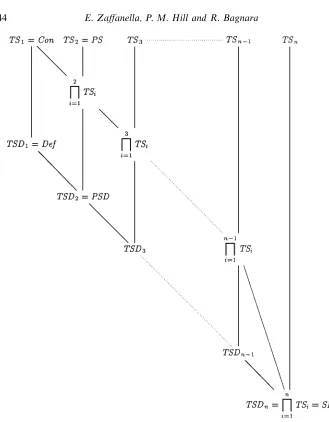
Finally, letting k = n, we observe that TSDn = SH. Figure 1 summarizes the relations between the tuple-sharing and the tuple-sharing dependency domains.
As already discussed at the start of this section, the set of variables of interest
Fig. 1. The set-sharing domainSH and some of its abstractions.
the domains SS andSSρ(corresponding to SH andPSD, respectively) are instead obtained by explicitly adding to each domain element a new component, representing the set of variables of interest. It is shown that SSρ is as good as SS for both representing and propagating pair-sharing and it is also proved that any weaker domain does not satisfy these properties, so thatSSρis the quotient (Cortesiet al., 1994, 1998) of SS with respect to the pair-sharing propertyPS.
We now generalize and strengthen the results in Bagnara et al. (1997, 2001) and show that, for each k∈ {1, . . . , n}, TSDk is the quotient of SH with respect to the reduced productTS1⊓ · · · ⊓TSk. These results are proved at the end of this section.
Theorem 3
eachsh′∈SH, and eachV ∈℘(VI),
ρTSDk amgu(sh1, σ)
=ρTSDk amgu(sh2, σ) , ρTSDk(sh′∪sh1) =ρTSDk(sh
′∪sh2),
ρTSDk proj(sh1, V)
=ρTSDk proj(sh2, V) .
Theorem 4
Let 16k6nfor eachsh1,sh2∈SH,ρTSDk(sh1)6=ρTSDk(sh2) implies
∃σ∈Subst,∃j∈ {1, . . . , k}. ρTSj amgu(sh1, σ)
6
=ρTSj amgu(sh2, σ) .
3.4 Proofs of Theorems 3 and 4
In what follows we use the fact that ρTSDk is an upper closure operator so that, for eachsh1,sh2∈SH,
sh1⊆ρTSDk(sh2) ⇐⇒ ρTSDk(sh1)⊆ρTSDk(sh2). (1)
In particular, since (·)⋆ =ρTSD
1, we have
sh1 ⊆sh⋆2 ⇐⇒ sh⋆1⊆sh⋆2. (2)
Lemma 1
For eachsh ∈SH and eachV ∈℘(VI),
ρTSDk(sh)\rel V , ρTSDk(sh)
=ρTSDk sh\rel(V ,sh) .
Proof
By Definition 7,
S∈ ρTSDk sh\rel(V ,sh)
⇐⇒ ∀T ⊆S :#T < k=⇒S=[{U∈sh\rel(V ,sh)|T ⊆U⊆S}
⇐⇒ ∀T ⊆S :#T < k=⇒S=[{U∈sh|T ⊆U⊆S} ∧S∩V =∅
⇐⇒ S∈ρTSDk(sh)\rel V , ρTSDk(sh) . q
Lemma 2
For eachsh1,sh2 ∈SH, eachV ∈℘(VI) and eachk∈Nwith 1< k6n,
ρTSDk(sh1)⊆ρTSDk(sh2) =⇒rel(V ,sh1)⋆⊆rel(V ,sh2)⋆.
Proof
We prove that
sh1⊆ρTSDk(sh2) =⇒rel(V ,sh1)⊆rel(V ,sh2)
⋆.
The result then follows from equations (1) and (2).
S∈ρTSDk(sh2). Letx∈V∩S. Then, by Definition 7, we have
S =[{U∈sh2| {x} ⊆U⊆S}
=[{U∈rel(V ,sh2)| {x} ⊆U⊆S}.
Thus S∈rel(V ,sh2)⋆. q
Lemma 3
For eachsh1,sh2 ∈SH, eachσ∈Subst and eachk∈Nwith 16k6n,
ρTSDk(sh1) =ρTSDk(sh2) =⇒ρTSDkamgu sh1, σ
=ρTSDkamgu sh2, σ .
Proof
If σ=∅, the statement is obvious from the definition of amgu. In the other cases, the proof is by induction on the size ofσ. The inductive step, whenσ has more than one binding, is straightforward. For the base case, when σ ={x 7→t}, we have to show that
sh1 ⊆ρTSDk(sh2) =⇒amgu sh1,{x7→t}
⊆ρTSDkamgu sh2,{x7→t} .
The result then follows from equation (1). Let vx
def
= {x},vt
def
= vars(t), andvxt
def
=vx∪vt. Suppose
S∈amgu sh1,{x7→t} .
Then, by definition of amgu,
S ∈ sh1\rel(vx∪vt,sh1)
∪bin rel(vx,sh1)⋆,rel(vt,sh1)⋆
.
There are two cases:
1. S ∈sh1\rel(vx∪vt,sh1). Then, by hypothesis,S ∈ρTSDk(sh2). Hence we have S∈ρTSDk(sh2)\rel vx∪vt, ρTSDk(sh2)
. Thus, by Lemma 1,
S ∈ρTSDk sh2\rel(vx∪vt,sh2).
2. S ∈ bin rel(vx,sh1)⋆,rel(vt,sh1)⋆. Then we must have S = T ∪R where
T ∈rel(vx,sh1)⋆ andR∈rel(vt,sh1)⋆.
The proof here splits into two branches, 2a and 2b, depending on whether k >1 ork= 1.
(2a) We first assume that k >1. Then, by Lemma 2 we have thatT ∈rel(vx,sh2)⋆
andR∈rel(vt,sh2)⋆. Hence,
S∈bin rel(vx,sh2)⋆,rel(vt,sh2)⋆.
Combining case 1 and case 2a we obtain
S∈ρTSDk sh2\rel(vx∪vt,sh2)∪bin rel(vx,sh2)⋆,rel(vt,sh2)⋆.
Hence as ρTSDk is extensive and monotonic
S∈ρTSDk sh2\rel(vx∪vt,sh2)∪bin rel(vx,sh2)⋆,rel(vt,sh2)⋆
and hence, when k >1,S∈ρTSDkamgu sh2,{x7→t}
.
(2b) Secondly suppose thatk= 1. In this case, we have, by Proposition 3:
ρTSD1(sh2) =sh ⋆
2
and that
ρTSD1amgu sh2,{x7→t}
= amgu sh2,{x7→t}⋆ .
Thus, by the hypothesis,
S ∈ bin rel(vx,sh⋆2)⋆,rel(vt,sh⋆2)⋆
,
= bin rel(vx,sh⋆2),rel(vt,sh⋆2)
.
Therefore, we can write
S=T ∪Tx∪R ∪Rt
where
T ∪Tx ∈ rel(vx,sh⋆2), R ∪Rt ∈ rel(vt,sh⋆2),
T , R ∈ sh2\rel(vxt,sh2)⋆, Tx ∈ rel(vx,sh2)⋆\ ∅,
Rt ∈ rel(vt,sh2)⋆\ ∅.
Thus
S ∈ sh2\rel(vxt,sh2)∪bin rel(vx,sh2)⋆,rel(vt,sh2)⋆
⋆
= amgu sh2,{x7→t} ⋆
.
Combining case 1 and case 2b for k = 1, the result follows immediately by the monotonicity and extensivity of (·)⋆. q
Lemma 4
For eachsh1,sh2 ∈SH,
ρTSDk(sh1∪sh2) =ρTSDk ρTSDk(sh1)∪ρTSDk(sh2)
.
Proof
This is a classical property of upper closure operators (Gierz et al., 1980). q
Lemma 5
For eachsh1,sh2 ∈SH and eachV ⊆VI,
ρTSDk(sh1) =ρTSDk(sh2) =⇒ρTSDk proj(sh1, V)
=ρTSDk proj(sh2, V) .
Proof
We show that
sh1 ⊆ρTSDk(sh2) =⇒proj(sh1, V)⊆ρTSDk proj(sh2, V) .
Suppose sh1 ⊆ρTSDk(sh2) and S ∈ proj(sh1, V). Then, as proj is monotonic, we haveS∈proj ρTSDk(sh2), V. We distinguish two cases.
1. There exists x∈ V such that S ={x}. Then S ∈proj(sh2, V) and hence, by
Definition 7,S ∈ρTSDk proj(sh2, V)
.
2. Otherwise, by definition of proj and Definition 7, there existsS′ ∈ ρTSDk(sh2)
such thatS=S′∩V and
∀T ⊆S′:#T < k=⇒S =[{U∈sh2|T ⊆U⊆S′} ∩V
.
Hence
∀T ⊆S:#T < k=⇒S=[{U∈proj(sh2, V)|T ⊆U⊆S},
and thusS∈ρTSDk proj(sh2, V)
.
q
Proof of Theorem 3
Statements 1, 2 and 3 follow from Lemmas 3, 4 and 5, respectively. q
The following lemma is also proved in Bagnaraet al.(1997, 2001), but we include it here for completeness.
Lemma 6
Let σ def= {x1 7→t1, . . . , xn 7→ tn}, where, for each i= 1, . . ., n, ti is a ground term. Then, for all sh∈SH we have
amgu(sh, σ) =sh\rel {x1, . . . , xn},sh
.
Proof
If n = 0, so thatσ =∅, the statement can be easily verified after having observed that rel(∅,sh) =∅. Otherwise, if n >0, we proceed by induction on n. For the base case, let n= 1. Then
amgu(sh, x1 7→t1) =sh\rel {x1},sh
∪binrel {x1},sh⋆
,rel ∅,sh⋆
=sh\rel {x1},sh .
For the inductive step, let n >1 and let
σ′def= {x17→t1, . . . , xn−1 7→tn−1}.
By definition of amgu we have
amgu(sh, σ) = amgu sh,{xn 7→tn} ∪σ′
= amguamgu sh,{xn7→tn}, σ′
= amgush\rel {xn},sh, σ′
= sh\rel {xn},sh
\rel{x1, . . . , xn−1},sh\rel {xn},sh
= sh\
rel {xn},sh∪rel
{x1, . . . , xn−1},sh\rel {xn},sh
Proof of Theorem 4
We assume that S ∈ ρTSDk(sh1)\ρTSDk(sh2). (If such an S does not exist we simply
swap sh1 andsh2.)
Let C denote a ground term and let
σdef={x7→C|x∈VI \S}.
Then, by Lemma 6, fori= 1, 2, we define amgu(shi, σ)
def
= shSi where
shS1 def= {T ⊆S|T ∈sh1}, shS
2 def
= {T ⊂S|T ∈sh2}.
Now, if #S =j andj6k, then we have S∈sh1\sh2. HenceS∈shS1 \shS2 and
we can easily observe that S∈ρTSj(shS1) butS /∈ρTSj(shS2).
On the other hand, if #S=jandj > k, then by Definition 7 there existsT with #T < ksuch that
S =[{U∈shS1 |T ⊆U}
but
S⊃[
{U∈shS
2 |T ⊆U} def
=S′.
Let x ∈ S \S′. We have h def= # T ∪ {x}
6 k and thus we can observe that
T ∪ {x} ∈ρTSh(shS1) but T∪ {x}∈/ρTSh(sh
S
2). q
4 The meet-irreducible elements
In Section 5, we will use the method of Fil´e & Ranzato (1996) to decompose the dependency domains TSDk. In preparation for this, in this section, we identify the meet-irreducible elements for the domains and state some general results.
We have already observed thatTSkandTSDn =SH are dual-atomistic. However,
TSDk, fork < n, is not dual-atomistic and we need to identify the meet-irreducible elements. In fact, the set of dual-atoms forTSDk is
dAtoms(TSDk) ={SG\ {S} |S∈SG,#S6k}.
Note that # dAtoms(TSDk) = Pk
j=1 nj
. Specializing this for k = 1 and k = 2, respectively, we have
dAtoms(Def) ={SG\ {{x}} |x∈VI},
dAtoms(PSD) ={SG\ {S} |S∈pairs(VI)} ∪dAtoms(Def),
and we have # dAtoms(Def) =n and # dAtoms(PSD) =n(n+ 1)/2. We present as an example of this the dual-atoms for Def andPSD whenn= 3.
Example 3
⊥=ρDef(⊥) =∅ cannot be obtained by the meet (which is set intersection) of a set of dual-atoms. Thus, unlikeCon andPS, neitherDef norPSD are dual-atomistic.
Consider next the set Mk of the meet-irreducible elements of TSDk that are neither the top element SG nor dual-atoms. Mk has an element for each sharing group S ∈ SG such that #S > k and each tuple T ⊂ S with #T = k. Such an element is obtained from SG by removing all the sharing groups U such that
T ⊆U⊆S. Formally, for 16k6n,
Mk
def
={SG\ {U∈SG |T ⊆U⊆S} |T , S∈SG, T ⊂S ,#T =k}.
Note that, as there are nk
possible choices forT and 2n−k−1 possible choices for
S, we have #Mk= nk
(2n−k−1) and # MI(TSDk) =Pk−1
j=0
n j
+ nk
2n−k.
We now show that we have identified precisely all the meet-irreducible elements of TSDk.
Theorem 5
Ifk∈Nwith 16k6n, then
MI(TSDk) ={SG} ∪dAtoms(TSDk)∪Mk.
The proof of this theorem is included at the end of this section. Here, we illustrate the result for the case when n= 3.
Example 4
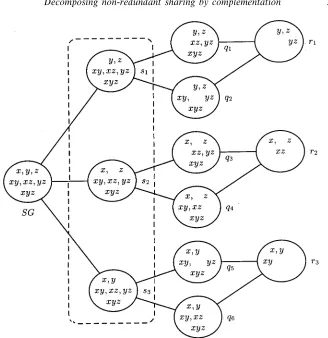
Consider again Example 3. First, consider the domain Def. The meet-irreducible elements which are not dual-atoms, besidesSG, are the following (see Figure 2):
q1={ y, z, xz, yz, xyz} ⊂s1,
q2={ y, z, xy, yz, xyz} ⊂s1, r1={ y, z, yz} ⊂q1∩q2, q3={x, z, xz, yz, xyz} ⊂s2,
q4={x, z, xy, xz, xyz} ⊂s2, r2={x, z, xz } ⊂q3∩q4, q5={x, y, xy, yz, xyz} ⊂s3,
q6={x, y, xy, xz, xyz} ⊂s3, r3={x, y, xy } ⊂q5∩q6.
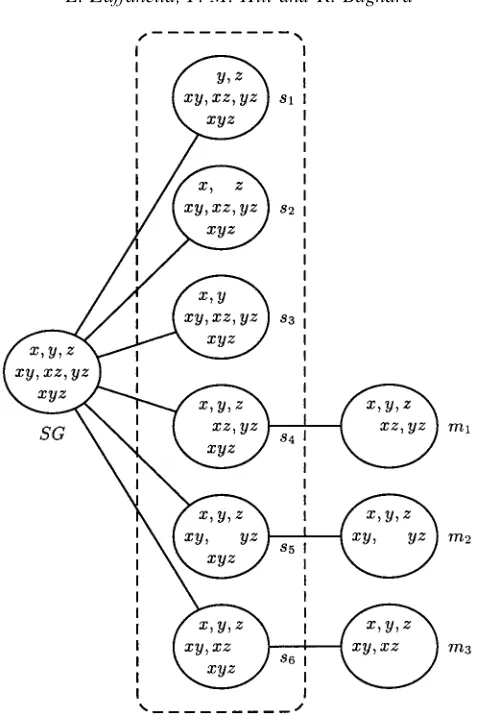
Next, consider the domain PSD. The only meet-irreducible elements that are not dual-atoms, beside SG, are the following (see Figure 3):
m1 ={x, y, z, xz, yz } ⊂s4 m2 ={x, y, z, xy, yz } ⊂s5 m3 ={x, y, z, xy, xz } ⊂s6.
Each of these lack a pair and none contains the sharing group xyz.
Fig. 2. The meet-irreducible elements ofDef forn= 3, with dual-atoms emphasized.
Corollary 2
Letk∈Nwith 16k6n. Then
dAtoms(TSk) ={sh∈MI(TSDk)|VI ∈/ sh}.
For the decomposition, we need to identify which meet-irreducible elements of
TSDk are inTSj. Using Corollaries 1 and 2 we have the following result.
Corollary 3
Ifj, k∈Nwith 16j < k6n, then MI(TSDk)∩TSj ={SG}.
By combining Proposition 1 with Theorem 5 we can identify the meet-irreducible elements of TSDk that are inTSDj, wherej < k.
Corollary 4
Ifj, k∈Nwith 16j < k6n, then
Fig. 3. The meet-irreducible elements ofPSD forn= 3, with dual-atoms emphasized.
4.1 Proof of Theorem 5
Proof of Theorem 5.
We prove the two inclusions separately.
1. MI(TSDk)⊇ {SG} ∪dAtoms(TSDk)∪Mk.
Letmbe in the right-hand side. Ifm∈ {SG}∪dAtoms(TSDk) there is nothing to prove. Therefore we assumem∈Mk. We need to prove that ifsh1,sh2∈TSDk and
m=sh1∧sh2 def
=sh1∩sh2
thenm=sh1 orm=sh2. Obviously, we havem⊆sh1andm⊆sh2. Moreover,
by definition of Mk, there exist T , S ∈SG where #T =k and T ⊂S such that
m=SG\ {U∈SG |T ⊆U⊆S}.
other is symmetric). Then, applying the definition ofTSDk, there is a T′⊂S
with #T′< ksuch that
[
{U′∈sh1|T′⊆U′⊆S} 6=S .
Since #T′<#T, there existsx such thatx∈T \T′. ThusT′⊂S\ {x}and
S\ {x} ∈m. Hence, as m⊆sh1, we haveS\ {x} ∈sh1. Consider an arbitrary U∈SG whereT ⊆U⊆S. Thenx∈U. Thus, since S = S\ {x}
∪U and
S /∈sh1,U /∈sh1. Thus, as this is true for all suchU, sh1⊆m.
2. MI(TSDk)⊆ {SG} ∪dAtoms(TSDk)∪Mk.
Let sh ∈ TSDk. We need to show that sh is the meet of elements in the right-hand side. Ifsh=SG then there is nothing to prove. Supposesh 6=SG. For eachS∈SG such thatS /∈sh, we will show there is an elementmS in the right-hand side such thatS /∈mS andsh⊆mS. Thensh=T{mS |S /∈sh}. There are two cases.
(2a) #S 6k; LetmS =SG\ {S}. ThenmS ∈dAtoms(TSDk) andsh ⊆mS. (2b) #S > k; in this case, applying the definition ofTSDk, there must exist a
set T′⊂S with #T′< ksuch that
[
{U′∈sh |T′⊂U′⊆S} ⊂S .
However, sinceT′⊂S, we have S =S
{T′∪ {x} |x∈S\T′}. Thus, for somex∈S\T′, if Uis such thatT′∪ {x} ⊆U⊆S thenU /∈sh. Choose
T ∈SG so thatT′∪ {x} ⊆T and #T =k and letmS =SG\ {U∈SG |
T ⊆U⊆S}. ThenmS ∈Mk,S /∈mS, andsh ⊆mS.
q
5 Decomposition of the domains
5.1 Removing the tuple-sharing domains
We first consider the decomposition of TSDk with respect to TSj. It follows from Theorem 1 and Corollaries 1 and 3 that, for 16j < k6n, we have
TSDk∼TSj = Moore MI(TSDk)\ρTSj(TSDk)
= Moore MI(TSDk)\TSj
= TSDk. (3)
SinceSH =TSDn, we have, using equation (3) and settingk=n, that, if j < n,
SH ∼TSj=SH. (4)
Thus, in general, TSj is too abstract to be removed fromSH by means of comple-mentation. (Note that here it is requiredj < n, because we haveSH ∼TSn6=SH.) In particular, letting j= 1, 2 (assuming n >2) in equation (4), we have
showing that Con and PS are too abstract to be removed from SH by means of complementation. Also, by equation (3), letting j= 1 andk= 2 it follows that the complement of Conin PSD isPSD.
Now consider decomposing TSDk usingTSk. It follows from Theorem 1, Propo-sition 2 and Corollary 2 that, for 16k6n, we have
TSDk∼TSk = Moore MI(TSDk)\ρTSk(TSDk)
= Moore MI(TSDk)\TSk
= {sh ∈TSDk |VI ∈sh}. (6)
Thus we have
TSDk∼(TSDk∼TSk) =TSk. (7)
We have therefore extracted all the domain TSk fromTSDk. So by lettingk= 1, 2 in equation (6), we have found the complements ofCon inDef andPS inPSD:
Def ∼Con = {sh∈Def |VI ∈sh}, PSD∼PS = {sh∈PSD |VI ∈sh}.
Thus, if we denote the domains induced by these complements as Def⊕ andPSD⊕, respectively, we have the following result.
Theorem 6
Def ∼Con =Def⊕, Def ∼Def⊕ =Con, PSD∼PS =PSD⊕, PSD ∼PSD⊕ =PS.
Moreover,Con andDef⊕ form a minimal decomposition forDef and, similarly,PS
andPSD⊕ form a minimal decomposition forPSD.
5.2 Removing the dependency domains
First we note that, by Theorem 5, Proposition 1, and Corollary 4, the complement of TSDj in TSDk, where 16j < k 6n, is given as follows:
TSDk∼TSDj = Moore MI(TSDk)\ρTSDj(TSDk)
= Moore MI(TSDk)\TSDj
={sh ∈TSDk| ∀S ∈SG: #S6j=⇒S∈sh}. (8)
It therefore follows from equation (8) and settingk=nthat the complement ofρTSDj
in SH forj < nis:
SH ∼TSDj = {sh ∈SH | ∀S ∈SG: #S 6j=⇒S ∈sh} (9)
def
In particular, in equation (9) whenj= 1, we have the following result forDef, also proved in Fil´e and Ranzato (1996, Lemma 5.4):
SH ∼Def = {sh∈SH | ∀x∈VI :{x} ∈sh}
def
= SH+Def.
Also, in Eq. (9) whenj= 2, we have the following result forPSD:
SH ∼PSD = {sh ∈SH | ∀S∈SG: #S62 =⇒S∈sh}
def
= SH+PSD.
We next construct the complement ofPSD with respect toDef. By equation (8),
PSD∼Def = {sh∈PSD | ∀x∈VI :{x} ∈sh}
def
= PSD+.
Then the complement factor Def− def= PSD ∼PSD+ is exactly the same thing as
SH ∼SH+Def so thatPSD andSH behave similarly forDef.
5.3 Completing the decomposition
Just as for SH, the complement of SH+Def usingPS (or, more generally, TSj where
1 < j < n) is SH+Def. By Corollary 2 and Theorem 1, as PS is dual-atomistic, the
complement of PS inPSD+ is given as follows.
Theorem 7
PSD‡ def= PSD+∼PS
= {sh ∈PSD |VI ∈sh,∀x∈VI :{x} ∈sh}, PSD+∼PSD‡ = PS.
So, we have extracted all the domainPS from PSD+ and we have the following result (see Figure 4).
Corollary 5
Def−,PS, and PSD‡ form a minimal decomposition forPSD.
6 Discussion
By studying the sharing domain SH in a more general framework, we have been able to show that the domainPSD has a natural place in a scheme of domains based on SH. Since the well-known domainDef for groundness analysis is an instance of this scheme, we have been able to highlight the close relationship betweenDef and
Fig. 4. A non-trivial decomposition ofPSD.
• Def is the quotient ofSH with respect to the groundness domain G≡Con; and
• PSD is the quotient ofSH with respect to the reduced productCon⊓PS of groundness and pair-sharing.
In the view of recent results on abstract domain completeness (Giacobazzi & Ranzato, 1997), these points can be restated by saying that Def and PSD are the
least fully-complete extensions (lfce’s) of Con and Con⊓PS with respect to SH, respectively.
From a theoretical point of view, the quotient of an abstract domain with respect to a property of interest and the least fully-complete extension of this same property with respect to the given abstract domain are not equivalent. While the lfce is defined for any semantics given by means of continuous operators over complete lattices, it is known (Cortesiet al., 1994, 1998) that the quotient may not exist. However, it is also known (Giacobazzi, Ranzato & Scozzari, 1998b) that when the quotient exists it is exactly the same as the lfce, so that the latter has also been calledgeneralized quotient. In particular, for all the domains considered in this paper, these two approaches to the completeness problem in abstract interpretation are equivalent.
In Bagnaraet al. (1997, 2001), we wrote thatPSD ∼PS 6=PSD. This paper now clarifies that statement. We have provided a minimal decomposition forPSD whose components includeDef− andPS. Moreover, we have shown thatDef andPSD are
not dual-atomistic and we have completely specified their meet-irreducible elements. Our starting point was the work of Fil´e and Ranzato. Fil´e & Ranzato (1996) noted, as we have, that SH+Def ∼PS =SH
+
Def so that nothing of the domain PS could be
extracted fromSH+Def. They observed thatρPS maps all dual-atoms that contain the sharing group VI to the top elementSG and thus lose all pair-sharing information. To avoid this, they replaced the classical pair-sharing domain PS with the domain
PS′where, for all sh∈SH+Def,
ρPS′(sh) =ρPS(sh)\ {VI} \sh,
and noted thatSH+Def ∼PS
′={sh ∈SH+
Def |VI ∈sh}. To understand the nature of
this new domain PS′, we first observe that,
This is because TSn= MI(TSn) ={SG\ {VI},SG}. In addition,
SH+Def ∼TSn={sh ∈SH +
Def |VI ∈sh},
which is precisely the same as SH+Def ∼PS
′. Thus, since SH+
Def ∼PS =SH + Def, it is
not surprising that it is precisely the added component TSn that is removed when we compute the complement forSH+Def with respect toPS
′.
We would like to point out that, in our opinion, the problems outlined above are not the consequence of the particular domains considered. Rather, they are mainly related to the methodology for decomposing a domain. As shown here, complementation alone is not sufficient to obtain truly minimal decompositions of domains. The reason being that complementation only depends on the domain’s data (i.e. the domain elements and the partial order relation modeling their intrinsic precision), while it is completely independent from the domain operators that manipulate that data. In particular, if the concrete domain contains elements that are redundant with respect to its operators (because the observable behavior of these elements is exactly the same in all possible program contexts) then any factorization of the domain obtained by complementation will encode this redundancy. However, the theoretical solution to this problem is well known (Cortesi, Fil´e & Winsborough, 1994, Cortesi, Fil´e & Winsborough, 1998, Giacobazzi and Ranzato 1997, Giacobazzi
et al., 1998b) and it is straightforward to improve the methodology so as to obtain truly minimal decompositions: first remove all redundancies from the domain (this can be done by computing the quotient of the domain with respect to the observable behavior) and only then decompose it by complementation. This is precisely what is done here.
We conclude our discussion about complementation with a few remarks. It is our opinion that, from a theoretical point of view, complementation is an ex-cellent concept to work with: by allowing the splitting of complex domains into simpler components, avoiding redundancies between them, it really enhances our understanding of the domains themselves.
However, as things stand at present, complementation has never been exploited from a practical point of view. This may be because it is easier to implement a single complex domain than to implement several simpler domains and integrate them to-gether. Note that complementation requires the implementation of a full integration between components (i.e. the reduced product together with its corresponding best approximations of the concrete semantic operators), otherwise precision would be lost and the theoretical results would not apply.
Moreover, complementation appears to have little relevance when trying to design or evaluate better implementations of a known abstract domain. In particular, this reasoning applies to the use of complementation as a tool for obtaining space saving representations for domains. As a notable example, the GER representation for Pos (Bagnara & Schachte, 1999) is a well-known domain decomposition that does enable significant memory and time savings with no precision loss. This is not (and could not be) based on complementation. Observe that the complement of G
with respect to Pos is Pos itself. This is because of the isomorphisms Pos ≡SH
Pos ∼G=Pos. It is not difficult to observe that the same phenomenon happens if one considers the groundness equivalence component E, i.e. Pos ∼ E = Pos. Intuitively, each element of the domain E defines a partition of the variable of interestVI into groundness equivalence classes. In fact, it can be shown that two variablesx, y ∈VI are ground-equivalent in the abstract element sh ∈ SH ≡Pos
if and only if rel {x},sh
= rel {y},sh
. In particular, this implies both {x}∈/ sh
and {y}∈/ sh. Thus, it can be easily observed that in all the dual-atoms of Pos no variable is ground-equivalent to another variable (because each dual-atom lacks just asingle sharing group).
A new domain for pair-sharing analysis has been defined in Scozzari (2000) as
ShPSh=PSD+⊓A,
where theAcomponent is a strict abstraction of the well-known groundness domain
Pos. It can be seen from the definition that ShPSh is a close relative of PSD. This new domain is obtained, just as in the case for PSD, by a construction that starts from the set-sharing domainSH ≡Sh and aims at deriving the pair-sharing information encoded by PS ≡PSh. However, instead of applying the generalized quotient operator used to define PSD, the domain ShPSh
is obtained by applying a new domain-theoretic operator that is based on the concept of optimal semantics
(Giacobazzi, Ranzato & Scozzari, 1998a).
When comparing ShPSh and PSD, the key point to note is that ShPSh is neither an abstraction nor a concretization of the starting domain SH. On the one hand ShPSh is strictly more precise for computing pair-sharing, since it contains formulas
ofPos that are not in the domainSH. On the other handSH andPSD are strictly more precise for computing groundness, sinceShPSh
does not contain all ofDef: in particular, it does not contain any of the elements in Con.
While these differences are correctly stated in Scozzari (2000), the informal dis-cussion goes further. For instance, it is argued in Scozzari (2000, Section 6.1) that
“in [(Bagnara, Hill & Zaffanella, 2001)] the domain PSD is compared to its proper abstractions only, which is a rather restrictive hypothesis. . . ”
This hypothesis is not one that was made in Bagnaraet al. (2001), but is a distinctive feature of the generalized quotient approach itself. Moreover, such an observation is not really appropriate because, when devising the PSD domain, the goal was to
simplify the starting domain SH without losing precision on the observable PS. This is the objective of the generalized quotient operator and, in such a context, the ‘rather restrictive hypothesis’ is not restrictive at all.
The choice of the generalized quotient can also provide several advantages that have been fully exploited in Bagnaraet al. (2001). Since an implementation for SH
results readily available for that implementation ofSH, so that the only new result that had to be proved was the correctness of the optimizations.
These advantages do not hold for the domain ShPSh. In fact, the definition of a feasible representation for its elements and,a fortiori, the definition of an executable specification of the corresponding abstract operators seem to be open issues.2 Most
importantly, the required correctness results cannot be inherited from those ofSH. All the above reasons indicate that the generalized quotient was a sensible choice when looking for a domain simpler than SH while preserving precision onPS.
Things are different if the goal isto improve the precision of a given analysis with respect to the observable, as was the case in Scozzari (2000). In this context the generalized quotient would be the wrong choice, since by definition it cannot help, whereas the operator defined in Scozzari (2000) could be useful.
7 Conclusion
We have addressed the problem of deriving a non-trivial decomposition for ab-stract domains tracking groundness and sharing information for logic languages by means of complementation. To this end, we have defined a general schema of domains approximating the set-sharing domain of Jacobs and Langen, and we have generalized and strengthened known completeness and minimality results. From a methodological point of view, our investigation has shown that, in order to obtain truly minimal decompositions of abstract interpretation domains, complementation should be applied to a reference domain already enjoying a minimality result with respect to the observable property.
Acknowledgements
We recognize the hard work required to review technical papers such as this one and would like to express our real gratitude to the journal referees for their critical reading and constructive suggestions for preparing this improved version.
References
Armstrong, T., Marriott, K., Schachte, P. and Søndergaard, H. (1998) Two classes of Boolean functions for dependency analysis.Science of Computer Programming,31(1), 3–45. Bagnara, R. and Schachte, P. (1999) Factorizing equivalent variable pairs in
ROBDD-based implementations ofPos,inA. M. Haeberer (ed.), Proceedings Seventh International Conference on Algebraic Methodology and Software Technology (AMAST’98): Lecture Notes in Computer Science 1548, pp. 471–485. Springer-Verlag.
Bagnara, R., Hill, P. M. and Zaffanella, E. (1997) Set-sharing is redundant for pair-sharing. In: P. Van Hentenryck (ed.),Static Analysis: Proceedings of the 4th International Symposium: Lecture Notes in Computer Science 1302, pp. 53–67. Springer-Verlag.
2In Scozzari (2000), the only representation given for the elements ofShPSh
Bagnara, R., Hill, P. M. and Zaffanella, E. (2001) Set-sharing is redundant for pair-sharing. Theoretical Computer Science. To appear 2002.
Codish, M. and Søndergaard, H. (1998) The Boolean logic of set sharing analysis. In: C. Palamidessi, H. Glaser and K. Meinke (eds.), Principles of Declarative Programming: Lecture Notes in Computer Science 1490, pp. 89–100. Springer-Verlag.
Colmerauer, A. (1982). Prolog and infinite trees. In: K. L. Clark and S. ˚A. T¨arnlund (eds.), Logic Programming, APIC Studies in Data Processing, Vol. 16, pp. 231–251. Academic Press. Colmerauer, A. (1984) Equations and inequations on finite and infinite trees. Proceedings International Conference on Fifth Generation Computer Systems (FGCS’84), ICOT, Tokyo, Japan, pp. 85–99.
Cortesi, A. and Fil´e, G. (1999) Sharing is optimal.J. Logic Programming,38(3), 371–386. Cortesi, A., Fil´e, G. and Winsborough, W. (1994) The quotient of an abstract interpretation
for comparing static analyses. In: M. Alpuente, R. Barbuti and I. Ramos (eds.),Proceedings 1994 Joint Conference on Declarative Programming (GULP-PRODE’94), Pe˜n´ıscola, Spain, pp. 372–397.
Cortesi, A., Fil´e, G. and Winsborough, W. (1996) Optimal groundness analysis using propo-sitional logic.J. of Logic Programming,27(2), 137–167.
Cortesi, A., Fil´e, G. and Winsborough, W. (1998) The quotient of an abstract interpretation for comparing static analyses.Theoretical Computer Science,202(1&2), 163–192.
Cortesi, A., Fil´e, G., Giacobazzi, R., Palamidessi, C. and Ranzato, F. (1995) Complementation in abstract interpretation. In: A. Mycroft (ed.), Static Analysis: Proceedings of the 2nd International Symposium: Lecture Notes in Computer Science 983, pp. 100–117. Springer-Verlag.
Cortesi, A., Fil´e, G., Giacobazzi, R., Palamidessi, C. and Ranzato, F. (1997) Complementation in abstract interpretation.ACM Trans. Programming Languages and Systems,19(1), 7–47. Cousot, P. and Cousot, R. (1979) Systematic design of program analysis frameworks.
Pro-ceedings of the Sixth Annual ACM Symposium on Principles of Programming Languages, pp. 269–282.
Fil´e, G. and Ranzato, F. (1996) Complementation of abstract domains made easy. In: M. Maher (ed.),Logic Programming: Proceedings of the Joint International Conference and Symposium on Logic Programming, MIT Press Series in Logic Programming, The MIT Press, pp. 348–362.
Giacobazzi, R. and Ranzato, F. (1997). Completeness in abstract interpretation: a domain perspective. In: M. Johnson (ed.), Proceedings 6th International Conference on Algebraic Methodology and Software Technology (AMAST’97) Lecture Notes in Computer Science 1349, pp. 231–245. Springer-Verlag.
Giacobazzi, R., Ranzato, F. and Scozzari, F. (1998a) Building complete abstract interpretations in a linear logic-based setting. In: G. Levi (ed.),Static Analysis: Proceedings 5th International Symposium: Lecture Notes in Computer Science 1503, pp. 215–229. Springer-Verlag. Giacobazzi, R., Ranzato, F. and Scozzari, F. (1998b) Complete abstract interpretations made
constructive. In: J. Gruska and J. Zlatuska (eds.),Proceedings 23rd International Symposium on Mathematical Foundations of Computer Science (MFCS’98): Lecture Notes in Computer Science 1450, pp. 366–377. Springer-Verlag.
Gierz, G., Hofmann, K. H., Keimel, K., Lawson, J. D., Mislove, M. and Scott, D. S. (1980) A Compendium of Continuous Lattices. Springer-Verlag.
Hill, P. M., Bagnara, R. and Zaffanella, E. (1998) The correctness of set-sharing. In: G. Levi (ed.),Static Analysis: Proceedings 5th International Symposium: Lecture Notes in Computer Science 1503, pp. 99–114. Springer-Verlag.
logic programs. In: E. L. Lusk and R. A. Overbeek (eds.),Logic Programming: Proceedings of the North American Conference, MIT Press Series in Logic Programming, MIT Press, Cleveland, OH, pp. 154–165.
Jacobs, D. and Langen, A. (1992) Static analysis of logic programs for independent AND parallelism,J. Logic Programming,13(2&3), 291–314.
Jones, N. D. and Søndergaard, H. (1987) A semantics-based framework for the abstract interpretation of Prolog. In: S. Abramsky and C. Hankin (eds.),Abstract Interpretation of Declarative Languages, pp. 123–142. Ellis Horwood.
Langen, A. (1990) Advanced Techniques for Approximating Variable Aliasing in Logic Pro-grams. PhD thesis, Computer Science Department, University of Southern California. (Printed as Report TR 91-05.)
Levi, G. (ed.) (1998)Static Analysis: Proceedings of the 5th International Symposium: Lecture Notes in Computer Science 1503, Springer-Verlag.
Scozzari, F. (2000) Abstract domains for sharing analysis by optimal semantics. In: J. Palsberg (ed.), Static Analysis: 7th International Symposium, SAS 2000: Lecture Notes in Computer Science 1824, pp. 397–412. Springer-Verlag.
Scozzari, F. (2001) Logical optimality of groundness analysis.Theoretical Computer Science. To appear 2002.