Proceedings of the CIB W78-W102 2011: International Conference –Sophia Antipolis, France, 26-28 October
A REVIEW OF IFC STANDARDIZATION –
INTEROPERABILITY THROUGH COMPLEMENTARY
DEVELOPMENT APPROACHES
Mikael Laakso, [email protected], Hanken School of Economics, Finland
Arto Kiviniemi, [email protected], University of Salford, United Kingdom
ABSTRACT
The Industry Foundation Classes (IFC) data model has been in development by an industry consortium since 1994; during this time the industry context, standardization organization, resource availability, and technology development have exposed the standardization process to a dynamic environment. While the overarching mission of IFC standardization has always been to provide interoperability between AEC/FM software applications and actors, both the goals and the views on how to best achieve those goals have changed throghout the years.Despite the fact that IFC has enjoyed sustained professional and scholarly interest throughout its development, reflective socio-technical studies on the subject are largely non-existent. This study reviews the major shifts in the development process of the IFC standard from its origins in the early 1990s up to 2011, splitting the timeline into four distinct phases. A finding of the review is that the IFC standardization process has utilized complementary minimalist and structuralist approaches for different phases of the standardization process - balancing exhaustive structuralism and implementable minimalism. The concepts behind Model View Definitions (MVD), Information Delivery Manuals (IDM), and the International Framework for Dictionaries (IFD) were not documented from the start and only became relevant as standardization progressed, with each of the components contributing minimalism to a structurally constructed data model.
Keywords: IFC, interoperability, standardization, BIM, review
1
INTRODUCTION
Development of the Industry Foundation Classes (IFC) standard was formally initiated in 1994, and resources have been poured into the effort ever since without interoperability reaching the level of functionality or industry uptake as originally envisioned. While certified implementations of major IFC releases have been present in leading building information modeling (BIM) software since early 2000, real-world use of the format as an enabler of interoperability between project actors has still remained low (Kiviniemi et al. 2008; Young et al. 2007). The exchange of BIM files is dominated by proprietary solutions - this despite the fact that industry started to work on specifications for open interoperability relatively early relative to the technological maturity of BIM software. IFC-supported model-based construction is something that has the potential to transform the core fundaments of construction processes. The potential for productivity increase is substantial: open interoperability for building information modeling would enable the seamless flow of design, production and maintenance information, reducing redundancy and increasing efficiency throughout the whole lifecycle of the building. As such the IFC effort can be considered one of the most ambitious IT standardization efforts in any industry.
2
RESEARCH AIM AND METHODOLOGY
and functionality or scope extensions to the baseline standard being among the most common. By drawing on existing literature, documentation, and research this paper suggests looking at the socio-technical process of IFC standardization in itself instead of limiting focus to the output of the process. In addition to an overview of the development process as a whole, of particular interest in this paper are the changes in both the standard and the organization behind it. The concepts of ‘minimalist‘ and ‘structuralist’ development methodologies are used as analytical lenses for identifying and contrasting the changes in development methodologies that have happened over time,. The following definitions are used for describing the two general approaches (Behrman 2002:3):
“The minimalist approach values simple standards and rapid adoption by the user community. It is a bottom-up approach in which standards start small. The development process places heavy emphasis on experimentation, testing, and iterative improvement of proposed standards in applications before adoption. Once such standards are adopted and gain acceptance, they are further developed as needed” [...] “The structuralist approach values comprehensive and complete standards. It is a top-down approach. The development process starts with a high-level model and then proceeds with the elaboration of more and more detail. The process is often daunting and time-consuming.”
Behrman (2002) described and compared the IFC standardization process to efforts in other areas of IT standardization, arriving at the conclusion that IFC has largely followed a structuralist approach. Behrman noted that IFC has had problems gaining functional software implementations, blaming it largely on the lack of inclusion of software vendors in the standardization process. The structuralist approach, the low resources, the lack of industry involvement and commitment, and the EXPRESS modeling language were pointed out as being main obstacles for successful standardization. As a conclusion to the analysis of the standardization cases, Behrman argued heavily for the use of bottom-up minimalist standardization methodology in favor of a top-down structuralist one. In addition to providing a chronological extension to the earlier study, this study also re-evaluates the earlier findings in light of new information.
3
REVIEW OF IFC STANDARDIZATION
3.1 -1994: Stepping out
In 1984 the TC184/SC4 subcommittee of ISO evaluated that no existing product information format could on its own be extended to serve the needs for an open computer modeling standard for multiple industrial and manufacturing industries; it was at that point when development of STEP (Standard for the Exchange of Product model data) was formally initiated. The AEC/FM industry was just one among the several industries included for standardization within STEP. The STEP specification formalized a long line of development of national and industry consortia standards development (Bloor & Owen, 1995: Kemmerer 1999). SC4 recognized that robust data modeling was central to support the complexity of STEP, and after some evaluation existing modeling languages were deemed incomplete or unsuitable for the requirements of STEP. Thus began an effort to develop a language that later became known as EXPRESS (Kemmerer 1999). The EXPRESS information modeling language was initially developed in conjunction with STEP for defining the STEP data models and the standard itself. Relationships, attributes, constraints, and inheritance are core concepts of EXPRESS (Schenck & Wilson 1994). Before the need for separate Application Protocols for different industries became apparent there was an attempt to integrate the information models from different disciplines. This was problematic and progressed slowly as the existing models were on different levels of abstraction (Kemmerer 1999). In December 1994 the initial release of STEP became an international standard - ISO10303:1994, Industrial Automation Systems and Integration - Product data representation and exchange (ISO.org). Considering the previously presented definitions for standardization methodology, the STEP effort is a textbook example of a structuralist effort, as also pointed out by Behrman (2002).
separate standardization effort grew among actors in the AEC/FM industry. The ISO developed STEP standard, which had been undergoing standardization for 10 years since 1984, was considered too slow and unresponsive to meet the demands of the AEC/FM industry within the near future (Tolman, 1999).
3.2 1994-1999: From initiation to IFC 2.0
In August 1994, 12 US based industry and software companies joined together examining the possibility of developing an open standard for increased interoperability for emerging building information modeling software. After putting together initial prototypes showcasing the potential, in September of 1995 the IAI (Industry Alliance for Interoperability, later changed to International Alliance for Interoperability in 1996) was formally founded and the consortia opened up for other companies to join (IAI 1999c). IAI had established 7 chapters in 1996, each a separate organization representing an international region: French Speaking, German Speaking, Japan, Nordic, North America, Singapore, and the UK Chapter (IAI, 1999c). The IAI stated its vision as “To enable software interoperability in the AEC/FM industry”, with the mission “To define, promote and publish a specification for sharing data throughout the project life cycle, globally, across disciplines and across technical applications” (IAI 1999c:3) Using existing parts from the ISO STEP standard, most notably the EXPRESS modeling language and STEP file format, technical development was not started from an empty slate. Thus work started on design of the standard, the IFC information model, which purpose was to contain descriptions of core AEC/FM industry objects and concepts. IFC 1.0 was published in January 1997, with scope being primarily focused on the architectural part of the building model. This first release was only used for prototypes in order to get some initial experiences for using the format and increase stability for IFC 1.5 (Liebich 2010). Implementation in BIM software did not happen until July 1998, with several commercial modeling suites supporting IFC 1.5.1 (IAI-international.org). At this point the objective of the IAI was to issue one major release of the IFC information model annually (1999c).
In 1997, a liaison agreement and a ‘Memorandum of Understanding between ISO TC184/SC4 and IAI’ was issued to strengthen the knowledge sharing between the two organizations and standardization efforts (IAI 1999c:20). The difference between the two efforts remained the forum of standardization and core mission scope; formulated succinctly in a paper from that time as “STEP must take as much time as necessary; the IAI must act quickly” (Baznajac & Crawley, 1997:209). In a review of the product modeling standardization efforts of the AEC/FM industry at the time, both the STEP and IFC standardization processes were given fairly pessimistic outlooks. STEP was evaluated as being fragmented and burdened by democracy, having no real drive behind it, and IFC for being weakly supported by the industry actors and too low on resources to make substantial progress (Tolman 1999).
3.3 2000-2005: Towards ISO PAS and IFC 2x
This time period marked several important shifts in the standardization process. The initial enthusiasm for the standardization effort was put up against some harsh realities: IFC 1.0, 1.5 and 2.0 were receiving lukewarm reception from the industry, IFC usability in real world projects was generally deemed unreliable. Coupled with dwindling resources and lack of long-term plans for future development one can easily identify this as one of the major low-points in the process, when changes had to be made in order to maintain momentum and industry relevance. Prior to the year 2000, road maps for future development were largely absent, partly due to the lack of a common perspective concerning the content and purpose of the standard. In an excerpt from meeting minutes of the Nordic IAI Chapter Board Meeting in October 2000 (p.2) the general atmosphere of the time is conveyed effectively: "The main problem is lack of international resources. Also the lack of participation of some chapters on international level is causing problems in decision making process, because it is very difficult to get the majority.".
Focus of the work within IAI was initially oriented towards specification development, leaving it to the industry to figure out feasible use-cases and implementations of the produced specification into software. Considering that development of the standard was a huge effort in itself, it is understandable that the limited consortia resources did not make it possible to establish robust in-house implementation support processes early on. No one was paid for supporting or monitoring implementations; general implementation and certification meetings were the main and only activities (Kiviniemi 2006). An effect of the liberal approach to implementations presented problems for setting up a unified robust certification process. Around the release of IFC 1.0 and 1.5 there was an urgent push for getting IFC certified products out on the marketplace, which combined with the insufficient resources, lead to setting up very simple certification tests. While the official certification guide is not a public document and was only available to IAI members, nor would it be possible to go into to much detail in this context, the central parts of the process are described in other publications, e.g. IAI (2000), Karstila Serén (2001), Steinmann (2010). Implementation quality with certified products was not sufficient for reliable use between software applications in real projects. Despite the problems with fundamental interoperability, marketing of future releases of the standard was done with emphasis on new features and domains covered by the standard, despite the fact that only a small fraction of the existing features had been implemented in the commercial software. These problems together contributed towards the still persistent notion that IFC interoperability as a whole is not usable.
Initially the intention was to keep IFC accessible only to members of IAI chapters it was not until the IAI summit in Munich October 1999 where the notion of an openly available IFC standard and documentation were brought up for formal discussion within the consortia. The open publishing and free use of the IFC standard were formally approved during the next international IAI summit in Melbourne, February 2000 (Nordic IAI Chapter Board Meeting 3/2000). In addition opening up the IFC specification, the Melbourne meeting was an important turning point in the standardization process and described in the meeting minutes as giving "…new hope for the future of IAI" (Nordic IAI Chapter Board Meeting 3/2000). Not only did the consortia decide to open up the standard to be implemented by anyone for free, and adopt a more transparent standardization process, but at the same time also initiated the ISO PAS (Publicly Available Specification) process to get IFC on the road to becoming an ISO published international standard. In order to increase the legitimacy of the standard it was made a high priority within the consortia to get ISO to publish the standard (IAI Nordic Meeting Minutes). During this time the consortia also got increasingly global with 5 new chapters having joined the consortia between 1997 and 2006: Australasia, China, Iberia, Italia, Korea (Kiviniemi 2006).
management (Liebich 2010). In 2005 the stable core of IFC2x obtained the ISO/PAS16739 status (ISO.org2).
During this time a significant push for IFC-based BIM was initiated in Finland in the form of the ProIT project, a national effort that ran between 2002 and 2005. ProIT was a broad joint project between public sector bodies and construction industry companies, coordinated by the Confederation of Finnish Construction Industries, with the goal to facilitate the use of product model data in the construction process. In addition to the important role of increasing market awareness and coordination on the topic by disseminating up-to-date information about BIM technology use in projects, modeling guidelines were developed for both architectural and structural design (ProIT 2004 & ProIT 2005). Furthermore the project signaled some of the first formal public sector interest in BIM and IFC, the project contributed directly to IFC standardization by developing an ‘IFC Aspect Card Library’, which provided pre-defined subsets of the IFC information model to support implementation of IFC data-exchange by having specific use-cases to base the exchange on (Karstila & Serén 2005). While the data-exchange use cases were primarily intended to support the modeling guidelines for the Finnish construction industry developed within the ProIT project, the work put into the development of the aspect card methodology was a direct contribution to facilitating implementation and use of the IFC standard and a more bottom-up minimalist approach to interoperability.
In summarizing some early lessons learned from deployment of IFC compatible software in three high-profile pilot projects, Baznajac (2002) evaluated the state of the standard from both a technical and methodological perspective. Among most notable findings was that the industry was largely unprepared to work on integrated projects, with workflows not leveraging the benefits of BIM, thus weakening the end-user demand for an open standard. Baznajac (2002) concluded that there were problems related to incompatible data and limitations for what data could be successfully transferred, but remained optimistic that these technical problems would be resolved within the near future by developing the IFC data model further and specifying limited views for data exchange, in addition to having dedicated modeling and data integration experts oversee population and exchange of data in projects. In a test of of IFC 2x interoperability for architectural domain data, Pazlar & Turk (2008) conducted IFC file-based exchange evaluations within and between three widely used IFC 2x certified software applications. Based on both visual and semantic analysis of the exchanged data the main result was that IFC-based exchange cannot be blindly trusted because of the loss of data between the exchanges. In a direct evaluation of the standard itself, Amor et al. (2007) conducted a meta-level analysis on the structure of the IFC data model and its development through version 1.5.0 to 2x3, resulting in an express for concern regarding unnecessary complexity in the model. Namely the number of associations and dependencies between classes, which reduction by refactoring techniques could make implementation maintenance easier. Amor et al. also tested the functionality of IFC translators available in commercial CAD systems, importing valid IFC files and directly exporting them back, concluding that the exported IFC files contained errors of varying severity, and indicating a need a address the issues in the IFC certification process and improving the accuracy of existing translators to retain semantic integrity on import and export.
3.4 2006-2011: The useful minimum
minimum is defined as “The minimum scope for data exchange, which makes IFC based exchange a better solution than any other available format.” (Hietanen & Lehtinen’s 2006:1). Reducing scope of information exchanges from dealing with any combinations of the whole IFC information model to limited well-supported and predictable workflows is seen as a gateway for the industry and implementers to increase their support for the standard, after which it would be easier to incrementally increase the number and scope of the supported exchanges when use of the standard increases.
A tangible outcome of the emergent minimalistic approach to standardization is the concept of Information Delivery Manuals (IDM), which specification was introduced as an official element of IFC standardization in 2007. IDMs are aimed to serve both technical implementation needs of software developers and provide role-based process workflows for end-users, supporting an integrated construction process. While buildingSMART could in theory release and endorse generic applied IDMs, buildingSMART’s primary purpose is to provide a toolset and specification for how IDMs should be structured for the purpose of industry actors creating their own. An IDM is intended to be an integrated reference for processes and data required by BIM; it should specify where a processes fits and why it is relevant, who are the actors creating, consuming and benefitting from the information, what is the information, and how the information should be supported by software solutions (Wix, 2007). The IDM methodology and format was published as ISO/DIS 29481-1 in April 2010 (ISO.org3).
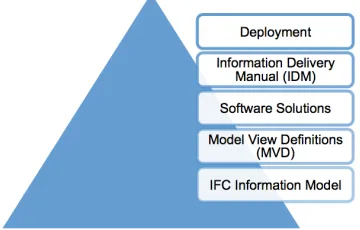
[image:6.595.76.256.467.582.2]Another outcome of a minimalist standardization approach is the IFC Model View Definition Format (MVD), which definition goal was “finding a useful balance between the wishes of users/customers and the possibilities of software developers, and documenting the outcome clearly.” (IAI 2006:2). Proposed by BLIS in early 2005, and introduced as an official element of IFC standardization in 2006, the MVDs narrow down the complete IFC model specification, documenting how data exchanges between different application types are applied; as such it is mostly something that is of direct benefit to implementers of IFC software. One software application can implement one or several MVDs depending on its domain scope. The MVD format is to a large extent a harmonization of the BLIS and ProIT efforts, which have both briefly been described earlier in this paper. How the both the IDMs and MVDs relate to each other and the wider context of the IFC information model is presented visually in figure 1.
FIG. 1: Layers of the information exchange framework (based on Wix 2007:18)
The IFC information model is the foundation from which specific MVDs are defined. Software applications then implement these MVDs. IDMs provide documentation and guide the workflow of IFC enabled exchange, and are designed acknowledging the functionality of specific MVDs. These cross-referencing information exchange layers were designed to facilitate the deployment of IFC-supported interoperability.
model. As such software is not universally certified ‘IFC compatible’, and rather gets certification for supporting specific MVDs. Where spreadsheets and extensive traveling was required in the old process, an advanced web-platform was developed to automate much of the process and provide centralized testing and documentation (Steinmann 2010).
In addition to the IDM and MVD concepts to extend the scope of standardization of IFC-based exchanges beyond the IFC information model, the International Framework for Dictionaries (IFD) effort was formally initiated within buildingSMART International around this same timeframe, in April 2008 (ifd-library.org). Referred to as the third pillar of IFC data exchange, together with IDM and MVD, IFD describes what is exchanged by providing a mechanism that allows the creation of dictionaries or ontologies, to connect information from existing databases to IFC information models (Bell & Bjorkhaug 2006). Initial work on a standard to fulfill similar purposes were initiated in 2006 as collaboration effort between the BARBi project in Norway and the Lexikon project in the Netherlands, which work was then continued within buildingSMART International (ifd-library.org).
4
DISCUSSION
4.1 IFC interoperability - a mix of structuralist and minimalist approaches
A summary of the IFC release timeline is shown in figure 2. buildingSMART currently aims for releasing major new versions of the standard with about three-year intervals, with the motivation that it strikes a balance between the need for stability to facilitate implementations, and responsiveness in incorporating new features to the standard (Liebich 2007).
FIG. 2: IFC release timeline
The IFC standardization process has by and large been one of incremental development, where each release has expanded upon the foundation of previous releases without larger changes to completed work on the standard. This is common for technology development in general, but particularly so for technical standards, where revising earlier architectural design decisions causes compatibility issues. In the standards literature the phenomenon is referred to as path dependency (Liebowitz Margolis 1995). In the case of IFC, where the process has been going on for many years, it is interesting to see how early design decisions have, and still do, influence composition of the artifact and and development process over a decade later.
process, which is founded on certificating MVD support rather than only standards compliancy of translated objects and concepts. This approach should have very few drawbacks with regards to limiting what data-exchange use-cases can be done with the underlying IFC information model as implementers are allowed to define their own MVDs which specification is then made available for others to implement if they so choose.
While Behrman’s (2002) notion that IFC standardization initially followed a structuralist approach gains support from the analysis in this paper, its rate of success in the industry should not be judged simply based on this finding. Such a perspective implicitly adopts a limited view on the dynamics involved in standardization. Suggesting that minimalist development approaches would be recommendable best practice for standardization purposes universally does not touch upon issues like openness in the process or product (Krechmer 2005), or necessary initial definition of concepts to be standardized, which are major reasons for having to adopt processes more in line with a structuralist approach. There are many more variables influencing the approach and outcome of standardization than polarizing structuralist vs. minimalist, like the degrees of technology and market maturity. In fact one could suggest that the IFC standard was originally intended to be a minimalist effort; a neutral data-exchange format developed outside of STEP, designed and used by members of its industry consortia consisting of several key software vendors. Choosing the pre-existing STEP file-format and EXPRESS as the modeling language should further support the initial minimalist intentions as existing work was chosen to be used as far as possible. Only after failing to find a viable minimal approach was a structuralist path taken regarding IFC – developing a complex model for mapping definitions of AEC/FM concepts and objects as well as their interrelations is a task which by design is arguably best suited for holistic structuralist development. While it generally holds true that releases of the IFC standard have usually first been published and only after the fact have implementations been attempted, this is more of a methodological development process issue than one stemming from lack of participation of software vendors in consortia activities as suggested by Behrman (2002). Software vendors make up a considerable share of the stakeholders who founded the consortia and they have been key funders, participants, and influencers within IAI and buildingSMART ever since. Regarding use of EXPRESS as the information modeling language as an obstacle for slow standardization, the development of an official XML representation of IFC, ifcXML, was started in 2001 and released later that same year. ifcXML provides XML language bindings to the IFC EXPRESS schema. However, because of the inherently different structures of the EXPRESS and XML modeling languages, translation of native IFC EXPRESS files to ifcXML result in needlessly large, lossy, and unoptimized files which do not play to the strengths of XML modeling (Behrman 2002). So simply translating between information modeling languages does not bring with it any instant fix to conceptual challenges in information modeling and interoperability, however, there are more people familiar with the widely adopted XML syntax than EXPRESS which might put an additional threshold for software developers to become involved in IFC development. However, the EXPRESS modeling language in itself does not strictly dictate how concepts are defined, nor has it become technically obsolete even though it is not in as widespread and general use as XML.
from Behrman (2002), but also to findings related to IFC standardization since then as described in this paper.
As discussed earlier, project-based funding from companies and governments around the world have been important resources in IFC standardization by directly and indirectly funding organizations and individuals active in IFC-related projects. However, the goals of tangent projects and the immediate optimal tasks of the standard development might not always be aligned. With the consortia operating on low fixed resources it can be speculated that it is unlikely that projects contributing to IFC development would get turned down, even if they do not comply with the immediate development priorities and vision of the consortia. For IFC one of the main problems with simply standardizing best practice rather than figuring out and developing something new is that BIM software has evolved at a rapid pace – making IFC standardization attempts at hitting a moving target. The IFC standard has been developed as it has been standardized, so called designing standardization, since no complete existing modules exist to simply pick and chose from. This type of anticipatory designing standardization is of high risk to fall into the trap of ‘design by committee’ if goal-orientation is not kept as a high priority (Purao et al. 2008). While it is hard to prepare and predict for the distant future, aligning ‘time-to-standard’ with ‘time-to-market’ goals has been shown to be of great importance for widespread adoption of standards (Gielingh, 2008). With development started early in the technological development cycle, one technological limitation which has emerged as computing has moved from local to networked is the lack of native model server support in the STEP architecture on which IFC is based. However, various software applications have been developed to remedy this increasingly important feature.
The purpose of this paper has been to review the IFC standardization process with particular emphasis on the different types of development approaches for reaching interoperability. It is suggested that both structuralist and minimalist development approaches have been used to complementary effect for different parts of the standard and during different phases of the process. Many interesting aspects of the effort have only been mentioned in brief, however, such underdeveloped discussions are hoped to spur future research interest for both technical and social research related to IFC standardization.
REFERENCES
Amor, R. et al. (2007). BIM in 2007 – Are we there yet?. Proceedings of the 2007 CIB W78 Conference, 159-162. Available at: http://itc.scix.net/cgi-bin/works/Show?w78_2007_78. Accessed 5.7.2011
Bazjanac, V. (2002) Early lessons from deployment of IFC compatible software. Proceedings of the 2002 ECPPM Conference, 9-16.
Bazjanac, V., Crawley, D. (1997) The implementation of industry foundation classes in simulation tools for the building industry. Proceedings of the 1997 International Building Simulation Conference, 203-210. Behrman, W. (2002) Best practices for the development and use of XML data interchange standards. Center for
Integrated Facility Engineering Technical Report. Report nr. 131, pp. 27. Available at: http://cife.stanford.edu/node/261. Accessed 5.7.2011
Bell, H., Bjørkhaug, L. (2006) A buildingSMART ontology. Proceedings of the 2006 ECPPM Conference, 185-190
BLIS-project.org - BLIS project pages. http://www.blis-project.org/. Accessed 5.7.2011 Bloor, M., Owen, J. (1995) Product data exchange. UCL Press, London, pp. 262
Gielingh, W. (2008) An assessment of the current state of product data technologies. Computer Aided Design. 40 (7), 750-759
Groome, C. (2010) IFC Certification 2.0: Specification of Certification Process, 1-7. Available at: http://buildingsmart-tech.org/certification/ifc-certification-2.0/. Accessed 5.7.2011
Henning, M. (2008) The rise and fall of CORBA. Communications of the ACM, 51 (8), 53-57
Hietanen, J., Lehtinen, S. (2006) The useful minimum. Working paper. Tampere University of Technology. Virtual Building Laboratory, pp. 4. Available at:
cic.vtt.fi/projects/vbe-net/data/2006_The_Useful_Minimum.pdf. Accessed 5.7.2011
IAI (1999a) AEC/FM Processes supported by IFC. Ed. See R. International Alliance Of Interoperability (IAI). Specification Task Force, pp. 283
IAI (1999c) An Introduction to the International Alliance for Interoperability and the Industry Foundation Classes. Ed. Wix, J. and See, R. International Alliance Of Interoperability (IAI). Specification Task Force, pp. 27
IAI (1999d) IFC Object Model Architechture Guide. Ed. Liebich, T. and See, R. International Alliance Of Interoperability (IAI). Specification Task Force, pp. 9
IAI (2000) IFC Technical Guide - Enabling Interoperability in the AEC/FM Industry. Ed. Liebich, T. and Wix, J. Modeling Support Group. International Alliance Of Interoperability (IAI), pp. 46
IAI-International.org (2000) A short history of the IAI and the IFC information Model, http://www.iai-international.org/about/history.html. Accessed 10.12.2008
IFD-Library.org – IFD Library website. http://www.ifd-library.org. Accessed 5.7.2011
ISO.org - Industrial automation systems and integration -- Product data representation and exchange -- Part 1: Overview and fundamental principles. http://www.iso.org/iso/catalogue_detail?csnumber=20579. Accessed 5.7.2011
ISO.org2 Industry Foundation Classes, Release 2x, Platform Specification (IFC2x Platform).
http://www.iso.org/iso/iso_catalogue/catalogue_tc/catalogue_detail.htm?csnumber=38056. Accessed 5.7.2011
ISO.org3 - Building information modelling -- Information delivery manual -- Part 1: Methodology and format. http://www.iso.org/iso/iso_catalogue/catalogue_ics/catalogue_detail_ics.htm?ics1=91&ics2=010&ics3=01& csnumber=45501. Accessed 5.7.2011
Karstila, K., Serén, K. (2001) IFC Release 2.0 Certification testing – IFC Schema Refinement. IAI Forum Finland/BLIS, pp. 35. Available at: http://www.blis-project.org. Accessed 5.7.2011
Karstila, K., Serén, K. (2005) IFC Aspect Card Library. Result of the Pro-IT project, Eurostep, pp. 86. Available at: http://virtual.vtt.fi/virtual/proj6/proit/julkiset_tulokset/proit_aspectcardlibrary_v1_1_2005_01_27.pdf. Accessed 5.7.2011
Kemmerer, S.J. (1999) STEP: The Grand Experience. NIST Special Publication 939, National Institute of Standards and Technology, Gaithersburg, MD, pp.185. Available at:
www.mel.nist.gov/msidlibrary/doc/stepbook.pdf. Accessed 5.7.2011
Kiviniemi, A. (2006) Ten years of IFC-development – Why are we not yet there?. Keynote lecture at the 2006 Joint International Conference on Computing and Decision Making in Civil and Building Engineering, Montreal, Canada
Kiviniemi, A. et al. (2008) Erabuild: Review of the Development and Implementation of IFC compatible BIM. Erabuild, pp. 126. Available at:
http://www.eracobuild.eu/fileadmin/documents/Erabuild_BIM_Final_Report_January_2008.pdf. Accessed 5.7.2011
Krechmer, K. (2005) Open Standards Requirements. The International Journal of IT Standards and Standardization Research. 4 (1), 43-62
Liebich, T. (2010) Unveiling IFC2x4 - The next generation of OPENBIM. Proceedings of the 2010 CIB W78 Conference. p. 8. Available at: http://itc.scix.net/cgi-bin/works/Show?w78-2010-124. Accessed 5.7.2011 Liebich, T., Wix, J. (1998) Highlights of the development process of industry foundation classes. Proceedings of
the 1999 CIB W78 Conference. p. 18. Available at: http://itc.scix.net/cgi-bin/works/Show?w78-1999-2758. Accessed 5.7.2011
Liebowitz, S., Margolis, S. (1995) Path dependence, lock-in, and history. Journal of Law, Economics, and Organization, 11, 205-226
Nordic IAI Chapter Meeting Minutes -
http://www.iainordic.no/category/Minutes/category.php?categoryID=176. Accessed 5.7.2011
Pazlar, T., Turk, Z. (2008) Interoperability in practice: geometric data exchance using the IFC standard. Journal of Information Technology in Construction – ITcon. Vol. 13, 362-380. Available at:
http://www.itcon.org/cgi-bin/works/Show?2008_24. Accessed 5.7.2011
ProIT (2004) ProIT News December 2004, Confederation of Finnish Construction Industries, pp. 1-8 ProIT (2005) ProIT News August 2005, Confederation of Finnish Construction Industries, pp. 1-8
Purao, S. et al. (2008) Standardizing Web Services: Overcoming 'Design by Committee'. 2008 IEEE Congress on Services - Part I, 223-230
Schenck, D., Wilson, P. (1994) Information Modeling: The EXPRESS Way. p.388. New York, USA: Oxford University Press.
Stangeland, B. (2009) Presentation: buildingSMART international – Vision, mission, strategy & goals. www.itp.net/events/buildsmart/presentations/Bjorn.pdf. Accessed 5.7.2011
Tolman, F.P. (1999) Product modeling standards for the building and construction industry: past, present and future. Automation in Construction. Vol. 8 (3), 227-235
Turner, J. (1990) AEC Building Systems Model, ISO TC 1184/SC4/WG1, Document 3.2.2.4, 1990.
Wix, J., Karlshøj, J. (2010) Information Delivery Manual – Guide to Components and Development Methods, buildingSMART Norway, pp. 82. Available at: http://iug.buildingsmart.com/idms/development/. Accessed 5.7.2011