Linear Support for
Multi-Objective Coordination Graphs
Diederik M. Roijers
Informatics Institute University of Amsterdam Amsterdam, the Netherlands[email protected]
Shimon Whiteson
Informatics Institute University of Amsterdam Amsterdam, the Netherlands[email protected]
Frans A. Oliehoek
DKE / Informatics InstituteMaastricht University / University of Amsterdam
[email protected]
ABSTRACT
Many real-world decision problems require making trade-offs among multiple objectives. However, in some cases, the relative importance of these objectives is not known when the problem is solved, precluding the use of single-objective methods. Instead, multi-objective methods, which compute the set of all potentially useful solutions, are required. This paper proposesvariable elimination linear support (VELS), a new multi-objective algorithm for multi-agent coordina-tion that exploits loose couplings to compute the convex coverage set(CCS): the set of optimal solutions for all pos-sible weights for linearly weighted objectives. Unlike ex-isting methods, VELS exploits insights from POMDP solu-tion methods to build the CCS incrementally. We prove the correctness of VELS and show that for moderate numbers of objectives its complexity is better than that of previous methods. Furthermore, we present empirical results showing that VELS can tackle both random and realistic problems with many more agents than was previously feasible. The incremental nature of VELS also makes it an anytime al-gorithm, i.e., its intermediate results constitute ε-optimal approximations of the CCS, withεdecreasing the longer it runs. Our empirical results show that, by allowing even very smallε, VELS can enable large additional speedups.
Categories and Subject Descriptors
I.2.11 [Distributed Artificial Intelligence]: multi-agent systems
General Terms
AlgorithmsKeywords
Multiple objectives, game theory, coordination graphs
1.
INTRODUCTION
In cooperative multi-agent decision problems, agents must work together to maximize their common utility. Key to coordinating efficiently is exploitingloose couplingsbetween agents: each agent’s behavior directly affects only a subset of the other agents. Such independence can be captured in a graphical model called acoordination graph, and exploited using methods such asvariable elimination[13, 17].
Appears in:Alessio Lomuscio, Paul Scerri, Ana Bazzan, and Michael Huhns (eds.), Proceedings of the 13th Inter-national Conference on Autonomous Agents and Multiagent Systems (AAMAS 2014), May 5-9, 2014, Paris, France. Copyrightc 2014, International Foundation for Autonomous Agents and Multiagent Systems (www.ifaamas.org). All rights reserved.
This paper considers a cooperative loosely coupled multi-agent setting in which there are multiple objectives. Many real-world problems have several objectives [23], e.g., maxi-mizing a computer network’s performance while minimaxi-mizing power consumption [28] or maximizing the economic benefits of timber harvesting while minimizing environmental dam-age [6, 12]. These problems typically have a small number of objectives that are not aligned, i.e., there is no solution that simultaneously maximizes utility in all objectives.
The presence of multiple objectives in itself though, does not necessarily require special solution methods. If the prob-lem can be transformed byscalarizingthe vector-valued util-ity function, i.e., converting it to a scalar function, it may be solvable with existing single-objective methods. How-ever, this approach is not applicable when the weights of thescalarization function are not known in advance or are difficult to quantify. For example, consider a company that produces different resources whose market prices vary. If there is not enough time to re-solve the problem for each price change, then we need multi-objective methods to com-pute aset of solutionsoptimal for all possible scalarizations. An important class of multi-objective problems is the multi-objective coordination graph (MO-CoG), which can model a range of multi-agent multi-objective tasks [9, 26]. Sev-eral methods have been developed for solving MO-CoGs [8, 10, 19]. For instance, Roll´on and Larrosa [26, 27] intro-duce an algorithm that we callPareto multi-objective vari-able elimination(PMOVE), which solves MO-CoGs by iter-atively solving local subproblems to eliminate agents from the graph. However, because these methods compute the Pareto coverage set (PCS), i.e., the Pareto front, they scale poorly in the number of agents. In many cases, the size of the PCS, and therefore the runtime of the algorithm, grows rapidly with the number of agents [24].
Fortunately, it is not always necessary to compute the PCS. In the highly prevalent case where we know the scalar-ization function is linear (e.g., in clinical trials [18] or re-source gathering [2, 24]), the convex coverage set (CCS) suffices. Since the CCS is a subset of, and typically much smaller than, the PCS, computing the CCS can be much cheaper. Convex MOVE (CMOVE) [24] is a variant of PMOVE that computes the CCS. However, even though CMOVE is much more efficient than MOVE, the CCS can still grow rapidly with the number of agents.
mod-3
1 2 3
u 1 u2
1 3
3
1 u4
a b c
[image:2.612.90.254.53.118.2]u
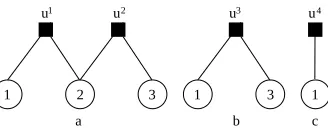
Figure 1: (a) A three agent, two local payoff func-tion MO-CoG. (b) After the eliminafunc-tion of agent 2 with (MO)VE. (c) After agent 3 is eliminated as well.
erate numbers of objectives, its complexity is better than that of previous methods. Furthermore, we present empiri-cal results showing that VELS is much faster than existing methods on both randomized and realistic MO-CoGs.
In addition, the incremental nature of VELS makes it an anytimealgorithm, i.e., if there is not enough time to com-pute the entire CCS, the intermediate solutions comcom-puted by VELS can serve as approximations to the CCS that im-prove the longer it runs. VELS provides an upper bound on the maximum error in scalarized payoff with respect to the full CCS of these approxations. This also implies that when provided with a maximum scalarized error ε, VELS can compute anε-CCS, i.e., anε-optimal CCS. Anε-CCS is useful, not only when computing the full CCS is too compu-tationally expensive, but when the full CCS is too large to store or iterate over at runtime (at which point the weights of the scalarization function are known). Our empirical results show that VELS can compute anε-CCS in only a fraction of the time it takes to compute the full CCS.
2.
BACKGROUND
In this section, we formally define a MO-CoG and briefly describe existing methods for it and closely related problems.
2.1
MO-CoGs
Amulti-objective coordination graph(MO-CoG)1[24] is a tuplehD,A,U iwhere: D={1, ..., n}is the set ofnagents;
A=A1×...×Anis the set of all possible joint actionsa, the Cartesian product of the finite action spaces of all agents; andU=
u1, ...,uρ is the set ofρ,d-dimensionallocal pay-off functions. A local payoff function has limited scope e, i.e., only a subset of agents participate in it. The total team payoff2 is the sum of all local payoffs: u(a) =Pρ
e=1u
e (ae). The superscripteis an index for the payoff factor, andaeis a joint action of the agents participating inue. We useu
ito indicate the value of thei-th objective. We refer to the set of all possible payoff vectors asV={u(a) :a∈ A}. A MO-CoG can be visualized with a factor graph as in Figure 1a, in which the circles denote agents, the squares denote the local payoff functions, and the edges denote which agents participate in the given local payoff functions. Such a fac-tor graph represents the conditional independencies between agents [5], e.g., agent 1 is independent of agent 3, given that agent 2 has already determined its action.
We assume there exists a scalarization function f that convertsu(a) to a scalar payoffuw(a) =f(u(a),w).3 This
function is parameterized by a weight vector w, which is unknownwhen the MO-CoG is solved but known when the
1
We previously referred to this setting asmulti-objective col-laborative graphical games[25].
2
Because this is a fully cooperative setting, the team payoff is the same for all agents.
3
Note that the bold subscriptwindicates a scalarized value.
agents must select a joint action. The solution to a MO-CoG is thecoverage set (CS)[3], i.e., all joint actionsaand associated valuesu(a) that are optimal for somew:
CS=
u(a) : u(a)∈ V ∧ ∃w∀a0uw(a)≥uw(a0) .
From theCSwe can compute theoptimal scalarized payoff functionu∗CS(w), which, given a weight vector, produces the optimal scalarized payoff:
u∗CS(w) = max
u(a)∈CSf(u(a),w). (1) If u∗CS is computed in advance, then at runtime, when w becomes known, the agents can use it to quickly select the best joint action, since doing so requires iterating only over
CS, notV. This is especially important whenwcan change rapidly, e.g., as market prices fluctuate.
What the CS looks like depends on what we assume about
f. A very minimal assumption is that f is monotonically increasing in all objectives. Under this assumption, a joint actionais better than another strategya0 when it Pareto-dominates it,u(a)P u(a0):
u(a)P u(a0)↔ ∀i ui(a)≥ui(a0)∧ ∃i ui(a)> ui(a0).
The coverage set for strictly monotonically increasing f is the Pareto coverage set (PCS) (i.e., the Pareto front), the set of all strategies that are not Pareto-dominated [23]:
P CS=
u(a) :u(a)∈ V ∧ ¬∃a0 u(a0)P u(a) .
Most research [8, 19, 26] on multi-objective decision prob-lems focusses on calculating the PCS. However, the PCS is often prohibitively large. Even if it can be computed and stored, its size can make it infeasible to select the best joint action at runtime usingu∗P CS(w) as defined by Equation 1. Therefore, many methods (e.g., [8, 19]) resort to approxi-mating the PCS, with few or no guarantees regarding the error in the scalarized payoff.
Fortunately, there is often more information aboutf that we can leverage to define smaller coverage sets. A highly prevalent case is when the scalarization function is linear:
f =w·u(a). In this case, we can restrict ourselves to the convex coverage set (CCS):
CCS=
u(a) :u(a)∈ V ∧ ∃w∀a0w·u(a)≥w·u(a0) ,
which contains all joint actions that are optimal for some weightw. Because linear scalarization functions are a spe-cial case of monotonically increasing ones, the CCS is a sub-set of the PCS, CCS ⊆P CS ⊆ V. Therefore, the CCS is the solution concept of choice whenfis linear.4 In the case of linearf, Equation 1 becomes:
u∗CCS(w) = max
u(a)∈CCSw·u(a).
We visualize the scalarized payoff of different (2-objective) payoff vectors in Figure 2a, where the weights are on the
x-axis (note thatw2= 1−w1), and the scalarized payoffuw
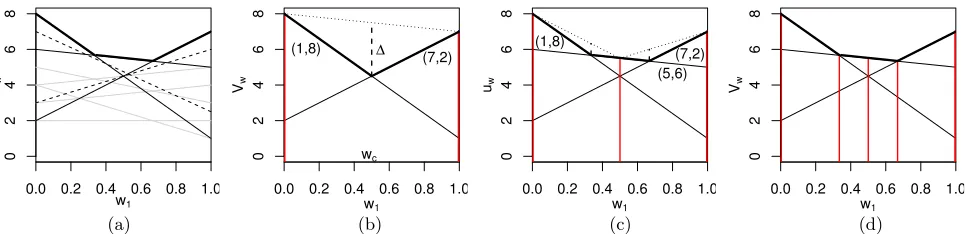
is on they-axis. Due to the linearity off, each payoff vector is a straight line. Furthermore,u∗CCS(w) (shown as the bold line segments), is the maximum scalarized value for eachw and is thus the convex upper surface of all of these lines.
4In addition, even if f is nonlinear, the CCS still suffices
Hence,u∗CCS(w) is a piecewise linear and convex (PWLC) function. The dashed lines are the vectors that are in the PCS but not in the CCS.
When consideringpartially observable Markov decision pro-cesses(POMDPs) [7, 15], the optimal value function is also a PWLC function.5 POMDPs and Mo-CoGs are thus related problems, a fact we exploit in Section 3.
2.2
Methods
A popular method for solving single-objective coordina-tion graphs isvariable elimination (VE) [13]. In VE, agents are eliminated from the coordination graph in sequence, thus solving the problem as a series oflocal subproblems, one for each agent. When an agent is eliminated, VE computes its best response to all possible actions of its neighbors. The local values of these best responses are then used to create a new local payoff function, replacing those to which the elim-inated agent was connected. Doing so exploits the graphical structure because the size of the local subproblems depends only on theinduced width, i.e., how many agents the elim-inated agent directly affects. VE is illustrated in Figure 1: in (a), the original graph; in (b), the graph after agent 2 is eliminated, introducing a new local payoff functionu3 that replaces those to which agent 2 was connected (bothu1and
u2); in (c), the graph after agent 3 is eliminated as well,
leaving only one agent and one new local payoff function. Roll´on and Larrosa [26, 27] propose a method that we callPareto multi-objective variable elimination (PMOVE), which extends VE to the multi-objective setting to compute the PCS, by computing alocal PCS instead of a single best response for the local subproblems. Roijers et al. [24] pro-poseconvex multi-objective variable elimination (CMOVE), which combines VE with a pruning operator [11] that com-putes the CCS. For linear scalarizations, CMOVE greatly outperforms both PMOVE and methods which do not ex-ploit the graphical structure of MO-CoGs.
However, the scalability of CCS methods is still limited, as the CCS can grow rapidly with the number of agents and objectives. In addition, like all existing multi-objective VE-based techniques [24, 27], CMOVE deals with the multi-objectiveness of the problem in theinner loop, at the level of the local subproblems. As a result, the method’s perfor-mance is all or nothing: if it is given enough time, it will compute the entire CCS; if not, it will not return anything.
3.
LINEAR SUPPORT FOR MO-COGS
In this section, we presentvariable elimination linear sup-port(VELS), a new method for computing the CCS in MO-CoGs. VELS has several advantages over CMOVE. Firstly, for moderate numbers of objectives, its computational com-plexity is better. Secondly, VELS is ananytime algorithm, i.e., over time, the intermediate results become better and better approximations of the CCS. Finally, VELS can com-pute approximate solutions with bounded error. In partic-ular, when provided with a maximum scalarized error ε, VELS can compute anε-optimal CCS.Rather than dealing with the multiple objectives in the inner loop (like PMOVE and CMOVE), VELS deals with it in theouter loop and employs VE as a subroutine. More
5
In particular, the belief vectorsbin POMDPs correspond to our weight vectorswand theα-vectors correspond to our payoff vectorsu(a).
specifically, VELS builds the CCS incrementally, with each iteration of its outer loop adding (at most) one new vector to a partial CCS. To find this vector, VELS selects a single w (the one that offers the maximal possible improvement). Then, in the inner loop, VELS uses VE to solve the single-objectivecoordination graph (CoG) that results from fixing w, adding the resulting vector to the partial CCS if it did not already contain it.
The departure point for creating this algorithm isCheng’s linear support (CLS) [7], which was originally designed as a pruning algorithm for POMDPs. Unfortunately, this algo-rithm is rarely used for POMDPs because its runtime is exponential in the number of states, which corresponds to the number of objectives in a MO-CoG. Fortunately, while realistic POMDPs typically have many states, many MO-CoGs have only a handful of objectives, and scalability in the number of agents is more important. Thus, CLS is an attractive starting point for building an efficient MO-CoG solution method.
First, building on CLS, we create an abstract algorithm that we calloptimistic linear support(OLS), which builds up the CCS incrementally. Since OLS takes an arbitrary single-objective problem solver as input, it can be seen as a generic multi-objective method.6 Second, we integrate OLS and
VE yielding VELS, our main contribution. VELS both uses the incremental scheme of OLS and exploits the graphical structure.
3.1
Optimistic Linear Support
OLS constructs the CCS incrementally, by adding vectors to an initially emptypartial CCS:
Definition 1. A partial CCS, S, is a subset of the CCS, which is in turn a subset ofV: S⊆CCS⊆ V.
It does so by finding the best payoff vector for specific values of w. BecauseS is a partial CCS, we can also define the scalarized value function overS, corresponding to the convex upper surface (shown in bold) in Figure 2a:
u∗S(w) = max
u(a)∈Sw·u(a).
Similarly, we defineAS(w) = arg maxu(a)∈Sw·u(a) as the optimal joint action set function with respect toS.
OLS, shown in Algorithm 1, assumes access to a function called SolveCoG that computes the best payoff vector for a given w, i.e., it solves the single-objective coordination graph that results from fixing w. For now, we leave the implementation ofSolveCoG abstract. In Sections 3.2 and 3.3, we consider different implementations ofSolveCoG. OLS also takes as inputm, the MO-CoG to be solved, andε, the maximal tolerable error in the result.
OLS starts (line 1) by initializing the partial CCS, S, which will contain the payoff vectors in the CCS discovered so far, as well as the the set of visited weights W. Then, it adds the extrema of the weight simplex, i.e., those points where all of the weight is on one objective, to a priority queueQ(line 4). Next, OLS enters the main loop (line 6), in which thewwith the highest priority is popped (line 7), and thenSolveCoGis called (line 8) to findu, the best pay-off vector for thatw. For example, Figure 2b showsS after two payoff vectors of a 2-dimensional MO-CoG have been found by applying SolveCoG to the extrema of the weight
6In fact, we apply OLS to multi-objective sequential
0.0 0.2 0.4 0.6 0.8 1.0
0
2
4
6
8
w1 Vw
0.0 0.2 0.4 0.6 0.8 1.0
0
2
4
6
8
w1 Vw
∆
wc
(1,8)
(7,2)
0.0 0.2 0.4 0.6 0.8 1.0
0
2
4
6
8
w1
uw
(1,8)
(7,2) (5,6)
0.0 0.2 0.4 0.6 0.8 1.0
0
2
4
6
8
w1 Vw
(a) (b) (c) (d)
Figure 2: (a) All possible payoff vectors for a 2-objective MO-CoG. (b) OLS finds two payoff vectors at the extrema (red vertical lines), a new corner weight wc= (0.5,0.5)is found, with maximal possible improvement ∆. CCSis shown as the dotted line. (c) OLS finds a new vector at(0.5,0.5), and adds two new corner weights to Q. (d) OLS callsSolveCoG for both corner weights, and finds no new vectors, making S=CCS=CCS.
Algorithm 1:OLS(m,SolveCoG, ε) Input: A CoGG and an agentito eliminate.
1 S← ∅;W ← ∅//partial CCS, set of checked weights
2 Q←an empty priority queue
3 foreachextremum of the weight simplexwedo
4 Q.add(we,∞) // add extrema with infinite priority
5 end
6 while¬Q.isEmpty()∧ ¬timeOutdo
7 w←Q.pop()
8 u←SolveCoG(m,w)
9 if u6∈Sthen
10 delete corner weights made obsolete byufromQ
11 Wu←newCornerWeights(u, S)
12 S←S∪ {u}
13 foreach w∈Wudo
14 ∆r(w)←calc. improvement using
maxValueLP(w, S,W)
15 if∆r(w)> εthen
16 Q.add(w, ∆r(w))
17 end
18 end
19 end
20 W ← W ∪ {w}
21 end
22 returnSand the highest∆r(w)left in Q
simplex: S={(1,8),(7,2)}. Each of these vectors must be part of the CCS because it is optimal for at least onew: the one for whichSolveCoG returned it as a solution. The set of weightsW that OLS has tested so far are marked with vertical red line segments.
After identifying a new vector u to add to S (line 8), OLS must determine what new weights to add toQ. Like CLS, OLS does so by identifying the corner weights: the weights at the corners of the convex upper surface, i.e., the points where the PWLC surfaceu∗S(w) changes slope. To define the corner weights precisely, we must first defineP, the polyhedral subspace of the weight simplex that is above
u∗S(w) [4]. The corner weights are then the vertices of P, which can be defined by a set of linear inequalities:
Definition 2. IfS is the set of known payoff vectors, we define a polyhedron
P ={x∈ <d+1:S+x≥~0,∀i, wi>0,X
i
wi= 1},
where S+
is a matrix with the elements of S as row vec-tors, augmented by a column vector of −1’s. The set of linear inequalities S+
x ≥ ~0, is supplemented by the
sim-plex constraints: ∀i wi > 0 and Piwi = 1. The vector
x= (w1, ..., wd, u) consists of a weight vector and a scalar-ized value at those weights. The corner weights are the weights contained in the vertices ofP, which are also of the form (w1, ..., wd, u).
Note that, due to the simplex constraints, P is only d -dimensional. Furthermore, the extrema of the weight sim-plex are special cases of corner weights.
After identifyingu, OLS identifies which corner weights change in the polyhedronP by addingutoS. Fortunately, this does not require recomputation of all the corner weights, but can be done incrementally: first, the corner weights in
Q for which uyields a better value than currently known are deleted from the queue (line 10) and then the function newCornerWeights(u, S) at line 11 calculates the new corner weights that involveuby solving a system of linear equations to see whereuintersects with the boundaries and the present vectors in S.7 Figure 2b shows one new corner weight
la-belledwc= (0.5,0.5).
Cheng showed that finding the best payoff vector for each corner weight and adding it to the partial CCS, i.e., S ←
S∪ {SolveCoG(w)}, guarantees the best improvement toS:
Theorem 1. (Cheng 1988) The maximum value of:
max
w,u∈CCSminv∈Sw·u−w·v,
i.e., the maximal improvement toS by adding a vector to it, is at one of the corner weights [7].
However, sinceSolveCoGis an expensive operation, test-ing all corner weights can be inefficient. Therefore, unlike CLS, at each iteration OLS pops only one w off Q to be tested. Making OLS efficient thus depends critically on giv-ing each w a suitable priority when adding it to Q. To this end, OLS prioritizes each corner weight according to itsmaximal possible improvement, an upper bound on the maximal improvement. This upper bound is computed with respect to the optimistic hypothetical CCS, CCS, i.e., the best-case scenario for the final CCS given thatS is the cur-rent partial CCS andWis the set of weights already tested withSolveCoG. The key advantage of OLS over CLS is that
7
[image:4.612.68.551.56.173.2]these priorities can be computed without callingSolveCoG, obviating the need to runSolveCoG on all corner weights.
Definition 3. Anoptimistic hypothetical CCS,CCSis a set of payoff vectors that yields the highest possible scalarized value for all possiblewconsistent with finding the vectorsS
at the weights inW.
Figure 2b denotes theCCS={(1,8),(7,2),(7,8)}with a dotted line. Note thatCCSis a superset ofS and the value ofu∗CCS(w) is the same asu∗S(w) at all the weights in W. For a givenw,maxValueLPfinds the the scalarized value of
u∗CCS(w) by solving:
max w·v
subject to Wv≤u∗S,W,
whereu∗S,W is a vector containing u ∗
S(w
0
) for allw0 ∈ W. Note that we abuse the notationW, which in this case is a matrix whose rows consist of all the weight vectors in the setW.
UsingCCS, we can define the maximal possible improve-ment:
∆(w) =u∗CCS(w)−u∗S(w).
Note that the value ofu∗CCS(w) needs to be calculated using maxValueLP. Figure 2b shows ∆(wc) with a dashed line. We use the maximal relative possible improvement, ∆r(w) = ∆(w)/u∗CCS(w), as the priority of each new corner weight w∈Wu. In Figure 2b, ∆r(wc)=(0.5,0.5)
·((7,8)−(1,8)) 7.5 = 0.4.
When a corner weightwis identified (line 11), it is added toQwith priority ∆r(w) as long as ∆r(w)> ε(lines 14-16). Afterwcin Figure 2b is added toQ, it is popped off again (as it is the only element ofQ). SolveCoG(wc) generates a new vector (5,6), yieldingS={(1,8),(7,2),(5,6)}, as illus-trated in Figure 2c. The new corner weights (0.667,0.333) and (0.333,0.667) are the points at which (5,6) intersects with (7,2) and (1,8). Testing these weights, as illustrated in Figure 2d, does not result in new payoff vectors, caus-ing OLS to terminate. The maximal improvement at these corner weights is 0 and thus, due to Theorem 1,S =CCS
upon termination.
In the following subsections, we provide two ways to im-plement SolveCoG. However, any exact CoG algorithm is applicable. Note that approximate methods for CoGs, such asmax-plus[17] would invalidate Theorem 1 since they may return suboptimal vectors for a corner weight.
3.2
Non-Graphical Linear Support
A naive way to implementSolveCoGis to explicitly com-pute the values of all joint actions V and select the joint action that maximizes this value:
SolveCoG(m,w) = arg max
u(a)∈V
w·u(a).
Using this implementation ofSolveCoGin OLS yields an al-gorithm that we callnon-graphical linear support (NGLS) because it ignores the graphical structure, flattening the CoG into a standard multi-objective cooperative normal form game. The downside of this approach is that the computa-tional complexity ofSolveCoGis linear in|V|, which is itself exponential in the number of agents, making it feasible only for very small MO-CoGs.
3.3
Variable Elimination Linear Support
Key to keeping MO-CoGs tractable is exploiting the graph-ical structure. Therefore, having dealt with the multiple ob-jectives in the outer loop of OLS, all we need to do now is to implementSolveCoG with a method that does so. VE is such a method.Because VE exploits the CoG’s graphical structure, its computational complexity is only O(n|Amax|w) [13], where
|Amax|is the maximal number of actions for asingle agent and w is the induced width, i.e., the maximal number of neighboring agents of an agent, at the moment when it is eliminated. Its complexity is thus exponential only in this induced width, which is often much less than the number of agents. Implementing SolveCoG using VE yields variable elimination linear support (VELS), completing our main contribution.
4.
ANALYSIS
In this section, we analyse the correctness and complexity of VELS, and compare it to that of alternative methods.
4.1
Correctness
We begin by establishing the correctness of VELS.
Theorem 2. When ε = 0, VELS terminates, and
cor-rectly produces the CCS form.
Proof. BecauseSolveCoGis implemented using VE, which optimally solves CoGs [13], each vectorucomputed by call-ing SolveCoG(w) must be optimal for w. Therefore, if u was already inS, then the fact thatu=SolveCoG(w) con-firms that the maximal possible improvement atw is zero. If uwas not already in S, adding it to S is correct: since it is optimal at w, it belongs in the CCS. In this case, all the new corner weights are added to Q, guaranteeing that
Qalways contains all the corner weights of S except those whose maximal possible improvement has been confirmed to be zero. VELS thus terminates only when the maximal possible improvement at all the corner weights ofS is zero, which Theorem 1 implies can occur only when S =CCS. SinceVis finite andCCS⊆ V, VELS must terminate.
Ifε >0, VELS terminates before it has found the CCS. However, in this case, we can bound the maximal actual relative improvement:
Definition 4. The maximal actual relative improvement that can be made toS with respect toCCSis
∆∗ar= max
w
u∗CCS(w)−u
∗
S(w)
u∗
CCS(w)
.
Note that, due to Theorem 1, ∆∗ar must be at one of the corner weights. We can now define anε-CCS:
Definition 5. Anε-CCS is a subset of the CCS for which ∆∗ar≤ε.
Theorem 3. During execution of VELS,S is anε-CCS with ε ≤∆r(w1), wherew1 is the corner weight with the
highest priority inQ.
Proof. BecauseS is a partial CCS,S⊆CCS and thus
u∗S(w) is a lower bound on u
∗
CCS(w). Furthermore, since
u∗CCS(w) is an upper bound on u∗CCS(w), it follows that
∆r(w) = u∗
CCS(w)−u
∗
S(w)
u∗
CCS(w) is an upper bound on
u∗CCS(w)−u∗S(w)
u∗
CCS(w) .
Corollary 1. If a fixedεis supplied, VELS terminates
and produces anε-CCS.
Proof. All corner weights for which ∆r(w1) > ε are
added to Q. Therefore, VELS terminates when there are no more corner weights with a priority higher thanε, making
S anε-CCS.
4.2
Complexity
We now analyze the computational complexity of VELS.
Theorem 4. The runtime of VELS withε= 0is
O(n|Amax|w(|CCS|+|WCCS|), wherewis the induced width when running VE,|CCS|is the size of the CCS, and|WCCS| is the number of corner weights ofu∗CCS(w).
Proof. Since n|Amax|w is the runtime of VE [13], the runtime of VELS is this quantity multiplied by the number of calls to VE. To count these calls, we consider two cases: calls to VE that result in adding a new vector toSand those that do not result in a new vector but instead confirm the optimality of the scalarized value at that weight. The former is the size of the final CCS,|CCS|, while the latter is the number of corner weights for the final CCS,|WCCS|.
Note that the overhead of OLS itself, i.e., computing new corner weights (newCornerWeights(u, S)), and calculating the maximal relative improvements by callingmaxValueLP(w, S,W), is negligible with respect to theSolveCoGcalls.
For d = 2, the number of corner weights is bounded by
|CCS|and the runtime of VELS is thusO(n|Amax|w|CCS|). Ford = 3, the number of corner weights is 2 times|CCS|
(minus a constant) because, whenSolveCoGfinds a new pay-off vector, one corner weight is removed and three new corner weights are added. Ford >3, a loose bound on |WCCS|is the total number of possible combinations ofd payoff vec-tors or boundaries: O( |CCSd|+d
). However, we can obtain a tighter bound by observing that counting the number of corner weights given the CCS is equivalent to vertex enu-meration, which is the dual problem of facet enumeration, i.e., counting the number of vertices given the corner weights [16].
Theorem 5. For arbitraryd,|WCCS|is bounded by
O( |CCS|−bd+12 c
|CCS|−d
+ |CCS|−bd+22 c
|CCS|−d
)[1].
Proof. This result follows directly fromMcMullen’s
up-per bound theorem for facet enumeration [14, 21].
The same reasoning used to prove Theorems 4 can also be used to establish the following:
Theorem 6. The runtime of VELS withε >0is
O(n|Amax|w(|ε-CCS|+|Wε–CCS|), where |ε-CCS| is the size of the ε-CCS, and |Wε–CCS| is the number of corner weights ofu∗ε–CCS(w).
In practice, VELS will often not test all the corner weights of the polyhedron spanned by theε-CCS, but this cannot be guaranteed. In Section 5, we show empirically that|ε-CCS|
decreases rapidly asεincreases.
4.3
Comparison to Alternative Methods
Taking Theorems 4 and 5 together establishes that the runtime of VELS is exponential in w andd. By contrast,the complexity of NGLS, O(|Amax|n(|CCS|+|WCCS|), is exponential in bothnandd.
The computational complexity of PMOVE is
O(n|Amax|wd|Vl||P CS|),
where|Vl|is the size of a local subproblem, i.e., the number of possible local value vectors as a result of a joint action of an agent and its direct neighbors, and|PCS|to the size of the PCS. The complexity of CMOVE8is
O(n|Amax|w (d|Vl| |LP CS|+|LP CS|P(d|CCS|) )),
where|LP CS|is the size of the local PCS andP(d|CCS|) is a polynomial in the size of the CCS andd, which corresponds to the runtime of a linear program that tests whether there is a weight for which a local payoff vector is optimal. Thus, both PMOVE and CMOVE are polynomial in the size of the coverage sets they compute. By contrast, VELS is only linear in the size of the CCS ford= 2 andd= 3. However, ford ≥4 the runtime of VELS becomes exponential in d. The runtimes of the MOVE algorithms depend onddirectly, and on the sizes of the coverage sets they compute, which is in practice polynomial ind. The complexity of VELS is thus better for moderate number of objectives, but worse for highd.
5.
EXPERIMENTS
To compare the performance of VELS to that of PMOVE and CMOVE, we tested these methods in two settings. The first consists of randomly generated MO-CoGs, which allow us to examine performance on MO-CoGs with widely vary-ing properties. The second isMining Day [24], a MO-CoG benchmark derived from a realistic scenario. We do not com-pare to NGLS or other non-graphical methods because they proved prohibitively slow.
5.1
Random MO-CoGs
To test VELS on randomly generated MO-CoGs, we use the MO-CoG generation procedure proposed by Roijers et al. [24]. This procedure produces a random MO-CoG given:
n, the number of agents;d, the number of objectives;ρthe number of local payoff functions; and|Ai|, the action space size, which is the same for all agents.9
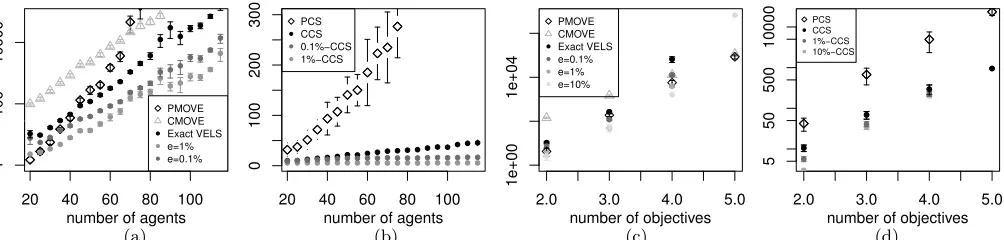
To determine how the scalability of exact and approxi-mate VELS compares to that of PMOVE and CMOVE, we tested them on random MO-CoGs with increasing numbers of agents. The average number of factors per agent was held atρ= 1.5nand the number of objectives atd= 2. Figure 3a shows the results, which are averaged over 30 MO-CoGs for each number of agents. Note that the runtimes, on the
y-axis, are in log-scale.
These results demonstrate that, as the number of agents grows, computing the CCS is much cheaper than comput-ing the PCS. Even though PMOVE is initially faster than CMOVE, the runtime of CMOVE grows much more slowly with the number of agents than PMOVE, and CMOVE out-performs PMOVE from 70 agents onwards. Exact VELS outperforms PMOVE from 45 agents onwards. The differ-ence in growth rates between PCS and CCS methods can be explained by the fact that the CCS grows much more slowly
8
For brevity we consider only the “basic” variant of CMOVE, which performed best empirically [24].
9
20 40 60 80 100
1
100
10000
number of agents
runtime(ms)
PMOVE CMOVE Exact VELS e=1% e=0.1%
20 40 60 80 100
0
100
200
300
number of agents
runtime(ms)
PCS CCS 0.1%−CCS 1%−CCS
2.0 3.0 4.0 5.0
1e+00
1e+04
number of objectives
runtime(ms)
PMOVE CMOVE Exact VELS e=0.1% e=1% e=10%
2.0 3.0 4.0 5.0
5
50
500
10000
number of objectives
CS siz
e
PCS CCS 1%−CCS 10%−CCS
(a) (b) (c) (d)
Figure 3: (a) The runtimes of PMOVE, CMOVE and VELS with different values ofε, for varying numbers of agents,n, andρ= 1.5nfactors, 2 actions per agent, and 2 objectives; (b) the corresponding sizes of the PCS and CCS; (c) the runtimes of PMOVE, CMOVE and VELS with different values ofε, for varying numbers of objectives,n= 25, ρ= 1.5n, and 2 actions per agent (d) the corresponding sizes of the PCS and CCS.
with the number of agents (Figure 3b). The runtime of ex-act VELS (ε = 0) is on average 16 times less than that of CMOVE. CMOVE solves random MO-CoGs with 85 agents in 74son average, whilst exact VELS can handle 110 agents in 71s.
While this is already a large gain, we can also achieve a much lower growth rate by permitting a smallε. For 110 agents, permitting a 0.1% error margin yields a gain of more than an order of magnitude, reducing the runtime to 5.7s. Permitting a 1% error reduces the runtime to only 1.3s. We can thus reduce the runtime of VELS by a factor of 57, while retaining 99% accuracy. Compared to CMOVE at 85 agents, VELS withε= 1% is 109 times faster.
These speedups can be explained by the slower growth of theε-CCS. For small numbers of agents, the size of theε -CCS grows only slightly more slowly than the size of the full CCS. However, from a certain number of agents onwards, the size of theε-CCS grows only marginally while the size of the full CCS keeps on growing. Forε = 1%, theε-CCS grew from 2.95 payoff vectors to 5.45 payoff vectors between 5 and 20 agents, and then only marginally to 5.50 at 110 agents. By contrast, the full CCS grew from 3.00 to 9.90 vectors between 5 and 20 agents, but then keeps on growing to 44.50 at 110 agents. A similar picture holds for the 0. 1%-CCS, which grows rapidly from 3.00 vectors at 5 to 14.75 vectors at 50 agents, then grows more slowly to 16.00 at 90 agents, and then more or less stabilizes, to reach 16.30 vectors at 120 agents, while between 90 and 120 agents, the full CCS grows from 35.07 vectors to 45.40 vectors.
To test the scalability of VELS, PMOVE and CMOVE, with respect to the number of objectives, we tested them on random MO-CoGs with a constant number of agents and factorsn= 25 andρ= 1.5n, but increased the number of ob-jectives. We kept the number of agents small in order to test the limits of scalability in the number of objectives. Figure 3c plots the number of objectives against the runtime (log scale). Because the PCS and CCS both grow exponentially with the number of objectives (Figure 3d), CMOVE and PMOVE are also exponential in the number of objectives. VELS however is linear in the number of corner weights, which is roughly exponential in the size of the CCS, mak-ing VELS doubly exponential. VELS is however faster than CMOVE ford= 2 andd = 3, and ford = 4 approximate VELS withε= 0.01 is 1.25 times faster, and withε= 0.1 it is more than 20 times faster.
Unlike when the number of agents grows, the size of theε
-0 100 200 300 400 500
0
10000
25000
number of agents
runtime(ms)
CMOVE Exact VELS e=0.0001% e=0.001% e=0.01% e=0.1% e=1%
1e−06 1e−04 1e−02
1e+02
5e+03
1e+05
ε
runtime(ms)
n=1000 n=500 n=250
Figure 4: (left) plot of the runtimes of CMOVE and VELS with different values ofε, for varyingn(up to 500). (right) loglogplot of the runtime of VELS on 250, 500, and 1000 agent mining day instances, for varying values ofε.
[image:7.612.60.562.57.177.2] [image:7.612.319.556.233.340.2]CCS does not stabilize when the number of objectives grows, as can be seen in the following table:
|ε–CCS| ε= 0 ε= 0.1% ε= 1% ε= 10%
d= 2 10.6 7.3 5.6 3.0
d= 3 68.8 64.6 41.0 34.8
d= 4 295.1 286.1 242.6 221.7
Thus, theε-CCSs seem to grow exponentially with the num-ber of objectives. Nonetheless, computing only an ε-CCS can lead to a large speedup when there are many agents.
5.2
Mining Day
In the Mining Day benchmark [24], a mining company mines gold and silver (objectives) from different mines (lo-cal payoff functions) spread throughout the region in which the company operates. The workers live in villages also spread throughout this region. The company has supplied one van to each village (agents) for transporting the workers of that village and must determine every morning to which mine each van should go (actions). A van can only travel to mines that are close to the village (graph connectivity). Workers are more efficient if there are many workers at a mine. Since the company aims to maximize profit, the best strategy depends on the fluctuating prices of gold and silver on the market, which are not known when the plan must be computed.10
To compare VELS to CMOVE, we generated 30 Mining Day instances for increasing nup to 500 and averaged the runtimes (Figure 4 (left)). At 160 agents, CMOVE has al-ready reached a runtime of 22s, while exact VELS (ε= 0)
10For details about the problem and the generation procedure
can compute the complete CCS for 420 agents in the same time. Thus, VELS greatly outperforms CMOVE on this structured 2-objective MO-CoG. Moreover, when we allow only 0.1% error (ε = 10−3), it takes only 1.1s to compute
anε-CCS for 420 agents, a speedup of more than an order of magnitude.
To measure the additional speedups obtainable by further increasingε, and to test VELS on very large problems, we generated Mining Day instances withn∈ {250,500,1000}. We averaged over 25 instances per value of ε. On these instances, exact VELS runs in 4.2s for n = 250, 30s for
n = 500 and 218s forn = 1000 on average. As expected, increasing ε leads to greater speedups (Figure 4 (right)). However, whenεis close to 0, i.e., theε-CCS is close to the full CCS, the speedup is small. Afterε has increased be-yond a certain value (dependent onn), the decline becomes steady, shown as a line in the log-log plot. Ifεincreases by a factor 10, the runtime decreases by about a factor 1.6.
Thus, these results show that VELS can compute the ex-act CCS for unprecedented numbers of agents (1000) in well-structured problems. In addition, they show that small val-ues ofεenable large speedups, and that increasing εleads to even bigger improvements in scalability.
6.
DISCUSSION & CONCLUSIONS
In this paper, we proposed the VELS algorithm to com-pute the CCS for multi-objective coordination graphs. Un-like previous methods, it deals with the multiple objectives in the outer loop rather than the inner loop, making it an anytime algorithm. We proved the correctness of VELS and analyzed its complexity in terms of the size of the CCS and the number of objectives. During execution of VELS, the intermediate results are ε-CCSs with ε being the maximal possible error of corner weight on top of a priority queue. When time is short, VELS can thus produce anε-CCS.
We have shown empirically that VELS greatly reduces computational costs for moderate numbers of objectives when computing the CCS, can tackle multi-objective problems with many more agents than previous methods. Moreover, by computing anε-CCS instead of the full CCS, VELS can reduce the computational costs even further. Therefore, we conclude that computing the CCS by dealing with the mul-tiple objectives in the outer loop can help greatly in keeping MO-CoGs tractable.
In future work, we will combine OLS with methods other than VE. In particular, when memory, not computation time, is the bottleneck in computing the CCS, memory-efficient methods can be used instead, e.g., [20].
Acknowledgements
This research is supported by the NWO DTC-NCAP
(#612.001.109) project and in part by NWO Innovational Re-search Incentives Scheme Veni (#639.021.336).
7.
REFERENCES
[1] D. Avis and L. Devroye. Estimating the number of vertices
of a polyhedron.Information processing letters,
73(3):137–143, 2000.
[2] L. Barrett and S. Narayanan. Learning all optimal policies
with multiple criteria. InICML, pages 41–47, 2008.
[3] R. Becker, S. Zilberstein, V. Lesser, and C. Goldman. Transition-Independent Decentralized Markov Decision
Processes. InAAMAS, 2003.
[4] D. Bertsimas and J. Tsitsiklis.Introduction to Linear
Optimization. Athena Scientific, 1997.
[5] C. M. Bishop.Pattern Recognition and Machine Learning.
2006.
[6] C. Bone and S. Dragicevic. GIS and intelligent agents for multiobjective natural resource allocation: A reinforcement
learning approach.Trans. in GIS, 13(3):253–272, 2009.
[7] H.-T. Cheng.Algorithms for partially observable Markov
decision processes. PhD thesis, UBC, 1988.
[8] F. Delle Fave, R. Stranders, A. Rogers, and N. Jennings. Bounded decentralised coordination over multiple
objectives. InAAMAS, pages 371–378, 2011.
[9] F. M. Delle Fave. Multi-objective decentralised coordination for teams of robotic agents. 2011.
[10] J. Dubus, C. Gonzales, and P. Perny. Choquet optimization using gai networks for multiagent/multicriteria
decision-making. InADT, pages 377–389. 2009.
[11] Z. Feng and S. Zilberstein. Region-based incremental
pruning for POMDPs.CoRR, abs/1207.4116, 2012.
[12] P. Gong. Multiobjective dynamic programming for forest
resource management.Forest Ecology and Management,
48:43–54, 1992.
[13] C. Guestrin, D. Koller, and R. Parr. Multiagent planning
with factored MDPs. InNIPS, 2002.
[14] M. Henk, J. Richter-Gebert, and G. M. Ziegler. Basic
properties of convex polytopes. InHandbook of Discrete
and Computational Geometry, Ch.13, pages 243–270. CRC Press, Boca, 1997.
[15] L. Kaelbling, M. Littman, and A. Cassandra. Planning and
acting in partially observable stochastic domains.Artificial
Intelligence, 101:99–134, 1998.
[16] V. Kaibel and M. E. Pfetsch. Some algorithmic problems in
polytope theory. InAlgebra, Geometry and Software
Systems, pages 23–47. Springer, 2003.
[17] J. Kok and N. Vlassis. Collaborative multiagent
reinforcement learning by payoff propagation.J. Mach.
Learn. Res., 7:1789–1828, Dec. 2006.
[18] D. Lizotte, M. Bowling, and S. Murphy. Efficient reinforce-ment learning with multiple reward functions for
random-ized clinical trial analysis. InICML, pages 695–702, 2010.
[19] R. Marinescu, A. Razak, and N. Wilson. Multi-objective
influence diagrams. InUAI, 2012.
[20] R. Mateescu and R. Dechter. The relationship between
and/or search and variable elimination.CoRR,
abs/1207.1407, 2012.
[21] P. McMullen. The maximum numbers of faces of a convex
polytope.Mathematika, 17(02):179–184, 1970.
[22] D. M. Roijers, J. Scharpff, M. T. Spaan, F. A. Oliehoek, M. de Weerdt, and S. Whiteson. Bounded approximations for linear multi-objective planning under uncertainty. In
ICAPS, 2014. To appear.
[23] D. M. Roijers, P. Vamplew, S. Whiteson, and R. Dazeley. A survey of multi-objective sequential decision-making.
Journal of Artificial Intelligence Research, 47:67–113, 2013. [24] D. M. Roijers, S. Whiteson, and F. A. Oliehoek.
Computing convex coverage sets for multi-objective
coordination graphs. InADT, pages 309–323, 2013.
[25] D. M. Roijers, S. Whiteson, and F. A. Oliehoek. Multi-objective variable elimination for collaborative
graphical games. InAAMAS, 2013. Extended Abstract.
[26] E. Roll´on.Multi-Objective Optimization for Graphical
Models. PhD thesis, Uni. Polit`ecnica de Catalunya, 2008.
[27] E. Roll´on and J. Larrosa. Bucket elimination for
multiobjective optimization problems.Journal of
Heuristics, 12:307–328, 2006.
[28] G. Tesauro, R. Das, H. Chan, J. O. Kephart, C. Lefurgy, D. W. Levine, and F. Rawson. Managing power
consumption and performance of computing systems using
reinforcement learning. InNIPS, 2007.
[29] P. Vamplew, R. Dazeley, A. Berry, E. Dekker, and R. Issabekov. Empirical evaluation methods for
multiobjective reinforcement learning algorithms.Machine