This is a repository copy of
Experimentally evaluating the effectivness of an upper-room
UVGI system
.
White Rose Research Online URL for this paper:
http://eprints.whiterose.ac.uk/79035/
Version: Accepted Version
Proceedings Paper:
McDonagh, A, Noakes, CJ and Fletcher, LA Experimentally evaluating the effectivness of
an upperroom UVGI system. In: UNSPECIFIED 11th REHVA world congress Clima 2013
-Energy efficient, smart and healthy buildings, 16-19 Jun 2013, Prague, Czech Republic. .
[email protected] https://eprints.whiterose.ac.uk/ Reuse
Unless indicated otherwise, fulltext items are protected by copyright with all rights reserved. The copyright exception in section 29 of the Copyright, Designs and Patents Act 1988 allows the making of a single copy solely for the purpose of non-commercial research or private study within the limits of fair dealing. The publisher or other rights-holder may allow further reproduction and re-use of this version - refer to the White Rose Research Online record for this item. Where records identify the publisher as the copyright holder, users can verify any specific terms of use on the publisher’s website.
Takedown
If you consider content in White Rose Research Online to be in breach of UK law, please notify us by
Experimentally Evaluating the Effectivness of an
Upper-Room UVGI System
Ann McDonagh#1 and Catherine J Noakes#2
#Pathogen Control Engineering Institute, School of Civil Engineering, University of
Leeds, Leeds LS2 9JT, UK
1
2
Abstract
An experimental investigation was carried out to determine the effectiveness of an UltraViolet Germicidal Irradiation (UVGI) system for eradicating airborne pathogens in an indoor environment. Experimental and environmental conditions were varied and the resultant inactivated percentage of Staphylococcus aureus was measured. Results indicate that it is paramount to keep experimental parameters constant to achieve reliable and comparable results. In particular; the sampling plates used in the Andersen sampler must have a consistent depth of nutrient agar, and sufficient time (~ 40 mins) must be given for steady state conditions to be achieved prior to the commencement of air sampling.
Furthermore a change in environmental conditions such as ventilation regime and ventilation rate, were found to significantly influence the determination of the effectiveness of an upper-room UVGI system; with a ventilation regime of in low, out high resulting in an average of 16 % higher microorganism inactivation than a regime of in high, out low. The environmental conditions for which the device was deemed most effective, i.e. which resulted in the highest percentage of airborne microorganisms inactivated (96.0 ± 3.2 %) were: for a ventilation rate of 3 air changes per hour (ACH) and ventilation regime of in low, out high.
Keywords - Upper-room UVGI system; air disinfection; aerobiology test chamber; airborne pathogens; ventilation rate; ventilation regime.
1. Introduction
and also note that the general society have questions relating to indoor air quality and are looking for ways they can protect their families. Consequently, a comprehensive assessment of the effectiveness of currently available air cleaning technologies is paramount.
This study aims to address this need by employing an experimental assessment of a widely available air disinfection device, using bioaerosols indigenous to the indoor environment. The bioaerosol used in this study was Staphylococcus aureus (SA); a gram-positive bacteria frequently found in the human respiratory tract and skin and chosen due to its significance in healthcare acquired infections ([2], [3]). The device employed was an upper-room ultraviolet germicidal irradiation (UVGI) system. UVGI devices make use of light in ultraviolet wavelengths, specifically in the germicidal range of 200 – 320 nm, to disinfect air and surfaces [4]. UVGI disinfects by causing photochemical changes in the deoxyribonucleic acid (DNA) of a microorganism, thus destroying its ability to reproduce. The germicidal effects of UV irradiation have been recognized for many decades; in 1932, Ehrismann and Noethling [5] identified the germicidal effectiveness of UV to peak at 253.7 nm, today it is estimated to be at approximately 260 – 265 nm. This wavelength corresponds to the peak of UV absorption by bacterial DNA [4], although this varies between species. An upper-room UVGI system is one where UV fixtures are used to create a zone of UV irradiation in the upper portion of a room, well above head height. The fixtures are typically passive devices comprised of a UV lamp, a parabolic reflector and an array of stacked parallel louvers (to direct the exit beams and restrict the irradiance to the upper zone). In a well mixed room, the air and any microorganisms in the air, will enter the UV zone due to natural air currents and be disinfected. One major advantage of this system is that the disinfection device is continuously operational within the room, where the source of hazardous microbes typically exists. Furthermore, the system can be retrofitted to most existing rooms, is relatively inexpensive and has been proven to be an effective against a wide variety of airborne viruses and bacteria (e.g. [4], [6], [7], [8] and [9]).
experimentally by deducing the percentage of airborne microorganisms which are inactivated by the UV irradiation. In this study, UVGI effectiveness is investigated in terms of two key assessment approaches:
(1) How the experimental measurement methodology affects the judgement of how effective a device is. Specifically: sampling locations, number of samples and experimental repeats, release mechanism, microorganism susceptibility etc.
(2) How the room/environment characteristics: ventilation rate and regime, and device location, can result in a device being deemed effective in one scenario and ineffective in another.
The results of this study provide quantative data demonstrating the most effective ways to employ an air disinfection device. Furthermore, recommendations for experimental methodologies are made which will ensure repeatable, reliable results in future studies.
2. Materials and Methods
Environmental Parameters
Fig. 1. Schematic of aerobiological test chamber, showing ventilation regime B. [10]
An upper-room UVGI system was set-up in the chamber using two wall mounted UV devices, mounted 0.5 m from the ceiling. The smaller device (Lumalier WM136, 36W output; Lumalier Corporation, Memphis, TN) was positioned centrally on the small back wall adjacent the inlets and a larger device (Lumalier WM236, 72W output; Lumalier Corporation) was centrally mounted on the larger side wall opposite the inlets, as shown in Fig. 1. Gilkeson and Noakes [10] detail the dose, intensity and field distribution of the resultant UV field, for a number of varying parameters. The inactivity (I), is the fraction of airborne microorganisms inactivated by the UV irradiation. It can be experimentally deduced by determining the difference in the concentration of airborne particles with and without the UVGI system, as a percentage of the average concentration of airborne particles without the UVGI system.
Experimental Parameters
The process of bioaerosol generation using a six-jet Collision Nebuliser, involves aspirating a liquid solution of the bacteria and de-ionised water into a sonic velocity gas jet, in which the liquid solution is sheared into droplets. This takes place in the ‘T-nozzle’ which is submerged into the solution. The resulting liquid/gas jet is then impacted against the inside of the jar containing the solution, to remove the larger fraction of the droplets and subsequently flows through a metal tube into the chamber. The position of the nozzle tip in the liquid solution is recommended by the manufacturers to be 3/8 of an inch (~ 1 cm) below the surface of the solution. This is to ensure that the spray pattern created by the liquid/gas jet impacting against the inside of the jar, does not come in contact with the surface of the solution as this would interfere with the jet formation. In order to maintain this recommended positioning, it was necessary to regularly adjust the position of the ‘T-nozzle’, as the level of the solution within the jar decreases with time.
To determine the concentration of airborne microorganisms, a sample of the chamber air was extracted at 18 Lmin-1, through a 25 mm diameter rigid plastic tube located at the ventilation outlet and connected to a six-stage Andersen sampler (in the ante-room). An Andersen sampler works on the principle of impaction. Air is drawn through the sampler at a constant rate. The six stages (each a media plate positioned beneath it) have 400 holes, which decrease in size with increasing stage number. The particle laden airstream passes through these holes and around the media plates onto the subsequent stage. Particles which are too large to follow the airstream, impact on the plate due to their momentum. Consequently the plates in the various stages collect particles within a specific size range. Following preliminary experiments, it was established that the majority of aerosols produced by the above described experimental set-up, were depositing on the 5th and 6th stages of the Andersen sampler. Therefore, stage six alone was loaded with sterile dry nutrient agar (Trypticase soy agar, TSA) plates, onto which the bacteria deposited. Samples were taken for varied lengths of time, from 30 seconds to two minutes and the plates were subsequently incubated at 37°C for approximately 24 hours. The number of colony forming units (cfu) on each plate was counted and this number was then corrected for coincidence (multiple particles impacting to form a single cfu), using the positive hole correction table from [11]. A number of repeated plates (five or ten) were taken in quick succession and the average number of cfu’s was used to deduce the airborne concentration, for a particular set of conditions.
3. Results and Discussion
Influence of Experimental Parameters
the effectiveness of an upper-room UVGI system. The variables investigated pertain to the aerosol generation method, the sample collection method, the number of sample repeats and the number of experimental repeats necessary to obtain reliable inactivation values.
Using the bioaerosol generation method discussed in section 2, the importance of maintaining the T-nozzle positioning throughout an experiment was investigated by allowing the level of liquid in the jar to drop to where the nozzle was < 0.5 cm below the surface of the liquid, as opposed to the recommended level of ~1 cm and comparing the mean airborne microbial concentrations (from 10 averaged plates) at both nozzle positions. The UVGI system was operational throughout the duration of the experiment. At the recommended position of ~ 1 cm, the mean airborne concentration was 930.0 ± 158.4 cfu/m3. After the liquid levels had dropped to the reduced level, ten more samples were taken and the mean airborne microbial concentration halved, to a value of 471.1 ± 235.6 cfu/m3. Furthermore, the variability between successively sampled plates increased as the liquid levels decreased; from a percentage standard deviation of 17 % at the recommended level of ~ 1 cm, to 50 % at < 0.5 cm. This increase in plate variance and the significant change in the airborne concentration of bioaerosols within the chamber, results in non-steady state conditions; which are necessary to achieve reliable results in this study. It was therefore concluded that the correct positioning of the nozzle (approximately 1 cm below liquid surface) should be maintained throughout all experiments.
As discussed in section 2, the concentration of airborne microorganisms was deduced by extracting a volume of air from the chamber and using a six-stage Andersen sampler to deposit the microorganisms onto TSA plates, upon which the resulting cfu’s could be counted following culturing. During experimentation, it became apparent that the level of agar in the plates has a significant influence on the number of particles which impact on its surface. This is due to a change in the distance between the bottom of the stage and the top of the media surface. It was noted that deeper filled plates (i.e. plates with less distance between a stage and media) resulted in a considerably higher number of cultured cfu’s. For example: in one typical experiment with the UVGI system operational, the average cfu count (the observed number of cfu’s, following 24 hours incubation and corrected for coincidence) for normally filled plates, was 54 cfu’s per plate. For plates with a ≤ 0.5 cm deeper fill of agar, the average cfu count per plate was 146 cfu’s; almost a 3-fold increase. Consequently it is recommended that an automatic media pourer be utilised to guarantee consistent depths of media on all plates, thus ensuring comparable results. As this option was not available in the timeframe of the experiments presented in this study, great care was taken to maintain consistent media levels when manually pouring plates.
(one value per cultured plate). A number of consecutive plates must be taken and averaged, to achieve a reliable average value for a particular set of conditions. In a single steady-state injection experiment, when all controllable variables are kept constant, some variation between plates is still expected. This variation is due to the nature of experimentation, the bioaerosols being a live bacteria and natural fluctuations in room air mixing at a constant ventilation rate. An investigation was conducted to determine if using five or ten consecutively sampled plates to obtain an average value, alters the standard deviation between the averaged plates. Of the 24 experiments where five plates were averaged: the percentage standard deviation between the airborne concentration values across the five plates ranged from 10 % to 72 %, with a mean value of 38 %. Of the 42 experiments where 10 plates were averaged: the percentage standard deviation between the airborne concentration values across the 10 plates ranged from 14 % to 84 %, with a mean value of 38 %. This indicates that there is statistically no advantage to sampling 10 plates to obtain an average airborne concentration, as opposed to sampling five.
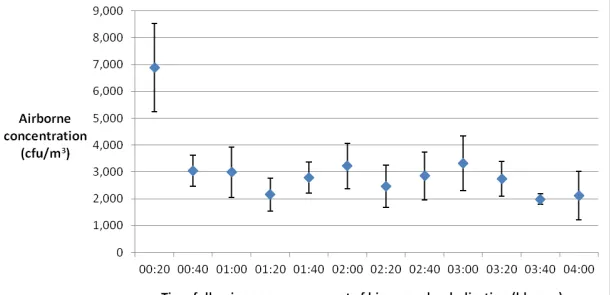
[image:8.420.58.363.317.465.2]The fluctuation in airborne microorganism concentration with time was experimentally investigated to validate that steady state conditions were being achieved. SA was continuously nebulised at 8 Lmin-1 into the centre of the chamber with a ventilation rate of 3 ACH and regime of in high, out low. Five, one minute samples were taken every 20 minutes, over a period of four hours. The results are shown in Fig. 2, where the error bars represent one standard deviation above and below the mean.
Fig. 2. Fluctuation in airborne microbial concentration over time, with continuous bioaerosol nebulisation
commencement of aerosol nebulisation. From this point until the end of sampling, there is no significant difference in the airborne concentration with time.
Influence of Environmental Parameters
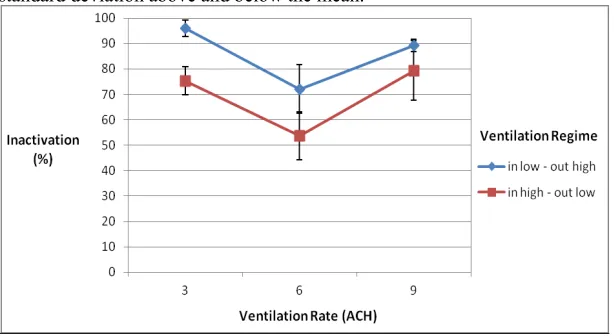
[image:9.420.58.365.206.374.2]The irradiance of SA by the upper-room UVGI system described in section 2 was experimentally examined in terms of three ventilation rates (3, 6 and 9 ACH) and two ventilation regimes (A: in low, out high and B: in high, out low). In each experiment, ten, 1 minute samples were averaged to determine a single concentration value (with and without UV). Six replicate experiments were carried out to determine the average inactivation. The resulting data is represented in Fig. 3, where the error bars represent one standard deviation above and below the mean.
Fig. 3. Inactivation of SA by an upper-room UVGI system, with varied ventilation rate and ventilation regime
Theoretically, an increase in the ventilation rate will reduce the residence time of the particles in the UV irradiance zone (tuv), thus reducing
the percentage of microorganisms inactivated, (1).
tuv = tres(huv/hr) (1)
Where; tres is the residence time of a particle in the room (= 1/ACH), huv is
the height of the UV zone, and hr is the height of the room [2]. For the test
chamber used in this study, the residence time of microorganisms in the UV zone is: 4.2 minutes at 3 ACH, 2.4 minutes at 6 ACH and 1.2 minutes at 9 ACH. Fig. 3, in part, corroborates this theory: Increasing the ventilation rate from 3 ACH to 6 ACH decreased the inactivation fraction from 96 % to 72 % in regime A and from 75 % to 53 % in regime B; a decrease of 24 % and 22 % respectively. However, a further increase in ventilation rate from 6 ACH to 9 ACH resulted in an increase in the fraction of microorganisms inactivated by 17 % and 26 % for ventilation regimes A and B respectively. This potentially demonstrates a false perception of increased UVGI system efficiency, as the lower concentration of airborne microorganisms detected may simply be due to the increased ventilation rate, such that the bioaerosols are being extracted at a faster pace. Further investigations will be carried out to clarify the cause of this increase in microorganisms’ inactivation.
4. Conclusions
The importance of good, consistent experimental technique and design has been shown to be necessary in order to achieve reliable results. It is paramount to sustain the same experimental conditions thoroughout all experiments to allow for the comparisons of data sets. To ensure repeatable, reliable results in future studies which employ the above described procedures, it is therefore recommended that: (i) during aerosol production, the position of the nozzle tip in the liquid solution be continuously sustained at the manufacturers recommended depth of ~1 cm (3/8 of an inch), (ii) the depth of nutrient agar in sampling plates placed in Andersen sampler must be kept consistent, (iii) following a change in any experimental variable, a time period of 40 minutes must be allowed for the chamber to reach a steady state, before sampling the air. Any inconsistencies in the above mentioned experimental variables will result in a considerable disparity in results; hence care should be taken during experimental design and execution, to ensure their standardization.
B (in high, out low), as it resulted in an average of 16 % more microorganism inactivation.
One parameter not investigated in the above study is the choice of bioaerosol species used in the experiments. Each species of microorganism has a specific UV susceptibility constant associated with it, hence the choice of species used will influence the perception of the effectiveness of the UVGI system. There is a large variance in published susceptibility constants, for a range of different species. Due to this substantial discrepancy, a supplementary study is in progress to accurately determine the susceptibility of a number of microorganisms, including the SA used in this study.
Acknowledgment
This study was funded by the Engineering and Physical Sciences Research Council (EPSRC).
References
[1] G. Clausen, G. Bekö, RL. Corsi, L. Gunnarsen, WW. Nazaroff, BW. Olesen, T. Sigsgaard, J. Sundell, J. Toftum and CJ. Weschler. Reflections on the state of research: indoor
environmental quality. Indoor Air (2011) 21(3): 219-30.
[2] AI. Hidron, JR. Edwards, J. Patel, TC. Horan, DM. Sievert, DA. Pollock and SK. Fridkin. NHSN Annual Update: Antimicrobial Resistant Pathogens Associated With
Healthcare Associated Infections: Annual Summary of Data Reported to the National Healthcare Safety Network at the Centers for Disease Control and Prevention, 2006–2007. Infection Control and Hospital Epidemiology (2008) 29(11); 996-1011.
[3] VD. Rosenthal, DG. Maki, S. Jamulitrat, EA. Medeiros, SK. Todi, DY. Gomez, H. Leblebicioglu, I. Abu Khader, MG. Miranda Novales, R. Berba, FM. Ramírez Wong, A. Barkat, OR. Pino, L. Dueñas, Z. Mitrev, H. Bijie, V. Gurskis, SS. Kanj, T. Mapp, RF. Hidalgo, N. Ben Jaballah, L. Raka, A. Gikas, A. Ahmed, LTA. Thu and ME. Guzmán Siritt. International Nosocomial Infection Control Consortium (INICC) report, data summary for 2003-2008, issued June 2009. American journal of infection control (2010) 38:95-104.e102. [4] W. Kowalski. Ultraviolet Germicidal Irradiation Handbook. Springer-Verlag Berlin Heidelberg (2009). ISBN: 978-3-642-01998-2.
[5] O. Ehrismann and W. Noethling. Uber die bactericide wirkung monochromatischen lichtes. Ztschr Hyg Infektionskr (1932) 113: 597-628.
[6] SL. Miller and JM. Macher. Evaluation of a methodology for quantifying the effect of room air ultraviolet germicidal irradiation on airborne bacteria. Aerosol Science and Technology (2000) 33; 274–295.
[7] MM. Jensen. Inactivation of airborne viruses by ultraviolet irradiation. Applied Microbiology, (1964) 52; 418–420.
[8] LA. Fletcher, CJ. Noakes, CB. Beggs, PA. Sleigh and KG. Kerr. The ultraviolet susceptibility of aerosolised microorganisms and the role of photoreactivation. Second International congress of the IUVA, Vienna, (2003) 9–11th July.
[9] P. Xu, J. Peccia, P. Fabian, JW. Martyny, KP. Fennelly, M. Hernandez and SL. Miller. Efficacy of ultraviolet germicidal irradiation of upper-room air in inactivating bacterial spores and mycobacteria in full-scale studies. Atmospheric Environment (2003) 37; 405–419. [10] CA. Gilkeson and CJ. Noakes. Application of CFD simulation to predicting upper-room UVGI effectivness. Photochemistry and Photobiology (in press).