promoting access to White Rose research papers
White Rose Research Online [email protected]
Universities of Leeds, Sheffield and York
http://eprints.whiterose.ac.uk/
This is an author produced version of a proceedings paper.
White Rose Research Online URL for this paper:
http://eprints.whiterose.ac.uk/43000/
Paper:
* School of Civil Engineering, University of Leeds, Leeds, LS29JT
Abstract
The paper reports on aspects of the development and application of our ESTEEMproject. The project aims to combine Engineering Mathematics resources that exploit advances in interactive technology, alongside traditional approaches, to improve student engagement in large group teaching environments. The work is being carried out in the School of Civil Engineering at the University of Leeds where the drive has been to improve the depth of understanding that our students have in Engineering Mathematics through approaches that increase levels of
engagement. The aim of the toolkit under development is to combine direct links to high quality freely-available online Maths resources with new materials (that have been developed in conjunction with Civil Engineering students at Leeds) to exploit a range of interactive
technologies (clickers, tablet, directed interactive online assessment). The developed resources focus on relevant Civil Engineering examples to maximise student engagement. The paper discusses some of the approaches taken to increase engagement using the interactive teaching elements, and includes survey results from two student cohorts who have been trialling aspects of the toolkit during the project development. The survey results show strong support for the inclusion of a range of interactive approaches for improving engagement. Further to this, a summary of results from a quantitative study comparing engagement with an out-of-lecture online teaching and assessment tool, when used both as a formative tool and summative tool, is included. These results demonstrate that there can be substantial engagement by students with online formative assessment tools when students feel it is integral to their course. Furthermore, engagement can be further improved when a small summative mark is associated with each task (with over 91% of the cohort actively engaging).
Background
2
2 The term blended learning is often used to describe a coordinated teaching approach that makes use of a combination of face-to-face lectures alongside online learning and teaching. It is seen by many as an approach with benefits over traditional standalone lectures (Singh (2003), Alonso (2005)). However, the general ‘fits all' term is criticised by some authors as being too vague an idea, meaning different things to different people (Oliver (2005)). In this paper a blended approach is taken to be one that coordinates interactive face-to-face lectures with online content and teaching.
The interaction between lecturer and students is seen as a vital ingredient in the large lecture environment if we want to engage our students and keep them actively involved with our modules (Barnett (2006), Allen (2006)). This engagement is both key while in the lecture and while out of the lecture. The educational literature shows evidence that introducing both interactive and blended elements can both improve student
performance and appreciation of a mathematical subject when implemented in a meaningful way (Randy (2004), Hake (1998), Springer (1999), Cagiltay (2008)). The current work being undertaken at Leeds in the ESTEEM project has been driven by a desire to create a productive learning environment for the teaching Engineering Mathematics that is based around a coordinated blended approach. The intention has been to exploit existing freely available structured online materials and to incorporate additional resources developed at Leeds into a toolkit that promotes enthusiastic engagement with the mathematical subject content. The three key elements of the approach are:
i) An interactive lecture environment. This includes the effective application of a PRS system (and other established approaches) into the delivery of lecture content. The aim is to provide increased in-lecture interactivity allowing students in the large group teaching environment to contribute and feedback during a lecture (Mayer (2009), Caldwell (2007)). Furthermore, tablet technology is used which brings the ability to directly interact with digital slides and resources (Anderson 2007), in the same way that good traditional "chalk and talk" maths lecturers have been able, over many years, to bring dynamism to equations and figures.
ii) Co-ordinated online resources and assessment. This has involved the incorporation of a coordinated online Engineering Mathematics resource to provide a means for setting students weekly focused assignments and tasks. These are directly related to the lecture material with further coordinated links to existing online mathematics content. The online tool provides students meaningful opportunities to attempt problems and gain experience (with real-time feedback on their progress). This enables a dynamic, interactive and flexible teaching resource for lectures and environment for students. The results of assessed online tasks can be used in the lecture to maintain a coherent and coordinated teaching environment. Currently we are using the Blackboard's VLE in conjunction with MyMathlab software (Pearson International, www.mymathlab.com) for the interactive study and assessment.
related examples, provides the students with relevance to the mathematical concepts. These resources are being developed in such a way they are suitable for use with the interactive technologies and also provide a context to the mathematics. In this paper the focus is on the engagement ideas covered in elements i) and ii) so the Civil Engineering examples are not discussed further.
Building on existing resources
In recent years there have been many computer aided learning tools and technologies developed for out-of-lecture study (Alpay (2010)). However, in many cases there have been barriers to their effective use by students. One reason for students not engaging with resources to a fuller extent has been attributed to these out-of-lecture learning tools not having had the flexibility to integrate smoothly with the lecture material being delivered during the other taught components of a course. The educational organisation of the resources is controlled by the developer which reduces their flexibility and therefore their effectiveness ((Maclaren (2004), Kennewell (2008)). Tools that act as a repository and provide large databases of questions that lecturers can select appropriate resources from are seen as potentially more valuable in developing an effective blending of lecture and online learning. In this work the MyMathlab tool has been trialled and then adopted as it provides large databases of Mathematics questions. It also has the benefits of inbuilt algorithms to provide unlimited similar themes of questions with features including detailed worked step-by-step examples. The tool allows data and activities to be managed in a flexible structured manner providing the essential flexibility required for integration with an existing course. The Blackboard VLE is available to all staff and students at the University of Leeds and provides a functional online learning environment that is widely used and thus familiar. In addition to acting as the means of keeping in contact with the students, it is used as a place for making the annotated lecture slides available, providing directed links to a range existing online content directly relevant to each lecture and as a means to coordinate with MyMathlab. It is noted that there are many excellent online Mathematics resources freely available and this work makes wide use of many, both in lecture and through the directed lecture links. A range of resources that the authors find particularly valuable include Mathtutor, Mathcentre, HELM workbooks, MITopencourseware, NRICH STEM and websites: www.khanacademy.org, www.coolmath.com, www.mathworld.wolfram.com,.
4
4 feedback and for keeping attention; the use of interactive props such as sets of student lecture notes, printed with large A,B,C,D on the back (ABCD cards), that allow students to answer multiple choice questions during a lecture; in lecture focused small group tasks; students solving examples and the use of other multimedia based resources for providing content or examples.
Evaluating the blended and interactive approaches
At this stage of work, full trials of all resources have not been completed, however we have been able to collect information from two cohorts of students providing their opinions of, and levels of interaction with, the approaches introduced. It has not been feasible (at this stage) to run two parallel classes which would provide data sets for statistical comparisons as in the case of Mayer (2009). This would provide the
opportunity to assess if the approaches can be shown to have a significant effect on, for example, examination performance.Examination performances for the cohorts using the resources were strong, however since examinations change year-on-year it is not
possible to draw statistically significant conclusions from this.
At this stage we have qualitative data in the form of surveys of level 1 and level 2 Civil Engineering students across three courses.We have also conducted focus groups with students to gauge opinion on the interactive resources used for these three courses. Further to this, we have collected and collated data from the MyMathlab online assessment tool for two consecutive level 2 Engineering Maths cohorts to provide a measure of the engagement with the online resource. It has been possible to compare the effectiveness of the two strategies based on different approaches for encouraging
students to engage with the resource: (a) when used solely as a formative tool and (b) when used with a summative mark attached.
Summary of results of engagement with the MyMathlab online assessment tool
The trial of MyMathlab has been undertaken with two consecutive level 2 groups. For the first cohort (2009/10) (of 162 students) the strategy was to set 10 weekly online tasks (using MyMathlab) covering material directly related to the face-to-face lectures. The students were informed the tasks were a key part of the formative assessment of the module (but that there was no summative mark attached). The class marks from the weekly tasks and associated problem areas were discussed during the lectures and regular oral and e-mail encouragements were used to stress the value of completing the tasks.
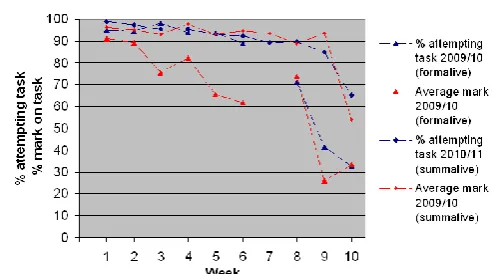
i) Engagement was relatively high in both cases. For other modules in the School involvement in formative online testing is typically at around 30-40%. In the trial, 62% of the formative group of students were assessed to be consistently engaging and 91% of summative group (based on the number of students getting more than 40% on at least 7 out of 10 tasks).
ii) In the formative case there is a very noticeable drop off in engagement with the resource in the later weeks in terms of number attempting and even more markedly in the average marks attained. This can be attributed to a number of factors including initial novelty and competing workloads later in the term. In the case of the summative case this effect is much less marked; in the final week project deadlines for other classes were reported to have had an impact. Furthermore, it should be noted there are very similar trends observed for other courses.
In the study, the average time spent by students on each weekly task was also considered. Similar trends were seen as with the average marks. For the formative group, students spent an average of 49.1 minutes while the summative students spend an average of 60.4 minutes. Although the average of 49.1 minutes per student can be seen as positive, it should be noted that there was a much more uniform distribution of time spent on tasks by each student in the case of the summative cohort. In the formative group there were a large proportion of students who did not engage with the online tool; 38%, compared with 9% for summative. It is noted that feedback, both from two large surveys and the focus groups, were strongly positive regarding the MyMathlab resource. In an online survey (86 respondents) there were several hundred written comments where the vast majority were very supportive of the resource. The negative comments tended to be about the more time consuming tasks and a software glitch with entering data that was later rectified.
Summary of survey results on student survey of ‘interactive resources’
[image:6.595.174.421.306.443.2]An anonymous survey was conducted at the end of the teaching period for two student cohorts, L1EM (107 students) and L2EM (102 students) in 2009/10 to gauge student opinion of the interactive tools implemented. The survey consisted of a series of
6
6 statements that students could respond to on a 5 point Likert scale (strongly agree, agree, neutral, disagree, strongly disagree).
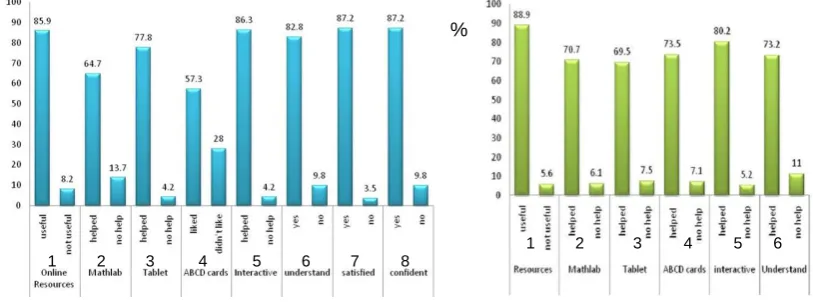
The survey statements for L1EM were as follows: (1) The online resources were useful to me, (2) MyMathlab has helped with my understanding of the lecture material, (3) The tablet helped when reading, mathematical material, (4) The A,B,C,D cards are useful, (5) The interactive elements in the lecture helped me engage in the lecture, (6) I understand the majority of material covered in the course, (7) I was satisfied with the module, (8) I am confident with my maths ability. The statements for L2EM were the same except the final two questions (7&8) were not included in the survey. The survey results (summarised in figure 2) for both cohorts appear to show similar features with the large majority in each cohort finding the interactive resources useful.
Survey Limitations
Since the surveys were optional it was not possible to ensure all students completed them. The number completing was high (over two thirds), however it should be noted that it was not a simple random sample. For example there could be bias towards more contentious students (who may be potentially more likely to give positive feedback). The online survey (86 respondents) just considering MyMathlab produced comparable results, however again there may be bias towards contentious students completing the survey. The large sample size helps to mitigate the influence of this bias to an extent.
Conclusions
The survey results indicate that the combined interactive lecture elements (PRS, ABCD cards, tablet PC, etc. were seen by students as valuable and useful as an aid to learning. However, it is difficult to draw detailed conclusions in terms of improvements to student performance at this stage due to limitations of the survey. A quantitative study will be undertaken to assess measurable improvements to performance in the next phase.
[image:7.595.92.499.286.437.2]1 2 3 4 5 6 7 8
Figure 2: Graph showing percentage agreement of students with positive statements on various interactive approaches used with groups. For student engagement and average marks attained in the MyMathlab trail for: a) L1EM 2009/10 and b) L2EM 2009/10
1 2 3 4 5 6 %
Engagement with the out-of-lecture focused MyMathlab assessment/teaching resource has been high with the feedback from two independent surveys and focus groups demonstrating that it is seen as valuable to the large majority of students; 90.4% of those completing the online survey reporting that the that regular on-line exercises helped with theirlearning.
Student engagement with the online MyMathlab tasks was high for both the formative and summative trials. However, when a summative mark was attached to the work the overall engagement was substantially higher with over 91% students regularly
completing the tasks. There was also a significantly reduced drop off in engagement with the tasks observed in the latter weeks in the summative case. In the formative case students spent an average of 49.9 minutes each week on the tasks whereas in the summative case students took an average of 64.4 minutes undertaking tasks.
A potential dilemma that this study reinforces is regarding the balance of educating our students to be independent learners with that of implementing strategies (such as allocating marks to the weekly tasks) in order to persuade students to engage with a valuable resource. This is a challenge and not one the authors sought to address here. However it is noted that the study has shown significant engagement with an online resource can be achieved without the use summative mark if students believe it to be useful and integral to the course they are studying.
References
Allen, B (2006) A blended approach to collaborative learning: Can it make large group teaching more student-centred? Proceedings of the 23rd annual ascilite conference.
Alonso, F et al (2005), An instructional model for web-based e-learning education with a blended learning process approach, British Journal of Educational Technology, Volume 36, Issue 2, pages 217–235, March 2005
Alpay, E et al (2010), The design of a computer-based maths toolbox for engineering students, European Journal of Engineering Education Volume 35, Issue 1, March 2010 , pages 59 - 78
Anderson, R. et al, (2007) Enhancing Interactive Education with Digital Ink, Computer, Sept 2007 Vol 40, pp56–61, ISSN: 0018-9162, IEEE Computer Society
Barnett, J (2006), Implementation of personal response units, in very large lecture classes: Student perceptions Australasian Journal of Educational Technology,2006, 22(4), 474-494.
Cagiltay, N.E., 2008. Using learning styles theory in engineering education. European Journal of Engineering Education,33 (4), 415–424.
Caldwell, J, 2007, Clickers in the Large Classroom: Current Research and Best-Practice, CBE Life Sci Educ 6(1): 9-20 2007
Hake, R. R. (1998). Interactive-Engagement Versus Traditional Methods: A Six-Thousand-Student Survey of Mechanics Test Data for Introductory Physics Courses.
American Journal of Physics, 66(1), pp. 64-74.
8
8
Kennewell, S (2008), Analysing the use of interactive technology to implement interactive teaching, Journal of Computer Assisted Learning (2008), 24, 61–73
Kent, P et al. (2002) .The Mathematical Components of Engineering Expertise: The Relationship between Doing and Understanding Mathematics, Proc.of the IEE 2nd Annual Symposium on Engineering Education, London.
Maclaren, I. (2004) New trends in web-based learning: objects, repositories and learner engagement. Eur. J. Engng Educ. 29 , pp. 65-71.
Mayer, R et al, 2009, Clickers in college classrooms: Fostering learning with questioning methods in large lecture classes, Contemporary Educational Psychology, Volume 34, Issue 1, January 2009, Pages 51-57
Oliver M (2005), Can ‘Blended Learning’ Be Redeemed? E–Learning, Volume 2, Number 1, 2005, 17
Randy, D. (2004),Blended learning: Uncovering its transformative potential in higher
education, The Internet and Higher Education, Volume 7, Issue 2, 2nd Quarter 2004, Pages 95-105
Singh, H. (2003) Building Effective Blended Learning Programs, Educational Technology, 43, pp. 51-54.
Springer, L., Stanne, M. E., and Donovan, S. S. (1999). Effects of small-group learning on undergraduates in science, mathematics, engineering, and technology: A meta-analysis. Review