© 2019 by Junjie Le, Qiong Liu and Minghai Zhou. All rights reserved. Short sections of text, not to exceed two paragraphs, may be quoted without explicit permission provided that full credit, including © notice, is given to the source.
UNNC School of Economics Working Paper Series
Series G Globalisation and Economic Policy
Can Direct Union Elections Increase Workers’ Economic Wellbeing
in China? Testing Effects and Explaining Mechanisms
Junjie Le, Qiong Liu, Minghai Zhou
1
Can Direct Union Elections Increase Workers’ Economic Wellbeing in
China? Testing Effects and Explaining Mechanisms
Junjie Le, Qiong Liu and Minghai Zhou1
Abstract: Direct union elections, a new institutional arrangement in grassroots trade unions in China, have been introduced experimentally in coastal regions since 2000. Using matched employer–employee data, this study examines the effects of direct union elections on workers’ economic wellbeing. Results reveal that 1) union members with directly elected leaders receive higher wages than those without and 2) direct union elections are positively correlated with worker satisfaction. Additional evidences suggest that effects of direct elections work through stronger union leadership and harmonious industrial relations, resembling the voice-response face of unionism. The effect of direct elections significantly weakens or disappears when we exclude the large firms from the analysis. Meanwhile, the effect of union membership regains its significance. We argue that direct elections are a government-sponsored experiment in which large firms are selected to form an incentive-compatible framework among local governments, firms, and workers for explaining union effects with Chinese characteristics.
Keywords: direct union elections; workers’ economic wellbeing; employer–employee data; firm size; incentive compatible; two faces of unionism
JEL Classification: J51; J53; J32
Acknowledgements: We thank the Fundamental Research Funds for the Central Universities, Key Bases for Philosophy and Social Sciences Research of Zhejiang Province (Grant No. 14JDZS02YB) and the Ningbo Talent Training Project (Grant No. NBLJ201802005) for funding. We are thankful for the useful comments from Richard Upward, Peter Kuhn, Richard Freeman, Junsen Zhang, Shihe Fu, Zhong Zhao, Francis Kramarz, Yiqing Xie, Giovanni Facchini, Paola Conconi, Brian Hilton, Juliane Scheffel, Luckraz Shravan, and other participants at the UNNC Brown Bag Seminar in 2014, the Chinese Economist Society Annual Conference in 2014, the Seventh GEP-China Conference in 2014, the First Xizi Forum on Local Social Governance and Business Environment Improvement in 2017, the Second Annual Conference of China Association of Labor Economics in 2017, and the 2017 International Symposium on Contemporary Labor Economics.
Conflict of Interest: The authors declare that they have no conflict of interest.
1
2
1. INTRODUCTION
It is widely accepted that trade unions increase the economic wellbeing of their members
at the cost of firms. However, understanding the role of unions is a long-standing and
controversial debate among economists since the 1970s. The two faces of unionism, i.e.,
the monopolistic face and the “collective voice-institutional response face,” are two
competing theories for analyzing the union effects in the labor market (Friedman 1972;
Freeman 1976; Borjas 1979; Freeman and Medoff 1984; Hirsch 2004). Both theories
adopt the union-centered approach and elaborate the game played between unions and
firms. However, their explanatory powers are seriously restrained in the case of trade
unions with Chinese characteristics. In this study, we argue that the role of local
governments must be included in the analysis to form a complete picture so as to
demystify the effects of direct union elections in China. Specifically, direct union
elections are a government-sponsored experiment in which large firms are selected as the
main targets for having stronger union leadership and harmonious industrial relations. As
a matter of fact, the direct elections form an incentive-compatible framework among
local governments, firms and workers. In addition, we assert that the direct union
elections are an economic innovation rather than a democratic movement as perceived in
the literature of politics and laws (Chen et al. 2004; Wang 2004; Pringle 2011).
One important challenge faced by the empirical literature on union effects is to identify
the causal effects or tease out the unobserved differences between union and non-union
workers. In the United States, unions tend to win elections either at highly successful
firms or vulnerable firms facing difficulties, resulting in selection and omitted variable
biases for identifying the union effects. DiNardo and Lee (2004) and Sojourner et al.
(2015) address the non-random unionization in the United States by introducing the
regression discontinuity design and using close union elections as a natural experiment
for manufacturing and service sectors. Interestingly, DiNardo and Lee (2004) find no
significant economic impact on the employers in the manufacturing sector, whereas
Sojourner et al. (2015) confirm that unionization does increase labor productivity in the
3
between unionized and non-unionized firms are embedded in the Trade Union Law, with
firms with more than 25 workers being required to have trade union representation.
Unlike the market nature of non-random unionization (i.e., bargaining between unions
and firms) in the West, non-randomness in China is imposed by the All-China Federation
of Trade Unions (ACFTU), a functional department of the central government in China.
For example, state-owned and large firms tend to establish unions and provide
satisfactory working conditions to workers in compliance with the political requirements
from the upper level trade unions and the Communist Party of China. Unsurprisingly,
unionized firms perform better because of selection in size due to the mandatory feature
of unionization in China. Using matched employer–employee data, we examine the
effects of direct union elections on workers’ economic wellbeing and address the
selection biases by using bias-adjusted tests and Propensity Score Matching (PSM)
method. This study finds positive effects of direct union elections on workers’ economic
wellbeing, such as wages and job satisfaction. We also find evidence regarding the
positive effects of direct union elections on firm performance, especially labor
productivity.
Data constraint, at least for China, is another challenge for identifying the causal impacts
of unionization. For instance, Yao and Zhong (2013) can capture merely the positive
union effects on firms’ average wage and welfare because only firm-level data are used.
Given the mandatory feature of unionization in China, unions could organize at
state-owned and large firms that can afford to pay higher wages to their workers than other
firms. Thus, examining the impacts of unionization by firm-level data may be insufficient
and subject to selection bias in the Chinese context. Few studies combine firm-level
analysis with worker level effect, and the interpretation of union effects depends crucially
on both. Using matched employer–employee data, we can control both firm attributes and
worker characteristics in our ordinary least squares (OLS) estimations and examine both
firm and worker level effects in our paper rather than the previous papers. We also assess
the impacts of unobserved variables on the robustness of our OLS results and adjust
4
treatment effects and identifying causal effects, the estimations are still subjected to
biases due to the cross-sectional feature of our data.
In this study, we pay particular attention to the organization of grassroots unions in China
rather than to union density, i.e., membership rate, which measures union power in
specific industries and local labor markets in the conventional literature (Hirsch and
Addison 1986; Stewart 1990; Booth 1995). There are two reasons. The practical reason is
that union density is extremely high in China, with nearly full membership rate in
unionized firms and the involvement of almost three quarters of urban workers.2
Discussing whether being a union member matters is not that meaningful because
formally employed workers are automatically granted union membership in the unionized
firms in China. A more fundamental reason is that the Trade Union Law rules out
discrimination between union and non-union members for collective bargaining, leaving
little advantageous status for enjoying union membership in principle. No prevailing
consensus has been reached in the empirical studies in China. Some studies question the
genuineness of Chinese trade unions and suggest limited union roles in protecting workers’ interests by expanding already high union density (Xia 2004; Zhang 2009),
whereas others claim to find evidence that trade unions in China have transformed and
indeed can increase workers’ average wage as in the West (Ge 2014; Yao and Zhong
2008; Yao et al. 2009; Yao and Zhong 2013). All aforementioned studies use the union
membership of workers or union status of firms as key measures of unionization. By
contrast, we focus on the effects of a new institutional arrangement, i.e., the direct
elections of union chairs which are multicandidate elections for union representative
committees and chairs on workers’ economic wellbeing. We believe that ascertaining
how to effectively organize grassroots unions to protect workers’ rights and interests is a
relevant and meaningful question in the Chinese context.
The remainder of the paper is set out as follows. Section 2 introduces the rationale and
the status quo of the direct elections of union chairs in China. Section 3 formulates three
2 In 2015, union membership accounted for 96% of unionized firms’ employees and 73% of urban workers
5
testable hypotheses on the effect and mechanism of direct union elections for protecting workers’ rights and interests under the discussions about the two faces of unionism.
Section 4 constructs the analytical framework, illustrates the econometric equation, and
describes the data and variables. Section 5 presents the results, and Section 6 concludes.
2. DIRECT ELECTIONS OF UNION CHAIRS IN CHINA
The membership of grassroots trade unions in China has increased by more than threefold
since 2000. In 2015, union members account for almost all employment in unionized
firms and nearly three quarters of urban workers.3 At the same time, labor conflicts in
China have increased and escalated from individual disputes to mass disturbances, e.g.,
Honda wildcat strike in 2010 and Foxconn suicides in 2011. Trust toward trade unions
was low among migrant workers since union chairs were either appointed by the upper
level trade unions or were relatives of private firm managers. Many collective actions,
such as wildcat strikes, were spontaneously organized by informal institutions among
migrant workers, such as the Association of Fellow Provincials or Fraternity Society
(Tongxiang Hui or Xiongdi Hui). These actions inevitably increased the governance cost
and caused social and political uncertainty for the Chinese government at all levels.
Driven by these events, Chinese governments initiated new institutional arrangements
within the union system to gain trust from workers and direct them back to formal
institutions. Since 2000, several local federations of trade unions (Zhejiang in early 2000s
and Guangdong in early 2010s) actively promoted one innovative institutional
arrangement, i.e., the direct elections of the grassroots union chairs. The direct elections
of union chairs opened channels for the workers to communicate and bargain with the firms. Consequently, workers’ economic wellbeing was improved, labor conflicts were
attenuated, and informal and self-organized unions were defused and weakened. The
direct elections of union chairs were considered a feasible reform to gain trust from
workers at low costs.
3 Please refer to Appendix Figure A1 for the number of union members and Appendix Figure A2 for the
6
Direct elections of union chairs refers to the process in which workers nominate any
candidate to stand for them in union positions, such as committee members, vice-chairs,
and chairs. Workers then vote directly for their preferred candidates who must have more
than half of the votes. Such process is called the “sea elections” method, which is
considered the most democratic way of selecting grassroots union leaders (Howell 2006;
2008). In practice, the election process varies across regions. Some have single round
elections where workers directly elect the union chairs from multiple candidates, whereas
others have two or more rounds of elections. In the latter, the first round is only for
nominating and selecting the representative committee separately from different plants
and production departments, leaving the selection of chairs from the committee to later
rounds. For both cases, nominees must deliver public speeches to propose policy agenda
for the workers if elected (Chen et al. 2004; Chan 2009; Pringle 2011; Wen 2014). The
list of nominees must be reviewed and approved by the upper level trade unions. More or
less, the selection of union chairs, at least on the surface, resembles the conventional
democratic elections in the West.4
Interestingly, early experiments of union chairs election can be traced back to the
mid-1980s. Several experiments were actively conducted in Lishu, Siping, Jilin Province and
Shekou, Shenzhen, Guangdong Province. These experiments were interrupted in the late
1980s due to the political turmoil in 1989. They restarted in the late 1990s and early
2000s in Yuhang, Hangzhou and Yuyao, Ningbo, both in Zhejiang Province, where
small- and medium-sized firms clustered in the exporting sector at that time (see Pringle
2011 for more details). According to local union leaders, the requirement of foreign
clients on labor protection and World Trade Organization (WTO) rules were the major
reasons for rebooting the union reform. For example, a shoe-making firm called Yajia in
Yuhang signed detailed contracts with its American and European clients in compliance
with specific standards in labor protection, including workers’ age, working time,
overtime pay, discrimination, security, and sanitation. To respond to the external
4 “Direct election” is interchangeably referred to as “democratic election” in the media. This observation is
7
requirements, Yajia initiated union reform by implementing the direct election of a union
chair in 2001. The first move after the establishment of the newly elected union was to
make collective wage bargaining and implement performance-pay scheme in the firm. By
linking wage growth to the growth of firm profits, the union significantly improved labor
relations in the firm and successfully enhanced the labor productivity of the firm. Such
union reforms were then expanded to other firms in the region, and the share of direct
elections among unionized firms in Yuhang was reported to increase from 40% in 2003
to 99% in 2009 and afterward (Xie et al. 2003; Wang 2004; Gao and Tang 2009).
In the early 2010s, a new round of turbulent labor relations that were triggered by the
widely-reported Foxconn suicides and Honda wildcat strike in Guangdong Province
ignited the drive for union reform within the region. In 2012, direct election of a union
chair in Ricoh Shenzhen was set as a role model for other firms by Provincial Governor
Wang Yang. Consequently, 163 firms with more than 1000 workers were selected to
expand the experiments of direct union elections more widely in Shenzhen. In May 2012,
the campaign of direct union elections in Ohm Shenzhen drew considerable attention
from the media as a breakthrough for establishing a genuine union for electing a union
chair who was one of the migrant workers in representing workers’ rights and interests.
In 2014, 5000 firms conducted direct elections of union chairs in Guangdong,
representing 2% of all unionized firms there. Expansion of such experiments were
planned to make them common in the following five years in Guangdong (Zhang et al.
2012; Zhang and Zhao 2012; Huang and Yao 2014; Wen 2014).
In a nutshell, rapid growth of the manufacturing sector, continual decline of state-owned
firms, and massive flows of rural migrant workers to coastal China over the last three
decades are the main driving forces for union reform in the direction of democratic
election. Researchers on politics, laws, and industrial relations predominantly approach
the issue of direct elections from the perspective of democratic credibility and
accountability (Chen et al. 2004; Wang 2004). Pringle (2011) argues that democratization
8
resolution of those grievances. From the perspective of economics, direct union elections
can be considered a successful means of improving labor relations and preventing
conflicts (e.g., strikes) in the experimental regions like Zhejiang and Guangdong because
directly elected chairs are believed to have stronger incentives to raise union members’
economic wellbeing relative to appointed chairs.
3. HYPOTHESES ON THE EFFECTS OF DIRECT UNION ELECTIONS
It is against this backdrop that we test four hypotheses on the effects of direct union
elections in China. Our aim is to establish whether direct union elections enhance workers’ economic wellbeing, and whether the effects of direct union elections can be
explained using insights from the two faces of unionism that dominate the conventional
literature on the roles of trade unions. The empirical strategy and data we use to test these
hypotheses are described in Section 4.
3.1: Union members with directly elected leaders receive higher wages than those
without.
3.2: Direct union elections are positively correlated with workers’ other rights and
benefits.
The two faces of unionism involve competing theories to explain the feature of trade
unions in the West, and they have become the standard analytical framework for studying
union effects in the labor market (Hirsch 2004). In the view of the monopolistic face,
unions raise the wages of their members but prevent effective allocation of labor market
resources and worsen the labor conditions of non-union members (Friedman 1972). In the
view of the “collective voice-institutional response” face, unions provide workers with a
collective voice that elicits institutional responses from the management and improves
labor relations by increasing training of special skills and preventing adverse selection
and moral hazards of workers, thereby increasing the levels of productivity and equality
between labor and capital (Freeman 1976; Borjas 1979; Freeman and Medoff 1984).
9
the play of collective voice (Miller and Mulvey 1991; Batt et al. 2002; Iverson and
Currivan 2003; Addison and Belfield 2004; Gunderson 2005; Lewin 2005; Benson and
Brown 2010).
However, the mainstream union-centered approach may be misleading for China. The
framework of two faces of unionism to China should not be directly applied without deep
understanding of the unique institutional arrangements of Chinese unions. Hui and Chan
(2015) argue that the dynamics among the quadripartite actors, i.e., party-state,
upper-level trade unions, capital, and labor, shaped the strike-driven direct elections in
Guangdong in 2010s. Trade unions at the upper level are functional departments of the
government which bear the same hierarchical, personnel, and fiscal system as any other
bureaucratic agency. For simplicity, we regard the party-state and upper-level trade
unions as a single level which we label “local government.” We discuss the direct
elections of union chairs under an incentive-compatible framework among local
governments, firms (representing capital), and workers (representing labor) in China.
Local governments are key institutional foundations of the economic system of China.
Xu (2011) describes the governance structure of the Chinese economy as “regionally
decentralized authoritarian,” and Cheung (2009) emphasizes the decentralized feature as “county competition.” The major goal of the local government is to promote local
economic development under the constraint of socio-political stability. The local
government supplies firms with cheap land, labor, and infrastructure and in return
extracts taxes from successful firms.5 As firms become larger, the increasing tension
between capital and labor poses a greater constraint on the socio-political stability to the
locality and its government. For instance, a workers’ strike in a large firm, is considered a “mass disturbance” threatening social stability for which local government officials
should take full responsibility. Local governments therefore have strong incentives to
prevent or mitigate such potential collective actions by introducing direct union elections
as a reform measure.
5 It is well-known that indirect value-added taxes from firms are the main sources of fiscal revenue of
10
As for profit-maximizing firms, strikes are costly, at least in economic terms. The optimal
choice for large firms is therefore to accept the government-sponsored experiment of
direct union elections because such election is less costly than potential strikes. By
introducing direct union elections, these firms may benefit from better labor relations and
higher labor productivity in the long term (Lu et al. 2010; Wei et al. 2013; Ge 2014).
Workers can also benefit from direct union elections by increasing workers’ economic
wellbeing. Therefore, it is also rational for workers to welcome the directly elected chairs
who they elect through democratic votes.
In short, direct union elections form an incentive-compatible framework among local
governments, firms, and workers. Using this tripartite framework, we anticipate positive
effects of direct union elections on workers’ economic wellbeing. We first test the
positive effects of direct union elections on workers’ wages. We then test the positive
effects of direct union elections on workers’ other rights and benefits, such as labor
conditions, worker development, and worker satisfaction.
3.3: The effects work through stronger union leadership and harmonious industrial
relations.
3.4: The effects work through large firms for a tripartite incentive-compatible framework.
If direct union elections can help raise the economic wellbeing of union members and
workers, we further test the underlying channels through which the effects of direct union
elections work. Four channels are possible. First, workers may be more willing to
actively participate in union affairs and seek support from unions if the chairs are directly
elected instead of appointed. Second, directly elected union chairs are believed to have
strong incentives to appeal to their constituencies, which can result in better welfare for
workers. As the political economy literature suggests, the working class benefits from
organized and competitive electoral politics by enjoying high income growth and
generous social welfare (Jennings 1979; Besley et al. 2010). Third, directly elected union
11
relative to appointed counterparts. Fourth, in the Chinese context, the acceptance of direct
union elections by a firm is an indication of positive management response to workers’
demands for better economic wellbeing. At the very least, the management acknowledges
the role of directly elected union leaders in coordinating labor relations between workers
and managers in the hope of increasing labor productivity. The last two channels imply
that the voice-response face of unionism may play a role in making direct union elections
effective. As we lack data on workers’ participation in union affairs and the competitive
election process, we can only test the last two channels in which the effects of direct
union election work through stronger union leadership and harmonious industrial
relations.
However, we must remain cautious when directly applying the two faces of unionism to
China for two reasons. First, trade unions in China are known to have insufficient
bargaining power from lack of independence (Clarke and Pringle 2009; Sun and He 2012;
Ge 2014; Wei et al. 2015). Chinese trade unions are not strong enough to promote
democratic local elections. Second, allowing direct union elections is also implausible in China when firms’ management is too weak to play the voice-response face of unionism.
The drive for direct union elections in China can only be explained as a
government-sponsored experiment in which large firms are selected as the main targets to form an
incentive-compatible framework among local governments, firms, and workers. By
introducing the role of the government, the tripartite framework can better explain both
the cause of direct union elections and its effectiveness in a consistent manner.
In this tripartite framework, firm size is an important but possibly overlooked element for
explaining the effects of direct union elections. If firm size is not large enough, despite
serious tensions between labor and capital, firms will find it easier to handle such
conflicts by dismissing undesirable workers, and such action will have no significant
social impact to the local city and its government. Therefore, direct union elections were
less desirable in 1990s when most firms were relatively small in size. It is not a
12
experiments in Zhejiang in the early 2000s due to WTO accession and in Guangdong in
the early 2010s due to wildcat strikes.
Workers in large firms have stronger bargaining power through collective actions (e.g.,
strikes) than those in small- and medium-sized firms. In our tripartite framework, the
strong bargaining power of workers will exert pressure on firms and can also threaten the
social stability of the locality and its government, which, in turn, places more pressure on
firms to accept direct union elections. Direct elections could be effective in improving workers’ economic wellbeing in large firms relative to small- and medium sized firms.
For the latter, even if they adopt direct union elections, the workers’ bargaining power
may not be strong enough to trigger the above cycle. In this case, local governments may
not be concerned by labor disputes and firms have no incentive to make direct union
elections effective. We therefore expect no substantive effects of direct union elections
for small- and medium-sized firms. In other words, the positive election effects are
mainly driven by large firms.
4. EMPRICAL SPECIFICATION AND DATA DESCRIPTION
4.1 Types of Union Participation and Wage Differences
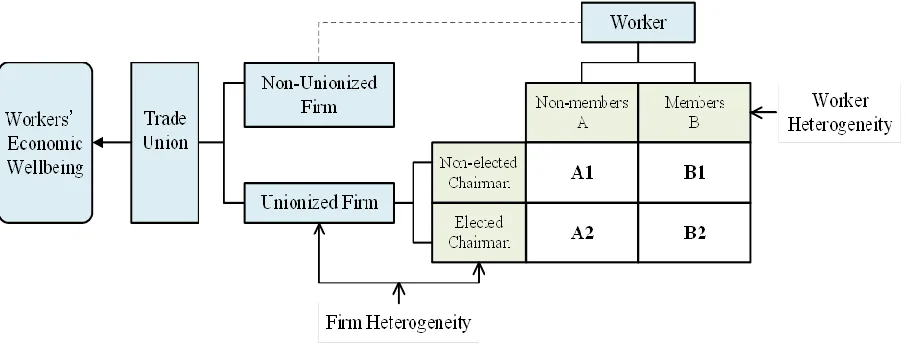
In Figure 1, we classify three types of union participation for affecting workers’
economic wellbeing: union status, union membership, and direct union elections. Union
status of firms distinguishes unionized firms with non-unionized ones. Union
membership of workers differentiates between union and non-union members. Finally,
direct union elections refer to the election of senior union officials by the workforce.
These types of union participation inevitably correlate with both observed and
unobserved firm and worker attributes which will create endogeneity issues.
[INSERT FIGURE 1 HERE]
We classify workers who are not union members as Type N workers and union members
13
chair is directly elected by union members or not (Type 1 equals not directly elected and
Type 2 equals directly elected).6 Therefore, we are able to classify four types of workers
by combining union membership and direct union elections information (see Figure 1).
Type N1 workers are non-union members whose union chairs are not directly elected.
Type N2 workers are non-union members whose union chairs are directly elected. Type
M1 workers are union members whose union chairs are not directly elected. Finally,
Type M2 workers are union members whose union chairs are directly elected. The main
task of the paper is to examine the effects of direct union elections on union members by
comparing wage and welfare differences between Types M1 and M2 workers. This work
also examines the effects of direct elections on all workers (union and non-union
members) by comparing wage and welfare differences between Type (N1+M1) and Type
(N2+M2) workers.
4.2 Empirical Strategy
In light of Figure 1 and Table 1, the empirical equation of the union effects can be
expressed as follows.
ij j i j i k
ij T I F
Y (1)
where Yij is worker i’s economic wellbeing in firm j. Ii is a vector of observed workers’
individual characteristics. Fj is a vector of observed firm attributes. μiis the unobserved
worker heterogeneity, and μj is the unobserved firm heterogeneity. μij is the remaining
error term. Tk is a vector of worker type dummies.
As mentioned in the Introduction, systematic differences between unionized and
non-unionized firms are endogenously embedded in the Trade Union Law, with the
mandatory requirement of unionizing firms with more than 25 workers. This situation
6 Our survey asks questions about ways of selecting union chairs. Choices include: 1) appointed by upper
14
implies that unionized firms are systematically larger than non-unionized firms.
Therefore, the estimated unionized effects in the previous studies (e.g., Yao and Zhong
2013) may be biased by unobserved firm heterogeneity, i.e., μj. Data used in this study
also indicate statistically significant differences between unionized and non-unionized
firms in many aspects, including firm ownership, firm size, and labor relations (see
Appendix Table B1). If such systematic differences are not taken care of, then a serious
endogeneity problem may occur by solely comparing unionized versus non-unionized
firms. In the empirical analysis, this work excludes non-unionized firms and examines the
union effects by comparing union versus non-union members. Since trade unions in
China are organized in a top-down structure rather than the bottom-up structures in
western countries, workers’ selection into unionized firms is not a serious issue in the
Chinese context. Simple exclusion of non-unionized firms will not cause serious selection
bias. Thus, the endogeneity issue triggered by firm heterogeneity, i.e., μj, will be
attenuated and the estimation bias will be smaller.
In China, workers have no choice regarding membership in the trade unions. Once
workers are formally employed by unionized firms, they are automatically granted union
membership. Only those short-term contract workers or dispatched workers have no
union membership in the unionized firms. Therefore, workers’ selection into union
membership is inapplicable in China. Moreover, we confine our analysis to union
members and examine the effects of direct union elections by comparing directly elected
union chairs versus non-directly elected counterparts. Therefore, the endogeneity issues
triggered by both firm and individual heterogeneity, i.e., μi and μj, will be attenuated
further and the estimation bias will be smaller.
In addition, trade unions in China serve multi-task roles, such as supporting
socio-economic development, participating in national affairs as the representative of workers,
and educating workers in multi-dimensions (Trade Union Constitution 2013). In a
multi-task environment, trade unions in China may act under conflicting objectives that are not
15
worker development, and worker satisfaction are also examined along with workers’
wages.
4.3 Data Collection and Variable Description
Our data are from the 2012 Hangzhou Labor Relations Survey conducted by the former
Center for Labor Economics and Public Policy Studies at Zhejiang University. It covers
504 firms in 14 districts of Hangzhou, which includes 9 municipal districts and 5
subordinate counties. This survey combines two sets of questionnaires, including the
employer-level questionnaire called Implementation Status of Firm’s Labor Relations
(Qiye Laodong Guanxi Zhixing Qingkuang) and the employee-level questionnaire called
Opinion Poll of Harmonious Status of Labor Relations (Laodong Guanxi Hexie
Qingkuang Minyi Diaocha).
The survey was conducted as follows. First, we drew a 0.5% random sample of all
100800 firms in 14 districts of Hangzhou on the basis of the sampling number in each
district from the ratio of the agriculture population in each district to total
non-agriculture population in Hangzhou. To consider firm heterogeneity, we stratified firms
in each district into four layers according to different firm sizes and then drew systematic
sampling from each layer. Second, once decided on the sampling firms, we drew random
samples of all workers in each firm. The number of sampling workers was in accord with
firm size. Specifically, we sampled 15 workers for firms with more than 200 workers, 10
workers for firms with 50 to 199 workers, 5 for firms with 10 to 49 workers, and 3
workers for firms with 5 to 9 workers. We excluded middle managers and senior
managers. The sampling scheme above ensured the randomness of the firm. However, the
sampling of workers may continue to be disproportionately represented. We addressed
this issue by incorporating sampling weights in later regressions. Specifically, sampling
weights were calculated by the ratio of the actual firm size to the sampled size.
The firm-level survey was conducted with the assistance of the Labor Inspection Team of
Hangzhou (Hangzhou Laodong Baozhang Jiancha Zhidui), a governmental department,
16
conducted by one-to-one interviews and the questionnaires were filled by student
surveyors from Zhejiang University, thereby ensuring high quality of individual level
information. Moreover, we separated the employee-level survey from the employer-level
survey, which precluded managerial influence and guaranteed independence between the
two surveys.
Finally, this survey collected 504 firm questionnaires and 3996 worker questionnaires to
form a matched employer–employee data set.7 As mentioned, we find systematic
differences between unionized and non-unionized firms in our data, which may cause a
potential endogeneity problem (see Appendix Table B1). Therefore, we excluded the 118
non-unionized firms and the 643 workers in these firms. We further excluded the 107
workers who did not respond or know relevant information such as wages, union
membership, gender, Hukou, and education. For outliers, we first excluded the 54
workers who are not in the working age (below 16 and above 65). We then excluded the
39 workers who work less than 80 hours (including those less than 9 days) and more than
360 hours per month. Then, we excluded the 14 workers whose hourly wages were lower
than 6.5 yuan because the hourly minimum wage in Hangzhou is 10.7 yuan in 2011.
Finally, 386 unionized firms and 2857 workers were left for regression analysis.
The main outcome variable of interest is the log of hourly wages, which includes bonuses
and stipends in cash but not in kind. Hourly wages are monthly wages divided by the
product of the number of working days in a month and the number of working hours in a
day. The other outcome variables we examine are: monthly working hours, whether
workers receive free checkups, whether workers receive on-the-job training, their
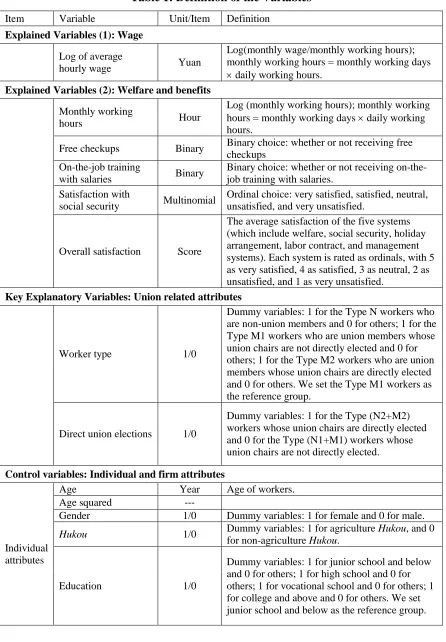
satisfaction with social security, and their overall satisfaction. Table 1 presents the
definitions of all variables.
[INSERT TABLE 1 HERE]
7 Initially, the response rate of firm was 99.4%. We searched additional online information of two firms and
17
We include both individual and firm attributes as control variables in Equation (1). The
individual attributes of workers include age, gender, hukou, education, political status,
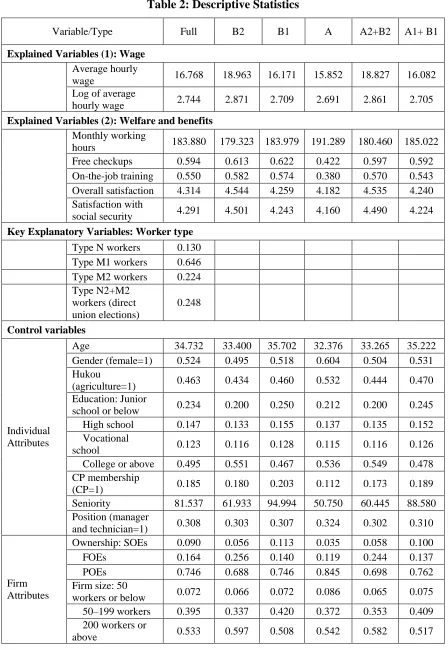
seniority, and occupation. Firm attributes include ownership, size, history, location,
industry, and skill intensity. Table 2 presents the descriptive statistics of all variables.
[INSERT TABLE 2 HERE]
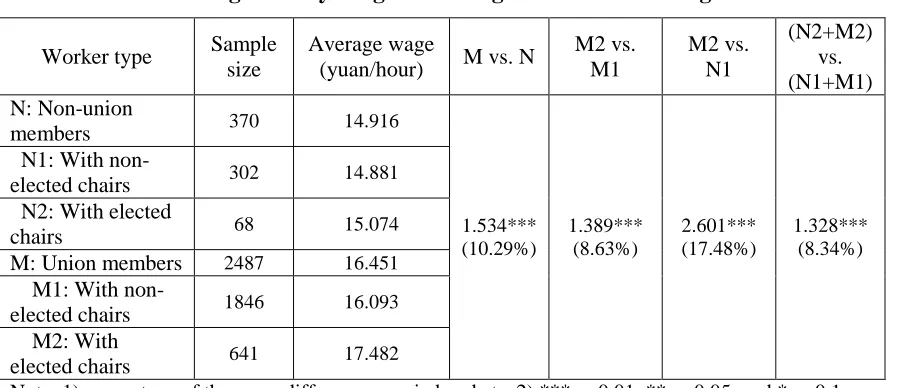
Furthermore, Table 3 presents the average wage differences among the different types of
workers. The wages of union members (Type M) are 10.3% higher than those of
non-union members (Type N). Among non-union members, wages are 8.6% higher for those with
directly elected union chairs (Type M2) than those without (Type M1). The wages of
union members with directly elected chairs (Type M2) are 17.5% higher than those of
non-union members whose union chairs are appointed (Type N1). Union members with
directly elected chairs enjoy the highest wages. Moreover, workers whose union chairs
are directly elected receive (Type N2+M2) 8.3% higher wages than those workers
without directly elected union chairs (Type N1+M1).
[INSERT TABLE 3 HERE]
5. RESULTS AND DISCUSSIONS
Hypothesis 1 – Union members with directly elected leader receive higher wages than
those without.
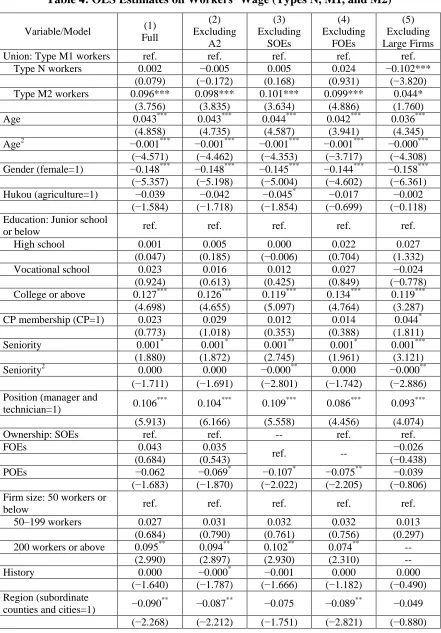
Table 4 presents the results of the OLS method in estimating the effects of direct union
elections on wages after adjusting the sampling weights. Column 1 in Table 4 indicates
that union members with a directly elected leader receive 10.1% higher wages than those
without. Unsurprisingly, we find no significant union membership effect after controlling
the effect of direct union elections. This outcome can be attributed to the high union
density in the unionized firmswhere only those short-term contract workers or dispatched
workers have no union membership. From an individual perspective, male workers, those
18
relatively high wages. From a firm perspective, large firms located in municipal districts,
which are not privately owned and have high skill intensity tend to provide relatively
high wages to their workers. These results are consistent with the firm and labor theories,
and are in line with our expectations. Moreover, the effects of union membership and
direct union elections are almost identical when we exclude Type N2 workers, i.e.,
non-union members with directly elected non-union chairs (Column 2 in Table 4).8
[INSERT TABLE 4 HERE]
Thus far, our analysis is confined to the effects of direct elections on union members.
According to the Trade Union Constitution 2013, the basic duty of the Chinese trade
unions is to protect the legitimate rights and interests of all workers rather than of union
members only. Therefore, the wage effects of direct union elections, in principle, should
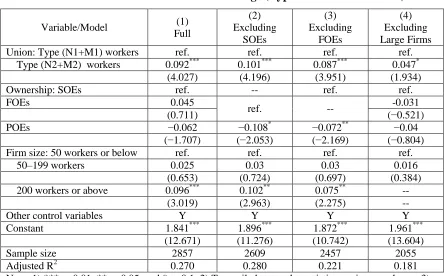
apply to non-union members. Table 5 further compares the wage differences between
workers with directly elected union chairs and those without. The average hourly wages
of workers whose union chairs are directly elected are 9.6% higher than those without
directly elected union chairs.
[INSERT TABLE 5 HERE]
One concern is that direct union elections can be more superficial in state-owned
enterprises (SOEs) than in other firms (Nichols and Zhao 2010). If the direct elections of
union chairs in SOEs are only political shows, the positive effects in SOEs may be driven
by those features associated with state ownership rather than the election itself. To
address the potential endogeneity, we simply excluded the sample of SOEs. The
estimation results are shown in Column 3 in Table 4 and Column 2 in Table 5. The
positive effects of direct union elections still hold (10.6% in both Table 4 and 5). These
results can be attributed to the relative scarcity of SOEs in our sample (6.7%) and the low
8 Only 68 workers were non-union members with directly elected union chairs. We tested for robustness by
19
incidence of direct union elections (14.7%) within SOEs.9 In principle, state ownership
implies that a stated-owned firm and all its workers belong to the state, and that the union
only serves as a bridge between workers and management. In practice, union chairs in
SOEs are communist party cadres who enjoy high hierarchical rankings in the personnel
system. The direct elections of union chairs are less desirable in SOEs and thus has less
impact on workers’ wages.
Another concern is that the effects of direct elections may be captured only through
foreign-owned enterprises (FOEs). Many trials of direct union elections in Guangdong
may have been implemented in FOEs simply because they had more knowledge and
experience in selecting union chairs in a democratic way. If this is the case, we then
would observe no effect of direct elections after excluding the sample of FOEs. As shown
in Column 4 in Table 4 and Column 3 in Table 5, the positive effects of direct union
elections are almost the same for union members (10.4%) and slightly smaller for all
workers (9.1%).10 The results can also be attributed to the relative scarcity of FOEs in our
sample (10.7%), although the share of direct union elections is relatively high in FOEs
(31.9%). After excluding FOEs, the R-squared decreases from 0.27 to 0.22, indicating
some explanatory power for having FOEs. These outcomes imply that unions in FOEs
may bear more resemblance to their counterparts in western countries for protecting workers’ rights and interests, especially for union members.
Direct union elections may be correlated with unobserved variables, such as a firm’s
governance structure. Therefore, the estimated effects of direct union elections by OLS
may be biased. Although worker and firm attributes are controlled for in our OLS
analysis, omitted variable biases may still occur. Following the seminal work of Altonji
et al. (2005) (hereafter AET), Oster (2017) develops the approach for evaluating the
robustness to omitted variable bias under the assumption that selection on observables is
9
The low share of SOEs in our sample is justifiable because private economy dominates in Zhejiang Province where Hangzhou is the capital city.
10 The low share of FOEs in our sample is justifiable because private economy dominates in Zhejiang
20
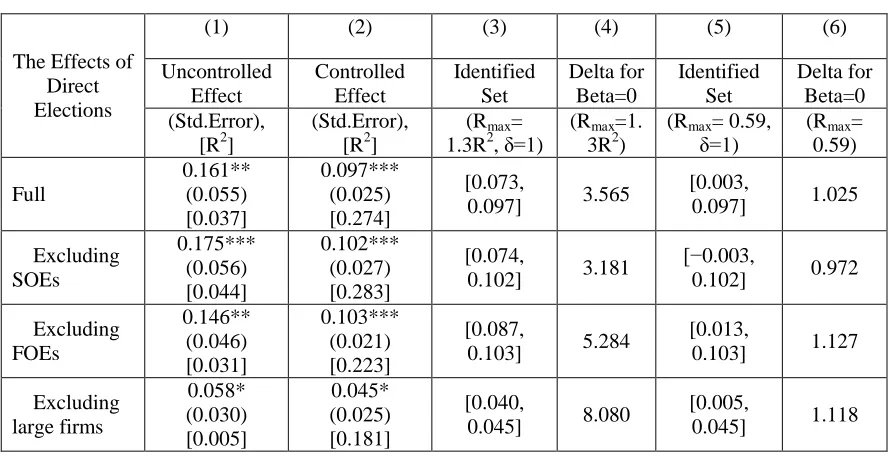
informative about selection on unobservables. We apply their approach and present the
results of biased-adjusted treatment effects of direct union elections in Table 6.
[INSERT TABLE 6 HERE]
In Table 6, the controlled treatment effect of direct union elections is 10.1%, which
remains significantly positive and is smaller relative to the uncontrolled treatment effect
of 17.5% (full specification in Columns 1 and 2). Oster (2017) points out that coefficient
stability must be combined with information about R-squared movements to develop an
argument. In our case, R-squared increases from 0.037 to 0.274 when the controls are
introduced in the full specification.
Following Oster (2017), we conducted two sets of robustness tests. We first calculated
the identified set for controlled treatment effects when the relative degree of selection on
observed and unobserved variables (δ) was set as one and R-squared from a full set
regression of the outcome on treatment and observed and unobserved controls (Rmax) was
set as 1.3R2. We find that the lower bounding value of the identified set is still large in
size and bigger than zero. Alternatively, we calculated δ when the treatment effect was
set as zero. To make the treatment effect zero, δ must be 3.565, which indicates a much
larger impact of unobservables than observables. Both tests suggest that selection on
unobservables cannot seriously bias the effects of direct union elections on workers’
wages in our OLS regressions. Similar results are shown in Table 6 in which we excluded
the samples of SOEs and POEs.
By supposing that all the unobserved variables can be captured by the wages of the
previous year, we can set the lowest possible value for Rmax if we regress the workers’
monthly wage in 2012 by the monthly wage in 2011. According to the regression result,
the lowest possible R-squared is 0.59. Then, we calculated the identified sets and values
of δ when Rmax was set as 0.59. Except for excluding SOEs, all identified sets do not
include zero, although the lower bounding values became relatively small. Alternative
21
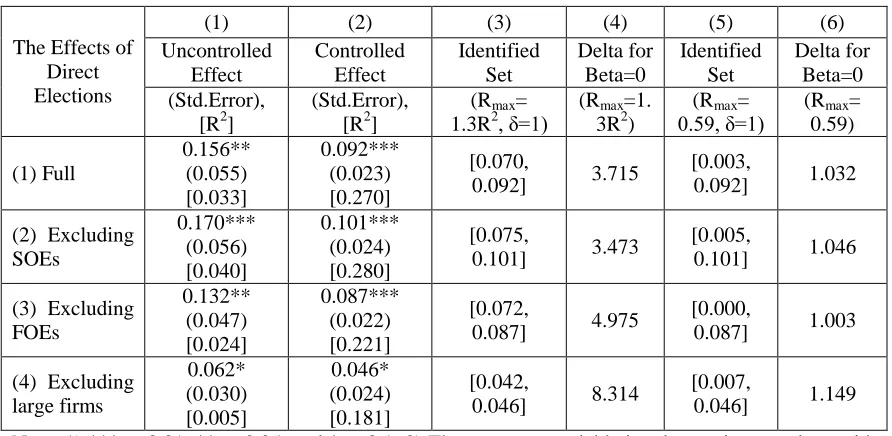
These tests further indicate that selection on unobservables does not significantly change
our OLS results. We also examined the impacts on the wage differences between workers
with directly elected union chairs and those without (Table 7). The results are consistent
with those of Table 6, again suggesting the robustness of the effects of direct union
elections.
[INSERT TABLE 7 HERE]
Since direct elections are a government-sponsored selection process, the selection could
also be jointly determined by firm and worker attributes. These attributes may also affect workers’ wages, thereby causing systematic wage differences among the four types of
workers. Alternatively, if workers expect wages increase if they directly select their union
chairs, they will actively promote the direct elections of union chairs. To further test the
robustness of our OLS results, we used PSM method to adjust for the self-selection biases
mentioned above.11 Following Heckman, Ichimura, and Todd’s (1997, 1998a, 1998b), we
specifically used local linear regression matching to estimate the effects of direct union
elections on workers’ wages, which involve the average treatment effects on the treated
(ATT). Following the PSM method, we first calculated the propensity scores by
regressing the probability of direct union elections on firm and worker attributes using a
logistic model (Dehejia and Wahba 1999). Then, we compared the wage differences
between Type M2 workers (the treatment group) and Type M1 workers (the control
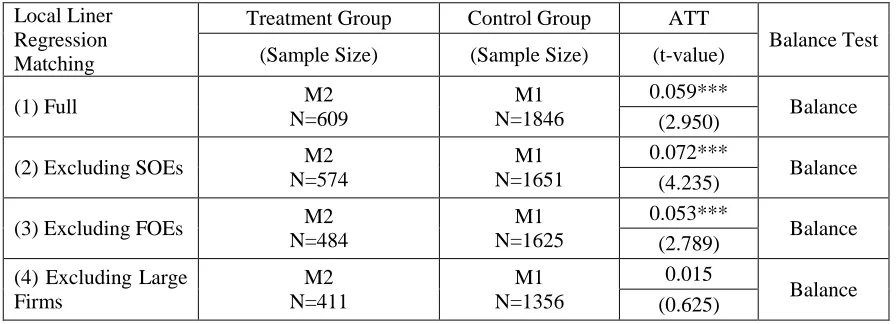
group). Table 8 shows the ATT results using local linear regression matching method.
[INSERT TABLE 8 HERE]
All our PSM estimations passed the balance test (see Appendix Figure A3 for more
details). The effects of direct union elections remain positive and significant at the 1%
level. Specifically, the ATT of the full sample indicates that direct union elections can
increase the hourly wages of union members by 6.1%. Similarly, the ATT when
11 For more discussion on the effectiveness of the propensity score matching method, please refer to
22
excluding sample of SOEs and FOEs are 7.5% and 5.4%, respectively. Although the
PSM method can eliminate overt bias rather than hidden bias, the PSM effects in our
analysis are consistent with OLS estimates but smaller in magnitude.
In a nutshell, we attempted to address the potential endogeneity issue due to unobserved
variables and self-selection by using the AET and PSM approaches. The two approaches
confirm our OLS results in testing the first hypothesis that union members and workers
with directly elected leader receive higher wages than those without.
Hypothesis 2 – Direct union elections are positively correlated with workers’ other rights
and benefits.
Increasing workers’ economic wellbeing should not only be confined to wages because
Chinese unions serve multi-task roles. Therefore, we further analyzed the effects of direct
union elections on other dimensions, such as labor conditions, the employment system,
worker development, and worker satisfaction. We used the monthly working hours of
workers and whether or not workers received regular free body checkups as the proxies
of the labor conditions. We argue that working hours reflect working intensity and
regular free checkups reflect the extent of the firm’s focus on labor conditions. We
employed satisfaction about social security as a proxy for the employment system.12 We
believe that the satisfaction about social security indicates the overall participation in
social security and whether or not a firm contributes sufficient social security payments
in accordance with laws and regulations. We utilized the presence or absence of
on-the-job training organized by the firm as the proxy of worker development. We assert that
firm training is a main way for workers to accumulate human capital. In addition, we
employed average satisfaction scores on several indicators (such as the firm’s welfare,
social security, holiday system, fulfillment of labor contracts, and democratic
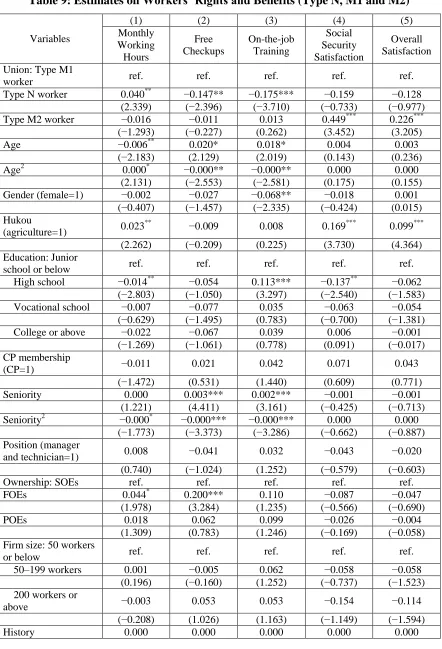
management) as a proxy for worker satisfaction. Table 9 presents the estimation results of
OLS and logit regression.
12 We initially intended to use the signing rate of labor contracts and participation rate of social security as
23
[INSERT TABLE 9 HERE]
The results in Table 9 show that after controlling firm and workers’ characteristics, the
union members work fewer hours, receive more free checkups, and more on-the-job
training. These results indicate that joining a union is helpful for improving labor
conditions and promoting worker development. But we do not observe significant
differences in working hours, free checkups, and on-the-job training between union
members with and without directly elected union chairs. However, direct union elections
are positively correlated with worker satisfaction. In other words, union members with
directly elected chairs are more satisfied with their social security system and other
indicators than those without. We find similar results in Table 10 where we compare the
differences for all workers rather than only union members.
[INSERT TABLE 10 HERE]
Our results therefore suggest that union membership enhances non-economic welfare,
whereas direct union elections play a minor role in further enhancing these benefits.
Unexpectedly, the effects of direct union elections mainly concentrate on worker
satisfaction. We claim that direct union elections may encourage more worker
participation in firm management such that workers have a high level of commitment and
satisfaction in their firms. Accordingly, the voice-response face of unionism may play a
role in making direct elections effective, which we test directly in the next hypothesis.
Hypothesis 3 – The effects work through stronger union leadership and harmonious
industrial relations.
We further tested whether the “collective voice-institutional response” face of unionism
can explain the working mechanisms behind the effects of direct union election.
Specifically, we checked if the effects of direct union elections work through stronger
24
differences between firms with directly elected chairs and without. Specifically, we
compared firm performance, firm governance in labor relations, and individual attributes
of union chairs between the two types of firm. The results are reported in Table 11.
[INSERT TABLE 11 HERE]
Firms with directly elected chairs have better performance, better governance in labor
relations, and stronger union leaders than those without. Specifically, directly elected
firms have significantly higher per capita output. These firms also are more open to
publicize firm affairs to workers and more willing to settle labor disputes for workers.
The directly elected union chairs are more educated and hold full-time positions rather
than part-time ones. In comparing the differences between directly elected and
non-directly elected firms, we do not report the regression results by controlling the attributes
of the firms and union leaders. Although some of the results are consistent with the
simple statistical comparison in Table 11, the regression results are not very robust
because the sample size of the firms is relatively small and firm performance variables
are subject to many missing values.
Interestingly, these results seem to be consistent with the “collective voice-institutional response” face of unionism. First, the results imply that directly elected union leaders are
better at coordinating labor relations between workers and managers as they show full
commitment and truly represent the collective voices of workers. Second, understanding
that direct union elections can enhance the labor productivity of the firm, firm
management is more willing to provide positive responses to workers’ demand for better
economic wellbeing, e.g., better labor dispute settlements and more public information of
firm affairs. Therefore, direct union elections, as an innovative institutional arrangement, provides a working mechanism for increasing workers’ economic wellbeing through
stronger union leadership and harmonious industrial relations.
Hypothesis 4 – The effects work through large firms for a tripartite incentive-compatible
25
We have argued that direct elections in China are a government-sponsored experiment in
which large firms are selected as the main targets to form an incentive-compatible
framework among local governments, firms and workers. Here, selecting large firms is
the key prerequisite for making direct union elections effective. In other words, only
direct union elections in large firms can form the tripartite incentive-compatible
framework.
Anecdotal evidences in the real world practice of the reform on direct union elections
also suggest that firm size appears to be an important factor. For example, the chairperson
of the Yuhang Federation of Trade Unions pointed out that “other than complying with
WTO rules, firm growth to a certain size in Yuhang makes direct union elections necessary” (Xie et al. 2003). Such observation is more obvious in that 163 firms with
more than 1000 workers were explicitly selected for the second stage of the expansion of
the initial experiment of direct union elections in Ricoh Shenzhen (Zhang et al. 2012).
One way to test this mechanism is to check whether the effects of direct union elections
still hold when excluding large firms with more than 200 workers in our sample. The
initial results can be found in Column (5) in Table 4. After excluding the large firms in
our sample, the effect of direct union elections decreases from 10.1% to 4.5% and is
significant only at the 10% level. On the contrary, the effect of union membership
becomes significant, which indicates that union members receive 10.7% higher wages
than non-union members for small- and medium-sized firms. This outcome implies that
direct union elections are effective mainly for large firms and union membership plays a
central role in explaining workers’ wage differences for small- and medium-sized firms.
Similarly, the average hourly wages of workers whose union chairs are directly elected
are only 4.8% higher than those without directly elected union chairs after excluding the
large firms (see Column (4) in Table 5). Moreover, bias-adjusted regression results are
consistent and very close to OLS estimates (see Tables 6 and 7). If we use PSM method,
the effect of direct union elections is no longer significant after excluding large firms.
26
direct union elections on increasing workers’ economic wellbeing. A complete picture for
explaining the effects of direct union elections is needed to ascertain the role of the local
government in selecting large firms as targets for settling labor relations in China.
6. CONCLUSION
Unlike trade unions in western countries, those in China are organized in a top-down
structure where grassroots trade unions, the focus of our paper, are positioned at the
bottom. The grassroots trade unions are distinctive in the sense that they lack
independence, are subject to government regulation, have higher union density, and serve
multi-task roles. Despite these differences, trade unions in China are transforming and
restructuring their role in response to intense labor relations that began in the new century
(Clarke 2005). Direct elections of union chairs are one of the prominent efforts to
attenuate conflicts between workers and capitalists and increase workers’ economic
wellbeing. After reviewing the short history of direct union elections in China, this work
argues that rapid growth of the manufacturing sector, continual decline of state-owned
firms, and massive flows of rural migrant workers to coastal China over the last three
decades are the main driving forces for union reform in the direction of democratic
elections.
Using matched employer–employee data, this study examines the effects of direct union
elections on workers’ economic wellbeing. Union members and workers with directly
elected leaders receive higher wages than those without. Moreover, direct elections of
union chairs are less desirable in SOEs and have less impact on workers’ wages. We
argue that unions in FOEs may bear more resemblance to their counterparts in western countries for protecting workers’ rights and interests, especially for union members.
Bias-adjusted tests further indicate that the selection on unobservables does not significantly
change our OLS results. The PSM effects are also consistent with OLS estimates but are
smaller in magnitude. Furthermore, direct union elections are positively correlated with
27
Further evidence suggests that the effects of direct elections work through stronger union
leadership and harmonious industrial relations, resembling the voice-response face of
unionism. However, our empirical results further show that the effect of direct elections
significantly weakens or disappears but the effect of union membership recovers its
significance when we exclude the large firms in the analysis. These outcomes imply that
firm size is the key to understanding the mechanism of direct union elections on increasing workers’ economic wellbeing. We assert that direct union elections are a
government-sponsored experiment in which large firms are selected as the main targets
for explaining the effects direct election with Chinese characteristics. Direct union
elections form an incentive-compatible framework among local governments, firms, and
workers, which differs from the two faces of unionism.
Fundamentally, this study deepens the understanding of China’s trade unions and how
institutional arrangements within the union system works to protect and improve workers’
economic wellbeing. Direct elections of union chairs are an excellent angle to transcend
the two faces of unionism and the mainstream union-centered approach. The cause of the
effects of direct union elections is neither from the union’s monopolistic power, nor
directly from the firm’s governance capacity but rather emerges from the government’s
selection of large firms as targets for implementing the union experiment. Direct union
elections are not a sign of grassroots political democracy in China as perceived and
suggested by researchers in politics and laws. Rather, such election is an effective
innovation to form an economically incentive-compatible framework among tripartite the
28
REFERENCES
Altonji, J. G., Elder, T. E., & Taber, C. R. (2005). Selection on observed and unobserved
variables: Assessing the effectiveness of Catholic schools. Journal of Political
Economy, 113(1): 151–184.
Angrist, J. D., & Pischke, J. S. (2009). Mostly harmless econometrics: an empiricists’
companion.Princeton: Princeton University Press.
Batt, R., Colvin, A. J. & Keefe, J. (2002). Employee voice, human resource practices,
and quit rates: evidence from the telecommunications industry. Industrial and Labor
Relations Review, 55(4): 573–594.
Benson, J. & Brown, M. (2010). Employee voice: does union membership matter?
Human Resource Management Journal, 20(1): 80–99.
Besley, T., Persson, T., & Sturm, D. M. (2010). Political competition, policy and growth:
theory and evidence from the US. The Review of Economic Studies, 77(4): 1329–
1352.
Booth, A. L. (1995). The economics of the trade union. Cambridge University Press.
Borjas, J. (1979) Job satisfaction, wages, and unions. Journal of Human Resources, 14(1):
21–40.
Chan, A. (2009). Challenges and possibilities for democratic grassroots union elections in
China: A case study of two factory-level elections and their aftermath. Labor Studies
Journal, 34(3): 293–317.
Clarke, S. (2005). Post-socialist trade unions: China and Russia. Industrial Relations
Journal, 36(1): 2–18.
Clarke, S., & Pringle, T. (2009). Can party-led trade unions represent their
members?. Post-Communist Economies, 21(1): 85–101.
Chen, S., Wu, W., & Chen, Y. (2004). Direct election of trade union: new development of Chinese local democracy (in Chinese). Zhejiang Social Sciences, 1: 63–73.
Cheung, S. N. S. (2009). The economic system of China. Beijing: China Citic Press.
29
Freeman, R. B. (1976). Individual mobility and union voice in the labor market. The
American Economic Review, 66(2): 361–368.
Freeman, R. B. & Medoff, J. L. (1979). The two faces of unionism. Public Interest, 57:
69–93.
Freeman, R. B., & Medoff, J. L. (1984). What do unions do, Industrial and Labor
Relations Review, 38(2): 244.
Friedman, M. (1972). Have monetary policies failed. The American Economic Review,
62(1/2): 11–18.
Gao, Q., & Tang, Y. (2009). Democratization of trade union in Yuhang has been recognized by the deputy chairperson of Zhejiang Federation of Trade Union (in Chinese). Urban-Rural Oriental, December 21.
Ge, Y. (2014). Do Chinese unions have “real” effects on employee
compensation?. Contemporary Economic Policy, 32(1): 187–202.
Gunderson, M. (2005) Two faces of union voice in the public sector. Journal of Labor
Research, 26(3): 393–413.
Guo, S., & Fraser, M. W. (2010). Propensity score analysis: statistical methods and analysis. London: SAGE Publications.
Heckman, J., Ichimura, H., & Todd, P. (1997). Matching as an econometric evaluation estimator: evidence from evaluating a job training programme. The Review of Economic Studies, 64(4): 605–654.
Heckman, J., Ichimura, H., & Todd, P. (1998a). Matching as an econometric evaluation estimator. The Review of Economic Studies, 65(2): 261–294.
Heckman, J., Ichimura, H., & Todd, P. (1998b). Characterizing selection bias using experimental data. Econometrica, 66(5): 1017–1098.
Hirsch, T. (2004). What do unions do for economic performance?. Journal of Labor
Research, 25(3): 415–455.
Hirsch, B. T., & Addison, J. T. (1986). The economic analysis of unions: new approaches
and evidence. Taylor & Francis.
Howell, J. (2006) New democratic trends in China? : reforming the All-China Federation of Trade Unions. Working paper series, 263. Brighton: IDS