ADAPTING AUTHORITARIANISM : INSTITUTIONS AND
CO-OPTATION IN EGYPT AND SYRIA
Joshua Alan Stacher
A Thesis Submitted for the Degree of PhD
at the
University of St. Andrews
2007
Full metadata for this item is available in the St Andrews
Digital Research Repository
at:
https://research-repository.st-andrews.ac.uk/
Please use this identifier to cite or link to this item:
http://hdl.handle.net/10023/354
This item is protected by original copyright
Adapting Authoritarianism:
Institutions and Co-optation in Egypt and Syria
Joshua Alan Stacher
Ph.D. Dissertation
Abstract
This thesis analyzes how politicized and depoliticized institutional political orders affect a regime’s ability to co-opt elites and non-elites so as to maintain authoritarian rule. It examines contemporary authoritarian governance in Egypt and Syria to demonstrate how institutional variations determine why otherwise similar regimes respond differently in adapting their authoritarian systems.
I argue that “depoliticized” institutional arenas, as in Egypt, provide a political system greater flexibility than systems with “politicized” institutions, as in Syria. By politicized or depoliticized institutions, I mean the degree that a system’s institutions such as the presidency, ruling party of state, and military/security services establishment contribute to politically formulating a governing consensus.
The Egyptian case has a higher capacity for authoritarian adaptation because the president oversees a political arena devoid of institutions that can obstruct the executive’s initiatives. Conversely, the Syrian president faces a different constraint because too many institutions -- including ones that should not be politically active -- are involved in formulating the governing consensus, which makes co-opting elites and non-elites a more diffuse process. It also decreases the system’s ability to adapt efficiently.
Declarations
I, Joshua Alan Stacher, hereby certify that this thesis, which is approximately 92,500 words in length, has been written by me, that it is the record of work carried out by me and that it has not been submitted in any previous application for a higher degree.
Date 9 March 2007 Signature of candidate _____________________
I was admitted as a research student in September 2002 and as a candidate for the degree of Ph.D. in September 2002; the higher study for which this is record was carried out in the University of St. Andrews between 2002 and 2006.
Date 9 March 2007 Signature of candidate ______________________
I hereby certify that the candidate has fulfilled the conditions of the Resolution and Regulations appropriate for the degree of Ph.D. in the University of St. Andrews and that the candidate is qualified to submit the thesis in application for that degree.
List of Charts
Charts
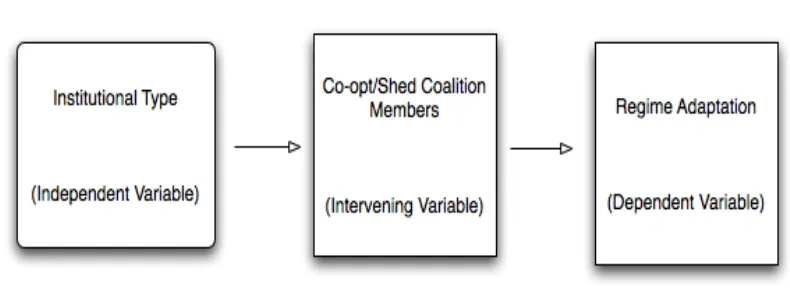
(1.1) Thesis Design: Independent, Intervening, and Dependent Variables: 12
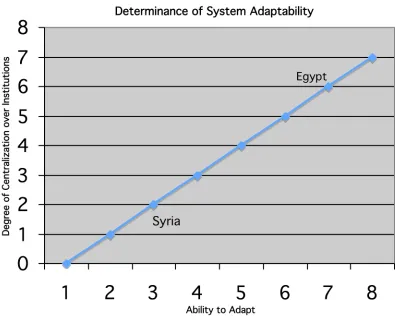
(1.2) Determinacy of System Adaptability: 17
Table of Contents
1.0 Problem Statement, Theoretical Concerns, and Methodology
1.1 – Introduction
1.2 – Background: The Persistence of Authoritarianism Amidst Democratization
1.3 – Theoretical Review
1.3.1 – Modernization Theory
1.3.2 – Authoritarian, Populism and Post-Populism Theory
1.3.2.A – Authoritarianism
1.3.2.B – Populist Authoritarianism
1.3.2.C – Post-Populist Authoritarianism
1.3.3 – Institution Theory
1.3.4 – Co-optation Theory
1.3.5 – Coercion Theory
1.4 – Comparing Egypt And Syria: A Literature Overview
1.5 – Research Methodology
1.5.1 – Printed Material
1.5.2 – Formal Interviews
1.5.3 – Informal Interviews
1.6 – Organization of the Study
10
17
20
20
24
24
27
30
32
35
38
39
49
51
52
56
56
2.0 The Origins of Depoliticized and Politicized institutions in Egypt and Syria
2.1 – Introduction and Argument
2.2 – Domestic Identity Constraints
2.3 – Comparative Political Development
2.3.1 – Egyptian Party Depoliticization
2.3.2 – Syrian Party Politicization
2.4 – Comparative Military Development
2.4.1 – Egyptian Military Depoliticization
2.4.2 – Syrian Military Politicization
59
60
63
63
67
72
72
2.5 – The External Patron, Peace, and Extra-Institutional Ruling Challenges
2.5.1 –American Friends, Weak Opposition Challenges, and a Separate Peace
2.5.2 –American Adversaries, Strong Opposition Challenges, and No Peace
2.6 – Depoliticized and Politicized Institutions
80
82
86
92
3.0 – Coalition Change and Management in Varying Authoritarian Systems: Institutions and Elite Co-optation
3.1 – Introduction
3.2 – Presidential Roles in Contemporary Egypt and Syria
3.2.1 – Hosni Mubarak’s Egypt
3.2.2 – Bashar al-Asad’s Syria
3.3 – Elite Co-optation
3.4 – Elite Coalition Change
3.4.1 – Egypt: The Case of `Amr Mosa
3.4.2 – The Cases of Gamal Mubarak, Safwat al-Sharif, Yusif Wali, and Kamal al-Shazli
3.4.3 – Syria: The Case of Bashar, Mahmod Zob`i, Rif`at al-Asad, and Succession
3.5 – Elite Coalition Management
3.6 – Conclusion
95
96
97
101
109
110
110
113
123
130
4.0 Institution Type and its Affect on Non-Elite Individual Co-optation
4.1 – Introduction
4.2 – Party Co-optation
4.2.1 – The Egyptian Case
4.2.2 – The Syrian Case
4.3 – Societal Co-optation
4.3.1 – Egypt: Councilization
4.3.2 – Syria: Controlled Association Expansion
4.4 – From Political Non-elites to Elected Elites: Parliamentary Differences
4.4.1 – Electoral and Parliamentary Dynamics in Egypt and Syria
4.5 – The Security Services: Detached Observers vs. Information Gathering
4.6 – Conclusions
137
139
139
144
147
147
153
157
157
162
170
5.0 – Conclusion
5.1 – Preliminary Conclusions
5.2 – Egypt and Syria: Similar But Different
5.3 – Politicized and Depoliticized Institutions and Elite Co-optation
5.4 – Non-Elite Individual Co-optation
5.5 – Systems are Changeable…This is not Destiny
5.6 – Theoretical Implications
5.7 – Adaptation vs. Reform
173
175
179
181
182
186
182
Chapter One
Problem Statement, Theoretical Concerns, and Methodology
1.1 Introduction
This present and central conundrum for Arab ruling elites and systems is analogous to a fictional case from Italian literature. Lampedusa’s famous Count in The Leopard declares, as the Sicilian political arrangements crumble around his elite family’s status, “Unless we ourselves take a hand now, they’ll [nationalists] foist a republic on us. If we want things to stay as they are, things will have to change.”1 Change in this sense, as with the contemporary Arab world, is more about adapting in order to maintain power rather than for the sake of revolutionary change or reform.
A struggle over reforming the Arab world is currently underway. It is a tale of power, relationships, and change cloaked in the language of terrorism, democracy, and peace. On one side of this struggle is the United States, which argues that Arab governments need to reform by increasing freedoms and democracy. On the other side are the Arab governments themselves, who are trying to manage a reform process that allows for system maintenance and adaptation. When the United States speaks of reform, it implies changing the nature of governance. When Arab leaders initiate reform, the implemented changes are far more limited than those envisioned by U.S. rhetoric.
A core problem is that the U.S. government presumes that all Arab regimes can benefit from its overarching prescriptions to fix existing governance problems because all are similarly authoritarian. Yet, the variance among Arab regimes is too great to be solved by a single set of prescriptions. Despite research on the conventional classifications such as monarchies and republics, comparative variance among these political systems is not well researched. The assumption seems to be that since republics havesimilar constitutions and institutions then they are more or less the same.2 Yet, it would seem that although Arab political systems are all being altered, change is coming in a variety of ways. No uniform outcome is likely.
Whether Arab leaders’ ultimate aim is the pursuit of democratic developmentis debatable but uncontrolled change is not part of their reform agenda. The question, therefore, is how do political systems reconcile an unwillingness to radically reform with pressures to change? These pressures are principally external but also internal. Whether Arab governments like it or not, political change is an unavoidable burden. As a consequence, those governments have a vested interest in this process. As the Cairo Bureau chief of the pan-Arab daily al-Hayat Mohamad Salah explains, “It is in a regime’s interest to change so that it can stay in power. They reform the system to keep it going.”3
1 Giuseppe di Lampedusa, The Leopard (Milan: Feltrinelli Editore, 1958): 21.
2 To my knowledge, no one has written on why comparisons do not exist between similar-looking systems. If
any trend is detectable, comparing Egypt and Syria has tended to stress similarities rather than differences.
To radically reform a system implies that changes are taking place that alter the fundamentally authoritarian tenants of governance. Yet, what if “reform” is not what is occurring despite changes to the political systems? This thesis argues that Arab governments are not initiating reform processes but, rather, are engaging in regime adaptation. Regime adaptation is distinct from reform because it does not change the central tenants of governance. But adaptation is most certainly change. For this thesis’s purposes, adaptation can be defined as political change meant to adjust a state to changes in its environment (such as a more mobilized, complex society, weakening state economic capabilities, external pressures, etc) without giving up authoritarian power or sacrificing the cohesion of elites. System adaptation is changing in order for regime power and domination over the society remains the same.4 It centers on co-optation strategies that typically include controlled openings, greater responsiveness by the regime to crises, and/or co-optation of new groups possibly at the expense of previously privileged groups. This implies a shift occurs in the state’s social base and involves institutional and other innovations in political technology. Increasing a regime’s capabilities to adapt is the key strategy of system maintenance, continuity, and persistence. As this definition suggests, adaptation does not indicate that the ruling elites seek to intentionally transform or re-structure existing power relationships between the ruling and the ruled.
My comparison of two similar post-populist authoritarian systems in Egypt and Syria attempts to reveal the existence of operational and structural differences for adaptation. At the center of this comparison lie two key governance components: institutions and co-optation. The central aim is to examine the micro-dynamics of elite co-optation strategies in authoritarian regimes in order to explain regime survival and adaptation. In a March 2004 interview, Egypt’s Youth minister, `Ali al-Din Hilal, remarked that despite numerous institutions, proposed initiatives “are challenged by powerful personalities.”5 Conversely, Syrian Expatriates minister, Bothaina Shab`an, cited different obstacles to the “reform” process. She argues, “Change on the ground will happen. It is easy to change a person at anytime but institutions tend to stand in the way of larger reform.”6 As such, while individuals supported by entrenched patronage networks slow and obstruct the process in Cairo, it is institutions that are considered problematic to adaptation in Damascus. Therefore, despite the assumed similarities between Egypt and Syria, different factors
4 Adaptation, as will be seen throughout this thesis, is a messy concept precisely because politics is immune
from manufactured academic concepts. Nonetheless, while adaptation is always change, change cannot be exclusively seen as reform. As a consequence, adaptation is a distinct process from reform. Developments that may cause a regime to adapt include but are not limited to technical developments, economic
liberalization, the multiple faces of globalization, and an external patron demanding concessions. With particular reference to regime adaptation to economic liberalization and the rise of a technocratic governments, please see Frederick Fleron, ‘System Attributes and Career Attributes: The Soviet Political Leadership System, 1952-1965’, in Carl Beck (ed.) Comparative Communist Political Leadership (New York: McKay, 1973): 43-85.
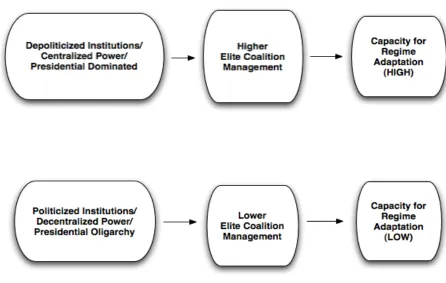
are said to hamper the “reform” process. Particularly, this thesis argues that despite an abundance of similar institutions in Egypt and Syria, the politicized (decentralized) or depoliticized (centralized) character of institutions determines a system’s ability to co-opt, affirm, and shed established and new elites while also incorporating unaffiliated social actors. It is a political system’s propensity to co-opt coalition members that determines its likelihood of system adaptation. The findings suggest that each system is capable of persisting and adapting. Yet, system adaptability is higher in Egypt because the depoliticized nature of the institutions enhances the centralization of presidential power. This allows for Egypt’s regime and its ruling coalition to be reconstructed in a more flexible manner. Syria’s institutional order demonstrates that several politicized institutions compete for influence while blocking changes by other institutionally backed participants. It makes the Syrian political arena less able to quickly adapt its system. This suggests that Syria possesses a lower adaptability quality.
FIGURE 1.
Institutions are important political structures. Any political system’s continuity depends on the type of institutions and elites within those institutions that govern. Institutionally backed elites interact and compete with one another in developing system consensus, which allows or obstructs the ruling elites to govern cohesively, resolve potential problems, and react to crises that emerge. Academic literature argues that authoritarian regimes possess weak institutions and favor personal rule.7 The logic suggests that by empowering institutions at the expense of personalities, more efficient and democratic governance will result. Strong institutions demand that power flows from those holding office. Institutions also encourage power to be distributed according to formal rules, which possess standard operating procedures that do not require constant intervention by political leaders. Strong institutions have autonomy and are able to absorb and win the loyalty of multiple social forces. Conversely, weak institutions are ones that are manipulated, have their rules
7 See Robert Jackson and Carl Rosberg, Personal Rule in Black Africa (Berkeley: University of California
set aside or overridden by patrimonial leaders or clientage networks.8 Egypt and Syria fit the pattern of possessing weak institutions dominated by political elites. Yet, this thesis intends to illustrate why even within personal authoritarian rule, institutions do matter and behave differently. It is in how elites in these institutions use, interact, and influence other institutions that produce differences for regime adaptation. The main argument will show that despite similarities between Egyptian and Syrian post-populist authoritarianism, different political processes are at work as each state pursues system adaptation. Egypt and Syria, as will be argued, exhibit different levels of institutional politicization.
The degree to which the politicization of professional state instruments, such as bureaucracy or security services, is present affects system adaptation. Professional state instruments are supposed to be a political leadership’s apolitical facilitators of power. In cases where this distinction is not maintained, it leads to a vicious circle of political underdevelopment. Therefore, politicized apolitical institutions can be defined as formal state organizations (security services or bureaucracy) that can compete with intended political state organizations (presidency, party) by prioritizing and safeguarding their elites’ individual interests over other institutionally supported elites’ interests. In theory, this creates a political arena where all the institutions – whether they are supposed to be politicized or not - have a degree of autonomy from one another. In reality it’s a bit more nuanced by creating a confused system where the institutions that are supposed to be political are and institutions that are supposed to be apolitical are not. This specifically applies when politicization is present among state instruments outside of the presidency, parliament, or political parties. This type of institutional configuration hampers the development or implementation of a regime’s consensus. Rather than lobbying, compromising, and debating the direction of regime adaptation, elites in politicized institutions possess influence that can block, dilute, and sabotage other elites intended politicized institutional initiatives in the interest of system viability. Hence, the presence of active and disruptive politicized professional apolitical institutions in authoritarian settings makes them repositories of power that lead to governance gridlock. A president can appoint ministers and begin programs but other institutionally supported elites can bureaucratically disrupt and isolate people and initiatives leading to lost time and governance mismanagement.
Depoliticized institutions, conversely, are state institutions that do not possess the autonomy that allow elites to operate on behalf of an institution’s initiative within the political arena. As in Egypt, a centralized president and upper elites have manipulated and conditioned a state’s institutions in such a way that elites within these institutions are dependent on the president. Hence, elites within depoliticized institutions, which include institutions that are intended to be
8 Social Science literature also makes another observation: In LCDs with colonial histories, bureaucratic
political institutions such as parties and parliament, do not openly compete with other institutionally supported elites. This structural arena is more centralized and more easily facilitates the formulation of the regime’s consensus. In this respect, rarely if ever, do elites in any institutional bloc openly or quietly resist the upper elites’ expressed decision. Depoliticized institutions are not sources or repositories of power. While ruling elites may be members of such depoliticized institutions, their power within the system is derived from individual proximity to the president rather than their official positions. Indeed, should a powerful elite run afoul of the system’s consensus, depoliticized institutions can do little to protect them. Alternatively, depoliticized institutions do advantage a system because there is little internal debate or inter-institutional conflict over the system’s consensus. While upper-elites may debate with one another, the institutions – be they intended professional apolitical arms of the state or its supposedly political arms -- are incapable of promoting or defending their interests against the upper elites/state’s interests.
Egypt’s system represents a political arena that is comprised of depoliticized institutions, which includes the professional apolitical and well as intended political state institutions. For example, one only need to look at the apolitical nature of the security services or the weakness of the ruling National Democratic Party (NDP) vis-à-vis the presidency to observe an institutional type distinct from that in Syria. Egypt remains dominated by depoliticized institutions in which the executive branch, and particularly the president, dominates the political order. Institutions, such as the ruling NDP and the security services, remain run by individuals with extensive patronage networks that depend largely upon the president’s will. None of the institutions save the presidency has a mandate to be politically active, compete with the presidency, or debate with other institutions. The executive has nurtured and created depoliticized institutions that accelerate the consensus-making process. As a result, Egypt’s institutions can be viewed as more flexible, for example, in terms of incorporating newer politicians into the political arena and system adaptation in general. One cost of these types of institutions could be isolation from society.
Syria, by contrast, exhibits a political arena that possesses politicized institutions, which include institutions that are intended to be political and those that are not. In the Syrian case, such institutions can be seen in the presidency, B`ath party, and the branches of the security services. These politicized institutions are repositories of power or the “centers of power” that many analysts, such as Michel Kilo, have referred to in Bashar al-Asad’s Syria.9 Unlike Egypt, Syria’s political system contends with separate politicized institutions, comprised of individual actors with patronage networks. While the individual patronage groups compete with one another inside their institutions, a balance and consensus is achievable that permits the institutional elites to participate with and compete against the system’s other institutional elites. When the institutions engage and
interact with one another, however, achieving consensus appears to be more problematic. Rather than leading to a more complex, more developed political arena, Syria’s politicized institutions contribute to more power sharing than in Egypt and often result in governance gridlock. This gridlock, in turn, hampers the system’s ability to adapt. As a result, competition for influence intensifies as institutions engage in defensive struggles to preserve their influence from being eroded. In this context, the presidency, the ruling B`ath party, and the security services vie to maintain their political influence within the system. In the absence of an authority capable of resolving cross-institutional elite disagreements, establishing a consensus among these competitive structures proves difficult.
This produces a complicated comparison between Egypt and Syria. In Syria, the party is more institutionalized and hence more appropriately politicized; the parliaments appear the most similar component in the comparison; and security services are more politicized and less institutionalized than in Egypt. The presidency in Egypt might be more institutionalized than in Syria given the fact it is so strong vis-à-vis the state’s other institutions. The outcome is that there is less centralization and more power sharing in Syria than in Egypt. What this is really describing is the difference between oligarchic and autocratic authoritarianism. Despite this qualification, simplicity requires that Egypt be described as having depoliticized (centralized) and Syria as possessing politicized (decentralized) institutions for the remainder of the thesis.
In summary, this study compares and contrasts Egypt and Syria’s institutions, which contribute to the systems’ adaptive capability. Institutional politicization will be examined as the independent variable and the ability to co-opt newer figures and shed older ones will be the intervening variable. The framework within which these processes occur will be evaluated historically to show where the systems diverged as their leaders chose different institutional formation strategies. After these differences are established, the role of the presidency in each country is reviewed as are elite politics. Non-elite individual co-optation and shedding is also considered to demonstrate similarities and differences between Egypt and Syria. The ability of the ruling parties to absorb and rid themselves of political participants will also be considered. The security services in each country are also examined to stress how a politicized security apparatus in the Syrian case operates while a depoliticized apparatus is prevalent in Egypt.
It is within this context that this thesis examines authoritarianism in an explicit top-down manner. This is not to ignore or attempt to discredit the immensely helpful bottom-up opposition literature of the 1990s.10 Particularly, the academic literature’s findings on civil society,11 labor movements, syndicates, opposition parties, and elections provided detailed examinations of the
10 A helpful and useful book within this genre is Ghassan Salame edited book, Salame (ed.), Democracy without Democrats: The Renewal of Politics in the Muslim World (London: I.B. Tauris, 1994.
various types of opposition that could challenge an authoritarian state. It is from this bottom-up opposition literature that academics focused on transitions towards democracy. In particular, academics concentrated their efforts on the state-opposition alliance. The absence of this alliance from the bottom was used to explain the lack of democracy. However, it is primarily on those works’ strength that the central revelation was that secular opposition in Arab states is weak, unorganized, and poor at connecting cross-sectional pockets of unified societal opposition. Yet, many of the “opposition from below” often excluded themselves because of their disorganized, personalize character that left the state as the dominant political hegemon.
After having been exposed to those work’s findings, this study shifted its attention and focus back onto the state and its various strategies of survival and manipulation. Looking at the state’s power and its changing character as well as how authority is exercised largely left the legal and illegal opposition out of the research design. To qualify my findings, I decided to examine institutions and top-down management of elite and non-elite co-optation. This work is primarily concerned about authoritarianism in and of itself. The movement away from transition studies or bottom-up approaches to explain authoritarian persistence has already begun. Works like Marsha Pripstein Posusney’s edited book on Authoritarianism in the Middle East examines the role of elections, external factors, and the security forces.12 More recently, Nicola Pratt’s also focuses on the character of the state’s authoritarian power rather than on the frequently powerless opposition from below.13 The central difference between Posusney and Pratt’s work and mine is that while we all agree that top-down approaches to studying authoritarianism need to be taken, I distinguish between different types of authoritarian rule among regimes that are frequently understood to have more in common that not. It is here that this study’s contribution lies.
The implications of this study are that Arab authoritarian regimes are different institutionally despite appearances and theoretical models that suggest otherwise.14 While this sounds simplistic, it breaks with prevailing policy and academic trends that superficially lump similar Arab political systems together. The choice of Egypt and Syria as case studies is intentional because of a lack of substantial research comparing the countries. The differences between the two states highlight and provide insight that complicates and problematizes thinking about Arab republican regimes. The existence of institutions is less of a concern for this study as it is assumed that they exist and matter. Instead, the focus is the level of politicization of such institutions and the capacity of these institutions to define and shape the adaptation of the political system.
12 Marsha Pripstein Posusney, Authoritarianism in the Middle East: Power and Resistance (Boulder: Lynne
Rienner Publisher, 2005).
13 Nicola Pratt, Democracy and Authoritarianism in the Arab World (Boulder: Lynne Rienner Publisher,
2007).
Contrary to conventional literature on authoritarianism, however, this project explores notions of authoritarian adaptability and persistence.15 As such, the thesis will revolve around three broad questions that serve as the study’s basis: (1) what are the differences in the institutional politicization that effectively define the political boundaries of each system; (2) what impact does the types of institution have in regards to co-opting and shedding elites; and (3) how does this impact system adaptation. The main point is that increased centralization over institutions -- which I am calling depoliticization -- equals a political system’s greater ability to adapt.
FIGURE 2.16
1.2 Background: The Persistence of Authoritarianism Amidst Democratization
Because authoritarian rule exists and persists in diverse forms in the Arab world, several questions are considered. What explains authoritarian variance in the Arab Middle East? How does
15 Richard Snyder, “Paths out of Sultanist Regimes: Combining Structural and Voluntarist Perspectives,” in
Chehabi & Linz (eds), Sultanist Regimes (Baltimore: Johns Hopkins University Press, 1998). Synder’s theory views authoritarianism as fragile, static, and prone to fail by providing cases that collapsed without looking at other cases where authoritarianism persisted.
institutional politicization and depoliticization affect a state’s capabilities to co-opt elites and non-elites? Which types of regimes, if any, are likely to move away from authoritarianism? Such questions touch on issues that scholars of authoritarianism and Middle Eastern studies have considered since the 1950s.17
Thoroughly authoritarian Arab monarchies and republics endured long after the “Third Wave” of democratization,18 the USSR’s implosion, and the 1991 Gulf war that entrenched American hegemony in the region. Recent developments, such as the overthrow of Saddam Husayn’s regime, Palestinian, Egyptian, and Iraqi elections, and Lebanese demonstrations against Syria are thought to suggest that authoritarianism’s days are numbered.19 Yet, ending authoritarianism through external military intervention or through elections does not necessarily result in democratization. Authoritarianism persists despite the prognostications of writers who issue dire warnings of imminent economic and political crises in individual states,20 use transition frameworks that focus on phenomena such as civil society21 and describe a positive relationship between economic and political reform.22
For their part, misguided international policy initiatives have done little to minimize the prevalence or longevity of authoritarianism in the Middle East. One example of such an initiative can be found in the U.S. government’s Greater Middle East Initiative (GMEI), which was launched in February 2004. The GMEI stressed democratically remaking the Arab world by strengthening civil society, empowering women, and restructuring decrepit educational curricula throughout the region. The essence of the GMEI is that by revitalizing these three purported basic pillars of democratic society, the regional political systems can be transformed into democracies. Arab governments and their leaders, led by Hosni Mubarak, resolutely denounced the initiative. The Arab leaders’ counterargument was that uncontrolled liberalization would lead to Islamist gains that would, in turn, lead to chaos. Arab commentators joined the chorus to refute the initiative by arguing reform is an internal matter and that foreign interference to impose a model on the region is unacceptable. The Arab governments ultimately resisted by noting the necessity to undertake economic reforms before political projects could be pursued. The United States calmed their fears and tried multi-lateral approaches to coax the governments to conduct internal reform efforts. Yet,
17 As an early example, see Daniel Lerner, The Passing of Traditional Society (Boston: The Free Press,
1958).
18 Samuel Huntington, The Third Wave of Democratization (Norman: Oklahoma UP, 1991).
19 One Economist cover even read “Democracy stirs in the Middle East,” with a picture of a pretty, western
dressed female flashing a peace sign during an anti-Syrian protest in Beirut in February 2005. The Economist, 5-11 March 2005.
20 See Cassandra, “The Impending Crisis in Egypt,” Middle East Journal vol. 49 no.1 (Winter 1995): 9-38. 21 Norton, Civil Society in the Middle East. Although Norton does not claim that civil society would end
authoritarianism, this book falls squarely in the democratization literature, which ostensibly points to having a linear democratizing endgame.
relations between the West and Arab governments reached new lows. By the time of the G-8 summit in June 2004, where the initiative was formally launched, the “initiative battle” was more or less over. The GMEI (later changed to the Broader Middle East Plan because in German “Greater” implies imperialist intent when translated) stalled because only a small number of Arab countries attended the summit. As al-Jazeera pointed out “Egypt and Saudi Arabia, two countries covered by the initiative but alarmed by its potential implications, declined invitations to the summit. Tunisia, which held the rotating presidency of the Arab League, followed suit. Leaders of Afghanistan, Algeria, Bahrain, Jordan, Turkey and Yemen accepted Bush’s invitation.”23 In all, only four out of 22-Arab League countries attended.
Another summit in Morocco in December 2004 further discussed the highly unpopular plan. The New York Times published a story that forecast the summit’s expected agenda and limited outcomes.24 It followed with a piece that argued that Arab leaders used the “excuse” of the Arab-Israeli conflict as the reason not to reform.25 The story did not, however, choose to focus on how the U.S. plan had changed over the year. The GMEI went from broad calls to transform society to the pursuit of restructuring Arab economies. By choosing to focus on economic reforms before political reforms, it underscored the U.S.’s reinvigorated push to revive the democratization initiatives of the 1990s based upon the Washington Consensus. The Washington Consensus is a neo-liberal modernization-based model that suggests economic liberalization, structural adjustment, subsidy cuts, fiscal restraint, and privatization helps a country attain certain socio-economic benchmarks. The extended logic is that democracy follows socio-economic growth. While the Washington Consensus is primarily an economic policy model, academics have refuted its core underpinnings when it became clear that economic liberalization did not lead to greater political reforms. Rather, it often led to a reversal in that economic reforms led to political liberalization being increasingly restricted to prevent instability born of the economic dislocations. As Pool notes, “it is more likely, however, that the more full-blooded and intense economic liberalization becomes, the stronger the tendency will be for a retreat to a stricter authoritarianism.”26 Yet, the rejection of the GMEI and the compromise that Arab governments will pursue economic before political reform does not end the saga of authoritarianism and reform in the Middle East.
Authoritarianism is by no means a static or unchangeable method of governance. Indeed, elites in authoritarian systems, as will be shown, must constantly work to ensure the system remains under their influence. A number of the region’s governments are undergoing legislative and institutional changes. Regimes in the region may open and close their political fields to embark
23 “No big breakthroughs at G-8 Summit,” al-Jazeera.net 11 June 2004.
24 Joel Brinkley, “US Slows Bid to Advance Democracy in Arab World,” New York Times 5 December 2004 25 Joel Brinkley, “Arab and Western Ministers Voice Different Priorities,” New York Times 12 December
2004
26 David Pool, ““The Links between Economic and Political Liberalization,” in Tim Niblock and Emma
on economic structural adjustment programs, for instance. Arab governments evince remarkably altered features and employ different strategies than they did in the post-independence authoritarian period (1950s & 1960s) but they remain authoritarian nonetheless. Within academia, doubt has gradually replaced optimism towards democratization’s prospects in the region, largely without slipping into cultural exceptionist arguments. As Heydemann notes, “The democratization euphoria of the post-1989 period is now tempered by the ‘neopessimist’ recognition that authoritarianism will be as much a part of our future as it has been of our past.”27 Therefore, authoritarianism is a subject that deserves continuous study and revision. As Wedeen states, “There are, oddly, few recent writings on authoritarianism in comparative politics and they tend to be concerned primarily with the transition from authoritarian to democratic forms of rule.”28 This study contributes to this neglected niche by reviewing and examining authoritarian adaptation without viewing democratization as the inevitable end state.
This study’s contribution reaches beyond Middle Eastern studies as its focuses on the dynamics of authoritarianism. It modifies and refines the various existing models used in analyzing and understanding the various authoritarian regimes in the Arab world. Previous efforts, using strict personal29 or political economic30 readings of authoritarianism fail to explain completely authoritarian variance and persistence. While the conventional alternative to cultural explanations is political economy theory, my alternative model combines the precepts of authoritarian literature with institutional interpretations of authoritarianism.
1.3 Theoretical Review: 1.3.1 Modernization Theory
Modernization theory’s origins can be traced to the 1950s. Theories such as proposed by W.W. Rostow outline the five necessary steps a country must proceed through before reaching the preconditions that permit economic “take-off” and political development based upon an American model, i.e., democratization.31 Through the author’s notion of “preconditions,” academics continue to build on this model despite its inherent America-centrism. Following Rostow, Gabriel Almond and James Coleman’s The Politics of Developing Areas32 and David Apter’s The Politics of Modernization33 made contributions but essentially focused on socio-economic indicators as the
key prerequisites of political and economic modernity. It is understood and expected that
27 Stephen Heydemann, Authoritarianism in Syria: Institutions and Social Conflict 1946-1970 (Ithaca:
Cornell University Press, 1999): 8
28 Lisa Wedeen, Ambiguities of Domination: Politics, Rhetoric, and Symbolism in Contemporary Syria
(Chicago, Chicago University Press, 1999): 26.
29 Jackson and Rosberg, Personal Rule in Black Africa, 14-31.
30 Volker Perthes, The Political Economy of Syria under Asad (London: I.B. Tauris, 1995).
31 W.W. Rostow, The Stages of Economic Development: A Non-Communist Manifesto (Cambridge:
Cambridge University Press, 1960).
32 Gabriel Almond and James Coleman (eds.) The Politics of Developing Areas (Princeton: Princeton
University Press, 1960).
modernity will necessarily lead to democracy. Samuel Huntington produced a substantial contribution for modernization theory in 1968. Political Order in Changing Societies34 gives
modernization theory a more sophisticated edge, arguing that as economic growth occurs, political instability follows, particularly in the middle stages of growth. Huntington writes that a degree of destabilization, or praetorianism, usually results as weakly institutionalized systems fail to control forces of modernization because they are unable to incorporate the increased political mobilization of social forces unleashed by the development process. As a result, single-party modernizing states perform better because strong political leadership is equipped to focus on social reforms.
While some academics, such as John Waterbury, have argued that transitions such as South Korea’s transition to democracy vindicate modernization theory,35 their claim is debatable. A more in-depth analysis of the South Korean case shows that its convoluted development process cannot be explained exclusively through the use of socio-economic indicators36 though they can, of course, condition possibilities. As Potter argues, South Korea’s transition to democracy resulted because of geopolitical and international engagements, economic development, changing class divisions, and state and institutional development (and the interrelationships between them).37 Hence, in addition to economic development, key international, social, and institutional changes must complement economic development to enable a democratic transition. Transitions cannot be based on economic development alone.
While modernization theory’s insistence on socio-economic indicators misrepresents the development process, this branch of theory was reinvigorated by democratization or transition theories following the post-1989 fall of many Soviet Bloc Communist regimes. Academics perceived many of these countries as undergoing democratic transitions. The most prominent work in this regard was Samuel Huntington’s The Third Wave of Democratization published in 1991. This book reaffirms the centrality of socio-economic indicators in modernization theory but updates it to include a supplemental cultural argument. While Huntington’s writings subtly echo Francis Fukuyama’s simplistic notion of “the end of history” and his belief that “the ideal of liberal democracy could not be improved on,”38 Huntington surmises that countries “resistant” to democracy after 1990 remain authoritarian because they “had no previous experience with democracy.”39 He explains this lack of experience in three key points.
Economic development -- the staple of modernization theory -- retains its prominent place and socio-economic indicators remain linked to democratization. For Huntington, richer countries
34 Samuel P. Huntington, Political Order in Changing Societies (New Haven: Yale University Press, 1968). 35 John Waterbury, “Democracy without Democrats? The Potential for Political Liberalization in the Middle
East” in Ghassan Salame (ed.) Democracy Without Democrats (London: I.B. Tauris, 1994): 44.
36 David Potter, “Democratization at the same time in South Korea and Taiwan,” in Democratization
(Cambridge: Polity Press, 1997): 219-39.
37 Ibid, 219.
are democratic and poorer ones are not. Therefore, “economic development, in short, provided the basis for democracy.”40 Development not only provides the basis for democratization, it is the first element in a causal relationship that begins when a country attains a middle-level economic status. After a country reaches this “take-off” point, a transition ensues followed by a democratic breakthrough. Middle-level economic growth mobilizes, politicizes, and educates more people, who eventually push for greater liberties and rights, and thus drive the democratization processes. Economic growth indicators serve as just one tendency within this theoretical model.
A second pillar of Huntington’s democratization theory indicates that changes in cultures or the lack thereof, can have an impact on whether a country begins a transition towards democratization. Accordingly, he places considerable weight on the role of cultural factors such as religion as prerequisites of the transition. For instance, Huntington finds it significant that South Korea has a higher percentage of Catholics than other Asian countries. Since the third wave was a “Catholic wave,”41 South Korea’s Catholics were a contributing factor in the country’s becoming democratic. Alternatively, he finds an authoritarian antithesis in countries that he perceives to be more rigid in their religious beliefs. He does not probe deeply before naming Islam as an obstacle towards democracy. While Huntington’s work is not as essentialist as that of Bernard Lewis, his argument remains culturally biased. With unsubstantiated statements such as “Islamic concepts of politics differ from and contradict the premise of democratic politics,” and “Whatever the compatibility of Islam and democracy in theory, in practice they have not gone together,”42 he aligns himself in the camp that views cultures, other than those of the Judeo-Christian world, as static and incapable of developing. Nevertheless, the argument is squarely rooted in modernization theory because particular cultures are viewed as intervening variables that accelerate or delay democratization. Its American/Western centric view is that “we” developed and therefore “they” must follow our lead to achieve progress. It believes that traditionalism is an obstacle to development and that economic development is a necessary requirement of modernity, which in this case is equated either with democratization or democracy.
Proponents of modernization are prone to label the Arab world as somehow deficient in comparison to other regions. This is best viewed in John Waterbury’s argument that the Arab world is exceptionally resistant to international democratic tendencies by analyzing the socio-economic indicators and the dynamics of constructing a democratic coalition. Waterbury argues that, “Until the 1980s the Middle East was not exceptional. Only with the gradual redemocratization of Latin American and Southern Europe at the beginning of the decade, and the tentative democratization in South Korea and Taiwan towards the end, did the Middle East begin
to appear behind the curve.”43 Citing that rising socio-economic indicators in many Arab countries proved unable to lead to a “democratic pay-off,” Waterbury looks at other factors such as the political-economic variable of a state-dependent bourgeoisie, continued military-led governments, and conflict as obstacles towards democratization. Yet, in Latin American countries similar conditions and contexts exist, which leaves Waterbury to argue that to Arab societies are somehow exceptional because of the combination of a number of factors. He implicates the Islamists, and apparently Islam, as the reasons a successful democratic bargain cannot be negotiated. While he does not label Islam as static, he does rely on cultural scapegoats as proof of the Arab world’s exceptionalism. As he notes, “Whether or not Islam or Middle Eastern ‘culture’ are separable phenomena, the two work in ways that do not augur well for democracy.”44 Waterbury argues Arab states will go through the necessary stages of struggle and bargaining that provide the opportunity for Islamic texts to be reinterpreted.45 Hence, time is the key factor according to Waterbury’s argument. Transforming the very cultures of the Middle East, one understands, can eliminate the obstacles to political modernity and end the exceptional nature of the Arab world.
To summarize, socio-economic indicators are inadequate representations of a country’s political development or its capacity to democratize. Indeed, Turkey held elections and had a democratic transition of presidential and party power in 1950 – well before the economic indicators warranted that it should have happened. Alternatively, countries such as Tunisia entered middle-level economic status and remain locked in a thoroughly authoritarian system. Where analyses of socio-economic indicators fail to unlock development’s complex formula, modernization scholars tend to blame culture as the source of political underdevelopment. Proponents of modernization are usually the first to argue that the Arab culture is exceptional in its resistance to political modernity and economic development. Thus, modernization scholars explain the persistence of authoritarian rule as derivative of cultural obstacles.46
Modernization theory provides substantial contributions to our understandings of the nature of political participation and economic reform. Nonetheless, modernization theory fails to provide an adequate explanation for authoritarian persistence by using cultural explanations. This is because modernization theory presumes an almost mechanical relationship between levels of economic development and democracy. Modernization theorists’ major weakness is their lack of detailed attention to political institutions. Single party authoritarian regimes are modern and such regimes can adapt and survive the modernization process. Therefore, the cultural variable does not add to understanding authoritarian persistence.
43 Waterbury, “Democracy without Democrats?” 25. 44 Ibid, 33.
45 Ibid, 45.
In the past decade academic interest focused almost exclusively on democratization and transitology studies, and scholars tended to overlook adaptation and variance of authoritarian governance. This project does not argue, however, that the discipline of Middle Eastern studies is flawed and ill conceived as some, such as Martin Kramer, suggest.47 Indeed, even as there are many publications that rigidly study the region using transition theory, there are other publications that explore why authoritarianism continues to rule the day. Studies, such as those by Maye Kassem, Oliver Schlumbeger, and Christopher Parker to name a few, suggest and argue that a transition theory approach is unsuited as a general approach simply because transitions never occurred in the individual countries they studied.48
As Heydemann argues, “When it comes to the study of democratization and economic reform…the field has been largely right. The persistence of authoritarianism, not the inevitability of democracy, has been the principle focus of research. The overwhelming sentiment among researchers has been not uncritical optimism about the prospects of democratization, but a cautious and critical skepticism, verging at times on frank pessimism.”49 Heydemann is correct in that social scientists were not fooled into believing that the region’s governments were in transition towards democracy. Nonetheless, understanding that transitions are not occurring is not the same as explaining the persistence of authoritarianism. Consequently, the debate’s focus needs to be modified if the social science community is to understand authoritarianism in a more focused way. As Carothers suggests, “It is time to recognize that the transition paradigm has outlived its usefulness and look for a better lens.”50 It is only by assessing authoritarianism that one can build a better understanding of the mechanisms and complexities that exist behind the appearance of “blocked development.”
1.3.2 Authoritarian, Populism, and Post-Populism Theory
1.3.2.A Authoritarianism
The concept of authoritarianism, by itself, is of limited utility as a theoretical tool and requires considerable development and differentiation. Since Max Weber’s early identification of traditional patrimonial, charismatic, and rational forms of authority,51 social scientists have treated authoritarianism either in broad or micro-typologies, as they try to classify its varying forms; they have tended to produce expansively generalized definitions or excessively case-specific definitions
47 Martin Kramer, Ivory Towers on Sand: The Failure of Middle Eastern Studies in America (Washington:
The Brookings Institute, 2001).
48Kassem, In the Guise of Democracy (London: Ithaca Press, 1999), Oliver Schlumberger, “Transition to
Development?” in George Joffe (ed.) Jordan in Transition: 1990-2000 (London: Hurst, 2002): 225-53, and Christopher Parker, “Transformation without Transition: Electoral Politics, Network Ties, and the Persistence of the Shadow State in Jordan,” in Iman Hamdy (ed.) Elections in the Middle East (Cairo: AUC Press, 2004): 132-70.
49 Stephen Heydemann, “Defending the Discipline,” Journal of Democracy Vol. 13 No.3 (July 2002): 103. 50Thomas Carothers, ”The End of the Transition Paradigm,” Journal of Democracy Vol. 13 No.1 (January
2002): 6.
of authoritarianism. For example, a macro-definition is provided by Linz who argues that authoritarianism is a
Political system with limited, not responsible, political pluralism, without elaborate or guiding ideology, but with distinctive mentalities, without extensive nor intensive political mobilization, except at some points in their development, and in which a leader and occasionally a small group exercises power within formally ill-defined limits but actually quite predictable ones.52
While this definition remains applicable today, its imprecision fails to accurately capture the complex diversities of authoritarian rule. The reason for such ambiguity in defining authoritarianism is attributable to the extensive range of such regimes. As Brooker notes, “The term ‘authoritarian’ is so widely applicable that it is difficult to develop a theory which can cover so many diverse cases without becoming either banal or incoherent…theorists have been plagued by the problem of how to cover what is still a diverse range.”53 Consistent with the difficulties of defining authoritarianism, social scientists have atomized the study of authoritarianism by developing endless typologies to characterize different types of authoritarian regimes instead of developing a single definition. Some of these typologies include military regimes, single-party regimes, traditional/patrimonial, sultanistic, pseudo-democracies, electoral authoritarianism, and predator states. None of these classifications is inherently incorrect, and as a whole encompass a wide variety of authoritarian regimes. However, the high number of classifications afford limited comparative potential because a typology can get so specific that it only applies to one case.
A more recent theoretical label, which comes out of the Weberian tradition, is that of neo-patrimonial regimes. Neo-neo-patrimonialism focuses on a more institutional, rather than personal, type of patrimonialism. While the practice of applying neo-patrimonialism theory often results in scholars reducing “a regime” to the chief executive and his cronies, the state’s institutions all contribute to an authoritarian regime’s ability to adapt and to persist. Neo-patrimonialism continues to be a theoretical concept that maintains applicability when studying authoritarianism in the Arab world. It also demonstrates the mixed character of authoritarian regimes. Bratton and van de Walle explain neo-patrimonialism as
hybrid political systems in which the customs and patterns of patrimonialism co-exist with, and suffuse, rational-legal institutions. As with classic patrimonialism, the right to rule in neopatrimonial regimes is ascribed to a person rather than to an office, despite the official existence of a written constitution…The chief executive and his inner circle undermine the effectiveness of the nominally modern state administration by using it for systematic patronage and clientelist practices in order to maintain political order. Moreover, parallel and unofficial structures may well hold more power and authority than the formal administration.54
52 Juan Linz, “An Authoritarian Regime: the case of Spain,” in Erik Allard and Stein Rokkan (eds.) Mass Politics: Studies in Political Sociology (New York: The Free Press, 1970): 255.
53 Brooker, Non-Democratic Regimes, 22.
54 Michael Bratton and Nicolas van de Walle, Democratic Experiments in Africa Cambridge: Cambridge UP,
As can be seen from the definition above, neo-patrimonialism is the combination of traditional culture combined with the “modern” state institutions according to the West. Essentially, neo-patrimonialism combines the two Weberian concepts of traditional rule with the legal-rational form of rule. As a consequence, neither a pure form of the former nor the latter is evident. Yet, it is within this neo-patrimonial hybrid concept that a great deal of variance can be present. For example, some regimes might be more legal-rational than traditional while other authoritarian states exhibit more traditional than legal-rational aspects. As a theoretical tool currently, this ability to account for variance is not present. I hope to use and build on the neo-patrimonial literature.
Scholars on the Arab world have considered neo-patrimonialism. For example, Hisham Sharabi viewed the process of modernization as leading to cultural adaptations of patrimonialism. Neopatriarchy, as he calls it, is an inherited patriarchal culture that blends the state and the family as the modernization process reinforces a former colonial country’s dependency on a capital center in the West.55 Within this relationship of unequal (capital vs. dependent) states, traditionalism is encouraged to flourish.56 This development of a neo-patrimonial state structure hinders a country’s ability to develop economically because the state pursues a distorted type of statist development. While Sharabi work is largely focused on Arab economies and their effect on society, others academics have drawn out the potential for political development.
Halim Barakat takes the theory of neo-patrimonialism and applies it politically to explain the lack of an active civil society. As Barakat argues, the potential for opposition to rise organically and challenge the state is unlikely because neo-patrimonialism encourages conditions that are not favorable for political contestation. In his words, “The conditions described above – dependency, underdevelopment, patriarchal and authoritarian relationships, social and political fragmentation, class distinctions, successive historical defeats, and a generalized state of repression – have rendered the Arab people and society powerless.”57 Barakat, then, argues that Arab society or the Arab polity has been so demobilized and depoliticized as their resources and wealth are used to benefit the a small ruling elite and external countries that the “Arab world does not seem to have a society that functions well.”58 Neo-patrimonialism’s effect on society carries with it detrimental political ramifications. This, in Barakat’s estimation, excludes the Arab polity as a political class that can effect change or be viable opposition as it prevents potential development for opposition to emerge from below.
55 Hisham Sharabi, Neopatriarchy (Oxford: Oxford University Press, 1988): 3-4. 56 Ibid, 6.
57 Halim Barakat, The Arab World: Society, Culture and State (Berkeley: University of California Press,
1993): 26.
Not only does this existing literature on neo-patrimonialism support research that is focused on explicit top-down studies of authoritarianism for its own sake, it also calls into question how best to utilize it conceptually. For example, currently, neo-patrimonialism does appear to be too generic and incapable of making distinctions between different authoritarian regimes. But this does not mean it should be disregarded. Sharabi and Barakat do not draw out distinctions between various Arab authoritarian regimes in their work. Instead, they focus on the “Arab World”. Similarly, as Sharabi and Barakat have used the notion, neo-patrimonialism is primarily a social phenomenon that retards the political and economic development. Hence, it is distinctly possible that the lack of political development in the Arab world stems from a structural or institutional problem. By identifying how neo-patrimonialism manifests itself in different ways and through different structural formats, the concept can be usefully employed. Unpacking and looking at how the concept of neo-patrimonial structures emerges and explains differences is a substantial contribution.
An additional complexity in studying such regimes and what continues to guide authoritarian studies is their ability to develop, adapt, and modernize. One social science tendency is to trace the emergence of regimes that blend authoritarian and democratic characteristics. Larry Diamond’s label of “hybrid regimes” demonstrates how authoritarian regimes amalgamate democratic attributes into a regime’s neo-patrimonial institutions. In this way, the external appearance of democratic governance is maintained while functionally systems of governance remain thoroughly authoritarian. Diamond views hybrid regimes as maintaining “the existence of formally democratic political institutions, such as multi-party electoral competition, that mask the reality of authoritarian domination.”59 Diamond’s observation may be just a starting-point but it shows the complexity of authoritarianism. While Diamond notes the adaptability of authoritarian regimes, his supplemental theoretical contribution offers more labels and types of authoritarianism. It is within this context that I will abandon the treatment of general authoritarian definitions in favor of examining two models of authoritarianism that broadly encompass the Egyptian and Syrian experience -- populist and post-populist authoritarianism.
1.3.2.B Populist Authoritarianism
Models do not explain differences between authoritarian regimes’ institutional development and co-optation abilities, but they do describe a general trajectory. While no model ever completely describes an individual state’s dynamics, they serve as roadmaps. For this study’s purposes, it is imperative to review the literature on populist and post-populist authoritarianism. For the purposes of this study, which focuses on Egypt and Syria, populist authoritarianism (PA) is central as a starting-point.
Populist authoritarianism is a post-colonial development strategy. Petit bourgeoisie military officers seize control in their countries and initiate a process of “revolution from above” that is subsequently transformed into radical state-led development.60 Revolution from above is a military takeover of the state apparatus from the old elite in which there is little to no popular participation. The change is usually conducted with little violence and is politically pragmatic in its initial orientation. The political objective of a revolution from above is the obliteration of the traditional elite’s economic and political bases, seen as a necessary prelude to modernization.61 According to Ellen Kay Trimberger, military officers rose to power because they were autonomous from the dominant classes of the colonial era. As she argues, “such autonomy is likely to occur when there is no consolidated landed class…or when a landed oligarchy is in economic and political decline. In the latter case, the rising bourgeoisie must also be weak and/or dependent on foreign interests.”62 After rising to power, the military officers realize that they have a legitimacy deficit and lack a social base.
The officers challenge the dominant landed class and must acquire legitimacy at the expense of it. As such, the newly established regimes offer new populist incentives and a nationalist ideology in exchange for the people’s support. Thus, as can be deduced, countries that possessed large landed classes produced the most radical changes in the Arab world. Such changes were witnessed in Egypt, Syria, and Iraq.63 Most notably, this strategy is generated through the state’s redistribution policies. Specifically, the enactment of land reforms and use of nationalizations displace the dominant class and the key agents of the ancien regime. In effect, the governments take from the rich and give to the poor.
This type of authoritarianism has political, social, and economic repercussions. As Hinnebusch argues, “Insofar as the PA regimes uses its concentrated power chiefly to attack the old dominant classes while seeking legitimacy through egalitarian ideology and the political incorporation of middle and lower strata, it is arguably ‘populist’ that is, an ‘authoritarianism of the left’ which challenges rather than defends the traditional, privileged status quo.”64 PA, as Hinnebusch infers, transforms the political, economic, and social landscape. The new regimes create organizations, offices, and a bureaucracy that serve as the state’s implementation instruments. Initially, PA leaders are left little option but to construct a wide ruling coalition that consists of workers, peasants, and lower-middle class members to substantiate the regime’s political legitimacy and broaden its support base. Populist privileges such as free university education, guaranteed state employment, and security of public sector employment, contribute to the state’s legitimacy. Additionally, land reforms, which gave land to previously landless peasants,
60 Ellen Kay Trimberger, Revolution from Above (New Brunswick: Transaction Inc, 1978): 2-3. 61 Ibid, 3.
62 Ibid, 5.