ISSN 1609-4190 2 O
Q
ω
τ-Ο O
Energie: jährliche
Statistiken
Daten 1999
Energy: Yearly
■ ■
statistics
Data 1999
Energie! statistiques
annuelles
Données 1999
D E
Eurostat hat den Auftrag, der
Europäischen Union
einen qualitativ hochwertigen statistischen Informationsdienst bereitzustellen.
E u r o s t a t - R e i h e n : ein an den Bedarf aller Nutzer angepaßtes Angebot. Pressemitteilungen: Sie enthalten die Schlüsselzahlen zur EU,
zu ihren Mitgliedstaaten und ihren Partnern. Die Pressemitteilungen werden kostenlos zur Verfügung gestellt. Unmittelbar nach ihrer Veröffentlichung sind sie auch im Internet zu finden:
www.europa.eu.int/comm/eurostat/
Statistik kurzgefaßt: aktuelle Zusammenfassungen der wichtigsten Ergebnisse von statistischen Erhebungen, Studien une Analysen.
Schlüsselindikatoren: Diese Reihe enthält in einem handlichen Buch von maximal 100 Seiten die wichtigsten Indikatoren zu einem Themenbereich oder einem Teilbereich.
Panorama der Europäischen Union: In dieser Reihe geht es um die Merkmale und Trends in multisektoralen
Themenbereichen oder sektoralen Teilbereichen.
Methoden und Nomenklaturen: Diese Veröffentlichungen richten sich an Fachleute; sie beschreiben die Methoden und Systematiken, die für einzelne Themen, Themenbereiche oder Sektoren verwendet werden.
Detaillierte Tabellen: Diese Veröffentlichungen richten sich an Fachleute; darin sind ein Teil oder die Gesamtheit der statistischen Angaben zu einem Thema, Themenbereich oder Sektor zu finden.
Studien und Forschung: Zusammenfassungen der Ergebnisse von Studien und Forschungsarbeiten im Bereich der europäischen Statistik.
Kataloge: Die kostenlosen Kataloge informieren rasch und genau über das Produkt- und Dienstleistungsangebot von Eurostat.
.Our mission is to provide the
European Union
with a high-quality statistical information service
E IMEurostat's collections are adapted to the needs of all users. Press releases: key figures on the EU, the Member States and
their partners. They are provided free of charge. They are also available on the Internet as soon as they are published: www.europa.eu.in1/comm/eurostat/.
Statistics in focus: up-to-date summaries of the main results of statistical surveys, studies and analyses.
Key indicators: the main indicators on a theme or sub-theme in an easy-to-carry booklet.
Panorama of the European Union: highlights the features and trends of a multi-sectoral theme or a sectoral sub-theme.
Methods and nomenclatures are intended for specialists who want to consult the methodologies and nomenclatures used for a theme, a sub-theme or a sector.
Detailed tables: statistical data for specialists compiled on a theme, sub-theme or sector.
Studies and research summarise the results of European statistical studies and research and are intended for specialists.
Catalogues: free of charge rapid access to concise information on Eurostat's products and services.
Notre mission est de fournir à l'Union
européenne
un service d'information statistique de qualité
Les collections d'Eurostat sont une offre adaptée aux besoins de tous les utilisateurs. FR
Communiqués de presse: les chiffres clés sur l'UE, les États membres et leurs partenaires. Ils sont distribués gratuitement et sont également disponibles sur Internet dès leur publication. Statistiques en bref: synthèses actualisées des principaux résultats des enquêtes, des études et des analyses statistiques. Indicateurs clés: les principaux indicateurs concernant un thème ou un sous-thème, sous la forme d'un livret facile à emporter.
Panorama de l'Union européenne: les caractéristiques et les tendances d'un thème multisectoriel ou d'un sous-thème sectoriel.
Méthodes et nomenclatures: les méthodologies et les nomenclatures relatives à un thème, un sous-thème ou un secteur. Tableaux détaillés: des données statistiques élaborées concernant un thème, un sous-thème ou un secteur, destinées aux spécialistes.
Études et recherche: cette collection comprend les résultats d'études et de recherches européennes en statistique et sont destinées aux spécialistes.
Energie: jährliche
Statistiken
Daten 1999
Energy: Yearly
statistics
Data 1999
Énergie: statistiques
annuelles
Données 1999
DE
Unmittelbarer Zugriff auf harmonisierte statistische Daten
Eurostat P a t a Shops: J
bieten ein umfassendes Angebot an „maßgeschneiderten"
Dienstleistungen:
* eine unmittelbare Bearbeitung von Informationsanfragen; * eine garantiert schnelle und individuelle Antwort; * Wahl des Trägers, auf dem die statistischen Daten geliefert
werden.
Informationen können telephonisch, schriftlich, per Fax oder per E-Mail angefragt werden.
I n t e r n e t : J
Die wesentlichen statistischen Nachrichten aus der Gemeinschaft
* Euro-Indikatoren: über 100 harmonisierte, vergleichbare und kostenlose Indikatoren der Eurozone;
* Pressemitteilungen: direkter Zugriff auf alle Pressemitteilungen von Eurostat.
Weitere Informationen finden sich auf der Internet-Site unter
www.europa.eu.in1/comm/eurostat/
immediate access to harmonized statistical data
I n t e r n e t : J)
EN
Eurostat Data Shops: J
provide a wide range of tailor-made services:
* immediate information searches * rapid and personalised response * choice of data carrier
Information can be requested by phone, mail, fax or e-mail.
Essentials on Community statistical news
■*■ Euro indicators: more than 100 indicators on the euro-zone; harmonized, comparable, and free of charge; * Press releases: direct access to all Eurostat press releases. For further information, visit us on the Internet at:
www.europa.eu.in1/comm/eurostat/
Accès immédiat à des données statistiques harmonisées
I n t e r n e t : J
FR
Eurostat Data Shops:
J
offrent un large éventail de prestations «sur mesure»:
* la prise en charge immédiate de toute recherche d'information, * la garantie d'une réponse rapide et personnalisée,
* le choix du support de fourniture des données.
Les informations peuvent être demandées par téléphone, par courrier, par télécopie ou par courrier électronique.
l'essentiel de l'actualité statistique communautaire
* Euro-indicateurs: plus de cent indicateurs sur la zone euro (harmonisés, comparables et disponibles gratuitement). * Communiqués de presse: accès direct à tous les
communiqués de presse d'Eurostat.
Pour plus d'informations, visitez le site Internet d'Eurostat:
www. eu ropa. eu. i n1/com m/eu rostat/
Zahlreiche weitere Informationen zur Europäischen Union sind verfügbar über Internet, Server Europa (http://europa.eu.int). A great deal of additional information on the European Union is available on the Internet.
It can be accessed through the Europa server (http://europa.eu.int).
De nombreuses autres informations sur l'Union européenne sont disponibles sur Internet via le serveur Europa (http://europa.eu.int).
Bibliografische Daten befinden sich am Ende der Veröffentlichung. Cataloguing data can be found at the end of this publication. Une fiche bibliographique figure à la fin de l'ouvrage.
Luxembourg: Office des publications officielles des Communautés européennes, 2001
ISBN 92-894-1451-0
© Europäische Gemeinschaften, 2001
© European Communities, 2001
© Communautés européennes, 2001
Printed in Luxembourg
GEDRUCKT AUF CHLORFREI GEBLEICHTEM PAPIER
P R I N T E D O N W H I T E C H L O R I N E - F R E E P A P E R
EUROSTAT
L-2920 Luxembourg — Tél. (352) 43 01-1 — Télex COMEUR LU 3423 e u r o s t a t Rue de la Loi 200, B-1049 Bruxelles — Tél. (32-2) 299 11 11
D E Eurostat ist das Statistische Amt der Europäischen
Gemeinschaften. Es hat den Auftrag, die Union mit europäischen
Statistiken zu versorgen, die Vergleiche zwischen Ländern und Regionen ermöglichen. Eurostat konsolidiert und harmonisiert die in den Mitgliedstaaten erhobenen Daten.
Um die weite Verbreitung der
gewaltigen verfügbaren Datenmenge zu gewährleisten und den einzelnen Nutzern zu helfen, diese
Informationen richtig zu verwenden, hat Eurostat sein Veröffentlichungs-und Dienstleistungsprogramm geschaffen. Um sich gezielt an das breite Publikum oder an Fachleute wenden zu können, wurden für die einzelnen Nutzergruppen spezielle Reihen entwickelt.
Im Rahmen des neuen Programms hat Eurostat eine Web-Seite entwickelt. Sie umfaßt ein breites Angebot von Online-Informationen über die Erzeugnisse und
Dienstleistungen, Pressemitteilungen, Kataloge, Online-Veröffentlichungen sowie Indikatoren für die Eurozone.
E M Eurostat is the Statistical Office of the European Communities. Its task is to provide the European Union with statistics at a European level, that allow comparisons to be made between countries and regions. Eurostat consolidates and harmonizes the data collected by the Member States.
To ensure that the vast quantity of accessible data is made widely available, and to help each user make proper use of the information, Eurostat has set up a publications and services programme.
As part of the new programme Eurostat has developed its website. It includes a broad range of on-line information on Eurostat products and services, newsletters, catalogues, on-line publications as well as indicators on the euro-zone.
Yves Franchet Director-General
F R Eurostat est l'Office statistique des Communautés
européennes. Il a pour tâche de fournir à l'Union européenne des statistiques au niveau européen, qui permettent des comparaisons entre pays et régions. Eurostat consolide et harmonise les données collectées par les États membres.
Pour assurer que l'ensemble des données disponibles soit largement accessible et pour aider chaque utilisateur à faire bon usage de toute cette information, Eurostat a mis en place un programme de publications et de services.
Dans le cadre du nouveau programme, Eurostat a développé son site Internet. Celui-ci comprend toute une série d'informations en ligne sur les produits et les services d'Eurostat, ses bulletins d'information, ses catalogues et ses publications en ligne ainsi que des indicateurs sur la zone euro.
Yves Franchet Directeur-Général
INHALT
Seite
Anmerkungen 6 Aufschlüsselung des energetischen Endverbrauchs der Industrie 12
Abkürzungen und Zeichen 13
KAPITEL 1 : GRUNDZAHLEN 33
Energiewirtschaft: Schlüsselzahlen 36 Welterzeugung und Vorräte 44
KAPITEL 2: WICHTIGSTE POSITIONEN NACH ERZEUGNISSEN 45
Endenergiebilanz: Hauptaggregate nach Erzeugnissen 46
KAPITEL 3: TABELLEN NACH ENERGIETRÄGERN 57
Feste Brennstoffe: Hauptaggregate 58
Mineralöl: Hauptaggregate 67
Gas: Hauptaggregate 85
BEMERKUNGEN
Die Veröffentlichung Energie - Jährliche Statistiken
verfolgt den Zweck, einen geschlossenen Komplex harmonisierter statistischer Informationen über die Energiewirtschaft der Europäischen Union und ihrer Mitgliedstaaten, insbesondere über das letzte Jahr, für das Daten vorliegen, zusammenzustellen. Die
Infor-mation ist daher besonders auf Energiebilanzen ausgerichtet, die das wichtigste Instrument einer Beurteilung der Energiewirtschaft darstellen. Die eher konjunkturbezogenen Angaben erschienen im Monatsbulletin Energie.
Das erste Teil des Jahrbuchs gibt einen Überblick über die charakteristischen Angaben der Energie-wirtschaft unter analytischen Gesichtspunkten. Mit Indikatoren-Zeitreihen werden für die Europäische Union und jeden Mitgliedstaat Veränderungen der wichtigsten energiewirtschaftlichen Gesamtgrößen im Vergleich zu denen der Gesamtwirtschaft dargestellt und die Struckturveränderungen näher beleuchtet, die in den letzten Jahren stattgefunden haben.
Der zweite Teil gibt für die Energiewirtschaft ins-gesamt sowie für alle Erzeugnis einen allgemeinen Überblick über die wichtigsten Gesamtgrößen, wobei diese in einer gemeinsamen Einheit (t RÖE) aus-gewiesen werden. Diese Reihen sind den zusammen-gefaßten Energiebilanzen für den Zeitraum
1985-1993 entnommen.
Der dritte Teil enthält Zeitreihen über die einzelnen Energieträger für die wichtigsten Gesamtgrößen.
Dabei wird für jeden Energieträger eine spezifische Einheit benutzt : Tonnen für Kohle, Terajoule (TJ) für Gas.
Nähere Angaben zur Methode der Endenergiebilanzen sind der Veröffentlichung
Energiebilanzen - Prinzipien und Methoden zu entnehmen.
I. ENERGIETRÄGER
In der vorliegenden Veröffentlichung werden folgende Produkte berücksichtigt :
Kohle und Derivate
Steinkohle : Kohle mit einem oberen Heizwert von
mindestens 24 MJ/kg auf Naßprobe, ohne Asche;
außerdem Mittelgut, Schlammkohle und Brand-schiefer.
Spanien : Ab 1987 umfassen die Daten über die Steinkohle auch die ältere Braunkohle (lignito negro).
Steinkohlenbriketts : Üblicherweise durch Heißbriket-tierung und unter hohem Preßdruck mit Binde-mittelzusatz (Teerpech) hergestellt.
Koks : Steinkohlenkoks, Gaskoks, Steinkohlenschwel-koks, Formkoks und BraunkohlenSteinkohlenschwel-koks, Pro-dukte aus Destillation von Stein- und Braunkohle.
Braunkohle : Kohle mit einem oberen Heizwert von weniger als 24 MJ/kg auf Naßprobe, ohne Asche, wie jüngere Braunkohle, ältere Braunkohle und Hart-braunkohle.
Torf : Brennstoff pflanzlichen Ursprungs, der nach Trocknen brennfähig ist.
Braunkohlenbriketts : durch Hochdruckverpressung hergestellt. In den Brikettmengen sind auch Trocken-und Staubkohle enthalten.
Torfbriketts : Durch Hochdruckbrikettierung erzeugte Brennelemente.
Erdöl und Derivate
Rohöl : Mineralische Rohöle und bituminöse Mine-ralien (einschließlich halbraffinierten Erdöls und Erd-gaskondensaten, falls diese destilliert werden).
Energierohstoffe : Raffinerie-Halbfertigerzeugnisse.
Raffineriegas : Nicht kondensierbares, hauptsächlich aus Wasserstoff, Ethan, Methan und Olefinen bestehendes Gas. Das durch die Trennung bei der Naturgaserzeugnung entstandene gereinigte Ethan wird unter Produktion von Primärenergieträgern ausgewiesen.
Flüssiggas : Propan- und Butangas bzw. eine Mischung aus beiden Gasarten.
Motorenbenzin : Normalbenzin, Superbenzin, blei-freies Benzin, Flugbenzin sowie natürlicher Diesel-kraftstoff.
Petroleum und Kerosin : Leuchtpetroleum (für Heizung und Antrieb), leichte und schwere Flugturbinen-kraftstoffe.
Rohbenzin : Leichtes, mittelschweres und schweres Rohbenzin.
Dieselkraftstoff und Destillat-Heizöle : Dieselkraftstoff für den Straßen- und Schiffsverkehr, Heizöl, leichtes Heizöl mit einer Viskosität von weniger als 10 cSt bei 80° C.
Rückstandsheizöle : Leichtes Heizöl mit einer Viskosität von mehr als 10 cSt bei 80° C.
Speziai- und Testbenzin : Leichtöle.
Schmierstoffe : Schmieröle und -fette (einschließlich Schmiermitteln, Weißöl, Isolieröl und Schneidöl).
Bitumen : Petrobitumen (einschließlich Bitumen-mischungen und -emulsionen).
Petrolkoks : Festes Produkt aus Erdölrückständen.
Sonstige Mineralölprodukte : Wachs, Vaseline, Pa-raffine, Schwefel und sonstige Destillations-rückstände.
Gas
Naturgas : Besteht im wesentlichen aus Methan, enthält jedoch geringe Anteile an anderen Gasen; umfaßt sowohl Erdgas als auch Erdölgas und Grubengas.
Ethan, Propan, Butan und die übrigen Kondensate werden nicht berücksichtigt, sofern sie gereinigt sind.
Sie werden als Produktion von Primärenergieträgern unter Erdöl und Derivaten ausgewiesen.
Kokereigas : Beim der Verkokung anfallendes Kuppel-produkt.
Hochofengas : Beim Hochofenprozeß anfallendes Kuppelprodukt.
Ortsgas : Sämtliche durch Destillation, Kracken, Reformieren oder Hydrierung gewonnenen Gase; unterscheiden sich von den Kokerei- und Hoch-ofengasen durch die Tatsache, daß es sich hier nicht um Kuppelprodukte, sondern um Gewinnung in eigens dafür eingerichteten Anlagen handelt.
Bei Ortsgas handelt es sich immer um ein abgeleitetes Produkt aus Steinkohle, Raffineriegas, Flüssiggas, Rohbenzin, Gasölen, Rückstandsheizölen oder Natur-gas. Sie enthalten also auf der Produktionsebene das Synthesegas.
Erneuerbare Energien
Die erneuerbaren Energien umfassen Energiequellen, die als langfristig unerschöpflich gelten.
Sonnenenergie : die direkte Umwandlung von solarer Strahlungsenergie in Wärmeenergie und photovoltai-schen Strom.
Erdwärme : natürliche Wärme der Erdkruste. Die geothermische Wärme umfaßt die direkte für die Beheizung von Gebäuden, aber auch die für die Stromerzeugung genutzte Wärme. Der erzeugte Strom wird in den Bilanzen wie auch die klassische Stromerzeugnung als abgeleitete Elektrizitätserzeu-gung verbucht.
Biomasse (und Abfälle) : organische, nichtfossile Stoffe, die zur Energieerzeugung verwendet werden. Darunter fallen Holz und pflanzliche Abfälle (Abfälle aus der Holzindustrie und der Landwirtschaft), aber auch Schwarzlauge, Müll, Biogas (durch anaerobe Fermentation von Biomasse entstanden) sowie die Biobrennstoffe (Ethanol, Bioalkohol usw).
Windenergie : elektrische Energie, die mit Hilfe von Windenergiewandlern (Windkraftanlagen) erzeugt wird. Die Primärenergieerzeugung geht in die Bilanz der elektrischen Energie ein.
Sonstige Brennstoffe
In der Industrie wiedergewonnenes Gas bzw. wieder-gewonnene Wärme sowie nicht näher benannte Biomasse, die in herkömmlichen Wärmekraftwerken eingesetzt werden.
Wärme
Wärme kann Primärenergie sein, wenn es sich um Erdwärme oder um die thermische Erzeugung von Kernkraftwerken handelt, oder auch um abgeleitete Energie, wie beispielsweise Dampf, der in kombi-nierten Heiz-Kraftwerken oder in Wärmekraftwerken erzeugt wird.
Kernenergie : Wird in Form der durch Uranspaltung in Reaktoren erzeugten Wärme aufgenommen. Diese Wärme wird als primär betrachtet und als Primärenergiegewinnung ausgewiesen. Die auf diese Weise verbuchte Wärme entspricht einer aus der Kernspaltung gewonnenen im Berichtsjahr verfüg-baren Energiemenge.
Elektrizität
Elektrizität aus Wasserkraftwerken mit natürlichem Zufluß, Wind, Erdwärme, herkömmlicher Wärmekraft und Kernkraft.
II. GESAMTGRÖSSEN
Erzeugung von Primärenergie : Aus natürlichen Energieträgern gewonnene Energie: Steinkohle, Braunkohle, Rohöl, Naturgas, Erdwärme, Wasserkraft, Wind, Sonnenkraft und Biomasse.
Kernenergie in Form von Spaltwärme wird ebenfalls als Primärenergie behandelt.
Die anderen Brennstoffe, die nur dann berücksichtigt werden, wenn es sich um Umwandlungseinsatz in den herkömmlichen Wärmekraftwerken handelt, gelten vereinbarungsgemäß als wiedergewonnene Produkte, denn um solche handelt es sich in den meisten Fällen.
Als Primärenergieproduktion an Steinkohle gilt die Nettoförderung der Zechen, d. h. die Bruttoproduktion (zutage geförderte Kohle) nach Eliminierung des Abfalls durch Sieben und Wachsen. Im allgemeinen ist der Anfall an minderwertigen Produkten (Staub, Mittelgut, Schlamm) darin enthalten, während die Wiedergewinnungsprodukte unberücksichtigt bleiben. Die Förderung umfaßt auch die Kohlengewinnung der Kleinzechen und Tagebaubetriebe.
Die Rohölproduktion schließt die Gewinnung von Naturbenzin und sonstigen Kondensaten, die bei Förderung, Reinigung und Stabilisierung von Naturgas anfallen, nur in den Fällen ein, in denen diese Produkte in den Raffinerien umgewandelt werden.
Die Produktion von Mineralölerzeugnissen umfaßt
auch flüssiges Gas (GPL) und Naturbenzin sowie andere Produkte, die bei der Förderung anfallen und zur Reinigung und Anreicherung des Naturgases, so wie sie sind, verbraucht werden können.
Die Naturgasproduktion umfaßt gereinigtes Naturgas nach Ausscheidung der Ballaststoffe. Die Daten verstehen sich weiterhin nach Abzug der durch Abblasen, Fackeln und Produktionsversuche eliminier-ten sowie der in die Lagerstätten eingepreßten Mengen.
Die Produktionsdaten schließen jedoch den
Eigen-verbrauch beim Erzeuger ein.
Einfuhr : Die Einfuhr umfaßt die in das Hoheitsgebiet eines Landes eingeführte Gesamt-energiemenge,
nicht aber den Transit vor allem über Gas- und
Erdölfernleitungen; eine Ausnahme bildet Elektrizität, deren Transit stets als Außenhandel verbucht wird.
Die Einfuhrdaten stammen im allgemeinen aus den Meldungen der Importeure; sie können daher von den in die Außenhandelsstatistiken übernommenen Daten der Zollbehörden abweichen.
Die Einfuhr von Rohöl und Mineralölprodukten umfaßt hauptsächlich a) zur Lohnverarbeitung für ausländische Rechnung bestimmte Mengen; b) vorübergehend eingeführte Mengen; c) in Zoll-ausschlußlager eingeführte Mengen; d) in Spezial-lager für ausländische Rechnung eingeführte Mengen; e) Einfuhren aus überseeischen Gebieten und Territorien unter nationaler Hoheitsgewalt.
Die Gesamteinfuhr der Europäische Union (EU-15 und EU-12) umfaßt auch den Inner-EU-Handel. Bestandsveränderungen : Unter Bestandsverände-rungen versteht man die Differenz der Energie-bestände der Produzenten, Importeure, Naturgas-Vertriebsgesellschaften, Umwandlungsbe-triebe und gewerblichen Großabnehmern zu Beginn und Ende des Bezugszeitraums + bedeutet Abbau der Bestände
und somit Erhöhung der verfügbaren Energiemengen,
- eine Aufstockung der Bestände, also eine
Verringerung der für den Verbrauch verfügbaren Energiemengen.
Ausfuhr : Im allgemeinen gelten hier dieselben Regeln wie für die Einfuhr.
Die Ausfuhr an Rohöl- und Mineralölprodukten umfaßt darüber hinaus a) sämtliche nach Behandlung oder Umwandlung wiederausgeführten Mengen; b) die Mengen für die im Ausland stationierten in- und ausländischen Truppen (sofern die Geheimhaltungs-bestimmungen dies gestatten).
Ausfuhr betrachtet, aber auch einem Verbrauch gleichgestellt werden.
Bunker für den Flugbetrieb werden dem Energie-endverbrauch "Verkehr" zugerechnet.
Für den Bruttoinlandsverbrauch verfügbar : Diese Gesamtgröße stellt den Schlüsselposten der Bilanz dar. Sie entspricht der Energiemenge, die im Bezugszeitraum zur Deckung des Inlandsverbrauchs einer bestimmten geographischen Einheit notwendig ist.
Die für den Inlandsverbrauch verfügbare Energie-menge wird aus der Bilanz von oben her berechnet (Primärenergieerzeugung + Einfuhr ±
Bestandsverän-derungen - Ausfuhr - Bunker); sie ist gleich der Summe aus Verbrauch, Verteilungsverlusten, Um-wandlungsverlusten und statistischer Differenz.
Die negativen Zahlen, die für einige Produkte und gewisse Länder bei dieser Gesamtgröße aus-gewiesen werden, ergeben sich hauptsächlich aus einem Ausfuhrüberschuß bzw. einer Aufstockung der Bestände.
Umwandlungseinsatz : Die Umwandlungsmengen umfassen den gesamten Einsatz einer Umwandlungs-anlage zu Erzeugung von abgeleiteten Produkten. Der Begriff Umwandlung findet nur dort Anwendung, wo eine physikalische oder chemische Veränderung energetischer Produkte stattfindet.
Umwandlungsausstoß : Der Ausstoß ist das Ergebnis des Umwandlungsprozesses. Er entspricht der Erzeugung abgeleiteter Produkte wie von Steinkohlenbriketts, Koks, Braunkohlen- und Tor-fbriketts, Steinkohlenpech, Teer, Benzol, raffinierten
Mineralölprodukten, abgeleiteten Gasen, Elektrizität aus Wärmekraft (klassischen und nuklearen Ursprungs) und abgeleiteter Wärme. Die abgeleitete Erzeugung versteht sich immer einschließlich des
Eigenverbrauchs der Um-wandlungsanlagen.
Die Differenz zwischen Umwandlungseinsatz und
-ausstoß nennt man Umwandlungsverluste. Zur
Ermittlung dieser Verluste müssen der Einsatz und der Ausstoß derjenigen Zeilen festgestellt werden, die sich auf einen bestimmten Umwandler beziehen.
Die Daten dieser Zeilen sowie die Daten der Zeilen "Umwandlungseinsatz" sind das Ergebnis der aus Kohärenzgründen für jeden Umwandlungsbetrieb er-stellten Umwandlungsbilanzen.
Die Summe des "Umwandlungsausstoßes" enthält zwangsläufig Doppel- oder sogar Dreifachzählungen, wenn es um aufeinanderfolgende Umwandlungsstufen geht (z. B. Koks + Hochofengas + aus diesem Gas erzeugte Elektrizität). Das Gleichgewicht der zusammengefaßten Bilanz wird
dadurch jedoch nicht beeinträchtigt, da der entsprechende Umwandlungs-einsatz ebenfalls verbucht wird.
Verbrauch des Sektors Energie : Der Verbrauch des Sektors Energie umfaßt die Verbrauchsmengen, die die Energieerzeuger und -umwandler zum Betrieb ihrer Anlagen beziehen oder selbst erzeugen. Um dem Begriff Umwandlung besser gerecht zu werden, wurde das Pumpen nicht als Umwandlungstätigkeit des Elektrizitätserzeugers gewertet (die Substanz
dieses Produkts wir nicht verändert). Die
Pump-verluste, d. h. der Saldo aus Energieeinsatz und -ausstoß beim Pumpen, werden daher ebenso wie der Verbrauch der Kraftwerksnebenbetriebe als Eigen-verbrauch des Herstellers betrachtet.
Nichtenergetischer Endverbrauch : Bedeutet Ein-satzmengen bei der Chemosynthese (ins-besondere in der Petrochemie) und die nicht-energetischen Verwendungen in den übrigen Verbrauchssektoren, hauptsächlich als Schmiermittel und für Straßenbeläge.
Energetischer Endverbrauch : Letzter in der Bilanz ausgewiesener Energiestrom, d. h. vom Verbraucher für sämtliche energetischen Nutzungen bezogene Energiemenge.
Industrie : Sämtliche Produktionsbereiche mit Aus-nahme der Energiewirtschaft (vgl. IV).
Die in den Kraftwerken der industriellen Eigenerzeuger umgewandelten Mengen sowie die in Hochofengas umgewandelten Koksmengen sind nicht dem Gesamt-verbrauch der Industrie, sondern den betreffenden Umwandlungspositionen zugerechnet worden. In dieser Rubrik erscheinen nur die Energiemengen, die zu energetischen Zwecken verbraucht wurden.
In bezug auf Erfassungsbereich und Vergleichbarkeit sind jedoch sowohl auf der Ebene der Energieträger als auch der Länder gewisse Mängel festzustellen. Die Erfassungsbereiche sind oft nicht deckungsgleich. Die Industrien werden zum einen aufgrund einer jährlich festgelegten Energieverbrauchsschwelle und zum anderen aufgrund einer bestimmten Beschäftigungs-zahl mit häufig sowohl zeitlich als auch räumlich variierenden Grenzen erfaßt. Bei einigen Energieträgern wie Elektrizität und Gas erfolgt die Abgrenzung des Wirtschaftszweigs häufig anhand der Zollstatistik.
Verkehr : Sämtliche Verkehrsarten, einschließlich dem Verkehr der privaten Haushalte, des Staats, usw., ohne Seeschiffahrt, die in der Rubrik "Bunker für die Seeschiffahrt" aufgeführt ist.
Dienst-leistungsgewerbes (ohne Verkehrswesen), der Landwirtschaft und Fischerei. In Ermangelung besseren statistischen Datenmaterials ist die Qualität dieses Position uneinheitlich.
Im allgemeinen sind die Daten dieser Zeile ein Saldo aus den auf den Markt gelieferten Mengen, von denen der Verbrauch der Industrie und des Verkehrswesens abgezogen wird.
Verfügbarkeit : Sie wird nach folgender Formel berechnet : Erzeugung + Gesamteinfuhr - Gesamt-ausfuhr ± Bestandsveränderungen.
Durchsatz der Raffinerien : Erfaßt wird die Gesamt-menge von Rohöl und Zwischenprodukten, die den Raffinerien geliefert und in ihnen eingesetzt wird. Die Differenz zwischen der entsprechenden Angabe und der Bruttoerzeugung abgeleiteter Produkte bilden die Raffinerieverluste.
III. SPEZIALAUSDRUCKE
Mineralölprodukte
KAPITEL I
Energieintensität : das Verhältnis des Bruttoinlands-verbrauchs zum Bruttosozialprodukt. Der Indikator erlaubt die Bewertung des Energieverbrauchs einer Volkswirtschaft und der Effizienz der Energienutzung insgesamt.
Energieabhängigkeit: der Anteil des Bruttoenergie-verbrauchs (Produktion + Einfuhren - Ausfuhren ± Bestandsveränderungen), der der Nettoenergie-einfuhr entspricht. Er zeigt die Abhängigkeit der Mitgliedstaaten oder der Europäischen Union von Energielieferungen aus dem Ausland auf.
KAPITEL III
Kohle
Leistung für den Untertagebereich : Dabei handelt es sich um die in Stunden ausgedrückte Arbeitszeit. Sie wird auf die Arbeitszeit, ausgedrückt in Stunden, bezogen. In den Angaben sind alle Untertage beschäftigten, einschließlich Aufsichtspersonals und im Auftrag Dritter Arbeitender erfaßt. Die Bestimmung der Leistung unter Tage umfaßt nur die Kohlengewinnung im eigentlichen Sinne.
Rohöl und Energierohstoffe
Rohöl : In der Rohölförderung sind die bei der Gewinnung, Reinigung und Stabilisierung von Naturgas "angefallenen" Mengen von Naturbenzin und Kondensaten nur dann enthalten, wenn diese Erzeugnisse in Raffinerien umgewandelt werden.
Bruttoerzeugung von abgeleiteten Produkten : entspricht der Erzeugung aller Mineralölerzeugnisse in Raffinerien, einschließlich der Produkte für nicht-energetische Verwendung und des Eigenverbrauchs der Raffinieren, mit Ausnahme der Raffinerieverluste.
Nettoerzeugung von abgeleiteten Produkten : Es handelt sich um die Bruttoproduktion abgeleiteter Pro-dukte abzüglich des Eigenverbrauchs der Raffinerien.
Verfügbarkeit: Gemäß folgender Formel berechnete Mengen: Primärerzeugung + Nettoerzeugung + Gesamteinfuhr - Gesamtausfuhr - Bunker ± Bestandsveränderung (bei den Raffinerien und den Importeuren).
Verbrauch im inländischen Markt : Entspricht den Inlandslieferungen, die gemäß folgender Formel berechnet werden: Eingänge für Umwandlung + ener-getischer Verbrauch + nichtenerener-getischer Verbrauch.
Umwandlung in Kraftwerken : In öffentlichen Kraft-werken und in KraftKraft-werken der Eigenerzeuger tatsächlich für die Erzeugung von Elektrizität verbrauchte Mengen sowie die an Dritte verkaufte Wärme.
Naturgas
Erzeugung : Es handelt sich um gereinigtes Naturgas, nach Ausscheidung der in ihm enthaltenen Bal-laststoffe. Die angegebenen Mengen verstehen sich nach Abzug der durch Abblasen, Fackeln und Produktionsversuche eliminierten sowie der in die Lagerstätten eingepreßten Mengen. Dagegen ist der Eigenverbrauch beim Erzeuger eingeschlossen.
Bestandsveränderungen : Erfaßt wird hier der Saldo de Zufuhren (-) und Entnahmen (+) von Gas in Speichern und in Transportleitungen.
Elektrische Energie
Bruttoerzeugung : Die Bruttoerzeugung ist die an den Abgangsklemmen der Maschinensätze des Kraftwerks gemessene Erzeugung und enthält den Verbrauch der Hilfsantriebe sowie die Verluste in
gegebenenfalls vor-handenen kraftwerkstransformatoren (vgl. UNÍPEDE 3.5.2).
Nettoerzeugung : Die Nettoerzeugung ist die gesamte Erzeugung abzüglich des Verbrauchs der Hilfsantriebe und der Verluste in den Kraftwerkstransformatoren (vgl. UNÍPEDE 3.5.5).
Für den inländischen Markt verfügbare Energie : Hierunter fällt jeweils die gesamte außerhalb der Erzeugungsanlagen verbrauchte elektrische Energie. Die Übertragungs- und Verteilungsverluste sind daher mit eingeschlossen. Diese verfügbare Energie ist somit gleich dem Bruttogesamtverbrauch abzüglich des Energieverbrauchs der Hilfsbetriebe und der Pumpspeicherwerke.
Brennstoffverbrauch : Hierunter fällt der Verbrauch an Brennstoffen durch die klassischen Wärmekraftwerke
(einschließlich der in Strom umgewandelten geothermischen Wärme), die für die Erzeugung von Elektrizität und Wärme (ausschließlich die an Dritte verkauften Mengen) benötigt werden.
Engpaßleistung : Die Engpaßleistung ist die Summe der ohne Rücksicht auf den besten Wirkungsgrad ausfahrbaren Dauerleistungen aller Kraftwerke, unter der Voraussetzung, daß alle ihre Einrichtungen voll betriebsfähig sind. Die Engpaßleistung kann brutto oder netto angegeben werde, je nachdem, ob sie die von den Hilfs- und Nebenanlagen beanspruchte elektrische Leistung und die Verluste in den Transformatoren der Kraftwerke umfaßt oder nicht. Sie kennzeichnet den höchstmöglichen Wert für die Gesamtheit der Kraftwerksanlagen (vgl. UNÍPEDE 2.1.3 und 2.2.5).
AUFSCHLÜSSELUNG DES ENERGETISCHEN ENDVERBRAUCHS DER INDUSTRIE (ohne "Energie")
davon :
1. Eisenschaffende Industrie (NACE1 27.1 + 27.2 + 27.3 + 27.51 + 27.52)
2. NE-Metalle (NACE 27.4 + 27.53 + 27.54)
3. Chemie (NACE 24)
4. Glasgewerbe, Keramik, Verarbeitung von Steinen und Erden (NACE 26)
5. Bergbau (ohne Brennstoffgewinnung) (NACE 13 + 14)
6. Nahrungs- und Genußmittel (NACE 15 + 16)
7. Textil, Leder, Bekleidung (NACE 17 + 18 + 19)
8. Papier und Druckereigewerbe (NACE 21 + 22)
9. Eisen- und Metallverarbeitung (NACE 28 + 29 + 30 + 31 + 32+ 34 + 35)
10. Sonstige (NACE 20 + 25 + 33 + 36 + 37 + 45 )
*
:
—
0
kg RÖE
Mio
Mrd
t
t = t
RÖE
Abkiirzu
vorläufige Angabe
kein Nachweis vorhanden
nichts
ngen
Angaben kleiner als die Hälfte der in der Tabelle verwendeten Einheit
Kilogramm Rohöleinheit (41868 Kilojoule Hu/kg)
Million
Milliarde
metrische Tonne
Tonne = Tonne
Rohöleinheit
(41860 Kilojoule Hu/kg)
und Zeichen
kWh
MW
GWh
J
kJ
TJ
Hu
Ho
EUR
davon
Kilowattstunde
Megawatt = 103 kW
Gigawattstunde = 106 kWh
Joule
Kilojoule
Terajoule = 109 kJ
unterer Heizwert
oberer Heizwert
Europäische Währungseinheit
das Wort "davon" bedeutet, daß sämtliche Unterteilungen angegeben sind
TABLE OF CONTENTS
Page
Explanatory notes 16 Breakdown of energy consumption by industry 21
Abbreviations and symbols 22
CHAPTER 1 : BASIC DATA 33
Energy economy : Key figures 36 World production and reserves 44
CHAPTER 2 : PRINCIPAL AGGREGATES BY PRODUCT 45
Final energy balance : Principal aggregates by product " 46
CHAPTER 3 : TABLES BY ENERGY SOURCE 57
Solid fuels : Principal aggregates 58
Petroleum : Principal aggregates 67
Gas : Principal aggregates 85
EXPLANATORY NOTES
The aim of the publication known as Energy statistics yearbook is to bring together a coherent body of harmonized statistical information on the energy economy in the European Union and the Member States, concerning mainly the last year for which data are available. The information is mostly structured around the energy balance-sheets, which are the basic tool for energy analysis. More short-term data have been published in the monthly bulletins Energy.
The first part of the yearbook covers characteristic data of the energy economy from an analytical viewpoint. Historical series of indicators show the development of the main energy aggregates for the European Union and for each Member State compared with some general economic indicators and the structural changes which have occurred during the last few years.
The second part gives an overall view of the principal aggregates for all energy and by-products in a common unit, the tonne of oil equivalent. These series are taken directly from the overall energy supplied balance-sheets for 1985-1993.
The third part gives historical series for each energy source for the principal aggregates.
The unit used is specific to each source ; e. g. coal in tonnes, gas in TJ.
Further information on the methodology of the energy supplied balance-sheets is given in the
publication Principles and methods of the energy
balance-sheets.
I. ENERGY PRODUCTS
The energy products covered by this publication are as follows :
Coal and derived products
Hard coal : Coal with a gross calorific value equal to or greater than 24 MJ/kg per wet sample, free of ash. This also includes middlings, slurries and combustible shale.
As of 1987 coal figures for Spain include black lignite (lignito negro).
Patent fuel : Normally produced by hot milling under pressure with the addition of binding material (pitch).
Coke : Hard coke, gas-works coke, coal semi-coke, milled coke and lignite coke, produced by distillation of coal or lignite.
Lignite : Coal with a gross calorific value not exceeding 24 MJ per wet sample, free of ash, such as black lignite.
Peaf : Fuel of vegetable combustion after drying.
origin suitable for
Brown-coal briquettes : Produced by briquetting under high pressure. This includes dried brown coal and brown-coal breeze.
Peaf briquettes
pressure.
Produced by milling under high
Tar, pitch and benzol : By-products obtained during the distillation of hard coal in coking plants.
Oil and derived products
Crude oil : Mineral petroleum oils or crude oils from bituminous minerals (including semi-refined petroleum and natural gas liquids (condensates) when these are treated by distillation).
Feedstocks : Refinery feedstocks.
Refinery gas : Incondensible gas composed mainly of hydrogen, ethane, methane and olefine. Refined ethane obtained by separation during the production of natural gas is entered here as a production of primary sources.
Liquefied petroleum gas
mixture of the two.
Propane and butane or a
Motor spirit : Regular and five-star motor spirit, lead-free motor spirit, aviation spirit and natural gasoline.
Paraffin oil and jet fuel : Paraffin oil (for heating and haulage), jet fuel in the form of spirits and oil.
Naphtas : Light, medium and heavy naphtas.
Residual diesel oil : Diesel oil with a viscosity greater than 10cSTat80°C.
White spirit and industrial spint : Light oil of narrow cut.
Lubricants : lubricating oil and greases (including spindle, white oils, insulating oil and cutting oils).
Bitumen : Petroleum bitumen (including bituminous mixtures and bitumen emulsions).
Petroleum coke : Solid petroleum residues.
Other petroleum products : Waxes, vaselines, paraffins, sulphur and other distillation residues.
Gas
Natural gas : Essentially methane but contains small proportions of other gases. It covers both non-associated natural gas and non-associated natural gas and methane recovered in coalmines.
vegetable wastes (wood-waste and agricultural waste) black liquor, municipal solid waste, biogas (produced by anaerobic fermentation) and biofuels (ethanol, diester, etc.).
Wind energy : Electrical energy produced by wind energy converters (wind generators). The primary production of energy is transferred in the electrical energy balance.
Hydro energy : The potential and kinetic energy of water. Hydro energy is accounted for as electricity produced by hydroelectric power stations. Primary energy production is transferred in the electrical energy balance. Hydro energy which is the result of pumping is excluded.
Other fuels
Gas and heat recovered by industry, unclassified biomass waste used in conventional thermal power stations.
Heat
Ethane, propane and butane and the other condensates are excluded in so far as they have been purified an are included in primary production of petroleum products.
Coke-oven gas : Gas recovered as a by-product of coke ovens.
Blast-furnace gas : Gas recovered as a by-product of blast furnaces.
Works gas : All types of gas obtained by distillation, cracking, reforming and hydrogénation. This gas differs from coking and blast-furnace gas in that it is not a by-product but a product manufactured intentionally in specialized plants. Works gas is always a derived product, obtained from coal refinery gas, oil, LPG, naphthas, gas oils, residual fuel oils or natural gas. Thus the production of substitute, natural gas is included under this heading.
Renewable energy
Renewable energy covers energy sources which are considered inexhaustible in the long term.
Solar energy : The conversion of solar radiation to thermal energy and photovoltaic electricity.
Geothermal heat : Natural underground heat. Geothermal heat includes the heat used for heating buildings as well as that used in electricity production. The electricity produced is included in the balances as derived electricity production in the same way as electrical energy of conventional origin.
Biomass (and waste) : Organic, non-fossil matter used to produce energy. This includes both wood and
The heat may be primary, in the case of geothermal sources or heat from nuclear power stations, or derived, in the case of hot water or steam produced in a co-generating power-station or in a heat plant.
Nuclear energy : Is included in the form of heat released during the fission of uranium in reactors. This heat is considered as primary and figures as such under primary production. The heat computed in this way corresponds to an availability of energy obtained via fission during the year under consideration.
Electrical energy
Hydroelectric energy from natural sources, wind, geothermal, conventional thermal and nuclear electrical energy.
II. AGGREGATES
Primary production : Extraction of energy from a natural source : coal, lignite, crude oil, natural gas, geothermics, hydro, wind, solar and biomass. Nuclear energy, in the form of heat produced during fission, is treated as primary production.
The other fuels, which are taken into account only when they correspond to a transformation input into conventional thermal power stations, are conventionally included in "recovered products", given that in most cases they correspond to real recoveries.
gross output (coal brought to the surface) by means of screening and washing. As a general rule, it includes the production of low grade products (dust, middlings, slurries) but not recovered products. Production figures cover small and open-cast mines.
The production of crude oil includes the production of natural gasoline or other condensates obtained on production, purification and stabilization of natural gas only when these materials undergo transformation in the refineries.
The production of petroleum products refers to
liquefied petroleum gas (LPG), naturally produced petrol or other products which after purification and the stabilising of the natural gas can be directly consumed.
The production of natural gas refers to purified
natural gas, i.e; after removal of inert matter. The data always exclude blow-offs, flaring, production tests and amounts reinjected into the strata.
The producers' own consumption is included in the production data.
Imports : Imports represent all entries into the national territory excluding transit quantities (notably via gas and oil pipelines) ; electrical energy is an exception and its transit is always recorded under foreign trade.
Data on imports are generally taken from importers' declarations ; accordingly, they may differ from the data collected by the customs authorities and included in the foreign-trade statistics.
In the case of crude oil and petroleum products, imports represent the quantities delivered to the national territory and, in particular, those quantities : (i) destined for treatment on behalf of foreign countries ; (ii) only imported on a temporary basis ; (iii) imported and deposited in uncleared bonded warehouses ; (iv) imported and placed in special warehouses on behalf of foreign countries ; (v) imported from regions and/or territories overseas under national sovereignty.
Total European Union imports (EU-15 and EU-12) also include intra-EU trade.
Stock changes : This refers to the difference between the existing quantities of energy stocked by the producers, importers, distributors of natural gas, transformers and large industrial consumers at the beginning and the end of the period under consideration. The sign + indicates reductions in stock and thus an increase in availabilities, whereas the sign - indicates reductions in stock and thus a
decrease in availabilities for consumption.
Exports : In general the same rules apply as in the case of imports.
In the case of crude oil and petroleum products exports also represent all the quantities : (i) re-exported after treatment or transformation ; (ii) supplied to national or foreign troops stationed abroad (in so far as secrecy permits this).
Bunkers : Supply of sea-going ships of all flags. Maritime bunkers can be considered either as exports, as is done in this matrix, or classified as consumption.
Aviation bunkers are included in the final energy consumption of 'transportation'.
Gross inland consumption : This is the key
aggregate in the balance sheet. It represents for the reference period the quantity of energy necessary to satisfy inland consumption of the geographical entity under consideration.
The energy available for inland consumption is calculated from the top of the balance sheet down (primary production + imports ± stock changes -exports - bunkers) ; it corresponds to the addition of consumption, distribution losses, transformation losses and statistical differences.
The negative figure shown for the aggregate in the case of certain products and countries is basically the result of exporting or stock building.
Transformation input : The quantities in question represent all the inputs into a transformation plant destined to be converted into derived products. The concept of transformation applies only when the energy products are physically or chemically modified.
Transformation output : The outputs are the result of the transformation process. They correspond to the production of derived products, namely : patent fuel, coke, brown-coal and peat briquettes, pitch, tar, benzol, refined petroleum products, derived gases, thermal electrical energy (conventional and nuclear) and derived heat. Derived production always includes own consumption of transformation plants. The difference between transformation input and
transformation output constitutes transformation
losses. To calculate these losses, inputs and outputs must be read from the lines which refer to a given transformer.
The data entered on these lines and on the line Transformation input' are taken from transformation balance-sheets which are drawn up for each transformer with a view to ensuring consistency.
corresponding transformation inputs are computed in the same way.
Consumption of the energy sector The
consumption of the energy sector covers the consumption of own-produced energy and of energy purchased by energy producers and transformers in operating their installations. In the interest of a strict definition of the concept of transformation, pumping is not considered as a transformation activity by the electricity producer (as the nature of the product is
not modified). Pumping losses, the difference
between the electrical energy absorbed in pumping and the electrical energy produced by pumping, are thus considered as own consumption by the producer, in the same way as the consumption of the auxiliary services of the power stations.
Final non-energy consumption : Consumption indicating : (i) inputs for chemical synthesis (in particular petrochemicals) ; and (ii) non-energy uses in the other consumption sectors, mainly lubrication and road surfacing.
Generally, the data presented on this line constitute a balance, calculated on the basis of the quantities supplied to the market, from which consumption by industry and transport has been deducted.
III. SPECIAL TERMS
Chapter I
Energy intensity : The ratio of gross internal consumption to gross domestic product. This indicator allows the evaluation of the energy evolution of an economy and its overall energy efficiency.
Energy dependence : The proportion of gross energy consumption (production + imported - exports ± stock changes ) which is made up of net energy imports. This shows the Member State's or European Union's dependence on energy supplied from outside sources.
Final energy consumption : The last energy flow computed in the balance-sheet, namely energy supplied to the consumer's door for all energy uses.
Industry : All industrial sectors with the exception of the energy sector (see IV).
It should be recalled that the quantities transformed in the electrical power stations of industrial own-producers and the quantities of coke transformed into blast-furnace gas are not entered under overall industrial consumption but under the appropriate transformation input items.
It should also be noted that this heading only includes quantities consumed for energy purposes. It should be pointed out that there are certain defects in coverage and comparability both at the level of resources and at national level. In many cases the area covered is not the same ; data on industries are gathered either on the basis of an annual energy consumption threshold or on the basis of a minimum number of employees which will frequently vary in time and space. Moreover, for certain sources -electrical energy and gas - the branches are often defined on the basis of tariff statistics.
Transport All types of transport, including transportation by households, public administrations, etc., with the exception of maritime shipping which is included under the heading 'bunkers!.
Services & households, etc. : Consumption by private households, small scale industry, crafts, commerce, administrative bodies, services, with the exception of transport, agriculture and fishery. Due to the lack of adequate statistical data this item is of very mixed quality.
Chapter III
Coal
Underground output per man-hour : This is based on the total working time expressed in hours. The calculations take account of all underground personnel, including officials and persons employed by an outside contractor. Underground productivity is determined only for actual coal mines.
Crude oil and feedstocks
Production : Covers the 'associated' condensates in the petroleum deposits, natural gasolines and other condensates obtained from the production, purification and stabilization of natural gas only when these products undergo transformation in the refineries.
Availabilities : Calculated in accordance with the formula : production + total imports - total exports ± stock changes in stocks.
Refinery throughput : These are the total quantities of crude oil and intermediate products received for treatment in the refineries. The difference between this figure and the gross production of derived products represents refinery losses.
Petroleum products
Gross production of derived products represents :
Net production of denved products : This is the gross production of derived products less refineries' own consumption.
Availability : The data are calculated according to the following formula primary production + net production + total imports - total exports - bunkers ± stock changes (refiners and importers).
Inland market consumption Inland deliveries calculated according to the following formula : entries to transformation sector + energy consumption + non-energy consumption.
Transformation in electric power stations : Quantities actually consumed in public power stations and stations operated by self-producers to produce electrical energy or heat sold to a third party.
Natural gas
Production : Covers purified natural gas after removal of the inert matter contained in the gas. The amounts shown exclude the quantities used for blow-offs, flaring, production tests and quantities reinjected into the deposits. Producers' own consumption is included.
Stock changes : This represents the balance of the amounts of gas fed into (-) and removed from (+) the storage reservoirs and the transport systems.
Inland market consumption : Observed data which cover transformation, final consumption for energy
purposes and final consumption for non-energy purposes.
Electrical energy
Generation is taken to mean the energy measured at the output terminals of power-station sets and thus includes the amount taken by station auxiliaries and losses in station transformers if these exist (see UNÍPEDE 3.5.2).
Net production : The 'net production' is total generation less the amount taken by station auxiliaries and losses in station transformers (see UNÍPEDE 3.5.2).
Available for inland market : This covers all the electricity consumed in the country concerned except by generating installations. Transportation and distribution losses are therefore included. This amount is thus equal to the gross total consumption less the energy absorbed by station auxiliaries and pumping stations.
Fuel consumption : Represents fuel consumed in conventional thermal power stations (including geothermal heat converted to electricity) in order to produce heat and electricity (limited to quantities sold to third parties).
Maximum capacity : 'Maximum capacity' is the sum of the maximum capacities attainable by each power station in continuous operation, without regard to optimum efficiency, the whole of its installations being assumed to be in full running order. This capacity may be gross or net ('output') according to whether or not it comprises the electrical capacity taken by the station auxiliaries and the losses in power-station transformers. It therefore represents the maximum potential of all the power plants installations (see UNÍPEDE 2.1.3 and 2.2.5).
BREAKDOWN OF ENERGY CONSUMPTION BY INDUSTRY (except the 'Energy' branch)
of which :
1. Iron and steel (NACE1 27.1 + 27.2 + 27.3 + 27.51 + 27.52)
2. Non-ferrous metals (NACE 27.4 + 27.53 + 27.54)
3. Chemical industry (NACE 24)
4. Non-metallic mineral products (NACE 26)
5. Ore-extraction (except fuels) (NACE 13+14)
6. Food, drink and tobacco (NACE 15 + 16)
7. Textile, leather and clothing (NACE 17 + 18 + 19)
8. Paper and printing (NACE 21 + 22)
9. Engineering and other metal (NACE 28 + 29 + 30 + 31 + 32+ 34 + 35)
10. Other non-classified (NACE 20 + 25 + 33 + 36 + 37 + 45 )
*
:
—
0
kg oe
Mio
Mrd
t
t = t
toe
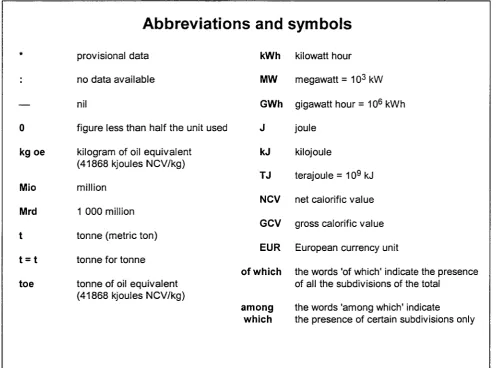
Abbreviations and symbols
provisional data
no data available
[image:24.595.67.564.86.454.2]nil
figure less than half the unit used
kilogram of oil equivalent (41868 kjoules NCV/kg)
million
1 000 million
tonne (metric ton)
tonne for tonne
tonne of oil equivalent (41868 kjoules NCV/kg)
kWh
MW
GWh
J
kJ
TJ
NCV
GCV
EUR
of which
among which
kilowatt hour
megawatt = 103 kW
gigawatt hour = 106 kWh
joule
kilojoule
terajoule = 109 kJ
net calorific value
gross calorific value
European currency unit
the words 'of which' indicate the presence of all the subdivisions of the total
the words 'among which' indicate
TABLE DES MATIERES
Page
Observations 24 Ventilation de la consommation énergétique de l'industrie 30
Abréviations et signes employés 31
CHAPITRE 1 : DONNEES DE BASE 33
Economie de l'énergie : Chiffres clés 36 Productions mondiales et réserves 44
CHAPITRE 2 : PRINCIPAUX AGREGATS PAR PRODUIT 45
Bilan énergie finale : Principaux agrégats par produit 46
CHAPITRE 3 : TABLEAUX PAR SOURCE D'ENERGIE 57
Combustibles solides : Principaux agrégats 58
Pétrole : Principaux agrégats 67
Gaz : Principaux agrégats 85
OBSERVATIONS
La publication Statistiques annuelles de l'énergie a pour but de rassembler un ensemble cohérent d'informations statistiques harmonisées sur l'économie de l'énergie de l'Union européenne et des États membres, principalement pour la dernière année disponible. L'information est donc particulièrement axée sur l'approche globale et structurelle, c'est-à-dire sur les bilans de l'énergie, qui constituent l'instrument essentiel de l'analyse énergétique. Quant aux données de caractère plus conjoncturel, elles ont trouvé leur place dans le bulletin mensuel Energie.
La première partie de l'annuaire donne un aperçu des données caractéristiques de l'économie énergétique, en particulier sous un aspect analytique. Des séries historiques d'indicateurs soulignent pour l'Union européenne et pour chaque Etat membre l'évolution des principaux agrégats de l'énergie comparativement à ceux de l'économie générale et montrent les modifications structurelles intervenues au cours des dernières années.
La deuxième partie donne un aperçu général des principaux agrégats relatifs à l'ensemble de l'énergie et à chaque produit dans une unité commune, la tonne-équivalent pétrole. Ces séries sont reprises des bilans énergétiques globaux pour la période 1985-1993.
La troisième partie fournit des séries historiques propres à chaque source d'énergie pour les principaux agrégats.
L'unité utilisée est spécifique à chaque source : la tonne dans le cas du charbon ou le Térajoule dans le cas du gaz.
Une information exhaustive sur la méthodologie des bilans de l'énergie finale est fournie par la publication
Principes et méthodes des bilans d'énergie.
I. SOURCES D'ENERGIES
Les produits pris en compte dans cette publication sont les suivants :
Charbon et dérivés
Houille : charbon d'un pouvoir calorifique supérieur, égal ou dépassant 24 MJ/kg sur échantillon numide,
exempt de cendres. Sont également compris les mixtes, les Schlamms et les schistes combustibles.
Pour l'Espagne, les données concernant la houille comprennent le lignite ancien (lignito negro) à partir de 1987.
Agglomérés de houille : formés normalement par moulage à chaud et sous pression, avec adjonction de liant (brai).
Coke : coke de four, coke de gaz, semi-coke de houille, coke moulé et coke de lignite, produits par distillation de la houille ou du lignite.
Lignite : charbon d'un pouvoir calorifique supérieur, ne dépassant pas 24 MJ/kg sur échantillon humide,
exempt de cendres, tel que lignite récent, lignite ancien et Hartbraunkohle.
Tourbe : combustible d'origine végétale, apte à la combustion après séchage.
Briquettes de lignite : obtenues par agglomération sous haute pression. Dans les quantités de briquettes sont compris le lignite séché et le poussier de lignite.
Briquettes de tourbe : éléments formés par moulage sous forte pression.
Goudron, benzol : sous-produits obtenus lors de la distillation de la houille dans les cokeries.
Pétrole et dérivés
Pétrole brut : huiles minérales brutes de pétrole ou de minéraux bitumeux (y compris le pétrole semi-raffiné et liquides de gaz naturel (condensais) lorsque ceux-ci sont traités en distillation).
Gaz de raffineries : gaz incondensables composés principalement d'hydrogène, d'éthane, de méthane et d'oléfines. L'éthane épuré obtenu par séparation lors de la production du gaz naturel figure ici comme une production primaire.
Gaz de pétrole liquéfiés : propane et butane ou le mélange des deux.
Essences moteur : essence moteur normale, essence moteur super, essences sans plomb, essence aviation ainsi que gazoline naturelle.
Pétrole lampant et carburéacteur : pétrole lampant (chauffage et tracteur), carburéacteur type essence et carburéacteur type pétrole.
Naphtas : naphtas légers, moyens et lourds.
Gas-oil et fuel-oil fluide : gas-oil, diesel-oil routiers et marins, gas-oil de chauffage, fuel-oils d'une viscosité inférieure à 10 cST à 80°C.
Fuel-oil résiduel : fuel-oils d'une viscosité supérieure à 10cSTà80°C.
White spirit et essences spéciales : huiles légères de coupe étroite.
Lubrifiants : huiles et graisses lubrifiantes (y compris spindle, huiles blanches, huiles isolantes et huiles de coupe).
Bitumes : bitumes de pétrole (y compris mélanges bitumeux et emulsions bitumeuses).
Coke de pétrole : résidu pétrolier solide.
Autres produits pétroliers : cires, vaselines, paraffines, soufre et autres résidus de distillation.
Gaz
Gaz naturel : essentiellement méthane, mais il contient également une faible proportion d'autres gaz. Il couvre à la fois le gaz naturel non associé et le gaz naturel associé, le méthane récupéré dans les mines de charbon.
L'éthane, le propane et le butane et les autres condensats, dans la mesure où ils sont épurés, sont exclus et sont comptabilisés comme production primaire dans les produits pétroliers.
Gaz de cokeries : gaz récupéré comme produit fatal à la sortie des fours à coke.
Gaz de hauts fourneaux : gaz récupéré comme produit fatal à la sortie du haut fourneau.
Gaz d'usines : tous types de gaz obtenus par des opérations de distillation, de craquage, de reformage ou d'hydrogénation. Ils se distinguent des gaz de
cokeries et de hauts fourneaux par le fait qu'il ne s'agit pas de produits fatals, mais au contraire de produits manufacturés expressément dans des installations spécialisées.
Les gaz d'usines sont toujours des produits dérivés obtenus à partir de houille de gaz de raffineries, de GPL, de naphtas, de gas-oils, de fuel-oils résiduels ou de gaz naturel. Ils comprennent donc, au niveau de la production, le gaz de synthèse.
Energies renouvelables
Les énergies renouvelables sont les sources d'énergie considérées comme inépuisables à long terme.
Energie solaire : chaleur solaire produite par la conversion du rayonnement en énergie thermique et l'électricité photovoltaïque produite par la conversion directe du rayonnement solaire.
Chaleur géothermique chaleur naturelle en provenance du sous-sol. La chaleur géothermique comprend les quantités destinées au chauffage des immeubles et autres ainsi que la chaleur utilisée pour la production d'énergie électrique. Cette dernière production est reprise dans les bilans en tant que production dérivée d'énergie électrique au même titre que l'énergie électrique d'origine thermique classique.
Biomasse (et déchets) : matières organiques, non fossiles, d'origine biologique utilisées pour produire de l'énergie. Cela comprend à la fois les végétaux et les déchets. Elle comprend les bois et les déchets végétaux (déchets de bois et culture), les liqueurs noires, les déchets municipaux solides, le biogaz (produits par la fermentation anaérobie de biomasse), les biocarburants (éthanols, diesters, etc.).
Energie éolienne : forme d'énergie électrique produite par les convertisseurs d'énergie éolienne (aéro-générateur). La production primaire d'énergie est transférée dans le bilan de l'énergie électrique.
Energie hydraulique : énergie potentielle et cinétique des eaux. L'énergie hydraulique est prise en compte sous la forme d'énergie électrique produite par les centrales hydroélectriques. La production primaire d'énergie est transférée dans le bilan de l'énergie électrique. La production hydraulique résultant du pompage est exclue.
Autres combustibles
Chaleur
La chaleur peut être primaire, s'il s'agit d'une source géothermique, solaire, ou de la production thermique des centrales nucléaires, ou dérivée, s'il s'agit de l'eau chaude ou de la vapeur produite dans une centrale thermique de cogénération ou dans une centrale de chauffage.
La chaleur nucléaire est prise en compte sous la forme de la chaleur dégagée par la fission de l'uranium dans les réacteurs. Cette chaleur est considérée comme primaire et reprise en tant que telle dans la production primaire. La chaleur ainsi comptabilisée correspond à une disponibilité d'énergie obtenue à partir de la fission au cours de l'année considérée.
Energie électrique
Energie électrique d'origine hydraulique issue d'apports naturels, éolienne, géothermique, thermique classique et nucléaire.
de pétrole liquéfiés (GPL), les essences naturelles ou autres produits obtenus à la production, à l'épuration et à la stabilisation du gaz naturel pouvant être consommés tels quels.
La production de gaz naturel se réfère aux quantités de gaz naturel épurées après élimination des matières inertes. Les données excluent toujours les lâchers, les brûlés à la torche, les essais de production et les réinjections dans le gisement.
Les données de production comprennent la
consommation propre des producteurs.
Importations : les importations représentent toutes les entrées sur le territoire national à l'exclusion du
transit, notamment par gazoducs et oléoducs; exception faite, l'énergie électrique, dont le transit est toujours comptabilisé dans le commerce extérieur.
Les données relatives aux importations proviennent, en général, des déclarations des importateurs ; elles peuvent donc différer des données établies par les services des douanes et reprises dans les statistiques du commerce extérieur.
II. AGREGATS
Production primaire : extraction d'énergie puisée dans la nature : houille, lignite, pétrole brut, gaz naturel, géothermie, énergie hydraulique, énergie
éolienne, chaleur solaire, biomasse. L'énergie
nucléaire, sous forme de chaleur produite par la fission, est traitée comme production primaire.
Les autres combustibles, pris en compte seulement quand ils représentent une entrée en transformation dans les centrales thermiques classiques, sont comptabilisés par convention à la ligne "récupération", s'agissant dans la plupart des cas de véritables récupérations.
La production primaire de houille est définie comme étant la production nette à la mine, c'est-à-dire après élimination des déchets de la production brute (charbon remonté à la surface) au moyen des opérations de criblage et de lavage. En règle générale, elle comprend la production des bas produits (poussiers, mixtes, Schlamms), mais n'inclut pas les produits de récupération. La production comprend celles des petites mines et des mines à ciel ouvert.
La production de pétrole brut ne comprend la
production d'essences naturelles ou d'autres condensate obtenus lors de la production, de l'épuration et de la stabilisation du gaz naturel que dans les cas où ces produits subissent une transformation dans les raffineries.
En ce qui concerne le pétrole brut et les produits pétroliers, les importations comprennent, en particulier, les quantités : a) destinées au traitement à façon pour compte étranger ; b) importées à titre temporaire seulement ; c) importées et mises en entrepôts hors douane ; d) importées et mises en entrepôts spéciaux pour compte étranger ; e) importées de régions et/ou de territoires d'outre-mer placés sous la souveraineté nationale.
Les importations totales de l'Union européenne (EU-15 et EU-12) comprennent également les échanges intra-Union européenne.
Variations des stocks : par variation des stocks, on entend la différence entre les quantités d'énergie existant en stock chez les producteurs, les importateurs, les distributeurs de gaz naturel, les transformateurs et les gros consommateurs industriels au début et à la fin de la période considérée. Le signe + indique un déstockage, et donc une augmentation des disponibilités, le signe -un stockage, et donc une diminution des disponibilités pour la consommation.
Exportations : en général, les mêmes règles que pour les importations sont appliquées.
En ce qui concerne le pétrole brut et les produits pétroliers, les exportations représentent, en outre, toutes les quantités : a) réexportées après traitement ou transformation ; b) fournies aux troupes nationales ou étrangères stationnées à l'étranger (dans la mesure où des dispositions concernant le secret ne s'y opposent pas).