Devolution in Practice II
Public Policy Differences within the UK
Devolution and the Economy:
A Scottish Perspective
Brian K Ashcroft* Peter G McGregor**
and J Kim Swales*
Seminar 3
Conference room A, First Floor, Welsh Assembly Government, Crickhowell House, Cardiff
Bay, Cardiff CF99 1NA
Friday 13 May 2005
*Fraser of Allander Institute and Department of Economics, University of Strathclyde and Centre for Public Policy for Regions (CPPR)
**Department of Economics, University of Strathclyde and CPPR
Introduction
In their interesting and challenging chapter John Adams and Peter Robinson assess the consequences for economic development policy of the devolution measures enacted by the UK Labour government post 1997. Their chapter ranges widely over current UK regional disparities, the link between devolution and economic growth, the balance of responsibilities in policy between
Whitehall and the devolved administrations, and finally, they raise questions about the developing “quasi-federal” role of Whitehall in regulating or co-ordinating the new devolved policy landscape.
In response, we propose to focus on four issues that we believe are key to understanding the economic consequences of devolution both at the Scottish and UK levels. First, we argue that the view of Scotland’s devolutionary experience in economic policy is partial and so does not fully capture the nature and extent of change post 1999. Secondly, we examine the role of devolution in regional economic performance. There is much in their paper on this topic with which we agree but we contend that there are significant
omissions in the analysis, which are important for policy choice. Our third section highlights an area not discussed in depth by Adams and Robinson’s paper: the funding of the devolution settlement. Here we consider some of the implications of funding arrangements for economic performance and the options for a new funding settlement. Finally, we deal with the difficult issue of co-ordination between the centre and the devolved regions. We contend that ordination is largely conspicuous by its absence. Moreover, where co-ordination is deployed it reflects an inadequate understanding of the extent to which the economies of the regions and devolved territories of the UK are linked.
1. Scottish Experience
devolution than it was before. They draw on Gillespie and Benneworth (2002) who stress that administrative devolution from the mid 1970s onwards and the response to pressures from nationalist movements, led to policy innovations such as the creation of the Scottish Development Agency (SDA) in 1975, and the formation of Scottish Enterprise and Highlands and Islands Enterprise in 19911. Thus economic policy in Scotland began to diverge considerably long before political devolution commenced in 1999. Moreover, the innovations adopted by Scottish Enterprise, such as an emphasis on clusters, and a well researched and specified business birth rate policy, led the English regions through the DTI and the RDAs to seek to adopt some of these earlier Celtic innovations2. Gillespie and Benneworth (2002) argue that these developments offer examples of some policy convergence post 1999, but we would point to a number of innovative examples in economic policy after the creation of the Scottish Parliament.
Adams and Robinson see much commonality between the UK Government’s policy framework and the Framework for Economic Development (FEDS), which was the Scottish Executive’s first economic development policy strategy document introduced in 2000. FEDS emphasised the importance of supply-side drivers of productivity such as innovation and skills, stressed the key role of market forces and offered the primary justification for policy intervention as market failure. Adams and Robinson see FEDS as reaffirming much of the UK Government’s policy framework. In contrast, Cooke (2005) characterises economic development policy in the devolved administrations as visionary in Scotland, precautionary in Wales and constrained in Northern Ireland. Cooke acknowledges the innovation in Scottish economic development policy prior to 1999 but highlights the visionary nature of post devolution policy through the attempt to promote a science-based economy as charted in the strategy
1
The Highlands and Islands Development Board (HIDB) preceded the creation of the SDA by at least a decade and both were merged with the Training Agency to form, respectively, Scottish Enterprise and Highlands and Island Enterprise in 1991.
2 It can be argued that these policy exemplars have moved on in Scotland with, for example,
document for the enterprise networks Smart Successful Scotland3 published in 2001. This regional development strategy can be viewed as the first attempt in the UK, and perhaps in Europe, to recognise the importance of linking scientific commercialisation and entrepreneurship within a specifically open economy context.
Adams and Robinson follow Gillespie and Benneworth (2002) in concluding that the Scottish Executive has not been particularly innovative in using its powers of industrial intervention, citing Regional Selective Assistance (RSA) as a specific example. According to these authors RSA has simply been “re-badged and streamlined rather than more comprehensively re-aligned with the interventionist approach alluded to in FEDS” (Gillespie and Benneworth
(2002), p 76). Clearly, judgements as to whether a policy change is innovative or not are likely to be subjective. However, we take the view that the Scottish Executive’s Review of RSA in 2001 was substantial and led to significant changes in both the nature and operation of policy4.
3Smart Successful Scotland established policy along 3 dimensions: 1. Growing Businesses
which pioneered a Business Growth Fund, allowing small companies to access RSA through less bureaucratic procedures; Proof of Concept Fund; Scottish Co-Investment Fund; the Edinburgh University-Stanford link; the Intermediary Technology Institutes (ITIs); enterprise education in primary and secondary schools sponsored by Scottish entrepreneurs. 2. Skills and Learning: the creation inter alia of Careers Scotland offering all-age careers advice. 3.
Global Connections: merged Locate in Scotland and Scottish Trade International to create Scottish Development International one organisation focused on attracting high value R&D, creating partnerships and seeking to assist the commercialisation of Scottish generated knowledge; the creation of Globalscot – a network of Scottish business expatriates to draw on their knowledge and expertise; creation of Event Scotland to bring major international events to Scotland. The subsequent creation of the Fresh Talent Initiative represents a broadening out of the Global connections approach to the attraction of mobile skilled labour as well as knowledge capital.
4 The application of the scheme was aligned with the objectives of Smart Successful
Adams and Robinson end their discussion of policy developments in the devolved territories by concluding that most divergence has been institutional and that where significant differences in economic development policies have occurred their roots lie in the earlier administrative, rather than the later political, devolution. While this may be true of England Wales and Northern Ireland, it is worth noting that in Scotland the principal delivery agencies of economic policy – Scottish Enterprise, Highlands and Islands Enterprise, the Local Enterprise Companies – have not changed5. Moreover, under political devolution the changes in policy did mark a major break with the past6. First, FEDS and Smart Successful Scotland placed economic development policy for the first time in a strategic framework and a framework that differed in several important respects from elsewhere (Ashcroft, 2002). Secondly,
devolved policy built on the successful economic policy innovations introduced in the 1990s but adapted them to meet the requirements of the new strategic vision within a specific open economy context, which as Cooke (2005) argues, sought “to position Scotland to exploit to the full the Knowledge Economy” (p. 44). Finally, as Cooke further points out the implementation of this strategic vision led to the adoption of some major policy innovations, the Intermediary Technology Institutes being a prime example.7
2. Devolution and Economic Performance
The role of the economy in the devolution process and the effect of devolution on economic performance has to be set in the context of the nature and extent
5 Change has occurred within these agencies as they have sought to streamline their
back-office functions. 6
It might be argued that the presence of well-established institutions such as the Scottish Office and Scottish Enterprise made the transition to devolution, and the adoption of new policies, smoother than it might otherwise have been.
7 The Intermediary Technology Institutes (ITIs) are one of the key components of Scottish
Enterprise’s approach to strengthening innovation and R&D in Scotland. Three Intermediary Technology Institutes: ITI Life Sciences; ITI Energy; and ITI Techmedia, have been created. Scottish Enterprise is investing heavily in the ITIs with £450million earmarked to be spent on them over the next 10 years. They operate as a “hub” for identifying, commissioning and diffusing pre-competitive research, embracing emerging markets, maximising the value of IPR and seeking to integrate new technologies into the market place. They are open for
of UK regional disparities, attitudes towards them and the scope for devolved policy to influence economic performance. The role of the economy in driving the motivation for devolution is quite a different issue from the impact of devolution on the economy.
Adams and Robinson argue that there has been remarkably little change in the pattern of regional and territorial disparities since they emerged in the 1930s, but cite Scotland as being an exception to this pattern with GVA per head rising relative to the UK from the 1970s to almost current parity with the UK8. In the light of this it is difficult to argue (pages 10 and 12) that support for devolution in Scotland was driven by the belief that it would improve the quality of people’s lives in terms of policy, including economic policy, outcomes. In fact it appears that there has never been a majority of respondents to surveys, either before or after devolution, expecting a
favourable impact of the Scottish Parliament on the Scottish economy. So, in 1999, only 43% of respondents expected the Parliament to improve
Scotland’s economy. Respondents were more convinced that political devolution would give ordinary people a greater say in how Scotland was governed than to any certainty of economic impact. (McCrone, 2003 and Bromley, Curtice, and Given, 2005).
The apparent scepticism of the Scottish people with respect to the favourable impact of devolution on the economy is perhaps a reflection of the lack of certainty amongst professionals and academic experts on the nature and extent of the impact. As Adams and Robinson point out “the link between devolution and economic performance has been one of the most hotly
debated topics in the field of territorial politics” (page 10). They cite academic argument to suggest that regional institutional capacity matters to economic performance, that the impact of regional government on economic growth is
8
contested and that the relationship between democracy and regional economic performance is ambiguous. While we would not necessarily disagree with these views, there are other ways in which devolution might affect the economy and in particular we would highlight the literature on fiscal federalism.
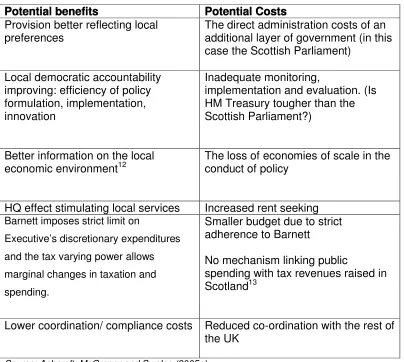
From a conventional fiscal federalist perspective, the economic arguments for devolution concern the provision and financing of local public goods, such as health and education expenditures9. There would appear to be three broad routes through which devolution might affect “economic efficiency”: in the allocation of public goods and services to meet Scottish preferences and needs10; in the allocation of inputs or resources to productive public use; and in the allocation of resources between present and future consumption i.e. through growth11. But a priori, devolution may incur costs as well as benefits to economic efficiency as Table 1 indicates.
Table 1 suggests that political devolution in Scotland may have had
favourable or unfavourable effects on information, resources, incentives, and coordination in the formulation and implementation of policy. In Ashcroft, McGregor and Swales (2005a) we discuss the issues surrounding the impact of devolution on the Scottish economy outlined in Table 1 above. We also look at some evidence and conclude that the impact of devolution on the Scottish economy requires further research and that the effect is likely to be complex, subtle and difficult to measure.
9 The literature suggests that national public goods, such as defence, foreign affairs, should
be provided nationally and that the external, or spillover, effects of local macroeconomic and distributional policies warrants that they be reserved to the national level. Conversely, compatibility of expenditure choices on local public goods with local preferences is best ensured by appropriate devolution. Devolution to Scotland and Wales has broadly followed this approach in the specification of the powers reserved to the centre. Tiebout (1956), Musgrave (1959), and Oates, 1972 are the classic accounts and Oates, 1999, provides a survey.
10
This would embrace the social inclusion agenda, which can be viewed as part of
economists’ standard definition of economic efficiency embracing the questions of what, how, and for whom to produce.
11 The effect of devolution on policy therefore embraces both static economic efficiencies (i.e.
Table 1. The Economic Benefits and Costs of Scottish Devolution
Potential benefits Potential Costs Provision better reflecting local
preferences
The direct administration costs of an additional layer of government (in this case the Scottish Parliament)
Local democratic accountability improving: efficiency of policy formulation, implementation, innovation
Inadequate monitoring,
implementation and evaluation. (Is HM Treasury tougher than the Scottish Parliament?)
Better information on the local economic environment12
The loss of economies of scale in the conduct of policy
HQ effect stimulating local services Increased rent seeking Barnett imposes strict limit on
Executive’s discretionary expenditures
and the tax varying power allows
marginal changes in taxation and
spending.
Smaller budget due to strict adherence to Barnett
No mechanism linking public
spending with tax revenues raised in Scotland13
Lower coordination/ compliance costs Reduced co-ordination with the rest of the UK
Source: Ashcroft, McGregor and Swales (2005a).
Anecdotally there is only limited evidence of policy changing to better reflect Scottish preferences. Since devolution, the relative pattern of expenditure is little changed. Stronger preferences for health and education, relative to England, are evident though the changes are modest14. Policy has diverged in areas of indirect consequence for the economy such as university tuition fees, care for the elderly and in the economic development policies underpinning
12 “Local” informational advantages are often regarded as one of the benefits of
decentralisation. Given that Scotland enjoyed administrative decentralisation prior to devolution this is a less obvious source of gain in this case. However, if, as seems likely, democratic accountability results in pressures that improve local information, then devolution may bring genuine gains through this mechanism.
13 Aspects of this are not costs of devolution per se, but relevant to whether a greater degree
of fiscal independence would generate larger gains.
14 Bell and Christie (2001) find no statistically significant changes in the pattern of public
Smart Successful Scotland noted above. And some of these policies, such as
care for the elderly, are likely to have a bigger impact on the pattern of expenditure in the future than at present.
However, there is concern in Scotland that the adoption and implementation of policy does not ‘fit’ fully with the declared preferences of the Scottish Executive and, we must assume, the preferences of the Scottish electorate15. The Scottish executive has made economic growth its paramount policy priority and placed much emphasis on securing improvements in the efficiency of delivery. But Wood (2005) finds that the share of primary expenditure on economic development policy has fallen from 7.4% to 5.5% between 1999 and 2005. Other expenditures classified as supporting development grew more slowly than overall public expenditure in Scotland (30% compared to 41%) implying a declining share, although less severe than that of primary development spend. Moreover, Wood also found that the share of such expenditures going to rural areas was significantly in excess of their
population share. This latter might be an example of the possible increased opportunities for rent seeking following devolution, which created a number of new agents with influence over policy, most obviously MSPs, that in turn has stimulated a host of lobbying organisations and other interest groups. Added to this is the finding of the Parliament’s Finance Committee that the revealed commitment to efficiency savings within the Executive was less than that promised by the UK government and less than originally claimed by the Executive itself (Finance Committee, 2004).
15 This raises the possibility of principal-agent problems between the electorate and Executive
3. Funding
The financial resources available to the Scottish Executive and the other devolved administrations principally depend on the budget assigned by Westminster16. The Barnett formula, which determines the assigned budget, allocates a population share to Scotland of increments to public spending on comparable programmes in England and Wales. Since devolution, the formula has been applied more rigorously with population weights updated annually (Heald & ?, 2005). At the start of devolution, public expenditure in Scotland on comparable programmes was in excess of its population share and so the effect of a rigid adherence to Barnett will be to reduce relative public spending in Scotland, ultimately - although over a much-extended period – moving to the English figure in real per capita terms. This has adverse consequences for GDP and employment in Scotland, as well as in the other devolved territories (Ferguson, et al, 2003).
Adams and Robinson recognise the so called so called ‘Barnett squeeze’ is the issue most likely to ignite territorial rivalry in the UK. But perhaps Barnett has reached the limits of appropriateness as the principal territorial funding mechanism in the UK, and may in any event become unsustainable as convergence in per capita spending levels raises the demands for an alternative.17
Hallwood and Macdonald (2005) survey the range of fiscal federal systems around the world – all reflecting different trade-offs between equity and
efficiency. They argue that a form of fiscal federalism should be adopted in the funding of the devolved territories in the UK, with a greater alignment of
revenue and spending powers to overcome the present vertical imbalance
16
In Scotland, other sources of revenue include Council Tax, Non-Domestic Rate Income, charges, and realised efficiency savings. The variable income tax provision of a 3p change in the basic rate – the Tartan tax – has not been used in the first two Parliaments.
17While Adams and Robinson (p24) may well be correct in their assertion that the 2004
implicit in Barnett. They take the view that the current funding mechanism unduly trades off efficiency in favour of equity and that moving to a more fiscal federalist system would require some sacrifice of equity in favour of potentially greater efficiency. While their approach perhaps fails to acknowledge the hard budget constraint implicit in Barnett, and hence the presence of an incentive to efficient spending, it is also correct that the present funding mechanism provides no link between public spending and tax revenues raised in Scotland. The incentive to promote growth is weakened by the resultant absence of any direct and automatic link between economic growth and tax revenues accruing to the Scottish Parliament.18 But it should also be noted that the evidence on fiscal decentralisation and the promotion of growth is ambiguous (Hallwood & MacDonald, 2005). Nevertheless, this is a debate that will increasingly come to dominate devolution in the UK and, in our judgement, merits considerably greater emphasis.
4. Co-ordination
One important consequence of devolution is the actual and potential tension between the (economic) interests of the devolved territories and the UK as a whole. While such tensions between region and nation are not new19,
devolution has given them institutional significance. Scotland and Wales are free to pursue their own economic development policies that may conflict with the economic policy objectives of the UK government. Adams and Robinson suggest the example of the employment growth objective of the Welsh Assembly as creating a tension with the UK Treasury goal of higher
productivity growth (page 13). Regional competition for mobile investment is
18 However, it should be recognised that the regular updating of the population weights that
has characterised the Barnett formula since the Darling amendment does provide a direct link between growth in population and the scale of the assigned budget of the Scottish
Parliament. Since we would expect at least a part of population growth to be directly related to economic activity, we would expect a positive relationship between growth in Scotland and the assigned budget. The link is less direct and systematic than schemes of the type proposed by Hallwood and MacDonald, 2005.
19 For example, several UK governments have taken the view that a UK regional (or more
also cited as potentially damaging to other regions and, by implication, to the national economic interest (page 22). And, policies formed by Whitehall departments for English needs may have “adverse consequences for the poorer nations of the United Kingdom …” while a “UK-wide policy might take a very different approach” (page 17).
Clearly devolution increases the need for greater co-ordination from the centre, while preserving the spirit of the devolution settlement. However, if the UK is to deal with the issue of co-ordination effectively there needs to be a clearer understanding of the nature of regional interdependence in the UK and the institutional arrangements to deal with it. This issue is fundamental: in principle, at least, interregional interdependence is important for all economic policies with a spatially differentiated impact, whether administered by
devolved or delegated authorities or by the Westminster government. While inward investment, for example, brings interregional competition into very sharp relief, economic interdependence renders virtually every policy at least a potential source of both interregional spillovers and gains from coordination.
Spillovers
Co-ordination is an issue principally because regions are interdependent. Regions and small countries are interdependent because they more open to trade and resource flows than larger jurisdictions. Hence, changes in
economic activity in one region spill over to other regions through movements in trade, migration and capital flows. The problem for policy is that our
-including the devolved and UK governments – understanding of the nature and extent of economic spillovers between regions generally, and UK regions in particular, is limited20. The theoretical possibilities are understood but as McGregor and Swales (2005) point out the issue is essentially an empirical one. Interregional interdependence depends on the specific conditions affecting demand and supply in each region. And in the UK, the empirical research is lacking, with matters not helped by a lack of data on interregional flows of trade and finance.
20
This lack of understanding has, however, not stopped governments from taking and promoting a view of the UK interregional macro-economy. Until the election of the Labour government in 1997 the UK Treasury took the very restrictive view that a policy disturbance in a UK region would be met by 100% crowding out in other regions and so would have no net impact on national economic activity (McGregor & Swales, 2005)21. In contrast, the ‘new regional policy’ of the Labour government appears to be underpinned by a view that each region is independent with no significant spillovers from one to the other. McVittie and Swales (2003) characterise this about face by the Treasury as “very odd”.
Two implications appear to follow from this volte-face. First, the focus of UK regional policy is on each region fulfilling its potential, with each English region treated as a mini-UK in the adoption of the Treasury supply-side agenda and the pursuit of policies to improve performance on the Treasury’s five
productivity drivers. Adams and Robinson rightly note that these drivers exclude some of the more important drivers at the local level. The openness of regional economies suggests the importance of trade, migration and capital flows to regional development. In Scotland, this is recognised to some degree through the promotion of global connections within Smart Successful
Scotland22and the adoption of a migration policy: the Fresh Talent Initiative to help stem Scotland’s declining population. But at the UK government level probable interregional links are not considered. So, for example, the link between the problems of congestion and over development in the South East of England and the lower rates of job creation in the north and the attendant policy solutions are both ignored. Secondly, the perceived lack of regional interdependence has led to a failure by the UK government to develop the appropriate institutional arrangements to co-ordinate policy across the
21 McGregor & Swales note that even simple demand re-allocations across regions would not
necessarily result in 100% crowding out if supply conditions varied across regions. 22
devolved – and English – regions to move closer to the joint maximisation of economic welfare (McGregor and Swales, 2005).
Institutions
Devolution led to the adoption of new institutional arrangements in the UK to encourage co-operation amongst the devolved territories and the different levels of government: Concordats; Joint Ministerial Committees; and Committee of the Isles. But the view of political analysts is that such arrangements promote minimal operation and offer no formal policy co-ordination (Jeffery 2004; Mitchell and Lodge, 2004). Adams and Robinson, in contrast, see the Treasury as playing a binding role both in thinking through the implications of devolution for territorial justice and in promoting UK-wide policies. We acknowledge that the Treasury is ideally placed to perform a co-ordinating role. But that role is currently only exercised - with DTI and ODPM – through the PSA target on regional growth, which, as Adams and Robinson note no longer applies to the whole of the United Kingdom. We can think of no examples of the Treasury playing a binding or co-ordinating role with respect to Scottish economic development policy or any other Scottish Executive policy. The potential UK wide implications and tensions of unique Scottish policies on care for the elderly, teachers pay, university tuition fees and economic migration through the Fresh Talent Initiative, appear simply to have been ignored. Overall, the UK government has adopted a disjointed
incremental approach to spatial institutional change, which is very fluid in England but which does not appear to be guided by an overall spatial institutional strategy23.
5. Conclusions
We consider Adams and Robinson’s analysis to be a useful and stimulating contribution. Our response from a Scottish perspective reflects rather different
23 At the level of the English regions, targets, evaluation procedures, democratic
judgements about the significance of four key issues. First, we believe Scotland’s post-devolution experience has seen a significant degree of innovation in Scottish policy. Secondly, we do not believe that there is any evidence to suggest that devolution in Scotland was fundamentally motivated by the prospect of an economic dividend. However, devolution in Scotland (and elsewhere, and decentralisation more generally) has potentially
important economic effects. Nonetheless, while the traditional fiscal federalism literature tends to emphasise the potential gains of devolution, there are undoubtedly also potential costs. The economic impacts of devolution are likely to be subtle and difficult to measure, but are no less important for this.
Thirdly, we consider the funding of the devolved (and delegated) authorities to be of central importance to the long-term future of the devolution process in the UK. The sustainability of Barnett is a major issue, not least because its rigorous implementation is likely to impact adversely on the economies of the devolved territories. Consideration of alternatives is therefore an issue of some concern, and the debate on the appropriate degree of autonomy is likely to increase in importance through time, and not just for Scotland. And,
fourthly, we feel the issue of the role of the centre and coordination is of even greater importance than Adams and Robinson suggest. In principle, any devolved, delegated or central economic policy may, in a system of interdependent regional economies, have important interregional spillover effects. This, in turn, may imply the potential for overall gains from the
appropriate coordination of policies across the same and different levels of the governance structure.
Finally, while identification of the key issues is comparatively straightforward, our current understanding of, for example, the likely macroeconomic