City, University of London Institutional Repository
Citation
:
Quinsee, S. & Parker, P. M. (2017). Developing educational leadership. INTED
2017 Proceedings: 11th International Technology, Education and Development Conference,
pp. 1221-1229. ISSN 2340-1079
This is the accepted version of the paper.
This version of the publication may differ from the final published
version.
Permanent repository link:
http://openaccess.city.ac.uk/18724/
Link to published version
:
Copyright and reuse:
City Research Online aims to make research
outputs of City, University of London available to a wider audience.
Copyright and Moral Rights remain with the author(s) and/or copyright
holders. URLs from City Research Online may be freely distributed and
linked to.
City Research Online:
http://openaccess.city.ac.uk/
[email protected]
DEVELOPING EDUCATIONAL LEADERSHIP
Susannah Quinsee, Pam Parker
11
City, University of London (United Kingdom)
Abstract
Developing effective leadership within an academic setting is becoming increasingly important in the UK with the changes in the higher education sector. This is particularly pertinent in relation to the leadership of learning and teaching activities, where, for the first time, there will be more systematic external review and benchmarking of academic practice through the introduction of the Teaching Excellence Framework (TEF). However, ensuring that we are giving our current and future leaders’ appropriate development, both in terms of relevance and timeliness, is more challenging. Stefani [1] identifies this as being an under researched area and, anecdotally, the two principal investigators know that many programme leaders and those in head of department roles often have received little or no development for their role. However, leading education is central to the development of high quality programmes and student success and satisfaction. McInnis, Ramsden and Maconachie [2] outline the need for robust leadership if colleagues are to be inspired and influenced.
In order to prepare our staff more effectively for the requirements of educational leadership, at City, University of London, we are undertaking research to explore what knowledge, skills, support and preparation staff need for these roles. This project involves a range of data collection from both existing leaders and those either new or aspiring to these roles. This paper discusses our initial data gathered from a survey via an online questionnaire of open questions with 17 education leaders. The paper will outline their views of the knowledge and skills needed to undertake such a role, the support and preparation they had for their role and what support and preparation they believe new leaders need. The paper will then conclude with some recommendations arising from this data and outline the next stages of the research.
Keywords: Leadership, education leaders, leadership development, higher education.
1
INTRODUCTION
[9] “successful departmental leadership on teaching also involved building a community in which there is discussion and debate”. This is common for research, less so for learning and teaching.
In order to understand more about the type of leadership development and support required for leading educational activities, this paper outlines the approach taken at City, University of London to ascertain what is required for creating more effective leadership development for academic staff to foster improvements in teaching and student learning. The basis for this research is the premise that by understanding the perceptions of existing and aspiring educational leaders about leadership development, we will be able to create more appropriate interventions for aspiring educational leaders to enhance their educational leadership practice. The research is currently in progress, but this paper outlines the initial data collection methodology and results from an online of 17 educational leaders. Analysis of these interviews enables the researchers to start to develop a set of leadership competences to be compiled around educational leadership practice. These competences will form the basis of an educational leadership development programme once further research has been undertaken. This paper makes some suggestions as to which competences are valued in relation to educational development and concludes with an outline of the future direction of the research.
2
LITERATURE REVIEW
2.1 The need for leadership development
Changes in the higher education sector in the UK are increasingly demonstrating a need for leadership development, particularly in relation to leading learning and teaching activities ([10], [9]). The increased financial pressure that Universities are under has led to higher education management being compared to private sector organisations and a drive for universities to be led in a more corporate manner. The rise of the “entrepreneurial university” which is characterised by an empowered executive management structure that drives rapid change is seen as emblematic of this changed environment [5]. As Bolden et al ([11]) observe, though, this leads to increased tensions “extent emerging forms of leadership and management practice may be experienced as conflicting with ideals of collegiality, academic freedom, education and scholarship” (p.755). This can create leadership development as a contested area and one that academics may be reluctant to engage in. Leadership is thus seen less as something to be valued, but more as a “duty” that has to be fulfilled or resulting in partial responses where individual academics feel obligated to defend departmental interests in opposition to the wider institution ([5]). This is exacerbated by much of the underpinning leadership literature originating from private sector organisations or being focused on generic leadership competences and thus being less immediately applicable for staff within higher education organisations [9]. Therefore, there is a distinct need for leadership development that is timely and appropriate. In particular, this is important for supporting female academics. Airini et al [5] identified professional development as significant factor in enabling more female academics to achieve leadership positions as it signified a culture that was supportive to promoting effective leadership. This view is supported by DeFrank-Cole et al [12] who argue that women need female only leadership programmes to support their leadership development.
Gibbs et al [9] however sound a note of caution in relation to leadership development for learning and teaching specifically. They argue that much of the literature only focuses on senior management or generic leadership skills, this makes it irrelevant for many academics attempting to lead initiatives and enact change at departmental level. In order to support leadership development for learning and teaching, they claim, a greater sensitivity to the disciplinary culture of staff is required. An appreciation of disciplinary sensitivities then, in terms of supporting educational leadership development, is important for this research in terms of suggesting centrally-run development opportunities for staff.
2.2 Leadership in higher education
need for clear leadership and are critical of ineffective or unhelpful leadership [14]. This inherent contradiction or tension in the perception of leadership and how it impacts on the role of the academic creates a problem for the development of leadership capabilities. Leadership development, then needs to be mindful of the sensitivity of perceptions of leadership and how it impacts on the role of the academic. As Spendlove [15] argues “rather than “borrowing” models from business, the priority must be for researchers to use a grounded approach to build comprehensive, new models of effective leadership in HE. Generic and broad brush conceptualisations of leadership are not helpful within the academic environment due to the complex identities of the academic community [15]. This explains why much of the leadership literature is unhelpful when applied to universities, because it does not adequately equate to a culture that is based on an individualistic model and instead implies an approach where assuming a leadership position results in the easy exercise of associated power [15]. In a higher education setting, however, this is not the case. What is required is a deeper conceptualisation of leadership that is built on consensus and the ability to motivate disparate staff around a common sense of purpose. This is particularly important in relation to the leadership of learning and teaching activities [9].
Although the imperative for effective leadership in higher education may be clear, there is less agreement as to what this looks like in practice, particularly beneath the role of senior manager. Rowley clearly encapsulates this problem as one resulting from the way leadership is achieved at different levels in the organisation; departmental leadership is often a temporary position which is rotated as opposed to the executive positions of more senior management: “the person who is responsible for providing the leadership is not necessarily willing to be leader, and knows that leadership must be highly collegial or it will be very difficult to return to a faculty position once the time in the chair concludes” [16]. This could account for challenges in attempting to articulate precisely what effective leadership looks like at departmental level. As Akbulut et al [14] identify “despite elaborate descriptions of the behaviours and styles of deans, department heads and other academic leaders, little evidence exists regarding which behaviours and styles are most effective, and why” (p.442). This causes problems for the design of any leadership development programme, as in order to deliver effective leadership development there is a need to identify exactly what that effective leadership looks like [17]. Ramsden [18] points to resource management as one of the key features of departmental leadership, as well as balancing between external and internal factors ([18], [14]). This translates slightly differently to the leadership of learning and teaching specifically. Gibbs et al [9] state that effective leadership for teaching and learning centres around activities that involve “establishing credibility and involving students” (p.11). They make a case that excellence in learning and teaching requires a more complex and multifaceted leadership approach than more general considerations of university leadership. This is due to the differences between disciplines, as outlined above, and the nature of educational leadership which is seen as more dispersed.
It may be limited, but there is an increasing body of literature that considers leadership in relation to the role of the head of department ([9], [14], however, there is much less research undertaken on other roles and those that are often pivotal for aspiring leaders, for example those who lead and manage programmes of study. Vilkinas and Ladyshewsky [19] define this as a relatively under-researched area of study “even though it has a significant role to play in learning and teaching outcomes for students, program quality and the reputation of the institution within which they work” (p.110). This is an area of interest for this study, as it is at programme level in an institution that innovation in learning and teaching is often recognized and enacted. Programme directors can be aspiring leaders and overlooked by institutional staff development programmes aimed at developing leadership competencies at head of department level and above. Yet, the authors argue that particularly in relation to educational leadership, more focused development for staff at this level is vital for improving learning as well as providing much needed support for other middle leaders in the organization, such as head of department.
2.3 Significance of leadership development
Leadership development is not about identifying a “correct” form of leadership behaviour nor about simply applying a particular leadership model but rather about “developing individual leaders and developing effective leadership processes” (p.64) [20].
many universities, “if you are good at being a faculty member, then you are bound to be good (or at least adequate) at being a department chair” (p.229) [21].
Effective leadership development then needs to be context specific and appreciate the sensitivities of the higher educational environment. Conger and Benjamin [16] identify various leadership development best practices, particularly a clear understanding of what leadership is and what effective leaders do. As we have seen, however, in higher education this can be a challenge as there is not necessarily a consensus on what leadership means for individual academics [5]. Developing a competency based approach, with appropriate reflection opportunities, is suggested as the most effective way of developing a leadership programme that will be most effective for academics to change educational practice. As McDaniel observes “competency-based models have the advantage of offering specific attributes and frameworks for behavioral benchmarking” [22]. A competency based approach would enable the participants to ascertain which competencies are most effective in their own organizational environment and self-assess against existing strengths and development areas. Competency based frameworks can be helpful within a university setting as they provide a “guiding framework” for the development of particular leadership capabilities [15]. However, the impact of any professional development for leadership will be limited if the organization does not have in place additional support mechanisms for ensuring sustainability. Zuber-Skerritt and Louw argue that the effectiveness of leadership development is reliant upon “an institutional system to ensure continued collaboration, cascading and sustainable development” beyond the programme [23] (p.1021). An organizational culture that enables participants to continue to reflect on their learning and share their experiences of leadership is a significant factor in the effectiveness or otherwise of any leadership programme. It is important to consider this in relation to the experiences of existing and aspiring leaders.
As we have seen there is an increased urgency around the need for effective leadership in UK higher education, however, although this may be recognized at senior management level, there is less conclusive agreement as to how to enact leadership at other levels in the institutions and some inherent resistance from the nature of the academic role. How to enact effective leadership development is, then, a contested area, but one that crucial for universities to adapt and survive in the changing external environment. Much of the research on this area has been focused at senior level, yet departmental and, more significantly for this research, academic programme leaders, have the agency to perform vital leadership roles in instigating changes to learning and teaching practice. In this context, our research forms an important step in understanding more fully what leadership development is required at head of department level and below to enable institutions manage educational change more effectively.
3
METHODOLOGY
The aim of the research being undertaken around education leadership development is to support and prepare new and future education leaders in their role. As we have seen, though, gaining an understanding of the scope and nature of the academic leadership role is not unproblematic [14], therefore, our initial research focuses on the preparation existing leaders experienced. To ascertain how leadership development could support and adequately prepare staff for leadership roles, our research focuses on three key questions:
• What skills and knowledge are needed for such a leadership role? • What preparation has been provided for those in existing roles? • What might be appropriate preparation to provide for future leaders?
context; i.e the reality of the situation, within which the participants are operating. A further feature of naturalistic inquiry is that it supports the use of a range of data collection tools so that the most appropriate data can be collected from a range of participants [24]. This is important to this research as it enables the authors to gather a fuller set of data concerned with both the experiences and views of those in existing leadership roles and those who are new to the role. Through the use of questionnaires, interviews, workshops and reflections on leadership activities and issues it is hoped that a rich picture of this role can be developed. The use of so many tools also means we can triangulate the validity of the data, which will be important in terms of addressing some of the challenges highlighted above about the complexities of academic leadership roles. Ethical approval for the research had been granted through the appropriate university committee.
This paper reports on the initial stage of the research which is from data gathered through an online questionnaire completed by 17 education leaders. The participants provided responses to three key open questions as well as some demographic data. Although the use of a questionnaire is not necessarily the most effective tool to gather in-depth information, at this stage in the research project it was chosen as it enabled some broad data to be collected concerning some key areas which could then be used to underpin and inform the use of other data collection tools such as interview schedules and workshop activities. An initial questionnaire, in that it provides a foundation for further methodologies, also ensured the authors did not influence later data collection through their own views and experiences [25]. The online survey was set up using SurveyMonkey® as this was easy to use for both researcher and participant. There were in total six questions, three of which were demographic and three open ended questions related to the key questions outlined earlier.
The participants were a purposeful sample of education leaders but one that might also enable maximum variation to be gained so that as much initial data as possible could be gathered. Initially 56 participants were identified who were known to be in educational leadership roles and represented a range of geographical areas and types of higher education institution. These participants were in a variety of roles from those leading education development units, who often provide leadership development, to those who were in deputy vice chancellor roles focusing on education, and those who were independent education consultants having previously been in an education leadership role in higher education. All were approached through SurveyMonkey® with an e-mail containing information about the research, a unique link to the questionnaire and a note about participation and consent. Despite two follow up e-mails only 17 (30%) responded. Such a response rate is not unusual for online questionnaires, however the data gathered through this was very broad and rich, so this was still a worthwhile tool to use.
The demographic data was analysed by placing the responses in categories or groups and the qualitative data was inductively analysed in line with Lincoln and Guba’s [24] views that the categories or themes should arise from the data.
4
DISCUSSION OF THE FINDINGS
The data will be presented in order of the questions so the demographic data will be first and then the broader data gathered related to the three key questions. The literature will be drawn upon and integrated where appropriate.
In response to the question around job role one participant was in a deputy vice chancellor type role, two were independent education consultants and fourteen were in roles described as Heads or Directors of education development type units. Thirteen participants were female and four were male which does tend to reflect the gender balance for Heads of these types of units in the United Kingdom. Although further discussion of this is beyond the scope of this paper, this is interesting in the context of the challenges facing women moving into leadership positions in relation to higher education which was commented on above ([12], [22]). The length of experience of higher education of these participants was 14 – 45 years with a mean of 26 years. This does reflect an experienced group of education leaders.
“being able to marshal resources.”; (P1), “deal with people at all levels..” (P8) and “have an interest in people and their skills and interests..” (P10). There was also reference to good organisational skills, problem-solving and making difficult decisions. In terms of interpersonal skills, there was reference to good communication, both written and verbal, but also there were references to more nuanced communication skills including the importance of being able to advocate, negotiate, persuade, influence and mediate as well as an “ability to communicate within and across disciplinary boundaries..” (P9). Given the role of an education leader in higher education, this last point is particularly important because education leaders may be in schools/faculties but often they work as part of the central services and so need to be able to work with colleagues across the institution. This relates to the notion of building a community of practice that Gibbs et al. [9] identified as important for departmental heads and supports the notion of educational leadership as complex and multifaceted ([1], [3]. [14]. Heads in these positions may need to use different approaches with different colleagues.
The next category focused on teaching and learning and how it was important for education leaders to have a “broad knowledge of pedagogy and implications in practice both in the physical and virtual environments..” (P8). There were references to leaders needing an “evidence based pedagogic expertise” (P2) and “sophisticated knowledge of pedagogy for HE.(P9). Eight (47%) participants felt this was important to the credibility of being an educational leader.
Again two further categories had the same number of participants (seven or 41%) cite knowledge of the policy and context and the ability to be strategic and analytical as important. Knowing the historical and current culture of an institution, understanding the current context in which they work and being aware of national policy were seen to be significant for this role. However, it was also seen as important to be able to “think strategically” (P15), “have skills in interpreting data” (P3) and have the “ability to focus on the big picture whilst dealing with details” (P10). Education leaders often find they have to deal with local level issues within their institution to at the same time as considering the impact of a policy or national initiative such as the Teaching Excellence Framework mentioned earlier. Again these findings correlate with Gibbs et al [9] identification of 9 main leadership activities, however, the strategic thinking and relation to a wider policy context are not covered by Gibbs. This could be that the participants were in central roles in institutions and had a wider appreciation of the external and policy context.
There were then a range of categories with less agreement but nevertheless these were felt to be important to some of the participants. The personal experience of the education leader should include experience of teaching as noted above but also include project management, experience of collaborative practice and networking skills. Alongside this some participants (five or 30%) felt that they should also be able to lead research and have a record of research and scholarship. Whilst earlier leadership and management skills were mentioned a few participants (four or 23%) knowledge of finance was a separate area and that knowing about the funding of higher education, and how to generate income was also significant. For education leaders who wish to maintain a scholarly research profile knowing about income generation is indeed crucial as the funding for educational research has reduced over the last few years. Change management is another important skill for a leader in education and participants felt that having the ability to scan the horizon for changes as well knowing how to change practice was essential to this role. There were also some participants who felt some knowledge of quality assurance and enhancement processes was good. The two last categories were about the personal characteristics of the leader so a feeling that they needed to be flexible, enthusiastic, empathetic, have a sense of humour and a sense of values. Lastly it was felt they should be someone who engages in lifelong learning and professional development.
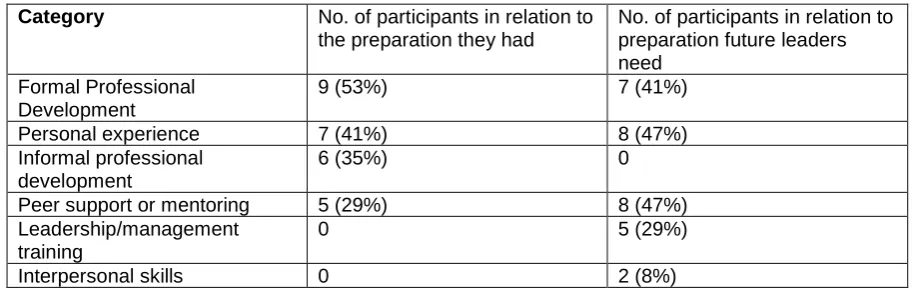
Table 1: Categories related to preparation for education leaders
Category No. of participants in relation to
the preparation they had
No. of participants in relation to preparation future leaders need
Formal Professional Development
9 (53%) 7 (41%)
Personal experience 7 (41%) 8 (47%)
Informal professional development
6 (35%) 0
Peer support or mentoring 5 (29%) 8 (47%) Leadership/management
training
0 5 (29%)
Interpersonal skills 0 2 (8%)
One category not included in the table, was from the participants who were in leadership roles and who had had no development at all for their role. That was eight (47%) participants. The participants stated that much of this was “experiential” (P8), “learnt on the job” (P4) and “made it up as I went along” (P2). This reflects the experiences of the authors and many of our colleagues and was one of the factors leading us to have an interest in this area. With the many demands placed on education leaders today they need to have appropriate preparation and support for their role. This is supported in the literature where notions of leadership, particularly at departmental level, are often identified as ill-formed or contested and so there is a reluctance for staff to engage in leadership development or leadership development is simply not available for these roles ([9], [14], [17]).
One further category that current leaders noted for themselves but not for future leaders was that of informal professional development and this included learning from good role models and mentors” (P13), “self-study” (P5) and reading (P1,11,12). Given that there was some reference to future leaders needing to undertake professional development and life-long learning the authors were surprised there was no reference to this in the future leaders’ preparation. This may have been because participants were focused on formal preparation. Given the gender bias in the participants this is surprising too, as McDaniel argues that formal mentoring and role modelling are vital for women to succeed in leadership roles [22].
The other two categories that only arose for future leaders were leadership and management skills and interpersonal skills. This is not surprising as these had been noted in the knowledge and skills needed for education leadership. The leadership skills that were observed as being needed reflected those outlined such as finance, human resources and strategic project management. The interpersonal skills were focused on communication and empathy across the levels of staff you work with.
Personal experience was a key category for both sets of leaders, existing and future. Those in current leadership roles felt that having held a number of roles already ranging from academic to programme leader to chairing of various committees was important to your development and your creditability. Previous leadership experience in these roles also meant that you had gained some skills in leading team and projects and in communicating. For future leaders the participants thought that having access to experienced leaders was important and “opportunities to develop policy” (P6) and “secondments into leadership roles” (P13). This supports Gibbs et al [9] that departmental heads need to establish credibility in order to enact educational change.
Formal professional development was also seen to be key for both existing and new leaders. Some of the existing leaders had undertaken in house programmes on leadership styles and models and but most had undertaken one of the Leadership Foundation Programmes [26]. These programmes cover strategic leadership, preparing for senior strategic leadership and executive leadership. Those who attend these do evaluate them well but they do come with an associated high financial cost. When outlining what future leaders needed participants did cite leadership programmes but interestingly only one or two referred to these programmes specifically.
guided and felt that for future leaders more on the job mentoring and shadowing would be useful (P13). Current leaders also mentioned being engaged in action learning sets which were regarded for future leaders in terms of ongoing support (P9) and could be seen to fit with the community of practice (R6) mentioned by another. This seemed to be about support and sharing ideas with others.
5
RECOMMENDATIONS AND IMPLICATIONS
The data collected from this first stage of the research has highlighted some useful areas about the development needs for future leaders and has provided some indication of how this support might be given. Whilst the authors acknowledge this data is from a small group of participants there was generally good agreement amongst them and this broadly correlates with issues identified in the literature, particularly that which focuses on departmental heads ([9], [14], [21]). There were some differences around the importance of policy and engaging with a wider external network which could be related to the types of roles that most of the participants occupy; i.e. that of departmental head but one in a central service role.
Clearly the implication of this research for those supporting and preparing new leaders is to ensure that in the future the next group of leaders who are surveyed indicate that they did have appropriate preparation for the role. The recommendations arising from this data for the authors are that they will talk to other educational leaders about the immediate support and development needs of those in fairly new leadership roles. In addition, they will share these findings with those who do provide leadership programmes across the institution so they can review the content to see if it is appropriate in the context of this research. Lastly, the authors will use this data to underpin the next stages of the research and inform the design of a semi-structured interview schedule. It will be interesting to see if there are differences in responses between those in discipline area leadership roles and those in cross institutional leadership roles in terms of leadership development needs and priorities.
6
CONCLUSION
This paper has demonstrated that using an online survey with educational leaders is an effective approach, at an early stage in the research project, to collecting some baseline data. The authors will now use this data as the basis for formulating a question set to be used in interviews with current leaders. These semi-structured interviews will enable the data to be developed and tested in more detail in terms of accuracy around perceptions and relevance. In addition, the authors hope to recruit some staff who are new to their roles to engage them in some workshops and reflective activities in order to ascertain a sense of what skills and strategies they use when making decisions. These activities will also enable the authors to gain a sense of how leaders can be prepared for their role effectively. At the end of these activities, both the interviews and workshops, the authors will be in a position to use the data to develop a richer understanding of the competencies required for educational leadership roles and consider how these can be supported through effective leadership development.
REFERENCES
[1] L. Stefani, “Stepping up to Leadership in Higher Education”, AISHE-J, vol. 7., no. 1, pp. 2161 – 21618, 2015.
[2] C., McInnis, P. Ramsden and D. Maconachie, Handbook for Executive Leadership of Learning and Teaching in Higher Education, Office for Learning and Teaching, Australia, 2012.
[3] Airini, S. Collings, L. Conner, K. McPherson, B. Midson, and C. Wilson, “Learning to be leaders in higher education: what helps or hinders women’s advancement as leaders in universities”,
Educational Management Administration & Leadership, vol. 9, no. 1, pp. 44 - 62, 2011.
[4] S. Jones, G. Lefoe, M. Harvey and K. Ryland, “Distributed leadership: a collaborative framework for academics, executives and professionals in higher education”, Journal of Higher Education Policy and Management, vol. 34, no. 1, pp. 67 - 78, 2012.
[6] Times Higher Education Supplement (THES), “Mock TEF results revealed: a new hierarchy emerges”, retrieved online https://www.timeshighereducation.com/features/mock-teaching-excellence-framework-tef-results-revealed-a-new-hierarchy-emerges, 2016.
[7] I. Diamond, Efficiency and effectiveness in higher education: A report by the Universities UK Efficiency and Modernisation Task Group, London: UUK, 2011.
[8] K. Peters and M. Ryan, Leading Higher Education, London: Leadership Foundation for Higher Education, 2015.
[9] G. Gibbs, C. Knapper, S. Piccinin, Departmental Leadership of Teaching in Research-Intensive Environments Final Report, London: Leadership Foundation for Higher Education, 2009.
[10] S. Debowski, “Developing Excellent Academic Leaders in Turbulent Times”, All Ireland Journal of Teaching and Learning in Higher Education, vol. 7, no. 1, pp. 2221 - 2223, 2015.
[11] R. Bolden, J. Gosling and A. O’Brien, “Citizens of the academic community? A societal
perspective on leadership in UK higher education”, Studies in Higher Education, vol. 39, no. 5, pp. 754 – 770, 2014.
[12] L. DeFrank-Cole, M. Latimer, M. Reed, and M. Wheatly, “The women’s leadership initiative: one university’s attempt to empower females on campus”, Journal of Leadership, Accountability and Ethics, vol. 11, no. 1, pp. 50 - 63, 2014.
[13] A. Bryman and S. Lilley, ‘Leadership researchers on leadership in higher education’. Leadership, vol. 5, no. 3, pp. 331 - 346, 2009.
[14] M. Akbulut, F. Nevra Seggie and B. Borkan, “Faculty member perceptions of department head leadership effectiveness at a state university in Turkey”, International Journal of Leadership in Education, vol. 18, no. 4, pp. 440 - 463, 2015.
[15] M. Spendlove, “Competencies for effective leadership in higher education”, International Journal of Educational Management, vol. 21, no. 5, pp. 407 - 417, 2007.
[16] D.J, Rowley and H. Sherman, ‘The special challenges of academic leadership’, Management Decision, vol. 41, no. 10, pp. 1058 - 1063, 2003.
[17] J. A. Conger and B. Benjamin, Building leaders: How successful companies develop the next generation, San Francisco: Jossey-Bass, 1999.
[18] P. Ramsden, Learning to Lead in Higher Education, London: Routledge, 1998.
[19] T. Vilkinas and R. K. Ladyshewsky, “Leadership behaviour and effectiveness of academic program directors in Australian universities”, Educational Management Administration & Leadership, vol. 40, no. 1, pp. 109 - 126, 2012.
[20] S. V. Day et al., “Advances in leader and leadership development: A review of 25 years of research and theory”, The Leadership Quarterly, vol. 25, pp. 63 – 82, 2014.
[21] M. Wolverton, R. Ackerman, and S. Holt, “Preparing for leadership: What academic department chairs need to know”, Journal of Higher Education Policy and Management, vol. 27, no. 2, pp. 227 - 238, 2005.
[22] E. A. McDaniel, “Senior leadership in higher education: an outcomes approach”, Journal of Leadership & Organizational Studies, vol. 9, no. 2, pp. 80 - 88, 2002.
[23] O. Zuber-Skerritt and I. Louw, “Academic leadership development programs: a model for
sustained institutional change”, Journal of Organizational Change Management, vol. 27, no. 6, pp. 1008 - 1024, 2014.
[24] Y. S. Lincoln and E. G. Guba, Naturalistic Inquiry, London: Sage Publications, 1985.
[25] D. Burton and S. Bartlett, Key issues for education researchers, London: Sage publications, 2009.