0022-538X/92/042456-08$02.00/0
CopyrightX 1992, American SocietyforMicrobiology
Multiple
Isolates and
Characteristics of
Human
T-Cell
Leukemia Virus
Type
II
WILLIAM W.
HALL,"*
HIDEHIRO TAKAHASHI,' CHUNREN LIU,' MARK H.KAPLAN,'
OLAFSCHEEWIND,2 SHINJI IJICHI,1KAZUO NAGASHIMA,3 ANDROBERT C. GALLO4 Division of Infectious Diseases, North Shore UniversityHospital-Comell University Medical College,Manhasset, NewYork 110301; TheRockefeller University, NewYork, NewYork 100212; Departmentof Pathology, University of Hokkaido, Sapporo 060, Japan3; and
LaboratoryofTumorCell Biology, Bethesda, Maryland208924 Received 29October 1991/Accepted 17 January 1992
Human T-cell leukemia (or lymphotropic) virus type II (HTLV-II) was isolated from eight
HTLV-seropositive patients, six ofwhomwerealso infectedwith humanimmunodeficiencyvirus, bycocultivation of peripheral blood mononuclear cells (PBMCs) withBJAB, acontinuous B-cell line. Restriction endonuclease
mapping of the proviruses demonstrated consistentdifferencesamongisolates, andtwodistinctphysicalmap
patternswereobserved. The resultssuggestthe existence oftwocloselyrelatedmolecularsubtypesof HTLV-II, which are tentatively designated HTLV-IIa and HTLV-IIb. This finding was supported by preliminary
nucleotide sequence analysis oftheenv gene region encoding the transmembrane glycoprotein gp2l, which showed consistent differences between the two proposed virus subtypes. Exploitation of differences in restrictionendonuclease sites allowed polymerasechain reaction amplification to detectand differentiatethe twosubtypesinfreshPBMCs ofHTLV-seropositiveintravenousdrug abusers (IVDAs). Theresults of these studiesconfirm that HTLV-IIinfection is the prominent HTLV infectioninseropositive IVDAs and alsoshow thatinfectionwith bothsubtypesoccurs.Thefinding of genetic heterogeneityintheHTLV-IIgroupof viruses mayhaveimportantimplications forstudiesonitsrolein humandiseaseandwill beusefulin characterizing
the viruses present in newlydiscoveredendemic foci in NewWorld indigenous populations.
Human T-cell leukemia (or lymphotropic) virus type I (HTLV-I)andHTLV-IIaregenetically relatedmembersofa
group of retroviruses sharing a tropism forT lymphocytes
and an association with rare lymphoproliferative diseases
(34, 42). HTLV-I infection is endemic in well-defined
geo-graphicareasand isassociated withadultT-cellleukemia,a
malignancyofmatureTlymphocytes (10, 24, 27, 28, 32, 43), and with a chronic encephalomyelopathy known both as
tropical spastic paraparesisandHTLV-I-associated myelop-athy (6, 25). In contrast, HTLV-II infection has not been definitely associated with any human disease. However, isolation of thevirus fromtwopatientswithveryrareT-cell
variants ofhairycell leukemia (5, 12, 15, 36), oneof whom
also hadacoexistingCD8+ proliferativeprocess(35), does suggest apotential role for the virus in lymphoproliferative
disorders.
AlthoughthetrueextentofinfectionbyHTLV-IIremains unknown, serological studies (33, 41), subsequently
con-firmed by DNA amplification using the polymerase chain reaction (PCR) (4, 9, 16, 20), have shown that intravenous drug abusers (IVDAs) are at increased risk for infection. Morerecently, similar studies havesuggestedthat thevirus
maybeendemic in New Worldindigenous populations (11, 12, 19, 31). Althoughthemethodsemployedinthesestudies have allowed the identification of HTLV-II infection, rela-tivelyfew attempts havebeen made to isolate and charac-terize the viruses involved. Such studies have long been neededtoobtainabetterunderstandingof thebiologyandto
investigatepossible geneticvariation in thisgroupofviruses.
Recently we have described the use of cocultivation of peripheralblood mononuclearcells (PBMCs)withBJAB, a
*Correspondingauthor.
continuous Epstein-Barr virus-negativeB-cell line to selec-tively isolate HTLV-II from IVDAs who were
concomi-tantly infected with human immunodeficiency virus (HIV) (9). Preliminarystudies usingSouthern hybridization analy-sisontwoisolatessuggestedthat theremaybesomegenetic
heterogeneityinthe HTLV-IIgroupof viruses.In thisreport
we extend these findings and describe the isolation and
characterization of HTLV-II from eight individuals both withand without HIV infection.
MATERIALS AND METHODS
Patient population and serological studies. All patients enrolled in thisstudywerefrom the New YorkCityareaand
wereevaluatedatNorthShoreUniversity Hospitalbetween 1984and 1990. Forvirus isolation studies,sixpatientswho
were seropositive forboth HIV and HTLV-I-HTLV-II and
twowhowereseropositiveforHTLV-I-HTLV-II alonewere
selected.AllpatientswereshowntobeHTLV-II infectedby using PCR amplificationmethods previously described (9). The demographic characteristics of these patients are de-scribed in the Results section (Table 1). Twelve additional and randomly chosen HTLV-I-HTLV-II-seropositive
pa-tients, all of whom hadahistoryofintravenousdrug abuse
(IVDA) and whowere also HIV infectedwere selected for additional PCRamplificationstudies. Serawerescreenedfor HIV and HTLV-I-HTLV-II antibodies by using
commer-cially available enzyme-linked immunosorbent assays (Du-pont and Cellular Products, respectively), with positive immunoreactivitiesbeingconfirmedbyWestern immunoblot analysis. Written informedconsentwasobtained from each
patient priorto studyentry.
Virus isolation from PBMCs. Virus isolation was carried
outbyusingmethods similarto thosepreviously described
2456
on November 9, 2019 by guest
http://jvi.asm.org/
TABLE 1. Demographic features ofpatients with HTLV-IIinfectiona
Pa- Sex,b HIVsero- Clinical
tient age Race Risk positivity statuec
1 F, 40 Afro-American IVDA + AIDS (A)
2 M, 34 Caucasian HSd + AIDS(D)
3 F, 38 Afro-American/ IVDA + AIDS (A) SeminoleIndian
4 M, 34 Caucasian IVDA + AIDS(D)
5 M, 40 Afro-American IVDA + AIDS(D)
6 F, 34 Hispanic IVDA + Asympt
7 F, 42 Caucasian IVDA - Asympt
8 F,47 Afro-American None - Asympt
aAllpatientswereseropositive for
HTLV-I-HTLV-II
onenzyme-linked immunosorbent assay and Western blot assays. Six patients were also seropositive for HIV, and five of these had AIDS. The remaining HIV-infectedpatienthad noAIDS-defining illness.bF, female; M,male.
cA,alive; D, dead; asympt,clinically asymptomatic.
dHS,homosexual.
(9). PBMCs were prepared from heparinizedvenous blood
samples bycentrifugation onFicoll-Hypaque
density
gradi-ents. Cellswere washed in RPMI 1640medium containing 20% heat-inactivated fetal calf serum and 0.001 M
L-glu-tamine andwereresuspended in the samemedium contain-ing phytohemagglutinin (0.005
mg/ml)
at a final concentra-tion of106cells per ml. Culturesweremaintainedat37°Cfor 3to 4 days,atwhichtime themediumcontaining
phytohe-magglutinin was removed and replaced with mediumcon-taining 10% interleukin-2 (IL-2) (Cellular Products). Cells
weremaintained at37°C, and fresh IL-2wasadded every 3 to4days.At10to14days,
surviving
cellswerecocultivated withanequalnumberof BJAB cells and maintained in RPMI with 10% heat-inactivated fetal calf serum without IL-2. Cocultures were monitored daily for cytopathic effects,supernatantswereassayedforreversetranscriptaseactivity
at regular intervals, and cells were examined by electron
microscopy when cytopathic effects became evident. For electronmicroscopy, cells werecollectedbycentrifugation
and fixed in 2.5% glutaraldehyde in phosphate-buffered
saline. Thin sections were stained with uranyl acetate and examined inaZeiss electronmicroscope.
Southern hybridization analysis. DNAwas isolated from the BJABcoculturesbyusing phenol-chloroform extraction,
and itwas digested with restriction endonucleases (United
States BiochemicalCorp.andBethesda Research
Laborato-ries) according tothe manufacturers' instructions. Samples were electrophoresed on 0.8% agarose gels, transferred to nylon membranes (Schleicher & Schuell, Inc.), and hybrid-ized with
[_y-32P]dCTP
random-primed labelled probes aspreviously described (9). TwoHTLV-II probes, 3' (3.5 kb)
and 5' (4.7 kb), each defined by BamHI sites and which
together covered the entire HTLV-II-Mo provirus, were
employed (5, 14). After hybridization, membranes were washed twice with 2x SSC (lx SSC is 0.15 MNaCl plus 0.015 M sodium citrate) containing 0.1% sodium dodecyl sulfate (SDS) for 15 min, and then they were washed with 0.1x SSCcontaining0.1% SDSat room temperaturefor20 min and at 60°C for 45 min. Membranes were exposed to X-Omat ARfilm withintensifying screens at -70°C.
PCRstudies. DNAfrom bothPBMC cocultures and from fresh uncultured PBMCs was amplified by using primers which flanked the gene region encoding the envelope gp2l
transmembrane protein. Primer sequences were bp 6031 to
6051 (5' CTGCAACAACTCCATTATCCT 3') and bp 6641 to6661 (5' CTGCAGAAGCTAGCAGGTCTA 3') andwere derived from the published sequence of HTLV-II-Mo (32). Amplification of DNA (50to100 ng from cocultures and 1,ug from fresh PBMCs)wasperformed inatotalvolume of 100 ,ulof reaction mixturecontaining 225 ,uM eachdATP, dCTP, dGTP, and dTTP; 100 pmol of eachprimer; 50 mMKCI; 2.5 mM MgCI2; 10 mM Tris-HCl (pH 8.3); and 1 U of Taq
polymerase (Cetus). Thirty cycles of denaturation for 1min at94°C, annealing for 1min at 56°C, and elongation for 2min at 72°C werecarried out on aDNAthermal cycler
(Perkin-ElmerCetus). In analysis of freshPBMCDNA, the primers werelabelled at the 5' end with[ot-32P]dATPbefore
ampli-fication. Samples of the amplified products were then di-gested withXhoI (United States BiochemicalCorp.) accord-ing to the manufacturer's instructions. Digested and undigested samples were directly electrophoresed on 1.5% agarose or 8% polyacrylamide gels. Gelswere dried under vacuum and exposed to XAR-2 Kodak X-ray film with intensifying screensat -70°C for 1 to2 h.
Cloning and nucleotide sequenceanalysisofamplified
prod-ucts. PCR-amplified products, using unlabelled primers, were electrophoresed on low-melting-temperature agarose gels; after ethidium bromide staining, DNA bands were excised and the agarosewasmeltedby heatingitat70°Cfor 15 min. After centrifugation, DNA in supernatants was ligated to plasmid pCR1000 (Invitrogen) andused to trans-fect Escherichia coli (INVa F'), using conditions recom-mended by the manufacturer. Positive colonies were se-lectedand grown in LBmedium, andplasmidswerepurified
by standard methods (38). DNA sequencingwith M13 re-verse and forward primers was carried out by using the
dideoxy chain termination method (Sequenase; United States Biochemical Corp.). At least two clones from each isolate were sequenced to ensure the reliability of the method.
Nucleotide sequence accession number. DNA sequences have been deposited in GenBank under accession number MA5226.
RESULTS
Virus isolation. In a recent study we have shown that HTLV-II could be isolated from PBMCs of IVDAs who wereseropositive for both HIV and HTLV bycocultivation with BJAB,acontinuous B-cell line(9). In the present study we extend these findings and describe the isolation of HTLV-II from individuals with and without concomitant HIVinfection. Eight patients, all of whom were seropositive for HTLV-I-HTLV-II, were selected; and the ages, sex, race, and possible risk factors for infection are shown in Table 1. Sixpatients, fiveofwhom had a history of IVDA, had concomitant HIVinfection. Two were HIV negative; of these one hada historyof IVDA, with the other having no known risk factors for HTLV infection. Cocultivation of
phytohemagglutinin- and IL-2-stimulated PBMCs with BJAB cells resulted in prominent syncytium formation within 12 to 48 h (Fig. 1). Although cell death would eventually occur, upon continued cocultivation with fresh BJAB cells the cell lines could be maintained for several months. Supernatants of cocultures had
Mg2"-dependent
reverse transcriptase activity (data not shown), and electron microscopy demonstrated the presence of type C particles (Fig. 1). Thus, it appears that HTLV-II replication in BJAB cells is cytopathic, with cell-free virus production, which contrasts to the situation in vivo, in which the infectionon November 9, 2019 by guest
http://jvi.asm.org/
A
B
(.
C
....
V
FIG. 1. Lightandelectron microscopic examination of cocultures of BJAB cells and PBMCs from a patient seropositive for HIV and HTLV-I-HTLV-II. (A and B) Typical giant and syncytial cell formation seen at 2 days after cocultivation; (C) uninfected BJAB cells. Magnifications, x400. (D) Electron microscopyof the cocultured cells. Particles with typical type C morphology are evident. The arrow showsavirus particle budding fromthecell membrane. Magnification, x80,000.
remains cell associated and presumably there is little or no virusreplication.
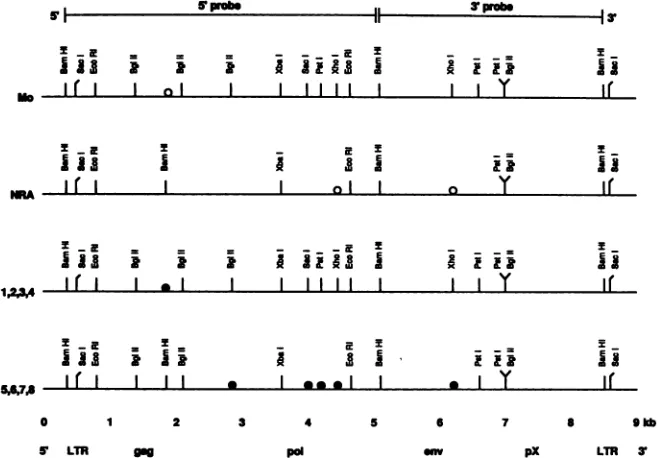
Provirus mapping studies. Southern hybridizationanalysis of DNA from the cultures confirmed the presence of the HTLV-II provirus (Fig. 2). Hybridization of chromosomal DNA digested with BamHI with the 3' probe gave the
expected signalof3.5kbinalleight isolates. Howeverwhen the5' probewasemployed, onlyfour DNAs(isolates1to4) produced the expected 4.7-kb signal defined by the two
BamHIsites which have beendescribedfor HTLV-II-Mo(5, 14).Theremaining fourproviruses(samples 5 to 8) hadan
additionalBamHIsite in the 5' end, withsignals at 3.2 and 1.5 kbbeingobserved. Physicalmapsof theeight proviruses
were prepared after partial and complete digestion with
singleandcombinations of restriction enzymes andSQuthern hybridization analysis. The results are shown in Fig. 3. It could be demonstrated that isolates 1 to 4 and 5 to 8, respectively,hadidenticalphysicalmapsand that therewere consistent differences between these isolates. In summary, isolates S to8differed from isolates1 to 4inthat theformer wereall found to have an additional BamHI site in the 5' end of the provirus and did nothave the expectedXhoI,SacI, PstI, andBglIIsites in the 5' endnor aXhoIsite in the 3' end
(see Fig. 5). Comparisonof thephysicalmapsof the isolates with those available for isolates Mo and NRA (Fig. 3)
showed that isolates 1 to 4 had identical maps to that of
isolate Mo. Althougha detailed physicalmap of the NRA isolate isnot available, it would appear from the published data (36)that it is similartothat ofisolates5to8 in that it wasreportedtohaveanadditional BamHI site in the 5' end and didnotcontain thetwoXhoIsites described in the Mo isolate. Thefindingsofconsistent differences in thephysical maps suggestthatthere may betwocloselyrelated molecu-lar subtypes of HTLV-II, and for the purposes of further studies these were tentatively designated HTLV-IIa and HTLV-IIb.
PCR amplification. PCR amplification methods were es-tablishedtoallow both theidentification of HTLV-II andto differentiate the two proposed subtypes with the aim of
screening PBMC DNA of HTLV-I-HTLV-II-seropositive
individuals. Primerswereselectedtoamplifythe generegion encoding the gp2lenv transmembrane protein, because the
physicalmapsshow that type aisolates haveaXhoI site in this region, whereas type b isolates do not. Thus, XhoI digestionofamplified DNAshould allowadifferentiationof thetwo subtypes. Inthese experiments both
primers
were labelledatthe 5' endspriortoamplificationand theproductsweredirectlyanalyzedbyelectrophoresis and autoradiogra-phyafterXhoI digestion.Theresults obtainedareshown in Fig. 4. Lanes 1 and2 were DNAsamples from PBMCs of
-i
4
l--., .:.
.. L
v -.,
k, .:.,... t'
e-. z-i
1A.
f..
on November 9, 2019 by guest
http://jvi.asm.org/
[image:3.612.88.538.74.409.2]1 2 3 4 5 6 7 8
B
1 2 3 4 5 6 7 89.4
6.6
-4.4
--is
_M
2.3 2.0
_
FIG. 2. Southern hybridization analysis ofDNA from BJAB-PBMCcocultures established fromeightpatients (lanes1to8).DNAswere
digestedwithBamHl andwereanalyzed withHTLV-II 3' (3.5kb) (A)andHTLV-II5'(4.7kb) (B) probes.
patients knownto be infected with types a andb,
respec-tively (isolates 2and 6). It could be seenthat after
amplifi-cation of typea DNA, XhtoI digestion produced signals at 450 and 180bp. As expected, the 630-bp product resulting
-I Wrbse
I
is
I
(
INo
5A,7.
fromamplification ofthe type b DNA was notdigested by XAhoI. Analysis of the 12 PBMC DNAs showed that in 8, digestionof theamplified productgave the twofragments of theexpected size,whereas fourremainedundigested. Thus,
-H-
probea =
I I
Y
Ii
,rf I coil Y'I
ElaSE
i
iA
4aS
fi
l15RX
IfI I I I . I.1 .IY Ir
2 3 4 5
LTR gmg Om pX LTR
FIG. 3. Restriction enzyme mapsof the proviruses of the eight HTLV-II isolates and comparisonwithmapsofthetwo original virus isolates(Mo and NRA)frompatients with atypical hairy cell leukemia. Mapswereconstructed from Southern blothybridizationanalyses
afterdigestionof the DNAswith theindicated restrictionendonucleases. Differences between isolates1to4and 5to8,respectively,arenoted
bythe solidcircles. ThephysicalmapofMowaspreparedbycomputeranalysis of the publishedsequence(39).ThemapofNRAwas as
previously published (36)and is adapted and used with permission of the publisher. Differences betweenthe Mo and NRA isolates are
indicatedby theopencircles.
A
9.4
--6.6
--4.4
-- 2.3-2.0
--I_ n I I I I I I lal l l l ll E
9 kb
on November 9, 2019 by guest
http://jvi.asm.org/
[image:4.612.113.498.75.336.2] [image:4.612.139.468.447.676.2]1 2
450bp- 0dA
180bp
FIG. 4. Gel electrophoretic analysisafterXhoI digestionof PCR
amplification products. DNAs from fresh PBMCswere amplified
with primers flanking thegeneregion encoding the transmembrane
gp2l protein.Samples 1 and 2areDNAs from PBMCsofpatients2
and6 andrepresentHTLV-IIa and HTLV-IIbisolates, respectively. Itcanbeseenthat the amplified product from patient1isdigested
with XhoI, whereas that from patient 2 is not. The remaining samplesareamplified products of DNAs from fresh PBMCs ofan
additional 12HTLV-seropositive IVDAs.
in addition to showing that all the patients have HTLV-II infection it appears that both of the proposed types are
present inthis population. It also appears that the
incorpo-ration oflabelled primers into thetypebamplifiedproduct is less than that into thetypeaproduct(Fig. 4). Thereasonsfor
HTLV-IIA HTLV- IIB
thisareunclear butmayreflectsomedivergence ofsequence
in theprimerregions.
Nucleotidesequenceanalysis. To determine whether there
are significant differences in nucleotide sequence between
thetwoproposed HTLV-II subtypes, the amplifiedproducts representing the transmembrane gp2l proteingene regions werecloned and sequenced. In these studies four isolates,
tworepresenting each HTLV-II subtype (type a, isolates 1
and3;typeb, isolates 6 and 7)wereanalyzed. Toensurethe
reliability of the method, the same region of HTLV-II-Mo was also analyzed and was found to have a sequence
identical to that previously published (39). In addition, at least two clones of each amplified region of each isolate
were analyzed, and no differences were noted. Figure 5
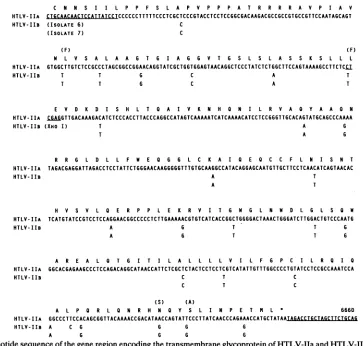
shows that both type a isolates had an identical sequence
to that reported for HTLV-II-Mo. The type b isolates showed identical changes in 25 bases, suggesting a 4%
divergence in nucleotide sequence.Onlyonebasedifference
was noted between the two type b isolates. All changes notedappeartobe pointmutations, and it canbe seenthat
theXhoI siteintype b isolates islostas aresult ofasingle
basechange (CtoT). Despite the relatively large numberof nucleotide changes, the predicted amino acid sequence of
C N N S I I L P P F S L A P V P P P A T R R R R A V P I A V
CT6CAACAACTCCATTATCCTCCCCCCTTTTTCCCTC6CTCCC6TACCTCCTCC66C6ACAA6AC6CCGCC6T6CC6TTCCAATAGCAGT (ISOLATE 6)
(ISOLATE 7)
(F) (F)
W L V S A L A A 6 T 6 I A G 6 V T G S L S L A S S K S L L L HTLV-IIA 6T66CTT6TCTCCGCCCTA6CG6CC66AACA66TATC6CT66TGGA6TAACA66CTCCCTATCTCT6GCTTCCA6TAAAA6CCTTCTCCI
HTLV-IIB T T 6 C A T
T T 6 C A T
E V D K D I S H L T O A I V K N H N I L R V A O Y A A O N
HTLV-IIA 6.A6GTT6ACAAA6ACATCTCCCACCTTACCCA66CCATAGTCAAAAATCATCAAAACATCCTCC666TT6CACA6TAT6CA6CCCAAAA
HTLV-IIB (XHO I) T A 6
T A 6
HTLV-IIA
HTLV-IIB
R R6 L D L L F W E O 6 L C K A I 0 E O C C F L N I S N T
TA6AC6A66ATTA6ACCTCCTATTCT666AACAA6G6G6TTT6T6CAA66CCATACA66AGCAATGTT6CTTCCTCAACATCA6TAACAC
H V S V L E R P P L E K R V I T 6 W 6 L N W D L 6 L S a W
HTLV-IIA TCAT6TATCCGTCCTCCA6GAAC6GCCCCCTCTT6AAAAAC6T6TCATCACC66CT6GG6ACTAAACT666ATCTT66ACT6TCCCAAT6
HTLV-IIB A 6 T T 6
A 6 T T 6
HTLV-IIA
HTLV-IIB
A R E A L 0 T 6 I T I L A L L L L V I L F 6 P C I L R O I 0
G6CAC6AGAA6CCCTCCA6ACA66CATAACCATTCTC6CTCTACTCCTCCTC6TCATATT6TTT66CCCCTGTATCCTCC6CCAAATCCA
(S) (A)
A L P O R L O N R H N O Y S L I N P E T M L - 6660 HTLV-IIA 6GCCCTTCCACA6C66TTACAAAACC6ACATAACCA6TATTCCCTTATCAACCCA6AAACCAT6CTATAATA6ACCT6CTA6CTTCT6CA6
HTLV-IIB A C 6 6 6 6
A 6 6 6 G
FIG. 5. Nucleotidesequenceof thegeneregion encoding the transmembrane glycoprotein of HTLV-IIaand HTLV-IIb.PCRamplification wascarriedoutwith DNA fromPBMC-BJABcocultures,andamplified productswerecloned inplasmid pCR1000.PrimersemployedinPCR
amplificationareunderlined.HTLV-IIa, represented bytheisolates frompatients2and3,wasfoundtohaveanidentical nucleotidesequence
tothatpreviously reported for the Mo isolate(39). Base changes in the HTLV-IIb (patients 6 and 7)sequences arenoted. Itcanbeseenthat the XhoI site in typeIIaisolates is eliminatedbyasinglebasepair change (CtoT)atposition6209. Thepredicted changesin amino acid
sequencearenoted inparentheses. The stopsignalis denotedwithanasterisk.
C
on November 9, 2019 by guest
http://jvi.asm.org/
[image:5.612.66.300.73.161.2] [image:5.612.124.487.332.678.2]the
gp21
of the type b isolates would haveonly
fourdifferences
(Fig. 5).
DISCUSSION
Inarecent report,we demonstrated that cocultivation of PBMCs from IVDAs who were
dually
infected with HTLV-II and HIV with BJABcells,
a continuousEpstein-Barr
virus-negative
B-cellline,
allowed the selective culti-vation of HTLV-II(9).
In the present report we have extended these studies and describe theuseofthis methodto isolate HTLV-II fromeight individuals, including
those with and without HIVinfection. The observation that the virus caninfect andreplicate
efficiently
in these cells offersunique
opportunities
for furtherstudy
of HTLV-II. The virus isclearly cytopathic
in BJABcells,
and there is considerableproduction
of cell-free virus asjudged by
reversetran-scriptase
activity
and electronmicroscopic
examination.Thus,
in addition toallowing analysis
of molecular eventsduring
HTLV-IIinfection,
cultivation of the virus in the BJABcell line shouldpermit large-scale production
ofvirusand/or
virusantigens
which may be useful forserological
andimmunological
studies. It ispresently
unclearwhether BJAB cells supportonly
thereplication
of HTLV-II and not HTLV-I.However,
allpreliminary
attempts to inducesyn-cytium
formation with HTLV-Iusing
a similar method of cocultivation have been unsuccessful(8a).
This result may suggest apreferential tropism
of HTLV-II for these cellsand/or
that HTLV-II has a greaterpotential
to cause cellfusion.
The isolation of HTLV-II from
eight
individuals has allowedfor the first timeadetailedcomparison
ofthis group of viruses. The literature containsonly
a small number of reportsonthe isolation and molecularanalysis
of HTLV-II. In additionto thetwooriginal isolates,
both of whichwere frompatients
withatypical hairy
cell leukemia(Mo
andNRA,
respectively),
the virus wassubsequently
isolated fromanIVDAwithclinicalfeatures of AIDS(8)
andfromapatient
withhemophilia
Awho had receivedmultiple
bloodproduct
transfusions(14). Although
the latter isolateswere notdirectly compared,
thepublished physical
mapsof theproviruses
would suggest that bothwereidenticaltothe Mo isolate.Recently,
we isolated and characterized HTLV-II fromtwoIVDAswhowereconcomitantly
infectedwith HIV(9).
Restriction enzymemapping
showed that whereas one isolate had an identical map to that of Mo, the second showedsimilaritiestoNRA,
andthefindings
suggestedthat there may begenetic
heterogeneity
in the HTLV-II group of viruses.In the present
study
using eight
virus isolates we have confirmed that there isgenetic heterogeneity,
but this isrestricted,
and there appearto be twodifferent but consis-tentphysical provirus
mappatterns.
Four of theproviruses
were identical to isolate
Mo,
with the other four havingidentical differences in six restriction endonuclease sites.
Interestingly,
theseisolates hadphysical
mapswhichwere similartothatreportedfortheNRAisolate.AlthoughNRAwas not
extensively
characterized and nucleotide sequence data is notavailablewhich would allow thegenerationofaphysical
map, it would appear that these four isolates areclosely
related toandperhaps
identical toNRA.The
finding
of twoconsistently
different provirus mappatterns
amongeight
virus isolates is unlikelyto be coinci-dental and suggests that there may be at least two closelyrelated
subtypes
ofHTLV-II,
which we have tentativelydesignated
HTLV-IIa and HTLV-IIb. On the basis ofre-striction endonuclease site differences, it could be expected that the nucleotide sequence of theproposed subtypes could varybyat least 5% (37) and thiswas supported in prelimi-nary analysis of the gene region encoding the transmem-brane protein gp2l. Of 631 bases analyzed, the two type b isolates had 25 identical base changes. Importantly, no differences were observed between the two type a isolates and HTLV-II-Mo, and only one base difference was ob-served between the two type b isolates. These findings supportthe idea that there may be at leasttwosubtypes of HTLV-II and demonstrate that there is strong sequence conservation in this generegion within each subtype.
The results of the present studies are too preliminaryto allow a comparison of the degree of nucleotide sequence
divergence occurring in HTLV-II with that in HTLV-I
proviruses. Inthe areasofJapan, the Caribbeanbasin, and Africa in which HTLV-I is endemic, the upper limit of
divergencebetween HTLV-Iisolates has been estimated at
3.5%,but it isgenerallymuch lower than this(3, 13, 17, 18,
23, 29, 30).Themajorityofnucleotide differencesaresingle
point mutations, and no correlation has been observed between thechanges and viruspathogenicity (3, 17, 18). In contrast, recent studies of HTLV-I isolates from newly discovered foci in Melanesia have shown upto 10% diver-gence in nucleotide sequence from those isolated in the
historicallyestablished areas (7). It may well be that these new isolates represent distinct molecular subtypes of HTLV-I and may have unique biological properties. By analogywith HTLV-I it can be expected that some diver-gence in nucleotide sequence will also be foundwithin the two proposed subtypes of HTLV-II. Further studies will determine whether this occurs more frequently in certain gene
regions
and, since many of the changes appear to bepoint mutations,
whether this will alsoproduce restriction enzymesitepolymorphism(s). Furthermore,continuedanal-ysisofnewHTLV-II isolates may leadtothe identification ofadditionalsubtypeswithperhaps differing biological prop-erties. If further analysis confirms significant nucleotide
differences among HTLV-IIisolates, this may well explain
some of the inconsistent results observed in a number of PCR studies in which certain generegionsof HTLV-II could be
amplified
whereas others couldnot (4, 16).The presentstudyalso extendsourpreviousobservations thatHTLV-II is theprominentHTLVinfection in seropos-itive IVDAs who are concomitantly infectedwith HIV(9).
Employing PCR to amplify gene regions which contained differences in restriction endonucleasesites, 12seropositive
IVDAswere all shown to have HTLV-II infection, with 8 and 4beinginfectedwithsubtypes IIaand Ilb, respectively. Recentlyit hasbeenreportedthat HTLV-II infection may be endemic in certain New World indigenous populations.
Similar studies to those described here should determine whetheroneof theproposedsubtypes occurs exclusively or
predominates.
The present study may have important implications for
investigations
intothe role ofHTLV-II in human disease. At present no definite disease associations exist, but this may well be duetothe small number ofindividuals identified with HTLV-IIinfection andto therelatively long latent periodsexpectedbetween infection and theonsetof disease. Future studies tobetter define this role should take into consider-ation potential genetic heterogeneity and possibly different
biological properties of the viruses. It is also unknown whether HTLV-II influences the natural history of HIV infection and/or vice versa. We have recently shown that
12.5% of the HIV-infected IVDAs in our population are
on November 9, 2019 by guest
http://jvi.asm.org/
HTLV seropositive (9) and this is predominantly due to HTLV-II infection (4, 9, 16, 20). Studies of homosexual males concomitantly infected with HTLV-I and HIV have suggested that they have significantlyincreased risk for the development of AIDS than individuals infected with HIV alone (1, 21). Similarly, it has been suggested that mortality ishigher inIVDAs with AIDS if there is concomitantHTLV infection (26). This apparent increase in HIV pathogenicity is supported by in vitro studies that the HTLV tax gene products can activate HIV gene expression in infected T cells (2, 40), that there isincreased production ofinfectious HIV in celllines mitogenically stimulated with HTLV-I (44), and that pseudotype formation may occur which could possibly lead to an extended tropism for HIV(22). Prospec-tiveclinical andimmunological investigations in this IVDA population will allow a better understanding of such interac-tions and of the role of HTLV-II in human disease.
ACKNOWLEDGMENTS
These studies were supported by grant CA5 1012-OlAl from the National Cancer Institute and the Jane and Dayton BrownVirology Laboratory.
The expert technical assistance of Maria Coronesi isappreciated. Wethank SusanMarki forpreparationof the manuscript.
REFERENCES
1. Bartholomew, C., W. Blattner, and F.Cleghorn. 1987. Progres-sion to AIDS in homosexual men co-infected with HIV and HTLV-IinTrinidad. Lancetii:1469.
2. Bohnlein, E., M.Siekevitz,D. W.Ballard, J. W.Lowenthal,L. Rimsky, H. Bogerd, J. Hoffman, Y. Wano, B. R. Franza, and W. C. Greene. 1989. Stimulation of the human immunodefi-ciencyvirus type 1enhancerby thehuman T-cellleukemiavirus type I tax gene product involves theaction ofinducible cellular proteins. J.Virol. 63:1578-1586.
3. Daenke, S., S. Nightingale, J. K. Cruickshank, and C. R. M. Bangham. 1990. Sequence variantsof humanT-cell lymphotro-picvirus type Ifrom patients withtropical spasticparaparesis and adultT-cellleukemia donotdistinguish neurological from leukemicisolates. J. Virol. 64:1278-1282.
4. Ehrlich, G. D., J. B.Glaser,K.LaVigne, D.Quan,D.Mildvan, J. J. Sninsky, S. Kwok, L. Papsidero, and B. J. Poiesz. 1989. Prevalence ofhumanT-cellleukemia/lymphoma virus (HTLV) type II infection among high risk individuals; type-specific identification ofHTLVs by polymerase chain reaction. Blood 74:1658-1664.
5. Gelmann, E. P., G. Franchini, V. Manzari, F.Wong-Staal,and R.C. Gallo. 1984. Molecularcloningofaunique T-cell leukemia virus(HTLV-IIMO). Proc. Natl. Acad. Sci. USA 81:993-997. 6. Gessain, A., F. Barin, J. L. Vernant, 0. Gout, L. Maurs,A.
Calender, and G. de The.1985. Antibodiestohuman T-lympho-tropicvirus type I inpatientswithtropical spasticparaparesis. Lancetii:407-409.
7. Gessain, A., R. Yanagihara,G. Franchini,R. M.Garruto, C.L. Jenkins,A. B.Ajdukiewicz, R. C. Gallo, and D. C. Gajdusek. 1991.Highly divergent molecular variants ofhuman T-lympho-tropic virus type 1 from isolated populations in Papua New Guinea and theSolomon Islands. Proc. Natl. Acad. Sci.USA 88:7694-7698.
8. Hahn, B.H., M.Popovic,V.S.Kalyanaraman,G. M.Shaw,A. Lo Monico, S. H. Weiss, F.Wong-Staal,and R.C. Gallo. 1984. Detection and characterisation of a HTLV-II provirus in a
patient with AIDS, p. 73-81. In M. S. Gottlieb and J. E. Groopman (ed.), Acquired immunodeficiency syndrome. Alan R.Liss, Inc., NewYork.
8a.Hall,W.W., and M. H. Kaplan. Unpublisheddata.
9. Hall, W. W., M. H. Kaplan, S. Z. Salahuddin, N.Oyaizu, C. Gurgo, M. Coronesi, K. Nagashima, and R. C. Gallo. 1990. Concomitant infections with human T-cell leukemia viruses (HTLVs)and humanimmunodeficiencyvirus(HIV);
identifica-tion of HTLV-II infecidentifica-tion inintravenous drugabusers(IVDAs), p. 254-273. In W. A. Blattner (ed.), Human retrovirology: HTLV. Raven Press, New York.
10. Hinuma,Y., K. Nagata, M. Hanaoka, M. Nakai, T. Matsumoto, K.Kinoshita, S. Shirakawa, and I. Miyoshi. 1981. Antigen in an ATL cell line and detection of antibodies to the antigen in human sera. Proc.Natl. Acad. Sci. USA 78:6476-6480. 11. Hjelle, B., R. Mills, S. Swenson, G. Mertz, C.Key, and S. Allen.
1991. Incidence of hairy cell leukemia, mycosis fungoides and chroniclymphocytic leukemia in first known HTLV-II endemic population. J. Infect. Dis. 163:435-440.
12. Ejelle, B., R. Scalf, and S. Swenson. 1990. High frequency of humanT-cell leukemia virus type II infection in New Mexico blooddonors: determination by sequence-specific oligonucleo-tidehybridisation. Blood 76:450-454.
13. JenGray, G. S., M. White, T. Bartman, and D. Mann. 1990. Envelope gene sequence of HTLV-I isolate MT-2 and its comparison with other HTLV-I isolates. Virology 177:391-395. 14. Kalyanaraman,V. S.,R.Narayanan, P. Feorino, R. B. Ramsey, E. L. Palmer, T. Chorbas, S. McDougal, J. P. Getschell, B. Holloway, A. K. Harrison, C. D. Cabradilla, M. Telfer,and B. Evatt. 1985. Isolation and characterisation of a human T-cell leukemia virus type II from ahemophilia A patient with pancy-topenia. EMBO J. 4:1455-1460.
15. Kalyanaraman, V. S., M. G. Sarngadharan, M. Robert-Guroff, M.Miyoshi, D. Golde, and R. C.Gallo. 1982. A newsubtypeof human Tcell leukemiavirus(HTLV-II)associated with a T cell variant ofhairy cellleukemia. Science 218:571-573.
16. Khabbaz, R. F., D. Hartel, M. Lairmore, C. R. Horsburgh, E. S. Schoenbaum,B.Roberts, T. M. Hartley, andG. Friedland. 1991. Human T-lymphotropic virus typeII (HTLV-II) infection in a cohort ofNewYork intravenousdrugusers: anold infection.J. Infect. Dis. 163:252-256.
17. Kinoshita, T., A. Tsujimoto, and K. Shimotohno. 1991. Se-quence variations in LTR and envregions of HTLV-I donot discriminate between the virus from patients with HTLV-I associatedmyelopathyandadult T-cell leukemia.Int.J.Cancer 47:491-495.
18. Komurian, F., F. Pelloquin, and G. de The. 1991. In vivo genomic variability of human T-cell leukemia virus type I depends more upongeographythan uponpathologies.J. Virol. 65:3770-3778.
19. Lairmore, M. D., S. Jacobson, F.Gracia,B. K. De, L.Castillo, M.Larreategui, B. D. Roberts, P. H.Levine, W. A. Blattner, and J. E.Kaplan.1990. Isolation ofhuman T-celllymphotropic virus type2 fromGuaymi Indiansin Panama. Proc.Natl. Acad. Sci. USA87:8840-8844.
20. Lee,G., P.Swanson,V.S.Shorty,J. A. Zack,J. D.Rosenblatt, and I. S. Y. Chen. 1989. High rate of HTLV-II infection in seropositiveIVdrug abusers inNewOrleans. Science 244:471-475.
21. Lefrere, H. H., A. M. Courouse, M. Mariotti, E. Wattel, 0. Prou, F. Bouchardeau, and P.Lampin. 1990.Rapid progression toAIDS in dualHIV-I/HTLV-I infection.Lancet336:509. 22. Lusso, P., F. Lori, and R. C. Gallo. 1990. CD4-independent
infectionbyhumanimmunodeficiencyvirus type 1 after pheno-typic mixing with human T-cell leukemia viruses. J. Virol. 64:6341-6344.
23. Malik, K. T. A., J. Even, and A. Karpas. 1988. Molecular cloning and complete nucleotide sequence of an adult T-cell leukemia type 1 (ATLV/HTLV-I) isolate ofCaribbean origin: relationshiptoothermembers of theATLV/HTLV-I subgroup. J. GenVirol. 69:1695-1710.
24. Miyoshi, I., I.Kubonishi,S.Yoshimoto,T.Akagi,Y.Ohtsuki,Y. Shiraishi, K. Nagota, and Y. Hinuma. 1981. Type C virus particlesin acord T-cell linederivedbyco-cultivatingnormal human cord leukocytes and human leukemic T-cells. Nature (London) 294:770-771.
25. Osame, M., K. Usuku, S. Izumo, N.Ijichi,H.Amitami,A.Igata, M.Matsumoto, and M. Tara. 1986. HTLV-I associated myel-opathy: a newclinicalentity. Lanceti:1031-1032.
26. Page, J. B., S. Lai, D. D.Chitwood,N.G.Klimas,P.C.Smith, and M.A. Fletcher. 1990. HTLV-I/II seropositivity and death
on November 9, 2019 by guest
http://jvi.asm.org/
from AIDS among HIV-I seropositive intravenous drug abus-ers.Lancet335:1439-1441.
27. Poiesz, B. J., F. W. Ruscetti, A. F. Gazdar, P. A. Bunn, J. D. Mima, and R. C. Gallo.1980. Detection and isolation of type-C retrovirus particles from fresh and cultured lymphocytes of a patientwith cutaneousT-celllymphoma.Proc. Natl. Acad. Sci. USA77:7415-7419.
28. Poiesz, B. J., F. W. Ruscetti, M. S. Reitz, V. S. Kalyararaman, and R. C. Gallo. 1981. Isolation of a new type-C retrovirus (HTLV) in primaryuncultured cells of a patient with Sezary T-cell leukemia. Nature (London) 294:268-271.
29. Ratner, L. 1990.Molecularvariation of human T-lymphotrophic viruses and clinical associations, p. 49-64. In W. A. Blattner (ed.), Humanretrovirology: HTLV.RavenPress, New York. 30. Ratner, L., S. F. Josephs, B. Starcich, B. Hahn, G. M. Shaw,
R. C. Gallo, and F. Wong-Staal. 1985. Nucleotide sequence analysis ofavariant human T-cell leukemia virus (HTLV-Ib) provirus withadeletion inpX-I. J.Virol. 54:781-790. 31. Reeves, W. C.,P. Levine,P.Cuevas, M.Quiroz, E. Maloney,
andC.Saxinger. 1990.Seroepidemiology of human T-cell lym-photropic virusin therepublicofPanama.Am. J. Trop. Med. Hyg.42:374-379.
32. Robert-Guroff,M., Y. Nakao, K. Notake, Y. Ito, A. Sliski, and R. C. Gallo. 1982. Natural antibodies to human retrovirus HTLV in a cluster of Japanese patients with adult T-cell leukemia. Science215:975-978.
33. Robert-Guroff, M., S. H. Weiss, J. A.Giron, A. M. Jennings, H. M.Ginzburg,B.Margolis, W. A. Blattner, and R.C. Gallo. 1986. Prevalence of antibodies to HTLV-I, -II and -III in intravenous drug abusersfrom anAIDSendemic region.JAMA 255:3133-3137.
34. Rosenblatt, J. D., I. S. Y. Chen, and W. Wachsman. 1988. Infection with HTLV-I and HTLV-II. Evolving concepts. Semin.Hematol.25:230-246.
35. Rosenblatt, J.D.,J.V.Giorgi,D. W.Golde,J. BenEzra, A. Wu, C. D. Winberg, J. Glapsy, W.Wachman, and I. S. Y. Chen. 1988. Integrated human T-cell leukemia virus II genome in
CD8+ T cells from apatientwith"atypical" hairycell leuke-mia: evidence for distinct T and B cell lymphoproliferative disorders. Blood 71:363-369.
36. Rosenblatt,J. D., D. W.Golde,W.Wachsman,J. V. Giorgi, A. Jacobs, G. M. Schmodt, S. Quan, J. C. Gasson, and I. S. Y. Chen. 1986. A second isolate of HTLV-II associated with atypicalhairycellleukemia. N.Engl.J.Med. 313:372-377. 37. Saag,M.S.,B.H.Hahn,J. Gibbons,Y.Li, E. S.Parks,W. P.
Parks, and G. M. Shaw. 1988. Extensive variation ofhuman immunodeficiency virustype 1 in vivo. Nature(London)334: 440-444.
38. Sambrook, J.,E. F.Fritch, and T.Maniatis. 1989. Molecular cloning: alaboratorymanual.ColdSpringHarborLaboratory, Cold SpringHarbor,N.Y.
39. Shimotohno, K.,Y.Takahashi,N.Shimizu,T.Gojobori,D. W. Golde, I. S. Y. Chen, M. Miwa, and T. Sugimura. 1985. Complete nucleotidesequenceofaninfectious clone ofhuman T-cell leukemia virus type II: an openreading frame for the protease gene.Proc. Natl.Acad. Sci. USA 82:3101-3105. 40. Siekewitz, M., S. F. Josephs, M. Dukovitch, N. Peffer, F.
Wong-Staal, and W.C. Greene. 1987.Activation of theHIV-1 LTR by T-cell mitogens and the trans-activator protein of HTLV-1.Science 238:1557-1559.
41. Tedder, R., D. Shanson, R. Jeffries, R. Cheingsong-Popov, P. Clapham, A. Dalgleish,K. Nagy, and R.A. Weiss. 1984. Low prevalence in the U.K. ofHTLV-I and HTLV-II infection in subjects with AIDS, with extended lymphadenopathy, and at riskforAIDS. Lancetii:125-128.
42. Wong-Staal,F., and R.C.GaBo.1985.HumanT-lymphotrophic retroviruses. Nature(London) 319:395-403.
43. Yoshida, M., I. Miyoshi,and Y. Hinuma. 1982. Isolation and characterisation of retrovirus from cell lines of human adult T-cell leukemia and itsimplication in disease. Proc. Natl. Acad. Sci. USA 70:2031-2035.
44. Zack, J. A., A. J.Cann,J. D. Lugo, and I. S.Y. Chen. 1988. HIV-I production from peripheral blood cells after HTLV-I induced mitogenic stimulation.Science 240:1026-1029.