Chapter 2
Turning Around the Least Liveability:
A Cost-Benefit Framework for Dhaka
Khorshed Alam
Abstract
The aim of this chapter is to seek smart solutions to key socio-economic, environmental, and infrastructural issues facing Dhaka city, the capital of Bangladesh. Specifically, a cost–benefit analysis (CBA) is employed to assess the suitability of selected intervention strategies for a liveable Dhaka city from the perspective of society. This study investigates the following key research questions: (i) How can Dhaka, a rapidly growing city, become liveable (interventions)?; (ii) How much is the liveability worth (costs)?; (iii) What are the socio-economic, health, and environmental benefits of interventions (benefits)?; and (iv) Are the interventions worth undertaking (net benefit)?
The research findings are based on two focus group discussions and a number of key informant interviews in the study area, as well as on an extensive review of published documents. Economic analysis revealed that the benefit–cost ratio at 10% discount rate and internal rate of returns of the project are 1.92 and 42%, respectively, which indicate the project is attractive, both financially and economically. However, this leaves policymakers, planners, development partners, and concerned citizens to make value judgment calls when interpreting these numbers. The results, which should be interpreted alongside the social and political imperatives of a rapidly growing megacity, suggest an immediate intervention to avoid any further deterioration of the environment and social structure.
2.1 Background and Motivation of the Study
Dhaka, the capital of Bangladesh, has experienced unprecedented urban growth since 1971: an eightfold increase in the population over the last four-and-a-half decades. Rapid and unplanned urbanization presents enormous challenges for the city, and it is predicted that in 2050 an additional 20 million people will live in Dhaka with a population density of 108,000/km2 (United Nations, 2015). The United
Nations report (2015) projected that Dhaka, from its current rank of 11th, would become the sixth most crowded city by 2030 with a
population of over 27 million. In recent times, Dhaka has been consistently ranked as one of the least liveable cities in the world (EIU, 2015). A recent study also projected Dhaka to be one of the top cities in terms of population exposure to flooding by the 2070s (Dasgupta et al., 2015).
Between 1990 and 2000, the built-up area increased by around 46%, and about 268 km2 of wetlands in and around Dhaka city were filled up
(JICA Baseline Study, 2000). The city’s expansion occurred both horizontally and vertically. With the increase in population and economic activity, the demand for utility and environmental services has increased.
The capital city is surrounded by a peripheral river system. Once there were numerous natural canals and khals (wetlands), in many cases interlaced with each other. These played a critical role in the city’s drainage management, as these acted as conveyance passages and temporary detention systems for stormwater generated in the city. However, due to unplanned urbanization and rapid growth of economic activities, this vast array of water bodies and low-lying areas have been encroached upon and subjected to construction without adequate water, sewage, drainage, and solid waste management (SWM) services. Peripheral rivers are also losing their floodplain areas; making waterlogging during monsoon seasons a perennial problem.
While the Government of Bangladesh (GoB) has undertaken a number of policy initiatives and made significant investments to improve the environmental quality and utility services in Dhaka city, there remains much to be done. Critically, interventions are often short-sighted and adhoc in nature. There are serious weaknesses in coordination among agencies involved and lack of a participatory approach to design, planning, and implementation. For instance, Dhaka Water Supply and Sewerage Authority (DWASA) is mandated for Dhaka city’s drainage system development and maintenance; however, a number of other organizations – including Dhaka City Corporation (DCC), Bangladesh Water Development Board (BWDB), Bangladesh Inland Water Transport Authority (BIWTA), Rajdhani Unnayan Kartripakkha (Capital Development Authority or RAJUK), Local Government Engineering Department (LGED), Roads and Highways (R&H), and Public Works Department (PWD) – are involved with the waterlogging and drainage congestion issues, and there is little coordination among these agencies. This poor governance and inefficient management structure has raised concerns as to whether the city can sustain an overcrowded populace with its massive environmental degradation and health hazards, decaying urban ecosystems, and a lack of adequate urban infrastructure and utility services.
The aim of this research is, therefore, to seek smart solutions to key socio-economic, environmental, and infrastructural issues facing Dhaka. Specifically, CBA is employed to assess the suitability of selected intervention strategies for a liveable Dhaka city from the perspective of society. This study investigates the following key research questions: (i) How can Dhaka, a rapidly growing city, become liveable (interventions)?; (ii) How much is the liveability worth (costs)?; (iii) What are the socio-economic, health, and environmental benefits of interventions (benefits)?; and (iv) Are the interventions worth undertaking (net benefit)?
This research provides an opportunity for the policymakers to drive prioritization and investment decisions by understanding the relative (net) benefits that each intervention strategy can produce. It can inform policy choices by summarizing the trade-offs involved in designing, applying, or reviewing a wide range of strategies. This will ensure that
the decision-makers adopt practices and policies on the best evidence available and in the public’s interest. Given that there remain critical research gaps in knowledge in terms of adopting a holistic approach to designing interventions for a livable city, a better understanding of location-specific interventions and their economic efficiency from a societal perspective will add value to the existing knowledge. This will also help planners and policymakers to identify critical areas of weakness, and to identify actions and programs to improve the city’s liveability conditions.
2.2 Methodology
2.2.1 Conceptual Framework
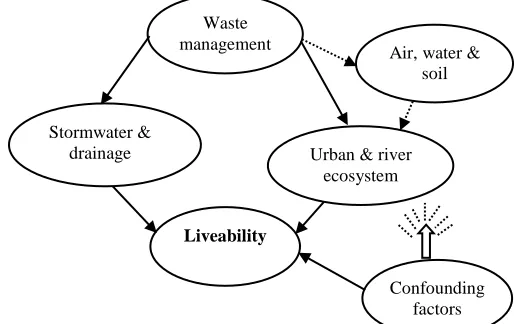
[image:3.842.482.739.392.554.2]The key socio-economic and environmental issues concerning Dhaka are interconnected (Figure 2.1). Therefore, a holistic and integrated approach to planning, development, and implementation is required. For instance, a lack of appropriate solid waste management infrastructure affects both the urban and river ecosystems in Dhaka: the sewage disposal and drainage systems in the city are affected, because not only are many landfill sites established close to the lakes, canals, and rivers, but households often dispose off their solid and liquid wastes directly into these systems (Alam, 2003; 2013).
Figure 2.1: Conceptual framework of urban livability
Waste management
Urban & river ecosystem Stormwater &
drainage
system
Liveability
Air, water & soil pollution
Inadequate and inappropriate storm water drainage along with the impacts of a changing climate also affects livability and resilience of the city. In recent years, it was observed that even a little rain causes serious inundation and water logging in Dhaka (Alam & Rabbani, 2007). Water logging due to drainage congestion in the city is not just associated with heavy rainfalls but is also related to unplanned changes to land-use; for instance, in filling and encroachment of low-lying areas, canals, and riverbanks and the concretization of land masses. Water logging creates large infrastructure damage and results in huge economic losses. The combined effect of these inadequacies and non-functioning services poses a threat to public health, ecosystem services, and economic growth, and thus affects the quality of life of the city’s inhabitants.
In designing the intervention strategies, it is worth noting a number of confounding factors including a changing climate, unplanned urbanization, lack of decentralization and good governance, rural-urban migration and political instability. A failure to take into account these factors in the economic analysis may lead to a flawed interpretation of the research findings.
2.2.2 Benefit Estimation
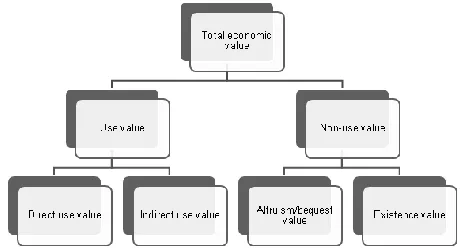
[image:4.842.501.733.89.213.2]The analytical approach in benefit estimation adopted for this research was the Total Economic Value (TEV) framework, which captures the diverse range of benefits of the intervention strategies (Figure 2.2). This framework is able to capture both the marketed and non-marketed benefits of the interventions.
Figure 2.2: The total economic value framework
Source: Adopted from Alam (2008) and Alam and Marinova (2003).
Estimating the value of various services and of the benefits that may be generated can be done with a variety of valuation approaches which have different advantages and disadvantages. Conducting an economic valuation by state-of-the-art criteria is time-consuming and costly. Despite the difficulties of transferring valuation approaches and results across countries and regions, ‘Benefits Transfer’ (BT) can be a practical, swift, and relatively inexpensive way to estimate benefits, particularly when the aim is to assess a wide range of interventions. Thus, value estimates were obtained through BT from economic valuation studies and project reports conducted for Dhaka and other cities. These values were corrected using an’ adjusted point estimation’ approach – these took the form of adjusting the value for income, differences in intervention impacts, and differences in time. In addition, expert judgments and the views of sectoral experts were employed for the adjustments.
The estimation framework for costs captures both the direct and indirect costs for capital and the operation and maintenance (O&M) investments.
2.2.3 Estimation of the Overall Efficiency of Interventions
research. The BCR of various interventions was estimated using the criteria following Alam (2011a):
n t t t n t t tr
C
r
B
BCR
1 11
1
In addition, the net present value (NPV) of each intervention was estimated using the following criteria:
n t t t tr
C
B
NPV
11
Here, B, C, rand t denote benefit, cost, discount rate and time-frame of the project (t=1, ….., n), respectively. The discount rate was used to convert annualized costs and benefits into the NPV. The discount rate at which the NPV is zero is called the Internal Rate of Return (IRR). Although the majority of the costs and benefits are continuous, the time-span of the analysis was limited to 10 years, since most of the impacts are expected to be observed in the first few years after the implementation of intervention actions and strategies. The sensitivity analysis was performed using a range of discount rates between 3% and 15%. The discount rate was assumed to be 10% for the base-case scenario, 15% for the pessimistic scenario, and 3% for the optimistic scenario.
2.2.4 Data Sources and Collection
Data on direct use benefits and costs of interventions were collected from primary sources, while data on other categories of benefits were sourced from secondary sources – published papers and/or unpublished documents. Primary data were collected through semi-structured interviews with key stakeholder groups of various public sector agencies including DCC, DWASA, BWDB and BIWTA. In addition, a few representatives from non-government organizations were
included, considering their involvement in the intervention actions. Semi-structured interviews were chosen, since the nature of research issues required that informants had flexibility to explain their opinion and had the opportunity to consult documents and provide appropriate information. Essentially, the investigation required participants with good knowledge about the issues under investigation, familiarity with utility service-related aspects, and involvement with the operation and management of these issues.
A systematic review of literature was also undertaken for peer-reviewed papers, reports, and other documents relating to the key domains of this research and with particular reference to Dhaka. Relevant documents were analysed to review the estimated costs and benefits of the intervention strategies as stated above. This was validated with the sectoral experts in the focus group discussions (FGDs).
Participants for the interviews were selected based on the particular purpose of this research. The aim was to select participants from the relevant public sector agencies who would provide relevant information about the suitability of the intervention actions and their estimated costs of various components. Fourteen participants and sectoral experts were interviewed in-person or via teleconferencing using a list of predetermined sets of questions (mostly open-ended). The interviews focused on the costs of various components of intervention actions and their expected benefits.
Two virtual FGDs were conducted with five and seven participants, respectively, from the Planning Commission, Ministries of the Environment and Forests, and Disaster Management and Relief, DWASA, DNCC, BWDB, BIWTA, and a private consultant on urban infrastructure design issues.
a roundtable in Dhaka on 14 February 2016, which was attended by a number of participants from BRAC (NGO), Copenhagen Consensus Center, and other research groups of the Bangladesh Priorities Project.
All revenues, benefits, and costs were updated and expressed in February 2016 prices. The proposed drainage network was designed based on the findings of the modelling studies of the BWDB (2010). Most cost estimates were based on the standard unit costs of the Schedule of Rates of the BWDB and current practices of the DWASA. Other cost components, such as land acquisition, were based on the market prices prevailing in February 2016.
For domestic sources, materials, equipment, and services included a value added tax of 15%. For overseas procurement, a composite tax rate of 29% was included in the base costs. All economic costs, in particular imported tradable inputs, are net of these duties and taxes. The 2016 (February) exchange rate of Tk 78.70 per US$1.00 was used in converting foreign exchange costs to their local currency equivalents, and vice versa.
2.3 Description of the Study Area
The study area – Dhaka metropolitan city – covers an area about 360 km2 and is surrounded by the distributaries of the two major river
systems, namely, the Brahmaputra and the Meghna. The city is bordered by Tongi khal (canal) and Turag River in the north, Balu River and Lakhya River in the east, and Buriganga River and Dhaleshwari River in the west and south (Map 1). In 2011, the Dhaka City Corporation was divided administratively into two localities: Dhaka North and Dhaka South. According to the 2011 Census, approximately 14.54 million inhabitants lived in the Dhaka Statistical Metropolitan Area (BBS, 2012); the population in 2016 was estimated to reach 10 million for the Dhaka City Corporation (DCC) area (World Bank, 2007).
Map 1: Dhaka and surrounding cities
Dhaka is one of the most densely populated cities in the world. An estimated 300,000 to 400,000 migrants, mostly rural poor and regional jobseekers, arrive in the city annually (World Bank, 2007), making Dhaka one of the world’s fastest-growing megacities and also one of the most unplanned urban centres (Rashid et al., 2013). More than 37% of the city’s population is poor and mostly live in slum areas in the Dhaka metropolitan area (CUS, 2006). During the last three decades, while the city population has grown by over 7% annually, the slum and squatter population of the city grew from 1.0 million in 1990 to 3.4 million in 2005 –a growth of 3.4 times over one-and-a-half decades.
Always a threat through periodic floods, the river remained an intrinsic part of the city until the early 1980s when intensive human interventions, unplanned urbanization, and population pressure greatly influenced its flow and ecological function. Once a determining factor for trade and urbanization and a source of industrial growth (predominantly small and medium scale enterprises in the southern part of the city), it was later degraded by industry (particularly tanneries) and sprawling residential developments along its banks and catchment, and by the use of waterways as sewers for carrying urban solid and liquid waste (Alam, 2011b; 2013). The situation deteriorated further because of the lack of appropriate waste management infrastructure and an inadequate sewage disposal system in the city, particularly in the vicinity of the river. Not only have many landfill sites been established close to the river, households along the river also directly dispose off their waste (both solid and liquid) into the river. Furthermore, since the early 1980s, unscrupulous people started to seize the off-shore land, building illegal encroachments without waste disposal and sanitation facilities. As a result of these human actions on the one hand, and failure by the authorities to enforce rules and regulations to save the river on the other, the Buriganga River is dying biologically and hydrologically (Alam, 2003; 2013).
Historically, lowlands, khals, and wetlands in and around the city played a significant role in controlling flooding and rainwater congestion in Dhaka city (Alam, 2008). Even today, whatever is left of these canals is used as the primary drainage system for the city. However, most of these canals have disappeared due to reasons such as unplanned urbanization, encroachment, dumping of solid wastes, lack of coordination between the government agencies, and lack of maintenance to the system. The few canals which are left are also on the verge of extinction as they have lost their flow, blocked by either roads or unauthorized structures, and cannot carry a huge volume of stormwater for the sprawling population. As a result, each year, the city dwellers face acute waterlogging during the rainy season (Mahmud et al., 2011).
Dhaka is not only the capital city of Bangladesh, it has a significant role in overall socio-economic development and employment growth of the country. About 10% of Bangladesh’s population lives in the Dhaka
metropolitan area; however, the city contributes 36% of the country’s GDP (Muzzini & Aparicio, 2013). According to IMF’s 2014 analysis, the total Gross Domestic Product (GDP) of Dhaka was US$ 231 billion in terms of Purchasing Power Parity. Overcrowding, pollution, inadequate utility services, and increasing demand for infrastructure make it a challenging task for planners, policymakers, and concerned citizens.
2.4 Identification of the Counterfactuals and
Intervention Strategies
A ‘business-as-usual’ scenario as a base-case counterfactual was assumed for this research. The baseline scenarios are important for comparing projected/estimated outputs and outcomes to what they would have been in the absence of the intervention actions. Therefore, costs and benefits were determined as incremental to what would have happened had the interventions not gone ahead.
As outlined in Figure2.1, three key intervention strategies were identified for this research: (i) improved solid waste management; (ii) restoration of the Buriganga River system; and (iii) improved stormwater drainage systems.
The following section provides an overview of the current situation, a brief inventory of baseline scenarios and institutional arrangements, and proposed interventions for these three actions.
2.4.1 Improved Solid Waste Management
sustainable – can be characterized as a combination of ‘collect-transport-dispose’ and ‘don’t-dump-in-my-doorstep’. It has significant impacts on water, air, and soil pollution and thus severe environmental, health, and safety concerns.
The waste stream consists of mostly organic materials and contains a wide range of substances including food and agricultural waste, paper, metals, and construction debris. These materials are not segregated at the point of origin, so contaminate the biodegradable parts and hinder the proper process of decomposition.
The intervention strategy for this study was designed on the ‘5Rs’ approach as follows (Alam, 2011a):
Reduce;
Reuse;
Recycle;
Recover waste transformation through composting and biogas;
Residual safe land filling.
The key components of this approach include minimization of waste and recycling through separation at sources, resource recovery through composting and biogas production, and reuse and recycling of waste. The key to the resource recovery process is the establishment of an anaerobic digestion system, which is elaborated below.
The organic component of MSW is digested through an anaerobic process, which results in the release of harmful greenhouse gases (GHGs) – including methane – into the environment. The mixed waste dumped at the landfill sites is characterized by high organic and moisture contents – about 80% and 50–70% by weight, respectively (BCSIR, 1998); this implies that MSW has the potential to generate energy such as biogas for domestic and commercial uses, and bio-compost for agricultural uses. In recent times, biogas production from SW has received significant attention as an alternative to conventional fossil fuel. The GoB is also promoting the production of biogas from biodegradable wastes as well as production of electricity from combustible (organic and inorganic) solid waste (GoB, 2008). Therefore, for an intervention, an integrated approach to MSW
management is proposed here. This includes an anaerobic treatment of waste through source segregation of waste into organic and inorganic components, and recycling of organic wastes to produce bio-composts and biogas through anaerobic treatment. The separation of recyclables at-source will ultimately reduce landfill volumes. Table 2.1 below provides an outline of the base-case and intervention scenario.
Table2.1: Improvement of solid waste management
Base-case scenarios Intervention scenarios The city generates 3500–
4000 Mt/day of waste, of which approximately 50% is collected and disposed of in open dumping sites, with the remainder being dumped in low-lying areas, water bodies, and rivers.
80–90% of the generated waste will be collected and disposed of, with part of this being separated at-source and recycled.
Composting and biogas generation is proposed as an alternative to the existing arrangement.
2.4.2 Buriganga River Restoration
The water of the Buriganga River is being polluted from surrounding point and non-point sources (Alam, 2003) along its path; waste water is discharged from these sources as industrial effluents, municipal sewage, and household, industrial, and clinical wastes. Of the approximately 300 effluent discharge outlets in Dhaka city, 19 outlets carry major discharge of mixed effluents, which is falling directly into the Buriganga River (IWM, 2007). Studies also found the presence of higher than recommended value of heavy metal concentrations in the Buriganga River, which suggests that the river water is harmful for humans and aquatic animal species (Ahmad et al., 2010).
control measures for different point and non-point sources of pollution. An upgrade of the Pagla Sewage Treatment Plant is necessary to treat the sewage from existing as well as future residents of the study area. The intervention also requires policies and strategies in the form of stopping illegal disposal of household and industrial wastes, and reclaiming riverbanks from illegal land developers.
An upgrade of the circular waterways around the city, integrating its peripheral water routes, can facilitate the transportation of people and goods. This can also reduce the already over-burdened city surface transportation system and provide a ‘by-pass route’ for commuters.
The GoB has implemented an initiative to relocate the existing tanneries – a large source of industrial waste – from Hazaribag to Savar. The construction phase of the new tannery location with effluent treatment facilities is now complete and tanneries are currently in the process of relocating there, meaning that one of the major contributors to point source pollution will be rectified within the next few months. However, it may take years to assimilate the already heavily polluted river water due to the significant presence of industrial pollutants.
Table2.2: Restoration of the Buriganga River
Base-case scenarios Intervention scenarios Industrial effluent of 207 tanneries
from Hazaribag directly flow to the river along with domestic waste and sewage and urban runoff from a large part of the city (tanneries discharge approx. 21,600 m2 of
liquid wastes, 627 dyeing units discharge 5000 m2 of effluents and
234 fertilizer industries discharge approx. 9000 m2 of effluents daily
into the river).
Illegal encroachment of riverbank.
An integrated approach to restore the river ecosystem with an aim to: remove illegal structures from the riverbanks, upgrade the waste (sewage) treatment plant; improve sewage network and develop treatment facilities for residents living along the riverbank; improve 110 km of circular waterways to restore navigability of the Buriganga-Turag rivers from Sadarghat to Ashulia to Kanchpur through dredging and construction of landing facilities and access roads; develop tourism and recreational facilities.
2.4.3 Improvement of Stormwater Drainage Systems
Of the mandated coverage area of 360 km2, only 140 km2
(approximately 39%) is covered by DWASA’s stormwater drainage networks (DWASA, 2016). Historically, a number of natural drainage channels criss-crossed through and around the city, which carried away runoff to the surrounding rivers and low-lying areas. Seventeen of 43 such natural canals no longer exist (Dasgupta et al., 2015).
In the past, box culverts have been constructed over many of the natural khals and canals in the city including on the Dholaikhal. Due to a lack of proper maintenance and the dumping of sewage and solid waste into the sestormwater drainage networks, these box culverts are clogged up and have become non-functional during the rainy season. The flow area of drainage canals has also narrowed due to unauthorized encroachment into canal sections.
Indiscriminate urbanization – coupled with the continuous filling up of low-lying flood-plains, including detention and retention ponds, surrounding rivers, and other water bodies in the city – are the key causes of urban flooding and waterlogging during heavy rainfall events (Dasgupta et al., 2015; Tawhid, 2004). This has also contributed to a progressive change in land-use patterns and thus an increase in concretizedl and cover.
DWASA has four permanent pumping stations in the city, located at Kalyanpur, Rampura, Kamalapur and Dholaikhal; BWDB also operates a pumping station at Goran Chat Bari. Dhaka city experiences severe waterlogging due to its stormwater drainage systems’ inability to manage peak runoff volume. In addition, precipitation intensity and patterns are expected to change due to climate change, and such variations are likely to contribute to the severe flooding (Afrin et al., 2015). Rainfall has a significant effect on the city’s water management: Dhaka experiences about 2000 mm of rainfall annually, 80% of which falls during the monsoon period of June to October (Yahya et al., 2010).
proposed that the stormwater drainage system is developed in a way that alleviates the rainfall-induced waterlogging in the city (Table 2.3). Proposed interventions include installation of four new pumping stations. Rehabilitation of existing pumping stations was excluded, as this is considered to be an ongoing responsibility of the concerned agency.
Table2. 3: Improvement of stormwater drainage system
Base-case scenarios Intervention scenarios Current drainage network
includes: 280 km of stormwater pipes, 10.5 km of box culverts, 145 km of open intake canals, 5 permanent and 15 temporary pumping stations.
Improvement of drainage system includes:
installation of 4 new permanent pumping stations, procurement and installation of electrical equipment, re-excavation of drainage canal network (12 km), construction of bridges & box culverts at the road-crossings with drainage canals (2km), restoration of retention ponds for storage of excess runoff during heavy rainfalls, construction of new drainage pipes (60 km), installation of 10 temporary pumping stations.
2.5 Costs and Benefits of Interventions
This section begins with a calculation of costs, proceeds to the monetization of benefits, and concludes with the calculation of CBA. Many items of cost and benefit are goods or services that are normally traded in markets at well-known or estimated prices. However, others are not directly traded and are more difficult to value. Values of such items are estimated through indirect, complicated, and somewhat subjective calculations. The most practical approach is usually to find previous studies estimating values for similar products and to use these values in the CBA with appropriate adjustments.
The benefits and costs of the interventions were measured against the counterfactuals identified in the previous chapter (Tables 1, 2, and 3). Every attempt was made to identify and value costs and benefits. When
quantification was difficult, the impact is mentioned or at least identified.
Most cost items were valued at their market prices with adjustments in some special circumstances. Cost components were divided into the capital costs – those required to install and construct necessary infrastructure and facilities, and for procurement of necessary equipment – and O&M costs, required annually to run the facilities.
Benefit estimates for non-market goods and services were transferred to the ‘policy site’ from the ‘study site’. Adjustment for price changes was also considered. Point estimates (mean values) were transferred without any further adjustments, except the adjustment for price changes between the original study and the current year. This is considered to be acceptable due to the similarity between the context with regard to both the relevant population and valued policy (Santos, 2007).
A standard discounted cash flow analysis was used to calculate the NPV, CBR, and IRR of the recommended actions. As required by the Bangladesh Planning Guidelines, 10% discount rate was applied. In addition, low rates such as 3% and 5% refer to the return we can expect from investment in public goods, while the 15% discount rate may reflect the assumed financial return the private sector could expect from their investment.
It is also important to note that underlying assumptions need to be made explicit in order to make a CBA plausible. The implementation period of the whole project is four years covering all the identified interventions, and it is assumed to have a useful economic life of more than 10 years. For the purpose of this analysis, a 10-year planning horizon was assumed.
intervention investments are additional and take into account potential socio-economic growth factors in the estimation.
2.5.1 Cost and benefit estimates for improving solid waste management
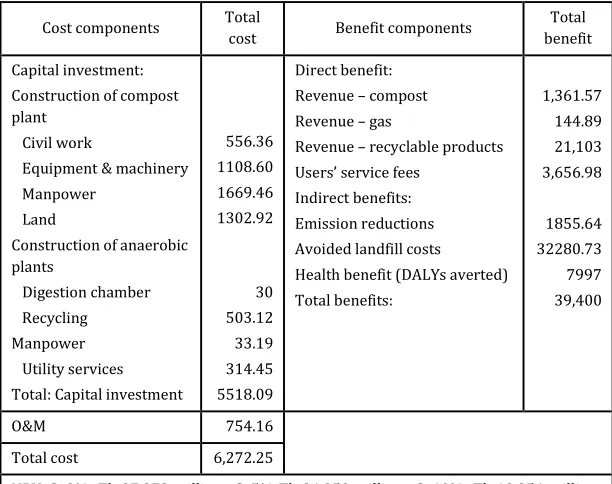
Key cost items include construction of 10 anaerobic bio-compost and biogas plants in 10 different localities of the city and also comprise land rent; additional waste collection costs; and utility services for the facilities. Direct benefits of the intervention include revenues from selling compost, biogas, and recyclable products; and users’ fees. Indirect benefits include emission reductions and avoided landfill costs. Gas and compost were priced at Tk 7 per cubic metre and Tk 5 per kg, respectively.
Total investment cost of the intervention is estimated at Tk 6,302.57 million (Table2.4); total benefit is estimated at Tk 39,400 million. The NPV is estimated between Tk 14,057 million and Tk 27,348 million for varying discount factors. At 10% discount rate, the BCR is 5.67. Therefore, we can conclude that the intervention is worthy from an economic perspective.
[image:11.842.464.770.95.337.2]One of the challenges of implementing the resource recovery initiative is that the gas distribution network in Dhaka city is well covered by the public sector agency – Titas Gas Transmission and Distribution – which is currently heavily subsidized. Biogas production needs to be connected to the gas network. This was not costed in this study.
Table 2.4: Total costs and benefits of solid waste management improvements (Million Tk)
Cost components Total
cost Benefit components
Total benefit Capital investment:
Construction of compost plant
Civil work
Equipment & machinery Manpower
Land
Construction of anaerobic plants
Digestion chamber Recycling Manpower Utility services Total: Capital investment
556.36 1108.60 1669.46 1302.92
30 503.12 33.19 314.45 5518.09
Direct benefit: Revenue – compost Revenue – gas
Revenue – recyclable products Users’ service fees
Indirect benefits: Emission reductions Avoided landfill costs
Health benefit (DALYs averted) Total benefits:
1,361.57 144.89 21,103 3,656.98
1855.64 32280.73 7997 39,400
O&M 754.16
Total cost 6,272.25
NPV @ 3%: Tk 27,378 million; @ 5% Tk 24,252 million; @ 10%: Tk 18,254 million; and @ 15% Tk 14,083 million.
BCR@ 3%:6.11; @ 5%: 6.0; @ 10%:5.71; and @ 15%: 5.42. IRR: 65%
The total volume of solid waste in the city is expected to accelerate along with increases in population, income, and economic activities. However, due to changes in lifestyle, other socio-economic factors, and the introduction of a source-separation initiative, per capita waste generation is expected to decline. Therefore, these two factors are assumed to offset each other; thus, the volume of solid waste remains constant over the project plan period.
rich. No attempt was made to do a distributional analysis – either for this particular intervention or for the overall intervention.
2.5.2 Cost and benefit estimates for restoration of the Buriganga
River
The capital cost components of the Buriganga River restoration include removal of illegal structures from the riverbank, construction of access roads and walkways, improvement of sewage facilities along the river, dredging and excavation of riverbeds and upgrading of landing facilities, and infrastructure development for recreation and tourism activities.
The direct benefits of the restoration intervention include increased property values, fee revenue from wastewater treatment, improved navigation and fish production, increased value of recreation and tourism activities, and improved health. Indirect benefits include cost savings from domestic and industrial water uses. Non-use benefits include residents’ willingness to pay for restored ecosystem services. This includes both option and existence values.
[image:12.842.464.770.89.362.2]The total cost of this intervention is estimated to be Tk 54,390 million over the 10-year duration of the project, including an O&M cost of Tk 22,395 million (Table 2.5). All these items are at constant 2016 prices. The NPV and BCR at 10% discount rate are Tk 29,352 million and 1.75, respectively. This indicates that the intervention can generate more benefits than the estimated costs.
Table 2.5: Total costs and benefits of Buriganga River restoration (Million Tk)
Cost components Total cost Benefit components Total benefit
Capital investment: Removal of illegal structures Compensation for displaced people Construction of access roads, benches & sheds
Construction of riverbank protection wall
Establishment of wastewater treatment plant
Riverbed dredging and upgrading of landing facilities
Infrastructure development for recreation & tourism activities Expansion of sewage network Total: Capital investment
650 670
170
145
25,603
3,394
160 1,201 31,994
Direct benefit:
Increased property values Revenue: fees from wastewater treatment
Improved navigation Increased fish production Increased value of recreation & tourism activities
Improved health benefit (avoided healthcare cost)
Sub-total: Direct benefits Indirect benefits:
Cost savings from domestic & industrial water uses DALYs averted
Non-use benefits: WTP for restored ecosystems
Total benefit:
17,722.42
275.94 253.46 8.7
209.38
91,571.32 110,041.22
1,300.19 15,994.58
888.65 128,224.64
O&M 22,395
Total cost 54,390
NPV @ 3%: Tk 56,243 million; @ 5% Tk 46,851 million; @ 10%: Tk 29,352 million; and @ 15% Tk 17,798 million.
BCR @ 3%: 2.15; @ 5%: 2.03; @ 10%: 1.75; and @ 15%: 1.52. IRR:32%
Enforcement costs involved in preventing future encroachment on the riverbanks were not included in this study.
2.5.3 Cost and benefit estimates for improving the drainage
network
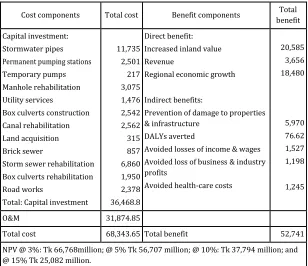
Table 2.6: Total costs and benefits of storm water drainage improvements (Million Tk)
Cost components Total cost Benefit components Total benefit Capital investment:
Stormwater pipes Permanent pumping stations Temporary pumps Manhole rehabilitation Utility services
Box culverts construction Canal rehabilitation Land acquisition Brick sewer
Storm sewer rehabilitation Box culverts rehabilitation Road works
Total: Capital investment
11,735 2,501 217 3,075 1,476 2,542 2,562 315 857 6,860 1,950 2,378 36,468.8 Direct benefit: Increased inland value Revenue
Regional economic growth
Indirect benefits:
Prevention of damage to properties & infrastructure
DALYs averted
Avoided losses of income & wages Avoided loss of business & industry profits
Avoided health-care costs
20,585 3,656 18,480 5,970 76.62 1,527 1,198 1,245
O&M 31,874.85
Total cost 68,343.65 Total benefit 52,741
NPV @ 3%: Tk 66,768million; @ 5% Tk 56,707 million; @ 10%: Tk 37,794 million; and @ 15% Tk 25,082 million.
BCR @ 3%: 2.10; @ 5%: 2.0; @ 10%: 1.78; and @ 15%: 1.59. IRR: 41%
Consequences of inadequate drainage include waterlogging, and environmental pollution which affects health and wellbeing of residents and their quality of life. Expected direct benefits of improved drainage systems include increased property values, particularly in the low-lying areas, and revenues from residents. A significant increase in land values – assumed to be Tk 0.5 million/ha – is expected because of the comprehensive drainage improvement: lowlands will be made flood and water-congestion free. Indirect benefits include reduced health risks to residents and positive impacts on general wellbeing through prevention of water-borne diseases and disruption to transportation and other economic activities.
Damages occurring from a 10-year return-period of a major inundation and prolonged waterlogging were assumed. Direct damage to physical infrastructure and public assets can include destruction or loss of private residential and commercial buildings, transport and other communication networks, utility facilities including water and sewage systems, educational institutions, and hospitals. Major indirect benefits arise from cost savings due to the avoidance of health-care costs of disease outbreaks and illnesses, the positive effect this has on livelihoods, and avoidance of losses of incomes and wages due to prolonged waterlogging and floods.
These damages and losses are regarded as future avoidable losses (benefits) of the intervention actions. The BWDB estimated annual benefits from prevention of damages to properties and infrastructure caused by drainage congestion to be Tk 507.86 million (BWDB, 2010). The benefits of avoiding damages and losses are assumed to commence immediately after the completion of this particular component, that is, from the third year of the project intervention. With the improvement of solid waste management and restoration of the urban ecosystems, the sediment removal costs in the drainage system will also be reduced significantly.
Some of the non-use benefits were not monetized; these include enhanced amenity values, water quality improvement benefits, and improved quality of life.
Total estimated cost of this particular intervention is Tk 68,343.65 million. The NPV is positive and BCR is greater than 1 at discount rates of 3%, 5%, 10%, and 15%. Overall, the intervention is deemed economically viable to undertake.
[image:13.842.72.380.94.360.2]lines with the natural water-bodies. It is assumed that in line with drainage improvement, sewage lines for the study area will also be developed.
It is important that conflict between drainage and networks is properly addressed in planning, design, and implementation phases. If it is at all possible, the number of crossings of roads on the drainage network are to be designed and implemented in a way so that waterways are not obstructed.
Future expansion of settlements and establishment of new economic activities were not included in the benefit stream, as this requires a more detailed study. Furthermore, the potential socio-economic impacts of water congestion are difficult to estimate. This requires detailed modelling on the depth and extent of inundation and duration, and likely economy-wide impacts. Without such a rigorous attempt, this study is indicative as well as conservative.
2.6 Economic analysis of liveability intervention and
discussions
In this section, an economic analysis of the overall liveability intervention is conducted. This integrated cost–benefit framework combines all monetary values of the three intervention strategies and the benefits resulting from them. The values of the inputs and outputs are then compared.
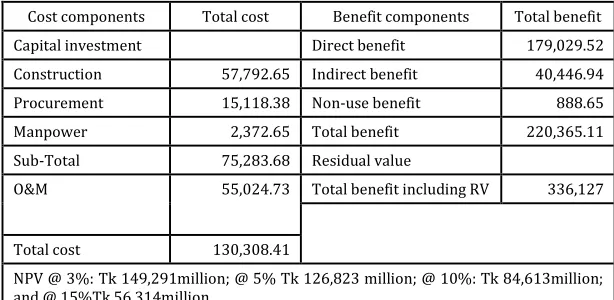
[image:14.842.463.770.83.233.2]The total economic value of the overall intervention, incorporating its direct, indirect, and non-market benefits, is estimated to be in the order of Tk 220.36 billion. Direct benefits include revenue generated from residents and users. Economic values also include the indirect revenue generated throughout the regional economic growth. Total cost of the project is estimated to be Tk 130.31 billion (US$ 1.65 billion), including a capital cost of Tk 75,283 million. The project cost by major investment category and benefits is summarized in Table 2.7 below.
Table 2.7: Cash flow of livability intervention (million Tk)
Cost components Total cost Benefit components Total benefit
Capital investment Direct benefit 179,029.52
Construction 57,792.65 Indirect benefit 40,446.94
Procurement 15,118.38 Non-use benefit 888.65
Manpower 2,372.65 Total benefit 220,365.11
Sub-Total 75,283.68 Residual value
O&M 55,024.73 Total benefit including RV 336,127
Total cost 130,308.41
NPV @ 3%: Tk 149,291million; @ 5% Tk 126,823 million; @ 10%: Tk 84,613million; and @ 15%Tk 56,314million.
BCR @ 3%: 2.29; @ 5%: 2.17; @ 10%: 1.92; and @ 15%: 1.70. IRR: 42%
As the NPV is positive up to a discount rate of 10% – that is, the present value of the benefits exceeds the present value of the costs – it is recommended that the project interventions be accepted, as we know that the higher the NPV and BCR, the more economically viable the interventions. As the estimated BCR is greater than 1, the project is considered to be worthwhile. BCR offers some measure of how large the benefits are relative to the cost of the project.
Economic analysis revealed that the BCR at 10% discount rate and IRR of the project are 1.92 and 42%, respectively, which indicates the project is attractive, both financially and economically. However, this leaves policymakers, planners, development partners, and concerned citizens to make value judgment calls when interpreting these numbers. The results should be interpreted alongside the social and political imperatives of a rapidly growing megacity which suggest an immediate intervention to avoid any further deterioration of the environment and social structure.
project cost can be considered reasonable in the liveability intervention; residual value reduces project capital costs significantly. Determining residual value can be far more problematic and the NPV may vary considerably with the choice of value. Furthermore, if implemented successfully, the intervention will significantly develop social and human capital, including public sector agencies’ management efficiency, enhance citizens’ attitudes towards the clean environment and improve social values and bonding. A detailed economic valuation is required to estimate such benefits on community development issues.
An effective coordination mechanism between agencies involved and implementation strategies involving public, private, and NGOs are essential to make this intervention workable. For instance, the surface drains in many areas of the city remain clogged with solid waste and construction materials, contributing to drainage congestion, and thereby resulting in waterlogging during rainy seasons. An effective waste management solution will obviously lead to improved drainage conditions and environmental sustainability.
As revealed, the DCC does not have the capacity to manage drainage systems. On the other hand, the DWASA is over-burdened with water supply issues. Strengthening of institutional capacities and capabilities is a pre-requisite for the successful implementation of the interventions.
In the past, the Gob took initiatives to restore the Buriganga River, however, the initiatives were piecemeal due to the absence of a coordinated and integrated approach. A circular waterway around the city was partly implemented by the BIWTA in the 2000s, which covers the western side of Dhaka city (Sadarghat to Ashulia). However, the plan did not provide a long-term solution to the problem due to lack of proper implementation and insufficient integration with other utility development.
The Gob needs to frame integrated policies and implementation strategies. For instance, policies, rules, and strategies are required to encourage the adoption of the 5–Rs from the micro level to the agency level. Appropriate incentive mechanisms, including tax incentives for
new entrepreneurs to be involved with waste treatment (compost and biogas), are required so that they can have access to the market, which is now predominantly controlled by the subsidized chemical fertilizer and state-owned natural gas companies. Similarly, a ‘carrot and stick approach’ can be employed to effect the behavioural change of citizens to encourage source segregation of waste.
2.7 Assessing uncertainties and risks
Given the uncertainties of socio-political and environmental changes including extreme climate events and the complexities of urban river ecosystem dynamics in the study area, implementing intervention strategies can have substantial risks. There may also be considerable uncertainties about the predicted impacts and the appropriateness of the monetization of impacts, particularly non-market benefits. In this section, a sensitivity analysis is used to deal with these uncertainties.
CBA outcomes are used to assess the sensitivity of outcomes to risks and uncertainties. This sensitivity analysis will give policymakers an idea of the degree of uncertainty surrounding the interventions and how important that uncertainty might be.
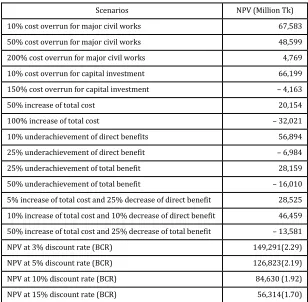
Sensitivity analysis is done for different outcomes – a varying level of cost and benefit estimates (Table 2.8). For instance, construction cost estimates can vary considerably, and changes in extreme climatic events or varying population growth can increase or decrease the demand for utility and environmental services.
Key risk factors were identified as follows:
i. Cost overrun for major civil works (e.g., 10%, 50%, and 200%), capital investment (e.g. 10% and 150%) and total cost (e.g. 50% and 100%);
ii. Under-achievement of direct benefit including expected revenue (e.g., 10% and 25%) and total benefit (e.g. 25% and 50%);
Table2. 8: Sensitivity analysis of livability intervention
Scenarios NPV (Million Tk)
10% cost overrun for major civil works 67,583
50% cost overrun for major civil works 48,599
200% cost overrun for major civil works 4,769
10% cost overrun for capital investment 66,199
150% cost overrun for capital investment – 4,163
50% increase of total cost 20,154
100% increase of total cost – 32,021
10% underachievement of direct benefits 56,894
25% underachievement of direct benefit – 6,984
25% underachievement of total benefit 28,159
50% underachievement of total benefit – 16,010
5% increase of total cost and 25% decrease of direct benefit 28,525 10% increase of total cost and 10% decrease of direct benefit 46,459 50% increase of total cost and 25% decrease of total benefit – 13,581
NPV at 3% discount rate (BCR) 149,291(2.29)
NPV at 5% discount rate (BCR) 126,823(2.19)
NPV at 10% discount rate (BCR) 84,630 (1.92)
NPV at 15% discount rate (BCR) 56,314(1.70)
The discount rate of 10% is mandated by the Planning Commission for all public sector projects in Bangladesh. The current long-term government savings certificate rate in Bangladesh is between 11.04% and 11.76%; therefore, this discount rate represents the opportunity cost of capital (social discount rate). As this rate may appear to be high from a theoretical perspective, two low rates – 3% and 5%, and one high rate – 15%, are used for the sensitivity analysis (Table2.8).
Sensitivity analysis shows that the project is sensitive to both benefits generation and to cost increases. A 25% decrease of total benefit coupled with a 50% cost increase will produce an IRR of 5%, which is marginal and a negative NPV.
The interventions do not appear to be viable under some other conditions. The NPV is sensitive to the amount of capital required – if the capital cost is increased by 150% or a 100% increase of total cost, the NPV will be negative and the project will not be viable. Such an increase in capital cost would not be surprising in a developing country like Bangladesh. Similarly, the interventions are sensitive to benefit generations. If the expected benefit fails to achieve the target, the project will not be viable; for instance, a 50% underachievement of total benefit will generate a negative NPV. The discount rate appears not to have much of an influence on the viability of the interventions.
2.8 Conclusions and policy implications
A combination of these three key factors for a liveable Dhaka city –solid waste management, drainage network and urban river ecosystem – may drastically alter the natural balance in the environment and its sustainability, thereby making the city less liveable. These issues are inter-related and dependent on each other to have a full-blown impact on citizens’ overall wellbeing and quality of life. It is evident that rapid growth of the population, unplanned urbanization and industrial development has created pressure on Dhaka city’s capacity to deliver basic utility and infrastructure services. Provision of infrastructure services such as drainage along with solid waste disposal and a clean environment is the greatest concern to human settlements. Failure to provide these services adequately, results in many well-known costs of urbanization: threats to health and wellbeing, and loss of urban productivity and environmental quality.
new approaches and management of all parties including citizens, businesses, state and national government agencies, and NGOs. There remain challenges.
As discussed, there are some benefits and services not captured in this study, and the continuous deterioration of some services highlights the fact that the CBA is conservative and underestimates the welfare effect of interventions. Therefore, the CBA should be understood as an approximation rather than an expression of the exact economic value of the project investment.
The analysis was limited by the availability of data and resources. In some cases, potential benefit and cost components were based on expert opinions and secondary sources, including dated research findings. These may have resulted in an over or under-valuation of certain costs and benefits of liveability across a broad range of interventions. However, the findings of the analysis provide an indication of the overall economic desirability of implementing the recommended actions and a reasonably good indication of where data and information were lacking.
This CBA did not consider issues of income distribution. Poor people living in slums, shanties, and low socio-economic areas, and daily wage earners and temporary workers including day laborers and rickshaw pullers, are the worst sufferers of the waterlogging in terms of income and job losses. Finally, the CBA here represented a partial equilibrium analysis – it did not capture economy-wide dynamic effects of the proposed interventions.
References
Afrin, S., Islam, M.M. and Rahman, M.M., (2015), ‘Assessment of future flow of Hatirjheel-Begunbari drainage system due to climate change’, Journal of Modern Science and Technology, 3(1): 102-16.
Ahmad, M.K., Islam, S., Rahman, M.S., Haque, M.R. and Islam, M.M., (2010), ‘Heavy metals in water, sediment and some fishes of Buriganga River, Bangladesh’, Int. J. Environ. Res., 4(2):3 21-332.
Alam, K. (2013), ‘Factors affecting public participation in river ecosystem restoration: Using the contingent valuation method’,
Journal of Developing Areas, 47(1): 223-240.
Alam, K. (2011), ‘An economic analysis of a public-private-community partnership: The case of solid waste management in Dhaka, Bangladesh’, World Review of Science, Technology and
Sustainable Development, 8(2-4): 166-181.
Alam, K. (2011b), ‘Public attitudes toward restoration of impaired river ecosystems: Does residents’ attachment to place matter?’,
Urban Ecosystems, 14(4): 635-653.
Alam, K. (2008), ‘Cost-benefit analysis of restoring the Buriganga River, Bangladesh’, International Journal of Water Resources
Development, 24(4): 593-607.
Alam, K. (2003), ‘Clean-up of the Buriganga River: Integrating the environment into decision making’, Unpublished PhD Dissertation, Murdoch University, Perth, Western Australia. Alam, K. and Marinova, D. (2003), ‘Measuring total value of a river
cleanup’, Water Science and Technology, 48(7): 149-156.
Alam, M. and Rabbani, M.G., (2007), ‘Vulnerabilities and responses to climate change for Dhaka’, Environment and Urbanization, 19(1): 81–97.
BBS (Bangladesh Bureau of Statistics) (2012), Population Census 2011, Government of Bangladesh, Dhaka.
BCSIR (Bangladesh Council of Scientific and Industrial Research) (1998), Refuse Quality Assessment of Dhaka City Corporation for Waste to Electrical Energy Project through biogas, Project Report funded by The World Bank and Ministry of Energy and Mineral Resources, Government of Bangladesh, Dhaka.
BWDB (2010), Feasibility Study on the Drainage Improvement of Dhaka-Narayanganj-Demra Project, Final Report: Vol 2, Government of Bangladesh, Dhaka.
CUS (Centre for Urban Studies) (2006), Slums of Urban Bangladesh: Mapping and Census, 2005. National Institute of Population Research and Training, Dhaka.
Dasgupta, S., Zaman, A., Roy, S., Huq, M., Jahan, S. and Nishat, A. (2015), ‘Urban flooding of Greater Dhaka in a changing climate: Building local resilience to disaster risk’, The World Bank, Washington, DC.
DWASA (Dhaka Water Supply and Sewerage Authority) 2016, Personal communication, February 2016.
EIU (The Economist Intelligence Unit) (2015), 2015 Global Liveability
Ranking, August 2015, London.
GoB (Government of Bangladesh) (2008), National Renewable Energy
Policy of Bangladesh, Ministry of Power, Energy and Mineral
Resources, Dhaka.
GoB (Government of Bangladesh), (2010), ‘Pollution Abatement Strategies for Rivers and Wetlands in and Around Dhaka City’, Parliamentary Standing Committee on Ministry of Environment & Forests, Dhaka.
IPCC (Intergovernmental Panel on Climate Change) (2013), Climate
Change 2013: The Physical Science Basis. Cambridge, UK:
IWM (Institute of Water Modelling), (2007), ‘Industrial environmental compliance and pollution control in Greater Dhaka – Phase I’, Final Report, Dhaka.
JICA (Japan International Cooperation Agency) (2000), ‘JICA Baseline Study for Dhaka’, Institute of Water Modelling, Dhaka.
Mahmud, M.S., Masrur, A. Ishtiaque, A., Haider, F. and Habiba, U. (2011), ‘Remote sensing and GIS based Spatio-temporal change analysisof wetland in Dhaka City, Bangladesh’, Journal of Water
Resources and Protection, 3, 781-787.
Muzzini, E. and Aparicio, G., (2013), Bangladesh: The Path to
Middle-Income Status from an Urban Perspective, The World Bank,
Washington DC.
Rashid, S.F., Gani, S. and Sarker, M., (2013), ‘Urban poverty, climate change and health risks for slum dwellers in Bangladesh’, In: R. Shaw, F. Mallick & A. Islam (eds), Climate Change Adaptation
Actions in Bangladesh, pp. 51-70, Springer, London.
Santos, J.M.L., (2007), ‘Transferring landscape values: How and how accurately?’, In: S. Navrud & R. Ready (Eds), Environmental
Value Transfer: Issues and Methods, Springer, pp 45-75.
Tawhid, K.G., (2004), ‘Causes and effects of water logging in Dhaka City, Bangladesh’, Unpublished Master’s Thesis, Royal Institute of Technology, Stockholm.
United Nations, (2015), World Urbanization Prospects: The 2014
Revision, Department of Economic and Social Affairs,
Population Division, United Nations, New York.
World Bank,(2007), Dhaka: Improving Living Conditions for the Urban
Poor, Bangladesh Development Series Paper No. 17, The World
Bank, Washington DC.
Yahya, S.M., Shams, S., Islam, A.K.M.S., Mahmud, K., (2010), ‘Climate change impacts on flood vulnerability for Dhaka City’, In: