to-cell fusion in virus spread in infected tissues. Certain mutations in glycoprotein B (gB), gK, UL20, and other viral genes
drasti-cally enhance virus-induced cell fusion
in vitro
and
in vivo
. Recent work has suggested that gB is the sole fusogenic glycoprotein,
regulated by interactions with the viral glycoproteins gD, gH/gL, and gK, membrane protein UL20, and cellular receptors.
Re-combinant viruses were constructed to abolish either gM or UL11 expression in the presence of strong syncytial mutations in
either gB or gK. Virus-induced cell fusion caused by deletion of the carboxyl-terminal 28 amino acids of gB or the dominant
syn-cytial mutation in gK (Ala to Val at amino acid 40) was drastically reduced in the absence of gM. Similarly, synsyn-cytial mutations in
either gB or gK did not cause cell fusion in the absence of UL11. Neither the gM nor UL11 gene deletion substantially affected gB,
gC, gD, gE, and gH glycoprotein synthesis and expression on infected cell surfaces. Two-way immunoprecipitation experiments
revealed that the membrane protein UL20, which is found as a protein complex with gK, interacted with gM while gM did not
interact with other viral glycoproteins. Viruses produced in the absence of gM or UL11 entered into cells more slowly than their
parental wild-type virus strain. Collectively, these results indicate that gM and UL11 are required for efficient membrane fusion
events during virus entry and virus spread.
H
erpes simplex virus 1 (HSV-1) encodes at least 11
glycopro-teins as well as several membrane-associated proglycopro-teins which
play important roles in viral entry and virus-induced cell fusion.
Virus-induced cell fusion is apparent in herpetic lesions and is
thought to facilitate virion transmission to adjacent cells without
exposure to the host humoral immune system, particularly
neu-tralizing antibody (reviewed in reference
1
). Certain mutations in
the UL20 gene (
2
–
4
), the UL24 gene (
5
,
6
), the UL27 gene
encod-ing glycoprotein B (gB) (
7
,
8
), and the UL53 gene coding for gK
(
9
–
14
) drastically enhance virus-induced cell fusion (syncytial or
syn
mutations). Recently, it has been suggested that gB is the sole
fusogenic glycoprotein while glycoproteins gD and gH/gL are
re-quired to activate gB’s fusogenicity in conjunction with specific
cellular receptors (
15
). In this membrane fusion model, binding of
gD to its cognate receptors, including nectin-1, herpesvirus entry
mediator (HVEM), and other receptors (
16
–
22
), is thought to
trigger sequential conformational changes in gH/gL and gB,
caus-ing fusion of the viral envelope with cellular membranes durcaus-ing
virus entry as well as fusion among cellular membranes (
23
,
24
).
Extensive membrane fusion can be induced by coexpressing
gly-coproteins gB, gD, and gH/gL in cell lines (
25
,
26
), suggesting that
these glycoproteins are sufficient for membrane fusion. However,
virus-induced cell fusion is regulated by a number of other viral
proteins, since wild-type viruses cause a limited amount of fusion
(
27
) and a lack of either glycoprotein gK or the membrane protein
UL20 severely inhibits membrane fusion (
4
,
28
).
We have shown that HSV-1 gK and UL20 functionally and
physically interact and that these interactions are absolutely
nec-essary for their coordinate intracellular transport, cell surface
ex-pression, and membrane fusion functions in the HSV-1 life cycle
(
28
,
29
). Furthermore, we have shown that a peptide comprised of
the amino-terminal 82 amino acids of gK (gKa) expressed in
trans
complemented gB-mediated cell fusion and may physically
inter-act with gB and gH in infected cells (
30
). These results suggest that
gB-mediated virus-induced cell fusion is regulated via direct
in-teractions with gK and UL20 (
30
,
31
).
Glycoprotein gM is a conserved type III integral membrane
protein with multiple transmembrane domains that forms a
com-plex with pUL49.5 (gN) (reviewed in reference
1
). Deletion of the
gM gene does not abrogate HSV-1 replication but inhibits the
ability of the virus to spread (
32
). gM expression causes
relocal-ization of several membrane proteins from the cell surface to the
trans-Golgi network (TGN) (
33
,
34
). Thus, gM may function to
retain viral glycoproteins at the TGN or retrieve them from the
plasma membrane to the TGN (
32
). Expression of HSV-1,
pseu-dorabies virus (PRV), and Kaposi’s sarcoma-associated
herpesvi-rus (KSHV, or human herpesviherpesvi-rus 8 [HHV-8]) gM and gN in
transfected cells inhibited cell fusion caused by simultaneous
ex-pression of glycoproteins gB, gD, gH, and gL, suggesting that
gM/gN may modulate membrane fusion (
34
,
35
). Also, lack of gM
was reported to inhibit virus-induced cell fusion caused by a single
Received30 April 2013Accepted5 May 2013
Published ahead of print15 May 2013
Address correspondence to Konstantin G. Kousoulas, [email protected]. Copyright © 2013, American Society for Microbiology. All Rights Reserved.
doi:10.1128/JVI.01181-13
on November 7, 2019 by guest
amino acid substitution in the carboxyl terminus of gB (A855V;
gBsyn) (
36
,
37
).
UL11 is a 96-amino-acid myristoylated and palmitoylated
teg-ument protein anchored into the cytoplasmic side of cell
mem-branes (
32
,
38
). UL11 has been suggested to play a role in
recruit-ing viral proteins to the virion assembly site at the TGN (
32
). UL11
is known to interact with UL16 and gE through its N-terminal
(
39
–
41
) and C-terminal (
42
) domains, respectively. Although
absence of UL11 in HSV and PRV revealed only moderate defects
in viral replication, the human cytomegalovirus (HCMV, or
HHV-5) UL11 homologue is essential for virus replication (
32
).
HSV-1 UL11 was recently shown to form a protein complex with
gE, UL16, and UL21 that may be required for efficient virus spread
(
43
).
Recently, we utilized mutant viruses lacking one or more viral
genes to show that the deletion of either the gK or UL20 gene
produced significantly greater defects in virion envelopment and
overall virus replication than deletion of the carboxyl terminus of
either gD, UL11, gM, or gE alone or in various combinations (
44
).
Herein, we investigated whether the lack of either gM or UL11
affected the ability of dominant syncytial mutations in either gB or
gK to cause extensive virus-induced cell fusion. We found that
both gM and UL11 are required for virus-induced cell fusion.
Moreover, mutant viruses lacking either gM or UL11 exhibited
slower kinetics of entry into Vero cells than the parental virus,
suggesting that gM and UL11 are involved in membrane fusion
phenomena during both virus-induced cell fusion and virus entry.
MATERIALS AND METHODS
Cells, antibodies, and plasmids.African green monkey kidney (Vero) cells were obtained from the American Type Culture Collection (Rock-ville, MD). Cells were maintained in Dulbecco’s modified Eagle’s medium (DMEM; Life Technologies-Gibco, Carlsbad, CA), supplemented with 10% fetal calf serum (FCS; Life Technologies-Gibco, Carlsbad, CA) and Primocin antibiotic (InvivoGen, San Diego, CA). Antibodies used include anti-HSV-1 gB, gC, gD, gE, and ICP5 (VP5) monoclonal antibodies (MAbs) (Virusys, Sykesville, MD), Alexa Fluor 488-conjugated goat mouse IgG (Life Technologies-Molecular Probes, Carlsbad, CA), anti-HSV-1 gH MAb (Abcam, Cambridge, MA), anti-FLAG MAb (Sigma, St. Louis, MO), rabbit anti-HSV-1 gM polyclonal antibody (pAb) (a gift from Joel Baines, Cornell University, Ithaca, NY), and rabbit anti-HSV-1 UL11 pAb (a gift from John Wills, Pennsylvania State University, Hershey, PA).
For transient-complementation experiments, HSV-1(F) UL10 (gM) and UL11 genes were cloned into pCDNA3.1 plasmid (Life Technologies-Invitrogen, Carlsbad, CA) and named pCgM and pCUL11, respectively.
Construction of HSV-1 mutant viruses.Mutagenesis was accom-plished inEscherichia coliusing the markerless two-step Red recombina-tion mutagenesis system using synthetic oligonucleotides (45,46), imple-mented on the bacterial artificial chromosome (BAC) plasmid pYEbac102 carrying the HSV-1(F) genome (47) (a kind gift from Y. Kawaguchi, Uni-versity of Tokyo, Tokyo, Japan). Construction of the HSV-1 mutants
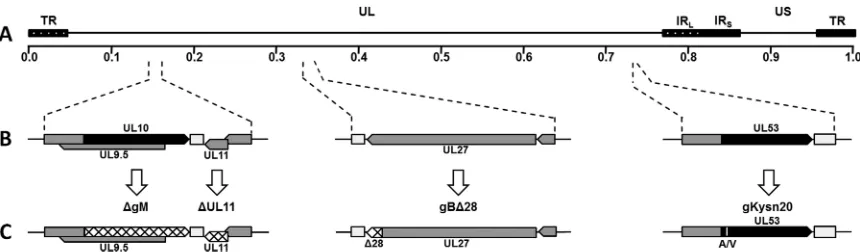
⌬gM2 (⌬gM) and⌬UL11 was described previously (44). Briefly, the⌬gM recombinant virus was constructed by altering two potential initiation codon sites (from ATG to CTG and from ATG to ATT, respectively) located 57 bp apart at the beginning of the UL10 open reading frame (ORF) (48) (Fig. 1). The⌬UL11 virus was constructed by changing the initiation codon from ATG to CTG. The gB⌬28 recombinant virus was produced by introducing a stop codon causing truncation of gB by 28 amino acids. The gKsyn20 recombinant virus was constructed by intro-ducing a point mutation (Ala to Val) at gK amino acid position 40. The
⌬gM and⌬UL11 mutant viruses were used as the backbone for construc-tion of the double mutants gB⌬28/⌬gM, gKsyn20/⌬gM, gB⌬28/⌬UL11, and gKsyn20/⌬UL11 by introducing the designated mutations (Fig. 1).
Confirmation of the targeted mutations and recovery of infectious viruses.HSV-1 BAC DNAs were purified from 50 ml of overnight BAC cultures with the Qiagen large-construct kit (Qiagen, Valencia, CA). Us-ing PCR test primers designed to lie outside the target mutation site(s), all mutated DNA regions were sequenced to verify the presence of the desired mutations in BACs. Viruses were recovered from cells transfected with BAC plasmids as we have described previously (45), and mutations were confirmed by DNA sequencing. To further validate the recombinant vi-ruses, the entire genomes of recovered viruses from BACs were sequenced via Ion Torrent next-generation sequencing (Life Technologies-Invitro-gen, Carlsbad, CA). Briefly, total genomic DNA (gDNA) was extracted from the virus-infected Vero cells using the PureLink genomic DNA minikit (Life Technologies-Invitrogen, Carlsbad, CA). High-quality frag-ment libraries of each virus were prepared from the extracted total gDNAs using the Ion Xpress Plus fragment library kit (Life Technologies-Invitro-gen, Carlsbad, CA). The fragment libraries were subsequently applied to Ion 316 chips and were analyzed on the Ion Personal Genome Machine system (Life Technologies-Invitrogen, Carlsbad, CA).
Plaque morphology of mutant viruses on Vero and transiently com-plementing cells.Visual analysis of plaque morphology of mutant viruses was performed as we have previously described (28,45,49,50). Confluent monolayers of Vero cells were transfected with 1g of gM- or UL11-expressing plasmid (one well of a 12-well tissue culture plate) using
Lipo-FIG 1Schematic representation of mutant viruses. (A) Prototypic arrangement of the HSV-1(F)-YE102 genome with the unique long (UL) and unique short (US) regions flanked by the terminal repeat (TR) and internal repeat (IR) regions. (B) Relative genomic positions and gene arrangements of targeted genes encoding the viral glycoproteins gB (UL27), gM (UL10), and gK (UL53) and membrane protein UL11. (C) Schematic representation of engineered mutations. Mutant viruses containing the⌬gM and⌬UL11 mutations were produced by changing the initiation codons of each gene (hatched regions). Mutant viruses containing gB⌬28 were produced by introduction of a stop codon causing truncation of gB by 28 amino acids (hatched region in gB). Mutant viruses containing gKsyn20 were produced by a point mutation (Ala to Val) at gK amino acid position 40 (white vertical line in gK).
on November 7, 2019 by guest
http://jvi.asm.org/
[image:2.585.77.507.65.191.2]confluent Vero cell monolayers in 12-well plates were infected with each virus in triplicate at either a low MOI (0.2) or high MOI (3.0) for 1 h at 4°C. Thereafter, plates were incubated at 37°C and 5% CO2, and virus was allowed to penetrate for 1 h at 37°C. Any remaining extracellular virus was inactivated by low-pH treatment (pH 3.0) for 10 to 15 s, and the plates were incubated at 37°C and 5% CO2. At 12 and 24 hpi, virus stocks were prepared and viral titers were calculated by endpoint titration on Vero cells. Viral plaques were counted after immunohistochemical staining with rabbit anti-HSV-1 pAb as previously described (30).
SDS-PAGE and Western immunoblot assay.Western immunoblot analysis was carried out essentially as described earlier (30). Briefly, con-fluent Vero cell monolayers were infected with the indicated virus at an MOI of 3. At 24 hpi, cells were collected by low-speed centrifugation, washed twice with ice-cold phosphate-buffered saline (PBS), and lysed with NP-40 lysis buffer (Life Technologies-Novex, Carlsbad, CA). The collected samples were mixed with SDS-PAGE sample buffer (Bio-Rad, Hercules, CA) at a 1:1 ratio and were electrophoretically separated by sodium dodecyl sulfate-polyacrylamide gel electrophoresis (Tris-HEPES-SDS gradient 4 to 20% gels; Thermo Scientific, Waltham, MA). Following electrophoresis, four identical gels were transferred to a nitrocellulose membrane under a constant current. Membranes were blocked in Tris-buffered saline containing 0.1% Tween 20 (TBST) plus 5% nonfat milk for 1 h at room temperature and were probed with primary MAbs over-night at 4°C. Goat anti-mouse secondary antibody conjugated with horse-radish peroxidase (HRP) and enhanced chemiluminescence (ECL) (GE Healthcare, Little Chalfont, United Kingdom) substrate were used for detection purposes.
Quantification of cell-to-cell fusion.A luciferase-based cell-to-cell fusion assay was performed essentially as described earlier (30). Briefly, a subconfluent monolayer of Vero cells in a 6-well plate was transfected with 2g of plasmid containing either the T7 polymerase gene under the cytomegalovirus (CMV) promoter (effector cells) or the T7-dependent luciferase gene (target cells) by using Lipofectamine 2000 transfection reagent. As positive and negative controls, cells were transfected with both of the plasmids simultaneously and with pCAGGS empty vector plasmid, respectively. Twelve hours after each transfection, the two different cell populations, effector and target cells or negative cells and target cells, were detached and reseeded to a new 12-well plate at a 1:1 ratio for experimen-tal groups and negative-control groups, respectively. At 24 h posttrans-fection, cells were infected with wild-type and mutant viruses at an MOI of 0.2. At 12 and 24 hpi, cells were washed twice with ice-cold PBS and lysed with passive lysis buffer (Promega, Madison, WI). The lysates were clari-fied by centrifugation at 10,000⫻gfor 5 min at 4°C and were reacted with luciferase substrate (Promega, Madison, WI). The intensity of luciferase activity was measured by a TD-20/20 luminometer (Turner Designs, Sunnyvale, CA) with a 5-s delay and 10-s read.
Analysis of membrane-associated proteins.Biotinylation of cell sur-face proteins was used to identify membrane-associated proteins of Vero cells infected with each of the designated viruses. Briefly, surface proteins of Vero cells infected with the designated viruses at an MOI of 3 were biotinylated at 12 hpi and isolated with a Pierce cell surface protein isola-tion kit (Thermo Scientific, Waltham, MA). The isolated proteins, whole lysates, and flowthrough were analyzed by Western blots with specific antibodies to gB, gC, gD, gH, gM, UL11, and VP5.
Virus penetration kinetics assay.The kinetics of virus penetration was measured as described previously (29, 52). Briefly, subconfluent monolayers of Vero cells in 12-well tissue culture plates were infected at 4°C for 1 h with approximately 250 PFU of wild-type HSV-1(F),⌬gM mutant, and⌬UL11 mutant viruses. Subsequently, infected cell cultures were incubated at 34°C to allow virus penetration. Immediately thereafter (0 min) and at 30, 60, 120, and 180 min, the virus inoculum was removed and washed once with PBS (pH 7.4), and then the remaining extracellular virus was inactivated by treatment with low-pH PBS (pH 3.0). The cells were washed once with PBS and DMEM without serum sequentially and then overlaid with 1% methylcellulose in DMEM supplemented with 2% FCS. The cells were fixed with ice-cold methanol at 48 hpi, and virus plaques were counted after immunohistochemical staining (30). Mean values and standard deviations of three independent experiments were calculated. To determine the entry kinetics, linear regression slopes dur-ing the exponential growth period, from 0 to 120 min, were calculated.
RESULTS
Construction of recombinant viruses.
Deletion of the
carboxyl-terminal 28 amino acids of gB (
⌬
28) or an Ala-to-Val mutation
(syn20) in the amino terminus of gK causes extensive
virus-induced cell fusion (
9
,
51
,
53
). To investigate the role of gM and
UL11 in virus-induced cell fusion, we constructed a set of
mu-tant viruses containing these syncytial mutations in the
pres-ence or abspres-ence of mutations that prevented expression of
ei-ther the gM or UL11 gene using the HSV-1(F) genome cloned
as a BAC (see Materials and Methods). The set of mutant
vi-ruses that were constructed included the following: (i) gB
⌬
28,
(ii) gB
⌬
28/
⌬
gM, (iii) gB
⌬
28/
⌬
UL11, (iv) gKsyn20, (v)
gKsyn20/
⌬
gM, and (vi) gKsyn20/
⌬
UL11 (
Fig. 1
and
2
).
Validation of recombinant viruses.
Individual mutant
vi-ruses were recovered by transfecting DNA of each constructed
mutant BAC into Vero cells, and the entire genomes of the
parental HSV-1(F) virus and all mutant viruses were sequenced
(see Materials and Methods). Viral genomes matched very well
to the published HSV-1(F) genomic sequence (GenBank
acces-sion number
GU734771.1
), with the exception of 37 nucleotide
changes resulting in 13 amino acid changes between the
pub-lished HSV-1(F) and our HSV-1(F) strain, which is derived
from pYE102bac (
Table 1
). Comparison of the
HSV-1(F)-pYE102bac with each mutant virus revealed the presence of
each engineered mutation, while no other nucleotide changes
were observed.
Characterization of mutant viruses.
The plaque morphology
of each recombinant virus was characterized as described in
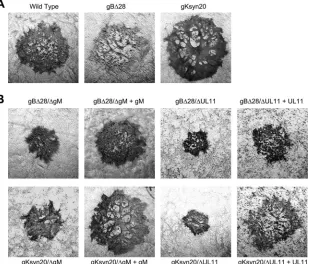
Ma-terials and Methods. As expected, the recombinant viruses gB
⌬
28
and gKsyn20 caused extensive cell fusion (
Fig. 2A
). In contrast,
lack of either gM or UL11 expression in the presence of either a
gB
⌬
28 or gKsyn20 mutation caused significantly reduced levels of
cell-to-cell fusion and decreased plaque sizes (
Fig. 2B
). To test
whether these plaque changes were due primarily to lack of either
on November 7, 2019 by guest
http://jvi.asm.org/
gM or UL11 gene expression, complementation assays in which
Vero cells were transfected with plasmids expressing either gM or
UL11 and subsequently infected with the mutant viruses were
performed. These experiments revealed that more than 50% of
viral plaques (data not shown) were rescued to either a gB
⌬
28 or
gKsyn20 plaque morphology (
Fig. 2B
). To quantify the fusogenic
capacity of mutant viruses, we utilized a luciferase-based assay to
measure cell-to-cell fusion (see Materials and Methods). The
gKsyn20 mutation caused much higher virus-induced cell fusion
than the gB
⌬
28 mutation, most likely because this virus spread
more rapidly than the gB
⌬
28 virus. Moreover, the amount of
gKsyn20-caused cell fusion was much higher than that obtained
by transfection of both luciferase gene and T7 polymerase in the
same cell population (positive control). Deletion of either gM or
UL11 completely abrogated gKsyn20-mediated cell fusion (
Fig.
3A
). Similarly, deletion of either gM or UL11 severely inhibited
gB
⌬
28-induced cell fusion, exhibiting cell fusion levels lower than
those produced by the wild-type virus (
Fig. 3B
). To assess the
relative effect of each mutation alone or in combination on virus
replication, viral titers were obtained at 24 or 48 h after infection
of Vero cells at an MOI of either 0.2 or 3.0. All viruses appeared to
replicate with efficiencies approximately equal to that of the
pa-rental wild-type virus irrespective of the presence of the
engi-neered mutations (
Fig. 4
).
Effect of mutations on the synthesis and cell surface
expres-sion of viral glycoproteins.
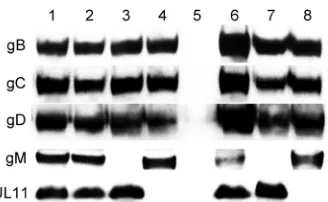
The effects of a lack of either gM or
UL11 expression on the synthesis of the viral glycoproteins gB, gC,
gD, and gM and the membrane-associated protein UL11 were
assessed using Western immunoblots of whole-cell lysates. A lack
of either gM or UL11 expression was confirmed via the inability of
anti-gM or anti-UL11 antibody to detect the presence of either
protein in their respective mutant viruses. Overall, neither lack of
gM expression nor lack of UL11 expression drastically affected the
synthesis of gB, gC, and gD. Furthermore, lack of gM did not affect
the synthesis of UL11 and lack of UL11 did not affect gM levels
(
Fig. 5
).
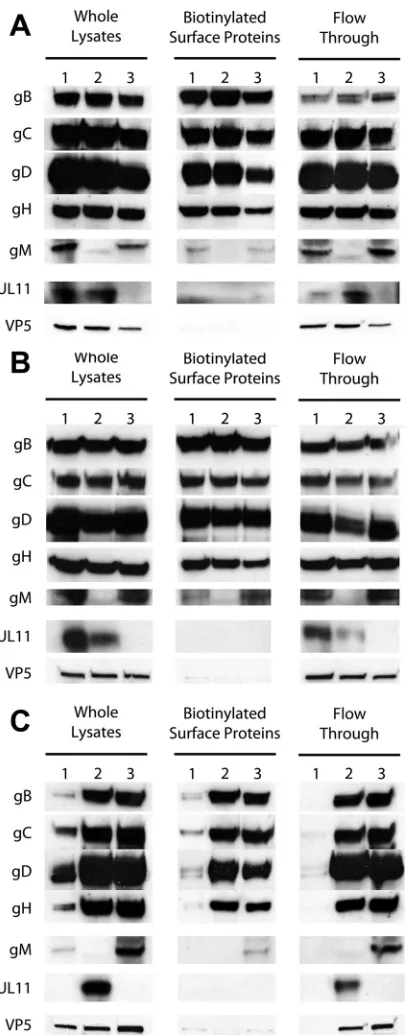
Surface glycoprotein expression profiles of Vero cells infected
with the designated viruses were analyzed by cell surface
biotiny-lation experiments (
Fig. 6
). Viral glycoproteins expressed on
in-fected cell surfaces were biotinylated under live conditions.
Bio-tinylated proteins were subsequently isolated by streptavidin
immunoprecipitation and analyzed by Western immunoblots
(see Materials and Methods). The HSV-1 capsid protein VP5 was
included in the immunoblots as a negative control since it is not
expected to be expressed in infected cellular plasma membranes.
Lack of either gM or UL11 did not affect overall expression of the
viral glycoproteins gB, gC, gD, and gH on HSV-1(F)-infected cell
surfaces (
Fig. 6A
). Similar results were obtained for the gB
⌬
28
virus (
Fig. 6B
) except in the case of gKsyn20-infected cells, most
likely due to rapid loss of fused cells (syncytia) (
Fig. 6C
).
UL20 protein physically interacts with gM in virus-infected
cells.
To determine whether gM and UL11 interact directly with
gB or the gK/UL20 complex, we performed two-way
immunopre-cipitation experiments. The results revealed that gM interacted
with UL20 but not gB, since gM immunoprecipitates contained
UL20 (
Fig. 7
, lane 2) but not gB (
Fig. 7
, lane 8) and UL20
immu-noprecipitates contained gM (
Fig. 7
, lane 4).
Immunoprecipita-tions with gB, gD, or gH failed to reveal any interacImmunoprecipita-tions with gM
FIG 2Plaque morphology of mutant viruses in comparison to HSV-1(F)-YE102. Confluent monolayers of Vero cells were infected with wild-type and mutant viruses at an MOI of 0.0001 and immunohistochemically stained at 48 hpi using polyclonal anti-HSV rabbit sera as described in Materials and Methods. (A) Representative viral plaques of HSV-1(F)-YE102 wild-type virus and the syncytial mutant viruses gB⌬28 and gKsyn20 on Vero cells. (B) Representative viral plaques of syncytial mutant viruses lacking gM or UL11 in the absence or presence of transient complementation with either gM- or UL11-expressing plasmid.
on November 7, 2019 by guest
http://jvi.asm.org/
[image:4.585.140.451.69.333.2](not shown). Similar immunoprecipitations with UL11 failed to
reveal any interactions with gB, gC, gD, gH, gM, gK, or UL20 (data
not shown).
HSV-1 gM and UL11 are required for wild-type-like virus
entry.
Virus-induced cell fusion and fusion of the viral envelope
with cellular membranes during virus entry are thought to occur
via similar mechanisms involving viral glycoproteins. Therefore,
we tested whether a lack of either gM or UL11 affected the kinetics
of virus entry into Vero cells. A lack of either gM or UL11 caused
slower entry of both viruses into Vero cells compared to the
wild-type virus (
Fig. 8
). Similarly, lack of either gM or UL11 caused
slower virus entry in the presence of either the gB
⌬
28 or gKsyn20
mutation (data not shown).
fusion phenomena. Herein, we show that the absence of either gM
or UL11 expression abrogated virus-induced cell fusion caused by
strong syncytial mutations in either gB or gK and that gM
inter-acted with the gK/UL20 protein complex. Moreover, virions
pro-duced in the absence of gM or UL11 entered more slowly into cells
than did their parental wild-type virus. These results suggest that
both gM and UL11 directly or indirectly interact and regulate the
HSV-1 membrane fusion machinery during virus-induced cell
fu-sion and virus entry.
Glycoprotein gM is a highly hydrophobic glycoprotein
pre-dicted to span membranes eight times. It is highly conserved in all
alphaherpesviruses, suggesting that it plays an essential role in
herpes infections. Previous work indicated that insertional
inacti-vation of the gM gene inhibited cell fusion caused by a syncytial
mutation in gB (gBsyn; Ala to Val at gB amino acid 855) (
36
,
37
).
This particular syncytial mutation causes significantly smaller
amounts of virus-induced cell fusion than the gB
⌬
28 mutation,
with the latter being the strongest gB syncytial mutation causing
extensive cell fusion of most cell types in tissue culture (
54
,
55
).
Similarly, the gKsyn20 mutation (Ala to Val at gK amino acid 40)
causes extensive virus-induced cell fusion in most cell types (
30
).
FIG 3Fusion activity of wild-type and mutant viruses. Fusion activity of each virus was quantified by a luciferase-based assay (see Materials and Methods). The extent of fusion was assessed at 12 and 24 hpi for the wild-type virus and all mutant viruses containing the gKsyn20 mutation (A) or the gB⌬28 mutation (B).
NC 34,226 35,711
UL19 40,404 A¡T 15 Major capsid protein
UL21 43,555 Tegument protein
NC 47,555
UL24 47,695 Nuclear protein
47,910 A¡V 86 Nuclear protein
47,911 A¡V Nuclear protein
UL27 53,638 gB
UL34 69,681 S¡N 45 Nuclear egress membrane protein
UL37 81,439 Tegument protein
82,015 Tegument protein
82,806 Tegument protein
82,815 Tegument protein
UL38 84,529 C¡R 45 Capsid triplex subunit 1 UL39 87,759 A¡V 424 Ribonucleotide reductase
subunit 1
88,762 Ribonucleotide reductase
subunit 1
UL48 103,969 Transactivating tegument
protein VP16 104,340 T¡A 212 Transactivating tegument
protein VP16
UL50 107,306 P¡T 134 Deoxyuridine triphosphatase UL55 115,491 M¡I 35 Nuclear protein UL55 UL56 116,406 A¡T 137 Membrane protein UL56 NC 132,421
134,690 137,938
US7 139,976 gI
ant, nucleotide; aa, amino acid.
b
NC, noncoding region.
on November 7, 2019 by guest
http://jvi.asm.org/
[image:5.585.41.285.86.557.2] [image:5.585.302.543.432.675.2]Our results show that a lack of gM abrogated virus-induced cell
fusion caused by either a gKsyn20 or gB
⌬
28 mutation, in
agree-ment with previous findings (
36
,
37
). Glycoprotein gM has been
suggested to function in either retaining viral glycoproteins to
TGN membranes or retrieving them from plasma membranes to
TGN (
32
). In contrast to these published findings, deletion of gM
did not appear to appreciably impact the overall level of other viral
glycoproteins or their relative levels expressed on cell surfaces.
Transient expression of HSV-1, PRV, and KSHV gM appeared to
inhibit cell fusion caused by simultaneous expression of gB, gD,
gH, and gL, suggesting potential interactions between gM and one
or more of these viral glycoproteins (
34
,
35
). However, extensive
two-way coimmunoprecipitation experiments failed to indicate
interactions between gM and either gB or gD, suggesting that gM
may indirectly interact with these proteins to regulate cell fusion.
Additional protein-protein interaction experiments revealed that
gM interacts with the UL20 protein, the interacting partner of gK.
We have shown that the gK/UL20 protein complex interacts with
gB (
31
); therefore, it is likely that a lack of gM affects the ability of
the gK/UL20 complex to bind and regulate the fusogenic
proper-ties of gB. In this regard, gM is a new member of the HSV-1 fusion
machinery composed of gB, gH, gD, gL, gK, UL20, and now gM.
Recently, it was shown that VP22 forms a protein complex with
gM and gE that may affect the functions of these proteins (
56
);
thus, gE may also participate in this glycoprotein network on
in-fected cell surfaces and virion envelopes.
The UL11 protein was of particular interest to these
investiga-tions due to its high conservation among all herpesviruses and its
ability to interact with the carboxyl terminus of glycoprotein gE
and multiple tegument proteins (
42
). We show that UL11 is
ex-pressed on infected cell surfaces at very low levels, if at all, in
agreement with the prediction that UL11 is attached to
cytoplas-mic sides of plasma membranes via its myristoylated and
palmi-toylated residues and its interaction with the cytoplasmic tail of gE
(
32
,
38
–
42
). Surprisingly, a lack of UL11 severely inhibited both
gB
⌬
28- and gKsyn20-caused virus-induced cell fusion. The
gB
⌬
28 results confirm recent findings that UL11 is required for
gBsyn (A855V) but significantly extend these findings, since
dele-tion of the gB carboxyl terminus causes extensive cell fusion in all
cell types, unlike the gBsyn (A855V) mutation (
55
). Moreover, a
lack of UL11 inhibited fusion caused by the gKsyn20 mutation,
which is a dominant syncytial mutation causing fusion of all cell
types tested.
A lack of gE (
36
,
37
) and UL11 (
43
) was reported to prevent
gBsyn-mediated virus-induced cell fusion. Immunofluorescence
and flow cytometry experiments failed to detect substantially
smaller amounts of gE in cells infected with either gM-null or
UL11-null virus (data not shown). This suggests that the observed
inhibition of virus-induced cell fusion in the absence of UL11 is
not due to a lack of gE cell surface expression. In contrast to our
findings, it was recently shown that deletion of UL11 appeared to
reduce gE cell surface expression in Vero but not HaCaT cells by
fluorescence microscopy (
43
). It is possible that different results
are obtained due to the use of HSV-1 (KOS) (
43
) versus HSV-1(F)
(this study). Additional studies will be needed to resolve whether a
lack of UL11 substantially affects gE expression and function on
infected cell surfaces.
Virus-induced cell fusion and fusion of the viral envelope with
cellular membranes during virus entry are thought to occur via
similar mechanisms involving viral glycoprotein gB and cellular
receptors (
15
). We have shown that gK and UL20 are expressed in
virion envelopes and are involved in virus entry, since deletion of
gK or a small segment of gK that interacts with gB causes virions to
enter more slowly than their parental wild-type virus into cells and
alter their ability to utilize HSV-1-specific receptors (
29
,
52
,
57
).
Similarly, virions produced in the absence of either gM or UL11
exhibited slower kinetics of entry into Vero cells than did their
parental virus. gM is known to be expressed in virion envelopes
(
48
). Also, UL11 is a structural component of virions (
58
) and
interacts with gE and other tegument proteins in infected cells
(
43
). Recently, it was shown that VP22 bridges a complex between
gE and gM (
56
). Therefore, it is conceivable that UL11 binding to
gE can indirectly affect both gE and gM functions, causing both
FIG 4Replication kinetics of the wild-type and mutant viruses. Confluent Vero cell monolayers were infected with each virus in triplicate at either a low MOI (0.2) (A) or a high MOI (3.0) (B), and viral titers were obtained by plaque assay on Vero cells at 24 and 48 hpi. Error bars represent standard deviations.
FIG 5Characterization of glycoprotein expression by wild-type and mutant viruses. The overall synthesis of each viral protein was assessed by Western immunoblotting. Each lane represents infected cellular extracts from cells in-fected with either wild-type or mutant virus: 1, wild type; 2, gB⌬28; 3, gB⌬28/
⌬gM; 4, gB⌬28/⌬UL11; 5, mock infection; 6, gKsyn20; 7, gKsyn20/⌬gM; 8, gKsyn20/⌬UL11. gB, gC, gD, gM, and UL11 denote antibodies specific for each protein.
on November 7, 2019 by guest
http://jvi.asm.org/
[image:6.585.102.486.66.182.2] [image:6.585.83.247.555.656.2]the observed inhibition of virus-induced cell fusion and the slower
kinetics of the UL11-null virus in comparison to its parental
wild-type virus. Alternatively, it is possible that absence of gM or UL11
affects the incorporation of other viral glycoproteins into virion
envelopes, causing the observed inhibition in virus entry.
Addi-tional investigations beyond the scope of this work are needed to
address this issue in the future.
Collectively, these results suggest that both gM and UL11 are
required for virus-induced cell fusion and efficient virus entry,
most likely because they directly or indirectly interact with the
viral fusion machinery. Glycoprotein gM directly interacts with
the gK/UL20 protein complex. We did not detect any UL11
inter-actions with either gB, gC, gD, gH, gM, or gK/UL20. It is possible
that such interactions are weak or of transient nature that cannot
be detected via coimmunoprecipitation experiments. UL11
inter-acts with gE and VP22 interinter-acts with both gE and gM (
56
),
sug-gesting that gE also participates in indirect interactions with the
fusion machinery. Additional experiments are needed to ascertain
the intracellular localization of UL11 and its potential functions in
virus-induced cell fusion. Overall, it is apparent that multiple
pro-FIG 6Cell surface expression of viral glycoproteins on infected cell surfaces by wild-type and mutant viruses. At 12 hpi, whole lysates were prepared and mem-brane-associated proteins were isolated (see Materials and Methods). Flow-through-labeled lanes represent cytoplasmic proteins. Each lane represents wild-type or mutant virus-infected cell extracts. (A) Lane 1, wild wild-type; lane 2,⌬gM; lane 3,⌬UL11. (B) Lane 1, gB⌬28; lane 2, gB⌬28/⌬gM; lane 3, gB⌬28/⌬UL11. (C) Lane 1, gKsyn20; lane 2, gKsyn20/⌬gM; lane 3, gKsyn20/⌬UL11. gB, gC, gD, gH, gM, UL11, and VP5 denote antibodies specific for each protein.
FIG 7UL20 protein interacts with gM in virus-infected cells. Vero cell mono-layers were infected with HSV-1(F) or HSV-1(F)-YE102-VC1 (having UL20 protein tagged with the 3⫻FLAG epitope and gK tagged with the V5 epitope). Cellular extracts were prepared at 24 hpi, and the presence of gB, gM, or UL20 was detected using Western immunoblots after immunoprecipitation (IP) with designated antibodies. Lanes 1, 3, 5, and 7, antigen from HSV-1(F)-infected cells; lanes 2, 4, 6, and 8, antigen from HSV-1(F)-YE102-VC1-HSV-1(F)-infected cells; lane M demarcates positions of molecular mass markers (10 to 250 kDa; Bio-Rad). Anti-gB (␣-gB), anti-gM (␣-gM), and anti-FLAG (␣-UL20) denote probed antibodies, and gB-IP, gM-IP, and UL20-IP (FLAG-IP) represent an-tibodies used for immunoprecipitation. gB, H, L, gM, and UL20 denote gB, heavy chain, light chain, gM, and UL20 proteins, respectively.
FIG 8Entry kinetics of HSV-1(F) (WT),⌬gM, and⌬UL11 viruses into Vero cells. Vero cell monolayers were infected with either HSV-1(F),⌬gM, or
⌬UL11 virus at 250 PFU per tissue culture well. The kinetics of virus entry at 34°C was measured (see Materials and Methods). Mean values and standard deviations of three independent experiments are shown. The relative efficiency of entry was calculated by obtaining the linear regression slope during the exponential viral growth period (0 to 120 min). The mean value and the stan-dard deviation of each slope are shown.
on November 7, 2019 by guest
http://jvi.asm.org/
[image:7.585.63.267.64.582.2] [image:7.585.338.508.64.200.2] [image:7.585.316.522.533.647.2]tein-protein interactions occur among viral glycoproteins and
tegument proteins that regulate membrane fusion phenomena in
HSV-1 infections.
ACKNOWLEDGMENTS
This work was supported by NIH NIAID grant AI43000 to K.G.K., and Core Laboratories were supported by NIH NIGMS grant P20GM103458. We acknowledge financial support by the LSU School of Veterinary Medicine.
We acknowledge helpful discussions with other BIOMMED staff.
REFERENCES
1.Roizman B, Knipe D, Whitley R.2007. Herpes simplex viruses, p 2501– 2601.InKnipe D, Howley P (ed), Fields virology, 5th ed, vol 2. Lippincott Williams & Wilkins, Philadelphia, PA.
2.Baines JD, Ward PL, Campadelli-Fiume G, Roizman B.1991. The UL20 gene of herpes simplex virus 1 encodes a function necessary for viral egress. J. Virol.65:6414 – 6424.
3.McLean G, Rixon F, Langeland N, Haarr L, Marsden H.1990. Identi-fication and characterization of the virion protein products of herpes sim-plex virus type 1 gene UL47. J. Gen. Virol.71:2953–2960.
4.Melancon JM, Foster TP, Kousoulas KG.2004. Genetic analysis of the herpes simplex virus type 1 UL20 protein domains involved in cytoplas-mic virion envelopment and virus-induced cell fusion. J. Virol.78:7329 – 7343.
5.Jacobson JG, Chen SH, Cook WJ, Kramer MF, Coen DM.1998. Im-portance of the herpes simplex virus UL24 gene for productive ganglionic infection in mice. Virology242:161–169.
6.Sanders PG, Wilkie NM, Davison AJ.1982. Thymidine kinase deletion mutants of herpes simplex virus type 1. J. Gen. Virol.63:277–295. 7.Bzik DJ, Fox BA, DeLuca NA, Person S.1984. Nucleotide sequence of a
region of the herpes simplex virus type 1 gB glycoprotein gene: mutations affecting rate of virus entry and cell fusion. Virology137:185–190. 8.Pellett PE, Kousoulas KG, Pereira L, Roizman B.1985. Anatomy of the
herpes simplex virus 1 strain F glycoprotein B gene: primary sequence and predicted protein structure of the wild type and of monoclonal antibody-resistant mutants. J. Virol.53:243–253.
9.Bond VC, Person S.1984. Fine structure physical map locations of alter-ations that affect cell fusion in herpes simplex virus type 1. Virology132: 368 –376.
10. Debroy C, Pederson N, Person S.1985. Nucleotide sequence of a herpes simplex virus type 1 gene that causes cell fusion. Virology145:36 – 48. 11. Hutchinson L, Goldsmith K, Snoddy D, Ghosh H, Graham FL, Johnson
DC.1992. Identification and characterization of a novel herpes simplex virus glycoprotein, gK, involved in cell fusion. J. Virol.66:5603–5609. 12. Pogue-Geile KL, Lee GT, Shapira SK, Spear PG.1984. Fine mapping of
mutations in the fusion-inducing MP strain of herpes simplex virus type 1. Virology136:100 –109.
13. Pogue-Geile KL, Spear PG.1987. The single base pair substitution re-sponsible for the syn phenotype of herpes simplex virus type 1, strain MP. Virology157:67–74.
14. Ruyechan WT, Morse LS, Knipe DM, Roizman B. 1979. Molecular genetics of herpes simplex virus. II. Mapping of the major viral glycopro-teins and of the genetic loci specifying the social behavior of infected cells. J. Virol.29:677– 697.
15. Connolly SA, Jackson JO, Jardetzky TS, Longnecker R.2011. Fusing structure and function: a structural view of the herpesvirus entry machin-ery. Nat. Rev. Microbiol.9:369 –381.
16. Campadelli-Fiume G, Cocchi F, Menotti L, Lopez M.2000. The novel receptors that mediate the entry of herpes simplex viruses and animal alphaherpesviruses into cells. Rev. Med. Virol.10:305–319.
17. Geraghty RJ, Krummenacher C, Cohen GH, Eisenberg RJ, Spear PG.
1998. Entry of alphaherpesviruses mediated by poliovirus receptor-related protein 1 and poliovirus receptor. Science280:1618 –1620.
18. Montgomery RI, Warner MS, Lum BJ, Spear PG.1996. Herpes simplex virus-1 entry into cells mediated by a novel member of the TNF/NGF receptor family. Cell87:427– 436.
19. Satoh T, Arii J, Suenaga T, Wang J, Kogure A, Uehori J, Arase N, Shiratori I, Tanaka S, Kawaguchi Y, Spear PG, Lanier LL, Arase H.
2008. PILR␣is a herpes simplex virus-1 entry coreceptor that associates with glycoprotein B. Cell132:935–944.
20. Shukla D, Liu J, Blaiklock P, Shworak NW, Bai X, Esko JD, Cohen GH, Eisenberg RJ, Rosenberg RD, Spear PG.1999. A novel role for 3-O-sulfated heparan sulfate in herpes simplex virus 1 entry. Cell99:13–22. 21. Spear PG, Eisenberg RJ, Cohen GH.2000. Three classes of cell surface
receptors for alphaherpesvirus entry. Virology275:1– 8.
22. Spear PG, Longnecker R.2003. Herpesvirus entry: an update. J. Virol.
77:10179 –10185.
23. Hannah BP, Heldwein EE, Bender FC, Cohen GH, Eisenberg RJ.2007. Mutational evidence of internal fusion loops in herpes simplex virus gly-coprotein B. J. Virol.81:4858 – 4865.
24. Heldwein EE, Lou H, Bender FC, Cohen GH, Eisenberg RJ, Harrison SC.2006. Crystal structure of glycoprotein B from herpes simplex virus 1. Science313:217–220.
25. Muggeridge MI.2000. Characterization of cell-cell fusion mediated by herpes simplex virus 2 glycoproteins gB, gD, gH and gL in transfected cells. J. Gen. Virol.81:2017–2027.
26. Turner A, Bruun B, Minson T, Browne H.1998. Glycoproteins gB, gD, and gHgL of herpes simplex virus type 1 are necessary and sufficient to mediate membrane fusion in a Cos cell transfection system. J. Virol.72: 873– 875.
27. Kousoulas KG, Person S, Holland TC.1978. Timing of some of the molecular events required for cell fusion induced by herpes simplex virus type 1. J. Virol.27:505–512.
28. Melancon JM, Luna RE, Foster TP, Kousoulas KG.2005. Herpes sim-plex virus type 1 gK is required for gB-mediated virus-induced cell fusion, while neither gB and gK nor gB and UL20p function redundantly in virion de-envelopment. J. Virol.79:299 –313.
29. Foster TP, Rybachuk GV, Kousoulas KG.2001. Glycoprotein K specified by herpes simplex virus type 1 is expressed on virions as a Golgi complex-dependent glycosylated species and functions in virion entry. J. Virol.
75:12431–12438.
30. Chouljenko VN, Iyer AV, Chowdhury S, Chouljenko DV, Kousoulas KG.2009. The amino terminus of herpes simplex virus type 1 glycoprotein K (gK) modulates gB-mediated virus-induced cell fusion and virion egress. J. Virol.83:12301–12313.
31. Chouljenko VN, Iyer AV, Chowdhury S, Kim J, Kousoulas KG.2010. The herpes simplex virus type 1 UL20 protein and the amino terminus of glycoprotein K (gK) physically interact with gB. J. Virol.84:8596 – 8606. 32. Leege T, Fuchs W, Granzow H, Kopp M, Klupp BG, Mettenleiter TC.
2009. Effects of simultaneous deletion of pUL11 and glycoprotein M on virion maturation of herpes simplex virus type 1. J. Virol.83:896 –907. 33. Crump CM, Bruun B, Bell S, Pomeranz LE, Minson T, Browne HM.
2004. Alphaherpesvirus glycoprotein M causes the relocalization of plasma membrane proteins. J. Gen. Virol.85:3517–3527.
34. Klupp BG, Nixdorf R, Mettenleiter TC.2000. Pseudorabies virus glyco-protein M inhibits membrane fusion. J. Virol.74:6760 – 6768.
35. Koyano S, Mar EC, Stamey FR, Inoue N.2003. Glycoproteins M and N of human herpesvirus 8 form a complex and inhibit cell fusion. J. Gen. Virol.84:1485–1491.
36. Balan P, Davis-Poynter N, Bell S, Atkinson H, Browne H, Minson T.
1994. An analysis of the in vitro and in vivo phenotypes of mutants of herpes simplex virus type 1 lacking glycoproteins gG, gE, gI or the putative gJ. J. Gen. Virol.75(Part 6):1245–1258.
37. Davis-Poynter N, Bell S, Minson T, Browne H.1994. Analysis of the contributions of herpes simplex virus type 1 membrane proteins to the induction of cell-cell fusion. J. Virol.68:7586 –7590.
38. Yeh PC, Meckes DG, Jr, Wills JW.2008. Analysis of the interaction between the UL11 and UL16 tegument proteins of herpes simplex virus. J. Virol.82:10693–10700.
39. Baird NL, Yeh PC, Courtney RJ, Wills JW.2008. Sequences in the UL11 tegument protein of herpes simplex virus that control association with detergent-resistant membranes. Virology374:315–321.
40. Loomis JS, Bowzard JB, Courtney RJ, Wills JW. 2001. Intracellular trafficking of the UL11 tegument protein of herpes simplex virus type 1. J. Virol.75:12209 –12219.
41. Loomis JS, Courtney RJ, Wills JW.2003. Binding partners for the UL11 tegument protein of herpes simplex virus type 1. J. Virol.77:11417–11424. 42. Yeh PC, Han J, Chadha P, Meckes DG, Jr, Ward MD, Semmes OJ, Wills JW.2011. Direct and specific binding of the UL16 tegument protein of herpes simplex virus to the cytoplasmic tail of glycoprotein E. J. Virol.
85:9425–9436.
43. Han J, Chadha P, Starkey JL, Wills JW.2012. Function of glycoprotein E of herpes simplex virus requires coordinated assembly of three tegument
on November 7, 2019 by guest
http://jvi.asm.org/
manipulation in Escherichia coli. Biotechniques40:191–197.
47. Tanaka M, Kagawa H, Yamanashi Y, Sata T, Kawaguchi Y. 2003. Construction of an excisable bacterial artificial chromosome containing a full-length infectious clone of herpes simplex virus type 1: viruses recon-stituted from the clone exhibit wild-type properties in vitro and in vivo. J. Virol.77:1382–1391.
48. Baines JD, Roizman B.1993. The UL10 gene of herpes simplex virus 1 encodes a novel viral glycoprotein, gM, which is present in the virion and in the plasma membrane of infected cells. J. Virol.67:1441–1452. 49. Foster TP, Melancon JM, Olivier TL, Kousoulas KG. 2004. Herpes
simplex virus type 1 glycoprotein K and the UL20 protein are interdepen-dent for intracellular trafficking and trans-Golgi network localization. J. Virol.78:13262–13277.
50. Fulmer PA, Melancon JM, Baines JD, Kousoulas KG. 2007. UL20 protein functions precede and are required for the UL11 functions of herpes simplex virus type 1 cytoplasmic virion envelopment. J. Virol.81: 3097–3108.
54. Foster TP, Melancon JM, Kousoulas KG.2001. An alpha-helical domain within the carboxyl terminus of herpes simplex virus type 1 (HSV-1) gly-coprotein B (gB) is associated with cell fusion and resistance to heparin inhibition of cell fusion. Virology287:18 –29.
55. Silverman JL, Greene NG, King DS, Heldwein EE. 2012. Membrane requirement for folding of the herpes simplex virus 1 gB cytodomain sug-gests a unique mechanism of fusion regulation. J. Virol.86:8171– 8184. 56. Maringer K, Stylianou J, Elliott G.2012. A network of protein
interac-tions around the herpes simplex virus tegument protein VP22. J. Virol.
86:12971–12982.
57. Chowdhury S, Chouljenko VN, Nadheri M, Kousoulas KG.2013. The amino terminus of herpes simplex virus 1 glycoprotein K is required for virion entry via the paired immunoglobulin-like type-2 receptor alpha. J. Virol.87:3305–3313.
58. Loret S, Guay G, Lippe R.2008. Comprehensive characterization of extracellular herpes simplex virus type 1 virions. J. Virol.82:8605– 8618.
on November 7, 2019 by guest
http://jvi.asm.org/