EPRC
Is simplification simply a fiction?
IQ-Net Thematic Paper 37(2)
Sara Davies
European Policies Research Centre School of Government & Public Policy
University of Strathclyde 40 George Street Glasgow G1 1QE United Kingdom
Tel: +44 (0) 141 548 3672 Fax: +44 (0) 141 548 4898
Email: [email protected]
The place of useful learning
The research for this paper was undertaken by EPRC in preparation for the 39th IQ-Net meeting held in Cardiff, Wales on 23-25 November 2015. The paper was written by Sara Davies.
The paper is the product of desk research and fieldwork visits during Autumn 2015 to national and regional authorities in EU Member States (notably partners in the IQ-Net Consortium). The field research team comprised:
Stefan Kah (Austria, Slovenia)
Dr Arno van der Zwet (Belgium)
Dr Vinko Muštra and Professor John Bachtler (Croatia)
Dr Marie Feřtrová, Dr Lucie Jungwiertová (Czech Republic)
Lise Smed Olsen (Denmark)
Heidi Vironen (Finland)
Timothée Lehuraux (France)
Dr Sara Davies (Germany)
Dr Eleftherios Antonopoulos (Greece)
Dr Martin Ferry (Poland)
Dr Carlos Mendez (Portugal, Spain)
Dr Martin Plešivčák (Slovakia)
Rona Michie (United Kingdom)
EPRC thanks all those respondents from national and regional authorities and other organisations who participated in the research. EPRC also gratefully acknowledges the financial support provided by participating Member States and regions, whose contributions are co-financed by technical assistance from the European Structural Funds. Many thanks are due to Rona Michie, Philip Vernon and Viktoriya Dozhdeva who participated in the research, as well as support with formatting of the paper from Alyson Ross. The report is, however, the responsibility of the author alone.
The partners in the IQ-Net network are as follows:
Austria
ÖROK Secretariat
Belgium
Enterprise Agency Flanders
Croatia
Ministry of Regional Development & EU Funds
Czech Republic
Ministry of Regional Development
Denmark
Danish Business Authority
Finland
South and West Finland (Etelä- ja Länsi-Suomi)
France
Germany
Nordrhein-Westfalen (North Rhine-Westphalia), Ministry for Business, Energy, Industry, SMEs and the Craft Sector, EU Affairs Unit
Greece
Management Organisation Unit of Development Programmes S.A.
Poland
Marshal Office of the Pomorskie Region
Portugal
Agency for Development and Cohesion (ADC)
Spain
País Vasco (Basque Country), Provincial Council of Bizkaia, Department of Economy and Finance
Slovakia
Central Coordination Body, Government Office
Slovenia
Government Office for Development and European Cohesion Policy
United Kingdom
Department of Communities and Local Government
Scottish Government
Welsh European Funding Office
For further information about IQ-Net, and access to the full series of IQ-Net Papers, please visit the IQ-Net website at: http://www.eprc.strath.ac.uk/iqnet/
To cite this paper, please use the following: Davies S (2015) ‘Is simplification simply a fiction?’ IQ-Net
Thematic Paper 37(2), European Policies Research Centre, University of Strathclyde, Glasgow.
Disclaimer
Is simplification simply a fiction?
TABLE OF CONTENTS
Executive summary ... 1
1. Introduction ... 3
2. Structural challenges ... 4
3. EU initiatives on simplification in 2014-20 ... 7
3.1 Simplification measures introduced in 2014-20 ... 7
3.2 New EU initiatives in 2014-15 ... 8
4. Iq-net partners’ views of eu initiatives aimed at improving simplification in 2014-20 ... 10
4.1 Key concerns of IQ-Net partners... 10
4.2 There remain serious concerns over a continued lack of legal certainty ... 12
4.3 The administrative burden remains heavy, despite efforts to simplify ... 13
4.3.1 Harmonisation of rules across ESI Funds ... 13
4.3.2 Lighter reporting ... 13
4.3.3 e-Cohesion ... 13
4.3.4 Changes that may lead to unforeseen negative consequences ... 14
4.4 Flexibility is welcome but does not mean simplification ... 15
4.4.1 Option for Multi-Fund programmes ... 15
4.4.2 Option to merge the managing and certifying authorities ... 15
4.4.3 Option for a joint monitoring committee ... 15
4.4.4 Options of ITI and CLLD ... 16
4.4.5 Other changes ... 16
4.5 More coordination and proportionality is needed in control and audit ... 17
4.5.1 Risk-based methods of sampling for controls ... 17
4.5.2 Smaller projects audited only once before closure ... 18
4.5.3 Scope to reduce controls and audit intensity ... 18
4.6 Simplified cost options are welcome but generate serious concerns ... 19
4.6.1 Legal uncertainty ... 19
4.6.2 Administrative burden ... 20
4.6.3 Treatment of SCO in audit ... 20
4.6.4 Other issues ... 20
4.7 Designation of authorities increases the administrative burden ... 21
4.8 The stronger strategic focus adds to complexity ... 22
4.8.2 Reporting requirements ... 22
4.8.3 Indicators ... 22
4.8.4 Evaluation ... 23
4.8.5 Performance framework ... 23
4.8.6 Ex ante conditionalities ... 23
5. National/regional action on simplification in 2014-20 ... 24
5.1 Revising domestic legal frameworks to reduce overlap with EU rules ... 24
5.2 Reducing the numbers of programmes and OP authorities ... 25
5.3 Simplifying programme architecture ... 25
5.4 Simplifying/harmonising monitoring systems ... 26
5.5 Simplifying eligibility rules and project application forms ... 27
5.6 Introducing delivery mechanisms that make life easier for beneficiaries ... 27
5.6.1 Harmonised information points and application procedures ... 27
5.6.2 Hands-on support for beneficiaries ... 27
5.6.3 Simpler and clearer procedures ... 28
5.6.4 Fewer interventions ... 28
5.6.5 Supporting applicants’ planning ... 28
6. Conclusions and issues for discussion ... 29
6.1 Questions relating to other partners’ experiences ... 29
6.2 Incremental change within the current system ... 29
6.3 Is more radical change necessary (and possible)?... 30
COUNTRY/PROGRAMME ABBREVIATIONS
Country Abbreviation
Austria AT
Belgium BE
Belgium (Vlaanderen) Vla
Croatia HR
Czech Republic CZ
Czech Republic (Integrated Regional Operational Programme) CZ IROP
Denmark DK
Finland FI
France FR
Germany DE
Germany (Nordrhein-Westfalen) NRW
Greece GR
Poland (Pomorskie) Pom
Portugal PT
Slovakia SK
Slovenia SI
Spain ES
Spain (País Vasco (Bizkaia)) PV
United Kingdom UK
United Kingdom (England) Eng
United Kingdom (Scotland) Sco
EXECUTIVE SUMMARY
Efforts have been made to simplify Cohesion policy administration since 2000-06 but management and implementation remain highly complex, heavy and time-consuming.
A number of structural dilemmas help to explain why simplification is so difficult to achieve: e.g.
The attempt to implement a comprehensive legal and implementation framework across 28 Member States, involving many regional/local actors across a broad array of themes;
EU-wide decisions are taken via negotiation (compromise) among senior politicians or civil servants, most of whom lack practical knowledge of implementation;
The number and complexity of rules has increased in each programme period;
Rules, structures and terminologies are subject to shifts between (and sometimes within) programme periods, leading to further complexity and uncertainty;
There is tension between simplification and other principles e.g. financial assurance, legal certainty, equal treatment of all Member States, subsidiarity, and strategic impact.
The Commission set out simplification proposals for 2014-20 in a Cohesion policy working paper in 2011, a communication on the Multi-annual Financial Framework in 2012, and a brochure targeted at beneficiaries and managing authorities. The regulations for 2014-20 include various measures e.g.:
Harmonisation of rules between Cohesion policy and other ESI Funds;
More flexibility (e.g. options: for multi-Fund OPs and monitoring committees; to merge managing and certifying authorities; to adjust the financial allocation by up to 3% between categories of regions; for ITI and CLLD; and for more varied financial instruments);
Increased proportionality (e.g. risk-based methods of sampling for controls; smaller projects audited only once before closure; scope to reduce controls and audit intensity);
Legal certainty through clearer rules (e.g. flat rates for revenue generating projects);
More efficient delivery and lighter reporting (e.g. for annual reports, and for additionality);
Reducing the administrative burden for beneficiaries (e.g. increased use of simplified costs; mandatory annual closure of operations in the annual clearance of accounts);
A move towards results-based management: the Joint Action Plan;
e-Cohesion;
Simplification of European Territorial Co-operation, and of the European Social Fund.
However, due to concerns over legal certainty, the 2014-20 regulations are accompanied by a plethora of delegated acts, implementing acts, and guidance notes.
New EU initiatives on simplification in Cohesion policy in 2014-15 include:
A discussion at the European Council meeting of June 2015;
The creation of a high level group of independent experts on monitoring simplification for beneficiaries of the ESI Funds;
IQ-Net partners welcome some of the simplification measures introduced in 2014-20 but also voice serious concerns over the administrative burden associated with Cohesion policy, querying whether there has been genuine simplification if the whole package of regulations, acts and guidelines is taken into account, and arguing that simplification has benefited beneficiaries but not OP authorities.
The main concerns of IQ-Net partners relate to:
The lack of legal certainty on key issues;
The heavy administrative burden for OP authorities and beneficiaries; and
Flexibility measures – which are welcome but often do not lead to simplification.
Two specific fields generating major worries for partners are:
The need for more coordination and proportionality in financial control and audit; and
Simplified cost options, which bring benefits but are seen as burdensome to implement and are associated with concerns over legal certainty and audit.
Moreover, simplification measures are seen to have been outweighed by other new elements in 2014-20, which has led to an overall increase in complexity, notably:
The process of designating managing and certifying authorities;
The range of measures associated with impact and results (including ex ante conditionalities, thematic objectives/concentration, evaluation, indicators, and the performance framework).
In addition to simplification measures introduced at EU level, IQ-Net partners have taken the initiative to simplify Cohesion policy implementation e.g. by
Revising domestic legal frameworks to reduce overlap with EU rules;
Reducing the numbers of programmes and OP authorities;
Simplifying programme architecture;
Simplifying/harmonising monitoring systems;
Simplifying eligibility rules and project application forms;
Ensuring that delivery mechanisms make life easier for beneficiaries.
The report concludes by summarising the concerns and views of IQ-Net partners with respect to current queries and future challenges, notably:
A selection of specific implementation problems which partners are currently facing;
Broader management and implementation themes where strong but incremental change is needed (e.g. relating to legal certainty, duplication/harmonisation, and proportionality/ differentiation); and
1. INTRODUCTION
Simplification has been an important dimension of debates on Cohesion policy since preparations for the 2000-06 period. Nevertheless, administration remains highly complex. Indeed, efforts at simplification have generated further complexity.
Simplification in Cohesion policy is a slippery concept with no clear definition. It is sometimes conflated with other aspects of Cohesion policy administration, such as flexibility and administrative capacity. In this paper, key aspects of simplification are seen to relate to:
The number of rules and procedures;
The clarity, coherence and consistency of different rules and procedures;
The number of actors and interrelationships;
The number of different accountability chains; and
The actors who should benefit from simplification.
During the fieldwork for this report, IQ-Net partners voiced their concerns over the administrative burden faced by OP authorities and beneficiaries. They raised a series of specific issues where they are currently facing difficulties, notably in relation to financial control and audit, and simplified cost options. Partners also provided their views on the root-causes of complexity in Cohesion policy administration and on the changes needed. Various partners - particularly those with long experience and institutional memory of Cohesion policy - also expressed deep scepticism of the scope for real and meaningful change and argued that the simplification issue raised fundamental questions over the future of Cohesion policy.
The report addresses the following themes:
The fundamental, structural challenges to simplification in Cohesion policy (Section 2);
Key measures being taken at EU-level to support simplification in 2014-20 (Section 3);
The views of IQ-Net partners (Section 4) on issues relating to simplification i.e.:
o legal certainty;
o administrative burden;
o flexibility measures;
o financial control and audit;
o simplified cost options;
o designation of managing and certifying authorities; and
o measures aimed at enhancing impact and results.
Domestic simplification measures introduced by IQ-Net partners in 2014-20 (Section 5);
o revising national legal frameworks;
o reducing the number of authorities and programmes;
o simplifying programme structure;
o simplifying/harmonising monitoring systems;
o simplifying eligibility rules and application forms; and
o revising delivery mechanisms to make life easier for beneficiaries;
2. STRUCTURAL CHALLENGES
There are structural dilemmas that help to explain why simplification is so difficult to achieve in Cohesion policy.
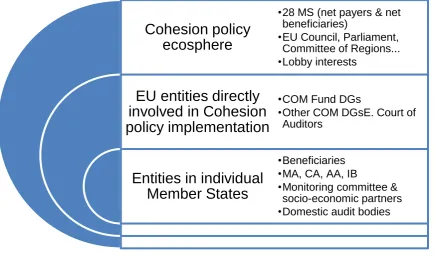
First, EU and Member State authorities (often supported by regional and local levels) have developed Cohesion policy as a field which operate via a comprehensive legal and implementation framework across 28 Member States, involving a wide range of regional/local actors and socio-economic interests (partnership principle) across a broad array of thematic areas (see Figure 1). This leads to:
Duplication between national/regional and EU rules e.g. in terms of project monitoring, and financial control and audit.
Multiple overlapping accountability and audit chains operating at EU and national/regional levels, leading to overlaps and audit overloads.
Unintended consequences e.g. changes in EU rules that simplify implementation in one Member State often create additional complexity in other States.
[image:12.595.75.511.388.645.2] Scope for misunderstandings and mistranslations due to the use of 24 official languages and significant cultural differences between countries.
Figure 1: Multiple dimensions of Cohesion policy
Second, the approach to decision-making and advice does not favour practical implementation:
EU-wide decisions are taken via negotiation among leading politicians or senior civil servants. This leads to compromises (so that radical simplification is not introduced) and generates scope for untended new sources of complexity (e.g. ex-ante conditionalities).
These decision-makers, as well as Commission staff responsible for drafting guidance and advice, often lack practical knowledge and experience of the implementation of programmes and projects.
Cohesion policy
ecosphere
EU entities directly
involved in Cohesion
policy implementation
Entities in individual
Member States
•28 MS (net payers & net
beneficiaries)
•EU Council, Parliament,
Committee of Regions...
•Lobby interests
•COM Fund DGs
•Other COM DGsE. Court of
Auditors
•Beneficiaries
•MA, CA, AA, IB
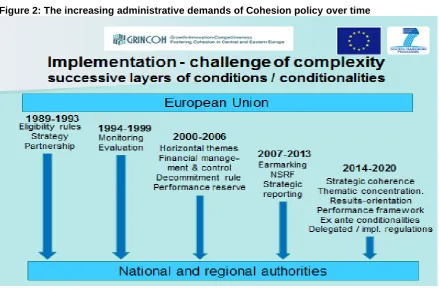
Third, the number and complexity of Cohesion policy rules has increased in each programme period (see Figure 2).
Figure 2: The increasing administrative demands of Cohesion policy over time
Source: EPRC.
Fourth, Cohesion policy rules, structures and terminologies are subject to shifts between (and sometimes within) programme periods. These periodic changes generate:
Complexity for OP authorities and beneficiaries, who have to deal simultaneously with multiple sets of regulations, rules and guidelines for different programmes and projects;
Uncertainty, due to the retrospective application of rules by EU authorities and auditors to earlier programmes and projects. For example, the 2007-13 regulations had only limited detail on rules on financial instruments. Managing authorities’ need for clarification and additional guidance prompted the publication of a series of COCOF notes, which were then applied retrospectively to financial instruments that had been set up before the notes were published.1
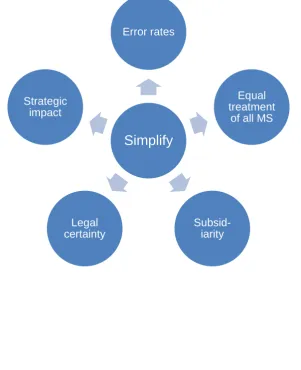
Last, there is tension between simplification and other Cohesion policy principles (see Figure 3) e.g.
Assurance that EU funds are being spent correctly and lawfully and that error rates are reduced. This has led to additional rules on how funds are spent, monitored, controlled and audited, and additional mechanisms aimed at ensuring financial correctness.
Legal certainty for OP authorities and beneficiaries, especially in the context of stricter audits and subsequent to programme suspensions/interruptions and financial claw-backs from projects. This has led to the proliferation of regulations, delegated and implementing acts and guidelines at EU level.
1
Equal treatment of all Member States, which translates into identical or similar requirements across countries and regions. This is seen to contrasts with the principle of proportionality, in the context of national differences in administrative capacity and levels of EU funding.
Subsidiarity, which is seen to imply greater flexibility and responsibility for Member States in setting and implementing rules. This is in tension with the need for legal certainty, financial assurance, and equal treatment of Member States. In some cases, steps in this direction also increase risk for Member States due to uncertainty over how EU authorities will assess domestic decisions in future audits.
[image:14.595.139.441.283.654.2] A stronger focus towards strategic impact. This has led to new rules on thematic concentration, intervention logic, performance framework, ex ante conditionalities, evaluation, and reporting.
Figure 3: Tensions between simplification and other principles
Simplify
Error rates
Equal
treatment
of all MS
Subsid-iarity
Legal
certainty
Strategic
3. EU INITIATIVES ON SIMPLIFICATION IN 2014-20
3.1 Simplification measures introduced in 2014-20
Simplification was a major theme during preparations for the 2014-20 period. The Commission published a draft working paper in 2011 on simplification in the Cohesion policy regulations for 2014-20, which set out proposed changes in the following areas:2
Harmonisation of rules between Cohesion policy and other ESI Funds;
More flexibility (e.g. option for multi-Fund programmes and monitoring committees; option to adjust the financial allocation by up to 3 percent between categories of regions; option to merge the MA and CA; ITI and CLLD; more varied options for financial instruments);
Increased proportionality (e.g. risk-based methods of sampling for controls; smaller projects audited only once before closure; scope to reduce controls & audit intensity);
Legal certainty through clearer rules (e.g. option of flat rates for revenue generating projects);
More efficient delivery and lighter reporting (e.g. for annual reports and for additionality);
Reducing the administrative burden for beneficiaries (e.g. increased use of simplified costs; mandatory annual closure of operations in the annual clearance of accounts);
A move towards results-based management: the Joint Action Plan;
e-Cohesion;
Simplification of European Territorial Co-operation, and of the European Social Fund.
This was followed in 2012 by a Commission communication on simplification in the Multi-annual Financial Framework,3 and by a brochure targeted at beneficiaries and managing authorities.4
Various measures aimed at improving simplification were introduced in the Cohesion policy regulations for 2014-20. However, due to concerns over legal certainty and clarity in the context of financial control and audit, the regulations are now accompanied by a proliferation of delegated acts, implementing acts, and Commission guidance notes.5
In addition, various studies on this theme were undertaken for the European Commission,6
the European Parliament7 and the Committee of the Regions.8
2
European Commission (2012) op. cit.; European Commission (2011) Simplification in the legislative framework for Cohesion policy for 2014-2020, Draft Working Paper, Fiche no 9, Brussels, 18.11.2011.
3
European Commission (2012) A Simplification Agenda for the MFF 2014-2020, Communication to the European Parliament, the Council, the European Economic and Social Committee and the Committee of the Regions, Brussels, 8.2.2012, COM(2012) 42 final.
4
European Commission (2012) Simplifying Cohesion policy for 2014-2020, Brussels, p. 3.
5
http://ec.europa.eu/regional_policy/en/information/legislation/regulations/
6
t33, Archidata, Berman Group, CSIL, Infyde, Laboratorium Rozwoju, METIS, and SWECO (2012) Measuring the impact of changing regulatory requirements to administrative cost and administrative burden of managing EU Structural Funds, Report to the European Commission, Brussels.
7
E.g. Mendez C, Bachtler J and Wishlade F (2012) Cohesion policy after 2013: A critical assessment of the legislative proposals, Report to the European Parliament’s DG for Internal Policies, PE 474.558, Brussels.
8
3.2 New EU initiatives in 2014-15
The European Council meeting of June 2015 in Brussels discussed the implementation challenges of Cohesion policy in 2014-20, including the theme of ‘Administrative capacity and simplification’ and outlined various steps to be taken (see Box 1).9
Box 1: European Council minutes of June 2015 on simplification
As well as emphasising the importance of administrative capacity, the minutes state that the Council:
“CALLS on the Commission to strengthen coordination within the Commission services and to reinforce its capacity to ensure timely, coordinated, clear and stable interpretation of rules and Commission decisions…
INVITES the Commission to explore the possibilities for further simplification and proportionality, taking into account the findings in the Sixth Cohesion report on varying governance capacities. CONSIDERS that the Better regulation initiative should encompass Cohesion policy, including simplification.
“WELCOMES the set-up by the Commission of the high level group monitoring simplification for beneficiaries. ASKS that the Council as of 2016 is informed regularly on the work of the group and that Member States are involved and ENCOURAGES relevant findings to be discussed with Member States and applied to the current programming period where it provides an immediate added value without undermining the stability of the general rules. RECALLS that achieving simplification of Cohesion policy is a shared objective and responsibility of the Commission, Member States, and other stakeholders. Respecting the principle of shared management of ESI Funds, all actors at EU and national level are invited to make use of the simplification measures provided for in the legal framework, to identify and remove processes and procedures which constitute excess administrative burden and cost, or can be simplified without undermining the overall assurance and effectiveness of the management and control system. RECOGNISES that auditors at EU and national level, including Court of Auditors, are well positioned to contribute to the simplification effort by detecting redundant processes and procedures and suggesting more effective solutions based on good practices.
(27) INVITES the Commission and Member States to make efforts and where necessary allocate sufficient resources for preventive actions increasing legal certainty in order to minimise the risk of errors and avoid retroactivity, as well as to identify problems in the early stages of implementation via the designation procedure, system audits and early-warning mechanisms. CALLS on the Commission to provide timely guidance and coordinated methodological support to Member States, including national auditors, and to share recurrent and horizontal audit results with the audit community and programme authorities.
9
The Commission has launched various initiatives in support of simplification in 2014-15, notably:
A High Level Group of Independent Experts on Monitoring Simplification for Beneficiaries of the ESI Funds10 to assess Member States’ take-up of simplification measures, analyse their implementation, identify good practice, and make recommendations e.g. in the context of the 2016 mid-term review, and looking to post-2020. The first meeting was on 20 October 2015, and the second meeting (on e-governance and simplified costs) will be on 1 December 2015.
The Simplify ESIF Platform, which is an online forum for sharing ideas on simplifying ESIF.11
A new study, which aims to build an evidence base on the application of the new simplification mechanisms in 2014-20 and assessing administrative costs and burdens.12
Member State and regional authorities have also put forward position papers. In particular, at the initiative of the French authorities and signed by 25 Member States (all except Denmark, Finland and Italy), a non-paper on simplification was sent on 20 July 2015 to Frans Timmermans as First Vice President of the Commission, Corina Crețu (Commissioner for Regional Policy) and Marianne Thyssen (Commissioner for Employment, Social Affairs, Skills and Labour Mobility).
Box 2: The Member States’ non-paper of 20 July 2015 argues that the following is essential:
1. On the part of the Commission:
to help Member States and in particular managing authorities to make full use of the possibilities offered by the new… regulations, such as the simplified costs options, the new procedures related to major projects, … flat rates for revenue generating projects, etc.;
to fully include cohesion policy in its “Better regulation” initiative…[and] to also allow it to benefit from the REFIT measures to come;
to apply as much as possible… the principle of proportionality with regards to the risks involved, to the quality of governance, and to the importance of the issues at stake;
to ensure timely, coordinated, clear and stable interpretation of regulations coherent with arrangements adopted in programming documents.
2. On the part of the Commission, the Member States and managing authorities:
to jointly screen all existing and planned implementing and delegated acts, guidelines, information notes and Commission’s decisions governing the implementation of the ESI Funds on European level in order to streamline, systematise and simplify these rules or refrain from setting them out wherever possible;
to work together in close cooperation in order to establish a common and shared diagnosis of the main sources of complexity and overlap in the implementation of the rules, and in the control procedures put in place at European, national, and regional levels;…
to propose some concrete simplification measures for the current programming period, within the scope of the current regulations as far as this is possible.
10
http://ec.europa.eu/regional_policy/en/policy/how/improving-investment/high-level-group-simplification/
11
https://ec.europa.eu/futurium/en/simplify-esif
12
4. IQ-NET PARTNERS’ VIEWS OF EU INITIATIVES AIMED AT
IMPROVING SIMPLIFICATION IN 2014-20
4.1 Key concerns of IQ-Net partners
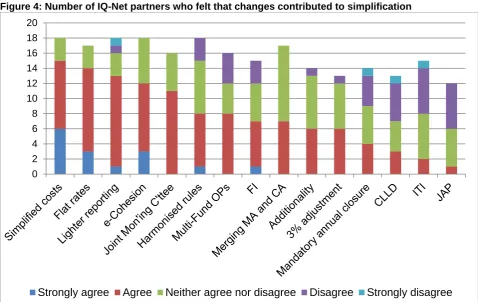
IQ-Net partners welcome some of the simplification measures introduced in 2014-20 (see Figure 4) yet continue to voice serious concerns over the administrative burden associated with Cohesion policy, querying whether there was genuine simplification if the whole package of regulations, acts and guidelines was taken into account, or arguing that simplification measures benefited beneficiaries but not OP authorities.
The main concerns of IQ-Net partners in relation to the simplification measures introduced in 2014-20 are as follows:
The continued lack of legal certainty on key issues;
The heavy administrative burden of EU Cohesion policy, which needs to be lightened, both for beneficiaries and for OP authorities; and
Flexibility measures – which are welcome but often do not lead to simplification.
Two specific fields generating major worries for partners are:
The need for more coordination and proportionality in financial control and audit; and
Simplified cost options, which bring benefits but are seen as burdensome to implement and are associated with concerns over legal certainty and audit.
Even where the simplification measures were welcomed, IQ-Net partners noted that these have been outweighed by other new elements in 2014-20 which has led to an overall increase in complexity, notably:
The process of designating managing and certifying authorities;
The range of measures associated with impact and results (including ex ante conditionalities, thematic objectives/concentration, evaluation, indicators, and the performance framework).
Nevertheless, a survey of IQ-Net partners clearly shows that some of the changes in 2014-20 are seen positively (see Figure 4), with over half of respondents welcoming simplified costs (including flat rates), lighter reporting, e-Cohesion, and scope for joint monitoring committees. In contrast, there is scepticism over the usefulness of JAP, ITI and CLLD, as well as other measures, such as mandatory annual closure.
This section examines the concerns of IQ-Net partners in more detail, focusing on:
legal certainty;
administrative burden;
flexibility measures;
financial control and audit;
simplified cost options;
designation of managing and certifying authorities; and
Figure 4: Number of IQ-Net partners who felt that changes contributed to simplification
Source: EPRC.
Note: Data are drawn from a survey of 18 IQ-Net partners i.e. Austria, Croatia, Czech Republic, Denmark, Finland, France, Greece, Slovakia, Slovenia and also England, Helsinki-Uusimaa, Nordrhein-Westfalen, Païs Vasco (Bizkaia), Pomorskie, Scotland, South Finland, Vlaanderen and Wales.
0 2 4 6 8 10 12 14 16 18 20
4.2 There remain serious concerns over a continued lack of legal certainty
Many partners felt that there was a lack of legal certainty due to unclear and complex rules, which was seen to imply a transfer of audit risk from the Commission to domestic OP authorities, potentially leading to programme interruptions and suspensions (NRW, PV, Sco). Partners were therefore unwilling to proceed without legal certainty. Key issues include:
Multiple EU-level legal and guidance documents – and the lack of consistency between them (Common Provisions Regulation, Fund regulations, Implementing Acts, Delegated Acts, Guidelines…), so that OP authorities have to combine and interpret the different texts (PT, SI, NRW, Wal);
Delays when managing authorities submit queries to the Commission on specific questions relating to legal certainty (DK, Sco);
A lack of stability over time in rules (e.g. on State aid and revenue-generating projects in 2007-13) and in the EU authorities’ interpretations of rules (FR, PV);
Retroactive decisions, with EU authorities re-interpreting rules in a stricter light at a later point in time and applying the new interpretation to previous years (GR, PV);
Insufficient Commission guidance on the application of new initiatives, which may therefore not be fully exploited due to concerns over legal certainty (CZ, Pom, Sco);
A reluctance to use national eligibility rules, because of a perceived risk that EU authorities could introduce future rules which differ from the national approach (DK).
Partners would like to see:
A clear, comprehensive and coherent legal framework, instead of a multiplicity of different documents (SI, NRW, Wal);
A coherent approach across all Commission DGs (including DG Competition) (CZ, Wal).
4.3 The administrative burden remains heavy, despite efforts to simplify
Although some of the steps introduced in 2014-20 (e.g. e-Cohesion and harmonisation of rules) were welcomed by partners, many noted that the administrative burden associated with Cohesion policy is extremely heavy.
Many partners felt that there was to narrow a focus in 2014-20 on reducing the burden for beneficiaries. While this was indeed seen as important, partners argued that there was also a need to reduce the burden for OP authorities and that the two goals were interlinked (HR, PT, NRW).
4.3.1 Harmonisation of rules across ESI Funds
Partners welcomed efforts to harmonise rules across ESI Funds (GR), especially where harmonisation covers the EAFRD as well as the ERDF, ESF and Cohesion Fund (AT). Outstanding issues remain, however, e.g.
Rules are not fully harmonised (FR, Wal), as there are separate regulations for each Fund (SK), e.g. ERDF and ESF rules differ in relation to monitoring and evaluation (e.g. definition of result indicators) (PT, Pom);
Harmonisation has little impact where ERDF and ESF OPs remain separate (PV, Vla).
Partners called for:
Further harmonisation of rules between ESIF and other EU instruments) (FR, Wal);
Consideration of a single ESI Fund, possibly with ring-fencing for specific types of spending (Wal);
The need to respect the different Treaty goals of the different Funds (PT) – which raises questions over the desirability of merging the Funds.
4.3.2 Lighter reporting
Views differed on the impact of reporting requirements in 2014-20. Some partners felt that the approach to reporting was lighter, and particularly welcomed the merger of the mid-term report, monitoring report and the summary of the payment into one report to be submitted with the payment application (FIN).
However, other partners did not feel that the burden in terms of reporting had been reduced (GR, HR), and had concerns e.g. over the obligation to collect data for a report on the performance framework in 2017, as well as the annual closure of accounts.
4.3.3 e-Cohesion
Partners felt that this was a positive change (GR), both for beneficiaries (e.g. in submitting claims) (Eng, Pom, Vla) and for communication between the Commission and OP authorities (Eng). Some partners felt that it might have been better if the Commission had developed an ad hoc IT-system rather than each Member State developing its own system (DK).
That Commission and domestic auditors may not accept electronic documentation (Eng);
That overall requirements are too high, and that the system is too complex and inflexible (AT);
Difficulties with electronic signatures (AT) e.g. where an application involves multiple applicants (DK);
That the new system involves changes in working practices and so will take time and effort for staff to become familiar with the new system (Vla).
This is also a field where there are particular issues due to interaction between domestic and EU approaches in individual Member States:
In Poland, the IT system has been set up at national level, which is seen to help in coordinating ESI Funds. However, it means that the regional managing authority of the Pomorskie ROP is dealing with detailed queries from applicants about an electronic system that they did not design.
In Finland, the new electronic service package (EURA 2014) aims to improve links between existing monitoring systems but there remains a wide range of domestic project templates with different domestic legal bases.
4.3.4 Changes that may lead to unforeseen negative consequences
Partners noted that some of the detailed changes introduced in 2014-20 could have unforeseen negative consequences.
Document retention periods have been reduced to assist beneficiaries, but are now more complex (Wal), with dates varying by Fund and size of project, so that the managing authority now has to work out document retention dates case by case and communicate these dates to beneficiaries individually. This approach is seen to create an additional administrative burden, as well as an increased risk of error (also because many beneficiaries receive both ERDF and ESF funding, where document retention periods differ);
4.4 Flexibility is welcome but does not mean simplification
The flexibility options introduced in 2014-20 are welcomed by IQ-Net partners but, in many cases, increased flexibility is seen not lead to simplification (CZ, SK, SI). Some partners decided not to implement these options because:
Of concerns that these changes could lead to increased risk for audit and/or increased complexity in practice (AT, FIN, Wal);
These options do not present a simplification for smaller programmes (DK);
Some of these options were already in place (DK, GR).
4.4.1 Option for Multi-Fund programmes
This option was welcomed in principle but seen as problematic in practice because:
There are still separate regulations and requirements for each Fund (AT, Wal) e.g. strict demarcation between each Fund’s intervention logic, targets and financial allocations;
The option did not cover the EAFRD (FR, SK).
Shifting between multi-Fund and mono-Fund OPs involves significant upheaval in terms of structures, systems and human resources. Greece, for example, had multi-Fund OPs in 2000-06, then changed to mono-Fund OPs in 2007-13, and has now shifted in 2014-20 to multi-Fund OPs. This has generated e.g. in terms of recruiting, allocating and training staff to deal with different Funds.
4.4.2 Option to merge the managing and certifying authorities
This option was not seen to bring significant benefits because rules for the different ESI Funds remain different, so that few gains were anticipated (Wal).
4.4.3 Option for a joint monitoring committee
Joint monitoring committees for all ESI Fund OPs have been introduced at Member State (FIN) or regional level (Eng, NRW, Sco, Wal), or joint monitoring committees for ERDF and ESF will continue as in 2007-13 (DK). This approach is seen to bring benefits. However, challenges remain:
Where national committees have been set up, there are concerns that the regions’ views may not be articulated as clearly as they would be with separate regional committees (FIN);
In Wales, although the regulations clearly state that a joint monitoring committee can be set up for the ERDF, ESF and EAFRD and although DG Regional Policy has welcomed this approach, DG Agriculture has raised concerns;
4.4.4 Options of ITI and CLLD
These options were seen as interesting in principle but were felt to increase complexity in practice (SI, Pom), due to:
Complex EU rules, which were also seen to be interpreted in a bureaucratic way by the Commission;
The regulatory obligation for local authorities (or other relevant local entities) to be designated as intermediate bodies for ITI/ISUD, and for a contractual arrangement between the managing authority and each local authority (Eng, NRW);
Related: local authorities’ lack of experience and capacity with Cohesion policy, and concerns over their ability to deal e.g. with audit and control requirements, implying the need for additional guidance, oversight and hands-on support by the managing authority or national administration (HR, Eng, Pom);
Application of the obligation to cover two Thematic Objectives at the level of each ISUD, rather than the overall Priority axis or project call (NRW),
Commission staff have taken a theoretical approach to urban development and have seemed to lack understanding of how local authorities work in practice.
4.4.5 Other changes
Other changes were welcomed, although the impact on simplification was seen as limited, e.g.:
The option to adjust the financial allocation by up to 3 percent between categories of regions;
More varied options for financial instruments;
4.5 More coordination and proportionality is needed in control and audit
Partners argued that the complexity and detail of rules relating to financial control and audit create a significant administrative burden (FR, Eng, NRW, PV, Vla), although some partners also emphasised the need for effective rules in order to avoid fraud and the misuse of funds (FIN). There are doubts as to whether the changes introduced in 2014-20 will lead to genuine simplification (CZ, Eng, Vla) and calls for greater proportionality/differentiation in control and audit (AT, DK, NRW, Sco, Vla, Wal).
A first set of issues relates to the degree of complexity:
The layers of checks i.e. of the beneficiary is accountable to the intermediate body, which is accountable to the managing authority, which is accountable to the audit authority and the Commission, while the audit authority is accountable to the Commission and the European Court of Auditors, and the Commission is accountable to the European Parliament and European Court of Auditors (AT, Eng); moreover, these EU layers of checks operate alongside parallel domestic layers of checks (NRW);
EU authorities’ tendency to micro-manage implementation across OPs (CZ, Eng, NRW);
Simplification has consisted of adding elements to the existing framework (with ‘simpler’ procedures applying only to certain types of project) – which leads to multiple sets of rules and so to increased complexity (AT, CZ, Wal);
A second set of issues concerns the perception that there has been a transfer of audit risk from the Commission to national/regional audit and managing authorities and beneficiaries (DK, PV, NRW, Sco, Vla). This is generating uncertainty and caution about future audit consequences:
OP authorities are concerned over possible OP interruptions and suspensions (NRW, PV, Sco), which are seen as politically unsustainable;
Beneficiaries are distracted from focusing on delivery and/or applicants may walk away from funding (Sco, Vla, Wal);
Key changes needed include:
Greater use of system audits which should act as an indicator of the scale and level of project audit needed (Vla);
A coordinated audit system between EU and domestic levels to reduce duplication (SI, NRW, PV), with domestic control/audit systems used where these function well (DK, NRW, Vla);
A need for auditors to focus on whether rules (e.g. on eligibility) are met and applied correctly and to refrain from introducing additional concepts (e.g. value for money) (Wal).
4.5.1 Risk-based methods of sampling for controls
This change was seen as beneficial (GR), at least in principle, although there were concerns in practice (AT) and calls for better and more consistent sampling (Vla). Key issues include:
Smaller or less risky projects may not benefit from this change in practice (AT, DK, Sco) because, in order to sample (e.g. expense) documents, there needs to be a larger pool from which the sample can be drawn and so all beneficiaries will still need to submit expense documentation.
4.5.2 Smaller projects audited only once before closure
While this change is helpful (GR), some projects still face multiple audits (PV, Vla).
There is seen to be a need to tailor project audits further, using a risk-based approach related to the nature of the beneficiary (rather than simply project size) (Wal), involving a lighter approach for e.g.:
applicants with a proven track record with ESIF-funded projects, and
projects led by local authorities (whose systems incorporate domestic checks and balances) as compared to projects led by a new one-person company.
4.5.3 Scope to reduce controls and audit intensity
Partners did not believe that changes in 2014-20 allowed much scope to reduce controls and audit intensity in practice (AT, HR). A particular concern was the disproportionate burden on smaller OPs, which have to fulfil the same requirements as large OPs but with less funding (Vla, Wal).
4.6 Simplified cost options are welcome but generate serious concerns
Many partners have adopted simplified cost options (SCO) (see Figure 8 and examples in Annex 1), which are seen as helpful, although preparatory work is onerous (AT, CZ, DK, FIN, GR, PT, SI, NRW). SCO help by:
reducing the workload for the beneficiary (particularly during the payment phase);
speeding up payment processing and reducing the need for clarifications (AT, FIN, Vla), and
[image:27.595.66.533.229.386.2] reducing the error rate (PT).
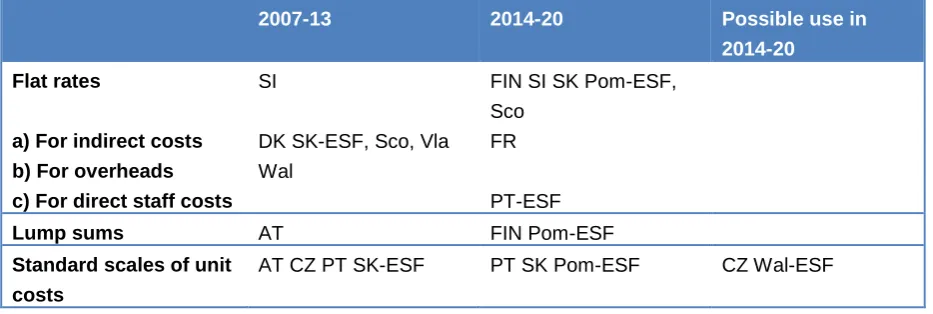
Figure 5: Use of simplified cost options in selected IQ-Net partner programmes
2007-13 2014-20 Possible use in
2014-20
Flat rates
a) For indirect costs b) For overheads c) For direct staff costs
SI
DK SK-ESF, Sco, Vla Wal
FIN SI SK Pom-ESF, Sco
FR
PT-ESF
Lump sums AT FIN Pom-ESF
Standard scales of unit costs
AT CZ PT SK-ESF PT SK Pom-ESF CZ Wal-ESF
Nevertheless, partners also experienced a series of difficulties with SCO.
4.6.1 Legal uncertainty
Partners voiced concern over legal uncertainty (FR), arguing that the Commission has not provided enough guidance and has been slow to respond to queries (CZ, PL, Sco, WaL). There is also a lack of clarity about which aspects require Commission approval (PT). In response, partners have:
Decided not to use (some) SCO (e.g. unit costs) in some programmes (CZ, Sco, Wal);
Used only methods set out in the Delegated Act (although these are time-consuming) or used in other EU funding streams (e.g. Horizon 2020 and LIFE), notably flat-rates (FR), especially where no off-the-peg national model is available (or, at least, no national model which would not require some modification) (Sco, Wal);
Cooperated with domestic authorities on methods and data sources (PT, Vla). E.g. managing authorities in Portugal must obtain agreement on SCO from the Agency for Development and Cohesion, the audit authority, and the inter-ministerial coordination committee.
Specific concerns relate e.g. to:
The use of unit costs and the evidence base needed;
Procedures for projects with joint beneficiaries;
The definition of direct and indirect personnel costs in specific cases;
The possibility that SCO (e.g. lump sums) may invoke State aid rules (FR, PT, Pom);
4.6.2 Administrative burden
The work involved in establishing methodologies and data sources for calculating SCO is considerable and time-consuming (CZ, GR, Vla), as has the communication process with the Commission (CZ, FR, GR). The amount of work has hindered the broader use of SCO (CZ, FR, Wal).
Partners have responded by:
Setting up units to work with OP authorities to develop methods and implement SCO (PT);
Developing national guidance and eligibility rules for regional managing authorities (FR);
Drawing on external expertise in developing methods and data sources (Vla).
4.6.3 Treatment of SCO in audit
Experiences with audit and SCO vary:
Some partners have seen no problems (CZ, DK, SI), possibly because audits have not yet been undertaken of the SCO approach (NRW);
In Finland, a European Court of Auditors audit in spring 2015 examined DAS audits of seven ESF projects; of these, only one project did not require further investigation (e.g. in relation to procurement, project eligibility period, VAT and statutory holiday salaries);
In Scotland, issues were raised in the 2007-13 ESF OPs in relation to flat rate staff costs, where less than 100 percent of staff time was spent on a project (e.g. incomplete timesheets and incorrect hourly calculations);
In Wales, the Commission audited the flat rates used in 2007-13 and criticised OP authorities for sending information on SCO to applicants via email, rather than including this information in the formal letter approving the project.
Partners emphasise that future use of different SCO depends on:
Clarity of rules (HR, SK) and legal certainty about how rules will be interpreted in future audits (AT, NRW, PV, Sco, Wal), with reluctance to use options (notably unit costs in ERDF) where there is seen to be a lack of legal certainty (Sco, Wal);
Acceptance of the SCO approach by EU auditors (as some Commission auditors still seem to prefer an actual costs and paperwork approach);
A further Delegated Act setting out options for using SCO for a wider range of ERDF themes (e.g. R&I, business support, broadband, and energy efficiency) (Eng).
4.6.4 Other issues
Complications where domestic systems of SCO already exist and where beneficiaries and intermediate bodies are reluctant to change to a new approach (SI, PV-ESF);
Some project beneficiaries argue that flat rate levels are too low (AT, DK);
Finland would like to see wider use of SCO in the EAFRD, in order to allow for greater coordination and integration with the ERDF and ESF;
4.7 Designation of authorities increases the administrative burden
Partners note that a key new source of complexity in 2014-20 is the process of designating managing and certifying authorities – which detracts from capacity of explicit simplification measures to reduce the overall administrative burden. Key concerns are as follows:
The process is seen as more complex than in 2007-13, with lengthy guidance and checklists provided by the Commission,13 so that the process is seen to be at least as complex as the process of drafting and agreeing the OP itself (FR, GR, NRW);
The rules are seen as unclear, and there are calls for a clearer guidance note (AT); this is partly because there are so many different EU documents (regulations, delegated and implementing acts, guidelines…) so that OP authorities need to combine rules from different documents in order to understand what needs to be done (NRW),
Designation is taking a very long time across all EU Member States, which in turn is leading to delays in financial implementation because only advance payments can be made until designation is complete.
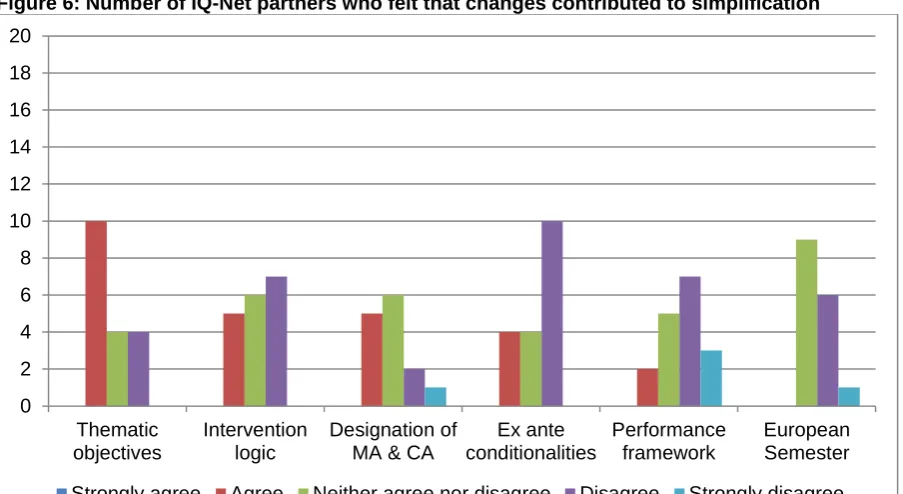
[image:29.595.74.526.398.645.2]More fundamentally, partners noted that the allocation of responsibility to Member State authorities creates additional challenges, given the lack of legal clarity and certainty over some rules and given that the domestic audit authorities remain accountable to the Commission and European Court of Auditors (AT, GR, Eng, NRW).
Figure 6: Number of IQ-Net partners who felt that changes contributed to simplification
Source: EPRC.
Note: See note to Figure 4.
13
European Commission (2014) Guidance for Member States on the designation procedure, EGESIF_140013-final, 18 December 2014, Brussels.
0 2 4 6 8 10 12 14 16 18 20 Thematic objectives Intervention logic Designation of MA & CA
Ex ante conditionalities Performance framework European Semester
4.8 The stronger strategic focus adds to complexity
Partners welcome the stronger strategic focus in 2014-20 in general terms but also note that it leads to increased complexity (AT, FIN, GR, SI, NRW, Wal).
One view is that a better balance is needed between rules on control and audit on the one hand and rules on results/content/project quality on the other (DK, SI, Eng, Sco, Vla). Thus more demanding rules on results/impact should be balanced by a reduction in rules on financial implementation and control (AT, DK). This could involve a stronger reliance on Member States’ own implementation, control and audit systems, and a focus on allocating EU funding on the basis of specific outcomes (e.g. €10,000 per qualification achieved) (Sco).
Another view is more sceptical, with partners arguing that approach taken has been very heavy and will generate a lot of data which cannot be used (Pom, SFin).
In this context, it is worth noting that few IQ-Net partners are using Joint Action Plans. Although seen as a potentially good idea which might in principle support simplification, they are not seen as practical due to complex rules (Vla).
4.8.1 Thematic objectives and concentration
It is challenging for applicants to specify the Thematic Objectives to which they are contributing (DK);
The Commission micro-managed thematic concentration through multiple requirements (e.g. separate targets for ‘climate change’ and for ‘low carbon transition’, which are calculated differently) (Wal);
The Thematic Objectives in the Common Provisions Regulation are not seen as fully compatible with the EAFRD (SK);
The application of the 10 Thematic Objectives has increased complexity in practice in particular countries/regions as they have led to the inclusion of more Priority axes and a lack of alignment between objectives (SI, Eng).
4.8.2 Reporting requirements
Complex data collection systems are needed to enable managing authorities to meet reporting requirements (Eng);
Some of the data to be collected is seen to be of little use at EU level but generates significant burdens for beneficiaries and OP authorities (CZ, Pom).
4.8.3 Indicators
There is a need for clear goals which can genuinely be measured. In contrast, indicators that meet EU requirements are seen by some partners as not meaningful for the OP, especially where funding is small relative to the scale of the aggregate economy (and so where impacts cannot be traced) and/or where OPs focus on pilot and developmental activities (FIN, NRW);
DG REGIO and DG EMPL use different outcome indicator concepts which are inconsistent and create conceptual confusion (PT).
4.8.4 Evaluation
The Commission’s approach to the evaluation plan is seen as overly theoretical (NRW), with managing authorities being presented with pages of formal comments and being asked to state exactly how they would undertake evaluations in 2019;
OP authorities are facing heavy demands due to the number of evaluations and studies being undertaken by the Commission and domestic authorities (NRW, Pom). In Pomorskie, the managing authority estimates that around 50 evaluations will be carried out in 2014-20 but only six of these will be for the managing authority and the remainder for the Commission and national government.
4.8.5 Performance framework
The performance framework is seen to add complexity but not to strengthen implementation or effectiveness (NRW, Wal).
4.8.6 Ex ante conditionalities
5. NATIONAL/REGIONAL ACTION ON SIMPLIFICATION IN 2014-20
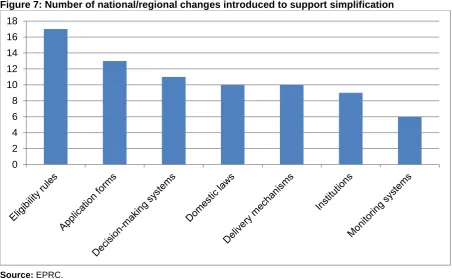
In addition to simplification measures introduced at EU level, Member States and regional authorities have also taken the initiative to find ways of simplifying Cohesion policy implementation (see Figure 7). Some IQ-Net partners have taken decisions to prioritise stability and simplicity as much as possible in preparing for 2014-20 because authorities and beneficiaries are familiar with existing systems and procedures (AT, Wal). Key measures involve efforts to:
Revise domestic legal frameworks to reduce overlap with EU rules;
Reduce the numbers of programmes and OP authorities;
Simplify programme architecture;
Simplify/harmonise monitoring systems;
Simplify eligibility rules and project application forms;
[image:32.595.72.525.294.573.2] Ensure that delivery mechanisms make life easier for beneficiaries.
Figure 7: Number of national/regional changes introduced to support simplification
Source: EPRC.
Note: See note to Figure 4.
5.1 Revising domestic legal frameworks to reduce overlap with EU rules
One reason for the administrative burden facing OP authorities and beneficiaries is the need to meet both EU and national/regional legal requirements. This has prompted some partners to simplify domestic frameworks and/or to harmonise these with EU regulations:
Nordrhein-Westfalen has introduced a Land ERDF Framework Regulation (
EFRE-Rahmenrichtlinie) in 2014-20 which effectively transposes EU legal requirements into
domestic law, so that projects co-funded by the ERDF must only meet these rules (e.g. in relation to monitoring and control), and not the ‘normal’ domestic legal requirements (under the Land budgetary regulation [Landeshaushaltsordnung] and instrument-specific regulations 0
(Fachrichtlinien).14
This change also facilitates the use of simplified cost options, which are administratively difficult under domestic law. This approach was enabled by support from the Land Minister responsible for the ERDF managing authority, and by a Land cabinet decision.
In Slovenia, the national law on budget execution has been revised to bring it closer to the EU regulations, with the aim of facilitating simpler and more transparent management.
In Portugal, the number of national regulations has been reduced from c.100 in 2007-13 to six in 2014-20 (one national regulation for all ESI Funds, one regulation for the ESF, and one regulation for each of the four themes of the Partnership Agreement). Nevertheless, some rules will continue to vary across interventions because project calls can set out more detailed conditions that do not appear in the regulations (e.g. methods for simplified costs).
5.2 Reducing the numbers of programmes and OP authorities
Many partners have taken steps to reduce the number of entities involved – which is often seen to have been a challenging process (CZ) or to have required high-level political decisions (NRW). Reductions sometimes focus only on the number of intermediate implementing bodies (CZ, NRW, PV, Sco), or also on the number of managing authorities and programmes (AT, CZ, FIN, HR, Eng). Nevertheless, challenges remain:
In Nordrhein-Westfalen, the number of intermediate bodies has been reduced significantly from over 100 in 2007-13 to nine main bodies in 2014-20, which is seen to allow significant improvements in coordination and audit robustness. However, the ERDF OP is funding
integrated urban strategies, which means that (c.20) local authorities must also be designated as intermediate bodies.
In Finland, the number of intermediate bodies has been reduced from 39 to 16, partly via the designation of a single ‘coordinating’ regional council as intermediate body in each of the South and West regions (but not in the East or North). This is seen to have simplified administration and communication for the managing authority. However, the division of labour between the ‘coordinating’ and other regional councils in the South and West is complex, as the ‘coordinating’ regional councils are responsible for final legal funding decisions and administering projects (payments, monitoring etc.) but the other regional councils decide on the focus of project calls, and prepare the decisions on applications.
A further issue in Finland is that other intermediate bodies (the ELY-centres) operate in a number of different administrative areas with different legal bases and with accountability chains to a number of different ministries and agencies.
5.3 Simplifying programme architecture
Member States which are significant recipients of ESIF funding often have complex programming structures, with various different kinds of programme (e.g. ERDF/ESF/CF, national/regional, LDR/TR/MDR) and OP authorities.
14
NRW Land (2015) Rahmenrichtlinie über die Gewährung von Zuwendungen aus dem Europäischen Fonds für regionale Entwicklung im Zielbereich Investitionen in Wachstum und Beschäftigung (EFRE) in der Förderperiode 2014-2020 im Land Nordrhein-Westfalen (EFRE-Rahmenrichtlinie – EFRE RRL), Ministerialblatt (MBl. NRW)
Ausgabe 2015 Nr. 20 vom 24.7.2015 pp. 443-66,
Poland has increased the percentage of funding for regional OPs in 2014-20, and these now cover both ERDF and ESF funding and are managed by the regional governments, with local authorities as intermediate bodies for ITI. The ROPs operate alongside national thematic OPs managed by central government ministries. The regionalisation of funding presents a significant coordination challenge so that central government has introduced new legislation and guidelines (e.g. on project calls and applicant checks) and also remains legally responsible for approving the ROPs.
Portugal has invested significant effort in ensuring a more coherent programming structure, including a hierarchy of objectives and investment priorities. The thematic OPs have a clear intervention logic and cover the mainland Less Developed Regions only (except for OPs or Priority axes which are fully national e.g. are funded exclusively by the Cohesion Fund or Youth Employment Initiative). The domestic regulations are also designed to follow each thematic domain to build a coherent and condensed set of regulations.
5.4 Simplifying/harmonising monitoring systems
Partners have taken steps to streamline monitoring systems (NRW), to centralise monitoring (CZ), to improve connectivity between existing systems (SI) and to improve user-friendliness (DK). These steps often depend on broader institutional changes e.g. streamlining the monitoring system in Nordrhein-Westfalen has depended on a significant reduction in the number of intermediate bodies.
Nevertheless, changes can generate further challenges:
In the Czech Republic, a central monitoring system has been re-introduced to eliminate overlap and to simplify processes for beneficiaries and OP authorities but a number of difficulties have emerged: a) the work of training staff was underestimated; b) there have been technical problems; c) the system does not cover all procedures; d) managing authorities have requested changes to the system to meet specific needs; e) the national guidance document on monitoring is over 1000 pages long (including detailed templates which can be used directly by OP authorities and beneficiaries).
In Finland, a new electronic service package (EURA2014) has been introduced for ERDF and ESF with a view to simplify procedures for applicants and OP authorities, to reduce error rates, to accelerate the processing of applications, and to facilitate data extraction for reporting purposes. However, challenges have emerged: a) there are a wide range of project templates with different legal bases, which has caused complexities for applicants and intermediate bodies (e.g. if a project has both investment and development elements, these need to be separated into two different projects in EURA 2014); b) the complex division of labour between the ‘coordinating’ regional councils and other regional councils in the South and West regions (see Section 6.2) has resulted in an overlap of tasks in EURA 2014.
5.5 Simplifying eligibility rules and project application forms
Steps have been taken to harmonise eligibility rules across all ESI Funds (Wal) or between the ERDF and ESF (Eng), or this was already done in 2007-13 (SI). Other measures include effort to make the eligibility rules easier to understand (DK) e.g. by eliminating jargon and aligning eligibility rules across the ERDF and ESF (Eng).
Partners have also simplified application and other forms:
Denmark has made efforts to simplify the application forms and to develop indicator guidelines for applicants. The application forms now include questions on State aid rules only under relevant Priority axes.
In Slovenia, the same application form is now used for all instruments under all Priority axes, including both calls and direct applications (and is based on the Commission’s form for major projects).
In England, administrative arrangements between the ERDF and ESF have been harmonised, including alignment of the application process and project selection criteria.
In Nordrhein-Westfalen, project application forms can now be completed online. Moreover, the structure of the application forms means that project monitoring forms are slimmer and harmonised.
5.6 Introducing delivery mechanisms that make life easier for beneficiaries
5.6.1 Harmonised information points and application procedures
One-stop-shops or a single network of information points have been introduced for potential applicants (FR, PL, PT, SI, Eng) or were already in place in 2007-13 (NRW);
Single on-line websites (sometimes for all OPs and ESI Funds), with a common application procedure and information on all Funds (HR, PT, Wal). In Portugal, the website includes FAQs, a series of (youtube) videos explaining key steps of the application process, scope to sign up to notifications of forthcoming project calls);
A single application procedure for all relevant EU, national and regional funding sources (FR).
5.6.2 Hands-on support for beneficiaries
In Denmark, project beneficiaries are now invited to start-up meetings, which provide e.g. information on reporting requirements with the aim of reducing the number of errors in the reporting processes. Similarly, the managing authority now phones beneficiaries during the preparation of project accounts in order to discuss any questions.
In Wales, a Delivery and Compliance Group (involving managing authorities and representatives of local authorities, the third sector, higher and further education, and other public entities) has been set up as a forum for beneficiaries and meets quarterly to deal with requests for clarification or training.