City, University of London Institutional Repository
Citation
:
Baronchelli, A., Felici, M., Loreto, V., Caglioti, E. and Steels, L. (2006). Sharp transition towards shared vocabularies in multi-agent systems. Journal of StatisticalMechanics: Theory and Experiment new, 2006(6), doi: 10.1088/1742-5468/2006/06/P06014
This is the unspecified version of the paper.
This version of the publication may differ from the final published
version.
Permanent repository link:
http://openaccess.city.ac.uk/2672/Link to published version
:
http://dx.doi.org/10.1088/1742-5468/2006/06/P06014Copyright and reuse:
City Research Online aims to make research
outputs of City, University of London available to a wider audience.
Copyright and Moral Rights remain with the author(s) and/or copyright
holders. URLs from City Research Online may be freely distributed and
linked to.
arXiv:physics/0509075v2 [physics.soc-ph] 26 Jun 2006
multi-agent systems
Andrea Baronchelli, Maddalena Felici and Vittorio Loreto Dipartimento di Fisica, Universit`a “La Sapienza” and SMC-INFM, P.le A. Moro 2, 00185 Roma, (Italy)
Emanuele Caglioti
Dipartimento di Matematica, Universit`a “La Sapienza”, P.le A. Moro 2, 00185 Roma, (Italy)
Luc Steels
VUB AI Lab, Brussels (Belgium)
Sony Computer Science Laboratory, Paris (France)
1. Introduction
Bluetooth, blogosphere, ginormous, greenwash, folksonomy. Lexicographers have to add thousands of new words to dictionaries every year and revise the usage of many more. Although precise data is hard to come by, lexicographers agree that there is a period in which novelty spreads and different words compete, followed by a rather dramatic transition after which almost everyone uses the same word or construction [1]. This ‘semiotic dynamics’ has lately become of technological interest because of the sudden popularity of new web-tools (such as del.icio.us or www.flickr.com) which enable human web-users to self-organize a system of tags and that way build up and maintain social networks and share information. Tracking the emergence of new tags shows similar phenomena of slow spreading followed by sudden transitions in which one tag overtakes all others. There is currently also a growing number of experiments where artificial software agents or robots bootstrap a shared lexicon without human intervention [2, 3]. These applications may revolutionize search in peer-to-peer information systems [4] by orchestrating emergent semantics [5] as opposed to relying on designer-defined ontologies such as in the semantic web [6]. They will be needed when we send groups of robots to deal autonomously with unforeseeable tasks in largely unknown environments, such as in the exploration of distant planets or deep seas, hostile environments, etc. By definition it will not be possible to define all the needed communication conventions and ontologies in advance and robots will have to build up and negotiate their own communication systems, situated and grounded in their ongoing activities [7]. Designers of emergent communication systems want to know what kind of mechanisms need to be implemented so that the artificial agents effectively converge towards a shared communication system and they want to know the scaling laws to see how far the technology will carry.
2. The Naming Game
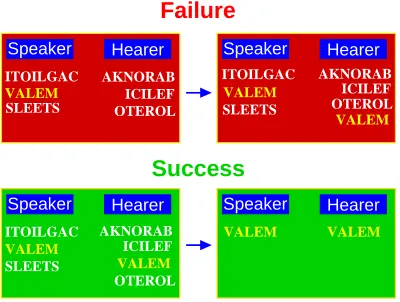
AKNORAB SLEETS SLEETS ICILEF ICILEF OTEROL AKNORAB AKNORAB Success Speaker Speaker Speaker Speaker SLEETS Hearer Hearer Hearer Hearer Failure OTEROL ITOILGAC ITOILGAC ITOILGAC VALEM VALEM VALEM VALEM VALEM VALEM VALEM OTEROL ICILEF
Figure 1. Inventory dynamics: Examples of the dynamics of the inventories in a failed and a successful game, respectively. The speaker selects the word highlighted in yellow. If the hearer does not possess that word he includes it in his inventory (top). Otherwise both agents erase their inventories only keeping the winning word.
has recently been studied also in [18] focusing on how a population selects among a set of possible grammars already known to each agent, whereas here we investigate how conventions may develop from scratch as a side effect of situated and grounded communications. The Naming Game model to be studied here uses as little processing power as possible and thus establishes a lower-bound on cognitive complexity and performance. In contrast with other models of language self-organization, agents do not maintain information about the success rate of individual words and do not use any intelligent heuristics like choice of best word so far or cross-situational learning. We want to understand how the microscopic dynamics of the agent interactions can nevertheless give rise to global coherence without external intervention.
The Naming Game is played by a population of N agents trying to bootstrap a common vocabulary for a certain number M of individual objects present in their environment, so that one agent can draw the attention of another one to an object, e.g. to obtain it or converse further about it. The objects can be people, physical objects, relations, web sites, pictures, music files, or any other kind of entity for which a population aims at reaching a consensus as far their naming is concerned. Each player is characterized by his inventory, i.e. the word-object pairs he knows. All the agents have empty inventories at time t = 0. At each time step (t = 1,2, ..) two players are picked at random and one of them plays as speaker and the other as hearer. Their interaction obeys the following rules (see Fig. 1):
• The speaker selects an object from the current context;
• The speaker retrieves a word from its inventory associated with the chosen object, or, if its inventory is empty, invents a new word;
• The speaker transmits the selected word to the hearer;
is associated to the object chosen by the speaker, the interaction is a success and both players maintain in their inventories only the winning word, deleting all the others;
• If the hearer does not have the word named by the speaker in its inventory, the interaction is a failure and the hearer updates its inventory by adding an association between the new word and the object.
This model makes a number of assumptions. Each player can in principle play with all the other players, i.e. there is no specific underlying topology for the structure of the interaction network. So the game can be viewed as an infinite dimension (or “mean field”) Naming Game (an almost realistic situation thanks to the modern communication networks). Second, we assume that the number of possible words is so huge that the probability that two players invent the same word at two different times for two different objects is practically negligible (this means that homonymy is not taken into account here) and so the choice dynamics among the possible words associated with a specific object are completely independent. As a consequence, we can reduce, without loss of generality, the environment as consisting of only one single object (M = 1). In this perspective it is interesting noting that Komarova and Niyogi [13], have formally proven, adopting an evolutionary game theoretic approach, that languages with homonymy are evolutionary unstable. On the other hand, it is commonly observed that human languages contain several homonyms, while true synonyms are extremely rare. In [13] this apparent paradox is resolved noting that if we think of ”words in a context”, homonymy does indeed disappears from human languages, while synonymy becomes much more relevant. These observations match perfectly also with our third assumption, according to which speaker and hearer are able to establish whether the game was successful by subsequent action performed in a common environment. For example, the speaker may refer to an object in the environment he wants to obtain and the hearer then hands the right object. If the game is a failure, the speaker may point or get the object himself so that it is clear to the hearer which object was intended.
3. Phenomenology
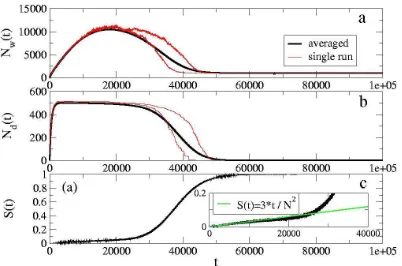
The first property of interest is the time evolution of the total number of words owned by the populationNw(t), of the number of different wordsNd(t), and of the success rate S(t). In Figure (2) we report these curves averaged over 3000 runs for a population of N = 1000 agents, along with two examples of single run curves. It is evident that single runs originate quite irregular curves. We assume in these simulations that only two agents interact at each time step, but the model is perfectly applicable to the case where any number of agents interact simultaneously.
Figure 2. Temporal evolution: we report here time evolution curves of a Naming Game played by N = 1000 agents. Without loss of generality (see text) we consider M = 1 objects. Bold curves are obtained averaging 3000 runs, while the light ones are obtained by a single run. (a)Total number of words in the systemNw(t) vs. t(there
denotes the number of games played) ;(b) Number of different words in the system Nd(t), whose average maximum isN/2;(c)Success rateS(t), calculated by assigning
1 to a successful interaction and 0 to a failure and averaging over many realizations. In the inset it is shown that, up to the disorder/order transition, the success rate is well described by the relationS(t) = 3t/N2.
inventories for each agent. The asymptotic state is one where a word invented during the time evolution took over with respect to the other competing words and imposed itself as the leading word. In this sense the system spontaneously selects one of the many possible coherent asymptotic states and the transition can thus be seen as a symmetry breaking transition.
The key question now is whether one can prove that this transition will always take place and on what time-scale. For our model, it is easy to prove that an absorbing state will be eventually reached with probability 1. Here an absorbing state is a state in which all the agents have only one word, the same for the whole population. The proof is straightforward. In fact from any possible state there is always a non-zero probability to reach an absorbing state in, for instance, 2(N −1) interactions. A possible sequence is as follows. A given agent speaks twice with all the otherN−1 agents using always the same word (say A). After these 2(N −1) interactions all the agents have only the word A. Denoting withpthe probability of the sequence of 2(N−1) steps, the probability that the system has not reached an absorbing state after 2(N−1) iterations is smaller or equal to (1−p). Therefore, iterating this procedure, the probability that, starting from any state, the system has not reached an absorbing state after 2k(N−1) iterations, is smaller than (1−p)k which vanishes exponentially withk. This very general argument, anyway, does not give any idea about how and on which time scale the absorbing state is reached. Alternatively one can define the overlap state function as O = 2
N(N−1) P
i>j |ai∩aj|
|ai||aj|, where
ai is the ith agent’s inventory, whose size is|ai|, and|ai∩aj|is the number of words in
in the system. Averaged over several runs, it always shows, numerically, a growth with time, i.e. hO(t+ 1)i > hO(t)i. On the other hand, looking at the single realization, this function grows almost always, i.e. hO(t+ 1)i > O(t) except for a set a very rare configurations whose statistical weight is negligible. This monotonicity combined with the fact that the overlap function is bounded, i.e. O(t) ≤ 1, strongly supports that the system will indeed reach a final coherent state but a formal proof is still lacking. This is consistent with the fact that the coherent state is the only state stable under the dynamical rules of the model. The more challenging question then concerns under what scaling conditions convergence is reached.
We can distinguish three phases in the behavior of the system, compatible with the S-shaped curve typically observed in the spreading of new language conventions in human populations [1, 19, 20]. Very early, pairs of agents play almost uncorrelated games and the number of words hence increases over time as Nw(t) = 2t, while the
number of different words increases as Nd(t) = t. In this phase one can look at the
system as a random graph where pairs of agents are connected if they have a word in common. Because two players always have the same word after a failed game, each failure at this stage corresponds to adding an edge to the graph. This fixes a time scale of order t ∼N to establish a giant component in the network [21] and for sure after a time of the order of t ∼ NlogN there will be, in the thermodynamic limit (N → ∞), only the giant component surviving [22].
Then the system enters a second stage in which it starts building correlations (i.e. multiple links connecting agents who have more than one word in common) and collective behavior emerges. We see in the simulations (see inset of fig.1c) that the rate of success
S(t) in this stage increases asS(t)≃3t/N2 and we have been able to show analytically
why this is the case ‡.
In this article, we focus on the third stage, when the disorder/order transition takes place. It occurs close to the time whenNw(t) reaches its maximum. Although one might
assume intuitively that the transition towards global coherence is gradual, we see in fact a sudden transition towards a consensus, and, even more remarkably, the transition gets steeper and steeper as the population size increases. This is important because it shows that the system scales up to large populations.
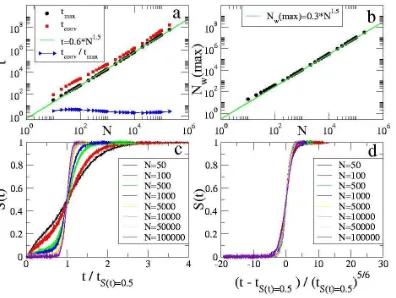
Time-scales. In order to better see this phenomenon and then understand why it is the case, we first look more carefully at the time scales involved in the process, specifically how the observables of the system scale with the size N of the population. Figure (3a) shows the scaling of the peak and convergence times of the total number of words with
N. Both curves exhibit a power law behavior§with an exponent 3/2. The distributions for peak and convergence times, for a given size N, are not Gaussian but fit well with the Weibull extreme value distribution [23] (data not shown).
‡ Details will be reported elsewhere.
Figure 3. Scaling relations: (a) scaling of the time where the total number of words reaches a maximum (tmax) as well as of the convergence times (tconv) with
the population sizeN. Both curves exhibit a power law behavior with exponent 3/2. Statistical error bars are not visible on the scale of the graph. An interesting feature emerges from the ratio between convergence and maximum times, which exhibits a peculiar oscillating trend on the logarithmic scale (mainly due to convergence times oscillations). (b) scaling of the maximum number of words that the system stores during its evolution with the population size N. The curve exhibits a power law behavior with exponent 3/2. Statistical error bars are not visible on the scale of the graph. It must be noted that the values represent the average peak height for each size N, and this value is larger than the peak of the average curve. (c) Curves of the success rate S(t) are reported for various systems size. The time is rescaled as t→ (t/tS(t)=0.5) so that the crossing of all the lines at t/tS(t)=0.5 = 1 is an artifact. The increase of the slope with system size is evident, showing that the disorder/order transition becomes faster and faster for large systems, when the dynamics is observed on the system time scale N3/2. The form of the rescaling has been chosen in order to take into account the deviations from the pure power-law behaviour in the scaling oftconv, rescaling each curve with a self consistent quantity (tS(t)=0.5). (d) Bottom
right: Success rateS(t) for various systems size. The curves collapse well after time rescalingt→(t−tS(t)=0.5)/(t2S/(3t)=0.5)5/4, indicating that the characteristic time of the disorder/order transition scales asN5/4.
The scaling of the maximum number of words Nw(tmax) is clearly governed by a
power law distribution Nw(tmax) ∼ N3/2 as well, as shown in Figure (3b). Here is
how the exponent can be understood using scaling arguments. We assume that, at the maximum, the average number of words per agent scales asNα, withαunknown. Then
it holds:
dNw(t)
dt ∝
1
cNα(1−q)− q cNα2cN
α, (1)
proportional to the number of words in the agent’s inventory. So the two terms are the gain term (in case of a failed game) and a loss term (in case of a successful game) respectively where 2cNα (strictly speaking 2(cNα −1)) words are removed from the
inventories.
Imposing dNw(t)
dt = 0 one gets α = 1/2. Exploiting the relation S(t) ≃ 3t/N 2
pointed out earlier and valid also at the the peak, one can predict the scaling of peak time as tmax ∼N
3 2.
Summarizing, we have a first time scale of the order N where the system performs uncorrelated language games and the invention process takes place. It follows the much more interesting time scale N32, which is the time-scale for collective behaviors
in the system, i.e. the time scale over which the multi-agent system collectively builds correlations and performs the spontaneous symmetry breaking transition.
Figure (3c) reports success rate curves, S(t), for different population sizes, all rescaled according to a transformation equivalent to t → t/N3/2 (see Figure caption
for details on the rescaling). It is immediately clear that the qualitative behavior of these curves, when observed on the collective time-scaleN3/2, changes with system size N. In particular the transition between a regime of scarce or absent communication,
S(t) ≃ 0, and a situation of efficient communication, S(t) ≃ 1, i.e. the disorder/order transition, tends to become steeper and steeper when the population size increases. In order to explain this phenomenon we need to look at what happens slightly before the transition.
4. Network Analysis
We first investigate the behavior of agent inventories and single words at the microscopic level. Since each agent is characterized by its inventory, a first interesting aspect to investigate is the time evolution of the fraction of players having an inventory of a given size. A nontrivial phenomena emerges in the fraction of players with only one word (data not shown). At the beginning, this fraction grows since each player has only one word after his first interaction, then it decreases, because the first interactions are usually failures and agents store the new word they encounter, and eventually it grows again until the moment of convergence when all the players have the same unique word. So, the histogram of the number of agents versus their inventory sizes k is a precious description of the system at a given time. In particular, slightly before the convergence, the normalized distribution p(k) deviates from a relatively flat structure to exhibit a power-law behavior. We can therefore write:
p(k)∼k−βf(k/√N) (2)
with a cut-off functionf(x) = 1 forx <<1 and f(x) = 0 forx >>1. From simulations it turns out that β ≃7/6.
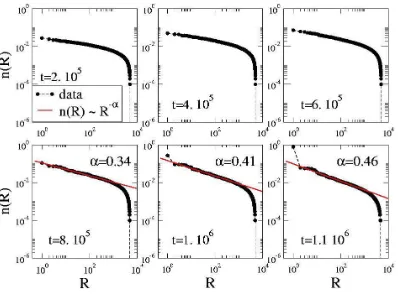
Figure 4. Single words ranking: The ranking of single words is presented for different times for a population size ofN = 104. The histograms are progressively well described by a power law function. For times close to convergence the most popular word (i.e. that ranked as 1st) is no more part of the power law trend and the whole distribution should be described with eq. (3).
most common single word is 1. During the first two stages, the distribution of the words can be described with a power law. However, approaching the transition, the first ranked single word starts to become more and more popular, while all the other words are power-law distributed with an exponent α which changes over time (reminiscent of Zipf’s law [24] and consistent with Polya’s urn and other recent approaches [25]). Concretely, the global distribution for the fraction of agents possessing the R-ranked word, n(R), can be described as:
n(R) =n(1)δR,1+
Nw/N −n(1)
(1−α)((N/2)1−α−21−α)R
−αf( R
N/2), (3)
where the normalization factors have been obtained imposing that R1∞n(R)dR =
Nw/N k. On the other hand from equation (2) one gets, by a simple integration, Nw/N ∼ N1−β/2, which gives n(R)|R>1 ∼ Nβ/12
−αR
−αf( R
N/2). This implies that in the
thermodynamic limit N(1), i.e. the number of players with the most popular word, is a finite fraction of the whole population (a feature reminiscent of the Bose-Einstein condensation [26]).
To explain why the disorder/order transition becomes steeper and steeper in the thermodynamic limit, we must investigate the dynamics that leads to the state where all agents have the same unique word. In other words, we need to understand how the network of agents, where each word is represented by a fully connected clique¶, reaches its final state of fully connected graph with only single links. A successful interaction determines the removal of a node from all the cliques corresponding to the deleted words of the two agents while a failure causes the increment of an element of the clique
k We substituted the discrete sums with integrals, an approximation valid in the limit of large systems.
[image:10.612.196.395.101.248.2]corresponding to the uttered word. Combining this view of the population as a network with the fact that the spreading of the most popular word exceeds that of less common ones, we see that evolution towards convergence proceeds in a multiplicative fashion, pushing further the popularity of the most common word while decreasing that of the others. An interaction in which the most common word is played will more likely lead to success, and hence the clique corresponding to the most common word will tend to increase, while other cliques will lose nodes. To put this argument on a formal footing, we can conveniently assume that just before the transition all agents already know the most popular word. Thus, we have only to determine how the number of the links deleted after a successful interaction, Md, scales with N, so that we can estimate the
rate at which the smaller cliques disappear from the network. It holds:
Md= Nw
N
Z ∞
2 n
2(R)NdR
∼N3−32β (4)
where the product between the average number of words of each agents (i.e. the average number of cliques involved in each reduction process), Nw
N , the probability of having a
word of rank R (i.e. the probability that the corresponding clique is involved in the reduction process), n(R), and the number of agents that have that word (i.e. the size of the clique), n(R)N, is integrated starting from the first deletable word (the second most popular). From simulations we have that β ≃ 7/6 so that Md ∼ N5/4 and the
ratio Md/N3/2 ∼ N−
3
2(β−1) = N−1/4 goes to zero for large systems. This explains the
greater slope, on the system timescale, of the success rate curves for large populations (Figure (3c)). In Figure (3d) the time is rescaled as t → (t−const.N3/2)/N5/4 (see
Figure caption for more details on the precise scaling), and the different S(t) curves collapse indeed well.
5. Discussion and conclusions
In this article we have introduced and studied a model of communication which does not rely on generational transmission (genetic or cultural) for reaching linguistic coherence but on self-organization. The model defines the microscopic behavior of the agents and is therefore directly implementable and thus applicable for building emergent communication systems in artificial multi-agent systems. We showed that the model exhibits the same phenomena as observed in human semiotic dynamics, namely a period of preparation followed by a rather sharp disorder/order transition. We have identified the different time-scales involved in the process, both for individual and collective behaviors. We have explained this dynamics by observing a build up of non trivial dynamical correlations in the agents’ inventories, which display a Zipf-like distribution for competing synonyms, until a specific word breaks the symmetry and imposes itself very rapidly in the whole system.
theoretical analysis less clear. By focusing on few and simple rules, we have been able to identify the main ingredients to describe how the population develops a shared and efficient communication system. The good news, from the viewpoint of applications, like emergent communication systems in populations of software agents, is that a well-chosen microscopic behavior allows a scale-up to very large populations.
Acknowledgments We thank A. Barrat, L. Dall’Asta, C. Cattuto, R. Ferrer i Cancho, A. Vulpiani for interesting discussions and a critical reading of the manuscript. This research has been partly supported by the ECAgents project funded by the Future and Emerging Technologies program (IST-FET) of the European Commission under the EU RD contract IST-1940. The information provided is the sole responsibility of the authors and does not reflect the Commission’s opinion. The Commission is not responsible for any use that may be made of data appearing in this publication.
6. Bibliography
[1] Lass R,Historical Linguistics and Language Change.1997 Cambridge University Press, Cambridge [2] Steels L, The synthetic modeling of language origins 1997Evolution of Communication11-34 [3] Kirby S, Natural Language from Artificial Life, 2002Artificial Life 8185-215
[4] Steels L, The Origins of Ontologies and Communication Conventions in Multi-Agent Systems, 1998Autonomous Agents and Multi-Agent Systems11, 169-194
[5] Staab S, Emergent Semantics, 2002IEEE Intelligent Systems1778-86
[6] Berners-Lee T, Hendler J and Lassila O, The Semantic Web, 2001Scientific AmericanMay 2001
[7] Steels L, Evolving grounded communication for robots, 2003Trends in Cognitive Science7308 [8] Hurford J, Biological Evolution of the Saussurean Sign as a Component of the language acquisition
device, 1989Lingua77187.
[9] Oliphant M and Batali J, Learning and the emergence of coordinated communication, 1997Center for Research on Language Newsletter111
[10] Nowak MA and Krakauer JD, The evolution of language, 1999 Proc. Natl. Acad. Sci. USA 96
8028-8033
[11] Nowak MA, Plotkin JB and Krakauer JD, The evolutionary language game, 1999,J. Theor. Biol.
200147
[12] Nowak MA, Komarova NL and Nyogi P, Evolution of universal grammar, 2001Science291114-118 [13] Komarova NL and Nyogi P, Optimizing the mutual intelligibility of linguistic agents in a shared
world, 2004Artificial Intelligence1541-42
[14] Nyogi, P. & Berwick, R., Evolutionary consequences of Language Learning, 1997Linguistics and Philosophy20697-719.
[15] Smith K, Kirby S and Brighton H, Iterated Learning: a framework for the emergence of language, 2003Artificial Life,9371-386
[16] Hutchins E and Hazlehurst B, How To Invent A Lexicon: The Development Of Shared Symbols In Interaction, in Gilbert N and Conte R (Eds.),Artificial Societies: The computer simulation of social life1995 UCL Press, London.
[17] Steels L, A self-organizing spatial vocabulary 1995,Artificial Life Journal2319.
[18] Matsen F and Nowak MA, Win-stay, lose-shift in language learning from peers, 2004Proc. Natl. Acad. Sci. USA10118053-18057.
[19] Best KH, Spracherwerb, Sprachwandel und Wortschatzwachstum in Texten. Zur Reichweite des Piotrowski-Gesetzes, 2003 Glottometrics 6 9-34. And Der Zuwachs der Wrter auf -ical im Deutschen, 2002Glottometrics 211-16.
[21] Bollobas B, The evolution of random graphs, 1984Trans. Amer. Math. Soc.286257. Kolchin VF, On the behavior of a random graph near a critical point, 1986Theory Probab. and its Appl.31
439. Luczak T, Components behavior near the critical point of the random graph process, 1990
Random Structures and Algorithms1287.
[22] Burton RM and Keane M, Density and uniqueness in percolation 1989,Comm. Math. Phys.121, 501.
[23] Gumbel EJ,Statistics of Extremes1958 Columbia University Press, New York
[24] Zipf, G. K.Selective Studies and the Principle of Relative Frequency in Language 1932 Harvard University Press, Cambridge MA
[25] Johnson, N. & Kotz, S. Urn model and their applications: an approach. to Modern discrete probability theory, 1977 Wiley, New York. For recent results see: Ferrer i Cancho R and Servedio, VDP, Can simple models explain Zipf’s law in all cases? 2005, Glottometrics 11, 1-8. Chung F, Handjani S and Jungreis D, Generalizations of Polya’s urn Problem 2003,Annals of combinatorics7, 141.