Volume 5, No. 6, July-August 2014
International Journal of Advanced Research in Computer Science
RESEARCH PAPER
Available Online at www.ijarcs.info
Comparing Software Usability Attributes in Virtual Environment and Non-Virtual
Environment
Kirti Muley Research Scholar, SCSIT
DAVV Indore, India
Dr. Kshama Paithankar Professor, MCA
SVIM Indore, India
Dr. Maya Ingle Professor, SCSIT
DAVV Indore, India
.
Abstract: Now a day‟s many software applications are being developed in Virtual Environment (VE) such as; education, entertainment, medical, aeronautical, defence etc. And, in this era of user centred development it is highly appreciated to incorporate usability software attributes to develop even an effective VE based application. Therefore, in this paper we have focused on the identification of usability attributes applicable to the virtual environment applications. At the same time, we put efforts to showcase the usability attributes used for development of application in Non-Virtual Environment (NVE). A comparison of usability attributes contributing solely in VE and those used in VE and NVE both is also presented in this paper.
Keywords:usability; attributes; virtual environment; non-virtual environment
I. INTRODUCTION
Software quality attributes play vital role while creating an environment for a user in computing area. There exist various quality attributes available in the literature such as, readability, understandability, robustness, readability, learnability etc., which sets the foundation for creating an environment. Each and every environment possesses its own set of attributes providing help to the developers to create a specific environment. In software development, software quality attributes may cause the different types of impacts in the environments such as Virtual Environment (VE) and Non-Virtual Environment (NVE). Also, two different environments may have some common attributes for developing an environment. VE provides the illusion of the actual system to the user and may create a place where user can interact with the system as if it is a part of real world [1, 2]. It is a computer generated, three-dimensional and simulated environment in which the response may be in real time depending upon the request of the users [3, 4]. VE applications use wide range of specialized input and output devices such as bodysuits, earphones, data gloves etc. which are used as both for transmitting and receiving data [4, 5]. VE provides an ability to design effective Human Computer Interactions (HCI) in entertainment, education, training and other computer assisted applications. VE also overcomes the limitations of the traditional/ standard HCI such as absence of physical presence, natural form of interaction etc. On the other hand, NVE supports 2-Dimensional interaction, which is easier form user point of view. In contrast, application does not provide real world illusion to the user in this environment. NVE applications provide much focused view and limited information to the user without any “world” distraction for the interaction. Developing an NVE application is simpler than VE application because of limited requirements. Standard input devices such as keyboard, mouse, joystick etc. are used
for receiving the data. Devices such as monitors, speakers etc. are used as output devices in NVE.
Usability is one of the important quality factors for VE as well as for NVE. There exists several usability attributes used in developing usable software. These attributes are discussed for VE and NVE in Section 2. These usability attributes may be considered common to both of the environments or may be entirely different. In Section 3, a study about comparison of usability attributes in VE and NVE is discussed. Finally, the result of the comparison of attributes in aforesaid environments and conclusion is presented in Section 4.
II. ENVIRONMENTBASEDUSABILITY ATTRIBUTES
In general, usability is associated with usability attributes such as Learnability, Efficiency, Memorability, Errors, Satisfaction etc. [6]. Usability is an important quality factor of software amongst several quality factors. It is recommended to incorporate usability during the early stages of software development life cycle to produce usable software. In literature, usability and its attributes have been defined but not in consistent manner across different standards. Also, usability as an attribute is most widely used term with different meanings by different users and hence, it is utilized with different aspects such as improvement in usefulness, provision of ease of use in the system, its incorporation in interface and functional design, data and metadata etc. [7, 8]. Thus, there is a need to concentrate upon the role of usability attribute in different environments also. The usability attributes existing in non-virtual and virtual environments are discussed in subsequent subsections.
A. Usability Attributes in Non-Virtual Environment
users. Following are identified as the commonly used usability attributes of any software in NVE:
Learnability: It is used to measure the comfortness of a user for accomplishing the basic task. These basic tasks may differ from application to application. In NVE, the user of the application may or may not be known to the developer. Therefore, it is required that application should possess a functionality which guides the user how to proceed with the basic tasks of the application. For example, Microsoft office application provides different menus to user for accomplishing different task.
Efficiency: Once user learns the software, efficiency of that software can be measured. The software should be able to identify the operations to satisfy various users without degrading the throughput and response time. In other words, this attribute defines the capacity to produce appropriate results on the bases of given input [9]. The users of an NVE application may have different expectations regarding the output generated by the application. For example, in mathematical calculator application, one user may require the result in integer form, while another user requires result in fraction format. The system should produce the result for the same operation according to the requirement of the user. Memorability: It refers to the ease of remembering the way software must be operated. In NVE, generally applications are developed for a wide range of users. It is not feasible for user to learn the application every time when he/she uses it (even after a long period of time). Hence, application should have a quality to get memorize. For example, in MS-DOS user has to remember all the commands to work with the software and therefore, user find it difficult to work with it. On the other hand Windows operating system provides graphical user interface which help users to remember the working of software.
Consistency: Consistency attribute defines the system uniformity and coherence [9]. In other words, application should produce the same result for the same input and operation given by different users. It also deals with consistent use of fonts, text, color, graphics, sequence of layout etc. [10, 11, 12]. Number of users and their capabilities are not known to the developer at the time of application development in NVE. Thus, it is required that application should produce consistent results irrespective of user and its capability. For example, cut option in file menu of word application will always cut the selected data from the document.
Readability: Readability attribute defines whether the contents are readable or not. To make content readable it is required to make proper choice of font type and size as well as content should be properly formatted. It also requires consistent use of fonts, text, color, graphics, sequence of layout etc. The users of NVE applications belong to different age groups, therefore the content available in the application should be visible to everyone. For example, content of news website is readable to everyone.
Accessibility: This attribute defines the range or level of users who can use the system irrespective of any physical characteristics they have [9]. Unless it is not defined, applications developed in NVE can be used by everyone. Hence, application should provide all possible means to access itself. For example, the application without voice assistance cannot be used by blind user.
Safety: It is the capacity of a system to avoid risk and damage from the use of the system. The safety attribute is divided into three sub attributes namely; user, third party and environmental safety [9]. Applications developed in NVE do not provide any illusion of the real world environment.
Therefore, NVE applications did not consider environmental safety. For instance, timer software used in household appliances is not dealing with environmental safety (increases noise pollution).
Helpfulness: Helpfulness attribute is defined as the manner system provides help to the user while using the system or application. In other words, system should sufficiently help the user to make the system operationally feasible [6, 9]. NVE applications are used by wide range of users including naïve and expert users. Therefore, application should provide proper help to the user to make application operationally feasible. For example, help provided in Word Star application.
Universality: It is the degree of acceptance of the system. It is
required that the system has to be universally acceptable. Users of NVE applications may come from any corner of the world, thus it is necessary that application should be accepted worldwide. Universality attribute incorporates accessibility attribute [9]. For example, Google search engine has universal acceptance.
Robustness: This attribute deals with the capacity of the
system to resist from errors and adverse conditions. Robustness is classified with internal errors, invalid users, third party abuse and environmental problems. In NVE applications, illusion of real world scenario is not created and therefore, environment is not going to change on the basis of the operations performed on it. Hence, NVE applications do
not consider the environmental problems [9]. For example,
error message can be displayed when some internal error occurs rather than exit from the system.
Understandability: It is a capability of software to enable the
Ease of Use:This attribute measures the degree of ease to use
the system without any assistance from expert user. It is not acceptable that every time user of NVE application will be assisted by an expert user. Hence, the application should be easy to use. Simple NVE gaming applications such as car race
does not require anyassistance.
Interactivity: With the help of interactive attribute, user can
explore the world via input and selection of choices. Interactivity is present in applications to support meaningful learning [10]. In NVE applications, only limited information is given on one page/ window and hence, to explore the application more interactivity is required such as URL given in the document to explore the information.
Affordance: It specifies the set of possible actions of an object [13]. Various operations can be performed on an object under consideration. The users of NVE applications may require different operations on the same object. Therefore, all possible sets of operations for the specific object should be defined in the application. For example, in paintbrush application a picture can be rotate on left or right side, zoom or crop.
Satisfaction: It is subjective opinion of a user for a system. Satisfaction attributes incorporate most of the attributes defined above, only the degree of these attributes vary from application to application. In NVE, satisfaction of a user is very challenging, as wide range of users will use it and everyone will have different expectation from the application. For example, in car racing application various levels are available to satisfy variety of users.
B. Usability Attributes in Virtual Environment
In literature review, it has been observed that there exist some usability attributes that are present in VE only. These are discussed as follows:
Presence:It is an important attribute of VE that has an ability
to create a sense or experience of „being in‟ computer generator environment [14]. Training simulators developed in VE highly required this attribute to train the user. For example, plane simulator is used to teach pilot to fly and handle a plane.
Interactivity: This attribute deals with content related
interactions and tasks that support meaningful learning [10]. In VE, research activity for interactivity is split in two areas; one is development of interaction devices and second is its associated aids. Mainly, there exist three task categories of VE interaction such as; viewpoint motion control, selection and manipulation [15]. It is suggested to use different combinations of interaction dimensions in VE. In other words, multisensory interaction channels are required [11]. For
example, educational application uses three pathways of
learning through eyes, ears and sense of touch. Students simultaneously see the letter(s), hear the sound, feel how it is formed with their lips, tongue, and throat, and feel the form as the sound is traced or written.
Active distraction: It is used in order to draw attention away
from the perception of pain in the stressful environment. There exist various medical applications which address the use of distraction attribute especially for burn and cancer patients [16]. Need to establish a peaceful virtual environment while treating the patients rather than simply playing audio-video which supports the role of distraction attribute in VE.
Expose: This attribute used to expose the user to the environment. The attribute is generally used to cure phobic clients. Clients expose themselves to feared stimuli within the safety of VE. By repeatedly exposing to the stimuli clients are able to understand the environment properly. For example, VE based flight simulator provides full exposure to the trainee pilot.
Navigation: It is not acceptable that all the users are aware
how to navigate (move) in the VE. There are two different types of navigation problems experienced by naive users. The first problem is aimless movement in which user is moving without any specific aim. Second problem arises when user is stuck between two virtual objects and unable to move in specified time i.e. disability to move [17]. It supports the user to navigate inside the VE without being lost in VE [18]. For example, directed arrows or audio assistance is provided in most of the VE based games.
Affordance: Affordance attribute contains a set of possible actions of an object [13]. Also provides information how to interact with 3-Dimensional objects and environments [19]. Different affordance can be used to inspect the product like, touch; smell, taste etc. In VE, the product can be examined easily by zoom in and out, or by rotating the product and visualize it from different angles. It is possible to have different affordances for same product or different affordances
for different products. For example, in car racing game various alterations in car equipment are possible.
III. ACOMPARATIVE STUDY AND DISCUSSION
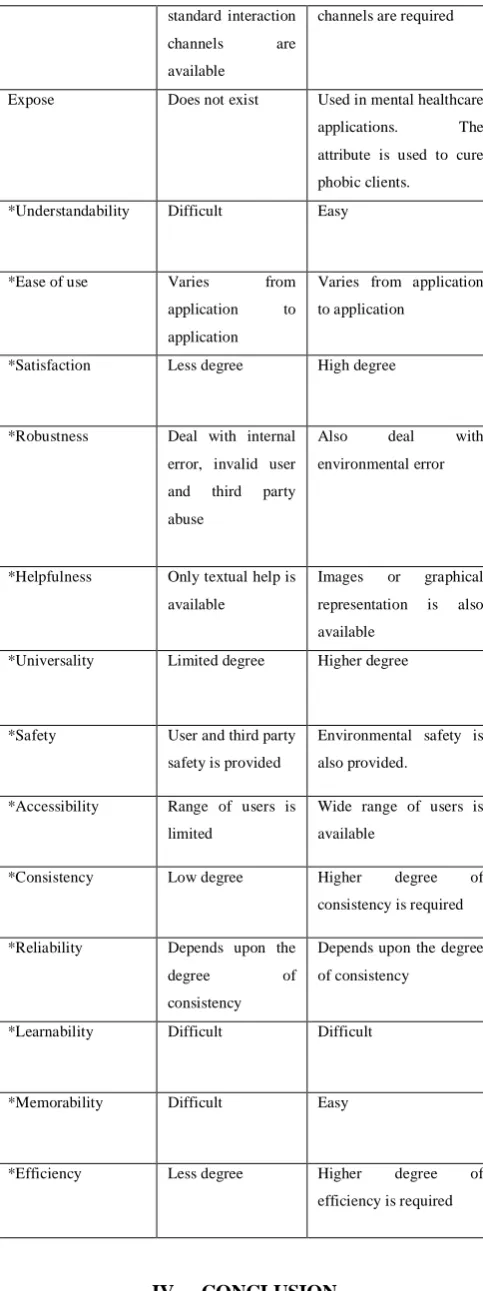
Based on the discussion in earlier sections, the summary of comparison of usability attributes in NVE and VE is shown in Table-1. While comparison, it has been observed that there exist some usability attributes playing the role in NVE and VE both. Such attributes of importance include learnability,
memorability, satisfaction, safety, efficiency,
understandability, affordance, helpfulness, navigation,
interactivity, ease of use, robustness, universality,
accessibility, consistency and reliability (it is depicted by „*‟ in Table-1).
Considering example of satisfaction as one of the common usability attributes in VE and NVE, this fact is highlighted that user satisfaction is the ultimate aim of any usable software. Gaming application in NVE and simulation application in VE proves to have this attribute of importance with common aim of achieving user satisfaction. Further, ease of use attribute also possesses the same affiliation for the above mentioned applications in NVE and VE with different type and experience of uses.
It has been observed that similar to the usability attributes showing common appliance in VE and NVE there exist some usability attributes solely present in VE. For instance, presence is the usability attribute that acts to create an illusion of real world to the users that has no importance in NVE. Expose is another usability attribute being solely used in VE as it provides the user an exposure to use the system in the artificial environment created by illusion. For example, exposed methodology is used to address mental health care disorders such as Post Traumatic Stress Disorder and Obsessive Compulsive Disorder. Similarly, the observations have been drawn for other usability attributes identified for VE and NVE applications.
Table-1: Comparison of Usability Software Attributes
Attributes NVE VE
Active distraction Passive distraction
is used to reduce
standard interaction
channels are
available
channels are required
Expose Does not exist Used in mental healthcare
applications. The
attribute is used to cure
phobic clients.
*Understandability Difficult Easy
*Ease of use Varies from
application to
application
Varies from application
to application
*Satisfaction Less degree High degree
*Robustness Deal with internal
error, invalid user
and third party
abuse
Also deal with
environmental error
*Helpfulness Only textual help is
available
Images or graphical
representation is also
available
*Universality Limited degree Higher degree
*Safety User and third party
safety is provided
Environmental safety is
also provided.
*Accessibility Range of users is
limited
Wide range of users is
available
*Consistency Low degree Higher degree of
consistency is required
*Reliability Depends upon the
degree of
consistency
Depends upon the degree
of consistency
*Learnability Difficult Difficult
*Memorability Difficult Easy
*Efficiency Less degree Higher degree of
efficiency is required
IV. CONCLUSION
In the proposed work, a comparison of software usability attributes of VE and NVE has been presented. It has been observed that most of the attributes exist in both VE and NVE. Hence, it is concluded that the set of usability attributes of VE is almost a subset of NVE usability attributes, as shown in Fig. 1. However, typical nature of VE leads to additionally
include some specific attributes exclusively. The objective of the proposed comparison was to identify the applicability of the usability attributes in specific environment and therefore does not focus on the behavioral aspect of the attributes in VE and NVE. And hence, there remains a scope of identifying the role and behavior of usability attributes in VE and NVE and comparison as well.
Fig. 1: Attributes in VE and NVE.
V. REFERENCES
[1] Ellis, R. S., “What are Virtual Environments?” IEEE Journal of Computer Graphics and Applications, Volume 14, January 1994, pp 17-22.
[2] Sas, C. and O‟Hare, G., “Presence and Individual Differences in Virtual Environment: A Usability Study”, Proceedings Volume 2
of the 16th British HCI Conference London, September 2002. [3] Ogle, T., “The Effects of Virtual Environments on Recall in
Participants of Differing Levels of Field Dependence”, Ph. D. Thesis, Blacksburg, VA, 11 April 2002.
[4] Cromby, J. J.; Standen, P. J. and Brown, D. J., “The Potentials of Virtual Environments in the Education and Training of People with Learning Disabilities”, Journal of Intellectual Disability Research, Volume 40, No. 6, December 1996, pp 489-501.
[5] Joseph L. Gabbard, “A Taxonomy of Usability Characteristics in Virtual Environments”, MS Thesis, Virginia Polytechnic
Institute and State University, 3 December, 1997.
[6] Paithankar, K. and Ingle, M., “Classification of Software
Quality Attributes – A Comparative study in Perspective of Usability”, Journal of Technology and Engineering Science, Volume 1, No. 2, Jul-Dec 2009.
[7] Dubey, K. D. and Rana, A., “Analytical Roadmap to Usability Definitions and Decompositions”, International Journal of Engineering Science and Technology, Volume 2, No. 9, 2010, pp. 4723-4729.
[8] Seffah, A.; Donyaee, M.; Kline, B. R. and Padda, K. H.,
“Usability measurement and metrics: consolidated model”, Software Qual J, Volume 14, 2006, pp. 159-178.
[9] Alonso-Ríos, D.; Vázquez-García, A.; Mosqueira-Rey, E. and Moret-Bonillo, V., “Usability: A Critical Analysis and a
Taxonomy”, International Journal of Human–Computer Interaction, Volume 26, No. 1, 2010, pp. 53–74, ISSN: 1044-7318 print / 1532-7590 online.
[10] Safie, N., “Does e-Learning Usability Attributes Correlate with
Learning Motivation”, In 21st AAOU Annual Conference, Kuala Lumpur, 29-31 October, 2007.
[11] Mikropoulos, A. T. and Bellou, J., “The Unique Features of
Educational Virtual Environments”, IADIS International Conference e-Society 2006, pp. 122-128, ISBN: 972-8924-16-X.
[12] Mueller, D. and Strohmeier, S., “Design Characteristics of
Virtual Learning Environments: An Expert Study”, International Journal of Training and Development Volume 14, No. 3, 2010, pp. 209-222.
VE NVE : Attributes in VE
: Attributes in NVE
[13] Gobbetti, E. and Scateni, R., “Virtual Reality: Past, Present and Future”, Virtual Environments in Clinical Psychology and
Neuroscience, Ios Press: Amsterdam, Netherlands, 1998. [14] Kalawsky R.S.; Bee S.T. and Nee S.P., “Human Factors
Evaluation Techniques to Aid Understanding of Virtual Interfaces”, BT Technology Journal, Third review version, 18 December 1998.
[15] Bowman, A. D. and Hodges, F. L, “Formalizing the Design, Evaluation, and Application of Interaction Techniques for Immersive Virtual Environments”, Journal of Visual Languages and Computing, Volume 10, 1999, pp. 37-53.
[16] Rizzo, A. A., Wiederhold, M. and Buckwalter, J. G., “Basic
Issues in the Use of Virtual Environments for Mental Health Applications”, Virtual Environments in Clinical Psychology and Neuroscience, Ios press: Amsterdam, Netherlands, 1998, pp. 23-42.
[17] Virvou, M. and Katsionis, G., “On the Usability and Likeability of Virtual Reality Games for Education: The case of VR-ENGAGE”, Computer & Education, Volume 50, No. 1, January, 2008, pp. 154-178.
[18] Troyer, O.; Kleinermann, F.; Pellens, B. and Bille, W.,
“Conceptual Modeling for Virtual Reality”, Proceedings Twenty-Sixth International Conference on Conceptual Modeling- ER 2007 - Tutorials, Posters, Panels and Industrial Contributions, Auckland, New Zealand, CRPIT, Volume 83, pp. 3-18.
[19]Li, H.; Daugherty, T. and Biocca, F., “Characteristics of Virtual
Experience in Electronic Commerce: A Protocol Analysis”,