City, University of London Institutional Repository
Citation
:
Dall'Asta, L., Baronchelli, A., Barrat, A. and Loreto, V. (2006). Nonequilibrium
dynamics of language games on complex networks. Physical Review E - Statistical,
Nonlinear, and Soft Matter Physics, 74(3), doi: 10.1103/PhysRevE.74.036105
This is the unspecified version of the paper.
This version of the publication may differ from the final published
version.
Permanent repository link:
http://openaccess.city.ac.uk/2666/
Link to published version
:
http://dx.doi.org/10.1103/PhysRevE.74.036105
Copyright and reuse:
City Research Online aims to make research
outputs of City, University of London available to a wider audience.
Copyright and Moral Rights remain with the author(s) and/or copyright
holders. URLs from City Research Online may be freely distributed and
linked to.
arXiv:physics/0607054v1 [physics.soc-ph] 6 Jul 2006
Luca Dall’Asta,1
Andrea Baronchelli,2
Alain Barrat,1
and Vittorio Loreto2 1
Laboratoire de Physique Th´eorique (UMR du CNRS 8627), Bˆatiment 210, Universit´e de Paris-Sud, 91405 ORSAY Cedex (France) 2
Dipartimento di Fisica, Universit`a “La Sapienza” and SMC-INFM, P.le A. Moro 2, 00185 ROMA, (Italy)
The Naming Game is a model of non-equilibriun dynamics for the self-organized emergence of a linguistic convention or a communication system in a population of agents with pairwise local interactions. We present an extensive study of its dynamics on complex networks, that can be considered as the most natural topological embedding for agents involved in language games and opinion dynamics. Except for some community structured networks on which metastable phases can be observed, agents playing the Naming Game always manage to reach a global consensus. This
convergence is obtained after a time generically scaling with the population’s size N as tconv ∼
N1.4±0.1
, i.e. much faster than for agents embedded on regular lattices. Moreover, the memory capacity required by the system scales only linearly with its size. Particular attention is given to heterogenous networks, in which the dynamical activity pattern of a node depends on its degree. High degree nodes have a fundamental role, but require larger memory capacity. They govern the dynamics acting as spreaders of (linguistic) conventions. The effects of other properties, such as the average degree and the clustering, are also discussed.
I. INTRODUCTION
Understanding the origin and the evolution of language or more generally of communication systems is a fascinat-ing challenge for the interdisciplinary scientific commu-nity [1], demanding contributions to researchers in very different fields, from linguistics to artificial intelligence, from social sciences to biology, mathematics and physics. Even though a unitarian view of language as a complex system is still lacking, a number of different approaches have been proposed in order to get major insights into some specific aspects such as, for instance, the self-organized processes leading to the emergence of a shared lexicon (i.e. a communication system) in a population of agents. In the past few years, it has been shown that simple models of interacting agents could display a collec-tive agreement on a shared mapping between words and objects (or meanings), eventually bootstrapping a shared system of linguistic conventions, even without global su-pervision or a priori common knowledge [2, 3, 4]. Such models of “Language Games”, in which the organization of language is tackled at a purely semiotic level (neglect-ing semantic relations between symbols and mean(neglect-ings), have played a pivotal role for the understanding of emer-gent communication systems. We will restrain ourselves to the case of the emergence and evolution of a commu-nication system on short temporal scales compared to those involved in the evolution of language, so that we neglect any darwinian principle commonly used in the modelization of language evolution [5, 6], and focus on simple population dynamics. In this context, a new field of research called Semiotic Dynamics has been recently developed, that investigates by means of simple models how (linguistic) conventions originate, spread and evolve over time in a population of agents endowed with basic internal states and able to perform local pairwise inter-actions [7].
The fundamental model of Semiotic Dynamics is the
Naming Game [8], that describes a population of agents trying to agree on the assignation of names to objects. The emergence of consensus about the object’s name al-lows to establish a communication system. Such model was inspired by global coordination problems in Artificial Intelligence and by peer-to-peer communication model-ing. A practical example of this type of dynamics is provided by the Talking Heads experiment [9], in which embodied software agents develop their vocabulary ob-serving objects through digital cameras, assigning them randomly chosen names and sharing these names in pair-wise interactions. Very recently [10, 11], models of Semi-otic Dynamics have as well found application in the study of a new generation of web-tools which enable hu-man web-users to self-organize a system of tags in such a way to ensure a shared classification of information about different arguments (see, for instance, del.icio.us or www.flickr.com).
of complex networks [15, 16, 17] has allowed to obtain a better knowledge of social networks [18], and in partic-ular to show that the typical topology of the networks on which agents interact is not regular. The natural step taken in this paper is thus to consider the Naming Game for agents embedded on more realistic networks and to study the influence of various complex topologies on the corresponding dynamical behavior.
The paper is organized as follows. Section II and III are devoted to the definition of the model and to sum-marize already known results about the Naming Game dynamics in the case of mean-field and low dimensional lattices. In section IV, we briefly recall the definition of network models subsequently used in the theoretical and numerical analysis, whose results are exposed in sec-tion V. Conclusions and direcsec-tions for future works are exposed in section VI.
II. MODEL DEFINITION
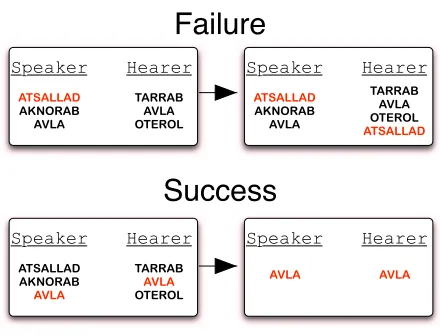
A minimal model of Naming Game has been put for-ward by Baronchelli et al. in Ref. [13] to reproduce the main features of Semiotic Dynamics and the fundamental results of adaptive coordination observed in the Talking Heads experiment [9]. In this minimal model, N iden-tical agents observe a single object, for which they in-vent names that they try to communicate to one another through pairwise interactions. Each agent is endowed with an internal inventory, in which it can store an a pri-ori unlimited number of names (or opinions). All agents start with empty inventories. At each time step, a pair of neighboring agents is chosen randomly, one playing as ”speaker” the other as ”hearer”, and a negotiation pro-cess takes place according to the following rules (see also Figure 1). The speaker transmits a name to the hearer. If its inventory is empty, a new word is invented, other-wise it selects randomly one of the names it knows. If the hearer has the uttered name in its inventory, the game is a success, and both agents delete all their words but the winning one. If the hearer does not know the uttered word, the game is a failure, and the hearer adds the word to its inventory, i.e. it learns it.
Note that the time unit is here given by one inter-action, in contrast to most non-equilibrium statistical physics models in which a time unit corresponds to N
interactions. In many cases, results for the dynamical evolution will therefore be expressed as a function of the rescaled time t/N.
Although this model can be seen as belonging to the broad class of opinion formation models, it is interesting to notice the important differences with other commonly studied such models [12]. In particular, each agent can potentially be in an infinite number of possible discrete states (or words, names), contrarily to the Voter model in which each agent has only two possible states. Moreover, an agent can here accumulate in its memory different possible names for the object, i.e. wait before reaching a
AVLA
Speaker Hearer
ATSALLAD
AKNORAB AVLA
TARRAB AVLA OTEROL
ATSALLAD
Speaker Hearer
ATSALLAD
AKNORAB AVLA
TARRAB AVLA OTEROL
Speaker Hearer
ATSALLAD AKNORAB
AVLA
TARRAB
AVLA
OTEROL
Speaker Hearer
Failure
Success
AVLA
FIG. 1: (Color online) Agents’ interaction rules. Each agent is described by its inventory, i.e. the repertoire of known words. The speaker picks up at random a name in its inventory and transmits it to the hearer. If the hearer does not know the selected word the interaction is a failure (top), and it adds the new name to its inventory. Otherwise (bottom) the interac-tion is a success and both agents delete all their words but the winning one. Note that if the speaker has an empty inventory (as it happens at the beginning of the game), it invents a new name and the interaction is, of course, a failure.
decision, and has an a priori unlimited memory. An in-teresting question therefore relates to the actual memory size required by each agent during the dynamics. Finally, each dynamical step can be seen as a negotiation between speaker and hearer, with a certain degree of stochastic-ity, while in the Voter model, an agent deterministically adopts the opinion of one of its neighbors.
Another remark concerns the random extraction of the word to be uttered from the speaker’s inventory. Previ-ously proposed models of semiotic dynamics used a more complicated representation of the negotiation interaction assigning weights to the words in the inventories. In such models (see [19] and references therein), the word with largest weight is automatically chosen by the speaker and communicated to the hearer. Communicative success or failures are translated into updates of the weights: the weight of a word involved in a successful interaction is increased to the detriment of the other weights (with no deletion process), while a failure leads to the decrease of the weight of the word not understood by the hearer. While such rules are certainly more realistic than the drastic deletion rule of the minimal Naming Game, the latter has been shown to retain the essential features of the emergence of a global collective behavior and corre-sponds to a much simpler definition.
[image:3.612.329.549.55.223.2]in the model, all objects are independent and the general problem reduces to a set of uncorrelated systems, each one described by the minimal model.
In the rest of the paper all analysis and numerical sim-ulations will deal with this simplified model that can be rightly seen as the prototype of the Naming Game.
III. STATE OF THE ART
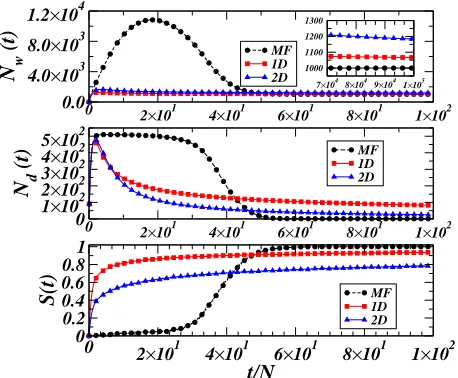
Most previous studies in Semiotic Dynamics have fo-cused on populations of agents in which all pairwise inter-actions are allowed, i.e. the agents are placed on the ver-tices of a fully-connected graph. In statistical mechanics, this topological structure is commonly referred as ”mean-field” topology. In the original work on the minimal Naming Game model [13], Baronchelli et al. have studied numerically and analytically the behavior of the mean-field model, providing theoretical arguments in order to explain the main properties of the population’s global behavior. The overall dynamics have been studied moni-toring the temporal evolution of the total numberNw(t)
of words in the system at timet, i.e. the total memory used by the agents’ inventories, of the number of differ-ent wordsNd(t), and of the average success rateS(t) (i.e.
the probability, computed averaging on many simulation runs, that the interaction at timetis successful). At the beginning, many disjoint pairs of agents interact, with empty initial inventories: they invent a large number of different words that then start spreading throughout the system, through unsuccessful interactions. Indeed, in the early stages of the dynamics, the overlap between inven-tories is very low and successful interactions are limited to those pairs which have been chosen at least twice. Since the number of possible partners of an agent is of order N, an agent rarely interacts twice with the same partner: the probability of such an event grows only as
t/N2
. The consequence, shown in Fig. 2 (black circles), is that in this phase the number of different words Nd
invented by the agents grows, reaching a maximum that scales asO(N). Ndthen saturates (no inventory is empty
anymore so that no new words are invented) and displays a plateau, while the total numberNwof words keep
grow-ing since the various words propagate in the system and correlations grow between inventories. The peak of Nw
has been shown to scale as O(N1.5
) [13], which means that each agent storesO(N0.5
) words, and occurs after the system has evolved for a timetmax∼ O(N1.5). The
strong correlations built during this time finally lead the system to consensus in a timetconv of order N1.5. The
final state corresponds to the agreement of the agents on the name to be assigned to a particular object: Nw=N,
which means that each agent possesses a unique word in its inventory, and Nd = 1, which shows that this word
is the same for all agents. The S-shaped curve (black circles) of the success rate in Fig. 2 summarizes the dy-namics: initially, agents hardly understand each other (S(t) is very low); the inventories start to present
signif-0 2×101
4×101
6×101
8×101
1×10²
0.0 4.0×10³ 8.0×10³ 1.2×10⁴
N w
(t) MF
1D 2D
0 2×101
4×101 6×101 8×101 1×10²
0 1×10² 2×10² 3×10² 4×10² 5×10²
N d
(t)
MF 1D 2D
0 2×101
4×101 6×101 8×101 1×10²
t/N
0 0.2 0.4 0.6 0.8 1
S(t) MF
1D 2D
7×10⁴
8×10⁴
9×10⁴
1×10⁵
1000 1100 1200 1300
FIG. 2: (Color online) Evolution of the total number of words
Nw(top), of the number of different wordsNd(middle), and
of the average success rateS(t) (bottom), for a mean-field
system (black circles) and low dimensional lattices (1D, red
squares and 2D, blue triangles) withN= 1024 agents,
aver-aged over 103
realizations. The inset in the top graph shows the very slow convergence for low-dimensional systems.
icant overlaps, so that S(t) increases until it reaches 1, and the communication system is completely set in.
A first study of the effects of topological embedding on the Naming Game dynamics is reported in Ref. [14]. When the interacting agents sit on the nodes of low-dimensional lattices, the long-time behavior is still char-acterized by the convergence to a homogeneous consensus state, but the evolution of the system changes consid-erably. Since each agent can interact only with a lim-ited number of neighbors (2din ad-dimensional lattice), at the local scale the dynamics is very fast: agents can rapidly interact two or more times with their neighbors, favoring the establishment of a local consensus with a high success rate (Fig. 2, red squares for 1D and blue triangles for 2D), i.e. of small sets of neighboring agents sharing a common unique word. These ”clusters” of neighboring agents with a common unique word are sep-arated by individuals having a larger inventory with two or more words, playing the role of ”interfaces”. For one-dimensional systems, it can be proved analytically [14] that the motion of interfaces is a random walk for which the diffusion coefficient can be computed. Consequently, the clusters of unique words grow in time with a law that is typical of coarsening phenomena [20], i.e. the compe-tition among the clusters is driven by the fluctuations of the interfaces. The coarsening picture can be extended to higher dimensions, where it has been checked numer-ically. Such an analysis shows that in low-dimensional structures local consensus is easy but in the long run de-lays the global consensus, which takes much longer to be reached than in mean-field (see Fig. 2): for example, O(N3
) in dimension 1 vs. O(N1.5
[image:4.612.326.555.52.241.2]How-ever, another important aspect of the problem concerns the memory used by the agents. In mean-field indeed, each agent needs a memory capacity scaling asO(N1/2
), i.e. diverging with the system size. In contrast, the con-sequence of the embedding in a finite-dimensional lattice (with finite number of neighbors), and of the subsequent coarsening like phenomena, with rapid local consensus, is that each agent uses only a finite capacity: the max-imum total number of words in the system (maximal memory capacity) scales linearly with the system sizeN
(as for the number of different words). In summary, low-dimensional lattice systems require more time to reach the consensus compared to mean-field, but a lower use of
memory.
Social interactions however take place on networks that are neither mean-field like nor regular lattices, but share a certain number of properties such as the small-world property (the average topological distance between nodes increases very slowly -logarithmically or even slower- with the number of nodes) and the relative abundance of “hubs” (nodes with very large degree compared to the mean of the degree distribution P(k)). More precisely, the degree distributions are in many cases heterogeneous, with heavy-tails often of a power-law (or “scale-free”) nature (for a significant range of values of k, one has
P(k) ∼ k−γ) [15, 16, 17]. Moreover, social networks
are often characterized by a large transitivity, which im-plies that two neighbors of a given vertex are also con-nected to each other with large probability. Transitivity can be quantitatively measured by means of the clus-tering coefficientci of vertex i [21], defined as the ratio
between the number of edges mi existing between the
ki neighbors of i, and its maximum possible value, i.e.
ci = 2mi/(ki(ki−1)). The average clustering coefficient,
defined asC=P
ici/N, usually takes quite large values
in real complex networks.
In order to investigate to what extent these properties can affect the local and global dynamics of the Nam-ing Game, we have performed extensive simulations of this model with agents embedded on the nodes of var-ious paradigmatic computer-generated network models, whose definitions and main properties are recalled in the next section.
IV. NETWORKS DEFINITION
While many models with various characteristics have been proposed in the last years in order to account for various detailed properties of real-world networks, our aim in this paper is to understand the influence on the dynamics of the Naming Game of the most salient prop-erties such as heterogeneity in the degree distribution, clustering, average degree, and we will therefore concen-trate on a few network models that have become indeed paradigms of complex networks.
The prototype of homogeneous networks is the un-correlated random graph model proposed by Erd¨os and
R´enyi (ER model) [23], whose construction consists in drawing an (undirected) edge with a fixed probabilityp
between each possible pair out ofN given vertices. The resulting graph shows a binomial degree distribution with averagehki ≃ N p, converging to a poissonian distribu-tion for largeN. Ifpis sufficiently small (order 1/N), the graph is sparse and presents locally tree-like structures.
In order to account for degree heterogeneity, other con-structions have been proposed for random graphs with arbitrary degree distributions [24, 25, 26, 27]. In par-ticular, we will consider the uncorrelated configuration (UC) model which yields uncorrelated random graphs through the following construction: N vertices with a fixed degree sequence taken from the desired degree dis-tribution, with a cut-off √N, are connected randomly avoiding multi-links and self-links.
Since many real networks are not static but evolv-ing, with new nodes entering and establishing connec-tions to already existing nodes, many models of growing networks have also been introduced. We will consider the model introduced by Barab´asi and Albert (BA) [28], which has become one of the most famous models for complex heterogeneous networks, and is constructed as follows: starting from a small set of m interconnected nodes, new nodes are introduced one by one. Each new node selects m older nodes according to the
preferen-tial attachmentrule, i.e. with probability proportional to
their degree, and creates links with them. The procedure stops when the required network sizeN is reached. The obtained network has average degree hki = 2m, small clustering (of order 1/N) and a power-law degree distri-butionP(k)∼k−γ, withγ= 3.
The BA networks have small clustering, in contrast with social networks. It turns out that growing net-works can as well be constructed with a large cluster-ing. In Ref. [29] indeed, Dorogovtsev et al. have pro-posed a model (DMS model) in which each new node connects with the two extremities of a randomly cho-sen edge, forming therefore a triangle. Since the num-ber of edges arriving to any node is in fact its de-gree, the probability of attaching the new node to an old node is proportional to its degree and the prefer-ential attachment is recovered. The degree distribution is therefore the same as the one of a BA model with
cluster-ing coefficient of nodes of degreek, can be computed as
C(k) = 2(1−q)(k−m)/[k(k−1)] +O(1/N) [30, 32]: changingmandqallow to tune the value of the cluster-ing coefficient.
Since the ER model also displays a low clustering, we consider moreover a purposedly modified version of this random graph model (Clustered ER, or CER model) with tunable clustering. Given N nodes, each pair of nodes is considered with probabilityp; the two nodes are then linked with probability 1−Qwhile, with probabil-ity Q, a third node (which is not already linked with either) is chosen and a triangle is formed. The clus-tering is thus proportional to Q (with p ∼ O(1/N) we can neglect the original clustering of the ER net-work) while the average degree is approximately given byhki ≃[3Q+ (1−Q)]pN≃(2Q+ 1)pN [44].
The next section contains the results of simulations of the minimal Naming Game with agents embedded on ER and BA networks. Our simulations have been car-ried out on networks of sizes ranging from 103
to 5.104 nodes, with results averaged over 20 runs per network realization and over 20 network realizations. Since the BA model has some particular hierarchical structure due to its growing construction, we have compared the corre-sponding results with the case of networks created with the UC model, in which the exponent of the degree dis-tribution can moreover be varied. It turns out that the obtained behavior is very similar, so that we will display results for the BA model. The effect of clustering will be discussed using the mixed BA-DMS and the CER net-work models.
V. RESULTS
In this section we expose the main results on the dy-namics of the Naming Game on complex networks. Be-fore entering into the details of the analysis, it is worth noting that the minimal Naming Game model itself, as described in section II, is not well-defined on general net-works. Indeed, the two neighboring agents chosen to in-teract have different roles: one (the speaker) transmits a word and is thus more ”active” than the other (the hearer). One should therefore specify whether, when choosing a pair, one chooses first a speaker and then a hearer among the speaker’s neighbors, or the reverse or-der. If the agents sit on either a fully connected graph or on a regular lattice, they have an equivalent neigh-borhood so the order is not important. On a generic network with degree distribution P(k) however, the de-gree of the first chosen node and of its chosen neigh-bor are distributed respectively according toP(k) and to
kP(k)/hki. The second node will therefore have typically a larger degree, and the asymmetry between speaker and hearer can couple to the asymmetry between a randomly chosen node and its randomly chosen neighbor, leading to different dynamical properties (this is the case for ex-ample in the Voter model, as studied by Castellano [33]).
1 1.2 1.4 1.6
N
w(t)/N
reverse NG direct NG
100 101 102 103
t/N
10-3 10-2 10-1 100
N
d(t)/N
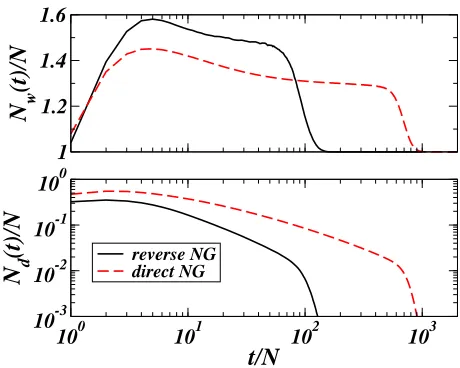
FIG. 3: Total memory Nw (top) and number of different
wordsNd(bottom) vs. rescaled time for two different
strate-gies of pair selection on a BA network ofN = 104
agents, with hki= 4. The reverse NG rule (black full line) converges much faster than the direct rule (red dashed line). Nonetheless, the two strategies lead to the same scaling laws with the system size for the convergence time (not shown).
This is particularly relevant in heterogeneous networks for which a neighbor of a randomly chosen node is a hub with relatively large probability. We therefore can distin-guish more possibilities for the definition of the Naming Game on generic networks.
• (i) A randomly chosen speaker selects (again ran-domly) a hearer among its neighbors. This is prob-ably the most natural generalization of the original rule. We call this strategydirect Naming Game. In this case, larger degree nodes will preferentially act as hearers.
• (ii) The opposite strategy, here calledreverse
Nam-ing Game, can also be carried out: we choose
the hearer at random and one of its neighbors as speaker. In this case the hubs are preferentially selected as speakers.
• (iii) A neutral strategy to pick up pairs of nodes is that of considering the extremities of an edge taken uniformly at random. The role of speaker and hearer are then assigned randomly with equal probability among the two nodes.
Figure 3 allows to compare the evolution of the di-rect and the reverse Naming Game for a BA network of
N = 104
[image:6.612.324.554.49.233.2]100 101 102 103 100
101
N
w(t)/N
ER, 103
ER, 104
ER, 5.104
MF, 103
100 101 102 103 100
101 BA, 103
BA, 104
BA, 5.104
MF, 103
100 101 102 103
t/N
10-4 10-3 10-2 10-1
(N
d
(t)-1)/N
ER, 103
ER, 104
ER, 5.104
MF, 103
100 101 102 103
t/N
10-4 10-3 10-2 10-1
BA, 103
BA, 104
BA, 5.104
MF, 103
FIG. 4: (Color online) ER random graph (left) and BA
scale-free network (right) with hki = 4 and sizes N =
103
,104
,5.104
. Top: evolution of the average memory per
agentNw/N versus rescaled timet/N. For increasing sizes a
plateau develops in the re-organization phase preceding the convergence. The height of the peak and of the plateau col-lapse in this plot, showing that the total memory used scales
withN. Bottom: evolution of the number of different words
Ndin the system. (Nd−1)/Nis plotted in order to emphasize
the convergence to the consensus withNd= 1. A steady
de-crease is observed even if the memoryNw displays a plateau.
The mean-field (MF) case is also shown (for N = 103
) for comparison.
of convergence. Depending on the network under study, and similarly to the Voter model case [33], the scaling laws of the convergence time can even be modified, as our preliminary study shows. A detailed analysis of this be-havior remains however beyond the scope of our present study and we leave it for future work (see also [34]). From the point of view of a realistic interaction among individ-uals or computer-based agents, the direct Naming Game in which the speaker chooses a hearer among its neigh-bors seems somehow more natural than the other ones. In the remainder of this paper therefore, we will focus on the direct Naming Game, mentioning where necessary the corresponding behavior for the other two rules.
A. Global quantities
We first study the global behavior of the system through the temporal evolution of three main quantities: the total numberNw(t) of words in the system, the
num-ber of different wordsNd(t), and the rate of successS(t).
All these quantities are averaged over a large number of runs and networks realizations. In Fig. 4, we report the curves ofNw(t) andNd(t) for ER (left) and BA networks
(right) with N = 103 , 104
and 5.104
nodes and average degree hki = 4. The corresponding data for the mean-field case (withN = 103
) are displayed as well for refer-ence. The curves for the average use of memory Nw(t)
show a rapid growth at short times, a peak and then a
102 104 106 108 1010
t
tmax tconv t ∝ Nα, α ≈ 1.0 t ∝ Nβ, β ≈ 1.4
100 101102 103104 105
N
100 102 104 106
N w
max
Nwmax ∝ Nγ, γ ≈ 1.0
101102 103104 105 106
N
BA
BA ER
ER
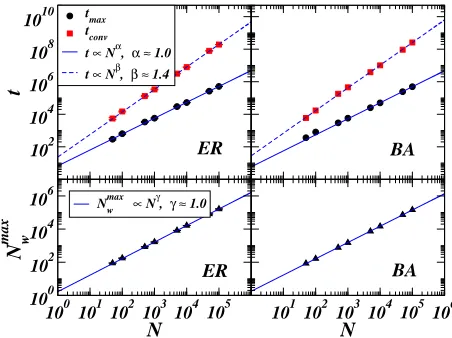
FIG. 5: (Color Online) Top: scaling behavior with the
sys-tem sizeN for the time of the memory peak (tmax) and the
convergence time (tconv) for ER random graphs (left) and
BA scale-free networks (right) with average degree hki= 4.
In both cases, the maximal memory is needed after a time proportional to the system size, while the time needed for
convergence grows as Nβ with β
≃ 1.4. Bottom: In both
networks the necessary memory capacity (i.e. the maximal
valueNmax
w reached byNw) scales linearly with the size of
the network.
plateau whose length increases as the size of the system is increased (even when time is rescaled by the system size, as in Fig. 4). The time and height of the peak, and the height of the plateau, are proportional toN. These scal-ing properties are systematically studied in Fig. 5, which also shows that the convergence timetconvscales asN1.4
for both ER and BA. The apparent plateau ofNw does
however not correspond to a steady state, as revealed by the continuous decrease of the number of different words
Ndin the system: in this re-organization phase, the
sys-tem keeps evolving by elimination of words, although the total used memory almost does not change.
The scaling laws observed for the convergence time is a general robust feature that is not affected by further topological details, such as the average degree, the clus-tering or the particular form of the degree distribution. We have checked the value of the exponent 1.4±0.1 for varioushki, clustering, and exponentsγof the degree dis-tributionP(k)∼k−γ for scale-free networks constructed
with the uncorrelated configuration model. All these pa-rameters have instead an effect on the other quantities such as the time and the value of the maximum of mem-ory (see section V D).
Figures 2, 4 and 5 allow for a direct comparison be-tween the networks investigated and both the mean-field (MF) topology and the regular lattices. Thanks to the finite average connectivity, the memory peak scales only linearly with the system size N, and is reached after a time O(N), in contrast with MF (O(N1.5
[image:7.612.325.551.50.219.2] [image:7.612.65.293.50.212.2]correla-102
t/N
103 00.2 0.4 0.6 0.8 1
S(t)
BA, N = 103BA, N = 104
MF, N = 103
0 50 100 150 200 250 300
t
0 0.05 0.1 0.15 0.2
S(t)
m=2 fit: 0.00053 t m=4
fit: 0.00026 t m=8
fit: 0.00013 t
FIG. 6: (Color online) Top: Temporal evolution of the success rate S(t) for BA scale-free networks with hki = 4 and sizes
N = 103
and 104
. The dotted black line refers to the mean-field case (N = 103
). The bottom plot shows the short time
behavior for N = 103
and hki= 4 (m= 2, circles), hki= 8 (m= 4, squares), andhki= 16 (m= 8, triangles). The fitted slopes are very close to the predicted value 2/hkiN.
tions between inventories, with an increasing used global memory, and almost no cancellation of words, is replaced here by a slow continuous decrease ofNdwith an almost
constant memory used. With respect to the slow coars-ening process observed in finite dimensional lattices on the other hand, the small-world properties of the net-works, i.e. the existence of short paths among the nodes, speeds up the convergence towards the global consensus (see also [35]). Therefore, complex networks exhibiting small-world properties constitute an interesting trade-off between mean-field ”temporal efficiency” and regular lat-tice ”storage optimization”.
Figure 6 displays the success rate S(t) for BA net-works withN= 103
(red full line), and 104
(blue dashed line) agents and hki = 4. The behaviour for ER net-works is similar. The success rate for the mean-field (N = 103
) is also reported (black dotted lines). The success rate increases linearly at very short times (Bot-tom plot of Fig. 6) then, after a plateau similar to the one observed for Nw, increases on a fast timescale
to-wards 1. At short times most inventories are empty, so that the success rate is equal to the probability that two agents interact twice, i.e. t/E, where E = Nhki/2 is the number of possible interacting pairs (i.e. the number of links in the network), as shown in Fig. 6 for BA net-works where linear fits to S(t) give slopes in agreement with the theoretical prediction 2/hkiN. Note that this argument as well explains that in mean-field the initial success rate is much lower than for finitehki, since there
E =N(N−1)/2 =O(N2
). When t∼ O(N), no inven-tory is empty anymore, words start spreading through unsuccessful interactions andS(t) displays a bending.
2
×
10
34
×
10
3N
clm = 2 m = 4 m = 8
0
0.5
1
<s>/N
m = 2 m = 4 m = 8
10
010
110
210
310
4t/N
10
410
610
8Var (s)
m = 2 m = 4 m = 8
BA
BA
BA
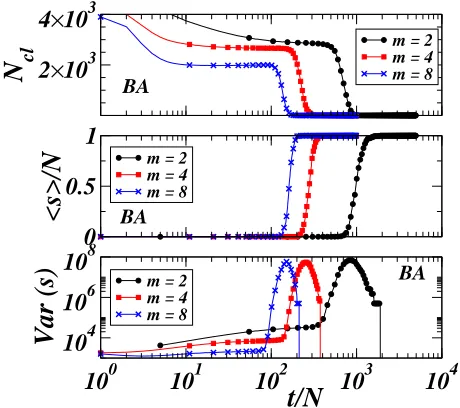
FIG. 7: (Color online) ER network with N = 104
, hki = 4 (circles),hki = 8 (squares), hki= 16 (crosses). From top to bottom: Total number of clusters, average normalized cluster sizehsi/N, fluctuations of the cluster size vs. time.
B. Clusters statistics
We now turn our attention to a complementary aspect of the dynamics of the Naming Game: the behavior of clusters of words. We call ”cluster” any set of neighbor-ing agents sharneighbor-ing a common unique word. In the case of agents embedded in low-dimensional lattices, it has in-deed been shown [14] that the dynamics of the Naming Game proceeds by formation of such clusters, that grow through a coarsening phenomenon: the average cluster size (resp. the number of clusters) increases (resp. de-creases) algebraically with time. On generic networks, a different behavior can be expected. As shown indeed in Fig. 7 for the ER model (the behaviour is very similar for the BA model) the number of clusters reaches very rapidly a plateau that lasts up to the convergence time at which it suddenly falls to 1. Moreover, the normalized average cluster size remains very close to zero (in fact, of order 1/N) during the plateau, and converges to one with a similar sudden transition. This transition becomes steeper when the average degree increases (and also when the size of the system increases), as also emphasized by sharper peaks in the variance of the cluster size.
In the same spirit, it is interesting to monitor the num-ber of agents with a certain numnum-ber of words: agents with only one word are parts of clusters while agents us-ing more memory are propagatus-ing words from one part of the system to another. Fig. 8 shows the temporal evo-lution of the fractions of nodes with 1, 2 and 3 words. As for Nw and the cluster size, these quantities
[image:8.612.62.290.50.223.2] [image:8.612.324.554.52.256.2]FIG. 8: (Color online) ER and BA networks with average
degree hki = 4. Fractions of nodes with one (n1 in black),
two (n2 in red) and three (n3 in blue) words versus time.
These fractions evolve only very slowly during the plateau displayed by the memory. The curves for three different sizes
are reported: N = 103
(dotted line),N = 104
(dashed line) andN= 5.104
(full line).
lower than what would be observed in a coarsening pro-cess in which agents with more than one word are only found at the interfaces.
The emerging picture is very different from the coars-ening obtained on finite dimensional lattices, although the initial formation of small clusters of agents reaching a local consensus through repeated interactions is similar. While a majority of nodes soon compose small clusters, the fraction of nodes with more words is not negligible and decreases only at the end of the evolution. There-fore, the dynamics can not be seen as a coarsening or growth of clusters but as a slow process of correlations between inventories, in a way much more similar to what is observed in mean-field [13].
C. Effect of the degree heterogeneity
In regular topologies, as well as in mean-field, all agents face an identical environment. Complex networks are dif-ferent in that respect, and strong differences in behavior can be expected for agents sitting on nodes with large or small degrees. Global properties of dynamical pro-cesses are often affected by the heterogeneous character of the network topology [16, 17]. The previous subsec-tion however has shown that, similarly to what happens for the Voter model [36], the dynamics of the Naming Game is similar on heterogeneous and homogeneous net-works. Nonetheless, a more detailed analysis reveals that agents with different degrees present very different activ-ity patterns, whose characterization is necessary to get additional insights on the Naming Game dynamics [38].
Let us first consider the average success rateSk(t) of
1 10 100
0.01 0.1
S k
(t
* )
data theory
1 10 100
0.01 0.1
1 10 100
k
0.01 0.1
S k
(t
* )
1 10 100
k
0.1
t* = 0.1× N t* = 0.2× N
t* = 0.4× N t* = 0.3× N
FIG. 9: (Color online) The four plots correspond to snap-shots of the success rate per degree classes Sk(t∗) at times
t∗/N = 0.1,0.2,0.3,0.4 in a power-law random graph with
exponentγ = 2.2 and size N = 104
generated using the un-correlated configuration model. The numerical computation of the success rate (black circles) qualitatively agrees with the numerical evaluation of the expression in Eq. 2 (red crosses).
nodes of degreek. At the early stages of the dynamics it can be computed following the arguments of section V A. The probability of choosing twice the edgei−j is
t N
1
ki
+ 1
kj
, (1)
i.e. the probability of choosing firsti(1/N) thenj(1/ki)
or vice versa. Neglecting the correlations betweenkiand
kj, one can average over all nodes i of fixed ki = k,
obtaining
Sk(t)≃ t
N
1
k+
1
k
. (2)
Fig. 9 shows that, on uncorrelated scale-free networks (UC model), the data (circles) obtained by numerical simulations are in qualitative agreement with the direct calculations of the expression in Eq. 2 (crosses). These data together with Eq. 2 show that, at the very begin-ning, the success rate grows linearly but the effect of the degree heterogeneity is partially screened by the presence of the constant termh1/ki. The same argument can be used to predict that the success rate should be essentially degree independent for larger times. S(t) is indeed always given by two terms, of which only that referring to the node playing as speaker contains an explicit dependence on 1/k. The argument is only approximate since the mul-tiplicative prefactors contain non-negligible correlations due to the overlapping inventories. More precisely, these arguments are correct for a neutral Naming Game rule, but they should hold also for the direct Naming Game in which the constant term, coming from the activity of nodes as hearers, is much more relevant for high degree nodes.
[image:9.612.326.557.48.207.2] [image:9.612.76.267.91.210.2]de-100 101
t/N
103 104 02 4 6 8
N
w(k,t)/N
k k=5
k=20 k=50 k=100
100 101 102 103
k
101 102
N
wmax
(k)
FIG. 10: (Color online) BA model withm= 2 (i.e. hki= 4),
N = 5.104
. Bottom: maximum memory used by a node as a function of its degree. The dashed line is∝√k. Top: average memory used by nodes of degreek, for various values ofk. The lines show the total memoryNw(k, t) used by nodes of degree
kat timet, normalized by the numberNkof nodes of degreek.
The circles correspond to the bottom curve (k0 = 5) rescaled
bypk/k0 showing the scaling of the peaks. Note that the
values ofNw(k, t)/Nkare averages over many runs that wash
out fluctuations and therefore correspond to smaller values
than the extremal values observed forNmax
w (k).
gree, we get that the height of the memory peak is larger for nodes of larger degree, as shown in Fig 10. This can be understood by the fact that hubs act more frequently as hearers and therefore receive and collect the different words created in the various ”areas” of the network they connect together [45]. In fact, the maximal memory used by a node of degreekis proportional to√k(see bottom panel in Fig. 10). For the mean-field case, all agents have degree k = N −1 and the maximal value of the total memoryNw scales indeed as N
√
k = N3/2 . Note however that in the general case, the estimation of the peak ofNwis not as straightforward. This peak is indeed
a convolution of the peaks of the inventory sizes of sin-gle agents, that have distinct activity patterns and may reach their maximum in memory at different temporal steps.
The knowledge of the average maximal memory of a node of degree k is not sufficient to understand which degree classes play a major role in driving the dynamics towards the consensus. More insights on this issue can be obtained observing the behavior of the total number of different words in each degree class. Figure 11 shows the evolution of the number Nd(k, t) of different words
in the class of nodes with degreek, for various values of
kin a BA network with sizeN = 104
andhki= 4. Two competing effects take part in determining the differences between nodes: high degree nodes require more mem-ory than low degree nodes (Fig. 10), but their number is much smaller. As a result, low degree classes have in fact overall a larger number of different words (as shown in Fig. 11). This is due to the fact that during the initial
100 101
t/N
102 103100 101 102
N
d(k,t)
k = 5 k = 20 k = 50 k = 100
FIG. 11: (Color online) BA network,m= 2,N= 104
. Total number of different words in classes of degreek, for values of
k= 5, 20, 50, 100 (curves fork= 50 and 100 are almost on
top of each other).
phase, in which words are invented, low degree nodes are more often chosen as speakers and invent many different words. The hubs need each a larger memory but they in fact retain a smaller number of different words. After the peak in memory, the dynamical evolution displays a relatively fast decrease ofNd(k, t) for small k while a
plateau is observed at large k: words are progressively eliminated for low-knodes while the hubs, which act as intermediaries and are in contact with many agents, still have typically many words in their inventories. The role of the hubs, then, is that of diffusing words through-out the network and their property of connecting nodes with originally different words helps the system to con-verge. On the other hand, however, playing mostly as hearers, the hubs are not able to promote actively suc-cessful words, and their convergence follows that of the neighboring low-degree sites. In fact, once the low-degree nodes have successfully eliminated most of the different words created initially, the system globally converges on a faster timescale. We note that the average memory
Nw(k, t)/Nk converges slightly faster thanNd(k, t) (and
thatNd(k, t) converges faster for largerk), showing that
the very final phase consists in the late adoption of the consensus by the lowest degree nodes, in a sort of final cascade from the large to the small degrees.
D. Effect of the average degree and clustering
[image:10.612.324.552.48.217.2] [image:10.612.64.289.50.214.2]1 2 3 4 5
N
w(t)/N
<k> = 4 <k> = 8 <k> = 16
1 1.5 2 2.5 3
<k> = 4 <k> = 8 <k> = 12
100 101 102 103
t/N
10-4 10-3 10-2 10-1 100
N
d(t)/N
100 101 102 103
t/N
10-410-3 10-2 10-1 100 ER
ER
BA
BA
FIG. 12: (Color online) ER networks (left) and BA networks
(right) withN = 104
agents and average degreehki = 4, 8, 16. The increase of average degree leads to a larger memory
used (Nw, top) but a faster convergence. The maximum in
the number of different words is not affected by the change in the average degree (bottom).
The effects of increasing the average degree on the behavior of the main global quantities are reported in Fig.12. In both ER (left) and BA (right) models, in-creasing the average degree provokes an increase in the memory used, while the global convergence time is de-creased. Note also that, while the behavior of the conver-gence time with N (i.e. a power-law Nβ with β ≈1.4)
is very robust, the linear scaling for the memory peak properties (Nmax
w ∝ Nα and tmax ∝ Nα with α = 1),
are slightly altered by an increase in the average degree (not shown). Increasinghkiat finiteN brings indeed the system closer to the mean-field behavior where the scal-ing of these quantities is non-linear (αMF = 1.5); at large
enough sizes however, the linear scaling is recovered. Moreover, for larger average degree, the number of nodes having only one word decreases (not shown); i.e. the system needs a more complicated re-organization phase that involves a larger number of agents with many words, but induces a faster convergence. In fact, the larger possibilities of interaction given by the larger num-ber of connections allows for a better sharing of common words and for a more efficient correlation of inventories, thus favoring a faster convergence.
Note that the clustering is slightly changing when changing the average degree, but its variation is small enough for the two effects to be studied separately. Here we use some other mechanisms to enhance clustering, summarized in the following two models that have been defined in section IV: clustered Erd¨os-R´enyi (CER) ran-dom graphs, and mixed BA-DMS model.
Figure 13 shows the effect of increasing the cluster-ing at fixed average degree and degree distributions: the number of different words is not changed, but the average memory used is smaller and the convergence takes more time. Moreover, the memory peak at fixed k is smaller
FIG. 13: (Color online) Effect of clustering on the behavior
of the total number of words Nw(t) and of the number of
different wordsNd(t) on random graphs (left) and scale-free
networks (right) withN = 104
. In order to inject triangles into the ER random graphs we have used the construction described in section IV, obtaining clustered random graphs
(CER model, with clustering coefficient proportional to Q)
that have been compared to standard ER graphs with equal
average degree (hki = 6 and 10). Scale-free networks have
been generated with the mixed BA-DMS model described in section IV, in which the clustering coefficient is proportional
to 1−q. In both networks higher clustering leads to smaller
memory capacity required but a larger convergence time.
FIG. 14: (Color online) Effect of enhanced clustering on the fraction of agents with 1 (n1in black), 2 (n2 in red) and 3 (n3
in blue) words. Top: We compare a clustered random graph
(CER model, with clustering coefficient proportional to Q)
to standard ER graphs, both with average degreehki = 10.
[image:11.612.64.293.53.216.2] [image:11.612.325.530.74.223.2] [image:11.612.344.520.432.586.2]101 102 103
t/N
10-3 10-2 10-1 100
N w
(t)/N -1
[image:12.612.62.291.48.214.2]BA tree (m=1) DMS, m=2 RAN BRV BA, m=4
FIG. 15: Evolution of the number of words for the Naming Game on hierarchical networks, namely the BA tree, the DMS model, the hierarchical BRV [39], and the Random Apollonian
network. The case of the BA model withm= 4 is shown with
a dashed line for reference.
for larger clustering (not shown): it is more probable for a node to speak to 2 neighbors that share common words because they are themselves connected and have already interacted, so that it is less probable to learn new words. Favored by the larger number of triangles, cliques of neighboring nodes learn from the start the same word, causing a slight increase in the fraction of nodes with only one word as reported in Fig. 14 for both ho-mogeneous and heterogeneous networks. At fixed aver-age degree i.e. global number of links, less connections are moreover available to transmit words from one part of the network to the other since many links are used in “local” triangles. The enhanced local coherence therefore is in the long run an obstacle to the global convergence. We note that this effect is similar to the observation by Holme et al. [37] that, at fixed hki, more clustered net-works are more vulnerable to attacks since many links are “wasted” in redundant local connections.
E. Effect of hierarchical structures
In the previous sections we have argued that networks with small-world property have fast (mean-field like) con-vergence after a re-organization phase whose duration depends on other properties of the system. The small-world property holds when the diameter of the network grows slowly, i.e. logarithmically or slower, with its size
N. This ensures that every part of the network is rapidly reachable from any other part, in contrast to what hap-pens with regular lattices. Such property therefore gener-ically enhances the possibility of creating correlations be-tween the inventories of the agents and of finally converg-ing to a consensus. In this subsection, we show that this line of reasoning bears, surprisingly at first sight, some exceptions.
The first (and easiest to apprehend) exception is given
by the scale-free trees, obtained by the preferential at-tachment procedure withm= 1. In this case, as shown in Fig. 15, the convergence is reached very slowly, with
Nw(t)/N−1 decreasing as a power law of the time. This
is in contrast with the generic behavior, i.e. a plateau fol-lowed by an exponential convergence, as shown also for reference in Fig. 15, but similar to the finite-dimensional lattices (the average cluster size as well grows as a power-law, in contrast with the data of Fig. 7). This is reminis-cent of what happens for the Voter model [36], in which a power-law instead of exponential decrease of the frac-tion of active bonds is observed, and can be understood through the tree structure of the network. Indeed, from the viewpoint of the dynamics, a tree is formed by two ingredients: linear structures on which the interfaces be-tween clusters diffuse as in one-dimensional systems and branching points at which interfaces may be pinned and their motion slowed. In fact, we have checked that simi-lar (slow) power-law behaviors are also obtained for the Naming Game on Cayley tree (i.e. in which every node has the same degree) or for scale-free tree with different degree distributions (obtained through the generalized linear preferential attachment model).
The slowness of this dynamical behavior is however rooted in a slightly more subtle consideration. As Fig. 15 indeed shows, the Naming Game displays power-law con-vergence in other heterogeneous networks that are not at all tree-like, such as the DMS model with m = 2 [29], in which at each step a triangle is created, the determin-istic scale-free networks of Barab´asi, Ravasz and Vicsek (BRV) [39] or the Apollonian and Random Apollonian Networks (RAN) [40, 41]. Let us briefly recall how these networks are constructed:
• For the DMS model withm= 2, one adds at each step a new node which is connected to the extrem-ities of a randomly chosen edge.
• For the deterministic scale-free BRV networks, one starts (step 1) with two nodes connected to a root. At each step n, two units (of 3n−1nodes)
identi-cal to the network formed at the previous step are added, and each of the bottom 2n nodes are
con-nected to the root.
• The Random Apollonian networks are embedded in a two-dimensional plane. One starts with a trian-gle; a node is added in the middle of the triangle and connected to the three previous nodes; at each step, a new node is added in one of the existing triangles (chosen at random) and connected to its three corners, replacing the chosen triangle by three new smaller triangles.
smaller triangles. Finally, in the DMS case, one can iden-tify a unit at a certain scale as an edge and the set of nodes that have been attached to the extremities of this edge or of the edges subsequently created in this unit. Because of these particular network organizations, each node belongs in fact to a given sub-hierarchical unit and, to go from one node to another node in another sub-unit, a hierarchical path has to be followed. The trees represent a particular class of such structures, in which there exist only one path between two given nodes. In this sense, such networks, although being small-world, present a structure which renders communication be-tween different parts of the network more difficult. Each sub-unit can therefore converge towards a local consensus which renders the global consensus more cumbersome to achieve.
Such results show that the small-world property in fact does not by itself guarantee an efficient convergence of dynamical processes such as the Naming Game, and that strongly hierarchical structures in fact slow down and obstruct such convergence.
VI. DISCUSSION AND OUTLOOK
In this article, we have studied the dynamical proper-ties of the minimal Naming Game model [13] in popula-tions of agents interacting on complex topologies, focus-ing on homogeneous and heterogeneous networks (rep-resented respectively by the Erd¨os-R´enyi random graph model and by the Barab´asi-Albert scale-free model). So-cial networks indeed are typically neither fully connected graphs nor regular lattices. We have considered the ef-fects of various networks characteristics such as the het-erogeneity, the average degree and the presence of clus-tering.
The main characteristic of the studied networks is the small-world property (the average hopping distance be-tween two nodes scales only logarithmically with the size of the network). After an initial phase during which words are created, the small-world property en-sures their propagation out of the local scale, boosting up the spreading process contrarily to what happens in low dimensional lattices where words’ spreading is purely diffusive (see sections V A-V B). As already suggested in Ref. [35], we argue that the small-world property al-lows to inhomogeneous and sparse networks to recover the high temporal efficiency observed in the mean-field system. For both the ER and BA network models we get a scaling law for the convergence timetconvwith the
sizeN of the system of the typetconv∼NβSW, with
ex-ponent approximatelyβSW ≃1.4. The discrepancy with
the mean-field exponent (βMF ≃1.5) may be due to
loga-rithmic corrections that are unlikely to be captured using numerical scaling techniques. Moreover, small-world net-works have higher memory efficiency than the mean-field model, since the peak in the total number of words scales only linearly with the sizeN. This is due to the fact that
these networks aresparse, i.e. their average degreehkiis small compared toN.
The detailed analysis of the Naming Game dynam-ics shows distinct activity patterns on homogeneous and heterogeneous networks. In homogeneous networks all nodes have a similar neighborhood and therefore simi-lar dynamical evolution, while in heterogeneous networks classes of nodes with different degree play different roles in the evolution of the Game. The role of the hubs is better understood thanks to the degree based analysis of the number of words and different words. High degree nodes, indeed, are more likely chosen as hearers and, consequently, they have larger inventory sizes. At the beginning, because of the pair choosing strategy (direct Naming Game), low degree nodes are much more involved in the process of word generation than the hubs. Local consensus is easily reached and a large amount of locally stable different words get in touch with higher degree nodes. The latter start to accumulate a large number of words in their inventories, playing as spreaders of names towards less connected agents and finally driving the con-vergence. From this viewpoint, the convergence dynami-cal pattern of the Naming Game on heterogeneous com-plex networks presents some similarities with more stud-ied epidemic spreading phenomena [42]. A more detailed comparison of the activity pattern for the direct and re-verse Naming Game is left for future work [38].
The relation between topological properties and dy-namical evolution of the system are further characterized by a detailed study of the effects of varying the aver-age degree and clustering coefficient. These effects are equivalent on homogeneous and heterogeneous networks. While any increase of the average degree provokes a larger memory peak and a faster convergence, the growth of clustering coefficient leads to the decrease of the neces-sary memory but the fast obtention of local consensus delays in the long run the global convergence. The latter effect is particularly relevant for real social networks in which local cohesiveness is an important feature that can-not be neglected. Acan-nother important ingredient of real networks that we have not addressed here is the presence of degree correlations in the network topology. It would indeed be interesting to know in what measure positive or negative degree correlations affect the negotiating pro-cesses of the agents.
sys-FIG. 16: Metastable states in networks with strong
commu-nity structure. Each commucommu-nity is composed of c nodes so
that there are N/c = 100 communities. The dashed ellipse
and the arrow identify the metastable states withNd=N/c
different words.
tem. In contrast with other non-equilibrium models, as those based on zero-temperature Glauber dynamics or the voter model [36, 43], we do not find any signature of the occurrence of metastable blocked states in any rel-evant topology with quenched disorder. While the to-tal number of words displays a plateau whose length in-creases with the system size during the re-organization phase, indeed, the number of different words is continu-ously decreasing, revealing that the convergence is not a matter of fluctuations due to finite-size effects, but the result of an evolving self-organizing process. Such behavior makes the Naming Game a robust model of self-coordinated communication in any structured pop-ulation of agents. A noticeable exception concerns the case of agents sitting on networks with strong commu-nity structures, i.e. networks composed of a certain num-ber of internally highly connected groups interconnected
by few links working as bridges. Figure 16 reports the behavior of the Naming Game on such a network, com-posed of fully-connected cliques, each ofcnodes, the var-ious cliques being connected to each other with only one link. From simulations it turns out that, not only the total number of words, but even the number of different words display a plateau whose duration increases with the size of the system. The number of different words in the plateau equals the number of communities, while the corresponding total number of words per node is about one, proving the existence of a real metastable state in which the system reaches a long-lasting multi-vocabulary configuration. Indeed, each community reaches internal consensus but the weak connections between communi-ties are not sufficient for words to propagate from one community to the other.
In conclusion, populations of agents with fixed com-plex topology do evolve towards a homogeneous state of consensus and efficient communication, except for some-how artificial network structures, the detailed topologi-cal properties affecting only the convergence pattern and time scale. Future work will address the important issue of a possible interplay between topology and dynamics in populations in which the agents are free of rearranging their connectivity patterns in relation to local (or global) information on the dynamical evolution of the system. It would for example be interesting to verify if such in-terplay may allow for a natural emergence of community structures and multi-language cohabitation.
VII. ACKNOWLEDGMENTS
The authors thank E. Caglioti, C. Cattuto and L. Steels for many useful discussions. A. Baronchelli and V. L. are partially supported by the EU under contract IST-1940 (ECAgents). A. Barrat and L.D. are partially sup-ported by the EU under contract 001907 “Dynamically Evolving, Large Scale Information Systems” (DELIS).
[1] R. Lass, Historical Linguistics and Language Change,
Cambridge University Press (Cambridge), 1997. T.
Briscoe, Linguistic evolution through language
acquisi-tion: formal and computational models, Cambridge Uni-versity Press (Cambridge), 1999. J. Hurford, C. Knight,
and M. Studdert-Kennedy (eds.),Approaches to the
Evo-lution of Human Language, Cambridge University Press (Cambraidge), 1999.
[2] L. Steels, Evolution of Communication1, 1-34 (1997).
[3] S. Kirby, Artificial Life8, 185-215 (2002). [4] D. J. Barr, Cognitive Science28, 937 (2004). [5] J. Hurford, Lingua77, 187 (1989).
[6] M.A. Nowak, J.B. Plotkin and J.D. Krakauer, J. Theor. Biol.200, 147 (1999).
[7] L.Steels, Proceedings of PPSM VI in Lecture Notes in
Computer Science, Springer-Verlag, Berlin (Germany),
2000.
[8] L. Steels, Artificial Life, 2(3), 319-332 (1995).
[9] L. Steels, Autonomous Agents and Multi-Agent Systems
1, 169-194 (1998). L. Steels, The Talking Heads
Exper-iment. Volume 1. Words and Meanings, Laboratorium, Antwerpen (Belgium), 1999.
[10] C. Cattuto, V. Loreto, and L. Pietronero, preprint cs.CY/0605015.
[11] For a recent contribution in this fast growing field see: S.A. Golder and B.A. Huberman, arxiv:cs.DL/0508082 (2005).
[12] K. Sznajd-Weron and J. Sznajd, Int. J. Mod. Phys. C,
11, 1157 (2000); G. Deffuant, D. Neau, F. Amblard and
G. Weisbuch, Adv. Compl. Syst.3, 87 (2000); R.
Hegsel-mann and U. Krause, J. Art. Soc. Soc. Sim.5, issue 3,
[image:14.612.65.273.74.224.2]Rev. Lett.90, 238701 (2003); R. Axelrod, J. of Conflict Resolut.,41, 203, (1997).
[13] A. Baronchelli, M. Felici, E. Caglioti, V. Loreto and L. Steels,preprint, arxiv:physics/0509075 (2005).
[14] A. Baronchelli, L. Dall’Asta, A. Barrat, and V. Loreto, Phys. Rev. E 73, 015102(R) (2006).
[15] A.-L. Barab´asi and R. Albert, Rev. Mod. Phys.74, 47-97 (2002).
[16] S.N. Dorogovtsev and J.F.F. Mendes,Evolution of
Net-works: from biological nets to the Internet and WWW
(Oxford University Press, Oxford 2003).
[17] R. Pastor-Satorras and A. Vespignani, Evolution and
Structure of the Internet: A statistical physics approach
(Cambridge University Press, Cambridge, 2004).
[18] M. Granovetter, American Journal of Sociology,78, 1360
(1973).
[19] T. Lenaerts, B. Jansen, K. Tuyls, and B. D. Vylder,
Jour-nal of Theoretical Biology,235, 566-582 (2005).
[20] A. Bray, Adv. in Phys51, 481 (2002).
[21] D.J. Watts and S.H. Strogatz, Nature 393, 440-442
(1998).
[22] B. Bollob´as, Random Graphs, Academic Press, London
(1985).
[23] P. Erd¨os and A. R´enyi, Publ. Math. Debrecen, 6, 290
(1959); P. Erd¨os and A. R´enyi,Publ. Math. Inst. Hung.
Acad. Sci.,7, 17 (1960).
[24] M. Molloy and B. Reed, Rand. Struct. Algo. 6, 161
(1995); M. Molloy and B. Reed,Combin., Probab.
Com-put.7, 295 (1998).
[25] W. Aiello, F. Chung, and L. Lu,Experimental Math.10,
53 (2001).
[26] M. Catanzaro, M. Bogu˜n´a, and R. Pastor-Satorras,Phys. Rev. E71, 027103 (2005).
[27] K.-I. Goh, B. Kahng, and D. Kim, Phys. Rev. Lett.87,
278701 (2001).
[28] A.-L. Barab´asi and R. Albert,Science286, 509 (1999). [29] S.N. Dorogovtsev, J.F.F. Mendes, and A.N. Samukhin,
Phys. Rev. E63, 062101 (2001).
[30] A. Barrat and R. Pastor-Satorras, Phys. Rev. E 71,
036127 (2005).
[31] P. Holme and B. J. Kim, Phys. Rev. E65, 026107 (2002).
[32] A. Barrat, unpublished.
[33] C. CastellanoAIP Conf. Proc.779, 114 (2005).
[34] A. Baronchelli, L. Dall’Asta, A. Barrat, and V. Loreto,
Proceedings of Evolang6, 2006.
[35] L. Dall’Asta, A. Baronchelli, A. Barrat, and V. Loreto,
Europhys. Lett.73, 969(2006).
[36] C. Castellano, V. Loreto, A. Barrat, F. Cecconi and D.
Parisi, Phys. Rev. E71066107 (2005).
[37] P. Holme, B. J. Kim, C. N. Yoon, S. K. Han Phys. Rev.
E65, 056109 (2002).
[38] L. Dall’Asta et al., work in preparation.
[39] A.-L. Barab´asi, E. Ravasz and T. Vicsek, Physica A299, 559-564 (2001).
[40] J.S. Andrade Jr,H.J. Herrmann, R.F.S. Andrade, and
L.R. da Silva, Phys. Rev. Lett.94, 018702 (2005).
[41] T. Zhou, G. Yan and B.H. Wang, Phys. Rev. E 71,
046141 (2005).
[42] M. Barth´elemy, A. Barrat, R. Pastor-Satorras, and A.
Vespignani,Jour. Theor. Biol.235, 275-288 (2005).
[43] I. Dornic, H. Chat´e, J. Chave, and H. Hinrichsen,Phys.
Rev. Lett. 87, 045701 (2001); C. Castellano, D. Vilone,
and A. Vespignani; Europhys. Lett. 63 (1), 153-158
(2003); D. Boyer and O. Miramontes, Phys. Rev. E67,
035102(R) (2003); K. Suchecki, V.M. Eguiluz, and M.
San Miguel,Phys. Rev. E 72, 036132 (2005);
[44] Note that, in order to compare an ER and a CER network with the samehki, we therefore tunepfor the construc-tion of the corresponding CER.


![FIG. 15: Evolution of the number of words for the NamingGame on hierarchical networks, namely the BA tree, the DMSmodel, the hierarchical BRV [39], and the Random Apolloniannetwork](https://thumb-us.123doks.com/thumbv2/123dok_us/1644866.117980/12.612.62.291.48.214/evolution-naminggame-hierarchical-networks-dmsmodel-hierarchical-random-apolloniannetwork.webp)