City, University of London Institutional Repository
Citation:
Tsakarestos, A., Nocera, S., Kaparias, I. and Eden, N. (2011). Performance evaluation of urban traffic management and ITS: The Rome case study. Paper presented at the SIDT National Conference and Scienttfic Seminar, 6-7 Sept 2011, Venice, Italy.This is the accepted version of the paper.
This version of the publication may differ from the final published
version.
Permanent repository link:
http://openaccess.city.ac.uk/6264/Link to published version:
Copyright and reuse: City Research Online aims to make research
outputs of City, University of London available to a wider audience.
Copyright and Moral Rights remain with the author(s) and/or copyright
holders. URLs from City Research Online may be freely distributed and
linked to.
1
Performance evaluation of urban traffic
manage-ment and ITS: The Rome case study
Antonios Tsakarestos
*, Silvio Nocera
†*, Ioannis Kaparias
‡, Niv
Eden
§1
Introduction
In order to cope with their growing traffic problems, cities throughout the world deploy Intelligent Transport System (ITS) applications in various fields of urban networks. The decision making process for the installation of ITS is a dialogue between the political instance of the municipalities and the planners. The strategic concept and the detailed planning are undertaken by transportation experts in the respective planning authorities and is based on a vast variety of measurements and evaluations (Reed et al., 1993). The decision for funding the systems however is taken on a political level and is based on the consideration of expected benefits, economic aspects but also public debates and controversies. It is obvious that this dialogue within an inhomogeneous group of stakeholders needs a common basis for the con-sideration of benefits of ITS as a counterpart to the often obvious costs.
In order to deliver this common basis of discussion, a transparent meth-odology to calculate and present the benefits of ITS has to be elaborated. This methodology should support the decision making process in several aspects:
to identify best practice applications already operational in simi-lar cases in other cities;
to decide on the installation of the system on a technical and a political level;
* Technische Universität München † IUAV University of Venice ‡ Imperial College London §
2
to monitor the performance of the deployed application over a longer period of time;
to weigh the investment and operational cost compared to the benefits of the system.
Several solutions to this problem were proposed within the EU FP7 pro-ject CONDUITS (2009 - 2011). They included the elaboration of a set of Key Performance Indicators (KPI) targeting different categories of ITS and providing a single, measurable value for their benefit.
The following paper gives an overview of the definition process for the KPI, explains their function and gives an example for the calculation of the KPI based on real-life data provided by the city of Rome.
2
Key Performance Indicators
2.1
Defining a set of KPI for urban ITS
Transportation plans and projects have goals and objectives from which performance measures are derived. Data requirements should be defined and analytical methods should be chosen with the intention of generating performance measures and applying them in a process of evaluation of the alternatives, decision-making support and ongoing monitoring. Such pro-cesses are mostly conducted by using several measures in order to reduce the inherited bias of basing decisions on a single measure. An alternative for that is based on composite synthesis indices, which combines several measures into a single index allowing drill-down and slicing the composite index.
A Key Performance Indicator is a composite index, consisting of differ-ent measurable indices and reflecting the performance of a system accord-ing to its pre-defined goals. The KPI is not necessarily required to have physical dimensions and its magnitude can vary between different applica-tion areas. The development of the values compared to past periods howev-er delivhowev-ers an easy and comprehensible idea of the systems phowev-erformance. One common example for a Key Performance Indicator is the Consumer Confidence Index (CCI).
The definition of a KPI is subject to different boundary conditions:
goals and objectives of the targeted system;
3 data availability;
social role or position of the addressee supposed to use the in-formation provided.
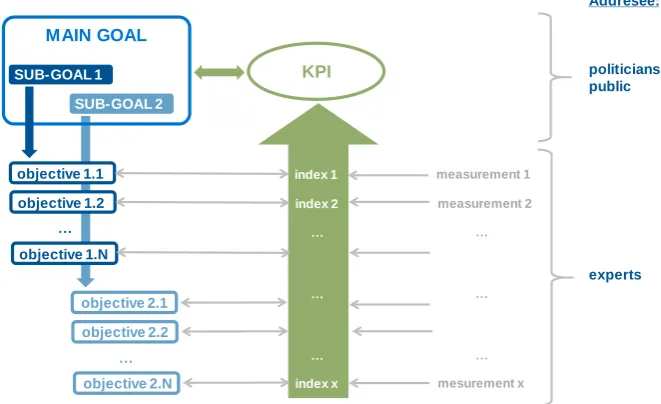
Figure 1 shows the placement of the KPI calculation within the conven-tional, performance-index-based evaluation of the system’s outcome.
MAIN GOAL
SUB-GOAL 1 SUB-GOAL 2
objective 1.1 objective 1.2
objective 1.N …
objective 2.1
objective 2.2
objective 2.N …
index 1
index 2
index x …
…
…
KPI
measurement 1
measurement 2
mesurement x …
…
…
Addresee:
politicians public
[image:4.595.144.475.226.428.2]experts
Figure 1: Evaluation of indexes and KPI
It is here important to underline that the KPI-based evaluation does not aim to replace the detailed evaluation procedures undertaken from the planning authorities and addressing transportation experts. It rather inte-grates it, processing the results of this evaluation to generate a less complex output addressing other target groups such as politicians and the open pub-lic.
2.2
Requirements and Categories of KPI
4
within the decision making process, to comment and steer their definition in terms and their usability for the public authorities and finally to provide data from realistic case studies for the final calculation and validation of the KPI set.
NCHRP report 446 discusses in details the requirements on performance measure. The most important ones are::
1. Measurability:
The KPI must be easily calculated with data already available at the municipalities and shall not require additional measure-ments;
2. Clarity:
The KPI must be comprehensible and simple to communicate to non-experts such as the open public and policy makers but also be usable in a first instance for professionals;
3. Controllability:
The public authorities must be able to adjust the KPI to their specific needs and according to their respective values. The KPI must be usable for different modes, different sizes of geograph-ical areas, different times of the day/year. Additionally a weighting between elements (modes, network parts, times of day) of higher and lower significance must be possible.
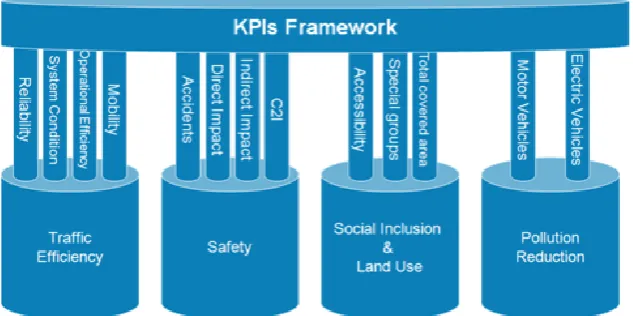
[image:5.595.155.472.460.618.2]The developed set of KPI was structured in four major categories, each one containing two or more indicators (Figure 2).
5
The categories of Traffic Efficiency and Pollution Reduction are origi-nal fields of urban ITS and thus have a number of applications targeting di-rectly their improvement.
The field of Traffic Safety includes some applications that influence safety impacts directly, and many others that actually aim at improving ef-ficiency or emissions but have a secondary effect - positive or negative - on traffic safety.
Finally, the fields of Social Inclusion and Land Use were considered. ITS may play an important role in social inclusion, even if they lack mass-applications due to the limited target group. Land Use is a slow-going pro-cess, mainly influenced by general development factors. In this case indica-tors to approximate single effects of ITS were developed.
In the final part of the project, the KPI for Traffic Efficiency, Pollution Reduction and Traffic Safety were calculated and validated using data pro-vided from the city pool.
3
Evaluating Traffic Efficiency
The term traffic efficiency may cover a variety of aspects. For the pur-poses of the present study, traffic efficiency is constituted by the following four sub-categories: mobility; reliability; operational efficiency; and system condition and performance.
Mobility is defined as the ability of a transport system to provide access to jobs, recreation, shopping, intermodal transfer points, and other land us-es, which is one of its primary purposes. Measuring the performance of mobility is hence an important part of quantifying the performance of the system in terms of traffic efficiency as a whole. Mobility measures should reflect the ability of people and goods to reach different destinations using different modes. Moreover, measures of mobility should capture the density of transport service within a given area and express the user’s perspective. Mobility is mainly concerned with the travel time on the road and public transport networks.
6
Operational efficiency refers to the good organisation of resources to produce an acceptable level of transport output and is, as such, an important constituent of traffic efficiency. The quantification of the performance of operational efficiency is of particular interest to the suppliers of transport services, and measures evaluate the competency of systems from a finan-cial, operational, time and user’s perspective. The most frequently used measures are trip time, congestion-related attributes, mode shares, transfer times at connecting facilities and public transport cost performance. As specified with regard to reliability measures, congestion-related attributes and trip times are typically estimated with travel models, mode shares are collected through surveys, and connecting times and distances at transfer facilities can be collected with field data or user surveys.
Finally, system condition and performance refers to the physical condi-tion of the transport infrastructure and equipment, which is seen as a vital directive by most practitioners. System condition and performance measures can focus on the condition of the system itself (e.g. roadways with deficient ride quality) or on the efficiency of transport programmes (e.g. cost to maintain roadways). The most common measures relate to roadway and bridge conditions and age, as well as maintenance by their management organisations.
Each traffic efficiency performance measure presented in the previous section necessitates an operative definition as far as measurement unit and levels of implementation are concerned. The following sections present the KPI for Mobility and Reliability that are of relevance for the Rome case-study.
3.1
KPI for Mobility
A mobility KPI can be composed of different elements but essentially consists of the average travel time to different destinations in the highway and public transport networks expressed in time units, normalised by the distance to the destinations, and weighted by importance according to the goals and objectives of the application under consideration. The mobility index, IMOB, may thus be formulated as follows:
PV PV PT PT R R r R R r r r PT PT PT r r PV PV PV MOBD
ATT
R
w
D
ATT
R
w
7
where:
RPV: set of monitored routes on the private transport network
RPT: set of monitored routes on the public transport network
r: a route among the monitored routes in RPV and RPT;
ATTrPV: average travel time for route r on the private transport net-work
ATTrPT: average travel time route r on the public transport network Dr: length of route r
wPV: represents the weight of the travel time on the road network wPT: denotes the weight of the travel time in public transport
The spatial concern of the analysis influences the selection of origins and destinations and the determination of the route sets RPV and RPT.
The spatial scale is mostly determined by the type of authority, as na-tional and regional authorities are likely to have different needs than lo-cal authorities, and are therefore likely to monitor different routes.
In equation (1) the ratio ATT/D is calculated separately for each of the routes of the sets RPV and RPT, and then summed. The reason why
two separate sets are used is to enable the application of different weighting factors for private and public transport, as opposed to the case where these would be weighted equally. Within the average travel time assessment these weighting factors are assigned values from 0 to 1, with their target sum set to 1.
Moreover, the IMOB KPI depends on the selection of the actual paths
connecting the OD pairs. The paths selected influence travel time and accordingly the index, but logical considerations of the minimal travel time path in congested conditions across different projects or different time points allows a fair comparison of mobility conditions. The mini-mum travel time path guarantees the evaluation of mobility as a necessi-ty, since travellers who do not choose the shortest path could be defined to have a different objective. The congested conditions ensure the “worst case scenario” condition of major interest, as free-flow condi-tions imply good mobility regardless of the implemented project or plan.
It should be noted that the units of IMOB KPI are “travel time per km”,
and that the dimensionless weights wPV and wPT have to be determined
8
3.2
KPI for Reliability
Congestion may be defined as an increase in travel time (or reduction of speed) above a threshold or could be calculated based on available algorithms in the literature based on data gathered from detectors, signal program information and static topological layout.
The congestion index which represents reliability could be calculated in different ways according to the acceptable methods of each transport agency. In order to allow a normalised benchmarking, the congestion or reliability KPI is to be normalised so that the result remains within pre-defined limits, i.e. 0-1.
The reliability index, IREL, calculated for links and for modes, may be
defined as follows:
L L l PV PV pv l PV PT PT pt l PT L L l PV PV pv wl l pv l PV PT PT pt wl l pt l PT RELw
w
w
w
T
CT
w
w
T
CT
w
w
I
(2)CTlx: congestion duration on link l in the “x” network, where x=pt
PTfor public transport and x=pv
PVfor the road networkwl: relative importance of link l
wPT: represents the weight of public transport
wPV: represents the weight of private transport
Twl: represents the period in which congestion is monitored and to which wl is attributed
The reliability index is computed over all the monitored links as the to-tal congestion ratio on public and private transport.
The weights wPT and wPV have to be defined with a continuous value
between 0 and 1 and they are required to add up to 1; their value should re-flect the importance of the mode, and as a result, they are usually city-wide weights.
9 The length of the link;
Inner links relative importance – the weight of a link should re-flect its general importance compared to other links (arterials are often more important than the local roads);
Seasonal importance – the weight of a link should reflect its changing importance during the year (links near recreation areas are to be assigned with higher weights during holidays and weekends rather than on weekdays);
Time importance – the weight of a link should reflect its chang-ing importance durchang-ing the day (a link that leads to the city is more important during the morning peak and of less importance during the evening peak).
In order to calculate the weights required in almost all of the indices, an expert-based method is suggested as a methodological approach able to achieve a two-fold purpose: (i) providing a methodology to construct a per-formance measure that may be tailored to any transport plan or program, and (ii) providing a methodology that may be transferred across projects, provided that suitable experts are selected. The selected expert-based tech-nique is the Delphi method which is considered a valid method for judg-mental forecasting (Tolley, 2001)..
4
Application
10
4.1
Mobility assessment
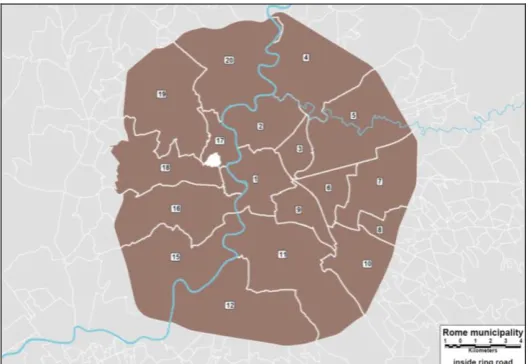
[image:11.595.173.439.317.499.2]For the assessment of the mobility of travellers, the city of Rome is bro-ken up into 18 zones, as shown in Figure 3, and data on the average travel time and distance between all zones on private and public transport is ob-tained. This results in 324 routes of known average travel time and length, which enables the calculation of the average travel rate (min/km) for each route and for both private and public transport. The mobility KPI presented in Section 3.1, is used to perform an assessment of the mobility in the city of Rome, for private and public transport separately, taking equal weights for each of the routes.
Figure 3: The 18 zones of the Rome study area, source: Rome Mobility Agency
The results of the assessment show that in Rome the average mobility of private transport over the 324 routes is better than that of public transport, with index values being 3.19 min/km for the former and 5.41 min/km for the latter. Based on the index values and setting the weights wPV = 0.3 and
wPT = 0.7 following consultation with a group of experts from the Rome
11
4.2
Reliability assessment
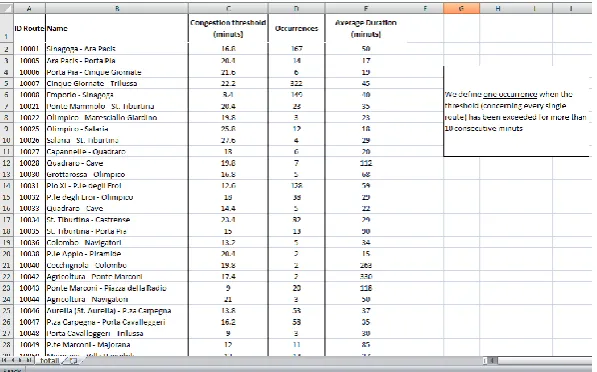
In the assessment of reliability, congestion data on 45 representative routes across the road network of the city of Rome is used. This consists of the number of congestion incidents and their duration for a period of refer-ence of one year, based on the definition of a congestion incident as the sit-uation where the travel time on a route exceeds a certain threshold for 10 consecutive minutes. The threshold is, naturally, different for each route and depends on its length as well as on a number of other factors identified by the Rome Mobility Agency. A sample of the congestion data is shown in Figure 4.
Figure 4: Congestion data for the city of Rome, source: Rome Mobility Agency
[image:12.595.145.444.293.479.2]12
4.3
Usability of the KPI
The results of this example from the city of Rome instantly state the question of their usability. In first instance a single value stands alone as general assessment of mobility or reliability. The value of this calculation lies within the scalability and the applicability of the KPI.
The scalability allows the local authority to calculate the indicator for smaller parts of the network and for single modes or ITS applications. Through the comparison with the city-wide average the contribution of sin-gle elements to the overall effect can be evaluated. Furthermore elements with a high deviation from the average can be identified as a subject for further improvement.
The applicability of the KPI allows the authorities to re-calculate the value in a row of many subsequent years in order to evaluate the perfor-mance development in time. The introduction of new ITS-applications can thus be closely monitored, first through the before/after comparison but al-so by monitoring the months following the systems introduction, investigat-ing its amortisation and eventual rebound effects.
The applicability also allows comparisons with other cities -mostly ones in search for suitable applications who already have an assessed “before-state” in their networks.
5
Conclusions and Outlook
The evaluation of the KPI framework with the help of some other realis-tic case studies (calibrations for the cities of Paris, Tel Aviv and Munich have been developed) proved the usability and accuracy of the indicator set. Local transportation experts (Municipality of Tel Aviv-Yafo, 2005) con-firmed that the KPI calculation output really reflects the main traffic condi-tions of the respective cities. In the case presented here, however, every-thing was expressed through the use of a single value and a single chart in place of a variety of manifold assessments.
Furthermore, KPI proved their scalability, since they were applied suc-cessfully in small parts of networks (e.g. the case studies of Paris) as well as in large caption areas (e.g. the general assessment for Rome presented in this paper).
con-13
firmed by the application with data from around five different cities but al-so after a survey among the fifteen members of the city pool.
Finally it can be stated that the KPI can support a robust decision mak-ing process for the application of ITS. This fact was confirmed by the acute interest in the outcome of the project from the side of the public authorities as well as from the side of the ITS industry.
Bibliography
Cambridge Systematics, Inc., 2000. NCHRP report 446: a guidebook for performance-based transportation planning. Transportation Research Board, Washington, DC.
Eden, N., Gal-Tzur, A., Komar, O., Sheety, E. (2010), Concept-development for quantifying improvements in traffic efficiency through ITS, CONDUITS deliverable 3.1), Brussels 2010
Gerstenberger, M., Tsakarestos, A., Nocera, S. and Busch, F. (2011), Concept-development for quantifying improvements in traffic safety through ITS, CONDUITS deliverable 3.2, Brussels 2011
Gerstenberger, M., Tsakarestos, A., and Busch, F. (2011), Concept-development for quanti-fying improvements in social inclusion and land use through ITS, CONDUITS delivera-ble 3.4., Brussels 2011
Kaparias, I., Bell, M. G. H., Eden, N., Gal-Tzur, A., Komar, O., Prato, C. G., Tartakovsky, L., Aronov, B., Zvirin, Y., Gerstenberger, M., Tsakarestos, A., Nocera, S. and Busch, F. (2011), Key Performance Indicators for traffic management and Intelligent Transport Systems, CONDUITS deliverable 3.5., Brussels 2011
Municipality of Tel Aviv-Yafo (2005), Tel Aviv-Yafo Strategic Plan. 2005.
Reed, M. F., Luettich, R. A., Lamm, L. P., and Humphrey, T. F. (1993), Measuring state transportation program performance. 357, NCHRP report
Tartakovsky, L., Aronov, B., Zvirin, Y. (2010), Concept development for quantifying pollu-tion reducpollu-tions through ITS, CONDUITS deliverable 3.3, Brussels 2010