City, University of London Institutional Repository
Citation
:
Jones, A. and Murphy, J. T. (2011). Theorizing practice in economic geography: Foundations, challenges, and possibilities. Progress in Human Geography, 35(3), pp. 366-392. doi: 10.1177/0309132510375585This is the unspecified version of the paper.
This version of the publication may differ from the final published
version.
Permanent repository link: http://openaccess.city.ac.uk/2599/
Link to published version
:
http://dx.doi.org/10.1177/0309132510375585Copyright and reuse:
City Research Online aims to make research
outputs of City, University of London available to a wider audience.
Copyright and Moral Rights remain with the author(s) and/or copyright
holders. URLs from City Research Online may be freely distributed and
linked to.
City Research Online: http://openaccess.city.ac.uk/ [email protected]
possibilities
Forthcoming, in press in Progress in Human Geography
12 May 2010
Andrew Jones
Department of Geography, Environment & Development Studies Birkbeck College,
University of London Malet Street
London WC1E 7HX UK
tel: +44 (0) 207 631 6471 fax: +44 (0) 207 631 6498 [email protected]
James T. Murphy (corresponding author) Graduate School of Geography
Clark University 950 Main Street Worcester, MA 01610 USA
Theorizing practice in economic geography: foundations, challenges, and possibilities
Abstract: Over the last decade or so there has been an identifiable shift in the interests of many economic geographers towards a concern with practices: stabilized, routinized, or improvised social actions that constitute and reproduce economic space, and through and within which socioeconomic actors and communities embed knowledge, organize production activities, and interpret and derive meaning from the world. Although this shift has gained significant momentum its general theoretical significance remains somewhat unclear and the concept is vulnerable to criticisms that it is incoherent, too ‘micro-scale’ in emphasis, unable to provide valid links between everyday practices and higher-order phenomena (e.g., institutions, class structures) and that, in some cases, it lacks a sound political economy. This paper argues that whilst it undoubtedly has limitations, the practice-oriented shift represents an ongoing
development of a longstanding and heterodox field of social scientific interest from both within and beyond the subdiscipline. We first highlight the diverse strands of economic geography scholarship that have an explicit interest in practices and then propose an epistemological and methodological framework for a practice-oriented economic geography. The framework is based on the polemical argument that insight from both critical realist and actor-network perspectives can provide the basis to better demarcate practices in relation to their social and spatio-temporal dimensions. It goes on to outline a reformulated retroductive methodology to assess the impacts and theoretical significance of particular economic-geographical practices. The paper concludes that practice offers a potentially powerful, yet complementary, epistemological tool that can create conceptual space for the study of a wide range of socioeconomic and geographical phenomena.
Key words: economic geography, practice, epistemology, methodology; critical realism; actor-network theory
I Introduction
In recent years there has been a significant shift in the research interests and
methodological approaches of many economic geographers. Characterized by some as part of human geography’s cultural, institutional, or relational “turns” (Crang, 1997; Amin and Thrift, 2000; Amin, 2001; Bathelt and Glückler, 2003; Yeung, 2005a), scholars with a wide range of empirical and theoretical interests have considered or studied how socio-spatial practices influence a diverse range of phenomena and processes: learning and innovation (Gertler, 2003; Amin and Cohendet, 2004; Faulconbridge, 2006; Hall, 2008; 2009), industrial organization (Bathelt et al., 2004; Glückler, 2005; James, 2007; Jones, 2007; Palmer and O’Kane, 2007; Pain,
2008), market systems (Crewe et al., 2003; Gibson-Graham, 2008; Berndt and Boeckler, 2009), networks and globalization (Amin, 2002; Hess, 2004; Murphy, 2006a), livelihood strategies (Smith and Stenning, 2006; Stenning et al., 2010), development (Radcliffe and Laurie, 2006; Abbott et al.,2007), race, class, and gender relations (Cameron and Gibson-Graham, 2003; Slocum, 2007; Dowling, 2009), neoliberal governance (Larner, 2005; Larner and Laurie, 2009; Dowling, 2010), and consumption and householding (Barr and Gilg, 2006; Mansvelt, 2009). A common link between these literatures is an explicit interest in what can be broadly defined as ‘socioeconomic practices’: the stabilized, routinized, or improvised social actions that constitute and reproduce economic space, and through and within which diverse actors (e.g., entrepreneurs, workers, caregivers, consumers, firms) and communities (e.g., industries, places, markets,
economic world. Although practices serve important instrumental purposes (e.g., production, consumption, learning), they are also significant analytically in that they can reveal the complexities, contingencies, identities, and meanings inherent in all forms of economic organization. Moreover, the study of practice can complement existing explanations for economic-geographical phenomena (e.g., institutional, radical, or relational) by providing an analytical “object” whose study can demonstrate how higher-order phenomena such as
institutions, networks, class structures, and gender inequalities are enacted, reproduced, and/or transformed through the everyday actions embedded within them.
Although this epistemological shift lacks coherence, a diverse strand of economic
geographers have become increasingly concerned with trying to construct generalized theoretical arguments about the nature, importance, and consequences of specific and collective practices undertaken by economic actors (Amin, 2002; Amin and Cohendet, 2004; Lee, 2006; Amin and Roberts, 2008; Berndt and Boeckler, 2009; Jones and Murphy, 2010). Significantly, however, the shift toward practice-oriented research is vulnerable to recent criticisms that have been leveled against some of the “newer” trends in economic geography (e.g., cultural, relational, post-structural). Specifically, critics have argued that qualitative ‘micro-scale’ practice research, with its emphasis on the activities of, and relationships between, individual actors: negates the possibility of effective generalization (Sunley, 2008), lacks a sound political economy (Peck, 2005), represents a distraction from and dilution of the policy relevant work (Duranton and Rodríguez-Pose, 2005), and is empirically mundane and methodologically dubious (Overman, 2004).
The purpose of this paper is to argue that overall - whilst there are limitations - the practice-oriented shift represents an important innovation in economic geographical thinking. We make four contentions in this respect. First, we argue that recent ‘practice-oriented’ thinking corresponds less to a radical ‘turn’ within economic geography, than to the latest manifestation of a longstanding and evolving epistemological debate within the sub-discipline. Second, we suggest that recent practice-oriented research has created the theoretical capacity to better understand how everyday micro-social practices influence and embody the complexities, contingencies, and meanings that constitute most socioeconomic and political-economic phenomena. Third, we argue that the critical concerns that have been raised around new economic geography approaches do not present an insurmountable challenge to developing a more coherent and powerful practice concept. Fourth, and following on, we thus propose an epistemological and methodological strategy for further developing practice-oriented research in economic geography that will increase the utility of the concept for theorizing economic
outcomes in the contemporary global economy. To do this we adopt a polemical approach in drawing upon two diverse and apparently very different theoretical perspectives – actor-network theory and critical realism – to construct a framework that aims to provide the basis for a
coherent and consistent approach to the study of practice. The goal is not to essentialize,
prescribe, and/or circumscribe what practice is or how it should be researched but to provide an heuristic framework that can be drawn on in flexible and particular ways by the diverse group of scholars who are interested in practices and their theoretical significance.
greater credibility, reliability, reflexivity, and transferability (Yeung, 2003; James, 2006). We further suggest that our epistemological and methodological approach provides an important starting point through which such a goal might be achieved.
The rest of this paper develops these arguments in depth. The next section begins by providing an overview of existing social scientific conceptions of practice. In the third section, we move on to consider the more specific implementation of practice as a key concept in economic geographical research. Here we suggest that at least four distinct strands of practice-oriented scholarship have emerged recently – institutional approaches, practice and
governmentality, diverse economies and everyday practices, and relational and communitarian perspectives on practice. The section that follows then considers the implications of recent debates about the limitations of ‘new’ economic geographical thinking for the practice-oriented shift, arguing that a number of epistemological limitations need to be overcome in order for practice-oriented work to address these concerns. The remainder of the paper then seeks to outline our epistemological and methodological framework for practice research and show how it creates the capacity to overcome these limitations. The paper concludes with a brief discussion of the future possibilities for a practice-oriented economic geography.
II Situating practice ontologically and epistemologically
Beyond the narrower sub-disciplinary concerns of economic geography, there are several challenges to demonstrating that the study of practice reflects a coherent intellectual project. The concept has ‘fuzzy’ origins, it is often unclear how one can distinguish between a practice and other concepts such as institution, convention, or social relation, and, because the word is so commonly used in everyday and academic discourse, it is often difficult to determine when it is used in a literal sense and when it is used conceptually. Understandably, the concept will mean little to economic geographers (or indeed any social scientist) if these problems are not overcome in a manner that makes clear how practice-oriented research can contribute to theory building. This section addresses the first concerns – where the practice concept comes from, what it is precisely, and how it is distinct from, yet complementary to, other socioeconomic and sociopolitical constructs (e.g., institutions, conventions, hierarchies).
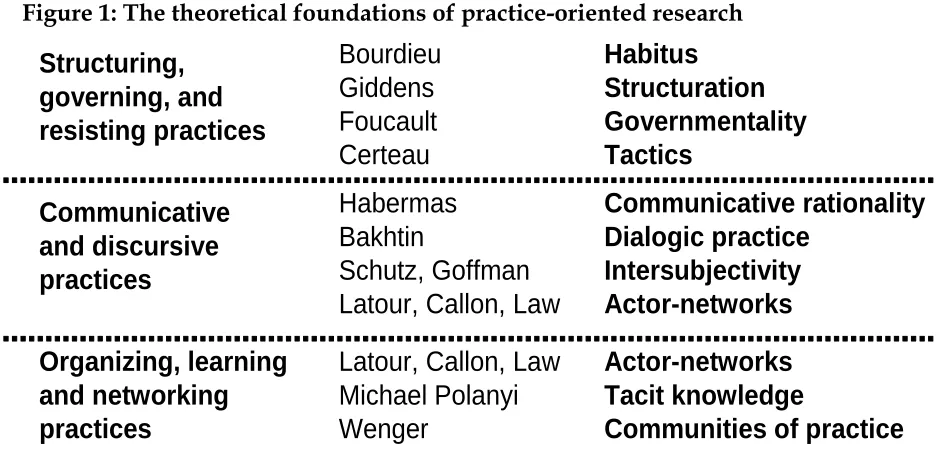
Tracing practice-oriented thinking back to a singular origin is impossible but it is possible to identify elements of what we consider practice in the writings several major 20th century philosophers, sociologists, anthropologists, and organizational theorists. This is not to say that these scholars and schools of thinking are aimed precisely at the conceptualization developed here but to instead demonstrate that there are rich and diverse origins for the study of practice. As Figure 1 shows, we heuristically organize these foundations into three areas of theoretical application and development: a) how practices embody meanings and identities and help to structure, organize, and govern cultures, societies, and nations (governance and structural approaches); b) the role of practices in facilitating and regulating communication norms and systems (communication and performance approaches); and c) the significance of practices for collective learning processes and their role as embodiments of tacit knowledge (learning and collective knowledge approaches). These categorizations are not meant to be rigid nor mutually exclusive but instead provide an heuristic for understanding the different ontological and
epistemological frameworks within which ideas about practice have been articulated.
Governance and structural approaches to practice have principally come from sociology and anthropological studies. For Bourdieu (1977), cultural rituals and individual habits (his version of practice) reflect dispositions or subconscious understandings of the world (the
habitus) that evolve historically and which position individuals within particular social classes or at points in a culture’s social structures. Giddens (1979) sees practices as everyday activities where agency and structure come together reflexively to create, reproduce, and/or restructure social systems in intended and unintended ways. Foucault (1975; 1980) too is concerned with practice as a structuring tool but for him emphasis is on the state and its techniques of social control (i.e., governmentality). The mundane practices of government (e.g., prison management, social work, town planning) are ideologically constructed technologies that create “fields” for intervention and domination by the state apparatus. De Certeau (1984) holds a similar view but is more optimistic about the prospects for subtle forms of resistance to systems of control and domination. For him, the everyday practices of individuals are in fact tactical compromises between an individual’s need to conform to a dominant social order and her/his personal expression of identity, meaning, and values (Buchanan 2000).
Notions about governing and resisting practices cross over into the rich literature that seeks to explain how social performance, inter-personal communication, and linguistic practices shape societies, economies, and cultures. Social psychologists, symbolic interactionists, and ethnomethodologists (e.g., Goffman, 1959; 1974; Garfinkel, 1967; Schutz, 1967) view practices as framed social performances or techniques of inter-personal communication aimed at achieving particular material or social outcomes. For Habermas (1984), mutually agreed to and understood communicative practices can help individuals or groups manage differences more effectively by helping to create what he calls communicative rationality – a situation where conflicts between social groups are managed and mediated through more pluralistic and fairer political systems. Alternatively, Bakhtin (1981) views practices dialogically and discursively and argues that states and powerful social groups create boundaries between appropriate and non-appropriate forms of communication through unitary forms of dialogic practice (monoglossia)1 that promote particular ideologies and exclude marginal social groups. Finally, actor-network theorists (e.g., Callon, 1986; Law, 1992; Latour, 2005) too are interested in the role of communication practices as means for creating social order. For them, such practices offer useful insights into the ways and means of translation – the process through which actors such as scientists, engineers, and
businesspeople exert power, mobilize material objects, and perform socially in order to achieve particular objectives (Latour, 1987; Harrisson and Laberge, 2002).
Actor-network theory crosses over significantly with a third group of practice-oriented researchers, those interested in how practices contribute to organizational cohesion, collective learning, and how they embody tacit forms of knowledge. Michael Polanyi (1967) was one of the first to posit that creative activities and new innovations are derived from the emotive and unconscious actions of individuals. For him, the tacit characteristics of knowledge are derived from personal, practical, and often subconscious, feelings, identities, and circumstances that cannot be easily transferred from one individual or community to the next (c.f. Polanyi, 1967). As Gertler (2003: 78) observes in his discussion of Polanyi’s contribution (italics in original):
1 Dialogism refers to how any statement within discourse always implies a receiver of the statement, and
The tacit component of the knowledge required for successful performance of a skill is that which defies codification or articulation – either because the performer herself is not fully conscious of the ‘secrets’ of successful performance or because the codes of
language are not well enough developed to permit clear explication. The best way to convey such knowledge is through demonstration and practice, such as in the classic master-apprentice relationship in which observation, imitation, correction, and repetition are employed in the learning process.
It is in the communities-of-practice (CoP) literature where Polanyi’s ideas have been most concretely articulated and used as an analytical tool. CoP scholars are concerned principally with how organizations sustain coherence and cohesion, how collective learning occurs, and with the dynamics of knowledge transfer within and between firms (Brown and Duguid, 1991;
Wenger, 1998; Amin and Roberts, 2008). For Wenger (1998: 5), practice is “a way of talking about the shared historical and social resources, frameworks, and perspectives that can sustain mutual engagement in action.” Viewed in this manner, practices are manifest in the everyday activities that stabilize organizational communities and serve as repositories of tacit forms of knowledge that can be vital for long-run competitiveness.
1 A general theory for practice?
Despite the diverse and rich scholarship cited above, there are few formal discussions on practice as a stand-alone social theory. Reckwitz’s (2002) paper is a notable, and commonly cited, exception and in it he circumscribes practice as a cultural theory that navigates between the extremes of homo economicus and homo sociologicus in order to explain social action and order. For him, a practice oriented philosophy is not yet a grand theoretical system but instead “a loose network of praxeological thinking” that strives to move beyond cognitive, interactive, structural, and/or textual explanations by ascribing higher-order meaning and collective understandings to everyday social routines (Reckwitz, 2002: 259). In doing so, the focus is on how “symbolic structures of knowledge,” manifest in social practices, constrain interpretations of the world and regulate social behavior.
In this view of practice, social order is created not through aggregations of individualized rational choices, nor by the rules and hierarchies alone, but is instead cognitively and
symbolically embedded in individuals, structures, and “a ‘shared knowledge’ which enables a socially shared way of ascribing meaning to the world” (Reckwitz, 2002: 250). These socially shared structures and meanings are expressed or carried through practice, what Reckwitz defines as:
a routinized way in which bodies are moved, objects are handled, subjects are treated, things are described and the world is understood….a ‘type’ of behaving and
understanding that appears at different locales and at different points of time and is carried out by different body/minds. (2002: 250)
Everyday practices are thus “time-space assemblages” of body-minds, things, knowledge,
When viewed in this manner, practice offers not so much a new theory but an alternative epistemological strategy that can help scholars to examine and interpret socioeconomic processes through a focus on the actions and meanings through which and wherein the everyday world is constituted. We believe that such an approach can, if it is clarified conceptually and
methodologically, provide a grounded theoretical lens for understanding how a diverse range of processes and phenomena (e.g., learning, networks, governance, development, livelihood strategies) occur, evolve, and/or become transformed over time and in space. The goal is not to supplant existing theories but to complement them through an approach that brings together contextually situated structural factors and individual agencies in a manner that can be integrated into a diverse range of theoretical frameworks (e.g., institutional, evolutionary, Marxist,
feminist). In short, we seek – following Barnes and Sheppard’s (2009) recent admonition of economic geographers for their tendency to roam in isolated packs – to facilitate a pluralistic engagement between diverse epistemic communities by developing an analytical object – practice – that can be applied to a wide range empirical questions and conceptual approaches. Before we elaborate how such an epistemological approach might be further developed, we first examine how recent theoretical developments in economic geography reflect the growing interest in practice oriented research.
III Economic geography and practice
Amongst economic geographers, a practice-oriented perspective has become evident in recent years as various strands of both theoretical thinking and empirical research have become increasingly focused on the role of social practices in the economic activity. In this section we identify and discuss four distinct strands of contemporary thinking that demonstrate how and why economic geographers are increasingly engaging with the concept of practice. These groupings of research approaches - institutional, governmentality, diverse economies, and relational economic geography – are not meant to be mutually exclusive but are used heuristically to demonstrate how the practices associated with a wide range of actors and socioeconomic phenomena have been studied by economic geographers.
On the surface, highlighting these different approaches may seem superfluous given that everything in the economy is “practiced” and all economic geographers are interested, directly or indirectly, in practices of some sort. However, it is only recently that practices themselves – rather than institutions, power structures, networks, agglomerations, embeddedness, proximity, etc. – have become an explicit dimension of analysis for studies striving to explain economic-geographical phenomena. This shift, as we characterize it, is not a major theoretical turn per se
but rather a continuation and development of several different approaches that have in one way or another sought to understand the space economy through an analysis of the everyday activities (i.e., practices) of actors such as individuals, firms, and states. For us, what (loosely) binds the scholars referenced below together is an implicit or explicit belief that the circumstances,
contingencies, and forces constituting or driving socioeconomic phenomena can be understood in part through an analytical emphasis on “ordinary” actions and/or seemingly “mundane”
economic activities. While other scholars may be concerned with such practices, they are often not central objects of analysis and are instead viewed as outcomes of rational choices or
structural forces (e.g., class relations, patriarchies, or institutions). In contrast, the epistemological shift we are observing and advancing here is one where an analytical
communities, livelihood patterns, networks, markets, power structures) and/or to show how and why some actors are able to resist and/or bypass the power imposed by conventional or
hegemonic structures. It is this emphasis on the constitutive, contingent, subversive,
improvisational, and/or unpredictable nature of practices that characterizes this shift and which influences our choice of scholars to include in the discussion below.
Importantly, we recognize that some of these researchers would not identify their work as explicitly part of a practice-oriented shift within the subdiscipline and we stress that our intent is not to essentialize the scholarship of others. Instead, our objective is heuristic as we seek to demonstrate how ideas and studies of practice are being applied to a diverse range of empirical and theoretical questions and to argue that the concept is contributing to a broad and significant epistemological shift in economic geography. We then move forward from these literatures and develop a framework that strives to make the study of practice – as an epistemological strategy – more coherent and able to provide a common analytical basis through which a diversity of theoretical approaches might engage one another.
1 Institutions and practice
The first strand of practice-oriented thinking comes from research on the role of
economic institutions – commonly characterized as conventions, norms, routines, and rules – in shaping the dynamics of industrial and regional development. The concern with institutions has drawn on scholarship from evolutionary economics (e.g., Nelson and Winter, 1982; Lawson, 1997; Hodgson, 1999; Castellacci, 2006), management studies (e.g., Scott, 1995; Braun, 2005) and social studies of technology (e.g., Lall, 1993; Kemp et al., 1998; Ruttan, 2001). What characterizes these engagements with practice has been a concern with understanding how practices reveal institutional factors that govern, coordinate, and direct industries, socio-technical regimes, and regional economies. In this case, practices are manifest in the rules, norms, habits, and routines that stabilize and reproduce institutional forms. Two types of contribution stand out with respect to the aims of this paper: work on the contribution of business conventions to
regional development and studies concerned with the institutionalization of economic activities within firms and regions.
Research on the role of conventions in coordinating economic activities links institutions to practice with the goal of understanding how “behavioral or untraded interdependencies” enable regions to become more competitive in the global economy (Storper, 1995; 1997). For Storper, institutions are industry and region specific and held together by the “conventional-relational transactions” that stabilize behavior patterns in key socioeconomic domains: buyer-seller relations; information, knowledge, or skill transfer relations; intra-firm management relations; factor-market relations (particularly labor); and state-economy or formal institution-economy relations (e.g., university or research institution ties to firms). It is through these regularized transactions, what we view as practices, that firms construct “worlds of production,” social frameworks or “entangled webs of socialized and institutionalized relationships” that facilitate economic action and which can promote or obstruct innovation and growth (Storper and Salais, 1997; Yeung, 2001; 2003: 444). Localized or network-specific practices are
The second thread of literature linking practice and institutions focuses on how the everyday practices of economic actors (e.g., businesspeople, firms, workers) contribute to the development and reproduction of larger-order social structures (Wood and Valler, 2001). As Castellacci (2006: 863) notes, ‘routinized productive activities carried out by a population of heterogeneous firms may generate a relatively stable pattern of economic activities and relationships over time’. By studying these routinized practices, scholars in the evolutionary vein view them as a means for understanding the ways in which institutions are reproduced and embedded in minds, places, and times and how institutional change occurs as novelties are introduced within ‘normal’ practices (Lawson, 1997; Downward et al., 2002; Shove, 2004; Boschma and Frenken, 2009). These ideas have encouraged a growing interest in the
development of an evolutionary economic geography as a means for better understanding how firms, industries, technologies, and regional economies develop and adapt in response to
changing economic circumstances (Boschma and Lambooy, 1999; Boschma and Frenken, 2006; 2009).
2 Governmentality and practice
A radical departure from the first approach comes with the Foucauldian inspired literature on the role of practice as an instrument of power, coordination, and control. In this case, power is viewed as a “series of strategies, techniques and practices” that coordinate political economies, control citizens and workers, and reproduce structural inequalities in communities, markets, and societies (Allen, 1997: 63). Governmental practice is manifest in managerial, planning, and development strategies and the statistics, regulations, laws, etc. used to support them
(MacKinnon, 2000; Murdoch, 2004; Wilson, 2006). These ‘mundane’ practices and the technologies of calculation, notation, and language enable states, elites, and firms to produce knowledge, fields of intervention, and governable objects/subjects (e.g., consumers, workers, investors, traders, development experts, urban futures) (Hughes, 2001; Larner, 2002; Murdoch, 2004; Bulkeley, 2006; Rose-Redwood, 2006; Langley, 2006; Larner and Laurie, 2009). In doing so, governmental practices create and maintain disciplinary or prescribed spaces for capitalism’s further extension into the everyday lives of people (Raco, 2003; Hudson, 2004; Huxley, 2008).
Concerns about the social and spatial consequences of neoliberalism have been a particular focus of this literature as scholars have used practice as a means for better
3 Diverse economies, livelihoods, and everyday practices
A third strand of the literature that engages with ideas about practices and their significance comes from scholars interested in diverse economies, alternative livelihood
strategies, feminist geography, and the everyday activities that constitute what Lee (2002; 2006) calls ‘ordinary’ economies. By focusing on the practical actions of real people striving to sustain a livelihood, our understanding of the “economic” world can become more inclusive, complexified, and emancipatory. Power and inequality are key concerns here but in contrast to governmental approaches, emphasis is placed not on the coordinating tendencies of practices but on the ways in which they create the real, diverse, and messy worlds of production, consumption, and householding (Lee et al., 2008). As Lee (2006: 421) observes:
[economies are] constituted geographically, socially and politically – and hence practised – as co-present and dynamic hybridizations of alternative, complementary or competing social relations which may vary over the shortest stretches of time and space.
In this view, practices can be viewed as complex and conjunctural relational forms that enable economies to exist, persist, and/or change over time and space and which serve as “sites of economic life” driven by forms of rationality or social objectives that may transcend utility maximization strategies and markets (Graham, 1996; 2008; Cameron and Gibson-Graham, 2003; Lee, 2006; Smith and Stenning, 2006; Pollard and Samers, 2007; Stenning et al., 2010). Practiced economies are thus more than simply sets of social relations driven by class, patriarchy, or other forms of structural power, they are instead amalgams of materials,
performances, structural factors, and cognitions whose particular time-space constitution is contingent on the agency of actors and is thus open to improvisation and accident.
In application, this work is manifest in two areas of research. First, there are studies concerned with the diverse forms of economic organization and exchange that are largely ignored by mainstream economic studies and theories. Specifically, this literature demonstrates how diverse economies are constituted through unpaid labor such as householding activities, alternative markets (e.g., second-hand clothing shops, community supported agriculture, artisan cooperatives, flea markets), and through forms of consumption and exchange that may rely on barter or localized forms of currency (Gibson-Graham, 1996; 2008; Aldridge and Patterson, 2002; Powell, 2002; Crewe et al., 2003; Gregson and Crewe, 2003; Leyshon et al.,2003; Maurer, 2003; North, 2007; Slocum 2007). Second, there is a significant literature explicating the emergent capitalist forms associated with diasporic cultural groups (Pollard, 2007; Pollard and Samers, 2007) and families and communities coping with post-socialist transitions (Smith, 2002; Povlovskaya, 2004; Smith and Stenning, 2006; Smith and Jehlicka, 2007; Smith and Rochovská, 2007; Stenning et al.,2010). Taken together, these scholars have shown how an emphasis on the diverse practices that constitute economies can significantly inform our explanations of larger-order phenomena such as markets, economic transition, and/or socioeconomic inequality.
4 Relational and communitarian approaches to practice
2003), and management studies (Wenger, 1998; Adler and Kwon, 2002; Borgatti and Cross, 2003). Relational economic geographers have increasingly taken intra- and inter-firm practices as their central concern in order to identify, interpret and explain the dynamic nature of the relationships that shape production and retailing activities, knowledge transfer and learning processes, value chains and global production networks, and industrial clusters. Although there is a diversity of empirical and theoretical foci, relationally inclined scholars commonly view practices as everyday relational processes that constitute economic action and hold communities or firms together within, and in relation to, particular geographic contexts, networks, institutional structures, power hierarchies, and/or spatial scales (Maskell and Malmberg, 1999; Gertler, 2001; Yeung, 2001; 2005a; Bathelt and Glückler, 2003; Murphy, 2003; 2006b; Amin and Cohendet, 2004).
Two general types of research mark relational approaches to the study of practice. The first draws significantly on the ‘communities-of-practice’ (CoP) literature and focuses on the role of practice in learning, knowledge transfer, and innovation. Embedded organizational practices, manifest in the everyday actions of workers and managers, play a key role in driving a firm, industry, or region’s performance by providing “a source of coherence in a community” (Wenger, 1998: 72; Hall, 2006; Amin and Roberts, 2008) and serving as repositories of tacit knowledge (esp. in “best” practices) (Gertler, 2001; 2003; Amin and Cohendet, 2004;
Faulconbridge, 2006). These practices reflect the tacit knowledge held within industrial, value-chain, or intra-firm communities, knowledge that is often only realized in the “doing” of business (e.g., Coe and Bunnell, 2003; Gertler, 2003; Bathelt et al., 2004; Gertler and Vinodrai, 2005; Faulconbridge, 2006; Hall, 2006; 2009; James, 2007). As such, learning within firms, clusters, and industries is driven by more than simply the aggregation of individual sources of human capital; it is instead the product of collectively legitimated (everyday) social practices wherein and through which knowledge is embedded.
The second type of literature is concerned with the socio-spatial dynamics of industrial organization. Dicken et al. (2001) view networking or relational practices as “ordering
mechanisms” through which power is articulated and globalized economic activities are
organized. In a related vein, Amin’s (2002: 396) relational-topological approach focuses on the “contoured geography of practices” that constitute contemporary forms of globalization by creating a multiplicity of networks and social spaces within urban and regional economies (see also Amin and Graham, 1997). Industries and firms too are organized through common social practices that legitimate, control, and coordinate business activities and which can help to create the relational proximity (and in some cases trust) needed for firms to act at a distance in a
globalized economy (Dicken et al., 2001; Amin, 2002; Bathelt and Glückler, 2003; Bathelt et al., 2004; Glückler, 2005; Yeung, 2005b; Murphy, 2006a; Jones, 2007; 2008; Palmer and O’Kane, 2007; Pain, 2008).
5 Economic geography and practice: Moving forward?
established conceptual frameworks (e.g., institutions, structural political economy, value chains) to more effectively explain the socio-spatial dynamics of economic change, livelihoods, and governance. What binds this diverse group of scholars together is a common, albeit often implicit, epistemological approach characterized by a belief that in order to understand higher-order (i.e., local, regional, national, or global-scale) economic and social outcomes (e.g., performance, innovation, integration, inequality, exploitation, markets) it is necessary to first closely observe and understand the micro-social activities (i.e., practices) carried out and performed by people living, laboring, and creating in the everyday economy. While the
explanatory objectives vary widely, the epistemological strategy is consistent in that a focus on the routine, everyday, and ordinary actions of individuals is used to provide critical insights into the social, cultural, political, and/or material factors that shape contemporary economic
geographies.
Conceptually, practice is an important step forward in that it can provide a meso-scale lens that is more sensitive to agency than structuralist or institutionalist accounts of the world, but which is also able to generalize beyond the idiosyncracies of micro-social behavior. A focus on practices can also help to identify non-routine, accidental, contingent, or improvisational activities, and determine their implications for individuals, firms, communities, and economies. Despite these advantages and strengths, we do not believe that practice should be seen as a replacement for existing theoretical approaches in economic geography. Rather, it can complement existing theories by providing an epistemological strategy able to interpret, interrogate, and reveal the formative complexity of socioeconomic phenomena through careful examinations of everyday activities. Before offering ideas about what this epistemology might look like, we need first to consider a number of limitations relevant to practice-oriented work.
IV Challenges for a practice-oriented epistemology
While interest in practice is perhaps a welcome development for some economic geographers, key challenges remain to achieving a more widely relevant concept. Practice remains a rather loose and literal idea that lacks a clear epistemological framework able to provide a coherent conceptualization of what practice is, how best it can be studied, and how it might inform theory in economic geography. More specifically, three questions reflect specific challenges for a broader practice oriented epistemology: 1) How can micro-social analyses of practice reveal key insights into higher-order or macro-scale phenomena?; 2) Can the study of practice effectively account for the role of power (e.g., class, gender) in structuring economic activities?; and 3) How might practice oriented research become more methodologically and analytically rigorous? In addressing these questions, we draw on recent critiques of relational economic geography which have highlighted similar concerns.
First, practice-oriented scholarship is confronted by the difficulty of effectively conceptualising the relationship between, on the one hand, the significance and meaning of micro-social actions and, on the other, larger-order structures such as institutions, social class, or culture (c.f. Scott, 2004; Sunley, 2008). Relational economic geography has been criticized for over-emphasizing the capacity and significance of individual agents at the expense of
Rather than celebrate inconstant and transitory networks, it would be more productive to recognize the durability of economic habits and routines and to examine the consequent path dependence of institutional change in particular sites and settings.
Yet we would argue that such a critique is problematic insofar as it poses a misguided proposition: that one cannot understand durable economic forms and their implications for evolutionary trajectories through the study of networks and the micro-social (i.e., messy, contingent, and improvisational) economic world. As such, the issue is the degree to which relational approaches to the study of practice have succeeded in doing this, not whether it is worth doing. For us, therefore, the implication of Sunley’s criticism is that conceptualizations of economic practice need to provide more coherent and consistent means for making generalized statements about the nature and dynamics of socioeconomic phenomena such as institutions, class systems, livelihoods, and markets.
Second, and related, a clear further challenge for practice-oriented research is that it needs to be able to highlight and improve our understanding of the role of structural power in governing economic actors if it is to convince many in economic geography that such a conceptual step is worth taking. Relational, economic-sociological, and/or network-oriented ‘new’ approaches have left many unconvinced, as Peck (2005: 151) recently observed:
In some respects, the networks and embeddedness paradigm seems to lend itself to soft-focus treatments of capitalism, in which the roles of power and inequality are not so much denied but gently sidelined through the privileging of the horizontal relations of trust, reciprocity, and associativity.
This naïve view of power, or so it goes, dilutes the politics of relational thinking and/or raises problematic questions about what relational scholars study and why (Hetherington and Law, 2000; Leitner and Sheppard, 2002; Sheppard, 2002; Mayer, 2003; Smith, 2003; Peck, 2005; Hadjimichalis and Hudson, 2006; Sunley, 2008). Although such criticisms are to some extent countered by a growing new economic geographical literature that has sought to address power and its role in shaping network and other forms of industrial organization (e.g., Yeung, 2005a; Murphy, 2006; Jones, 2008), they do highlight the need for the practice concept to be suitable to “hard-focus” treatments of capitalism such as those associated with governmentality research. Specifically, the concept might best complement the work of radical political economists and economic geographers if it provides a novel means for interrogating and understanding structural power relations and their complex variations within the space economy. As such, a practice-oriented epistemology must be able to incorporate meaningful approaches to power, ones that address its different sources (structural and cognitively derived) and which can be adequately operationalized and interpreted in relation to particular practices.
A third challenge for a practice-oriented work relates to the issue of methodological and analytical rigor – perceived or otherwise. Specifically, cultural economic and relational
approaches have been criticised for being too descriptive, void of economic meaning, fuzzy, impossible to falsify, and incapable of rigorously linking macro-scale effects to micro-scale causes (Rodríguez-Pose, 2001; Overman, 2004; Scott, 2004; Sunley, 2008). The micro-to-macro validity argument is based on the premise that meaningful statements about larger-scale
relationality stem in part from dissatisfaction with explanations built on purified (e.g.
rationalistic, unitary) conceptualizations of economic and industrial processes. As the literatures outlined above demonstrate, practice oriented research is meant to be qualitatively rich,
contextually specific, and capable of demonstrating how “economic meaning” is derived from a wide range of actions and a diversity of social situations and spaces. Although this means that the findings of practice oriented research cannot be easily integrated into more formalistic kinds of analysis, questions about internal validity or consistency should remain an important concern for researchers such that the study of micro-social practices can lead to more widely legitimated explanations for larger-order socioeconomic phenomena.
To summarize, we argue that central to any response to these challenges is the need to better capture – empirically and theoretically - what practices are and how they can best be observed, described, and unpacked in ways that enable us to better understand the structural features of, and sociospatial dynamics driving, socioeconomic phenomena. At the present, practice is commonly used in the literal or terminological sense, to describe the actions and activities of individuals, states, consumers, households, firms, etc., but our contention is that it has significant potential as a concept or epistemological strategy. In the sections that follow, we outline an epistemological framework and a methodological approach for the economic
geographical study of practices.
V An epistemological and methodological framework for practice research
Our proposed epistemological and methodological framework for the economic
geographical study of practice is a broad framework that identifies key dimensions and dynamics of practice such that its study can be associated with a wide range of conceptual approaches. As such, the approach does not narrowly or rigidly circumscribe what we view as the necessary or
essential boundaries of what constitutes a practice and which thus determine precisely how they should be studied. Instead it develops a general philosophy for the study of practice, one that focuses on the interplay between empirics and theory and which provides some initial ideas about how practices – as analytical objects – might be more consistently studied. In doing so, our aim is to facilitate greater engagement between the diverse groups of scholars interested in understanding how everyday practices shape economic geographies and to be engagingly pluralistic (a la Barnes and Sheppard, 2009) by stimulating further debate about the utility of practice-oriented work.
Epistemologically, our view of practice draws upon both a critical realist (Sayer, 1984; 2004; Yeung, 1997; Downward et al., 2002; Bathelt and Glückler, 2003; Mäki and Oinas, 2004; Castellacci, 2006) and a (poststructuralist-inspired) actor-network perspective (ANT) (Law, 1986; 1994; Latour 1987; 1996; 2005; Callon, 1991; 1999; Murdoch 1995; 1997; 1998; 2006; Hull, 1999; Lee and Hassard, 1999; Murphy 2006a). Such a proposition may appear polemical given recent debates about the irreconcilability, or otherwise, of the philosophical underpinnings to these epistemologies (e.g. Silva, 2007; Elder-Vass, 2008; Mitev, 2009). However, we suggest that in facing the challenge of better theorizing economic practices there is considerable common ground around how to generate a meso-level concept that captures how practice shapes
Our argument is based around the fact that both a critical realist and ANT perspective question the idea that it is possible to fully “close off” socioeconomic systems through narrow and formalistic modeling procedures. For critical realists, orthodox approaches in economics are often viewed as being prone to epistemic fallacies – circumstances where one’s knowledge of reality is conflated with reality itself (Sayer, 1984; Lawson, 1997; 2003; Yeung, 1997;
Castellacci, 2006; Downward and Mearman, 2007). From an ANT perspective, such an argument would be taken much further by demonstrating how the boundaries of what social scientists regard as ‘systems’ are potentially infinite, fluid and enroll a range on non-human ‘agents’ (Latour, 2005; Jones, 2008).
However, the problem with ANT when applied to the socioeconomic world is that its epistemological perspective can fail to differentiate which of the numerous associations in actor-networks are more important (and hence able to develop meso-level concepts that go beyond description). Our suggestion is that recent critical realist thinking, coming principally from heterodox economics, provides a potential to overcome this limitation through a qualified form of transcendental analysis. This recent shift in critical realist thinking has responded to
poststructuralist criticisms concerning the scope for generalized socioeconomic theories by developing a more fluid conception that ‘necessarily [takes] contingent historical premises and specific social conditions, and [aims] to produce hypothetical and conditional conclusions’ (Lawson, 1997: 50). Such a form of theorizing is not final but rather ‘always open to elaboration and transformation’ (ibid.), whilst still seeking to construct (dynamic) conceptions of ‘causal mechanisms’ and ‘to continually test the efficacy of these factors in the face of the diversity, contingency, and complexity that is the real world’ (ibid). In this respect, Lawson (1997: 204) argues that:
Over restricted regions of time-space certain mechanisms may...be reproduced continuously and come to be (occasionally) apparent in their effects at the level of actual phenomena, giving rise to rough and ready generalities or partial regularities, holding to such a degree that prima facie an explanation is called for.
Lawson (1997: 204) calls these partial regularities demi-regularities able to identify “the occasional, but less than universal, actualization of a mechanism or tendency”. In doing so, they can:
…serve to direct social scientific investigations, through providing evidence that, and where, certain relatively enduring and potentially identifiable mechanisms have been in play. (Lawson, 1997: 207)
Such a position is not, we suggest, incompatible with an ANT–derived concept of what appears to be stable, enduring (economic) agency or systems. By combining the critical realist argument that there is a need to construct meso-level conceptions of practice with an actor-network
sensitivity to the fluid, dynamic and multi-dimensional constitution of the entities that practice enrolls, practices can be viewed as demi-regularities able to provide significant insights
regarding the mechanisms driving economic and social change.
dynamic, contingent, and complex sets of associations that enrol a wide array of actants. This approach thus holds open epistemological space wherein it is possible to trace the multiple and variegated associations that create the appearance of semi-permanence or regularity in the realm of socioeconomic practice. Moreover, it permits the development of a more sophisticated conception of what critical realists term a ‘causal mechanism’ by revealing the
multi-dimensional complexity of causality in the socioeconomic world. We therefore contend that this epistemological approach to practice can enable researchers to better identify the socio-spatial processes, contingencies, and context-specific factors driving the evolution of firms,
communities, markets, and economies. The further challenge, however, is to develop a coherent methodological approach such that practice-oriented research may be consistently practiced. The next step of our argument is to suggest that drawing on the critical realist concept of retroduction
offers a constructive way forward.
On the surface we recognize that our choice of critical realist concepts and inspirations from heterodox economics may make it seem as if we are trying to close off or fix practice in a narrow manner that negates our desire to remain (post-structurally) open to contingency, improvisation, or instability. Rigid prescription or narrow conceptualization is not our goal but we do hope to provide a generic set of methodological and analytical procedures and conceptual dimensions that can help to create a more coherent understanding of what practices are and how they can reveal insights into socioeconomic processes. While the procedures and dimensions detailed below may seem at first to be a bit mechanistic or formal, the methodology is meant to flexible and open to a wide range of research questions, techniques, and philosophies. In other words, we view our framework as a first attempt at outlining a methodological approach for the study of practices and a conceptual framework through which their socio-spatial characteristics might be analyzed.
1 Retroduction as methodology
Following further on from recent writings in heterodox economics, we believe that
retroduction developed in light of the epistemological position outlined above offers a method well suited to the study of practice. Retroduction is appealing in that it is open to a diversity of qualitative and quantitative techniques and because it emphasizes the importance of triangulation as a process through which empirical data and abstract theories can be more rigorously inter-related through an exchange of information derived from both intensive (e.g., ethnographic) and extensive (e.g., surveys, questionnaires) methodological approaches (Denzin, 1970; 1989; Baxter and Eyles, 1997; Lawson, 1997; Yeung, 1997; Downward et al., 2002; Yeung, 2003; Olsen, 2004; Castellacci, 2006; Downward and Mearman, 2007). In doing so, retroductive analyses proceed through a reflexive and continuous “dialogue” between theoretical interpretations of the mechanisms constituting or driving phenomena of interest and our empirical observations of them (Castellacci, 2006; Downward and Mearman, 2007).
network) in order to focus on how the practice or set of practices helps to constitute the
phenomenon in question or shape the tendencies (i.e., directions of change) that drive it toward its particular manifestation (Lawson, 1997; 2003; Yeung, 1997; 2003). Starting with a generic conceptualization of the practice(s) in question, empirical research can then be used to construct a more context-specific or process-sensitive formulation of it (them), one able to identify the factors and trace the sets of associations that lead to distinct socioeconomic outcomes. In doing so, the retroductive approach to practice can identify alternative or contrastive explanations of the processes and outcomes.
Importantly, the notion that the system in question be quasi “closed-off” in order to focus on a practice or set of practices should not be interpreted as an attempt to reduce or essentialize it. Instead, the goal is to use practice as an analytical object such that it can help to reveal the formative characteristics, spatial and temporal contingencies, and/or uncertainties and
inconsistencies that constitute/mark all economic activities and systems, even those that seem highly formalized and structured (e.g., see Knorr Cetina and Bruegger [2002] on the practices of international currency traders). It is because of these complexities that some focus is necessary and retroduction as methodology can enable it whilst retaining an analytical openness to the unexpected or inconsistent. Moreover, we believe that retroduction is compatible with a wide range of research techniques and conceptual frameworks and that it can, when applied to the study of practice, effectively build on extant theories to better account for the nature, diversity, and complexity of real economic worlds.
While the retroductive process is somewhat straightforward, the key challenges that remain entail how we might define a practice, assess its significance, and isolate its meaning, significance, and/or causal effects from other factors. These identification, framing, and interpretation processes are crucial in determining if and how a practice-oriented epistemology might work in the research and theory-building world. From our perspective, a coherent practice-oriented methodology must meet three conditions. First, it must clearly demarcate the boundaries of particular practices such that they are discernable as quasi-independent factors constituting or driving larger-order socioeconomic phenomena. Second, it must be able to identify those practices that have a significant impact on socioeconomic outcomes at the, among others, firm, household, community, regional, or global scale. In other words, once practices are demarcated, their significance must be clearly demonstrated through methodologies that provide credible, reliable, reflexive, and transferable explanations for socioeconomic phenomena (Yeung 2003; James, 2006). Third, and perhaps obviously, a practice-oriented epistemology means little unless it enables economic geographers to make generalizations about meanings in, and the socio-spatial dynamics of, the space economy.
In the discussion that follows, we offer some suggestions for how demarcation, impact assessment, and generalization processes might work. This is meant to be an heuristic
2 Isolating practices as analytical objects: Demarcation
Demarcating the fuzzy boundaries that distinguish one practice from another is critical if the concept is to serve as a useful unit of analysis for economic-geographical scholarship. Demarcating should not be seen as a process of fixing practices in permanent or essential ways but rather as an analytical strategy that seeks to temporarily stabilize them such that their
cognitive, structural, and spatial characteristics can be understood more clearly. In broad terms, we suggest that practices can be demarcated with respect to their intentions, consequences, and socio-spatial dimensions. Intentions, the conscious or unconscious intentionality associated with one’s participation in a practice, are crucial in determining the logics or interpretive contexts that are mobilized in relation to a particular circumstance or situation (Murphy, 2003; Bathelt et al., 2004). Intentions can be related to any number of actions or activities that occur regularly in a firm, household, market, or economy and are conceptualized here as the overarching objectives driving or underlying one’s participation in a practice. Consequences are the intended and unintended outcomes of practice (e.g., profit, subsistence, learning, market integration) and they may or may not coincide with the intentions that helped create them. Importantly, as we discuss below, consideration of the consequences associated with a practice is most significant in terms of how they impact larger-order socioeconomic phenomena. While intentions and consequences are important starting points, a deeper demarcation of a practice requires one to unpack and understand the cognitive, material, performative, and structural factors that constitute it within a particular place and time. We view these constitutive factors as being manifest in four
dimensions - perceptions, performances, patterns, and power relations.
Perceptions are shaped by the unconscious and conscious intentionalities of economic actors and by the thought processes, symbols, rights, capacities, and choices that individuals associate with economic practices. They are characterized by cognitively derived
representational and constitutive elements (Scott, 1995; Murphy, 2003; 2006a). Representations include the linguistic symbols, identities, discourses, and basic meanings or ideas (“truths”) associated with particular communities and practices. Constitutive elements are derived from an individual’s ego or socially constructed self. These include the motivations, desires, and
objectives that create intentions as well as the rights, choices, and capacities that empower (or disempower) an individual in relation to a particular practice. Context, and an understanding of the self and its role in social relations, matter in determining how perceptions are socially constructed and, consequently, how human agency is enacted in relational settings. As Callero (2003: 121) notes:
… a full understanding of self-meanings, self-images, and self-concepts requires a broad conceptualization of context, one that extends beyond the immediate definition of the situation to include the historical and cultural setting where articulated assumptions about the nature of the person have their origin.
By conceptualizing perception in constitutive and representational terms, it is possible to achieve a much richer conceptualization of agency; one that transcends “thinner” versions based solely on (isolated) individualistic rational choices or calculative optimization.
not result in intersubjectivity. Intersubjectivity implies that participants in an interaction are oriented toward a common object, that they share a common interpretive context, situational definition, or relational logic, that there is a mutual recognition or reciprocity with respect to each others orientation, purpose, or intention, and that time is synchronized or interlocked among or between the participants (Mead, 1934; Goffman, 1959; 1974; Garfinkel, 1967; Schutz, 1967; Blumer, 1969; Knorr Cetina and Bruegger, 2002; Murphy, 2003; Bathelt et al., 2004). The common object may be a problem, idea, transaction, market, circumstance, or social situation; one that has emerged in the course of an established relationship or brought the individuals together in a new one. Intersubjectivity means that there is what Schutz (1967) terms a “we-relationship” where each actor recognizes through the actions of the other the self that they are seeking to display. In other words, there is a mutual recognition and implicit acknowledgement (through emotions, symbolic communication, and gesture) that the performance is in line with an expected role or social self (Burke and Stets, 1999). Achieving the mutual understanding that comes with intersubjectivity requires that individuals have the skills, knowledge, and power necessary to realize and recognize “appropriate” social roles and that their perceptions of the situation at hand converge with those of the others involved in the interaction. Furthermore, as a growing body of literature drawing on cultural economic approaches has begun to develop (c.f. Callon 1998), the performativity of economic practices is entwined with material and technical contexts that mean practice is entwined with a range on nonhuman constituent ‘props’ and /or technical devices (c.f. Hall, 2007; Berndt and Boeckler, 2009). The ‘agency’ of economic actors thus needs to be understood as a distributed effect that enrols human, nonhuman and distant entities in the actor-networks that produce the capacity to act.
Beyond these subjective and inter-subjective dimensions, practices are also structural forms in that they embody roles, routines, norms, rules, and conventions that guide practical action and which are referenced, mobilized, or resisted through everyday actions. These structures are the behavioral and institutional patterns normally associated with socioeconomic contexts and situations; patterns that can be derived from or situated in a number of scales (e.g., local, regional, or global). Most significantly, the stabilized and often long-standing nature of these patterns means that they provide significant insight into how practices take on larger-order significance within a firm, household, community, industry, and/or economy. Moreover, they demonstrate why change can be difficult to achieve and why certain segments of a population (e.g., women, different cultural backgrounds) may be excluded from or included in a practice. Such discontinuities are important in the demarcation process in that they can help us understand who actually practices a practice, how a seemingly similar practice is constituted differently by particular communities, and what these differences mean for relevant socioeconomic outcomes.
both manifestations of power – structural and instrumental/agentic - can be observed in most practices, the demarcation process should make distinctions with regard to the significance of each form of power as a constituent, contingent, and/or transformative influence on the practice or phenomena in question.
Finally, the four dimensions outlined above – perception, performance, pattern, and power – mean little if they are not situated within, or demarcated in relation to, the space-time contexts where they occur. Temporally, this may require researchers to understand the “whens” and “why-thens” of significant practices and to determine if and why they occur within
“communities of time” characterized by synchronicity, continuity, and/or immediacy (Schutz, 1967; Knorr Cetina and Bruegger, 2002). For example, some practices (e.g., currency trading – see Knorr Cetina and Bruegger, 2002) are strictly structured within particular, often small, windows of time and may only be successful if a well-defined sequence of actions occurs (e.g., a price is proposed, a bid is made, and a deal is agreed to). In other cases, a practice may be associated with individuals that come from a common generation, a person’s legitimacy within the context of a practice may be derived in part from her/his age, and/or the sociospatial
dynamics of particular practices may change over time and with a continuity (or discontinuity) of actors.
Practices are also constituted by the places, spaces, and material contexts where they are performed and which they link together in relationships. Spatial settings, outcomes, and
influences of/on practice cannot be separated from their social dimensions. This is a relativist view of space, one that merges the social and the material as they are assembled together in the diverse instantiations of practice. As Pries (2005: 176) observes:
[a relativist view] uncouples the exclusive relationship between societal and geographic space, allowing for the formation of pluri-local, dense and durable agglomerations of societal practices, symbols, and artifacts.
Space is thus seen as an heuristic through which practices can be unpacked, interpreted, and reassembled in ways that reveal their meaning for and influence on socioeconomic outcomes (c.f. Bathelt and Glückler, 2003). This approach is not meant to ignore the physicality of social interaction but instead to transform the meaning of space’s materiality such that it can be directly linked to its cognitive and relational aspects. For example, conference rooms, kitchens, markets, factories, or trade fairs can be important “containers” for practice but their significance lies not in the physical arrangement of chairs, machines, products, brochures, etc. but in the ways in which these objects are intertwined with, influential on, and shaped by intentions, perceptions, social patterns, power relations, and performances (c.f. Jones 2009). Thus practices embody influences and characteristics derived from multiple spatialities even though they are, in reality, produced and reproduced through social activities, interactive spaces, and materials situated in the micro-scale (i.e., cognitively and inter-personally).
3 Assessing the significance of practices: Impact and generalization
that have both significant impacts on larger-order socioeconomic phenomena and/or which can be used in theoretical generalizations that transcend the empirical contexts where they are studied.
INSERT FIGURE 2 ABOUT HERE
Impact must thus be a key criteria for determining which practices matter. By impact we mean that the practice in question can be clearly and directly linked to significant socioeconomic meanings or outcomes for individuals, firms, communities, industries, regions, etc. Such
meanings or outcomes might include identities, roles, knowledge, innovations, performance, inequalities, access, or empowerment and it is critical for researchers to develop particular methods that able to link these phenomena to the socio-spatial factors that constitute a given practice or set of practices. For example, differences in the structural positionality of, or the social interaction strategies used by businesspeople or entrepreneurs may be associated with distinct and significant industrial performance outcomes that are manifest or measureable at the regional or national scale. By identifying these points of differentiation in relation to a practice, it may be possible to develop finer-grained explanations that capture the role of particular socio-spatial factors in economic and social change.
Beyond explaining socioeconomic outcomes, practice-oriented research will ultimately mean little if it cannot provide scalable or generalizable insights regarding the dynamics and drivers of socioeconomic phenomena. To do so will require researchers to retroductively and reflexively engage the empirical evidence generated from the study of practices with theoretical explanations for the socioeconomic phenomena in question. A key challenge is to develop methodological techniques able to separate the “wheat from the chaff” by filtering out those dimensions of a practice that have both a clear association with a significant meaning or impact and which can constructively inform or transform existing theoretical explanations. By doing so, practice can serve as a complementary theory-building tool, not as a replacement for existing explanatory frameworks.
VI Conclusion
Recent concerns and interests with economic practices reflect a continued desire among many in economic geography to identify novel and meaningful ways to integrate, more
intensively and explicitly perhaps, contextual reality into theories explaining such phenomena as regional development, livelihood strategies, neoliberal governance, industrial organization, and learning processes. Interest in practice is best viewed as another bend in the arc that began with the engagement between geographers, institutional economists, cultural theorists, and economic sociologists starting in the early 1990s. This has hardly been a universal, smooth, or consistent journey, and so our goal here has not been to develop a new theoretical framework that “turns” away from these rich and important lines of scholarship that have marked the subdiscipline in the last two decades. Rather, we have aimed to provide a broad framework through which the study of practice can be used to complement other theoretical approaches (e.g., governmental,
evolutionary, diverse economies, relational) where the study of everyday activities is used, in part, to describe or explain socioeconomic phenomena and processes.
methodological approach presented here doubtless has its own limitations, our intervention is a step in moving forward debates about how a more coherent and useful epistemological approach concerned with practice can be developed with respect to method, relevance, politics, and evidence. In particular, we have sought to demonstrate how practice-oriented economic geography may provide the epistemological capacity to develop theoretical understandings of socioeconomic phenomena that escape existing frameworks within the subdiscipline.
Yet equally, and furthermore, our closing argument is that in advocating a practice-oriented epistemology, we see such an approach as a constructive complement to existing theories rather than as one ‘in competition’ with them. By drawing upon but developing
commonalities across very different epistemological perspectives – namely actor-network theory and critical realism – we wish to further advance the argument that some of the points of