Running head:
Peer-victimisation and loneliness
Cognitive mediators of the effect of peer-victimisation on
loneliness
Jennifer Catterson
1, and Simon C. Hunter
11
Department of Psychology, University of Strathclyde.
Word count (exc. figures/tables): 6,646 (exc. refs = 5,187)
*Requests for reprints should be addressed to Dr. Simon C. Hunter, Department of Psychology, University of Strathclyde, 40 George Street, Glasgow, G1 1QE, UK (e-mail:
Published:
Catterson, J., & Hunter, S.C. (2010). Cognitive mediators of the effect of peer-victimization on loneliness. British Journal of Educational Psychology, 80 (3), 403-416.
Cognitive mediators of the effect of peer-victimisation on loneliness Abstract
Background: The impact of stress on psychological adjustment may be mediated by cognitive interpretations (i.e., appraisals) of events for individuals (Lazarus & Folkman, 1984). Defining characteristics of loneliness (Cassidy & Asher, 1992) suggest that appraisals of blame, threat, and perceived control may be particularly important in this domain.
Aims: To evaluate the extent to which cognitive appraisals (perceived control, threat, and blame) can mediate the effect of peer-victimisation on loneliness.
Sample: 110 children (54 boys, 56 girls) aged 8 to 12 years attending mainstream schools in Scotland.
Method: Self-report measures of peer-victimisation, appraisal, and loneliness.
Results: Perceived control partially mediated the effects of peer-victimisation on loneliness, but neither blame nor threat were mediators. All three measures of control were significantly
associated with loneliness at the bivariate level, but only perceived control was significant when the appraisals were entered as predictors in a hierarchical multiple linear regression.
Conclusions:The results highlight the importance of research designs assessing multiple
For children and young people, cognitive appraisals such as perceived threat and control are associated with peer-victimisation and the coping process evoked in that context (Hunter, Boyle, & Warden, 2006; 2007). Appraisals are also important predictors of psychological adjustment in childhood contexts such as the experience of interparental conflict (Kerig, 1998), childhood cancer (Fearnow-Kenney & Kliewer, 2000) and in response to negative life events more generally (Lengua & Long, 2002). However, statistical assessments of the possible
mediating roles of multiple appraisal components (e.g., via perceived control, threat, and blame) among children experiencing peer-victimisation are absent from the literature. Furthermore, their relationship with loneliness has been neglected. We feel that appraisals may play a particularly important role in explaining individual differences in children‟s feelings of loneliness when experiencing peer-victimisation.
Peer-Victimisation and Loneliness
supporting evidence relating to depressive cognitions, see Gibb, Alloy, Walshaw, Comer, Shen, and Villari, 2006). Clearly then, loneliness is a pervasive difficulty associated with the peer-victimisation in childhood and adolescence.
Loneliness includes feeling that one has few friends, is socially incompetent and is unable to satisfy basic friendship needs (Cassidy & Asher, 1992). Notably, these characteristics of loneliness are perceptions which the child has of his or her own competencies and of the situation at hand. Such perceptions share many characteristics of cognitive appraisals, specifically
perceived control, threat, and blame, and we propose here that these appraisals may mediate the effect of peer-victimisation on loneliness. We expand upon this argument below.
Appraisals and Loneliness
Process theories of stress and coping (e.g., Lazarus, 1999) emphasise the role that one‟s perceptions of any given situation play in determining behaviour and adjustment. Such
perceptions, known as appraisals, include perceived control, threat (expectation of negative outcomes), and blame (Grych & Fincham, 1993; Lazarus & Launier, 1978). These appraisals have been shown to influence adjustment across a range of childhood stressors (El-Sheikh & Harger, 2001; Hasan & Power, 2004; Kerig, 1998; McIntosh, 2003). Their salience and relevance in peer-victimisation contexts has also been supported (Hunter & Boyle, 2004; Hunter et al., 2006; 2007).
among 10-14 year olds and found threat and self-blame to be mediators of the effects of parental conflict on internalising, but not externalising, problems. Graham and Juvonen (1998) focused on peer-victimisation as a stressor, and found that attributions of characterological self-blame (e.g., „If I were a cooler kid I wouldn’t get picked on‟), but not behavioural self-blame (“I should have been more careful”), partially mediated its effect on a combined measure of loneliness and social anxiety. Beyond these examples, we are unaware of direct tests of the mediational hypothesis among children and young people, though supporting data have been reported relating to cognitive style and young people‟s vulnerability to depression (e.g., Mezulis, Hyde, & Abramson, 2006) and relating to the indirect effects of stressors on outcomes via appraisals (Grych,Harold, & Miles, 2003).
The current study extends the existing literature relating to peer-victimisation by
evaluating the mediating role of more than one form of appraisal. This is important because some interventions dealing with peer-victimisation include elements derived from a
cognitive-behavioural therapy framework (e.g., DeRosier & Marcus, 2005). Such frameworks emphasise the importance of challenging maladaptive cognitions and only direct assessment of multiple cognitions can clarify which are the best candidates for producing change.
The defining characteristics of loneliness outlined above (Cassidy & Asher, 1992) suggest that certain appraisals may be good candidates for acting as mediators of the effects of peer-victimisation in this domain. First, feeling that one has few friends may be related to the appraisal of threat. Threat is an appraisal of a situation which focuses on the possibility of negative
Trueman, Chau, Whitehand, & Amatya, 1999; Fox & Boulton, 2006; Hodges, Boivin, Vitaro, & Bukowski, 1999; Smith, Shu, & Madsen, 2001). Furthermore, seriousness of victimisation appears to be positively associated with levels of perceived threat (Hunter et al., 2007). Therefore, we expect that threat will act as a statistical mediator of the effect of peer-victimisation upon loneliness.
Additionally, Cassidy and Asher (1992) note that loneliness is characterised by the feeling that one is socially incompetent and unable to satisfy basic friendship needs. In the
peer-victimisation context, appraisals of control appear to decrease as levels of peer-victimisation increase (Hunter & Boyle, 2002; Hunter et al., 2007). If victimisation does indeed lead to a lowering of perceived control, this may subsequently impact on loneliness because control here reflects the extent to which one is able to influence a social situation. Hence, low feelings of control may influence loneliness because of the „social incompetence‟ element inherent in definitions of loneliness. Furthermore, as noted above, appraisals of control are particularly important mediators of peer based stress (Deardoff et al., 2003), adding weight to the expectation that control may have a distinctive role to play in relation to peer-victimisation. In this way, we expect that the effect of peer-victimisation on loneliness will be mediated via perceived control.
fault. Thus the focus here is not on the degree to which different aspects of the self are at fault for the victimisation, but rather the extent to which it is the self or the other who is to blame. This dovetails with Cassidy and Asher‟s (1992) definitions relating to loneliness, since loneliness appears to include cognitions relevant to self- and other-blame (e.g., feeling socially incompetent or unable to satisfy friendship needs is likely to be associated with self- rather than other-blame). Hence, our third and final appraisal dimension to be assessed here was blame.
Aims
The present study was designed to investigate the relationship(s) between peer-victimisation, appraisals, and loneliness. Specifically, three distinct type of appraisal (threat, control, blame) were expected to mediate the effects of peer-victimisation upon loneliness.
Method Participants
Participants were 110 Primary School pupils (54 males and 56 females) from four mainstream primary schools in Renfrewshire, Scotland. Three of the four schools were non-denominational, while one was a Roman Catholic school. Participants‟ ages ranged from 8-12 years (M = 10.08, SD= 1.04) and were drawn from Primary Five (M = 9.09, SD= 0.49) and Primary Seven (M = 11.04, SD= 0.19) classes across the four schools. There were equal numbers of boys and girls in the P5 classes (27 boys and 27 girls) but slightly more girls (29) than boys (27) in the P7 classes. Classes near the end of the Primary stage were selected as
peer-victimisation and aggression tend to peak during this period (Bjorkqvist, Lagerspetz, &
Kaukiainen, 1992; Whitney & Smith, 1993), and P5 and P7 classes were selected on the basis of convenience to both the researchers and the schools.
A self-report questionnaire was devised based on previous literature which used a mixture of previously published measures and new measures. The questionnaire aimed to assess
background variables, such as age and gender, as well as information about experiences of peer-victimisation, appraisals, and levels of loneliness.
Peer-victimisation. This was assessed using Owens et al.‟s (2005) Peer-victimisation Scale. This measure consisted of 18 items, each of which described an aggressive behaviour (e.g., “Being called names”), and children were asked to rate how often they experienced such
aggression. Responses were rated on a 5-point Likert scale where 0 represented “Never” and 4 represented “Very often”. The scale included items relating to a range of aggressive behaviours, including physical, verbal and indirect aggression. A final score was calculated for each child which was a mean of the 18 items, allowing participants to score between 0 and 4. In the current study, Cronbach‟s alpha was 0.92, indicating excellent reliability.
Threat appraisal. Hunter, Boyle, and Warden‟s (2004) four-item scale was used. Children were asked about the consequences of peer-aggression for them, and were required to report how likely each of four outcomes were. An example item is „More and more people will be nasty to you’, and the children were asked to rate these on a 4-point Likert scale where 1 represented “Not likely” and 4 represented “Very likely”. Again a mean score was calculated, which therefore varied from 1 to 4. In the current study, Cronbach‟s alpha was 0.70, again indicating good reliability.
control over important domains of peer-victimisation („If other kids pick on me, I am able to stop them‟; „If other kids took my things I would be able to get the things back‟; „If other kids hit or kick me, I can’t make them stop‟ ; „I would be able to stop them if other children called me names‟; „When children leave me out, I can make sure they don’t do it again‟; „I couldn’t stop it happening if I was being teased‟). A seventh item („If people said nasty things about me on the internet I wouldn’t be able to make it stop‟) was also presented, but was subsequently dropped from the scale as reliability analysis suggested this item did not adequately tap the same construct as the other items (inclusion reduced the Cronbach‟s alpha from a satisfactory .68 to an
unsatisfactory .58). The items were rated on a 5-point Likert scale, where 1 represented “Always true”, 2 represented “True most of the time”, 3 represented “True sometimes”, 4 represented “Hardy ever true”, and 5 represented “Not true at all”. A mean score was calculated and each child scored between 1 and 5.
Loneliness. Asher, Hymel, and Renshaw‟s (1984) Loneliness Scale was used to assess loneliness, where children were asked to rate how well items such as „I have nobody to talk to‟ described them. These were again rated on a 5-point Likert scale where 1 represented “Always true”, 2 represented “True most of the time”, 3 represented “True sometimes”, 4 represented “Hardly ever true”, and 5 represented “Not true at all” and the mean score obtained could vary between 1 and 5. In the present study Cronbach‟s alpha was excellent (α = .91).
Procedure
Following ethical clearance from the Department of Psychology Ethics Committee at our University, approval to approach schools was granted from the relevant Local Authority. Six schools in Central Scotland were approached, of which four participated. The only criterion for pupils‟ participation in the study was that they were required to gain parental consent (between 26% and 52% of all consent forms were returned across different schools) and that express assent was obtained from the pupils themselves. All children who had obtained consent from their parents agreed to participate in the study.
Pupils were assured that their results would remain anonymous, that their participation was completely voluntary, and were asked to be as sincere as possible in their responses. In two of the participating schools, teachers preferred to be present while questionnaires were completed whereas in the other two, questionnaires were completed with only the researcher present. Pupils were instructed to complete the questionnaire at their own pace, but to ask for clarification of any items which they did not fully understand. Once pupils had completed the study they were thanked for their participation and provided with information about what they could do and who they should contact if they felt they were being victimised.
Results are presented in two sections. The first section illustrates the descriptive statistics relating to the main study variables. Secondly, regression analyses assessing the mediational analyses are reported.
Descriptive Statistics for Main Study Variables
Preliminary screening of data indicated that the peer-victimisation measure was skewed (zskewness = 5.25). A square root transformation successfully addressed the issue of skew (zskewness = 1.26 following transformation). Therefore, all subsequent reference to „peer-victimisation‟ relates to this transformed variable.
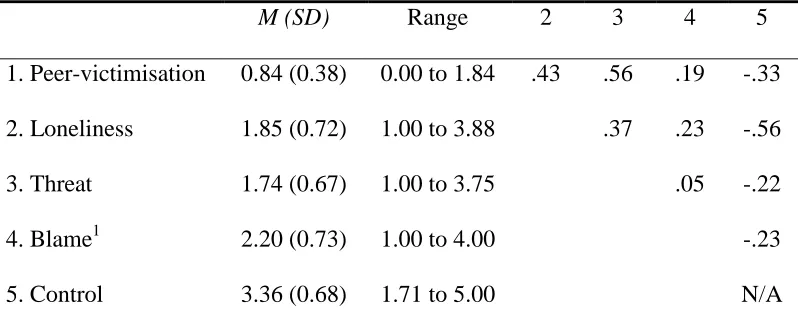
Examining the mean values for the three types of appraisal, we can see that threat had the lowest mean value, followed by blame and then perceived control. Blame scores were slightly below the mid-point on the scale, indicating a tendency toward blaming others more than the self. A repeated-measures ANOVA indicated that the three appraisal means were significantly
different from each other, F1,109 = 24.60, p < 0.001, partial-η2 = 0.184, and post-hoc Bonferroni analyses showed that all three were significantly different from one another (p < 0.001). The mean value for loneliness was at the lower end of the scale used to assess this construct, while the transformed peer-victimisation measure had a mean near the middle of the scale.
Table 1 about here
This pattern of correlations is broadly supportive of our theoretical model, that is: peer-victimisation is positively associated with loneliness; peer-peer-victimisation is associated with all three forms of appraisal; and all three forms of appraisal are associated with loneliness.
There were two small, though significant, effects of gender. Boys reported significantly higher levels of self-blame (F1,108 = 5.49, p = 0.021, partial-η2 = 0.048) and control (F1,108 = 5.67, p = 0.019, partial-η2 = 0.050) than girls, while there were no gender differences on levels of loneliness, threat, or peer-victimisation.
Do Appraisals Mediate the Effect of Peer-Victimisation on Loneliness?
The extent to which each of the three appraisal variables could account for the effect of peer-victimisation upon loneliness was assessed using Baron and Kenny‟s (1986) test for
mediator effects. First, we checked that peer-victimisation predicted loneliness using hierarchical multiple regression. Gender effects were controlled for by entering them at the first step of the regression and adding peer-victimisation at the second step. Peer-victimisation was a significant, positive predictor of loneliness. The standardised regression coefficient for peer-victimisation was β = .46, p < 0.001 (F-change1,107 = 28.24, p < 0.001; R2change = .204).
0.078; F-change1,107 = 3.17, p = 0.078; R2change = .027), indicating that blame cannot act as a statistical mediator in this instance.
We then predicted loneliness using the same model as above, but this time threat and control were used as predictors in a third step in the hierarchical multiple regression analysis. Complete mediation is indicated if the previously significant peer-victimisation predictor
becomes non-significant in the final analysis. Partial mediation may occur when the standardised regression coefficient of peer-victimisation shows a reduction from analysis one to analysis three, but not to the extent that it becomes non-significant. The third step in this analysis accounted for a significant portion of the variance in loneliness, F-change1,105 = 15.93, p < 0.001, R2change = .180. The peer-victimisation standardised coefficient remained significant (β = .21, p = 0.032) but was considerably reduced compared to the unmediated value (β = .46, p < 0.001). This suggests that the effect of peer-victimisation upon loneliness is partially mediated via the appraisal variables included in the third step of the regression analysis.
Interrogating the meditational effect further, the final step in the final analysis indicated that control (β = -.44, p < 0.001) but not threat (β = .16, p = 0.089) was a significant individual predictor. This suggests that the meditational effect is due to control appraisal and not threat appraisal. The Sobel test is a conservative test of the significance of indirect effects (MacKinnon & Dwyer, 1993), and this indicated that there was a significant indirect effect of
As shown in Figure 1, there is a direct effect of peer-victimisation on loneliness, and this effect is partially mediated via control. In addition, peer-victimisation influences threat
appraisals, though those appraisals do not influence loneliness. Peer-victimisation is not associated with the extent to which children blame themselves for peer-victimisation.
Figure 1 about here
Since the effect of blame on loneliness, when controlling for peer-victimisation, was not tested for in the meditational analyses, and one of our aims was a comparison of the differential effects of different appraisals on loneliness, we carried out a final analysis. Gender was again entered at the first step in a regression, followed by peer-victimisation at step two, and appraisals of control and threat at step three. However, blame was also entered at this final step. This analysis indicated that blame was a non-significant predictor of loneliness (β = .11, p = 0.164). Hence, our final model (Figure 1) reflects the fact that blame does not predict loneliness when the effects of control and threat are also taken into consideration (NB., inclusion of blame in the regression model did not alter the standardised regression coefficient of threat, and only marginally altered that for control from β = .44, p < 0.001 to β = .41, p < 0.001).
Discussion
This study examined whether appraisals of blame, control and threat mediated the effects of peer-victimisation upon loneliness. Despite significant correlations between peer-victimisation and all three measures of appraisal, and significant correlations between all measures of appraisal and loneliness, only control partially mediates the effect of peer-victimisation on loneliness.
higher levels of peer-victimisation were associated with lower control, higher threat, and more self- than other-blame. Furthermore, higher levels of loneliness were associated with lower control, higher threat, and more self- than other-blame. Such a pattern of relationships provides support for our contention that specific characteristics of loneliness, such as feeling that one has few friends, is socially incompetent and is unable to satisfy basic friendship needs (Cassidy & Asher, 1992), are likely to be related to appraisals of control, threat and blame. However, the regression analyses demonstrate that only control has a unique association with loneliness when all three are included as predictors.
Our results indicate that control appears to have unique associations with loneliness, and that self-blame and threat are not important predictors of loneliness when this association is taken into account. This highlights the importance of perceived control for children experiencing loneliness as a result of peer-victimisation, and suggests that the bivariate associations of self-blame and threat with loneliness are perhaps epiphenomena of the association between perceived control and loneliness. In short, self-blame and threat may only be associated with loneliness because of their associations with perceived control. This highlights the research importance of considering multiple measures of appraisals within studies aiming to evaluate the effect of appraisals on specific outcome measures.
& Oost, 2000), and the current research provides support for their further use and dissemination with regards to victims. Furthermore, as noted in the introduction, interventions dealing with peer-victimisation already use a cognitive-behavioural therapy framework (DeRosier & Marcus, 2005) and the current study indicates that challenging maladaptive cognitions relating to
perceived control is likely to be particularly important when dealing with children who experience loneliness as a consequence of peer-victimisation. However, it is important to emphasise that we are not suggesting that blame and threat should not be addressed, only that interventions designed to combat loneliness in this context may find it less helpful to address them; addressing blame and threat may still be helpful for interventions addressing other outcomes (depression, low self-esteem, etc). We would recommend future research which
assesses multiple meditational pathways across multiple indices of adjustment to unpack specific relationships.
(effort beliefs, ability beliefs, powerful others, luck, unknown causes) and found that children‟s ability to distinguish between these develops across the period 7 to 12 years. This suggests that theory relating to the possible mediating role of control should aim to tailor expectations toward the specific types of control that children can distinguish between.
In contrast, blame and threat were not mediators. Previous research has supported the mediating role of both these forms of appraisal in relation to the effects of parental conflict on internalising symptoms (Grych et al., 2000) and specific types of self-blame have been shown to mediate the effects of peer-victimisation on loneliness/social phobia (Graham & Juvonen, 1998). With regards to threat, the lack of a mediating role was particularly striking because
peer-victimisation was actually more strongly associated with threat than with control. Hence, these results may indicate that threat is outcome specific, influencing some outcomes, such as depression, but not others, such as loneliness. While we did not directly assess this possibility here, support for such an interpretation has been reported by other researchers (Grych et al., 2000; Smári, Pétursdóttir, & Porsteinsdóttir, 2001; Oğul & Gençöz, 2003). Perhaps threat appraisals are not associated with loneliness because loneliness reflects an assessment of current feeling rather than feelings associated with expected future developments related to the stressor.
The lack of a mediating role for self-blame contradicted Graham and Juvonen‟s (1998) results. This difference may indicate that only the specific aspects of self-blame assessed by Graham and Juvonen (1998) are predicted by, and mediate the effects of, peer-victimisation. However, two facts lead us to argue against such an interpretation: (i) peer-victimisation was correlated at the bivariate level with our measure of blame, and (ii) our measure of self-blame correlated at the bivariate level with loneliness. This leads us to conclude that these
appraisal when conducting research in this vein. An alternative explanation of the difference in results may be that Graham and Juvonen used a combined loneliness and social phobia measure as their outcome variable, and it may be that the effects are actually more related to social phobia than loneliness. If this is the case, it argues for the inclusion of multiple adjustment measures in future research in order that outcome-specific relationships between appraisals and adjustment can be clarified.
Our finding that peer-victimisation was associated with levels of loneliness supported previous research (Boivin et al., 1995; Crick & Grotpeter, 1996; Eslea et al., 2004; Hawker & Boulton, 2000; Kochenderfer & Ladd, 1996) and reinforces the message that peer-victimisation is an experience which has numerous negative outcomes for children (Hawker & Boulton, 2000). It also suggests that victims of peer-victimisation may benefit particularly from befriending
schemes (Naylor & Cowie, 1999) and that development of such schemes within Primary schools would be a valuable addition to the battery of intervention and prevention schemes currently available.
We also note that appraisals of threat and control were both associated with levels of peer-victimisation, again supporting previous work (Hunter et al., 2007). This reinforces the message that children who experience peer-victimisation may develop cognitive biases which are likely to lead to maladjustment and/or negative affect (Camodeca & Goossens, 2005). This implies that school staff, and others working with children who are the victims of peer-victimisation, should not only aim to end peer-victimisation when it is detected, but to offer follow-up support and assistance to children in the post-victimisation period. Such follow-up could aim to identify whether there are lingering cognitive biases, and address these appropriately.
good level of internal reliability. Replication of previous findings relating to control and peer-victimisation also suggest that the measure is reliably tapping perceived control. These encouraging results suggest the measure is worthy of future development, and investigation across a more diverse range of validity and reliability indices is warranted.
However, the present research employed a self-report questionnaire methodology, which may have been subject to self-presentational biases (Amabile & Glazebrook, 1982) as well as potentially inflated estimates due to shared-method variance. This is a difficult problem to overcome when studying cognitive appraisals as researchers are restricted in the range of assessment tools available to assess these unobservable, subjective constructs. However, to reduce shared-method variance it would be preferable to assess levels of peer-victimisation using peer-nominations or teacher-report data. Additionally, future research should aim to replicate these results using prospective research designs which are better able to substantiate claims of causality. We also recognise that these results may neither generalise to children‟s experiences with similar stressors. Specifically, they may not relate to the categorical distinction between bullied and not-bullied children since we assessed peer-victimisation as a continuous construct rather than dichotomous one and did not explicitly address issues of power imbalance and aggressor intent. Similarly, these results may not generalise to other indices of psychological wellbeing.
In conclusion, the present research extends our knowledge relating to children
experiencing peer-victimisation, and develops existing models of adjustment relating to children. The importance of control as a partial mediator of the effects of peer-victimisation on loneliness was emphasised, and the inclusion of multiple measures of appraisal when testing such
References
Amabile, T.M., & Glazebrook, A.H. (1982). A negativity bias in interpersonal evaluation. Journal of Experimental Social Psychology, 18, 1-22.
Asher, S., Hymel, S., & Renshaw, P.D. (1984). Loneliness in children. Child Development, 55, 1456-1464.
Baldry, A.C., & Farrington, D.P. (2004). Evaluation of an intervention program for the reduction of bullying and victimisation in schools. Aggressive Behaviour, 30 (1), 1-15.
Baron, R.M., & Kenny, D.A. (1986). The moderator-mediator variable distinction in social psychological research: Conceptual, strategic, and statistical considerations. Journal of Personality and Social Psychology, 51, 1173-1182.
Bjorkqvist, K., Lagerspetz, K.M.J., & Kaukiainen, A. (1992). Do girls manipulate and boys fight? Developmental trends in regard to direct and indirect aggression. Aggressive Behavior, 18,117-127.
Boivin, M., Hymel, S., & Bukowski, W.M. (1995). The roles of social withdrawal, peer rejection, and victimization by peers in predicting loneliness and depressed mood in childhood. Development and Psychopathology, 7, 765-785.
Boulton, M.J., Trueman, M., Chau, C., Whitehand, C., & Amatya, K. (1999). Concurrent and longitudinal links between friendship and peer victimisation: Implications for befriending interventions. Journal of Adolescence, 22, 461-466.
Camodeca, M., & Goossens, F.A. (2005). Aggression, social cognitions, anger and sadness in bullies and victims. Journal of Child Psychology and Psychiatry, 46 (2), 186-197. Cassidy, J., & Asher, S.R. (1992). Loneliness and peer relations in young children. Child
Development, 63, 350-365.
mechanisms in children‟s social adjustment. Psychological Bulletin, 115(1), 74-101. Crick, N.R., & Grotpeter, J.K. (1996). Children‟s treatment by peers: Victims of relational and
overt aggression. Development and Psychopathology, 8, 367-380.
Deardorff, J., Gonzales, N.A., & Sandler, I.N. (2003). Control beliefs as a mediator of the relation between stress and depressive symptoms among inner-city adolescents. Journal of Abnormal Child Psychology, 31 (2), 205-217.
DeRosier, M.E., & Marcus, S.R. (2005). Building friendships and combating bullying: Effectiveness of S.S.GRIN at one-year follow-up. Journal of Clinical Child and Adolescent Psychology, 34, 140-150.
El-Sheikh, M., & Harger, J. (2001). Appraisals of marital conflict and children‟s adjustment, health, and physiological reactivity. Developmental Psychology, 37 (6), 875-885. Eslea, M., Menesini, E., Morita, Y., O‟Moore, M., Mora-Merchán, J.A., Pereira, B., & Smith,
P.K. (2004). Friendship and loneliness among bullies and victims: Data from seven countries. Aggressive Behaviour, 30 (1), 71-83.
Fearnow-Kenney, M., & Kliewer, W. (2000). Threat appraisal and adjustment among children with cancer. Journal of Psychosocial Oncology, 18 (3), 1-17.
Fox, C. L., & Boulton, M. J. (2006). Friendship as a moderator of the relationship between social skills problems and peer victimisation. Aggressive Behavior, 32 (2), 110-121.
Gibb, B.E., Alloy, L.B., Walshaw, P.D., Comer, J.S., Shen, G.H.C. & Villari, A.G. (2006). Predictors of attributional style change in children. Journal of Abnormal Child Psychology, 34 (3), 425-439.
investigations of the cognitive-contextual framework. Child Development, 64, 215-230. Grych, J.H., Fincham, F.D., Jouriles, E.N., & McDonald, R. (2000). Interparental conflict and
child adjustment: Testing the mediational role of appraisals in the cognitive-contextual framework. Child Development, 71 (6), 1648-1661.
Grych, J.H., Harold, G.T., & Miles, C.J. (2003). A prospective investigation of appraisals as mediators of the link between interparental conflict and child adjustment. Child
Development, 74, 1176-1193.
Hasan, N., & Power, T.G. (2004). Children‟s appraisal of major life events. American Journal of Orthopsychiatry, 74 (1), 26-32.
Hawker, D.S.J., & Boulton, M.J. (2000). Twenty years‟ research on peer victimization and psychosocial maladjustment: A meta-analytic review of cross-sectional studies. Journal of Child Psychology and Psychiatry, 41, 441-455.
Hodges, E.V.E., Boivin, M., Vitaro, F., & Bukowski, W.M. (1999). The power of friendship: Protection against an escalating cycle of peer victimisation. Developmental Psychology, 35, 94-101.
Hunter, S.C., & Boyle, J.M.E. (2002). Perceptions of control in the victims of school bullying: The importance of early intervention. Educational Research, 44(3), 323-336.
Hunter, S.C., & Boyle, J.M.E. (2004). Coping and appraisal in victims of school bullying. British Journal of Educational Psychology, 74(1), 83-107.
Hunter, S.C., Boyle, J.M.E., & Warden, D. (2004). Help seeking amongst child and adolescent victims of peer-aggression and bullying: The influence of school-stage, gender,
Hunter, S.C., Boyle, J.M.E., & Warden, D. (2006). Emotion and coping in young victims of peer-aggression. In P. Buchwald (Ed.), Stress and anxiety - Application to health, community, work place and education. Newcastle, UK: Cambridge Scholar Press (pp307-324). Hunter, S.C., Boyle, J.M.E., & Warden, D. (2007). Perceptions and correlates of
peer-victimization and bullying. British Journal of Educational Psychology, 77, 797-810. Kerig, P.C. (1998). Moderators and mediators of the effects of inter-parental conflict on
children‟s adjustment. Journal of Abnormal Child Psychology, 26, 199-212.
Kochenderfer, B.J., & Ladd, G.W. (1996). Peer victimization: Cause or consequence of school maladjustment? Child Development, 67, 1305-1317.
Kochenderfer-Ladd, B.J., & Wardrop, J.L. (2001). Chronicity and instability of children's peer victimization experiences as predictors of loneliness and social satisfaction trajectories. Child Development, 72, 134–151.
Lazarus, R.S. (1999). Stress and emotion: A new synthesis. London: Springer Publishing Company.
Lazarus, R.S., & Folkman, S. (1984). Stress, appraisal, and coping. London: Springer Publishing Company.
Lazarus, R.S., & Launier, R. (1978). Stress-related transactions between person and environment. In L.A. Pervin and M. Lewis (Eds) Perspectives in interactional psychology (pp287-327). London: Plenum Press.
Lengua, L.J., & Long, A.C. (2002). The role of emotionality and self-regulation in the appraisal-coping process: Tests of direct and moderating effects. Journal ofApplied Developmental Psychology,23, 471-493.
McIntosh, J. (2003). Enduring conflict in parental separation: Pathways of impact on child development. Journal of Family Studies, 9, 63–80.
Mezulis, A.H., Hyde, J.S., & Abramson, L.Y. (2006). The developmental origins of cognitive vulnerability to depression: Temperament, parenting, and negative life events in childhood as contributors to negative cognitive style. Developmental Psychology, 42 (6), 1012-1025. Naylor, P., & Cowie, H. (1999). The effectiveness of peer support systems in challenging school
bullying: The perspectives and experiences of teachers and pupils. Journal of Adolescence, 22,467-479.
Oğul, M., & Gençöz, T. (2003). Roles of perceived control and coping strategies on depressive and anxiety symptoms of Turkish adolescents. Psychological Reports, 93, 659-672. Owens, L., Daly, A., & Slee, P. (2005). Sex and age differences in victimisation and conflict
resolution among adolescents in a South Australian school. Aggressive Behaviour, 31 (1), 1-12.
Shrout, P.E., & Bolger, N. (2002). Mediation in experimental and nonexperimental studies: New procedures and recommendations. Psychological Methods, 7, 422-445.
Skinner, E.A. (1990). Age differences in the dimensions of perceived control during middle childhood: Implications for developmental conceptualizations and research. Child Development, 61, 1882-1890.
Smári, J., Pétursdóttir, G., & Porsteinsdóttir, V. (2001). Social anxiety and depression in adolescents in relation to perceived competence and situational appraisal. Journal of Adolescence, 24, 199-207.
Peer-harassment in school: The plight of the vulnerable and victimised (pp332-351). London: Guilford Press.
Stevens, V., Bourdeaudhuij, I.D., & Oost, P.V. (2000). Bullying in Flemish schools: An evaluation of an anti-bullying intervention in primary and secondary schools. British Journal of Educational Psychology, 70, 195-210.
Storch, E.A., & Warner, C.M. (2004). The relationship of peer victimization to social anxiety and loneliness in adolescent females. Journal of Adolescence, 27, 351-362.
Table 1.
Descriptive Statistics for, and Zero-Order Correlations between, all Main Study Variables.
M (SD) Range 2 3 4 5
1. Peer-victimisation 0.84 (0.38) 0.00 to 1.84 .43 .56 .19 -.33 2. Loneliness 1.85 (0.72) 1.00 to 3.88 .37 .23 -.56
3. Threat 1.74 (0.67) 1.00 to 3.75 .05 -.22
4. Blame1 2.20 (0.73) 1.00 to 4.00 -.23
5. Control 3.36 (0.68) 1.71 to 5.00 N/A
Note: Correlations above .18 significant at p < 0.05; above .24 significant at p < 0.001. 1
Figure Caption
Peer-Victimisation Loneliness
Control
Threat
Blame .46 (.21) -.36
.57
-.44
.17