Rochester Institute of Technology
RIT Scholar Works
Theses Thesis/Dissertation Collections
2-1-2010
Asset protection in a limited swarm environment
utilizing artificial potential fields
Dieter Laskowski
Follow this and additional works at:http://scholarworks.rit.edu/theses
Recommended Citation
Asset Protection in a Limited Swarm
Environment Utilizing Artificial Potential Fields
by
Dieter Laskowski
A Thesis Submitted in Partial Fulfillment of the Requirements for the Degree of Master of Science
in Computer Engineering
Supervised by
Associate Professor Dr. Shanchieh Jay Yang Department of Computer Engineering
Kate Gleason College of Engineering Rochester Institute of Technology
Rochester, New York February 2010
Approved by:
Dr. Shanchieh Jay Yang, Associate Professor
Thesis Advisor, Department of Computer Engineering
Dr. Marcin Lukowiak, Assistant Professor
Committee Member, Department of Computer Engineering
Dr. Roy S. Czernikowski, Professor
Thesis Release Permission Form
Rochester Institute of Technology Kate Gleason College of Engineering
Title:
Asset Protection in a Limited Swarm Environment Utilizing Artificial Potential Fields
I, Dieter Laskowski, hereby grant permission to the Wallace Memorial Library to re-produce my thesis in whole or part.
Dieter Laskowski
c
Dedication
Acknowledgments
I am grateful for the assistance and guidance offered to me by my committee members, especially Dr. Shanchieh Jay Yang for weathering the long distance thesis meetings and his patience through thick and thin. I’d also like to acknowledge Dr. Marcin Lukowiak and Dr. Roy S. Czernikowski for serving on my committee, and their feedback throughout the latter months of the process.
Abstract
Asset Protection in a Limited Swarm Environment Utilizing Artificial Potential
Fields
Dieter Laskowski
Supervising Professor: Dr. Shanchieh Jay Yang
Asset protection is a behavior in which a team of robots establishes a formation around
a resource marked as an asset in a hostile environment in order to protect the asset from
threats. The robots are assumed to be homogeneous and run a decentralized control
algo-rithm and possess a repulsive quality to the threats. Previous works in this area have used
centralized control or considered the use of many robots. This work aims at developing an
algorithm that is both decentralized, and able to protect assets using only a few robots.
In order to provide this behavior an algorithm coined the Asset Guarding Intelligent
System (AeGIS), was developed and analyzed. Using AeGIS, each robot will detect an
asset move towards it and form a protective formation around it. AeGIS utilizes Quadratic
Artificial Potential Fields (QAPFs) as the robot’s path planning module. As such the fields
are designed to move the robots into formation, avoid collisions, and in turn protect assets.
AeGIS is tested usingLeviathan — an event-driven simulator designed to test groups
of autonomous swarm robots employing distributed control algorithms. The success rate
of different variations of AeGIS were tested. Additionally, the number of threats, robots
employing AeGIS, and the number and mobility of assets were varied to observe their effect
on the success rate. The simulation results show that with sufficient number of robots, the
assets, static or mobile are well protected against 20 modeled threats. Through these results
Contents
Dedication. . . . iv
Acknowledgments . . . . v
Abstract . . . . vi
1 Introduction. . . . 1
1.1 Problem Statement . . . 2
1.2 Cooperative Robotics . . . 4
1.3 Artificial Potential Fields . . . 5
1.3.1 Quadratic Artificial Potential Fields . . . 11
1.4 Swarm Robotics . . . 12
1.5 Flocking . . . 13
1.6 Organization of Thesis . . . 15
2 Related Work . . . . 16
2.1 Centralized Controller for Entrapment/Escorting . . . 16
2.2 Social Potential Fields . . . 21
2.3 Threat Containment . . . 24
3 AeGIS Asset Protection Algorithm . . . . 26
3.1 Asset Capabilities . . . 27
3.2 Asset Mobility Algorithms . . . 28
3.2.1 Waypoints . . . 28
3.2.2 Random Waypoints . . . 28
3.2.3 Random Direction . . . 29
3.2.4 Random Time and Direction . . . 29
3.2.5 Collision Avoidance . . . 30
3.2.6 Asset Intelligence . . . 31
3.3 Threat Capabilities . . . 31
3.4.1 Potential Assets exert on Threats . . . 32
3.4.2 Potential Nodes exert on Threats . . . 33
3.4.3 Potential Threats exert on Threats . . . 34
3.5 Node Capabilities . . . 34
3.6 Node Intelligence (AeGIS) . . . 35
3.6.1 Basic Algorithm . . . 35
3.6.2 Potential Threats exert on Nodes . . . 39
3.6.3 Spring Laws . . . 42
3.6.4 Adaptive Algorithm . . . 45
4 Simulator Architecture . . . . 47
4.1 Variable Input . . . 47
4.2 Initialization . . . 48
4.3 Running the Simulation/Request Framework . . . 52
4.4 Logger . . . 53
4.5 Components . . . 54
4.5.1 Battery Model . . . 54
4.5.2 Sensor Model . . . 55
4.5.3 Locomotion Model . . . 55
4.6 Graphical User Interface (GUI) . . . 57
5 Simulation Results and Discussion . . . . 59
5.1 Simulation Setup . . . 59
5.1.1 Physical and Environment Parameters . . . 59
5.1.2 Algorithmic Parameters . . . 61
5.2 Evaluation of Asset Protection Success . . . 63
5.3 Simulation Results . . . 63
5.3.1 Basic Algorithm SuccessversusNumber of Threats . . . 63
5.3.2 Consistency of Mobility Models . . . 67
5.3.3 Basic Algorithm Success over Multiple Assets . . . 69
5.3.4 Assets CompromisedversusSimulation Time . . . 73
5.3.5 Assets CompromisedversusSimulation Time using Adaptive AeGIS 76 5.3.6 Threat Behavior that Compromises Otherwise Well Protected Assets 79 6 Conclusions and Future Work . . . . 82
A Derivation of Choice Artificial Potential Field Coefficients . . . . 87
A.1 General One Threat One Node Scenario . . . 87
A.2 Two Nodes, One Threat Scenario . . . 88
A.3 R nodes, T threats Scenario . . . 89
List of Tables
3.1 Table of Variables and Constants used in Equations . . . 27
4.1 Table of Command Line Arguments for use in theLeviathanSimulator . . . 48
4.2 Table of Accepted Strings for Asset Mobility Algorithms . . . 48
5.1 Physical Parameters of Agents in the Simulator . . . 60
5.2 Environmental Parameters of the Simulator . . . 61
5.3 Algorithmic Parameters of Agents in the Simulator . . . 62
5.4 Node placement success for multiple static assets . . . 72
5.5 Node placement success for multiple assets using the random direction mo-bility algorithm . . . 72
5.6 Percent of assets not compromised at chosen time and the rate at which assets become compromised per algorithm for the period of highest threat arrival as defined in Figure 5.15. . . 78
List of Figures
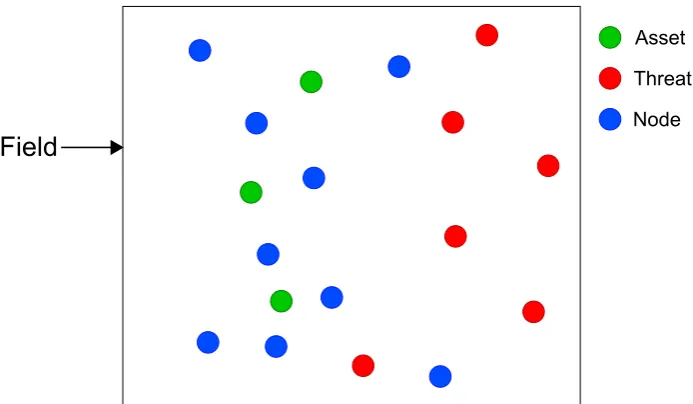
1.1 nnodes nearaassets in a 2D field of set dimensions, just astthreats appear on the field. . . 3 1.2 Examples of a repulsive (Figure 1.2a) and an attractive (Figure 1.2b)
po-tential field . . . 7 1.3 Aggregate APF of a goal at (0,0) and an obstacle at (1,0) . . . 8 1.4 A potential field function plotted in 2D in terms of distance (Figure 1.4a),
and that same potential field function used as a radial APF and plotted in 3D (Figure 1.4b) . . . 8 1.5 The box canyon problem exists when a robot may be attracted into a local
minima with no desire to leave. . . 10 1.6 A typical QAPF using the equationP(x) = (x−1)2. . . 11
1.7 A QAPF that has been tuned for a stronger repulsion (steeper slope) than attraction. . . 12 1.8 Purely repulsive APF by only utilizing the repulsive component of the
QAPF by way of a piecewise equation . . . 13
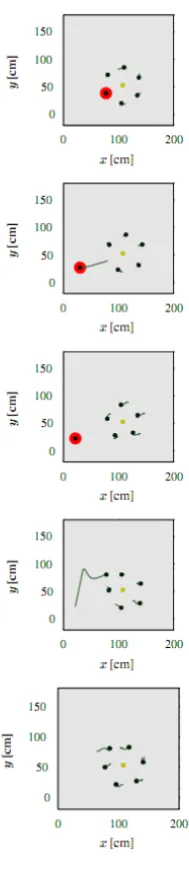
2.1 University of Cassino’s Industrial Automation Laboratory setup . . . 18 2.2 Experimental run of DAEIMI’s NSB behavior used to entrap a tennis ball. . 19 2.3 The same simulation as seen in Figure 2.2 but with a fault induced. . . 20 2.4 Magnitude of the inverse force law usingσ1 = 3.0,σ2 = 0.8,c1 = 20and
c2 = 15. Derived using (2.1) from Reif and Wang [11] . . . 22
2.5 Three different stages in Reif and Wang’s castle guarding scenario [11]. . . 23
3.1 Pat, the potential field assets exert on threats . . . 32 3.2 Pnt, the potential field nodes exert on threats . . . 33 3.3 Ptt, the potential field threats exert on threats. . . 34 3.4 Adequate protection of an asset. Protection using fewer nodes may suffice
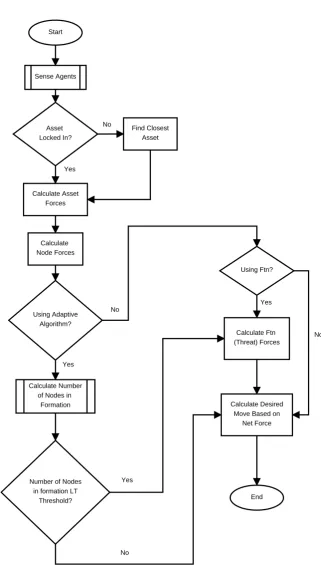
for most scenarios. . . 35 3.5 The AeGIS Algorithm Flowchart, including the decision making structure
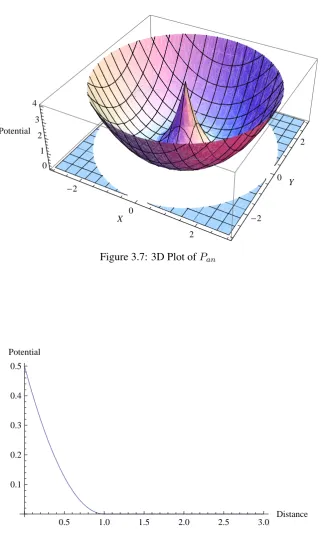
3.7 3D Plot ofPan . . . 38 3.8 Pnn, the potential field nodes exert on nodes . . . 38 3.9 Insufficient protection for an asset that allows multiple access points for a
threat to compromise protection . . . 39 3.10 Ptn, the potential field threats exert on nodes . . . 40 3.11 Ptnsuccessfully stopping a threat from compromising the asset from Figure
3.9 . . . 41 3.12 Ptncausing failure in asset protection when asset is otherwise well protected 41 3.13 Nodes including Ptn in their calculations are drawn to the stronger threat
force on one side of the asset, exposing the asset to being compromised by a single threat. . . 42 3.14 Overhead view of the local minima problem caused by two assets in close
proximity . . . 42 3.15 Potential Field for 2 assets separated by 2 meters . . . 43 3.16 The formation of spring laws used to test the effectiveness of spring laws . . 43 3.17 A depiction of how late arrivals in a scenario where neighbors are locked
in tends to be defective. . . 45
4.1 Flowchart depicting simulator lifespan . . . 49 4.2 The three zones of which agents can be created in . . . 51 4.3 The process the simulator goes through during its course of execution . . . 52 4.4 The process that the Locomotion Module follows to determine how far a
robot can move in a given time . . . 56 4.5 A screenshot of the GUI mid-simulation. 20 threats appear as red dots, six
nodes as blue dots and a single asset as a green dot. . . 58
5.1 Success rate for a single static asset under different amounts of threats and nodes . . . 64 5.2 Success rate for a single mobile asset under different amounts of threats
and nodes . . . 65 5.3 Success rate for a single mobile asset choosing intelligent random
move-ments under different amounts of threats and nodes . . . 66 5.4 Cumulative success rate for assets utilizing each mobility algorithm while
varying number of threats and nodes . . . 67 5.5 A depiction of how different mobility models the asset can employ effect
5.6 Success rate for multiple static assets while varying the number of nodes and threats . . . 69 5.7 Success rate for multiple mobile assets while varying the number of nodes
and threats . . . 70 5.8 Average number of nodes received versus the number of nodes given to
each asset for static assets. . . 71 5.9 Average number of nodes received versus the number of nodes given to
each asset for multiple assets employing the random direction mobility model. 72 5.10 Success rate for multiple static assets while varying the number of nodes
and threats with assets being created simultaneously . . . 73 5.11 Success rate for multiple mobile assets while varying the number of nodes
and threats with assets being created simultaneously . . . 74 5.12 Assets not compromised over simulation time in a field of randomly placed
nodes comparing the basic algorithm to theFtn algorithm. . . 75 5.13 The presence of nodes in formation and the arrival rate of threats from the
simulations in Figure 5.12. . . 76 5.14 Assets not compromised over simulation time in a field of randomly placed
nodes comparing the adaptive algorithm to the basic algorithm and theFtn algorithm. . . 77 5.15 Regions of interest in threat arrival overlaid on a plot of the average number
of threats at the assetversustime. . . 78 5.16 Emergent threat behavior, where the three threats shown push the inner
threat through the asset’s protective formation. Threats typically spread out around the protective formation prior to layering. . . 80
Chapter 1
Introduction
The term “robot” was first used in Karel Capek’s play,Rossum’s Universal Robotsin 1929
in which the robots were a race of workers created by the play’s inventor, Rossum, from
a vat of biological parts. Capek coined the workers “robots,” a term derived from the
Czech word robota, which is loosely translated as menial laborer [9]. To this end “Rossums
Universal Robots” demonstrated how robots were able to replace “real” people from any
type of labor that was deemed too lowly to merit respect, subsequently freeing humans to
do more meaningful work.
Today robots are still used to replace workers in roles where a robot’s precision, ability
to repeat a task accurately, and their expendability make them more desirable in a role than
a human worker. Robots have been used in applications ranging from robotic welding arms
in production lines, to robotic vacuum cleaners, to bomb defusal and search and rescue
robots.
Some of these robots are considered to be autonomous, which means that they think
and act on their own without human interaction or direction. This level of autonomy opens
up the use of autonomous robots to be left to complete a task unsupervised by humans,
freeing them to perform other tasks as in Capek’s play. Commonly the tasks assigned
to autonomous robots can be accomplished faster through the use of multiple autonomous
robots, other times the task may be impossible without the use of multiple robots. The
and is described in detail in Section 1.2.
Cooperative robotics may be utilized in a manner that would allow multiple autonomous
robots to perform the tasks previously described that would be too dangerous for human
workers. One of the main motivations for robotics research is the desire to remove humans
from dangerous work and replace them with an expendable robot. One such task is that of
asset protection.
Asset protection, as it sounds, is the protection of resources labeled as assets from harm.
The need for asset protection arises from the presence of a resource in a hostile
environ-ment. This resource is in the hostile environment for any number of reasons, whether the
resource is trapped there, has a particular task to perform within the environment, or simply
needs to traverse the environment in order to deliver supplies, information, or get home. In
any case the resource is valuable to the implementer, so it will be marked as an asset.
Typically the nature of the hostile environment will not be known aside from its
disposi-tion. A hostile environment will have agents that can do harm to the asset; as such they will
be labeled as threats. As the nature of the environment is not usually known beforehand,
the strength, number and location of these threats is unknown to the asset, so it cannot plan
to avoid them. The asset is left defenseless against the threat.
For whatever reason the asset is in the hostile environment it becomes necessary to
have a general, flexible response to threats. This problem is posed generally as the “asset
protection” problem. Assuming that enough is known about the hostile environment that a
number of robots may be equipped that will be able to repel these threats, the robots can be
used to protect the asset from the threats. With this information the problem itself can be
properly formulated.
1.1
Problem Statement
Given an environment in which assets are defined and threats are present, a number of
Figure 1.1: nnodes nearaassets in a 2D field of set dimensions, just astthreats appear on the field.
effect the nodes have on the threats.
The environment is a 2D field of fixed dimensions that will containaassets,nnodes and
t threats during the course of a simulation. Initiallyn nodes are present in the simulation
and turned on, followed by a assets being defined within the environment, followed by t
threats, alerted to the assets’ presence in the field attempting to compromise the asset.
Multiple threats appear in the environment after the assets are identified and employ
their own path planning algorithm to avoid the nodes and reach the assets. These threats
exploit their knowledge of the environment and have omniscient information about the
locations of the assets and nodes.
Conversely the assets are of singular purpose and pay no heed to efforts or locations of
the nodes in the environment. The assets can either be stationary, as if performing a task at
a location, or mobile, attempting to get from one location to another.
In either case the nodes attempt to form a protective formation around the assets. Ideally
this would consist of many nodes forming a circle coincident on the asset leaving no
en-trance for a threat to get to the asset, but in many cases the resources would not be available
when there are not enough nodes to form a robust circular formation. For this reason and
the purposes of asset protection, any formation, structure, or behavior of nodes that result
in an asset being protected from a threat will be considered asset protection.
Constructing such behavior on numerous robots of limited capabilities is a non-trivial
matter. The behavior must be able to protect the assets from threats when there are
“suf-ficient nodes” to produce a robust circle formation, but able to alter their formation based
on the number of nodes in formation without communicating with each other. In order
to provide such a behavior Artificial Potential Fields (APFs) are employed to construct an
asset protection behavior that is robust to individual node failure, but simple enough to be
used on robots of limited means. This solution to the asset protection problem is called
the Asset Guarding Intelligent System (AeGIS). Details on the AeGIS algorithm used is
described in Section 3.6 while APF functionality in general can be found in Section 1.3.
1.2
Cooperative Robotics
The concept of cooperative robotics entails a group of robots that work together to achieve
a common goal. Algorithms within the field of cooperative robotics are commonly divided
into two categories; centralized and decentralized.
Centralized robot controllers use a single entity (computer, other robot, etc.) that tells
each robot what to do. A centralized controller is typically chosen for environments in
which the coordination of the robots needs to be carefully orchestrated and knowledge of
the environment is easily attainable. Centralized robot controllers typically have either
global knowledge, or the collective knowledge of each of the robots it controls meaning it
will always have more knowledge than any singular robot would. Using this knowledge
the centralized controller can easily make informed decisions and send the robots accurate
instructions throughout the course of the mission.
Decentralized robot controllers trade optimal knowledge and coordination for system
from the environment and decide what its next action is on its own. This process of
in-dependent control introduces system wide robustness in the sense that if any robot is
dis-abled, or otherwise rendered ineffective, the system will continue to operate normally with
the exception of the affected robot. In a centralized controller, if the controller is disabled,
or receives bad information, or is unable to transmit instructions, the entire system will be
rendered ineffective. However this trade off typically means that complicated tasks
requir-ing coordination of multiple robots will be much harder to accomplish in the decentralized
controller.
Cooperative robots have been used in a number of scenarios in an effort to remove
hu-mans from menial or dangerous tasks. Some such tasks would be those such as coordinated
group movement of an object [6, 15], escorting a target by surrounding it and maintaining
formation relative to the target’s position [3], and robot soccer [20].
1.3
Artificial Potential Fields
Artificial Potential Fields (APFs) are a simple mathematical path planning algorithm based
on naturally occurring potential such as gravitational potential or electrical potential. APFs
are commonly described using functions for their compactness and computational speed
and are sometimes for this reason called Artificial Potential Functions.
Agents interact with the fields as Newtonian Particles, resulting in them needing to
fol-low Newton’s force laws with respect to gravitational potential. In this manner the potential
fields exert a force upon the particles in the system in the direction of the lowest potential.
In order to determine these forces the force vector is defined as the negative gradient of the
potential field.
⃗
In order for these forces to be useful as a path planning algorithm the virtual
environ-ment must be shaped in a way that the forces will lead the agent away from obstacles and
ultimately towards its goal. Taking note of this, each object in the environment is given a
potential field, either attractive or repulsive. Significant locations in the environment can
also be given potential fields. Obstacles will be given repulsive potential fields and goals
will be given attractive potential fields.
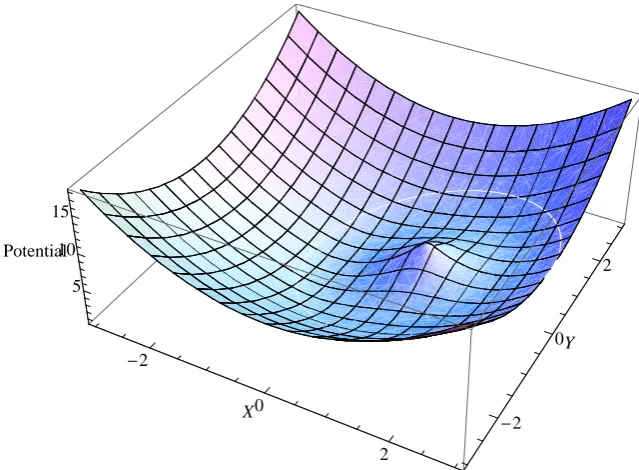
A repulsive potential field can take many shapes, but keying off of the concept of
gravi-tational potential, a repulsive potential field will have a high potential at the origin, tapering
off to lower potentials as distance from the origin increases until the limit of the repulsive
field at which the field would be level with the rest of the environment, producing no force.
An example of such a repulsive potential field can be seen in Figure 1.2a. When the force
gradient is calculated for the repulsive APF, it should point away from the origin of the
field.
An attractive potential field is created in much the same manner as the repulsive
po-tential field. In order to produce an attractive popo-tential field the origin of the field must
be surrounded by rings of successively higher potential so that when the force gradient is
calculated it will point towards the origin of the field. An example of such an attractive
potential field can be seen in Figure 1.2b
Navigation of an environment that contains both goals and obstacles using APFs still
involves calculating the force vector produced by the fields. The environment can be
de-scribed by the collection of all the potential fields in the environment. The fields are
col-lected by calculating an aggregate potential field by summing each of the individual
po-tential fields relative to their position in the environment. From this point the force vector
acting on the agent can be determined by calculating the negative gradient at the agent’s
position in the aggregate potential field.
-2
0
2
X -2
0 2 Y 0 2 4 6 Potential
(a) A purely repulsive potential field centered at (0,0)
-2 0 2 X -2 0 2 Y 0 5 10 15 Potential
(b) A purely attractive potential field centered at (0,0)
Figure 1.2: Examples of a repulsive (Figure 1.2a) and an attractive (Figure 1.2b) potential field
Ptotal(x, y) = ∑
n
Pi(x, y) (1.3)
Commonly the APFs are stored as functions in order to reduce the storage required and
speed up computations for potential field values. One of the methods to produce simple
attractive and repulsive potential fields is to describe them using radial potential field
func-tions. In a radial potential field function, the potential field is described by an equation
whose only parameter is distance from the origin. One such APF is shown in Figure 1.4.
When using functions to describe APFs, the APFs are centered at the origin, resulting in
the use of localization variables to place the APF within the virtual environment. These
variables are in fact the coordinates of the objects with which the APF is associated.
Ptotal(x, y) = P1(x−x1, y−y1) +P2(x−x2, y−y2) +· · ·+Pn(x−xn, y−yn) (1.4)
In (1.4) the localization variables, xi andyi are the location of each of the objects in
the virtual environment. If the functions are a function of distance from the origin, then
-2
0
2 X
-2
0 2
Y 5
10 15
Potential
Figure 1.3: Aggregate APF of a goal at (0,0) and an obstacle at (1,0)
0.5 1.0 1.5 2.0 2.5 3.0 Distance
1 2 3 4 5 6 Potential
(a) A plot of a potential field function in terms of distance
-2
0
2
X -2
0 2
Y
0 2 4 6
Potential
[image:23.595.148.468.121.356.2](b) The same potential field function plotted in 3D
√
(x−xi)2+ (y−yi)2 which results in (1.5), wheredis distance from the origin.
Ptotal(x, y) = P1(
√
(x−xi)2+ (y−yi)2) +P2(
√
(x−xi)2+ (y−yi)2) +. . .
+Pn( √
(x−xi)2+ (y−yi)2)
Ptotal(x, y) = P1(d) +P2(d) +· · ·+Pn(d) (1.5)
NowPtotalcan be expressed as a sum of one variable as in (1.3).
Ptotal(x, y) = ∑
n
Pi(d) (1.6)
Computation of the force vector acting on the agent can be further accelerated by taking
advantage of the aggregate potential field being described as a sum of functions, in which
the aggregate force acting on the agent can be calculated by a single derivative over the
equation describing the aggregate potential field, since the potential field has been reduced
to a single variable of distance from the origin of each field. Additionally, since the field is
radial the force vector will point either towards the origin or away from the origin based on
the polarity of the force.
Fnet(x, y) = d
d(d)(Ptotal(x, y)) (1.7)
The potential field equations can be stored as force equations due to the sum rule of
derivatives.
d
d(d)(Ptotal(x, y)) =
d d(d)
( ∑
n
Pi(d) )
=∑
n (
d
d(d)Pi(d) )
(1.8)
Equation (1.8) results in a compact simple method for calculating the force vector acting
on an agent at any location in the environment. Using this relationship the net force acting
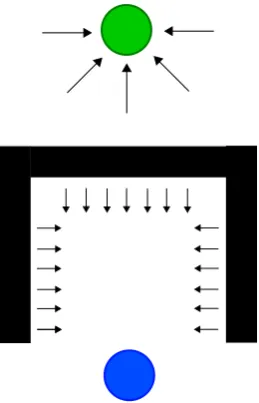
Figure 1.5: The box canyon problem exists when a robot may be attracted into a local minima with no desire to leave.
from the agent to each object in the environment and summing the force vectors, producing
the direction and magnitude that the agent should move in.
However APFs do have a few notable disadvantages when compared to other path
plan-ning algorithms. Some behaviors may be difficult or almost impossible to describe using
APFs, while complicated behaviors may still take a very long time to design. Another
prob-lem that APFs incur is that of local minima. A local minima in an APF is a point where the
agent has no force vector acting upon it, though a global minima (point of lower potential)
that is more desirable exists elsewhere in the environment. An example of a local minima
is shown in Figure 1.5 as the box canyon scenario. In this scenario the agent is drawn into
the canyon by the goal beyond it. Once the agent is within the box canyon it encounters
the repulsive force of the canyon itself, and since it still sees the goal beyond the canyon it
doesn’t attempt to escape the canyon itself; it is caught in a local minima.
There are however some solutions to the local minima problem, including stream
func-tions [21], introducing an excitation factor or randomness to shake the robot out of the local
0.5 1.0 1.5 2.0 2.5 3.0 Distance 1
2 3 4 Potential
Figure 1.6: A typical QAPF using the equationP(x) = (x−1)2.
1.3.1 Quadratic Artificial Potential Fields
APFs can take many forms, and the equations describing them can be as complex or as
simple as the implementer desires, however they are often kept simple in order to maintain
the algorithmic nimbility for which they often are utilized.
Quadratic Artificial Potential Fields (QAPFs) demonstrate the two main forces
em-ployed in applications of APFs: attraction and repulsion. A QAPF typically takes the
shape of a parabola in such a manner that it generates short range repulsion and long range
attraction. These fields are useful for purposes where the agent is needed to maintain a
distance, but still stay near to another agent or object. A normal QAPF can be tuned in the
same manner that a parabolic equation can (Figure 1.6).
An additional amount of configuration can be included by making the QAPF a
piece-wise function in which each lobe of the QAPF has its own tuning coefficient, and a common
centering point.
In this manner a QAPF may be tuned to have a stronger repulsive force than attractive
force or however the implementer decides to design it. The force equation is calculated by
taking the derivative of each lobe individually.
0.5 1.0 1.5 2.0 2.5 3.0 Distance 1
2 3 4 Potential
Figure 1.7: A QAPF that has been tuned for a stronger repulsion (steeper slope) than attraction.
purely repulsive force by negating one of the lobes completely. This is demonstrated in
Figure 1.8 where the field retains only repulsive behavior.
1.4
Swarm Robotics
Swarm intelligence is described as a set of simple behaviors that when followed by each
member of the swarm will produce a group, or emergent behavior. A swarm environment
is most commonly characterized as a decentralized control algorithm employed on
homo-geneous robots that are programmed with relatively simple behaviors that together display
some emergent behavior [4].
Swarm robotics is based on the observation of swarms in nature such as bees, ants and
other creatures. In each one of these swarms, when a single agent is taken out of the swarm
it will exhibit simple individual behavior, when there are many agents however, they act as
a swarm they can accomplish large tasks.
Various species of ants cooperate without direct communication, though modifications
of the environment called stigmergy[6]. Through stigmergy ants cooperate to bring large
prey back to the hive, prey that individually they would not be able to bring back. The
0.5 1.0 1.5 2.0 2.5 3.0 Distance 0.1
0.2 0.3 0.4 0.5 Potential
Figure 1.8: Purely repulsive APF by only utilizing the repulsive component of the QAPF by way of a piecewise equation
to the prey, and through physical pushing of the prey they eventually decide on a direction
to move.
In a limited swarm environment the number of agents in the system is substantially
smaller than that of a typical swarm. Typical swarms employ between hundred and tens of
thousands of agents. Swarms in robotics typically do not reach this size in experimentation
due to their cost, however they can be achieved in simulation. Swarms in robotics have
been seen as small as 10-20 robots, but a limited swarm environment would have its target
population between 5-20 robots.
1.5
Flocking
One of the most effective forms of formation control observed in nature is a behavior
recog-nized as flocking. Flocking is a method that organisms utilize to avoid predators, increase
survival chances and in some cases even reduce strain on travel.
Flocking as it is known today in computer science circles originated with Reynolds who
was searching for an easy way to generate paths of birds and fish while creating computer
path for each object in the flock would have to be individually plotted out by the animator.
Now with Reynolds’ rules, only the leader of the flock’s path must be scripted leaving the
rest of the flock mates to “flock.” Reynolds’ rules of flocking follow [12].
1. Collision Avoidance: avoid collisions with nearby flockmates
2. Velocity Matching: attempt to match velocity (a vector quantity) with nearby
flock-mates
3. Flock Centering: attempt to stay close to nearby flockmates
Collision avoidance manifests itself as a short range repulsive force between
flock-mates, and velocity matching is somewhat complimentary. These two behaviors are also
sometimes referred to as static collision avoidance and dynamic collision avoidance. Static
collision avoidance considers only the location of the flockmates, ignoring velocity, which
makes it similar to the collision avoidance behavior seen in APFs, while dynamic collision
avoidance is based only on velocity of flockmates and ignores location. As Reynolds puts
it, “if the [member of the flock] does a good job of matching velocity with its neighbors, it
is unlikely that it will collide with any of them very soon.”
Flock centering is a behavior that makes the member want to be in the middle of the
flock. If a member is deep in the flock, the presence of flock members around it will cause
it to be pulled at roughly the same strength in all directions resulting in a near zero sum
force. But if a flock member is on the outside of a flock, it will be pulled towards the center
of the flock. This behavior can be drawn easily from the protective quality of flocks seen
in nature. It is flock centering that essentially makes the flock a cohesive entity.
These flocking rules are implemented on all flock members besides the leader as a
distributed control algorithm. When each member of the flock adheres to these three rules
the flock appears to be cohesive and act as an entity with a single mind.
Reynolds noted that the flocks seemed to behave more real when the sensing range was
position in the flock as long as their neighbors do not change, so a flock would be able to
conduct various maneuvers that would respond to obstacles or predators.
It’s not a far stretch to see how Reynolds’ flocking rules can be implemented using APFs
[16, 17]. Additionally flocking can easily be adapted to escorting objects or members of
the flock by having the flock treat the object as a flockmate and the object being controlled
independently.
1.6
Organization of Thesis
The layout of this work is as follows: Chapter 2 goes over works done by other researchers
similar to this problem. Chapter 3 will detail the algorithms used to model asset and threat
behavior, as well as explain in detail the node’s asset protection algorithm, AeGIS. Chapter
4 discusses the architecture of the simulator used to simulate the algorithms described in
Chapter 3. Chapter 5 shows the simulation parameters and the simulation results. Finally
Chapter 6 discusses the conclusions based on the results in Chapter 5 and possible future
Chapter 2
Related Work
Several strategies have been attempted in order to solve what is commonly described as
the Entrapment/Escorting scenario. Entrapment is the act of robots surrounding an object
preventing its escape by creating a surrounding formation. This formation is also called
a “containment” formation due to its use to “contain” the object to its current location.
Escorting is the act of achieving an entrapment or containment formation, but not using it
to keep the object in place and instead maintain a formation around the object and guiding
it along its path, or protecting it from outside threats.
2.1
Centralized Controller for Entrapment/Escorting
Antonelliet al.’s approach to the entrapment/escorting problem utilizes a centralized
con-troller employing their Null Space Based (NSB) control method to manipulate a multirobot
system to escort an object in both a simulated environment, and a physical one.
The NSB control method attempts to find a move for each robot that will satisfy a
set of subproblems that will be individually solved, and then based on the priority given
to each subproblem combine the solutions into one move. NSB control utilizes a task
Jacobian matrix, commonly utilized in robotic manipulation, to find a “closed-loop inverse
kinematics least-square solution.” Antonelli et al. claim that the NSB control method
“always fulfills” the highest priority task by making sure that none of the solutions to the
that two solutions do conflict with each other the components of the lower priority tasks
that conflict with the highest priority task are removed from the final move of the robot.
In order for NSB control to be applied to the escorting mission it was broken down into
four subproblems:
1. Command the robots’ centroid to be coincident with the target
2. Move the robots on a given circumference around the centroid
3. Properly distribute the robots along the circumference
4. Avoid collisions among the robots themselves and with obstacles
Antonelliet al. ran several simulations varying the priorities given to these subtasks in
order to see how the NSB controller combined these tasks, and what would be the optimal
priority. The simulations showed that given a satisfactory ordering of the subtasks the
robots were able to converge on the target quickly and accurately.
University of Cassino’s (UNICAS) Industrial Automation Laboratory’s (LAI)
multi-robot setup includes six Khepera II multi-robots with Bluetooth modules and a computer system
that reads the robots’ position on a smooth table via two overhead video cameras. The
computer system consists of a computer running Windows XP that reads the camera
im-ages via frame grabbers and sends the acquired image to a Linux-based PC which runs the
NSB control algorithm and transmits the movement information to the robots (Figure 2.1).
Needless to say this makes the control algorithm centralized.
The experimental results as shown on DAEIMI’s website1 show that NSB control is
both accurate and robust in its ability to deal with robot fault. Additionally the system
appears to react quickly to change in target position (escorting) and maintain a stable
for-mation around the target. For their target in their experiments the robots escort a tennis ball
that is given an impulse by one of the authors in the lab.
1
Figure 2.1: University of Cassino’s Industrial Automation Laboratory setup (http://webuser.unicas.it/lai/robotica/Laboratory.html).
However the Robotics Research Group at DAEIMI has also experimented with
decen-tralized control schemes and applied them to flocking algorithms as evidenced by the videos
on their website and published papers on flocking [2], however it does not appear that they
have taken to decentralizing their NSB control scheme at this time, though they do express
an interest in doing so.
Another group that has attempted to solve the entrapment/escorting mission utilizing a
centralized controller is Mas et al. who use a “cluster-space” approach which groups the
n-robots of a system as a single entity, and constructing Jacobian and Inverse Jacobian
ma-tricies to find the inverse kinematic solution to place their three degree of freedom robots
at the desired locations [7]. As with Antonelliet al., Maset al.plan to look into
decentral-izing their approach to the entrapment/escorting algorithm in order to reap the benefits of a
2.2
Social Potential Fields
Reif and Wang at Duke University experimented with setting up a framework in which
APFs were used to form relationships between different groups of robots by setting up
different APFs for each group, defining intra- and inter-group behaviors [11]. They hoped
that by setting up this framework that APFs could be designed in a scalable manner so
that they could be applied to Very Large Scale Robotics (VLSR) and be applied to both
industrial and military applications. A VLSR system as described by Reif and Wang would
target between hundreds and tens of thousands of robots.
The social potential field framework is a distributed control mechanism across the
VLSR system of homogeneous robots. These robots are divided up into groups of which
intra-group (within the group) and inter-group (other groups) behavior is defined. Through
this process, groups and relationships are defined that produce the desired behaviors.
Reif and Wang’s approach involved the use of inverse-power laws to define their
poten-tial fields. The inverse-power law is described as being similar to those found in molecular
dynamics, in which a field can exhibit long-range attraction, but short-range repulsion.
Their example inverse-power law characterized by (2.1) embodies both attractive and
re-pulsive forces.
f(r) = −c1
rσ1 +
c2
rσ2
c1, c2 ≥0, σ1 > σ2 >0
(2.1)
In (2.1) the function can be tuned by altering the parametersσ1,σ2,c1andc2. Attraction
is controlled by the termc2/rσ2 while repulsion is controlled by−c1/rσ1. Whenc1, c2 >0,
assuring positive attraction and repulsion forces the inverse-power law becomes a
cluster-ing force law. The strength of the attraction and repulsion can be tuned using σ1 and σ2.
Whenσ1 > σ2 >0the repulsive force will dominate at short distances while the attraction
will have a stronger effect over long distances. The distance at which these forces take
5 10 15 20Distance
-6
-4
-2
0 2 4 6 8 Force
Figure 2.4: Magnitude of the inverse force law usingσ1 = 3.0,σ2 = 0.8,c1 = 20andc2 = 15.
Derived using (2.1) from Reif and Wang [11]
that repulsion will be strong at short ranges, will decay rapidly with distance, while a small
σ2 will give the attractive force a stronger long range effect.
The process to which these potential fields are designed to function in the social
poten-tial field framework is proposed to be as follows:
1. Specify the required behavior
2. Design intra-group forces
3. Design inter-group forces
4. Define the dynamic element of the potential force laws
Reif and Wang test this approach in several scenarios, from the simple task of clustering
to the relatively complex behavior described as bivouacking. The most relevant scenario
they test is a scenario called “guarding a castle.”
In the “guarding a castle” scenario three groups of robots are defined: the castle, the
guards and the attacker. The castle is represented by a singular “landmark” robot, which
(a) (b) (c)
Figure 2.5: Three different stages in Reif and Wang’s castle guarding scenario [11]. In Figure 2.5a the initial setup is shown with many “guards” and one landmark robot (circled) that acts as the “castle.” In Figure 2.5b the state of the system is shown after the guards have taken formation around the castle. In Figure 2.5c an attacker (circled) is shown attempting to find vulnerabilities in the castle’s protection, and the guards are seen chasing after the attacker
guards are represented by a number of identical robots and the attacker, or invader consists
of only one robot.
Force laws are defined such that the guards are attracted to the castle, but repelled to
a distance away from it to simulate a perimeter. Additionally the guards are repelled by
each other to spread out the formation and avoid collisions. The guards are attracted to the
attacker, but the attraction is weak enough that the guards tend to stay near the castle. The
attacker is then designed to be attracted to the castle but repelled by the guards.
Reif and Wang observe that this behavior can be achieved without defining complicated
rules that each robot has to follow to achieve the desired result. To this end it is proposed
that many complex behaviors can be implemented by defining multiple groups of robots
and their inter- and intra-group actions.
As an extension, Reif and Wang discuss the application of spring laws in an attempt to
form what they describe as “exact structures.” Hooke’s spring restoration force laws are
applied to robots in such a manner that they will form a predefined formation based on the
number of connections and the strength of the “springs” themselves. This concept of using
is important to note, as it may be applied to formation control or flocking.
2.3
Threat Containment
Threat containment is a variation of the entrapment problem where the objects to be
en-trapped are threats. In order to pacify the environment, robots actively seek out threats in
the environment to surround, and thus contain the threat’s impact to the rest of the
environ-ment.
Mehendale designed the event driven simulator MAHESHDAS to simulate a swarm
environment in which threats would be created randomly throughout the course of the
simulation and it would be up to a number of robots to surround and contain them [8].
The approach was based on QAPFs that would hold the robots in a radial formation around
the threat, while a special node spreading force would attempt to assure that the nodes were
spread out around the threat in addition to the normal node to node repulsive force.
Ransom also worked on this problem and enhanced the success rate of threat
contain-ment by using ad-hoc wireless networks set up by the robots to control the number of nodes
containing a single threat [10]. Ransom noticed that in some cases the robots would have
a disproportionate number of robots containing a single threat, while other threats in the
environment were not contained, or had inadequate containment. Using wireless networks
the robots could control the number of nodes at a single threat by making robots just
ar-riving to the threat ask for permission to join the containment formation. Additionally the
wireless networks were used to maintain formation by each robot identifying and
com-municating with its neighbors, and Ransom’s Mid-Angle Formation Algorithm (MAFA)
ensuring equal distribution around the threat.
Both Mehendale and Ransom’s algorithms rely on having a superior number of robots to
threats. In both Mehedale and Ransom’s work, the threats were containable, meaning that
there were no difficulties to containing a threat once it was located. Ransom experimented
Chapter 3
AeGIS Asset Protection Algorithm
Asset protection itself involves identifying what the assets are in the environment. This
means an asset can take the form of something static (something that does not move) such
as a building or physical location, or something dynamic (something that moves) such as
a convoy or person. The labeling of assets can be done in any environment at the
imple-menter’s discretion, but for the purposes of simulation it will be done by the simulator as
described in Section 4.2.
From this point, asset protection involves forming a protection algorithm to protect the
assets from the threats. The manner in which this is done is highly interdependent on the
capabilities and behaviors of each of the agents, which will be discussed throughout this
chapter.
The asset protection algorithm has gone through many stages of development and
rede-velopment based on incremental testing and analysis of results. In this manner each of the
three agents involved in this algorithm were added and their features tested. This chapter
describes the capabilities and algorithms employed by each of the three agents in the asset
protection scenarios, assets, threats and nodes.
All agents share the following simulator properties. The agents are modeled as a
cir-cular robot in a 2D plane with a fixed radius. Their location, or state, is stored using a
coordinate system that keeps track of their position, (x, y)and orientation,θ. Their
Table 3.1: Table of Variables and Constants used in Equations
Variable Meaning
Pat Potential Field Assets exert on Threats
Pnt Potential Field Nodes exert on Threats
Pan Potential Field Assets exert on Nodes
Pnn Potential Field Nodes exert on Nodes
Ptn Potential Field Threats exert on Nodes
Ptt Potential Field Threats exert on Threats
αat Coefficient that controls the force ofPat
αrn Coefficient that controls the magnitude of the repulsive component ofPan
αan Coefficient that controls the magnitude of the attractive component ofPan
ηrt Coefficient that controls the magnitude of the repulsive component ofPnt
ηrn Coefficient that controls the magnitude of the repulsive component ofPnn
τrn Coefficient that controls the magnitude of the repulsive component ofPtn
τan Coefficient that controls the magnitude of the attractive component ofPtn
τrt Coefficient that controls the magnitude of the repulsive component ofPtt
dat Distance from Asset to Threat
dnt Distance from Node to Threat
dr Distance from Asset to Node
dnn Distance from Node to Node
dtn Distance from Threat to Node
dtt Distance from Threat to Threat
ddnt The Distance Threats desire to be away from Nodes
ddrn The Distance Nodes desire to be away from Assets
ddnn The Distance Nodes desire to be away from Nodes
ddtn The Distance Nodes desire to be away from Threats
ddaa The Minimum Distance Assets are allowed to be from each other
ddtt The Distance Threats desire to be away from Threats
(Section 4.5.3) and their speed, both linear and rotational is limited to values specified by
the user.
3.1
Asset Capabilities
The assets are considered to be “dumb” agents, in that their movements are not as complex
or adaptable to changes in the environment as either the threats or the nodes. While the
nodes and threats react to the presence of other agents, the assets however do not react to
The sensing for each asset is essentially ideal and omniscient, but it is utilized in a
limited fashion that their sensing abilities are explained through the mobility algorithms.
3.2
Asset Mobility Algorithms
Since the assets do not typically move based on the locations of other agents, the method
in which they move is more aptly described as a mobility algorithm. The mobility
al-gorithms all incorporate random movement except for the waypoints mobility algorithm,
whose express purpose is to use user specified movements. The assets have four other
mo-bility models that direct them around the environment in addition to the choice of being
stationary, or static. These algorithms are explained further in their respective sections.
3.2.1 Waypoints
The waypoints mobility model is designed to allow for the custom routing of assets for
specific scenarios. This mobility scenario may become more useful when an asset has to
perform a specific task involving a specific route. However the environment in which the
asset is moving is 2D with no terrain so the waypoints simply serve as custom paths.
The waypoints are loaded into the simulator via a waypoint configuration file. In this
file each line contains ordered pairs which indicate an ordered list of waypoints that the
asset has to follow. Once an asset reaches the last waypoint it will stay at that location to
simulate reaching its destination.
3.2.2 Random Waypoints
This mobility model is similar to the waypoints mobility model, but instead of getting
way-points from a waypoint configuration file they are generated from the simulator’s Random
Number Generator (RNG). The RNG produces a random number,ϕ, such that(0≤ϕ≤1),
of the environment as valid destinations for the assets employing this mobility algorithm.
3.2.3 Random Direction
The random direction mobility model was developed in an attempt to produce a more
“smooth” mobility model for the assets in which it could be determined whether frequent
direction changes affects asset protection. In other mobility models the assets may behave
in a manner that appears jerky, consisting of frequent direction changes. The Random
Direction mobility model will cause the asset to continue along its heading until the asset
reaches one of the boundaries of the environment and then calculate a new random direction
that will lead it back into the environment.
To this end, the random direction model works in the following manner:
1. At the beginning of the simulation choose a random direction to travel in,[0,2π].
2. Once at the edge of the environment, choose a new direction that will point within
the field of the environment.
3. Repeat until the end of the simulation.
3.2.4 Random Time and Direction
Known as the “Random Mobility Model” in wireless networks [14] this mobility model is
a variation on the random direction model in which the duration for which the asset moves
along a random direction is limited by a time or distance parameter that is determined by
the RNG through the simulator.
As in the random direction mobility model, the algorithm starts out by choosing a
ran-dom direction, but it generates a coordinate by calculating where it would end if it followed
that direction for a random amount of time. Should the asset reach the bounds of the
model. Otherwise the asset will continue until it reaches the calculated coordinate and then
choose a new random direction and duration in which to travel.
3.2.5 Collision Avoidance
While the assets are the least “intelligent” agents in the asset protection scenario, it stands
to reason that they will be intelligent enough to avoid collisions. Some form of collision
avoidance is present in each mobility algorithm, even if the collision avoidance solution is
to not move any closer to the object the asset is about to collide with.
Collision avoidance for assets only applies to other possible collisions with other assets.
Collisions with threats are typically unavoidable if the threat has already breached the asset
protection formation as the asset typically moves slower than the threats. Collisions with
nodes should be avoided in the node’s algorithm. Again, the assets aren’t meant to be very
intelligent agents as the idea is let the assets do what they need to in order to accomplish
their task and protect them from threats.
If an asset gets too close to another asset where the assets are ddaa or closer to each
other, the asset’s collision avoidance routine is triggered.
If the asset is using the waypoint or random waypoint mobility algorithm then the
colli-sion avoidance algorithm discards the current waypoint and uses the next waypoint. While
this might be problematic in an environment where the waypoint mobility algorithm is
used, and the waypoints have to be followed exactly (i.e. navigating a canyon floor,
pass-ing over a bridge). Another problem that may arise is that the waypoint mobility model
may run out of waypoints before the collision avoidance routine successfully avoids the
collision, whereas with the random waypoint mobility algorithm the list of waypoints is
infinite.
When the random direction or random time and direction mobility algorithms are used
the collision avoidance algorithms are a little more intelligent. A virtual wall is set up
head directly away from each other, mitigating the collision. This works naturally into the
already existing random direction and random time and direction algorithms.
3.2.6 Asset Intelligence
In an effort to make the assets less likely to choose a direction that would lead them into
dangerous situations an asset intelligence module was developed in order to augment the
random direction and random time and direction mobility models. When using asset
in-telligence the asset finds the largest gap in the field of threats, and then chooses a random
direction within that gap.
Using this module the assets are more likely to avoid being compromised by heading in
the safest direction available to the asset, given its current position and the distribution of
threats.
3.3
Threat Capabilities
The threats, unlike the assets are considerably more “intelligent” based on their enhanced
ability to react to agents in the environment. Threats employ APFs in order to quickly make
changes in their navigation to help them get to the assets while avoiding nodes.
Threats have omniscient and ideal sensors so that they can head towards the asset(s)
from any point in the environment and act accordingly.
3.4
Threat Intelligence
Threats differ from assets primarily in the level of intelligence they exhibit. By using APFs
for the threat’s path planning the asset protection algorithm is tested completely as the use
0.5 1.0 1.5 2.0 2.5 3.0 Distance 5
10 15 Potential
Figure 3.1:Pat, the potential field assets exert on threats
3.4.1 Potential Assets exert on Threats
The primary drive of the threat’s path planning algorithm is to attract the threats to the
assets. This is done with a purely attractive APF. This APF linearly increases with regard
to distance from the asset (3.1), creating a radial APF as seen in Figure 3.1.
Pat(dat) =αatdat (3.1)
Threats therefore experience constant force towards the asset so that even in close
prox-imity to the asset, the threat is equally “determined” to get to the asset.
However, having multiple assets in the environment may end up in the threat being
trapped in a local minima between the assets. In order to counter this the threats employ
a method called Single Asset Consideration (SAC). When the threats use SAC to
deter-mine their asset forces, only the closest asset’s potential field is evaluated. Throughout the
course of the simulation the closest asset may change and in each case the closest asset is
recalculated in order to give the threat the greatest chance of compromising an asset. By
0.5 1.0 1.5 2.0 2.5 3.0 Distance 1
2 3 4 5 6 Potential
Figure 3.2:Pnt, the potential field nodes exert on threats
3.4.2 Potential Nodes exert on Threats
For assets to be protected from threats by nodes, threats must be repelled by the nodes in
the environment. For this purpose the nodes exert a purely repulsive APF against the threats
as seen in (3.2) and Figure 3.2.
Pnt(dnt) =
ηrt(dnt−ddnt)2 , dnt < ddnt
0 , ow
(3.2)
The field is shaped so that the closer the threat gets to the node, the greater the force
acting against it will be. The relatively small force near the outside of the field’s reach is
small enough that it facilitates threats navigating around the node(s).
Higher intelligence features of threats, such as strategizing an attack on an asset by
cooperation and coordination of multiple threats may not be possible using a potential field
based navigation and path planning system. Many interesting “attack plans” may have
greater effect at reaching the asset, but they have not been employed in this version of
0.5 1.0 1.5 2.0 2.5 3.0 Distance 1
2 3 4 Potential
Figure 3.3:Ptt, the potential field threats exert on threats.
3.4.3 Potential Threats exert on Threats
If the threats are modeled to be objects that occupy space, it stands to reason that they do
not want to collide with each other. For this purposePtt was designed.
Ptt(dtt) =
τrt(dtt−ddtt)2 , dtt < ddtt
0 , ow
(3.3)
Ptt is a fully repulsive field which will repel threats away from other threats until the
desired minimum threat-threat distance, ddtt. This field will also seek to mitigate
threat-threat collisions as the repulsive force will increase as the threat-threats get closer together.
3.5
Node Capabilities
The nodes have extremely similar capabilities to the other agents due to them being
mod-eled on physical robots. The nodes employ APFs in order to maneuver them into a
protec-tive formation around assets, avoid collisions, and at times react to threats.
Nodes most notably differ from the other agents in that they have a limited sensor range.
Figure 3.4: Adequate protection of an asset. Protection using fewer nodes may suffice for most scenarios.
they can only detect objects within a limited range, making the node intelligence the most
realistically implementable on physical robots.
3.6
Node Intelligence (AeGIS)
The purpose of the AeGIS algorithm is, as mentioned earlier, to protect the assets from the
threats. The most obvious method of asset protection noting the repulsive effect that the
nodes have on the threats would be to interpose, or get between, the asset and the threat.
Additionally, success will largely be assured by the presence of a sufficient number of nodes
to complete the task as seen in Figure 3.4. However, if this is not possible, other approaches
will need to be considered, and follow as variations on the basic AeGIS algorithm.
3.6.1 Basic Algorithm
Before threats are present in the environment the location of the threats, or where they
will appear cannot be known. Additionally throughout the course of the simulation the
asset may move, or be surrounded by threats. For this reason it is desired for the nodes to
surround the asset in order to protect it. Using QAPFs, a field can be designed to create a
Start
End Sense Agents
Asset Locked In?
Find Closest Asset
Calculate Asset Forces
Calculate Node Forces
Using Adaptive Algorithm?
Number of Nodes in formation LT
Threshold?
Calculate Ftn (Threat) Forces
Using Ftn?
Calculate Number of Nodes in
Formation Calculate Desired
Move Based on Net Force No
No
No Yes
Yes
Yes
No
[image:51.595.147.469.85.651.2]Yes
0.5 1.0 1.5 2.0 2.5 3.0 Distance 1
2 3 4 Potential
Figure 3.6:Pan, the potential field assets exert on nodes
Pan(dr) =
αrn(dr−ddrn)2 , dr< ddrn
αan(dr−ddrn)2 , ow
(3.4)
UsingPan, the nodes will be attracted to the desired distance,ddrn, away from the asset,
utilizing an attractive force pulling nodes towards it, and repulsive forces pushing the nodes
away from it.Panitself will not spread the nodes near it into a uniform formation around it,
which would have all the nodes equally spaced while remainingddrnaway from the asset.
For this the intra-nodal potential field,Pnn is introduced.
Pnn(dnn) =
ηrn(dnn−ddnn)2 , dnn < ddnn
0 , ow
(3.5)
Pnn is a fully repulsive field which will repel other nodes until the desired minimum
node-node distance, ddnn. This field will also seek to mitigate node-node collisions as
the repulsive force will increase as the nodes get closer together. ddnn should be greater
than the desired node-node distance when in formation so the nodes will be forced into
equilibrium, with equal node-node forces on either side. In this manner, if a node leaves
-2
0
2
X -2
0 2
Y 0
1 2 3 4
[image:53.595.151.474.113.647.2]Potential
Figure 3.7: 3D Plot ofPan
0.5 1.0 1.5 2.0 2.5 3.0 Distance
0.1 0.2 0.3 0.4 0.5 Potential
[image:53.595.149.468.127.360.2]Figure 3.9: Insufficient protection for an asset that allows multiple access points for a threat to compromise protection
The result of these two fields yields the necessary node intelligence for the nodes to
enter formation around the asset in order to protect it from threats, given that the number
of nodes in formation is sufficient to repel the threats(s).
Noting the equations forPanandPnt, the fields that put the nodes into formation around
the asset, and after making assumptions about the formation of the nodes around the asset,
the coefficient forPnt can be made to repel threats in terms of theαat coefficient inPatas
described in Appendix A.
When there are only a few nodes in formation around the asset the formation naturally
suffers from large gaps in protection due to physical distance between nodes in formation
as seen in Figure 3.9.
3.6.2 Potential Threats exert on Nodes
With flaws in formation as seen in Figure 3.9, if the nodes pay no heed to the threats then
there may remain large gaps for the threats to simply “walk in” and compromise the asset.
Upon this observation a field that the threats influence on the nodes, Ptn, was developed
which somewhat unintuitively attracts the nodes to threats. Ptn was engineered such that
the nodes would not be pulled significantly away from the asset, though it would steer the
0.5 1.0 1.5 2.0 2.5 3.0 Distance 0.2
0.4 0.6 0.8 1.0 Potential
Figure 3.10:Ptn, the potential field threats exert on nodes
fields, Ptn has a repulsive component to ensure collision avoidance. Ptn is designed to
bring the node’s repulsive force against the threats into play against the encroaching threats
when they otherwise would go unutilized.
Ptn(dnn) =
τrn(dtn−ddtn)2 , dtn < ddtn
τan(dtn−ddtn)2 , ow
(3.6)
This attractive force from the threat on the nodes has some notable advantages and
disadvantages. As stated before, it can shift the nodes from one side of the asset (that does
not currently need protection) to a side that the threat is approaching from as seen in Figure
3.11. It can also draw nodes from an area of the environment that has not sensed any assets
to protect, and pull them towards an asset at which point the node can contribute to asset
protection. In other cases however, it can weaken a formation that is already sufficient to
block threats from reaching the asset by using the node’s Pnn repulsive forces against the
nodes in formation by opening a hole in the protection that allows the threat to slip in a
compromise the asset.
When multiple threats attack a single asset, when the nodes employPtn the nodes
Figure 3.11:Ptnsuccessfully stopping a threat from compromising the asset from Figure 3.9
[image:56.595.245.376.146.248.2](a) (b)
Figure 3.13: Nodes includingPtnin their calculations are drawn to the stronger threat force on one side of the asset, exposing the asset to being compromised by a single threat.
Figure 3.14: Overhead view of the local minima problem caused by two assets in close proximity
be compromised by smaller threat forces on the exposed side of the asset as seen in Figure
3.13.
Additionally, multiple assets can create a problem of a minima between the two (or
more) assets resulting in poor formation for all assets involved.
3.6.3 Spring Laws
In an effort to compensate for these weaknesses in protection another form of formation
control was explored utilizing spring laws. Spring laws have been used in distributed
flo
![Figure 2.2: Experimental run of DAEIMI’s NSB behavior used to entrap a tennis ball. The timelapse from the first frame to the last is said to be ≈ 5s [3].](https://thumb-us.123doks.com/thumbv2/123dok_us/54429.4995/34.595.205.417.142.607/figure-experimental-daeimi-behavior-entrap-tennis-timelapse-rst.webp)