Wheeler et al.: UK Export Performance: Review and Implications
1
UK Export Performance Research
Review and Implications
C O L I N W H E E L E R University of Portsmouth, UK
K E V I N I B E H
University of Strathclyde, UK
PAV L O S D I M I T R ATO S
Athens University of Business and Economics, Greece
Previous research on export performance has been criticized for being both a mosaic of autonomous endeavours and for a lack of theoretical development. Building upon extant models of export performance, and a review and analysis of research on export performance in the UK for the period 1990–2005, an integrated model of export performance is developed and theoretical explanations of export performance are put forward. It is suggested that a multi-theory approach to explaining export performance is viable. Management and policy implications for the UK emerging from the review and synthesis of the literature and the integrated model are discussed.
K E Y WO R D S : integrated model; UK export performance
Introduction
Most previous integrative reviews of export performance research (e.g. Aaby and Slater, 1989; Zou and Stan, 1998) synthesize studies from all over the world with little attempt to identify the effects of country-specifi c issues. It seems to be assumed that country conditions, or ‘export climates’ (see Holzmuller and Stottinger, 1996), are broadly the same, and that there are no country-specifi c infl uences on fi rms’ export performance. Yet, there exists a widespread recognition of the importance of country environments – economic, institutional and cultural environments (Dunning, 1988); factor conditions (Porter, 1990); national resource asymmetries (Fahy, 2001); country-of-origin effects (Balabanis and Diamantopoulos, 2004) – on fi rms’ economic performance, including export performance (Das, 1994; Morgan and Katsikeas, 1998; Sullivan and Bauerschmidt, 1989; Tesfom and Lutz, 2006;
Copyright © 2008 SAGE Publications (Los Angeles, London, New Delhi and Singapore) http://isb.sagepub.com [DOI:10.1177/0266242607086574] Vol 26(2): 000–000
i
s
b
j
000-000 ISB_086574.indd 1
000-000 ISB_086574.indd 1 12/17/2007 10:28:05 AM12/17/2007 10:28:05 AM
2
Westhead et al., 2001; Whitelock and Jobber, 1999; Zahra et al., 1997). Stottinger and Holzmuller’s account seems particularly instructive. Using an export per-formance model developed among Austrian fi rms, these researchers attempted to explain the drivers of export performance for US fi rms, but found a very different set of infl uential factors. They concluded that export performance ‘is strongly infl u-enced by background variables from the local business environment’ (Stottinger and Holzmuller, 2001: 23).
This may explain the increasing emergence of country/region-specifi c integrative reviews of export behaviour research in the literature, including the respective reviews of European, Italian, Brazilian and African export behaviour studies by Ford and Leonidou (1991), Bonaccorsi (1994), Da Rocha and Christensen (1994), and Tesfom and Lutz (2006). These integrative reviews have provided a number of important country/region-specifi c insights, including Ford and Leonidou’s (1991: 2) observation of ‘a signifi cantly different conceptual approach to marketing research in Europe’ – arising from the International Marketing and Purchasing Group (IMP) approach to studying relationships rather than the marketing mix approach; Tesfom and Lutz’s (2006: 277) conclusion that developing country exporters are particularly plagued by ‘the country of origin barrier’; and, Bonaccorsi’s (1994) fi nding that many small Italian exporters tend to allocate little or no resources to formal international market planning and research and limit their international commitment to exporting through close personal relationships with agents and representatives. Da Rocha and Christensen (1994) also reported that Brazilian exporters faced particular diffi culty with fi nding export intermediaries and, thus, tended to leave foreign importers in charge of marketing activities while con-centrating on the production side of export activity. This followed unsuccessful attempts by the Brazilian government to establish new types of intermediaries, notably export cooperatives and export trading companies.
It is arguable that a comparable integrative review might highlight similar dis-tinctive aspects of export performance in the UK context. Such review effort also seems eminently sensible given its potential to cast light on the widely reported underperformance of British fi rms in outward internationalization relative to their counterparts from other advanced economies, including the USA, Canada, Germany, Italy, and Japan (Beamish et al., 1993; Diamantopoulos and Schlegelmilch, 1994; McGuinness et al., 1991; Morgan and Katsikeas, 1998).
The foregoing provides the rationale for this study, which focused on the UK export performance research published during the period 1990–2005. This is in the belief that the more recent research has a greater likelihood of capturing the probable effects of recent developments in the UK exporter’s environment and providing more useful empirical insights on some of the topical issues confronting exporting scholars as well as policy makers at national, regional and corporate levels. It is also envisaged that reviewing more current research would highlight the aspects of export behaviour that are being investigated and those that are receiving little or no attention. This knowledge may be useful in infl uencing future exporting research agenda in the UK.
The key questions explored in the present study, therefore, were: What does recent relevant empirical research tell us about the key infl uences on the export
000-000 ISB_086574.indd 2
000-000 ISB_086574.indd 2 12/17/2007 10:28:35 AM12/17/2007 10:28:35 AM
3 performance of UK fi rms? How different are these from the earlier conclusions reached in the broader export performance research? Which aspects of export performance are being investigated and which aspects are receiving little or no at-tention? Which factors may account for the observed relative under-performance of UK exporting fi rms and how might this be redressed? How should policy makers and business leaders, at national, regional, and corporate levels, respond to the ag-gregate insights from recent UK performance research? Which emerging issues should export performance scholars focus on and what new approaches should they adopt?
The remainder of this article is structured as follows. The next section draws upon the previous relevant work to explain and justify the present study’s approach and methodology, culminating in a proposed holistic framework of export per-formance. The third section presents and discusses the study’s fi ndings, making appropriate references to the literature. The fi nal section highlights the implications of the study’s fi ndings for theory development, managerial and policy decision-making and for future research.
Review Approach and Methodology
Articles were included if they met the following criteria. First, they were published in the period 1990 to 2005; and second, they investigated the performance of exporters in the UK, drawing upon quantitative or qualitative data. The fi rst step in the search process was to use Internet-based resources including ABI/INFORM, MCB Emerald and Zetoc electronic databases. The search terms included exporting, export performance, export marketing strategy, export channels, export networks, and UK. In some instances, full-text articles were only available from 1994, so copies of the articles were obtained manually. The search also extended to journal and publishers’ websites and manual searches were made of books and references in articles collected. In all, 33 studies met the criteria for inclusion. The analysis of the articles was carried out by the authors; with the results agreed by them. Most of the studies were designated as having been carried out in the UK as a whole.
Measures of Export Performance
Among the many challenges of integrating the research on export behaviour is the issue of measuring export performance. It can, indeed, be argued that researchers’ attempts to heed Aaby and Slater’s (1989: 23) rousing charge of establishing ‘what is known’ and widening the range of ‘solid conclusions’ about fi rm export behav-iour (hence rid the fi eld of its fragmentary label) have faltered on the altar of these disparate export performance measures. Cavusgil and Zou (1994) have listed the export performance measures used in previous research studies as including: export sales level; export sales growth; export profi ts; ratio of export sales to total sales; ratio of export profi ts to total profi ts; increase of importance of export to total business; overcoming barriers to export; propensity to export; acceptance of product by export distributors; export involvement; exporter international-ization; and, attitudes toward export.
000-000 ISB_086574.indd 3
000-000 ISB_086574.indd 3 12/17/2007 10:28:35 AM12/17/2007 10:28:35 AM
4
One obvious reason for this divergence is that the export behaviour research en-compasses studies of fi rms at different levels of the export development process, namely pre-export, initial, and advanced (Leonidou and Katsikeas, 1996). While the qualitative/non-fi nancial/subjective measures appear to be mainly used for studies involving, wholly or partly, fi rms at the pre- and initial exporting stages, the quantitative/fi nancial/objective measures are, in general, associated with studies of fi rms at more advanced stages of export development. The Experf scale by Zou et al. (1998) seems to have advanced the search for generally acceptable export per-formance measures. This scale, which comprises fi nancial/objective measures (i.e. sales, profi ts and growth), non-fi nancial/subjective measures (i.e. perceived success, satisfaction and goal achievement), and a composite measure of export performance, has arguably bridged the dichotomy between the quantitative and qualitative export performance measures, thus providing an appropriate measurement spectrum for fi rms at different stages of export and internationalization development process (see Matthyssens and Pauwels [1996] and Zou and Stan [1998] for a sound descrip-tion of each of these measures). The empirical validadescrip-tion of this scale by Styles (1998), using cross-national (UK and Australia) empirical evidence, and its adoption in Zou and Stan’s (1998) rigorous integrative review, has arguably strengthened the value of the scale as an encompassing measure of export performance. It is, there-fore, applied in this article in integrating the export performance of UK fi rms.
Independent Factors Investigated
Another major challenge associated with integrating the research on export per-formance is the diversity of independent variables investigated. There is, indeed, no better illustration of the reluctance of export behaviour researchers to build upon previous effort (i.e. ‘a mosaic of autonomous endeavours’; Aaby and Slater, 1989: 7) than the situation with the selection of independent variables, and the lack of consistency in the way in which these variables have been measured. A major contributory factor to this is the disparate nature, or complete absence in some studies, of an underlying theory to guide the choice of independent variables (Zou and Stan, 1998).
It is gratifying to note, however, that the overall trend in export behaviour re-search is toward greater theoretical sophistication, and more importantly, building upon previous theoretical frameworks. For example, the studies by Chetty and Hamilton (1993), Styles and Ambler (1994), and Zou and Stan (1998) all supported, and built upon, Aaby and Slater’s (1989) ‘Strategic Export Model’. This model, which is rooted in the organizational capability/strategic management/resource-based view of the fi rm, essentially presents export performance as driven by internal factors, including fi rm characteristics, competencies, and strategy. This, to be sure, resonates with the focus by resource-based theorists on the fi rm as a unique bundle of tangible and intangible controllable ‘resources’ (assets, capabilities, processes, managerial attributes, information and knowledge), which enable the conception and implementation of strategies aimed at improving fi rm effi ciency and effectiveness (Barney, 1991; Wernerfelt, 1984; Zou and Stan, 1998).
Later theory building effort has complemented Aaby and Slater’s (1989) model in two major respects. First, Styles and Ambler (1994) have drawn from industrial
000-000 ISB_086574.indd 4
000-000 ISB_086574.indd 4 12/17/2007 10:28:35 AM12/17/2007 10:28:35 AM
5 marketing/interaction/network theory to advance a hybrid model of export per-formance, which gave greater prominence to the importance of network/relation-ships factors in export performance. This refl ects the understanding that a fi rm’s success in entering new international markets may depend on its existing rela-tionships with market actors (customers, suppliers, competitors, family, friends and private and public support agencies), both domestic and international; these relationships may offer contacts and help toward developing new partners and positions in new markets, or may restrict the nature of a fi rm’s growth initiatives (Axelsson and Easton, 1992; Johanson and Mattsson, 1988).
Second, Zou and Stan (1998) have, in their integrative work, drawn from the Industrial Organization theory (IO) to further highlight the infl uence of external environmental factors on export performance. Although these authors’ review evidence appeared not to fully support the IO’s view of external factors and fi rm’s export strategy as the primary determinants of export performance (Scherer and Ross, 1990; Zou and Stan, 1998), suffi cient indications were obtained to underscore the need for greater research into the effect of external factors on fi rm export behaviour.
There is no gainsaying the usefulness of the insights provided by the outlined theoretical streams in further illuminating fi rm-level export behaviour. As observed by Bell et al. (2004), greater understanding of fi rm export (and international-ization) behaviour can be gained by exploring and exploiting the complementarities among relevant theoretical perspectives (see also Coviello and McAuley, 1999). The integrative review undertaken in this present article is, therefore, organized around a holistic framework, which draws from relevant previous works (Aaby and Slater, 1989; Styles and Ambler, 1994; Zou and Stan, 1998), including their underlying theoretical bases; these are the resource-based view of the fi rm (Barney, 1991; Wernerfelt, 1984), the network/interaction theory (Axelsson and Easton, 1992; Johanson and Mattsson, 1988), and the industrial organization theory (Collis, 1991; Scherer and Ross, 1990).
The Proposed Framework
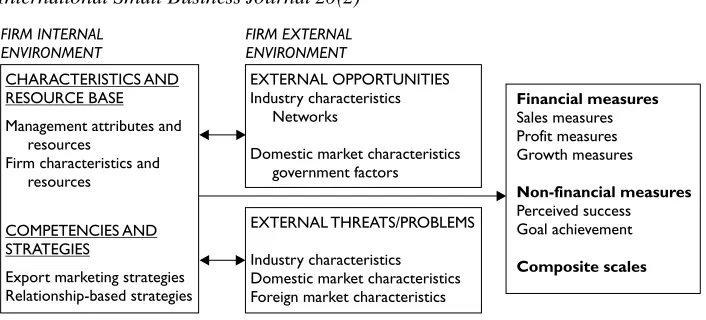
As can be seen from Figure 1, the proposed framework identifi es two broad cat-egories of factors – internal and external environmental factors – as underpinning fi rm-level export performance. The internal environment of the fi rm is conceptual-ized as comprising three sets of factors, namely management-related attributes and resources; fi rm characteristics and resource base; and, fi rm competencies and strategies, including export marketing and relational strategies. The external envir-onment is viewed as encompassing the relevant industry, domestic and foreign market environments, replete with their mixed offering of opportunities and threats/ problems. As implied by the direction of the arrows in Figure 1, these external factors are thought to have only indirect effects on fi rm export performance, through their impact on elements of the fi rm’s internal environment (Cavusgil and Zou, 1994). Export performance (defi ned along the increasingly accepted three-dimensional Experf scale – see earlier discussion) is, therefore, thought to result from the relative effectiveness of the fi rm in applying and transforming the available (or accessible) resources and capabilities into competencies and strategies that best optimize the
000-000 ISB_086574.indd 5
000-000 ISB_086574.indd 5 12/17/2007 10:28:35 AM12/17/2007 10:28:35 AM
6
opportunities in the external environment, while minimizing exposure to external threats/problems.
It is worth highlighting that these competitive resources and competencies (Piercy et al., 1998) may arise not only from the internal environment, but also from external sources. Network-related advantages, as Figure 1 shows, are a good example of factors that bridge the internal-external divide. Where the fi rm achieves signi-fi cant export performance benesigni-fi ts through its proactive roles in developing and leveraging useful inter-fi rm and fi rm-to-customer relationships, including ‘inward and outward links’ (Crick and Jones, 2000), such competency would be regarded as internal. However, where useful exporting initiatives/links are originated, instigated, activated by an outside agency (e.g. industry association or government agency), the benefi ts should be viewed as externally-derived.
Review Results
Overview of the Reviewed Studies
As indicated earlier, the review is based on 33 studies, which are summarized in Table 1. The table provides information about the size of sample; industry context of the study; type of fi rms sampled, data collection methods; response rate; analytical approaches; unit of analysis; whether an explicit theoretical basis is followed and whether hypotheses are used; measures of export performance and independent factors investigated. Twenty-four or 75% of the studies were published between 1997 and 2005, which would suggest that interest in export performance in the UK is increasing.
[image:6.542.104.457.81.241.2]Sample size varied between 10 and 1,087 refl ecting the mix of qualitative and quantitative methods used in the UK studies under review. The mail survey was the predominant data collection method and most of the mail survey studies had a sample size of more than a hundred, which appears to be adequate for the analysis undertaken. Response rates varied between 16% and 71%, with most of the studies reporting rates of more than 30%. Five studies: Oakley (1996), Katsikeas et al. (1997), Crick and Jones (2000), Keeble et al. (1998), McAuley (1999) used personal
Figure 1. A Proposed Integrative Framework of Export Performance
000-000 ISB_086574.indd 6
000-000 ISB_086574.indd 6 12/17/2007 10:28:36 AM12/17/2007 10:28:36 AM
7
T
able 1.
UK Export Performance Studies
, 1990–2005
Author
Sample size
Industr
y
type
Firm siz
e
Data collection method Response rat
e
Analytical appr
oac
h
Unit of analysis
Theor etical fr ame work Hypotheses Expor t perf ormance Independent f actor s*
Balabanis & Katisik
ea (2003) 82 _ SML sur ve y 19% path anal ysis fi rm clear y COM ENT O* TEE Beamish, et al. (1993)
106 UK 91 Canada
_ S M sur ve y 38% 26% cor relations fi rm unclear y SAL PRF EO PD
A PDS CHR
CHT MEC IO EM MP
A FT SF CR
NoM IPV
Br
o
wn and Cook
(1990) 214 m ult man uf/ser v SML sur ve y 71% fr equencies fi rm unclear n COM EO MR U PD A PDS PC
A PCC PMA
CHR MEC IO EM SF NoM IRM
Crick and J
ones (2000) 10 m ult man uf S inter vie ws – qualitativ e fi rm clear n G A C GR W PRF
CHR IO MIE FCC SCL CR NoM
Crick et al.
(2000) 100 one man uf SM sur ve y inter vie ws 72% quantitativ e fi rm clear y G A C MEC GES
Crick and Bradsha
w (1999) 180 m ult man uf/ser v SML sur ve y 36% chi-squar e fi rm unclear n COM MR U PD A PC A
PMA CHA MPB FCC IPV
Crick et al.
(2002) 152 10 m ult man uf SML Sur ve y inter vie ws 38% factor anal ysis fi rm unclear y COM GES MR U
Crick and J
ones (1999) 176 m ult man uf _ sur ve y 68% MANCO V A fi rm unclear n COM
PDS IRM (Table 1 continued)
000-000 ISB_086574.indd 7
000-000 ISB_086574.indd 7 12/17/2007 10:28:36 AM12/17/2007 10:28:36 AM
8
Author
Sample siz
e
Industr
y
type
Firm siz
e
Data collection method Response rat
e
Analytical appr
oac
h
Unit of analysis
Theor etical fr ame work Hypotheses Expor t perf ormance Independent f actor s*
Crick and Katsik
eas (1995) 55 one man uf SM sur ve y 30% per centages fi rm unclear n PRF EO MR U PD A CHR
CR IRM IPV
Crick et al.
(1994) 50 m ult man uf SML sur ve y 33% MANO V A fi rm unclear y SAL PRF MR U Eyr
e & Smallman
(1998) 32 man uf/ser v S M sur ve y 40% per centages fi rm
management frame
w
ork
tested
n
SAL
EO MIE MEE SZ FCC
Fr eel (2000) 228 m ulti man uf SM sur ve y – Mann-Whitne y ‘u’ test fi rm unclear y SAL PD A Har t & Tzokas (1999) 50 m ult man uf SM sur ve y 30% PC A ANO V A fi rm
conceptual appr
oach n SAL PRF MR U IRM Katsik
eas et al.
(1997)
66 UK 35 Bahr
ein one man uf _ inter vie ws 75% 59% MD A fi rm clear y SAL MR
U PDS CHR
MEC SF CR
K
eeble et al.
(1998) 100 m ult man uf SM inter vie ws 49% chi-squar e fi rm unclear n SAL SZ F A
FT ITI DRC
SCL IRM IPV FCC
McAule y (1999) 15 man uf/ser v S inter vie ws – qualitativ e fi rm clear n SUC
EP PDS CHR CR FCC IPV ITI
McGuinness et al (1991) 19 UK 9 Chinese 216 Chinese
m ult man uf L inter vie ws sur ve y 27% m ultiple regr ession fi rm clear n SUC
PDS PCC PMI CHR SF CR IPV
Mole and W o rrall (2001) 1000 man uf SML m ultiple sur ve ys – chi -squar e fi rm clear n G R W PD A (T
able 1 continued)
000-000 ISB_086574.indd 8
000-000 ISB_086574.indd 8 12/17/2007 10:28:36 AM12/17/2007 10:28:36 AM
9
Morgan and Katsik
eas (1998) 254 m ult man uf SM sur ve y 28% PC A fi rm clear y SAL GES MR
U MPB SZ
FA
EMC EMB MEC
GEP SF
Morgan et al.
(2003)
243 UK 198 China
m ult man uf SML sur ve y 43% 88% SEM Pr oduct/ mark et ve ntur e clear y COM
GES EP FCC
Oakle y (1996) 30 one man uf M inter vie ws – t-test Mann-Whitne y ‘u’ test Firm clear? y COM
EP PDS PMI MEC IO EM F
A
FT FCC
FR NoM
O’Far
rell et al.
(1998)
374 UK 45 S.E.
Eng.
43 Scot. 40 Neth.
ser vices SM sur ve y inter vie ws 30% chi-squar e Offi ce clear n SAL SZ F A ITI EMC
EMA EMB DM DRC
Pier
cy et al.
(1998) 312 m ult man uf SM sur ve y 35% cor relation pr oduct/ mark et ve ntur e clear n COM MR
U PDS PCC
CHR SZ FT FCC SCL CR FR
Roper & Lo
ve
(2002)
1087 UK 1190 Germ.
man uf SML sur ve y
21% UK 24% Germ.
regr ession cor reation Plant claer n SAL PDS PD A (T
able 1 continued)
000-000 ISB_086574.indd 9
000-000 ISB_086574.indd 9 12/17/2007 10:28:36 AM12/17/2007 10:28:36 AM
10
Author
Sample siz
e
Industr
y
type
Firm siz
e
Data collection method Response rat
e
Analytical appr
oac
h
Unit of analysis
Theor etical fr ame work Hypotheses Expor t perf ormance Independent f actor s*
Souchon & Dur
den
(2002)
198 UK 239 NZ
–
–
sur
ve
y
24% UK 41% NZ
spearman rho Firm unclear y COM MR U IRM Spence (2003)
113 and 52
man uf/ser v SML sur ve ys
67% , 46%
regr ession fi rm unclear y SAL
MIE SZ EP PD
A
PC
A PMA CHA CR
IPV GEP Styles & Ambler (1994) 67 m ult man uf SML sur ve y 53% t-test fi rm clear n COM MR
U PDS PCC
PMI CHA CHR SF FCC EMA EMB CR IRM IPV
Styles &
Ambler
(2000)
202 UK 232 Australia
m ult man uf SM sur ve y 36% SEM pr oduct/ mark et ve ntur e clear y COM CHR MEC
Tzokas et al.
(2000) 178 m ult man uf _ sur ve y 35% PC A fi rm clear y SAL
GES EP PCD EM
W ak elin (1998) 320 m ult man uf SML data set –
econometric model
fi
rm
clear
n
SAL
PDS SZ FT FCC ITI
W esthead (1995) 267 man uf/ser v S M sur ve y 16% logit r egr ession fi rm clear y SAL
PDS PCC MEC IO EM MEE SZ F
A
ITI
DM FR GEP
W
esthead et al.
(2004) 377 man uf/ser v S M sur ve y 43% Logit r egr ession fi rm clear y COM
GES PDS F
A SZ FCC TEE Williamson (1991) – m ult man uf SML secondar y data – fr equencies industr y unclear n SAL EP (T
able 1 continued)
*See Figur
e 2 f
or the defi
nitions of the labels
.
000-000 ISB_086574.indd 10
000-000 ISB_086574.indd 10 12/17/2007 10:28:37 AM12/17/2007 10:28:37 AM
11 interviews; while another four: McGuinness et al. (1991), O’Farrell et al. (1998), Crick et al. (2000) and Crick et al. (2002) combined personal interviews with a mail survey. A wide range of analytical approaches, ranging from simple to complex quantitative techniques and qualitative analysis, are represented. The more com-plex approaches include structural equation modelling, principal component and regression analyses. Qualitative analysis is used by McAuley (1999) and Crick and Jones (2000).
The unit of analysis in the majority of studies was the fi rm and in one instance plant level (Roper and Love, 2002). (These are mostly manufacturing fi rms – only one study investigated service fi rms). It is notable that in spite of the well-known problems associated with assessing export performance at the fi rm level, only three studies, Morgan et al. (2003), Piercy et al. (1998) and Styles and Ambler (2000), analysed activities at the product/market venture level. The study of service fi rms by O’Farrell et al. (1998) was conducted at the offi ce level. Finally, it should be noted that many of the articles published from 1997 onwards have a clear theoretical basis, suggesting there is more theoretical development later in the review period. It would seem that calls for more theoretical development of the subject are being heeded (Zou and Stan, 1998).
The Effects of Independent Factors on Export Performance
Table 2, shows the aggregate fi ndings from export performance research under-taken among UK fi rms during the 1990–2005 period. The independent factors investigated fall under four major categories, namely (1) management-related attributes and resources; (2) fi rm characteristics and resources; (3) fi rm compe-tencies and strategies (including export marketing and relational strategies); and, (4) fi rm external environmental (including industry, domestic, and foreign market) characteristics. While categories 1–3 comprise factors that are internal to the fi rm, the fourth category includes the external, largely uncontrollable factors. It is arguable that this four-part classifi cation represents a fair attempt at achieving a parsimonious and meaningful integration of the existing schemes for grouping independent export performance factors in the literature (see Aaby and Slater, 1989; Styles and Ambler, 1994; Zou and Stan, 1998). It is helpful, also, that the categories are suffi ciently fl exible to accommodate factors from several theoretical streams, including the resource-based view of the fi rm, the network/interaction theory, and the industrial organization theory.
As indicated earlier, the dependent variable is not the single, or omnibus, export performance measure used, notably, in Chetty and Hamilton’s (1993) study. Rather, this study has followed Zou and Stan’s (1998) example in ensuring that the observed effects (positive, negative, or insignifi cant) of each independent factor are specifi ed for the various dimensions of export performance explored in the UK studies under review. As Table 2 suggests, the investigated dimensions are mainly the fi nancial (export sales, export profi ts, export growth) and the composite measures. The non-fi nancial measures (perceived export success, satisfaction, goal achievement) would appear to have received less attention in UK export per-formance studies undertaken during the 1990–2005 period. Indeed satisfaction as a measure was not used in any of the studies under review.
000-000 ISB_086574.indd 11
000-000 ISB_086574.indd 11 12/17/2007 10:28:37 AM12/17/2007 10:28:37 AM
12
It is worth highlighting, also, that consistent with previous integrative reviews (Aaby and Slater, 1989; Chetty and Hamilton, 1993; Madsen, 1987; Zou and Stan, 1998), the bulk of the fi ndings on the determinants of fi rm export performance in the UK relates to the internal environment. As is evident from the latter sections of Table 2, relatively few studies reported fi ndings on the infl uence of external en-vironmental factors on export performance. This refl ects the dominant view of exporting as an internally-driven activity, and reinforces the widespread tendency to overlook (Madsen, 1987) or assume away the not easily measured effects of un-controllable external factors on export performance (e.g. Aaby and Slater, 1989).
Internal Environmental Factors
These encompass three categories of factors. The fi rst set relates to the attri-butes and resources embodied in the top management. Often-investigated variables here include management commitment, motivation, attitudes and perceptions regarding exporting, management international orientation and experience, including education. The second category of factors comprises the characteristics and resources associated with the fi rm itself, including size, age, technological and fi nancial resources and other fi rm-specifi c capabilities. The third type of internal factors – fi rm competencies and strategies – are also fi rm-specifi c, but the focus is not on resource base (as in category two), but on how effectively and uniquely these resources/capabilities are confi gured and applied to offer superior customer value and improve fi rm competitive position. Independent factors related to aspects of export marketing strategy and the relationship-based strategy have been included within this category. This is based on the understanding that strategy selection decisions generally involve conscious effort to optimize benefi ts from the resources/capabilities available or accessible (e.g. network-related advantages) to the fi rm. Aggregate fi ndings regarding each of the above categories of factors are now discussed.
Management-related Attributes and Resources Factors within this category appear to have received considerable attention within the UK export perform-ance studies reviewed. As Table 2 shows, the eight independent factors investigated were management export commitment, international orientation, export motiv-ation, management perception of export advantages, management perception of export barriers, entrepreneurial orientation, management international experi-ence, and management education/experience. A number of important conclusions can be highlighted based on the aggregate analysis. The fi rst is that favourable and supportive attitudes (including perceptions, motivations, and commitment) to exporting on the part of the fi rm’s top management seem to have strong positive effects on the export sales, export profi ts and the composite measures of export performance. This also refl ects the review evidence regarding the impact of the quality of managerial resources, including management education/background experience, international orientation and international experience, on fi rm export performance in the UK. It should be added that for management export commit-ment, international orientation and international experience, the positive fi ndings reported relate to fi nancial and non-fi nancial measures of export performance,
000-000 ISB_086574.indd 12
000-000 ISB_086574.indd 12 12/17/2007 10:28:37 AM12/17/2007 10:28:37 AM
13
(T
able 2 continued )
T
able 2.
Summary of the F
indings on the Direct Infl
uence of Independent F
actors on the Export Performance of UK F
irms
Independent var
iables
No of studies
Dependent var
iables:
expor
t perf
ormance
+ – 0
Sales Pr ofi t G ro wth Success Goal ac hie vement composite + – 0 + –0 + – 0 + –0 + – 0 + – 0 Expor t Mark eting Str ategies General expor t strateg y 6 2 – – – – – – – – – – – 1 – – 2 – 1 5 0 1 Expor t organisation 4 2 – – 1 – 1 – – – – – – – – – – – 1 3 0 2 Expor t mark eting r esear ch utilisation 1 1 4––3––––––––––– 5 – 1 1 2 0 1 Expor t planning 6 3 – – – – – – – – – – 1 – – – 2 – – 5 0 1 Pr oduct ada ptation 8 2 – 2 – – 2 1 – – – – – – – – 1 – 1 4 0 5 Pr oduct str engths 13 4 – 1 – – 1 – – – 1 – 1 – – – 5 – 1 10 0 4 Price ada ptation 3 1 – – – – – – – – – – – – – – 2 – – 3 0 0 Price competitiv eness 5 – – 1 – – – – – – – – 1 – – – 1 – 2 1 0 4 Price determination 1 1 – – – – – – – – – – – – – – – – – 1 0 0 Pr omotion ada ptation 3 1 – – – – – – – – – – – – – – 2 – – 3 0 0 Pr omotion intensity 3 – – – – – – – – – 1 – – – – – 1 – 1 2 0 1
Distribution channel ada
ptation 3 1 – – – – – – – – – – – – – – 1 – 1 2 0 1
Distribution channel relationships
1 0 2––3––1––2––1–– 4 – – 1 3 0 0
000-000 ISB_086574.indd 13
000-000 ISB_086574.indd 13 12/17/2007 10:28:37 AM12/17/2007 10:28:37 AM
14
(T
able 2 continued ) Independent V
a riables No of studies Dependent var iables: expor t perf ormance
+ – 0
Sales Pr ofi t G ro wth Success Goal ac hie vement composite +– 0 + – 0 +– 0 + – 0 +– 0 + – 0
Distribution channel type
1 1 – – 1 – – – – – – – – – – – – – – 2 0 0 Ser vice Factors 6 2 1 – 1 – – – – – 1 – – – – – 1 – 1 5 1 1 Suppl
y chain links
3 1 – – 1 – – 1 – – – – – 1 – – 1 – – 5 0 0 Customer r elationships 9 3 – – 3 – – 1 – – 2 – – 1 – – 2 – – 1 2 0 0
Number of expor
t mark ets 4 1 – – 1 – 1 1 – – – – – 1 – – 2 – – 6 0 1 Interactiv e r esear ch methods 6 2 – – 2 – – – – – – – – – – –
3 –
– 7 0 0 Interactiv e pr omotion, including visits 8 3 ––2–––––2––––– 2 – – 9 0 0 Management Expor t commitment 8 4 ––––1––––––1–– 3 – – 8 0 1 Manag ement Attitudes and Perceptions International orientation 5 2 – – 2 – – 1 – – – – – 1 – –
2 –
–
8
0
0
Expor
t motivation (pr
oactiv e) 5 3 – – – – 1 – – – – – – – – –
2 –
– 5 0 1 Mgt’ s per ceiv ed expor t advantages 1 1 ––––1––––––––– – – – 1 0 1 Mgt’ s per ceiv ed expor t bar riers 2 – 1 – – – – – – – – – – – – – – – – 0 2 0 Entr epr eneurial orientation 1 – – – – – – – – – – – – – – –
1 –
– 1 0 0 Manag ement Char acter istics
Management international experience
3 2 ––1––1–––––1–– – – – 5 0 0 Mgt. Education/experience 2 2 – – – – – – – – – – – – – – – – – 2 0 0
000-000 ISB_086574.indd 14
000-000 ISB_086574.indd 14 12/17/2007 10:28:37 AM12/17/2007 10:28:37 AM
15
Firm Char
acter
istics and Competencies
Size 9 5 1 1 – – – – – – – – – – – –
1 –
1 6 1 2 Firm’ s age 6 2 – 2 – – – – – – – – – – – –
1 –
1 3 0 3 Firm’ s technolog y 5 2 – 1 – – 1 – – – – – – – – –
2 –
– 4 0 2 Firm’ s ca pabilities and competencies 1 1 3––1––1––1––1–– 6 – – 1 3 0 0 Financial r esour ces 3 – – 1 – – – – – – – – – – – –
2 –
– 2 0 1 Industr y Char acter istics Industr
y technological intensity
5 4 – – – – – – – – 1 – – – – – – – – 5 0 0 Expor t Mark et Char acter istics Expor t mark et competitiv eness 2 – 1 1 – – – – – – – – – – – – – – – 0 1 1 Expor t mark et attractiv eness 2 1 – – – – – – – – – – – – – – – – 1 1 0 1 Expor t mark et stability – – – – – – – – – – – – – – – – – – – – – – Expor t mark et bar riers 3 – 1 1 – – – – – – – – – – – – – – 1 0 1 2 T
urbulence in external envir
onment 2 – –––––––––––––– – 2 – 0 2 0 Domestic Mark et Char acter istics Domestic mark et conditions 2 – 2 – – – – – – – – – – – – – – – – 0 2 0 Domestic r egional location /cluster 2 2 –––––––––––––– – – – 2 0 0 Go ve rnment expor t pr omotion 3 1 1 1 – – – – – – – – – – – – – – – 1 1 1 + P ositiv e eff
ect on expor
t perf
ormance
–
Negativ
e eff
ect on expor
t perf
ormance
0
No eff
ect on expor
t perf
ormance
000-000 ISB_086574.indd 15
000-000 ISB_086574.indd 15 12/17/2007 10:28:38 AM12/17/2007 10:28:38 AM
16
namely sales, profi ts, growth and goal achievement. Related factors, entrepre-neurial learning and persistence, were further observed to be associated with future exporting intention in Crick’s study of fi rms that had ceased exporting (Crick, 2004).
Only one of the eight management-related factors investigated, namely man-agement’s perception of export barriers, would seem to have a detrimental effect on UK fi rms’ export performance – specifi cally export sales and the composite measures. This is understandable given that such negative perceptions suggest lower levels of international orientation and experience, and may detract from the amount of commitment and support given by the top management to export ventures and initiatives. It is, indeed, important to highlight that as far as the export performance effects of management-related attributes and resources are con-cerned, this present review of UK evidence suggests none of those inconsistent and contradictory fi ndings widely reported in previous integrative reviews of export performance research (e.g. Aaby and Slater, 1989).
Altogether, the aggregate results on these factors, as shown in Table 2, agree with the conclusions reached in previous reviews (Aaby and Slater, 1989; Chetty and Hamilton, 1993; Ford and Leonidou, 1991; Leonidou and Katsikeas, 1996; Zou and Stan, 1998). Aaby and Slater (1989), for example, concluded that manage-ment commitmanage-ment and managemanage-ment perceptions and attitudes towards export problems and incentives are good predictors of export success. Ford and Leonidou’s (1991) review, which focused on European export performance studies, also con-cluded that exporters with high-quality, internationally oriented management are more likely to have a successful export business. Equally interesting are the simi-larities between these conclusions and the fi ndings of earlier empirical studies under-taken in the UK during the 1960s (e.g. Tookey, 1964) and the 1970s (e.g. Betro Trust Committee, 1976; Cunningham and Spigel, 1971; Fenwick and Amine, 1979).
It can, indeed, be argued that this historical consistency provides some kind of longitudinal support for the importance of management-related factors in achieving improved export performance. It seems entirely appropriate, therefore, to conclude that UK companies aiming to achieve improved export performance could benefi t from the availability, development or introduction of top management staff that are imbued with the relevant attributes, skills, orientation and resources. Export policy support should continue to focus on such capacity enhancement measures with a view to expanding the cohort of successful exporting fi rms and boosting overall export performance in the UK.
Firm Characteristics and Resources Firm characteristics and resource base seem to be good determinants of export performance in the UK. As can be seen from Table 2, the UK studies under review investigated fi ve relevant independent factors, including fi rm size, age, technological and fi nancial resources and other fi rm-specifi c capabilities. Aggregate analysis suggests that fi rm capabilities, size and fi nancial resources have strong, positive effects on various dimensions of export performance, including export sales, profi ts, growth and goal achieve-ment, as well as the composite measures. This supports Ford and Leonidou’s (1991) conclusion regarding the importance of ‘fi nancial, manpower, marketing
000-000 ISB_086574.indd 16
000-000 ISB_086574.indd 16 12/17/2007 10:28:38 AM12/17/2007 10:28:38 AM
17 and production advantages’ associated with larger fi rm size. It also agrees with the balance of relevant empirical evidence (Chetty and Hamilton, 1993; Miesenbock, 1988), which suggests the importance of size-related capabilities and resource advantages (Keng and Jiuan, 1989; Ogram, 1982; Reid, 1982; Tyebjee, 1994), par-ticularly in initiating international activity (Bilkey, 1978; Reid, 1982; Tybejee, 1994). This aggregate UK evidence adds to the strength and consistency of empirical support for the export performance implications of fi rm resource base and capabilities, reinforcing the growing realization among international business scholars of the relevance of the resource-based view in explaining the internationalization behaviour of fi rms (Bell and Young, 1998; Crick and Jones, 2000; Ibeh, 2001; Ibeh and Wheeler, 2005; Jones, 1999).
It is worth noting, however, that fi ndings on a number of independent factors, particularly fi rm age and technology, are not as consistent and as clear cut as those for fi rm capabilities, or for the management-related factors discussed earlier. For example, three of the six studies that investigated the relationship between the age of the fi rm and export performance found a positive association, while three others reported non-signifi cant effects. These mixed fi ndings support the conclusions reached in previous integrative reviews (Aaby and Slater, 1989; Madsen, 1987; Zou and Stan, 1998) that fi rms’ age and technology orientation per se are of less importance in achieving superior export performance. What seems to matter is not for how long (or how short) the fi rm has been in existence, but its relative success in acquiring key advantage-generating resources and capabilities. For some new fi rms, in certain sectors, backed by one or more internationally orientated and experi-enced decision makers (e.g. the MacDougall, Shane, and Oviatt’s [1994] inter-national start-ups, or Jones’ [1999] interinter-national entrepreneurs), this critical resource stockpile may be fast paced leading to accelerated internationalization (Burgel and Murray, 2000; Coviello and Munro, 1997; Crick and Jones, 2000; Madsen and Servais, 1997) and positive export performance. For some others, however (e.g. fi rms in traditional, culture-bound industries or from large domestic markets), the requisite export-promoting resources/capabilities may take longer to acquire, thus, leading to lower or zero levels of export performance.
The inconclusive evidence on the effects of fi rm technological level on export performance may be explained by the differences in the industries and markets covered by the UK fi rms in the reviewed studies. For example, as Bell et al. (2004) suggested, high-tech fi rms tend to have different internationalization pathways from low-tech fi rms. Given that technological intensity may have markedly dif-ferent competitive advantage implications across industries and markets, future researchers seeking to obtain clearer insights into the effect of this factor on export performance are urged to focus on fi rms from fairly homogenous industries (e.g. the high technology sector), and which target export markets at comparable level of economic development. This, indeed, echoes Zou and Stan’s (1998) earlier call for greater consideration for the context in which technology level is studied.
Firm Competencies and Strategies This section discusses aggregate UK fi ndings on the export performance effects of relevant indicators of fi rm-level compe-tencies and strategies (including export marketing and relational strategies).
000-000 ISB_086574.indd 17
000-000 ISB_086574.indd 17 12/17/2007 10:28:38 AM12/17/2007 10:28:38 AM
18
As can be observed from Table 2, some 20 independent factors were investi-gated in the UK studies reviewed. These include general export strategy, export organization, export planning, export marketing research utilization, product adaptation, product strengths, price adaptation, price competitiveness, price determination, promotion adaptation, promotion intensity, distribution channel adaptation, distribution channel type, service factors, number of export markets, distribution channel relationships, supply chain links, customer relationships, interactive research methods, and interactive promotion, including visits. For greater clarity of analysis, these variables are discussed under appropriate headings employed in previous integrative reviews, namely export marketing strategy (Aaby and Slater, 1989; Zou and Stan, 1998) and relational strategies (Styles and Ambler, 1994).
Export Marketing Strategy In general, the fi ndings reported on aspects of export marketing strategy seem to exhibit the earlier noted inconsistencies of exporting research (Aaby and Slater, 1989; Young, 1995). Nevertheless, several conclusions can be drawn based on Table 2. First, having a defi ned strategy for the fi rm’s exporting activity appears to be a good predictor of export sales. Although only six studies reported fi ndings on this variable (i.e. general export strategy), the additional favourable evidence obtained on the use of export market diversifi cation strategy and multiple internationalization modes (Crick et al., 2003)from several other UK studies underscores the importance of having a strategic orientation for achieving improved export performance. Further relevant research is needed on this factor, however, in view of the inconclusive nature of the conclusions reached in pre-vious reviews (e.g. Madsen, 1987; Zou and Stan, 1998).
The second important conclusion emerging from the aggregate analysis in Table 2 is that making a deliberate effort in planning and organizing for exporting may lead to improvements in export sales, export profi ts and in the composite measures of export performance. This fi nding refl ects the balance of previous rele-vant evidence (Aaby and Slater, 1989; Zou and Stan, 1998) and is easily explained since investment of efforts and resources in export planning and organization suggests commitment to exporting, which tends to be rewarded with favourable export performance. This is without prejudice to the observed role of chance or serendipity in the early internationalization of high-tech SMEs from the UK in more recent work by Crick and Spence (2005), an issue that is taken up in the con-cluding sections of this article.
Even more strongly supported by the reviewed UK empirical studies are a number of specifi c strategic factors and competencies, including marketing re-search utilization, product strength, and service quality. Take marketing rere-search utilization for instance. All but 1 of the 13 fi ndings reported on this variable suggested positive associations with dimensions of export performance (export sales, export profi ts, and the composite measures). The only non-supportive fi nding was a not-signifi cant effect. For product strength there were 10 positive, 4 not-not-signifi cant and no negative fi ndings. These aggregate results on export market research utilization and product strengths, also shared by previous reviews (Madsen, 1987; Zou and
000-000 ISB_086574.indd 18
000-000 ISB_086574.indd 18 12/17/2007 10:28:39 AM12/17/2007 10:28:39 AM
19 Stan, 1998), underscore the overall importance of fi rms’ competitive skills and competencies (Piercy et al., 1998) in delivering superior export performance.
It is, indeed, arguable that the identifi ed competencies are at the heart of com-petitive advantage, particularly in the international setting. To be sure, export market research utilization generally translates to greater internalisation of rele-vant knowledge regarding target export markets, including the key actors and infl uences therein. It makes sense therefore, that fi rms with requisite competencies in export market intelligence gathering and knowledge management are more likely to develop and offer products and services of appreciably superior quality, and achieve better export performance.
The impact of adaptation strategies on the export performance of UK fi rms appears to be mixed. As Table 2 shows, some neutral effects were reported for pro-duct adaptation and distribution channel adaptation while price and promotion adaptation received some support. This refl ects the lack of clear guidance on standardization/adaptation decisions from both the export behaviour and the wider international business literature (Zou and Stan, 1998). The fi ndings regarding price competitiveness are, however, more defi nitive: the mainly not-signifi cant results suggest that UK fi rms do not use pricing as a competitive tool in their ex-porting operations, reinforcing previous evidence from studies undertaken in the UK during the 1970s: Cunningham and Spigel (1971) and Michell (1979), for example, reported that successful UK exporters attached less importance to pricing-related variables such as lower price than competition and special discounts.
Relational Strategies Factors pertaining to fi rms’ competencies in managing rela-tionships and leveraging external networks/resources consistently received strong, positive endorsements from the UK studies reviewed. As can be seen from Table 2, all the investigated variables (that is, distribution channel relationships, customer relationships, supply chain links, interactive research methods, and interactive pro-motional methods, including market visits) seem to have strong positive associations with a range of export performance measures. More specifi cally, good distribution channel and customer relationships appear to impact favourably on export sales, export profi ts, export growth, perceived export success, goal achievement and on the composite measures of export performance. The adoption of interactive research methods and interactive promotion (including market visits) also seem to have similarly strong positive effects on all dimensions of export performance apart from growth.
Altogether, these findings strongly underline the importance of relational strategies as critical success factors in exporting. It should be noted that although previous integrative studies (e.g. Madsen, 1987; Zou and Stan, 1998) had concluded on the importance of channel relationships, none had reported a level of consistency and predictive strength comparable to that observed in this UK focused review. This might, indeed, suggest that relationship based strategies have been particularly critical in promoting export performance among UK fi rms during the period under review. Future integrative reviews of UK exporting research should follow up on this fi nding, to discover whether these relational variables would remain solidly positive and highly consistent predictors of UK fi rm export performance
000-000 ISB_086574.indd 19
000-000 ISB_086574.indd 19 12/17/2007 10:28:39 AM12/17/2007 10:28:39 AM
20
during the 21st century. Overall, there can be little doubt that fi rms that develop excellent relationship-creating skills, and which pursue a strategy of deploying such competencies in achieving closely managed – personal, interactive, trusting, long-term – partnerships with foreign distributors, customers, and other relevant market actors are highly likely to gain exporting success (Bell, 1995; Coviello and Munro, 1997; Crick and Jones, 2000; Hellman, 1996).
External Environmental Factors
Previous effort (e.g. Zou and Stan, 1998) to integrate fi ndings relating to the effects of the external environment on export performance has generally been organized around three categories of factors. These include the industry/market characteristics, the foreign market factors, and the domestic market characteristics. As can be seen from Table 2, few defi nite conclusions can be drawn on these factors. (The only exceptions are industry technological intensityand proximate location to a relevant cluster of fi rms). This is because of the mixed nature of the fi ndings and the generally scant attention given to external factors in UK-focused export performance research – mirroring the situation in the broader export performance and international business literature (Rao et al., 1989; Zou and Stan, 1998; Young, 2001).
Industry Characteristics The level of technological intensity in an industry seems to be a good predictor of export performance, with the fi ve UK studies that examined this factor all reporting positive associations. A likely explanation for this is that the global nature of technology-based competition (marked by high R & D invest-ments, short product life cycles, and so on) requires and challenges success-seeking fi rms in such sectors to be internationally alert/active, and to explore links aimed at achieving and maintaining their international competitiveness (Crick and Jones, 2000). This fi nding arguably strengthens the observation made earlier in this article with respect to fi rm technology level and export performance, that is, technology intensity may yield signifi cant export performance benefi ts to fi rms operating in some sectors (e.g. high technology sectors) but may be less important for others competing in more traditional industries (Bell et al., 2004). Industry-wide (rather than fi rm-level) technological intensity, therefore, appears to be a better pre-dictor of export performance (Oakley, 1996; Wakelin, 1998) among UK fi rms.
Domestic Market Characteristics The reviewed UK evidence also suggests that regional environment, including membership or proximity to a relevant cluster of fi rms, may have a favourable impact on export performance. The studies that examined the impact of this factor concluded on the favourable impact of appro-priate regional environment (O’Farrell et al., 1998) or embeddedness within a local cluster/network (Keeble et al., 1998) on fi rm export performance (Westhead, 1995). This adds to the growing body of anecdotal and empirical evidence on the import-ance of appropriate regional location (or proximity to a relevant cluster of fi rms) in improving international market performance (Brown and McNaughton, 2000).
Another domestic environment-related factor investigated in a number of the studies under review is the perceived impact of government export promotion programmes. Consistent with the balance of evidence in previous studies
000-000 ISB_086574.indd 20
000-000 ISB_086574.indd 20 12/17/2007 10:28:39 AM12/17/2007 10:28:39 AM
21 (see Leonidou, 1995), the fi ndings generally suggest low perceptions of govern-ment export promotion programmes among UK fi rms. Indeed, the three UK studies that examined the factor reported a positive effect, a negative effect and a non-signifi cant effect respectively. This suggests that despite the observed improve-ments in UK government export support programmes (Crick, 1995), they are still not favourably perceived among exporting fi rms.
The observed inverse relationships between UK fi rms’ export sales and their perceptions of domestic environmental factors (see Table 2) is worth highlighting. This supports the view of adverse conditions in the domestic market – recession, stagnation, saturation – as ‘push’ factors associated with higher export perform-ance (Bilkey, 1978; Pavord and Bogard, 1975; Rao et al., 1989). Further research is, however, required given previous contradictory fi ndings (Zou and Stan, 1998) and the scant attention paid to this area in the UK studies reviewed.
Foreign Market Characteristics Of the seven studies that reported evidence on the relationship between perceived export market attractiveness, export market barriers and foreign market turbulence and export performance, all but one indi-cated either non-signifi cant or negative effects. Styles and Ambler (1994), for example, reported that the high and low performers among UK exporting fi rms surveyed did not differ signifi cantly in terms of their perceptions of the quality of infrastructure in foreign markets. This reinforces the conclusion reached by Michell (1979) nearly two decades earlier, and adds to the totality of confl icting evidence reported on the above factors in previous exporting research (Madsen, 1987; Zou and Stan, 1998).
The aggregate UK evidence on the effect of export market competitiveness on export performance is also weak. As Table 2 shows, the two studies that investi-gated this factor respectively reported negative and not signifi cant effects on export sales. Although this evidence aligns with Ford and Leonidou (1991) who found that that keen competition in foreign markets reduces the chances for successful export operations, the confl icting nature of the conclusions reached in other integrative studies (Madsen, 1987; Zou and Stan, 1998) suggests the need for further clarifi cation.
There are grounds, however, to suspect, as this present review suggests, that UK fi rms fi nd it hard going in highly competitive export markets. In addition to the earlier discussed evidence that UK fi rms generally attach less importance to price competitiveness and market adaptation, several researchers (Bennett, 1998; McGuinness et al., 1991; Moore, 1990; Williamson, 1991) have concluded that UK fi rms compare badly with their counterparts from other advanced developed economies. McGuinness et al. (1991), for example, studied the Chinese customers’ perceptions of western companies operating in the Chinese market. They found that German and Swiss fi rms were beginning to supplant Japan at the quality end of the market, while the Italians were moving strongly into the sizeable lower quality, lower priced equipment niche. British fi rms were perceived to be worst placed: in the middle, with rather high prices and weak promotional and service activities. Williamson (1991) has also attributed the British fi rms’ relatively low and unstable share of total US imports in various product categories to their below
000-000 ISB_086574.indd 21
000-000 ISB_086574.indd 21 12/17/2007 10:28:39 AM12/17/2007 10:28:39 AM
22
average investment in local sales marketing and distribution infrastructure and much higher price volatility in the US market.
Summary, Conclusions and Implications
This article has integrated and reviewed fi ndings from previous export perform-ance research undertaken in the UK during the 1990–2005 period. It follows in the tradition of earlier country/region focused meta analyses (Bonaccorsi, 1994; Da Rocha and Christensen, 1994; Ford and Leonidou, 1991; Tesfom and Lutz, 2006), which had sought to understand aspects of export behaviour of fi rms from a given geopolitical context in order to better inform managerial and policy decision-making and facilitate improved outcomes. The study contributes at a number of levels, including being one of the fi rst attempts at consolidating the knowledge base on export performance research in the UK, an effort that seems particularly germane given the observed relative underperformance of British fi rms in outward internationalization (Beamish et al., 1993; Diamantopoulos and Schlegelmilch, 1994; McGuinness et al., 1991; Morgan and Katsikeas, 1998). Another key contri-bution relates to the study’s approach, which explicitly builds upon previous review models, constructs and independent factors (Aaby and Slater, 1989; Zou and Stan, 1998) and responds to mounting calls for a holistic view of fi rm international-ization (Bell et al., 2004;Bell et al., 2003; Crick and Spence, 2005; Ibeh, 2001).
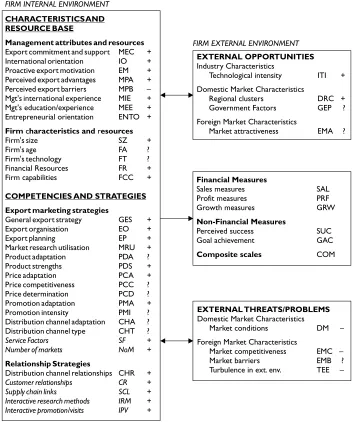
Among the main conclusions of the present review are the observed criticality of managerial, resource/competency-related, and relationship-based factors in predicting fi rm-level export performance; and the mixed, or inconclusive, export performance effects of factors, including fi rm’s age and technology level, marketing mix adaptation, and foreign and domestic market environments. These conclusions are fi rmly consistent with previous evidence from the wider export behaviour literature (Aaby and Slater, 1989; Young, 1995). Certain distinctive aspects of UK fi rms’ export behaviour were, however, observed, specifi cally their strong emphasis on relational strategies and little use of pricing and market adaptation as competi-tive tools. Figure 2, summarizes the review fi ndings.
Theoretical Implications
The summary framework represents a fair attempt at blending the better aspects of previous relevant models, notably Aaby and Slater’s (1989), Styles and Ambler’s (1994), and Zou and Stan’s (1998). It is also the case that the observed predictors of fi rm-level export performance in the UK can be explained from several theoretical angles. For example, the importance of managerial and fi rm-specifi c resources/ capabilities and competencies in promoting export performance is consistent with the resource-based viewpoint (Barney, 1991; Wernerfelt, 1984) as well as the organ-izational capability (Madhok, 1997) and strategic management perspectives (Cavusgil and Zou, 1994; Namiki, 1988; Young, 1987). The solidly favourable effects reported for relational strategies similarly echo insights from the network/interaction-based models (Axelsson and Easton, 1992; Johanson and Mattsson, 1988). Even the not-so-well supported external factors include a number of important fi ndings (on the favourable effects of industry technological intensity and appropriate
000-000 ISB_086574.indd 22
000-000 ISB_086574.indd 22 12/17/2007 10:28:39 AM12/17/2007 10:28:39 AM
23 regional location or proximity to a relevant cluster of fi rms), which underscore the relevance of the industrial organization perspective in studying export perform-ance (Zou and Stan, 1998). The foregoing thus suggests that exporting research has advanced beyond Aaby and Slater’s characterization of the fi eld ‘as a mosaic of autonomous endeavours’ (Aaby and Slater, 1989: 7).
[image:23.542.85.439.94.516.2]Overall, it can be concluded that the summary fi ndings, in Figure 2, provide con-siderable support for the view that an enlarged base of complementary theoretical
Figure 2. A Summary of Aggregate Findings on the Determinants of Export Performance Among UK Firms
000-000 ISB_086574.indd 23
000-000 ISB_086574.indd 23 12/17/2007 10:28:39 AM12/17/2007 10:28:39 AM
24
perspectives may offer richer insights into fi rm-level export performance (Bell and Young, 1998; Bell et al., 2004; Bell et al., 2003; Crick and Spence, 2005; Zou and Stan, 1998). It is gratifying also that the considerable effort invested in bench-marking the present study against the major previous reviews of export performance research has yielded a robust integrative framework, which appears to provide a fuller explanation of fi rm export performance in a UK context.
Managerial and Policy Implications
The present review fi ndings strongly suggest the need for success-seeking UK exporting fi rms to prioritize having managerial staff with the appropriate mix of pro-exporting attributes, including international orientation and experience; as well as developing fi rm-level capabilities in the areas of export market intelligence gathering, knowledge management (e.g. in planning and organizing for exporting), quality product and service delivery, and international relationship management. These conclusions have well-established and widespread empirical support (Aaby and Slater, 1989; Zou and Stan, 1998) and should, thus, command the focused attention of UK business leaders, policy makers and other stakeholders (e.g. the Confederation of British Industries [CBI], The Federation of Small Businesses [FSB]) with a keen interest in expanding the cohort of successful British exporting fi rms and improving the economic health of the UK and its regions. The envisaged intervention should broadly be aimed at targeting customized capacity building solutions particularly at smaller fi rms to enable them to overcome critical resource gaps that may constrain their international involvement and success. Such a tailored approach seems sensible given previously reported indifferent perceptions of government export support programmes among UK fi rms (Crick, 1995; Young, 1995).
Another major challenge that demands concerted public and private sector effort concerns the fi nding that UK fi rms tend to attach little importance to price com-petitiveness and market adaptation in their exporting operations. This is consistent with previous evidence from UK studies undertaken during the 1970s (Cunningham and Spigel, 1971; Michell, 1979), with the latter observation on market adaptation seemingly refl ecting the observed reluctance of UK fi rms to develop foreign lan-guage competencies (Williams and Chaston, 2004) and their use of similar strategies in both domestic and export markets (Stewart and McAuley, 2000). This observed lack of price competitiveness and market responsiveness may, at least in part, explain why British fi rms are perceived to compare badly with their counterparts from other advanced developed economies (Bennett, 1998; McGuinness et al., 1991; Moore, 1990; Williamson, 1991). The present authors, thus, call on the UK Trade International and their regional counterparts to work collaboratively with relevant private sector organizations, notably the CBI, FSB, in designing appropriate support initiatives, with the twin aims of sensitizing British exporters about their observed shortcomings and partnering them to develop and implement effective remedial strategies for their various export markets. Such public-private sector collaboration may improve the effi cacy of support programmes to the user community and obviate previous characterization of government export assistance as taking a ‘scatter-gun’ approach (Crick, 1995). It may also lead to the broadening of the spectrum of support
000-000 ISB_086574.indd 24
000-000 ISB_086574.indd 24 12/17/2007 10:28:40 AM12/17/2007 10:28:40 AM
25 provision beyond exporting, to refl ect the reality of small fi rms’ increasing use of other internationalization modes (Bell et al., 2004; Majocchi and Zucchella, 2003).
Methodological Issues and Future Research Directions
The present review suggests some methodological advancements in export behav-iour research since the last major integrative effort in the late 1990s (Zou and Stan, 1998). These include an increasing use of explicit theoretical frameworks and further progress towards complementary and holistic explanations (as opposed to the com-peting explanations observed by Zou and Stan, 1998). That said, several previously highlighted methodological concerns still persist, including the preponderant focus on the fi rm, rather than the product-market, as the unit of analysis in exporting research;the insuffi cient application of multivariate data analysis techniques and less-than-robust defi nition, measurement and testing procedures for key constructs and independent factors; the relative neglect of, and inconsistent specifi cation, of external environmental factors; the lack of clarity on the factors that have direct effects on export performance and those with indirect effects; the continuing lack of agreement on, and use of disparate, measurement scales for export perform-ance and independent factors (Lages and Lages, 2004; Sousa, 2004); the relatively low usage of non-fi nancial and subjective measures of export performance, including perceived ‘satisfaction’ (Jones and Crick, 2001; Sousa, 2004); and the low incidence of longitudinal research and coverage of service exporting.
Future researchers are urged to address the areas of concerns mentioned earlier, by, among other things, heeding earlier calls to focus on the product-market level as their unit of analysis (Sousa, 2004; Styles and Ambler, 1994); undertaking more longitudinal research to deepen understanding of the processes involved in develop-ing capabilities and competences; usdevelop-ing multivariate data analysis techniques wherever feasible, with appropriate control variables, improved construct meas-urement and properly stated validity, reliability and error levels (Zou and Stan, 1998); providing better specifi cation of the nature of the effects – direct or indirect – of particular independent factors on export performance (Zou and Stan, 1998; Williams and Chaston, 2004); making more regular use of qualitative approaches particularly for theory development; employing appropriate or multiple meas-ures of export performance, including subjective and non-fi nancial options such as perceived ‘satisfaction’ (Crick and Jones, 2001; Sousa, 2004); and studying more service exporters.
Researchers should also prioritise studies with explicit export performance implications in view of their greater potential to guide policy and managerial decision-making. This last point may be particularly helpful in improving the knowledge base on the effects of Internet usage on UK export performance, as a complement to recent research that has mainly examined the role of the Internet on fi rm’s international activities (Bennett, 1997, 1998; Hamill and Gregory, 1997; Morgan-Thomas and Bridgewater, 2004). Other interesting research issues that should be further investigated include the impact of the recent enlargement of the European regional market on fi rms’ international performance; the role of planned and unplanned strategies on fi rms’ international success (Crick and Spence, 2005); and the effects, if any, of export discontinuation or de-internationalization events
000-000 ISB_086574.indd 25
000-000 ISB_086574.indd 25 12/17/2007 10:28:40 AM12/17/2007 10:28:40 AM