This is a repository copy of ‘Only the wind hears you…’ The experiences of Pakistani girls in a primary school: An Interpretative Phenomenological Analysis.
White Rose Research Online URL for this paper: http://eprints.whiterose.ac.uk/96871/
Version: Accepted Version
Article:
Rizwan, R. and Williams, A.R. (2015) ‘Only the wind hears you…’ The experiences of Pakistani girls in a primary school: An Interpretative Phenomenological Analysis. Educational & Child Psychology, 32 (2). ISSN 0267-1611
[email protected] https://eprints.whiterose.ac.uk/ Reuse
Unless indicated otherwise, fulltext items are protected by copyright with all rights reserved. The copyright exception in section 29 of the Copyright, Designs and Patents Act 1988 allows the making of a single copy solely for the purpose of non-commercial research or private study within the limits of fair dealing. The publisher or other rights-holder may allow further reproduction and re-use of this version - refer to the White Rose Research Online record for this item. Where records identify the publisher as the copyright holder, users can verify any specific terms of use on the publisher’s website.
Takedown
If you consider content in White Rose Research Online to be in breach of UK law, please notify us by
1
“Only the wind hears you…” The experiences of Pakistani girls in a primary school:
An Interpretative Phenomenological Analysis
Abstract
The experiences of Pakistani pupils at school are little documented. This article introduced
findings from an Interpretive Phenomenological Study that investigated the experiences of a
group of Year 6 pupils from a Pakistani cultural background. It is recognised in research
focused on ethnic minority children that there are significant differences between different
ethnic groups in terms of attainment levels, social background and levels of special
educational need (DFE, 2008). However, public and political rhetoric tends to speak of
ethnic minorities as a homogeneous group. The lead author and researcher is from a
Pakistani background and as such is particularly interested in the primary school experiences
of Pakistani pupils, recognising the important part primary school plays in the life of all
young children. There is a particular focus here on how experiences of school intersect and
are interwoven with other areas of life such as peers relations, home environment and
community culture, which are all important in shaping and developing children’s sense of
who they are. This interest in exploring the Pakistani experience is timely as there is a great
deal of negative media attention surrounding Muslims characterised as “Islamaphobia”
(Ghaffar-Kucher, 2012). This negative media attention contributes to the context in which
young Pakistani school children develop a sense of self and seek a sense of place in 21st
century Britain.
Semi-structured interviews were carried out with four primary school pupils from Pakistani
backgrounds from Year Six, aged between 10 to 11 years old from the same school. The
narratives were analysed from these interviews using Interpretative Phenomenological
Analysis (IPA). IPA is an interpretative, idiographic approach to methodology which is used
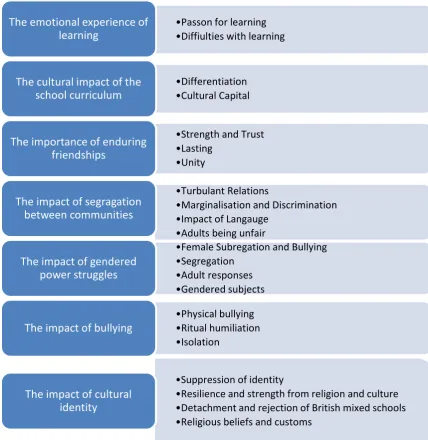
to generate super-ordinate and sub-ordinate themes. The analysis found seven super-ordinate
themes: the emotional experience of learning, the cultural impact of the school curriculum,
the importance of enduring friendships, the impact of the segregation between communities,
the impact of gendered power struggles, the impact of bullying and the impact of cultural
identity. Implications for service planning and educational psychologists are discussed.
2 Introduction
This research was developed from a feminist perspective with the specific aim of uncovering
marginalized voices and hidden experiences. Incorporating a transformative paradigm which
aims to view the meaning of knowledge through a cultural lens and examine the power
relationships which determine legitimate knowledge (Mertens, 2010). Therefore, the
relationship between the participant and researcher and the knowledge produced by their
interaction is considered interactive and characterised by cultural complexities. Indeed
Haraway (1988) argues that research should be empowering for the participants, and as such
requires reflection regarding the power relationships inherent in the research process and the
political dimension of all research. A continued consideration is required throughout the
research process of whose interests such relationships serve.
Relevant literature informing the study
Modood and Berthoud (1997) explained how ethnic minority’s presence in Britain grew
substantially through the importing of cheap labour from former British colonies in the 1960s
and 70s. These immigrants produced their own communities who wished to retain a degree
of autonomy from the mainstream society through the maintenance of their own cultural
practices. Modood and Berthoud (1997) argue that such communities assert their identities
by challenging existing power relations and demanding public acknowledgement, resources
and representation.
Mirza (1992) conducted an ethnographic study of 62 Afro Caribbean girls aged between 15
and 19 years from two comprehensive schools. She found in her studies that teachers held
negative stereotypes of black girls’ educational achievement. For example, during interviews
Mirza found that 75 percent of teachers reported at least one negative comment. One fifth
year (Year 11) teacher stated: “Most of these girls will never succeed…they are unable to
remember, the girls just can’t make it at this level (“O” level and CSE), never mind what is
demanded in higher education” (p53). Mirza (1992) found that girls did not internalise these
negative views and were aware and keen to challenge such attitudes. Gillborn (1997) points
to historical ethnographic studies in schools which revealed stereotypes held by teachers of
3
related to behaviour in school. Black pupils were seen as a threat to the order of the
classroom even when there was none. Gillborn (1997) described South Asian young people
also experiencing school as a racist institution but the stereotypes and consequences of
interactions with teachers differ greatly from Afro-Caribbean pupils. Gillborn (1997) found
qualitative studies have revealed ethnic stereotypes which have closed down educational
opportunities for young Asian people. Teachers assume such communities are run by
authoritarian, even violent males, who have no interest in the education of their children.
These views lower the expectations of teachers particularly for young Asian women. Asian
males in contrast to Afro-Caribbean’s are perceived of as having better ability and behaviour
with Asian females viewed as passive and therefore “invisible” or unimportant in relation to
discourses around ethnic minorities.
Archer (2001) uses a feminist approach to examine the identity of British Muslim boys.
Archer (2001) is critical of global preoccupations of “Muslim men”, while noting men from
Indian, Pakistani and Bangladeshi backgrounds are invisible in academic literature of “black
masculinity”. Archer (2001) conducted discussion groups with 24 British Muslims, aged
14-15 years from three schools in a medium sized town in the north-west of England. Of the
young men, 16 came from Pakistani families, six from Bangladeshi families and two were
identified from Pakistani-Kenyan backgrounds. Archer (white, British female) conducted
half of the discussions and a British-Pakistani female (Tamar) conducted the other half.
Archer (2001) found that the boys used black, Asian and Muslim masculine identities in
differing ways including as a form of solidarity against racism and as resistance to whiteness
but also as a way of differentiating themselves between black groups and to assert masculine
power. By changing the interviewer, Archer attempted to illustrate the impact this has over
the discourse. Archer found that the young men were more likely to share their more radical
views with Tamar and were more guarded with Archer. The boys tried to assert their
authority over Tamar as an Asian woman through criticism of her western identity (p90).
Archer’s study suggests that differences and contradictions in discussions between different
interviewers highlight how knowledge is produced within and through racialized and
gendered interactions between participants and researchers (2001, p99). Archer (2002)
wished to investigate claims that Muslim girls’ lack of participation in post-16 education was
due to cultural constraints or low teacher expectations and racism. Archer (2002) conducted
single sex discussion groups with 64 British Muslim males and females, aged 14-15. A
4
choices of Muslim girls and the girls own motivations for their choices. The boys would
reinforce stereotypical views of Asian girls being restricted culturally, by arguing that the
parents would decide whether a girl would attend college. Whereas the girls reported that it
was their choice to attend college and that their families encouraged post-16 education (2002,
p.367). Archer interpreted the boys’ constructions as a way of bonding the boys together as
the dominating sex and attempting to maintain the females in a traditional feminine role as
passive and without agency (2002, p.364).
Ghaffar-Kucher (2012) in her study of male and female Pakistani students in America, found
that even though Muslim participants tried to challenge negative stereotypes of Muslims, they
also played on terrorist stereotypes using humour to defy teachers and their non-Muslim
peers. Ghaffar-Kucher (2012) found that the teachers in her study viewed current students’
behaviour as more difficult than previous students. Thus, male students were viewed as
inflexible, or narrow-minded (p45). Ghaffar-Kucher (2012) found that teachers viewed
Pakistani boys as problematic and Pakistani girls as oppressed victims of Islam who would
not be allowed to go to college and would be “married off”. Such stereotypes limited the
amount of careers guidance that these girls would receive. These domesticated and
traditional stereotypes were in contrast to the actual experience of Muslims girls who
reported no such restrictions in this study (2012, p.28). Only one of the 27 girls interviewed
indicated that she could be “married off” instead of attending college (28).
Participants
A purposive approach was used to recruit year pupils in the same primary school in order to
increase the homogeneity of the sample. Four girls were recruited from the same year six
class, aged between 10 and 11 years old. Although IPA requires a homogenous sample, this
does not imply that they are identical rather it aids uniformity (for example age and social
context) so that the researcher can analyse “the pattern of convergence and divergence which
arises” (Smith, Flowers and Larkin, 2009, p 50). All the participants were born in Britain,
however, their parents (or one parent) and grandparents originated from Pakistan. All
participants engaged in a single interview in May or June 2013. The interviews followed a
5 Data Analysis
Smith et al. (2009) describe IPA as embodying certain processes and an emphasis on
understanding the participant’s view with the focus on personal meaning in particular
contexts. The analysis uses an inductive cycle through the following stages as described in
the table below:
(Smith et al., 2009, p79)
• Transcription of taped interviews
• Line by line analysis of concerns and understandings of each participant
• Identifying emerging themes within thesedata highlighting commonality and
difference for each case and then across multiple cases
• The researcher develops a “dialogue” between themselves, their themed data and
psychological knowledge to ascertain the meaning behind these concerns within this
particular context (Smith, 2004)
• A structure is developed which brings the relationships between these themes together or “gestalt”
• The organisation of this material is transparent because the analysed data can be
traced back through the process of transcription and emerging themes
• The interpretation is supported through supervision or collaboration so that it is
coherent and valid
• A visual guide such as a table or diagram to supplement the narrative of analyses
theme by theme
• Reflection of the researcher of their own perceptions throughout this process (Smith,
6 Table 1: Stages of Analysis
[image:7.595.71.500.133.574.2]The super-ordinate and sub-ordinate themes that were generated are displayed below:
Table 2: Super-ordinate and sub-ordinate themes
The super-ordinate themes are now discussed.
The emotional experience of learning
Three of the participants expressed their passion for learning in and out of school:
Like I just like writing stories, them play scripts even at home I’ve got a book and I write lots
of play scripts and stories in it. (Samina, 3.103-104)
Passon for learning Diffiulties with learning
The emotional experience of learning
Differentiation Cultural Capital
The cultural impact of the school curriculum
Strength and Trust Lasting
Unity
The importance of enduring friendships
Turbulant Relations
Marginalisation and Discrimination Impact of Langauge
Adults being unfair
The impact of segragation between communities
Female Subregation and Bullying Segregation
Adult responses Gendered subjects
The impact of gendered power struggles
Physical bullying Ritual humiliation Isolation
The impact of bullying
Suppression of identity
Resilience and strength from religion and culture Detachment and rejection of British mixed schools Religious beliefs and customs
7
I’ve never gone to Mrs Slee all these years except for, for my gold chart to show her and get
prizes (Tanya, 12.432-433)
The enjoyment of subjects at school was very clear, particularly sports and cricket which
brought the class together. However, Samina went further than just participating, she wanted
to share her knowledge in Religious Education (RE), “And when Miss Best comes in erm and
she does RE and I like it cos like I get to learn different religions and I get to share things
about Islam what I know about Islam” (2.46-48). Samina points to her own particular interest
in Islam and how she shares with the class, making the learning more personal and
meaningful. She gives an example of child-centred learning where school is not just a place
to disseminate knowledge but to gain knowledge from the pupils themselves.
The cultural impact of the school curriculum
Cultural capital was a strong sub-ordinate theme forthree participants. Trips provided value
which included arange of diverse experiencesadding to participants’ experience of school.
For Ada, school trips represented the first experience of certain animals:
“We went to I don’t remember which trip, and we went to a farm or something and I liked it
there because that was our first trip and I hadn’t been to a different trip before, that was like
the first time” (Ada, 7.246-250). “The first time” signifies the beginning of the importance
trips would have in their lives and how trips provided an added dimension to their school
experience, generating the wonder, the thrill of new experiences which produced lasting
memories.
The importance of enduring friendships
The sub-ordinate theme of unity was strong amongst the four female participants and almost
took on a political fervour. Here, Samina specifically singles out her religion and gender as
the unifying factors of her friendships, “Aaina and Zeba, Zoya, Zarina …nearly all the
Muslim girls” (13.484). Ada describes how the Muslim girls became friends, “Then
gradually we all came together. And then we were all in one group” (10.379-380). Ada
appears to suggest that all the Muslim girls became one group as a response to the hostility
and unfriendliness that was experienced from the other communities in school. Such unity
8
friendship circles, “Us Pakistani girls like we don’t like being with goray1girls er we like to
be with Pakistani girls” (10, 380-381). Ada makes a very strong statement without
self-consciousness or apology which suggests that such views are aired casually without
consequence or could be common practice amongst her friendship group.
The impact of the segregation between communities
All the participants spoke strongly about the turbulent relations that existed between the
communities at school. “I like to get well on with the Lithuanians as well but then sometimes
they don’t want to get on with me” (Tanya, 15.571-572).
Samina provides a strong visual image of the division between the communities as reflected
by the division in the playground, the other communities are on the “other side of the
playground”. Divisions are created not only culturally and linguistically but also reflected by
the environment at school. Samina also describes the unity between community members
which serve to isolate her even when she is in the right. This unity amongst community
members is consistent with Ada’s earlier proclamations of the unity amongst Muslim girls.
However, the unity amongst the white communities to subjugate Samina is not recognised as
the same unity amongst the Pakistani girls which excludes the white and other communities.
“At first the classes used to be okay, used to be till Year Three. Year Two and Year Three and
then all the Lithuanian start coming to England so…then it started going a little bit dirty and
everything” (Ada, 6.224-227). Ada provides her experience of the immigration of the
Lithuanian community. “The Lithuanians coming to England” sounds like a headline of a
tabloid paper, overheard from adults, a popular narrative in the community and the wider
society. It is ironic that Ada’s parents or grandparents would have been immigrants and may
have faced the same hostility and prejudice. It appears that Ada perceives the Lithuanians as
the reason for altering her experience of school which may be a case of lying educational
issues at the doors of another community. Or are the difficulties between communities so
great that the whole experience of school can be changed?
Segregation and Discrimination
1
9
The sub-ordinate theme of segregation and discrimination provides an uncomfortable and
emotive response from the participants and researcher. Prejudiced attitudes appeared
somewhat normalised and the researcher was also struck by how easily the participants were
able to vocalise these views, perhaps not understanding the significance or implications of
what they were saying.
“The others are friends like the Lithuanians with Lithuanians and Muslims with Muslims”
(Samina, 13.492-493). Lithuanians with Lithuanians and Muslims with Muslims remain
steadfast in their groups, secure in their own knowledge of victimization and prejudice, each
fearing the other group with similar issues.
“Now the Lithuanians go past and all the roads streets be dirty, all have rubbish on the floor”
(Ada, 7.232-233). As Ada shares a narrative depicting prejudice, it is clear that the victims of
prejudiced views of others can also mirror and perpetuate prejudice based on ethnicity and
culture difference. During the interview the researcher attempted to elicit a positive or
alternative view about other communities by asking Ada, “Has there been a time when you
have worked with the other people?” (13, 474-475). However, Ada’s reply was in a similar
vein as earlier comments, “Sometimes we work with these Lithuanians. I try to get away from
them, they nick stuff, that’s what I hate” (13, 476-477). Ada appears so problem-saturated
that she cannot envisage a different narrative about the Lithuanians. Now Lithuanians are not
only dirty they are also thieves.
However, Ada and Tanya did provide positive examples of interaction between Lithuanians
that were facilitated by the school. For example, “do you know these other two Lithuanians
they’re okay. Like sometimes when we work with them in a group, well they don’t have any
body and they be okay” (Ada, 13. 500-503). Tanya described when she worked with a
Lithuanian, “Then I went with her, I worked with her and then I got five effort points because
I worked with her because no one wanted to work with her cos they were all started being
nasty to her” (16. 591-594). Tanya found that working with this girl produced a positive
result, “she just be’s kind to me now erm she says “thank you for helping me” and then I said
“it’s alright” (16. 608-609). However, although some barriers had been broken down, Tanya
did not repeat this experience because “she wanted to work with her friend instead” (16. 604).
“They’ll be tapping me every minute like (small voice) “hickory dickory dock.” (Farah,
12.438-439) Farah provides a painful and uncomfortable description of Lithuanians
10
familiarity, a positive reminder of childhood and primary school but here it is used to cause
discomfort.
The impact of language
The sub-ordinate theme of the impact of language reveals how the discrimination that these
participants feel so strongly about and are threatened by is heightened by the Lithuanian
community having their own language. Previously, it was the Pakistanis who were the only
people who had a different, secret language as described by Ada. Lithuanians owning a
different language is perceived by a number of participants as somehow devaluing and
threatening the Pakistani pupils’ position in school.
“Some people you know like Lithuanians they, I don’t know whose learnt em but they like say
swear words in our language” (Samina, 6.213-214). Samina is outraged by someone from
another community understanding and using her language. The fact that swear words are
being used in her language reinforces her sense of moral outrage at this injustice. Samina
cannot envisage another community understanding her language and even worse, swearing.
Samina does not equate learning her language by someone from another community in the
same vein that a person could be interested in for example, French and learning the language.
The impact of gendered power struggles
The girls spoke about the systematic undermining and bullying that the boys caused in class,
“I sit with a boy and he always says it and like whenever if I do something wrong or any time,
he just starts saying “pancake face” or “burnt pancake” things like that” (Samina,
5.185-187). The word “pancake face” produces a strong visual image, something which is
overdone, damaged, marked, unappetising and inedible. The connotations of “pancake face”
are deeply insulting with racist leanings which could be seemingly innocent for teachers but
Samina is well aware of its origins and intentions to hurt, wound and damage her self-esteem
and confidence.
Tanya pinpoints why she is being victimized, “Then they still carry on, they think that like
just because I’m quiet then I won’t say anything to them” (13, 468-470). Tanya is quiet in
11
her quietness which turns her into a victim, the compliance with school rules and an emphasis
on school achievement will not protect her from the constant attacks from her male peers.
Loud and rebellious versus quiet and compliant, the latter learning type appears to be valued
in school but is helpless in the face of the harsher realities of bullying and sexism. Tanya
believed that being loud would prevent the bullying.
Gender Segregation
Perhaps the most shocking and surprising finding in my analysis was the stark segregation
between males and females which is counter parted by the segregation of the communities in
school. “I used to go to a different mosque but then my dad said it’s not good for me to get
teached by a boy because I’m a bit old now so I should go to a girl mosque teacher” (Tanya,
18.672-674). Tanya describes a gender distinction; which creates divisions and differences
between sexes.
“Girls like in different side and boys in different side” (Samina, 10.364). Samina actively
proposed a separation of boys and girls without understanding that this act itself could be the
cause of her further subjugation which runs contra to the ethos of mixed, mainstream
teaching in British schools. Such separations occur in single sex or faith schools but go
against current, inclusive educational ethos. Samina in her statement describes the troubled
relationships between genders, hinting at female subjugation and oppression by males.
Samina goes into great detail as to why she would like the separation of boys and girls, which
does not appear to be limited to cultural or demands made from the family:
Because boys are quite mean to girls and they just I don’t like boys anyway cos they’re just
nasty they never listen to yer. Like Ali sits next to me and then he never listens like if I want to
do something, you have to be partners, he never lets me do anything. Then I have to like move
to like someone else’s group and it’s not fair for like the other girls cos they get like bullied
and everything but the boys they’re just fine they don’t have any problems. It’s mostly girls
12 The impact of cultural identity
Ada provided a highly charged and passionate account of a Muslim boy ripping the Pakistan
flag, “Bilal, he’s a Muslim as well, I don’t know why he ripped it but he ripped it, no, they
ripped it the Pakistan flag and they punched the Saudi Arabia flag (4.132-134). It was a
personal attack on Ada’s identity and the origins of Muslims (Saudi Arabia) which was
deliberate and calculated. Ada found the ripping of the flags inexplicable because Bilal was
also a Muslim. Ada repeats the ripping of the flags which reinforces the shock and outrage of
this violent action. Ada cannot reconcile a Muslim committing this crime of destroying
Islamic symbols. Ada’s response appears similar to the well-known cases of The Satanic
Verses and the Dutch cartoon causing outrage amongst Muslims throughout the world for
insulting the religion.
Farah positively explodes with emotion when describing her distaste of school uniforms,
“We’re supposed to express who we are, not blumin brown t shirt and things like that! I just
don’t like it, I don’t like school uniforms” (7.232-233). Farah shows awareness of the school
uniform supressing her self-expression –she is deeply resentful of the “brown t shirt”, uses
“blumen” to further emphasise the point, freeing her from formal language and the formal
uniform. The school uniform represents a stifling of personality, creativity and enjoyment,
reflecting what the school represents. “Like even if we go to my auntie’s house, they’ll be like
wearing makeup and like rings and tiaras and everything. (Both laugh) We’d be wearing all
that and I’m like proper girly girl (laughs)” (7, 252-255). It is dramatic forFarah to wear all
her jewellery. The feminine act of wearing jewellery evokes soft, gentle stereotypes but
Farah does not appear to embody such stereotypes. “I get to like let myself out, I don’t have
to be trapped inside the body that looks like a school kid” (7, 268-269). Being trapped is a
very strong image representing her strong views about school uniform. Farah is trapped
against her will, she cannot get out and she feels supressed and oppressed. Farah appears to
be struggling against more than just the uniform. Farah states she does not want to look like
a school kid but she is attending school and is a primary aged pupil. Farah seems to be
articulating the struggle of adolescence where she has the body of a school child but wants to
13 Discussion
The data for the current study was taken from a small non-representative sample of Pakistani
young people in the same school. Further exploration is required to validate the sub-ordinate
and sub-ordinate themes that emerged from the analysis. However, the analysis revealed a
rich, varied and complex picture of the experiences of young Pakistani girls in school. The
study also demonstrates the validity of using primary aged pupils in research to explore the
views of ethnic minorities and their ability to give voice to their experiences and cultural
complexities.
The themes found in the research resonate with previous studies with older young people,
such as Archer’s studies (2001, 2002).The participants singled out the boys from their own
ethnicity as subjugating them which suggests the tensions between genders are related to
culture and the oppression of females of one’s own community raises questions about the
motivations of those Pakistani males. For Farah and Ada single sex and single faith schools
are the answer. As mentioned earlier in the literature review Archer’s (2002) study on British
Muslim girls’ and boys’ discursive constructions of post-16 educational choices may shed
light on perceived gender and ethnic difficulties.
The analysis revealed how the young girls tried to make sense of their everyday experiences
through the intersectionality of gender and cultural influences. The key super-ordinate
themes reflected the variety of ways the girls’ viewed themselves and struggled to understand
the complex world around them including; the emotional impact of learning; the difficulties
with different communities; the strength of friendships; conflicting gender relations and pride
in one’s own culture. The multi-stranded narratives that the young girls produced provides a
challenge to the stereotypes of Pakistani females as passive as reported by Gilborn, (1997), or
the teachers perceptions of Pakistani females as being “married off” quickly instead of
attending college in Ghaffar-Kucher’s (2012) study or without agency as described by the
boys in Archer’s study (2002).
Implications for Educational Psychologists
14
Educational Psychologists (EPs) have the potential to increase school staff’s awareness of
young people who have English as an additional language (EAL). English as an additional
language (EAL) issues were touched on in this study. EPs have an important role to play in
working with school staff to ensure the curriculum is accessible to ethnic minority students
with literacy difficulties. The work of Cummins (1986) and Baker (2001), on the importance
to English language acquisition of continuing with first language speaking and learning could
be incorporated in literacy interventions. It is also important to find out if young people have
difficulties with their first language which may be impacting upon their learning and
understanding of English and literacy. Even if young people from different ethnic groups
have been attending British schools for a long time, EAL issues can still remain.
Encouragement of first language use and empowerment in cultural identity can have an
impact upon school learning as well as greater engagement with school (Fredricks,
Blumenfeld and Paris, 2004). My study illustrated the social impact of the accepted first
language use by Lithuanians and not by Pakistanis as a way of further dividing the
communities.
Greater awareness of school engagement could be promoted and the potential of schools to
increase social and cultural capital particularly in areas of high deprivation as discussed by
Towery (2007). Towery (2007) also points to the transformatory powers of education to
break down racial and gendered practices, which highlights how schools can create change
and emancipation for teachers and pupils. Consultations, planning meetings and training
events with school staff could be potential spaces within which to transmit these messages. A
multi-agency approach could also be used with the links that EPs have to other services such
as the Learning Support Service and Educational Welfare. Increased engagement is also
linked to lower dropout rates and school absences which would prove invaluable for young
people and their education (Wehlage, Rutter, Smith, Lesko and Fernandez, 1989). The
present research could also be added to the research already carried out on parent and child
voice with the added dimension of considering ethnicity and gender when hearing voice.
Implications
The analysis revealed the variability of the experiences and views of these four girls which is
a powerful reply to the stereotyped images of Pakistani people that may exist (Gillborn, 1997
15
school and how they relate or do not relate to the practices in school. The Pakistani young
people viewed themselves as different and took pride in their autonomy from school which
was particularly evident in the super ordinate theme of the impact of cultural identity.
Therefore, it may be helpful for practitioners to consider and include the feelings of Pakistani
young people regarding the mosque, religion and culture as part of their everyday experience
and not just educational achievement in school.
My research has raised the question of the researcher’s ethnicity in my own Educational
Psychology Service (EPS) and that if another EP from a different ethnicity would have
produced as a rich narrative. A co-researcher from the same background as the participants is
a very useful tool because they will have access to “insider knowledge” of any language
differences and subtle cultural nuances and traditions that people from other backgrounds
may not share and so provides a reflective and reflexive counterpart. The challenge for EPs
is how the findings of this study can be translated to practice, particularly when interpreting
or assessing a young person from ethnic minorities. It is important for EPs to reflect on any
assessments or narratives around ethnic minorities with sensitivity to their particular culture
which may be more pertinent to them, may not be an issue or take a more nuanced position.
It may be necessary to ensure that the structures and systems are in place in the EPS to ensure
such reflection can take place. For example, are there members of the same community the
EP can check out certain findings with or reflect on certain narratives about the young person
or their family within their particular cultural and linguistic context? Having a co-researcher
or person with insider knowledge presents a shift towards a more post-modern view of the
child as an active agent rather than a passive object. Young people will adopt positions with
different people but may not disclose certain issues with other people.
The relevance of the positionality and appearance of the researcher impacts on the
engagement and the type of relationship that emerges which has important implications for
EPs at a service level.
EPs may be able to promote the systems in school which promote transparency around
decisions regarding disputes amongst young people which include checking out with pupils
in order to ensure they are appreciated and have understood the messages.
EPs can be involved with illuminating the gender bias that may exist between boys, girls and
the teachers. EPs can deliver interventions which promote the self-esteem of young girls
16
research. The participants were assertive about the inequalities that they felt existed, does
this position continue through secondary school and beyond?
Finally, what emerged from this study is the importance of listening to girls from Pakistani
backgrounds in order to gain a better understanding of the impact of their gender and
ethnicity on their experience of school.
REFERENCES
Archer, L. (2001). 'Muslim Brothers, Black Lads, Traditional Asians': British Muslim Young
Men's Constructions of Race, Religion and Masculinity. Feminism &
Psychology, 11, 1, 79-105.
Archer, L. (2002). Change, Culture and Tradition: British Muslim pupils talk about Muslim
girls’ post-16 “choices”. Race, Ethnicity and Education, 5, (4), 359-376.
Baker, C. (2001). Foundations of bilingual education and bilingualism. Clevedon, England:
Multilingual Matters.
Cummins, J. (1986). Empowering minority students: A framework for intervention. Harvard
educational review, 56 (1), 18-37.
Department for Education (DfE) (2008). Raising the attainment of Pakistani, Bangladeshi,
Somali and Turkish heritage pupils: Guidance for developing inclusive practice. The
National Strategies.
Fredricks, J., A., Blumenfeld, P.C., Paris, A.H. (2004). School engagement: potential of the
concept, state of the evidence. Review of Educational Research, 74, (1), 59-109.
Fuller, M. (1980).“Black girls in a London comprehensive school”. In R. Deem (Ed.).
Schooling for Women’s Work. London: Routledge, and Kegan Paul.
Ghaffar-Kucher, A. (2012). The Religification of Pakistani-American Youth.American
17
Gillborn, D. (1997). Ethnicity and Educational Performance in the United Kingdom: Racism,
Ethnicity, and Variability in Achievement. Anthropology & Education
Quarterly, 28, 3.
Haraway, D. (1988). Situated knowledge: The science question in feminism and the privilege
of partial perspective.Feminist Studies, 14 (3), 575-599.
Mertens, D.M. (2010). Research and Evaluation in Education and Psychology: Integrating
diversity with quantitative, qualitative, and mixed methods. London: Sage.
Miles, R. (1989). Racism. London: Routledge.
Mirza, H.S. (1992). Young, Female and Black. London: Routledge
Modood, T., & Berthoud, R. (1997).Ethnic minorities in Britain: Diversity and
Disadvantage. London: Policy Studies Institute.
Smith, J.A. (2004). Reflecting on the development of interpretative phenomenological
analysis and its contribution to qualitative research in psychology.Qualitative
Research in Psychology, 1, 39-54.
Smith, J.A. (2007). Hermeneutics, human sciences and health: Linking theory and practice.
International Journal of Qualitative Studies on Health and Wellbeing, 2, 3-11.
Smith, J. A., Flowers, P. & Larkin, M. (2009). Interpretative Phenomenological Analysis:
Theory, Method and Research. London: Sage Publications Ltd.
Towery, I.D. (2007).Fostering Gender equity in schools through reflective development: A
Critical Analysis of Teacher Perspectives. Penn GSE Perspectives on Urban
Education, vol. 5, Issue 1.
Wehlage, G.G., Rutter, R.A, Smith, G.A., Lesko, N.L., & Fernandez, R.R. (1989).Reducing