
August 2016
A thesis submitted for the degree of
Doctor of Philosophy
of The Australian National University by
Charlotte Kirsty Rouse
Research School of Chemistry
The Australian National University, Canberra, Australia
Supramolecular
Devices and
Author’s Statement
This is to declare that the work in this thesis represents original work that I have undertaken during my Ph.D. degree at the Research School of Chemistry, The Australian National University from 2012 to 2016, with the following exceptions; the crystal structure of compound 83 reported in Chapter 4 was obtained, solved and refined by Dr Paul Carr at The Australian National University, and the rheological, AFM and FT-IR analysis of compound 112 in Chapter 7 was performed by Dr Adam Martin at The University of New South Wales.
To the best of my knowledge, the thesis does not contain material that has been published or written by another person or accepted for the award of any other degree or diploma in any other university or tertiary institution, unless due reference has been made in the text. All figures that do not cite permission to publish are my own work.
I give consent to this copy of my thesis, when deposited in the University library, being available for loan or photocopying.
iv
Acknowledgements
First and foremost I would like to thank Professor Chris Easton for his excellent supervision during my Ph.D. studies. Not only has he provided guidance and support, he has also allowed me the independence to explore my own ideas and has always pushed me to achieve more.
I am also indebted to Dr Hideki Onagi who has been a constant source of advice throughout this project and whose dedication to research is an inspiration. Thank you also to all the past and present members of the Easton group, particularly Dr Lee Alissandratos, Dr Hye Kyung Kim and Dr Tim Altimore for their insightful discussions and whose input has been invaluable.
Thank you to the RSC staff, particularly Anithahini Jeyasingham, Chris Blake and Dr Paul Carr for your fantasic support.
Thank you to Professor Pall Thordarson and Dr Adam Martin at The University of New South Wales for your contribution and collaboration.
Thank you to Dr David Fulton at the University of Newcastle upon Tyne, whose mentorship and encouragement during my undergraduate studies initiated my interest in supramolecular chemistry and without whom I would not have even considered studying for a Ph.D.
Thank you to my family; mum, dad and Jordan, and Daniel Bartkus for your unerring support and belief.
v
Conference Presentations
Charlotte K. Rouse, Hideki Onagi, Stephen F. Lincoln, Christopher J. Easton,
‘Self-Assembly of a Metal Receptor via Peptide Structure Modification’ poster presentation,
Self-Assembly and Supramolecular Chemistry Gordon Research Conference, 2015, Lucca,
Italy
Charlotte K. Rouse, Hideki Onagi, Stephen F. Lincoln, Christopher J. Easton,
‘Self-Assembly of a Metal Receptor via Peptide Structure Modification’ invited oral presentation, Self-Assembly and Supramolecular Chemistry Gordon Research Seminar, 2015, Lucca, Italy
Charlotte K. Rouse, Hideki Onagi, Stephen F. Lincoln, Christopher J. Easton,
‘Modification of Peptide Structure by Cyclodextrin-based Molecular Machines’ oral presentation, RACI National Congress, 2014, Adelaide, Australia
Charlotte K. Rouse, Hideki Onagi, Stephen F. Lincoln, Christopher J. Easton,
‘Modification of Peptide Structure and Function’ oral presentation, RACI NSW Branch
Organic One-Day Symposium, 2014, Canberra, Australia
Charlotte K. Rouse, Hideki Onagi, Stephen F. Lincoln, Christopher J. Easton, ‘Peptidic
vi
Abstract
This thesis describes work towards the development of a range of supramolecular devices and materials based on cyclodextrin host-guest interactions, and/or short peptide structures.
The first such device targeted was a photoswitchable molecular lariat composed of a [c2] (cyclic, two-component) asymmetric daisy chain. Upon combining the two hetero monomer units it was found that a [c2]-dimer was not formed.
The next phase of research involved the design of a second type of supramolecular device, also based on cyclodextrin host-guest inclusion complexes, this time serving to produce a change in peptide secondary structure. A range of devices were synthesised giving several modifications; increasing the stability of hexavaline -sheets, reducing the PPII (polyproline type II) helicity in pentaalanine and introducing -sheet character to pentaalanine. Furthermore, an azobenzene moiety was introduced as a photo-switchable cyclodextrin guest, enabling PPII helicity to be switched between states of increased and decreased structure via photoirraditation.
vii
A number of smaller studies were also performed to explore the possibility of the application of peptide chemistry techniques and principles to supramolecular concepts. The solid-phase synthesis technique used to make peptide sequences was investigated as a method for the preparation of rotaxanes. Despite several attempts no interlocked structures were synthesised, however a method was established for the mobilisation of a cyclodextrin onto a stationary phase. -Sheet peptide-peptide interactions, in conjunction with cyclodextrin host-guest interactions were then explored as a method for the generation of self-assembling polymers. A range of polymeric structures were considered, however within all the systems examined it was found that none formed.
viii
Glossary
chemical shift (ppm)
°C degrees Celsius
2D two-dimensional
3D three-dimensional
ADP adenosine diphosphate AFM atomic force microscopy
Ala alanine
ATP adenosine triphosphate
AU arbitrary unit
Boc di-tert-butyl dicarbonate BOM benzyloxymethyl acetal
BOP benzotiazol-1-yloxy-tris(dimethylamino)phosphonium hexafluorophosphate (Castro’s reagent)
br broad
C2D2Cl4 deuterated tetrachloroethane
ca. circa
calcd calculated
CD cyclodextrin
CD CX cyclodextrin carbons, X = 1-6 CD HX cyclodextrin protons, X = 1-6
CD OHX cyclodextrin hydroxyl protons, X = 1-6 CD3OD deuterated methanol
CDCl3 deuterated chloroform
cGMP cyclic guanosine monophosphate
cr crude
D2O deuterium oxide
DCL dynamic combinatorial library
DCM dichloromethane
dec. decomposition
ix DIPEA diisopropylethylamine DMAP 4-dimethylaminopyridine DMF N,Nʹ-dimethylformamide DMSO dimethylsulfoxide
DMSO-d6 deuterated dimethylsulfoxide
DMTMM 4-(4,6-dimethoxy-1,3,5-triazin-2-yl)-4-methylmorpholinium chloride DNA deoxyribonucleic acid
eq equivalents
ESI electrospray ionisation et al. et alia
Et2O diethyl ether EtOAc ethyl acetate
Fmoc fluoroenylmethyloxycarbonyl
G Gibb’s free energy
g gram
GDP guanosine diphosphate
Gly glycine
GTP guanosine triphosphate
H enthalpy
HBTU N,N,Nʹ,Nʹ-tetramethyl-O-(1H-benzotriazol-1-yl)uranium hexaflurophosphate
His histidine
HOBt hydroxybenzotriazole HOD mono-deuterated water
HOMO highest occupied molecular orbital HPLC high performance liquid chromatography
h hour
HRMS high-resolution mass spectrometry
Hz hertz
ITC isothermal titration calorimetry
J coupling constant
x
Ka association constant
Kd dissociation constant
LC-MS liquid chromatography mass spectrometry lit. literature
LR low resolution
LUMO lowest unoccupied molecular orbital
M moles per litre
m.p. melting point
m/z mass-to-charge ratio
M+ molecular ion
MeCN acetonitrile
MeOH methanol
mg milligram
mgc minimum gel concentration
min minutes
mL millilitres
mol moles
n number of molecules
nm nanometre
NMP N-methyl-2-pyrrolidone NMR nuclear magnetic resonance nOe nuclear Overhauser effect
PA peptide amphiphile
pKa logarithmic acid dissociation constant PPII polyproline type II helix
R gas constant
Rf retention factor
ROESY rotating-frame Overhauser effect spectroscopy
RT room temperature
S entropy
xi TLC thin layer chromatography
Tm mid-point transition
TNBS 2,4,6-trinitrobenzenesulfonic acid
Tos tosylate
tR retention time
TSPA-d4 deuterated (trimethylsilyl)-3,3,2,2-tetradeuteropropionic acid UV-vis ultraviolet-visible
v volume
Val valine
xii
Contents
Chapter 1: Introduction ... 1
1.1 Supramolecular Chemistry ... 1
1.2 Non-Covalent Interactions ... 7
1.3 Cyclodextrins ... 14
1.4 Cyclodextrin-Based Molecular Switches ... 20
1.5 Molecular Switches in Nature ... 26
1.6 Combining Peptidic and Non-Peptidic Supramolecular Entities ... 28
1.7 Self-Assembling Polymers and Daisy Chains ... 46
1.8 Aims of the Project ... 52
Chapter 2: Results and Discussion ... 56
Attempted Synthesis of a Photo-Responsive Molecular Lariat 2.1 Introduction ... 56
2.2 Synthesis of the Molecular Lariat Components ... 57
2.3 Attempted Synthesis of the Molecular Lariat ... 63
2.4 Conclusions ... 74
Chapter 3: Results and Discussion ... 76
Molecular Devices that Elicit Change in Peptide Secondary Structure 3.1 Introduction ... 76
3.2 Synthesis of a Peptide Structure Photo-Switch ... 77
3.3 Effect of the Strength of the Cyclodextrin Host-Guest Interaction ... 92
3.4 Thermodynamics of Peptide Structure Transition in Molecular Devices ... 101
3.5 Synthesis of a System wherein Cyclodextrin Complexation Enhances Peptide Structure ... 107
3.6 Conclusions ... 115
xiii
Self-Assembly of a Peptidic Zinc-Binding Site
4.1 Introduction ... 117
4.2 Design of the Peptide Sequence ... 118
4.3 Attempted Synthesis of Host-Peptide-Guest Constructs by Coupling of Peptide Segments ... 120
4.4 Attempted Synthesis of an -Cyclodextrin-Peptide-Azobenzene Construct ... 124
4.5 Attempted Synthesis of a -Cyclodextrin-Peptide-Adamantane Construct ... 126
4.6 Synthesis of an -Cyclodextrin-Peptide-Octane Construct ... 127
4.7 Synthesis of a Control Peptide ... 133
4.8 Self-Assembly Behaviour of the -Cyclodextrin-Peptide-Octane Construct ... 134
4.9 Effect of Complex Formation on Peptide Structure in the -Cyclodextrin-Peptide-Octane Construct ... 141
4.10 Determination of Zinc Metal-Binding Capabilities of the -Cyclodextrin-Peptide-Octane Construct ... 143
4.11 Crystal Structure of the Zinc Metal-Binding -Cyclodextrin-Peptide-Octane Construct ... 147
4.12 Conclusions ... 153
Chapter 5: Results and Discussion ... 155
Options for Solid-Phase Synthesis of Cyclodextrin Rotaxanes 5.1 Introduction ... 155
5.2 Attempted Daisy Chain Synthesis from a Guest-Modified Resin ... 156
5.3 Attempted Daisy Chain Synthesis from a Cyclodextrin-Modified Resin ... 159
5.4 Attempted Daisy Chain Synthesis with an Extended Cyclodextrin-Resin Linker 162 5.5 Attempted Rotaxane Synthesis with an Azobenzene Guest... 165
5.6 Attempted Rotaxane Synthesis with a TNBS Stoppering Reagent ... 166
5.7 Attempted Rotaxane Synthesis on Wang Resin ... 168
xiv
5.9 Conclusions ... 170
Chapter 6: Results and Discussion ... 172
Self-Assembling Polymeric Systems 6.1 Introduction ... 172
6.2 Study of an -Cyclodextrin-Azobenzene, -sheet Self-Assembling Polymer ... 172
6.3 Study of a -Cyclodextrin-Azobenzene, -sheet Self-Assembling Polymer ... 176
6.4 Second Study of an -Cyclodextrin-Azobenzene, -sheet Self-Assembling Polymer ... 177
6.5 Study of a -Cyclodextrin-Azobenzene, -sheet Self-Assembling Polymer ... 179
6.6 Study of a bis -Cyclodextrin-Adamantane, -sheet Self-Assembling Polymer . 181 6.7 Conclusions ... 183
Chapter 7: Results and Discussion ... 185
A Peptide Amphiphile Organogelator 7.1 Introduction ... 185
7.2 Gelation Behaviour ... 186
7.3 Rheological Properties of the Gel ... 189
7.4 Effect of Gelation on Peptide Structure ... 191
7.5 Structure-Property Relationships ... 194
7.6 Conclusions ... 196
Chapter 8: Conclusions and Future Work ... 198
Chapter 9: Experimental Methods ... 202
9.1 General Methods ... 202
9.2 Experimental for Chapter 2 ... 206
9.3 Experimental for Chapter 3 ... 214
9.4 Experimental for Chapter 4 ... 223
9.5 Experimental for Chapter 5 ... 242
xv
9.7 Experimental for Chapter 7 ... 255
Chapter 10: References ... 258
Appendix A ... 268
Appendix B ... 270
1
Chapter 1:
Introduction
1.1 Supramolecular Chemistry
‘If atoms are letters, molecules are the words, supramolecular entities are the sentences and the chapters’ so Jean-Marie Lehn1 analogised the field of supramolecular chemistry or ‘chemistry beyond the molecule’. Just as words can be arranged to create meaning, supramolecular chemists can arrange molecules to create devices and materials that go beyond the scope of size, complexity and capabilities that can typically be achieved with conventional single molecule chemistry.
Following Lehn’s likeness of chemistry to language, the grammatical rules that govern the organization of words can be compared to the connections that control the way in which molecules interact. Supramolecular chemistry therefore focuses on the study and control of what is between molecules, that is intermolecular interactions. Although typically much weaker than covalent, intramolecular bonds, non-covalent intermolecular interactions can be combined in a cooperative fashion to produce strong attractive forces,2 similar to the way in which Velcro works (Figure 1.1).
Figure 1.1 Weak, non-covalent bonds can be combined cooperatively to create strong interactions similar to the
way in which Velcro works.2 Reproduced with permission from Nature Publishing Group.
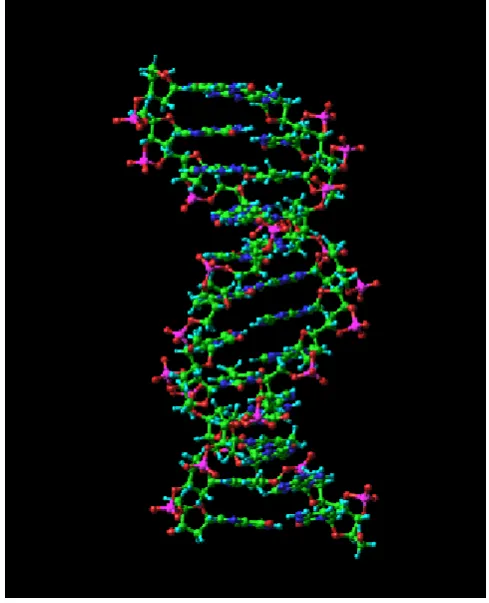
This strategy allows for the formation of complex, stable molecular architectures which still remain thermodynamically responsive.3, 4 Life itself relies upon such construction, as in the DNA double helix (Figure 1.2) which is held together by hydrogen bonds but
Multiple copies of a guest functionality are displayed
on a surface
Multiple copies of a complementary host are
displayed on another
The two surfaces may interact through many simultaneous binding
events
Multiple low-affinity interactions act in concert to
2
[image:18.595.146.391.167.469.2]can be readily unzipped to enable essential processes such as transcription and replication to occur. This disruption of the hydrogen bonds between DNA strands can also be achieved thermally in a process termed as ‘DNA melting’, as used in the polymerase chain reaction (PCR) DNA amplification technique.5
Figure 1.2 The DNA double helix is held together by many weak hydrogen bonds.6 Reproduced with permission
from Elsevier.
3
[image:19.595.114.541.462.754.2]arrangement is termed ‘self-assembly’ and is an integral aspect of supramolecular chemistry.9
Figure 1.3 DNA assembles via hydrogen bonding between complementary base pairs. Adenine binds to thymine
(above) and cytosine binds to guanine (below).
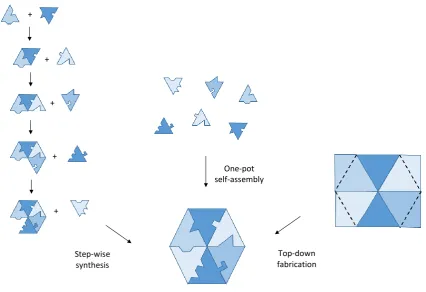
Self-assembly is a ‘bottom-up’ approach to synthesis, beginning from the smallest construction materials possible and using them as building blocks. As this is usually a one-pot procedure, it is much quicker than traditional step-wise methods to reach nano-sized structures with high complexity (Figure 1.4).
Figure 1.4 Different strategies towards the synthesis of nano-sized structures.
Adenine Thymine
Guanine Cytosine
One-pot self-assembly
Step-wise synthesis
Top-down fabrication +
+
+
+
4
‘Top-down’ fabrication methods, namely lithography, have also been traditionally used for nano-scale synthesis. In 1985 Tom Newman collected one of Richard Feynman’s US$1,000 prizes by writing the first page of Charles Dickens’ ‘A Tale of Two Cities’ on a 1/25,000 scale using electron beam lithography (Figure 1.5).10 The letters were about 75 nm in height, the scale required in order to write the entire Encyclopedia Brittanica on the head of a pin. Current techniques can now etch 1.5 nm letters,11 however the self-assembly in supramolecular chemistry offers construction down to the same magnitude but with molecular-level resolution, as well as the potential for three-dimensional structures around the full 360° (as they do not require a solid surface), and the formation of mechanically interlocked species.
Figure 1.5 Lithographic techniques to etch the smallest letters possible in 1985 (left)10 and 1992 (right).11
Reproduced with permission from AIP Publishing LLC and Elsevier.
The combinatorial approach in supramolecular chemistry not only allows access to large molecules, but also high complexity systems. If we have 𝑛 molecules in a system, there are 𝑛(𝑛+1)2 possible interactions between them all (including interactions with themselves), and if sequence is applied for example in a polymer chain, there are 𝑛! possible combinations of these molecules. This allows for an immense amount of information storage using comparatively simple components and is seen in biological systems; entire genetic codes are written using just four DNA bases, and proteins with diverse functions are constructed using combinations of just twenty amino acids.
5
systems, termed dynamic combinatorial libraries (DCLs).12 As DCLs can then adapt to the addition of a material, e.g. a bioactive substance, specifically optimised combinations are generated which can then be isolated via an irreversible reaction (Figure 1.6).13 The formation of these optimum arrangements are not as a statistical distribution, rather they are selected for by way of specific intermolecular interactions, spontaneously forming the most thermodynamically stable product.
Figure 1.6 Templation of a dynamic combinatorial library.14 Reproduced with permission from the Royal Society of
Chemistry.
Nano-scale structures feature unique supramolecular functionalities that are not apparent at either the atomic scale or micrometre scale, and are also the size range at which biological compounds operate (Figure 1.7). They are large enough to attain sophisticated, emergent functionalities that are simply not possible with small molecules, but are small enough that effects such as equilibrium, Brownian motion and viscosity are still applicable. Forces such as friction and gravity are limited, yet it is possible for nano-sized compounds to have an effect at the macroscopic level, for example the unidirectional movement of myosins along actin filaments producing the contraction of muscles.15
Polymer-Scaffolded Dynamic Combinatorial Library
template
6
Figure 1.7 The scope of supramolecular chemistry.16-18
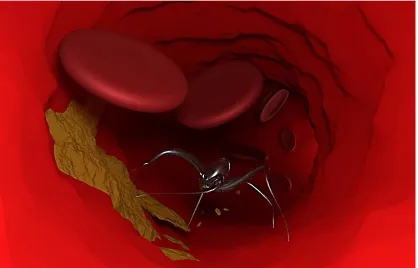
If we hope to synthesise compounds that approach the level of functionality observed in natural systems or interact with them, we must also construct at the nanometre size. The potential significance of construction at the nano-scale has long been realised by forward-thinking scientists and even science fiction writers. Whilst the perils of robots that reproduce themselves, i.e. the ‘grey goo’19 may not be a realistic fear for now, certainly the application of molecular-sized wires20 that could power molecular sized computers, or the construction of molecular machines21, 22 that could eventually be turned into molecular surgeons23 are in the beginnings of being realised. Such molecular robots could be sent into places no human hand could ever operate - from the inside of a human heart valve, to the inside of a nuclear reactor, or even act as preventative devices, patrolling the bloodstream looking for clots and tumours (Figure 1.8).
Cyclodextrin (1.4 nm)
Ribosome (20 nm)
0.1 nm 1 nm 10 nm 100 nm 1,000 nm
A carbon atom
(0.07 nm) Haemoglobin (6.5 nm)
HIV (120 nm)
7
Figure 1.8 Conceptual artwork of a 'molecular surgeon' removing plaque from a blood vessel.
1.2 Non-Covalent Interactions
Supramolecular chemistry is characterised by the use of non-covalent interactions. They allow for features such as bottom-up synthesis via self-assembly, thermodynamic responsiveness, error-checking, multi-valency and combinatorial complexity. Non-covalent bonds are broadly categorised into electrostatic, -interactions and hydrophobic effects. Each has their own properties which are exploited to build and control structures and devices, and often form the basis of supramolecular functionality.
8
Figure 1.9 Approaches to rotaxane and catenane synthesis adapted from Caballero and coworkers.24
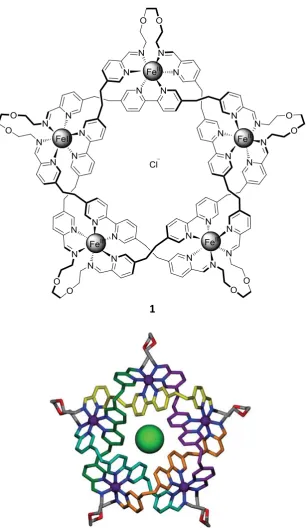
Almost all types of non-covalent interactions have been used in supramolecular chemistry and many examples use combinations, such as in the synthesis of the molecular pentafoil knot 1 (Figure 1.10).25 In this architecture, relatively weak interactions are multiplied five-fold giving a large effect on the thermodynamic stability of the structure. Metal-ion interactions promote helicate formation of bi-pyridine ligands, hydrogen bonds with the central chloride ion template the cyclic arrangement and stereoelectronic effects favour the looped conformations of aldehyde ligands. The aldehyde and amine ligands then react to give imine bond formation which, although covalent, is reversible until quenched thereby giving an ‘error-checking’ mechanism under which the most thermodynamically stable product is formed, hence its wide use in supramolecular chemistry.26
Clipping Stoppering
Slippage Snapping Swelling
Cyclisation
Double Cyclisation
9
Figure 1.10 Molecular structure (above) and crystal structure (below) of a molecular pentafoil knot synthesised by
self-assembly of aldehyde and amine ligands.25 Reproduced with permission from Nature Publishing Group.
The first synthetic examples of supramolecular host-guest chemistry (natural systems of course were operating much earlier!) used ion-dipole interactions to selectively encapsulate cation guests, for example the crown ether host 2 which binds K+ ions (Figure 1.11).27 Although ion-dipole interactions are usually non-selective, the fixed cavity of the crown ether results in high size-dependent selectivity of the cation. Since the first example in 1967, this molecular recognition principle has been extended to
10
azacrowns, thiacrowns, lariat ethers,28 azacycloalkanes, azacyclophanes,29 cryptands, and spherands,30 and used to form rotaxanes.31
Figure 1.11 18-Crown-6, one of the crown ether hosts reported by Pederson27 that selectively encapsulates a cation.
The most prevalent non-covalent interaction in biological systems is the hydrogen bond, and not surprisingly it is found throughout synthetic supramolecular chemistry. Hydrogen bonds between the NH donors on the wheel of rotaxane 3 and the carbonyl groups on its axle have been used to form a ‘station’ on which the wheel sits, preventing free rotational and directional movement (Figure 1.12). These interactions can then be switched off with the introduction of DMSO solvent which outcompete the axle as a hydrogen bond acceptor.32
Figure 1.12 An amide rotaxane wheel is threaded onto the axle via hydrogen bonding, which is disrupted when the
solvent is changed to DMSO.32
C2D2Cl4
DMSO-d6 2
11
Other electrostatic interactions have been less widely used in supramolecular chemistry, nevertheless ionic interactions have been employed to drive the copolymerisation of dendritic cationic and anionic monomers 4 and 5 into nanotubes (Figure 1.13).33 These high-order aggregates remain stable at pH 7, but can be disassembled when the pH is brought away from physiological conditions.
Figure 1.13 Peptide monomers 4 and 5 (above) assemble via ionic interactions into nanotubes (below).33
Reproduced with permission from John Wiley and Sons.
Different forms of -interactions have also been used throughout supramolecular chemistry. Conjugated - systems have conducting properties, making this an ideal interaction from which to make self-assembling molecular wires.34 If the conjugated
- systems are made to form the axle of a rotaxane, the use of a suitable wheel gives a strategy for the formation of insulated molecular wires. This has been demonstrated with the use of conjugated stilbene axles, threaded through a cyclodextrin wheel to give rotaxane 6 which forms extended molecular wires in both solution and the crystal structure (Figure 1.14).35
4
12
Figure 1.14 - Stacking of the rotaxane 6 (above) gives conjugated molecular wires in the crystal structure
(below).35 Reproduced with permission from the American Chemical Society.
-Interactions not only exist between two conjugated systems however, they can also be formed between an ion and a system, as in the case of ferrocene. Ferrocene formation has been widely used throughout supramolecular chemistry, for example in the formation of the [3]rotaxane 7 (Figure 1.15).36 Here, ferrocene is not only part of the axle of the rotaxane, it also acts as a redox-active sensor, giving a voltammetric response in the presence of bound chloride or sulfate anions.
Figure 1.15 A ferrocene -cation interaction forms part of the axle of the [3]rotaxane 7.36
6
13
Donor-acceptor - stacking systems have also been used to create interlocked molecules, for example the [3]catenane 8 assembles via the interaction of -electron rich tetrathiafulvalene units with -electron poor cyclobis(paraquat-4,4ʹ-biphenylene) units (Figure 1.16).37 This structure was then used as a ‘molecular flask’ as it gives ideal geometric arrangements and high effective concentrations that stabilise mixed-valence and radical-cation species upon oxidation.
Figure 1.16 A 'molecular flask' constructed from the [3]catenane 8 which is assembled by interactions between
-electron poor and -electron rich units.37 Reproduced with permission from Nature Publishing Group.
Another category of non-covalent interaction is hydrophobic effects, which drive the formation of cyclodextrin host-guest complexes. In aqueous solutions, hydrophobic guest groups form inclusion complexes with the hydrophobic cavities of the cyclodextrins. This interaction has been widely used in supramolecular chemistry, and has even been used to direct the assembly of macroscopic objects. Polyacrylamide gels
14
to self-assemble and their interaction may be visualised on the macro-scale (Figure
1.17).38
Figure 1.17 Functionalised polyacrylamide gels 9 and 10 (above) exhibit host-guest interactions which can be
visualised on the macro-scale (below).38 Reproduced with permission from Nature Publishing Group.
The use of cyclodextrin host-guest interactions as a molecular recognition process has been used in this thesis to develop a range of supramolecular devices and materials.
1.3 Cyclodextrins
Cyclodextrins were first observed by Antoine Villiers39 in 1891 as a product in the bacterial fermentation of potato starch with Bacillus macerans. Although it was noted that these new compounds were quite different to the known saccharides of the time, it wasn’t until 1948 that their structures were elucidated by Freudenberg and Cramer40 as cyclic, chiral oligomers of 1,4-α-linked glucopyranose units. The most common cyclodextrins consist of 6, 7 and 8 of these sugar units termed as , and , respectively. The 1,4-linkages position all the primary hydroxyl groups on one face (the primary face), and all the secondary hydroxyl groups on the opposite face (the secondary face).
Water/Shaking
15
[image:31.595.289.360.494.572.2]Cyclodextrins exist as a slightly truncated cone and are often represented as the simplified 3D shape with carbons and hydrogens numbered 1-6 in a clockwise direction around each glucopyranose ring (Figure 1.18).
Figure 1.18 Chemical structure of -cyclodextrin 11 (left), numbering of atom positions on the pyranose rings
(centre) and the simplified representation of the cyclodextrin (right).
The -link denotes that the O at the C1 position is in the axial, rather than the equatorial position, even though this conformation is more sterically hindered. This arrangement is an anomeric or Edward Lemieux effect, attributable to hyperconjugation between the HOMO of the adjacent oxygen and the LUMO of the C-O bond (Figure 1.19).41
Figure 1.19 Proposed hyperconjugation that results in the axial positioning of the C1 oxygen in cyclodextrins.
The arrangement of the glucopyranose units also allows for the formation of hydrogen bonds between the C2-hydroxyl groups and the C3-hydroxyl groups of the next units. In
-cyclodextrin this bonding extends all the way around the sugar ring forming a secondary hydrogen ‘belt’ giving it a more rigid structure and making it much less soluble in water than - and -cyclodextrins.42
Primary face
Secondary face
11
16
The arrangement of the hydroxyl groups on the exterior of the cyclodextrins gives their most interesting property; a hydrophilic exterior and a hydrophobic interior, which imparts the ability of the cyclodextrins to form inclusion complexes with hydrophobic guests in aqueous solution. Complexation is a thermodynamic process, enthalpically driven by the displacement of water molecules from within the hydrophobic cyclodextrin cavity and around the hydrophobic guest (Figure 1.20).
Figure 1.20 Cartoon representation of a hydrophobic guest (yellow) complexing with the hydrophobic cavity of a
cyclodextrin (blue) resulting in the displacement of water molecules (pink).
As different cyclodextrins comprise different numbers of glucopyranose units, they also differ in the size of their cavities (Table 1.1) resulting in selectivity in complexing different sized guests.
Table 1.1 Properties of -, - and -cyclodextrins.
As cyclodextrins become larger than 8 glucopyranose units, the annulus begins to distort under steric strain and some units adopt a trans configuration with - rather than -1,4 links.44 This collapsed structure persists up until -cyclodextrin which consists of 26 units and forms a ‘figure of eight’ annulus.45 The largest cyclodextrin that has been isolated and characterised has 39 units46 however the existence of cyclodextrins composed of
Glucopyranose units 6 7 8
Diameter between C5 H 4.7 Å 6.0 Å 7.5 Å
Diameter between C3 H 5.2 Å 6.4 Å 8.3 Å
Volume 174 Å 262 Å 472 Å
17
hundreds of units has been detected.47 Despite reports of inclusion complexes of large-ring cyclodextrins with Buckminster fullerene,48 carbon nanotubes49 and even proteins,50 their use is restricted as a consequence of the difficulty in their separation.
Since the first report of iodine complexation in 1911,51 the application of cyclodextrin host-guest formation has become wide-spread thanks to the low-cost production of -,
- and -cyclodextrins by the enzyme cyclodextrin glucosyl transferase [CGT-ase], and their low inherent toxicity. As early as 1953, Freudenberg, Cramer and Plieninger52 obtained a patent covering the use of cyclodextrins in a range medical applications, and today they are part of a number of pharmaceutical preparations (Figure 1.21). They form complexes with nicotine in Nicorette, diclofenac in Voltaren and estradiol in Aerodiol enhancing the water solubility of lipophilic drugs, protecting easily oxidisable substances and reducing the volatility and hence the loss of pharmaceutically active compounds. 2-Hydroxypropyl--cyclodextrin is currently being trialled in the treatment of Niemann-Pick disease as it is thought to complex with accumulated cholesterol and glycolipids in lysosomes, helping to transport them out.53
Figure 1.21 Examples of commercial products which contain cyclodextrin.
18
colourants in confectionery. Cyclodextrins are used as ‘slow release’ agents of fragrant molecules, as well as the moisture-maintaining compound ceramide, and antibacterial oils in perfumes and cosmetics, and agricultural chemicals. Compounds with useful properties have also been combined with cyclodextrins, and coated onto fabric and wrapping materials, after which they are released over time. Cyclodextrins are also used to capture unwanted compounds such as the bitter flavoured naringin in grapefruit juice and catechins in tea, and the fabric freshener Febreze includes cyclodextrin to capture hydrophobic compounds that cause bad odours.54
Cyclodextrins play a major role in supramolecular research including in enantioseparation, nanoparticles, catalysis,55 and the construction of supramolecular structures and devices. Inclusion can be analysed directly by the use of techniques such as isothermal titration calorimetry (ITC), X-ray crystallography and 2D rotating frame nuclear Overhauser effect spectroscopy (ROESY), or indirectly by measuring a change in the properties of the guest (for example increased solubility, nuclear magnetic resonance (NMR) spectroscopy shifts, Cotton effects in circular dichroism spectroscopy, UV-Vis spectra, fluorescence spectra, reactivity and diffusion). Differences between the free and included guest may not only serve as a tool for topology characterisation but may also afford functionality such as in molecular sensors.56
19
Figure 1.22 Different bases are used to selectively tosylate -cyclodextrin 11 at either the C6-OH position or the
C2-OH position.
Synthesis with cyclodextrins is made all the more easier with the use of an acidic naphthalene-1,3-diol thin-layer chromatography (TLC) dip which produces pink-coloured spots in the presence of cyclodextrin-containing compounds (Figure 1.23). As each naphthalene molecule reacts with a glucopyranose unit, the dip is fairly sensitive. The mechanism, although not proven, is thought to involve electrophilic aromatic substitution.
Figure 1.23 Proposed mechanism for the TLC dip which produces pink spots on the plate where
cyclodextrin-containing products elute.
Many cyclodextrin-based interlocked molecules have been fabricated using host-guest complexation to thread axles, with the first stoppered cyclodextrin rotaxane 14 reported in 1981,60 and the first cyclodextrin catenane 15 in 1993 (Figure 1.24).61
Pink-coloured product Pyridine Tosyl chloride
NaOH Tosyl chloride
11
12
13
C2
20
Figure 1.24 The first cyclodextrin based rotaxane 14 (above)60 and catenane 15 (below).61
The molecular recognition process can also be switched on and off forming the basis of cyclodextrin molecular switches, an important component of molecular devices.
1.4 Cyclodextrin-Based Molecular Switches
Molecular switches can be defined as systems which reversibly shift between two or more stable states in response to an external stimulus.62 Their effect is described as influence as a function of state, rather than influence as a function of trajectory, which applies to molecular machines.63 True molecular machines perform cumulative work with each switching step moving farther and farther from the initial state in a single direction, for example Feringa’s molecular rotor64 and Leigh’s walking molecule65 and artificial ribosome.22
Cyclodextrins form the basis of synthetic molecular switches where an external stimulus influences the equilibrium process that governs the initial host-guest complex formation. This is expressed by a change in the association constant Ka which, for a 1:1 cyclodextrin:guest complex is determined by Equation 1.1.
14
21
Equation 1.1 Expression for the association constant for the formation of a 1:1 cyclodextrin:guest complex.
Cyclodextrin-based switching can involve removal and inclusion of a single guest (simple ‘in and out’ switching), displacement of a guest by another competing guest in ‘displacement’ switching, or ‘back and forth’ switching where the cyclodextrin shuttles between two linked guest sites or stations.66
[image:37.595.169.483.423.660.2]The stimulus for this switching varies. Solvent can be used to switch between structures, for example the contracted or extended state of the [c2] dimer 16 which depends on the polarity of the solvent (Figure 1.25).67 In DMSO the cyclodextrin units sit over the amide bonds of the cinnamide unit, however upon the addition of H2O (to a 1:1 ratio) the cyclodextrin shuttles to include the hexyl chain. This is because the presence of more polar solvent inside the apolar cyclodextrin cavity results in a thermodynamically unfavourable system which is alleviated by switching to the apolar alkyl chain.
Figure 1.25 Solvent is used to switch between an extended and contracted [c2]-cyclodextrin dimer 16.67
Reproduced with permission from the American Chemical Society.
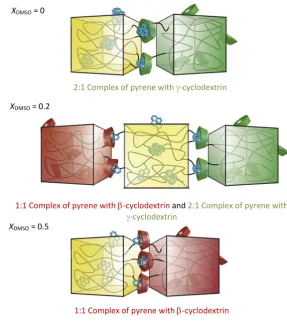
Switching solvent has also been used to exert a macroscopic effect, by incorporating cyclodextrins and a pyrene host into polyacrylamide gels. Here the oligomerisation of the pyrene guest and hence interaction with different sized cyclodextrin cavities is
Ka = [Complex] [Cyclodextrin] [Guest]
22
dependent on DMSO/H2O solvent mixtures (Figure 1.26).68 When the volume fraction of DMSO (XDMSO) is 0, i.e. only water, pyrene exists mainly as a dimer which interacts with
[image:38.595.121.409.212.535.2]-cyclodextrin but not -cyclodextrin. As the polarity of the solvent is decreased, to XDMSO = 0.2, a mixture of pyrene monomers and dimers exist, allowing the pyrene gels to interact with both - and -cyclodextrin gels. Finally, at XDMSO = 0.5 pyrene exists mainly as a monomer, interacting with only -cyclodextrin.
Figure 1.26 Changing solvent alters pyrene oligomerisation, which then dictates the cyclodextrin that binds the
guest.68 Reproduced with permission from Nature Publishing Group.
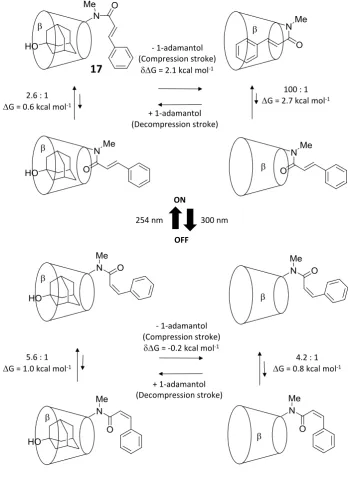
Switching can also be executed with the addition of a competing guest as observed in the mechanism of the molecular piston 17. The decompression stroke is performed when 1-adamantol is incorporated in place of the cinnamide guest, and the compression stroke when the alkyl guest is extracted with a non-polar solvent (Figure 1.27).69 Work performed by the system, as calculated by the difference in E/Z amide ratios, was measured as 2.1 kcal mol-1 during compression. Photoisomerisation of the cinnamide alkene switches the machine on and off.
XDMSO = 0.2
XDMSO = 0
2:1 Complex of pyrene with -cyclodextrin
1:1 Complex of pyrene with -cyclodextrin and 2:1 Complex of pyrene with
-cyclodextrin
1:1 Complex of pyrene with -cyclodextrin
23
Figure 1.27 A molecular piston wherein the compression stroke is performed by a competing adamantol guest
displacing the tethered cinnamide guest.69
The external stimulus used for cyclodextrin switching can also be a change in pH. Liu et al.70 demonstrated that in a pyridine-dicarboxamide-bridged bis--cyclodextrin compound, the pyridine group sits outside the cyclodextrin cavities at neutral pH, whereas at acidic pH it is shallowly included into one of the hosts (Figure 1.28). Inclusion is observed by the appearance of an induced circular dichroism peak when the chromophoric linker sits inside the chiral cyclodextrin cavity. It was also noted that the linking guest was able to partially displace a number of short oligopeptides from cyclodextrin, giving a pH-switchable binding mode.
300 nm
ON
- 1-adamantol (Compression stroke)
G = 2.1 kcal mol-1
+ 1-adamantol (Decompression stroke) 2.6 : 1
G = 0.6 kcal mol-1
100 : 1
G = 2.7 kcal mol-1
- 1-adamantol (Compression stroke)
G = -0.2 kcal mol-1
+ 1-adamantol (Decompression stroke) 5.6 : 1
G = 1.0 kcal mol-1
4.2 : 1
G = 0.8 kcal mol-1
24
Figure 1.28 Change in binding of the cyclodextrin bridge upon pH change induces a change in the binding mode of
oligopeptides.70 Reproduced with permission from the American Chemical Society.
Switching can be redox-responsive, as shown in the shuttling rotaxane 18 reported by Stoddart et al.71 The cyclodextrin initially includes the tetrathiafulvalene unit, whereas upon oxidation this becomes positively charged and the triazole unit becomes the most energetically favoured guest, inducing shuttling of the cyclodextrin ring (Figure 1.29).
Figure 1.29 Oxidation of the tetrathiafulvane unit shuttles the cyclodextrin from this station to the triazole station.71
Finally, probably the most useful stimulus for synthetic molecular switches is light as it is non-invasive, chemo-selective and highly controllable.72 The ability of a number of cyclodextrin guests to form inclusion complexes can be switched on and off via photoisomersation between trans and cis isomers. In the molecular muscle 19, stilbene is incorporated into a [c2]-cyclodextrin dimer (Figure 1.30).73 In the trans configuration the -cyclodextrin ring sits on the stilbene guest station. Upon photoisomerisation to
- 2e-
+ 2e-
18
25
[image:41.595.127.519.135.637.2]the cis configuration, the stilbene becomes too sterically bulky to sit inside the -cyclodextrin cavity and the host shuttles to the secondary, propyl guest station resulting in overall contraction.
Figure 1.30 Photoisomerisation of stilbene guests shuttle the -cyclodextrins to secondary propyl guests, resulting
in overall contraction of the [c2]-dimer 19.73
350 nm
350 nm 254 nm
254 nm
19
26
1.5 Molecular Switches in Nature
Many natural systems feature molecular switches, where an external stimulus produces a change in state or conformation of a protein or peptide. An initial change can then act as the stimulus for a succeeding switching step producing a cascade of switches. If one of the steps involves the activation of an enzyme, the initial stimulus is amplified throughout the signalling cascade.
[image:42.595.83.480.397.636.2]For example the vision process begins with the photoisomerisation of retinal, the chromophore bound to the opsin protein, from the cis to the trans state (Figure 1.31). This is followed by a conformation change of opsin to metarhodopsin II, causing it to split and activate the regulatory protein transducin. A release of GTP occurs, activating phosphodiesterase and amplifying the signal, leading to an increase in cGMP concentration and the closure of sodium channels. This causes hyperpolarisation of the cell and closure of calcium channels which gives nerve signal.74
Figure 1.31 The protein opsin with retinal highlighted (left)75 and a simplified mechanism of the vision process
(right). Reproduced with permission from Elsevier.
A molecular switching process is also a key component of calcium signalling, wherein Ca2+ ions bind to the regulatory protein calmodulin. This induces a large change in conformation, exposing hydrophobic domains which then bind to and control other
Change in opsin conformation
Nerve signal
27
proteins, such as cadmodulin-dependent protein kinases which are involved in the regulation of fuel metabolism, ionic permeability, and neurotransmitter synthesis and release.
28
Figure 1.32 The structure of ATP synthase showing the rotatational unit (Fo) and the catalytic unit (F1).78 Reproduced
with permission from Elsevier.
If we hope to mimic Nature and produce our own synthetic molecular switches that replicate the high-level functions that biological systems demonstrate, or even develop synthetic systems that can interact with natural ones for example to correct disease states, one strategy is to combine non-peptidic, supramolecular systems such as cyclodextrin host-guest inclusions complexes, with peptides.
1.6 Combining Peptidic and Non-Peptidic Supramolecular Entities
29
Of the available natural substances, peptides present a particularly attractive building material being supramolecular structures in their own right.81, 82 The peptide bond provides a stable backbone, secondary structures are well-studied and occur in a variety of different architectures which are easily analysed,83 and amino acid residues are capable of a wide range of non-covalent interactions such as - stacking, hydrogen bonding and metal binding. Solid-phase synthesis methods are highly efficient meaning that chemists are not restricted to natural sequences, rather de novo sequence design is possible and there is no restriction to the palette of naturally encoded amino acids. Peptides exhibit their inherent properties under physiological conditions and many examples are themselves biologically active, therefore they are advantageous for use in systems with biological applications.
New, acquired properties arise through the combination of peptides with other, non-peptidic supramolecular components presenting two strategies to achieve such emergent functionalities. In one approach functionality is conferred by the inherent structure of the peptide (Figure 1.33), in the other supramolecular function affords control over peptide structure (Figure 1.34).
Figure 1.33 Conceptual scheme illustrating an approach to combining peptides with non-peptidic supramolecular
components, wherein the inherent structure of a peptide determines function. Peptide Non-peptidic
supramolecular functionality
Emergent functionality Peptide structural
30
Figure 1.34 Conceptual scheme illustrating an approach to combining peptides with non-peptidic supramolecular
components, wherein the property of a non-peptidic supramolecular moiety affects peptide structure.
Peptides are supramolecular moieties in their own right as they fold into three-dimensional structures by way of non-covalent interactions, and some have been designed (or evolved in the case of collagens, for example) to form a variety of nanostructures such as nanotubes,84 gels,85 fibres86 and vesicles87. When non-peptidic components are applied to these scaffolds, new supramolecular functionalities emerge. Peptide structure is therefore considered as a tool or building block in synthetic supramolecular systems.
In the simplest type of scaffold, a single peptide strand is used as a structural backbone for supramolecular assembly. Primary amines, such as those present on lysine side-chains form complexes with crown ethers, and accordingly an oligolysine peptide chain was used as a ‘molecular track’ along which crown ether moieties were shown to undergo direct binding-site hopping (Figure 1.35).88
Molecular switch Switching peptide structure Peptide Non-peptidic
31
Figure 1.35 A single peptide strand acts as a scaffold for crown ethers to undergo binding site hopping.88
Reproduced with permission from Nature Publishing Group.
Peptides have also been employed as the axle in a rotaxane, where the capability of the amide backbone to form hydrogen bonds has been used to create stations for amide-based wheels (Figure 1.12).32, 89, 90
A peptide strand has also been used as a template for inorganic materials, as demonstrated by the Stevens group91 when they used a helical peptide strand on which to grow a gold nanocluster (Figure 1.36). Cysteine residues provide sites for concentrated nucleation, but it is the cavity of the helix which controls growth and determines the size of the final nanocluster.
Figure 1.36 A single peptide strand acts as a scaffold for the control of growth of a gold nanocluster.91 Reproduced
with permission from the Royal Society of Chemistry.
32
[image:48.595.127.413.276.507.2]peptides as a scaffold for these types of functionalities has therefore led to the development of peptide-based molecular wires. This was demonstrated by Ghadiri et al.92 who used a cyclic peptide, decorated with naphthalene diimide functionalities, to form nanotubes with delocalised electron states (Figure 1.37). The peptides have the added advantage of being electronically insulating. The same principle was later employed by Ashkenasy and Ashkenasy et al.93 with a similar naphthalene diimide electronically-active functionality, this time incorporated onto a -sheet fibril-forming peptide. The use of a fibril forming peptide as a scaffold for molecular electronics has also been shown with porphyrin functionalities.94
Figure 1.37 A fibril forming peptide is decorated with naphthalene diimide functionalities giving molecular wires.92
Reproduced with permission from John Wiley and Sons.
33
therefore properties of such systems, the optically active residues have been covalently bound to the peptide scaffold. MacPhee et al.96 have shown that fibril forming peptides, modified with fluorophores, demonstrate exciton migration in the resulting structures. As assembly is fully controlled by the peptide, the optically active residue could then be independently altered, introducing both donor and acceptor moieties to give light-harvesting properties, whilst retaining the core self-assembled structure (Figure 1.38).97 Energy transfer has also been facilitated by the arrangement of donor/acceptor chromophores within a peptide hydrogel, resulting in an optically active material that also has potentially useful mechanical properties.98
Figure 1.38 A fibril forming peptide is decorated with donor and acceptor fluorophores resulting in a light harvesting
system.96 Reproduced with permission from the American Chemical Society.
34
Figure 1.39 Carbon nanotubes are coated with peptides that assemble via ionic interactions.99 Reproduced with
permission from the American Chemical Society.
Other nano-technological materials which require control of aggregation are inorganic nanoparticles, and the attachment of a peptide which has pH dependent secondary structure has led to control over the aggregation of gold nanoparticles100 and gold nanorods (Figure 1.40).101 At acidic pH, the polyglutamic acid peptide exists as an -helix, interacts with other attached peptides and causes aggregation or assembly of the nanoparticles. Upon raising the pH, the peptide switches to a random coil structure, disrupting interactions and dispersing the nanoparticles back into solution.
Figure 1.40 Peptide-peptide interactions which are pH-switchable are used to control the aggregation of gold
[image:50.595.133.403.489.717.2]35
Gold nanoparticles exhibit a colour change when switching between aggregated and dispersed states, a feature that makes them good candidates for use in detectors. Nanoparticles have been functionalised at the cysteine residue of protease cleavable peptide sequences, which leads to aggregation via - stacking at the Fmoc-protected
N-termini and gives the nanoparticles a blue colour. The system then acts as a biological
sensor in the presence of thermolysin, which cleaves the peptides. The segments containing the aggregating Fmoc functionality are removed and the remaining peptide segments are left with positively charged unprotected -NH3+ N-termini. These charged peptides then repel each other resulting in dispersion of the nanoparticles and a visible colour change (Figure 1.41).102 As the control of aggregation and dispersion is wholly dependent on the change in the peptides’ N-termini from protected Fmoc to charged amines, this concept can be applied to detect any peptidase by simply changing the peptide sequence to a corresponding recognised cleavage site.
Figure 1.41 N-Fmoc protected peptides cause aggregation of nanoparticles, which are dispersed when a protease
cleaves the peptide and exposes charged N-termini.102 Reproduced with permission from the American Chemical
Society.
36
switch without the need to replicate an entire globular protein structure. In another technique de novo peptides have been designed with careful sequencing that gives inherent structural duality,104 however this method imposes tight restrictions on the sequence making modifications for functionality difficult. The use of a non-peptidic switch enables structure change that is independent of peptide sequence, allowing for the introduction of functional peptides whose activity can be switched on and off by way of change in their structure. Many examples are also universally applicable, in that the non-peptidic switch functionality can be applied to any peptide sequence.
37
Figure 1.42 Photocontrol of peptide aggregation resulting in switching between gel and solution phases.107
Reproduced with permission from the Royal Society of Chemistry.
38
Figure 1.43 Photocontrol of peptide aggregation, resulting in switching between fibres and spheres at basic pH, and
spheres and vesicles at acidic pH.108 Reproduced with permission from the Royal Society of Chemistry.
39
Figure 1.44 Cyclodextrin-adamantane complex formation arranges a transcriptional factor protein into a dimeric
form, enabling it to bind to DNA.110 Reproduced with permission from the American Chemical Society.
Since this first example, similar replacement of the wild-type leucine-zipper for dimer formation has been achieved with other non-peptidic switching functionalities. Peacock et al.111 attached the two arms of the same transcriptional peptide dimer to a terpyridine moiety (Figure 1.45). Upon the addition of Cu2+ or Zn2+, the metal ions bind to the terpyridine, resulting in a shift from the trans conformation to the cis. This in turn brings the peptide arms to the same distance as in the dimeric form, enabling binding to DNA.
Figure 1.45 Two arms of a transcriptional peptide dimer are arranged into a DNA binding configuration with the use
[image:55.595.177.480.515.738.2]40
[image:56.595.77.465.188.400.2]Vazquez, Mascarenas and co-workers112 also used the formation of a metal complex to assemble the arms of a transcription peptide into an arrangement that resembles dimer formation and hence allows for DNA binding (Figure 1.46). This ruthenium complex was also photolysed, which resulted in the detachment of one of the peptides from the complex and therefore switched off DNA binding.
Figure 1.46 Control over the quaternary structure of peptides is afforded with the formation of a metal complex.112
Reproduced with permission from the Royal Society of Chemistry.
In addition to DNA binding activity quaternary structure switches have also been used to control the activity of capase, cleavage proteins that are active in the dimeric form and non-active in the monomeric form. Brusnveld et al.113 labelled the N-terminus of the capase-9 monomer with phenylalanyl-glycyl-glycine sites which are selectively included in the cavity of cucurbit[8]uril in a 2:1 binding ratio (Figure 1.47). This host-guest recognition could therefore be used to bring together the two inactive capase monomers to form an active dimer.
41
Figure 1.47 Cucurbit[8]uril host-guest interactions are used to control dimerisation of a capase protein.113
Reproduced with permission from John Wiley and Sons.
The use of host-guest interactions to mediate oligomerisation has also been applied to protein p53, a transcription factor which exists as a homotetramer. In some cancers however, p53 is mutated causing a destabilisation of quaternary folding and favouring the monomeric form. Mendoza et al.114 used modified calix[4]arene which sits inside hydrophobic clefts in the mutated peptide, to hold together monomers via ion-pair interactions between positively charged guanidiniomethyl groups on the calixarene ring and negatively charged peptide arginines, restoring wild-type tetramer structure (Figure
42
Figure 1.48 Calix[4]arene host-guest interactions stabilize the quaternary structure of a mutated p53 protein.114
Reproduced with permission from the National Academy of Sciences.
The tertiary folding of peptides is controllable using host-guest chemistry. Urbach et al.115 made use of the specific recognition of cucurbit[8]uril for methyl viologen and tryptophan pairs in order to create a tryptophan sequence recognition receptor (Figure
1.49). Peptides modified with methyl viologen residues could be matched to their
43
Figure 1.49 Control over the tertiary structure of peptides is demonstrated with systems that use cucurbit[8]uril and
methyl viologen-tryptophan interactions.115 Reproduced with permission from the American Chemical Society.
[image:59.595.168.483.59.295.2]In another strategy, the activity of green fluorescent protein is controlled by the introduction of a cyclodextrin-coumarin host-guest pair to either terminus of a short peptide section that has been detached from the complete structure (Figure 1.50).117 The formation of an inclusion complex forces the tertiary structure of this peptide into a misfolded conformation preventing it from associating with the bulk protein. Upon addition of a competing guest molecule the cyclodextrin-coumarin host-guest interaction is disrupted allowing the peptide to refold back within the protein, restoring fluorescent activity.
Figure 1.50 The short peptide section of split GFP is modified with cyclodextrin-coumarin groups, enabling control
of this host-guest interaction to influence refolding within the mature protein.117 Reproduced with permission from
44
[image:60.595.151.380.282.494.2]The most precise control of peptide structure involves the ordering and disordering of specific secondary structure, such as -helices, -sheets and 310 polyproline type II (PPII) helices. Switching between secondary structure states has been demonstrated with the incorporation of photo-isomerisable units into peptide structures as part of the backbone, or as single or bridging amino-acid side-chains (Figure 1.51).118 The conformation change of the photoresponsive moiety from trans to cis initiates a change in peptide secondary structure which translates to enhancement of an existing structure, the disruption of an existing structure or the switch from one distinct type of structure to another.
Figure 1.51 A photoresponsive bridging moiety disrupts the secondary structure of a peptide backbone upon
photoisomerisation.119 Reproduced with permission from the American Chemical Society.
45
Figure 1.52 The extent of -helicity in a peptide backbone is increased with azobenzene-cyclodextrin host-guest
inclusion.120
Other methods that use host-guest interactions to induce a change in peptide secondary structure include the work of Fujita and co-workers121 who used a palladium-porphyrin host to entirely encapsulate a trialanine peptide, resulting into its folding into a -turn structure (Figure 1.53).
Figure 1.53 Trialanine forms a -turn when encapsulated in a palladium-porphyrin host.121 Reproduced with
permission from the American Chemical Society.
46
Figure 1.54 Control over peptide secondary structure is provided by pH switching of a crown ether host-guest
interaction.122 Reproduced with permission from the Multidisciplinary Digital Publishing Institute.
Cyclodextrins are an attractive input for switches that affect peptide structure as they operate under aqueous conditions and are bio-orthognal. This enables the non-peptidic supramolecular system to be developed separately to the peptide, allowing widespread application of a device to influence multiple peptidic sequences.
1.7 Self-Assembling Polymers and Daisy Chains
Among the wide variety of possible structures, the self-assembly process has been used to make polymers which consist of many small molecules (termed ‘low molecular weight building blocks’) held together by non-covalent intermolecular bonds. As with smaller oligomer supramolecular structures, many different types of non-covalent bonds can be used to self-assemble polymers such as metal-ligand bonds,123 hydrogen bonding,124
- stacking125 and protein-protein interactions.126 The polymers themselves have been shown to exhibit properties such as switchability and conductance, and physical features such as gelation.127 Polymerisation can also be controlled by doping in a competing molecule that terminates the polymer chain.128 If the bond controlling polymerisation is switchable, changes on the molecular scale have the potential to be translated into an effect on the macro scale by the cumulative effect of many interactions.129
47
[image:63.595.153.502.168.511.2]pillar[5]arene has been used to form an interlocked [c2]-dimer with one of these functionalities acting as a guest leaving the other as as an unbound recognition site (Figure 1.55).132 The [c2]-daisy chains are then linked using a bis-pillar[5]arene compound to give a self-assembled polymer chain 20.
Figure 1.55 A pillar[5]arene based polymer composed of a di-guest and di-host unit.132
Once the low molecular weight building blocks have assembled into polymeric structures, they can then be mechanically locked with the use of a stoppering moiety which prevents disassembly, usually by steric bulk (Figure 1.56). This enables the polymeric mixtures to be separated and characterised.
20
+
48
Figure 1.56 Conceptual image of a [c2]-daisy chain mechanically locked by a stopper (red) which prevents
dissociation of the interlocked product by steric hinderance.
Daisy chain polymers are so-called because the construction emulates that of the traditional flower craft; the stem is the axle, the hole in the stem is the ring and the stopper is the flower (Figure 1.57). Nomenclature gives a or c for acyclic or cyclic systems, and n as the number of bound monomers (Figure 1.58).
Figure 1.57 Structure of a molecular daisy chain (left) constructed from host rings (blue), linkers (green), guests
49
Figure 1.58 Configurations of various stoppered daisy chains.
Daisy chains with more than two components are difficult to synthesize in one-pot reactions however, because the loss of entropy as the polymer increases outweighs the enthalpy gain that comes from forming the ring/axle inclusion complex. Moreover, even if the daisy chain is created, it can be very difficult to analyse and may exist as a mixture of different sized polymers. The ratio of daisy chain polymer to monomeric and dimeric species within the mixture may also be very small.
Only a handful of cyclodextrin based daisy chain polymers have been reported including the formation of a [c5]-daisy chain from the azobenzene-napthalene methylated -cyclodextrin monomer 21,133 a polymer assembled from nitrophenyl--cyclodextrin
22134 and a range of oligomers and cyclic trimers formed from the cinnamoyl-based cyclodextrin compounds 23-26 (Figure 1.59).135-137
a1 a2
c1 c2

![Figure 1.25 Solvent is used to switch between an extended and contracted [c2]-cyclodextrin dimer 16.67 Reproduced with permission from the American Chemical Society](https://thumb-us.123doks.com/thumbv2/123dok_us/7920929.191665/37.595.169.483.423.660/solvent-extended-contracted-cyclodextrin-reproduced-permission-american-chemical.webp)
![Figure 1.30 Photoisomerisation of stilbene guests shuttle the -cyclodextrins to secondary propyl guests, resulting in overall contraction of the [c2]-dimer 19.73](https://thumb-us.123doks.com/thumbv2/123dok_us/7920929.191665/41.595.127.519.135.637/figure-photoisomerisation-stilbene-shuttle-cyclodextrins-secondary-resulting-contraction.webp)
