Cloud Radio Access Networks
.
White Rose Research Online URL for this paper:
http://eprints.whiterose.ac.uk/100450/
Version: Accepted Version
Article:
Peng, M., Xie, X., Hu, Q. et al. (2 more authors) (2015) Contract-Based Interference
Coordination in Heterogeneous Cloud Radio Access Networks. IEEE Journal on Selected
Areas in Communications, 33 (6). pp. 1140-1153. ISSN 0733-8716
https://doi.org/10.1109/JSAC.2015.2416985
© 2015 IEEE. Personal use of this material is permitted. Permission from IEEE must be
obtained for all other users, including reprinting/ republishing this material for advertising or
promotional purposes, creating new collective works for resale or redistribution to servers
or lists, or reuse of any copyrighted components of this work in other works.
[email protected] https://eprints.whiterose.ac.uk/ Reuse
Unless indicated otherwise, fulltext items are protected by copyright with all rights reserved. The copyright exception in section 29 of the Copyright, Designs and Patents Act 1988 allows the making of a single copy solely for the purpose of non-commercial research or private study within the limits of fair dealing. The publisher or other rights-holder may allow further reproduction and re-use of this version - refer to the White Rose Research Online record for this item. Where records identify the publisher as the copyright holder, users can verify any specific terms of use on the publisher’s website.
Takedown
If you consider content in White Rose Research Online to be in breach of UK law, please notify us by
Contract-Based Interference Coordination in
Heterogeneous Cloud Radio Access Networks
Mugen Peng, Senior Member, IEEE, Xinqian Xie, Qiang Hu, Jie Zhang Member, IEEE, and H. Vincent
Poor, Fellow, IEEE
Abstract—Heterogeneous cloud radio access networks
(H-CRANs) are potential solutions to improve both spectral and energy efficiencies by embedding cloud computing into heteroge-neous networks (HetNets). The interference among remote radio heads (RRHs) can be suppressed with centralized cooperative processing in the base band unit (BBU) pool, while the inter-tier interference between RRHs and macro base stations (MBSs) is still challenging in H-CRANs. In this paper, to mitigate this inter-tier interference, a contract-based interference coordination framework is proposed, where three scheduling schemes are involved, and the downlink transmission interval is divided into three phases accordingly. The core idea of the proposed frame-work is that the BBU pool covering all RRHs is selected as the principal that would offer a contract to the MBS, and the MBS as the agent decides whether to accept the contract or not according to an individual rational constraint. An optimal contract design that maximizes the rate-based utility is derived when perfect channel state information (CSI) is acquired at both principal and agent. Furthermore, contract optimization under the situation where only the partial CSI can be obtained from practical channel estimation is addressed as well. Monte Carlo simulations are provided to confirm the analysis, and simulation results show that the proposed framework can significantly increase the transmission data rates over baselines, thus demonstrating the effectiveness of the proposed contract-based solution.
Index Terms—Heterogeneous cloud radio access networks,
interference coordination, contract-based game theory.
I. INTRODUCTION
The demand for high-speed and high-quality data applica-tions is expected to increase explosively in the next generation cellular network, also called the fifth generation (5G), along with the rapid growth of capital expenditure and energy con-sumption [1]. Since the traditional third generation (3G) and fourth generation (4G) cellular networks, originally devised for enlarging the coverage areas and optimized for the homoge-nous traffic, are reaching their limits, heterogeneous networks
Manuscript received Jul. 21, 2013; revised Dec. 15, 2014; accepted Feb. 19, 2015. The work of M. Peng, X. Xie, and Q. Hu was supported in part by the National Natural Science Foundation of China under Grant 61222103 and 61361166005, the National High Technology Research and Development Program of China under Grant 2014AA01A701, and the Beijing Natural Science Foundation under Grant 4131003. The work of H. V. Poor was supported in part by the U.S. National Science Foundation under Grant ECCS-1343210. Corresponding Author: Mugen Peng, Tel.: +86-0-13911201899, Fax: +86-10-62283385.
Mugen Peng (e-mail: [email protected]), Xinqian Xie (e-mail: [email protected]), and Qiang Hu (e-mail: [email protected]) are with the Key Laboratory of Universal Wireless Communications, Ministry of Education, Beijing University of Posts & Telecommunications, Beijing, China. Jie Zhang (e-mail: [email protected]) is with the Electronic and Electrical Engineering Department at the University of Sheffield, Sheffield, UK. H. Vincent Poor (e-mail: [email protected]) is with the School of Engineering and Applied Science, Princeton University, Princeton, NJ, USA.
(HetNets) have attracted intense interest from both academia and industry [2]. HetNets offer the advantages of serving dense customer populations in hot spots with low power nodes (LPNs) (e.g., pico base stations, femto base stations, small cell base stations, etc.), while providing ubiquitous coverage with macro base stations (MBSs), and reducing the energy consumption [3]. Unfortunately, high densities of LPNs incur severe interference, which restricts performance gains and commercial applications of HetNets [4]. To suppress inter-LPN and inter-tier interference, coordinated multi-point (CoMP) transmission and reception has been presented as one of the most promising techniques in 4G systems [5]. Though perfor-mance gains of CoMP are significant under ideal assumptions, they degrade with increasing density of LPNs due to the non-ideal information exchange and cooperation among LPNs. On the one hand, it has been demonstrated that the performance of the downlink CoMP with zero-forcing beamforming (ZFBF) depends heavily on time delay, and thus the ZFBF design should be fairly conservative [6]. Further, it has been shown that CoMP ZFBF has no throughput gain when the overhead channel delay is larger than 60% of the channel coherence time. On the other hand, it has been reported in [7] that the average spectral efficiency (SE) gain of uplink CoMP in downtown Dresden field trials is only about 20% with non-ideal backhaul and distributed cooperation processing located on MBSs. Hence, novel system architectures and advanced signal processing techniques are needed to fully realize the potential gains of HetNets.
evolved.
Motivated by the aforementioned challenges of both Het-Nets and C-RANs, an advanced solution known as the het-erogeneous cloud radio access network (H-CRAN) is intro-duced in [11]. The motivation of H-CRANs is to avoid inter-LPN interference existing in HetNets through connecting to a “signal processing cloud” with high-speed optical fibers [12]. As such, the baseband datapath processing as well as the radio resource control for LPNs are moved to the BBU pool so as to take advantage of cloud computing capabilities, which can fully exploit the cooperation processing gains, lower operating expenses, improve SE performance, and decrease energy consumption of the wireless infrastructure. The simpli-fied LPNs are converted into RRHs, i.e., only the front radio frequency (RF) and simple symbol processing functionalities are configured in RRHs, while the other important baseband physical processing and procedures of the upper layers are jointly executed in the BBU pool.
In H-CRANs, the control and user planes are decoupled, and the delivery of control and broadcast signalling is shifted from RRHs to MBSs, which alleviates the capacity and time delay constraints on the fronthaul. Therefore, RRHs are mainly used to provide high bit rates with high EE performances, while the MBS is deployed to guarantee seamless coverage and deliver the overall control signalling. With the help of MBSs, unnecessary handover and re-association can be avoided. The adaptive signaling/control mechanism between connection-oriented and connectionless modes is supported in H-CRANs, which can achieve significant overhead savings in the radio connection/release by moving away from a pure connection-oriented mechanism.
As shown in Fig. 1, the BBU pool is interfaced to MBSs for coordinating the cross-tier interference between RRHs and MBSs. The data and control interfaces between the BBU pool and the MBS are S1 and X2, respectively, which are inherited from definitions of the 3rd generation partnership
project (3GPP) standards. With the help of centralized large-scale cooperative processing in the BBU pool, the intra-tier interference can be fully suppressed, while the inter-intra-tier interference between RRHs and MBSs still present challenges to improving SE and EE performance. Significant attention has been paid to inter-tier interference collaboration [13], [14] and radio resource cooperative management techniques [15] to alleviate inter-tier interference. As these works are focused primarily on HetNets, new models and methods are needed for H-CRANs.
Intuitively, game theory is a useful tool for examining the inter-tier interference problem, and the published literature for HetNets has presented using this approach. For example, a Stackelberg game model has been used in [17] to design a distributed radio resource algorithm, and its adaption to hierarchical problems such as hierarchical power control has been considered in [18]. More specifically, a Stackelberg game with a single leader and multiple followers is formulated to study joint objective optimization of the macrocell and femtocells subject to a maximum interference power constraint at the MBS in [19]. In [20], a hierarchical game framework with multiple leaders and multiple followers is adopted to
1 M
M-1
m
Fig. 1. System model of the H-CRAN with one MBS andKRRHs.
investigate uplink power allocation to mitigate inter-tier in-terference in two-tier femtocell networks. In order, for the Stackelberg game, to reach an equilibrium, players involved in the game have to interact periodically, which leads to high latency and signalling overhead. Furthermore, the incentive in the Stackelberg game model is ineffective if the information is asymmetric between the leader and follower. To overcome these issues, an advanced game model with proper incentive mechanisms and regarding the limited overhead is preferred.
To overcome the aforementioned problems in the Stack-elberg model, contract-based game theory has recently been applied to aspects of spectrum sharing and relay selection. In [21], to solve the cooperative spectrum sharing problem under incomplete channel state information (CSI) in cognitive radio networks, a resource-exchange scheme is proposed and the corresponding optimal contract model is designed. The problem of spectrum trading with a single primary user selling its idle spectrum to multiple secondary users is investigated in [22], where a money-exchange based contract is offered by the primary user containing a set of different items each intended for a specific consumer type. In [23], under an asymmetric information scenario where the source is not well informed about the CSI of potential relays, a contract based game theory model is designed to help the source select relays for optimizing the throughput. Motivated by these existing works, since the cooperative processing capabilities and acquired CSI are significantly different between the BBU pool and the MBS in H-CRANs, contract-based game theory is a promising technique for modeling the inter-tier interference coordination mechanism under information asymmetry.
the impact of imperfect CSI but also the corresponding training based channel estimation technique should be considered when examining contract-based interference coordination in H-CRANs.
In this paper, we propose a contract-based interference coordination framework to mitigate the inter-tier interfer-ence between RRHs and MBSs in H-CRANs. Based on the proposed framework, different scheduling schemes can be utilized jointly to achieve performance gains. Specifically, three scheduling schemes are embedded into the proposed framework in this paper, and the downlink transmission is divided into three phases accordingly. At the first phase, RRHs help MBSs serve macro-cell user equipments (MUEs), which is termed the RRH-alone with UEs-all scheme. At the second phase, MBSs let RRHs use all radio resources to serve the associated UEs (denoted by RUEs), which is called the
RRH-alone with RUEs-only scheme. Then at the third phase,
RRHs and MBSs serve their own UEs separately, namely the
RRH-MBS with UEs-separated scheme. Note that these three
schemes are examples merely used to show the principles of the proposed contract-based inter-tier interference coordina-tion framework, and other inter-tier interference coordinacoordina-tion schemes can be embedded into this framework, or replace these three schemes. Through the contract-based interference coordination framework, RRHs and MBSs establish a mutually beneficial relationship, which can be effectively modeled and optimized by using contract-based game theory. The main contributions of this paper are summarized as follows:
• To coordinate the inter-LPN interference in HetNets, and to compensate for the substantial fronthaul overhead and processing in conventional C-RAN, the H-CRAN is considered in this paper, which incorporates advantages of both the HetNet and C-RAN. The H-CRAN decouples the control and user planes, and thus RRHs are mainly used to provide high data rates via cloud computing to suppress the intra-tier interference, while the MBS is deployed to guarantee seamless coverage and deliver all control and broadcast signals.
• Since the cooperative processing capability and acquired CSI between the BBU pool and MBS are asymmetric, a contract-based interference coordination framework is proposed to coordinate the inter-tier interference between RRHs and MBSs, where the BBU pool and the MBS are modeled as the principal and agent, respectively. Based on the proposed coordination framework, three scheduling schemes, namely RRH-alone with UEs-all, RRH-alone
with RUEs-only, and RRH-MBS with UEs-separated, are
adaptively utilized. Accordingly, the downlink transmis-sion in each interval is divided into three phases. • With complete CSI, i.e., the BBU pool can acquire the
perfect global CSI, sufficient and necessary conditions for a feasible contract are presented. An contract design that maximizes a rate-based utility is derived to achieve the optimized transmission duration for these three phases and to obtain the optimized received power allocation for RUEs and MUEs. Theoretical analysis indicates that the optimal rate-based utility is achieved when the time
TABLE I
SUMMARY OFABBREVIATIONS
AWGN additive white Gaussian noise BBU base band unit
cdf cumulative density function
CICF contract-based interference coordination framework CoMP coordinated multi-point
C-RAN cloud radio access network CSI channel state information EE energy efficiency
FRPC frequency reuse with power control H-CRAN heterogeneous cloud radio access network HetNet heterogeneous network
IC incentive compatible IR individual rational KKT Karush-Kuhn-Tucker LPN low power node LSE least-squares estimate MBS macro base station MSE mean-square error MUE macro-cell user equipment
OFDMA orthogonal frequency division multiple access pdf probability density function
RB resource block RF radio frequency RRH remote radio head
RUE remote radio head served user equipment SE spectral efficiency
SNR signal-to-noise ratio TDD time division duplex
TDIC time domain interference cancelation TTI time transmission interval
UE user equipment
ZFBF zero-forcing beamforming
duration of the third phase is zero, i.e., the RRH-MBS with
UEs-separated scheme is not triggered due to the large
inter-tier interference even though the fairness power control algorithm is applied.
• Considering the imperfect CSI acquired in piratical H-CRANs, training and channel estimation schemes are presented to obtain partial CSI. Based on the estimated partial CSI, contract design and optimization for the pre-sented framework are addressed. Specifically, sufficient and necessary conditions for a feasible contract under partial CSI are presented, which are individually rational and incentive compatible. In addition, the optimization problem to determine the contract that maximizes the rate-based utility is formulated. Moreover, an optimal contract design is derived when the number of RRHs is large.
The rest of this paper is organized as follows: Section II describes the system model and the proposed interference coordination framework. In Section III, an optimal contract design with ideal and complete CSI is presented. Then in Section IV, contract design with practical channel estimation is considered. Numerical results are shown in Section V, followed by conclusions in Section VI.
Notation: The transpose, inverse, and Hermitian of matrices
are denoted by(·)T,(·)−1, and(·)H, respectively.k·kdenotes the two-norm of vectors.diag(e1, e2, . . . , eN)is theN×N
diagonal matrix.IKrepresents theK×Kdimensional unitary
II. SYSTEMMODEL ANDINTERFERENCECOORDINATED FRAMEWORK
The discussed H-CRAN consists of one BBU pool,KRRHs and one MBS, in which each RRH connects with the BBU pool through an ideal optical fiber, and the MBS connects with the BBU pool ideally with no constraints. It is assumed that all K RRHs cooperate, and they share the same radio resources with the MBS. The radio resources are allocated to different MUEs using orthogonal frequency division multiple access (OFDMA). It is assumed that each node has a single antenna, and thus for each resource block (RB) in the OFDMA based H-CRAN, only one MUE will be served by the MBS, and at most K RUEs will be associated with the K RRHs. Without loss of generality,M (M < K) RUEs and one MUE can share the same RB in OFDMA based H-CRAN systems. When M ≥K, K RUEs are selected to be auto-scheduled [27]. We note that a number of synchronization solutions for distributed antenna and virtual MIMO systems, e.g., the protocol in [29] and post-facto synchronization [30], can be effectively applied to accomplish the synchronization among RRHs. Thus we assume that all RRHs and the MBS can be perfectly synchronized.
Downlink transmission is considered, in which the BBU pool sends individual data flows to RUEs via RRHs, and the MBS transmits the data flows to MUEs. The radio channel matrix between RRHs and RUEs is denoted by G whose
(m, k)-th entrygmkrepresents the channel coefficient between
the k-th RRH and the m-th RUE. The channel coefficient between the MBS and MUE is denoted bygB. LetfkMdenote
the radio channel coefficient between thek-th RRH and MUE, and fBm represent the channel coefficient between them-th
RUE and MBS. It is assumed that all channels are quasi-static flat fading so that they remain constant within one transmission block but may vary from one block to another. We further define sm as the symbol transmitted from the BBU pool to
the m-th RUE, and sM+1 as the symbol from the MBS to
MUE. It is assumed that distributed precoding is used at all K RRHs, and theK×M precoding matrix is denoted asA. The observations at all M RUEs can be expressed in vector form as
yR=GAs + fBsM+1 | {z } interference
+nC, (1)
where s= [s1, s2, . . . , sM]T,fB= [fB1, fB2, . . . , fBM]T, and
nC is an M×1 dimensional additive white Gaussian noise
(AWGN) vector with each entry having the zero mean and variance σ2
n. Moreover, G=D
1
2H models the independent fast fading and large-scale fading, where H is an M ×K matrix of fast fading coefficients whose entries are independent and identically distributed (i.i.d.) zero-mean complex Gaussian with unity variance, and D12 is an M ×M diagonal matrix with[D]mm=υmknown at the BBU pool. The variance of the
m-th element in fB is denoted by υBm. The signal received
at the MUE is given by
yB=gBsM+1+ fMAs | {z } interference
+nB, (2)
wherefM= [f1M, f2M, . . . , fKM]with variances of elements
denoted by υM+1, and nB is zero-mean Gaussian noise with
varianceσ2
n. Eqs. (1) and (2) suggest that the received signals
at the RUEs and MUE experience the inter-tier interference, thus degrading the transmission performance.
To coordinate this inter-tier interference, three scheduling schemes are considered as examples, namely RRH-alone with
UEs-all, RRH-alone with RUEs-only, and RRH-MBS with UEs-separated. For the RRH-alone with UEs-all scheme, both
RUEs and MUEs are served by RRHs, and the MBS keeps silent. For the RRH-alone with RUEs-only scheme, to avoid the interference and interruption to RUEs, both MBS and MUE keep silent, and only RRHs and their corresponding serving RUEs operate. While for the RRH-MBS with UEs-separated scheme, both RRHs and the MBS operate simultaneously, and the interference between RUEs and the MUE is mitigated by using power control. To adaptively adopt these three schemes, a contract-based cooperative transmission framework is presented to coordinate these three scheduling schemes. Accordingly, as shown in Fig. 2, there are three phases for these three scheduling schemes in each time transmission interval (TTI) with a fixed time lengthT0.
Phase I Phase II Phase III
MBS RRH1
F r on tha u
l
X 2 /S1
In ter
face Backha
ul
D ata
BBU Pool
RRHk
MUE1
MUE2 RUE1
Fr onth
aul
RUEm
RUE2
RUE3
MBS RRH1
F r on tha ul
X 2 /S1
In terface Backha
ul
BBU Pool
RRHk
MUE1
MUE2 RUE1
Fr onth
au l
RUEm
RUE2
RUE3
MBS RRH1
F r on tha u
l
X 2 /S1
Inter face Back
haul
Data
BBU Pool
RRHk
MUE1
MUE2 RUE1
Fr onth
au l
RUEm
RUE2
RUE3
T0
t1 t2 T0 - t1 - t2
RUE3 RUE3 RUE3
Fig. 2. Frame structure and scheduling algorithm
• Phase I : During the time period of[0, t1]in each TTI, the
RRH-alone with UEs-all scheme operates, where RRHs
help the MBS serve the MUE, and the MBS benefits RRHs. Particularly, allK RRHs serveM RUEs and the single MUE in the typical RB, while the MBS remains idle. Since K ≥ M+ 1 is satisfied, the interference between RUEs and the MUE can be suppressed by using distributed precoding in the BBU pool. Note that RRHs consume additional power for serving the MUE, which can be regarded as the payoff of the RRHs.
• Phase II : During the time period of [t1, t1+t2]in each
TTI, the RRH-alone with RUEs-only scheme operates, where all K RRHs only serve the accessed M RUEs, while the MBS remains idle and the corresponding MUE is not served. Since RRHs help the MBS to serve the MUE in Phase I, the MBS awards RRHs by staying idle at this phase; thus there is no inter-tier interference from the MBS to RUEs.
• Phase III : During the remaining time period of
[t1+t2, T0] in each TTI, the RRH-MBS with UEs-separated scheme operates, where RRHs and the MBS
utilized herein.
The H-CRAN architecture can support efficiently the contract-based interference coordination framework, in which the BBU pool manages all connected RRHs and accessed RUEs. The inter-tier interference coordination happens be-tween the BBU pool and the MBS, which avoids the sub-stantial overhead and capacity requirements between LPNs and MBSs of HetNets. Note that the advanced inter-tier interference collaboration scheme [13] and radio resource cooperative management techniques [15] can be used to re-place the RRH-MBS with UEs-separated scheme at Phase III. To highlight characteristics of the proposed contract-based cooperative transmission framework and exploit performance gains resulting from contract-based game theory in H-CRANs, scheduling without coordinating the severe inter-tier interfer-ence is considered in the Phase III.
Remark: The BBU pool and the MBS have conflicting
objectives in the aforementioned three schemes. RRHs want to have a longer t2 because all RUEs can be served without
inter-tier interference during Phase II. Alternatively, the MBS wants a longer t1 because the MUE can be served by RRHs
without its own power consumption. If both RRHs and the MBS can benefit from this presented transmission framework, they would cooperate with each other. Otherwise, it would lead to t1 = t2 = 0, and t3 = T0 which devolves to
the traditional transmission scheme enduring severe inter-tier interference. The core idea of the proposed framework is that two participants under information asymmetry, i.e., the BBU pool and MBS, establish a mutually beneficial relationship, which can be effectively modeled and optimized by using contract-based game theory.
III. OPTIMALCONTRACTDESIGN UNDERCOMPLETECSI
It is preferred that BBU pool managing on all RRHs and RUEs act as the principal, due to the powerful capabilities of centralized cloud computing and large-scale cooperative processing. In the contract-based game model, the BBU pool as the principal designs a contract and offers it to the agent. The MBS as the agent decides to accept or reject the offered contract. Since the BBU pool and MBS are connected with an X2/S1 interface in H-CRANs, it is possible for them to exchange the corresponding individual CSI timely and completely. Thus, we can assume that the BBU pool can acquire the global and perfect CSI in this section.
A. Rate-based Utility Definition
A rated-based utility function for the contract is considered in this paper to represent the SE performance of H-CRANs. Though more advanced precoding techniques can be utilized to provide better interference coordination performance with higher implementing complexities than ZF does, the ZF pre-coding technique is adopted in this paper to suppress the inter-RRH interference in the BBU pool because this common linear precoding can achieve performance close to the sum capacity bound with a relatively low complexity when the number of RUEs is sufficiently large in interference-limited H-CRAN systems [16].
• Phase I: Denote the received symbol power of sm and
sM+1 byPC1 andPM1, respectively. The sum
transmis-sion data rate of all RUEs, denoted byRC1, and the data
rate of the MUE, denoted by RM1, can be expressed as
RC1=Mlog
1+PC1
σ2 n
, (3)
RM1= log
1+PM1
σ2 n
, (4)
respectively. DefiningF= [GT,fT
M]T, the expected total
transmit power of the RRHs is constrained by
Entr FFH−1Λo≤Pmax, (5)
wherePmaxis the pre-defined allowable maximum
trans-mit power, and Λ is an (M+ 1)×(M+ 1) diagonal matrix with the(M+1)-th diagonal element given byPM1
and other diagonal elements given byPC1. The transmit
power constraint can be re-written as
tr
˜ D−12E
n
(H ˜˜HH)−1oD˜−12Λ
≤Pmax, (6)
whereD˜=diag(υm, . . . , υM+1)is an(M+1)×(M+1)
diagonal matrix withH˜= [HT,hT
f]T, wherehfis a1×K
Gaussian vector with zero means and unity variances. As
˜
HH˜H∼ W(M+1,I
M+1)is an(M+1)×(M+1)central
complex Wishart matrix withK(K > M+1)degrees of freedom, (6) can be written as
M X
m=1
PC1 (K−M−1)υm
+ PM1
(K−M−1)υM+1
≤Pmax. (7)
• Phase II: Denote the received symbol power of sm by
PC2, and the sum rate of all RUEs can be expressed as
RC2=Mlog
1+PC2
σ2 n
, (8)
where the long-term average transmit power is similarly constrained by
E
PC2tr GGH −1
=
M X
m=1
PC2
υm(K−M)
≤Pmax.
(9)
Since there is no inter-tier interference from the MBS to the desired RUEs due to the silent MUE,PC2 would be
always set at the maximum value PC2=(K−Mε1)Pmax to
optimize the sum rate, whereε1=PMm=1υ1m.
• Phase III: Denote the transmit power of the MBS and
the RRH byPB andPC3, respectively. Under the fairness
power control algorithm [30], PC3 and PB are derived
from
{PC3, PB}= arg max PC3,PB
min{RC3, RM3}, (10)
The sum rate of all RUEs, denoted byRC3, and the data
rate of the MUE, denoted byRM3, can be expressed as
RC3= M X
m=1 log
1 + PC3
|fBm|2P B+σ2n
,
(12)
RM3= log 1 +
|gB|2P B
PC3fMGH(GGH)−2GfHM +σn2 !
,
(13)
respectively.
The rate-based utility of the BBU pool is defined as the sum rate in each TTI obtained by adopting the proposed framework compared with the traditional scheme in Phase III, which is given by
UC=t1RC1+ (T0−t1−t3)RC2−(T0−t3)RC3. (14)
Further, the data rate-based utility of the MBS during each TTI can be expressed as
UM =t1RM1+t3RM3. (15)
B. Contract Design under Perfect CSI
To make the contract feasible under complete CSI, the principal should ensure that the agent obtains at least the reservation utility value that it would get by accepting this contract. Such a constraint is known as being individual rational (IR), which has the following definition.
Definition (Individual Rational) A contract with the item
(t1, t3, PM1, PC1)is individual rational if the rate-based utility
that the agent obtains is larger than the reservation utility u, i.e.,
t1RM1+t3RM3≥u=T0RM3. (16)
Since the principal desires to obtain a maximal profit from the contract, the optimal contract (t∗
1, t∗3, PM∗1, PC∗1) can be
obtained from
(t∗1, t∗3, PM∗1, PC∗1) = arg max t1,t3,PM1,PC1
t1RC1+
(T0−t1−t3)RC2−(T0−t3)RC3
,
s.t. t1RM1+t3RM3≥T0RM3,
t3≥0, t1≥0, T0−t1−t3≥0,
PC1 (K−M−1)ε1
+ PM1
(K−M−1)υM+1
≤Pmax.
(17)
Lemma 1: Under complete CSI, the contract
(t∗
1, t∗3, PM∗1, PC∗1) that maximizes the rate-based utility
of the BBU pool satisfies the following conditions:
t∗1R∗M1−(T0−t∗3)R∗M3= 0, (18)
t∗3= 0, (19)
P∗
C1 (K−M−1)ε1
+ P
∗
M1 (K−M−1)υM+1
=Pmax. (20)
Proof: See Appendix A.
TABLE II
ALGORITHM1:ONE-DIMENSIONAL SEARCH FORP∗
M1UNDER PERFECT CSI
Input:PM(1)1,P
(2)
M1, whereP (1)
M1, P
(2)
M2∈[0,(K−M−1)υM+1Pmax]
satisfyPM(2)1> P (1)
M1,ς1=
∂UC
∂PM1
PM1=P(1)
M1 <0,
andς2=∂P∂UMC1
PM1=P(2)
M1 >0.
Initialize:UC(1),U
(2)
C by substitutingP
(1)
M1andP
(2)
M1into (14), respectively.
k= 1, errorǫ >0.
Repeat until convergence:
Calculate:
s=3[U
(2)
C −U
(1)
C ]
P(2)
M1−PM(1)1
,z=s−ς1−ς2, w=pz2−ς1ς2,
¯
PM1=PM(1)1+ (P (2)
M1−P
(1)
M1)
1− ς2+w+z
ς2−ς1+2w
.
If|PM(2)1−P
(1)
M1| ≤ǫ
Termination criterion is satisfied.
Else
CalculateU¯Candς=∂P∂UC
M1
P
M1= ¯PM1by substituting
¯
PM1into (14).
Ifς= 0
Termination criterion is satisfied.
Else Ifς <0
PM(1)1= ¯PM1,UC(1)= ¯UCandς1=ς,
Ifς >0
PM(2)1= ¯PM1,UC(2)= ¯UCandς2=ς,
k=k+1.
Remark: Lemma 1 indicates that the MBS will obtain zero
utility gain from the contract, which is not unexpected since the BBU pool will maximize its own utility with the minimal payoff. Moreover, the time period of Phase III would be zero when the contract is accepted by the MBS. Otherwise, the contract is rejected.
Once the optimal contract is accepted, the objective function depends only on PM1, and the computational complexity for
obtainingP∗
M1 is acceptable with numerical methods, which
is provided in Algorithm 1. OnceP∗
M1is obtained,t∗1andPC∗1
can be directly determined.
Remark: Algorithm 1 is based on the spline interpolation
method, whose computational complexity is mainly deter-mined by the number of iterations. In this case, the computa-tional complexity can be expressed asO(k), wherekdenotes the number of iterations. Note that k depends on the error convergence parameterǫ and the initial configuration ofPM1
critically; thus it is important to choose proper initialPM1 to
promote the convergence of the algorithm.
IV. CONTRACTDESIGN UNDERPRACTICALCHANNEL ESTIMATION
In order to enable the BBU pool to acquire the downlink instantaneous CSI, an uplink training design is considered, which is based on the channel reciprocity in the time division duplex (TDD) mode. It is assumed that the fronthaul and backhaul are non-constrained and ideal, while the radio access links are non-ideal.
A. Uplink Training Design and Channel Estimation
Let ψm denote the training sequence transmitted from the
m-th RUE to the corresponding RRH, andψM+1represents the
training sequence from the MUE to the MBS. All ψm’s have
the N(> M) symbol length. kψmk2=N P
s andkψM+1k2=
N Pb, wherePsandPbare the training power of the RUEs and
MUE, respectively. Moreover,Ψ= [ψ1,ψ2, . . . ,ψM]satisfies
ΨHΨ=N P
sIM and ΨHψM+1=0M. During the training
stage in the uplink, all RUEs and the MUE transmit their own training sequences simultaneously, and the observations at the k-th RRH can be expressed as
xk= M X
m=1
gmkψm+fkMψM+1+wk, (21)
where wk is an N×1 dimensional AWGN vector with
covariance σ2
nIN. The least-squares estimate (LSE) of the
channel coefficient between thek-th RRH andm-th RUEgmk,
denoted bygˆmk, can be expressed as
ˆ
gmk=
ψH m
kψmk2xk, (22)
and the LSE of the channel coefficient betweenk-th RRH and MUE fkM is
ˆ
fkM=
ψMH+1
kψM+1k2
xk. (23)
Similarly, the MBS observes
xB=ψM+1gB+ M X
m=1
ψmfBm+wB, (24)
where wB is an N ×1 dimensional AWGN vector with
covarianceσ2
nIN. The LSEs ofgB andfBm are
ˆ
gB=
ψH M+1 kψM+1k2
xB, (25)
ˆ
fBm=
ψH m
kψmk2xB, (26)
respectively. The mean-square errors (MSEs) ofˆgmkandfˆBm,
denoted byδmk andδBm, are equal and can be written as
δmk=δBm=
EkψH mwkk2
kψmk2 =
EkψH M+1wkk2 kψM+1k2 =
σ2 n
N Ps | {z } δ1
.
(27)
Similarly, the MSEs of ˆgB and fˆkM, denoted by δB and
δkM, can equivalently be written as
δB=δkM=
σ2 n
N Pb | {z }
δ2
. (28)
B. Contract Design under Imperfect CSI
For notational simplicity, we define RˆC1,RˆM1,RˆC2,RˆC,
and RˆM under imperfect CSI to be compatible with the
corresponding data ratesRC1,RM1,RC2,RC, andRM under
complete CSI. These transmission data rates under imperfect CSI are characterized in the following lemma.
Lemma 2: The transmission data rates for all RUEs and the
MUE at the three phases are given as follows.
Phase I: The sum transmission data rate of all RUEs and
the data rate of the MUE are given by
ˆ
RC1=M
log
1+ PC1
δ1PC1 M X
m=1 h
ˆ FFˆH
i−1
m,m+δ2PM1 h
ˆ FFˆH
i−1
M+1,M+1+σ 2 n
,
(29)
ˆ
RM1=
log
1+ PM1
δ1PC1 M X
m=1 h
ˆ FFˆHi
−1
m,m+δ2PM h
ˆ FFˆHi
−1
M+1,M+1+σ 2 n
,
(30)
respectively, where the total transmit power is constrained by
M X
m=1
PC1
(K−M−1) (υm+δ1)
+ PM1
(K−M−1) (υM+1+δ2)
≤Pmax.
(31)
Phase II: The sum rate of all RUEs can be expressed as
ˆ
RC2=Mlog
1+
PC2
δ1PC2tr h
ˆ
GGˆHi−1
+σ2 n
, (32)
where the total transmit power is constrained by
M X
m=1
PC2 (υm+δ1) (K−M)
≤Pmax. (33)
Note that RRHs prefer to achieve the maximal sum rate, and thus PC2 would always be set at the maximum value as
Phase III: The sum rate of all RUEs and the data rate of
the MUE are given by
ˆ
RC3
=
M X
m=1 log
1+
PC3
δ1PC3tr h
ˆ
GGˆHi−1
+|fBm|2P B+σn2
,
(34)
ˆ
RM3= log
1+
|gB|2P B
PC3fGˆH
ˆ
GGˆH−2Gfˆ H+σ2 n
, (35)
respectively. With the same power control algorithm as under perfect CSI,PC3andPBunder the fairness power control can
be achieved by
{PC3, PB}= arg max PC3,PB
minnRˆC3,RˆM3 o
,
s.t. 0≤PC3≤Pmax,0≤PB≤Pmax. (36)
Proof: See Appendix B.
The BBU pool can acquire the estimated CSI of the RRH-RUE and RRH-MUE links, and it cannot estimate CSI of the MBS-MUE link, i.e., |gB|2, which results in information asymmetry. In order to design the optimal contract, an in-centive compatible (IC) constraint is presented according to the revelation principle [31]. It is assumed that |gB|2 has L
potential quantified values and the set containing those values is denoted byΞ ={ξ1, ξ2, . . . , ξL}. Without loss of generality,
we further assume thatξ1< ξ2< . . . < ξL. The IC constraint
can be defined as follows.
Definition (Incentive Compatible) A contract is incentive
compatible if the agent with channel coefficients of the MBS-MUE link |gB|2 = ξl prefers to choose the contract item
(tl
1, tl3, PM1, PC1)designed specifically for its own type, i.e.,
tl
1RˆM1+t3lRˆlM3≥tl
′
1RˆM1+tl
′
3RˆlM3,∀l, l′∈ {1,2, . . . , L}.
(37)
On the other hand, the IR constraint under partial CSI is given by the following definition.
Definition (Individual Rational) A contract is individual
ra-tional if the rate-based utility that the agent with |gB|2 =ξl
obtains by choosing the contract item (tl
1, tl3, PM1, PC1) is
larger than the reservation utility ul, i.e.,
tl
1RˆM1+tl3RˆlM3≥ul=T0RˆlM3,∀l∈ {1,2, . . . , L}, (38)
where tl
1 and tl3 are the time duration of Phase I and Phase
III intended for the agent with |gB|2 = ξl, respectively, and
ˆ
Rl
M3 is calculated by (35) under|gB| 2
=ξl.
Since the BBU pool can obtain the knowledge of the statistical parameters and the distributions of random variables by using appropriate learning and fitting methods, we assume that the BBU pool can acquire the probability density function (pdf) of z =|fBm|2, the set Ξ = {ξ
1, ξ2, . . . , ξL}, and the
variableql denoting the possibility of |gB|2 =ξl. Obviously,
ql∈[0,1]and P l∈{1,2,...,L}
ql= 1.
Hence, when the contract is accepted by the MBS with
|gB|2 = ξl, the rate-based utility in the BBU pool can be
written as
UC=tl1RˆC1+ T0−tl1−tl3 ˆ
RC2
− T0−tl3 Z
z
p(z) ˆRC3dz. (39)
Similarly, the rate-based utility in the MBS can be obtained by
UM =tl1RˆM1+tl3RˆMl 3. (40)
Then the optimal contract with imperfect CSI can be ob-tained by solving the following optimization problem:
max
{(tl
1,tl3,PM1,PC1),∀l∈{1,2,...,L}}
X
l∈{1,2,...,L} ql
h
tl
1RˆC1+ T0−tl1−tl3 ˆ
RC2− T0−tl3 ˆ
RC3 i
(41)
s.t. tl
1RˆM1+tl3RˆlM3≥T0RˆlM3,∀l∈ {1,2, . . . , L}, (42)
tl
1RˆM1+t3lRˆlM3≥tl
′
1RˆM1+tl
′
3RˆlM3,
∀l, l′∈ {1,2, . . . , L}, (43) tl3≥0, tl1≥0, T0−tl1−tl3≥0,∀l∈ {1,2, . . . , L},
(44)
PM1≥0, PC1≥0, (45)
PC1 (K−M−1)ε2
+ PM1
(K−M−1) (υM+1+δ2)
≤Pmax.
(46)
The above optimization problem can be further transformed to
max
{(tl
3,PM1,PC1),∀l∈{1,2,...,L}}
U∗
C
{(tl3,PM1,PC1),∀l∈{1,2,...,L}}
(47)
s.t. 0≤t13≤t23≤ · · · ≤tL3, (48)
T0−˜tl1−tl3≥0,∀l∈ {1,2, . . . , L}, (49)
PM1≥0, PC1≥0, (50)
PC1 (K−M−1)ε2
+ PM1
(K−M−1) (υM+1+δ2)
≤Pmax,
(51)
where
UC∗
{(tl3,PM1,PC1),∀l∈{1,2,...,L}}
=hRˆC1−RˆC2
i X
l∈{1,2,...,L}
ql˜tl1−Rˆ X
l∈{1,2,...,L}
qltl3+T0R,ˆ
(52)
ˆ
R= ˆRC2−RˆC3,˜t11=
uL−t13Rˆ1M3 ˆ
RM1
TABLE III
ALGORITHM2:ONE-DIMENSIONAL SEARCH FORP∗
M1UNDER IMPERFECT CSI
Input: PM(1)1, P
(2)
M1, where P (1)
M1, P
(2)
M2 ∈ [0,(K−M−1)(υM+1 +
δ2)Pmax]satisfyPM(2)1> P (1)
M1,
ς1=
∂UC∗
∂PM1
PM1=P(1)
M1
<0, andς2=
∂UC∗
∂PM1
PM1=P(2)
M1 >0.
Initialize:U∗(1)
C ,U
∗(2)
C by substitutingP
(1)
M1andP
(2)
M1into (39), respec-tively,
k= 1, errorǫ >0.
Repeat until convergence:
Calculate:
s=3[U
∗(2)
C −U
∗(1)
C ]
P(2)
M1−P (1)
M1
,z=s−ς1−ς2, w=
p
z2−ς1ς2,P¯M1=P(1)
M1+
(PM(2)1−P (1)
M1)
1− ς2+w+z
ς2−ς1+2w
.
If|PM(2)1−P
(1)
M1| ≤ǫ
Termination criterion is satisfied.
Else
CalculateU¯Candς=
∂UC∗
∂PM1
P
M1= ¯PM1by substituting
¯
PM1into (39).
Ifς= 0
Termination criterion is satisfied.
Else Ifς <0
PM(1)1= ¯PM1,UC∗(1)= ¯UCandς1=ς,
Ifς >0
PM(2)1= ¯PM1,UC∗(2)= ¯UCandς2=ς,
k=k+1.
˜
tl1= 1 ˆ
RM1 "
uL−t13Rˆ1M3+ l X
i=2 ˆ
RiM3 ti3−1−ti3
#
,
∀l∈ {2, . . . , L}. (54)
Note that the rate-based utility optimization in (47) with constraints (48)–(51) cannot always be solved in closed-form, which makes it difficult to design the optimal contract directly. Nevertheless, once the pdf of each random variable is determined, the optimal contract can be achieved according to the following Algorithm 2.
Remark: The computational complexity of Algorithm 2 is
similar to that of Algorithm 1.
C. Discussion with the Sufficiently Large K
In this subsection, we consider the case in which the number of RRHs is large. It is assumed that each radio channel coefficient has a complex Gaussian distribution with mean zero. According to the Law of Large Numbers, we have the following approximations:
1
KGˆGˆ
H→D+δ
1IM,
1
KFˆFˆ
H→diag [D+δ
1IM,(υM+1+δ2)].
(55)
Definition When the number of RRHs is sufficiently large,
the transmission data rates of all RUEs and the MUE at three
phases under imperfect CSI can be rewritten as
˜
RC1=Mlog 1+
PC1 δ1PC1
Kε2 +
δ2PM K(υM+1+δ2)+σ
2 n
!
, (56)
˜
RM1= log 1+δ PM1
1PC1
Kε2 +
δ2PM1
K(υM+1+δ2)+σ
2 n
!
, (57)
˜
RC2=Mlog 1+
PC2 δ1PC2
Kε2 +σ
2 n
!
, (58)
˜
RC3= M X
m=1
log 1+δ1P PC3
C3
Kε2 +|fBm|
2P B+σ2n
!
, (59)
˜
RM3= log 1+
|gB|2P B υM+1PC3
Kε2 +σ
2 n
!
. (60)
Eqs. (56)–(60) in Definition 4 can be derived directly by substituting (55) into the transmission data rates in Lemma
2. Based on Definition 4, the optimal contract design can be
derived via the following lemma when the number of RRHs is sufficiently large.
Lemma 3: For a sufficiently largeK under imperfect CSI,
once the contract is accepted by the agent, the optimaltl 3,PC∗1,
andP∗
M1 follow
tl
3= 0, l= 1, . . . , L−1, (61)
tL 3=
T0 R˜M1( ˜RC2−R˜C3)<R˜ML3( ˜RC2−R˜C1), [0, T0] R˜M1( ˜RC2−R˜C3) = ˜RML3( ˜RC2−R˜C1), 0 R˜M1( ˜RC2−R˜C3)>R˜ML3( ˜RC2−R˜C1),
(62) P∗
C1 (K−M−1)ε2+
P∗
M1
(K−M−1) (υM+1+δ2)=Pmax.
(63)
Proof: See Appendix C.
V. NUMERICALRESULTS
In this section, Monte Carlo simulations are provided to evaluate the performances of the proposed contract-based interference coordination framework in H-CRANs numeri-cally. All the fast fading channel coefficients are generated as independent complex Gaussian random variables with zero means and unit variances. The large-scale fading coefficients υm(m= 1, . . . ,(M+1)) are modeled asυm=zm/(rm/r0)v,
wherezmis log-normal random variable with standard
devia-tion8dB,rmis the distance between them-th UE and RRHs,
r0is set to be100meters, andv= 3.8is the path loss exponent.
The other common parameters are set at Pmax= 1, T0= 1,
M = 4 and N= 10; thus the signal-to-noise ratio (SNR) is given by SNR=Pmax
σ2
n =
1 σ2
n. Totally 10
5Monte-Carlo runs are
used for the average calculations. Two baselines are considered in this paper:
• Frequency reuse with power control (FRPC): RRHs and
the MBS reuse the same RB, and the transmit powers are determined according to the fairness power control adopted for the proposed CICF in Phase III:
{PC3, PB}= arg max PC3,PB
min{RC3, RM3},
• Time domain interference cancelation (TDIC): RRHs and the MBS transmit separately in the different time phases, where the transmission duration allocated to RRHs and the MBS are tR and tM, respectively, and they satisfy
the relationship with tR=tM=T20.
A. Performance Evaluations under Perfect CSI
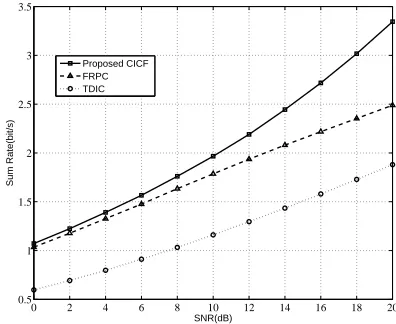
In Fig. 3, the sum rates of all RUEs versus SNRs under perfect CSI are compared among the CICF, FRPC and TDIC. According to these simulation curves, the proposed CICF achieves a larger sum rate than the two baselines do, which indicates that the BBU pool as the principal can benefit from the proposed contact model, thus demonstrating the effectiveness of the proposed CICF for all RUEs. Due to gains from the optimized time duration of the three phases and the allocated transmission power of RRHs and the MBS, the sum rate of all RUEs increases almost linearly with SNRs, whereas the baseline FRPC cannot provide the same performance gain as the CICF because the intr-tier interference is still severe even though the fairness power control is utilized. For the baseline TDIC, the sum rate is the lowest because its spectral efficiency is low even though the inter-tier interference is avoided.
0 2 4 6 8 10 12 14 16 18 20
0.5 1 1.5 2 2.5 3 3.5 4
SNR(dB)
Sum Rate (bit/s)
Proposed CICF FRPC TDIC
FRPC proposed−CICF
[image:11.612.335.534.62.225.2]TDIC
Fig. 3. Sum rates versus SNRs for all RUEs with different schemes.
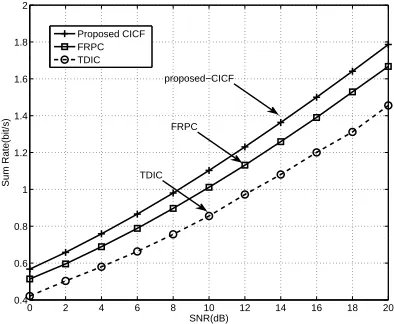
To evaluate performance gains of the agent, the data rates of the MUE versus SNRs are compared among the CICF, FRPC and TDIC in Fig. 4. It can be observed that the proposed CICF achieves the equivalent data rate for the MUE as the FRPC, which is not unexpected since the equality of the IR constraint would always hold when the BBU pool can acquire the complete and perfect CSI. Comparing with the baseline TDIC, the data-rate based utility gain for the MUE is significant for the proposed CICF because only partial spectral resources are utilized in the TDIC.
Summarizing the sum rates of all RUEs and MUE in Fig. 3 and Fig. 4, respectively, the rate-based utility gain from the proposed CICF is significant, which demonstrating the effectiveness of the proposed contract-based solution under perfect CSI.
0 2 4 6 8 10 12 14 16 18 20
0.4 0.6 0.8 1 1.2 1.4 1.6 1.8 2
SNR(dB)
sum rate(bit/s)
Proposed CICF FRPC TDIC
proposed−CICF
FRPC
[image:11.612.74.272.362.527.2]TDIC
Fig. 4. Data rates versus SNRs for MUEs with different schemes.
B. Performance Evaluations under Partial CSI
In Fig. 5, the sum rates of all RUEs versus SNRs under imperfect CSI for the proposed CICF and baselines (i.e., FRPC and TDIC) are evaluated and compared. Similarly to the results under perfect CSI, the proposed CICF can achieve a significant sum rate gain compared with the baselines due to the fact that both the time durations of the three phases and the allocated power are optimized. Moreover, comparing the performance gain gap from the CICF to FRPC in Fig. 3 and Fig. 5, the benefit of the principal under imperfect CSI is lower than that under perfect CSI. This happens because the derived optimal contract under imperfect CSI cannot always ensure the equality of all IR constraints. Furthermore, the performances of FRPC and TDIC under perfect CSI is better than that under imperfect CSI due to the fact that the channel estimation error degrades the precoding performance at RRHs.
0 2 4 6 8 10 12 14 16 18 20
0.5 1 1.5 2 2.5 3 3.5
SNR(dB)
Sum Rate(bit/s)
Proposed CICF FRPC TDIC
Fig. 5. Sum rates versus SNRs for RUEs with different schemes.
[image:11.612.335.533.489.651.2]IR constraints. Meanwhile, the performance of FRPC in Fig. 6 is worse than that in Fig. 4 because the fairness power control depends critically on the instantaneous CSI. While TDIC in Fig. 6 is the same as that in Fig. 4 since the CSI has no impact on the downlink transmission of the MBS with this baseline.
0 2 4 6 8 10 12 14 16 18 20
0.4 0.6 0.8 1 1.2 1.4 1.6 1.8 2
SNR(dB)
Sum Rate(bit/s)
Proposed CICF FRPC TDIC
proposed−CICF
FRPC
[image:12.612.315.564.391.522.2]TDIC
Fig. 6. Data rates versus SNRs for MUEs with different schemes.
To characterize the optimal contract in the proposed CICF, the cumulative density function (cdf) of both t∗1 and t∗2 are
plotted in Fig. 7. It can be seen that P(t∗1≥0.5T0)>0.7and
P(t∗
2≤0.5T0)>0.8, which indicates that the time duration of
Phase I should be longer than that of Phase II to optimize the sum date rates. To optimize the transmission data rates of the whole H-CRAN, more time resources should be assigned to allow MUEs to be served by RRHs, and thus an example of the transmission frame structure under these scheduling algorithms and configurations in this paper is suggested such that the time duration of Phase I is about 70 percent of the TTI length, and the time duration of Phase II is about 30 percent of the TTI length. Note that the transmission duration of Phase III would be zero when the contract is signed, which is indicated in both Lemma 1 and Lemma 2.
0 0.1 0.2 0.3 0.4 0.5 0.6 0.7 0.8 0.9 1
0.1 0.2 0.3 0.4 0.5 0.6 0.7 0.8 0.9 1
t
cdf
t
1 *
t
2 *
t2*≤0.5T 0
[image:12.612.75.270.544.703.2]t1*≥0.5T 0
Fig. 7. The cdf distributions oft∗
1andt∗2.
VI. CONCLUSIONS
In this paper, a contract-based interference coordination framework has been proposed to mitigate inter-tier interference in H-CRANs, whose core idea is that the BBU pool is selected as the principal that would present a contract to the MBS, and the MBS as the agent decides whether to accept the contract or not according to its potential for improving the SE performance. An optimal contract design that maximizes the overall rate-based utility has been derived when perfect CSI is available at both principal and agent. Furthermore, the contract optimization under the situation where the partial CSI has been obtained from channel estimation has been considered as well. Monte Carlo simulations have been pro-vided to corroborate the analysis, and simulation results have shown that the proposed framework can significantly increase the sum data rates, thus demonstrating the effectiveness of the proposed contract-based framework. Interesting topics for further research include, more advanced inter-tier interference coordination schemes to enhance the RRH-MBS with
UEs-separated phase in the presented framework, and the inclusion
of fronthaul constraints within this framework.
APPENDIXA PROOF OFLEMMA1
For the fixed t1 and t2, the optimal PC1 andPM1 can be
derived by using the Karush-Kuhn-Tucker (KKT) conditions. The corresponding Lagrangian function can be written as
L(PC1, PM1, λ) =−t1RC1
−λ
Pmax− PC1 (K−M−1)ε1
− PM1
(K−M−1)υM+1
, (64)
whose solution is derived as
∇L(PC1, PM1, λ) =−t1∂RC1
∂PC1
+λ 1
(K−M−1)ε1
= 0, (65)
λ
Pmax− PC1 (K−M−1)ε1
− PM1
(K−M−1)υM+1
= 0, (66)
λ≥0. (67)
It is obvious thatλmust be positive to achieve the optimal solution forPC1, and thus the optimal received powers PC∗1
andP∗
M1 allocated to RUEs and MUE should satisfy
P∗
C1 (K−M−1)ε1
+ P
∗
M1 (K−M−1)υM+1
=Pmax. (68)
For given PC1 and PM1, the optimal t1 and t2 can be
obtained by solving following equations:
RC2−RC1+v−v1−wRM1= 0, (69)
RC2−RC3+v−v2−wRM3= 0, (70)
v1t1= 0, v2t2= 0, v(T−t1−t2) = 0, (71)
̟(t1RM1+t3RM3−u) = 0, (72)
v1≥0, v2≥0, v≥0, ̟≥0. (73)
where v, ̟, v1, and v2 are the Lagrangian multipliers. It
is obvious that ̟ must be larger than zero. Therefore, the IR constraint is derived. Moreover, in order to maximize the transmission bit rate of the MUE, the optimal t3 should be
APPENDIXB PROOF OFLEMMA2
Denoting the m-th column ofGT andA by gm and am,
respectively, the transmission data rate can be derived as [32]
ˆ
Rm=
log 1+ |E[gmam]|
2
σ2
n+var{gmam}+|fBm|2PB+PMi6=mE[|gmai|2] !
.
(74)
For the ZF precoder, we haveˆgmai=δmi. Denote the radio
channel matrix byG= ˆG+ ˜G, whereG˜ is the estimation error, and we have
gmai= ˆgmai+ ˜gmai=δmi+ ˜gmai. (75)
According to (75), the expectation and variance can be written as
E[gmai] =PC1,E[|gmai|2] =δ1PC1 M X
i6=m
GGH−1
ii ,
(76)
var{gmai}=EaHmgHmgmam=δ1PC1GGH
−1
mm. (77)
Thus, the sum data rate of all RUEs in the downlink transmission during Phase III is given by
ˆ
RC3= M X
m=1 log
1+
PC3
δ1PC3tr h
ˆ
GGˆHi−1
+|fBm|2P B+σn2
,
(78)
and the data rate of the MUE can be written as
ˆ
RM3= log
1+ |gB| 2P
B
σ2 n+|fA|2
= log
1+
|gB|2P B
PC3fGˆH
ˆ
GGˆH−2Gfˆ H+σ2 n
. (79)
Similarly, the sum rates during the Phase I and II can be calculated in the same way.
APPENDIXC PROOF OFLEMMA3
By using the KKT conditions, the optimal t˜L
3 can be
obtained by solving the following equations:
−( ˜RC2−R˜C1)qL
˜
RL M3 ˜
RM1
+( ˜RC2−R˜C3)qL−ω1+ω2(1− ˜
RL M3 ˜
RM1
) = 0, (80)
ω1tL3= 0, ω2(T0−t˜L1−tL3) = 0, (81)
ω1≥0, ω2≥0. (82)
Based on (80), (81), and (82), we have the following results:
• When R˜M1( ˜RC2−R˜C3)>R˜ML3( ˜RC2−R˜C1),ω1 must
be positive, i.e.,tL
3= 0. Astl3 (l= 1, . . . , L−1) is often
less than tL
3,tl3 is equal to zero.
• WhenR˜M1( ˜RC2−R˜C3) = ˜RLM3( ˜RC2−R˜C1),tL3 can be
an arbitrary value in the interval [0, T0]. The derivative
of−U∗
C with respect totL
−1
3 can be written as
( ˜RC2−R˜C1) [qL+qL−1] ( ˜RML3−R˜ML−31)>0. (83)
To maximizeU∗
C, we havet L−1
3 = 0, and alltl3(l < L−1)
should be equal to zero.
• WhenR˜M1( ˜RC2−R˜C3)<R˜ML3( ˜RC2−R˜C1), ω2 must
be positive. Meanwhile, the following equation holds:
T0= ˜tL1+tL3. (84)
Obviously, this contract is unacceptable for the agent. Therefore,tL
3 should be equal to T0. In order to satisfy
the IR constraint,tl
3 (l= 1, . . . , L−1) should be set as
zero.
As for the optimal powers assigned to RRHs and MBS in Phase I, whentl
3 (l= 1, . . . , L−1)is equal to zero,UC∗ can
be expressed as
UC∗=( ˜RC1−R˜C2)uL ˜
RM1
+T0( ˜RC3−R˜C2). (85)
The Lagrangian function can be written as
L1(PC1, PM1, λ1) =−( ˜RC1− ˜
RC2)uL
˜
RM1
| {z }
f1(PC1,PM1)
−λ1
Pmax−
PC1 (K−M−1)ε2
− PM1
(K−M−1)(υM+1+δ2)
.
(86)
The derivative of the Lagrangian function with respect to PC1 is
∇L1(PC1, PM1, λ1) =
−∂f1(PC1, PM1)
∂PC1
+λ1 1 (K−M−1)ε2
= 0, (87)
λ1
Pmax− PC1
(K−M−1)ε2−
PM1
(K−M−1)(υM+1+δ2)
= 0.
(88)
λ1≥0. (89)
Since the derivative of f1(PC1, PM1) with respect to PC1
is positive,λ∗ must be positive, and the optimal powersP∗
C1
andP∗
M1 should satisfy
P∗
C1 (K−M−1)ε2+
P∗
M1
(K−M−1)(υM+1+δ2)=Pmax.
(90)
IftL
3 is positive,UC∗ can be re-written as
UC∗= ( ˜RC1−R˜C2)[1−qL]
uL
˜
RM1
+( ˜RC1−R˜C2)qL
uL−R˜LM3 ˜
RM1
+T0( ˜RC3−R˜C2)[1−qL].
Similarly, the Lagrangian function is re-formulated as
L2(PC1, PM1, λ2) =
−( ˜RC1−R˜C2)[1−qL]
uL
˜
RM1
+( ˜RC1−R˜C2)qL
uL−R˜LM3 ˜
RM1
| {z }
f2(PC1,PM1)
(92)
−λ2
Pmax−
PC1 (K−M−1)ε2−
PM1
(K−M−1)(υM+1+δ2)
.
(93)
As the derivative of f2(PC1, PM1)with respect to PC1 is
also positive, the optimal powers allocated to PC∗1 andPM∗1
are the same as in (90).
REFERENCES
[1] M. Peng and W. Wang, “Technologies and standards for TD-SCDMA evolutions to IMT-Advanced,” IEEE Commun. Mag., vol. 47, no. 12, pp. 50–58, Dec. 2009.
[2] M. Peng, Y. Liu, D. Wei, W. Wang, and H. Chen, “Hierarchical coopera-tive relay based heterogeneous networks,” IEEE Wireless Commun., vol. 18, no. 3, pp. 48–56, Jun. 2011.
[3] M. Peng, D. Liang, Y. Wei, J. Li, and H. Chen, “Self-configuration and self-optimization in LTE-Advanced heterogeneous networks,” IEEE Commun. Mag., vol. 51, no. 5, pp. 36–45, May 2013.
[4] W. Shin, W. Noh, K. Jang, and H. Choi, “Hierarchical interference alignment for downlink heterogeneous networks,” IEEE Trans. Wireless Commun., vol. 11, no. 12, pp. 4549–4559, Dec. 2012.
[5] M. Peng, X. Zhang, and W. Wang, “Performance of orthogonal and co-channel resource assignments for femto-cells in LTE systems,” IET Communications, vol. 7, no. 5, pp. 996–1005, May 2011.
[6] P. Xia, C. Liu, and J. G. Andrews, “Downlink coordinated multi-point with overhead modeling in heterogeneous cellular networks,” IEEE Trans. Wireless Commun., vol. 12, no. 8, pp. 4025–4037, Aug. 2013. [7] R. Irmer, H. Droste, P. Marsch et al., “Coordinated multipoint: Concepts,
performance, and field trial results,” IEEE Commun. Mag., vol. 49, no. 2, pp. 102–111, Feb. 2011.
[8] M. Peng, C. I, C. Tan, and C. Huang, “IEEE access special section editorial: Recent advances in cloud radio access networks,” IEEE Access, vol. 2, pp. 1683–1685, Dec. 2014.
[9] X. Xie, M. Peng, W.Wang, and H. V. Poor, “Training design and channel estimation in uplink cloud radio access networks,” IEEE Signal Process. Letters, vol. 22, no. 8, pp. 1060–1064, Aug. 2015.
[10] M. Peng, S. Yan, and H. V. Poor, “Ergodic capacity analysis of remote radio head associations in cloud radio access networks,” IEEE Wireless Commun. Letters, vol. 3, no. 4, pp. 365–368, Aug. 2014.
[11] M. Peng, Y. Li, J. Jiang, J. Li, and C. Wang, “Heterogeneous cloud radio access networks: A new perspective for enhancing spectral and energy efficiencies,” IEEE Wireless Commun., vol. 21, no. 6, pp. 126–135, Dec. 2014
[12] M. Peng, Y. Li, Z. Zhao, and C. Wang, “System architecture and key technologies for 5G heterogeneous cloud radio access networks,” to appear in IEEE Network.
[13] D. Lopez-Perez, I. Guvenc, G. de la Roche et al., “Enhanced intercell interference coordination challenges in heterogeneous networks,” IEEE Wireless Commun., vol. 18, no. 3, pp. 22–30, Mar. 2011.
[14] S. Zhang, S. Liew, and H. Wang “Blind known interference cancellation ,” IEEE J. Sel. Areas Commun., vol. 31, no. 8, pp. 1572–1582, Aug. 2013. [15] W. Cheung, T. Quek, and M. Kountouris, “Throughput optimiza-tion, spectrum allocaoptimiza-tion, and access control in two-tier femtocell net-works,” IEEE J. Sel. Areas Commun., vol. 30, no. 3, pp. 561–574, Apr. 2012.
[16] A. Liu and V. Lau, “Joint power and antenna selection optimization in large cloud radio access networks,” IEEE Trans. Signal Process., vol. 62, no. 5, pp. 1319-1328, Feb. 2014.
[17] J. Wang, M. Peng, S. Jin, and C. Zhao, “A generalized Nash equilibrium approach for robust cognitive radio networks via generalized variational inequalities,” IEEE Trans. Wireless Commun., vol. 13, no. 7, pp. 3701– 3714, Jul. 2014.
[18] S. Guruacharya, D. Niyato, I. Dong, and E. Hossain, “Hierarchical competition for downlink power allocation in OFDMA femtocell net-works,” IEEE Trans. Wireless Commun., vol. 12, no. 4, pp. 1543-1553, Apr. 2013.
[19] X. Kang, R. Zhang, and M. Motani, “Price-based resource alloca-tion for spectrum-sharing femtocell networks: A stackelberg game ap-proach,” IEEE J. Sel. Areas Commun., vol. 30, no. 3, pp. 538–549, Apr. 2012.
[20] Q. Han, Y. Bo, X. Wang, K. Ma, and C. Chen, “Hierarchical-Game-Based uplink power control in femtocell networks,” IEEE Trans. Veh. Technol., vol. 63, no. 6, pp. 2819–2835, Jul. 2014.
[21] L. Duan, L. Gao, and J. Huang, “Cooperative spectrum sharing: a contract-based approach,” IEEE Trans. Mobile Comput., vol. 13, no. 1, pp. 174–187, Jan. 2014.
[22] L. Gao, X. Wang, Y. Xu, and Q. Zhang, “Spectrum trading in cognitive radio networks: a contract-theoretic modeling approach,” IEEE J. Sel. Areas Commun., vol. 29, no. 4, pp. 843–855, Apr. 2011.
[23] Z. Hasan and V. Bhargava, “Relay selection for OFDM wireless systems under asymmetric information: a contract-theory based approach,” IEEE Trans. Wireless Commun., vol. 12, no. 8, pp. 3824–3837, Aug. 2013. [24] V. R. Cadambe and S. A. Jafar, “Interference alignment and degrees of
freedom of the K-user interference channel,” IEEE Trans. Inf. Theory, vol. 54, no. 8, pp. 3425–3441, Aug. 2008.
[25] M. Biguesh and A. B. Gershman,“Training-based MIMO channel esti-mation: a study of estimator tradeoffs and optimal training signals,” IEEE Trans. Signal Process., vol. 54, no. 3, pp. 884–893, Mar. 2006. [26] N. Lee, O. Simeone, and J. Kang, “The effect of imperfect channel
knowledge on a MIMO system with interference, ” IEEE Trans. Com-mun., vol. 60, no. 8, pp. 2221–2229, Aug. 2012.
[27] J. Choi and F. Adachi, “User selection criteria for multiuser systems with optimal and suboptimal LR based detectors,” IEEE Trans. Signal Process., vol. 58, no. 10, pp. 5463–5468, Oct. 2010.
[28] R. Rogolin, O. Y. Bursalioglu, H. Papadopoulos, G. Caire et al., “Scal-able synchronization and reciprocity calibration for distributed multiuser MIMO,” IEEE Trans. Wireless Commun., vol. 13, no. 4, Apr. 2014. [29] M. Sichitiu and C. Veerarittiphan, “Simple, accurate time
synchroniza-tion for wireless sensor networks,” in Proc. IEEE Wireless Communica-tions and Networking Conference (WCNC), New Orleans, LA, Mar. 2003, pp. 1266–1273.
[30] Y. Jing and S. ShahbazPanahi, “Max-min optimal joint power control and distributed beamforming for two-way relay networks under per-node power constraints,” IEEE Trans. Signal Process., vol. 60, no. 12, pp. 6576–6589, Dec. 2012.
[31] B.Patrick and M. Dewatripont, Contract Theory, MIT Press, 2005. [32] J. Jose, A. Ashikhmin, T. L. Marzetta, and S. Vishwanath, “Pilot
Mugen Peng (M’05–SM’11) received the B.E.
de-gree in Electronics Engineering from Nanjing Uni-versity of Posts & Telecommunications, China in 2000 and a PhD degree in Communication and Information System from the Beijing University of Posts & Telecommunications (BUPT), China in 2005. After the PhD graduation, he joined in BUPT, and has become a full professor with the school of information and communication engineering in BUPT since Oct. 2012. During 2014, he is also an academic visiting fellow in Princeton University, USA. He is leading a research group focusing on wireless transmission and networking technologies in the Key Laboratory of Universal Wireless Communications (Ministry of Education) at BUPT. His main research areas include wireless communication theory, radio signal processing and convex optimizations, with particular interests in cooperative communication, radio network coding, self-organizing network, heterogeneous network, and cloud communication. He has authored/coauthored over 50 refereed IEEE journal papers and over 200 conference proceeding papers.
Dr. Peng is currently on the Editorial/Associate Editorial Board of the IEEE Communications Magazine, the IEEE Access, the IET Communications, the International Journal of Antennas and Propagation (IJAP), the China Communications, and the International Journal of Communications System (IJCS). He has been the guest leading editor for the special issues in the IEEE Wireless Communications. Dr. Peng was a recipient of the 2014 IEEE ComSoc AP Outstanding Young Researcher Award, and the best paper award in GameNets 2014, CIT 2014, ICCTA 2011, IC-BNMT 2010, and IET CCWMC 2009. He received the First Grade Award of Technological Invention Award in Ministry of Education of China for his excellent research work on the hierarchical cooperative communication theory and technologies, and the Second Grade Award of Scientific and Technical Advancement from China Institute of Communications for his excellent research work on the co-existence of multi-radio access networks and the 3G spectrum management.
Xinqian Xie received the B.S. degree in
telecom-munication engineering from the Beijing University of Posts and Communications (BUPT), China, in 2010. He is currently pursuing the Ph.D. degree at BUPT. His research interests include cooperative communications, estimation and detection theory.
Qiang Hu received the B.S. degree in applied
physics from the Beijing University of Posts & Com-munications (BUPT), China, in 2013. He is currently pursuing the Master degree at BUPT. His research interests include cooperative communications, such as cloud radio access networks (C-RANs), and sta-tistical signal processing in large-scale networks.
Jie Zhang (M’02) is a full professor and has held
the Chair in Wireless Systems at the Electronic and Electrical Engineering Dept., University of Sheffield since 2011. He received PhD in 1995 and became a Lecturer, Reader and Professor in 2002, 2005 and 2006 respectively. He and his students pioneered research in femto/small cell and HetNets and pub-lished some of the most widely cited publications in these topics. He co-founded RANPLAN Wireless Network Design Ltd. (www.ranplan.co.uk) that pro-duces a suite of world leading in-building distributed antenna system, indoor-outdoor small cell/HetNet network design and opti-mization tools “iBuildNet-Professional, Tablet and Cloud”. Since 2003, he has been awarded over 20 projects by the EPSRC, the EC FP6/FP7/H2020 and industry, including some of earliest research projects on femtocell/HetNets.
H. Vincent Poor (S’72, M’77, SM’82, F’87)