This is a repository copy of
A WS-Agreement Based SLA Implementation for the CMAC
Platform
.
White Rose Research Online URL for this paper:
http://eprints.whiterose.ac.uk/85684/
Version: Accepted Version
Proceedings Paper:
Galati, A, Djemame, K orcid.org/0000-0001-5811-5263, Fletcher, M et al. (3 more authors)
(2014) A WS-Agreement Based SLA Implementation for the CMAC Platform. In: Altmann,
J, Vanmechelen, K and Rana, OF, (eds.) Economics of Grids, Clouds, Systems, and
Services (Lecture Notes in Computer Science). Economics of Grids, Clouds, Systems, and
Services: 11th International Conference, GECON 2014, 16-18 Sep 2014, Cardiff, UK.
Springer , pp. 159-171. ISBN 978-3-319-14608-9
https://doi.org/10.1007/978-3-319-14609-6_11
© 2014 Springer International Publishing Switzerland. This is an author produced version
of a paper presented at the 11th International Conference, GECON 2014, and published in
Economics of Grids, Clouds, Systems, and Services (Lecture Notes in Computer Science
8914). Uploaded in accordance with the publisher's self-archiving policy. The final
publication is available at Springer via http://dx.doi.org/10.1007/978-3-319-14609-6_11
[email protected] https://eprints.whiterose.ac.uk/
Reuse
Unless indicated otherwise, fulltext items are protected by copyright with all rights reserved. The copyright exception in section 29 of the Copyright, Designs and Patents Act 1988 allows the making of a single copy solely for the purpose of non-commercial research or private study within the limits of fair dealing. The publisher or other rights-holder may allow further reproduction and re-use of this version - refer to the White Rose Research Online record for this item. Where records identify the publisher as the copyright holder, users can verify any specific terms of use on the publisher’s website.
Takedown
If you consider content in White Rose Research Online to be in breach of UK law, please notify us by
A WS-Agreement Based SLA Implementation
for the CMAC Platform
Adriano Galati1
, Karim Djemame1
, Martyn Fletcher2,3, Mark Jessop2,
Michael Weeks2
, and John McAvoy3
1
Distributed Systems and Services Research Group, School of Computing, University of Leeds, E.C. Stoner Building, Woodhouse Lane, LS2 9JT, UK 2
Advanced Computer Architecture Group, Department of Computer Science, University of York, YO10 5DD, UK
3
Cybula Ltd. R&D Team, Science Park, York, YO10 5DD, UK
Abstract. The emerging transformation from a product oriented econ-omy to a service oriented econecon-omy based on Cloud environments envi-sions new scenarios where actual QoS (Quality of Service) mechanisms need to be redesigned. In such scenarios new models to negotiate and manage Service Level Agreements (SLAs) are necessary. An SLA is a formal contract which defines acceptable service levels to be provided by the Service Provider to its customers in measurable terms. SLAs are an essential component in building Cloud systems where commitments and assurances are specified, implemented, monitored and possibly ne-gotiable. This is meant to guarantee that consumers’ service quality ex-pectations can be achieved. In fact, the level of customer satisfaction is crucial in Cloud environments, making SLAs one of the most important and active research topics. This paper presents an SLA implementation for negotiation, monitoring and renegotiation of agreements for Cloud services based on the CMAC (Condition Monitoring on A Cloud) plat-form. CMAC offers condition monitoring services in cloud computing environments to detect events on assets as well as data storage services.
Keywords: SLA, WS-Agreement, Requirements, Negotiation.
1
Introduction
Cloud computing [1] is emerging as a new computing paradigm and it is gain-ing increasgain-ing popularity throughout the research community. One aspect of the cloud is the provision of software as a service over the internet, i.e. providing applications (services) hosted remotely. Ideally, these services do not require
SLA implementation, and in Section 6 we provide the lessons we have learned throughout this experience. Finally, Section 7 concludes this paper.
2
Related Work
would be the support for SLA template deployment from a tool for designing SLA templates. SLA templates can be created during the design process of a service and the deployment of an SLA template from the design tool would al-low a better integration with the SLA infrastructure. Cremona (Creation and Monitoring of Agreements) [18] was developed by IBM using an early version of WS-Agreement. It is a middleware, which supports the negotiation, monitoring, and management of WS-Agreement-based service level agreements. The provided functionality supports both parties involved in the service provisioning and con-sumption process, i.e. the service provider and the service consumer. SORMA (Self-Organizing ICT Resource Management) [19] implement an Open Grid Mar-ket in a comprehensive way by addressing three arguments: the economic model providing an economically sound market structure; the self-organization model, which deals with the interaction between the Grid-application and the market and provides intelligent tools; and the economic middleware model, which builds the bridge between the self-organization and the economic model on the one side and state-of-the-art Grid infrastructure on the other side.
3
SLA Protocol Design
In this section we draw attention to some aspects related to the design and integration of an SLA protocol for the CMAC platform to a point where it can be commercially implemented. Most research up to now provides little insight on how negotiation, and in particular automated negotiation, can be realised. In addition, it is difficult to define the quality aspects of SLA requirements. Here, we have designed an SLA protocol which is integrated in the CMAC platform. For this purpose, the main challenges that we tackle in order to provide QoS guarantees, are mainly three:
– the identification of the QoS properties, i.e. its requirements and terms, and their publication in the SLA template;
– SLA generation and negotiation control based on service requirements and assets available to satisfy customer requests, as well as the decision process to accept, reject, or renegotiate the counteroffer in the negotiation process;
– maximising providers’ profit implementing an optimal service and resource allocation policy. Profits are recognised when SLA agreements are honored, generally when workload execution completes on time, otherwise penalties are incurred;
essential for the fulfillment of the service. Our SLA protocol allows negotiation based on the terms presented by the parties. In this context, the agreed terms are necessary conditions, but not sufficient, to reach an agreement; service require-ments must be satisfied anyway. It is necessary to determine all the guarantee terms that will be signed by both parties. For the CMAC services we identify some terms which are QoS parameters like the delivery ability of the provider, the performance of user’s workloads, the bounds of guaranteed availability and performance, the measurement and reporting mechanisms, the cost of the ser-vice, the terms for renegotiation, and the penalty terms for SLA violation. Our SLA protocol defines ad-hoc SLA template structures for each service on the base of its prerequisites. Our SLA protocol has been designed to allow negotia-tion only for the guarantee terms. In this respect, the WS-Agreement negotianegotia-tion protocol decides whether to accept or reject the user’s offer, or eventually rene-gotiate providing a counteroffer, if there are the prerequisites for raising one. The negotiation is quite flexible; it is based on temporal restrictions, resource constraints, previous offers and a maximum number of renegotiations is possi-ble. Once the service requirements and the guarantee terms are met the contract has been stipulated. The negotiation constraints in the negotiation template are used to control the negotiation process. Although, virtualization of resources is a prerequisite for building a successful cloud infrastructure, we do not con-sider it at this stage. At this point CMAC can start monitoring the service and determining whether the service objectives are achieved or violated. Namely, if the provider has delivered the service within the guaranteed terms. At this early stage we assume only the service provider to be in charge of this process, although each party should be in charge of this task and how fairness can be assured between them is an open issue. The monitoring process helps the service provider to prevent violations of the guarantee terms by renegotiating them.
4
CMAC Requirements
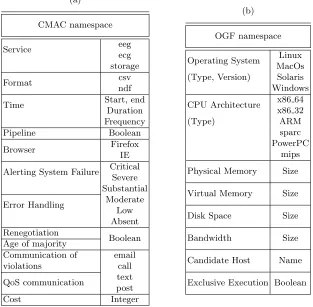
(elec-Table 1: Service Description Terms in the CMAC’s SLA template.
(a)
CMAC namespace
Service eeg
ecg storage
Format csv
ndf
Time Start, end
Duration Frequency
Pipeline Boolean
Browser Firefox
IE
Alerting System Failure Critical Severe Substantial
Error Handling Moderate Low Absent Renegotiation
Boolean Age of majority
Communication of email
violations call
QoS communication text post
Cost Integer
(b)
OGF namespace
Operating System Linux MacOs (Type, Version) Solaris Windows
CPU Architecture x86 64 x86 32
(Type) ARM
sparc PowerPC
mips
Physical Memory Size
Virtual Memory Size
Disk Space Size
Bandwidth Size
Candidate Host Name
Exclusive Execution Boolean
troencephalogram), the ecg (electrocardiogram), and the storage of data. The eeg and ecg are both software tools designed for medical signal analysis. Such applications can read data in cnv (vector image files primarily associated with DB2 conversion files) and ndf format. CMAC allows users to request service
[image:7.612.146.459.153.460.2]failures. For that, CMAC can detect anomalies and system failures in signal processing and notify them to service consumers based on the selected alerting level. The error handling level is concerned with recording and communication of failures of the CMAC services. System errors and service failures are notified to CMAC users by means of the preferred communication method, that is, email, call and text. The same communication method is used to notify SLA violations and QoS auditing. CMAC also allows users to upload and make available for use any own software for processing data as long as some requirements such as the operating system and version, CPU architecture, physical memory, vir-tual memory and disk space can be run on an execution node. Execution nodes can be exclusively allocated or shared among CMAC users. Therefore, users can choose the terms presented in Table 1(b) both for their own and CMAC services. Service consumers can be contacted anytime to renegotiate the agreed terms if the renegotiation flag is set to true. Finally, CMAC users can define maximum cost that they are willing to pay for the service provision and must state they are over eighteen on the SLA template.
<?xml version="1.0" encoding="UTF-8"?> <wsag:Template wsag:TemplateId="1"
xmlns:wsag="http://schemas.ggf.org/graap/2007/03/ws-agreement"> <wsag:Name>CMAC-1</wsag:Name>
<wsag:Context>
<wsag:ServiceProvider>AgreementResponder</wsag:ServiceProvider> <wsag:TemplateId>1</wsag:TemplateId>
<wsag:TemplateName>CMAC-TEMPLATE-1</wsag:TemplateName> </wsag:Context>
...
</wsag:Template>
Fig. 1: Name and Context sections of the CMAC’s SLA template described by means of the OGF XML Schema.
5
Implementation
...
<wsag:ServiceDescriptionTerm
wsag:Name="TIME_CONSTRAINT_SDT" wsag:ServiceName="SAMPLE-SERVICE"> <wsag4cmact:TimeConstraint xmlns:wsag4cmact=
"http://schemas.wsag4cmact.org/2012/10/wsag4j-scheduling-extensions"> <wsag4cmact:StartTime>$STARTTIME</wsag4cmact:StartTime> <wsag4cmact:EndTime>$ENDTIME</wsag4cmact:EndTime> <wsag4cmact:Duration>$DURATION</wsag4cmact:Duration> <wsag4cmact:Frequency>$FREQUENCY</wsag4cmact:Frequency> </wsag4cmact:TimeConstraint>
</wsag:ServiceDescriptionTerm> ...
<wsag:ServiceDescriptionTerm
wsag:Name="SERVICE_CONSTRAINT_SDT" wsag:ServiceName="SAMPLE-SERVICE"> <wsag4cmact:ServiceConstraint xmlns:wsag4cmact=
"http://www.comp.leeds.ac.uk/2012/10/CMAC-scheduling-extensions"> $SERVICE
</wsag4cmact:ServiceConstraint> </wsag:ServiceDescriptionTerm> <wsag:ServiceDescriptionTerm
wsag:Name="RENEGOTIATION_CONSTRAINT_SDT" wsag:ServiceName="SAMPLE-SERVICE">
<wsag4cmact:RenegotiationConstraint xmlns:wsag4cmact=
"http://schemas.wsag4cmact.org/2012/10/CMAC-scheduling-extensions"> $RENEGOTIATION
</wsag4cmact:RenegotiationConstraint> </wsag:ServiceDescriptionTerm>
... </wsag:All> </wsag:Terms>
Fig. 2: Resources described by means of the wsag4cmact XML Schema in the
terms block of the CMAC’s SLA template.
by the SLA template asCMAC-1. In thecontextsection we define the party that creates the agreement as ”agreement responder”, namely the service consumer, and assign him with a unique identifier composed of the template name and id,
<wsag:CreationConstraints> ...
<wsag:ItemConstraint>
<xs:sequence xmlns:xs="http://www.w3.org/2001/XMLSchema"> <xs:element name="OperatingSystem" minOccurs="1" maxOccurs="1"
type="jsdl:OperatingSystem_Type"/>
<xs:element name="CPUArchitecture" minOccurs="1" maxOccurs="1" type="jsdl:CPUArchitecture_Type"/>
... </xs:sequence> </wsag:ItemConstraint> </wsag:Item>
<wsag:Item wsag:Name="ResourcesSDT_JobDefinition_JobDescription_Resources_ CPUArchitecture_CPUArchitectureName">
<wsag:Location> ...
$this/wsag:AgreementOffer/wsag:Terms/wsag:All/wsag:ServiceDescriptionTerm [@wsag:Name=’RESOURCE_SDT’]/jsdl:JobDefinition/jsdl:JobDescription/ jsdl:Resources/jsdl:CPUArchitecture/jsdl:CPUArchitectureName </wsag:Location>
<wsag:ItemConstraint>
<xs:simpleType xmlns:xs="http://www.w3.org/2001/XMLSchema"> <xs:restriction base="xs:string">
<xs:enumeration value="sparc"/> <xs:enumeration value="powerpc"/> <xs:enumeration value="x86_32"/> <xs:enumeration value="x86_64"/> ...
</xs:restriction> </xs:simpleType> </wsag:ItemConstraint> ...
</wsag:CreationConstraints>
Fig. 3: Snippets of creation constraints in the CMAC’s SLA template.
implementation of the CMAC’s agreement template contains several sections of creation constraints which can be used by an agreement responder to define the structure and possible values of valid agreement offers. Only offers that are valid with respect to its template creation constraints are accepted by CMAC. Our creation constraints support CMAC in finding out acceptable values for service descriptions. Besides, they protect the agreement responder from accepting of-fers that are created in an illegal way. The CMAC agreement template we have designed helps both the agreement initiator and the responder to come to a common understanding of the provided service in the context of an SLA. The agreement offer is valid only if all of the offer items are valid according to the specified item constraints. Figure 3 shows snippets of value and structural con-straints described in jsdl of the CMAC SLA templates. The first item refers to the resources defined in the terms section of the CMAC SLA template. Here, they must occur once. The second item refers to the CPU architecture name. The location tag points to theCPUArchitectureNamefield which is also defined
<?xml version="1.0" encoding="UTF-8"?> ...
<xs:complexType name="FrequencyConstraintType"> <xs:sequence>
<xs:element name="StartTime" type="xs:dateTime" minOccurs="0" maxOccurs="1" /> <xs:element name="EndTime" type="xs:dateTime" minOccurs="0" maxOccurs="1" /> <xs:element name="Duration" type="xs:int" minOccurs="0" maxOccurs="1" /> <xs:element name="Frequency" type="xs:int" minOccurs="0" maxOccurs="1" /> </xs:sequence>
</xs:complexType>
<xs:simpleType name="FormatConstraintType"> <xs:restriction base="xs:string">
<xs:enumeration value="csv"/> <xs:enumeration value="ndf"/> <xs:enumeration value="plain"/>
</xs:restriction> </xs:simpleType>
<!-- ecg: electrocardiogram, eeg: elettroencephalogram --> <xs:simpleType name="ServiceConstraintType">
<xs:restriction base="xs:string"> <xs:enumeration value="ecg"/> <xs:enumeration value="eeg"/> <xs:enumeration value="storage"/> </xs:restriction>
</xs:simpleType>
<xs:simpleType name="AlertingSystemFailureConstraintType"> <xs:restriction base="xs:string">
<xs:enumeration value="Critical"/> <xs:enumeration value="Severe"/> <xs:enumeration value="Substantial"/>
<xs:enumeration value="Moderate"/> <xs:enumeration value="Low"/> <xs:enumeration value="Absent"/> </xs:restriction>
</xs:simpleType> ...
</xs:schema>
Fig. 4: CMAC’s XML Schema.
with which such child elements must occur, their cardinality and how they are clustered. This part implies that the context and the terms sections must be specified in the CMAC SLA template, whereas itsname section is optional.
6
Lessons Learned
7
Conclusions
Currently, WS-Agreement provides little insight on how negotiation, and in par-ticular automated negotiation, can be realized. In addition, it is difficult to define the quality aspects of SLA requirements. This paper presents an SLA protocol designed to guide the negotiation, the monitoring and the renegotiation phase of the agreed terms to maximize revenues in the CMAC platform. Besides, we also provide a clear distinction between quality aspects of SLA requirements. In this work we integrate our SLA protocol into the CMAC platform which offers a range of analytical software tools designed to detect events on assets and com-plex systems as well as data storage services. For this purpose, we choose the WSAG4J framework which is a tool to create and manage service level agree-ments in distributed systems. In this work, we have developed the first SLA protocol for the CMAC platform with the intention to maximize revenues by designing an appropriate resource allocation process based on time restrictions and related service parameters agreed during the negotiation phase and possi-bly modified by means of renegotiations. The lessons learned provide us with basis references for the development of WS-Agreement based SLAs. Our rec-ommendations provide practitioners with a set of operational SLA concepts. In particular, we draw attention to the identification and definition of requirements of cloud services as fundamental for the design of suitable SLA agreements and efficient SLA protocols. In future work we would like to implement and evaluate the renegotiation protocol we have designed in this work. We would also like to consider varying expiration times based on historical records to handle the duration of the negotiation phase so as to enhance its flexibility. Besides, we would also like to provide service consumers with estimates on previous service executions along with service performance measurement methods, measurement periods and data analysis reports, which will help choosing suitable service re-quirements. Moreover, we are examining the possibility of integrating the SLA protocol with service pricing and discounting policies to apply when SLA com-mitments are not satisfied.
Acknowledgment
We would like to thank Wolfgang Ziegler, Oliver W¨aldrich and Hassan Rasheed from the Fraunhofer Institute SCAI for their valuable advices. This research is partly funded by the University of Leeds through a Knowledge Transfer Secon-dement grant, and the European Union within the 7th Framework Programme under contract ICT-257115 - OPTIMIS.
References
2. E. Keller and H. Ludwig,The WSLA Framework: Specifying and Monitoring Service
Level Agreements for Web Services, Journal of Network and Systems Management,
Vol. 11, pp. 57-81 (2003).
3. A. Galati, K. Djemame, M. Fletcher, M. Jessop, M. Weeks, S. Hickinbotham, J. McAvoy,Designing an SLA Protocol with Renegotiation to Maximize Revenues for
the CMAC Platform, at the Cloud-enabled Business Process Management (CeBPM
2012), Paphos, Cyprus (2012).
4. S. Hickinbotham, J. Austin and J. McAvoy,Interactive Graphics on Large Datasets
Drives Remote Condition Monitoring on a Cloud, In the Proceedings of the Open
Access Journal of Physics: Conference Series, Part of CMAC project, for Cybula Ltd. and the University of York, COMADEM2012, 18-20 (2012).
5. B. Liang, S. Hickinbotham, J. Mcavoy and J. Austin,Condition Monitoring Under the Cloud, In the Proceedings of the Digital Research 2012, Oxford (UK), (2012). 6. D. Battr´e, M. Hovestadt and O. W¨aldrich,Grids and Service-Oriented Architectures
for Service Level Agreements, Springer, pp. 23-34 (2010).
7. O. W¨aldrich and W. Ziegler,WSAG4J - Web Services Agreement for Java, [online] Available: https://packcs-e0.scai.fraunhofer.de/wsag4j
8. A. Andrieux, K. Czajkowski, A. Dan, K. Keahey, H. Ludwig, T. Kakata, J. Pruyne, J. Rofrano, S. Tuecke, M. Xu, Web Services Agreement
Specifica-tion (WS-Agreement), GRAAP-WG, OGF recommendation, [online] Available:
http://www.ogf.org/documents/GFD.192.pdf
9. OGF GFD.120:Open Grid Services Architecture - Glossary of Terms, J. Treadwell (2007).
10. SLA Management Handbook: Volume 2 Concepts and Principles, Release 2.5,
Tele-Management Forum, GB 917-2(2005).
11. R. Kub¨ert, G. Gallizo, T. Polychniatis, T. Varvarigou, E. Oliveros, S.C. Phillips and K. Oberle,Service Level Agreements for Real-time Service-Oriented Infrastructures, Chapter 8 in Achieving Real-Time in Distributed Computing book: From Grids to Clouds. , IGI Global Books, Information Science Pub, (2011).
12. IRMOS Project, Available [online]: http://www.irmosproject.eu
13. A. Menychtas, D. Kyriazis, S. Gogouvitis, K. Oberle, T. Voith, G. Gallizo, S. Berger, E. Oliveros and M. Boniface, A Cloud Platform for Real-time Interactive Applications, 1st International Conference on Cloud Computing and Service Science (CLOSER 2011), Noordwijkerhout, The Netherlands, (2011).
14. T. Erl, Service-oriented Architecture: Concepts, Technology, and Design, Upper Saddle River: Prentice Hall PTR, ISBN 0-13-185858-0, (2005).
15. H. Ludwig, T. Nakata, O. W¨aldrich and W. Ziegler Coregrid Tr,Reliable
Orches-tration of Resources using WS-Agreement, High Performance Computing and
Com-munications Lecture Notes in Computer Science Volume 4208, pp 753-762,(20060. 16. D. Battr´e, F.M.T. Brazier, K.P. Clark, M.A. Oey, A. Papaspyrou, O. W¨aldrich, P.
Wieder and W. Ziegler,A Proposal for WS-Agreement Negotiation, In Proc. of the 11th IEEE/ACM Int. Conference on Grid Computing, pp. 233-241, (2010). 17. A. Pichot, P. Wieder, O. W¨aldrich and W. Ziegler,Dynamic SLA-negotiation based
on WS-Agreement, CoreGRID TR-0082, Technical Report. (2007)
18. H. Ludwig, A. Dan, R. Kearney,Cremona: An architecture and library for creation
and monitoring of WSAgreements, Proceedings of the International Conference on
Service Oriented Computing (ICSOC172004), 65-74, ACM: New York (2004). 19. D. Neumann, J. Stoesser, A. Anandasivam, N. Borissov,SORMA-Building an open
market for grid resource allocation, Grid Economics and Business Models (Lecture