On the Use of Gaussian Approximation
in Analyzing the Performance
of Optical Receivers
Volume 6, Number 1, February 2014
G. El-Howayek, Student Member, IEEE
C. Zhang
Y. Li
J. S. Ng, Member, IEEE
J. P. R. David, Fellow, IEEE
M. M. Hayat, Fellow, IEEE
On the Use of Gaussian Approximation
in Analyzing the Performance
of Optical Receivers
G. El-Howayek,1 Student Member, IEEE, C. Zhang,2Y. Li,3
J. S. Ng,4Member, IEEE, J. P. R. David,4Fellow, IEEE, and
M. M. Hayat,1 Fellow, IEEE
1Center of High Technology Materials and Department of Electrical and Computer Engineering,
University of New Mexico, Albuquerque, NM 87131-0001 USA
2Department of Electrical Engineering and Computer Science, University of
Michigan, Ann Arbor, MI 48109 USA
3Department of Electrical and Computer Engineering, University of Illinois at
Urbana-Champaign, Champaign, IL 61820 USA
4Department of Electronic and Electrical Engineering, University of Sheffield, Sheffield, S1 3JD U.K.
DOI: 10.1109/JPHOT.2014.2302792
1943-0655Ó2014 IEEE. Translations and content mining are permitted for academic research only. Personal use is also permitted, but republication/redistribution requires IEEE permission. See http://www.ieee.org/publications_standards/publications/rights/index.html for more information.
Manuscript received December 31, 2013; revised January 14, 2014; accepted January 15, 2014. Date of publication January 27, 2014; date of current version February 11, 2014. This work was supported in part by the National Science Foundation under Award ECS-0601645 and in part by the University of New Mexico’s Science and Technology Corporation (STC.UNM). Jo S. Ng would like to acknowledge funding from the Royal Society for her University Research Fellowship. Corresponding author: G. El-Howayek (e-mail: [email protected]).
Abstract:The analytical calculation of the bit error rate (BER) of digital optical receivers that employ avalanche photodiodes (APDs) is challenging due to 1) the stochastic nature of the avalanche photodiode’s impulse-response function and 2) the presence of intersymbol interference (ISI). At ultrafast transmission rates, ISI becomes a dominant component of the BER, and its effect on the BER should be carefully addressed. One solution to this problem, termed the bit-pattern-dependent (PD) approach, is to first calculate the conditional BER given a specific bit pattern and then average over all possible bit patterns. Alternatively, a simplifying method, termed the bit-pattern-independent (PI) approach, has been commonly used whereby the average bit stream is used to calculate the distribution of the receiver output, which, in turn, is used to calculate the BER. However, when ISI is dominant, the PI approximation is in-accurate. Here, the two approaches are analytically compared by analyzing their asymptotic behavior and their bounds. Conditions are found to determine when the PI method over-estimates the BER. The BER found using the PD method exponentially decays with the received optical power, whereas for the PI approach, the BER converges to a constant, which is unrealistic. For an InP-based APD receiver with a 100-nm multiplication layer, the PI method is found to be inaccurate for transmission rates beyond 20 Gb/s.
Index Terms:Bit error rate (BER), optical receivers, Gaussian distribution, photodectors, intersymbol interference (ISI), analytical models, approximation error.
1. Introduction
which takes place in the high-field (intrinsic) multiplication layer of the APD [1]. However, the en-hancement from the gain is accompanied by excess in the shot noise by a factor known as the excess noise factor, which is a measure of uncertainty associated with the stochastic nature of the APD’s gain. Moreover, the APD’s buildup time, which is the stochastic time required for the cascade of impact ionizations to complete per incident photon, further limits the receiver performance by causing intersymbol interference (ISI). While separate absorption and multiplication InP APDs have been successfully deployed in 10 Gb/s lightwave systems, they cannot sustain higher bit rates due to their long avalanche buildup time. Much of the recent work on APDs has focused on developing new structures and incorporating alternative materials that will yield lower noise and higher speed. For example, in 2009, a Ge/Si APD was demonstrated to have a gain-bandwidth product of 340 GHz and a sensitivity of28 dBm [2] at 10 Gb/s. Moving toward higher transmission speed, a new approach has been proposed in [3], [4] that employs periodic bit-synchronized dynamic biasing of the APD to reduce ISI by quenching the avalanche buildup time near the end of each optical pulse. The analytical calculation of the bit-error rate (BER) of digital optical receivers that employ APDs is especially challenging due to the presence of ISI and the stochastic nature of avalanche gain and its correlation with the stochastic avalanche buildup time.
Numerous methods have been developed to approximate the BER. In [5], a procedure was given to numerically compute system performance, which uses the nearly exact Webb’s approximation of the true Conradi distribution for the APD output. The measured performance of the system was found to be in excellent agreement with the performance predicted. In their model, the ISI was not addressed due to the low transmission speed. However, as it is the case in modern lightwave systems, the transmission rates are large (upwards of 10 Gb/s) and the ISI cannot be neglected. Sun et al.[6] developed a method to compute the exact BER based on the moment-generating function (MGF). The effects of ISI as well as the APD’s dead space are both included in the analysis. The exact BER was computed by adding the contribution of every photon absorbed by the APD during every bit interval to the receiver output. However, this exact method is computationally expensive and provides no closed-form expression for the BER.
In many cases, a closed-form expression for the BER is required to understand, predict and provide analytical insight for the receiver performance. A closed-form expression for the BER can be found by first conditioning on the past bit pattern; then the BER is calculated by averaging the conditional BER over all possible past bit patterns. This approach, denoted here by the bit-pattern– dependent (PD) approach, was adopted by Ong et al. [7], [8] in which the receiver output, conditional on the present and all the past bits, is approximated by a Gaussian random variable. The validity of this approximation has been verified for large number of incident photons [9]. The Gaussian approximation has been shown to be quite accurate in estimating the bit error probabilities [10]. On the other hand, to simplify the analysis, another method has been commonly used by conditioning on the current bit while considering theaverageof all possible bit patterns (in place of the individual realizations of bit patterns) to generate the Gaussian distribution of the output [11]–[13]. Hence, the receiver output in this approach is bit-pattern–independent (PI), as it depends only on the average past bit pattern. However, the benefit from the simplification comes at the expense of inaccuracy in the BER when ISI is dominant, i.e., when transmission speed is very high as in the OC-192 standard.
exceeding the photocount threshold, ISI should be properly addressed by conditioning on the entire bit pattern stream as done by the PD approach.
2. Review of Relevant BER Models
Consider a typical non-return-to-zero, on-off keying optical communication system incorporating an APD-based integrate-and-dump receiver. When an information bit 1 is transmitted, an optical pulse is transmitted in a time interval of durationTb; otherwise, no pulse is transmitted. LetBndenote the
input binary sequence representing the binary information in thenth bit (n¼0 represents current bit). Let denote the raw output resulting from the integrate-and-dump receiver (i.e., prior to any decision). The information (0 or 1) can be detected by comparingto a threshold,. Each infor-mation bit Bn contributes a term RnBn to the receiver output, where Rn is the random variable
representing the stochastic receiver output when thenth past bit is a 1 and all other past bits are 0. Thus, the receiver outputs conditioned on the current bit (B0¼0 or 1), denoted by 0 and 1,
respectively, can be expressed as
0¼
X1
n¼1
RnBnþN
1¼
X1
n¼1
RnBnþR0þN (1)
whereN is the receiver Johnson noise. Note that only the termR0 conveys information from the
current bit. The componentsRn,n1, represent the ISI contributions in the receiver output from the
earlier bits. Due to the analytical complexity of the exact statistics ofRn, it is customary to modelRn
as a Gaussian random variable.
For its relevance to the present paper, we begin by briefly reviewing the probabilistic model for the conditional receiver outputs,0and1, developed using the PI and PD methods to determine
their BERs; these BERs are termed BERI and BERD. Both the mean and variance ofRn, denoted
byn and2n, respectively, are shown in [7] to be proportional to the average number of photons
per bit, n0. Additionally, they are both exponentially decreasing with the bit order n. More
pre-cisely [7],
0¼n0 (2)
n¼n0en ðn¼1;2;. . .Þ (3)
20¼n0 (4)
2n¼n0en ðn¼1;2;. . .Þ: (5)
The coefficients, , , and are APD-specific system parameters derived in [7] as
¼
hGi
ð1þe
Þ (6)
¼
hGi2F
ð2þ2e
þeÞ (7)
¼
2hGi
ðcoshðÞ 1Þ (8)
¼
hGi2F
ðe
1Þð1eeÞ (9)
where brackets represent ensemble average andF is the APD’s excess noise factor, defined as
F ¼ hG2i=hGi2. Sun et al.[11] defined the so-called shot-noise-equivalent-bandwidth as Bsneq¼
hG2=Ti=2hGi2F, the bandwidth correlation factor as¼4B
sneq=2 B3dB and the detector’s relative
density function (PDF) associated with the random variables comprising the APD’s stochastic gain,G, and its stochastic avalanche duration time,T, developed in [11].
The PI method used in [11] approximates the conditional receiver outputs, 0 and 1, by
Gaussian random variables. In particular, BERI is computed as [11]
BERI¼
1 2erfc
Ij1Ij0
ffiffiffi 2 p
ðIj0þIj1Þ
!
(10)
whereIj0and2Ij0denote the mean and variance of the receiver output conditional on the present
bit being 0 while assuming the average of all possible patterns, i.e.,Bn¼1=2 forn1. Moreover,
Ij1 and2Ij1 are similar quantities conditional on the present bit being 1. The expressions for the
parametersIj0,2Ij0,Ij1, and2Ij1 are [11]
Ij0¼1 2
e
1en0 (11)
Ij1¼Ij0þn0 (12)
2Ij0¼1 4
X1
n¼1
22nþ2n
þ2N (13)
2Ij1¼2Ij0þn0: (14)
The optimal decision threshold,that minimizes BERI is [1]
¼Ij1Ij0þIj0Ij1
Ij1þIj0 : (15)
Note that in the PI method, the distribution of the conditional receiver output has a unimodal distribution.
We next describe the PD method. Instead of assuming a Gaussian PDF for the receiver output conditional on the present bit, Ong et al. [7] assume a Gaussian PDF for the receiver output conditional on the present andthe entire past bit stream. This will lead to a multimodal distribution for the conditional receiver output.
More precisely, for an arbitrary past bit pattern,Ij 2 f0;1g1, the pattern-dependent means and
variances of0and1 are given by [7]
Dj0ðIjÞ ¼
X1
k¼1
akðIjÞk (16)
Dj1ðIjÞ ¼Dj0ðIjÞ þ0 (17)
2Dj0ðIjÞ ¼
X1
k¼1
akðIjÞ2kþ2N (18)
2Dj1ðIjÞ ¼D2j0ðIjÞ þ20 (19)
whereakðIjÞ ¼0 unless thekth bit in the patternIj is a 1 bit, in which caseakðIjÞassumes the value 1.
To calculate BERD, Onget al.compute the ensemble average of the pattern-specific BER over all
possible past bit patterns: [7]
BERD¼limL!1
1 2L
X2L
j¼1
1 4 erfc
Dj0ðIjÞ
ffiffiffi 2 p
Dj0ðIjÞ
!
þerfc Dffiffiffij1ðIjÞ 2 p
Dj1ðIjÞ
!
" #
(20)
whereis calculated for convenience from (15). Note that the optimal threshold, denoted byo, does
not have a simple analytical expression in this case because the PDF of the receiver output is a multimodal distribution. However, one can calculateonumerically by finding the intersection point of
BERD;opt using the optimal threshold,o, and compare it to BERD, which uses the threshold. Note
that we have implicitly neglected the additional current generated from the background light and tunneling. Nonetheless, the above models can be easily generalized to accommodate the dark current and the background light rates. These effects will only shift the means and increase the variances of the receiver output by adding additional interference and noise. Therefore, ignoring these effects will not influence the conclusions of this paper.
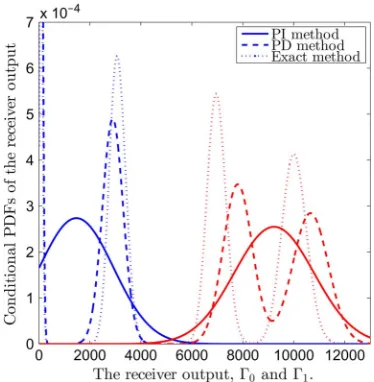
Fig. 1 shows an example of the conditional PDFs calculated for an InP-based APD with 100-nm multiplication layer. An electric field of 10.5 kV/cm was assumed in the multiplication layer, corresponding to an average gain of 10.3 and a buildup-time–limited 3-dB bandwidth of 29 GHz. The bit transmission rate is set to 60 Gb/s. The PDFs of0and1for the PI and PD approaches are
compared to the exact PDFs found in [6]. For a linear-mode operation of the APD, the avalanche buildup time terminates at some finite random time almost surely. Therefore, in the PD approach, we can justify setting an adequate value forLto be sufficiently large to capture all the ISI terms. In our calculation, we foundL¼5 as an appropriate value beyond which no significant change in the BER was observed. Fig. 1 foretells that the PD method yields a better approximation of the exact PDF compared to the PI approach. Also, it is clear from the figure that BERD(as well as the exact
BER) outperforms BERI since the PDFs of the PI method are larger than that for the PD (and the
exact) method in the vicinity of the decision threshold,.
3. Asymptotic Analysis of the BER
We now compare BERI and BERD for largen0 and for various transmission rates, 1=Tb.
3.1.1. Theorem 1
limn0!1BERI is a constant whereas BERD decays exponentially in n0. Moreover, when n0
exceeds the threshold
nth
1
c2 2
ln pffiffiffierfc
ffiffiffiffiffiffiffiffiffiffiffiffiffiffiffiffiffiffiffiffi 1e2 p
ffiffiffi 2 p
e
!
" #
(21)
wherec2 is defined in (26), then BERIBERD9 rðn0Þ, whererðn0Þis a monotonically increasing
[image:6.594.204.391.59.250.2]positive function converging to limn0!1BERI.
Before proving this theorem, it is worthwhile to mention that the photon count threshold,nth, is a
function of the bit transmission speed, 1=Tb, reflected in the detector’s relative speed factor,
¼2 B3dBTb.
3.1.1.1. Proof
Consider the case for which the current bit is 0; in this case and for largen0,
2Ij01 4
e2 1e2
2
n
2
0: (22)
Similarly, for the case when the current bit is 1, it can be shown that2Ij12Ij0 whenn0is large.
Substituting these results in the error probability found in (10), we obtain
limn0!1BERI ¼
1 2erfc
ffiffiffiffiffiffiffiffiffiffiffiffiffiffiffiffiffiffiffiffi 1e2 p ffiffiffi 2 p e ! : (23)
Thus, BERI is asymptotically independent ofn0and it saturates to a predetermined constant.
Next, we find the upper bound,Uðn0Þ, for BERDand describe its asymptotic behavior. This is done
by considering the worst (maximum error) bit-pattern scenario. Consider the first term in (20), which represents the probability of falsely announcing 1 when the current bit is 0. This term is maximized when all the past bits are 1. Similarly, the second term in (20), which represents the probability of falsely announcing 0 when the current bit is 1, is maximized when all the past bits are 0. By replacing these worst-case scenarios in (20), we obtain the following upper bound for BERD:
BERD G
1 4 erfc
P1n¼1n
ffiffiffiffiffiffiffiffiffiffiffiffiffiffiffiffiffiffiffiffiffi 2P1n¼12 n
p
!
þerfc ffiffiffiffiffiffiffiffiffiffiffiffiffiffiffiffiffiffiffiffiffi0 2P1n¼02 n
p
!
" #
: (24)
Using the upper bound erfcðxÞG ð2=pffiffiffiÞðex2
=xþpffiffiffiffiffiffiffiffiffiffiffiffiffiffiffiffiffiffiffiffiffiffiffix2þ ð4= ÞÞ[14], we further obtain
BERD G
1 4pffiffiffi
ec2 1n0
c1 ffiffiffiffiffin0
p þe
c2 2n0
c2 ffiffiffiffiffin0
p !
Uðn0Þ (25)
wherec1andc2are defined as
c1¼ 1
2
e
2ð1eÞ ffiffiffiffiffiffiffiffiffiffiffiffiffiffiffiffiffiffiffiffiffi 2 e
1e
q and c2¼
1
2
e
2ð1eÞ ffiffiffiffiffiffiffiffiffiffiffiffiffiffiffiffiffiffiffiffiffiffiffiffiffiffiffiffiffiffiffiffiffiffiffi 2 þ e
1e
q : (26)
Similarly, to find a lower bound for BERD, we consider the best (minimum error) past-bit scenarios (a
past-bit stream of all 0s when considering the probability of falsely announcing 1 and a past-bit stream of all 1s when considering the probability of falsely announcing 0). By using these best-case scenarios in conjunction with the lower bound erfcðxÞ9 ð2=pffiffiffiÞðex2
=ðx þpffiffiffiffiffiffiffiffiffiffiffiffiffiffix2þ2ÞÞ[4], it can be
shown that
BERD9
1 4pffiffiffi
ec2 0n0
c0 ffiffiffiffiffin0
p (27)
where c0¼=2 ffiffiffiffiffiffiffiffi2 p
. Therefore, unlike BERI, BERD decays exponentially with respect to the
average photon countn0since its upper and lower bounds decay exponentially inn0.
Next, consider the intersection point between limn0!1BERIandUðn0Þ, which can be approximated
for large n0 by nth defined in (21). Note that when n09nth, BERI 9BERD; furthermore, BERI
BERD 9rðn0Þ where rðn0Þ ¼limn0!1BERIUðn0Þ. Clearly, rðn0Þ is a monotonically increasing
4. Numerical Results
In our calculations, we selected an InP-based APD receiver with a 100-nm multiplication layer and an electric field of 10.5 kV/cm. The system parameters, calculated numerically using the renewal theory approach [11], are ¼97:49,¼5:5103, ¼7:76, and ¼325:4. The bit-length parameter is set toL¼5, which is large enough to capture all significant ISI terms for this example. The behavior of BERI, BERD, and BERD;opt, are shown in Fig. 2 for two transmission rates, 10 GHz
[image:8.594.117.477.58.213.2]and 30 GHz. We compare the results to the exact BER calculated using the MGF approach [6]. The numerical results suggest that at low transmission rate (10 Gb/s), the PI method gives a good estimate of the BER and it can be used instead of the PD method to reduce the computational complexity. However, at 30 Gb/s, ISI becomes crucial to the BER and the PI method deviates from the exact BER and saturates at high optical powers as the asymptotic analysis predicted. On the
Fig. 2. The BER of an InP-based optical receiver using the two approximation methods compared to the exact BER. In the PD method, the optimal threshold,o, was considered in addition to the suboptimal
threshold,ðL¼5Þ. (a) BER at a transmission rate of 10 Gb/s. (b) BER at a transmission rate of 30 Gb/s.
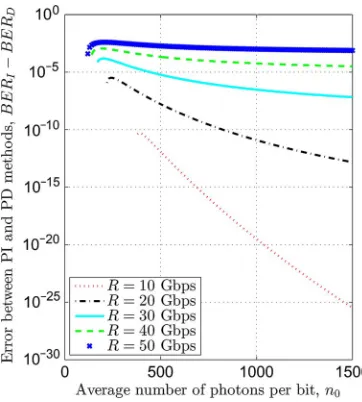
Fig. 3. The discrepancy, BERIBERD, between the PI and PD approximation methods for different
[image:8.594.205.386.290.491.2]other hand, for the PD method, both BERDand BERD;opt decay exponentially and follow the exact
BER with a small difference. This difference is due to the Gaussian approximation of the actual PDFs, which are, unlike the normal distribution, asymmetric about the mean value. Therefore, we conclude that the PD method offers a better approximation to the exact BER than the PI method at high transmission rates.
The asymptotic analysis found in Section III is included in Fig. 2(b). At 10 Gb/s the photon count threshold was found from (21) to be large enoughðnth104Þthat the advantage of the PD method
over the PI method are not realizable for any reasonable value ofn0. However, by increasing the
transmission speed to 30 Gpbs,nthdrops dramatically to 1500 photons per bit, as shown in Fig. 2(b).
Clearly at such speed the PI method is invalid and the PD method must be used. Fig. 3 illustrates BERIBERDat different transmission speeds. It is observed that the discrepancy between BERI
and BERDwidens with the transmission rate. At lower transmission rates such as 10 Gb/s, where ISI
is not severe, the PI and PD methods are almost equivalent. However, at higher transmission rates, e.g.,R¼30 Gb/s, BERIBERD¼2:9107 when n0¼1000, and BERIBERD¼6:6108
whenn0¼1500.
5. Conclusion
This paper provides a rigorous comparison of two commonly used BER approximations for APD-based optical receivers. The analysis has been supported with examples and compared to the numerical BER found using the MGF approach. When ISI is dominant, the PI method overestimates the BER substantially and the PD method should be used instead. The BER of the PD method decreases exponentially with the optical energy in each bit while the BER computed using the simplified PI method saturates to a constant as the optical energy per bit increases. A closed-form expression was found for a threshold value,nth, for the average number of photons per 1 bit beyond
which the PD method should be used instead of the PI method. As an example, the numerical calculations show that the BER of an optical receiver utilizing InP APD with a 100 nm multiplication layer, cannot be approximated with the PI method when the system speed exceeds 20 Gb/s.
References
[1] G. P. Agrawal,Fiber-Optic Communication Systems,3rd ed. New York, NY, USA: Wiley, 2002.
[2] Y. Kang, H.-D. Liu, M. Morse, M. J. Paniccia, M. Zadka, S. Litski, G. Sarid, A. Pauchard, Y.-H. Kuo, H.-W. Chen, W. S. Zaoui, J. E. Bowers, A. Beling, D. C. McIntosh, X. Zheng, and J. C. Campbell,BMonolithic germanium/silicon avalanche photodiodes with 340 GHz gain–bandwidth product,[Nature Photon., vol. 3, pp. 59–63, Jan. 2009. [3] M. M. Hayat and D. A. Ramirez,BMultiplication theory for dynamically biased avalanche photodiodes: New limits for
gain bandwidth product,[Opt. Exp., vol. 20, no. 7, pp. 8024–8040, Mar. 2012.
[4] G. El-Howayek and M. M. Hayat,BMethod for performance analysis and optimization of APD optical receivers operating under dynamic reverse bias,[inProc. IEEE IPC, Bellevue, WA, USA, Sep. 2013, pp. 362–363.
[5] F. Davidson and X. Sun,BGaussian approximation versus nearly exact performance analysis of optical communication systems with PPM signaling and APD receivers,[IEEE Trans. Commun., vol. 36, no. 11, pp. 1185–1192, Nov. 1988. [6] P. Sun, M. M. Hayat, and A. K. Das,BBit error rates for ultrafast APD based optical receivers: Exact and large deviation
based asymptotic approaches,[IEEE Trans. Commun., vol. 57, no. 9, pp. 2763–2770, Sep. 2009.
[7] D. S. G. Ong, J. S. Ng, M. M. Hayat, P. Sun, and J. P. R. David,BOptimization of InP APDs for high-speed lightwave systems,[J. Lightw. Technol., vol. 27, no. 15, pp. 3294–3302, Aug. 2009.
[8] D. S. G. Ong, M. M. Hayat, J. P. R. David, and J. S. Ng,BSensitivity of high-speed lightwave system receivers using InAlAs avalanche photodiodes,[IEEE Photon. Technol. Lett., vol. 23, no. 4, pp. 233–235, Feb. 2011.
[9] A. Papoulis,BHigh density shot noise and Gaussianity,[J. Appl. Probability, vol. 8, no. 1, pp. 118–127, Mar. 1971. [10] S. D. Personick, P. Balaban, J. Bobsin, and P. Kumar,BA detailed comparison of four approaches to the calculation of
the sensitivity of optical fiber system receivers,[IEEE Trans. Commun., vol. 25, no. 5, pp. 541–548, May 1977. [11] P. Sun, M. M. Hayat, B. E. A. Saleh, and M. C. Teich,BStatistical correlation of gain and buildup time in APDs and its
effects on receiver performance,[J. Lightw. Technol., vol. 24, no. 2, pp. 755–768, Feb. 2006.
[12] J. B. Abshire,BPerformance of OOK and low-order PPM modulations in optical communications when using APD-based receivers,[IEEE Trans. Commun., vol. 32, no. 10, pp. 1140–1143, Oct. 1984.
[13] H. M. H. Shalaby,BEffect of thermal noise and APD noise on the performance of OPPM-CDMA receivers,[J. Lightw. Technol., vol. 18, no. 7, pp. 905–914, Jul. 2000.