
Evaluation of Gaming Environments for Mixed
Reality Interfaces and Human Supervisory Control
in Telerobotics
Ida Bagus Kerthyayana Manuaba
April 2014
A thesis submitted for the degree of Doctor of Philosophy
of the Australian National University
Research School of Computer Science
College of Engineering and Computer Science
iii
Declaration
This thesis contains the results of my own original research and has not been submitted for a postgraduate degree at any university or institution, except where specific reference or acknowledgment is made to the work or contribution of others. Much of this content research has either been published or submitted for publication as conference and journal proceedings, short paper, workshop presentation, poster, and exhibition. The following is a list of these publications:
Paper conference and journal proceedings:
I.B.K. Manuaba, K. Taylor, & T. Gedeon (2012): ―Evaluation of Response Models to a
Series of Commands in a Telerobotics Supervisory Control System‖. In the proceedings of the 5th International Conference on Intelligent Robotics and Applications. Montreal, Quebec, Canada, October, 2012, LCNS 7508, Springer, Part III, pp. 73-84.
I.B.K. Manuaba, K. Taylor, & E. Widzyk-Capehart (2011): ―Building Effective Telerobotics Interfaces For Mining Applications by Utilising Mixed Reality‖. In the proceedings of 22nd International World Mining Congress and Expo. Istanbul, Turkey, September, 2011, pp. 387-394.
I.B.K. Manuaba, K. Taylor, & T. Gedeon (2011): ―Exploration of Mixed Reality Environment for Telerobotics Interface: An Option to Provide Effective Information‖. In the proceedings of the Australian Journal of Intelligent Information Processing Systems, Special issue for the International Workshop on Bio-inspired Computing for Intelligent Environments and Logistic Systems (IWBCIELS2011), Vol 13, No.1, 2011, pp. 31-38.
I.B.K. Manuaba, K. Taylor, & T. Gedeon (2011): ―Comparison between Two Mixed
Reality Environments for Telerobotics Interface‖. In the proceedings of the IEEE International Conference on Robotics and Automation (ICRA2011). Shanghai, China, May, 2011, pp. 1335-1340.
I.B.K. Manuaba, K. Taylor, & T. Gedeon (2010): ―Exploration of Second Life as a
iv
Short Paper: I.B.K. Manuaba (2011): ―Applying a Mixed Reality Interface with Human Supervisory Control for Telerobotics‖. In Science and Engineering Expo Graduate Research 2011. CSIRO ICT Centre, Canberra, Australia, August 2011, pp. 7-8.
I.B.K. Manuaba, K. Taylor, T. Gedeon, & E. Widzyk-Capehart (2010): ―Evaluation of Augmented Virtuality Environments for Telerobotics Interface‖. In CSIRO ICTCC‘10, Sydney, 10 – 11 November 2010.
Workshops Presentations:
I.B.K. Manuaba (2011): ―Applying a Mixed Reality Interface with Human Supervisory Control for Telerobotics‖. In Science and Engineering Expo Graduate Research 2011. CSIRO ICT Centre, Canberra, Australia, August 2011.
I.B.K. Manuaba, K. Taylor, & T. Gedeon (2011): ―Exploration of Mixed Reality
Environment for Telerobotics Interface: An Option to Provide Effective Information‖. In the International Workshop on Bio-inspired Computing for Intelligent Environments and Logistic Systems (IWBCIELS2011). The Australian National University, Canberra, Australia, March 2011.
K. Taylor, & I.B.K. Manuaba, I.B.K. (2010): ―Using computer gaming environments to develop situated virtual reality methods for telerobotics of mining equipment‖. In OzViz 2010, Queensland Bioscience Precinct, University of Queensland, 2 December 2010.
Posters:
I.B.K. Manuaba (2010): ―Applying a Predictive Display in a Mixed Reality Interface for a Tele-Manipulator‖. In ANU Poster Day CECS, The Australian National University, Canberra, Australia, 15 August 2011.
I.B.K. Manuaba, K. Taylor, T. Gedeon, & E. Widzyk-Capehart (2010): ―Comparison Two
Augmented Virtuality Environments for Telerobotics Interface‖. In CSIRO ICTCC‘10, Sydney, 10 – 11 November 2010.
I.B.K. Manuaba (2010): ―Play with the Robot Arm with Your Avatar…No Worries!!
v
Exhibition: Exhibition at CSIRO Discovery Centre: A prototype of telerobotics system as a
model application for remote manipulation in simple mining scenario by utilising the principles of human supervisory control in mixed reality interfaces. (2011 – Today)
The research presented in this thesis has been performed under the supervisor of Dr. Ken Taylor and Prof. Tom Gedeon, and using some implementation work done by Mr. Stephane Bersot.
Ida Bagus Kerthyayana Manuaba The Australian National University April 2014
vii
ix
Acknowledgment
Over the past three and a half years of my research, I have received support, guidance and encouragement from a great number of individuals whom I would like to acknowledge and thank.
First and foremost, to my God, Ida Sang Hyang Widi Wasa, I am thankful for the faith, grace and mercy bestowed upon me during my studies.
I would like to thank my supervisory panel, Dr. Ken Taylor, Prof. Tom Gedeon and Assoc. Prof. Henry Gardner for their guidance, insight, inspiration, feedback, and encouragement. Special thanks go to Ken Taylor for his patience, helpfulness and support. This thesis would certainly not have been possible without his role as my supervisor. Thanks also to Tom Gedeon for his support, advice and encouragement, which was always available when I needed it.
To the Commonwealth Scientific and Industrial Research Organisation (CSIRO), I am grateful for the scholarship awards and research facilities. I am grateful also to the Research School of Computer Sciences (RSCS) for the additional financial support and facilities.
I thank my father, Ida Bagus Putra; my mother, Ida Ayu Made Puspawati; and my sister, Ida Ayu Putu Suryanti, as well as all my family in Bali for providing me their love, support and blessings. Special thanks also goes to Yodi Christiani for her support, helpfulness and patience; especially in reading most of my work, discussing and analysing my experimental data, and teaching me about many other things. I thank Simon Ow, Lauren O‘Neil, Wayan Arka and family, and Meksi Ndii for their helpfulness, support and patience in proofreading my writing, especially for this thesis; Adi Swandani for her support and helpfulness and for never complaining when I needed her help, even in the middle of the night; Ida Bagus Rajendra and family for their support in helping me start my research study.
I thank the CSIRO and ANU-RSCS fellows and administrators: Chris Gunn, Doug Palmer, Matt Adcock, Dingyun Zhu, Stephane Bersot, Umran Abdulla, Renate Hays, Deirdre Tribe, Karen Barndt, Bruce Daphne, Julie Arnold, Shaw Tyi Tan, Suzy Andrew, and many others who would take up over a page if mentioned individually, for being friendly and helping me during my study.
x
xi
Glossary of Abbreviations
AJAX
Asynchronous JavaScript and XML
ANU
Australian National University
API
Application Programming Interface
AR
Augmented Reality
AV
Augmented Virtuality
cdf
cumulative distribution function
CPU
Central Processing Unit
crv
continuous random variables
CSIRO
Commonwealth Scientific and Industrial Research
Organisation
DDX
Dynamic Data eXchange
DOF
Degree of Freedom
E
Rijsbergen‘s effectiveness (Chapter 5)
FIFO
First-In-First-Out
FS
Full Stop
HSC
Human Supervisory Control
HTTP
The Hypertext Transfer Protocol
xii
iHcc
Information & Human Centred Computing
info
Information
IP
Internet Protocol
KB
Kilo Bytes
LAN
Local Area Network
LGPL
Lesser General Public License
LiSA
Localization and Semantics of Assistance
LSL
Linden Scripting Language
MB
Mega Bytes
MR
Mixed Reality
OpenCV
Open Source Computer Vision
OR
Odd Ratio
P / p – value
Probability Value
PC
Personal Computer
PDA
Personal Data Assistant
probability density function
PHP
Hypertext Preprocessor
PPV
Position Predictive Value
PTZ
Pan Tilt Zoom
R
number of requests (Chapter 6)
Chi-square goodness fit test
xiii
ROM
Read Only Memory
RPC
Remote Procedure Call
SA
Situational Awareness
SD
Standard Deviation
Sec
Seconds
SL
Second Life
Sm
Simmersion
T
length of playing (Chapter 6)
TCP
Transmission Control Protocol
TS
Temporary Stop
TUI
Telerobotics User Interfaces
UAV
Unmanned Aerial Vehicle
UDP
User Datagram Protocol
USAR
Urban Search and Rescue
UWA
University of Western Australia
VGA
Video Graphic Array
VR
Virtual Reality
VRML
Virtual Reality Modelling Language
WEB
Website
Chi-square /
Chi-square goodness fit test
xiv
XML
eXtensible Markup Language
Others
2D
Two Dimensions
3D
Three Dimensions
xv
Abstract
Telerobotics refers to a branch of technology that deals with controlling a robot from a distance. It is commonly used to access difficult environments, reduce operating costs, and to improve comfort and safety. However, difficulties have emerged in telerobotics development. Effective telerobotics requires maximising operator performance and previous research has identified issues which reduce operator performance, such as operator attention being divided across the numerous custom built interfaces and continuous operator involvement in a high workload situation potentially causing exhaustion and subsequent operator error.
This thesis evaluates mixed reality and human supervisory control concepts in a gaming engine environment for telerobotics. This concept is proposed in order to improve the effectiveness of current technology in telerobotic interfaces. Four experiments are reported in this thesis which covers virtual gaming environments, mixed reality interfaces, and human supervisory control and aims to advance telerobotics technology.
This thesis argues that gaming environments are useful for building telerobotic interfaces and examines the properties required for telerobotics. A useful feature provided by gaming environments is that of overlying video on virtual objects to support mixed reality interfaces. Experiments in this thesis show that mixed reality interfaces provide useful information without distracting the operator from the task.
This thesis introduces two response models based on the planning process of human supervisory control: Adaptation and Queue response models. The experimental results show superior user performance under these two response models compared to direct/manual control. In the final experiment a large number of novice users, with a diversity of backgrounds, used a robot arm to push blocks into a hole by using these two response models.
Further analyses on evaluating the user performance on the interfaces with two response models were found to be well fitted by a Weibull distribution. Operators preferred the interface with the Queue response model over the interface with the Adaptation response model, and human supervisory control over direct/manual control.
xvi
productivity using human supervisory control found in this experiment can be expected to be greater.
xvii
Table of Contents
Declaration ... iii
Acknowledgment ... ix
Glossary of Abbreviations ... xi
Abstract ... xv
Table of Contents ... xvii
List of Figures ... xxiii
List of Tables ... xxix
Chapter 1 ... 1
Introduction ... 1
1.1 Telerobotics ... 1
1.1.1 What is Telerobotics? ... 1
1.1.2 Type of Telerobotics ... 2
1.1.3 Human Factor in Telerobotics ... 5
1.1.4 Technology of Telerobotics ... 7
1.2 Research Topic ... 9
1.3 Research Outcomes ... 10
1.4 Contributions ... 10
1.5 Research Design ... 11
1.5.1 Methodology ... 12
1.5.2 Research Framework, Variable and Instrument ... 12
1.5.2.1 Research Framework ... 13
1.5.2.2 Research Indicators ... 16
1.5.3 Model Analysis. ... 17
1.5.4 Timeline and Places ... 18
1.6 Organisation of the Dissertation... 20
Chapter 2 ... 23
Gaming Environments for Telerobotics User Interface ... 23
2.1 Gaming Environment ... 23
2.1.1 Utilising Gaming Engines in Telerobotic Interfaces ... 23
xviii
2.1.2.1 Second Life ... 24
2.1.2.2 Mycosm ... 26
2.1.2.3 Unity3D ... 27
2.1.3 Characteristics of Telerobotics User Interfaces ... 31
2.1.4 Telerobot Model ... 32
2.1.4.1 Virtual Reality Model for Controlling Process ... 33
2.1.4.2 Looping Control System Model. ... 34
2.1.4.3 Telerobot System Architecture ... 34
2.1.4.4 Software Telerobot Architecture Model ... 35
2.1.4.5 System Configuration Model ... 38
2.2 Mixed Reality Concept for Telerobot Interfaces? ... 39
2.2.1 Telerobot Interfaces ... 40
2.2.1.1 Video Interfaces ... 41
2.2.1.2 Virtual Reality Interface ... 43
2.2.1.3 Mixed Reality Interfaces... 44
2.2.2 Advantages of Mixed Reality Interfaces ... 48
2.2.3 Design of Mixed Reality Interface in Gaming Environment ... 49
2.3 Human Supervisory Control for Telerobot Control Model ... 50
2.3.1 Telerobot Control Model ... 52
2.3.2 Utilising Gaming Concept for Human Supervisory Control ... 55
2.3.3 The Model of Response Movement based on Multi-Command Input ... 56
2.4 Telerobot Communication by Gaming Environment ... 58
2.4.1 Web-based Telerobotics Simulator... 62
2.4.2 UWA ABB Robot ... 63
2.4.3 Custom Built Server with Arm Robot (a modified haptic device)
Attached ... 64
Chapter 3 ... 67
Evaluation of Gaming Environments with MR Concept ... 67
3.1 Introduction ... 67
3.2 Prototype Implementation ... 68
3.2.1 Utilisation of Second Life as Mixed Reality Telerobotics Interface ... 69
3.2.2 Utilisation of Simmersion as a Mixed Reality Telerobotics Interface ... 71
3.3 User Study ... 72
xix
3.3.2 Participants ... 73
3.3.3 Experimental Design and Procedure ... 74
3.4 Result ... 75
3.4.1 User Performance Based on MR Telerobot Interface in SL Environment 75
3.4.2 User Performance Based on MR Telerobot Interface in Sm
Environment ... 78
3.4.3 Comparison of Mean Difference Test of User Performance between SL
and Sm Environment ... 81
3.4.4 Dragging versus Clicking ... 84
3.5 Discussion ... 85
3.6 Summary of Chapter ... 87
Chapter 4 ... 89
Telerobotic Gaming Environment with Virtual Camera Control Devices ... 89
4.1 Introduction ... 89
4.2 Prototype Implementation ... 90
4.2.1 The 3D Robot Arm Virtual Model ... 90
4.2.2 Rock Models ... 92
4.2.3 Virtual Camera ... 94
4.3 User Study ... 96
4.3.1 Apparatus and Implementation ... 96
4.3.2 Participants ... 100
4.3.3 Experimental Design, Task and Procedure ... 100
4.4 Results ... 101
4.4.1 Objective Measurement ... 101
4.4.2 Subjective Measurement ... 104
4.4.3 Additional analysis to determine similarities and differences in user
performance between this experiment and Zhu et al‘s experiment [34]. ... 106
4.5 Discussion ... 107
4.6 Summary of Chapter ... 108
Chapter 5 ... 111
Human Supervisory Control in Gaming Environments ... 111
5.1 Introduction ... 111
5.2 Prototype Implementation ... 112
xx
5.2.2 A-star Path Tracking ... 115
5.2.3 Virtual Objects for Planning/Feedback Information ... 116
5.3 User Study ... 117
5.3.1 Experimental Setup ... 118
5.3.2 Participants ... 119
5.3.3 Experimental Design and Procedure ... 120
5.4 Results ... 121
5.4.1 Objective Measurement (Distribution Proportion, Logistic Regression,
F1-Score Analysis)... 121
5.4.2 Evaluation of the impact of features usage in relation to variable
outcomes ... 125
5.4.3 Questionnaire ... 128
5.5 Discussion ... 128
5.6 Summary of Chapter ... 131
Chapter 6 ... 133
The Utilisation of
Weibull
Distribution for User Performance Analysis ... 133
6.1 Introduction ... 133
6.2 Prototype Implementation ... 134
6.3 User Study ... 140
6.3.1 Apparatus and Implementation of the Telerobotics System ... 140
6.3.2 Participants (Sessions) ... 141
6.3.3 Experimental Design and Procedure ... 142
6.4 Results ... 143
6.4.1 HSC with Adaptation Response Model ... 144
6.4.2 HSC with Queue Response Model ... 149
6.4.3 Direct/Manual Model... 153
6.5 Discussion ... 155
6.6 Summary of Chapter ... 159
Chapter 7 ... 161
Conclusions and Recommendations for Future Work ... 161
7.1 Conclusions ... 161
7.2 Future Work ... 167
Appendix A ... 169
xxi
A.2 Inverse Kinematics ... 170
Apendix B ... 173
B.1 User Study Questionnaire for Experiment 1 ... 173
B.2 User Study Questionnaire for Experiment 2 ... 177
B.3 User Study Questionnaire for Experiment 3 ... 183
xxiii
List of Figures
Figure 1.1: General telerobotics architecture. In the local area, the operator
generates commands, performs manipulation and receives feedback
from the system interface; while the remote machine performs the
command, sends feedback and has some level of autonomy. ... 1
Figure 1.2:
Rockbreaker
robot arm from [5] ... 3
Figure 1.3: TUI (Telerobotics User Interfaces) for telerobotics
Rockbreaker
from [5] ... 4
Figure 1.4: Mining telerobotics user interface from [6] ... 5
Figure 1.5: An example of incorrect visual adjustment due to kinematic
transformation (left) or relative movements (right) from [19] ... 6
Figure 1.6: Architecture of USAR system application which was utilising a
gaming engine as simulation telerobot [28] ... 8
Figure 1.7: Mixed reality test bed environment in
‘Virtual Bounds’
application
interface [29] ... 8
Figure 1.8: Second Life viewer, Unity3D editor, and 3D gaming editor ... 12
Figure 1.9: Research framework ... 15
Figure 1.10: Stage of research ... 16
Figure 1.11: Timeline ... 19
Figure 2.1: A Second Life client interface showing an avatar that is creating
virtual objects; and the Second Life logo [46] ... 24
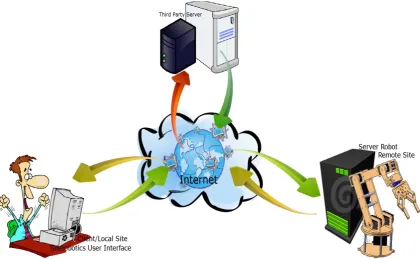
Figure 2.2: Communication flow diagram between telerobotics interface and
telerobot through third party server ... 25
Figure 2.3: Mycosm studio editor and logo [47] ... 27
Figure 2.4: Unity3D editor and logo [48] ... 28
Figure 2.5: Direct communication flow diagram ... 28
Figure 2.6: Control based on the virtual reality (VR) model ... 33
Figure 2.7: Control based on the classic model ... 33
Figure 2.8: Coordinated telerobotic control system based on the virtual reality
xxiv
Figure 2.10: Proposed control system design based on control by virtual reality
(VR) simulation ... 34
Figure 2.11: Telerobot system architecture [3] ... 35
Figure 2.12: Software telerobotic architecture based on client server and
operation by virtual simulation ... 37
Figure 2.13: System configuration ... 38
Figure 2.14: Telerobotics user interface with multiple screens to monitor each
sub- telerobotics process [5] ... 39
Figure 2.15: Perspective: determined by centre of projection ... 42
Figure 2.16: Examples of video interfaces in a monitor as part of a UAV play
load and control mechanism[71] ... 42
Figure 2.17: This example of a VR interface shows the RSVP-HyperDrive, which
displays a graphical version of the rover that is used to drive the
MER Spirit rover and place its robotic arm on rocks [21] ... 43
Figure 2.18: Sample of mixed reality (MR) concept ... 45
Figure 2.19: Simplified representation of MR (referred to [64]) ... 46
Figure 2.20: Examples of AR interfaces. (Left) Embedded country flags and the
names of sailors are displayed on the screen for the America‘s Cup
race tracking display
[84], and (Right) An arrow object as additional
navigation interface [85] ... 47
Figure 2.21: Example of an AV interface concept from TV newscasters who sit at
a real table in a virtual studio [88] ... 47
Figure 2.22: MR environment in gaming environment ... 50
Figure 2.23: Five generic supervisor functions as nested control loop ... 51
Figure 2.24: Spectrum control diagram (referred to by Sheridan [2]) ... 52
Figure 2.25: The
LiSA
(Localization and Semantics of Assistance) model concept
with
perception reconstruction, virtual execution, action generation,
and
action reconstruction
model assistance (from [23]) ... 53
Figure 2.26: An example of path finding implementation for the gaming
environment [95] ... 55
Figure 2.27: Diagram of Adaptation and Queue response model ... 57
Figure 2.28: The system‘s architecture of
Rockbreaker
[5 ] ... 59
Figure 2.29: First trial overview of telerobotics using the Second Life (SL)
xxv
Figure 2.30: DDX framework ... 62
Figure 2.31: ABB robot telerobotic client interface [67] ... 64
Figure 2.32: File lock concept applied ... 65
Figure 3.1: Robot arm, workspace and two remote cameras ... 69
Figure 3.2: MR concept built in Second Life (SL) ... 70
Figure 3.3: MR concept built in Simmersion (Sm) ... 71
Figure 3.4: An overview of the experiment‘s architecture: (1 and 3) streaming
video from the camera, (2 and 4) 3D model white board ... 72
Figure 3.5: Attention level of participants to the 3D model for the first and
second tasks using SL environment ... 78
Figure 3.6: Attention level of participants to 3D model for the first and second
task using Sm environment ... 81
Figure 3.7: Preferred environment based on questionnaire ... 84
Figure 4.1: Remote settings and 3D model of remote settings based on Unity3D
game engine: (1) Robot arm with engraver attached, (2) Rocks –
targets objects, (3) Worksite - board with a hole in the middle ... 91
Figure 4.2: The ―ghost‖ tip in transparent green ... 91
Figure 4.3: Remote IP camera ... 92
Figure 4.4: Rock tracking steps in OpenCV ... 93
Figure 4.5: Calibration and registering process ... 93
Figure 4.6: Application and image processing ... 94
Figure 4.7: The virtual camera in virtual environment can show scenes from any
angle ... 95
Figure 4.8: The helping line model (vertical line) to show the height tip position . 96
Figure 4.9: Remote setting test rig: (1) Robot arm from
Phantom Premium V.1.5
haptic device, (2) Board with a hole in the middle, (3) Rocks –
targets objects, (4) Camera. ... 97
Figure 4.10: User setting: (1) Unit PC with situated virtual application running on
it, (2)
FaceLAB
V.4.5
eye tracker software and sensors, (3)
Logitech
Dual Action
gamepad ... 98
Figure 4.11: Mapping gamepad control: (1) Left – Viewpoint movement, (2)
xxvi
Figure 4.14: Mean number of rocks sunk (a) and number of nudges (b) for each
operation period. ... 104
Figure 4.15: Subjective measurement variables ... 105
Figure 4.16: Total number of rocks sunk on a full video interface* and a gaming
environment interface using two different input devices (*data from
[39]) ... 106
Figure 4.17: Total number of nudges on a full video interface* and a gaming
environment interface using two different input devices (*data from
[39]) ... 107
Figure 5.1: MR concept built in Unity3D ... 113
Figure 5.2: Telerobotics system ... 114
Figure 5.3: Path generated from the A-star algorithm in: (a) selected block, and
(b) unselected block model ... 116
Figure 5.4: Visual information: (1) green circles, (2) shadow of tip, (3) line path,
and (4) overlay pointer ... 117
Figure 5.5: Experimental setup for third experiment ... 118
Figure 5.6:
Logistic Regression
showing the relationship between the probability
of success and completion time ... 122
Figure 5.7: Scatter plot – performance and completion time for four supervisory
models tested ... 123
Figure 5.8: The relationship between task results ... 124
Figure 6.1:
Probability Density Function
(
) and
Cumulative Distribution
Function
(
cdf
) with selected values of the shape parameter ... 135
Figure 6.2: Probability Density Function (pdf) and Cumulative Distribution
Function (cdf) with variant of scale parameter ... 136
Figure 6.3: The effect of location parameter in Probability Density Function
(pdf) and Cumulative Distribution Function (cdf) ... 136
Figure 6.4: Preview of information screens for the telerobotic interfaces ... 138
Figure 6.5: Menu buttons representing each model control tested... 139
Figure 6.6: Overview of the exhibition ... 141
Figure 6.7: The comparison between the
Weibull
curve and observed data in
xxvii
Figure 6.8: The contribution of the
value from each of the bins for a simple
Weibull
model fit as per Equation 6.6 for the full range of observed
data of the number of request recorded for HSC with an Adaptation
response model ... 147
Figure 6.9: The probability of the user making an additional request in HSC with
an Adaptation response model ... 148
Figure 6.10: The comparison between the fitted
Weibull
Curve and the length of
time for HSC with an Adaptation response model from a sample of
2218 sessions ... 149
Figure 6.11: The comparison between the fitted
Weibull
curve and observed data
using HSC with a Queue response model, from a sample of 1593
sessions which recorded 1 – 80 requests sent to the telerobotic
interface ... 150
Figure 6.12: The contribution of the
value from each bin for a simple
Weibull
model fit as per Equation 6.6 for the full range of the observed data
of the number of request recorded for HSC with a Queue response
model ... 151
Figure 6.13: The probability of the user making an additional request in HSC with
a Queue response model ... 151
Figure 6.14: The comparison between the fitted
Weibull
curve and the length of
playing time using HSC with a Queue response model from a sample
of 1593 sessions ... 152
Figure 6.15: The comparison between the fitted
Weibull
curve and the length of
playing time by using direct/manual model from a sample of 2328
sessions ... 154
Figure 6.16: Comparison of the number of requests between the two HSC models
tested ... 155
Figure 6.17: Comparison of time variables between the three models tested ... 155
Figure 6.18: Rescaling the Adaptation sampling data according to Equation 6.13
xxviii
xxix
List of Tables
Table 2.1:
The advantages and disadvantages of the SL platform ... 26
Table 2.2:
The advantages and disadvantages of locally-based gaming
environments ... 29
Table 2.3:
Comparison of available gaming features suitable for telerobotic
interfaces, taken from [34, 41, 43, 45-54] ... 29
Table 2.4:
Characteristics of telerobotic interfaces and their varieties, taken
from [1-3, 6, 7, 10, 12, 13, 17, 26, 28, 37, 38, 55-62] ... 31
Table 3.1:
Characteristics of the participants ... 74
Table 3.2:
Mean difference of task completion time between low and high level
of attention groups by task, SL environment ... 76
Table 3.3: Mean difference of total number of commands sent by participants
between low and high attention groups by task, SL environment ... 76
Table 3.4:
Proportion of self-perceived difficulty in task 1 by level of attention,
SL environment ... 77
Table 3.5:
Proportion of self-perceived difficulty in task 2 by level of attention,
SL environment ... 77
Table 3.6:
Mean difference of task completion time between low and high
attention groups by task, Sm environment ... 79
Table 3.7:
Mean difference of total number of commands sent by participants
between low and high attention groups by task, Sm environment ... 79
Table 3.8:
Proportion of self-perceived difficulty in task 1 by level of attention,
Sm environment ... 80
Table 3.9:
Proportion of self-perceived difficulty in task 2 by level of attention,
Sm environment ... 80
Table 3.10: Average task completion time measurement for each target position
in task 1 and task 2 ... 81
Table 3.11: Participants‘ assessment of time needed to become familiar with the
xxx
Table 4.1:
Characteristics of the participants ... 100
Table 4.2:
Difference between the 2 input devices for the mean number of rocks
sunk and the mean number of nudges ... 102
Table 4.3:
ANOVA test of the average number of rocks sunk (model) differs
between input devices and subject characteristics ... 102
Table 4.4:
ANOVA test of average number of nudges (model) differs between
input devices and subject characteristics ... 103
Table 5.1:
Participants characteristics ... 119
Table 5.2:
Task completion time for a successful result using each model tested121
Table 5.3:
The distribution proportion of the results of the experiment by
completion time ... 121
Table 5.4:
F
1-score
for each model tested ... 125
Table 5.5:
Distribution
X
2analysis of the total number of times the virtual
camera was used versus the success rate, whether the path was
followed and whether the target was sunk for four different
combinations of the group models tested ... 126
Table 5.6:
Distribution
X
2analysis of the total number of times the virtual
1
Chapter 1
Introduction
1.1 Telerobotics
1.1.1 What is Telerobotics?
The term telerobotics consists of two words ―tele‖ and ―robotics‖, and refers to a branch of technology that utilises a computer system for control, sensor feedback and the processing of information from a robot at a distance. There are several definitions of telerobotics used by different researchers [1-3]. In general, telerobotics is defined as an interaction between the human operator and the remote machine. Figure 1.1 shows the general architecture of telerobotics.
Figure 1.1: General telerobotics architecture. In the local area, the operator generates commands, performs manipulation and receives feedback from the system interface; while the remote machine performs the command, sends feedback and has some level of autonomy.
Using internet connection, telerobotics is widely used in many areas, such as mining, space and medical areas [1, 4, 5]. The technology has been applied in various applications such as from navigation systems [6-9], underwater telerobot [10, 11] and tele-surgery [12].
2
1.1 Telerobotics
Chapter 1
telemanipulation under manual control [15, 16]. In direct/manual control, the operator continually controls the robot movement. Delay in the response from the telerobot can cause the operator to overcorrect for errors that are different from the actual robot errors. This causes the robot to move in ways unexpected by the operator and the operator to provide further corrections, which again do not reflect the errors at the robot. Errors tend to grow and this is often referred to as instability. With some forms of feedback e.g. force feedback it is impossible for the operator to avoid instability when the delay is too great. With other forms of feedback, and where the situation at the robot is not varying much, an operator can sometimes avoid instability by making a series of movements, then stopping and waiting longer than the delay period to observe the result before repeating the process. Thirdly, incomplete information from the remote location. According to a number of researchers [3, 6, 10, 13], providing complete information about the remote location into a single interface is a major challenge in telerobotic scenarios. For example, a limited range of vision from a remote video camera cannot replace operator eyes that are able to explore the remote environment directly and which can be moved to a different view point if required. This missing information can lead to degradation in operator performance. The fourth issue is having unfriendly user interfaces. Interfaces sometimes can be difficult to use which can be caused by using too many graphical components (e.g., buttons, sliders or graphics) to control the telerobot or non-intuitive graphical representations and controls [28, 33]. This can make the operation unnecessarily complicated.
Currently, the Line-of-sight remote control is a form of telerobotics technology, which is widely used in mining and other industries [6]. This technology has been proven to be effective in protecting the operator from hazards, for example the underground Load-Haul-Dump (LHD) vehicle operating in a location where the roof is unsupported and there is occasioned rock falls. Nonetheless, the operator still needs direct vision to control the machine, which may compromise the safety of the operator. According to Fong and Thrope [1], there are three characteristics which distinguish the term telerobotics from the remote control (Line-of-sight remote control). As the impact of the different location between operator and remote machine, compare to remote control, telerobotics requires: Firstly, a more reliable navigation system; Secondly, more efficient motion commands; and Thirdly, better remote sensors to provide the information that is needed by the operator.
1.1.2 Type of Telerobotics
Chapter 1
Introduction
3
reach; for telemanipulation, however, the remote machine typically performs its tasks in one static position. Many telerobotics systems are built using a combination of these two categories, depending on their purpose and task.
A vehicle telerobotic is widely used to explore an area or space when it is hard or dangerous for a human to reach yet still requires human intelligence [18]. Research conducted by Monferer and Bonyuet [11] is one of many examples of vehicle telerobotics. Their research investigated cooperative control for underwater telerobotics also known as ‘GARBI’ (underwater robot). Utilising a virtual reality (VR) interface, Monferer and Bonyuet tested the possibility of sharing information and collaborating in the underwater environment with two users. Lin and Kuo [10] conducted a similar experiment which investigated pilot training for underwater telerobotics using a VR environment.
For telemanipulation applications, research as reported by Duff et al [5] shows the telemanipulation of a large Rockbreaker robot (Figure 1.2) in iron ore mining. They built a telerobotics system for a large Rockbreaker that was located over 1,000 km from the operator.
[image:33.595.137.516.395.680.2]4
1.1 Telerobotics
Chapter 1
Figure 1.3: TUI (Telerobotics User Interfaces) for telerobotics Rockbreaker from [5]
In their research, Duff‘et al‘s telerobotics user interface (Figure 1.3) consisted of three live videos and a 3D model of the robot arm Rockbreaker in a single display. The three live videos showed different viewpoints from remote cameras. Two cameras showed information on the bin and the arm‘s position from different angles. The third camera provided information on the view from the front of the bin, where the truck loads the rocks into the bin.
Chapter 1
Introduction
5
Figure 1.4: Mining telerobotics user interface from [6]
1.1.3 Human Factor in Telerobotics
In building a good telerobotics system, it is essential to identify the operator‘s requirements as part of a closed loop telerobotics model [19]. Given the range of applicability of telerobotics technology, the operator's needs and the interface characteristics can be vary for different scenarios.
Telerobot interfaces have two important functions, which are to communicate to the operator the status of executed tasks in the remote location and to accept commands from the operator in order to properly control the telerobot [19]. In order to reduce the ergonomic disadvantages, which were identified from research conducted by Duff et al. [5] and Hainsworth [6], a challenge in building telerobotic interfaces is to reduce ergonomic disadvantages by designing multi-modal or different human sense system interfaces. The challenge can be addressed by considering human perception capabilities to obtain improved interface interaction. For example: (1) by displaying information to represent the remote environment in a natural manner (telepresence), which implies a feeling of presence at the remote site and; (2) by providing multi modal interfaces such as haptic input devices . ―A good degree of telepresence guarantees the feasibility of the required manipulation task‖[19].
6
1.1 Telerobotics
Chapter 1
telerobotics used in space [21] or forestry operations [22], inaccurate or missing information about the remote environment can put the operation at risk; it can trigger a situation that damages the environment, including the telerobot. Besides sufficient information of the remote environment, the operator needs feedback on the congruence between the commands given and the telerobot's execution of those commands. Aracil [19] describes a situation where incorrect visual adjustments between commands and the observed motion of the telerobot existed (shown in Fig. 1.5). In this instance, the incorrect adjustments resulted from kinematic transformation and the relative movements between object and camera resulting in incoherence in the visual reference, giving the operator a false perception of the actual remote conditions. Using techniques such as information redundancy, and providing stimulus fidelity of the information is essential for providing the operator with an accurate perception of the remote environment [19].
Figure 1.5: An example of incorrect visual adjustment due to kinematic transformation (left) or relative movements (right) from [19]
The role of the human operator is an important consideration in developing telerobotics technology Sheridan‘s [2] and Verna‘s [23] closed loop models for the telerobotics system demonstrate that the human operator is an integral part of telerobotics systems - regardless of the specific telerobotic scenario, the human operator affects the system effectiveness. Hence, any study of the effectiveness of such systems requires experiments that involve a human operator.
Chapter 1
Introduction
7
1.1.4 Technology of Telerobotics
Direct/manual control is the most common type of control method for telerobotics [1, 6 , 39, 60].
In this control model, the operator controls a remote machine directly using a hand-controller, specifies the speed and direction of movement, and monitors and adjusts the controls continually. A number of studies have attempted to improve this direct/manual model control through adding multiple modalities, including haptic [25, 26] and other input devices [27]. In a situation where communications are substantially delayed, relative to the speed of movement, the resulting instability requires that the system be able to run independently—requiring little input from the human operator. HSC [2] addresses this issue, increasing productivity and making it easier for the operator to perform tasks. HSC allows the operator to specify tasks for an intelligent system without continuous operator involvement. This also reduces operator workload.
8
1.1 Telerobotics
Chapter 1
[image:38.595.60.482.103.358.2]Figure 1.6: Architecture of USAR system application which was utilising a gaming engine as simulation telerobot [28]
Chapter 1
Introduction
9
A review of existing literature indicates that advances in the gaming environment may allow it to be utilised as a telerobotic interface. Moreover, virtual gaming provides a sophisticated setting to build and define a 3D model. It can also be used to communicate information within the virtual world or between virtual and real world applications (e.g. client-server communication). Virtual gaming is usually designed to be easy to operate (user friendly). By utilising the multiplayer functions, a virtual gaming environment, which is played online through the internet, can possibly be utilised for collaborative control of telerobotics systems. However, there are some differences between a telerobotic interface and a virtual gaming environment. Firstly, virtual gaming has task scenarios without any consequences if the user fails to accomplish the task. While in telerobotics, a failure in task accomplishment would not be acceptable as it has real-life consequences. Secondly, in providing incomplete simulated information, gaming visualisations are already video simulations, and telerobotic interfaces can be equipped with video.
Regardless of the advances in virtual gaming environments, it is difficult to provide real-time complete information of remote situations. This occurs because of inadequate sensing that leads to inaccurate and incomplete models of the remote environment sensor cannot provide the information due to frequently changing conditions in many mining. A simulation is easier because the robot situation is precisely understood by the operator interface. In a real system there is only limited knowledge of the external system state.
To overcome these shortcomings, I propose building telerobotic interfaces using gaming environments with a concept of mixed-reality (MR) environment and the principle of human-supervisory-control (HSC). Both MR and HSC have been utilised in many applications [32]. However, applying these two concepts into a gaming environment for the telerobotics scenario is not common, since gaming and telerobotic interface are seen as different domains. This thesis explores the features of the gaming environments, which are useful in applying MR and HSC, to improve the system and overcome the existing limitations from the current telerobotics scenario. Further exploration on MR and HSC concepts in gaming environments are discussed through the conducted experiments in the following chapters.
1.2 Research Topic
The thesis evaluates gaming environments for mixed reality (MR) interface and human supervisory control (HSC) in telerobotics.
10
1.3 Research Outcomes
Chapter 1
The research project aims to develop an application prototype for telerobotics in remote mining equipment scenarios by utilising the features of gaming environments. This project investigates MR interfaces and the use of HSC concepts for the control model, and conducts usability testing to determine the effectiveness of the scenario based on operator satisfaction.
This research is associated with the ―Future Mining‖ theme under the CSIRO Minerals Down Under (MDU) Flagship, with supervision by Dr. Ken Taylor (ICT Centre, CSIRO), Prof. Tom Gedeon (Research School of Computer Science, ANU) and Assoc. Prof. Henry Gardner (Head School of Computer Science, ANU).
1.3 Research Outcomes
The major outcome of this research is to improve user interfaces for telerobotics designs, particularly in telemanipulation for mining scenarios. The key components of the potential outcomes are listed below:
1. Enhanced knowledge of the features of gaming environments for telerobotics user interfaces, including assessing its feasibility and evaluating its performance.
2. Prototype telerobotic system interface:
Applying telerobotics user interfaces that integrate real world sensor information
from remote locations (e.g. cameras) into a model in a virtual environment (which can be called a MR environment) providing sophisticated information on a single screen for the operator.
Applying the principle of HSC in the design of telerobotic user interfaces improves
the autonomy of the remote machine and allows it to adapt to dynamic environments. This method also enables the operator to monitor and interrupt the process when needed.
1.4 Contributions
Contributions from this research are:
1. Exploring a number of virtual gaming environments that may be used as telerobotic interfaces, especially for telemanipulation in mining. This includes:
Identification of virtual reality interface (gaming environments) components
Chapter 1
Introduction
11
Evaluation of user satisfactions and preferences regarding the ideal source of
information and the required feature set from the gaming engine for telerobotic interfaces.
2. Evaluating user performance in using gaming environment with the principle of human supervisory control (HSC) and mixed reality (MR) for telerobotic interfaces.
3. Applying HSC and MR concepts to telerobotic interfaces in a gaming environment addresses a number of issues raised by Duff et al [5] and Hainsworth [6], including:
Regardless of the different types of input devices, determining whether the use
of multiple information displays increases operator cognitive fatigue, which affects their attention to the interface and reduces performance.
Improving effectiveness and user friendliness of the telerobotic interface.
Reducing safety concerns and implicitly decreasing the effect of latency.
The next section presents the research design as guidance for my research direction and limitation.
1.5 Research Design
In this research, investigating gaming environments for MR interface and HSC concepts for telerobotic interfaces is proposed.
Gaming environments have been utilised by a number of previous studies such as: (1) Richer and Drury [33] which successful classify a video gaming based framework for human machine interaction. They grouped video gaming users‘ interaction using this framework which could potentially be used for human machine interaction design. (2) Bourke [34] who mentioned a gaming technology is advanced as it provides a sophisticated environment for creating 3D models or programming, and (3) Chung[25] and Schou [35, 36] that demonstrated virtual gaming environments to provide an immersive environment. Based on these previous studies, I proposed to utilise a gaming environment for telerobotic interfaces.
12
1.5 Research Design
Chapter 1
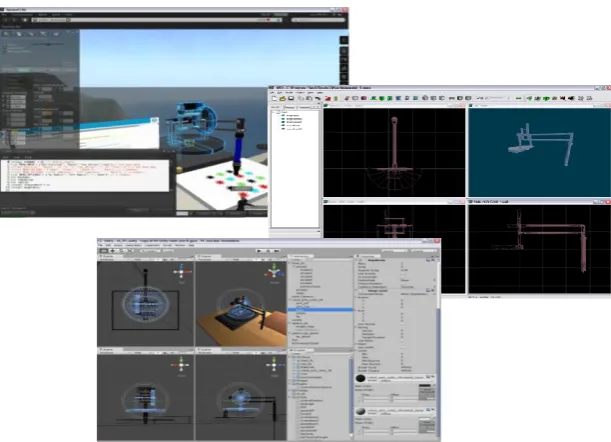
Figure 1.8: Second Life viewer, Unity3D editor, and 3D gaming editor
As part of the research design, in the following sub-sections, I present a methodology and research framework to explain the direction and limitations of my research area. In order to achieve the objectives of this research, I also describe a number of model analyses and research stages, including time frames for overall research experiments.
1.5.1 Methodology
The research aims to identify the generic properties common to gaming environments that are advantageous for telerobotics experiments and methods for effectively incorporating MR and HSC into gaming environments. This is investigated through a series of experiments.
The series of experiments assessed the concept of MR interface, and the principle of HSC, for low level telemanipulation based on a mining scenario. At the initial stage of this research, the gaming environments are explored as the basic platform to build a telerobotics user interface, followed by application of the proposed telerobotic model.
1.5.2 Research Framework, Variable and Instrument
Chapter 1
Introduction
13
1.5.2.1 Research Framework
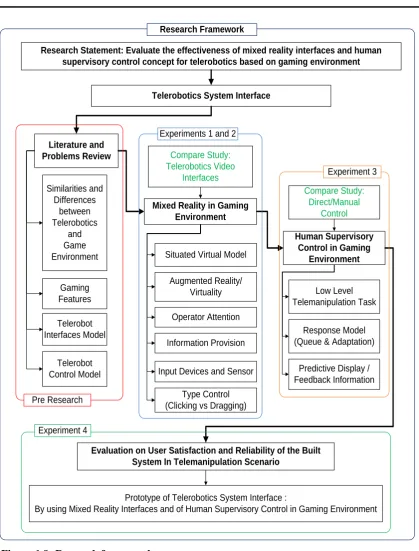
The research commenced with the exploration of the gaming environment. Then, it was followed by the utilisation and investigation of the MR concept and the principle of HSC to improve human machine interfaces in a telerobotics mining scenario.
The main environment in this research is a gaming environment modified for telerobotic interfaces. The user was provided with information on the remote location through this environment. Communication between the user and the remote machine was tested and recorded. Performance variables and the times needed for accomplishing the experimental tasks were recorded, with user preferences and feedback captured in a questionnaire.
I began the research with a review of existing literature and those applications that utilised MR or HSC in the telerobotics area. A number of gaming environments were investigated to assess the feasibility of using their technologies to communicate with a number of remote machines/servers. Then, four experiments were conducted to evaluate the user performance on the proposed telerobotic interfaces. These four experiments are further discussed in the following paragraphs.
The first experiment primarily covered an exploration of the number of gaming environments. Features of gaming environments were also evaluated to encompass more detail about the effectiveness of using MR concepts for telerobotic interfaces. Since all of the information was presented on a single display, it suggested that the operators might have more or less focused into a telerobotic interface. Hence, there is an attempt to evaluate operator performance based on their level of attention in using mixed information in a single display interface.
Based on the first experimental result, it was possible to improve the MR environment by applying additional sensing to detect the block position and provide an additional 3D model of the block. Hence, the second experiment covered an evaluation of user performance in gaming environments with this additional sensing. Here, the gaming environment was also tested with additional input devices, gamepad and eye-tracking, for virtual camera control.
14
1.5 Research Design
Chapter 1
experiment. Hence, a sub experiment of direct/manual control was also performed to compare operator performance.
Chapter 1
Introduction
15
Telerobotics System Interface
Literature and Problems Review
Mixed Reality in Gaming Environment
Human Supervisory Control in Gaming
Environment
Gaming Features
Telerobot Interfaces Model
Situated Virtual Model
Augmented Reality/ Virtuality
Operator Attention
Type Control (Clicking vs Dragging)
Compare Study: Direct/Manual
Control
Response Model (Queue & Adaptation)
Predictive Display / Feedback Information Similarities and Differences between Telerobotics and Game Environment
Research Statement: Evaluate the effectiveness of mixed reality interfaces and human supervisory control concept for telerobotics based on gaming environment
Information Provision
Telerobot Control Model
Prototype of Telerobotics System Interface :
By using Mixed Reality Interfaces and of Human Supervisory Control in Gaming Environment
Evaluation on User Satisfaction and Reliability of the Built System In Telemanipulation Scenario
Pre Research
Experiments 1 and 2
Experiment 3 Experiment 4 Research Framework Compare Study: Telerobotics Video Interfaces
Input Devices and Sensor
[image:45.595.118.538.78.630.2]Low Level Telemanipulation Task
16
1.5 Research Design
Chapter 1
Research Proposal Initial Research Literature Survey and Problems Review Concept Approval Prototype Development Experimental Design Testing and Evaluation Analysis Data Result Possible PublicationExperiment 1 Experiment 2 Experiment 3
Situated Virtual Model Compare with Video Interface Possible Input Device and Sensors Mixed Reality Environment Evaluation of Operator Attentions Collaboration Information Testing for Simple Model Input Human Supervisory Planning & Feedback Information Enhanced Game Features Response Model on Multi
commands Experiment 4 Test Reliability Of User Behaviour Telerobotics Interfaces Start Final Prototype Final Report Finish
Cycle Process per Experimental
List of Experiments (include sub-experiments)
Three and a half years Period Virtual Gaming Environment Telerobotics Model Control Possible Input Device and Sensors Telerobotics Interfaces
Figure 1.10: Stage of research
1.5.2.2 Research Indicators
During the experiments, information was collected through two main indicators: user performance and preference. These two indicators were analysed based on the interaction between the participant/user and the remote machine through the developed interface and are detailed in point ‗a‘ and ‗b‘ below:
a. User Performance Indicators
Chapter 1
Introduction
17
of requests to the telerobot were also recorded as an additional performance indicator for further analysis.
b. User Preference Indicators
After conducting the experiment, each participant was asked to complete a questionnaire using the Likert-scale model and ranked their model preference, while other questions were open-ended. Some participants were also asked to undergo an informal interview to provide further detail on the user prototype interaction performance.
In general, data collected in the questionnaire included a number of components: (1) personal information such as: name, age, educational background, and also how long they usually spend using computers and using computer games; and any prior knowledge of the prototype tested; (2) the performance of each model tested, and the effectiveness of the system in helping them to perform the given task. For comparison purposes, participants were also asked which model they thought was the best; and (3) feedback on the system prototype and suggestions to improve the system.
In this research, I conducted all the experiments by using participants with general background, and not directly by the user with specific knowledge (e.g. mining operator). Besides the limited access to test the application prototype with real mining devices and operator, I assumed using general participants in this research were able to produce conception about the gaming environment is reliable and capable to be used for telerobot interfaces.
1.5.3 Model Analysis.
In this study, the data obtained were analysed by using a number of statistical tests (e.g. analysis of variance, Chi-squared goodness fit test and Logistic Regression) and; further analysed using the F1-score and Weibull distribution. I have presented the descriptive data in accordance with
observations in the field, which include:
Investigation of the gaming engine
Testing of operator performance in a MR environment
Testing of multi command control with the principle of supervisory control
18
1.5 Research Design
Chapter 1
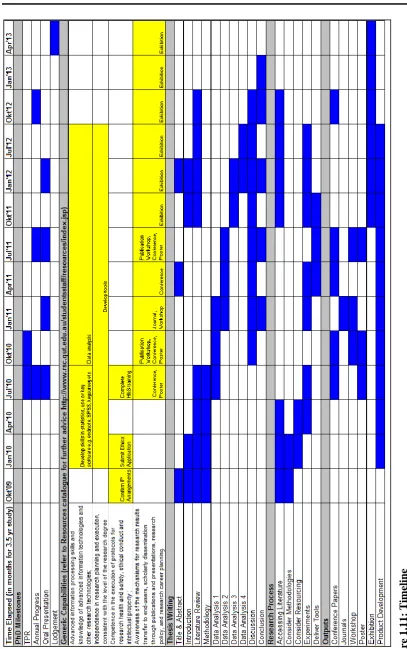
1.5.4 Timeline and Places
Chapter 1
Introduction
19
Fi
gure
1
.1
1
: T
im
el
ine
[image:49.595.110.518.81.731.2]20
1.6 Organisation of the Dissertation
Chapter 1
1.6 Organisation of the Dissertation
This thesis was completed as part of a collaborative project between the Information Human Centred Computing (iHcc) Group in the Research School of Computer Science (RSCS) at the Australian National University and the Information Communication Technologies (ICT) Centre at the Commonwealth Scientific and Industrial Research Organisation (CSIRO), with funding provided from the Minerals Down Under (MDU) National Research Flagship.
This thesis consists of seven chapters: an introduction, a background on telerobotics and related work that has been undertaken in this field; four chapters on the designed prototype, user studies, evaluation, discussion, and a summary of the entire work in the conclusion. The remainder of this dissertation is organised as follows:
Chapter 2 presents the literature review regarding the concepts of telerobotics systems, interface design (e.g. the possibility of utilising the gaming environment for telerobotics user interfaces) and control model (e.g. the possibility of improving the control model from one that was based on direct/manual control to one that is based on HSC), including introducing related research. This review also describes the MR environment, including types of current telerobotic interfaces, and HSC - including the spectrum of current telerobotic control models. At the end of this chapter, I demonstrate the communication implementation between a gaming environment and a number of telerobots or simulation telerobot as initial gaming features evaluation.
Chapters 3 to 6 provide descriptions of the whole evaluation and the experiments including sub-experiments that were conducted during the research. These chapters discuss the implemented prototype model for telerobotics systems MR and situated virtual model interfaces and the combination of manual and supervisory control models.
Chapter 3 discusses the utilisation of a MR interface, which combines information from streaming video and 3D generated computer visualisation, as telerobotics user interfaces. Based on previous work in Chapter 2, the MR concept is applied to a number of gaming environments. The experiment result was also analysed in relation to the operator‘s level of attention to the telerobotic interfaces. This experiment is designed to compare the effectiveness of a MR telerobotic interface in providing suitable information to the operator, as an alternative to telerobotic user interface using streaming video or fully virtual interfaces.
Chapter 1
Introduction
21
with other potential input devices for virtual camera movements. This chapter evaluate the user performance of the improved model interfaces by closely adhering to the experimental settings of Zhu et al‘s experiment [39].
Chapter 5 discusses the principle of HSC as a substitute for direct/manual control in telerobotics to improve automation and reduce the dependence of human operators on the system. The MR interfaces from the previous experiment in Chapter 4 are combined with the HSC concepts. Besides focusing on the planning process which is one of the five generic functions of HSC, the predictive and feedback information associated with the MR concept is also explored in more detail in this chapter. There are two proposed response models for HSC models which are tested. An experiment is designed to analyse the user performance of each response model interface, including a sub experiment for direct/manual control as a comparison study.
Chapter 6 provides an analysis using the Weibull distribution to evaluate the user performance of the latest prototype telerobotics user interface. This evaluation data was recorded from the implementation of the telerobotic system at a public exhibition held for a period of three months. In this chapter, a Weibull model is applied with three parameters to describe the observed sampling data from three model interfaces, including two interfaces for the HSC response model and one interface for the direct/manual model. Two statistical model approaches, the Chi-square goodness fit test and the Coefficient of determination test, are also used to test the suitability of fitting the Weibull curve to the observed data.
23
Chapter 2
Gaming Environments for Telerobotics User
Interface
This chapter presents the literature review related to my research topic, which evaluates the gaming environment for mixed reality (MR) and human supervisory control (HSC) concepts to improve telerobotics interfaces, especially in mining and related scenarios. This chapter consists of three main parts: gaming environment, interfaces and control models. Each group describes information and examples from related work that supports this research. At the end of this chapter, I discuss a preliminary research in testing a gaming environment to communicate with a number of remote applications.
2.1 Gaming Environment
2.1.1 Utilising Gaming Engines in Telerobotic Interfaces
In this research, gaming environments were selected due to its user friendly features. They serve as a powerful tool for applying MR and HSC, which are proposed to address the telerobotic interface problems discussed in the previous chapter. Moreover, gaming engines provide sophisticated and suitable environments for building and customising 3D computer-generated virtual objects, which can be used to replace conventional information displays, such as: texts, pictures and graphs. Most gaming engines also provide custom programming environments that can configure the actions and behaviour of virtual objects.
A virtual reality (VR) concept inside a gaming environment is suitable for simulating the actual environment and parameters needed locally. For telerobotic purposes, it works to reduce the bandwidth requirements and provide unlimited viewpoints of the remote location. In addition, according to Richer et al [33], successful gaming environments are able to offer users with required information and control capabilities in an engaging and enjoyable way. Richer et al [33] also mentioned that a gaming environment can bring new ideas to interface design, especially in the highly dynamic and multimedia world of robotic interfaces.
![Figure 1.2: Rockbreaker robot arm from [5]](https://thumb-us.123doks.com/thumbv2/123dok_us/7900924.187960/33.595.137.516.395.680/figure-rockbreaker-robot-arm-from.webp)
![Figure 1.7: Mixed reality test bed environment in ‘Virtual Bounds’ application interface [29]](https://thumb-us.123doks.com/thumbv2/123dok_us/7900924.187960/38.595.60.482.103.358/figure-mixed-reality-environment-virtual-bounds-application-interface.webp)
![Figure 2.1: A Second Life client interface showing an avatar that is creating virtual objects; and the Second Life logo [46]](https://thumb-us.123doks.com/thumbv2/123dok_us/7900924.187960/54.595.69.468.532.743/figure-second-interface-showing-creating-virtual-objects-second.webp)
![Figure 2.3: Mycosm studio editor and logo [47]](https://thumb-us.123doks.com/thumbv2/123dok_us/7900924.187960/57.595.130.482.288.497/figure-mycosm-studio-editor-and-logo.webp)
![Figure 2.11: Telerobot system architecture [3]](https://thumb-us.123doks.com/thumbv2/123dok_us/7900924.187960/65.595.133.518.369.575/figure-telerobot-system-architecture.webp)
