arXiv:1406.2566v2 [math.AG] 15 Jun 2014
TOM BRIDGELAND, YU QIU AND TOM SUTHERLAND
Abstract. We compute the space of stability conditions on the CYn version of theA2 quiver for alln and relate it to the Frobenius-Saito structure on the unfolding space of theA2singularity.
1. Introduction
In this paper we study spaces of stability conditions Stab(Dn) on the sequence of CYn
triangulated categories Dn associated to the A2 quiver. Our main result is Theorem 1.1 below. There are several striking features. Firstly we obtain uniform results for all n: the space of stability conditions quotiented by the action of the spherical twists is independent of n, although the identification maps are highly non-trivial. Secondly, there is a close link between our spaces of stability conditions and the Frobenius-Saito structure on the unfolding space of the A2 singularity: in fact this structure is precisely what encodes the identifications between our stability spaces for various n. A third interesting feature is that the space of stability conditions on the usual derived category of the A2 quiver arises as a kind of limit of the spaces for the categories Dn asn → ∞.
For any integer n > 2 we let Dn = DCYn(A2) denote the bounded derived category
of the CYn complex Ginzburg algebra associated to the A2 quiver. It is a triangulated category of finite type over C and is characterised by the following two properties:
(a) It is CYn, i.e. for any pair of objects A, B ∈Dn there are natural isomorphisms
Hom∗
Dn(A, B)∼= Hom
∗
Dn(B, A[n])
∨ .
(b) It is (strongly) generated by two spherical objects S1, S2 satisfying
(1) Hom∗
Dn(S1, S2) = C[−1].
We denote by D∞ the usual bounded derived category of the A2 quiver. It is again a
C-linear triangulated category, and is characterised by the property that it is generated
by two exceptional objects S1, S2 satisfying (1) and
Hom∗
The notation D∞ is convenient: the point is that as n increases the Serre dual to the
extension S1 → S2[1] occurs in higher and higher degrees until when n = ∞ it doesn’t occur at all.
For 26n 6∞we let Stab(Dn) denote the space of stability conditions on the category
Dn. We let Stab∗(Dn) ⊂ Stab(Dn) be the connected component containing stability
conditions in which the objects S1 and S2 are stable. Let Aut(Dn) denote the group
of exact C-linear autoequivalences of the category Dn, considered up to isomorphism of
functors. We let Aut∗(Dn) denote the subquotient consisting of autoequivalences which
preserve the connected component Stab∗(Dn) modulo those which act trivially on it. When n <∞we let Sph∗(Dn) denote the subgroup of Aut∗(Dn) generated by the Seidel-Thomas
twist functors TwS1 and TwS2 corresponding to the spherical objects S1 and S2.
The Cartan algebra of the Lie algebra sl3 corresponding to the A2 root system can be described explicitly as
h ={(u1, u2, u3)∈C:
X
i
ui = 0}.
The complement of the root hyperplanes is
hreg ={(u1, u2, u3)∈h:i6=j =⇒ ui 6=uj}.
There is an obvious action of the Weyl group W = S3 permuting theui which is free on
hreg. The quotient h/W is isomorphic to C2 with co-ordinates (a, b) by setting
p(x) = (x−u1)(x−u2)(x−u3) =x3+ax+b.
The image of the root hyperplanes ui =uj is the discriminant
∆ ={(a, b)∈C2 : 4a3+ 27b2 = 0}.
We can now state the main result of this paper.
Theorem 1.1. (a) For 26n <∞ there is an isomorphism of complex manifolds Stab∗(Dn)/Sph∗(Dn)∼=hreg/W.
Under this isomorphism the central charge mapStab(Dn)→C2 corresponds to the
multi-valued map hreg/W →C2 given by
Z
γi
p(x)(n−2)/2dx
(b) Forn =∞ there is an isomorphism of complex manifolds
Stab(D∞)∼=h/W.
Under this isomorphism the central charge map Stab(D∞) → C2 corresponds to
the map h/W →C2 given by
Z
δi
ep(x)dx
for an appropriate basis of paths δi which approach∞ in both directions along rays for which x3 → −∞.
Theorem 1.1 gives a precise link with the Frobenius-Saito structure on the unfolding space of the A2 singularity x3 = 0. The corresponding Frobenius manifold is precisely
M =h/W. The maps appearing in part (a) of our result are then thetwisted period maps of M with parameter ν = (n−2)/2 (see Equation (5.11) of [4]). The map in part (b) is given by the deformed flat co-ordinates of M with parameter ~ = 1 (see [3, Theorem
2.3]).
Then <∞case of Theorem 1.1 was first considered by R.P. Thomas in [15]: he obtained the n = 2 case and discussed the relationship with Fukaya categories and homological mirror symmetry. The n = 2 case was also proved in [1] and generalised to arbitrary ADE Dynkin diagrams. The n = 3 case of Theorem 1.1 was proved in [13], and was extended to all Dynkin quivers of A and D type in [2]. The first statement of part (a), that Stab(D)∼=hreg/W, was proved for all n <∞ in [10].
The case n=∞of Theorem 1.1 was first considered by A.D. King [7] who proved that Stab(D∞) ∼= C2. This result was obtained by several other researchers since then, and
a proof was written down in [10]. The more precise statement of Theorem 1.1 (b) was conjectured by A. Takahashi [14].
Just as we were failing to get round to finishing this paper, A. Ikeda posted [6] on the arxiv which also proves Theorem 1.1 (a), and indeed generalizes it to the case of the Ak
quiver for all k >1. The methods we use here are quite different however so we feel this paper is also worth publishing.
Acknowledgements. We thank Alastair King for many useful conversations on the topic of this paper.
2. Auto-equivalences and t-structures
heart. For any 26 n6∞ the category Dn has a canonical heart which is the
extension-closed subcategory generated by S1 and S2. The exchange graph EG(Dn) has vertices the
hearts in Dnand edges corresponding to simple tilts. We denote by EGo(Dn) theprincipal
component, i.e. the connected containing the canonical heart A ⊂ Dn. The vertices of
EGo(Dn) are called reachable hearts. We say that a heart in Dn is full if it is equivalent
to the canonical heart.
Remark 2.1. When n > 2, this canonical heart is equivalent to the category Rep(A2) of representations of the A2 quiver; besides the simple objects S1 and S2, it contains one more indecomposable object which we denote E; there is a short exact sequence
(2) 0−→S2 −→E −→S1 −→0.
When n = 2, the canonical heart is equivalent to the category of representations of the preprojective algebra: besides E there is another non-simple indecomposable fitting into a short exact sequence
(3) 0−→S1 −→F −→S2 −→0.
The group of auto-equivalences of Dn acts on EG(Dn) in the obvious way. An
autoe-quivalence is called reachable if it preserves the connected component EGo(Dn). We write
Aut∗(Dn) for the sub-quotient of the group of autoequivalences in D consisting of
auto-equivalences which preserve the principal component, modulo those which act trivially on it. We will show that this agrees with the definition given in the introduction later (see Remark 4.3(b)).
Lemma 2.2. Let 26n <∞ and define the following auto-equivalences of Dn:
Σ = (TwS1TwS2)[n−1], Υ = (TwS2TwS1TwS2)[2n−3].
Then we have
Σ(S1, E, S2) = (S2[1], S1, E), Υ(S1, S2) = (S2, S1[n−2]).
Proof. For any spherical object S we always have TwS(S) =S[1−n], and for any pair of
spherical objects we have the relation
TwS1◦TwS2 = TwTwS1(S2)◦TwS1.
The short exact sequence (2) shows that
TwS1(S2) =E, TwE(S1) =S2[1], TwS2(E) =S1.
Thus Σ = TwE◦TwS1[n−1]. Hence
It follows that Σ(E) is the unique non-trivial extension of these two objects, namely S1. Moving on to the second identity we know that TwS1 and TwS2 satisfy the braid relation (see Prop. 2.7 below). Hence
Υ(S1) = Σ(S1[1]) =S2, Υ(S2) = TwS2(E[n−2]) =S1[n−2].
This completes the proof.
The following description of the tilting operation in Dn is the combinatorial
underpin-ning of our main result.
Proposition 2.3. Let 2 6 n 6 ∞, and consider hearts obtained by performing simple tilts of the standard heart A ⊂Dn.
(a) The right tilt of A at the simple S2 is another full heart:
A=hS1, S2i → hS2[1], Ei= Σ(A).
(b) If n > 2 then repeated right tilts at appropriate shifts of S1 gives a sequence of hearts
A=hS1, S2i → hS1[1], S2i → hS1[2], S2i → · · · → hS1[n−2], S2i= Υ(A).
Proof. This is easily checked by hand, or one can consult [8, Proposition 5.4].
Remarks 2.4. (a) When n > 3 the intermediate hearts in the sequence in (b) are non-full. In fact, since
Hom1Dn(S1[k], S2) = 0 = Hom1Dn(S2, S1[k])
for 0< k < n−2, each of these hearts is equivalent to the category of representa-tions of the quiver with two vertices and no arrows.
(b) The cases n= 2,3,∞ of (b) all deserve special comment.
(i) When n=∞the sequence of non-full hearts is of course infinite.
(ii) When n= 3 the first tilt is already a full heart so no non-full hearts arise. (iii) When n = 2, the statement of Prop. 2.3 (b) needs slight modification: there
is now a non-trivial extension (3) and the right tilt of A atS1 is A=hS1, S2i → hF, S1[−1]i= Σ∗(A),
where Σ∗
= (TwS2TwS1)[1]. so again no non-full hearts arise.
Corollary 2.5. The auto-equivalencesΣ,Υand[1]are all reachable. In the groupAut∗(Dn)
we have relations
Proof. The reachability of Σ and Υ is immediate from the last result. Since the twist functors TwSi are reachable it follows from the definition of Σ and Υ that the shift [1] is also reachable. From Lemma 2.2 we know that the auto-equivalence Σ3[−1] fixes the objectsS1, S2. This is enough to ensure that it acts trivially on EG0(Dn) and hence defines
the identity element in Aut∗(Dn). Similarly for Υ2[2−n].
Proposition 2.6. For 2 6 n 6 ∞ the action of Aut∗(Dn) on the set of full reachable
hearts is free and transitive.
Proof. It is free by definition. That it is transitive follows from the characterisation of the categories Dn in terms of generators, or by the explicit description of tilts given in Prop.
2.3.
We denote by Br3 the Artin braid group of the A2 root system; it is the fundamental group ofhreg/W. More concretely, Br3 is the standard braid group on 3 strings and has a presentation
Br3 =hσ1, σ2 :σ1σ2σ1 =σ2σ1σ2i.
The centre of Br3 is generated by the element τ = (σ1σ2)3 and there is a short exact sequence
1−→Z−→τ Br3 −→PSL(2,Z)−→1.
We can give the following description of the group Aut∗(Dn).
Proposition 2.7. Let 26n <∞.
(a) The groupAut∗(Dn) is generated by the subgroup Sph∗(Dn) together with the shift
functor [1].
(b) There is an isomorphismBr3 ∼= Sph∗(Dn) sending the generator σi to TwSi. (c) The isomorphism in (b) sends the central element τ to [3n−4].
(d) The smallest power of[1] contained in Sph∗(Dn) is[3n−4]. Thus there is a short
exact sequence
1−→Sph∗(Dn)−→Aut∗(Dn)−→µ3n−4 −→1.
Proof. Part (a) follows from the explicit description of tilts given in Prop. 2.3 since any element of Aut∗(Dn) takes the canonical heart A to a reachable full heart. Part (b) was
proved by Seidel and Thomas [12]. Part (c) is immediate from Cor. 2.5. Part (d) then follows from the fact thatτ generates the centre of Br3, since any shift [d] lying in Sph∗(D)
is necessarily central and hence corresponds to a multiple of τ.
It will be useful to introduce the quotient group
•
•
• •
• • •
• •
•
• •
• • •
•
• •
•
•
• 0
1
[image:7.595.180.441.99.386.2]−1 ∞
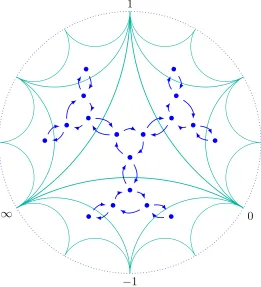
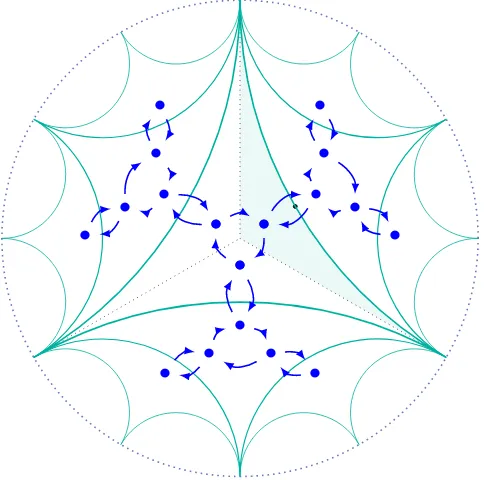
Figure 1. The projective exchange graph of D3 drawn on the hyper-bolic disc. The action of PAut∗(D3) corresponds to the standard action
of PSL(2,Z) on the disc.
•
• •
•
• •
• •
• •
• •
• •
• • •
• • •
• • •
•
• •
• •
• •
•
• •
•
• •
Figure 2. The projective exchange graphs of D2 and D4 drawn on the
[image:7.595.124.496.445.626.2]When 26n <∞ it follows from Prop. 2.7 that
PAut∗(Dn) = Sph∗(Dn)/h[3n−4]i ∼= Br3/hτi ∼= PSL(2,Z).
Note that by Cor. 2.5, the autoequivalences Σ and Υ define elements of PAut∗(Dn) of
orders 2 and 3 respectively.
For the category D∞ the situation is much simpler.
Proposition 2.8. There is an equality Aut∗(D∞) = Aut(D∞). Moreover
(a) The group Aut(D∞)∼=Z with the Serre functor Σ being a generator.
(b) There is a relationΣ3 = [1].
Proof. This is easy and well-known. The Auslander-Reiten quiver for D∞ is an infinite
strip
· · · →E[−1]→S1[−1]→S2 →E →S1 →S2[1]→E[1]→ · · ·
and Σ moves along this to the right by one place.
It follows that PAut(D∞) ∼= µ3. Note that our use of the symbol Σ in Prop. 2.8 is
reasonably consistent with our earlier use for the category Dn: for example the first part
of Cor. 2.5 continues to hold in the n=∞ case.
3. Conformal maps
In this section we describe some explicit conformal maps which will be the analytic ingredients in the proof of our main result.
x y
0 1
l+
l−
2 3 2−n
[image:8.595.160.453.458.676.2]2
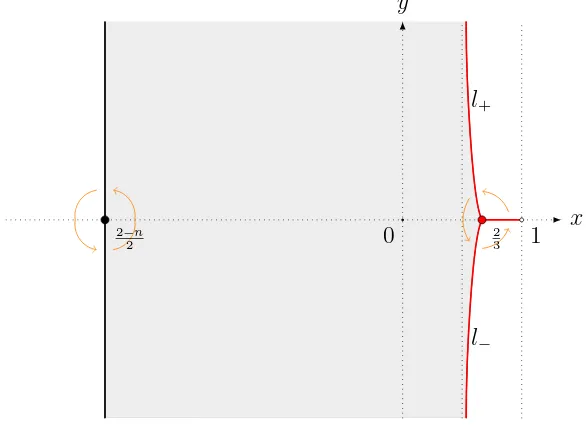
For 2 6n <∞ we consider the region Rn ⊂C depicted in Figure 3. It is bounded by
the line Re(z) = (2−n)/2 and by the curves ℓ±. Here ℓ± are the images under the map
z 7→(1/πi) log(z) of the arcs of circles of Apollonius
(4) r± ={z ∈C:|z±1+ 1|= 1}.
connecting 0 and ω±1
=e±2πi/3
. We also consider splitting the region Rn into two halves
R±
n by dividing it along the line Im(z) = 0. By convention we take Rn+ to be the part
lying above the real axis. Note that R+
n has three vertices: (2−n)/2,2/3 and ∞. The
Riemann mapping theorem ensures that there is a unique biholomorphism
fn: H →R+n
which extends continuously over the boundary and sends (0,1,∞) to (2−n
2 ,∞, 2
3). The Schwarz reflection principle then shows that Rn itself is biholomorphic to the open subset of P1 consisting of the complement of [0,∞].
Proposition 3.1. For n <∞ the functions fn can be explicitly written as
fn(t) = 1
πilog
φ(2)n (a, b) φ(1)n (a, b)
where t=−(27b2)/(4a3) and
φ(ni)(a, b) =
Z
γi
(x3+ax+b)n−22 dx,
for appropriately chosen cycles γi.
Note that the function fn only depends on t = −(27b2)/(4a3) because rescaling (a, b)
with weights (4,6) rescales both functions φ(ni) with weight
3(n−2) + 2 = 3n−4
and leaves their ratio unchanged.
Proof. We consider the Schwarzian derivative of the function gn(t) = expfn(t). As the images inP1of the three sides ofR+
n under the exponential map are segments of circles, the
image of the boundary of the upper-half plane H under gn is a curvilinear triangle in P1.
Thus by the proof of the Schwarz triangle theorem as e.g. in [9, p.207], the Schwarzian derivative of the function gn is determined by its exponents αi at the singular points {0,1,∞}.
of the singular points {0,1,∞}. We know from the explicit description of the boundary of R+
n that the exponents at 0 and ∞ are 12 and 1
3 respectively. The exponent at 1 is the difference between the real parts of the asymptotes of the boundary components of R+
n at
infinity, namely
1 2 −
2−n
2 =
n−1 2 .
The transformation law of the Schwarzian derivative is that of a projective connection; a function defines a section of the projective local system associated to its Schwarzian derivative. In particular gnis given by the ratio of a pair of linearly independent solutions to any second-order linear differential equation with precisely three regular singularities at (0,1,∞) at which the characteristic exponents of its solutions differ by (12,n−1
2 , 1 3) respectively.
Now consider the periods φn(z) = φn(−3,2(2z −1)) where we have fixed the coeffi-cient a of the polynomial p(x). We prove in the Appendix that these periods satisfy the hypergeometric differential equation
(5) z(1−z)φ′′
(z) + (γ −(α+β+ 1)z)φ′
(z)−αβ φ(z) = 0
with coefficients (α, β, γ) = (4−3n
6 , 8−3n
6 , 3−n
2 ). This differential equation has three regular singularities at (0,1,∞) with differences in characteristic exponents
(1−γ, γ−α−β, β−α) =
n−1
2 ,
n−1 2 ,
2 3
.
We deduce that the periods φn(t) satisfy a differential equation with precisely three regular singularities at (0,1,∞) with differences in exponents (12,n−1
2 , 1
3). Indeed the covering map t = (2z−1)2 is ramified over t ={0,∞} and the two regular singularities atz ={0,1}are the preimages of the point t= 1.
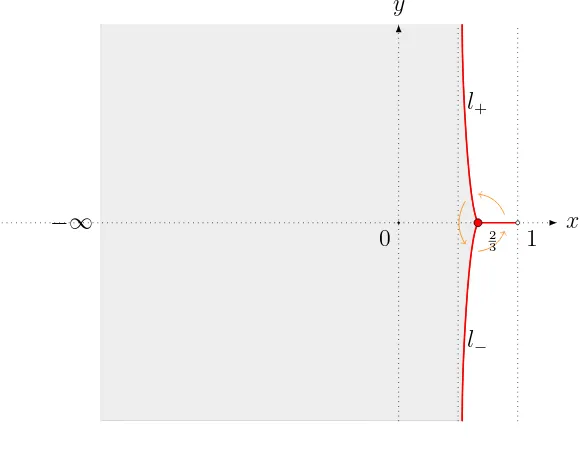
In the case n =∞ we consider the region R∞ depicted in Figure 4. It is bounded by the same two curves ℓ±. We again consider the half regionR+
∞ consisting of points ofR∞
with positive imaginary part. This region R+
∞ has just two vertices: 2/3 and ∞. The
Riemann mapping theorem ensures that there is a biholomorphism
f∞: H → R+∞
x y
0 1
l+
l−
[image:11.595.162.452.98.323.2]2 3 −∞
Figure 4. The region R∞
Proposition 3.2. The function f∞ can be written explicitly as
f∞(t) = 1
πilog
φ(2)∞(a, b) φ(1)∞(a, b)
where t=a3, b is arbitrary, and
φ(∞i)(a, b) = Z
γi
ex3+ax+bdx,
for appropriately chosen cycles γi.
Note that the functionf∞only depends onabecause translating (a, b) in theb-direction
rescales both functions φ(∞i) and leaves their ratio unchanged.
Proof. The defining property off∞(t) shows that it is of the form t1/3·m(t) at t = 0 and
t1/2·n(t) att =∞, where m(t) and n(t) are locally-defined analytic functions. Consider the function g(a) = exp(f∞(a3)) defined on the sector
Σ ={a∈C: 0<arg(a)< π/3}.
Then g(a) extends analytically over the boundary of Σ ⊂ C, and in a neighbourhood of
transformation without altering the Schwarzian, and since g maps the boundary rayR>0
to a circle, it follows that S(g) is real-valued on this ray. A similar argument applied to the function g(eπi/3a) shows that S(g) takes the other boundary ray R
>0exp(πi/3) of Σ to itself (up to sign).
Consider the function h(a) = exp(a3/2). Then
h′′
(a)
h′(a) =
3a3/2 + 1 2a .
So the Schwarzian is
S(h) =
h′′
(a)
h′(a) ′
− 1 2
h′′
(a)
h(a)
2
=−9a 3+ 5
8a2 .
In particular, the Schwarzian S(h) has a simple pole at a=∞.
It now follows that, up to sign, the Schwarzian S(g) takes Σ to itself and extends over the boundary. This then implies that S(g) = λa for some real λ. By precomposing
f∞(a) by a rescaling of a we can reduce this to S(g) =a/3. By general properties of the Schwarzian it follows that g(a) is given by a ratio of solutions of the linear differential equation
y′′
(a)− a
3·y(a) = 0,
a variant of the Airy equation. Since the solutions to this equation are precisely the functionsφ(∞i)(a) (as can easily by checked by differentiating under the integral sign), this
completes the proof.
4. Stability conditions
We let Stab∗(Dn) denote the connected component of the space of stability conditions
on Dn containing stability conditions whose heart is the canonical one. We set
PStab∗(Dn) = Stab∗(Dn)/C.
It is a complex manifold locally modelled on the projective space
P1 =PHomZ(K0(Dn),C).
If σ is a stability condition we set S(σ) to be the set of indecomposable semistable objects of σ. We also set PS(σ) to be the set of such objects up to shift. We now define
an open subset Un ⊂PStab∗(Dn) as follows.
Definition 4.1. A projective stability condition ¯σ ∈PStab∗(Dn) lies in Un if one of the
(a) PS(σ) ={S1, S2} and 0< φ(S2)−φ(S1)<(n−2)/2,
(b) PS(σ) ={S1, S2, E} and
(6) 06φ(S1)−φ(S2)< φ(E[1])−φ(S1), 06φ(S1)−φ(S2)< φ(S2[1])−φ(E).
The point of this definition is the following result.
Proposition 4.2. For any 2 6 n 6 ∞ the domain Un is a fundamental domain for the
action of PAut∗(Dn) on PStab∗(Dn).
Proof. Suppose a projective stability condition σ lies in the intersection Un∩Φ−1(U
n)⊂
PStab∗(Dn) for some Φ∈Aut∗(Dn). This means thatσ ∈Un and also Φ(¯σ)∈Un. There
are two cases to consider, corresponding to the two parts of Definition 4.1.
Suppose first that PS(σ) ={S1, S2}. Then Φ maps each Si to anSj up to shift. Given
the Hom-spaces between S1 and S2 it is easy to see that if Φ defines a non-trivial element of PAut∗(Dn) then we must have n <∞ and
Φ(S1, S2) = (S2, S1[n−2]))
up to shift. But then for Φ(σ) to lie inUnwe must haven−2−(φ(S2)−φ(S1))<(n−2)/2
which gives a contradiction.
The second case is when PS(σ) = {S1, S2, E}. Then Φ preserves this set of objects
up to shift. Given the maps between them, and using Lemma 2.2, it follows that Φ ∈
PAut∗(Dn) lies in the order 3 subgroup generated by Σ. Noticing that the inequalities (6)
are equivalent to
|Z(S2)|<|Z(E)|, |Z(S1)|<|Z(E)| (7)
where Z is the central charge for σ, they give a contradiction.
Now consider the union of the closures of the regions Φ(Un) for Φ∈PAut∗(Dn). This
subset of PStab∗(Dn) is closed because it is a locally-finite union of closed subsets. To
prove that it is open consider a stability condition σ defining a point in the boundary of
Un. Again, there are two possibilities, corresponding to the two parts of Definition 4.1.
In the first case,PS(σ) ={S1, S2}and φ(S2)−φ(S1) = (n−2)/2. Then a neighbourhood
of σ is covered by the closures of the regions Un and Υ(Un). In the second case PS(σ) =
{S1, S2, E}and one or both of the two inequalities (6) is not strict. Then a neighbourhood of σ is covered by the closures of the regions Un, Σ(Un) and Σ2(Un). This completes the
proof.
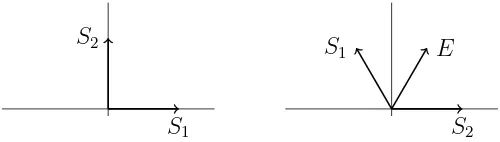
Remarks 4.3. (a) When n < ∞there are two special points in the boundary of Un:
S2
S1
E S1
[image:14.595.184.434.96.167.2]S2
Figure 5. Stability conditions corresponding to orbifold points of PStab∗(Dn)
(b) It follows from this result that an autoequivalence in Aut(Dn) is reachable
pre-cisely if it preserves the connected component Stab∗(Dn). Moreover by [11,
Corol-lary 5.3]) such an autoequivalence acts trivially on Stab∗(Dn) precisely if it acts
trivially on the principal component EGo(Dn).
Proposition 4.4. Let 26n6∞. Then the function
g(σ) = 1
πilog
Z(S1)
Z(S2)
defines a biholomorphic map between the regions Un and Rn.
Proof. The region Un consists of two parts, corresponding to conditions (a) and (b) of
Definition4.1. In the first partS1 andS2 are the only indecomposable semistable objects. This implies thatφ(S2)> φ(S1) since otherwise the extensionE would also be semistable. Combined with the inequality in Definition 4.1 this gives
0< φ(S2)−φ(S1)<(n−2)/2.
Any stability condition for whichS1andS2are the only indecomposable semistable objects is clearly determined up to theC-action by logZ(S2)/Z(S1), and it is also easy to see that
any possible value compatible with the above constraint is possible. So the image of this part of Un is precisely the strip (2−n)/2<Re(z)<0.
In the second part of the region Un, all three objects S1, S2 and E are semistable.
The existence of nonzero maps S1 → S2[1] implies the image of this part of Un lies in
the strip 0 6 Re(z) < 1. Now the inequalities (6) in Definition 4.1 (or equivalently (7)) imply that this image is one third of this region, divided by the order 3 subgroup generated by Σ in Aut∗(Dn). To see it is precisely the left part of Rn, we only need
•
•
• •
• • •
• •
•
• •
• • •
•
• •
•
[image:15.595.189.431.95.335.2]• •
Figure 6. Exchange graph as the skeleton of space of stability conditions
We can now prove a projectivised version of Theorem 1.1. Recall that the quotienth/W
is isomorphic to C2 with co-ordinates (a, b) by setting
p(x) = (x−u1)(x−u2)(x−u3) =x3+ax+b.
The image of the root hyperplanes ui =uj is the discriminant
∆ ={(a, b)∈C2 : 4a3+ 27b2 = 0}.
Note that h has a natural C∗ action rescaling the ui co-ordinates with weight 1. This
acts on (a, b) with weights (2,3). We thus have
C∗\(h\ {0})/W ∼=P(2,3).
The weighted projective space P(2,3) contains two orbifold points with stabilizer groups
µ2 and µ3 respectively. The image of the discriminant is a single (non-orbifold) point which we also label ∆.
In the n =∞ case we consider the quotient of P1 by µ
3 given by [1 : z]7→[1 :e2πi/3z]. We label the two orbifold points {µ3,∞}.
Theorem 4.5. (a) For 26n <∞ the action ofPAut∗(Dn)on PStab∗(Dn)is
quasi-free and there is an isomorphism of complex orbifolds
(b) The action ofPAut(D∞)onPStab(D∞)is quasi-free and there is an isomorphism
of complex manifolds
PStab(D∞)/PAut∗(D∞)∼=C/µ3.
Proof. We identify the upper plane arising in the last section with the upper half-plane in the coarse moduli space of the orbifold P(2,3), in such a way that the points
(0,1,∞) correspond to (µ2,∆, µ3). Combining the map g of Prop. 4.4 and the inverse of the maps fn of the last Section gives a biholomorphic map
Un−→g Rn f
−1 n −→P.
Here, we view Un as an open dense subset of PStab∗(Dn)/Aut∗(Dn), and P =P(2,3)\
([µ2,∆] ∪ [∆, µ3]) is the union of two copies of the upper half-plane glued along the boundary component [µ2, µ3].
By definition, the map g extends over the boundary of Un and sends the two types of
boundary points (corresponding to parts (a) and (b) of Definition 4.1) to the boundaries on the left and right of Figures 3 – 4 respectively. Under the map f−1
n these boundaries
become identified with [µ2,∞] and [µ3,∞] respectively. The result then follows.
The case n=∞proceeds along similar lines. We identify the upper half-plane with the upper half-plane in the coarse moduli space of the resulting orbifoldP1/µ3. The composite
f−1
∞ ◦g then identifies the dense open subsetU∞ofPStab(D∞)/PAut(D∞) with the union
of two copies of the upper half-plane glued along one of the boundary components [µ3,∞].
The rest of the argument is then as above.
Remark 4.6. Note thatPStab(D∞) is isomorphic toCand the action ofPAut(D∞)∼=µ3
corresponds to the usual action of µ3 on C by multiplication by a primitive third root of unity.
We can now lift Theorem 4.5 to obtain a proof of our main theorem.
Proof of Theorem 1.1. We have a diagram of complex manifolds and holomorphic maps
Stab∗(Dn)/Sph∗(Dn) C2\∆
y
y
PStab∗(Dn)/PSph∗(Dn) θn
−−−→ P(2,3)\∆
The vertical arrows are C∗
the central charge map
PStab(Dn)→P1
corresponds under the isomorphism θn to the multi-valued map given by ratios of the
functionsφ(ni)(a, b). These functions lift toC2\∆ and are then scaled with weight 3n−4>0
by the C∗
-action. There is therefore a unique way to fill in the upper arrow so that the multi-valued central charge map on Stab(Dn) corresponds toφ(ni)(a, b).
In the n =∞ we have a similar diagram
Stab∗(D∞) C2
y
y
PStab∗(D∞) θ∞ −−−→ C
in which the vertical arrows areC-bundles. The bundle on the right is just the projection C2 →C given by (a, b)7→a. By construction the central charge map
PStab∗(D∞)→P1
is given by ratios of the functionsφ(∞i)(a, b). These functions lift toC2 and are then scaled
by weight eb by translation by (0, b). There is therefore a unique way to fill in the upper
arrow so that the central charge map on Stab(D∞) corresponds toφ(∞i)(a, b).
Remark 4.7. In the n =∞ case the auto-equivalence group is Z generated by Σ. The
induced action onh/W is given by (a, b)7→(e2πi/3a, b+πi/3). The element Σ3 = [1] then fixes a and acts byb 7→b+πi.
Appendix A. Hypergeometric equation for the twisted periods
In this section we prove that the twisted periods satisfy the hypergeometric differential equation (5) appearing in the proof of Theorem 3.1.
Let us fix a∈C and consider the function
fa(h) = h−(ν+1)
Z
eh(x3+ax)dx.
Setting t=h1/3·x we see that
fa(h) =h−(ν+4 3)
Z
et3+h2/3atdt.
Introduce the differential operator
Then
(Dh+ 1
3)fa(h) = 2 3·h
−(ν+4 3)
Z
h23 ·at·et 3
+h2/3
atdt.
Repeating we obtain
(Dh−1
3)(Dh+ 1
3)fa(h) = 4 9·h
−(ν+4 3)
Z
h43 ·(at)2·et 3
+h2/3
atdt,
and it follows that
(Dh− 1
3)(Dh+ 1 3) +
4a3 27 ·h
2
!
f(a, h) =
=h−(ν+43)·h 4 3 ·4a
2
27
Z
(3t2+h23a)·et 3
+h2/3
atdt= 0.
Now consider the (inverse) Laplace transform
pa(b) =
Z
ebhfa(h)dh=
Z Z
eh(x3+ax+b)·h−(ν+1)dx dh.
Exchanging the order of integration and using
Z
eh(y+b)·h−(ν+1)dh= (−ν−1)!·(y+b)ν,
valid for Re(ν)>−1 this becomes
pa(b) = (−ν−1)!·
Z
(x3+ax+b)νdx.
Under the inverse transformh∂h becomes−b∂b−1 so the transform of the operatorDh is
Mb = (−b∂b+ν).
The twisted periods therefore satisfy the differential equation
(−b∂b+ν+1
3)(−b∂b+ν− 1 3) +
4a3 27 ·∂
2
b
pa(b) = 0
which can be rewritten
(8)
4a3 27 +b
2
∂b2+ (1 +α+β)b∂b+αβ = 0
The differential equation (8) is second order in b with three regular singularities. To put it in hypergeometric form substitute
b=d(2z−1) with 4a3+ 27d2 = 0
so that the singularities lie atz ∈ {0,1,∞}. The equation now becomes
z(1−z)∂z2+ γ−(1 +α+β)z
∂z−αβ = 0,
with γ = 1/2−ν. Setting ν = (n−2)/2 gives the claim.
References
[1] Tom Bridgeland, Stability conditions and Kleinian singularities, Int Math Res Notices, 2009. arXiv:math/0508257v2
[2] Tom Bridgeland and Ivan Smith, Stability conditions and quadratic differentials,arXiv:1302.7030v1. [3] Boris Dubrovin, Painlev´e transcendents in two-dimensional topological field theory, arXiv:9803107. [4] Boris Dubrovin, On almost duality for Frobenius manifolds, arXiv:0307374.
[5] Johannes J. Duistermaat, Discrete integrable systems, QRT maps and elliptic surfaces, Springer Monographs in Mathematics. Springer, New York, 2010,
[6] Akishi Ikeda, Stability conditions on CYN categories associated to An-quivers and period maps, arXiv:1405.5492.
[7] Alastiar King, The elephant and the mouse, Talk in Edinburgh, early 2000s.
[8] Alastair King and Yu Qiu , Exchange Graphs of acyclic Calabi-Yau categories, arXiv:1109.2924v2. [9] Zeev Nehari, Conformal mapping, McGraw-Hill Book Co., Inc., New York, Toronto, London, 1952 [10] Yu Qiu, Exchange graphs and stability conditions for quivers, Ph.D thesis, University of Bath, 2011. [11] Yu Qiu, Stability conditions and quantum dilogarithm identities for Dynkin quivers,
arXiv:1111.1010v2.
[12] Paul Seidel and Richard Thomas, Braid group actions on derived categories of coherent sheaves,
Duke Math. J., 108(1):37-108, 2001.arXiv:math/0001043v2
[13] Tom Sutherland, The modular curve as the space of stability conditions of a CY3 algebra, arXiv:math/1111.4184.
[14] Atsushi Takahashi, Private communication.
[15] Richard Thomas, Stability conditions and braid groups,Communications in Analysis and Geometry