Efficient Noninteractive Certification
of RSA Moduli and Beyond
Sharon Goldberg*, Leonid Reyzin*, Omar Sagga*, and Foteini Baldimtsi†
*Boston University, Boston, MA, USA
[email protected],[email protected],[email protected] †George Mason University, Fairfax, VA, USA
October 3, 2019
Abstract
In many applications, it is important to verify that an RSA public key (N, e) specifies a permutation over the entire spaceZN, in order to prevent attacks due to adversarially-generated
public keys. We design and implement a simple and efficient noninteractive zero-knowledge protocol (in the random oracle model) for this task. Applications concerned about adversarial key generation can just append our proof to the RSA public key without any other modifications to existing code or cryptographic libraries. Users need only perform a one-time verification of the proof to ensure that raising to the powereis a permutation of the integers moduloN. For typical parameter settings, the proof consists of nine integers moduloN; generating the proof and verifying it both require about nine modular exponentiations.
We extend our results beyond RSA keys and also provide efficient noninteractive zero-knowledge proofs for other properties of N, which can be used to certify that N is suitable for the Paillier cryptosystem, is a product of two primes, or is a Blum integer. As compared to the recent work of Auerbach and Poettering (PKC 2018), who provide two-message protocols for similar languages, our protocols are more efficient and do not require interaction, which enables a broader class of applications.
1
Introduction
Many applications use an RSA public key (N, e) that is chosen by a party who may be adversarial. In such applications, it is often necessary to ensure that the public key defines a permutation overZN: that is, raising to the poweremoduloN must be bijective, or, equivalently, every integer
between 0 andN−1 must have aneth root moduloN. An attacker who deliberately generates a bad key pair may subvert the security of other users — see for example, [MRV99], [CMS99], [MPS00], and [LMRS04]. In particular, our work was motivated by TumbleBit [HAB+17], a
transaction-anonymizing system deployed [Str17] on top of Bitcoin, in which a bad key pair can lead to a devastating attack (see footnote 2 in Section 5 for the attack specifics).
First, because the folklore solution requirese > N,eis not in the set of standard values typically used for e in RSA implementations e.g., e ∈ {3,17,216+ 1}. Unless a large prime value for e is standardized, before using the public key, one would have to perform a one-time primality test on
e, to ensure thatereally is prime. This primality test is quite expensive (see Section 5).
Second, most RSA implementations choose a small value for e, typically from a set of standard values e ∈ {3,17,216+ 1}. Choosing a small e significantly reduces the cost of performing RSA public key operations. However, this efficiency advantage is eliminated in the folklore solution, which requires e > N. Unlike the previous drawback, which results in a one-time cost for each public key used, this drawback makes every public-key operation about two orders of magnitude more expensive.
In addition, this solution is not compatible with existing RSA standards and off-the-shelf im-plementations. This is because the folklore solution does not ensure that the public key operation is a permutation over ZN, where ZN ={0,1, ..., N −1}. Instead, it ensures only that the public
key operation defines a permutation over the set Z∗N, whereZ∗N is the set of values inZN that are
relatively prime withN. Thus, there are no assurances about the values in the set ZN−Z∗N,i.e.,
the set of values that are less than N butnot relatively prime with N. (To see this, consider the example N = 9 and e = 11.) If the RSA public key is generated honestly, this is not a problem, because the setZN−Z∗N contains only a negligible fraction ofZN. However, if an adversary chooses
the RSA public key (N, e) maliciously, then it could choose N so that the setZN −Z∗N is a large
fraction ofZN.1 To address this attack, the folklore solution additionally requires a gcd check along
with every RSA public-key operation, to ensure that the exponentiated value is relatively prime withN.
1.1 Our Contributions
Proving that an RSA Key Specifies a Permutation over all of ZN We present a simple
noninteractive zero-knowledge proof (NIZK) in the random oracle model, that allows the holder of an RSA secret key to prove that the corresponding public key defines a permutation over all of
ZN, without leaking information about the corresponding secret key. Our NIZK can be used even
when the RSA exponenteis small, which is useful for applications that require fast RSA public key operations. In addition to the NIZK algorithm and a concrete security proof, we present a detailed specification of the prover and verifier algorithms, as well as production-quality implementation and an analysis of its performance. Because our NIZK is for all values in ZN, it is compliant with
existing cryptographic specifications of RSA (e.g., RFC8017 [MKJR16]).
For typical parameter settings, our NIZK consists of 9 elements of ZN. Generating the NIZK
costs roughly 9 full-length RSA exponentiations moduloN. Meanwhile, each verifier pays the one-time cost of verifying our NIZK, which is also roughly equal to 9 full-length exponentiations. When compared to the folklore solution we described earlier, our solution (1) avoids the more expensive one-time primality test and (2) allows the verifier to continue using a small value ofe, resulting in better performance for every public-key verification.
We view this result as of most immediate practical applicability (in fact, it has already been deployed). We therefore present not only a high-level explanation of this protocol (Section 3.3), but also its detailed specification (Appendix C) and implementation results (Section 5 and code at [cod]).
Suitability for Paillier and Other Properties of N We also present simple NIZK proofs for several other properties of N, such as ensuring that N is square-free (Section 3.2), is suitable for Paillier encryption (required in [Lin17] and [HMRT12]; see Section 3.2), is a product of exactly two primes (Section 3.4), or is a Blum integer (i.e., product of two primes that are each 3 modulo 4; see Section 3.5). Most of these problems have been addressed only via interactive protocols in prior literature [AP18]. Noninteractive proofs have considerably broader applicability than interactive ones, because the owner of the public key can simply generate a nonineractive proof once and publish it once together with the public key, whereas in the interactive, the owner needs to be online, handle potentially high query loads, and be subject to denial of service attacks.
Our proofs for square-freeness and suitability for Paillier are of similar efficiency to the per-mutation proof, requiring only 8 elements in ZN for typical parameter settings and 8 full-length modular exponentiations. Our proofs for products of two primes and Blum integers require the proof of square-freeness and a test for prime powers (same as in [AP18]), plus one more component, which is less efficient for the prover, but more efficient for the verifier. For 128-bit security, this additional component requires about 1420 square root operationsZN by the prover (note, however,
that this is done one-time during key generation). The verifier, on the other hand, needs to perform only Jacobi-symbol computations and modular squarings, which are much more efficient, making the verifier cost comparable to the cost of just a few full-length modular exponentiation. This additional component requires the publication of 1420 elements ofZN.
All of our protocols are presented first as two-message public-coin honest-verifier protocols. We then convert them to noninteractive using the Fiat-Shamir heuristics, by obtaining the verifier’s public-coin message through an application of the random oracle to the protocol input (see Sec-tion 4). They all have perfect completeness, perfect honest-verifier zero-knowledge, and statistical soundness, with the exception of the protocol for showing thatN is a product of two primes, which has computational honest-verifier zero-knowledge under the quadratic residuosity assumption.
1.2 Related Work
Auerbach and Poettering [AP18] present two-message interactive protocols in the random oracle model for the same problems as we consider, with the exception of proving that (N, e) specifies a permutation over ZN (they prove only that (N, e) specifies a permutation over Z∗N, which, would
require users to modify their RSA implementations to add a gcd computation to every public-key operation). As already mentioned, noninteractive protocols have broader applicability than interactive ones. It is much more appealing to be able to post, say an RSA public key along with a NIZK proof of being well formed, as opposed to be expected to run an online, interactive protocol with each verifier. Their protocols for proving that (N, e) specifies a permutation, N is square-free, or is suitable for Paillier, are all considerably less efficient than ours, requiring 81-128 modular exponentiations for 128-bit security level. Their protocols for proving thatN is a product of exactly two primes or is a Blum integer are also less efficient for the verifier (because the first step in those protocols is proving square-freeness); they are about 10 times more efficient for the prover if we consider only one-time use, but, because they are interactive, they must be run repeatedly by the prover, while in our noninteractive case, the prover needs to run them only once.
Wong, Chan, and Zhu [WCZ03, Section 3.2] and Catalano, Pointcheval, and Pornin [CPP07, Appendix D.2] present interactive protocols (using techniques similar to ours) that, like the proto-cols of [AP18], also work only overZ∗N rather than the entireZN.
The protocols given by Camenisch and Michels [CM99, Section 5.2] and Benhamouda et al. [BFGN17] achieve much stronger goals. The former provesN =pqis a product of two safe primes (i.e.,p, q,(p−1)/2, and (q−1)/2 are all prime); the second can prove that any prespecified procedure for generating the primes p and q was followed. These protocols can be used to prove that (N, e) specifies a permutation by imposing mild additional conditions on e (and the prime generation procedure for [BFGN17]). However, these stronger goals are not necessary for our purposes. Our protocol is considerably simpler and more efficient, and does not restrictp and q in any way.
Our protocol for showing that (N, e) specifies a permutation overZN builds on the protocol of
Bellare and Yung [BY96], who showed how to prove that any function is “close” to a permutation. However, “close” is not good enough for our purposes, because the adversary may be able to force the honest parties to use the few values in ZN at which the permutation property does not
hold. Thus, additional work is required for our setting. This additional work is accomplished with the help of a simple sub-protocol from Gennaro, Micciancio, and Rabin [GMR98, Section 3.1] for showing the square-freeness of N (a similar sub-protocol in the interactive setting was discovered earlier by Boyar, Friedl, and Lund [BFL89, Section 2.2]). We demonstrate how to combine the ideas of [BY96] and [GMR98] to prove that (N, e) specifies a permutation overZN.
2
Preliminaries
Some number-theoretic preliminaries are presented in Appendix A.
Here, we first recall the standard notion of honest-verifier zero-knowledge (HVZK).
Definition 2.1. (Honest-Verifier Zero Knowledge (HVZK)) An interactive proof system between a prover and verifier (P, V)for a NP language L is said to be honest-verifier zero knowledge if the following properties hold:
1. (perfect) Completeness. For every x∈L and every NP-witness w for x,
P r[hP(x, w), V(x)i= 1] = 1.
2. (statistical) Soundness. For every x6∈L and every interactive algorithm P∗ P r[hP∗(x), V(x)i= 1] = negl(|x|)
3. HVZK. There exists a probabilistic polynomial-time simulator S such that for all x∈L and all PPT distinguishers D we have:
viewDhP(x,w),V(x)i≈viewDS(x).
We say (P, V) ispublic coin if all the messages sent by verifier V to prover P are random coin tosses.
Promise problems We also recall the notion of a promise problem, which is a generalization of the notion of a language. A promise problem consists of two disjoint sets: Lyes and Lno. In a
language, Lno = Lyes, but in a promise problem, there may be strings that are neither in Lyes nor
Lno, and we generally do not care what happens if such a string is input. Thus, in a ZK proof for a
promise problem, completeness and zero-knowledge need to hold for inputs in Lyes, while soundness
3
HVZK Proofs for Properties of
N
and
e
3.1 HVZK Proof for a Permutation over Z∗N
Bellare and Yung [BY96] showed how to certify that any function is close to a permutation. The idea is to simply ask the prover to invert the permutation on random points. It is a standard fact from number theory (Lemma A.8) that raising to eth power is either a permutation of Z∗N or very
far from one—in fact, it is either a permutation or an e0-to-1 function, where e0 is the smallest prime divisor ofe. Here, we adapt the protocol of [BY96] to show that the RSA function is not just close to a permutation, but is actually a permutation overZ∗N: if we check that e
0 is high enough,
then not many random points will be needed.
It is also a standard fact (recalled in Lemma A.2) that raising to the poweredefines a permu-tation overZ∗N if and only ifeis relatively prime to φ(N). Thus, let
LpermZ∗N ={(N, e)|N, e >0 and gcd(e, φ(N)) = 1}.
Let
Le0 ={(N, e)|N, e >0 and no prime less thane0 divides e}.
(In typical RSA implementations,e is a fixed small prime, such as 3, 17, or 65537, and one would usee0 =e.)
The following is an HVZK protocol for LpermZ∗N ∩Le0 with perfect completeness, perfect
zero-knowledge, and statistical soundness error 2−κ. We emphasize that, while the protocol is similar to that of [BY96], it is not identical. Specifically, the addition of Le0 and the verifier check in Step
4a allow us to guarantee that the RSA function is a permutation over Z∗N much more efficiently
than the protocol of [BY96].
Protocol PpermZ∗
N
1. Both prover and verifier letm=dκ/log2e0e.
2. The verifier chooses mrandom values ρi∈Z∗N and sends them to prover.
3. The prover sends backeth roots ofρi moduloN:
σi= (ρi)e
−1modφ(N)
modN
fori= 1. . . m.
4. The verifier accepts thatN ∈LpermZ∗N ∩Le0 if all of the following checks pass.
(a) Check that N, e, and σi fori= 1. . . mare positive integers, and that enot divisible by
all the primes less than e0 (ifeis a fixed prime as in typical RSA implementations, this check simply involves checking thate=e0).
(b) Verify that ρi = (σi)emodN fori= 1. . . m.
Theorem 3.1. PpermZ∗N is a 2-message public-coin protocol with perfect completeness, perfect
honest-verifier zero-knowledge, and statistical soundness error 2−κ for the language LpermZ∗N ∩Le0.
Proof. It is a standard fact (see Lemma A.2) that raising to the power N is a permutation of Z∗N
whenevere∈LpermZ∗N, and the inverse of this permutation is raising to the power (e
−1modφ(N)).
This fact gives perfect completeness and a perfect HVZK simulator who simply chooses σi and
apply only to (N, e) ∈ LpermZ∗N ∩Le0). Statistical soundness with error 2
−κ follows from the fact
that if (N, e)∈/ LpermZ∗N but (N, e)∈Le0, then size the image of the mapσ 7→σ
eis at most|
Z∗N|/e0
by Lemma A.8. Thus, the probability that aσi exists for everyρiis at most 1/(e0)m= 2−mlog2e 0
≤
2−κ.
3.2 HVZK Proofs for Paillier and Square-Free N
The Paillier cryptosystem requires a modulusN that is relatively prime withφ(N). Thus, let
Lpailler-N ={N >0|gcd(N, φ(N)) = 1}.
We emphasize that, unlike [AP18], we do not verify the properties of the generatorgin the Paillier cryptosystem—but since the common choice is to use g = N + 1 per [DJ01], verifying that N ∈
Lpailler-N is sufficient for the common case.
Let
Lsquare-free={N >0| there is no prime psuch that p2 dividesN}.
Note that to be in Lpailler-N, N has to be in Lsquare-free and also have no prime divisors p, q such
that p|q−1 (by definition of φ(N), as recalled in Appendix A), so Lpailler-N ⊂ Lsquare-free (see
Lemma A.3). Thus, letting
Lgap ={N ∈Lsquare-free|N has two prime divisors p, q such thatp dividesq−1},
we know that Lsquare-free−Lgap= Lpailler-N.
Our protocols for proving suitability for Paillier or square-freeness will depend on a parameter
α and the corresponding language
Lα ={N >0|no prime less thanα dividesN}.
We now describe the protocol Ppailler-N, an HVZK protocol for Lα∩Lpailler-N with perfect
com-pleteness, perfect zero-knowledge, and statistical soundness error 2−κ. This protocol builds on the
protocol from [GMR98, Section 3.1], but is not identical to it: specifically, the addition of Lα and
verifier’s Step 4a gives better performance. Settingα= 2 gives a protocol for Lpailler-N, but a higher
setting ofα will improve efficiency (see Section 5 for a discussion of how to pickα).
The idea of the protocol is to ask the prover to take Nth roots of random points—they will not exist for many points if N /∈ Lpailler-N, because raising to the power N will be far from a
permutation. The protocol is the same as the protocol LpermZ∗N described in Section 3.1, replacing
ewithN and e0 withα.
Protocol Ppailler-N:
1. Both prover and verifier letm=dκ/log2αe.
2. The verifier chooses mrandom values ρi∈Z∗N and sends them to prover.
3. The prover sends backNth roots ofρi modulo N:
σi = (ρi)N
−1modφ(N)
modN
fori= 1. . . m.
(a) Check thatN is a positive integer and is not divisible by all the primes less thanα. (b) Check thatσi is a positive integer for i= 1. . . m.
(c) Verify that ρi = (σi)N modN fori= 1. . . m.
Theorem 3.2 (GMR98). Ppailler-N is a 2-message public-coin proof with perfect completeness, perfect honest-verifier zero-knowledge, and statistical soundness error 2−κ for the language Lα ∩
Lpailler-N.
Note that choosing elements in Z∗N in step 2 of the protocol requires a gcd computation by the
verifier (because the verifier cannot be sure that the difference betweenZN and Z∗N is negligible).
To avoid this computation, the verifier can choose values in ZN instead. Then the verifier may
have a lower probability of rejecting inputs outside of Lα∩Lpailler-N, but is still guaranteed to reject
inputs outside of Lα∩Lsquare-free with probability 1−2−κ, as we show in Lemma A.6. Perfect
completeness and zero-knowledge still hold for Lα∩Lpailler-N, and thus for an honestly generated
RSA modulus. Let us call this modified protocolPsquare-free.
Protocol Psquare-free: Same as the protocol Ppailler-N described above, replacing ZN∗ with ZN in
step 2 andN ∈Lpailler-N ∩Lα with N ∈Lsquare-free∩Lα in step 4. Specifically,
1. Both prover and verifier letm=dκ/log2αe.
2. The verifier chooses mrandom values ρi∈ZN and sends them to prover.
3. The prover sends backNth roots ofρi modulo N:
σi = (ρi)N
−1modφ(N)
modN
fori= 1. . . m.
4. The verifier accepts thatN ∈Lsquare-free∩Lα if all of the following checks pass.
(a) Check thatN is a positive integer and is not divisible by all the primes less thanα. (b) Check thatσi is a positive integer for i= 1. . . m.
(c) Verify that ρi = (σi)N modN fori= 1. . . m.
Theorem 3.3. Psquare-freeis a 2-message public-coin proof with perfect completeness, perfect honest-verifier zero-knowledge, and statistical soundness error 2−κ for the promise problem (Lyes = Lα∩
Lpailler-N,Lno = Lα∩Lsquare-free).
Proof. It is a standard fact that raising to the power N is a permutation of ZN whenever N ∈
Lpailler-N, and the inverse of this permutation is raising to the power (N−1 modφ(N)) (Lemma A.3
and Lemma A.4, setting f = N). This fact gives perfect completeness and a perfect HVZK simulator who simply chooses σi and computes ρi = (σi)N modN for i = 1. . . m (recall that by
definition, completeness and HVZK apply only to N ∈Lyes). Statistical soundness with error 2−κ
follows from the fact that if p ≥α is a prime such that p2|N , then the map σ 7→ σN is at least
α-to-1 over ZN (per Lemma A.6); thus, the probability that a σi exists for every ρi is at most
3.3 HVZK Proof for Permutation over Entire ZN
As explained in the introduction, ensuring that raising to the power e is a permutation over the entireZN is more desirable than ensuring only that it is a permutation overZ∗N. In this section, we
show that a careful combination of protocols Psquare-freeand PpermZ∗
N gives an efficient two-message
public-coin HVZK protocol for proving that an RSA public key defines a permutation over the entire ZN.
Let LpermZ∗N and Le0 be as in Section 3.1, and Lα, Lsquare-free, Lpailler-N, and Lgapbe as in Section
3.2, except defined not just on integersN, but on pairs (N, e) for an arbitrary e >0. Let LpermZN ={(N, e)|N, e >0 and raising to the power eis a permutation over ZN}.
Note that
Lpailler-N ∩LpermZ∗N
⊂ Lsquare-free∩LpermZ∗N
⊂ LpermZN.
(the first ⊂property follows from Lemma A.3; the second ⊂property follows from Lemma A.4). Note that the only pairs (N, e) in LpermZN −
Lsquare-free∩LpermZ∗N
are those for whiche= 1 and
N is not square-free (per Lemma A.5).
We want to design a protocol for LpermZN. For efficiency reasons, we will focus instead on
LpermZN ∩Lα∩Le0, i.e., require N and e to not have divisors smaller than α and e
0, respectively.
Moreover, just like in protocolPsquare-freeof Section 3.2, we will consider slightly weaker complete-ness: if N is square-free, but has two prime divisorsp, q such that p|(q−1) (i.e., falls into Lgap),
the verifier will be permitted to rejectN. Thus, let
Lyes = Lpailler-N ∩LpermZ∗N ∩Lα∩Le0
Lno = LpermZN ∪Lα∪Le0
The gap between Lyesand Lno (i.e., the only pairs (N, e) not in Lyes∪Lno) is almost the same as
in Theorem 3.3: namely, Lgap∩Le0∩Lα, as well as some pairs (N, e) withe= 1. Naturally occurring
RSA moduli should never fall into this gap. Every (N, e) in the gap still defines a permutation over the entireZN, but the prover may be unable to show this fact.
We now present a protocol PpermZN for the promise problem (Lyes,Lno). The protocol PpermZN
is not simply a combination ofPsquare-freeandPpermZ∗
N: we save space by using the sameρi for both
eth roots andNth roots. Because any value that has an (eN)th root also has an eth root and an
Nth root, we combine the two protocols simply by checking theρi values have eNth roots.
The protocol PpermZN depends on two parameters α and e0, which are both primes, at most about 16 bits long. The verifier will reject anyN that is divisible by a prime less thanα and any
e that is divisible by a prime less than e0. Any setting of α and e0 is valid for security; varying these parameters affects only efficiency. An optimal setting of these parameters is implementation-dependent, since larger e0 and α will result in some additional work for the verifier, but will also reduce work for the prover and verifier since m1 and m2 in equation (1) below become smaller.
When eis a fixed prime like 3, 17, or 216+ 1, as is standard for many RSA implementations, then we set e0 equal toe. We further discuss parameter settings in Section 5.
The prover’s witness is the prime factorization ofN. Recall thatκis a security parameter. The protocol will achieve statistical soundness error 2−κ.
Protocol PpermZN:
1. Both prover and verifier let
m1 =dκ/log2αe and m2 =
−κ/log2
1 α + 1 e0
1− 1 α
Notice that m2 ≥m1 sincee0>1.
2. The verifier chooses m2 random values ρi∈ZN and sends them to Prover.
3. The Prover sends back
σi = (ρi)(eN)
−1modφ(N)
(modN)
fori= 1. . . m1 (for convenience, we call this a “weird RSA signature”) and
σi = (ρi)e
−1modφ(N)
(modN)
fori=m1+ 1. . . m2 (which is just a regular RSA signature).
4. The verifier accepts that (N, e) defines a permutation over all of ZN if all of the following
checks pass.
(a) Check thatN >0 and N is not divisible by all the primes less than α.
(Equivalently, one can let P be the product of all primes less than α (also known as
α−1 primorial) and verify that gcd(N, P) = 1.)
(b) Check that e > 0 and is e not divisible by all the primes less than e0. (In most im-plementations of RSA, eis a fixed prime, in which case the verifier can just check that
e=e0.)
(c) Verify that ρi = (σi)eN (mod N) for i= 1. . . m1.
(d) Verify that ρi = (σi)e (modN) for i=m1+ 1. . . m2.
Note that for many natural choices of parameters (e, κ, α), we have m1 =m2, and so step 4d
disappears.
Theorem 3.4. PpermZN is a 2-message public-coin proof with perfect completeness, perfect
honest-verifier zero-knowledge, and statistical soundness error 2−κ for the promise problem
Lyes = Lpailler-N∩LpermZ∗N ∩Lα∩Le0
Lno = LpermZN ∪Lα∪Le0
Proof. It is a standard fact (per Lemmas A.3 and A.4) that raising to a power f is a permutation of ZN whenever N ∈ Lpailler-N and gcd(f, φ(N)) = 1, and that the inverse of this permutation is
raising to the power (f−1modφ(N)). This fact, when we setf =eN fori= 1. . . m
1 andf =N for i=m1+ 1, . . . , m2, gives perfect completeness. It also gives a perfect HVZK simulator who simply
choosesσi and computes ρi = (σi)eN modN fori= 1. . . m1 and ρi = (σi)e fori=m1+ 1, . . . , m2
(recall that, by definition, the simulator needs to work only for (N, e)∈Lyes).
To show soundness, suppose (N, e)∈Lno. If x∈Lα∪Le0, the verifier will reject in steps 4a or
4b, and soundness holds. Therefore, assume (N, e)∈Lα∩Le0. This means (N, e)∈/ Lperm
ZN.
Suppose (N, e) ∈/ Lsquare-free. Since the smallest prime divisor of N is at least α, by applying
Lemma A.6, we know at most 1/αfraction ofZN will have anNth root. By choosingm1 elements
of ZN and verifying that they have Nth roots, we ensure that the chances that the prover passes
Step 4c withN that is not square-free are at most (1/α)m1 ≤2−κ.
Now suppose (N, e) ∈ Lsquare-free but (N, e) ∈/ LpermZN. Since N is square free, the smallest
choosing m2 elements of ZN and verifying that they have eth roots, we ensure that the chances
that the prover passes Steps 4c and 4d are at most
1
α +
1
e0
1− 1 α
0m2
≤2−κ.
A possible optimization. Instead of choosing the ρi values from ZN, the prover could choose ρi values fromZ∗N (this requiresm2 gcd computations), and therefore set a potentially lowerm2 =
max (dκ/log2e0e, m1). The proofs of completeness and zero-knowledge proofs remain the same
(be-cause if (N, e) define a permutation overZN, they also define a permutation when restricted toZ∗N).
The proof of soundness changes in the last paragraph. Observe that, since
Lsquare-free∩LpermZ∗N
⊂
LpermZN, if (N, e)∈Lsquare-freebut (N, e)∈/LpermZN, then (N, e)∈/ LpermZ∗N. Thus, per Lemma A.8,
the chances that the prover passes steps 4c and 4d are at most
1
e0 m2
≤2−κ.
For example, for κ = 128 and e = α = 65537, this optimization reduces the value of m2
from 9 to 8. This reduction in m2 is at the expense of gcd(ρi, N) computations, and so it may
or may not improve overall performance, depending on the implementation and the parameter values. We emphasize, however, that the lowerm2 value will not give security 2−κ without the gcd
computations on the part of the verifier, so implementers of this optimization should ensure the verifier rejects if gcd(ρi, N)6= 1 for some i.
3.4 HVZK Proof for a Product of Two Primes
In this section, we consider the language
Lppp={N >0 |Nis odd and has exactly two distinct prime divisors}.
Note that the more interesting language is
Lpp={N >0 |Nis odd and is a product of two distinct primes }=
(Lppp∩Lsquare-free) ⊃ (Lppp∩Lpailler-N),
because it rules out prime powers as factors of N.
We obtain a two-round public-coin HVZK proof for the promise problem Lyes= Lppand Lno =
Lppp(note that onlyN not in Lyes∪Lno are those that have exactly two distinct odd prime divisors
and are not square-free). We can obtain an HVZK proof for Lpp (with a similar gap for the case
p|q−1) by combing the protocol in this section with the protocol for and Lsquare-free, similar to
[AP18]. The combination can be space-saving, similar to ProtocolPpermZN in Section 3.3.
Let JN denote the subset of Z∗N with Jacobi symbol 1. Let QRN denote the subset of JN
that consists of quadratic residues in Z∗N. The following is an HVZK protocol for for the promise
problem (Lyes = Lpp, Lno = Lppp). Letκ be the statistical security parameter.
Protocol Pppp
2. The Verifier choosesm random values ρi ∈JN and sends them to Prover.
3. For every ρi ∈QRN, the Prover sends back σi ∈ZN∗ such that σi2modN =ρi. Of the four square roots, the Prover chooses one at random. For otherρi, the prover sends back 0.
4. Verifier first checks that N is a positive odd integer and is not a prime or a prime power (see [Ber98, BLP07] and references therein). If these checks pass, then the Verifier accepts if the number of nonzero responses is at least 3m/8, and for every nonzero σi, it holds that
ρi = (σi)2 modN.
Note that our design choice to have the verifier pick values inJN rather than in all ofZN∗ results
in improved efficiency by a factor of four as compared to the hash-then-solve protocol presented in [AP18]. This is because when the verifier chooses elements in JN, at least 1/2 of them have square roots for N ∈Lpp, vs. 1/4 for N /∈ Lppp. In contrast, when the verifier chooses elements
in all of ZN∗, the fractions change to 1/4 and 1/8, respectively. But the number of repetitions m
required to distinguish 1/4 from 1/8 is four times greater than the number of repetitions required to distinguish 1/2 from 1/4, for any fixed confidence level 2−κ (this follows from bounds on the tail of the binomial distribution; see the proof of Theorem 3.5).
Theorem 3.5. Pppp is a 2-message public-coin protocol for the promise problem (Lyes = Lpp,
Lno = Lppp) with statistical completeness error2−κ, computational honest-verifier zero-knowledge,
and statistical soundness error 2−κ.
Proof. In order to show completeness, we need to show that the honest prover will be able to carry out Step 3, and the verifier’s checks in Step 4 will pass. Since the prover knows the factorization of N =pq, it can efficiently check if ρi ∈QRN by determining if it is a quadratic residue module each prime divisor pand q of N.
Then, given that ρi ∈QRN, it is easy for the prover to computeσi such that σ2i modN =ρi.
To do so, the prover computes βi =ρi modp and γi =ρi modq. Then the prover finds solutions
±b to σ2i modp = β, and ±c to σi2 modq = γ, using any of the available algorithms for finding square roots modulo primes. Finally, the prover uses the Chinese Remainder Theorem to obtain four solutions (corresponding to pairs (b, c),(−b, c),(b,−c),(−b,−c)) to σ2i modN =ρi. Thus, the prover can indeed carry out Step 3.
Let us now discuss why the verifier’s checks in Step 4 will pass with probability close to 1. As discussed above if ρi ∈ QRN the prover can always send back valid σi’s. So in order to achieve completeness, we need to make sure that among the ρi’s sent from the Verifier to the Prover in
Step 2, at least 3m/8 of them are in QRN. Since N ∈Lpp,|JN|=φ(N)/2 while |QRN|=φ(N)/4
(it is in this step that we use the fact that thatN ∈Lpp and not just in Lppp; because |JN|when
isN is a product of two prime powers can be more than twice |QRN|if one or both the powers is even).
By applying the classic Hoeffding bound [Hoe63, Theorem 2] form=dκ·32·ln 2e, we see that Pr[the number of ρi’s ∈QRN <3m/8]< e−2m(1/2−3/8)
2
= 2−2m/(64 ln 2)≤2−κ. Thus we conclude that our protocol has statistical completeness with error probability at most 2−κ.
To show soundness, suppose that N 6∈Lppp , i.e.,N is even, a prime, a prime power, or has at
least three prime divisors. IfN is even, a prime, or a prime power, the verifier will reject. IfN has at least three prime divisors, then at most 1/4 of the elements of JN have square roots. But the
prover can cheat only if 3m/8 of the ρi values have square roots. Thus, probability of cheating is Pr[the number of squares is≥3m/8]≤e−2m(3/8−1/4)2 ≤2−κ by the Hoeffding bound.
Assumption 3.6 (QR assumption). For any N =pq, a randomly chosen ρ∈JN, and any PPT
algorithmA,
Pr[σ=QR(ρ) | N =pq, ρ←JN, A(ρ, N)→σ∈ {±1}]≤1/2 +negl(κ).
The HVZK simulator (which, by definition, needs to work only whenN ∈Lpp) will pick random
values σi and square them getting ρi. For each number, it will flip a coin and, depending on the coin’s output the simulator will either output (σi, ρi) or (0, ρ0i) for a random ρ0i ∈JN. Because of the QR assumption (the distributions ofJN and QRN are computationally indistinguishable) the
view of the simulator is computationally indistinguishable from that of an honest verifier interacting with a prover.
3.5 HVZK Proof for a Blum Integer
In this section we consider the language Lblum−powers ={N > 0 | N =paqb for primes p ≡q ≡3
(mod 4)}. Note, similar to Section 3.4, that the more interesting language is the language of Blum integers Lblum= Lsquare-free∩Lblum−powers.
In this section we obtain a two-round public-coin HVZK protocol for the promise problem (Lyes = Lblum,Lno = Lblum−powers). We can obtain a protocol for Lblum (with a similar gap for the
case p|q−1 as in Section 3.2) by combing the proofs for Lblum−powers and Lsquare-free. Remarks at
the beginning of Section 3.4 apply here, as well.
The protocol for Lblum−powers is very similar to the protocol for Lpppbut instead of considering
square roots, we now consider 4th roots. Note that if N is a Blum integer then among the four roots ofρi∈QRN, one and only one is a quadratic residue.
Protocol Pblum−powers
Same as protocol Pppp described in Section 3.4 but in step 3 the prover computes 4th roots
instead and in step 4 the verifier checks 4th roots.
1. Both the Prover and the Verifier letm=dκ·32·ln 2e.
2. The Verifier choosesm random values ρi ∈JN and sends them to Prover.
3. For every ρi ∈QRN, the Prover sends back σi ∈ZN∗ such that σi4modN =ρi, choosing one at random from among four possibilities. For otherρi, the prover sends back 0.
4. Verifier first checks that N is a positive odd integer and is not a prime or a prime power (see [Ber98, BLP07] and references therein). The Verifier accepts if the number of nonzero responses is at least 3m/8, and for every nonzeroσi, it holds thatρi= (σi)4modN.
Theorem 3.7. Pblum−powers is a 2-message public-coin protocol with statistical completeness error
2−κ, perfect honest-verifier zero-knowledge, and statistical soundness error 2−κ, for the promise problem (Lyes= Lblum,Lno = Lblum−powers).
Proof. Similar to the proof of Theorem 3.5, we get statistical completeness with error 2−κ. The prover knowing the factorization of N can efficiently compute the 4th roots for N ∈ Lyes, and
completeness relies on receiving enough ρi’s ∈QRN. Also we get the same statistical soundness error 2−κ.
Finally, Pblum−powers achieves perfect honest-verifier zero-knowledge since−1 is always a Jacobi
4
Making our Protocols Noninteractive via Fiat-Shamir
We use the Fiat-Shamir paradigm [FS86] to convert each of the 2-message public-coin HVZK interactive protocols presented above into a non-interactive zero-knowledge (NIZK) protocol. The transformation is very simple, because the first message in every protocol we present always consists of the verifier sending some challenges ρ1, . . . , ρm to the prover. The challenges are uniformly
distributed in some space with easy membership testing (such as ZN orZ∗N, for example).
Thus, to make our protocols noninteractive, Prover samples ρi by herself using the random
oracle. To make sure values ρi are in the correct space, such as ZN or Z∗N, the prover performs
rejection sampling for eachρiusing a counter, trying multiple random-oracle outputs until obtaining
the first one that lands in the desired space. Thus, each ρi is obtained by computing the output
of the random oracle over the concatenation of (1) the protocol input — e.g., the RSA public key (N, e); (2) a salt given as a system parameter; (3) the index i; and (4) the counter value. If the result is in the correct space, the prover uses this ρi; if not, she increments the counter and tries
again.
Thus, the protocol input and the salt determine the set of ρi ∈ZN. The verifier can therefore
compute ρi on his own, by following the same procedure as the prover, and subsequently perform
verification. Note that the verifier, just like the prover, will need to perform rejection sampling. The noninteractive proof then is simply the message that the prover sends to the verifier in the interactive protocol.
The security of this transformation is standard; we provide some formal details in Appendix B.
5
Specification, Implementation and Performance
for NIZK of Permutations over
Z
NSpecification. Here we provide a more precise specification the protocol of Section 3.3 made non-interactive using the Fiat-Shamir paradigm as described in Section 4. The goal of this specification is to make the protocol precise enough for implementation and compatibility. The full specification is available in Appendix C. It assumes e is a fixed prime and thus sets e0 =e. It takes in α and the salt as system parameters. The random oracle used to determinstically select the ρi values
is a “full-domain hash” [BR93] instantiated with the industry-standard MGF1 Mask Generation Function as defined in [MKJR16, Sec. B.2.1]. We use the industry-standard I2OSP and OS2IP to convert between octet strings and integers [MKJR16, Sec. 4.1] and the industry-standard RSASP to perform an RSA secret key operations [MKJR16, Sec. 5.2.1], and RSAVP for RSA public-key operations [MKJR16, Sec. 5.2.2].
Implementation. An open-source implementation of our specification in C#, based on the bouncycastle cryptographic library [bou], is publicly available[cod]. We hope that our implemen-tation will become a part of bouncycastle.
Integration with TumbleBit. Our implementation has already been integrated into the open-source reference implementation of TumbleBit, which is currently being developed for production use [Ntu, Str17]. TumbleBit [HAB+17] is a unidirectional Bitcoin payment hub that allows parties
can steal bitcoin from payers.2 Thus, in addition to publishing (N, e), a Tumbler publishes our NIZK proof that (N, e) defines a permutation, which is verified, during a setup phase, by any payer or payee who wants to participate in the protocol with this Tumbler. Integration with TumbleBit was easy. No modification to the existing TumbleBit protocol or codebase were required; instead, our NIZK was simply added to TumbleBit’s setup phase.
Parameters and performance for TumbleBit. When used with TumbleBit, our NIZK has parametersκ= 128, the RSA key length is|N|= 2048, the public RSA exponent ise=e0 = 65537, and the salt is the SHA256 hash of the Genesis block of the Bitcoin blockchain.
The performance of our NIZK largely depends on our choice of the parameter α. A shorter α
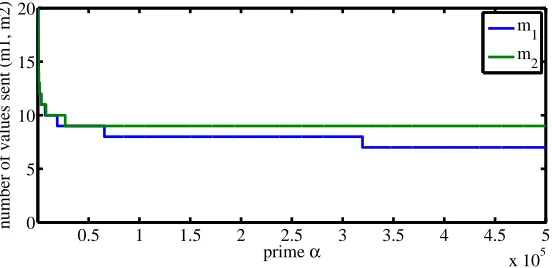
means that the verifier has to spend less time trying to divide N by primes less than α, but also increases m1 and m2, the number of RSA values in the NIZK. The relationship between α and m1, m2 is determined by equation (1). Specifically for the TumbleBit parameters, we show this
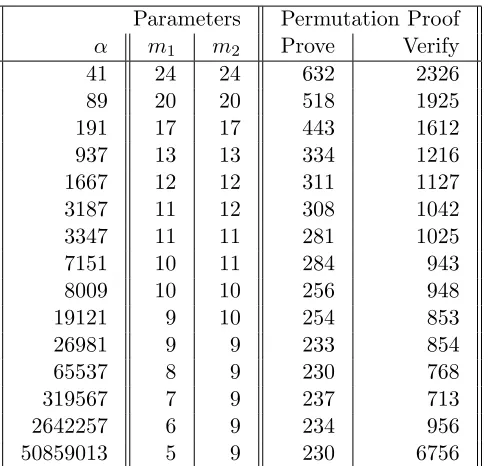
relationship in Figure 1. To evaluate the performance of our NIZK, we choose the smallest value of αthat corresponds a given pair of (m1, m2) values, and benchmark proving and verifying times
for our NIZK for the RSA key length|N|= 2048 bits in Table 1 on a single-core of an Intel Xeon processor. We can see from the table that choosingα= 319567 (so thatm1= 7 andm2 = 9) gives
optimal performance, though performance forα = 65537 is roughly similar and the optimal choice is likely implementation-dependent.
For the optimal choice ofα, proving takes about 237 ms (a small fraction of the key generation cost, which is 2022 ms) and verifying takes about 713 ms. For comparison, verification of our NIZK is about 8 times faster than the folklore solution discussed in Section 1, which requires the verifier to spend 5588 ms to perform the Rabin-Miller primality test on a 2048-bit RSA exponent, and also slows down every public-key operation by a factor of about 60 becauseeis 2048 bits long (instead of e= 65537, which is 17 bits long). We should note that even though our solution is much faster
2Specifically, in TumbleBit, the Tumbler provides the payee Bob with a value z called a “puzzle,” and a proof that its solution will transfer some of Tumbler’s money to Bob. This solution is a valuesuch thatz=emodN. The protocol crucially relies on uniqueness of , because the proof that the solution will unlock money applies to only one of the solutions of z. When Alice wants to pay Bob, she learns the solution to the puzzle in exchange for paying money to the Tumbler, and then gives that solution to Bob as payment. If RSA is not a permutation, then a malicious Tumbler can provide the payee Bob with a puzzle z that has two valid solutions 1 6= 2, where
z= (1)e= (2)e modN, and a proof that1 transfers money. Then, to steal money, the Tumbler gives payer Alice the solution2in exchange for her money, which does not permit Bob to obtain the Tumbler’s money and complete the transaction.
0.5 1 1.5 2 2.5 3 3.5 4 4.5 5
x 105 0
5 10 15 20
number of values sent (m1, m2)
prime α
m
1
m
2
Parameters Permutation Proof
α m1 m2 Prove Verify
41 24 24 632 2326 89 20 20 518 1925 191 17 17 443 1612 937 13 13 334 1216 1667 12 12 311 1127 3187 11 12 308 1042 3347 11 11 281 1025 7151 10 11 284 943 8009 10 10 256 948 19121 9 10 254 853 26981 9 9 233 854 65537 8 9 230 768 319567 7 9 237 713 2642257 6 9 234 956 50859013 5 9 230 6756
Table 1: Proving and verifying times for our C# implementation as observed on an Azure DS1 v2 virtual machine running Windows Server 2016 Datacenter (single-core 2.4 GHz Intel Xeon E5-2673 v3 Haswell processor, 3.5GiB RAM). Time is given in ms. Public exponent is e=e0 = 65537 and security parameter is κ= 128.
than the folklore one, and adds only 12% to the prover’s normal RSA key generation cost, it is still relatively expensive for the verifier: for comparison, the public key operation (encryption or signature verification) withe= 65537 takes only about 1.4ms.
From Table 1 we also see that verifying is generally slower than proving (until α gets so big that divisibility testing takes too long for the verifier). This follows because proving involves m1
modular exponentiations (using RSASP), which can be done separately modulopand moduloqfor
N =pq(with the exponent reduced modulop−1 andq−1), and then combined using the Chinese Remainder Theorem (CRT). Meanwhile, the verifier does not know p and q, and so cannot use (CRT); moreover, the exponent used for modular exponentiations (using RSAVP) is slightly longer than φ(n), but the verifier does not know φ(N) and so cannot reduce it. Thus, exponentiations performed by the verifier are slower than those performed by the prover.
Acknowledgements
The authors thank Ethan Heilman, Alessandra Scafuro and Yehuda Lindell for useful discussions. This research was supported, in part, by US NSF grants 1717067, 1350733, and 1422965.
References
March 25-29, 2018, Proceedings, Part II, volume 10770 of Lecture Notes in Computer Science, pages 403–430. Springer, 2018.
[Ber98] Daniel J. Bernstein. Detecting perfect powers in essentially linear time. Mathematics of Computation, 67, July 1998.
[BFGN17] Fabrice Benhamouda, Houda Ferradi, R´emi G´eraud, and David Naccache. Non-interactive provably secure attestations for arbitrary RSA prime generation algo-rithms. In Simon N. Foley, Dieter Gollmann, and Einar Snekkenes, editors, puter Security - ESORICS 2017 - 22nd European Symposium on Research in Com-puter Security, Oslo, Norway, September 11-15, 2017, Proceedings, Part I, volume 10492 of Lecture Notes in Computer Science, pages 206–223. Springer, 2017. https: //eprint.iacr.org/2017/640.
[BFL89] Joan Boyar, Katalin Friedl, and Carsten Lund. Practical zero-knowledge proofs: Giving hints and using deficiencies. In Jean-Jacques Quisquater and Joos Vandewalle, editors,
Advances in Cryptology - EUROCRYPT ’89, Workshop on the Theory and Application of of Cryptographic Techniques, Houthalen, Belgium, April 10-13, 1989, Proceedings, volume 434 ofLecture Notes in Computer Science, pages 155–172. Springer, 1989. [BLP07] Daniel J. Bernstein, Hendrik W. Lenstra, and Jonathan Pila. Detecting perfect powers
by factoring into coprimes. Mathematics of Computation, 76(257):385–388, January 2007.
[bou] bouncycastle c# api. https://www.bouncycastle.org/csharp/index.html.
[BR93] Mihir Bellare and Phillip Rogaway. Random oracles are practical: A paradigm for designing efficient protocols. In Proceedings of the 1st ACM conference on Computer and communications security, pages 62–73. ACM, 1993.
[BY96] Mihir Bellare and Moti Yung. Certifying permutations: Noninteractive zero-knowledge based on any trapdoor permutation. J. Cryptology, 9(3):149–166, 1996. https:// cseweb.ucsd.edu/~mihir/papers/cct.html.
[CM99] Jan Camenisch and Markus Michels. Proving in zero-knowledge that a number is the product of two safe primes. In Jacques Stern, editor, Advances in Cryptol-ogy - EUROCRYPT ’99, International Conference on the Theory and Application of Cryptographic Techniques, Prague, Czech Republic, May 2-6, 1999, Proceeding, volume 1592 of Lecture Notes in Computer Science, pages 107–122. Springer, 1999.
http://www.brics.dk/RS/98/29/BRICS-RS-98-29.pdf.
[CMS99] Christian Cachin, Silvio Micali, and Markus Stadler. Computationally private infor-mation retrieval with polylogarithmic communication. In Eurocrypt, volume 99, pages 402–414. Springer, 1999.
[cod] Tumblebit setup implementation. https://github.com/osagga/TumbleBitSetup.
[CPP07] Dario Catalano, David Pointcheval, and Thomas Pornin. Trapdoor hard-to-invert group isomorphisms and their application to password-based authentication. J. Cryptology, 20(1):115–149, 2007. http://www.di.ens.fr/~pointche/Documents/Papers/2006_
[DJ01] Ivan Damg˚ard and Mads Jurik. A generalisation, a simplification and some applica-tions of paillier’s probabilistic public-key system. In Kwangjo Kim, editor,Public Key Cryptography, 4th International Workshop on Practice and Theory in Public Key Cryp-tography, PKC 2001, Cheju Island, Korea, February 13-15, 2001, Proceedings, volume 1992 of Lecture Notes in Computer Science, pages 119–136. Springer, 2001.
[FKMV12] Sebastian Faust, Markulf Kohlweiss, Giorgia Azzurra Marson, and Daniele Venturi. On the non-malleability of the fiat-shamir transform. In Steven D. Galbraith and Mridul Nandi, editors,Progress in Cryptology - INDOCRYPT 2012, 13th International Conference on Cryptology in India, Kolkata, India, December 9-12, 2012. Proceedings, volume 7668 of Lecture Notes in Computer Science, pages 60–79. Springer, 2012. [FS86] Amos Fiat and Adi Shamir. How to prove yourself: Practical solutions to
identifica-tion and signature problems. In Andrew M. Odlyzko, editor, Advances in Cryptology - CRYPTO ’86, Santa Barbara, California, USA, 1986, Proceedings, volume 263 of
Lecture Notes in Computer Science, pages 186–194. Springer, 1986.
[GM84] Shafi Goldwasser and Silvio Micali. Probabilistic encryption. J. Comput. Syst. Sci., 28(2):270–299, 1984.
[GMR98] Rosario Gennaro, Daniele Micciancio, and Tal Rabin. An efficient non-interactive sta-tistical zero-knowledge proof system for quasi-safe prime products. In Li Gong and Michael K. Reiter, editors, CCS ’98, Proceedings of the 5th ACM Conference on Com-puter and Communications Security, San Francisco, CA, USA, November 3-5, 1998., pages 67–72. ACM, 1998. http://eprint.iacr.org/1998/008.
[HAB+17] Ethan Heilman, Leen Alshenibr, Foteini Baldimtsi, Alessandra Scafuro, and Sharon Goldberg. Tumblebit: An untrusted bitcoin-compatible anonymous payment hub. In
24th Annual Network and Distributed System Security Symposium, NDSS. The Internet Society, 2017. https://eprint.iacr.org/2016/575.pdf.
[HMRT12] Carmit Hazay, Gert Læssøe Mikkelsen, Tal Rabin, and Tomas Toft. Efficient RSA key generation and threshold paillier in the two-party setting. In Orr Dunkelman, editor, Topics in Cryptology - CT-RSA 2012 - The Cryptographers’ Track at the RSA Conference 2012, San Francisco, CA, USA, February 27 - March 2, 2012. Proceedings, volume 7178 of Lecture Notes in Computer Science, pages 313–331. Springer, 2012. [Hoe63] W. Hoeffding. Probability inequalities for sums of bounded random variables. Journal
of the American Statistical Association, 58(301):13–30, March 1963.
[KKM12] Saqib A. Kakvi, Eike Kiltz, and Alexander May. Certifying RSA. In Xiaoyun Wang and Kazue Sako, editors, Advances in Cryptology - ASIACRYPT 2012 - 18th International Conference on the Theory and Application of Cryptology and Information Security, Bei-jing, China, December 2-6, 2012. Proceedings, volume 7658 of Lecture Notes in Com-puter Science, pages 404–414. Springer, 2012.http://www.cits.rub.de/imperia/md/ content/may/paper/main.pdf.
[LMRS04] Anna Lysyanskaya, Silvio Micali, Leonid Reyzin, and Hovav Shacham. Sequential aggre-gate signatures from trapdoor permutations. In Eurocrypt, volume 3027, pages 74–90. Springer, 2004.
[MKJR16] K. Moriarty, B. Kaliski, J. Jonsson, and A. Rusch. RFC 8017: PKCS #1: RSA Cryptography Specifications Version 2.2. Internet Engineering Task Force (IETF), 2016.
https://tools.ietf.org/html/rfc8017.
[MPS00] Philip D. MacKenzie, Sarvar Patel, and Ram Swaminathan. Password-authenticated key exchange based on RSA. In Tatsuaki Okamoto, editor, Advances in Cryptol-ogy - ASIACRYPT 2000, 6th International Conference on the Theory and Appli-cation of Cryptology and Information Security, Kyoto, Japan, December 3-7, 2000, Proceedings, volume 1976 of Lecture Notes in Computer Science, pages 599–613. Springer, 2000. http://citeseerx.ist.psu.edu/viewdoc/download?doi=10.1.1. 89.3089&rep=rep1&type=pdf.
[MRV99] Silvio Micali, Michael O. Rabin, and Salil P. Vadhan. Verifiable random functions. In 40th Annual Symposium on Foundations of Computer Science, FOCS ’99, 17-18 October, 1999, New York, NY, USA, pages 120–130. IEEE Computer Society, 1999. [Ntu] Tumblebit implementation in .net core. https://github.com/NTumbleBit/
NTumbleBit/.
[Sho09] Victor Shoup. A Computational Introduction to Number Theory and Algebra. Cam-bridge University Press, second edition, 2009. http://www.shoup.net/ntb/ntb-v2. pdf.
[Str17] Stratis Blockchain. Bitcoin privacy is a breeze: Tumblebit success-fully integrated into breeze. https://stratisplatform.com/2017/08/10/ bitcoin-privacy-tumblebit-integrated-into-breeze/, August 2017.
[WCZ03] Duncan S. Wong, Agnes Hui Chan, and Feng Zhu. More efficient password authen-ticated key exchange based on RSA. In Thomas Johansson and Subhamoy Maitra, editors, Progress in Cryptology - INDOCRYPT 2003, 4th International Conference on Cryptology in India, New Delhi, India, December 8-10, 2003, Proceedings, vol-ume 2904 of Lecture Notes in Computer Science, pages 375–387. Springer, 2003.
http://www.ccs.neu.edu/home/ahchan/wsl/papers/pake_indocrypt03.pdf.
A
Number-Theoretic Lemmas
We present number-theoretic lemmas that are useful for proving security of our protocols. Some of them are standard and are presented here only to make the presentation self-contained.
LetZN ={0,1, ..., N−1}for any positive integerN andZ∗N be the multiplicative group modulo
N, i.e., the set of values inZN that are relatively prime toN, or else{x∈ZN|gcd(x, N) = 1}. We
use notation p|N to denote that “p dividesN”.
Euler’s phi or totient function (see, e.g., [Sho09, Section 2.6] for the relevant background) is defined for all positive integersN as :
IfN =pqwherep, qare two distinct primes it holds that φ(N) = (p−1)(q−1). More generally, if the prime factorization ofN isN =pα1
1 × · · · ×p αk
k , thenφ(N) = (p α1−1
1 × · · · ×p αk−1
k )×((p1−1)× · · · ×(pk−1)), with φ(1) = 1 [Sho09, Theorem 2.11]. The following theorem is standard [Sho09,
Theorem 2.13]:
Lemma A.1 (Euler’s theorem). Let N be a positive integer anda∈Z∗
N. Then aφ(N) modN = 1.
Given positive integers N and e, consider the map x 7→xemodN. We will first consider this map as restricted toZ∗N. The following lemma is standard.
Lemma A.2. The map x7→xemodN is a permutation of Z∗N if and only ifgcd(e, φ(N)) = 1. If
the map is a permutation ofZ∗N, then its inverse is the map x7→xdmodN for d=e
−1modφ(N)
(which exists by [Sho09, Theorem 2.5] because gcd(e, φ(N)) = 1).
Proof. Suppose gcd(e, φ(N)) = 1. Then let d= e−1 modφ(N). Thus, de =kφ(N) + 1 for some integerk. For every x∈Z∗N, (xe)dmodN =xed modN = (xφ(N))k·xmodN = 1k·x=x, where
the second-to-last equality follows from LemmaA.1.
Now suppose gcd(e, φ(N)) = g 6= 1. Let p be a prime divisor of g. Then p|φ(N), and thereforeZ∗N contains an elementx6= 1 such thatxp modN = 1 [Sho09, Theorem 6.42]. Therefore, xe modN = (xp)e/pmodN = 1e/p= 1, and thus the map is not a permutation.
A number N is square free if it can be written as N = p1p2. . . pk for distinct prime numbers pi. (N is not square free if it is divisible byp2, where pis some prime.)
Lemma A.3. For a positive integer N, if gcd(N, φ(N)) = 1, then N is square-free.
Proof. Indeed, suppose p2|N for some prime p. Thenp|φ(N), so gcd(N, φ(N))≥p >1. . We now extend one direction of Lemma A.2 to all of ZN for the case of square-free N.
Lemma A.4. If for some positive integers N and f, N is square-free and gcd(f, φ(N)) = 1, then the map x 7→ xf modN is a permutation on ZN. Its inverse is computed as follows: for g=f−1 modφ(N) (which exists by [Sho09, Theorem 2.5]) and for all x∈
ZN, xgf modN =x.
Proof. Let N = p1p2. . . pk for distinct prime numbers pi. By the Chinese Remainder Theorem
(CRT) [Sho09, Theorem 2.8], the ringZN is isomorphic to the product of ringsZp1× · · · ×Zpk. It
therefore suffices to show thatxef modpi =xfor eachi. Indeed,f g=tφ(N) + 1 for some integert,
and thereforexf g = (xpi−1)s·xfor some integers, and the result follows by Fermat’s little theorem
[Sho09, Theorem 2.14] whenxmodpi 6= 0, and trivially when xmodpi= 0.
To extend the other direction of Lemma A.2 to all of ZN is a little more complicated.
Lemma A.5. If for some positive integers N andf, the map x7→xf modN is a permutation on
ZN, then x 7→ xf modN is a permutation on Z∗N (and thus gcd(f, N) = 1 by Lemma A.2) and
either:
• N is square-free, or
• f = 1
Proof. The first part of the lemma follows from the fact that when raised to the power f modulo
N, elements of ZN∗ stay withinZN∗ (because if gcd(x, N) = 1, then gcd(xf modN, N) = 1). The second part of the lemma is proven as follows. Suppose N is not square-free andf > 1. Then let
The following lemma shows that one can validate if an integer N is square-free by checking if random values in ZN have Nth roots. This lemma generalizes the result of Gennaro, Micciancio,
and Rabin [GMR98, Section 3.1], which worked overZ∗N and thus required a gcd computation every
time a random value was selected.
Lemma A.6. Let N be a positive integer andp be a prime such that p2 dividesN (i.e., N is not square free). Then, the fraction of elements ofZ∗N that have anNth root moduloN is at most1/p,
and the fraction of elements of ZN that have an Nth root modulo N is also at most1/p.
Proof. Supposexhas anNth root modulo N. Then there is a value r such thatrN ≡x (modN). Hence, N divides rN −x, which means p2 divides rN −x (since p2 divides N), and therefore r
is the Nth root of x modulo p2. Thus, in order to have an Nth root modulo N,x must have an
Nth root modulop2. Since a uniformly random element xof
ZN is also uniform modulo p2, and a
uniformly random element x of Z∗N is also uniform in Z
∗
p2 when reduced modulo p2, it suffices to
consider what fractions ofZp∗2 and of Zp2 haveNth roots.
By Lemma A.8 below, the number of elements ofZp∗2 that have Nth roots is at most φ(p2)/e0,
wheree0 is the largest prime divisor of gcd(N, φ(p2)) = gcd(N, p(p−1)). Sincep|N, we havee0 =p. Thus, the number of elements of Zp∗2 that haveNth roots is at most φ(p2)/p=p−1. This shows
the first half of the conclusion. Ifx∈Zp2−Z∗
p2, thenp|x. Ifxhas anNth rootrmodulop2, thenp2|(rN−x), hencep|(rN−x),
hencep|rN (becausep|x and p|(rN−x)), hencep|r (because p is prime), hencep2|r2, hence p2|rN
(becauseN >1), and hencep2|x(because p2|(rN−x) andp2|rN). We therefore have that x∈Zp2
and p2|x, which means thatx= 0.
Thus, the total number of elements ofZp2 that have anNth root is at mostp−1 elements from
Zp∗2 and one element fromZp2−Z∗
p2 (namely, the element x= 0), for a total of at most pelements
from Zp2. Thus, at most a p/|Zp2| = 1/p fraction of elements of Zp2 have Nth roots. It follows
that at most a 1/p fraction of elements of ZN has Nth roots.
The following lemma shows that if we know that N is square free (which we can test using Lemma A.6), then we can check whether raising to the powereis a permutation ofZN, by checking
if random values in ZN have eth roots.
Lemma A.7. Suppose N > 0 is a square-free integer so that N = p1p2. . . pk for distinct prime
numbers pi, and e >0 is an integer. If raising to the powere moduloN is not a permutation over
ZN, then the fraction of elements of ZN that have a root of degreee is at most
1
p+
1
e0
1−1 p
,
where e0 is the smallest prime divisor of e and p is the smallest prime divisor of N (these are well-defined, because if N = 1 or e= 1, then raising to the eth power is a permutation overZN).
Proof. By Chinese Remainder Theorem (CRT) [Sho09, Theorem 2.8], the ring ZN is isomorphic
to the product of rings Zp1 × · · · ×Zpk. Note that if raising to the power e modulo N is not a
permutation over ZN, then there exist x 6≡ y (mod N) such that xe ≡ ye (modN). Let i be
such that x 6≡y (mod pi) (it must exist by CRT); then raising to the powere modulo pi is not a permutation ofZpi, because x
e≡ye (modp
i) (by CRT).
Since a uniformly random element x of ZN is uniform modulo pi, it suffices to consider what
fraction of Zpi haseth roots. By Lemma A.8 below, the number of elements of Z ∗
roots is at most φ(Zp∗i)/e0 = (pi−1)/e0. The only element in Zpi−Z ∗
pi is the element 0. So, in
total, at most (pi−1)/e0+ 1 elements ofZpi haveeth roots. Sincepi≥p,
(pi−1)/e0+ 1
pi
= 1
e0 +
1
pi
1− 1 e0
≤ 1 e0 +
1
p
1− 1 e0 = 1 p + 1 e0
1− 1 p
.
The proofs of two lemmas above relied on the lemma below.
Lemma A.8. For any positive integers N and e, if raising to the power e modulo N is not a permutation overZ∗N, then gcd(e, φ(N))>1 and the number of elements of Z
∗
N that have a root of
degree eis at most φ(N)/e0, where e0 is the largest prime divisor of gcd(e, φ(N)).
Proof. Suppose there exist x and y inZ∗N such that xe≡ye (mod N) butx6≡y (mod N). Then x/y6≡1 (mod N) but (x/y)e≡1 (mod N). Therefore, the multiplicative order of (x/y) is greater than 1 and divides e[Sho09, Theorem 2.12] and φ(N) [Sho09, Theorem 2.13], which implies that gcd(e, φ(N))>1. Let e0 be the largest prime divisor of gcd(e, φ(N)).
Because e0 is a prime that dividesφ(N),Z∗N contains an elementz of ordere
0 [Sho09, Theorem
6.42]. Therefore, the homomorphism that takes each element of Z∗N to the power e has kernel of
size at least e0 (because this kernel contains distinct values z, z2, . . . , ze0 which are all eth roots
of 1 because e0 divides e). The image of this homomorphism contains exactly the elements that have roots of degreee, and the size of this image is equal toφ(N) divided by the size of the kernel [Sho09, Theorem 6.23], i.e., at mostφ(N)/e0.
B
Background on the Fiat-Shamir transform
Any efficient, interactive constant-round, public-coin, honest-verifier zero knowledge (HVZK) proof system can be converted into a noninteractive ZK argument3 (NIZK) through the so called Fiat-Shamir (FS) transformation [FS86]. Applying FS allows us to replace the verifier V by instead calling a hash function on input the current transcript. The security of the resulting scheme holds in the random oracle [BR93] (RO), where a hash functionH is evaluated through calls to an oracle that acts as a random function. The main idea in the security proof is that the simulator for HVZK can “program” the RO (i.e., the simulator decides the answer to each specific query). This allows the simulator to convert the entire transcript of a public-coin HVZK proof into a single message that is indistinguishable from the message computed by an honest NIZK prover. We first recall the definition of NIZKs in the RO and then state the Fiat-Shamir transformation theorem (definitions slightly modified from [FKMV12]).
Let S be a simulator that operates in two modes: (hi, st) ← S(1, st, qi) which on input a
random oracle query qi it responds with hi (usually by lazy sampling), and (π, st) ← S(2, st, x) which simulates simulates the actual proof. (Note that calls to S(1,· · ·) and S(2,· · ·) share the common state stthat is updated after each operation.)
Definition B.1(NIZK). Let(S1,S2)be oracles such thatS1(qi)returns the first output of(hi, st)←
S(1, st, qi) and S2(x, w) returns the first output of (π, st)←S(2, st, x) if (x, w)∈RL.
A protocol hPH,VHi is said to be a NIZK proof for language L in the random oracle model, if there exists a PPT simulator Ssuch that for all PPT distinguishers Dwe have
viewDH(·),PH(·,·)≈viewDS1(·),SH2(·,·).
3As opposed to a proof system where soundness needs to hold unconditionally, in an argument system it is sufficient
We now state and prove the following theorem for the Fiat-Shamir transformation [FKMV12]:
Theorem B.2(Fiat-Shamir NIZK). Letκbe a security parameter. Consider a non-trivial constant round, public-coin, honest-verifier zero-knowledge (HVZK) interactive proof system hP,Vi for a language L. Let H() be a function with range equal to the space of the verifier’s coins. In the random oracle model the proof system hPH,VHi, derived from hP,Vi by applying the Fiat-Shamir transform, is a noninteractive ZK argument.
Proof. (sketch) All we need to show is that there exists a simulator S as required in Definition B.1. This can be done by invoking the HVZK simulator associated with the underlying interactive proof system.
We design S to work as follows:
• To answer to a queryqto S1, S(1, st, q) lazily samples a lookup table kept in statest. It checks
whether an answer for q was already defined. If this is the case, it returns the previously assigned value; otherwise it returns a fresh random valueh and stores the pair (q, h) in the table.
• To answer to a query x to S2, S(2, st, x) calls the HVZK simulator of hP,Vi on input x to
obtain a proof π. Then, it updates the look up table by storing x, π. If the look up table happens to be already defined on this input, S returns failure and aborts.
Given that the protocol is non-trivial, the probability of failure in each of the queries to S2 is
negligible.
C
Detailed Specification for the NIZK of Permutations over
Z
nThe following specification is for the NIZK of Permutations overZn, as described in Section 5. This
specification assumes that the RSA exponenteis prime.
C.1 System Parameters
The system parameters are the RSA modulus length len, the security parameter κ (where by default κ= 128), a small prime α (about 16 bits long or less), and a publicly-known octet string
salt.
C.2 Proving
System parameters:
1. salt (an octet string),
2. α (a prime number)
3. κ (the security parameter, use 128 by default)
4. e, the fixed prime RSA exponent
Auxiliary Function: getRho, defined in Section C.4.
Input: Distinct equal-length primespandqgreater thanαsuch that the RSA modulus isN =pq
is of lengthlen, and edoes not divide (p−1)(q−1).
Output: (N, e),{σ1, ..., σm2}.
Algorithm:
1. Setm1 and m2 as in equation 1, Section 3.3, withe0 =e.
2. SetN =pq.
3. Obtain the RSA secret keyK as specified by [MKJR16, Sec. 3.2]:
K = (p, q,dNP,dNQ,qInv)
4. Compute the “weird RSA” secret key corresponding to public key (N, eN) (with exponent
eN and modulus N) in the [MKJR16, Sec. 3.2] as
K0 = (p, q,dNP,dNQ,qInv)
wherep, q,qInv are the same as in the normal RSA secret keyK and
dNP = (eN)−1mod (p−1) dNP = (eN)−1 mod (q−1) (2)
5. For integeri= 1. . . m2
(a) Sampleρi, a random element ofZN, as
ρi = getRho((N, e),salt, i,len, m2)
(b) Ifi≤m1, let
σi = RSASP1(K0, ρi)
where RSASP1 is the RSA signature primitive of [MKJR16, Sec. 5.2.1]. In other words,
σ is the RSA decryption of ρi using the “weird RSA” secret keyK0.
(It follows thatσi is (eN)th root of ρi.)
(c) Else let
σi= RSASP1(K, ρi)
where RSASP1 is the RSA signature primitive of [MKJR16, Sec. 5.2.1]. In other words,
σ is the RSA decryption of ρi using the regular RSA secret keyK.
(It follows thatσi is eth root of ρi.)
C.3 Verifying.
System parameters:
1. salt (an octet string),
2. α (a prime number)
3. κ (the security parameter, use 128 by default)
4. e, the fixed prime RSA exponent
5. len, the RSA key length
Auxiliary Function: getRho, defined in Section C.4.
Input: RSA public key (N, e) and {σ1, ..., σm2}.
Output: VALID or INVALID
Algorithm:
1. Check that N is an integer and N ≥ 2len−1 and N < 2len. If not, output INVALID and
stop.
2. Check thate is prime. If not, output INVALID and stop.
3. Compute m1 and m2 per equation (1), Section 3.3, with e0 =e.
4. Check that there are exactly m2 values {σ1, ..., σm2} in the input. If not, output INVALID
and stop.
5. Generate the vector Primes(α−1), which includes all primes up to and includingα−1. (This can be efficiently implemented using the Sieve of Eratosthenes when α is small.)
For eachp∈Primes(α−1):
• Check thatN is not divisible byp. If not, output INVALID and stop.
(Alternatively, letprimorialbe the product of all values in Primes(α−1). primorialshould be computed once and should be a system parameter. Check that gcd(primorial, N) = 1.)
6. For integeri= 1. . . m2
(a) Sampleρi, a random element ofZN, as
ρi = getRho((N, e),salt, i,len, m2)
(b) Ifi≤m1, check that
ρi = RSAVP1((N, eN), σi)
where RSAVP1 is the RSA verification primitive of [MKJR16, Sec. 5.2.2]. In other words, check that ρi is the RSA encryption of σi using the “weird RSA” public key
(c) Else check that
ρi = RSAVP1(PK, σi)
In other words, check that theρi is the RSA encryption of σi using the RSA public key (N, e). If not, output INVALID and stop.
(Thus, check that ρi =σei modN).
7. Output VALID.
C.4 Auxiliary function: getRho
This function is for rejection sampling of a pseudorandom element ρi ∈ZN. It is “deterministic,”
always producing the same output for a given input.
Input:
1. RSA public key (N, e).
2. salt (an octet string)
3. Index integer i.
4. Length of RSA moduluslen
5. Valuem2, withi≤m2.
Output: ρi
Algorithm:
1. Let
|m2|=
1
8(log2(m2+ 1))
be the length ofm2 in octets. (Note: This is an octet length, not a bit length!)
2. Letj= 1.
3. While true:
(a) LetPK be the ASN.1 octet string encoding of the RSA public key (N, e) as specified in [MKJR16, Appendix A].
(b) Let EI = I2OSP(i,|m2|) be the |m2|-octet long string encoding of the integer i. (The
I2OSP primitive is specified in [MKJR16, Sec. 4.2].)
(c) Let EJ = I2OSP(j,|j|) be the |j|-octet long string encoding of the integer j, where
|j|=d1
8log2(j+ 1)e.
(d) Lets=PK||salt||EI||EJ be the concatenation of these octet strings.
(e) Let ER = MGF1-SHA256(s,len) where H1 is the MGF1 Mask Generation Function
based on the SHA-256 hash function as defined in [MKJR16, Sec. B.2.1], outputting values that arelen bits long.
(f) Letρi= OS2IP(ER) be an integer.
(That is, convert ER to an len bit integer ρi using the OS2IP primitive specified in
(g) Ifρi≥N, then letj =j+ 1 and continue; Else, break.
(Note: This step tests if ρi ∈ZN.)