Two Layered Wireless Security System for
Highly Secured Indoor Locations
S.Kayalvizhi
1Assistant Professor, Dept. of ECE, SRM University, Chennai, Tamilnadu, India 1
ABSTRACT: This paper proposes a smart way of handling the Electronic Voting Machine (EVM) theft problem by having a wireless network based security and monitoring system using WPAN, RF signal strength, MEMS motion sensors and GSM technology. The proposed system consists of EVM units each equipped with a MEMS motion sensor forming a WPAN network based on star topology with the coordinator node acting as the central hub of the network. The coordinator node broadcasts a beacon that enquires the status of all EVM units. Any disturbance to an EVM unit in all three dimensions can be sensed via MEMS sensors and this information will be transmitted to the coordinator unit which will send the details via SMS to respective higher authority. Radio frequency grid is an innovative way to secure a space, when an intrusion occurs, the RF propagation environment changes, and thus the received RF signal strength and Eigen values changes. The coordinator node is able to recognize this RSSI change and alert through SMS. This is an innovative method that provides low cost intrusion detection without costly cameras or video processing systems. Hence there is a two layer security providing complete protection for an entire storage room even if it contains hundreds of EVM units.
KEYWORDS:Eigen value, Eigen vector, WPAN, MEMS, space-time signal
I. INTRODUCTION
In recent days, the deal of interest in security systems for residential and office usage is increasing, such as intruder detection and event detection. General intruder detection uses infrared sensors, video cameras, and so on. Infrared sensors detect an intruder via a few infrared rays that are emitted by a human body. Video cameras detect an intruder or an event via image processing technologies that extract an intruder from the input image and identify whether the intruder corresponds to the event of interest or not. However, information obtained from one sensor or camera is local. Therefore, in conventional systems, a wide-range observation requires the installation of sensors or cameras in many places. Furthermore the detection capability of conventional systems depends on the installation location and the number of sensors or cameras. Achieving high performance comes to high costs.
The aim is to develop an autonomous anti-theft system for Electronic Voting Machine storage room that immediately sends an SMS to government authorities if it finds anything fishy. A two layer security model is proposed here. One layer uses MEMS accelerometer sensor and the second layer is an innovative attempt to secure a place which is sensor less and detects intrusion using wireless wave propagation and signal strength alone. The entire system uses IEEE 802.15.4, RF signal strength, MEMS motion sensors and GSM technology.
II. LITERATURE REVIEW
Wireless Security and Monitoring System Using Array Antenna: Array Sensor
This paper [1] proposed wireless security and monitoring system using array antenna, referred to as array sensor. The proposed system exploits an antenna array on the receiver side and decomposes received signals into eigenvectors and eigenvalues. When an event (e.g. intrusion) occurs, the propagation environment changes, and thus the eigenvector changes. Based on the change of eigenvector, we can detect an event accurately. This paper introduces the fundamental principle of the proposed system and its various applications.
Wireless Security and Monitoring System Based on Space-Time Signal Processing
This paper [2] proposed wireless security and monitoring system based on space-time signal processing. The proposed system monitors a whole room with only a pair of transmitter and receiver. Using an antenna array at the receiver, it can get not only received signal strength (RSS) that is susceptible to noise but also eigenvector spanning signal subspace that is inherent to its environment. When an event (e.g. intrusion) occurs, the propagation environment changes, and thus the eigenvector changes. Based on the change of eigenvector, we detect an event.
Indoor human detection systems using VHF-FM and UHF-TV broadcasting waves
This paper [3] studies new indoor human detection systems using VHF-FM and UHF-TV broadcasting waves. By use of the broadcasting waves as radio transmission waves, the proposed systems don't need a transmitter; the systems are composed of only receiving systems including a receiving antenna and a receiver. The proposed systems can detect the presence or absence of human in a room, based on the principle that the received levels are fluctuated due to multi-path fading or shadowing with human presence.
Indoor Event Detection with Signal Subspace Spanned by Eigenvector for Home or Office Security
This paper [4] proposed an indoor event detection scheme using an electric wave such as intrusion into home or office. The proposed system exploits an antenna array on the receiver side and detects events such as intrusion using signal subspace spanned by eigenvector obtained by the antenna array. The eigenvector is not based on received signal strengths (RSS) but on the direction of arrival (DOA) of incident signals on an antenna array.
Signal-Subspace-Partition Event Filtering for Eigenvector-Based Security system Using Radio Waves
This paper [5] proposed signal-subspace-partition event filtering for the event detection system with signal subspace spanned by eigenvector in [3][4]. To detect an event with small changes of signal subspace components, we emphasize the changes of signal subspace components by selecting an appropriate component of signal subspace with signal-subspace partition. In addition, to detect an event in the presence of the changes of signal subspace components due to some undesired movements,
Experimental study of antenna arrays in indoor wireless applications
In this paper [6] array antenna based localization using spatial smoothing processing (SSP) is proposed for wireless security and monitoring, referred to as array sensor. The proposed method is based on the array sensor that exploits an array antenna at the receiver to detect the propagation environment of interest. If an event occurs, e.g., human motion, the propagation environment is changed. Thus the eigenvector and eigenvalue spanning the signal subspace that is inherent to its environment changes as well. The proposed method is improved from our previous work which uses only a limited number of signal subspace features.
III. PROPOSEDSYSTEM
A. Proposed Model
a house) occurs, the propagation environment changes, and thus the eigenvector changes. To detect an event, we use this change. In addition to security, the proposed system can be used as a monitoring system that can monitor people without invading their privacies by images. All data packets adhere to IEEE 802.15.4 frame format and each node has a transceiver circuitry to handle the packet reception and transmission. All EVM units have a low power microcontroller which runs the security algorithm
B. Methodology
The signal subspace spanned by eigenvector changes only when the environment of interest changes. In this section, we explain our proposed wireless security and monitoring system using signal subspace spanned by eigenvector. The proposed system uses the subspace method. The subspace method analyzes the radio wave propagation by focusing on the property of eigenvectors and eigenvalues obtained by the eigenvalue decomposition (EVD) of correlation matrix of received signals. The correlation matrix is divided into signal subspace and noise subspace, and both subspaces are orthogonal. We use the signal subspace spanned by the first eigenvector. The incident multipath signals go through everywhere of interest. Thus, the signal subspace spanned by eigenvector represents wave propagation. When the environment of interest changes, the wave propagation changes and thus the signal subspace spanned by eigenvector
The signal subspace spanned by eigenvector changes only when the environment of interest changes. In this section, we explain our proposed wireless security and monitoring system using signal subspace spanned by eigenvector. The proposed system uses the subspace method. The subspace method analyzes the radio wave propagation by focusing on the property of eigenvectors and eigenvalues obtained by the eigenvalue decomposition (EVD) of correlation matrix of received signals. The correlation matrix is divided into signal subspace and noise subspace, and both subspaces are orthogonal. We use the signal subspace spanned by the first eigenvector. The incident multipath signals go through everywhere of interest. Thus, the signal subspace spanned by eigenvector represents wave propagation. When the environment of interest changes, the wave propagation changes and thus the signal subspace spanned by eigenvectorchanges. Consequently, the signal subspace spanned by eigenvector is inherent to its environment of interest. We define a cost function Pvec(t) for the event detection as follows.
Where vno is the reference eigenvector obtained when no event occurs and vob(t) is the eigenvector obtained when we
observe the environment of interest. Both vectors are normalized to one. Then, Pvec(t) is close to 1 because vob(t) is close
to vno when no event occurs, and lower than one when some events occur.
C. Block Diagram
The fig.1 shows the block diagram of the proposed system. It has a central monitoring mote and the electronic voting machine mote
Fig.1 Block Diagram
D. Electronic Voting Machine
Fig.2 Electronic Voting Machine Mote
E. Central Monitoring Mote
The fig.3 shows the Central Monitoring Mote. It has the controller connected with the PCB antenna and GSM module.
Fig.3 Central Monitoring Mote
IV.EXPERIMENTAL RESULT
A. Experimental Setting
The fig.3 shows the proposed system. It has a central monitoring mote and the two electronic voting machine motes.
. Fig.4 Proposed System
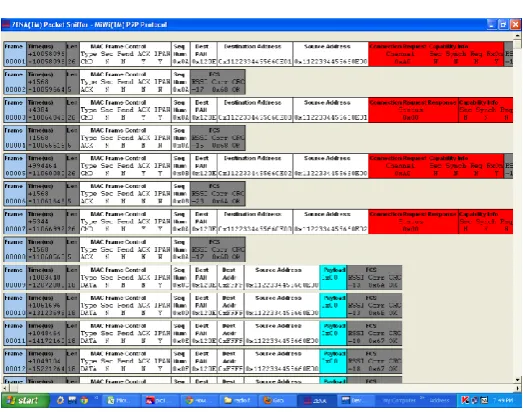
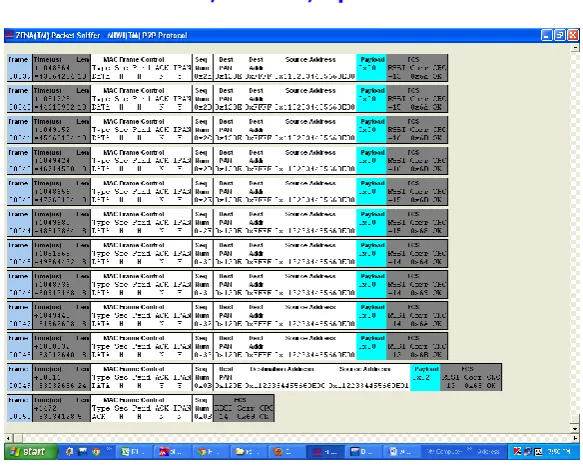
B. Experiment 1: Communication Between Motes: Hand Shaking
Fig.5 Communication between Motes (Handshaking)
C. Experiment 2:Detection of Person Intrusion
Figure 6 shows experimental results for the personintruding, stopping, or moving. In this experiment, the personopens the door and intrudes, and passes through A, B, C, andgoes through the door. The person stops for20 seconds at each point, A, B, C.The cost function Pvec(t) changes significantly when thedoor opens. Pvec(t) also fluctuates
significantly when theperson moves and fluctuates moderately when the personstops. These are because the change of environment, such asthe door opening, the existence of the person, and the person’smotion, changes the propagation of the radio waves and thusthe first eigenvector as well. Therefore, the cost function thatis the correlation of the first eigenvector between in thereference and in the observation, also changes. As a result, wecan easily detect the person’s movement, intruding, stoppingor moving. Moreover, we can see that four elements areenough to detect static or dynamic state in this environment,and thus the receiver can be more simplified.
Fig.6 Detection performance of person’s behaviours, intrusion, walking, and stopping
Fig.7 Detection of Person Intrusion
D. Experiment 3:Detection of Electronic Voting Machine Movement
Figure 8 shows experimental results for the Electronic Voting Machine Movement. In this experiment, the person opens the door and stealsthe EVM on the point D shown in Fig. 6.Pvec(t)does not fluctuate while no event occurs
whetherthere is the EVM or not. However, the value of Pvec(t) afterthe EVMMovement is different from that before the
EVM Movement. This is because the environment in the room (i.e. radiopropagation) changes owing to the EVM Movement. Thus, thefirst eigenvector also changes and the correlation becomeslower. Therefore, the proposed system has a possibility todetect something stolen and something left behind. Thedetection performance, such as size, material, and place thatthe proposed system can detect depends on the signal that theproposed system uses, such as radio frequency and bandwidthof the signal.
Fig. 8 Detection performance of EVM Movement
Fig.9 Detection of EVM Movement
V. CONCLUSION
The proposed security system is a two Layer security model which provides autonomous and intelligent operation. Human securities are minimized and there is no need of costly cameras and other video or image processing technologies. All the motes are battery powered.The proposed system can be useful for monitoring without invading privacy, such as monitoring elderly person living alone, monitoring person in bathroom. There are various applications for the proposed system other than already mentioned. One interesting application is a car security system that monitors a car while parking. The proposed system can detect not only intrusion into a car or movement of a car but also suspicious behaviours, such as looking into a car.. More results will be reported in the near future.
REFERENCES
[1] TomoakiOhtsuki, Keio University, “Wireless Security and Monitoring System Using Array Antenna: Array Sensor” International Conference
on Computing, Networking and Communications 2012
[2] TomoakiOhtsuki ,“Wireless Security and Monitoring System Based on Space-Time Signal Processing” International Conference on
Ubiquitous and Future Networks 2010
[3] S. Ikeda, H. Tsuji, and T. Ohtsuki, “Indoor Event Detection with Eigenvector Spanning Signal Subspace for Home or Office Security,” IEEE
68th Vehicular Tech. Conf., Sep. 2008.
[4] S. Ikeda, H. Tsuji, and T. Ohtsuki, “Indoor Event Detection with Signal Subspace Spanned by Eigenvector for Home or Office Security,” Trans. of Institute of Electronics, Information and Communication Engineers , E92-B no.7 pp. 2406–2412, July 2009.
[5] S. Ikeda, T. Ohtsuki, and H. Tsuji, “Signal-Subspace-Partition Event Filtering for Eigenvector-Based Security System Using Radio Waves,”
IEEE International Symposium on Personal Indoor and Mobile Radio Communications (PIMRC2009), Tokyo, Japan, pp. 2792–2796, Sep. 2009.
[6] S.S. Jeng, G. Xu, H.P. Lin, and W.J. Vogel, “Experimental study of antenna arrays in indoor wireless applications,” 29th Asilomar Conf. on
Sig. Syst., Comput,, vol. 2, pp. 766–770, Oct. 1995.
[7] H. Krim and M. Viberg, “Two decades of array signal processing research,” IEEE Sig. Proc. Mag., vol. 13, no 4, pp. 67–94, July 1996.
[8] A. Karnik, “Performance of TCP congestion control with rate feedback: TCP/ABR and rate adaptive TCP/IP,” M. Eng. thesis, Indian Institute
of Science, Bangalore, India, Jan. 1999.
[9] J. Padhye, V. Firoiu, and D. Towsley, “A stochastic model of TCP Reno congestion avoidance and control,” Univ. of Massachusetts, Amherst,
MA, CMPSCI Tech. Rep. 99-02, 1999.
[10] Wireless LAN Medium Access Control (MAC) and Physical Layer (PHY) Specification, IEEE Std. 802.11, 1997.
BIOGRAPHY