Achieving Fair Treatment in Algorithmic Classification
Andrew Morgan Cornell University
Rafael Pass∗ Cornell Tech
October 5, 2018
Abstract
Fairness in classification has become an increasingly relevant and controversial issue as com-puters replace humans in many of today’s classification tasks. In particular, a subject of much recent debate is that of finding, and subsequently achieving, suitable definitions of fairness in an algorithmic context. In this work, following the work of Hardt et al. (NIPS’16), we consider and formalize the task ofsanitizing an unfair classifierCinto a classifierC0satisfying an approximate notion of “equalized odds” orfair treatment. Our main result shows how to take any (possibly unfair) classifier C over a finite outcome space, and transform it—by justperturbing the out-put ofC—according to some distribution learned by just having black-box access to samples of labeled, and previously classified, data, to produce a classifier C0 that satisfies fair treatment; we additionally show that our derived classifier is near-optimal in terms of accuracy. We also experimentally evaluate the performance of our method.
1
Introduction
As algorithmic decision-making becomes ever more popular and widely-used in today’s society, concerns are being raised about whether, and to what extent, algorithms have the potential to discriminate, either as a result of malicious designers or perhaps from learning biases inherent in previous decisions on which an algorithm could be trained. In a well-known recent example, the COMPAS recidivism analysis tool, one of an increasingly popular set of algorithmic criminal “risk assessments” which are being used nationwide in sentencing and other decisions pertaining to defendants in the criminal justice system, was shown to exhibit highly disparate treatment between different races; a study by ProPublica [1,2] showed that African-American defendants who ultimately did not recidivate were almost twice as likely as white defendants to receive a high risk score from the algorithm.
As a result of these concerns, there has been extensive research in computer science and other fields pertaining to how fairness, or non-discrimination, should be defined in the context of a classification scenario. In this work, we will formalize and study one such definition,fair treatment, which is an approximate and distribution-based version of the notion ofequalized odds[6] orbalance
[8].
∗
Fair Treatment (a.k.a. approximate equalized odds). The originally proposed notion of fairness in classification is that of statistical parity [5] (which is essentially identical to the notion of causal effect [10]), which captures non-discrimination between groups. Given a classifierC which assigns to individuals σ from some distribution D—each of which has some subset of observable features O(σ)—anoutcome C(O(σ)) (e.g., a risk score), and given a functionf(σ) representing an individual’s actual class (e.g., whether they will recidivate), statistical parity simply requires that the output of the classifier be independent (or almost independent) of the group of the individual; that is, for any two groups X and Y, the distributions {C(O(σX))} and {C(O(σY))} are -close
in statistical distance. This is a very strong notion of fairness, and in many contexts it may not make sense. In particular, if the base rates (e.g., the base percentages of people from each race who actually recidivate) are different, we should perhaps not expect the output distribution of the classifier to be the same across groups. Indeed, as the ProPublica article points out, in the COMPAS example, the overall recidivism probability among African-American defendants was 56%, whereas it was 42% among white defendants. Thus, in such situations, one would reasonably expect a classifier toon average output a higher risk score for African-American defendants, which would violate statistical parity. Indeed, the issue raised by ProPublica authors was that, even after taking this base difference into account (more precisely, even after conditioning on individuals that did not recidivate), there was a significant difference in how the classifier treated the two races.
The notion of equalized odds due to Hardt et al. [6] formalizes the desiderata articulated by the authors of the ProPublica study (for the case of recidivism) in a general setting by requiring the output of the classifier to be independent of the group of the individuals, after conditioning on the class of the individuals. Very similar notions of fairness appear also in works such as [3, 8] using different names; for instance, Kleinberg et al. [8] consider a notion of “balance” which is an approximate version of equalized odds, albeit one which is tailored to scoring-based classifiers over a binary class space and only requires the conditioned expectation of the outcome (i.e., the score) to be close between groups. We here consider a more general approximate version of this notion which applies to all classifiers with a finite outcome space, which we refer to as -fair treatment. This requires that, for any two groups X and Y and any classc, the distributions
• {C(O(σX))|f(σX) =c}
• {C(O(σY))|f(σY) =c}
are -close with respect to some appropriate distance metric to be defined shortly. That is, in the COMPAS example, if we restrict to individuals that actually do not recidivate (respectively, those that do), the output of the classifier ought to be essentially independent of the group of the individual (just as intuitively desired by the authors of the ProPublica study, and as explictly put forward in [6]). Furthermore, if the distributions are identical (i.e., = 0), we note that our definition is equivalent to that of equalized odds in [6]; we refer to this errorless notion as perfect
fair treatment.
classifier C satisfies -fair treatment with respect to a context P = (D, f, g, O), then for any (pos-sibly probabilistic) function M, C0(·) = M(C(·)) will also satisfy -fair treatment with respect to
P. Closure under post-processing is important as we ultimately want the output of any subsequent classifier that uses only the output of a prior fair classifier to be fair as well.1
Can we sanitize an “unfair” classifier? As shown in the ProPublica study, the COMPAS classifier has a considerably large error in balance between races and hence also has a large error in the stronger notion of fair treatment. A natural question, then, would be whether we can “post-process” the output of this unfair classifier (or others) to satisfy some notion of balance or fair treatment. Indeed, there is a considerable amount of research devoted toachieving various defini-tions of fairness in practice. This is a highly non-trivial problem, in fact; early na¨ıve approaches, such as just removing protected attributes from the feature set, fail due to redundant encodings for such features in the data (as discussed in [5]).
This question was more recently addressed in the work of Hardt et al. [6], who examine various methods by which a potentially unfair classifier can be post-processed into a fairbinary classifier. They formalized the notion of aC-derived classifier: namely a classifierC0 obtained fromCby first runningC, and then “perturbing” the output of C. More precisely, such a C derived classifier may be specified by a “perturbation matrix”P where entryPi,j indicates with what probability output
i gets perturbed into output j. Hardt et al. showed that for classifiers C over a binary outcome spaces, we can construct non-trivialC-derived classifiers that satisfy their notion of equalized odds (in our terminology “perfect” fair treatment). Subsequent work [13] using this method showed that, for a binary version of the COMPAS classifier (which only attempts to predict recidivism and not output a risk score), it can produce a perfectly fair classifier with only an overall loss in accuracy of roughly 1.5%. Their method, however, requires “perfect” knowledge of the distribution D as well as of the classifier C in order to demonstrate both fairness and optimality; additionally, as mentioned, it only applies to binary outcomes (and as such, does not directly apply to a risk assessment setting such as COMPAS).2
Thus, the literature leaves open the questions of (1) whether we canefficiently find aC-derived classifier (without having perfect knowledge ofDandC), and (2) whether sanitization can be done for non-binary outputs.
Towards addressing this problem, we first formalize the notion ofblack-box sanitization: how to efficiently find a C-derived classifier given just black-box access to a “sampling oracle” which sam-ples random individuals σ ← D and outputs (O(σ), f(σ),C(O(σ)), g(σ)) (that is, the individual’s observable features, prior classificationC, actual class, and group, which is essentially the data used by the ProPublica authors to investigate the fairness of COMPAS).
Definition 1 (Informally stated.). We call an algorithm B a black-box sanitizer if, given a distributionDand a sequence of prior classifiers{Cn}such thatCntakes as inputn-bit descriptions
On(σ) of individuals’ features3, then, for eachn, it:
1
Remarking once again on the earlier definition of Kleinberg et al., we note that while it is equivalent to our definition for the case of binary outcomes, it is weaker for non-binary outcomes (as in the case of the COMPAS classifier). Furthermore, as with most expectation-based definitions, it is not closed under post-processing.
2
Hardt et al [6] also presented a method for sanitizing a classifier outputting a risk-score (just as COMPAS), but the final, derived, classifier again would only output a single bit.
3
• runs in time polynomial inn, and
• outputs someCn-derived classifierCn0 which, with overwhelming probability 1−ν(n) for some
ν(·) negligible4 in n, satisfies approximate fair treatment (with some small error (n)) for individualsσ ← D,
while only making “black-box” queries to the prior classifier. (That is,Bcannot use any information about DorCn aside from querying random samples (On(σ0), f(σ0),Cn(On(σ0)), g(σ0)) forσ0 ← D.)
Our key result is the construction of an efficient (i.e., polynomial-time inn) black-box sanitizer B that works for any distributionD and prior classifier sequence {Cn} over a fixed outcome space,
and produces a classifier which not only satisfies approximate fair treatment but also can be shown to be near-optimal in terms of prediction accuracy (though the same also holds for a more general class of linear loss functions, which are formalized in the main statement of the result):
Theorem 1 (Informally stated). For any fixed outcome space Ω, group space G, and inverse
polynomial(n), there exists a black-box sanitizerBwith fair treatment error (n) such that, with probability at least 1−ν(n) overB’s queries for some inverse-exponentialν(·), the accuracy loss of the classifierC0 output byB(compared to the optimalC-derived classifier over the sameD,f, and
C) is bounded by|Ω|((n) +(n)4|G|).
We note that while Hardt et al. demonstrate a classifier satisfying errorless fair treatment, our derived classifier only satisfies-approximate fair treatment for some small, but this is unavoidable as we do not assume knowledge of the distribution D. In contrast, we show how this classifier can be efficiently found without this knowledge of D; additionally, our method applies to classifiers over any finite outcome space, as opposed to just binary outcomes.
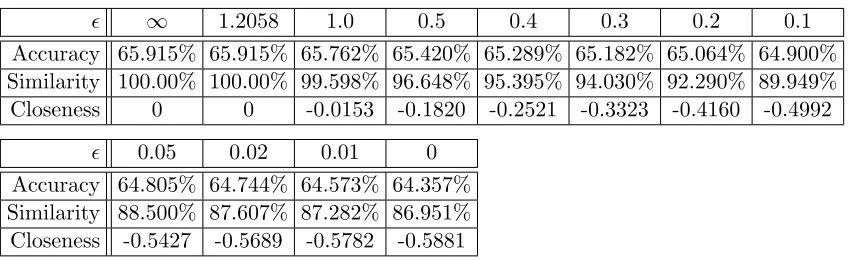
We also experimentally evaluate the accuracy of our post-processing technique using a data set from the COMPAS recidivism analysis tool [1]. We investigate the fair treatment rates of the original data set and subsequently use the above technique to create classifiers satisfying fair treatment with varying errors while optimizing three different loss functions, amounting to overall accuracy (when considering a binary version of the classifier where scores 0-5 get mapped to a 0, and 6-10 get mapped to 1) and two notions of the similarity of the derived classification to the original classification. We find that our method is able to produce derived classifiers satisfying fair treatment with a relatively small amount of loss (with respect to this experimental data).
1.1 Proof Outline for Theorem 1
We show our sanitization theorem in three steps. First, we consider an arbitraryC-derived classifier, and we demonstrate constraints for a linear program that can be used to efficiently find the optimal such classifierC0satisfying fair treatment. We note that these constraints are precisely a generalized version of those which Hardt et al. [6] demonstrate forbinary classifiersC(though they also consider C with larger outcome spaces); we, however, also leverage our approximate definition to create constraints for approximate fair treatment. We further note that solving this linear program will require time polynomial in the number of possible outcomes |O|.
Of course, our linear constraints, as well as the loss function we wish to optimize, may in general depend on features ofDandCthat we may in this model only approximate with black-box queries.
So, towards approximating this optimal classifier in a black-box setting, we show that it suffices to use experimental probabilities derived from these queries rather than actual probabilities to build the linear program, since over sufficiently many queries, and as long as real probabilities are sufficiently large, it is overwhelmingly likely by a simple Chernoff bound that the experimental probabilities will be very close to accurate. To deal with the case when real probabilities may be quite small (and prone to large multiplicative error in estimation due to variance in samples), we additionally add a very small amount of random noise to the classifier in order to smooth out the multiplicative distance between real and experimental probabilities, effectively by increasing the minimum possible probability of events (noting that the noise is optional when the probabilities we wish to calculate experimentally are reasonably large). By solving this approximate version of the linear program, we may obtain a near-optimal derived classifier satisfying approximate fair treatment with respect to a given loss function.
However, the loss function we wish to minimize in the linear program is also potentially de-pendent on certain probabilities of events over C and D which require non-black-box knowledge to derive exactly; to overcome this, we show that the constructed sanitizer can in fact estimate these accurately using black-box queries by the same argument as that for the linear program’s coefficients, and so, given enough samples, an approximate loss function derived from experimental probabilities is overwhelmingly likely to be close to the real loss function. Of course, while the approximation of the loss function is close, it is unclear as to whether the optimum of the approx-imate loss function is necessarily close to optimal over the real loss function; we show, through leveraging properties of the loss function and the space over which it is defined, that in fact this is the case for accuracy (and other loss functions, including natural classes of loss functions that are linear in the probabilities Pr [σ ← D:f(σ) =i∧ C(O(σ)) =j]), which completes our argument of near-optimality.
2
Preliminaries and Definitions
2.1 Notation
Conditional probabilities. Given some random variableX and some eventE, we let Pr[p(X)|
E] denote the probability of a predicatep(X) holding when conditioning the probability space on the eventE. If the probability ofE is 0, we slightly abuse notation and simply define Pr[p(X)|E] = 0.
Multiplicative distance. The following definition of multiplicative distance will be useful to us. We let themultiplicative distanceµ(x, y) between two real numbersx, y≥0 be defined as
µ(x, y) =
lnmaxxy,yx ifx >0, y >0
0 ifx=y= 0
∞ otherwise
2.2 Classification Contexts
We start by defining classification contexts and classifiers.
• Dis a probability distribution with some finite support ΣP (the set of all possibleindividuals
to classify).
• f : ΣP →ΨP is a surjective function that maps each individual to their classin a set ΨP.
• g: ΣP →GP is a surjective function that maps each individual to theirgroup in a setGP.
• O : ΣP → {0,1}∗ ×GP is a function that maps each individual σ to their observable features (O0(σ), g(σ)); note that we by default assume that an individual’s group can be observed.
We note that f and g are deterministic; this is without loss of generality as we can encode any probabilistic features that f and g may depend on into σ as “unobservable features” of the individual.
Given such a classification context P, we let ΨP denote the range of f, and GP denote the
range of g. Whenever the classification context P is clear from context, we drop the subscript; additionally, whenever the distributionDand group functiongare clear from context, we use σto denote a random variable that is distributed according toD, andσX to denote the random variable
distributed according toD conditioned on g(σ) =X.
2.3 Classifiers
A classifier C for a classification context P = (D, f, g, O) is simply a (possibly randomized) al-gorithm that acts on the support of O (the observable description of an individual). We let ΩCP denote the support of the distribution {C(O(σ))}.
We also must formalize what it means for a classifier to be “derived” from another classifier; hence, we define the following notion of a classifier C0 that “perturbs” the output of some original classifierC. Given an individualσ,C0will runCand then “post-process” the output according only to the output C(O(σ)) andσ’s group.
Definition 3. [6] Given a classifier C, we say that a classifier C0 is a C-derived classifier if, in any context P = (D, f, g, O), the outcome C0 is only dependent on C(O(σ)) and σ’s group g(σ).
(Equivalently,C0 is a classifier over the contextP0 = (D, f, g,(C(O(·)), g(·))).)
Formally, we can represent this as a |ΩCP| × |ΩCP| × |GP|vectorP~C0 of the probabilities
Pi,jg = PrC0(C(O(σg)), g) =j|C(O(σg)) =i
and let C0 be a classifier that, given an individual σ, runs C on that individual, observes its
outcome i = C(O(σ)) and group g(σ), and assigns that individual the distribution of outcomes {j with pr. Pi,jg }.
3
Defining Fair Treatment
Definition 4. (Fair treatment, a.k.a. approximate equalized odds [6].) We say that a classifierC satisfies-fair treatmentwith respect to a contextP = (D, f, g, O) if, for any groupsX, Y ∈GP,
any classc∈ΨP, and any outcomeo∈ΩCP, we have that
µ(Pr[C(O(σX)) =o|f(σX) =c],Pr[C(O(σY)) =o|f(σY) =c])≤
For the case of binary classification tasks and binary classifiers (i.e., when ΨP = ΩCP ={0,1}),
fair treatment is equivalent to requiring “similar” false positive and false negative rates [8].
3.1 On the Use of Multiplicative Distance
As defined here, fair treatment essentially requires that themax-divergence between the conditional distributions of outcomes is small between groups. Max-divergence is a distance measure often found in areas such as differential privacy (see [4]); we stress here, through two arguments following very similar logic to differential privacy, that using such a multiplicative distance is important to ensure fairness between groups that may be under-represented in the data, and also that fair treatment defined using multiplicative distance exhibits desirable properties that other distance metrics may not.
First, to motivate our statement that multiplicative distances are important for parity between under-represented groups, consider as an example a classifier used to determine whether to search people for weapons. Assume such a classifier determined to search 1% of minorities at random, but only the minorities (and no others). Such a classifier would still have a fair treatment error of 0.01 if we used standard statistical distance, while the max-divergence would in fact be infinite (and indeed, such a classification would be blatantly discriminatory).
Our use of max-divergence between distributions for our definitions is reflective of the fact that, in cases where we have such small probabilities, discrimination should be measured multiplicatively, rather than additively. In addition, when we may have a large number of possible classes, the use of max-divergence (in particular, themaximum of the log-probability ratios) means that we always look at the class with themost disparity to determine how discriminatory a classification is, rather than potentially amortizing this disparity over a large number of classes.
3.2 Closure under Post-Processing
We also remark that our definition of fair treatment is closed under “post-processing”. If a classifier C satisfies-fair treatment with respect to a context P = (D, f, g, O), then anyC-derived classifier
which acts independently of an individual’s group (i.e., whose decision is based only on the outcome of C) will also satisfy -fair treatment with respect to P.
Theorem 2. Let C1 be a classifier satisfying -fair treatment with respect to a context P =
(D, f, g, O). Let C2 be any classifier whose output for an individualσ is strictly a (possibly
proba-bilistic) function of C1(O(σ)). ThenC2 satisfies-fair treatment with respect toP.
Proof. Let C1 be a classifier satisfying -fair treatment w.r.t. some context P. Consider some groups X, Y ∈GP, some classc∈ΨP, and some outcome o∈ΩC
0
P; we need to show that
Towards doing this, note that
Pr[C2(C1(O(σX))) =o|f(σX) =c]
= X
o1∈Ω
C1 P
Pr[C2(o1) =o|f(σX) =c,C1(O(σX)) =o1]Pr[C1(O(σX)) =o1 |f(σX) =c]
= X
o1∈Ω
C1 P
Pr[C2(o1) =o]Pr[C1(O(σX)) =o1 |f(σX) =c]
where the last step follows from the fact thatC2depends only onC1. By the same argument applied
toY, we also have that:
Pr[C2(C1(O(σY))) =o|f(σY) =c]
= X
o1∈Ω
C1 P
Pr[C2(o1) =o]Pr[C1(O(σY)) =o1 |f(σY) =c]
These two probabilities are-close since, by fair treatment, Pr[C1(O(σX)) =o1 |f(σX) =c] and
Pr[C1(O(σY)) = o1 | f(σY) = c] are-close, and furthermore multiplicative distance is preserved
under linear operations5. This proves the theorem.
We also remark that, in general, earlier “expectation-based” definitions of fair treatment are not preserved under post-processing.
4
Black-Box Sanitization
Next, we provide a novel definition of the type of sanitizer we shall construct in our main theorem. For the purposes of defining a “computationally efficient” sanitizer, let us define a notion of an “ensemble” of classification contexts, wherein we assume a parameter n (similar to the idea of a security parameter in cryptography) so that each individual’s observable features can be represented in n bits. In particular, this means that, for some setting of n there may be up to 2n distinct descriptions of individuals in a distributionD, and so acomputationally efficient black-box classifier which runs in polynomial time with respect toncould not, for instance, query every possible feature description.
Definition 5. Let aclassification context ensembleΠ be given by a sequence of classification contexts {Pn}n∈N = {(D, f, g, On)}n∈N (note that (D, f, g) remains the same as n varies), such that, whenever 2n≥ |GPn|(i.e.,nis sufficiently large to describe g(σ)),Onmaps the space ΣPn of
individuals to{0,1}n, the space ofn-bit descriptions.
Notably, the contexts are effectively describing the same distribution of individuals, but using different feature lengths for each context in the ensemble. Also, becauseD,f, and g are the same throughout, this implies that the space of individuals ΣPn and the class and group spaces ΨPn and
GPn are likewise the same for every n.
5
In our proofs, we will also consider deriving our classifier from a sequence of prior classifiers
χ = {Cn}n∈N, where the classifier Ci is used to classify individuals in the context Pi (that is,
individuals having feature lengthi).
Lastly, we wish to represent the fact that a sanitizer may, given a prior classifier sequenceχover a distribution ensemble Π, wish to make black-box queries to a distribution of labeled “training data” representing individuals’ observable features, classes, groups, and prior classifications. We shall denote this distribution for a specific parameternby
τχ,Π(1n),{σ ← D: (On(σ), f(σ),Cn(On(σ)), g(σ))}
Notationally, letBτχ,Π(1n)6 denote that a sanitizerBmay make black-box queries to the distri-bution τχ,Π(1n) for some parameter n. Finally, we are able to formalize the notion of a “black-box
sanitizer” given the above:
Definition 6. We say that an algorithmB(·) is an(·)-black-box sanitizer if it is:
• Efficient: there exists a polynomial p(·,·) such that, for any m ∈ N, and for any context ensemble Π = {Pn}n∈N and sequence χ = {Cn}n∈N of classifiers for which |ΨPn| ≤ m,
|GPn| ≤ m, and |Ω
Cn
Pn| ≤ m (i.e., the class, group, and output spaces have size bounded by m), Bτχ,Π(1n) runs in time at most p(m, n) for all n∈
N.
• Fair: for any context ensemble Π = {Pn}n∈N and any sequence χ = {Cn}n∈N of classifiers, there exists negligible ν(·)7 such that, for all n ∈ N, with probability at least (1−ν(n)) over the samples it queries fromτχ,Π(1n), Bτχ,Π(1n) outputs a Cn-derived classifierC08 which
satisfies(n)-fair treatment with respect to Pn.
4.1 Loss Functions
Lastly, we need to define “optimality” for derived classifiers in this context. In particular, we assume some loss function`(·) bounded in [0,1] which may either be fixed or based on D,f, and C (in which case we write `D,f,C(·) for clarity). Intuitively, `(C0) represents the “loss” in utility
incurred by classifying an individual σ with outcome C0(O(σ)) when their actual class is f(σ). As
a concrete example, if we consider classifiers which attempt to classify each individual according to their correct classf(σ)∈Ψ, one might consider the overall inaccuracy as a loss function, which is given by:
`D,f,C(C0) = 1−Pr
C0(O(σ)) =f(σ)
We can define the error of a derived classifier to be its loss compared to the optimal perfectly fair derived classifier, as follows:
Definition 7. For some context P = (D, f, g, O) and prior classifier C, given some loss function
`D,f,C that maps any classifier to its loss in [0,1], letting S be the set of all C-derived classifiers
satisfying perfect (= 0) fair treatment, then we define the error of some C-derived classifier C0 with respect to`D,f,C to be
∆`,D,f,C(C0) = maxC∗∈S(`D,f,C(C0)−`D,f,C(C∗))
6
The input of 1n, or a string ofnones, is provided simply as a cryptographic convention, so that we can assert that the running time ofBis polynomial in its input length. When implicit or clear from context, we shall for notational simplicity omit this input.
7
That is,ν(n)<1/p(n) for every polynomialp(·) and sufficiently largen.
8
We note that, because we compare a classifier (which may be only approximately fair) to the optimalperfectly fair classifier, certain particularly good classifiers may in fact have a negative loss. We could, when considering -approximately fair classifiers, generalize this notion to consider the loss over all f()-fair classifiers for some f() < and derive a similar optimality result to what we prove here, but for simplicity and consistency over different parameters we consider the case when f() = 0.
Linear loss functions. Furthermore, with respect to derived classifiers, we consider the class of loss functions`D,f,Cwhich arelinear in the probabilitiesPi,jg constituting the derived classifier—that
is:
Definition 8. We say that a loss function `D,f,C(·) is a linear loss function for a context P =
(D, f, g, O) and prior classifier C if it can be represented as some |ΩCP| × |ΩCP| × |GP| vector~`D,f,C
so that the loss of a derived classifierC0 is given as the inner product
h~`D,f,C, ~PC0i=
X
i,j∈ΩCP,g∈GP
(~`D,f,C)gi,jPi,jg
of this vector with the probabilities constituting the derived classifierC0.
We can define error slightly more specifically for linear loss functions using the vector form:
∆~`,D,f,C(C 0
) = maxC∗∈S(h~`D,f,C, ~PC0i − h~`D,f,C, ~PC∗i)
We will focus on the specific subclass of linear loss functions whose coefficients (the coefficients of Pi,jg ) can either be constant or up to dth-degree polynomials in probabilities Pr [g(σ) =γ] and Pr [f(σg) =i∧ C(O(σg)) =j], which can be formalized as follows:
Definition 9. We shall define alinear loss function with t-term coefficients of degree das one that can be represented as
`D,f,C(C0) = X
i,j,g
qi,jg (ρ)Pi,jg
or equivalently
(~`D,f,C)gi,j =qgi,j(ρ)
where ρ denotes the set of all variables Pr [g(σ) =γ] and Pr [f(σg) =x∧ C(O(σg)) =y] (for any
γ, x, y), Pi,jg is the vector representation of C0, and each qi,jg (·) is a dth-degree polynomial in the variables ofρ which contains at mosttmonomials which themselves are bounded in [0,1] whenever the variables inρ are likewise bounded.
Claim 1. For a context P and for any classifier with ΩCP = ΨP =O, the overall inaccuracy loss
function
`D,f,C(C0) = 1−Pr
C0(O(σ)) =f(σ)
is a linear loss function with (|ΩCP| −1)-term coefficients of degree 2.
Proof. The inaccuracy of a classifier, conditioning on a groupg, can be expressed as a linear function inPi,jg ifD, f,C are fixed:
Prf(σg)6=C0(O(σg))= 1−Prf(σg) =C0(O(σg))
= 1−X
j∈O
Prf(σg) =j∧ C0(O(σg)) =j
= 1− X
i,j∈O
Prf(σg) =j∧ C(O(σg)) =i∧ C0(O(σg)) =j
= 1− X
i,j∈O
Pr [f(σg) =j∧ C(O(σg)) =i] Pr
C0(O(σg)) =j|f(σg) =j∧ C(O(σg)) =i
Recalling that the output ofC0 is based only on an individual’s group and the output of C:
= 1− X
i,j∈O
Pr [f(σg) =j∧ C(O(σg)) =i] Pr
C0(O(σg)) =j|C(O(σg)) =i
= 1− X
i,j∈O
Pr [f(σg) =j∧ C(O(σg)) =i]Pi,jg
This can be expanded into the overall inaccuracy of C0 if we sum over groups, i.e.,
1− X
i,j∈O;γ∈GP
Pr [g(σ) =γ] Pr [f(σγ) =j∧ C(O(σγ)) =i]Pi,jγ
or, equivalently,
X
i,j∈O;γ∈GP
Pr [g(σ) =γ]X
k6=j
Pr [f(σγ) =k∧ C(O(σγ)) =i]Pi,jγ
This suggests that we can, as previously described, write this loss function as a vector ~`D,f,C over
the space of probabilitiesPi,jγ, in particular such that
(~`D,f,C)γi,j = Pr [g(σ) =γ] X
k6=j
Pr [f(σγ) =k∧ C(O(σγ)) =i]
5
Theorem: Achieving Fair Treatment by Post-Processing
We now show that it is possible to achieve fair treatment, even in non-binary classification scenarios, by post-processing starting from a prior classification that may be unfair. We note that, though our theorems only state existence, we provide our concrete construction of the black-box sanitizer in the body of the proof. Focusing first on the specific example above where we use inaccuracy as a loss function, we show the following positive result:
Theorem 3. For any fixed outcome space Ω, any polynomial q(n), and any(n)∈[q(1n),1), there exists an(·)-black-box sanitizerBsuch that, given any context ensemble Π ={Pn}n∈N(such that
|GPn|= m) and any classifier sequence χ such that ΨPn = Ω
Cn
Pn = Ω, there exists negligible ν(·)
such that, with probability 1−ν(n) over the samples it queries fromτχ,Π(1n),Boutputs a classifier
C00 which both satisfies(n)-fair treatment and has error
∆`,D,f,C(C00)≤ |Ω|((n) +m(n)4)
with respect to the overall inaccuracy loss function
`D,f,C(C00) = 1−Pr
C00(O(σ)) =f(σ)
This is in fact implied directly by the following more general result, which we shall prove in its stead:
Theorem 4. For any fixed outcome space Ω, any constants t, d ∈ N, any linear loss function `
with t-term coefficients of degreed, any polynomial q(n), and any(n) ∈[q(1n),1), there exists an
(·)-black-box sanitizerB such that, given any context ensemble Π = {Pn}n∈N, and any classifier
sequence χ, there exists negligible ν(·) such that, with probability 1−ν(n) over the samples it queries from τχ,Π(1n), B outputs a classifier C00 which both satisfies (n)-fair treatment and has
error
∆`,D,f,C(C00)≤ |ΩCPnn|((n) +|GPn|(n)
4)
In the example above where we consider overall inaccuracy, we have (by Claim 1) d= 2 and
t=|Ω| −1, directly implying Theorem 3. Next, we outline the proof of Theorem 4:
Achieving fair treatment with distributional knowledge. We begin with the simplifying assumption that the sanitizer we construct does have perfect knowledge of the context Π and classifier χ = {Cn}n∈N, and we show (Claim 2) that for each n we can use the probabilities of
events in those distributions to construct a set of linear constraints for fair treatment over the probabilities Pi,jg = Pr [C0(O(σ
g)) =j|Cn(O(σg)) =i]. Then, given a loss function which is also
linear inPi,jg , we can construct a linear program (Corollary 1) to efficiently minimize loss subject to the constraints for fair treatment. Since, by construction, any Cn-derived C0(σ) which satisfies
Black-box approximation. Next, we work towards discarding the assumption of non-black-box knowledge of Π and χ. In particular, we use a Chernoff-type bound to show (Lemma 3) that, given a sufficiently large (yet still polynomial in n) number of labeled and classified samples from
τχ,Π(1n), with very high probability (i.e., probability 1−ν(n)) all of the experimental probabilities
relevant to our linear program will be close enough to their actual counterparts so that any solution to the linear program formulated from the experimental probabilities will also satisfy approximate fair treatment with respect to the actual probabilities. However, we note that the Chernoff bound will only apply when the real probabilities of the events in question are sufficiently large; if we are not guaranteed that this is the case, we additionally add a very small amount of noise to the classifierC0 to deal with the possibility that events with very small real probability are measured to have a wildly different experimental probability due to sampling variance. This random noise will ensure that these events are accounted for when approximating the linear program while adding only a minimal error to the approximation. So, combined with the previous step, this suggests the approach that we will use to construct the final sanitizerB; specifically, we can do as follows:
• Use a sufficiently large (yet polynomial in n) number of samples from τχ,Π(1n) to estimate
the parameters of the linear constraints from the previous step, in particular using a fairness error significantly smaller than(n) in order to account for variance in samples and random noise that will be added, yet one large enough to not rule out optimal classifiers that may not be perfectly fair. Also use the samples to estimate any distributionally dependent parameters of the loss function.
• Use standard linear programming techniques to optimize the derived loss function over the derived constraint region in polynomial time, and take the optimal solution as the “transfor-mation parameters” of a derived classifier C0 (i.e., the probabilitiesPi,jg ).
• Output the (slightly noisy) classifier C00 which, except with a small probability, applies the
transformation given by the above solution to the output of the prior classifier; the rest of the time, it returns a random outcome.
If parameterized correctly, this classifier will still satisfy-approximate fairness whenever all of the above Chernoff bounds hold; furthermore, as we subsequently show, the output will also not incur much loss due to estimating parameters and adding noise when these bounds hold.
Showing near-optimality. In particular, we must account both for the noise added to the solutionC0to the linear program and for the fact that the loss function over whichBoptimizes may be imprecise, as we have remarked that loss functions such as accuracy are in general dependent on features of the context or the classifier (which our sanitizer must estimate using samples). However, once again, we show (Claim 5) that this can be overcome by using another Chernoff-type bound (Lemma 4) to show that, with high probability, the experimentally derived coefficients of the loss function are very close to the corresponding coefficients of the actual loss function. Then we demonstrate that a slightly noisy variant of the optimalCn-derived classifier is always derivable by Bwhen the bounds hold, and furthermore use linearity to show that, in that case, the actual loss of the outputC00 must not differ by much from that of the optimalC
n-derived classifier (in particular,
when the intermediate classifier C0 itself might differ from this classifier due to the optimum over
the approximate loss function being different from the optimum over the actual loss function.
Notation. For brevity and notational simplicity, in the body of the proof we will abbreviate the probability Pr [E(σg)] (i.e., the probability of some event E holding forσ drawn from group g) as Prg[E(σ)], and the probability Pr [g(σ) =γ] as Pr [γ].
Furthermore, we abbreviate the eventf(σ) =iasfi, and similarly for any classifierCabbreviate
C(O(σ)) =iasCi.
5.1 Step 1: Achieving Fair Treatment
For our first step, we prove the following result, showing that an optimal derived classifier can always be found efficiently given “perfect” knowledge of a context and a prior classifier:
Claim 2. Let C be an arbitrary classifier over context P = (D, f, g, O). Then there exists a set of polynomially many (in |ΨP|, |GP|, and |ΩCP|) satisfiable linear constraints in the variables
Pi,jg = Prg[C0(σ) =j|C(σ) =i] that define the set of C-derived classifiers C0 which satisfy -fair
treatment with respect toP.
Corollary 1. LetC be an arbitrary classifier over contextP = (D, f, g, O), and let`D,f,C be a loss
function which is linear over the probabilities Pi,jg as defined above. Then the C-derived C0 which minimizes`D,f,C(·) while satisfying-fair treatment with respect toP can be found efficiently (i.e.,
in time polynomial in|ΨP|,|GP|, and |ΩCP|).9
The corollary will follow immediately from Claim 2 by the efficiency of solving linear programs (that is, the well-known fact that a linear program with a polynomial number of variables and constraints may be solved in polynomial time). We now prove Claim 2:
Proof. Assume we have a discrete classifier C that classifies individuals from a context P = (D, f, g, O), and we wish to produce C0 that satisfies -fair treatment with respect to P. Con-sider theC-derived classifier defined by the set of |GP||ΩCP|2 variables
Pi,jg = Prg
Cj0|Ci
fori, j∈ΩCP andg∈GP.
Next, we directly translate the definition of fair treatment into a set of constraints, which represents the space of all possible derived classifiers satisfying-fair treatment:
∀i, j∈ΩCP,∀g∈GP :Pi,jg ∈[0,1]
∀i∈ΩCP,∀g∈GP : X
j∈ΩC P
Pi,jg = 1
∀j∈ΩCP,∀k∈ΨP,∀X, Y ∈GP : PrX
Cj0|fk
≤ePrY
Cj0|fk
9If `
D,f,C(·) is not linear, it is of course findable, but not necessarily efficiently, as we no longer have a linear
Notice, however, that:
Prg
Cj0|fk
= 1
Prg[fk]
Prg
fk∧ Cj0
= 1
Prg[fk]
X
i∈ΩCP
Prg
fk∧ Cj0 ∧ Ci
As observed earlier (see the proof of Claim 1), because we assign outcomes in C0 based only onC and g(σ), it must be the case that Prg
h
Cj0|Ci i
= Prg h
Cj0|Ci∧fk i
, or, expanding using conditional probability,
Prg h
Cj0 ∧ Ci i
Prg[Ci]
= Prg
h
fk∧ Cj0 ∧ Ci i
Prg[fk∧ Ci]
which implies
Prg
fk∧ Cj0 ∧ Ci
=
Prg[fk∧ Ci] Prg h
C0 j∧ Ci
i
Prg[Ci]
= Prg[fk∧ Ci] Prg
Cj0|Ci
= Prg[fk∧ Ci]Pi,jg
So our conditions of the form PrX h
C0 j|fk
i
≤ePrY h
C0 j|fk
i
can be rewritten (after substituting and
multiplying through) as
PrY [fk]
X
i∈ΩCP
PrX[fk∧ Ci]Pi,jX
≤ePrX[fk]
X
i∈ΩCP
PrY [fk∧ Ci]Pi,jY
We can also reformat the second set of conditions into inequality constraints by selecting j∗ ∈ ΩCP, replacing each Pi,jg∗ with 1−Pj∈ΩC
P\j∗P
g
i,j, and requiring P
j∈ΩC P\j∗P
g
i,j ≤1. Then our final
set of constraints becomes:
∀i∈ΩCP,∀j∈Ω C P\j
∗
,∀g∈GP :Pi,jg ≥0, P g i,j≤1
∀i∈ΩCP,∀g∈GP:
X
j∈ΩCP\j∗
Pi,jg ≤1
∀j∈ΩCP\j ∗
,∀k∈ΨP,∀X, Y ∈GP:
PrY[fk]
X
i∈ΩC P
PrX[fk∧ Ci]Pi,jX
≤e
PrX[fk]
X
i∈ΩC P
PrY[fk∧ Ci]Pi,jY
∀k∈ΨP,∀X, Y ∈GP:
PrY[fk]
X
i∈ΩC P
PrX[fk∧ Ci]
1− X
j∈ΩC P\j∗
Pi,jX
≤e
PrX[fk]
X
i∈ΩC P
PrY[fk∧ Ci]
1− X
j∈ΩC P\j∗
Pi,jY
which is a system of 2|GP||ΩCP|2+|GP|2|ΩCP||ΨP|equations in|GP||ΩCP|(|ΩCP| −1) variables.
Furthermore, we know that this system necessarily has a solution on its domain, since taking
Pi,jg = 1/|ΩCP|for each i,j, and g corresponds to a classifier C0 where all individuals are offered a uniform distribution over outcomes; this classifier trivially satisfies fair treatment (and indeed, one can easily verify that it satisfies the above conditions for anyC and P).
Thus, finding assignments for Pi,j in order to construct a classifier C0 satisfying fair treatment
5.2 Step 2: Approximate Fairness From Experimental Probabilities
Of course, we have only established so far that C0 constructed in such a manner satisfies fair treatment if we already know the exact probabilities Prg[fk] and Prg[fk∧ Ci] for each group g.
This of course requires non-black-box knowledge of P and C; however, we will now show by a Chernoff bound that, assumingBis givenexperimental probabilities Prg[fk] and Prg[fk∧ Ci] from
a sufficiently large “training set” of individuals randomly drawn from the distribution τχ,Π(1n),
C0 constructed according to the above linear program, and with a small amount of random noise added to prevent interference due to experimental variance in observing extremely rare events, will still satisfy-approximate fair treatment with overwhelming probability. Specifically, it can be proven that the probability ofC0not satisfying approximate fair treatment is extremely small given a sufficiently large number of random samples (i.e., a number inversely polynomial in the desired fair treatment error ).
To formalize what we mean by adding “a small amount of random noise”, given some derived classifier C0 (which we recall can be expressed as an |ΩCP| × |ΩCP| perturbation matrix), and letting (1)m×n be anm×nmatrix of all ones, we shall let
Qr(C0),
r
|ΩCP|(1)|ΩPC|×|ΩCP|+ (1−r)C
0
be the derived classifier that with probabilityr outputs a random outcome and otherwise outputs an outcome according to the classifier C0. (Hence, Qr(C0)(σ) is identical to C0(σ) with probability
1−r.)
We will herein make use of the following well-known bound (for ease of notation, we denote exp(x) =ex):
Lemma 1. (Hoeffding Bound.) Let X1, . . . , XN be independent binary random variables (i.e.,
Xi∈ {0,1}). Letm be the expected value of their average and X∗ their actual average. Then, for
any δ∈(0,1):
Pr [|X∗−m| ≥δ]≤2 exp −2δ2N
In particular, when δ and m are fixed, this probability is inversely exponential (i.e.,negligible) in the number of random variables N. To take advantage of this, consider our scenario where we have some classifier C trained using some number of individuals drawn (independently) from the distribution from the distribution τχ,Π(1n), and we wish to measure the probability of some event
E1 occurring conditioned on a subgroup g. Notationally, we will henceforth denote by Ex[E] the
experimental probability of an eventE over a set of random samples—i.e., lettingS be the set of samples and 1E(s) the indicator variable which is 1 if E is true for a sample sand 0 if not:
1 |S|
X
s∈S 1E(s)
We will denote by Exg[E] the experimental probability of E conditioned on a group g, or Ex[E∧
g]/Ex[g]. Then we prove the following lemma:
with probability at least 1−4 exp
−2δPr[3g]2N
over the samples, the following two conditions
hold:
1. |Exg[E]−Prg[E]|< δ
2. |Ex[g]−Pr [g]|< δ
Specifically, this states that the probability of the experimental and real probabilities diverging for some fixed event E is inverse-exponential in the size of C’s training set.
Proof. First we prove the following claim:
Claim 3. Given positive real numbers a, b, c, d, such that|a−b|< and|c−d|< , then
a c −
b d
< (a+c) c(c−)
Proof. The following three facts suffice:
a c −
b d
= 1
cd|ad−bc|
1
cd <
1
c(c−)
|ad−bc|<|a(c+)−(a−)c|=(a+c)
So, as long as |Ex[g]−Pr [g]|< δ and |Ex[E∧g]−Pr [E∧g]|< δ, then
|Exg[E]−Prg[E]|=
Pr [E∧g] Pr [g] −
Ex[E∧g] Ex[g]
< (Pr [E∧g] + Pr [g])δ
Pr [g] (Pr [g]−δ)
which means that, by Lemma 1,
Pr
|Exg[E]−Prg[E]| ≥
(Pr [E∧g] + Pr [g])δ
Pr [g] (Pr [g]−δ)
≤Pr [|Ex[g]−Pr [g]| ≥δ] + Pr [|Ex[E∧g]−Pr [E∧g]| ≥δ]≤4 exp −2δ2N
This follows because, for each of the (unconditioned) probabilities in question, we can use a Cher-noff bound with N variables X1, . . . , Xn equal to 1 if the respective event occurs for a sampled
individual and 0 otherwise; then X∗ is equal to the experimental probability of the event and m
(its expectation) is by definition equal to the actual probability. Finally, let
δ0= (Pr [E∧g] + Pr [g])δ Pr [g] (Pr [g]−δ) =
(Prg[E] + 1)δ
Pr [g]−δ
Then
δ0Pr [g] = (Prg[E] + 1 +δ0)δ
δ0Pr [g] Prg[E] + 1 +δ0
=δ
And so
Pr|Exg[E]−Prg[E]| ≥δ0
≤4 exp −2δ2N= 4 exp −2
δ0Pr [g] Prg[E] + 1 +δ0
2
N
!
≤4 exp −2
δ0Pr [g] 3
2
N
!
since δ0 <1 by assumption and Prg[E]≤1 trivially. Furthermore, when we show that |Exg[E]−
Prg[E]|< δ0, we do so by showing that
|Pr [g]−Ex[g]| ≤[δ =] δ
0Pr [g]
Prg[E] + 1 +δ0
≤δ0
which completes the other part of the argument.
Now we can prove our key lemmas using this consequence.
Lemma 3. Given context P = (D, f, g, O) and∈(0,1), letC0 be a C-derived classifier satisfying a modification of the linear constraints in Corollary 1 for (2/4)-fair treatment where the coeffi-cients are determined by theexperimental (rather than actual) probabilities of the respective events given N random samples (O(σ), f(σ),C(σ), g(σ)) from the distribution τχ,Π(1n). Then the
classi-fier Q2|ΩC P|/3(C
0) satisfies -approximate fair treatment with respect to P except with probability
negligible in N over the selection of samples—in particular, with probability 1−O(e(−c4N)) for some constantc dependent only onD.
Proof. Letc= 14422mingPr [g]2. Notice thatcis not dependent onnor, for that matter, on anything
besides the (fixed) distribution D.
First let us consider the classifierC0before noise is added. BecauseC0is derived fromCaccording to Corollary 1, we have, by the respective constraints for fair treatment for eachj∈ΩCP,X, Y ∈GP,
and k∈ΨP:
µ
ExY[fk]
X
i∈ΩCP
ExX[fk∧ Ci]Pi,jX
,ExX[fk]
X
i∈ΩCP
ExY[fk∧ Ci]Pi,jY ≤ 2 4
which, since both sides are at most 1 and thus can differ additively by at most 1−e−2/4 ≤2/4, implies:
ExY[fk]
X
i∈ΩC P
ExX[fk∧ Ci]Pi,jX
−ExX[fk]
X
i∈ΩC P
wherePi,jX and Pi,jY are derived from solving the constraints. Applying Lemma 2 (1) once for each
k∈ΨP to the eventfk and group Y (with δ=2/48) then gives us that
PrY [fk]
X
i∈ΩCP
ExX[fk∧ Ci]Pi,jX
−ExX[fk]
X
i∈ΩCP
ExY[fk∧ Ci]Pi,jY ≤ 2 4 + 2 48
except with probability no greater than
4 exp −2
(2/48)Pr [Y] 3
2
N
!
≤4 exp −2
2(mingPr [g])
144
2
N
!
= 4 exp
−
24(mingPr [g])2
1442
N
= 4(exp(−c4N))
for each choice of k, or, over all of the |ΨP| choices of k, no greater than 4|ΨP|(exp(−c4N)) by
the union bound. Symmetrically for each event fk and groupX:
PrY [fk]
X
i∈ΩCP
ExX[fk∧ Ci]Pi,jX
−PrX[fk]
X
i∈ΩCP
ExY[fk∧ Ci]Pi,jY ≤ 2 4 + 2 24
except with the same failure probability. We then do the same for the events fk∧ Ci (for each of
the|ΨP|choices of k) conditioned on X and Y to obtain that
PrY [fk]
X
i∈ΩC P
PrX[fk∧ Ci]Pi,jX
−PrX[fk]
X
i∈ΩC P
PrY [fk∧ Ci]Pi,jY ≤ 2 4 + 2 12 = 2 3
except with probability 16(exp(−c4N)) for each choice of k (or 16|Ψ
P|(exp(−c4N)) overall).
By the union bound over all classes k ∈ ΨP and over all (fewer than |GP|2) pairs of groups X
and Y, the total failure probability from applying these bounds to all of the constraints is at most 16|GP|2|ΨP|(exp(−c4N)) =O(exp(−c4N)), which is of course negligible in the number of
samples N. So, with probability at least 1−O(exp(−c4N)) over the drawn samples, all of the above constraints will hold.
This is not quite identical to the statement
µ PrX
Cj0|fk
,PrY
Cj0|fk
≤
(i.e., fair treatment for C0); particularly, if the probability of some outcome is very small, then a bound on the additive distance between real and experimental probabilities has no impact on whether themultiplicativedistance is bounded. To overcome this issue, we will consider the classifier
Q2|ΩC P|/3(C
0) that, as defined above, runsC0 and outputs the resultexcept with probability 2|ΩC P|/3,
in which case it will pick an output uniformly at random. This guarantees that the probability of any outcome occurring (even conditioned on any group) must be at least 2/3; hence, except with the aforementioned failure probability, the multiplicative distance between the real and experimental probabilities for any such conditional outcome can be at most either
ln
2/3 +2/3
2/3
or
ln
2/3 2/3−2/3
= ln
1 1−/2
≤
for all <1.
Remark. While it may seem counterintuitive for the classifier output by our sanitizer to output a uniformly random class with small probability, in fact this “random noise” is only necessary due to the possibility of arbitrarily small probabilities Prg[fk∧ Ci] occurring in the distributionD;
specifically, if some such event occurs with small enough probability, it would likely be measured to have probability 0, potentially causing an unbounded multiplicative fairness error in the derived classifier. If there instead exists a constant lower bound for these probabilities (or even, once parameterized, an asymptotic lower bound of (n)), then we can directly obtain the result above without having to add noise to the outcome of the derived classifier, as we do in our experimental results (Section 6).
Importantly, we can also apply Lemma 3 in reverse, transforming from the exact conditions to the modified conditions with experimental probabilities, under precisely the same conditions. This will be useful to demonstrate optimality (i.e., that the optimal fair classifier is derivable by Bas it is overwhelmingly likely to satisfy approximate versions of the constraints) in the following section.
Lemma 4. Given contextP = (D, f, g, O), letC0 be aC-derived classifier satisfying the conditions
in Corollary 1 for perfect fair treatment with respect to P. Then, for any∈(0,1), the classifier
Q2|ΩC P|/4(C
0), with probability 1−O(e(−c8N)
) (for some constant c dependent only onD) overN
random samples (O(σ), f(σ),C(σ), g(σ)) from the distributionτχ,Π(1n), satisfies the modification of
the linear constraints in Corollary 1 for (2/4)-fair treatment where the coefficients are determined by the experimental (rather than actual) probabilities of the respective events given the random samples.
Proof. We proceed very similarly to Lemma 3, except changing the error parameterand reversing Ex[. . .] with Pr [. . .]. Since we know thatC0 satisfies perfect fair treatment, we have, this time with respect to the real probabilities:
PrY [fk]
X
i∈ΩCP
PrX[fk∧ Ci]Pi,jX
−PrX[fk]
X
i∈ΩCP
PrY [fk∧ Ci]Pi,jY = 0
Next we apply Lemma 2 (1) withδ =4/128 to all events fk and fk∧ Ci for groupsX andY just
as in Lemma 3, obtaining that
ExY[fk]
X
i∈ΩCP
ExX[fk∧ Ci]Pi,jX
−ExX[fk]
X
i∈ΩCP
ExY[fk∧ Ci]Pi,jY ≤4 4 128 = 4 32
except with probabilityO(e(−c8N)) over theN samples taken (for some small constantCdependent only on D). To convert this into multiplicative distance, we use the classifierQ2|ΩC
P|/4(C
0) so that
the multiplicative distance between the real and experimental probabilities for any such conditional outcome can be at most either
ln
2/4 +4/32
2/4
= ln 1 +2/8 ≤2/4
or
ln
2/4
2/4−4/32
= ln
1 1−2/8
≤2/4
for all <1.
5.3 Step 3: Optimality over Derived Classifiers
Now we can construct an(·)-black box sanitizer for any inverse polynomial(n) using Corollary 1 and Lemma 3. In particular, given some context ensemble Π ={(D, f, g, On)}n∈N and a sequence of classifiers χ = {Cn}n∈N, if, for any n, we use Corollary 1 on experimental probabilities (given
enough samples fromτχ,Π(1n)) to produce aCn-derived classifier which is fair with respect to those
probabilities, Lemma 3 allows us to assert that a slightly noisy version of the resulting classifier is still approximately fair, even though we only have black-box access to the training data setτχ,Π(1n)
(whereas notably our original formulation in Corollary 1 requires non-black-box access to determine the exact probabilities Prg[fk] and Prg[fk∧ Ci] for the optimization constraints). We propose the
following construction and subsequently prove its correctness as a black-box sanitizer, amounting to the first part (existence) of the proof of Theorem 4:
Constructing the Black-Box Sanitizer. Consider the following algorithm for Bτχ,Π on input 1n, where we assume some fairness parameter(n)≥ 1
q(n) for polynomialq(·) and some loss function
`D,f,C(·) which is linear in the probabilitiesPi,jg but may depend on probabilities observed inD,f,
and C:
• (Estimating constraints by sampling.) Use queries to τχ,Π(1n) to produce (for some 0 > 0
and polynomial p(n) = Ω(q(n)8+0)) N =p(n) samples (On(σ0), f(σ0),Cn(On(σ0)), g(σ0)) for
σ0 ← D, so that the failure probabilities described in both Lemmas 3 and 4 are negligible in
n. (In particular, this failure probability will be at most O(e−cp(n)/q(n)8) =O(e−cn0
), which is negligible sincec depends only on the fixed distribution D.)10
• (Estimating the loss function.) Furthermore, use the experimental probabilities of the sam-ples to estimate any distributionally-dependent parameters of the loss function `. Call the approximate loss function `0(·).
• (Solving the derived constraints.) Use Corollary 1 to produce probabilitiesPi,jg for aCn-derived classifier which minimizes `0(·) with respect to the constraints for ((n)2/4)-fair treatment generated from the experimental probabilitiesExg[fk] and Exg[fk∧ Ci] over theN samples.
• (Adding noise and producing the derived classifier.) Output the Cn-derived classifier C00 =
Q2(n)|ΩCn
Pn|/3
(C0) (which with probability 2(n)|ΩCn
Pn|/3 outputs a uniformly random element
10We useω(q(n)8) samples so that we can later assert that Lemma 4 holds with all-but-negligible probability in
of ΩCn
Pn, and which otherwise uses the probabilities P
g
i,j found from the optimization to
classify σ according to Cn(On(σ)) and σ’s group g(σ)—i.e., draws from the distribution
{j with pr. PCg
n(σ),j}).
Claim 4. For any(n)≥ q(1n) for polynomialq(·), the above construction ofB(·)is an(·)-black-box
sanitizer.
Proof. By Lemma 3, the classifier C00 =Q2(n)|ΩCn
Pn|/3
(C0) output by B satisfies (n)-fair treatment
with probability at least 1−ν(n) (whereν(·) is negligible) for any givenn.
Furthermore, we note that the algorithm for B is efficient; for any context ensemble Π and classifier sequence χ such that |GPn| ≤m,|ΨPn| ≤m, and|Ω
Cn
Pn| ≤m, it runs in time polynomial
inm and polynomial in n. The former bound comes from the running time of the linear program in Corollary 1, and the latter bound comes from Lemma 3 and the fact that we make N =p(n) oracle queries to gather “training data”. Hence B(·) must be an (·)-black-box sanitizer.
Notably, the running time of this algorithm is proportional to (n1)8, which is natural in that, to derive a more accurate approximation of the real probabilities with training data, more samples are required. (In fact, as we shall show, decreasing and/or respectively increasing the number of samples will reduce both the fairness and optimality errors.)
Finally, we remark on the loss function `D,f,C(·) and the optimality of our construction. Of
course, the entries of~`D,f,C—that is, the probabilities Pr [g] and Prg[f(σ) =k∧ C(σ) =i]—are in
general unknown to the black-box sanitizer B, and this is why our construction uses its training samples to also calculate the experimental probabilities needed to approximate the loss function. Now we will show that using the experimentally derived loss function (naturally) increases the error bound of C00, but only slightly (albeit dependent on the degree and number of terms of the
coefficients ofPi,jg in`). The following claim essentially states that, as the optimum of a linear loss function changes at most minimally if the coefficients change minimally, the loss of the classifier output byB over the predicted loss function will not be much worse than the loss over the correct loss function. This fact, combined with the fact that (a slightly noisy version of) the optimal perfectly fair classifier can always be derived by B if it knows the correct loss function, suffices to show that the classifier actually derived byBwill not be much worse than the optimal fair classifier, hence proving the final part of Theorem 4.
Claim 5. With probability at least 1−ν(n) (for negligible ν(·)) over B’s queries, the C00 output
by Bτχ,Π(1n) constructed above has error
∆`,D,f,C(C00)≤ |ΩCPnn|((n) +|GPn|(n)
4)
with respect to any linear loss function witht-term coefficients of degreedgiven by `D,f,C(C00).
Proof. Herein we shall for consistency refer to the loss function optimized by B by deriving from the experimental probabilities as `0(·), and the “true” loss function as`(·).
Let C∗ be the optimal perfectly fair Cn-derived classifier, letC∗∗,Q(n)2|ΩCn
Pn|/4
(C∗) be a noisy
version of C∗, and, as in the construction of B, let C0 be the classifier that optimizes `0 over the
experimentally derived constraints and C00 = Q2(n)|ΩCn
Pn|/3
(C0) the noisy version of C0. Towards
• Beginning withC00, the actual output, we notice that the difference in loss betweenC0 and C00
must be small becauseC00 is by definition identical to C0 except with small probability.
• Next, we can bound the difference in loss between C∗∗ and C0 by noticing that Lemma 4
provides that C∗∗ with high probability satisfies (2/4)-fair treatment with respect to the experimentally derived constraints and can thus be derived byB. So this means that Bmust find a classifier which is as good asC∗∗or better with respect to`0; by analyzing the similarity
between ` and `0 we can also conclude that C∗∗ is not much better than C0 in terms of the true loss function `.
• Finally, the difference in loss betweenC∗ and C∗∗ is once again bounded by the fact thatC∗∗ is nearly identical to C∗.
Formally, we present the following subclaims:
Subclaim 1. `(C00)−`(C0)≤2(n)|ΩCn
Pn|/3 with probability 1.
Proof. C00 is identical toC0 except with probability 2(n)|ΩCn
Pn|/3 (i.e., no probabilityPi,j can differ
between the two by more than that amount). As such, since the loss function`is bounded in [0,1] by assumption and linear in the probabilities Pi,jg , the subclaim follows by linearity. Formally:
`(Qr(C0)) =`
r
|ΩCP|(1)|ΩPC|×|ΩCP|+ (1−r)C
0
=r`
1
|ΩCP|(1)|ΩCP|×|ΩCP|
+ (1−r)`(C0)
and so:
`(Qr(C0))−`(C0) =r`
1
|ΩCP|(1)|ΩCP|×|ΩCP|
−r`(C0)≤r(1−0) =r
Subclaim 2. `(C0)−`(C∗∗) ≤ |ΩCn
Pn||GPn|(n)
4 with probability at least 1−ν(n) (for negligible
ν(·)) overB’s queries.
Proof. We show this through three lemmas.
First, it is important to observe how far the experimental loss function `0 might be from the real function `. Denote by `gi,j the entry of~` corresponding to the coefficient of Pi,jg (resp. for ~`0). Then:
Lemma 5. With probability 1−ν0(n) (for negligibleν0(·)), if`is a linear loss function witht-term coefficients of degreed, then for anyi, j, g it is true that
`
0g i,j−`
g i,j
≤(n) 4/2.
Proof. By Lemma 2 for each eventfk∧ Ciand each groupgwithδ=(n)4/(2dt), we have|Exg[fk∧
Ci]−Prg[fk∧ Ci]| < (n)4/(2dt) and |Pr [g]−Ex[g]| < (n)4/(2dt) for any i, k, g except with
As we consider loss functions whose coefficients are polynomial in the above probabilities, we can note the following identity to bound the error between the coefficients in ` and `0: if we have
x1, . . . , xn, x01, . . . , x0n∈[0,1] and|xi−x0i| ≤i for each i, then11:
Y
i
xi− Y
i
x0i
≤X
i
i
So, given some coefficient `gi,j in the loss function which is a polynomial in the respective probabilities, the respective additive error between the real and experimental value of any degree-d
monomial in that coefficient (which is bounded in [0,1], i.e., does not contain a constant term greater than 1) will be at most (n)4/(2t); this can be seen by takingn=din the above identity, letting xi represent a real probability, x0i the corresponding experimental probability, and noting
that as shown abovei ≤(n)4/(2dt) for eachi. In turn, the coefficient itself, or the sum oftof these
monomials, cannot have error greater than (n)4/2 (adding the error bounds from each individual monomial). So, for any variable Pi,jg , except with the aforementioned negligible probability:
`
0g i,j−`
g i,j
≤(n) 4/2
as desired.
Next, we compare the value of the experimental loss function `0 betweenC∗∗ and C0, which is
easily done sinceB optimizes C0 with respect to`0 over a region that we can show includes C∗∗:
Lemma 6. `0(C0)≤`0(C∗∗) with probability at least 1−ν00(n) (for negligibleν00(·)) overB’s queries.
Proof. By Lemma 4, except with some negligible probability ν00(n) (again negligible sinceB takes
p(n) =ω((n)−8) samples),C∗∗ =Q
(n)2|ΩCn
Pn|/4
(C∗) satisfies (n)2/4-fair treatment with respect to
theexperimental probabilities derived byB, sinceC∗satisfies perfect (errorless) fair treatment with respect to the actual probabilities. However, recall that the C0 recovered byBcan by construction (Corollary 1) lie anywhere within the set of derived classifiers satisfying(n)2/4-fair treatment with respect to the same derived experimental probabilities. Since B optimizes `0 over that region, we know that, with all but the above negligible probability:
`0(C0)≤`0(C∗∗)
as desired, because, sinceC∗∗is always findable byB,Bcan always find eitherC∗∗itself or something with a smaller value of`0.
11Proof: Ifx
1x2> x01x
0
2, then:
|x1x2−x01x
0
2|=x1x2−x01x
0
2< x1(x02+2)−(x1−1)x02=2x1+1x02≤1+2
and otherwise:
|x1x2−x01x
0
2|=x
0
1x
0
2−x1x2<(x1+1)x02−x1(x02−2) =1x02+2x1≤1+2
Applying the same tox1x2 andx3 gives|(x1x2)x3−(x01x02)x03| ≤(1+2) +3, and iteratively repeating to include