Event Driven
Languages
for Novice Programmers
Peter Shackleton
Department of Information S y s t e m s
Faculty of Business
Victoria University of Technology
1 9 9 8
A thesis submitted in fulfilment of the requirements for the degree of
Master of Business by Research (Business Computing) from
iTS
STA THESIS
005.1071194 SHA
30001005349180
Shackleton, Peter
Declaration
I certify that this thesis contains no material that has been submitted for the award of
any other degree or diploma in any institute, college or university, and that it contains
no material previously published or written by another person, except where due
reference is m a d e in the rest of the thesis.
Peter Shackleton
,t
fi^kmr
Acknowledgements
M u c h of the work of this thesis could not have been done without the support and encouragement of a number of people.
Firstly, I would like to thank my supervisor Nick Billington for his support, guidance and, above all, his patience throughout the writing process. I would also like to thank m y secondary supervisor Angela Scollary for the m a n y hours she spent editing m y work on her long trips to W a g g a and for her invaluable advice.
My sincere thanks go to the many students and lecturers who gave freely of their time and who contributed so m u c h rich data for this study.
To my colleagues in the Department of Information Systems at Victoria University I am also indebted.
Summary
M o s t mature scientific disciplines have a sound and widely accepted foundation of basic concepts. This is not yet the case for the discipline of Information Systems. It is acknowledged that the majority of students will w o r k in organisational settings where they will specify, develop, build, implement or m a n a g e information systems. Although there is consensus on the need for information systems education, the structure and content of courses of this type in each of Victoria's eight universities varies considerably. Computer programming, in different formats, is a part of each of these courses although the content and scope varies between universities.
This thesis investigates the use of event driven languages by novice programmers in information system courses. T o establish the context for the study an extended literature analysis examines h o w novice programmers acquire programming skills. T h e current use of programming languages
and program design methodologies in introductory programming subjects is also examined. T h e initial research for the thesis involves an investigation of the use of event driven languages at three Australian universities. Extended interviews identify the reasons w h y the event driven paradigm w a s adopted or rejected in these universities, and the advantages and disadvantages of its use in an introductory subject at one university. Changes to the method of teaching, and the aims and objectives of the introductory subject, together with the impact on the student learning from the use of object-based, visual programming environments is discussed.
Table of Contents
Chapter 1 - The Problem and its Significance
1.1 Introduction 1 1.2 The Research Questions 2
1.3 Information Systems as a Discipline 3 1.4 Information Systems Curricula in Australian Universities 6
1.5 Programming in Information Systems Curricula 7 1.5.1 A i m s of Introductory Programming Subjects 9
1.5.2 Other Programming Paradigms 13 1.6 Significance of a Study in this Area 15
1.7 S u m m a r y 17
Chapter 2 - Cognitive Skills and Program Design 18
2.1 Problem Solving and Design 18 2.2 Programmer Behaviour 22
2.2.1 Cognitive Science 22 2.2.2 Cognitive Style and Cognitive Ability 24
2.3 General Cognitive Models 26 2.3.1 Syntactic/Semantic Model 26 2.3.2 Production System Model (Coding/Comprehension Model) 30
2.3.3 Schemas and Rules of Discourse 33
2.4 Programming Tasks 35 2.4.1 Design/Requirements 36
2.4.2 Coding 37 2.4.3 Comprehension 38
2.4.4 Debugging 39 2.4.5 Documentation 40 2.4.6 Programming Tasks Revisited 40
2.5 Programming Environments and Program Design 43
2.5.1 Program Environments 43
2.5.2 Program Design 44
Chapter 3 Event Driven Programming and Curriculum Design 48
3.1 The Changing Information Systems Curriculum 48 3.1.1 Programming in Information Systems Curriculum 52
3.2 A Framework for the Learning Process 54
3.2.1 Introduction 54 3.2.2 Learning Outcomes 58
3.3 Object-Oriented and Visual Programming Environments 62
3.3.1 Visual Programming Environments 62 3.3.2 Object-Oriented Programming 64 3.4 Object-based Languages in Introductory Programming Subjects 68
3.4.1 Reasons for Introducing Object-based Programming 68 3.4.2 Evaluation of Object-based Languages in Introductory Programming Subjects 70
3.4.3 Program Design 71
3.5 S u m m a r y 74
Chapter 4 Research Rationale and Methodology 76
4.1 Qualitative and Quantitative Research Methods 76
4.1.1 Qualitative Research Methods 76
4.1.2 Case Studies 78 4.2 Interpretivism 79
4.2.1 Case Study and Interpretivism 81 4.2.2 Interpretivism, Case Studies and Theory Development 81
4.3 Research Design 82 4.3.1 Exploratory Phase 83
4.3.2 Case Study 85 4.3.3 Limitations of Methods 88
4.3.4 Ethical Issues 89 4.4 Data Analysis 89
Chapter 5 Developing a Methodology for Event-Driven Programming 93
5.1 Introduction 93 5.2 Overview of Courses and Subject Changes 93
5.3 Factors Influencing the Choice of Language 94 5.3.1 Student Interest and Gender Issues 94 5.3.2 Technology Change, Employer Perception and the Need to Update Courses 96
5.3.3 A i m s and Objectives of the Introductory Subject 97 5.4 Changes to the Content, Teaching Approach and Design Methodology 98
5.4.1 Teaching Approach 98 5.4.2 Problems for Lecturing Staff 100
5.4.3 Skills Development 101 5.4.4 Program Design Methodology 102
5.4.5 S u m m a r y 103 5.5 The Need for a Design Methodology for Event-Driven Programming 104
5.6 A Program Design Methodology for Event-Driven Systems 104
5.6.1 Program Methodolgy and Cognitive Style 105 5.6.2 Problem Statement and Defining Diagram 105
5.6.3 The Screen Layout 108 5.6.4 The Event/Response List 109
5.6.5 Test Data Ill 5.6.6 Program Variable Table Ill
5.6.7 A Detailed Pseudocode Algorithm 113
5.7 S u m m a r y 119
Chapter 6 Analysis of a Program Design Methodology 120
6.1 Mental Models 121 6.2 The Problem Statement 124
6.3 Defining Diagram 129 6.3.1 Introduction 129 6.3.2 Identification of inputs and outputs 130
6.4 Screen Layout 135 6.4.1 Development of the Screen Layout 137
6.5 Event Response List 148 6.5.1 Overview 148 6.5.2 Event Boundaries 150
6.5.3 Event Context 155 6.5.4 Event Status 157 6.5.5 Response Detail 159 6.5.6 Placement of Code 160
6.6 Test Data 162 6.6.1 Development of Test Data 162
6.6.2 Testing Strategies 165 6.7 Program Variable Table 166
6.8 Algorithm 172 6.8.1 Pseudocode 172 6.9 Visual Basic Code 180 6.10 Problem Solving Strategies „. 183
6.10.1 Problem Solving Strategies 184 6.10.2 Strategies Used in Solving a Programming Problem 185
6.11 S u m m a r y 187
Chapter 7 Conclusion 191
7.1 Findings 191 7.1.1 Language Trends in Introductory Programming Subjects 191
7.1.2 Findings from the Use of the Design Methodology 193
7.2 Recommendations for Further Research 194 7.2.1 Revised program design methodology 194 7.2.2 Recommendations for further research 195
Bibliography 197
Appendix 1 - Student Interview Sample program 208
Appendix 2 - Background of Interviewed Students 209
List of Figures
Figure 1.1: Scope of the Computing Studies and Information Science Disciplines 4
Figure 1.2: Information Technology - Principal Subject Clusters 5
Figure 1.3: Programming in a Computer Science Course 11
Figure 1.4: Programming in Information Systems Courses 12
Figure 2.1: Goal of Cognitive Approach 24
Figure 2.2: Syntactic/Semantic Model 27
Figure 2.3: Long-Term M e m o r y Components -Semantic Versus Syntactic Knowledge 29
Figure 2.4: Types of Programming Knowledge 30
Figure 2.5: Generalisability O f The Brooks Model 32
Figure 2.6: Program Complexity 42
Figure 3.1: Overlap Between Analyst-Programrning Tasks 5 3
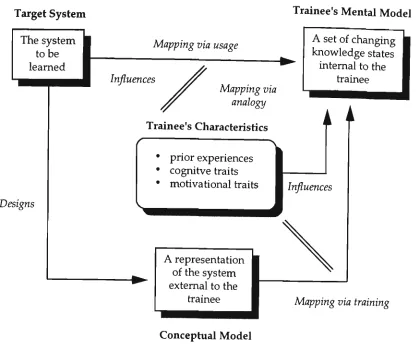
Figure 3.2: Mental Model Formation Process 57
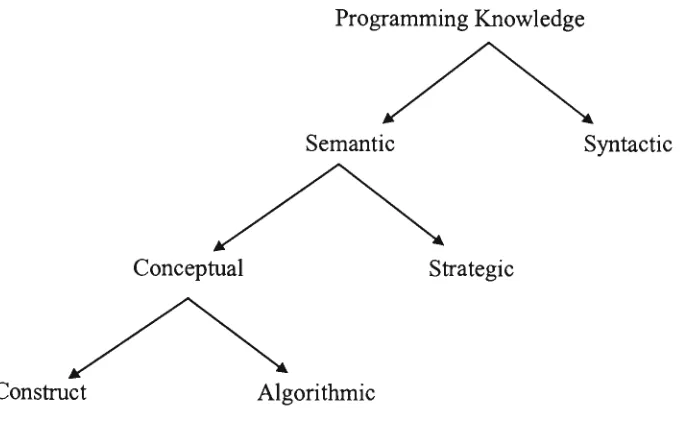
Figure 3.3: Sequential Classification of Programming Knowledge 5 8
Figure 3.4: Programming Tasks and Underlying Knowledge Bases 59
Figure 3.5: Programming Knowledge Combinations 60
Figure 3.6: Didactic Approaches 61
Figure 3.7: Level Setting For Textual C o m m a n d and Visual Factors 63
Figure 3.8: A Matrix Comparing Object-Oriented Products Based on Abstraction A n d Distribution 65
Figure 4.1: Structure of Research Design 83
Figure 7. 1: Scope of Information Systems Courses In Teaching Programming 192
List of Tables
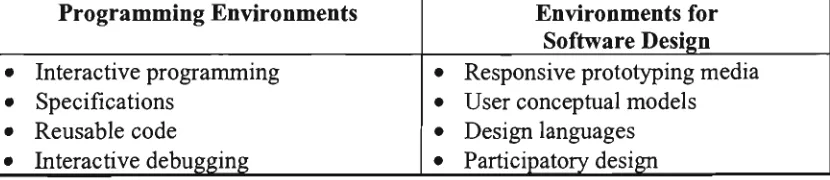
Table 2.1: Environments for Programming and Software Design 43
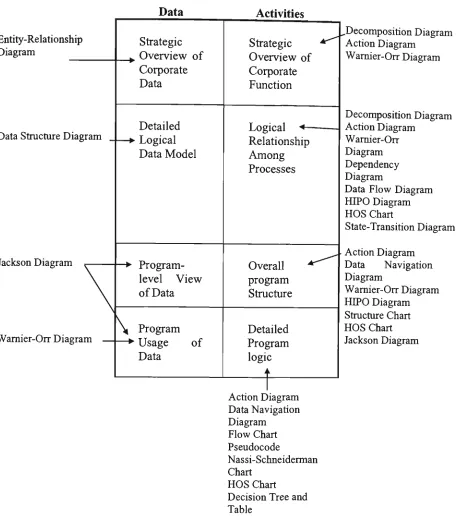
Table 2.2: Representation of Data and Activities for Procedural Programs 45
Table 4.1: S u m m a r y of Students Interviewed 86
Glossary of Acronyms
A C M Association of Computer Machinery (United States of America) A C S Australian Computer Society
C A E College of Advanced Education C S Computer Science
D E E T Department of Employment, Education and Training IS Information Systems
IT Information Technology
Chapter 1 - The Problem and its Significance
1.1 Introduction
Australia w a s one of the first countries to establish courses in Business Computing, later to be k n o w n as Information Systems, w h e n the C o m m o n w e a l t h Government required computing professionals for its growing administrative needs in the 1960's. Originally established in Colleges of Advanced Education ( C A E ) , they eventually spread to all Victorian universities. A s would be expected, the curriculum content of these courses has varied over the years in response to the changes in technology and the growing needs of business for information systems graduates. Programming, in some form and in varying degrees, has been an integral part of Information Systems courses throughout the years. Initially, procedural languages using structured programming techniques were the only choice of language but, in recent times, universities and colleges have been able to consider other languages from the object oriented and event-driven platform for their introductory programming subjects.
A change to a new programming paradigm, however, often necessitates changes beyond the subject content. Structured programming techniques is the popular design method for procedural languages such as Pascal, while object techniques can be adopted for object-oriented languages such as Smalltalk. Event-driven programming languages, although extremely popular in business, have not been used extensively as the platform in introductory programming subjects in information systems courses. Moreover, there is no recognised program design methodology for event-driven systems amongst systems developers and programmers nor is there a methodology for the teaching of these types of languages.
This study will, firstly, review the existing literature and, secondly, research the experiences of lecturers and students using event-driven programming languages in introductory programming
subjects in Information Systems courses. It will examine the experiences of a number of lecturers from Australian universities where event-driven programming has been adopted. It will then explore the experiences of students w h o used a n e w program design methodology to develop event-driven programs.
and issues related to cognitive science, skills and processes are discussed. N e w visual programming environments and alternative programming paradigms are investigated, and changes to the programming tasks, program design and programming skills are discussed.
Chapter 3 reviews the literature on the area of teaching with object-oriented and event-driven programming, A framework for teaching and learning to program is established. T h e impact of
object-based languages on teaching programming in introductory subjects in information systems courses is investigated. T h e small amount of literature available on event-driven programming in programming subjects is reviewed.
Chapter 4 explains the research rationale and methodology used in undertaking the study. The case study for the investigation of a n e w program design methodology is detailed. Each of the data collection methods is explained and the limitations of the methodology noted.
Chapter 5 outlines the findings from interviews with experts from universities who have adopted the event-driven paradigm into introductory programming subjects. Benefits and problems of the language are investigated in the light of the programming skills discussed in the literature. A clear need for a program design methodology is established and data from a pilot study is investigated. T h e chapter concludes by outlining a n e w program design methodology.
Chapter 6 analyses the results from the use of the program design methodology in an undergraduate and postgraduate introductory programming subject.
Finally, chapter 7 of the thesis reflects on the whole study by highlighting relevant issues that have arisen and pointing to future areas of research.
1.2 The Research Questions
In investigating the use of event-driven languages in introductory programming subjects a number of questions are considered in this thesis:
1. H o w do students in introductory programming subjects learn to program?
2. W h a t changes need to be m a d e to introductory programming subjects to accommodate event-driven programming platforms?
1.3 Information Systems as a Discipline
Over a period of 4 0 years, the Information Systems discipline has b e c o m e an essential part of business and government organisations in Australia. A s it has b e c o m e more sophisticated the Information Systems discipline has m o v e d from processing data to providing an information infrastructure with applications aligned to an organisational strategy (Longenecker, Feinstein et al., 1995: 4).
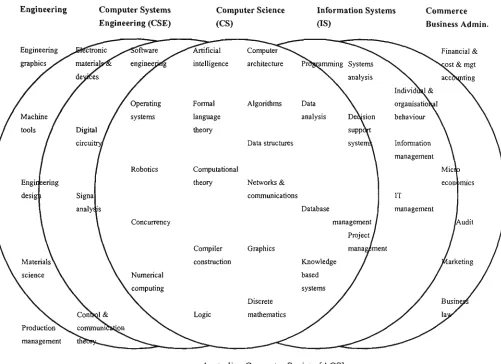
Engineering Computer Systems Engineering (CSE)
Computer Science (CS)
Information Systems (IS)
C o m m e r c e Business Admin.
Financial & pst & mgt Sypting
Production management
Institution of Engineers (Australia) [IE(Aust)]
Australian Computer Society [ A C S ]
Australian Society of Certified Practicing Accountants [ A S C P A ]
Figure 1.1: Scope of the C o m p u t i n g Studies and Information Science Disciplines
NB: The topic areas are indicative only and are not exhaustive. The orientation dimension, comprising basic research, applied research, product development and application areas (such as commerce, industry, government, libraries, land information and health) is orthogonal to this disciplinary dimension. Software Engineering is included as a subject area rather than a discipline.
Source: DEET et al, 1992: Figure 2.2
'designed to prepare or develop further the abilities of students to analyse information needs, functions, operations, procedures, physical systems and technical problems of an organisation to establish the feasibility of, and develop procedures for, automatically processing data by use of computers and communications networks' (DEET, 1992:16).
Computer science, on the other hand, concentrates on algorithmic processes and system software, while computer systems engineering involves the design and development of computer and communication components and equipment, and computer-based systems.
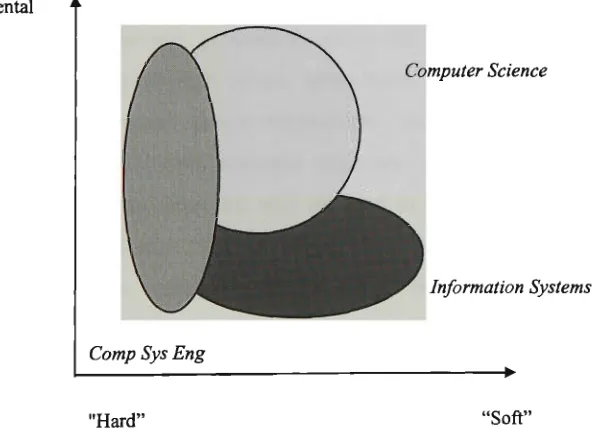
Figure 1.2 further highlights the differences between the three areas of computer science engineering, computer science and information systems. The m o v e m e n t along the horizontal axis ('hard' to 'soft') represents a spectrum from hardware oriented to more h u m a n involvement in the development of applications. Given the growth in recent years of computer use and, in particular end-user computing, it is understandable h o w information systems has changed during that period of time.
Fundamental
Applied
omputer Science
Information Systems
Comp Sys Eng
"Hard" "Soft"
Figure 1.2: Information Technology - Principal Subject Clusters Source: D E E T et al, 1992: Figure 2.1
responsibility to monitor n e w information technology (IT) and to assist in incorporating IT into the organisation's strategy, planning and practices. T h e systems development component of information systems involves the systematic application of techniques and methodologies to construct systems used for a range of organisational tasks such as data acquisition and storage, communication, data analysis and decision support. Issues of innovation, human-machine systems and user interfaces are often relevant w h e n creating information systems.
The nature and context of information system functions, however, has changed over the years as information technology has been m o v e d into most functional areas of organisations. Today, the function of information systems is often one of supporting innovation, planning and coordinating resources and systems, rather than one where a specialist or specialists are doing all the w o r k in isolation. Moreover, systems development concentrates heavily on individual and departmental application development in addition to the traditional role of supporting systems. This has required Information Systems curricula to train both specialists and to provide students from other disciplines with a knowledge of information systems functions and systems development.
Information systems will be used to denote all operations and procedures involved in the
design and implementation of an information processing system. T h e term implies the
integration of computer based components and manual operations to enable data to be collected, organised, saved, managed and retrieved as useful information ( D E E T , 1992: 16). Similarly, Information Systems will be used to denote a field of academic study in which curricula are designed primarily to educate people in the efficient and effective application of
computer hardware, software and systems to the solution of business and organisational problems (Tatnall, 1993: 4).
1.4 Information Systems Curricula in Australian Universities
w a s the last to establish an undergraduate program in Information Systems1. Today, each Australian university offers a range of computing courses including Information Systems.
There has been significant growth, particularly in recent years, in the number of specialised undergraduate courses that lead to a formal qualification in information technology. These
courses account for almost 7 0 % of the number of undergraduate courses in the information technology field D E E T (1992). At the same time, however, there has developed a greater flexibility in existing undergraduate programs, permitting n e w combinations of study leading to an increase in non-computing courses, that is, those with a computing content of at least 3 0 % within a non-computing field of study. In 1991, 3 6 % of information technology students were enrolled in courses of this type. These statistics reflect the extent to which Information Systems has permeated m a n y other disciplines and the demand for graduates with some Information Systems expertise.
It is not surprising then that a large number of new computing professionals in Australia are qualifying through Information Systems courses. The most recent statistics from D E E T (1992:
43) indicate that 2200 students are enrolled in computing courses at Australian universities that contain enough subject material to qualify graduates for Level 1 membership of the Australian Computer Society2. A t least 8 0 % of these students are enrolled in Information Systems courses (Tatnall, 1993: 4). Today, there is an increasing demand for graduates from Information Systems courses rather than computer science and engineering courses ( D E E T , 1992: 126).
Computer programming is viewed as a necessary skill for information technology
professionals. In 1990, D E E T released a report into the education and training needs of computing professionals in Australia ( D E E T , 1990). The report identified 15 groups of tasks undertaken by professionals and para-professionals within the computing profession. Their survey of each computing occupation indicated that only one group, System Trainers, were not involved in computer programming as part of their everyday work. Moreover, another study by D E E T (1992) on the relevance of course content to employer needs for entry level information technology graduates indicated that a knowledge of programming, particularly procedural and object oriented programming, w a s highly desirable (1992: 108).
The University of Melbourne has conducted IS courses through the Department of Librarianship and Information
Systems (originally as part of the old Melbourne C A E ) for a number of years. A Bachelor of IS was offered by
the Department of Information Systems in the Faculty of Science for the first time in 1996.
1.5 Programming in Information Systems Curricula
Computer programming, in some form or another is identified by the A C S as an important component of Information Systems education at the tertiary level. At Level 1, students must have a working knowledge of a programming language. Depending on h o w one defines computer programming, it is also part of the Level 2 and 3 requirements for A C S professional recognition.
There is, however, increasing debate on what constitutes a programming language. Prior to the development of powerful application programs, it w a s possible to identify computer
programming as a skill where programmers carefully composed programs from symbolic expressions in arcane and esoteric programming languages that prescribed the tasks that w e wanted our processes to perform (Abelson, Sussman et al., 1985: 1). Twenty years ago, according to Cooke (1990), the terms computer user and programmer were synonymous. In those times the owner of a computer almost certainly wrote programs. The developments in hardware and the increased sophistication of compilers, to mention just two factors, have m a d e languages less procedural and, in recent years, more visual, enabling the end user to develop programs through individual applications ( D E E T , 1990: 209).
Today, with the widespread use of application languages, 'computer user and programmer are again synonymous but this time, software developers are consciously trying to m a k e languages more powerful and easier to use' (Cooke, 1990: 211). Languages for application users are as friendly as possible and the 'computer's resources ease you into the language and guide you through it'(Cooke, 1990: 211). Languages for professional programmers, on the other hand, are geared towards 'someone w h o needs to get the most power and flexibility out of an application, ... and tend toward the complex and difficult'(Cooke, 1990: 211). Nevertheless, a computer program is still a set of rules that outlines an abstract being comprising computational process which operate on abstract things called data. In the world of the abstract, novice and professional programmers must learn to understand and to anticipate the consequences of sets of instructions, its impact on the data and the computational process, as well as on other elements such as hardware devices (Abelson, Sussman et al., 1985: 1).
Glinert (1990) emphasises that a person is required to work at two distinct but highly inter-related levels w h e n programming: at an abstract and at a concrete level. The abstract
was coding in a low-level language then the distinction between the abstract and concrete components of a language m a y not be as evident as it would if a high-level language w a s being used. A similar analogy could be used between text-based languages and visual programming languages (which manipulate objects). This implies that a programmer m a y require a different set of skills depending upon the type of language being used and, in particular, the level of abstraction above the machine-level code. In programming subjects that use visual programming environments with object-based languages a different set of skills m a y need to be taught from those where traditional procedural languages are used.
According to Cooke (1990: 214) 'perhaps the most important development in applications languages is the recognition that they are languages. If they are designed and implemented as languages rather than as automated key presses, you can expect them to b e c o m e m u c h better.' It is n o w possible to expand the range of programming languages to include not only the traditional languages from the procedural and object-oriented paradigms, but applications languages such as macros in spreadsheets and coding tools in windows-based applications. 1.5.1 Aims of Introductory Programming Subjects
The aims of introductory programming subjects in Information Systems courses in different institutions are as wide and varied as the discipline itself. The aims of these subjects often vary according to the specific requirements of the overall course, the level at which the subject is taught and the need to cater for external demands. Accordingly, an introductory programming subject is often taught to satisfy one or more requirements: to train in a specific language, to teach broad programming concepts or methodologies, or to develop or enhance problem solving skills.
Where the subject focuses on training, programming is taught to develop skills in the syntax of the particular language. T h e major emphasis in a subject of this type is on the syntax of a
processes that the person used to develop a solution to a problem. T h e language, in this case, would be used to implement a solution.
1.5.1.1 Problem Solving Skills
Irrespective of the primary aim of an introductory programming language, learning to program and to develop an algorithm is, in itself, a form of problem solving development. According to Linn (1985)
'Structured programming concepts require a programmer to explicitly use some potentially powerful problem-solving skills. A programmer must manipulate data using only a small set of primitive instructions; they must decompose a large problem into a series of smaller manageable tasks; and finally they should test the programmed solution and make changes to the
code'(p. 14).
When solving problems, Denenberg (1990) describes how many students have difficulty determining w h e n or h o w to use an experimental approach versus a method of simple deductive reasoning. M a n y science and applied science courses develop the a posteriori or empirical approach (effect to cause) while mathematics courses develop the a priori or deductive (cause to effect) approach. H e concludes that computer programming can be used as a vehicle to teach reasoning and problem solving skills and states
'there usually exist no courses to integrate the two methods or to develop the intuition of when it is appropriate to utilise one or the other, or both, in attacking a problem. Computer programming combines the methods of a priori and a posteriori reasoning and as such, can provide the necessary integrative vehicle' (p260).
In response to industry demand, many Information Systems courses concentrate on developing or improving students' problem solving skills ( D E E T , 1992). Programming subjects are part of this process. This contrasts with programming subjects in computer science courses where the focus is on teaching specific programming skills through the systematic study of algorithmic
processes (Longenecker, Feinstein et al., 1995: 10). Indeed, this emphasis on computer knowledge to the exclusion of other factors has been a source of major criticism of computer
science courses from both academics and business ( D E E T , 1992: 186).
In the past, students coming to computer science courses have had a background in mathematics and/or science3. It has been argued that mathematics is not only a language but involves problem-solving techniques (DeGrace and Hulet Stahl, 1990: 13), although there is considerable research to challenge DeGrace's view (Pea and Kurland, 1983; Kurland, Clement
3
et al., 1986; V a n Papstein and Frese, 1988; Linn and Songer, 1991; Turkle and Papert, 1992). This alternate view suggests that computer science students use their general cognitive skills in a programming subject to develop specific cognitive skills and processes in the programming domain (see Figure 1.3: Programming in a Computer Science Course).
Mathematics & Science Skills
General Cognitive Skills
\
Computer Programming I
\
Cognitive Skills & Processes
in Programming
Figure 1.3: Programming in a Computer Science Course
Students bring general cognitive skills, developed in mathematics and science subjects to the computer programming subject through which they develop specific cognitive skills and processes in computer programming.
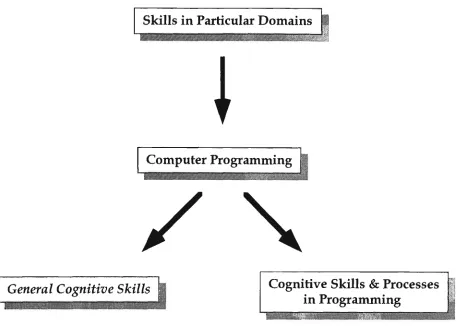
Skills in Particular
T
C o m p u t e r P r o g r a m m i n g jj
SHRmNSHHHBHIMHHHBHHHPh-General Cognitive Skills
Figure 1.4: Programming in Information Systems Courses
The programming subject aims to develop general cognitive skills as well as specific cognitive skills and processes in the programming domain.
1.5.1.2 Program Design
Traditionally, procedural languages have been used in introductory programming subjects and, almost by default, the design methodology has been structured programming. Procedural programs are constructed from statements that are precisely ordered and structured programming design not only acts as a method to ensure code is readable and maintainable but as a process for the development of a program solution. The main arguments expressed in favour of structured programming as a program design methodology are that it reduces the intellectual load when handling size-induced complexity, facilitates the maintenance and proving of design correctness, yields substantial improvements in program understandability and increased programmer productivity (Ratcliff and Siddiqi, 1985).
To obtain a solution to a procedural programming problem, a student is taught to adopt a classic or 'algorithmic' view of programming. Attention is focused on 'the smallest unit of a
program (ie. the statement), on the sequential arrangement and performance of those statements, and on the required precision with which these are created and sequenced' (Yourdon and Constantine, 1979: 31). Moreover, Yourdon (1979) argues that this view of programming necessitates a strict order of teaching programming to novices which
Domains
concentrates on finding a computational solution and on a detailed statement-by-statement translation of the algorithm. H e states:
'Some function or task is given; an algorithm or "method of computation " is selected, discovered, or created; this algorithm is translated into a language which the computer will accept' (Yourdon and Constantine, 1979: 31).
There has been, however, a steady m o v e m e n t away from the use of procedural languages in both industry and in introductory programming subjects. T h e steady m o v e m e n t away from text-based systems by both programmers and end-users has resulted in substantial productivity improvements in software development,
'...this is because the computer's ability to represent in a visual manner normally abstract and ephemeral aspects of the computing process such as recursion, concurrency, and the evolution of data structures through time, can have a remarkable and positive impact on both the productivity of programmers and their degree of satisfaction with the working environment'
(Chang, 1990: 145).
In recent years, tertiary institutions have adopted different programming paradigms into their programming subjects, in particular, object-oriented, object-based or event-driven languages.
Moreover, most of these languages work within a visual programming environment. Although program design methodologies exist for object-oriented languages, the newer windows-based and event-driven languages do not have any recognised design methodology.
In the past, structured programming was the automatic selection for procedural languages and the institution only had 'to determine just the applications domain, which could consist of scientific number crunching or commercial data processing, and the language level' (Glinert, 1990: 1). N o w , for the first time, m a n y tertiary institutions that are adopting different programming paradigms are being forced to develop their o w n program design methodologies.
1.5.2 Other Programming Paradigms
S o m e Information Systems courses have introduced object-oriented methodologies in design and implementation subjects, in specialist programming subjects and of late, in first year programming subjects using a variety of languages from Smalltalk to C + + . W h e r e pure object-oriented languages are used in introductory programming subjects, the complex interface of the editor and interactive debugger has deterred m a n y students from effective use of the language (Smith and Kelly, 1994). A s Tatnall & Davey (1995) report, attempts to introduced object-oriented programming into other subject areas have not been wholly successful:
This p h e n o m e n o n also seems to be mirrored in general practice and Jon Udell (1994) reports that
"The traditional OOP vision was, at best, vague on the subject of reuse: Objects would appear as by-products of software development, a market would emerge, and programmers would become producers and consumers of objects. There were two major roadblocks. Most OOP language systems , including
C + + , lack the means to package and distribute objects effectively in binary
form. More subtly, the skills and disciplines needed to build components are often quite different from those needed to use them' (Udell, 1994: 46).
Instead, event-driven programming languages have been advocated as an alternative to support applications development subjects. Students w o r k within an object environment but without producing their o w n objects. Event-driven languages such as Microsoft Visual Basic and Borland Delphi, introduce aspects of the object-oriented paradigm but are not classified in the strictest sense as pure object-oriented languages. Applications are developed from objects which are driven or triggered by an event. T h e program code behind each event is procedurally based. For the application to function as intended by the programmer, communication between objects via messages is required. A n object only responds to an event that has code placed behind it (Smith and Kelly, 1994).
Although the name may give the impression that these languages are visual programming languages, they are 'textual languages which use a graphical interface builder to m a k e programming decent interfaces easier on the programmer. T h e user interface portion of the language is visual, the rest is not'4. T h e objects refer not to visual data but to traditional data types such as arrays, and to application-oriented data types such as forms, lists, text and databases. In an ideal world, it would be advantageous to have a visual programming language that could combine and manipulate these objects using visual aids. In reality, the user or developer must revert to s o m e traditional procedural constructs to alter or combine these objects to develop an application.
The move to languages which have a visual component changes the processes people use to develop programs. W h e n using a text based language inexperienced programmers or end users use the syntax of the language to prompt for higher level concepts or semantic knowledge. With experience, this semantic knowledge is gradually separated from the syntax of a particular language and can be transferred to other languages. B y contrast visual programming enables
4
This description was taken from
the object to be selected and the operation to be performed immediately; there is no need for decomposition into multiple c o m m a n d s - '..each c o m m a n d produces a comprehensible action in the problem domain that is immediately visible' (Shneiderman, 1983: 326).
In the light of the increase in adoption of these new programming paradigms in tertiary programming subjects, it is important to examine the skills that are taught and the program design approach that is used. Currently, most ideas on what is important are based on the concepts of procedural programming, and this thesis addresses the changes of approach necessary w h e n a procedural paradigm is replaced with an event-driven programming language. Moreover, a program design methodology for event-driven systems is developed, trialed and evaluated for application to introductory programming subjects.
1.6 Significance of a Study in this Area
A characteristic of information technology is rapid change. Today, information processing is more integrated into business operations rather than existing as a separate service function. Information systems is a growing discipline within Australian universities while d e m a n d for computer science declines along with the other more traditional science disciplines. F e w other curriculum areas have developed so rapidly and there is a need to continually update curricula and program requirements. Computer programming has, for m a n y years, been a part of Information Systems curricula in one form or another. Whether at an introductory level or in electives, students design, construct and test computer programs. Like information technology, the role of computer programming is changing in business as users obtain tools to develop and customise applications, and as a consequence it is likely that the d e m a n d for trained professional programmers will decline in the future.
'As the field of programming has matured over the years, attention has shifted from the program to the programmer - from the logical and computational
structure of algorithms to the cognitive structures of the people who produce them. Innovations such as interactive programming environments, object-oriented programming, and visual programming have not been driven by considerations of algorithm efficiency or formal program verification, but by the ongoing drive to increase the programmer' effectiveness in understanding, generating, and modifying code' (Winograd, 1995: 65).
It is clear that a study of the changing role of computer programming in information systems curricula is an important one.
research methods are m o r e appropriate for a study of this type where there is a need to place 'emphasis on the human as instrument' (Tesch, 1990: 44). Moreover, in justifying qualitative
research Lincoln and G u b a (1985) state:
'Humans are the major form of data collection device'. As instruments, they
'can be developed and continuously redefined'... In fact, 'there is no reason to believe that humans cannot approach a level of trustworthiness similar to that of ordinary standardised tests '(p. 195).
Computer science has been taught in Australian tertiary institutions since the early 1960's. In the United States, attempts to formally outline a computer science curriculum began in 1965. Yet an Information Systems curriculum was not proposed in the United States until the early 1970's, with the publication of the Association for Computing Machinery's Graduate
Professional Program in Information Systems. In Australia, the first Information Systems conference to discuss common ground in courses was not held until 1989. Identifying the key
components of Information Systems curricula has not been as easy.
'Nailing down the fundamentals of this area has proved more difficult than
computer science as, being more concerned with the applications of computing, the development of Information Systems curricula has reflected many changes caused by the rapid development of information technology' (Tatnall, 1993: 12).
The increase in popularity of Visual Basic as a programming language is but one example of this rapid change in technology.
There will continue to be major changes in the programming profession in the very near future.
'The occupation so far contained by the single job description - computer
programmer - is fast splitting into two divergent streams. One group comprises user-programmers, people primarily employed or trained to do something else, but expected to dabble in programming for application-centric tasks, using increasingly user-friendly tools such as Visual Basic to do so. Another group comprises traditional skilled and trained programmers. The job specs (sic) for these people are beginning to converge on tool-centric tasks, the invention and development of high performance, high quality, reusable software components' (Goschnick, 1993: 20).
methods are being adopted by business, tools for their use are still cumbersome. Instead, businesses have adopted more practical languages such as object-based, event-driven programming languages which have offered productivity benefits for both the traditional programmer and the end-user. Although s o m e m a y be quick to point out the lack of purity of these languages as object-oriented they have become very popular and will need support from the increasing number of Information Systems graduates. It is n o w estimated that there are 2 million corporate programmers using Visual Basic; this is second only to C O B O L and far exceeds C + + (Van Kirk, 1995). A s Information Systems courses adopt the event-driven programming paradigm into their programming subjects, lecturers are being forced to reconsider the skills they teach to students and to find a design methodology that can deliver the essential features of event-driven systems development.
In justifying the need for research into the study of programmer behaviour Soloway et al (1986) states
'Broadly speaking, the basic assumption of researchers who study programmers is this: By understanding how and why programmers do a task,
we will be in a better position to make prescriptions that can aid programmers in their task, eg if we can understand how a maintainer goes about comprehending a program, we should be in a good position to recommend changes in documentation standards that would enable the maintainer to more effectively glean from the documentation the necessary information. Similarly, recommendations for software tools and education should also follow '(p.vii).
1.7 Summary
Numerous studies have tried to laud one procedural programming language over another but, in most cases, the skills and concepts and the methodology taught in the subject were the same. Changes are occurring in programming environments and there are pressures placed on Information Systems graduates to have a different set of skills and concepts. A s event-driven languages are n o w widely used in business, programming subjects in Information Systems courses are embracing this programming platform, often without considering the approach and methodology to be used.
Chapter 2 - Cognitive Skills and Program Design
A s the field of programming has matured over the years, attention has shifted from the program to the programmer, that is 'from the logical and computational structure of algorithms to the cognitive structures of the people w h o produce them' (Winograd, 1995: 66). A n y discussion of programming languages, processes and environments must examine our current understanding of the cognitive processes and skills which gradually evolve as a novice learns to program. This chapter reviews the literature on our current understanding of h o w novice programmers learn a range of programming tasks in the procedural paradigm. In addition, models of programmer behaviour and issues relating to cognitive science, skills and processes are discussed.
According to Dumas(1995), as programming tools and users become more sophisticated, large productivity gains are only accomplished through changes in the programming environment and in the ways programmers go about creating programs. The chapter concludes by investigating n e w visual programming environments and alternative programming paradigms and with a discussion of the changes to the programming tasks, program design and programming skills.
Starting with the cognitive aspects of well-understood programming tools, 'we can get insights into the demands for an environment that will support the ongoing development of computer
software in a rapidly changing industry' (Winograd, 1995: 66).
2.1 Problem Solving and Design
Despite all the progress that has been achieved in programming languages and environments since the early days of computing:
'.. it is an undeniable fact that we remain unable to bridge the chasm that
continues to separate the way we, as human beings conceive of solutions to problems from the way that we now must program these solutions for our
computers. True, our computing engines become more powerful from year to year, and our knowledge of how to use them advances, too. But our
expectations and demands rise even faster. The net result is that today, more than a quarter century since the dawn of programming, the central problem facing computer science is still to find a means by which we will be able to
Malhotra et al (1980) describe the act of solving a problem as a process which m o v e s a person from one state to another:
'A problem state is said to exist when a human, or other goal-oriented system, has a goal but no immediate procedure that will guarantee attainment of the goal. The goal may be a satisfaction to be achieved or a dissatisfaction to be alleviated. Problem-solving occurs in moving from a problem state to a non-problem state. In non-problem solving, then, a person begins in an initial state, uses
transformations that move him from one state to another, and ends in a final state. Any of these states and transformations may be well-defined or ill-defined' (p. 120).
Algorithm design, which 'typically occurs after the decomposition of a large system into modules and before the more straightforward processes to be accomplished by programmers,... involves transforming a declarative statement of what is to be done into a procedural
specification of how to do it' (Kant and Newell, 1984: 97). Using problem space theory, Kant and Newell (1984) describe the process of designing an algorithm:
'A problem space contains partial knowledge about a problem and its solution (the current state). The subject has a set of operators that can be applied to the current state to produce a new state. The subject starts with an initial state
(..the problem) and tries to discover a state that contains a solution (.. an algorithm). Behaviour in this space involves a search, since the subject usually does not have enough knowledge to proceed directly to the final desired state, especially if the problem is difficult. The subject does, of course, have some (often substantial) search control knowledge that guides the selection of which operators to apply. But in general the subject will try various paths and run out false leads into dead ends, causing a return to earlier states that can be
remembered (or constructed), and eventually will proceed down more appropriate paths. The current state grows throughout the problem solving, as the subject gradually explores the space and acquires knowledge of its various aspects, (p. 99)
Palumbo and Reed (1991: 343) define the set of knowledge, information, facts, and relationships needed to solve a particular problem as the task environment. The mental representation of this task environment is included in the problem space. Thus
'one needs both an accurate and complete task environment, providing that all the information necessary to solve a particular problem is presented and then is accurately encoded into working memory for a successful solution of a problem' (Palumbo and Reed, 1991: 344).
Often, however, the only a priori structure imposed on the processes that a programmer must follow is determined by the initial goal structure, that is, what the program should do:
Not all problems in the computing domain, however, are of the same type. S o m e problems m a y not have a clearly defined starting point from which the programmer or software developer can m o v e . In other cases, the goal state m a y not be clearly defined, or there m a y exist a myriad of
solutions open to the programmer. These types of problems are typical in software design even though the functional specifications m a y have outlined the broad aims of a system. A s a consequence, a programmer is often forced to use a combination of a priori (deductive - cause to effect) and a posteriori (empirical - effect to cause) approaches (Denenberg, 1990).
Vitalari and Dickson (1983) outline the processes that an analyst must use to determine information requirements and to synthesise a solution that meets the needs of the user.
Specifically, the focus is on the frequency, ordering, and association with analyst performance of the clues, goals, strategies, heuristics, hypotheses, information, and knowledge manifested in the thought process of the analyst' (p.949)
In contrast, algorithm design problem-solving belongs to an area of human problem solving which Reitman (1965) equates with 'ill-structured' problems. M a n y of the formal procedures, which m a y be used to solve well-defined problems, cannot be used by the programmer to solve design problems. 'Problem-solving behaviour in this domain characteristically cannot be specified minutely as a set of moves, selected from a small and finite initial state in order to derive a unique final or goal state' (Carroll, T h o m a s et al., 1985: 143). Moreover, 'a designer, typically, does not k n o w in advance what the goal state will be, although he (sic) usually has criteria to evaluate potential goal states. Indeed, the designer often does not even have a definition of the initial problem state' (Carroll, T h o m a s et al., 1985: 143).
In the process of solving a problem a programmer is faced with two distinct tasks; comprehending the structure of the problem and constructing a solution structure.
'The solution structure is that which the problem solver must construct in order to solve the problem. Solution structure consists, on the one hand, of the process of solution, a sequence of steps or stages (eg., "incubation"), and on
the other hand, of the more statically structured final product of the solution (ie., the "answer"). Problem structure may be decomposed into the inherent structure of the problem (formal relations between entities and an algebra for manipulating these relations) and the presentation of this inherent structure (the problem scenario, the sequence in which relevant facts are revealed to the problem solver, etc)' (Carroll, Thomas et al, 1980: 269).
An empirical study by Carroll et al (1980: 269) found that the structuring of requirements has an impact on the problem solution; that is, greater structure in the original problem statement
'problem situations become more complex as the relationships between elements in the problem space are more obscure, thus requiring more operations to construct an adequate problem solution. Problems where all the information is presented in the problem statement are, thus, much easier to solve than those with missing or obscure information' (p. 344).
This method of teaching concentrates on finding a computational solution and on the detailed statement-by-statement translation of the algorithm.
Over the years, tools have been developed to provide a structured approach to the analysis, design and construction of complex computer systems. Structured analysis and structured programming concepts have been used for procedural languages and various methodologies have been proposed for object-oriented systems development. These tools have outlined a set of procedures designed to assist h u m a n s solve complex problems. The need for these types of tools has been long recognised. In his famous letter to the A C M , Dijkastra (1968) wrote
'our intellectual powers are rather geared to master static relations and that our powers to visualise processes evolving in time are relatively poorly developed. For that reason we should do (as wise programmers aware of our limitations) our utmost to shorten the conceptual gap between the static program and the dynamic process, to make the correspondence between the program (spread out in text space) and the process (spread out in time) as
trivial as possible '(p. 147).
For procedural languages, Kraft (1977) argues that structured programming is a way of thinking or 'attitude, one in which programs are written for people rather than machines' (p.130). This point is shared by Ratcliff (1985 :78) w h o argues that, while structured programming in such forms as step-wise refinement certainly embodies a framework for disciplined design, it provides no specific means of determining the best decomposition from a number of alternatives; 'whilst w e have the knife, w e do not k n o w h o w to carve' (Ratcliff and Siddiqi, 1985 :78). Moreover, Waters (1993) believes that there is often too m u c h emphasis placed on the final product rather than on the process of developing a program
'A good program (and by extension, a good system) is an articulate, lucid and elegant statement of the function it is to perform. Like a good report, the writing is simply the final recording of the information. Much work has preceded it. The ideas are clear, the intent is clear and it is easy to
understand '(p. 47)
Although there are clear benefits from the use of a program design methodology, and they are advocated in the use and teaching of procedural and object-oriented languages, there does not
2.2 Programmer Behaviour
According to Armstrong (1989), computer programming is a simulation of h u m a n controlled processing. It is easy to understand w h y such an analogy can be m a d e as the processes that a h u m a n follows w h e n solving a problem which involve designing, planning, monitoring, testing
and evaluating, are similar to those used w h e n programming a computer, that is, specifying an outcome, designing a solution structure for reaching the outcome, and evaluating the efficiency of a system in terms of the desired outcome. Thus, 'modelling the machine that models the h u m a n provides a structure within which control processes can be understood and provides a vocabulary which can be used to articulate them' (Armstrong, 1989: 71).
Cognitive research on programming, however, depends in part on the work by cognitive psychologists in modelling mental processes. Conceptual models are an essential component of cognitive science and they have been used to explain the cognitive processes in programming at different stages. T h e models presented in this section are based on cognitive theories that are continually being developed and modified. Although the models m a y vary, they have as their core short and long term-memory. Short term m e m o r y is a limited capacity workspace that processes information occupying the immediate attention of the individual. Long-term m e m o r y is an unlimited store and holds the programmer's permanent knowledge. Surprisingly,
'cognitive theories of programming have not been elaborated to the extent that they provide alternative explanations of programmer performance. In fact, many of the theories are interesting applications of psychological principles to programming, but they have not been sufficiently elaborated for consistent practical application at a technical level' (Curtis, 1985: 7).
Some description of the rise in importance of cognitive science is pertinent as it provides a background to the explanation of mental models.
2.2.1 Cognitive Science
Prior to the development of a mathematical theory of computability, researchers believed there was a sharp distinction between the brain and the mind (Johnson-Laird, 1989); the brain w a s the physical object and the mind s o m e ghostly nonentity. Succeeding the invention of the programmable digital computer, an analogy w a s m a d e between the brain, which is controlled by the mind, and the computer, which is controlled by a program. A s there w a s nothing particularly 'ghostly' about a program, cognitive science, the study of the mind, w a s born.
In time, cognitive scientists began to question the merits of Behaviourism (or Human Factors). Behaviourists viewed psychology as a natural science, one in which the goal w a s to predict
entity and believed that h u m a n s were incapable of conscious actions progressing through mental stages. Any study of mental process would be fruitless as they believed that any evaluation was possible using stimulus-response studies utilising strict empirical methods
emanating from the natural sciences (Johnson-Laird, 1989).
In contrast, cognitive scientists
'... study how people perceive, organise, process and remember information.
They also study how people later use this information in comprehending new information or solving problems. Finally, they study how different cognitive abilities are distributed across people (Curtis, 1985: 2)
According to Johnson-Laird (1989), cognitive scientists believe it is possible to study mental processes as people process information or solve problems. In the computer, cognitive
scientists had a strong ally:
'The return to the study of the mind had a new metaphor in it's language - the computer. In the past, the mind had been likened to a wax tablet, a hydraulic system, and to a telephone exchange. Now, there was a new reaction to Dualism: brain and mind are bound together as computer and program. Yet the full power of the metaphor eluded people. It seemed to reside in the existence
of "machines that think". In fact, what the computer offered - or rather the theory lying behind the computer - was a new conception of psychological explanation. This conception is much more powerful than the earlier
mechanical analogies. Indeed, ... it is yet to be exhausted' (Johnson-Laird, 1989: 23).
The cognitive theories that have been developed attempt to illustrate how humans picture, store and retrieve information from their short and long-term memory. In addition, they attempt to explain how humans manipulate information to make decisions and solve problems, and how they implement their responses. A cognitive approach to solving a problem or making a
Conceptual Model
Programming Code
Mental Model
Figure 2.1: Goal of Cognitive Approach
Source: Adapted from Eberts (1987: 275)
In Figure 2.1, the conceptual model is a formal description of the computer hardware and operating system that is accurate, consistent and complete. This m a y be a virtual machine created by a high-level language. T h e mental model is the model that the programmer forms of h o w the computer system is manipulated b y a program; this mental model determines the programmer's actions and behaviours. The programmers mental model m a y change over time through interactions with the programming code in the various programming phases. This process highlights the problems m a n y inexperienced people have in developing computer programming skills. In the initial stages, it is often difficult for novice programmers to develop a mental model which accurately reflects the true conceptual model. A s they develop clearer mental models their knowledge of programming improves.
2.2.2 Cognitive Style and Cognitive Ability
Cognitive style (or processes) refers to the manner in which individuals process information,
that is, h o w they think (Foreman, 1990: 56). Over time individuals develop a preferred w a y of thinking, solving problems and interacting with the immediate environment. In terms of academic achievement, the various styles range on a continuum from field dependent to field independent learners. According to Foreman (1990), field independent learners are inclined to impose a structure on a problem if some logical pattern does not exist, whereas field dependent learners accept the status quo. Importantly, field independent learners have a greater degree of cognitive restructuring, a skill which enables them to interpret a problem and reformulate it into a series of structured concepts. Bostrom (1988), however, concludes that
Learning style is the only cognitive style variable that Bostrom et al (1988) believe could influence the learning of software.
Cognitive ability, on the other hand, is used to describe individual differences in performance (Foreman, 1990). Aptitude or intelligence is often used in reference to a persons cognitive
ability. Intelligence includes, amongst other factors, the ability to learn, to adapt to n e w situations, and to solve problems but little is k n o w n about the mechanism that causes individual differences in basic cognitive ability (Foreman, 1990). Moreover, 'an attempt to define basic ability or aptitude is fraught with philosophical issues' (Bostrom, Olfman et al., 1988: 231). Nevertheless, a person's cognitive ability is enhanced by the cognitive skills they possess or c o m e to possess, and the cognitive processes they use. Cattell (1987) divides cognitive ability into two categories based on cognitive function; crystallised ability and fluid ability. Crystallised ability is often used to describe the general ability of an individual whereas fluid ability is a specific ability. Crystallised ability is accumulated from previous experiences and involves applying that ability to n e w circumstances. Fluid ability is a skill that is needed to modify certain performance requirements. For example, general mathematical ability is acquired from previous experiences and, is thus a crystallised ability. O n the other hand, the ability to follow instructions is an example of a fluid ability.
Computer programming demands a large range of cognitive skills and abilities in the process of developing an algorithm to solve a problem. T h e c o m m o n method adopted by a programmer
towards algorithm design involves reformulating the problem into to a series of structured processes matching the logic of the program (Turkle and Papert, 1992). Field independent learners, it is claimed, have a greater propensity to tackle problems in this w a y (Foreman, 1990) as they have greater skills in cognitive restructuring than field dependent learners. Programming a computer, however, calls on a large range of cognitive skills making it difficult to match them to one particular cognitive style (Shneiderman and Mayer, 1979; Pea and Kurland, 1983). A s w e will see later, research has s h o w n that programmers do not necessarily use a structured, top-down approach to algorithm design in procedural languages (Ratcliff and Siddiqi, 1985; Turkle and Papert, 1992).
Moreover, some studies have suggested that there is a correlation between general mathematical ability (a crystallised ability) and cognitive skills required to learn programming (Koubek, Salvendy et al., 1989; Wilkes, 1991; Navrat, 1994).
Often, learning to program is a n e w experience for most people and fluid ability (eg. reasoning, spatial visualisation) m a y be equally, or even more important than general ability, particularly for non-procedural languages (DeGrace and Hulet Stahl, 1990; Foreman, 1990). The development of event-driven systems in visual programming environments is significantly different from the development of a main-line controlled procedural program. It cannot be assumed that the methods used to teach procedural programming to students or the previous mathematical knowledge possessed by a student, are applicable in an introductory subject using event-driven programming as the platform. Bostrom et al (1988) emphasises this point w h e n he states
'a host of mental-aptitude constructs have been examined in a learning environment by numerous researchers. Only a handful have been shown to be consistent predictors of learning or problem solving proficiency' (p.231).
2.2> General Cognitive Models
A n y model of programmer behaviour must outline the cognitive processes and the stages of knowledge acquisition that occur for novice and expert programmers. Moreover, it must outline the basic tasks of programming in terms of the cognitive structures programmers possess or come to possess, and the cognitive processes involved in using their knowledge or in gaining n e w knowledge. It should be sufficiently general in nature to accommodate the fundamental tasks of the different programming paradigms whether they be structured procedural programming, object-oriented programming, event-driven programming, or some other programming paradigm.
The general cognitive models presented here were formulated when procedural programming languages, such as C O B O L and Pascal, were the predominant languages. Despite some changes to accommodate n e w programming paradigms (such as Shneiderman (1983)) the basic models have remained intact and revolve around long-term and short-term memory. A greater number of novice and experienced programmers, however, are n o w programming computers at different virtual levels using a larger range of languages and processes than was available in the past. S o m e of these general cognitive models do not account for tasks which are n o w included in the programmer's domain such as screen design. Moreover, with the increased power of programming languages (particularly with event-driven languages) m a n y of the traditional tasks such as system design, interface design and algorithm design are closely linked (Malhotra, T h o m a s etal., 1980; Cooke, 1990; Wilkes, 1991).
2.3.1 Syntactic/Semantic Model
cognitive model was developed to explain five subtasks of programmer behaviour: composition, comprehension, debugging, modification and the acquisition of n e w programming concepts, skills and knowledge. Shneiderman and M a y e r used the research of Greeno (1973), w h o outlined the components of m e m o r y used during problem solving, to develop a m e m o r y model of programmer behaviour. The model has three interrelated m e m o r y systems:
Short-term m e m o r y - a relatively limited capacity store taking up to seven 'chunks' or items
an unlimited capacity store which contains the programmer's permanent knowledge and;
which has a storage capacity between that of short-term m e m o r y and long-term memory, and allows for the interaction of information between short-term and long-term memory. N e w structures m a y be developed in this m e m o r y area.
Long-term m e m o r y
Working memory
-Input from
perception
\
Short-term
Memory
Working
Memory
2
Long-Term Memory
Semantic and Syntactic Knowledge
Figure 2.2: Syntactic/Semantic M o d e l Components of M e m o r y in Problem Solving
Source: Shneiderman & Mayer (1979: 221)
stored in long-term m e m o r y . A n y n e w information or concept is stored back into long-term m e m o r y and action in the form of a solution is taken to solve the problem.
2.3.1.1 Types of Knowledge
Shneiderman and M a y e r (Shneiderman and Mayer, 1979) distinguished between two forms of knowledge stored in the long term m e m o r y of an experienced programmer. Semantic knowledge is a complex multilevel body of knowledge that '..consists of general programming concepts that are independent of specific programming languages' (p.222). This type of knowledge takes the form of a hierarchical structure ranging from low-level notions, such as what an assignment statement means, to higher level notions such as recursion, and sorting and merging algorithms.
'Semantic knowledge is meaningfully acquired by reference to previous knowledge, by example, or by analogy. There is a logical structure to semantic knowledge that is independent of the specific syntax used to record it. Semantic knowledge is further decomposed into computer and task-related domains. Semantic knowledge has to do with the actions and objects in the computer domain. The low-level actions might be assignment, iteration, conditional execution, input, output, synchronisation , etc. Higher level actions are algorithms for sweeping through an array, for sorting items, or for recursive binary tree search. Computer objects include the low-level data types such as booleans, integers, strings, real numbers, etc. Higher level objects include arrays, records, stacks, or threaded trees' (Shneiderman and Mayer, 1979: 5).
The semantics of the task domain can be decomposed into objects and actions. Actions and objects in the task domain are not necessarily related to a knowledge of computers
or programming. The task domain m a y be a business area such as stock control or accounting, or s o m e other discipline. In this case, a knowledge of the objects such as customers, stock or debtors is required along with a knowledge of the actions such as opening an account, or recording stock deliveries.