ABY
3: A Mixed Protocol Framework for Machine Learning
Payman Mohassel and Peter Rindal
Abstract
Machine learning is widely used to produce models for a range of applications and is increasingly offered as a service by major technology companies. However, the required massive data collection raises privacy concerns during both training and prediction stages.
In this paper, we design and implement a general framework for privacy-preserving machine learning and use it to obtain new solutions for training linear regression, logistic regression and neural network models. Our protocols are in a three-server model wherein data owners secret share their data among three servers who train and evaluate models on the joint data using three-party computation (3PC).
Our main contribution is a new and complete framework (ABY3) for efficiently switching back and forth between arithmetic, binary, and Yao 3PC which is of independent interest. Many of the conversions are based on new techniques that are designed and optimized for the first time in this paper. We also propose new techniques for fixed-point multiplication of shared decimal values that extends beyond the three-party case, and customized protocols for evaluating piecewise polynomial functions. We design variants of each building block that is secure againstmalicious adversarieswho deviate arbitrarily.
We implement our system in C++. Our protocols are up tofour orders of magnitudefaster than the best prior work, hence significantly reducing the gap between privacy-preserving and plaintext training.
1
Introduction
Machine learning is widely used to produce models that classify images, authenticate biometric information, recommend products, choose which Ads to show, and identify fraudulent transactions. Major technology companies such as Microsoft, IBM, Amazon, and Google are providing cloud-based machine learning services [4, 5,7, 2] to their customers both in form of pre-trained models that can be used for prediction as well as training platforms that train models on customer data. Advances in deep learning, in particular, have lead to breakthroughs in image, speech, and text recognition to the extent that the best records are often held by neural network models trained on large datasets.
A major enabler of this success is the large-scale data collection that deep learning algorithms thrive on. Internet companies regularly collect users’ online activities and browsing behavior to train more accurate recommender systems, the healthcare sector envisions a future where patients’ clinical and genomic data can be used to produce new diagnostic models and there are efforts to share security incidents and threat data, to improve future attack prediction.
Privacy-preserving machine learning based on secure multiparty computation (MPC) is an active area of research that can help address some of these concerns. It ensures that during training, the only infor-mation leaked about the data is the final model (or an encrypted version), and during prediction, the only information leaked is the classification label. These are strong guarantees that, though do not provide a full-proof privacy solution (the models themselves or interactions with them can leak information about the data [60,55,57]), provide a strong first line of defense which can be strengthened when combined with orthogonal mechanisms such as differential privacy [8, 45]. The most common setting considered in this line of work is a server-aided model where data owners (clients) send encrypted version of their data to multiple servers who perform the training procedure on the combined data or apply a (shared) pre-trained model to classify new data samples. Performance of these solutions has improved significantly over the years, leading to orders of magnitude speedup in privacy-preserving machine learning. Nevertheless, there is still a large gap between plaintext training and the privacy-preserving solutions. While part of this gap is unavoidable given the desired guarantees, the current state of affairs is far from optimal. In the three-party computation (3PC) setting with one corruption, following up on a large body of work [13,14,24,41], new techniques and implementations [46,10,31] have significantly reduced this gap, e.g. processing 7 billion AND gates per second. The MPC techniques for machine learning, however, are primarily limited to the two-server model and do not benefit from these speedups. They also only consider security against the weaker semi-honest attackers.
In this paper, we explore privacy-preserving machine learning in the three-server model. We emphasize this does not mean only three data owners can participate in the computation. We envision application scenarios where the servers are not considered the same as data owners. Each server can be an independent party or the representative for a subset of data owners. In other words, as long as we guarantee that at most one of the three servers is compromised, an arbitrary number of data owners can incorporate their data into the framework.
A natural question is whether directly applying the new 3PC techniques to machine learning algorithms would yield the same speedup for server-aided privacy-preserving machine learning. Unfortunately, when using existing techniques the answer is negative.
The first challenge is that the above-mentioned 3PC techniques are only suitable for computation over aZ2kring. This is in contrast with machine learning computation wherein both the training data and the intermediate parameters are decimal values that cannot be natively handled using modular arithmetic. The two most common solutions are to (i) represent decimal values as integers where the least significant bits represent the fractional part, and choose a large enough modulo to avoid a wrap around. This approach fails when performing many floating point multiplications, which is the case in standard training algorithms (e.g. stochastic gradient descent) where millions of sequential multiplications are performed. Moreover, a large modulo implies a more expensive multiplication that further reduces performance, (ii) perform fixed-point multiplication using a boolean multiplication circuit inside the MPC. Such a boolean circuit can be evaluated using either the secret sharing based [10] or the garbled circuit based [46] techniques, leading to a significant increase in either round or communication cost of the solution, respectively.
such as approximate activation functions (e.g. logistic function), and piecewise polynomial functions (e.g. RELU). The former is most efficiently instantiated using arithmetic secret sharing while the latter should be implemented using either binary secret sharing or Yao sharing. Standard ways of converting between different sharing types are costly and quickly become a major performance bottleneck.
Addressing the above challenges efficiently is even harder in presence of an attacker who behaves arbitrarily malicious.
1.1 Our Contribution
We design and implement a general framework for privacy-preserving machine learning in the three-server model with a single corrupted server. Our contributions are as follows:
1. New approximate fixed-point multiplication protocols for shared decimal numbers at a cost close to a standard secret shared modular multiplication, in both the semi-honest and the malicious case. For a single multiplication, we find that our protocol results in a 50× improvement in throughput and 24×improvement in latency compared to an optimized boolean circuit. For some machine learning operations, our fixed-point technique reduces the amount of communication by 32,768×and requires 80×fewer rounds. SeeAppendix 6 for details.
We note that the recent fixed-point multiplication techniques of [47] fails in the 3PC setting and certainly fails in presence of malicious adversaries. Our new techniques are not only secure against malicious adversaries but also extend to arbitrary number of parties.
2. A new general framework for efficiently converting between binary sharing, arithmetic sharing [10] and Yao sharing [46] in the three-party setting, that yields the first Arithmetic-Binary-Yao (ABY) framework for the three-party case with security against malicious adversaries (See Table 1). Many of these conversions are based on new techniques and are designed and optimized for the first time in this paper. Our framework is of general interest given that several recent privacy-preserving machine learning solutions [47, 43, 50] extensively utilize ABY conversions, and its use cases go beyond machine learning [25]. As we will see later, the techniques we develop for our ABY framework are quite different from the original two-party framework of [27], since secure three-party computation techniques deviate significantly from their two-party counterparts.
3. Other optimizations include adelayed re-sharetechnique that reduces the communication complexity for vectorized operations by several orders of magnitude and a customized 3PC protocol for evaluating piecewise polynomial functions based on ageneralized three-party oblivious transfer primitive.
4. We instantiate all our building blocks in both the semi-honest and the malicious setting, often re-quiring different techniques.
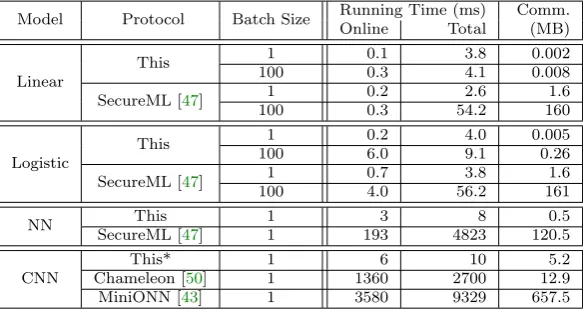
our neural network experiment can generate a handwriting prediction in 10 milliseconds compared to the state-of-the-art Chameleon [50] protocol requiring 2700 milliseconds.
1.2 Overview of Techniques
As a brief notational introduction, we defineJxKas the sharing of a secret valuex. This sharing will be one
of three types: 1) JxKA denotes an additive secret sharing ofx∈Z2k over the groupZ2k. 2)JxKB denotes a vector of kbinary secret sharing which encodes x∈Z2k. 3)JxKY to denote thatxis secret shared using keys which are suitable for evaluating a Yao’s garbled circuit[46].
Approximate fixed-point multiplication Our starting point is the semi-honest three-party secure computation protocol of Araki et al. [10] based on replicated secret sharing in the ring Z2k. This protocol represents a value x∈Z2k by linearly secret sharing it into three random values x1, x2, x3∈Z2k such that sum of them equals x. Each of the three parties is given two of these shares such that any two parties can reconstruct x. The first challenge in the use of replicated secret sharing is that it does not naturally support fixed-point multiplication and the fixed-point technique introduced in [47] fails in the three-party setting.
We design a new construction for this problem which can be reduced to computing JxK := Jx0/2dK given Jx0K and d. The solution generates an offline pair Jr0K,JrK ∈ Z2k where r = r0/2d. Given such a truncation pair, parties can truncate a shared value Jx
0
K by first revealing x
0 −r0 to all and jointly
computing JxK=JrK+ (x0−r0)/2d. We show that with high probability,xis a correct truncation ofx0 with at most 1 bit of error in the least significant bit. We also show how to efficiently generate the pair JrK,Jr0K
using high throughput techniques. This approach can be made secure against malicious adversaries and it is easy to see that it generalizes to an arbitrary number of parties.
Moreover, we show that fixed-point multiplication can be further optimized when working with vectors and matrices. In particular, the inner product of two n-dimensional vectors can be performed using O(1) communication and a single truncation pair.
Three-party ABY framework For training linear regression models, we only need to use arithmetic sharing, i.e. additive replicated sharing over Z2k where kis a large value such as 64. In logistic regression and neural network training, however, we also need to perform computation that requires bit-level oper-ations. The best way to perform such tasks is to either use binary sharing i.e. additive sharing over Z2
or Yao sharing based on three-party garbling [46]. The former is more communication efficient, with only
O(n) bits communicated for a circuit with n gates, but with the number of rounds proportional to the circuit depth, while the latter only requires 1 or 2 rounds but a higher communication cost.
We show efficient conversions between all three sharing types, with the goal of minimizing both round and communication cost. Please refer to Table 1 for a complete list of our conversion protocols and their cost. When compared to the original two-party ABY framework of [27], we reiterate that our conversion techniques, while functionally similar, differ significantly due to large deviations between 3PC and the less efficient 2PC techniques. To provide a flavor of our techniques, we review our new solution for converting an arithmetic share at the cost of a single addition circuit. ConsiderJxKA= (x1, x2, x3) wherex=x1+x2+x3.
Conversion Semi-honest Malicious Comm. Rounds Comm. Rounds
JxK
A→
JxK
B k+klogk 1 + logk k+klogk 1 + logk
(JxK A, i)→
Jx[i]K
B k 1 + logk 2k 1 + logk
JxK
B→
JxK
A k+klogk 1 + logk k+ logk 1 + logk
JbK
B→
JbK
A 2k 1 2k 2
JbK
Y→
JbK
B 1/3 1 2κ/3 1
JbK
B→
JbK
Y 2κ/3 1 4κ/3 1
JxK
Y→
JxK
A 4kκ/3 1 5kκ/3 1
JxK
A→
JxK
Y 4kκ/3 1 8kκ/3 1
Table 1: Conversion costs between arithmetic, binary and Yao representations. Communication (Comm.) is measured in average bits per party. x∈Z2k is an arithmetic value, b∈ {0,1} is a binary value,κ is the computational security parameter.
then inputs (x1+x2) while party 3 inputs x3 to a binary sharing 3PC that computes an addition circuit
that computes J(x1+x2)K
B+
Jx3K
B. Parties also locally compute binary sharing of two random values
Jy2K
B,
Jy3K
B which are revealed to parties (1,2) and parties (2,3) respectively. They then locally compute
Jy1K
B = (
J(x1+x2)K
B+
Jx3K
B)⊕
Jy2K
B⊕
Jy3K
Band reveal it to parties (1,3). This completes the semi-honest
conversion to the binary sharingJxKB = (y1, y2, y3). When using a binary sharing 3PC, we use an optimized
parallel prefix adder [36] to reduce the number of rounds from ktolog(k) at the cost of O(klogk) bits of communication. For a Yao sharing, we present an optimization which allows the conversion to be performed using k AND gates anda single round by leveraging redundancies in the replicated secret sharing.
But this approach is only secure against a semi-honest adversary. A malicious party 1 can use a wrong value in place of (x1+x2) which goes undetected since the addition is done locally. We can prevent this by performing the addition inside another malicious 3PC but this would double both round and communication cost. We introduce new techniques to avoid this extra cost in case of binary sharing 3PC. Consider the traditional ripple-carry full adder where the full adder operation FA(x1[i], x2[i], c[i−1]) → (c[i], s[i]) normally takes two input bits x1[i], x2[i] and a carry bit c[i−1] and produces an output bit s[i] and the
next carry bit c[i]. We modify the full adder to instead takex3[i] as its third input. It is then easy to see that x1+x2+x3 = 2c+s. As a result, k parallel invocations of FA in a single round to computec and
s and one evaluation of a parallel prefix adder circuit to compute 2c+sare sufficient to computex. This results in logk+ 1 rounds andklogk+kbits of communication which is almost a factor of 2 better than 2 logk rounds and 2klogk communication for the naive approach. Since the whole computation is done using a 3PC, the resulting protocol is secure against a malicious adversary if the 3PC is.
3PC for piecewise polynomial functions Piecewise polynomial functions compute a different poly-nomial at each input interval. Activation functions such as RELU are a special case of such functions and many of the proposed approximations for other non-linear functions computed during machine learning training and prediction are also of this form [43, 47]. While our new ABY framework enables efficient three-party evaluation of such functions, we design a more customized solution based on an optimized con-struction for the following two building blocks: aJbKB =JabKA (aknown by one party) andJaKAJbKB =JabKA
integerais the sender’s input. We design new protocols for this task with both semi-honest and malicious security that run in 1 and 2 rounds respectively and require between 2k to 4k bits. This should be of more general interest as piecewise polynomial functions appear in many applications and are a common technique for approximating non-linear functions.
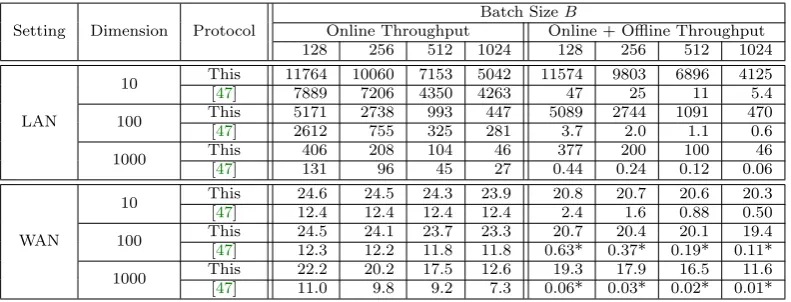
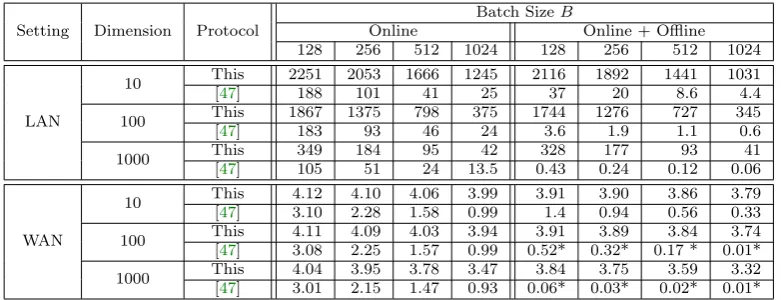
Implementation We implemented our framework in the semi-honest setting and demonstrate that it is faster than all previous protocols. In most cases, this framework improves the overall running time by 100 to 10000×(depending on training model, and problem size) while at the same time reducing the amount of communication. The tasks that we implement include linear, logistic regression and neural network training and evaluation for a variety of problem sizes.
2
Related Work
Earlier work on privacy preserving machine learning considered decision trees [42], k-means clustering [38, 16], SVM classification [63, 61], linear regression [28, 29, 53] and logistic regression [56]. These papers propose solutions based on secure multiparty computation, but appear to incur high efficiency overheads, as they do not take advantage of recent advances in MPC and lack implementation.
Linear Regression Privacy-preserving linear regression in the two-server model was first considered by Nikolaenko et. al. [49] who present a linear regression protocol on horizontally partitioned data using a combination of linearly homomorphic encryption (LHE) and garbled circuits. Gascon et. al. [32] and Giacomelli et. al. [33] extend the results to vertically partitioned data and show improved performance. However, they reduce the problem to solving a linear system using either Yao’s garbled circuit protocol or an LHE scheme, which introduces a high overhead and cannot be generalized to non-linear models. In contrast, we use the stochastic gradient descent (SGD) method for training which yields faster protocols and enables training non-linear models such as neural networks. Recent work of Mohassel and Zhang [47] also uses the SGD for training, using a mix of arithmetic, binary, and Yao sharing 2PC (via the ABY framework). They also introduce a novel method for approximate fixed-point multiplication that avoids boolean operations for truncating decimal numbers and yields the state-of-the-art performance for training linear regression models. The above are limited to the two-server model and do not extend to the three-server model considered in this paper. Gilad-Bachrach et. al. [35] propose a framework which supports privacy preserving linear regression. However, the framework does not scale well due to extensive use of garbled circuits.
Neural Networks Privacy preserving machine learning with neural networks is more challenging. Shokri and Shmatikov [54] propose a solution where instead of sharing the data, the two servers share the changes on a portion of the coefficients during the training. Although the system is very efficient (no cryptographic operation is needed at all), the leakage of these coefficient changes is not well-understood and no formal se-curity guarantees are obtained. In addition, each server should be able to perform the training individually in order to obtain the coefficient changes, which implies each server holds a big portion of a horizontally partitioned data in plaintext.
Privacy-preserving prediction using neural networks models has also been considered in several recent works. In this setting, it is assumed that the neural network is trained on plaintext data and the model is known to one party who evaluates it on private data of another. One recent line of work uses fully homomorphic or somewhat homomorphic encryption to evaluate the model on encrypted data [34,37,19, 15]. Another line of work takes advantage of a combination of LHE and garbled circuits to solve this problem [43, 52, 21]. Riazi et al. [50] and Liu et al. [43] each proposes efficiency improvements to the ABY framework and use it for privacy-preserving neural network inference. Chandran et al. [21] propose a framework for automatically compiling programs into ABY components and show how to use it toevaluate neural network models. These constructions are all based on two-party protocols and do not benefit from major speed-ups due to new 3PC techniques [10,31, 46]. They also only provide security against a semi-honest adversary. In Section 8we give an explicit performance comparison to these frameworks and demonstrate that ours is significantly more efficient.
Very few recent work consider privacy preserving training of Neural Networks. Mohassel and Zhang [47] customize the ABY framework for this purpose and propose a new approximate fixed-point multipli-cation protocol that avoids binary circuits, and use it to train neural network models. Their fixed-point multiplication technique is limited to 2PC.
To the best of our knowledge, [44] is the only work that considers privacy-preserving machine learning with malicious security and more than two parties. They use the SPDZ library [26] to implement privacy preserving SVM-based image classification and stick to arithmetic operations only and choose a large enough field to avoid overflows during computation. SPDZ provides security against a dishonest majority and hence inherits the same inefficiencies as 2PC. In contrast, we assume an honest majority.
An orthogonal line of work considers the differential privacy of machine learning algorithms [23,58,8]. In this setting, the server has full access to the data in plaintext but wants to guarantee that the released model cannot be used to infer the data used during the training. A common technique used in differentially private machine learning is to introduce an additive noise to the data or the update function (e.g., [8,45]). The parameters of the noise are usually predetermined by the dimensions of the data, the parameters of the machine learning algorithm and the security requirement, and hence are data-independent. As a result, in principle, these constructions can be combined with our system given that the servers can always generate the noise according to the public parameters and add it directly onto the shared values in the training. In this way, the trained model will be differentially private once reconstructed, while all the data still remains private during the training.
of information. In particular, a differentially private gradient of the current model is repeatedly revealed to the participating parties. This approach is also limited to the case where the training data is horizontally partitioned.
3
Preliminaries
3.1 Notation
Leti±1 to refer to the next (+) or previous (-) party with wrap around, i.e. party 3 + 1 is party 1, party 1-1 is party 3. We useκ to refer to the computational security parameter andλfor the statistical security parameter. Our implementation uses κ= 128 andλ= 40.
3.2 Three-party Secure Computation
3.2.1 Secret Sharing Based
Throughout our presentation the default representation of encrypted data uses the replicated secret sharing technique of Araki, et al. [10]. A secret valuex∈Z2k is shared by sampling three random valuesx1, x2, x3 ∈
Z2k such thatx=x1+x2+x3. These shares are distributed as the pairs{(x1, x2),(x2, x3),(x3, x1)}, where party i holds the ith pair. Such a sharing will be denoted as JxKA. Sometimes, for brevity, we refer to shares ofJxKA as the tuple (x
1, x2, x3), though we still mean the replicated secret sharing where each party
holds a pair of shares.
First, observe that any two out of the three parties have sufficient information to reconstruct the actual valuex. This immediately implies that such a secret sharing scheme can tolerate up to a single corruption. All of the protocols presented will achieve the same threshold. We briefly review these building blocks here. See Table 2 for the cost of each building block. To reveal a secret shared value to all parties, party
i sends xi to partyi+ 1, and each party reconstructsx locally by adding the three shares. To reveal the
secret shared value only to a party i, party i−1 sendsxi−1 to party iwho reconstructs the secret locally.
Arithmetic operations can now be applied to these shares. To add two valuesJxK+JyKall parties locally computeJxK+JyK=Jx+yK:= (x1+y1, x2+y2, x3+y3). Addition or subtraction of a public constant with
a shared value JxK±c=Jx±cKcan also be done by defining the three shares ofJx±cKas (x1±c, x2, x3).
To multiply a shared value JxKwith a public constantc we can define the shares ofJcxKas (cx1, cx2, cx3). Note that all of these operations are with respect to the group Z2k. To multiply two shared values JxKand
JyKtogether, the parties must interactively computeJxyK. First observe that,
xy=(x1+x2+x3)(y1+y2+y3)
=x1y1+x1y2+x1y3
+x2y1+x2y2+x2y3
Collectively the parties can compute all such cross terms. We define JzK=JxyKsuch that
z1 :=x1y1+x1y2+x2y1 +α1
z2 :=x2y2+x2y3+x3y2 +α2
z3 :=x3y3+x3y1+x1y3 +α3
For now ignore the termsα1, α2, α3 and observe that partyican locally computezi given its shares ofJxK
and JyK. However, we require that all parties hold two out of the three shares. To ensure this, the protocol specifies that party i sends zi to party i−1. We call this sending operation re-sharing. The additional
termsα1, α2, α3are used to randomize the shares ofz. We therefore require that they be random elements
of Z2k subject to α1 +α2+α3 = 0. Each party knows exactly one of the three values. Such a triple is referred to as a zero sharing and can be computed without any interaction after a one time setup where partyiobtains random keyskiandki+1 to a pseudorandom function (PRF)F. Then, thejth zero sharing
is obtained when party iletsαi =Fki(j)−Fki+1(j). For more details see [10].
The same PRF keys can be used to efficiently share a random value in Z2k . In particular, to share a random value for thejth time, partyiletsri =Fki(j), ri+1=Fki+1(j). Note that (r1, r2, r3) form a proper replicated secret sharing of the random value r=r1+r2+r3.
If, for example, party 1 wishes to construct a sharing of its private input x, the parties first generate another zero sharing α1, α2, α3. The shares of JxKare then defined as (x1, x2, x3) := (α1+x, α2, α3). The
sharing of xis completed by having party isend the share xi to party i−1.
The protocols described above work in the semi-honest setting where the parties follow the protocol as described. However, in the case where one of the parties is malicious, they may send the incorrect value during the multiplication or input sharing phases. The follow-up work of [31] presents highly efficient techniques to prevent such attacks. We, therefore, take for granted that all the operations discussed above can be efficiently performed in the malicious setting as well.
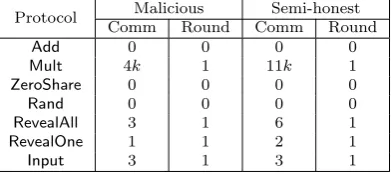
Protocol Malicious Semi-honest Comm Round Comm Round
Add 0 0 0 0
Mult 4k 1 11k 1
ZeroShare 0 0 0 0
Rand 0 0 0 0
RevealAll 3 1 6 1
RevealOne 1 1 2 1
Input 3 1 3 1
Table 2: Round is number of messages sent/received, Comm is number of bits exchanged, ring is Z2k
3.2.2 Arithmetic vs. Binary sharing
3.2.3 Yao sharing
Two-party sharing In the two-party setting, Yao’s garbled circuit protocol allows a garbler to encode a boolean function into a garbled circuit that is evaluated by a second party, called the evaluator. More concretely, the garbling scheme first assigns two random keys k0w, kw1 to each wire w in the circuit cor-responding to values 0 and 1 for that wire. Each gate in the circuit is then garbled by encrypting each output wire key using different combinations (according to the truth table for that gate) of input wire keys as encryption keys. These ciphertexts are randomly permuted so their position does not leak real values of the intermediate wires during the evaluation. The evaluator obtains the keys corresponding to input wires to the circuit which enables him to decrypt exactly one ciphertext in each gabled gate and learn the corresponding output wire key. The evaluator can decode the final output give a translation table that maps the circuit’s final output wire keys to their real values.
Various optimizations to this basic garbling idea have been introduced over the years, the most notable of which are the point-and-permute [12], Free-XOR [39] and the half-gate [64] techniques. These optimiza-tions require some modificaoptimiza-tions to how the keys are generated. In particular, the free-XOR techniques requires that kw1 = k0w⊕∆ for every wire w where ∆ is a global random (secret) string. To use the point-and-permute technique, we need to let the least significant bit of ∆ to be 1, i.e. ∆[0] = 1. The least significant bit of each key (pw⊕i=kiw[0]) is then referred to as thepermutation bit. As discussed in the two-party ABY framework [27], two-party Yao’s sharing of an input bit x for wire w, can be seen as one party holding k0w and ∆, while the other party holds kwx.
Three-party sharing Mohassel et al. [46], extend Yao’s garbled circuit protocol to the three-party setting with one corruption, and obtain security against a malicious adversary with the cost comparable to that of the semi-honest two-party Yao’s protocol. The high-level idea is as follows. Party 1 plays the role of evaluator and parties 2,3 play the role of garblers. The two garblers exchange a random seed that is used to generate all the randomness and keys required by the garbled circuit. They separately generate the garbled circuit and send their copy to the evaluator. Since at least one garbler is honest, one of the garbled circuits is computed honestly. The evaluator can enforce honest garbling behavior by checking equality of the garbled circuits.
The Yao sharing in the three-party setting, denoted byJxKY, can be seen as the evaluator holdingkxw
and the two garblers holding (kw0,∆). In the semi-honest case, a garbler shares its input bit x by sending
k0
w⊕x∆ to the evaluator. In the malicious case, both garblers send commitments to both keys (permuted), i.e. Comm(kwb),Comm(k¬wb) to the evaluator and the garbler who is sharing its input sends the opening for one of the commitments. The evaluator checks that the two pairs of commitments are equal (the same randomness is used to generate and permute them) and that the opening succeeds. The evaluator could share its input by performing an oblivious transfer with one of the garblers to obtain one of the two keys. Mohassel et al. remove the need for OT by augmenting the circuit such that each input wire corresponding to evaluator is split into two inputs bits that XOR share the original input. The circuit first XORs these two bits (for free) and then computes the expected function. The evaluator shares its input bit x by generating two random bits x2 and x3 where x = x2⊕x3 and sending xi to party i. The party i then
shares xi as it would share its own input, except that there is no need to permute the commitments since
party 1 knows the xis.
Parameters: ClientsC1, . . . ,Cm and servers S1,S2,S3.
Uploading Data: On input xi from Ci, storexi internally.
Computation: On inputf from S1,S2, or S3 compute (y1, . . . , ym) =f(x1, . . . , xm) and sendyi toCi.
This step can be repeated multiple times with different functions.
Figure 1: Ideal Functionality Fml
garbled circuit for the corresponding function and proceed as discussed above. All the two-party garbling optimizations such as free-XOR, half-gates and point-and-permute can be used in the three-party setting as well. Note that it is possible to not provide the evaluator with the translation table for output keys such that it only learns the output key but not its real value (hence remain shared). Moreover, it is possible to have the evaluator reveal output values to one or both garbler by sending them the output key. Note that due to the authenticity of the garbling scheme, the evaluator cannot cheat and send the wrong output key. To share a random value, Parties 2 and 3 generate random valuesr2andr3and input them to a garbled circuit that XORs them and lets the evaluator (party 1) learn the output keys. The shared random value is r=r2⊕r3.
4
Security Model
We use the same security model and architecture as SecureML [47] except that we extend it to the three party case with an honest majority and consider both semi-honest and malicious adversaries. In particular, data owners (clients) secret share their data among three servers who perform 3PC to train and evaluate models on the joint data. We observe that security in this model reduces to standard security definitions for 3PC between the three servers. Hence, we follow the same security definitions and refer to [10] and [31] for a formal description of these adversarial settings. Since all our building blocks are reduced to the composition of existing 3PC building blocks, their security is implied via standard composition theorems [18].
5
Our Framework
5.1 Fixed-point Arithmetic
We now detail how to perform decimal arithmetics by secret sharing fixed-point values.
A fixed point value is defined as akbit integer using twos-complement representation where the bottom
d bits denote the decimal, i.e. for positive values bit i denotes the (i−d)th power of 2. Addition and subtraction can be performed using the corresponding integer operation since the results are expected to remain below 2k. Multiplication can also be performed in the same manner but the number of decimal bits doubles and hence must be divided by 2d to maintain the ddecimal bit invariant.
5.1.1 Why technique of [47] fails
We start by reviewing the two-party fixed-point multiplication protocol of [47] and show why it fails in the three-party setting. [47] secret shares a fixed-point x using the ring Z2k as JxK := (x+r,−r) for some secret r ← Z2k. Addition and subtraction in Z2k naturally work but multiplication does not due to (two’s complement) division by 2d not being supported in Z2k. Consider having a standard sharing
Jx
0
K := JyKJzK over Z2k and desire to compute JxK := Jx0/2dK such that when x, y, z are interpreted as fixed-point values the quality x=yz holds (assuming the semantic values do not overflow) . Ideally both shares ofJx0K= (x0+r0,−r0) can be locally divided by 2dto obtain twok-bit shares
Jx˜K:= (
x01
2d,
x02
2d) holding the value x = x0/2d = ˜x. However, this final equality does not hold. First, there is a bad event that the divisions by 2d removes a carry bit from the firstd bits that would have propagated into the d+ 1th bit. That is, at bit position d of the addition x01 +x02 = (x0+r0) + (−r0) mod 2k a carry is generated (which we have eliminated due to separately dividing each share by 2d). However, this probabilistic error has a magnitude of 2−d and is arguably acceptable given that fixed-point arithmetics naturally has limited precision. In fact, [47] shows that this small error, does not have any impact on the accuracy of trained models when dis sufficiently large.
Unfortunately, a more serious error can also be introduced due to the values being shared in the ring modulo 2k combined with the use of twos complement semantics. In particular, the desired computation of
x0/2d is with respect to two’s complement arithmetics, i.e. shift the bits ofx0 down by dpositions and fill the topdbits with the most significant bit (MSB) ofx0. This latter step can fail whenx0 is secret shared in
Z2k. Take for examplex0 =−2k−1, which is represented in binary two’s complement as 100...000. We then
have that x0/2d is represented as 1...100...000 where there are d+ 1 leading ones. However, when secret shared, it is likely that both sharesx01, x02 have zero in the MSB. As a result, when they are divided by 2d, the two shares will have at least d+ 1 leading zeros. When these shares are reconstructed the result will be incorrect. In particular, the result will have d(or d−1) leading zeros and correspond to an incorrect positive value.
A simple case analysis shows that a necessary condition for this error is that the MSB ofx0 is opposite of both x01, x02. That is, the reverse of the example above can also result in this large error1. A clever fix to this problem is to maintain that |x0|<2` 2k wherex0 is interpreted as a two’s complement integer. This ensures that there is a negligible probability that the MSB of x01 is the same as x02. To see this, observe thatx01:=x0+r0, x02 =−r0 and that whenr0 6= 0 the sign/MSB ofr0 and −r0 are always opposite.
1In the reversed case, x0 1, x
0
When x0 is positive the probability ofx01 having the same MSB as x02 is the probability that the top k−`
bits of r0 are all ones and that a carry is generated at the `th bit of x0 +r0. Due to r0 being uniformly distributed, the probability that r0 has this many leading ones is 2`−k which can be made exponentially small for appropriately chosen `, k. A similar argument also holds when x0 is negative.
In summary, there are two sources of error when performing fixed-point arithmetics. When shares are individually truncated, the carry-in bit can be lost. However, due to this representing an error of magnitude 2−d, the resulting value is “close enough” to be sufficient in most applications. Indeed, the size of this error can be made arbitrarily small simply by increasing the size ofd. The other more serious source of error, which has very large magnitude, occurs when the individual shares are sign-extended incorrectly with respect to the underlying value. However, the probability of this event can be made very small.
Unfortunately the approach of truncating each share separately does not extended to three-party secret sharing where JxK= (x+r1+r2,(−r1),(−r2)). The first source of error now has magnitude 2−d+1 due
to the possibility of truncating two carry bits. However, a more serious issue is that bounding |x|<2` no longer ensures that the large error happens with very small probability. The necessary condition for this error is more complex due to the possibility of two carry bits, but intuitively, bounding |x|<2` no longer ensures that exactly one of the shares x1, x2, x3 will be correctly sign-extended due to r1, r2 both being
uniformly distributed and independent. To make such a secret sharing work, a constraint on how r1, and
r2 are sampled would be required. However, such a constraint would render the multiplication protocol
insecure.
5.1.2 Our Multi-Party Fixed-Point Multiplication
We present two new methods for performing three-party decimal multiplication/truncation with different trade-offs. While presented in terms of three parties, we note that our second technique can be extended to settings with more than three parties as well.
Share Truncation Πtrunc1 Our first approach minimizes the overall communication at the expense of performing multiplication and truncation in two rounds. The idea is to run the two-party protocol where one party does not participate. Since we assume an honest majority, the security still holds in the semi-honest setting. Let the parties hold a 2-out-of-3 sharing of Jx0K:= JyKJzK over the ring Z2k and desire to compute JxK=Jx
0
K/2
d. As in the two-party case, we assume thatx0 2k.
Parties begin by defining the 2-out-of-2 (x01, x02+x03) between party 1 and 2, and locally truncate their shares to (x01/2d,(x02+x03)/2d). The errors introduced by the division mirror that of the two-party case and guarantees the same correctness. The result is defined as JxK:= (x1, x2, x3) = (x
0
1/2d,(x02+x03)/2d−r, r),
where r∈Zk
2 is a random value known to parties 2,3. Note that party ican locally compute the share xi
and therefore JxK can be made a 2-out-of-3 sharing by sending xi to party i−1. One limitation of this
approach is that two rounds are required to multiply and truncate. Crucially, party 2 must know both
x02 and x03 where the latter is computed by party 3 in the first round of multiplication where the parties compute a 3-out-of-3 sharing of Jx0K := JyKJzK. Then party 3 sends x03 to party 2 who then computes
Parameters: A single 2-out-of-3 shareJx0KA= (x0
1, x02, x03) over Z2k, a positive integerd, and a pre-shared key
Kbetween party 2,3 for a PRFF.
1. Parties 2,3 locally compute a randomr∈Z2k by invokingFK(·).
2. Party 1,3 locally computex1:=x01/2
d.
3. Party 2 locally computesx2:= (x02+x03)/2d−rand sends this to party 1.
4. Party 3,2 locally computex3:=r.
5. OutputJyK
A := (x
1, x2, x3).
Figure 2: Semi-honest share truncation protocol Πtrunc1. Requires two rounds when composed with fixed-point multiplication.
Share Truncation Πtrunc2 The number of multiplication rounds can be reduced back to 1 with a more sophisticated technique which leverages preprocessing. First, let us assume we have preprocessed the shares
Jr
0
K,JrK=Jr
0/2d
Kwhere r
0 ∈
Z2k is random. Again, let us have computedJx0Kover the ringZ2k and wish to divide it by 2d. To compute the sharing ofx=yz/2dwe first revealJx0−r0K=Jx0K−Jr0Kto all parties2. Locally, everyone can compute (x0−r0)/2d. Parties then collectively computeJexK:= (x
0−r0)/2d+
JrK. Note
that this computation exactly emulates the two-party scenario and therefore the maximum error between
e
x and x=yz/2dwill be 2−dwith probability 1−2−k+` which is overwhelming for correctly chosen kand
` wherex∈Z2`.
This operation can be combined with the computation of Jx0K := JyKJzK and performed in a single round. Recall that standard share multiplication is performed in two steps, 1) locally compute a 3-out-of-3 sharing of Jx
0
K, and 2) reshare it as a 2-out-of-3 sharing. Between steps 1 and 2, the parties can instead
compute a 3-out-of-3 sharing of Jx0−r0K. Step 2) can then be replaced by revealingJx0−r0Kand defining
JxK:= (x
0−r0)/2d+
JrK. So the multiplication and truncation can be done in exactly one round and the
required communication is 4 messages as opposed to 3 in standard multiplication.
There are several ways to compute the pairJr0K,JrK=Jr0/2dK. The most immediate approach could be to use ΠTrunc1, but we choose to use a more communication efficient method using binary secret sharing that is also secure against malicious adversaries. First, parties non-interactively compute the random binary share Jr0KB. This sharing is locally truncated to obtain JrKB by removing the bottom dshares. To obtain the final sharing Jr0KA,JrKA, parties 1 and 2 jointly sample and secret share the values r20, r2 ∈Z2k and parties 2 and 3 sample and share r30, r3 in the same way (i.e. generating them using pre-shared PRF
keys). Parties then securely compute subtraction binary circuits, and revealJr
0 1K B := Jr 0 K B− Jr 0 2K B− Jr 0 3K B
and Jr1K
B :=
JrK
B−
Jr2K
B−
Jr3K
B to party 1 and 3. The final shares are defined as
Jr
0
K:= (r
0
1, r20, r03) and
JrK:= (r1, r2, r3).
This computation can be performed in parallel for all truncations in a preprocessing stage and hence has little impact on the overall round complexity of the protocol. As a result, we choose to optimize the overall communication (instead of rounds) of the addition circuit with the use of an optimized ripple carry full addition/subtraction circuit using k−1 and gates. As an additional optimization, the computation
of Jr1K can be performed in Z2k−d and therefore requires k−d−1 and gates per subtraction. In the
semi-honest setting, one of the subtractions ofr2, r3 can be performed locally by party 2.
Another advantage of this second protocol is its compatibility with the malicious setting. When the
Parameters: A single 2-out-of-3 (or 3-out-of-3) shareJx0KA= (x0
1, x02, x03) over the ringZ2k and a integerd < k.
Preprocess:
1. All parties locally computeJr0KB ←Rand((Z2)k).
2. Define the sharingJrKB to be the k−dmost significant shares ofJr0KB, i.e. r=r0/2d. 3. The parties computeJr02K
B,
Jr
0
3K
B←Rand((
Z2)k) andJr2K
B,
Jr3K
B ←Rand((
Z2)k−d). r20, r2 is revealed to
party 1,2 andr30, r3 to parties 2,3 using theRevealOneroutine.
4. Using a ripple carry subtraction circuit, the parties jointly compute Jr
0 1K B := Jr 0 K B − Jr 0 2K B − Jr 0 3K B,
Jr1K
B:=
JrK
B−
Jr2K
B−
Jr3K
B and reveal r0
1, r1 to parties 1,3.
5. Define the preprocessed shares asJr0KA:= (r0
1, r02, r03),JrK
A := (r
1, r2, r3).
Online:
1. The parties jointly computeJx0−r0KA and then compute (x0−r0) :=RevealAll(
Jx−r
0
K
A).
2. OutputJxKA:=
JrK
A+ (x0−r0)/2d.
Figure 3: Single round share truncation protocol Πtrunc2.
computation of Jx
0
K = JyKJzK is performed initially all parties hold a 3-out-of-3 sharing of Jx
0
K and then
reshare this to be a 2-out-of-3 sharing by sending x0i to party i−1. Additionally, a small proof πi is sent
demonstrating thatx0i is indeed the correct value. We propose that thisx0i and the proof is still sent along with the reveal of Jx
0−r0
Kwhich can be composed into a single round. However, it is possible for party i
to send the correct message (xi, πi) to party i−1 but send the incorrect reveal message xi−ri to party i+ 1. To ensure that such behavior is caught, parties i−1 and i+ 1 should maintain a transcript of all
xi−ri messages from party i and compare them for equality before any secret value is revealed. For a
more detailed description of the protocol and a security analysis, we refer the reader to Section 9.2.
Public Operations One useful property of an additively secret shared valueJxKAis thatc+JxKA,JxKA−
c, cJxKA for any signed integer c can be computed locally. When x is a fixed-point value, addition and subtraction naturally work so long as c is also expressed as a fixed-point value. For multiplication and a two’s complement integer c, the standard multiplication with a public value still works. Whencis a fixed point value, the result must be divided by 2d using the semi-honest Π
trunc1 or malicious Πtrunc2 protocol to obtain a sharing JcxK
A withddecimal bits. One byproduct of fixed-point multiplication is that division
by a public value c is now supported very efficiently , i.e. JxKA/c=c−1JxKA.
5.2 Vectorized Multiplication
For many machine learning algorithms the primary computation is matrix multiplication. This in turn can be implemented by a series of inner products, one for each row-column pair of the first and second matrices. Inner product is defined as ~x·~y:= Pn
i=1xiyi, where ~x, ~y∈(Z2k)n are vectors of nelements. A
naive solution would require n independent multiplication protocols and O(n) communication. We show how this can be optimized to only require communicating O(1) ring elements, and computing only one pre-processed truncation-pair Jr0K,JrK.
Recall from the previous section that semi-honest decimal multiplication is performed in two steps by first revealing the 3-out-of-3 sharing Jz0 +r0K = JxKJyK+Jr0K. The final product is then computed as
JzK := (z
0 +r0)/2d−
after which a series of local transformations are made. As such, the computation of the inner product can be written as J~xK·J~yK:= reveal((Pn
i=1JxiKJyiK) +Jr
0
K)/2
d−
JrK. Here, all parties locally compute a
3-out-of-3 sharing of each JxiKJyiK which are summed, masked, truncated, and reshared as a 2-out-of-3
sharing of the final result. As a result, only a single value is reshared. One additional benefit of this approach is that the truncation induces an error of 2−d with respect to the overall inner produce, as opposed to individual multiplication terms, resulting in a more accurate computation. More generally, any linear combination of multiplication terms can be computed in this way where the parties communicate to reshare and truncate only after computing the 3-out-of-3 secret share of the linear combination (as long as the final result does not grow beyond the 2` bound). The malicious setting is more complicated due o the fact that for each multiplication JxiKJyiK a proof of correctness must be provided. This would
immediately result in the communication increasing back toO(n) elements. However, we show that in the context of matrix multiplication this increased communication can be transferred to an offline phase. To compute JXKJYKthe parties first generate two random matrices JAK,JBKwhich are respectively the same
dimension asJXK,JYK. During the offline phase, the parties compute the matrix tripleJCK:=JAKJBKusing the scalar fixed-point multiplication protocol described in the previous section. Given this, the malicious secure multiplication protocol of [31] can naturally be generalized to the matrix setting. In particular, the parties locally compute the 3-out-of-3 sharing JZK:= JXKJYK and then party isends their local share Zi
to party i−1. Partyialso proves the correctness of Zi using the matrix triple (JAK,JBK,JCK) along with
a natural extension of protocol 2.24 in [31] where scaler operations are replaced with matrix operations. The online communication of this protocol is proportional to the sizes of X, Y, Z and almost equivalent to the semi-honest protocol. However, the offline communication is proportional to the number of scaler multiplication which is cubic in the dimensions of X and Y.
5.3 Share Conversions
For many machine learning functions, it is more efficient to switch back an forth between arithmetic (multiplications and addition) and binary (non-linear activation functions, max-pooling, averages, etc.) operations. In such cases, it is necessary to convert between different share representations. We design new and optimized protocols that facilitate efficient conversions between all three types of sharing: arithmetic, binary and Yao. We elaborate on these next. See Table 1 for the cost of various conversions.
Bit Decomposition, JxK
A →
J~xK
B We begin with bit decomposition where an arithmetic sharing of
x∈Z2k is converted to a vector of secret shared bitsx[1], ..., x[k]∈ {0,1}such thatx=
Pk
i=12i
−1x[i]. The
basic idea is that parties use their shares of JxKA = (x1, x2, x3) as input to a boolean circuit that computes
their sum. But we introduce several optimizations that significantly reduce rounds of communication and the communication complexity of this approach. Observe that JxKA = (x1, x2, x3) can be converted to
Jx1K
B := (x
1,0,0),Jx2K
B := (0, x
2,0),Jx3K
B := (0,0, x
3) with no communication3. Naively using the
text-book ripple-carry full adder (RCFA) circuit would require 2k rounds to compute RCFA(RCFA(x1, x2), x3) when performing 3PC on binary shared values. To avoid the high round complexity which becomes the bottleneck in our implementations, we first employ a parallel prefix adder (PPA) [36] which takes two
3
inputs and computes the sum using a divide and conquer strategy, totaling logkrounds andklogkgates. Once again, doing this naively would require two addition circuits. We show how to keep the cost close to that of a single PPA in both the semi-honest and the malicious setting, hence reducing both the round (only for binary sharing) and communication complexity by a factor of two.
First observe that the computation of x1+x2+x3 can be reduced to computing 2c+s by executing
k independent full adders FA(x1[i], x2[i], x3[i−1]) →(c[i], s[i]) for i∈ {0, ..., k−1} where c[i], s[i] denote
the ith bit of the bitstrings cand s. It is worth noting that traditionally, full adders are chained together to compute the addition of two bits and a carry in, however, here we used them to reduce 3 operands (i.e.
x1, x2, x3) to 2 (i.e. c,s) while using a single round of communication as opposed tok. The final result can
then be computed as 2JcK
B+
JsK
B using a parallel prefix adder. Alternatively, in the semi-honest setting
Party 2 can provide (x1+x2) as private input to a 3PC which computes JxKB :=Jx1+x2KB+Jx3KB. In both settings, this results in a total of 1 + logk rounds, which is significantly better than a factor of two increase in rounds and communication.
Bit Extraction, JxK
A →
Jx[i]K
B A special case of bit decomposition is when a single bit of the share
JxK
A should be decomposed into a binary sharing, e.g. the ith bit
Jx[i]K
B. This case can be simplified
such that onlyO(i)and gates andO(logi) rounds are required. While relatively simple, this optimization
removes all the unnecessary gates from the parallel prefix adder. As a result, the circuit logic only requires 2iandgates. We use this optimization in our implementation. For brevity, we refer the reader to inspect
[36] to deduce exactly which gates can be removed.
Bit Composition, JxK
B→
JxK
A It can also be required to convert a k bit value in the binary secret
share representation to an arithmetic secret share representation. Effectively, we use the same circuit as the bit decomposition with the order of operations slightly reversed. First, parties 1,2 input a random share J−x2K
B and parties 2,3 input a random share
J−x3K
B. These will be part of the final arithmetic
sharing and therefore the former can be known to parties 1,2 and the latter can be known to parties 2,3.
Jx2K
B can be generated by having parties 1,2 hold three PRF keysκ
1, κ2, κ3 and party 3 holdκ2, κ3. The
share is then defined as Jx2K
B := (F(κ1, N), F(κ2, N), F(κ3, N)) where N denotes a public nonce.
Jx3K
B
can be defined in a similar way with the roles shifted. The parties computeFA(Jx[i]KB,J−x2[i]K
B,
J−x3[i]K
B)→(
Jc[i]K
B,
Js[i]K
B) fori∈ {1, ..., k−1} and then
using a parallel prefix adderJx1K
B := 2
JcK
B+
JsK
B. In the semi-honest setting, this can be further optimized
by having party 2 provide (−x2−x3) as private input and compute Jx1KB :=JxKB+J−x2−x3KB using a parallel prefix adder. Regardless, x1 is revealed to parties 1,3 and the final sharing is defined as JxK
A :=
(x1, x2, x3). Overall, the conversion requires 1 + logk rounds andk+klogkgates.
Bit Injection, JxK
B →
JxK
A Another special case can often occur when a single bit x encoded in a
binary sharing needs to be promoted to an arithmetic sharing JxKA. For ease of presentation, we defer the explanation of this technique toSection 5.4where a generalization of it to efficiently computeaJxKB →JaxKA
is presented.
Joint Yao Input Recall that in Yao sharing of a bitx, party 1 (evaluator) holdskxx while the other two parties hold kx0 ∈ {0,1}κ and a global random ∆∈ {0,1}κ such thatk1
conversions to and from Yao shares is the ability for two parties to provide an input that is known to both of them. For example, parties 1,2 know a bit xand wish to generate a sharing ofJxKY. In the semi-honest setting, this is trivial as party 2 can locally generate and send JxKY to party 1 (who uses it to evaluate a garbled circuit). However, in the malicious setting party 1 needs to verify that JxK
Y actually encodes x
without learning ∆. In the current example, party 3 can be used to allow party 1 to check the correctness of the sharing by having party 2 and 3 send Comm(k0x),Comm(k1x) generated using the same randomness shared between them (party 2 can send a hash of the commitments). Party 1 verifies that both parties sent the same commitments and thatComm(kxx) decommits to kxx. This interaction requires two commitments, one decommitment and at most one round per input bit. In the case that x is known to parties 1,3 the roles of 2,3 above can simply be reversed.
When sharing many input bits (nλ, forλa statistical security parameter), we show that the number of commitments can be capped at 2λ. After receiving the input labelskx1
x1, ..., k xn
xn (without commitments)
and before revealing any secret values which are dependent on these input labels, party 1 computes λ
random linear combinations kc1 c1, ..., k
cλ
cλ of kxx11, ..., k xn
xn in (Z2)
λ with coefficients in
Z2. Parties 2, 3 receive
the combination from party 1 and both compute the λ combinations of k0x1, ..., k0xn to obtain k0c1, ..., kcλ0 . Using the same randomness, parties 2,3 send Comm(k0
ci),Comm(k 1
ci =k 0
ci⊕∆) fori∈ {1, ..., λ}to party 1
(one party can send hash of the commitments instead). Party 1 verifies that the two sets of commitment are the same and that Comm(kci
ci) decommits to k ci
ci for all i. The probability that party 1 received an
incorrect label and this test passes is 2−λ.
In the other case were 2,3 both knowx, it is possible to generate JxK
Y with no communication. Using
a shared (among all three parties) source of randomness, the parties locally sample kxx ← {0,1}κ. Parties
2,3 can then define k0
x :=kxx⊕(x∆).
Yao to Binary, JxK
Y →
JxK
B As observed in [27], the least significant bit of the keys (permutation bit)
form a two-party sharing ofx. i.e. x⊕px=kxx[0] wherepx=kx0[0]. Note that party 3 also knowspxsince it holds kx0[0]. Parties 1 and 2 locally generate another random bitr and party 1 sends kxx[0]⊕r =x⊕px⊕r to Party 3. This yields the following three-party replicated sharing JxK
B = (x⊕p
x⊕r, r, px) in a single round and with one bit of communication.
In the malicious setting, the bitx⊕b⊕rthat party 1 sends to party 3 must be authenticated to ensure that party 1 indeed uses b=px. Parties 1 and 2 sample krr ← {0,1}κ and party 2 sends k0
r := krr⊕(r∆) to party 3. Both party 2 and 3 send commitments C0 =Comm(kpxy ), C1 = Comm(kypx) to party 1 where
k0y :=kx0⊕k0r. Party 1 sends kyx⊕r :=kxx⊕krr to party 3 who verifies that it is in the set {ky0, k1y}. Party 1 also verifies that the commitment Cpx⊕x⊕r decommits tokxy⊕r and that both copies ofC0, C1 sent from party 2 and 3 are the same. Note that px ⊕x = kxx[0]. The parties can then compute the three-party sharing JxKB = (x⊕px⊕r, r, px). Observe that party 3 computes x⊕px⊕r askxy⊕r[0]⊕pr. In total, this conversion takes two rounds of communication, however, the final sharingJxKBis computable after a single round. It is therefore ok to use JxK
B after the first round so long as dependent values are not revealed in
that round. In the event that the verification steps fail, the parties should abort.
Binary to Yao,JxKB →JxKY LetJxKB = (x1, x2, x3). Parties jointly input the sharesJx1K
Y,
Jx2K
Y,
Jx3K
Y
technique, this does not require any communication between the parties and can be computed locally by party 1. In the semi-honest setting, this can be further optimized by observing that party 2 knows x2
and x3. They can therefore locally computex2⊕x3 and sendJx2⊕x3K
Y to party 1 who locally computes
JxK
Y :=
Jx1K
Y⊕
Jx2⊕x3K
Y.
Yao to Arithmetic, JxKY →JxKA To convert x ∈Z2k from Yao to arithmetic sharing, we could first switch from Yao to Binary and then perform the bit composition or bit injection (in case of a single bit) protocol, but since the inputs are in form of Yao sharings, we choose to use a garbled circuit 3PC for the CRFA addition circuit. Parties 1, 2 sample x2 ← Z2k and parties 2, 3 sample x3 ← Z2k and jointly input them using the procedures above. Then, using a garbled circuit parties compute Jx1K
Y :=
JxK
Y−
Jx2K
Y−
Jx3K
Y and reveal this to parties 1 and 3.
JxK
A= (x
1, x2, x3) forms the new arithmetic sharing
of x. This requires communicating k joint input bits (only x2) and 2k garbled gates. In the semi-honest setting this can be further optimized by having party 3 locally compute x2+x3 and provide it as private
input toJx1K
Y :=
JxK
Y−
Jx2+x3K
Y. As a result, the cost of the garbled circuit is reduced by a factor of 2.
Arithmetic to Yao, JxK
A →
JxK
Y Parties jointly input the shares of
JxK
A = (x1, x2, x3) to generate
Jx1K
Y,
Jx2K
Y,
Jx3K
Y. A garbled circuit can then be used to generate
JxK
Y :=
Jx1K
Y+
Jx2K
Y+
Jx3K
Y. In the
semi-honest setting this can be optimized by having party 2 locally compute x2+x3 and send party 1 the
sharing Jx2+x3K
Y who computes and the final sharing
JxK
Y :=
Jx1K
Y+
Jx2+x3K
Y.
5.4 Computing JaKA JbK
B = JabK
A
While converting between share representations allows for arbitrary combination of shares to be used together, it can be more efficient to provide custom protocols to directly perform the computation on mixed representation. To this end, we provide a mixed-protocol for performing JaKAJbKB = JabKA. This operation is needed repeatedly to compute piecewise linear or polynomial functions that are commonly used to approximate non-linear activation functions in training logistic regression and neural network models. All of these operations will take a shared binary bitJbKB and multiply it by an arithmetic (possibly shared) valuea∈Z2k and output an arithmetic sharingJcKA:=JabKA. The difficulty in constructing such protocols is that b∈ {0,1} is shared over Z2, i.e. b=b1⊕b2⊕b3. However, the result needs to be shared over Z2k as c=c1+c2+c3 mod 2k.
5.4.1 Semi-honest Security
Three-Party OT We begin by providing an oblivious transfer protocol in the three-party honest ma-jority setting. As with the two-party 1-out-of-2 OT case, we have a sender and a receiver. To this, we add a third party called ahelper who receives no output and knows the receiver’s choice bit. The functionality for the (sender, receiver, helper) can be expressed as ((m0, m1), c, c)7→(⊥, mc,⊥). Several previous work
consider multi-party OT [48,30,20,40], but to the best of our knowledge we are the first to consider this particular functionality with an honest majority.
mc. As such the helper sendswcto the receiver who can then recovermc. This procedure requires sending
3 messages in a single round.
Computing aJbKB =JabKA The simplest case is the multiplication of a public valuea∈Z2k known to party 1 with a shared bitb∈ {0,1}. First, party 3 (the sender) samplesr←Z2k and defines two messages,
mi := (i⊕b1⊕b3)a−r fori ∈ {0,1}. Party 2 (the receiver) defines his input to be b2 in order to learn
the message mb2 = (b2⊕b1⊕b3)a−r =ba−r. Note that party 1 (the helper) also knows the value b2 and therefore the three party OT protocol above can be used here. The parties then use locally generated replicated zero sharing (s1, s2, s3) to computeJcK=JabK= (s1+r, ab−r+s3, s3). However, to make this
a valid 2-out-of-3 secret sharing, c2 =ab−r+s3 must be sent to party 1. This would result in a total of
two rounds of communications. Alternatively, the three-party OT procedure can be repeated (in parallel) with again party 3 playing the sender with inputs (i+b2+b3)a−r+s3 fori∈ {0,1}so that party 1 (the receiver) with input bitb2 learns the messagec2 (notmb2) in the first round, totaling 6kbits and 1 round.
Computing JaKAJbKB =JabKA In the semi-honest setting, it is sufficient to run the aJbKB = JabKA
procedure twice in parallel. Crucial in this technique is to observe that ain the computation above need not be public. That is, party 1 could have privately chosen the value of a. Leveraging this, observe that the expression can be written as JaKJbKB =a1JbK
B+ (a
2+a3)JbK
B. Party 1 acts as the sender for the first
term and party 3 for the second term. In total 4kbits per party are communicated over 1 round.
5.4.2 Malicious Security
Computing aJbK
B =
JabK
A Unfortunately, our semi-honest approach fails in the malicious setting
pri-marily due to party 1 being free to choose the valueait inputs to the OT, arbitrarily. We avoid this issue by first performingbit injection onb. That is, we computeJbKB →JbKA and thenaJbKA =JabKA. As performed in Section 5.3, the parties can locally compute shares Jb1K
A,
Jb2K
A,
Jb3K
A where
JbK
B = (b1, b2, b3). We can
now emulate the XOR of these values within an arithmetic circuit by computing Jb1⊕b2K
A =
JdK
A :=
Jb1K
A+
Jb1K
A −2
Jb1K
A
Jb2K
A followed by
JbK
A :=
Jd⊕b3K
A. This conversion requires sending 2k bits over
two rounds. The final result can then be computed as JabK
A :=a
JbK
A where each party locally multiplies a
by its share of b. Compared to performing the generic bit decomposition from Section 5.3, this approach reduces the round complexity and communication by O(logk).
Computing JaK
A
JbK
B =
JabK Once again, the bit injection procedure can be repeated here to convert JbK
B to
JbK
A followed by computing
JaK
A
JbK
A using the multiplication protocol.
5.5 Polynomial Piecewise Functions