Acknowledgements
This case study is based on research conducted in 2013 by A/Prof Kitty te Riele, Dr Dorothy Bottrell and Dr Vicky Plows from The Victoria Institute at Victoria University, for the project Putting the jigsaw together: innovative learning engagement programs in Australia. Luke Swain, Esther Chan and Hendrik Jacobs contributed to preparing the case study reports.
We are grateful for the major funding provided by the Ian Potter Foundation and for the additional support from Dusseldorp Skills Forum, and from The Victoria Institute through the Australian Government’s Collaborative Research Network.
The research would not have been possible without the considerable assistance of coordinating staff in each case study site – and all the staff, students, community stakeholders, and graduates who made us feel welcome and offered us insights into their experiences and viewpoints.
Please note: All individual names are pseudonyms.
Creative Commons Licence
This publication is licensed under a Creative Commons Attribution 3.0 Australia Licence.
Attribution-NonCommercial-No Derivatives CC BY-NC-ND
Creative Commons Attribution 3.0 Australia Licence is a standard form license agreement that allows you to redistribute this publication, provided that you attribute the work. The reference for attribution is below. A summary of the licence terms is available from http://creativecommons.org/ licenses/by-nc-nd/3.0/au/. The full licence terms are available from http://creativecommons.org/ licenses/by-nc-nd/3.0/au/legalcode.
Please cite this report as: Plows, V., Te Riele, K. and Bottrell, D. (2014). Beacon program at Cressy District High School. Case study. Melbourne: The Victoria Institute for Education, Diversity and Lifelong Learning
For other products from this research project and related information, and to download this report please visit the website dusseldorp.org.au/priorities/alternative-learning/
CONTENTS
ACKNOWLEDGEMENTS 2
INTRODUCTION 6
ABOUT THE BEACON PROGRAM AT CRESSY DISTRICT HIGH SCHOOL:
BACKGROUND AND OVERVIEW 7
Context 7
Program governance and aims 9
Students 9
Staff 10
Timetable and Curriculum 10
Facilities 12
Key Dimensions 13
VALUED OUTCOMES 15
Positive pathways and planning 15
Enhanced employability 16
Student engagement 17
Confidence and raised aspirations 17
Strong school-community connections 18
ACTIONS 20
Strong support for pathway planning 20
Creating meaningful learning opportunities 22
Building school-community relationships 23
Parental engagement 24
Reflexivity and program evolution 25
PRINCIPLES 27
Positive pathways for all 27
Being aspirational 28
Everyone’s responsibility 28
Invest in relationships 29
CONDITIONS 30
Small school size 30
Strong community support 30
Strong leadership and strategic implementation 31
Commitment to resourcing 31
SUMMING UP: REMARKABLE AND DISTINCTIVE FEATURES 32
1) Less ‘alternative’ and more ‘innovative’ 32
2) Pathway planning as integrated into core business 32
3) Strength of the Beacon Foundation’s vision with the CDHS framework 32
4) Extensive partnerships 33
INTRODUCTION
This case study is based on research conducted in 2013 by A/Prof Kitty te Riele, Dr Dorothy Bottrell and Dr Vicky Plows from The Victoria Institute at Victoria University, for the project Putting the jigsaw together: innovative learning engagement programs in Australia. The project was majority-funded by the Ian Potter Foundation and also supported by Dusseldorp Skills Forum and by The Victoria Institute through the Australian Government’s Collaborative Research Network.
The research project explored options for marginalised young people to complete secondary schooling (Year 9-12 or equivalent) through innovative, flexible and/or alternative learning programs.
PHASE 1 - investigated the provision and diversity of such programs across Australia, with the results (listing over 850 sites) available through the Dusseldorp Forum website1.
PHASE 2 - analysed publicly available documentation from about 20 programs to generate insight in how they work and the outcomes they achieve. Short vignettes of each program are also on the Dusseldorp Forum website2.
PHASE 3 - involved more in-depth research with eight of those ‘vignette’ sites. For each program one member of the research team collected additonal documentation and spent 3-4 days on-site to observe activities and interview staff, students, community stakeholders and, where possible, graduates3.
0% 5% 10% 15% 20% 25% 30%
NORTHERN MIDLANDS LGA
AUSTRALIA
ABOUT THE BEACON
PROGRAM AT CRESSY
DISTRICT HIGH SCHOOL:
BACKGROUND AND OVERVIEW
Context
Beacon is a national non-profit organisation working primarily within schools serving areas of
socioeconomic disadvantage to address youth unemployment and foster engagement with education4.
The focus of this report is the Beacon program at Cressy District High School referred to subsequently as Beacon at Cressy. Cressy is a small rural town situated in the inner north of Tasmania, about 35 kilometres south of Launceston. Cressy has less than 700 residents. It is part of the Northern Midlands Local
Government Area (LGA), one of the largest rural local government areas in Tasmania5. About 12,000 people
reside in the Northern Midlands LGA in total6. The original inhabitants of the Northern Midlands area were
the Panniher Aboriginal people7.
The Northern Midlands LGA has different patterns of age-cohort demographics when compared to national averages. There is a lower percentage of young people aged between 15 and 24 years of age (10.9% compared to 13.3% nationally) and a substantially lower proportion of people aged 25 to 34 years of age (9.1% compared to 13.8% nationally, see Figure 1)8. There is a much higher percentage of 55 to 64 year
olds (14.9% compared to 11.6% nationally) and people aged 65 years and older (17.3% compared to 14% nationally) in the area9.
Working residents of the Northern Midlands LGA are most likely to be employed in the manufacturing sector and agricultural, forestry and fishing sector (17.3% and 16.9% respectively), with the next two biggest employment sectors being transport, postal and warehousing (7.9%) and retail (7.8%)10.
The labour market situation in the Northern Midlands LGA is comparable to the Australian average. The full-time employment rate for young people is slightly higher for the 15-24 year old cohort (43.4% compared to 40.4% nationally) but slightly lower for the overall population (56% compared to 59.7% nationally, see Figure 2)12. In contrast, the part-time employment rate is lower for the 15-24 year old cohort
(37.8% compared to 41.3% nationally) while higher for the overall population (32.4% compared to 28.7% nationally)13. The higher youth full-time employment rate may be an offset due to the high percentage of
older persons living in the Northern Midlands LGA.
Figure 2: Labour force status, percentage of age group14
The Northern Midlands LGA contains six schools – four public primary schools and two public district high schools (offering Kinder through to Year 10)15. There are no senior secondary schools or Colleges in the
immediate area that offer Years 11 and 12. The closest location for undertaking Years 11 and 12, TAFE or tertiary studies is Launceston.
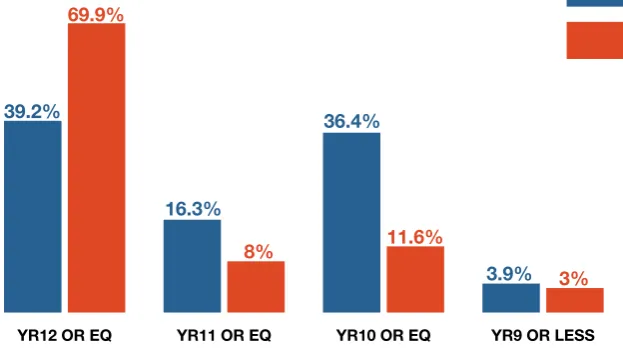
The completion rate of Year 12 or equivalent for 20-24 year olds in the Northern Midlands LGA is considerably lower than the national average (39.2% compared to 69.9% nationally, see Figure 3)16. In
contrast, Year 10 or equivalent as the highest level of schooling completed among 20-24 year olds is over three times higher than the national average (36.4% compared to 11.6% nationally)17.
Figure 3: Highest year of school completed, percentage of 20-24 year olds18
0% 10% 20% 30% 40% 50% 60% 70%
AUSTRALIA ALL AGES
NORTHERN MIDLANDS LGA ALL AGES
AUSTRALIA 15-24 NORTHERN MIDLANDS LGA15-24
Program governance and aims
Established in 1988, the Beacon Foundation (Beacon) is a national non-profit organisation currently working in over 110 secondary schools across all states and territories in Australia. Through harnessing the support of the community, the Beacon program aims to inspire and motivate students to increase their educational engagement and attainment and to choose a positive pathway that enables successful transition to employment, further education or training19. Specifically, these aims are achieved through:
• Increasing the number and strength of relationships between schools and businesses;
• Improving the capacity of schools to deliver good practice careers education;
• Increasing the capacity for secondary students to earn and learn; and
• Raising the future aspirations of secondary students20.
Schools can apply to become a Beacon School. Beacon representatives work within the schools with the aim to increase connections between students, school staff, parents, local business and community members. They run a range of career education activities and programs. The Beacon model is designed to be self-sustaining following the formal participation in the program for a period of up to five years. During that tine, schools are encouraged to embed the core principles of Beacon into their school approach. Schools then can graduate to ‘Platinum’ status based on good results in line with the Beacon vision21. Beacon launched a refined model of practice in 2014 with a focus on stakeholder capacity
building; full school approach; sustainable business-school partnerships; 21st century skills development; and real jobs22.
The Beacon Head Office is based in Tasmania, with staff located across Victoria, Queensland, New South Wales, Western Australia and South Australia. Beacon is largely funded by the private sector. The program relies on the contribution of time, resources, volunteers and knowledge from the business community and adequate resourcing and committed staff within the schools.
Cressy District High School (CDHS) is a government coeducational school for Kindergarten to Year 10. It became a Beacon school in 2005 and was awarded Beacon Platinum status in 2009. CDHS implements a number of activities and programs developed from the Beacon model as part of a school-specific approach, which they call the Inspiring Futures program. The vision for the Inspiring Futures program is for 100 percent of CDHS Year 10 students to go onto further education, training or employment once they leave school23. In
2013, the school sought to formally embed the Inspiring Futures program across all curriculum areas from Kinder to Year 1024, an approach in alignment with the refined Beacon model. This report focuses on the
Beacon program at the secondary school level only.
Students
Since 2001, 160 schools and approximately 87,000 students have participated in the Beacon program. Around 13,000 secondary school students are currently completing the program. Of the 127 schools involved in 2012, 15 were located in Tasmania, of which two, including CDHS, were Platinum schools25.
Beacon schools are primarily located in areas experiencing socioeconomic disadvantage, educational disadvantage or disproportionately high youth unemployment or disengagement26. In 2012 over 83% of
Beacon students were from disadvantaged communities27. Before starting in the Beacon program, 40% of
CDHS is a rural co-educational government school serving the Northern Midlands area of Tasmania. In 2013, 388 students were enrolled at the school: 180 secondary students (45 in Year 9 and 50 in Year 10), 180 primary level students and 28 students in kindergarten. Eight percent of the students in the school were Indigenous. The Index of Community Socio-Educational Advantage (ICSEA) value of the school is 920, meaning the student population of CDHS experiences relative disadvantage (the mean value is 1000)29.
With the integration of aspects of the Beacon program across the school curriculum and all school years, all CDHS students are involved to some degree with the program. This involvement is clearer and more intensive for Year 9 and Year 10 students.
Staff
The Beacon Foundation comprises of 7 board members, 5 executive staff, 7 head office staff and 14 additional state-based program staff30. Beacon staff roles include: business engagement, partnerships,
project management, research and evaluation, finance and administration. Over 290 teachers and 50 business partners across a range of employment sectors and 7,300 volunteers were involved in Beacon programs in 201231. Representatives from the Beacon Foundation work directly with a Beacon coordinator
within each school.
Every teacher at CDHS is involved in varying degrees with the Beacon program, as the program’s goals are in alignment with the school’s and the Beacon model is implemented across the curriculum. For example, all teachers are involved in professional learning about the Beacon Foundation, are encouraged to establish community networks, to link careers pathways into their curriculum and to facilitate real-world opportunities for students. In 2013 there were 35 teaching staff members and 22 non-teaching staff members at CDHS32.
Three staff members in particular led the Beacon program at the school: the Principal, the Inspiring Futures Coordinator (a full-time member of the teaching staff) and the Pathways Planning Officer (at the school 1.5 days a week). Additionally, Beacon Student Ambassadors, as part of the CDHS Careers Leadership Group, support the organisation and the running of the Beacon program. Community partners also make an important contribution to the delivery of the Beacon program at Cressy, for example providing opportunities for work experience and participating in mock interviews.
Timetable and Curriculum
Being a Beacon school means adopting a co-designed industry focused curriculum33:
The main ideals of Beacon are, they actually have a rounded curriculum that means that it lives in the subject and is something that you actually study. [...] So if this is really important, if one of your main goals is to have really positive futures and positive pathways for children, then how you’re going to achieve it needs to be in the curriculum. (Emily, staff)
The Beacon Foundation offers a suite of tools, activities and resources that support positive aspirations, engagement and transition within schools. What students participate in as part of their curriculum will vary but core Beacon activities include:
• Charter Signings: here Year 10 students publicly make a pledge that by the following year they will be in further education, employment or training. The pledge is made to an audience that includes local business and community members;
• Business Blackboard: this involves business visits to the school for sharing knowledge with students and linking real-life situations to the school curriculum;
• Career Education: here events such as the school’s work experience program or mock interviews are enhanced by the Beacon network and business support; and
• Industry Knowledge: this enables students and teachers to learn more about specific industries and careers.
Students also attend specific programs such as:
• High impact programs: one day workshops targeted at selected skills, such as the Polish program focusing on personal presentation and workplace communication skills, and the Work Readiness Series;
• Real Futures Generation: this encompasses school-based preparation and hands-on experience in consultation with the employer leading to specific employment opportunities34.
At CDHS the Beacon program is referred to synonymously with the Inspiring Futures program. While a number of discrete Beacon activities are run in the school, from 2013 the school has sought to formally integrate and embed the Inspiring Futures program across all curriculum areas and school levels from early childhood to Year 10. The program is implemented sequentially as students progress through the school. At the secondary school level an increasing number of activities and opportunities are provided at various points during the school year including:
• Guest speakers (subject based – during the year) (all school years) • Charter signing involvement (all school years)
• Charter signing (Year 10)
• Pathway planning folders (Years 7-9) and personal pathway profiles (Year 10) • Further and higher education visits (Years 7-10)
• College taster days and college master classes (Years 9-10) • College transition days and college enrolments (Year 9-10) • Work site and career-based excursions (Years 7-10) • Industry tours (Years 9-10)
• Student hosted Industry Expos for younger students (Years 8- 10) • Employers’ expectation workshop (Years 9-10)
• Polish program (Year 10)
• Regular work placements and work experience (Years 9-10) • Mock interviews, and cover letter and resume writing (Years 9-10) • Work inspiration pilot project (Year 10)
• CAPs (Careers Awareness Program) one day per week (Year 10) • Visits from former students (Years 7-10)
As the list shows, Beacon related activities at CDHS involve both in-school learning (such as working professionals visiting the school and sharing their knowledge) and off-site learning (such as work placements and college, university and industry tours, spending time with potential employees).
Facilities
Cressy District High School is on the main road running through Cressy. The school is made up of a number of buildings and facilities including a multipurpose hall, a Materials, Design and Technology (MDT) and Cooking block, IT and wet labs, library, drama room, art room, automotive study centre, a learning support centre, science centre, fully equipped kitchen, canteen, designated Kindergarten block, staffroom and the school office. There is also an oval, courts, play equipment and a school-based working farm35. Aside from
an office for the pathway planner to use, there is no dedicated space for the Beacon program within the school. The program occurs within the curriculum and in the everyday school spaces such as classrooms and multipurpose hall as well as off-site in work places and college/university visits.
Key Dimensions
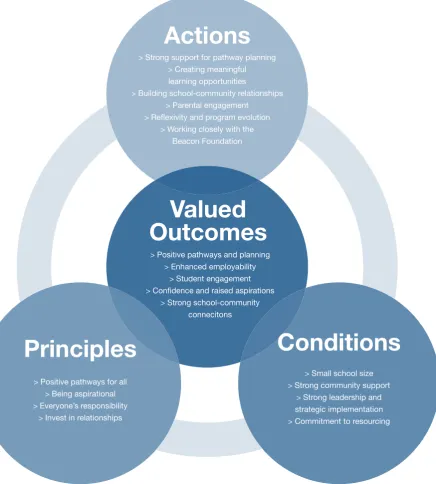
The remainder of this case study will report on four key dimensions of the work of alternative or flexible learning programs: Valued Outcomes, Actions, Principles and Conditions. These dimensions are
interrelated, which means some specific aspects (eg. pathways) may appear in several sections. Figure 4 schematically represents the dimensions.
Figure 4: Key dimensions - Beacon Program at Cressy District High School
Note:This model was developed by Kitty te Riele as Chief Investigator of the project team. Use permitted for non-commercial purposes and with attribution to Kitty te Riele and this report (see page 2 for citation guidance)
Conditions
Principles
Actions
> Strong support for pathway planning> Creating meaningful learning opportunities
> Building school-community relationships
> Parental engagement
> Reflexivity and program evolution
> Working closely with the Beacon Foundation
Valued
Outcomes
> Positive pathways and planning
> Enhanced employability
> Student engagement
> Confidence and raised aspirations
> Strong school-community connecitons
> Positive pathways for all
> Being aspirational
> Everyone’s responsibility
> Invest in relationships
> Small school size
> Strong community support
> Strong leadership and strategic implementation
These dimensions address aspects that are of relevance across alternative or flexible learning programs for marginalised young people. The specific detail within each dimension varies for each program and case study. The dimensions are:
• Valued outcomes: this addresses outcomes from the program that count as ‘success’ in the perspectives of key stakeholders: students, graduates, staff and community members. Evidence is provided for achieving those outcomes, based on interviews, fieldwork observations, and program documentation.
• Actions: this dimension refers to the actions carried out through the program that support the achievement of the valued outcomes. This offers practical insights in how successes are realised.
• Principles: underpinning the program’s practices are principles that produce a foundation for actions. These principles together form the (implicit or explicit) philosophy or vision of the program.
• Conditions: this dimension includes various conditions that enable or hinder people in a program to act on its principles and achieve valued outcomes.
Rather than pre-determining what counts as success, this section is based on the perspectives of students, staff and key stakeholders. What counts as success for Beacon at Cressy reflects the outcomes valued by the Beacon Foundation more generally. These valued program outcomes have, however, taken on a specific shape in the context of CDHS.
Positive pathways and planning
A highly valued and overarching outcome of Beacon at Cressy is “really positive futures and positive pathways for children” (Emily, staff). This outcome is not unexpected given that a core aim of the Beacon program is to provide more young people with positive pathways to further education, training or
employment once they leave school36. A core element is the ability of students to develop career goals
related to their interests and pathway plans to achieve those goals:
I guess you know you have been successful at Cressy when the students leave Year 10 and they have a clear understanding of what they want to do, what sort of person they are and what sort of person they want to become […] They’re not leaving Year 10 worried about next year, or having no idea what they’re going to do. They all have a pretty firm understanding of what their interests are and what that can lead to and what steps they need to take to get there. (Jessica, staff)
Jessica’s notion of success also reveals the value placed on students having knowledge of themselves and confidence in their choices and plans. Emily (staff) affirms this when she states:
The main aim for me is to make the students always confident in thinking about pathways. So to be exposing them to enough things about their future, that make them feel really positive and informed.
This is also reflected in community member Rob’s comments about the purpose of Beacon at Cressy as “to encourage the students to be forward-thinking and to take on something, rather than, ‘Oh, I can’t do it’” so that all students can go on to “further education or get into employment or trades”. It is also important to staff that students plan for multiple eventualities through having “a plan A, B and C” (Lucy, staff).
VALUED OUTCOMES
Valued
Outcomes
> Positive pathways and planning
> Enhanced employability
> Student engagement
> Confidence and raised aspirations
Evidence of success in this area is provided when students talk articulately about their career goals and detail the steps they need to take to get there:
Well, my ultimate goal is to gain an apprenticeship so hopefully it sort of sets me in good stead and I get the marks that I need and what employers want, to get the job next year. (Carl, student)
For some this includes back-up plans and keeping their options open:
I hope to get a career out of doing drama ... Once I’ve done Grade 10 I would really love to go to college and just succeed with college. I would like to go to NIDA, which is the National Institute of Dramatic Art, that’s in Melbourne and it’s a drama college, university. So I’d love to do that and if that doesn’t work out, I’ll go to UTas [University of Tasmania] and that’ll be my little plan. (Rosie, student)
I’m going on to college next year, so I’ve got three pre-tertiaries and two foundation subjects, and then hopefully from there I can follow a science-based career. I want to keep my doors open, so obviously English and Maths are really important. (Simone, student)
Lucy (staff) also sees success in terms of students achieving the marks they need for a positive transition: “ultimately that is success – the big tick; they’ve been successfully placed into the course they wanted to get into”. The transition of the majority of Year 10 CDHS students into further education, training or employment (97% in 201337) evidences success in this area and is as Carl (student) states “why we’re a
platinum school”.
Enhanced employability
Linked to the positive pathway plans is the outcome of enhanced employability. This involves increasing students’ career knowledge and skills valued in the workforce. The vast majority of students involved with Beacon programs nationally state that the program helped them to improve their knowledge of different working industries, improved their personal learning aspirations or improve their skills that will improve their future employability38. At CDHS, staff value the range of knowledge and skills students gain that prepare
them for the world of work:
Our goal for teaching Year 10, and probably throughout, is to give them the edge in the workplace. Whether it’s academically and knowledge-based – that they have really good marks – or whether it’s giving them the edge with their personal or interpersonal skills and how they relate to other people and the first impression they make, or we try to get them the edge with understanding cultural diversity, so they’ll go into a workplace and be a bit more sensitive to people of different cultural backgrounds. (Jessica, staff)
Students also value developing work-related interpersonal and self-presentation skills. Kirsty (graduate) reflects that she “certainly gained maturity and life skills” and Simone (student) discusses her learning from the Beacon Polish program:
Polish is for all the Grade 10s. This year we got split into two groups, but they have two
Students also value getting insider knowledge about different industries and professions – and gaining an awareness of employer, as well as employee, appropriate behaviour: “it’s good to meet them. They tell you different information, like what you should be paid and they give us ideas” (Carl, student).
Student engagement
An important measure of success for Beacon at Cressy is the engagement of students with the program and thus the engagement of students with learning at the school. Emily (staff) talks about this in terms of “raw data” - “the children who actually go on, retention rates” and “the number of children who get involved with the different things that we offer” at the school. Beacon programs are directly attributed with supporting student engagement at the school. As Lucy (staff) explains: “we’ve got some really disengaged students who have found a foothold for staying in this school because of these extracurricular programs we’ve put into the curriculum”. She argues that “pathways gives them purpose to why they’re at school”. Current and former students do not talk directly about educational engagement but do talk enthusiastically about all of the “opportunities” that are afforded to them through Beacon at Cressy including those related to transitions “the teachers here give you lots of opportunities to experience different occupations and different career paths” (Simone, student) and becoming a Beacon student ambassador:
I’m actually a careers leader in the Beacon program here at Cressy […] I’ve always wanted to do it since I was in primary school. I always looked up to the people that were in the leadership group and thought “I want to do that myself”.
For Emily (staff), this coveting of the Beacon Ambassador positions by students is a sign of success:
Our most prestigious position in the whole school, even more than school leaders like the school president, is actually to be a Beacon Ambassador. To me that was a bit of a tick that we’re really getting to where we want to be. (Emily, staff)
Confidence and raised aspirations
program is important: “having children taking control of their region” is “a real sign” of achievement (Emily, staff). This occurs at the Charter Signing events:
Every time they have a signing of the charter, I’m just amazed at the community people that come to that. That’s from politicians down, that they want to be here. That is run by the children themselves. They chair it, they organise it, they introduce people and they do it with such confidence. They feel comfortable doing it. So with all these high profile people that are there, it doesn’t daunt them. (Rob, community member)
Students in leadership roles within Beacon at Cressy recognise that they have responsibilities, as Simone (student) explains:
I think we were called last year ‘the face of the school’, so we have to always be on our game. [...] So we get, I think, a lot more opportunities than others, but we also have that extra pressure on us to make sure that we do represent the school in a really high and positive manner.
Raised aspirations is also about career knowledge, a successful outcome is when “the students are fully informed of all the choices out there” (Lucy, staff). This extends beyond the students to families being fully informed: “I certainly think that [Beacon] gives families a wider opportunity to understand where students can take their careers” (Kirsty, graduate). Jessica (staff) emphasises the importance of this outcome, in the context where “students may be some of the only people in their family that are actually looking at college or further education”.
Strong school-community connections
Having strong school-community relationships and connections is another highly valued outcome from the perspective of staff and students. Of the schools involved in the Beacon program in 2013, 98 percent reported that their school and students had increased their connections to local businesses39. At CDHS, the
staff aim for students to “feel connected to their school and to their community” (Emily, staff) and to “make sure everyone has some sort of program that connects the school to industry” (Lucy, staff). Students also recognise the importance of the school being connected with the community and believe that “over the years the connection’s just grown stronger and stronger” (Simone, student).
at these events is indicative that “a lot of the business people are really proud of that connection” to the school. It is also about the school’s success in fostering parental support for Beacon at Cressy. Lucy (staff) provides a counterfactual example: “We don’t have parents complaining that their child’s future is uncertain. Everyone is involved in the process of preparing students so everyone is informed.”
Further, Kirsty (graduate) suggests the “engaging of external professional community members, parents” is a valued outcome because it gives “students connection to the real world”. At a national level, the Beacon Foundation reports that 91 percent of schools found a noticeable positive change in the way the community perceived the school due to the partnership with Beacon . Rob (community member) describes the positive impact of an interaction between an important community member and Beacon at Cressy students:
I brought one of our councillors to the signing of the charter about three years ago. He was blown away. Now he’s out in the community all the time. He said the thing was that the students were the MCs, they met us all at the door, they carried all the speeches out, they did all the thankyous – he was blown away by it.
This is, as Emily (staff) puts it, an “incredibly big thing” because prior to the school’s adoption of the Beacon program:
To achieve the outcomes that are valued, Beacon at Cressy uses a range of actions. Many are familiar from across many alternative and flexible learning programs. Each is given its own shape within Beacon at Cressy, especially because it has been embedded across a whole, conventional school, in contrast to other alternative programs that tend to be somewhat more separate from mainstream educational provision. The categories of actions that were most prominent for Beacon at Cressy reflect both the Beacon model and the school ethos, as discussed in detail below.
Strong support to pathway planning
Fundamental to achieving many valued outcomes is the provision of strong support for pathway planning within the school in the programs developed by the Beacon Foundation and in integrating the Beacon model in the curriculum. Strong support for pathway planning means “it’s what you do and it’s your core business and it’s your main business, it’s not an add on” and that “every teacher is committed to teaching about how that subject has relevance in the world of working, in pathways and in future learning and connections with the community” (Emily, staff). This action is visible in staff commitment to setting and reviewing career goals with students which gives students a purpose to engage with their studies:
Yesterday I sat down with one Year 10 student, “I need to review your goals. What are your goals?”. He replied, “I want to get into this”. I showed him the marks he’s sitting on at the moment and explained how he needed to lift his game. From that moment studying then became so much more relevant and purposeful. (Lucy, staff)
Staff members also explicitly focus on skills related to improving the employability of students. This includes employment specific activities, such as “[writing] resumes, taking on part-time jobs, and preparing for mock interviews” (Lucy staff) and “workplace-based skills as well as literacy” (Jessica, staff) integrated into the curriculum. The Beacon coordinator at the school is a “key person” in planning this support and who works on “getting to know each child through doing individual interviews” (Emily, staff). The school also provides extra support when needed, such as additional “transitional visits” to colleges and extra information nights, for example when educational policy changes (Lucy, staff). For Kirsty (graduate) this support involves being
ACTIONS
Actions
> Strong support for pathway planning> Creating meaningful learning opportunities
> Building school-community relationships
> Parental engagement
> Reflexivity and program evolution
“pushed” by the staff members in a way that made her “realise that you’re worth it, and that makes you actually strive to do more”.
Students value the strong support provided in this area as they recognise how the teachers “really support you and get behind you as you go from transition to transition” (Simone, student). Simone goes on to explain the importance of this:
Moving onto College is a big thing for most people, so knowing that you have that extra support behind you is extremely comforting and it makes us more confident as we move forward into the transition.
Carl (student) believes the reason CDHS is a platinum Beacon school is because “the teachers themselves are so supportive because they just know everyone so well and you just always get along and they’re always trying to help you”. The ability of staff to build relationships with students is an important pre-cursor to being able to provide support:
You have to build that trust with the students, and you have to be reliable. If they see you as somebody that they can go to, and they will rely on you for so much more than just, you know, academic learning. (Kirsty, graduate)
The ways in which the staff talk with the students matter in this process: their “sincere approach is
important” (Lucy, staff) as is treating students “like we’re young adults as well, which is always a good thing. I guess our maturity is based around that” (Simone, student).
Strong support for pathway planning also involves “always making sure that we find a place for positive feedback” and supporting students to collect “presentation portfolios of all their certificates and awards so they feel proud of themselves” (Lucy, staff). As Carl (student) notes:
We get a lot of certificate to recognise that we’ve done things which go into our portfolio […] when we sign the charter they give you a certificate to say that you’ve signed it and that you’ve recognised that you’re not going on to doing nothing.
Creating meaningful learning opportunities
Creating meaningful learning opportunities refers to the ways in which Beacon at Cressy has a clear focus on improving students’ knowledge of employment and career options. Staff members actively endeavour to provide students with many opportunities to view different industries and potential careers as well as different study and training options. According to the staff, “it’s really about educating the students to know the possibilities that are out there” (Jessica) through “exposing them to things about their future that make them feel really positive and informed” so that “students [are] always confident in thinking about pathways” (Emily). At CDHS this works through having “so many opportunities to connect with industry people and guests” (Lucy, staff). Examples include activities such as resume writing and mock interviews, taster days, industry visits, work experience, and guest speakers. For Carl (student) the school’s relationship with Beacon is significant in this:
It is actually a pretty big thing for everyone. See, Beacon gives us all the opportunities. They provide us with places to go. This year we went to a jobs expo in Launceston where they do a big expo of jobs and industries where we may like to go one day. If we didn’t have the Beacon Foundation, we probably would not have ended up going to those sort of places, or getting people to come to school to talk to us.
The benefit of creating these learning opportunities includes the possibility of employment for students who impress employers during such events:
I believe the Launceston General Hospital partnership has seen real benefits. They said to [a student] that he had made an impact, and that “we need plumbers and you want to do plumbing”. They got information to [him], saying that “we’ve got some plumbing apprenticeships coming up, look out because we remember you”. (Emily, staff)
This is reflected in Carl’s (student) view on the relevance of work experience:
Well, it’s not so much the actual learning. The way I look at it and a lot of people look at it, if you go to a work experience, you’re there to show the person you’re with that you want that job and you’d be good at that job and they should have you on their work team and that sort of stuff. So it sort of shows prospective employers why I’m here: “I’m the best for your job” and that sort of stuff.
Building school-community relationships
Beacon harnessing the support of the community is a key action, reflected in the views of staff at Beacon at Cressy who argue “it’s all about relationships and getting connections to happen” (Lucy, staff) and “I’d never understate the importance of people knowing each other” (Emily, staff). Students also recognise and value these connections: “We’re extremely, extremely close to our community and we value them quite a lot” (Simone, student).
Actions that support relationship building include the school’s “constant communication” with community partners (Rob, community member). The school is continually making and fostering these relationships as Christine (community member) explains: “I think one of the real beauties of it is the way they have absolutely unerringly committed to keep out there in the face of the businesses and community organisations”. As Kirsty (graduate) says:
It’s amazing how proactive Cressy actually is with their program. They will find a program and they will bring them into the school and they’ll get support from the community, so that the
implementation is relatively seamless. I suppose what they’re good at is that pro-activeness and that ability to engage external professional community members and parents.
An essential action in building these relationships is “having really key people come into the school and just getting the community to know children, and children to know key people in our community”. (Emily, staff). This occurs at CDHS though invitations to community and business members to speak with students, participate in mock interviews with students, and attend events such as the annual Year 10 Charter Signing. Further, these relationships are fostered through activities such as “partnership breakfasts” (Christine, community member). There are also examples of students themselves inviting business members to come to the school and help the students with their stall at the student Industry Expo.
Former students are also a valuable part of the school’s wider community networks and are invited back to attend and present at the Inspiring Futures Charter Signings. Sharing the personal experiences of successful students is seen as a “powerful” way to inspire others who may see former students as a “role model” (Christine, community member).
The students came to council, they got matched to one staff member to about three or four students, and that person spent 20 minutes getting to know the students, then the students went round and saw those five staff members, all of the students saw them, in their work stations. Then they came back and that person, the staff member talked to the students about their career and then we had a general discussion at the end of it. Two of the staff didn’t want anything to do with it, and at the end they said “when is the next one?”. […] So we were really pleased to be involved with that and certainly want to do that more.
Parental engagement
The engagement of parents is also “pivotal” to the success of Beacon at Cressy (Lucy, staff). On one level this is about utilising parent knowledge and networks about industry, which is one of the ways of connecting the school to the wider community. On another level, it is also about educating parents about Beacon at Cressy, and about pathway planning and career options for their children. In practice this means that staff members provide parents with significant amounts of information about the program and also opportunities to be involved in it. This occurs through providing information to parents in the school newsletter, which includes a calendar of activities at the beginning of each term. Staff are contactable by parents by phone and email and are available for one on one contact (Lucy, staff). The school invites parents to assemblies, award nights, Charter Signings and Inspiring Futures’ information evenings. These information nights are important in harnessing parental support for students’ aspirations and post-school pathways:
We’ve started having Year 10 parent meetings […] the parents actually came in one evening and we had representatives from both Colleges, from the university and from different employment industries. They came in and they actually explained their role to the parents and then got the parents to ask questions. We also had lots of material available for parents. I was telling the students that “if you inform your parents about what you want to do at College and how it actually works, they’re going to be able to be more supportive for you”. (Jessica, staff)
Reflexivity and program evolution
Since becoming a Beacon school, the way in which the Beacon program is implemented at CDHS has evolved - “we tinker with it every year because we reflect and try and improve all the time” (Emily, staff). This is partly about school ownership of the program, for example, the school decided to rename the Beacon ‘No Dole’ program to become the “more positive” (Rob, community member) ‘Inspiring Futures’ program. It is also about changing the program to suit student needs and interests:
You have to look ahead. We need to look at the leaders and go “right, this is what we’re thinking for [this year], but what are the future learning needs of these children, and will the current model really meet them? How do we have to tweak it? How does it have to mould to be exciting and appropriate to that group of children?”. We’ve done that every year. (Emily, staff)
Jessica (staff) provides an example of how this works in practice as she responds to students’ interests by instigating a new learning opportunity with career possibilities:
The last five weeks I did a computer programming online course with a group of students that were just completely interested in coding. That was through the - I think it’s the University of Sydney. That was just an extra, I think there might have been six Grade 10 students and the rest were Grade 7 or 8 students, so there were only 12 of them altogether. Every lunch they would just come in and do this computer coding course. I thought that was really good, because that’s a sort of unique group of students that wouldn’t normally get to experience that, because I have no skill in that area. But to find out that there’s this online program that’s completely supported and give them a taste of this area that they’re interested in, yes, I thought that was really good. So that will be a future goal, to get them a bit more interested in tertiary education.
CDHS staff members provide flexibility in opportunities for students in many different ways. Simone (student) states that she has a “real sense of freedom to pick what I really want to do and what I’m
interested in”. Jessica (staff) provides an example of this, based on her reflection of what would work for a particular student:
There’s a boy who is doing a school-based apprenticeship at a dairy farm, and he’s actually away every Friday and occasionally on Wednesdays. He misses a majority of my English lessons. So, what I’ve done is made a copy of all his work that he has to do for TAFE for his apprenticeship and that’s what he does for his English work and he hands that up. He knows that with that work alone he’s probably not going to get the really high marks, but at least he’ll hopefully get the passing mark for Year 10, and he knows that he can use that work again when he has to hand in his assessment pieces for his apprenticeship.
Staff also adapt the way they teach to suit the different learning needs of students such as one on one learning that in Simone’s (student) words “caters to my learning abilities and I love it” and through providing differentiated learning experiences for, for example, “students who preferred to learn with their hands and not necessarily in textbooks [...] So they still learnt the same, but it was just a different way”
(Kirsty, graduate).
This year we sort of changed the way we went about it with Beacon and the way that students are guided. We extended it right down to Kinder now so if the students want to see someone that’s really good with building the building blocks we’ll get someone in to show them […]. We used to only do it for high school students, Year 9, 10 students. But now we’ve extended right down to primary school and it’s sort of open for them to have people come in and talk to them. (Carl, student)
Working closely with the Beacon Foundation
Even as a platinum Beacon school, CDHS staff members continue to work closely with Beacon staff and the Beacon vision. Simone (student) explains that “the staff are so interlocked with the Beacon program” and that the school and Beacon Ambassadors “work really closely with Beacon representatives in
Tasmania”. This is a mutual relationship as the school and Beacon continue to collaborate with each other on curriculum and programs. For Emily (staff) this relationship has to be “a two-way thing” if it is going to work. So while Beacon provides a framework and good practice examples, schools also have to contribute to the process:
[Beacon] is a provider, and we all know that to meet success it needs to be give and take. They help us so much and provide so many positive outcomes for our children, so you have to give back. If Beacon ever would like anything of us – sometimes it’s a bit tough – but you need to do that […] We just really need to be mindful of it being respectfully two ways; it is very much a partnership.
The outcomes that are valued and actions taken within Beacon at Cressy are underpinned by several principles. These principles are discernable mostly in comments from staff and community. Some are explicitly formulated in interviews; others were determined through our analysis of the data. The four categories of principles that emerged from data analysis are discussed in detail below.
Positive pathways for all
Beacon at Cressy begins from the premise that all young people should aspire to transition from school into education, training or employment. This principle is embedded in the strong support for pathway planning and the programs that are run to increase students’ knowledge and awareness of post-school options and widen their aspirations and also those that seek to improve students’ employability through relevant community connections and the development of workplace skills. This does not mean all students have to take the same path; differentiated career learning support and opportunities are based on the needs of the students and their social context:
You have to come at it from a really diverse view. We’d all love everyone to go to university, but that’s not the real world and that’s not matching the students’ needs or wants when you’re looking at the whole school. You have to really differentiate. You have to know your children, and you have to know their parents, and you have to match that. (Emily, staff).
This diversity is evident in the wide range of careers that are showcased and valued through the student-run Industry Expo.
PRINCIPLES
Principles
> Positive pathways for all> Being aspirational
> Everyone’s responsibility
Being aspirational
Being aspirational is a guiding principle of Beacon at Cressy. This principle manifests itself in the aspirations for the students in terms of their pathways but also more broadly in their future contribution to society:
A goal that I have with the children here is to be amazing citizens in the Northern Midlands region, but also even wider – knowing things about how they sit within the world. I would like them to have a macro and a micro view. (Emily, staff)
The principle is also about being aspirational in terms of the implementation and evolution of Beacon activities within the school. This is best illustrated through ambitions and success in negotiating partnerships with large employers outside of Cressy. As Emily (staff) states:
You wouldn’t suppose that a little school like Cressy would partner with a big provider like the Launceston General Hospital [...] that’s been a massive step. I can only describe it as going from something very small and attainable, to something not really conceivable.
Everyone’s responsibility
Invest in relationships
Several conditions enable (and/or constrain) the ability of Beacon at Cressy to undertake the actions outlined above, in order to meet the outcomes that are valued both within the Inspiring Futures program at the school and by the Beacon Foundation. Some of these conditions are similar to conditions for other alternative learning programs, but others are shaped by the specific context of Beacon at Cressy. The four categories of conditions that arose during data analysis are explored below.
Small school size
An important condition that enables Beacon at Cressy to operate in the way that it does is the small size of the school. This is important for the provision of intensive pathway planning with Year 9 and 10 students and the “powerful” one to one conversations with students about their goals (Lucy, staff). For Jessica (staff),
The benefit of Cressy being such a small school, and being a bit a flexible in the curriculum, is that you do actually have opportunities. So you can normally work with, or work around issues.
There is, thus, space to be responsive to opportunities and make changes as is evident in the evolution of Beacon at Cressy over the years. Changes are made in relation to the student cohort but also to changing labour market conditions. The benefits of small numbers in supporting and monitoring pathway planning and transitions means “no one slips under the radar” (Lucy, staff) and personalised pathway planning is possible. It also means that staff can get to know the students and vice versa:
Since it’s such a small school, all the teachers know everyone’s name. It doesn’t really mean much to go to different classes because you get along with them in the first place. You know who they are and what they’re like. (Carl, student)
Strong community support
Being located in a relatively small community supports the work of Beacon at Cressy in facilitating opportunities for student-community engagement:
CONDITIONS
Conditions
> Small school size> Strong community support
> Strong leadership and strategic implementation
I guess being a smaller community helps. There are always opportunities to go out and speak at places, or the rest of the community comes to our assemblies and we showcase our work and what we’ve been up to. (Simone, student)
Having strong support from the local community (including business, local councillors, and parents) is viewed by interviewees as a key component for achieving successful outcomes for students in the Beacon program. At CDHS it has been important to have “high profile people” (Rob, community member) actively participating in the school and the Beacon program – including the Mayor: “we call her the ‘champion’ of the Inspiring Futures program” (Emily, staff). Simone (student) makes clear that the support of the Cressy community is a condition of the success of the program:
I mean, we wouldn’t have the school we are today or the platinum status that we have with the Beacon Foundation, if we didn’t have the community’s support behind us.
Strong leadership and strategic implementation
Having strong leadership and strategically implementing the Beacon program is viewed as an important condition for success. Emily (staff) describes the clear and purposeful implementation of Beacon at Cressy as “it’s very strategic; it’s not accidental” and the importance of having the “right person” in the Beacon coordinator role alongside a committed leadership team. Lucy (staff) suggests that “leadership at the top is pivotal” and Rob (community member) discusses the essential role of the principal in harnessing community support.
Commitment to resourcing
Having a school committed to investing in the resources required to deliver Beacon successfully is seen as essential. The program can be resource intensive and needs the support of everyone involved:
It’s the team that you have to have behind it. There’s administrative help, and there’s always the acknowledgement that when the portfolio gets really onerous and work demands increase that you can buy in help and get support. The workload around this is backbreaking, because you’re really talking about whatever numbers of graduates you have having a pathway which is individual and they change their minds and we have to look at all the alternatives […] You need to give [the Beacon coordinators] the resources they need to have a good budget, and they need to have the time allocation and have a team of people around. (Emily, staff)
The core of each case study report (including this one) focuses on four dimensions that emerged from analysis of all the vignettes and case studies. The starting point is the outcomes that are valued and achieved by alternative learning programs. In order to achieve these outcomes, specific work is done and actions are taken. Underpinning the aims (valued outcomes) and approach (actions) we can discern principles that inform each program. Finally, certain (external and internal) conditions help or hinder the actions and the achievement of outcomes.
This framework is effective for understanding ‘what works and why’ and resonates with practitioners in alternative learning programs. It helps to highlight commonalities across programs but also permits sensitivity to distinctive features. Some aspects of central significance to a program may be relevant across more than one dimension. A drawback of our framework is that, by discussing these aspects under several headings, this importance may have been concealed. This final section, therefore, sums up the most noteworthy characteristics of the program that help to make it successful.
For the Beacon program at Cressy District High School, the following features are particularly remarkable:
1) Less ‘alternative’ and more ‘innovative’. Cressy District High School (CDHS) is a mainstream school,
not an alternative education provider. In this sense, Beacon at Cressy, is best understood as an ‘innovative’ rather than ‘alternative’ education program. The existence of the Beacon program within CDHS is important in the context of limited alternatives to mainstream educational settings in the Northern Midlands area of Tasmania. Beacon at Cressy acts as a hook for educational engagement; the model helps make learning meaningful to students through connecting the curriculum to career aspirations and the ‘real world’. As Beacon at Cressy shows, the program contributes to a transformation of traditional understandings of what counts as learning within schools and expands the core business of schools to include pathway planning and careers education. It also involves the community playing a much larger role than usual in mainstream schooling and students having a much stronger presence within the community. It requires flexibility and innovation in delivering the timetable and in adapting the regular curriculum.
2) Pathway planning as integrated into core business. CDHS is particularly innovative in the way it has
chosen to integrate the Beacon model across the school curriculum and extending the model sequentially through all year levels including early childhood and primary. The extent to which pathway planning and career-based learning has been integrated into the philosophy of the school and impacted the mindset of students, their parents and school staff is a remarkable feature, and is evidenced by the school’s success with post-school transitions for its students. This integration means that it can be difficult to distinguish between the Beacon program and the school. A concrete example is that there is no specific ‘Beacon’ space within the school. Beacon at Cressy occurs in numerous places, both on and off the school site.
3) Strength of the Beacon Foundation’s vision within the CDHS framework. Although the Beacon
program only formally runs for up to five years after its initial implementation in a school, the Beacon Foundation is still regarded as a true partner of the school after nearly a decade. The name of the ‘No Dole’
refer to the successful elements of the program as ‘Beacon’. As evidenced in this case study, it appears largely impossible to separate Beacon program activities from other school activities; this is to be expected as the school has sought to embed Beacon in everything they do and the program is often credited for a substantial portion of the success the school has experienced since it first became a Beacon school.
4) Extensive partnerships. Beacon at Cressy is a product of the quality and quantity of productive
ENDNOTES
1 http://dusseldorp.org.au/priorities/alternative-learning/program-database/ 2 http://dusseldorp.org.au/priorities/alternative-learning/case-studies/
3 This phase of the research was approved by the Victoria University Human Research Ethics Committee
(HRE13-038) and permission was given by each of the programs. All programs agreed to be named.
4 Beacon Annual Report 2011-12 p2
5 http://www.northernmidlands.tas.gov.au/files/Publications/Strategic_Plan_2007_to_2017_Vol_1_Mapping
our_Direction.pdf
6 ABS 2011 census, community profiles
7 http://economy.id.com.au/northern-midlands/about 8 ABS 2011 census, community profiles
9 ABS 2011 census, community profiles
10 http://economy.id.com.au/northern-midlands/Employment-census 11 ABS 2011 census, community profiles
12 ABS 2011 census, community profiles 13 ABS 2011 census, community profiles 14 ABS 2011 census, community profiles
15 http://www.education.tas.gov.au/About_us/Pages/Directory.aspx; http://www.independentschools.tas.edu
au/schools
16 ABS 2011 census, community profiles 17 ABS 2011 census, community profiles 18 ABS 2011 census, community profiles
19 http://beaconfoundation.com.au/what-we-do/overview-2/
20 http://beaconfoundation.com.au/2013/09/beacons-annual-outcomes-report/ 21 http://beaconfoundation.com.au/about-us/
22 http://beaconfoundation.com.au/wp-content/uploads/2013/11/Beacon-New-Direction-Flyer
November-20131.pdf
23 Fieldwork notes and material 24 Fieldwork notes and material 25 Beacon schools flyer 2012
26 http://beaconfoundation.com.au/2013/09/beacons-annual-outcomes-report/ 27 Beacon Foundation, Annual Outcomes Report 2013 p8
28 Beacon Foundation Pre Program Survey, reported in the Beacon Foundation, Annual Outcomes Report
2013 p9
29 MySchool ACARA Cressy District High School accessed 15/05/2014; also see Guide to Understanding
ICSEA http://www.acara.edu.au/verve/_resources/guide_to_understanding_icsea.pdf
30 http://beaconfoundation.com.au/about-us/
31 http://beaconfoundation.com.au/2013/09/beacons-annual-outcomes-report/
32 http://www.myschool.edu.au/SchoolProfile/Index/71510/CressyDistrictHighSchool/40072/2013#LBOTEF
otnote
33 http://beaconfoundation.com.au/2013/11/beacons-refined-model-exciting-new-direction/ 34 http://beaconfoundation.com.au/2013/09/beacons-annual-outcomes-report/
35 https://education.tas.edu.au/cressydistricthigh/Documents/Prospectus%202013.pdf