Scholarship@Western
Scholarship@Western
Electronic Thesis and Dissertation Repository
9-17-2013 12:00 AM
Vehicular Instrumentation and Data Processing for the Study of
Vehicular Instrumentation and Data Processing for the Study of
Driver Intent
Driver Intent
Taha Kowsari
The University of Western Ontario
Supervisor
Dr. Steven Beauchemin
The University of Western Ontario Graduate Program in Computer Science
A thesis submitted in partial fulfillment of the requirements for the degree in Doctor of Philosophy
© Taha Kowsari 2013
Follow this and additional works at: https://ir.lib.uwo.ca/etd
Part of the Artificial Intelligence and Robotics Commons, Graphics and Human Computer Interfaces Commons, and the Other Computer Sciences Commons
Recommended Citation Recommended Citation
Kowsari, Taha, "Vehicular Instrumentation and Data Processing for the Study of Driver Intent" (2013). Electronic Thesis and Dissertation Repository. 1638.
https://ir.lib.uwo.ca/etd/1638
This Dissertation/Thesis is brought to you for free and open access by Scholarship@Western. It has been accepted for inclusion in Electronic Thesis and Dissertation Repository by an authorized administrator of
Processing for the Study of Driver Intent
by
Taha Kowsari
Faculty of Science
Department Computer Science
Submitted in partial fulfillment
of the requirements for the degree of
Doctor of Philosophy
The School of Graduate and Postdoctoral Studies
The University of Western Ontario
London, Ontario, Canada
c
The primary goal of this thesis is to provide processed experimental data needed to determine whether driver intentionality and driving-related actions can be predicted from quantitative and qualitative analysis of driver behaviour. Towards this end, an instrumented experimental vehicle capable of recording several synchronized streams of data from the surroundings of the vehicle, the driver gaze with head pose and the vehicle state in a naturalistic driving envi-ronment was designed and developed. Several driving data sequences in both urban and rural environments were recorded with the instrumented vehicle. These sequences were automatically annotated for relevant artifacts such as lanes, vehicles and safely driveable areas within road lanes. A framework and associated algorithms required for cross-calibrating the gaze tracking system with the world coordinate system mounted on the outdoor stereo system was also designed and implemented, allowing the mapping of the driver gaze with the surrounding environment. This instrumentation is currently being used for the study of driver intent, geared towards the development of driver maneuver prediction models.
I would like to show my greatest appreciation to my supervisor Steven
Beauchemin. I cannot say thank you enough for his tremendous support and
help. During the instumentation times he has been working like other
mem-bers of the project in the hot and cold weather, and without his devotional
help and guidance this porject would not have been successful.
I would like to thank other members of the team, espetially, Owen
Mc-Carthy, Ji Hyun Cho, Kevin Brightwell, and Mohsen Zabihi for their great
work and help.
Last but not least I take this opportiunity to express my gratitude to my
wife and my son, this project would have not been possible to complete
without their support and patience.
ABSTRACT ii
ACKNOWLEDGEMENTS iii
CONTENTS iv
LIST OF TABLES vii
LIST OF FIGURES viii
1 Introduction 1
1.1 Literature Survey . . . 2
1.2 Research Overview . . . 7
1.3 Contributions . . . 9
1.4 Thesis Organization . . . 11
2
Instrumented Vehicle
18
2.1 Introduction . . . 182.2 Related Literature . . . 20
2.3 Hypothesis Verification . . . 21
2.3.1 Primary Conjecture . . . 21
2.3.2 Hypotheses . . . 22
2.4 Layered Approach to Vehicular Instrumentation . . . 25
2.4.1 Instrumentation . . . 26
2.4.2 Justification of sensors selection . . . 28
2.4.3 Device-Level Data Processing . . . 29
2.4.4 Data Fusion and Integration . . . 30
2.4.5 Predictive Behavioral Model . . . 32
2.5 Inter-Vehicular Communication . . . 33
2.6 In-Vehicle Laboratory . . . 35
2.6.3 Software Services . . . 38
2.6.4 Vehicular Operation . . . 41
2.6.5 Limitations . . . 43
2.7 Methodological Considerations . . . 44
2.8 Performance Evaluation of Platform . . . 46
2.9 Conclusion . . . 49
3
Lane Detection System
55
3.1 Introduction . . . 553.2 Lane Model . . . 59
3.2.1 Spline Lane Marker Model . . . 62
3.2.2 Generating the Lane Map . . . 62
3.3 Model Fitting Using a Particle Filter . . . 63
3.3.1 Ground Plane Estimation . . . 64
3.3.2 Likelihood Function . . . 67
3.3.3 Particle Filtering . . . 70
3.4 Obstacle Detection . . . 71
3.5 Experimental Results . . . 75
3.6 Conclusion . . . 76
4
Vehicle Detection System
80
4.1 Introduction . . . 814.2 Related Literature . . . 82
4.3 Description of Approach . . . 83
4.4 Hypothesis Generation . . . 84
4.5 Hypothesis Verification . . . 89
4.6 Hypothesis Fusing and Tracking . . . 91
4.7 Experimental Results and Discussion . . . 92
4.8 Conclusion . . . 97
5
Driver Gaze Mapping
104
5.1 Introduction . . . 1045.2 Literature Survey . . . 106
5.3 System Configuration . . . 106
5.4 Computing the Gaze Vector . . . 107
5.5 Technique . . . 108
5.6 Calibration Process . . . 111
5.8.1 Convergence Rate . . . 118
5.8.2 Error Analysis . . . 119
5.9 Conclusion . . . 122
6 Conclusion and Future Work 125
6.1 Future Work . . . 127
BIBLIOGRAPHY 129
VITA 129
2.1 Stereo match density for short and long range
sys-tems, where d is minimum disparity and D is match
density with standard deviation σ . . . 48
4.1 Detection Rates for different distances and vehicles 93
4.2 The effect of the image horizon line and disparity
histogram constraints on false positives and frame rates . . . 95
4.3 Comparison on frame rates, distance (or size), hit
rates, false positives, and vehicle views . . . 95
2.1 The four layers comprising the data processing strategy on-board the instrumented vehicle. . . . 26 2.2 Color-coded calibrated stereo depth maps are obtained at 30Hz.
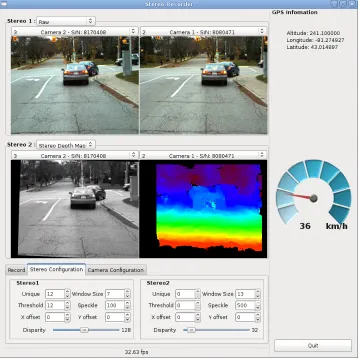
The distance between the instrumented vehicle and the roadside curbs, and other vehicles, is estimated in real-time. . . . 29 2.3 A description of the retroactive mechanism operating between
the current and predicted RTDs with respect to the outlined lay-ered approach, in which driving assistance impacts both the cur-rent and predicted behavioral state of the driving agent. The reception of V2V information enriches the current CFS, which in turn impacts the predicted RTD. Informational elements from both the current and predicted RTDs are broadcast to other in-strumented vehicles.. . . 31 2.4 The RoadLAB in-vehicle laboratory: a) (left): on-board
com-puter and LCD screen, b) (center): dual stereo front visual sensors, c) (right): side stereo visual sensors. . . . 35 2.5 Various mounting configurations: a) (left): dual stereo sensors
mounted on top of vehicle b) (center): dual stereo sensors mounted on hood of vehicle, c) (right): experiment with an external sensor configuration . . . 36 2.6 Schematic vehicle instrumentation: 1): dual stereo sensors 2):
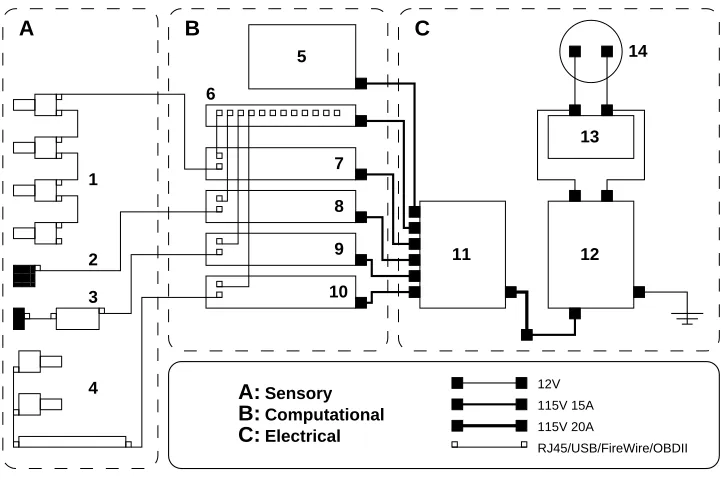
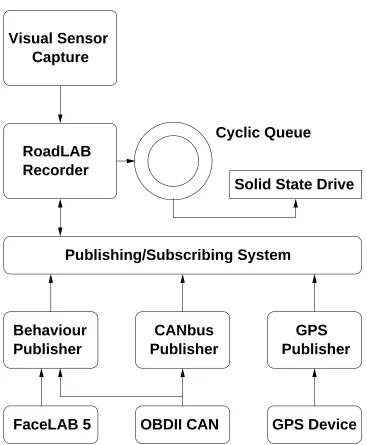
GPS unit with USB interface 3): OBD-II to USB interface 4): FaceLAB 5tm 5): 19-inch LCD display 6): gigabit network switch 7): 3.0GHz quad-core master node with 128G Solid State Drive (SSD) 8), 9), 10): 3.0GHz quad-core slave nodes 11): 20A power conditioner 12): 1500W power inverter 13): vehicle battery 14): 140A vehicle alternator . . . 37 2.7 Software services provided by the instrumented vehicle . . . 39 2.8 The RoadLAB Sequence Recorder in operation inside the
instru-mented vehicle. . . 40
2.10 Real-time vehicle tracking experiment using the RoadLAB in-strumented vehicle in i-ADAS mode . . . 42 2.11 Range resolution functions for dual stereo system, from 0 to
150 m. . . . 47
3.1 Challenges of lane detection: a) (top-left): different curvature and shapes b) (bottom-left): vanished lane markers c) (top-right):
splitting and merging lanesd) (bottom-right): occlusion and clutters 57 3.2 Common work flow of a typical lane detection system. . . . 57 3.3 Images from the map building application a) (left): visible lanes in
presence of traffic b) (center): Splitting lane sample c) (right):
Several neighboring lanes . . . 61 3.4 a) (left): The raw image b) (center): Low-level lane feature
de-tection result c) (right): Features depicted on the image. . . . 65 3.5 a) (left): Color-coded stereo depth map and the region used for
ground plane estimation b) (right): Horizon line estimated from ground plane . . . 66 3.6 a)(top-left): Color-mapped stereo depth mapb) (top-right):
Ac-cumulated projected obstacle pointsc) (bottom): Results of obstacle-free areas detection . . . 71 3.7 Examples of lane detection results a) Out-of-sight lane markers b)
Multiple curved lanesc)Occluded lane markersd) Splitting lanee)
Urban distractions f ) Multiple lanes partially occluded g) Splitting lane and occlusionh) Irregular lane shape . . . 74 3.8 Examples of obstacle-free area detection results a) (left): Ongoing
traffic, within the detected lanesb) (right): Incoming traffic outside of detected lanes . . . 75
4.1 a) (left): Color-coded stereo depth map and the region used for ground plane estimation b) (right): Horizon line estimated from ground plane . . . 86 4.2 The geometry of estimating the horizon line in camera coordinates 87 4.3 Histogram of depth map depicted for different rectangular areas.
High peaks constitute evidence of presence of an obstacle in that area. The position of the peak defines acceptable scale ranges. . . . 89 4.4 Examples of detection results for various frames, including errors . 91 4.5 The RoadLAB in-vehicle laboratory . . . 93 4.6 Detection hit rates for different vehicle positions and distances . . 96
5.1 Physical configuration a) (left): Remote eye-tracking system, and
b) (right): RoadLAB stereoscopic vision system . . . 107 5.2 The topology of the tracker and scene reference frames, wherexi and
yi are coordinates of the fixated point in the scene,o is the reference frame of the stereo scene system, o0 that of the tracker, and ci and
gi are the eye center position and gaze vector respectively. . . . 108
5.3 The calibration procedurea) (top): The operator selects calibration points from a set of Hessian salient points provided by OpenCV.b) (bottom left): The driver gazes at selected points one at a time while the gaze data and depth is recorded. c) (bottom right):
Driver gaze transformed into the reference frame of the stereo imag-ing system and intersected with the depth-map at frame rate (30Hz). 112 5.4 A depiction of the integrated calibration interface. The cross-calibration
area of the interface is located in the bottom right corner. . . . 114 5.5 A depiction of the convergence rate of the cross-calibration algorithm
for the four test subjects. . . . 119 5.6 a) (left): A wall and its depth map are used to perform experiments
with co-planar calibration points. b) (right): A typical scene used to perform experiments with non co-planar calibration points. . . . 120 5.7 a) (left): Angular errors (with standard deviation bars) obtained
with the four test subjects on test and training scenes with CoP and NcP calibrations. b) (right): Angular error averages (with standard deviation bars) over the test subjects obtained on test and training scenes with CoP and NcP calibrations. . . . 121 5.8 a) (left): 2D image errors in re-projection between points requested
to be fixated and points actually fixated under a CoP calibration for a test scene b) (right): 2D image errors in re-projection between points requested to be fixated and points actually fixated under an NcP calibration for a test scene . . . 122
Chapter 1
Introduction
Since August 1896 when Mary Ward killed in the first motor vehicle accident,
25 million people died in vehicle-related accidents. The proposed research
program aims at reducing vehicle-related fatalities and injuries first by creating
the required vehicular instrumentation for the study and modeling of driver
intent.
Over recent years, auto manufacturers have introduced various systems
to enhance driving safety, such as rear-view cameras and sensors, adaptive
cruise controls, enhanced night vision, and so on. However, these systems (in
production or under development in research laboratories) have yet to realize
their full potential. Our envisioned integration of ADAS technologies reveals
an extended capacity for context analysis and behavioural prediction that will
enhance traffic safety [3].
The pervasiveness of vehicle-related injuries and casualties imposes
enor-mous costs on our society. Such losses may become largely avoidable if
ad-dressed with proper technologies derived from research initiatives such as this
While there is large amounts of research performed on different aspects of
ADAS systems such as lane departure and collision avoidance warning systems,
little attention is devoted to the driver as a central part of the driving task.
There is evidence that 95 percent of all accidents are caused by human error,
and therefore monitoring and correcting driver behaviour seem to be crucial
in the effectiveness of a future ADAS.
1.1
Literature Survey
A forecast from the World Health Organization states that among the 10
lead-ing causes of disease burden1, traffic-related injuries will rank 3rd in 2020, up
from 9th in 1999 [21]. While injuries per driven kilometer are in decline in
the developed countries [1], a reverse trend can be observed elsewhere in the
world, especially in countries where car ownership is rising quickly. In
ad-dition, further significant gains in traffic safety in developed countries seem
only possible via ADAS, since the impact of other forms of safety
improve-ments have begun to plateau [7]. The functions one finds in various current
ADAS are LDW (Lane Departure Warning), LCA (Lane Change Assistance),
LKA (Lane Keeping Assistance), FCW (Forward Collision Warning), BSW
(Blind Spot Warning), and DDW (Drowsy Driver Warning), among others.
LDW, LCA, and LKA systems alert the driver when unintentional or unsafe
lane changes are to take place, or to assist the driver in keeping or changing
lanes. These systems determine the vehicle position with respect to detected
lanes. This is usually performed with real-time computer vision algorithms,
since the detection of road markings and curbs is essential to locate lanes.
Additionally, such systems can be interfaced with vehicle turn signals, blind
spot warning systems, and possibly driver monitoring systems to determine
if lane changes are safe and intentional. Stereo vision algorithms have been
successfully adapted for some of these tasks [6, 28, 18, 17, 20] , supported by
various computer vision techniques such as edge detection, image
segmenta-tion, feature tracking, and particle filtering. A consensus around vision-based
techniques for lane detection has recently emerged [25] mainly because
vi-sion sensors provide accurate positional information which do not involve any
instrumentation of highway infrastructures. When conditions prevent vision
sensors to perform correctly, data from other sensing devices may be fused
with the vision data to increase reliability. Other vision-based ADAS address
specific aspects of driving. For instance, one finds methods and algorithms for
detecting and evaluating the speed and distance of advance cars [42, 30], radar
and vision-based adaptive cruise control systems [14, 26, 9, 36], driver and
ve-hicle hardware in-the-loop frameworks [13, 29], driver attention and fatigue
management [11], pedestrian detection [8, 12, 23, 10, 31], and collision
warn-ing systems [34, 38, 37, 4]. Advanced Drivwarn-ing Assistance Systems are generally
designed to support decision making by providing ergonomic information on
the driving environment, such as the presence of surrounding vehicles,
poten-tial hazards, and general traffic conditions. Sensing may be performed with
radar [14, 41], lidar [15], or laser range finders [24]. However a majority of
ADAS rely principally on vision systems supported by other sensor modes
[25]. With such a variety of sensor modalities and hard real-time constraints,
fusion becomes central to ADAS and the current literature reflects this fact in
the large number of contributions that approach data and knowledge fusion in
this context [19, 14, 9, 43]. Alternatively, several functions of ADAS may be
realized using vehicle-to-vehicle (V2V) wireless communication protocols and
information, [27, 35], collision warning systems [16, 39], lane changing
assis-tance [2], and tracking neighboring vehicles [32]. While research on ADAS
may integrate a number of different functions such as forward collision
detec-tion and lane departure tracking [22], most of them pay little attendetec-tion to the
monitoring of events and factors that are directly concerned with the driver of
the vehicle. It is only recently that the cognitive aspects have been considered
as a legitimate part of intelligent ADAS [33]. Since 95 percent of all accidents
are caused by human errors such as cognitive (47 percent), judgment (40
per-cent), and operational errors (13 perper-cent), it is crucial that these aspects of
driving be a central part of any intelligent ADAS [40]. Keeping the driver
as an active participant in the feedback mechanisms allows for providing
con-textually motivated informational support and offers immediate applications
for enhancing safety [29]. Research efforts to integrate these various systems
have very recently begun, on the premise that integration is likely to generate
greatly enhanced functionality for the next generation of ADAS [3]. A survey
of possibilities include the following types of integration:
1. Lane change assistance with vehicle detection, blind spot monitoring,
driver head pose estimation, and car turn signal system: This type of
integration allows for increased safety during lane change maneuvers
as it is possible to determine the position and velocity of surrounding
vehicles, while the driver head pose (looking into the blind spot) and
monitoring of the turn signal systems allow to determine if the lane
change is intentional.
2. Driver gaze direction monitoring with vehicle, obstacle, pedestrian, and
road sign detection: This integration assists in determining if the driver
brings the possibility of assessing whether the driver is seeing other
vehi-cles, road signs, and obstacles in the visual field. Warnings may then be
issued only if important traffic elements are not observed by the driver,
preventing cognitive overload and unnecessary distractions, among other
things. Additionally, the frequency with which the driver looks in the
rear view mirrors, the instrumentation panel, and other odometry-
re-lated equipment can be determined and constitutes a significant factor
when assessing the cognitive state of a driving agent.
3. Integrating vehicle odometry and sensor readings with computer vision
systems of ADAS: Vehicle odometry obtained in real-time through the
CANbus interface of the vehicle greatly improves and simplifies
com-puter vision processes such as feature tracking and motion estimation.
For instance, if the speed of the vehicle is known with accuracy, it is
then possible to infer the motion that should be observed from the
pave-ment surface and other elepave-ments of the scene. Any discrepancy with the
inference would indicate that an obstacle is detected on the surface of
the road, such as an advance vehicle. In this context it is relatively easy
to deferentially determine the speed of this vehicle. Other benefits of
integrating odometry with ADAS in general include the possibility to
know the current state of the steering, brakes, and acceleration (positive
or negative) of the vehicle, allowing once again to warn the driver only
when the appropriate maneuvers are not being applied given the current
driving context (driver level of attention, surrounding cars, and so on).
4. Integrating driver attention levels with the warning functions allows
ADAS to make informed decisions regarding the mode and intensity
an audio warning may not be suitable when the driver is engaged in a
conversation. Instead, seat or steering vibrations may be more effective
in this case.
5. Integrating V2V communications with the current driving context
infor-mation descriptors inside ADAS may substantially augment the
knowl-edge level of traffic conditions prevailing beyond the range of visual
sen-sors. As a result, warning on dangerous traffic conditions may be issued
well before traffic problems enter the drivers field of view.
The resulting outcomes of such a level of integration and capability
ex-tensions of ADAS are many. For one, driving behaviour can be analyzed over
time and correlated with traffic context and events to provide tailored warnings
and to enable the prediction of driving actions in the short term. The benefits
of observing a driver for extended periods of time include the assessment of
driving patterns, delineating the most common errors, and performing driver
re-training if so requested, as it was recently accomplished in the context of
el-derly drivers and driving simulators [5], and presently in instrumented vehicles.
The extended possibilities of integrated, intelligent ADAS are very relevant
re-search areas as they do not intend to replace the driver as much as to assist
in the process of driving safely. As it has been pointed out by Petersson et al.
[29], what remains to be automated to reach the state at which vehicles are
completely autonomous in a practical manner turns out to be difficult and
elu-sive in everyday driving situations. However driver support through i-ADAS
1.2
Research Overview
The primary goal of this research is to study driver intent towards the
devel-opment of predictive models of driver actions. In this thesis, we describe a
hardware and software vehicular instrumentation which permits the
observa-tion and recording of drivers in the context of urban driving with a minimum
of interference due to the instrumented vehicle. Of particular interest, is to
determine the relevance of ocular behaviour as it pertains to the next driving
maneuver. The instrumented vehicle was designed in such a way as to provide
sufficient contextual information to enable a comprehensive study of driver
in-tent. In our context, driver intent is meant to signify the relationship between
driver cephalo-ocular behaviour, current driving maneuvers, and vehicular
at-titude, with respect to the most probable next maneuver to be effected by
the driver. Understanding this relationship is fundamental to the creation of
predictive models of driver behaviour, that could be in turn, used in future
ADAS. The central concept being that an ADAS with predictive capabilities
could be more effective in protecting its driver if it could prevent a wrong
maneuver before it is effected, as opposed to reacting to that maneuver, as it
is applied by the driver.
The instrumented vehicle is capable of recording and computing the
fol-lowing information at a frame rate of 30 Hz:
1. video stream from a calibrated front stereo system. A depth map is
automatically computed at frame rate.
2. video stream from a pair of rear and front panomorph lenses with a
360◦field of view.
vehi-cle1. This stream of data contains real-time information on important
aspects of driving, including vehicle acceleration (in 3D), current speed,
steering wheel angle, accelerator and brake pedal pressure, the state of
turn signals, and more.
4. The vehicle also provides its own GPS coordinates, which are retrieved
on its internal network.
5. A driver eye-tracker capable of providing 3D head pose and gaze
detec-tion data, together with other useful parameters such as saccade and
blink frequencies.This system also provides confidence measures on the
provided data.
6. An on-board software subsystem that relates the 3D driver gaze with
the depth map from the front stereo sensors in a way as to provide the
absolute 3D coordinates of the driver gaze into the environment.
The sum of these data channels and computations are recorded and
com-puted at 30 Hz.
Many software components needed to be created in the process of
instru-menting the vehicle:
1. The recorder: is an on-board computer system recording the sum of the
data streams and performing the computation of the depth maps and the
absolute 3D gaze coordinates in the reference frame of the front stereo
system.
2. The calibration: allows the experimenters to calibrate the front stereo
system and to cross-calibrate the eye-tracker with it.
3. The player: which allows experimenter to playback the recorded driving
sequences for further analysis.
We used the instrumented vehicle to conduct experiments with 16 volunteer
drivers under realistic driving condition1. The drivers followed a common path
of 28.5 kilometers within the city of London, Ontario.
1.3
Contributions
This thesis is an inherent part of the RoadLAB research program, instigated
by Professor Steven Beauchemin, and is entirely concerned with vehicular
instrumentation for the purpose of the study of driver intent. Chapters 2, 3,
4, and 5 have been published (or in the process of being) in recognized
peer-reviewed venues. In what follows I describe my contributions with regards to
each publication within the thesis:
1. Chapter 2: S.S. Beauchemin, M.A. Bauer, T. Kowsari, and J. Cho,
Portable and Scalable Vision-Based Vehicular Instrumentation for the
Analysis of Driver Intentionality, IEEE Transactions on
Instrumenta-tion and Measurement, Vol. 61, No. 1, pp. 159-173, 2013.
• Under a set of strict requirements, Professor Beauchemin gave me
the responsibility of designing and implementing the hardware and
software systems for the instrumented vehicle. This publication is
a direct result of this effort.
2. Chapter 3: T. Kowsari, S.S. Beauchemin, and M.A. Bauer, Map-Based
1These experiments were conducted under Ethnic Approval Notice number 102849,
Lane and Driveable Area Detection, submitted to, VISAPP 2014
Con-ference, Lisbon, portugal.
• I designed and implemented a new method to detect lanes and
drive-able areas within them in an effort to provide the experimental data
sequences with a reasonable annotation for further analysis. The
detection of driveable areas within lanes in front of the
experimen-tal vehicle appears sufficient to determine in most circumstances if
the current driver maneuver is correct.
3. Chapter 4: T. Kowsari, S.S. Beauchemin, and J. Cho,Real-Time Vehicle
Detection and Tracking Using Stereo Vision and Multi-View AdaBoost”,
IEEE Intelligent Transportation Systems Conference, Washington DC,
USA, pp. 1255-1260, October 5-7, 2011.
• For the purpose of experimental data sequence annotation, I
devel-oped an approach to vehicle detection that uses the horizon plane
to limit the number of generated hypotheses, sufficiently reducing
the computational burden to achieve a 25Hz rate. This approach
compared favorably with other recent methods found in the
litera-ture.
4. Chapter 5: T. Kowsari, S.S. Beauchemin, M.A. Bauer, D. Laurendeau,
and N. Teasdale, Multi-Depth Cross-Calibration of Remote Eye Gaze
Trackers and Stereoscopic Scene Systems, accepted in IEEE Transactions
on Instrumentation and Measurement, Dec. 2012.
• After initial discussions with Professor Beauchemin in which he
delineated a general approach to implement the cross-calibration, I
3D driver gaze onto the stereo depth map of the front stereo system
at frame rate (30Hz). This publication reports on the algorithms
and experimental results.
1.4
Thesis Organization
The organization of the thesis is as follows, in Chapter 2 we introduce the
instrumented vehicle, which is the main contribution of this thesis, and
elabo-rate on the design and implementation of the hardware and software systems.
In Chapters 3 and 4, contributions related to vehicle and lane detection are
presented. In Chapter 3, our Ada-Boost-trained vehicle detection system used
for detecting and annotating vehicles in the sequences is presented. In
Chap-ter 4, a map-based lane detection system is devised and explained. Our lane
detection system uses a particle filter-based tracker to fit spline lane sets
ex-tracted from the Google map of the drivers’ path to the lane feature detected
in the sequences. Using the stereo depth map, we also compute the safely
drivable area in the lanes, which consists of the obstacle-free portion of the
lanes ahead of the experimental vehicle.
In Chapter 5, another important contribution to this research is provided,
which consists of a cross-calibration method for calibrating the gaze detection
system with respect to the world coordinate system of the front stereo system.
In this Chapter we provide an algorithm for back projecting the point of gaze
on the image plane to find where the driver is looking at in absolute 3D
coordinates of the front stereo system and at frame rate (30 Hz). Chapter 6
Bibliography
[1] National Highway Traffic Safety Administration. Traffic safety facts 2006:
A compilation of motor vehicle crash data from the fatality analysis
re-porting system and the general estimates system. Technical Report HS
810 818, US DOT, 2006.
[2] S. Ammoun, F. Nashashibi, and C. Laurgeau. An analysis of the lane
changing manoeuvre on roads : the contribution of inter-vehicle
coopera-tion via communicacoopera-tion. In Intelligent Vehicles Symposium, 2007 IEEE,
pages 1095 –1100, june 2007.
[3] S. Ashley. Crashless cars: Making driving safer. Sci. Am., December
2008.
[4] S. Atev, H. Arumugam, O. Masoud, R. Janardan, and N.P.
Pa-panikolopoulos. A vision-based approach to collision prediction at traffic
intersections. Intelligent Transportation Systems, IEEE Transactions on,
6(4):416–423, 2005.
[5] S.S Beauchemin, P.D. Varcheie, L. Gagnon, D. Laurendeau, M.
Laval-liere, T. Moszkowicz, F. Prel, and N. Teasdale. Cobvis-d: A computer
vision system for describing the cephalo-ocular behavior of drivers in a
simulated driving context. InInternational Conference on Image Analysis
and Recognition (ICIAR), pages 604–615, Halifax, Canada, July 2009.
[6] M. Bertozzi and A. Broggi. Gold: A parallel real-time stereo vision
sys-tem for generic obstacle and lane detection. Image Processing, IEEE
[7] PT Blythe and AM Curtis. Advanced driver assistance systems: gimmick
or reality? In 11th World Congress on ITS, Nagoya, 2004.
[8] A. Broggi, M. Bertozzi, A. Fascioli, and M. Sechi. Shape-based pedestrian
detection. InIntelligent Vehicles Symposium, 2000. IV 2000. Proceedings
of the IEEE, pages 215–220. IEEE, 2000.
[9] D. Caveney, B. Feldman, and J.K. Hedrick. Comprehensive framework
for multisensor multitarget tracking in the adaptive cruise control
envi-ronment. In International Symposium on Ad2 vanced Vehicle Control,
Hiroshima, Japan, 2002.
[10] M. Enzweiler, P. Kanter, and DM Gavrila. Monocular pedestrian
recog-nition using motion parallax. In Intelligent Vehicles Symposium, 2008
IEEE, pages 792–797. IEEE, 2008.
[11] L. Fletcher, L. Petersson, and A. Zelinsky. Road scene monotony detection
in a fatigue management driver assistance system. In Intelligent Vehicles
Symposium, 2005. Proceedings. IEEE, pages 484–489. IEEE, 2005.
[12] D.M. Gavrila and S. Munder. Multi-cue pedestrian detection and tracking
from a moving vehicle.International journal of computer vision, 73(1):41–
59, 2007.
[13] O. Gietelink, J. Ploeg, B. De Schutter, and M. Verhaegen. Development
of advanced driver assistance systems with vehicle hardware-in-the-loop
simulations. Vehicle System Dynamics, 44(7):569–590, 2006.
[14] U. Hofmann, A. Rieder, and ED Dickmanns. Radar and vision data
fusion for hybrid adaptive cruise control on highways. Machine Vision
[15] A.S. Huang, D. Moore, M. Antone, E. Olson, and S. Teller. Finding
multiple lanes in urban road networks with vision and lidar. Autonomous
Robots, 26(2):103–122, 2009.
[16] J. Huang and H.S. Tan. Design and implementation of a cooperative
col-lision warning system. In Intelligent Transportation Systems Conference,
2006. ITSC’06. IEEE, pages 1017–1022. IEEE, 2006.
[17] K. Huh, J. Park, D. Hong, D.D. Cho, and J.H. Park. Development of
a vision-based lane detection system considering configuration aspects.
Optics and lasers in engineering, 43(11):1193–1213, 2005.
[18] J. Kaszubiak, M. Tornow, RW Kuhn, B. Michaelis, and C. Kn¨oppel.
Real-time vehicle and lane detection with embedded hardware. In
In-telligent Vehicles Symposium, 2005. Proceedings. IEEE, pages 619–624.
IEEE, 2005.
[19] N. Kawasaki and U. Kiencke. Standard platform for sensor fusion on
advanced driver assistance system using bayesian network. In Intelligent
Vehicles Symposium, 2004 IEEE, pages 250–255. IEEE, 2004.
[20] T. Kowsari, SS Beauchemin, and J. Cho. Real-time vehicle detection and
tracking using stereo vision and multi-view adaboost. InIntelligent
Trans-portation Systems (ITSC), 2011 14th International IEEE Conference on,
pages 1255–1260. IEEE, 2011.
[21] E. Krug. Road traffic injuries. WHO Overview Fact Sheet, 2000.
[22] J.F. Liu, Y.F. Su, M.K. Ko, and P.N. Yu. Development of a
collision warning functions. In Computing: Techniques and Applications,
2008. DICTA’08. Digital Image, pages 480–485. IEEE, 2008.
[23] X. Liu and K. Fujimura. Pedestrian detection using stereo night vision.
Vehicular Technology, IEEE Transactions on, 53(6):1657–1665, 2004.
[24] B. Ma, S. Lakshmanan, and A.O. Hero III. Simultaneous detection of
lane and pavement boundaries using model-based multisensor fusion.
In-telligent Transportation Systems, IEEE Transactions on, 1(3):135–147,
2000.
[25] J.C. McCall and M.M. Trivedi. Video-based lane estimation and tracking
for driver assistance: Survey, system, and evaluation. IEEE Trans. Intell.
Transp. Sys., 7(1):20–37, 2006.
[26] R. M¨obus, M. Baotic, and M. Morari. Multi-object adaptive cruise
con-trol. Hybrid Systems: Computation and Control, pages 359–374, 2003.
[27] T. Nadeem, S. Dashtinezhad, C. Liao, and L. Iftode. Trafficview: traffic
data dissemination using car-to-car communication. ACM SIGMOBILE
Mobile Computing and Communications Review, 8(3):6–19, 2004.
[28] S. Nedevschi, R. Schmidt, T. Graf, R. Danescu, D. Frentiu, T. Marita,
F. Oniga, and C. Pocol. 3d lane detection system based on stereovision.
In Intelligent Transportation Systems, 2004. Proceedings. The 7th
Inter-national IEEE Conference on, pages 161–166. IEEE, 2004.
[29] L. Petersson, L. Fletcher, and A. Zelinsky. A framework for
driver-in-the-loop driver assistance systems. InIntelligent Transportation Systems,
[30] D. Ponsa, A. L´opez, F. Lumbreras, J. Serrat, and T. Graf. 3d vehicle
sensor based on monocular vision. InIntelligent Transportation Systems,
2005. Proceedings. 2005 IEEE, pages 1096–1101. IEEE, 2005.
[31] M. Rapus, S. Munder, G. Baratoff, and J. Denzler. Pedestrian recognition
using combined low-resolution depth and intensity images. In Intelligent
Vehicles Symposium, 2008 IEEE, pages 632–636. IEEE, 2008.
[32] S. Rezaei, R. Sengupta, H. Krishnan, X. Guan, and R. Bhatia.
Track-ing the position of neighborTrack-ing vehicles usTrack-ing wireless communications.
Transportation Research Part C: Emerging Technologies, 18(3):335–350,
2010.
[33] M. Rockl, P. Robertson, K. Frank, and T. Strang. An architecture
for situation-aware driver assistance systems. In Vehicular Technology
Conference, 2007. VTC2007-Spring. IEEE 65th, pages 2555–2559. IEEE,
2007.
[34] N. Saunier, T. Sayed, and C. Lim. Probabilistic collision prediction for
vision-based automated road safety analysis. InIntelligent Transportation
Systems Conference, 2007. ITSC 2007. IEEE, pages 872–878. IEEE, 2007.
[35] N. Shibata, T. Terauchi, T. Kitani, K. Yasumoto, M. Ito, and T.
Hi-gashino. A method for sharing traffic jam information using inter-vehicle
communication. InMobile and Ubiquitous Systems-Workshops, 2006. 3rd
Annual International Conference on, pages 1–7. IEEE, 2006.
[36] M.A. Sotelo, D. Fernandez, J.E. Naranjo, C. Gonzalez, R. Garcia,
T. de Pedro, and J. Reviejo. Vision-based adaptive cruise control for
2004). Proceedings. 2004 IEEE/RSJ International Conference on,
vol-ume 1, pages 64–69. IEEE, 2004.
[37] N. Srinivasa. Vision-based vehicle detection and tracking method for
for-ward collision warning in automobiles. InIntelligent Vehicle Symposium,
2002. IEEE, volume 2, pages 626–631. IEEE, 2002.
[38] Z. Sun, G. Bebis, and R. Miller. On-road vehicle detection: A
re-view. Pattern Analysis and Machine Intelligence, IEEE Transactions on,
28(5):694–711, 2006.
[39] H.S. Tan and J. Huang. Dgps-based vehicle-to-vehicle cooperative
colli-sion warning: Engineering feasibility viewpoints. Intelligent
Transporta-tion Systems, IEEE TransacTransporta-tions on, 7(4):415–428, 2006.
[40] Y. Umemura. Driver behavior and active safety (overview), special issue
driver behavior and active safety. R&D Review of Toyota CRDL, 39(2).
[41] G.R. Widmann, M.K. Daniels, L. Hamilton, L. Humm, B. Riley, J.K.
Schiffmann, D.E. Schnelker, and W.H. Wishon. Comparison of
lidar-based and radar-lidar-based adaptive cruise control systems. Society, 109(Part
7):126–139, 2000.
[42] J. Yi, S. Yang, I. Jang, J. Chung, and M. Lim. Automobile advance
alarm system based on monocular vision processing. In Intelligent
Vehi-cles Symposium, 2007 IEEE, pages 428–432. IEEE, 2007.
[43] Y. Zhu, D. Comaniciu, V. Ramesh, M. Pellkofer, and T. Koehler. An
integrated framework of vision-based vehicle detection with knowledge
fusion. InIntelligent Vehicles Symposium, 2005. Proceedings. IEEE, pages
Chapter 2
Instrumented Vehicle
This Chapter is a reformatted version of the following article:
S.S. Beauchemin, M.A. Bauer, T. Kowsari, and J. Cho, Portable and
Scal-able Vision-Based Vehicular Instrumentation for the Analysis of Driver
Inten-tionality, IEEE Transactions on Instrumentation and Measurement, Vol. 61,
No. 1, pp. 159-173, 2013.
A portable and scalable vehicular instrumentation designed for on-road
ex-perimentation and hypothesis verification in the context of designing i-ADAS
prototypes is described in this contribution.
2.1
Introduction
World-wide deaths from injuries are projected to rise from 5.1 million in 1990
to 8.4 million in 2020, with traffic-related injuries representing the major cause
for this increase [15, 1]. Our research aims at reducing these fatalities by first
developing a deeper understanding of the cognitive (cephalo-ocular) task of
driving, identifying related risk factors and integrating these findings into
in-clude the identification of the cognitive factors involved in driving that impact
traffic safety, the definition of sound principles for the design of automated
vehicular safety technologies, and the development of intelligent, Advanced
Driving Assistance Systems (i-ADAS), with driver behavior prediction and
correction as the central tenet of safety improvement.
While research on ADAS may integrate a number of different functions
such as forward collision detection and lane departure tracking [21], little
at-tention is devoted to the monitoring of events and factors that directly concern
the driver of the vehicle. It is only recently that cognitive aspects have been
considered as a legitimate part of intelligent ADAS [25]. Since 95 percent of all
accidents are caused by human error, it is crucial that these aspects of driving
be a central part of intelligent ADAS [31]. Keeping the driver as an active
participant in the feedback mechanisms allows for providing contextually
mo-tivated informational support and offers immediate applications for enhancing
safety [23].
The extended possibilities of integrated, intelligent ADAS are very relevant
research areas as they do not intend to replace the driver as much as to assist
in the process of driving safely. As it has been pointed out by Petersson et
al. [23], what remains to be automated to reach the state by which vehicles
become completely autonomous in a practical manner turns out to be difficult
and elusive in everyday driving situations. In light of this, it is our belief that
driver support through i-ADAS can be deployed more readily, with consequent
socio-economic benefits.
This contribution rests on earlier work in which preliminary
instrumenta-tion and tests were recently conducted [6]. It however differs significantly in
that it motivates the instrumentation in the form of clearly stated
of the platform, along with identified physical, sensory, and computational
limitations.
Our approach, while sharing common elements with those of others, is
unique in several ways. First, we designed a portable instrumentation
re-quiring no modification to the vehicular platform, using low-cost off-the-shelf
components that are widely available. Second, our on-board computational
approach rests on scalability. That is to say, additional computing power can
easily be added to the current instrumentation, without any modifications to
the existing system. This of course is a core requirement, as algorithms must
be run in real-time. Third, our approach integrates the driver in the system
as an inherent behavioral agent, in the aim of understanding and predicting
driving actions.
2.2
Related Literature
While many research groups provide brief descriptions of their vehicular
in-strumentation in the context of driving assistance, such as [22, 10] for vision
systems, and [28, 11] for multi-sensor instrumentation, few contributions
di-rectly address instrumentation strategies, concepts, and implementation in
the context of ADAS. A notable exception is by Thrun [30] in the context
of autonomous driving in which the sensory interface, perception modalities,
planning and control, user interfaces, and software services are described in
extensive detail. The motivation for our contribution partly stems from the
2.3
Hypothesis Verification
Our primary goal is to determine whether driver intentionality and
driving-related actions can be predicted from quantitative and qualitative analyses
of driver behavior. This broad question, while only partially answered [18],
conveys its importance in more than one way. For instance, predictive
for-mulations of the cognitive aspects of driving open the way to the design of
reliable models of driver intentionality prediction and may lead to advances in
safety-related vehicular technologies and accident prevention strategies from
the perspective of on-board safety systems, up to assisting in guiding policies
regarding the regulation of i-ADAS.
2.3.1
Primary Conjecture
Studies of driver behavior have approached the problem of intentionality from
various perspectives. Driver behavior models have been suggested along with
their empirical validations, with varying degrees of success [19]. However,“the
most effective technology may be that which monitors driver state and driving
behavior in order to help attend to the roadway and recognize unsafe behavior”
[9]. In addition, it has been demonstrated time and time again that eyes, in
general,“look directly at the objects they engage with”[3] and that the“fixation
that provides the information for a particular action immediately precedes that
action” [4]. These observations support our primary conjecture, which states
thatif one considers a vehicle as an extension to the inherent human capability
for motion, then one must also admit the possibility that eye movements are as
predictive of driving actions as they are of physical movement. The underlying
rationale from which our conjecture stems rests on the demonstration that eye
generate actions in relation to the environment [13, 16, 18].
2.3.2
Hypotheses
Since 95% of all accidents are caused by human error, it is imperative that
drivers be the central element of systems that provide driving support [32].
Consequently, our short term goals consist of the empirical testing of
hypothe-ses derived from the primary conjecture, in the hope of demonstrating that
on-board vehicle safety systems which focus on the predictability of driver
be-havior are capable of significantly increasing driving safety. Toward this end,
our primary conjecture is functionally fragmented into a number of hypotheses
which can be investigated effectively and objectively:
1. Cephalo-ocular behavior correlates with driver intentionality and precedes
driving actions: This hypothesis has been demonstrated in certain
driv-ing circumstances, as it is known that drivers negotiatdriv-ing a bend fixate
on its tangent point to gather information on its curvature. This
fixa-tion precedes steering adjustments by an average of 0.8s [16]. Are there
other driving circumstances (negotiating intersections, merging,
high-way driving, etc.) for which particular ocular behavior precede driving
actions? While it is clear that ocular behavior cannot be constantly
pre-dictive of actions due to secondary drivers tasks (such as attending to
vehicle functions), it is important to determine which behaviors possess
a predictive value. However, the possibility exists that ocular behavior
may not be sufficiently correlated with intentionality for use in
predic-tion models. In this case, other investigative avenues may be possible,
particularly through the observation of maneuvers being applied to the
and determining to which extent this may be the case would be central
to this scenario. A third investigative avenue may be that both current
driver maneuvers and ocular behavior are sufficient for useful prediction
purposes.
2. Driver levels of attention are indicative of the meaningfulness of
cephalo-ocular behavior: Driver visual attention is a central part of safe driving.
It has been shown that driver glances away from the road for 2s or more
resulted in 3.6 times more involuntary lane departures than glances of
1s [20]. Conversely, long visual fixations are not necessarily synonymous
with attention. While eyes may be fixating, attention may not be elicited
by events in the visual field. However, certain ocular patterns such as
fixations accompanied by regular saccades are descriptive of the visual
search behavior for information acquisition processes and correlate with
drivers attending to the roadway [26]. The identification of factors
pro-viding indications of meaningful cephalo-ocular movements is necessary
in order to assess whether or not the ocular behavior represents intent.
3. Information delivered to drivers does not increase their cognitive loads:
Drivers are exposed to increasing flows of information provided by
mod-ern on-board vehicle functions. Recent studies have revealed that drivers
are not always capable of eliciting a correct response to such solicitations
due to, among other factors, the complexity of the driving context, or an
increased cognitive load generated by actions not directly related to
driv-ing [2]. While it is suspected that the aforementioned hypothesis does not
hold in general, it is crucial to experimentally determine the modalities,
timings, and types of delivered information that can be tolerated and
time to perform corrective maneuvers [9]. Still, it can be conjectured
that in most circumstances the cognitive loads of drivers may already
be high when safety-related information must be issued, probably
in-creasing driving risk rather than reducing it. In the case this conjecture
proves correct, it may become fruitful to investigate automated driving
interventions (without delivery of information) in particularly
demand-ing traffic contexts, or when information would not come in time, or
otherwise distract drivers even more.
4. Visual stimuli drivers attend to can be identified: Salient elements in the
visual field of drivers elicit cephalo-ocular responses aimed at attending
to such stimuli. Correspondences between cephalo-ocular behavior and
visual stimuli must be established to identify the elements within the
visual field to which driver attention is turned. This knowledge will
al-low predictive models to assess whether or not drivers are attending to
the appropriate stimuli, given current traffic contexts. This requirement
implies that elements in the environment be correctly identified, located,
and intersected with the 3D gaze direction of the driver. Consequently,
systems in charge of processing the output of stereo sensors must
reli-ably detect the presence of other vehicles, pedestrians, and obstacles in
general. This objective has only been partially attained with the use of
passive sensing (CCD cameras) mainly because the reliability of most
(if not all) techniques greatly depends on visual scene conditions [33].
While it is expected that passive vision systems will fail from time to
time in difficult driving conditions, there may be effective methods of
providing enhanced reliability by way of combining other sources of
be used in situations where vision systems fail or under-perform, such as
times when fog, snow, or rain are present. Such communication
modal-ities have the potential to both enrich and extend the range of visual
sensors when surrounding vehicles signal their presence and position.
These ideas may enhance the robustness of on-board vision systems and
are further investigated in [5].
The creation of effective predictive driving behavior models rests on the
confirmation of these hypotheses. While it is not expected that every aspect
of these ideas can be empirically demonstrated, it is believed their investigation
will extend the current knowledge of the cognitive task of driving and allow for
the establishment of strong principles for the design and operation of future
on-board safety systems.
2.4
Layered Approach to Vehicular
Instrumen-tation
The next generation of i-ADAS will require extensive data fusion and analysis
processes owing to an ever increasing amount of available vehicular
informa-tion. In this context a layered approach is best suited for real-time processing.
In particular, such an approach enables bringing real-time data from sensors to
a common level of compatibility and abstraction which significantly facilitates
fusion and analysis processes. Our proposed computational model consists of
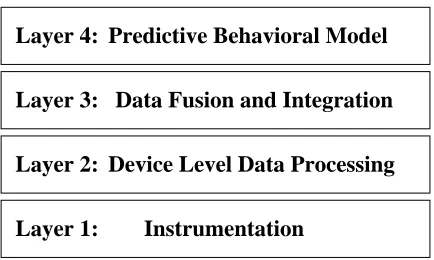
four layers, with increasing levels of data abstraction (see Figure 2.1). The
innermost layer consists of the hardware and software required to capture
ve-hicle odometry, sequences from visual sensors, and driver behavioral data. The
Layer 4: Layer 3: Layer 2: Layer 1:
Data Fusion and Integration Device Level Data Processing
Instrumentation
Predictive Behavioral Model
Figure 2.1: The four layers comprising the data processing strategy on-board
the instrumented vehicle.
gathering, and vision detection processes. The third layer is where the data is
transformed and fused into a single 4-dimensional space (x, y, z, t). The last
layer makes use of the fused data to compare driver behavioural data with
models of behavior that are appropriate given current odometry and traffic
conditions. While we proceed to describe the four layers, it is to be noted
that this contribution specifically addresses the instrumentation (layers one
and two) and its performance evaluation.
2.4.1
Instrumentation
Contemporary vehicles equipped with On-Board Diagnostic systems (OBD-II)
allow vehicle sensors to report on current status, and constitute the interface
through which odometry is made available in real-time. Since 2008, the
CAN-bus protocol1 has become mandatory for OBD-II. This standardization
simpli-fies the real-time capture of vehicle data. OBD-II to USB hardware interfaces
with appropriate drivers are now common devices used to feed vehicle-related
information to on-board computers or similar devices. The available
informa-1The CANbus (Controller Area Network bus) provides micro-controllers with the means
tion relevant to i-ADAS applications include current speed and acceleration
(longitudinal and lateral), steering wheel rotation, state of accelerator and
brake pedals, and independent wheel speed, which are real-time data captured
at frequencies generally comprised between 20 and 200Hz. These elements
pro-vide the information that is required to understand the maneuvers effected by
the driver.
In addition, several vision systems must instrument the vehicle in order
to appropriately monitor the immediate environment (lanes, other vehicles,
pedestrians, obstacles, etc) and the behavior of the driver (gaze direction, level
of attention, etc). These hardware systems must be capable of high sampling
rates (30Hz or more) such that sufficient accuracy in image processing and
automated vision processes is achieved. It is useful to keep in mind that the
position of a vehicle moving at 120 kph changes by 33 meters every second.
Similar observations apply concerning the changes in visual gaze direction
(known as saccades) as they occur very rapidly. For this reason, vision
hard-ware monitoring the gaze direction of the driver must have sufficiently dense
sampling rates as to allow for deriving driver intentionality prior to the
execu-tion of the anticipated behavior [17]. This part of the vehicle instrumentaexecu-tion
is realized with commercial hardware and software1 from which data such as
eye gaze direction, vergence distance, and saccade events are obtained at a
frequency of 60Hz.
Also part of the instrumentation layer is a GPS device which is used by
Vehicle-to-Vehicle (V2V) communications systems to provide other near-by
instrumented vehicles with knowledge of traffic conditions beyond the range
of their visual sensors.
Last but not least, on-board computing capabilities must also be sufficient
to process the sum of incoming data in real-time. To this end we have designed
and assembled a computer for real-time data processing and fusion consisting
of 16 cores, each running at 3.0GHz, with 16GB of internal memory and a
128GB Solid State Drive (SSD), with Linux Debian 5.01 as the operating
system. The nodes are networked with a high-end gigabit network switch, and
configured as a disk-less cluster, with the master node providing the operating
system image to other nodes.
2.4.2
Justification of sensors selection
In the context of our hypothesis, it is vital that the instrumentation be able
to provide information on current (and expected) driver behaviour and vehicle
operation. Two subsystems contribute to this goal. First, an OBD-II to USB
interface1 sends vehicular data (odometry and vehicle operation) to the
on-board computer for recording or real-time analysis, or both. Second, an eye
and head pose tracking system provides the necessary data for cephalo-ocular
behavior recording and analysis. The sum of these subsystems provide the
information required to determine the interactions between the driver and the
vehicle, in addition to ocular behavior parameters. The resulting
instrumen-tation allows to identify the visual stimuli drivers respond to in relation with
the driving surroundings and the most probable behavior to be observed next.
Our choice of passive sensors is motivated by the fact that data acquisition
is non-invasive and provides information conveyed by visual elements such as
road markings and signs, which are critical to the task of driving and yet
unavailable to active sensors such as radars or range finders [7]. In addition,
multiple lens and sensor configurations are possible. For instance, IR or
near-1A Kvaser Leaf LighttmOBD-II to USB device implements this part of the
Figure 2.2: Color-coded calibrated stereo depth maps are obtained at 30Hz. The distance between the instrumented vehicle and the roadside curbs, and other vehicles, is estimated in real-time.
IR (Infra-Red) filters or sensors may readily be installed to provide night vision.
Conversely, lenses of various types may be mounted on the sensors without any
design modifications.
2.4.3
Device-Level Data Processing
For visual sensors, it is critical to obtain precise calibration parameters such as
lens distortion, the optical center, and the external orientation of sensors with
respect to each other. This calibration is required to perform stereo and to
estimate distances of objects (other vehicles, pedestrians, etc.), which in turn
track-ing, and obstacle detection. The RoadLAB stereo calibration interface was
designed for this process. The interface is implemented using a calibration
al-gorithm from the OpenCV 2.1 open source library based on Zhang’s technique
[34]. The calibration process consists of two steps. Intrinsic parameters are
first estimated for each sensor and then, based on these, the extrinsic
param-eters for all possible sensor pairs are obtained. It is also possible to estimate
the extrinsic parameters dynamically [8]. All the image frames from visual
sensors are synchronized to within 125 µs. Once the synchronized frames are
obtained, stereo depth maps are computed at frame rate, based on the
cali-bration parameters (see Figure 2.2). The GPS data is obtained throughgpsd,
a GPS service daemon from http://gpsd.berlios.de/ which provides an
event-driven architecture. The data from the OBD-II/CANbus is obtained in
a similar manner by creating a software layer for this purpose. Additionally,
the incoming data from the instrumentation provides timestamps, allowing
the system to fuse and select data elements in a synchronized fashion.
2.4.4
Data Fusion and Integration
Streams of data and video frames coming from monitoring the driver, the
en-vironment, and vehicle odometry must be placed in a suitable context for use
by the behavioral prediction engine. We define a driver-centered frame of
ref-erence, in which elements of the Cognitive State of Driver (CSD) descriptor
(head pose, gaze direction, blink events, lip movement), the Contextual
Fea-ture Set (CFS) descriptor (road lanes, other vehicles, pedestrians, etc), and
the Vehicle State of Odometry (VSD) are transformed into, from their local
sensor frames of reference (see Figure 2.3 for a depiction of the CSD and CFS
Behavior Model and Prediction Front/Side Stereo Systems OBD−II/CANbus GPS Unit Driving Agent Instr. Vehicle Environment
Layer 1 Layer 2 Layer 3 Layer 4
Gaze Analysis System V2V Receive V2V Broadcast Predicted RTD Current RTD CSD CFS VSO CSD CFS VSO Driving Assistance
Figure 2.3: A description of the retroactive mechanism operating between the
current and predicted RTDs with respect to the outlined layered approach, in which driving assistance impacts both the current and predicted behavioral state of the driving agent. The reception of V2V information enriches the current CFS, which in turn impacts the predicted RTD. Informational elements from both the current and predicted RTDs are broadcast to other instrumented ve-hicles.
the extrinsic parameters obtained with the calibration of the visual sensors
with respect to each other. With these elements fused into a single frame of
reference, the current CSD, CFS, and VSO descriptors are updated at 30Hz,
and made available to the behavioral prediction engine.
Two modes of operation exist at this level. A recording mode captures
the data and video streams from the instrumentation for in-laboratory,
off-line analysis. A processing mode which performs as an i-ADAS operating in
real-time is also possible. Each sequence generated for off-line analysis obeys a
strict format standard, in which the calibration data, the timestamped frames
2.4.5
Predictive Behavioral Model
Our general hypothesis stems from research demonstrating that eye movements
reflect moment-to-moment cognitive processes used to locate the information
needed by the motor system for producing actions in relation to the
environ-ment [17, 14, 24]. This hypothesis is the foundation for our conjecture stating
that the analysis of driver gaze direction (and other facial features) fused with
the knowledge of the environment surrounding the vehicle (and its odometry)
lead to the possibility of predicting driving behavior for short time frames (a
few seconds). To accomplish these goals, it is necessary to infer a behavioral
driving agent model that puts in relation the cognitive state of the driver, the
vehicle odometry, and its surrounding environment as captured by sensors. For
this purpose, we devise a Real-Time Descriptor (RTD) for a moving vehicle
essentially consisting of a CFS, a CSD, and a VSO descriptor.
These elements represent the knowledge required in composing an extensive
RTD suited for our purposes. While we are interested in deriving practical and
predictive driving agent models, it is worth noting that both the CFS and the
VSO possess predictive models which are less difficult to formulate. We further
propose to structure the elements of the RTD within a retroactive mechanism
(see Figure 2.3) in which both the current and predicted descriptors (CSD,
CFS, and VSO) assist in determining not only the safety level of the context
derived from the current RTD, but also that posed by the predicted RTD.
At the heart of the behavioral prediction engine is a Bayesian model which
takes the current CSD, CFS, and VSO as inputs and predicts actuation
behav-ior of the driver in the next few seconds. It also gathers statistical information
about driving decisions and errors in a Driver Statistical Record (DSR) which
and CFS are in turn used to establish a Driver Memory of Surroundings (DMS)
based on the attention level and gaze direction analysis of the driver. A
Gen-eral Forgetting Factor (GFF) is applied to the DMS as time elapses to reflect
common characteristics of short-term visual memory. In addition, a Driver
Cognitive Load factor (DCL) is inferred, based on the activities engaged by
the driver, which in turn impacts the DMS, among other things.
2.5
Inter-Vehicular Communication
Vehicular networks have been an area of research for the past two decades [27].
Interest has been shown by researchers, government agencies, and automobile
manufacturers in developing the technologies and protocols for vehicular
net-works. There is a number of major areas of interest where unique problems
must be solved, including protocols for the physical and link layer, higher
layer protocols to deliver traffic, safety, and security information. Beyond
these purely technical challenges, vehicles created by different manufacturers
must be able to communicate, thus rendering standardization essential.
Some standardization has already occurred with the IEEE 802.11p draft
standard and allocation of 75MHz in the 5.9GHz spectrum for Dedicated Short
Range Communications (DSRC) for the physical and link layer protocols.
Fur-ther standardization with the IEEE 1609 draft standards for higher level
pro-tocols and services is ongoing [12]. Nonetheless, there are numerous open
areas of research where solutions must be found before vehicular networks are
adopted in consumer vehicles. How these two sets of technologies intersect is
a topic that currently has not been looked at in depth. Vehicular networking
technologies can provide detailed information about other vehicles in a large
about the environment immediately surrounding a vehicle in real-time. How
these two sets of technologies intersect is a topic that currently has not been
looked at in depth.
Being able to combine both sources of information provides greater detail
and breadth than any one technology can provide on its own. How to do
this exactly is an open research problem. There is also no guarantee that the
information provided by these separate system will agree. There is a wide
variety of circumstances in which data from both systems may not match and
the vehicle will need to deduce which one is most likely correct.
Our approach consists of the systems, strategies, and implementation of
the concept of using V2V to extend on-board visual sensor range. Coupling
V2V and sensory input may increase detection reliability and range for
vi-sual sensors. Conversely, sensors may inform i-ADAS of the presence of
non-communicating elements such as pedestrians and non-vehicular obstacles. The
potential that is held by integrating V2V communication with on-board
sen-sory perception is considerable.
An instrumented vehicle navigating in an environment where other vehicles
are similarly equipped would have access to critical traffic information well
beyond the range of its sensors. Additionally, cascading information between
communicating vehicles would allow a single vehicle to decide upon the range
within which traffic information is deemed desirable.
While it seems natural to integrate sensory information with V2V in the
context of i-ADAS, few research efforts have been conducted toward this goal.
We believe that the complementarity of information obtainable from on-board
sensors and V2V communication can form the basis for new approaches in