Maximum Power Point Tracking Control for
Wind Energy Conversion System: A Review
Praveen Shukla1, Neelabh Tiwari2, Shimi S.L.3
PG Student, Dept. of Electrical Engineering, NITTTR, Chandigarh, India1
Assistant Professor, Dept. of ECE, BBDNITM, Lucknow, India2
Assistant Professor, Dept. of Electrical Engineering, NITTTR, Chandigarh, India3
ABSTRACT:The Utilizationand Development of wind energy has become an important part of world sustainable energy development. Wind energy systems are being firmly studied becauseof its benefits as an environment friendly and sustainablesource of energy. Due to its erratic nature, power execution concepts arenecessary for extraction as much power as possible from the wind energy.In this paper somealgorithms have been discussed to preserve the system at its highest possible plenty at all times. The algorithmshave been used to obtain the optimal operating points for transferof maximum power. The algorithm determines the turbine’s internal characteristics through operation.Maximum power point tracking (MPPT) is a cosmictechniqueof energy conversion from therenewable energy source. In recent year various numbers of publications appear in journals and conferences insist to attempt better and faster MPPT techniques for any wind energy conversion system (WECS). This paper favours anextensive analysis of these techniques. As such, so many maximum power point tracking techniques have beenimplemented anddeveloped. So these MPPT algorithms can be categorized into mainly three types: Power-Signal feedback method, Hill climb search based,and Tip-Speed control.
KEYWORDS: MPPT, Tip Speed Control, WECS, TSR.
I.INTRODUCTION
Wind energy power generation is the most important form of the utilization of wind energy. The maximum extraction of power from a renewable energy source mainly depends on the strength of the source as well as on the operating point of the energy conversion system. Therefore the importance ofMaximum Power Point tracking (MPPT) in renewable energy conversion systems is not only to maximize the system’s efficiency but also to minimize the payback period of the installation cost. In wind energy conversion system (WECS) the concept of MPPT is to reform the generatorspeed with respect to the wind velocityinterdict by the wind turbine to maximise the power. Studies have shownthat the capacity of installed wind power generation over the worldhas been increasing more than 25% every year over the previous ten years [1].
Fig.1 Power V/S Wind Speed Curve
Amount of power output from a wind energy conversion system depends upon the accuracy with which peak power is tracked by the maximum power point tracking controller of WECS control system regardless of the type of generator used. Inregion 1 the wind speed is less than the cut in (Vcut-in) value. So, the WECS fails to deliver any useful power to
proportion to the cube of wind speed in region 2. The power output increases till the rated wind speed (Vrated). At Vrated
the system generates rated power. Beyond Vrated till cut out wind speed (Vcut-out) the power is regulated at the rated
power. Operation is shut down above Vcut-out to avoid mechanical collapse of the blades.
T. Tudorache et al. in [21], have presented the design, implementation and experimental investigation of an autonomous Wind/PV/ Diesel/Batteries power system. The system optimal design was carried out using HOMER software package based on the renewable energy potential of the installation site and taking into account imposed daily load profiles.
Mao Meiqin et al. in [22], have presented control strategies and design scheme for 1kW to 5 kW stand-alone WSHGSs. The simulation and experiment results show that by the proposed controland design scheme, wind turbine and solar array operate at maximum power point and battery bank may be in float charging state, enhancing the cycle rate and prolong the life of batteries.
S.M. Mousavi et al. in [23], have presented a control method for hybrid system of wind-PV and battery with consideration of battery memory effect by linear prediction of wind and solar system and also by fuzzy control method of battery due to charge and discharge.
II. WIND ENERGY SYSTEM
Power produced by a wind turbine can be given by [2]
2 30.5
,
m p w
P
C
R V
(1)WhereR is the turbine radius,
V
wis wind speed, is the air density, Cpis powercoefficient, is tip speed ratio ,βis thepitch angle and it is set to zero.
The tip speed ratio is given by: r
w
R
V
(2)r
isturbine angular speed. The dynamic equation of the wind turbine can be written as
1
r
m L r
d
T
T
F
dt
j
(3)Where jis the system inertia, Fis viscous friction coefficient, Tmis torque developedby the turbine andTL is torque due to
the load which in this case is the generator torque. The optimum power from the wind turbine
3
max opt r opt_
P
K
(4)5 max 3
0.5
p opt optC
R
K
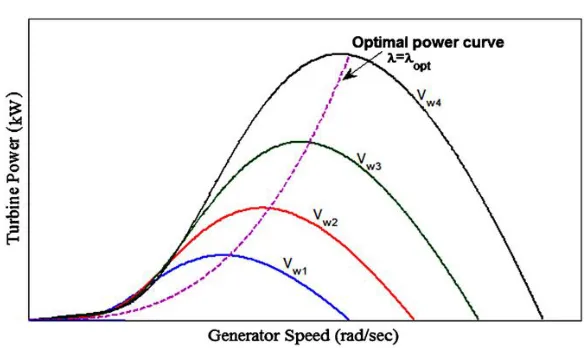
(5)To extractthe maximum power ωrshould vary with the wind speed such as to maintain λ at its optimum λopt.Operating
wind turbine at variable rotational speeds it is possible to achieve wind turbine output power at maximum Cp over a
Fig. 2 Turbine Power vs. Rotor Speed at Various Wind Speeds
III. MAXIMUM POWER PONT TRACKING ALGORTIHMS
The following section describes the various conventionalvarious methods of MPPT in wind energy conversion system.
A. HILL CLIMB SEARCH (HCS) METHOD
This algorithm is used frequently in wind power system at varying wind speeds.Assuming that theearlier cycle of the
wind power isP ( -1) to produce a speed variation Δ and compare the present wind power P ( )withP ( -1) .If the
power increases, as shown in Fig.3 Δ willmove continuously to the optimal rotation speed, else the power decreases.
Fig .3 Output Power vs. Generator Speed Characteristics
This method correlates the present power at some instant to the power attained at the previous step. If the power is growing, then duty cycle of the gate pulse applied to the converter switches is increased to drive the operating point more towards the peak power. If the power decreases, then the duty cycle is reduced. This method is simple and independent from wind turbine characteristics. Limitation of the Hill Climbing Search method is its inability to track the maximum power point in cases of suddenly varying wind speed.
Fig.4 Power Coefficient (Cp)vs. Tip Speed Ratio (λ) Characteristic
point of the TSRvalue can be determined experimentally or theoretically and reserved as a reference. Since this method seemssimple because wind speed is directly and continuously measured, a precise measurement for wind speed is futile in reality and alsoincreases the cost of the system also [3, 4–8]. The Block diagram of tip speed ratio control method is shown here in Fig. 5.
Fig .5 Tip Speed Ratio Control Block Diagram
C. OPTIMAL TORQUE CONTROL
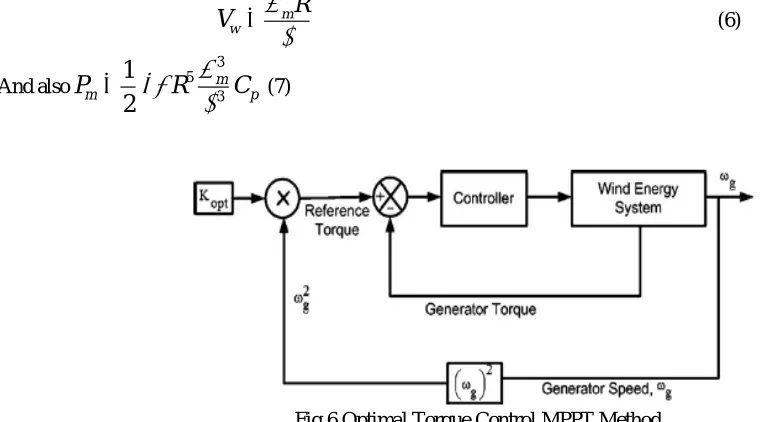
The MPPT-based control algorithms for the optimum energy from a wind turbine can be presented around rated wind speed. This method is applied the PMSG torque correspondingto maximumpower torque at a particular wind speed. The turbinepowerto be determined as a function of
and
m[15-18].m w
R
V
(6)And also
3 5
3
1
2
m
m p
P
R
C
(7)When the rotor is running at
opt, it will run atC
pmax thenmax
5 3
_ 3
1
2
p
m opt m
opt
C
P
R
(8)Since
P
m
m.
T
mmax
5 2
_ 3
1
2
p
m opt m
opt
C
T
R
(9)It is a torque-control method and expression of the optimum torque curve can be represented by Eq. (8). Fig. 6shows the reference torque for the controller that is connected to wind turbine. In general, this method is fast, and adequate. However, efficiency is lower in comparison with that of TSR control methodsince it does not measure the wind speed directly [23].
D. METHOD OF POWER SIGNAL FEEDBACK(PSF)
PSF method uses a reference power which is maximum power at that particular wind speed. This presents an issue, as the prior knowledge of the wind turbine characteristics and wind speed measurements is required. Once this reference power is obtained from the power curve at particular wind speed, a comparisonof yield is done with the present power. Then error produced drives a Control algorithm. PI control refers to Proportional (P), integral (I) control. It contains P and I part that are manipulated to reduce the error between a known set point and the instantaneous values of the measured values.
Fig.7 TheBlockDiagram of Power Signal Feedback Method
The block diagram of a wind energy conversion system with power signal feedback (PSF) control method is shown in Fig.7. The maximum output power datapoints corresponding to wind turbine speed can be stored in a lookup table [19-21]. Therefore maximum DC power output and the DC-link voltage were taken as input and output of the lookup table [13].
IV. CONCLUSION
wind aspossible therefore intelligent control strategiesmust be implemented. The power curve-based MPPT algorithm would result in robustand cost effective control method for wind turbine systems.
REFERENCES
[1] P. Gipe, “Soaring to new heights: the world wind energy market,” Renewable Energy World, vol.5, no. 4, pp. 33–47, Sept./Oct. 2002 [2] M. Pucci, M. Cirrincione, “Neural MPPT control of wind generators with induction machines without speed sensors,” IEEE Transactions Ind.
Elec., vol. 58, no.1, pp.37-47, Jan. 2011.
[3] R. Kazmi,H. Goto , Hai-Jiao Guo, Ichinokura O., “Review and critical analysis of the research papers published till date on maximum power point tracking in wind energy conversion system”, In: 2010 IEEE Energy Conversion Congress and Exposition (ECCE), pp. 4075–82, 2010. [4] M. Patel. Wind and solar power systems. CRC Press; 1999.
[5] Q.Wang, “Maximum wind energy extraction strategies using power electronic converters [PhD dissertation]”, Canada: University of New Brunswick; 2003.
[6] S. Barakati., “Modeling and controller design of a wind energy conversion sys-tem including matrix converter [PhD. dissertation].” Waterloo, Ontario, Canada: University of Waterloo; 2008.
[7] J. Zhang, M. Cheng, Chen Z, Fu X.,“Pitch angle control for variable speed wind turbines” , pp. 2691–6, 2008.
[8] JS. Thongam, M. Ouhrouche., “MPPT control methods in wind energy conversion systems”, In: Carriveau R, editor. Fundamental and advanced topics in wind power. InTech; 2011.
[9] MasoudB.,“Modeling and controller design of a wind energy conversion system including a matrix converter”, [Thesis PhD]. Ontario, Canada: Electrical and Computer Engineering, University of Waterloo, 2008.
[10] K. Tan, S. Islam., “Optimum control strategies in energy conversion of PMSG wind turbine system without mechanical sensors”, IEEE Transactions on Energy Conversion, pp.19:392–9, 2004.
[11] Yuanye Xia, Khaled H. Ahmed, and Barry W. Williams, “Wind Turbine Power Coefficient Analysis of a New Maximum Power Point Tracking Technique”, IEEE Transactions on Industrial Electronics, Vol. 60, No. 3, March 2013.
[12] S. Barakati, M. Kazerani , JD. Aplevich, “Maximum power tracking control for a wind turbine system including a matrix converter”, IEEE Transactions on Energy Conversion, pp.24:705–13, 2009.
[13] Q. Wang, L. Chang., “An intelligent maximum power extraction algorithm for inverter-based variable speed wind turbine systems”, IEEE Transactions on Power Electronics,vol.19, pp.1242–49, 2004.
[14] JiningnLu,K.Huang, Y.Zhang, “A Novel Variable Step Hill-Climb Search Algorithm Used for Direct Driven PMSG”, Proceedings of the International Conference Energy and Environment Technology, Guilin, Guangxi, China,vol.1, pp. 511–514, 16–18 October 2009.
[15] Nakamura T, Morimoto S, Sanada M, Takeda Y. “Optimum control of IPMSG for wind generation system”, In: Proceedings of the Power Conversion Conference, Osaka,vol.3, pp. 1435–40, 2002.
[16] S. Morimoto ,H. Nakayama ,M. Sanada ,Y. Takeda, “Sensorless output maximization control for variable-speed wind generation system using IPMSG”, IEEE Transactions on Industry Applications,vol.41, pp.60–7, Jan.2005.
[17] M. Pucci ,M. Cirrincione, “Neural MPPT control of wind generators with induction machines without speed sensors”, IEEE Transactions on Industrial Electronics ,vol.58, pp.37–47, Jan.2011.
[18] M.Shirazi, A.H.Viki, O. Babayi, “A comparative study of maximum power extraction strategies in PMSG wind turbine system”, IEEE Electrical Power & Energy Conference (EPEC), pp. 1–6, 2009.
[19] B. Masoud, “Modeling and controller design of a wind energy conversion system including a matrix converter [Thesis PhD]”, Ontario, Canada: Electrical and Computer Engineering, University of Waterloo; 2008
[20] K. Tan,S. Islam, “Optimum control strategies in energy conversion of PMSG wind turbine system without mechanical sensors”, IEEE Transactions on Energy Conversion,vol.19, pp.392–99, Jun. 2004.
[21] T Tudorache, D Kisck, B Rădulescu, M Popescu, “Design And Implementation of An Autonomous Wind/PV/Diesel/Battery Power System”, IEEE International Conference onOptimisation Electronic And Electrical Equipment, Brasov, Romania, pp. 987-992, May 2012.
[22] M Meiqin, Su Jianhui, L Chang, Z Guorong,ZYuzhu “Controller For 1KW-5KW Wind-Solar Hybrid Generation Systems”, IEEE Canadian Conference on Electrical and Computer Engineering, pp. 1175-1178, May 2008.