Available online: https://edupediapublications.org/journals/index.php/IJR/ P a g e | 1150
Relation between Interconnection Technologies for Cluster Computing
Anita Pruthi
PG Department Of Mathematics,
D.A.V College, Abohar-152116, INDIA
Cluster computers built from commodity processors are becoming the predominant super computer architecture because of their scalable performance and attractive price. Modern computing environments require low latency, high bandwidth and full time availability. This trend demands crash-safe operation, high level of safety, higher isolation and greater capacity to move data between processing nodes as well as between a processor node and I/O devices. To satisfy all the above-mentioned needs, various technologies have emerged in the era of cluster computing. In this paper, we have investigated various interconnection technologies used in cluster computing such as Giganet cLAN, InfiniBand, Myrinet, Gigabit Ethernet. Further a comparative study has been performed based on different criteria.
Keywords: Cluster Computing, Bandwidth, Latency.
I. INTRODUCTION
When people speak about piles of PCs, the first thing that comes to mind is a cluttered computer room with processors, monitors and snarls of cables all around. Collection of computers has become more sophisticated than in the early days [1]. Today clusters have replaced traditional super computers. As the need of processing power for solving problems is growing day by day, cluster computing is emerging very fast.
The performance of parallel applications running on the clusters depend s on the implementation of the nodes and the LAN or SAN that acts as the communication system [2]. Modern computing environments require low latency, high bandwidth and full time availability. This trend demands crash-safe operation, high level of safety, higher isolation and greater capacity to move data between processing nodes as well as between a processor node and I/O. Clusters need to incorporate fast Interconnection technologies in order to support high bandwidth and low latency inter-processor communication between cluster nodes. Today, improved network technologies help realize the construction of more efficient clusters [3].
Available online: https://edupediapublications.org/journals/index.php/IJR/ P a g e | 1151
technologies InfiniBand and Myrinet. In Section VI, comparison of these interconnects in terms of bandwidth and latency is shown. The conclusion is made in Section VII.
II. GIGABIT ETHERNET
Ethernet has been the main component in clustering technology since the very beginning; Gigabit Ethernet is still popular because it is “everywhere”. Since its introduction in 2002, 10 Gigabit Ethernet (10GbE) over fiber media has proved itself as a high-bandwidth, Low-latency solution. Multiple Gigabit Ethernet ports can be found on almost every server motherboard. Also the people feel Ethernet technology convenient. It is also inexpensive so that user can consider using it on cluster Gigabit Ethernet also has the ability to offer wide functionality, increased performance, and at the same time reduced cost [4]. Its use may not fit everyone’s needs. Those who want a simple cluster with minimal configuration, this is the best. Also the case of implementing a 10-GbE cluster is perhaps what is more attractive [4]. The data-intensive environments demand 10GbE performance. We can find it in digital filmmaking, especially in the areas of animation and special effects.
Name Medium Specified distance
1000BASE-CX Shielded balanced copper
cable
25 meters
1000BASE-KX Copper backplane 1 meter
1000BASE-SX Multi-mode fiber 220 to 550 meters dependent
on fiber diameter and
bandwidth
1000BASE-LX Multi-mode fiber 550 meters
1000BASE-LX Single-mode fiber 5 km
1000BASE-LX10 Single-mode fiber using
1,310 nm wavelength
10 km
1000BASE-EX Single-mode fiber at 1,310 nm
wavelength
40 km
1000BASE-ZX Single-mode fiber at 1,550 nm
wavelength
70 km
1000BASE-BX10 Single-mode fiber, over
single-strandfiber:1,490 nm downstream1,310 nm upstream
10 km
1000BASE-T Twisted-pair cabling (Cat-5,
Cat-5e, Cat-6, Cat-7)
Available online: https://edupediapublications.org/journals/index.php/IJR/ P a g e | 1152
1000BASE-TX Twisted-pair cabling (Cat-6,
Cat-7)
100 meters
Table1: Gigabit Ethernet Varieties [5], [6].
Varieties: Table 1 shows the five physical layer standards for Gigabit Ethernet using optical fiber
(1000BASE-X), twisted pair cable (1000BASE-T), or shielded balanced copper cable (1000BASE-CX). Ethernet later added 1000BASE-LX10 and -BX10.
III. GIGANET cLAN
Giganet is one of the leading interconnects for cluster of commodity computer systems. Giganet is a connection-oriented interconnect based on a hardware implementation of Virtual Interface Architecture (VIA) and Asynchronous Transfer Mode (ATM) technologies [7]. We cannot exchange messages between communication processes. For this purpose, a Virtual Channel (VC) has to be established. Each VC is allocated buffer queue, routing tables entries and other resources in the network and at the host. Therefore, the size of the cluster is limited by resources that are available at the switching element and the host interface [8]. For Giganet, end-to-end flow control scheme and circuit–based switching are used. Basically, Giganet cLAN is developed with the aim of supporting VIA in hardware & it supports low latency but it only provides a low bandwidth, thus making it not a good choice for implementing fast cluster networks [8].
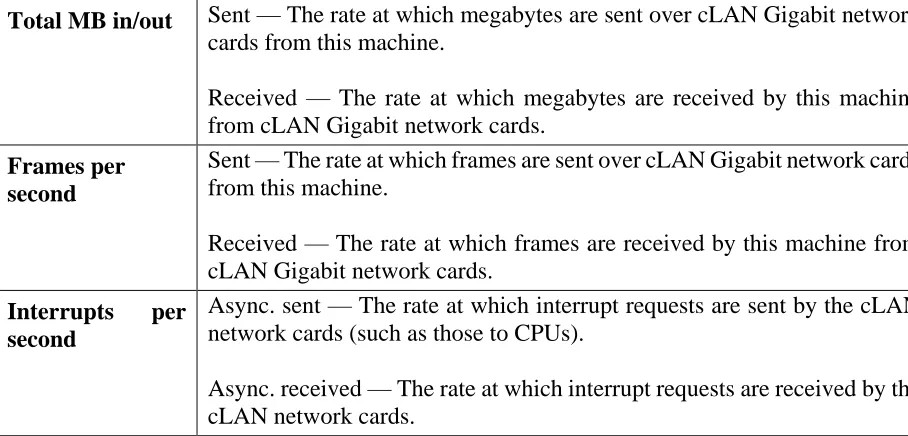
Total MB in/out Sent — The rate at which megabytes are sent over cLAN Gigabit network
cards from this machine.
Received — The rate at which megabytes are received by this machine from cLAN Gigabit network cards.
Frames per second
Sent — The rate at which frames are sent over cLAN Gigabit network cards from this machine.
Received — The rate at which frames are received by this machine from cLAN Gigabit network cards.
Interrupts per
second
Async. sent — The rate at which interrupt requests are sent by the cLAN network cards (such as those to CPUs).
Async. received — The rate at which interrupt requests are received by the cLAN network cards.
Table 2: Gigabit cLAN characteristics.
Available online: https://edupediapublications.org/journals/index.php/IJR/ P a g e | 1153
InfiniBand is a powerful architecture, which supports I/O connectivity for the Internet infrastructure. It is an open standard, internet protocol with ultra low latency. The first infiniBand specification was released in 2000. Unlike shared bus architectures, InfiniBand is a low pin count serial architecture that connects devices on the PCB and enables “Bandwidth out of the box”, spanning distances up to 17m over ordinary twisted pair copper wires. Over common fiber cable, It can span distances of several kilometers or more [9].
SDR DDR QDR FDR-10 FDR EDR HDR NDR
Theoretical effective throughput, Gbs, per 1x
2 4 8 10 14 25 50
Speeds for 4x and 12x (Gbit/s) 8, 24 16, 48 32, 96 41.25, 123.75 54.54, 163.64 100, 300 200, 600
Encoding (bits) 8/10 8/10 8/10 64/66 64/66 64/66
Latency
(microseconds)
5 2.5 1.3 0.7 0.7 0.5
Year 2001,
2003
2005 2007 2011 2014 2017 After
2020
Table 3: INFINIBAND Characteristics [10], [11], [12].
V. MYRINET
Myrinet is a new type of local area network based on the technology used for packets communications and switching with in massively parallel processors [14]. Myrinet’s host interfaces map the network, select routers, and control packet traffic. Its streamlined software allows direct communication between user processes and the network [14]. The basic unit of Myrinet network is a 16-port switching chip, which can be used for making topologies of different sizes.
Available online: https://edupediapublications.org/journals/index.php/IJR/ P a g e | 1154
Fig 1: Myrinet Network.
VI. COMPARISON OF INTERCONNECTION TECHNOLOGIES
Available online: https://edupediapublications.org/journals/index.php/IJR/ P a g e | 1155
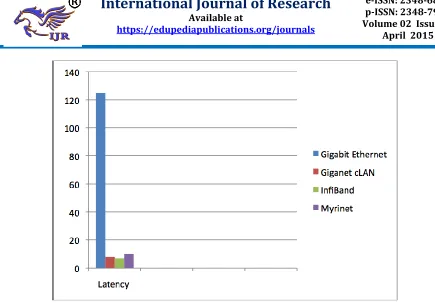
Fig. 3: Latency of four interconnects in microseconds.
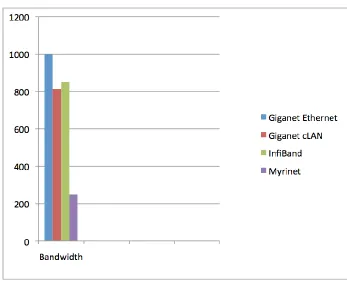
The base performance of the four interconnects in terms of bandwidth and latency are shown in Figures 2 and 3, respectively.
VII. CONCLUSION
Clusters provide an excellent platform for solving a range of parallel and distributed applications in both scientific and commercial areas. Designing fast and low latency network is important for any cluster. A lot of work being done in this is in both hardware (InfiniBand, Myrinet) and software (VIA) [17]. Here in this paper we have discussed the four major interconnection technologies available for designing cluster systems. From the figures, we find that Gigabit Ethernet has maximum bandwidth and Myrinet has minimum. Also latency of Gigabit Ethernet is maximum and that of InfiniBand is minimum. These interconnect solutions differ from one another with respect to their architecture, programmability, scalability and performance. This also shows that Gigabit Ethernet is only suitable for compute intensive applications.
Available online: https://edupediapublications.org/journals/index.php/IJR/ P a g e | 1156
[1]. Mark Baker, Rajkumar Buyya, Dan Hyde, ”Cluster Computing: A High –Performance Contender”, Technical Activities Forum, July 1999.
[2]. Hermann Hellwagner, Matthias Ohlenroth,”VI architecture communication features and performance on the Giganet cluster LAN”, Future Generation Computer Systems 18 (2002), 421-433.
[3]. Chee Shin Yeo, Rajkumar Buyya, Hossein Pourreza, Rasit Eskicioglu, Peter Graham, Frank Sommers, “Cluster Computing: High–Performance, High-Availability, and High Throughput Processing on a Network of Computers,
[4]. Douglas Eadline, “The 10 Gigabit Ethernet HPC Cluster”, 22 October 2009,
[5]. IEEE 802.3-2008 Section 3 Table 38-6 p.111
[6]. “Mode-Conditioning Patch Cord Installation Note”, Retrieved February 14, 2009
[7]. Jenwei Hsieh, Tau Leng, Victor Mashayekhi and Reza Rooholamini, “Architectural and performance evaluation of GigaNet and Myrinet Interconnects on Cluster of Small-Scale SMP Servers”, 0-7803-9802-5/2000/$10.00(c) 2000 IEEE.
[8]. R. Brightwell and A. B. Maccabe, “Scalability Limitations of VIA- Based Technologies in Supporting MPI”, In the Proceedings of the Fourth MPI Developer’s and User’s Conference, March 2000.
[9]. “Introduction to InfiniBand”, Mellanox Technologies Inc, Document Number 2003 WP.
[10]. http://www.infinibandta.org
[11].http://www.hpcadvisorycouncil.com/events/2014/swissworkshop/presos/Day_1/1_Mellanox
[12]. Panda, Dhabaleswar K.; Sayantan Sur (2011). “Network Speed Accelration with IB and
HSE”. Designing Cloud and Grid Computing Systems with InfiniBand and High-Speed Ethernet.
Available online: https://edupediapublications.org/journals/index.php/IJR/ P a g e | 1157
[14]. Nanette J. Boden, Danny Cohen, Robert E. Felderman, Alan E. Kulawik, Charles L. Seitz, Jakov N. Seizovic, Wen-King Su, Myricom Inc., “ Myrinet: A Gigabit-per- Second Local Area Network”, IEEE, Feb. 1995.
[15]. Myrinet, Inc.,” The GM Message Passing System”,http://www.myri.com,1999
[16]. S. Majumdar and S. Rixer, “ Compairing Ethernet and Myrinet for MPI Communication.
![Table 3: INFINIBAND Characteristics [10], [11], [12].](https://thumb-us.123doks.com/thumbv2/123dok_us/7812800.1294528/4.612.71.554.232.393/table-infiniband-characteristics.webp)