A Fast Single-Key Two-Level Universal Hash Function
Debrup Chakraborty, Sebati Ghosh and Palash Sarkar Indian Statistical Institute
203, B.T.Road, Kolkata, India - 700108. {debrup,sebati r,palash}@isical.ac.in
November 23, 2016
Abstract
Universal hash functions based on univariate polynomials are well known, e.g. Poly1305 and
GHASH. Using Horner’s rule to evaluate such hash functions require `−1 field multiplications for hashing a message consisting of ` blocks where each block is one field element. A faster method is based on the class of Bernstein-Rabin-Winograd (BRW) polynomials which requireb`/2c multipli-cations andblg`csquarings for`≥3 blocks. Though this is significantly smaller than Horner’s rule based hashing, implementation of BRW polynomials for variable length messages present significant difficulties. In this work, we propose a two-level hash function where BRW polynomial based hashing is done at the lower level and Horner’s rule based hashing is done at the higher level. The BRW polynomial based hashing is applied to a fixed number of blocks and hence the difficulties in handling variable length messages is avoided. Even though the hash function has two levels, we show that it is sufficient to use a single field element as the hash key. The basic idea is instantiated to propose two new hash functions, one which hashes a single binary string and the other can hash a vector of binary strings. We describe two actual implementations, one overF2128 and the other over F2256 both using thepclmulqdqinstruction available in modern Intel processors. On both the Haswell and Skylake processors, the implementation overF2128 is faster than the highly optimised implementation of GHASHby Gueron. We further show that the Fast Fourier Transform based field multiplication overF2256 proposed by Bernstein and Chou can be used to evaluate the new hash function at a cost of about at most 46 bit operations per bit of digest, but, unlike the Bernstein-Chou analysis, there is no hidden cost of generating the hash key. More generally, the new idea of building a two-level hash function having a single field element as the hash key can be applied to other finite fields to build new hash functions.
Keywords: universal hash function, Horner’s rule, BRW polynomials, two-level hash function, MAC schemes.
1
Introduction
An important primitive in cryptography is a hash function family with provably low collision and differ-ential probabilities. Hash functions with provably low collision probability are called almost universal (AU) and those with provably low differential probability are called almost XOR universal (AXU). Starting from the work of Carter and Wegman [6], such hash functions have been used to construct message authentication code (MAC) schemes. They have also been suggested for the construction of disk encryption and authenticated encryption.
The computation can be reduced to about `/2 field multiplication by using the pseudo-dot product construction [25]. One problematic issue for both the multi-linear hash and the pseudo-dot product is that the key for the hash function is as long as the message.
The problem of long hash keys can be avoided by using another well known approach. In this approach, the digest is obtained by evaluating a univariate polynomial over a finite field. The coefficients of the polynomial are the message blocks and the point at which the polynomial is evaluated is the hash key. As a result, the hash key consists of a single field element. Using Horner’s rule, a univariate polynomial of degree ` can be evaluated using `−1 field multiplications. This cost is about the same as that required for multilinear map based hash function.
Bernstein [3] built on a previous work by Rabin and Winograd [18] to propose a hash function using a class of univariate polynomials called the BRWpolynomials [19]. The hash key is still a single element of the field. The main advantage of BRW polynomial based hashing is that the number of multiplications required for hashing a message consisting of ` ≥ 3 blocks is b`/2c with an additional
blg`csquarings. In fact, what the pseudo-dot product is to the multilinear hash, theBRWpolynomials is to the Hornerbased hash.
There is, however, an obstacle in efficient implementation of BRW polynomials. The definition of BRW polynomial is inherently recursive and the computation for an `-block message requires two recursive calls on messages consisting of smaller number of blocks. In principle, the recursion can be simulated in a bottom-up fashion. The major problematic issue is that even the first recursive call cannot be made unless the length of the whole message is available. The whole message has to be buffered before even the first message block can be processed. A second problem is that at each point of the computation, it is quite complicated to figure out the operands that are to be multiplied. Again, in principle this can be done, but, actually determining the operands requires additional time. Possibly due to these issues, till date there has been no software efficient implementation of BRW based hash function. On the other hand, hardware implementations for fixed length inputs are known [7].
Our Contributions
We investigate the possibility of harnessing the speed of BRW polynomial based hashing without the associated difficulties in implementation. To this end, our first observation is that if the number of blocks in a message is a small fixed number, then the above mentioned difficulties disappear. Making effective use of this observation leads us to consider a two-level hash design. Suppose BRW is to be applied when the number of blocks isη. Let us call anη-block message to be a super-block. The input message blocks are divided into super-blocks andBRW is applied to each super-block. The outputs of these BRWcalls are then combined using a Horner based hashing.
The number of multiplications required for a message consisting of` super-blocks is about `η/2 +
`−1 (the precise count is provided later). Applying Horner to such a message will require `η −1 multiplications while BRW will require `η/2 multiplications. By choosing a suitable value of η, the number of multiplications required by the new hash function can be made quite close to that of BRW. Such a two-level strategy has the advantage that it avoids the difficulties associated with implementing BRWon variable length messages.
The idea of two-level (or, multi-level) hashing is not new and has been proposed in the literature [22, 17, 20]. Two-level hashing in general requires independent keys for each level. So, applied directly, the hash key will consist of two field elements. For many applications, it is desirable to have only a single field element as the overall hash key.
power of τ as the key to theHorner layer. Moreover, if η is one less than some power of two, then the required power of τ can be computed using only one extra squaring over and above the computations required by BRW.
The underlying field for the new hash function can be any field. In particular, this field can be a suitable binary field or, it can be a field of large characteristic such as F2130−5, the field which has been used in Poly1305.
To make the ideas concrete, we instantiate the two-level hash construction for the binary fieldsF2128 and F2256. For implementing the new hash functions, the basic requirement is efficient implementation of multiplication over F2n forn equal to either 128 or 256. Being a binary field, it is possible to utilise
the instructionpclmulqdq available in modern Intel processors for field multiplication. The instruction
pclmulqdq multiplies two 64-bit polynomials and returns the 128-bit polynomial as the product. Our implementations for both F2128 and F2256 are based on the pclmulqdq instruction.
A field multiplication inF2n consists of a polynomial multiplication followed by a reduction modulo
the irreducible polynomial representing the field. Late, or, delayed reduction is a well known technique for speeding up a group of field multiplications. Essentially, the idea is to perform several polynomial multiplications, add the results and then perform a single reduction for the entire group of multiplication. This technique cannot always be applied. We carefully analyse the structure of BRW and identify the groups of multiplications for which a single reduction suffices. Our implementations of the hash function forn= 128 andn= 256 make use of delayed reduction to achieve efficiency improvement.
Several other concrete efficiency issues forBRWhave been identified and implemented. One of these is to perform independent multiplications together so that all thepclmulqdqinstructions for these mul-tiplications can be placed together. This permits possible utilisation of instruction level pipelining. For
n = 128, the implementation of the new hash function is faster than the highly optimised implemen-tation of GHASH by Gueron [9]; on the Haswell processor of Intel, we obtain speed improvements of about 15% to 19%, while on the Skylake processor, the speed improvements are about 10% to 15%.
The work by Bernstein and Chou [4] reports the implementation of a pseudo-dot product based hash function over F2256. This implementation does not use thepclmulqdq instruction and is instead based on the Fast Fourier Transform (FFT) algorithm. The work shows that the hash function can be computed at the cost of 29 bit operations per bit of the digest. There is, however, a considerable hidden cost of generating the hash key which is as long as the message. This cost is not accounted for in the 29 bit operations per bit measure given in [4].
The FFT based multiplication algorithm can also be used with the new hash construction that we propose. The code for the multiplication algorithm described in [4] is not publicly available and so we could not carry out a concrete implementation. Instead, we used the operation counts for direct and inverse FFT, pointwise multiplication and the reduction algorithm reported in [4], to derive an expression for the number of bit operations per bit for the new hash function. For η = 31, this cost is at most about 46, while for η = 63 or 127, the cost is lower. The cost of 46 bit operations per bit is higher than the cost of 29 bit operations per bit reported in [4]. On the other hand, unlike [4], in our case there is no hidden cost of generating the hash key. Securely generating a long hash key will have a significant cost and if this cost is taken into account, then we expect the total cost in [4] to be significantly more than the 46 bit operations per bit that we obtain.
Previous Works
and GHASH [15]. Gueron and Kounavis [10] described an efficient method for reduction over binary fields. The most recent implementation of GHASH by Gueron [9] uses delayed reduction through the use of a pre-computed table. BRW polynomials were introduced in [3] and hardware implementation was reported in [7]. Well known constructions of hash functions based on the pseudo-dot product are UMAC andVMAC. As mentioned earlier, the construction in [4] is a more recent such construction over
F2256. Nandi [16] has shown a lower bound on the number of multiplications required for secure hashing which shows that the pseudo-dot and BRW based hashing essentially require an optimal number of field multiplications. Brief surveys on various constructions of universal hash functions can be found in [3, 21].
2
Preliminaries
Let D and G be finite non-empty sets. Let {Hτ}τ∈T be an indexed family of functions such that for
each τ,Hτ :D → G. The index set T is considered to be the set of all keys and a particular τ from T
is considered to be the key forHτ. We define two kinds of probabilities associated with such a function
family.
Collision probability: For distinctx, x0 ∈ D, the collision probability of{Hτ}τ∈Tfor the pair (x, x0)
is defined to be Prτ[Hτ(x) =Hτ(x0)].
Differential probability: Suppose G is an additively written group. For distinct x, x0 ∈ D and any
y∈ G, the differential probability of{Hτ}τ∈T for the triplet (x, x0, y) is defined to be Prτ[Hτ(x)− Hτ(x0) =y].
In the above, the probabilities are taken over uniform random choices of τ from T.
The family{Hτ} is said to be -almost universal (-AU) if for all distinct x, x0 inD, the collision
probability for the pair (x, x0) is at most . The family {Hτ} is said to be -almost XOR universal
(-AXU) if for all distinct x,x0 inD and any y∈ G, the differential probability for the triplet (x, x0, y) is at most .
In the following,Fwill denote a finite field. The groupGwill be instantiated as the additive group of F. The two standard operations overFare multiplication and addition. Forx, y∈F, the product (resp.
sum) ofx and y will be denoted as xy (resp. x+y) as is conventional. If F is a field of characteristic
two, then the sum ofx and y will be denoted asx⊕y.
2.1 Polynomial Hashing
For `≥0, the polynomialHornerτ(m1, m2,· · ·, m`) in the variable τ with m1, . . . , m` ∈F is defined as
follows:
If`= 0, then Hornerτ() = 0; and for ` >0,
Hornerτ(m1, m2,· · · , m`)
= m1τ`−1+m2τ`−2+· · ·+m`−1τ+m`
= (((m1τ +m2)τ +m3)τ +· · ·+m`−1)τ +m`.
(1)
Note that computing Horner on `field elements requires `−1 additions and`−1 multiplications. It is well known that {Hornerτ}τ∈F, is ((`−1)/#F)-AU. Further, the hash function {τHornerτ}τ∈F
2.2 BRW Hashing
In [3], Bernstein defined a family of polynomials based on previous work by Rabin and Winograd [18], later called the BRW polynomials in [19]. For l≥0, BRWτ(m1, m2,· · ·, ml) with m1, . . . , ml ∈F is a
polynomial in the variableτ and is defined as follows:
• BRWτ() = 0;
• BRWτ(m1) =m1;
• BRWτ(m1, m2) =m1τ+m2;
• BRWτ(m1, m2, m3) = (τ +m1)(τ2+m2) +m3;
• BRWτ(m1, m2,· · · , ml)
=BRWτ(m1,· · ·, mt−1)(τt+mt) +BRWτ(mt+1,· · · , ml);
ift∈ {4,8,16,32,· · · }and t≤l<2t.
Suppose l ≥ 3. Following [3], it can be shown that BRWτ(m1, . . . , ml) can be computed using bl/2c
multiplications andblglc additional squarings to computeτ2, τ4, . . ..
Letd(l) denote the degree of BRWτ(m1, . . . , ml). Then d(l) = 2blglc+1−1 [3] and so d(l) ≤2l−1
where the bound is achieved if and only if l= 2r for somer≥2 and d(l) =lif and only if l= 2r+1−1 for somer ≥1.
It has been proved in [3] that the map fromFl toF[τ] given by
(m1, . . . , ml)7−→BRWτ(m1, . . . , ml)
is injective. As a consequence, the hash function{BRWτ}τ∈F,BRWτ : (m1, . . . , ml)7→BRWτ(m1, . . . , ml)
is (d(l)/#F)-AU.
3
Combining BRW with Horner
Both {Hornerτ} and {BRWτ} use a single key τ ∈F. The number of multiplications in F required to
evaluate the two functions, though, are different. For a message consisting of ` field elements, Horner can be evaluated using `−1 multiplications, while for `≥3, BRW requires b`/2c multiplications plus
blog2`c squarings. In theory, this difference makesBRW much faster thanHorner.
The problem, however, is that the definition ofBRW is recursive. It is possible to have a recursive implementation of BRW. The overhead of such an implementation will nullify the benefit of lesser number of multiplications. On the other hand, if` is a fixed integer, then it is possible to have a very fast non-recursive implementation ofBRW.
Horneron the other hand can handle arbitrary values of`quite easily. So, it makes sense to try and combine BRW and Horner so that the benefits of both the approaches can be obtained. One top-level strategy for doing this is the following. Suppose the message is a bit string which is formatted into a sequence of blocks where each block is an element of the field F. Divide the sequence of field elements
into groups ofη blocks (assuming thatηdivides the number of blocks in the message). Each such group will be called a super-block.
Horner can be used to combine the outputs ofBRW calls. The number of multiplications required by this approach is a little greater than that of BRWand is significantly smaller than that ofHorner.
An important issue that needs to be properly tackled is the size of the key for the hash function. Generic approaches to multi-level hash [22, 17, 20] require the key to have independent components for each level of the hash. For a two-level hash, this would normally require two independent field elements as the key. It is, however, desirable to use a single field element as the key. We show how this can be done.
Proposition 1. Letη, `be positive integers. ForM ∈Fη` writeM = (M1, . . . , M`)where eachMi∈Fη.
We defineGτ(M1, . . . , M`) to be a polynomial inτ in the following manner.
Gτ(M1, . . . , M`)
= Hornerτd(η)+1(BRWτ(M1), . . . ,BRWτ(M`))
= τ(d(η)+1)(`−1)BRWτ(M1) +τ(d(η)+1)(`−2)BRWτ(M2) +
· · ·+τ(d(η)+1)BRWτ(M`−1) +BRWτ(M`). (2)
The following hold for the function G given by (2).
1. The degree of G in τ is `d(η) +`−1.
2. G injectively mapsFη` to F[τ].
Consequently, the hash family {Gτ}τ∈F is ((`d(η) +`−1)/#F)-AU and the hash family {τ Gτ}τ∈F is
((`d(η) +`)/#F)-AXU.
Proof. Since each Mi ∈Fη, the degree of BRWτ(Mi) is d(η) and so the degree of the polynomial Gis
(d(η) + 1)(`−1) +d(η) =`d(η) +`−1. This proves the first point. EachMi ∈Fη and so for all i,BRWτ(Mi) has degreed(η). Let
BRWτ(Mi) =τd(η)ci,d(η)+τd(η)−1ci,d(η)−1+· · ·+τ ci,1+ci,0
for someci,d(η), . . . , ci,1, ci,0∈Fwhich depend on Mi. Using this, we write
Gτ(M1, . . . , M`)
= τ(d(η)+1)(`−1)+d(η)c1,d(η)+· · ·+τ(d(η)+1)(`−1)+1c1,1+τ(d(η)+1)(`−1)c1,0 +τ(d(η)+1)(`−2)+d(η)c2,d(η)+· · ·+τ(d(η)+1)(`−2)+1c2,1+τ(d(η)+1)(`−2)c2,0 +· · ·+
+τ(d(η)+1)(`−i)+d(η)ci,d(η)+· · ·+τ(d(η)+1)(`−i)+1ci,1+τ(d(η)+1)(`−i)ci,0 +· · ·+
+τ2d(η)+1c`−1,d(η)+· · ·+τd(η)+2c`−1,1+τd(η)+1c`−1,0 +τd(η)c`,d(η)+· · ·+τ c`,1+c`,0.
Considered as a polynomial in τ, the coefficients of Gτ(M1, . . . , M`) are ci,j with 1 ≤ i ≤ ` and
0≤j≤d(η). Due to the choice of the key for Hornerto beτd(η)+1, eachci,j is associated with a unique
power of τ.
Let M, M0 ∈ Fη` with M =6 M0. Write M0 = (M0
1, . . . , M`0) with each Mi0 ∈ Fη. Let c0i,j be the
coefficients of the polynomial Gτ(M10, . . . , M`0). Since M 6= M
0, there is an i such that M
Table 1: Summary of the features of the basic scheme, Horner and BRW for hashing η` blocks with
η= 2r+1−1 for some r≥1.
scheme # sqr # mult AU bound Horner – η`−1 (η`−1)/#F
BRW blgη`c bη`/2c d(η`)/#F
Gτ r+ 1 `(η+ 1)/2−1 (η`+`−1)/#F
From the injectivity property of BRW, it follows that BRWτ(Mi) 6= BRWτ(Mi0) and so there is a j ∈ {0,1, . . . , d(η)} such that ci,j 6=c0i,j. From this it follows that Gτ(M1, . . . , M`)6=Gτ(M10, . . . , M`0).
This shows the second point.
Since for distinctM and M0,Gτ(M1, . . . , M`) and Gτ(M10, . . . , M`0) are distinct and have the same
degree, it follows that Gτ(M1, . . . , M`)−Gτ(M10, . . . , M`0) is a non-zero polynomial of degree at most `d(η) +`−1. Consequently, the probability that Gτ(M1, . . . , M`) is equal to Gτ(M10, . . . , M`0) is the
probability thatτ is a root of the non-zero polynomialGτ(M1, . . . , M`)−Gτ(M10, . . . , M`0). The number
of distinct roots of a non-zero polynomial over a field is at most its degree from which it follows that the required probability is at most (`d(η) +`−1)/#F. This shows the AU property.
For the AXU property, we note that the degree of τ Gτ(M1, . . . , M`) is `d(η) +`. The rest of the
argument is similar to that of the AU propery.
A crucial point in the above construction and the proof is the choice of the appropriate power ofτ
as the key for Horner so that the injectivity of Gτ follows directly from the injectivity of BRWτ. The
key for BRWτ is τ and the degree of BRWτ in τ is d(η). Based on this, the key for Horner is chosen
to be τd(η)+1. This ensures that during the computation ofHorner, theBRW polynomials arising from distinct super-blocks do not “overlap”.
For η ≥ 3 suppose r ≥ 1 is such that 2r ≤ η < 2r+1. Then d(η) = 2r+1 −1. The number of multiplications required in evaluating (2) is given by the number of multiplications required to evaluate all the BRW invocations and the number of multiplications required to evaluate the single Horner invocation. Each BRW requires bη/2c multiplications and Horner requires `−1 multiplications for a total of `bη/2c+`−1 multiplications. Additionally, blgηc=r squarings are required to compute the powers τ2, . . . , τ2r which are used for evaluating BRW; an additional squaring is required to compute the powerτd(η)+1 =τ2r+1 which is used as a key toHorner. So a total ofblgηc+ 1 squarings are required to compute all the required powers ofτ.
For η = 2r+1 −1 with r ≥ 1, Table 1 compares the efficiency and security of G
τ with that of
Hornerand BRW. The ratio of the number of multiplications required byGτ to that required byHorner
is (`(η+ 1)−2)/(2(`η−1)) and the ratio of the number of multiplications required by BRW to that required byGτ is 2bη`/2c/(`(η+1)−2). Supposeη = 31: the first ratio is (16`−1)/(31`−1) which equals
1/2 for `= 1 and has the limiting upper bound of 16/31≈0.52; the second ratio is b31`/2c/(16`−1) which equals 1 for ` = 1 and decreases to about 0.97 as ` increases. So, for η = 31, the number of multiplications required by Gτ is about 50% to 52% of that required by Horner while the number of
multiplications required byBRW is about 97% to 100% of that required byGτ.
Forη = 31, the AU bound for Horner is (31`−1)/#F; the AU bound for Gτ is (32`−1)/#F; and
the AU bound for BRW is d(31`)/#F = (2blg(31`)c+1−1)/#F. The AU bound for BRW is in general
higher than the AU bound forGτ. The two bounds can be equal, e.g. for`= 1,2,4,8, . . .. On the other
hand, the AU bound for BRW can be about twice as large as the AU bound forGτ, e.g. for`= 9, the
Overall, Gτ allows a range of efficiency/security trade-offs between BRW and Horner. By choosing
an appropriate value for η, it is possible to attain speed nearly equal to that of BRW with AU bound not too larger thanHorner.
Multi-level hashing: The idea of usingBRWat the lower level andHornerat the upper level can be extended to more than one level. The critical issue is to choose an appropriate power ofτ as the key for each level. While this can be done, extending to more than two levels results in a rather complicated construction which would mainly be of theoretical, rather than any practical, interest. So, we did not pursue the idea of multi-level hashing.
4
Two-Level Hash Function
For practical applications, it is required to handle variable length strings. We show how to modify the construction in Proposition 1 to be able to do this. For concreteness,in the rest of the paper we will fix
the finite field F to be F2n for some positive integern. The ideas, on the other hand, are quite general
and can be adapted to work with other finite fields. The following notation will be used.
• Given a binary string S, let len(S) denote the length ofS, i.e., len(S) is the number of bits inS.
• Given an integeriwith 0≤i≤2k−1, let bink(i) denote the k-bit binary representation ofi.
• Given a positive integernand a binary stringS, letpadn(S) denoteS||0i whereiis the minimum non-negative integer such that len(S) +iis divisible by n.
Let
D =
2n−1 [
i=0
{0,1}i. (3)
The reason for the bound 2n −1 on the length of the strings in D is that we require the binary representation of the length of any string in D to fit into an n-bit string. For M ∈ D, we define a functionsuperBlksn,η(M) as follows. Considerpadn(M) to be formatted into a sequence of n-bit blocks. Let` be such that
len(padn(M))
n =η(`−1) +λ (4)
for some λ ∈ {1, . . . , η}. Then padn(M) consists of `−1 full super-blocks and one possibly partial super-block. LetsuperBlksn,η(M) denote these super-blocks and we write
superBlksn,η(M) = (M1, . . . , M`)
whereM1, . . . , M`−1are full super-blocks (consisting of exactlyη n-bit blocks each) andM`is a possibly
partial superblock (consisting of at most η n-bit blocks).
Theorem 1. Let D be as given in (3). Define a hash family {Hash2Lτ}τ∈F2n where Hash2Lτ : D →
{0,1}n such that for M ∈ D,
Hash2Lτ(M)
where (M1, . . . , M`) =superBlksn,η(M).
Let M and M0 be distinct elements of D with len(M) ≥ len(M0). For a uniform random τ ∈ F2n
and any β ∈F2n
Pr
τ
Hash2Lτ(M)⊕Hash2Lτ(M0) =β
≤ `(d(η) + 1) + 1
2n (6)
where ` is the number of super-blocks inM.
Proof. The proof follows if we can show thatHash2Lτ(M)⊕Hash2Lτ(M0)⊕β is a non-zero polynomial
in τ of degree at most `(d(η) + 1) + 1. The maximum degree ofHash2Lτ(M) as a polynomial in τ is `d(η) +`−1 + 2 =`(d(η) + 1) + 1. So, we only need to argue thatP =Hash2Lτ(M)⊕Hash2Lτ(M0)⊕β
is a non-zero polynomial.
First suppose that len(M) 6=len(M0). The coefficient of τ inHash2Lτ(M) is binn(len(M)) and the
coefficient ofτ inHash2Lτ(M0) isbinn(len(M0))6=binn(len(M)). So, P is a non-zero polynomial inτ.
So, suppose that len(M) = len(M0). Then ` = `0 and an argument similar to that provided for Proposition 1 shows that P is a non-zero polynomial in τ. The only difference with the argument in Proposition 1 is that the last super-blocks M` and M`0 may be partial. This, however, does not affect
the argument, since the property that M`6=M`0 impliesBRWτ(M`)6=BRWτ(M`0) is preserved.
Remark: The manner in which Hash2Lτ(M) has been defined ensures the AXU property. If only the
AU property is desired, then one can define Hash2Lτ(M) to be
τHornerτd(η)+1(BRWτ(M1), . . . ,BRWτ(M`))⊕binn(len(M)).
This requires one less multiplication.
4.1 Hashing a Vector of Strings
The hash family Hash2L handles a single binary string. We show how to extend it to handle a vector where each component is a binary string.
The parametersnand η are defined as in the case ofHash2L. We define the hash family
{vecHash2Lτ}τ∈F2n such that vecHash2Lτ :VD →F2n. (7) The domain VD consists of variable length vectors of binary strings. Formally,
VD =
255 [
k=0
(M1, . . . , Mk) : 0≤len(Mi)≤2n−16−1 . (8)
The reason for the bound k≤255 is that we require the binary representation of k to fit into a byte. Similarly, the reason for the bound len(Mi)≤2n−16−1 is that we require the binary representation of
the length of any Mi to fit into n−16 bits. Ifk = 0, then the input is the empty list. Note that this
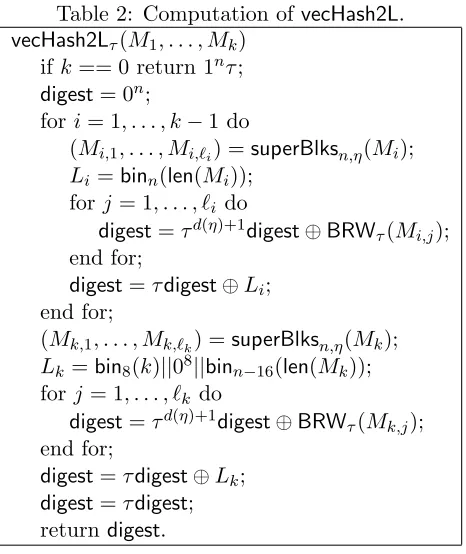
input is different from the input where k= 1 and M1 is the empty string. The computation of the output ofvecHash2Lτ is shown in Table 2.
Theorem 2. Let k ≥ k0 ≥0; M= (M1, . . . , Mk) and M0 = (M10, . . . , Mk00) be two distinct vectors in
VD. For a uniform randomτ ∈F2n and for any β ∈F2n,
Pr
τ
vecHash2Lτ(M)⊕vecHash2Lτ(M0) =β
≤ max (k+ (d(η) + 1)Λ, k
0+ (d(η) + 1)Λ0)
2n (9)
where Λ =Pk
i=1`i andΛ
0=Pk0
i=1`
0
Table 2: Computation ofvecHash2L. vecHash2Lτ(M1, . . . , Mk)
ifk== 0 return 1nτ;
digest= 0n;
fori= 1, . . . , k−1 do
(Mi,1, . . . , Mi,`i) =superBlksn,η(Mi);
Li=binn(len(Mi));
forj = 1, . . . , `i do
digest=τd(η)+1digest⊕BRWτ(Mi,j);
end for;
digest=τdigest⊕Li;
end for;
(Mk,1, . . . , Mk,`k) =superBlksn,η(Mk); Lk=bin8(k)||08||binn−16(len(Mk));
forj= 1, . . . , `k do
digest=τd(η)+1digest⊕BRWτ(Mk,j);
end for;
digest=τdigest⊕Lk;
digest=τdigest; returndigest.
Proof. Quantities corresponding to M0 will have the superscript 0.
Fori= 1, . . . , k and 1 ≤j ≤`i, the degree of BRWτ(Mi,j) is d(η) for 1≤j < `i and it is at most d(η) for j=`i. Write
BRWτ(Mi,j) =ci,j,0⊕ci,j,1τ⊕ · · · ⊕ci,j,d(η)τd(η)
where the c’s depend on theMi’s. So, each Mi contributes at most`i(d(η) + 1) + 1 coefficients ci,1,0, . . . , ci,1,d(η), . . . , ci,`i,0, . . . , ci,`i,d(η), Li
to vecHash2Lτ(M). The total number of coefficients is at most k+ (d(η) + 1)Λ. The last step in the
digestcomputation increases the degree by one and so the maximum degree of vecHash2Lτ(M) is equal
to the maximum number of coefficients in vecHash2Lτ(M). The degree of
P =vecHash2Lτ(M)⊕vecHash2Lτ(M0)⊕β
is max (k+ (d(η) + 1)Λ, k0+ (d(η) + 1)Λ0). The result follows if we can show that P is a non-zero polynomial in τ. The detailed proof is divided into several cases.
Case k0 = 0: Since M 6= M0, it follows that k > 0. vecHash2Lτ(M0) equals 1nτ. Since k > 0,
vecHash2Lτ(M) is of the form Lkτ⊕τ2(· · ·) where
Lk=bin8(k)||08||binn−16(len(Mk))6= 1n.
Case k > k0 >0: In this case,vecHash2Lτ(M) is of the formLkτ ⊕τ2(· · ·) andvecHash2Lτ(M0) is of
the form L0k0τ⊕τ2(· · ·) where
Lk=bin8(k)||08||binn−16(len(Mk))6=bin8(k0)||08||binn−16(len(Mk00)) =L0k0.
So, again P is a non-zero polynomial.
Case k=k0 >0: There are two subcases to consider.
Sub-case (a): There is some isuch that len(Mi) 6=len(Mi0). Let i be the maximum such value and
so, len(Mj) = len(Mj0) for j = i+ 1, . . . , k. Since len(Mi) 6= len(Mi0), it follows that Li 6= L0i. Let s= 1 + (k−i) +Pk
j=i+1`j(d(η) + 1) = 1 + (k0−i) +Pk 0
j=i+1`0j(d(η) + 1). Then the coefficient ofτs in P is Li⊕L0i 6= 0. So, againP is a non-zero polynomial.
Sub-case (b): In this case, len(Mi) =len(Mi0) for i= 1, . . . , k. As a result, in this case the number
of components and the length of all the components in Mand M0 are equal. SinceM6=M0, it follows that there must be somessuch that Ms6=Ms0.
Since len(Ms) = len(Ms0), it follows that the number of superblocks of Ms and Ms0 are equal, i.e., `s=`0s. The super-blocks corresponding toMsareMs,1, . . . , Ms,`s while the super-blocks corresponding
to Ms0 are Ms,01, . . . , Ms,`0 s. Since Ms 6= Ms0, at least one of the superblocks must be unequal. Let t ∈ {1, . . . , `s} be such that Ms,t 6= Ms,t0 . By the injectivity of BRW, it follows that BRWτ(Ms,t) 6=
BRWτ(Ms,t0 ) and so there is a k ∈ {0, . . . , d(η)} such that cs,t,k 6=c0s,t,k. As a result, P is a non-zero
polynomial.
This completes all the cases and the proof.
5
Implementations Based on
pclmulqdq
Our target platform were the Intel processors which support thepclmulqdqinstruction. This instruction takes as input two degree 64 polynomials overF2(represented as two 64-bit words) and returns as output the degree 128 polynomial which is the product of the two input polynomials. The implementation was done using Intel intrinsics.
We report implementations forn= 128 and n= 256. For n= 128, F2128 was represented using the irreducible polynomial σ(x) =x128⊕x7⊕x2⊕x⊕1 and for n= 256,F2256 was represented using the irreducible polynomial σ(x) = x256⊕x10⊕x5⊕x2⊕1. In both cases, σ(x) is of the form xn⊕g0(x) whereg0(x) is a polynomial of degree less thann/2 having exactly 4 non-zero coefficients.
We report timings on two different machines. For the timing measurements, we followed the strategy of [13]. The first timing measurements were taken on a single core of a machine with Intel Core i7-4790 Haswell @ 3.60GHz. The second timing measurements were taken on a single core of a machine with Intel Core i7-6500U Skylake @ 2.5GHz. In both cases, the operating system was 64-bit Ubuntu-14.04-LTS and the C code was complied using GCC version 4.8.4. The code is publicly available1.
5.1 Field Multiplication
The multiplication of two 128-bit polynomials using the schoolbook method requires 4 pclmulqdq
calls and using Karatsuba’s algorithm requires 3 pclmulqdq calls. The multiplication of two 256-bit 1
polynomials using the schoolbook method requires 16pclmulqdqcalls and using Karatsuba’s algorithm requires 9pclmulqdq calls. The reduction step can also be computed usingpclmulqdqcalls. From the work of Gueron and Kounavis [10] one obtains that forn= 128, 2pclmulqdqcalls are sufficient for the reduction while forn= 256, 4pclmulqdqcalls are sufficient. Details are provided in Section 5.2 below.
Batch multiplications: Supposem independent multiplications are to be computed. The code can be arranged such that the pclmulqdq instructions for these multiplications can be grouped together. This may help the instruction scheduler to utilise instruction pipelining to speed up the computation. We have experimented with values of m≤4 and have found some speed improvements. In theory, the speed improvement should continue asm increases. In practice, however, this does not always happen.
5.2 Efficient Reduction
Let nbe a positive even integer and F2n be represented by an irreducible polynomialσ(x) of degree n
overF2. Elements ofF2n are represented using polynomials overF2 of degrees less thann. Leta=a(x)
and b = b(x) be two elements of F2n. The computation of ab = a(x)b(x) modσ(x) consists of two
steps. In the first step,a(x) and b(x) are multiplied together to obtain a result e(x) of degree less than 2n−1 and thene(x) is reduced moduloσ(x) to obtain the desired result. Lete(x) =a(x)b(x) and write
e(x) = d(x)⊕c(x)xn where c(x) and d(x) have degrees less than n. The essential task is to compute
c(x)xnmodσ(x). A method for doing this was described by Gueron and Kounavis [10]. We review their method and determine the number of pclmulqdq instructions required for the reduction for both
n= 128 and n= 256.
Letq(x) andp(x) be such that c(x)xn=q(x)σ(x)⊕p(x) with deg(q),deg(p)≤n−1. The goal is to find p(x). Writeσ(x) =xn⊕σ∗(x), where deg(σ∗)≤n−1. The equationc(x)xn=q(x)σ(x)⊕p(x) becomes c(x)xn = q(x)xn ⊕q(x)σ∗(x)⊕p(x) and so p(x) = q(x)σ∗(x) modxn. So, finding q(x) is sufficient for obtaining p(x).
Letq+(x) andp+(x) be such thatx2n=q+(x)σ(x)⊕p+(x) with deg(p+)≤n−1 and deg(q+) =n. So,
c(x)x2n = q(x)σ(x)xn⊕p(x)xn
⇒ c(x)(q+(x)σ(x)⊕p+(x)) = q(x)σ(x)xn⊕p(x)xn
⇒ c(x)q+(x)σ(x)⊕c(x)p+(x) = q(x)σ(x)xn⊕p(x)xn
⇒ jc(x)q+(x)σ(x)⊕c(x)p+(x)
x2n
k
= jq(x)σ(x)xx2nn⊕p(x)xn
k
⇒ jc(x)q+x2(xn)σ(x)
k
=
j
q(x)σ(x)
xn
k .
In the above the following two facts have been used: deg(cp+) ≤ 2n− 2 and deg(p) ≤ n− 1. Let u(x) be of degree at most n−1, v1(x) of degree at most 2n−1 and v2(x) of degree at most
n−1 such that c(x)q+(x)σ(x) = u(x)x2n⊕v1(x) and q(x)σ(x) = u(x)xn⊕v2(x). From this we ob-tain c(x)q+(x)σ(x)/xn = u(x)xn ⊕v1(x)/xn = q(x)σ(x) ⊕v2(x)⊕v1(x)/xn. This is re-written as
c(x)q+(x)/xn =q(x)⊕v2(x)/σ(x)⊕v1(x)/σ(x)xn.Since deg(v2) ≤n−1,bv2(x)/σ(x)c= 0 and since deg(v1)≤2n−1, bv1(x)/(σ(x)xn)c= 0. So, we obtainq(x) =bc(x)q+(x)/xnc.
Further simplifications: Suppose n is even, and σ∗(x) = g0(x) with deg(g0) < n/2. So, σ(x) =
deg(c1),deg(c0)< n/2. Consider the product
c(x)q+(x) = c(x)σ(x) =c(x)(xn⊕g0(x)) =c(x)xn⊕c(x)g0(x)
= c(x)xn⊕(c1(x)xn/2⊕c0(x))g0(x) =c(x)xn⊕xn/2c1(x)g0(x)⊕c0(x)g0(x).
Since deg(c0g0)≤n−2,b(c0g0)/xnc= 0 and we have
q(x) =
c(x)q+(x)
xn
=c(x)⊕
$
xn/2c1(x)g0(x)
xn
%
=c(x)⊕
c1(x)g0(x)
xn/2
.
Write q(x) = q1(x)xn/2 ⊕q0(x) with deg(q1),deg(q0) < n/2. Since deg(c1),deg(g0) < n/2, it follows that deg(c1g0) < n−1 and so b(c1(x)g0(x))/xn/2c is a polynomial of degree less than n/2. So, we have q(x) = c1(x)xn/2 ⊕c0(x) ⊕
(c1(x)g0(x))/xn/2
. In effect, q1(x) = c1(x) and q0(x) = c0(x) ⊕
b(c1(x)g0(x))/xn/2c. Computing q(x) requires computing c1(x)g0(x) which accounts for one n/2-bit polynomial multiplication.
Given q(x), p(x) is obtained asp(x) = q(x)σ∗(x) modxn = q(x)g
0(x) modxn = q1(x)g0(x)xn/2⊕
q0(x)g0(x) modxn = c1(x)g0(x)xn/2 ⊕q0(x)g0(x) modxn. The product c1(x)g0(x) has already been computed. So, computing p(x) requires another additional n/2-bit polynomial multiplication, namely
q0(x)g0(x). So, the entire reduction can be carried out using 2n/2-bit polynomial multiplications. For
n= 128, n/2 = 64 and the twon/2-bit polynomial multiplications can be computed using 2pclmulqdq
calls. The entire reductione(x) modσ(x) requires a total of 7 instructions. Forn= 256,n/2 = 128 and an n/2-bit polynomial multiplication is a 128-bit polynomial multiplication. We choose g0(x) to have degree less than 64. Since c1(x) is a polynomial of degree less than 128, the product c1(x)g0(x) can be computed using 2 pclmulqdq instructions. Similarly, the product q0(x)g0(x) can also be computed using 2 pclmulqdq instructions. So, 4 pclmulqdq instructions are sufficient for the reduction and the code for computing e(x) modσ(x) requires a total of 14 instructions.
5.3 Arithmetic Operations for Computing BRW
Letη= 2r+1−1≥3. SupposeA
r+1is the number of field additions required to evaluateBRWτ(m1, . . . , mη).
Then Ar+1 = 2 + 2Ar,r ≥2 and usingA2= 3, we have Ar+1= 5·2r−1−2 for r≥1.
The number of multiplications for computing BRWτ(m1, . . . , mη) is bη/2c = 2r −1. Two field
elements β andγ are represented using polynomials overF2 of degrees less than n. Let us denote these polynomials asβ(x) andγ(x). As described above, the computation ofβγ is done in two steps, namely a polynomial multiplication followed by a reduction.
For computingBRW, it is possible to reduce the number of reductions. We describe this with respect toF2n, but, the general idea also applies to other fields. While computingBRWτ(m1, . . . , mη) with η=
2r+1−1≥3, the product ofBRWτ(m1, . . . , m2r−1) and (τ2 r
+m2r) is added toBRWτ(m2r+1, . . . , m2r+1−1). This involves a reduction step in the computation of the productBRWτ(m1, . . . , m2r−1)(τ2
r
+m2r) and
a reduction step in the computation of the output ofBRWτ(m2r+1, . . . , m2r+1−1). These two reductions can be combined into a single reduction in the following manner. Perform the polynomial multiplica-tion of BRWτ(m1, . . . , m2r−1) and (τ2
r
+m2r); compute BRWτ(m2r+1, . . . , m2r+1−1) without the final reduction; add the two polynomials; then perform a reduction on the resulting polynomial.
Forη= 2r+1−1≥3, letRr+1 be the number of reductions required to computeBRWτ(m1, . . . , mη)
with R2 = 1. The computation of BRWτ(m1, . . . , m2r−1) requires Rr reductions; the computation of
# sqr #n-bit XORs # poly mult # red AU bnd
r 14·2r−2−4 2r−1 2r−1 η/2n
Table 3: Efficiency and AU bound forBRWτ(m1, . . . , mη) over F2n withη= 2r+1−1≥3.
A field addition inF2n is XOR of twon-bit strings. In trying to reduce the number of reductions,
the number ofn-bit XORs go up. Unreduced quantities are 2n-bit polynomials and adding together two such polynomials require 2n-bit XORs. Further, the cross product terms of the different multiplications are first added together and then shifted. This requires an extran-bit XOR per delayed reduction. Let
Nr+1 be the number of n-bit XORs required to evaluate BRWτ(m1, . . . , mη) with η = 2r+1−1 ≥ 3.
Then Nr+1 = 2Nr+ 4 forr≥2 with N2 = 3 so that Nr+1= 14·2r−2−4.
The relevant parameters for computingBRWτ(m1, . . . , mη) along with the AU bound are summarised
in Table 3.
5.4 Computing BRW Polynomials
For the actual implementation, for both n= 128 and n= 256, we setη= 31, i.e., the number of n-bit blocks in a super-block is 31. For the two-level hash function, the last super-block can be partial. So, we did separate implementations ofBRWfor handling number of blocks from 1 to 31. Below we provide the details for theBRW implementation for 31-block inputs.
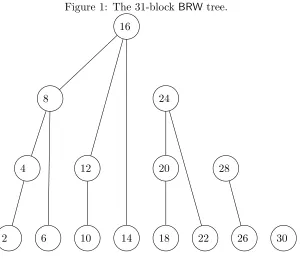
On a 31-block input, BRW requires a total of 15 n-bit multiplications. There is some amount of parallelism in these multiplications. A convenient way to bring out this parallelism is to represent the BRW computation using a tree as has been done in [7]. Such a tree depicts the dependencies among the multiplications required forBRW computation. We omit the details of how the tree is constructed as these details are not directly relevant to the present work.
The relevant part of a 31-block BRW tree is shown in Figure 1. Each node is marked by an even number between 2 and 30 corresponding to the 15 multiplications that are required. (For the reason why the node labels are 2 to 30 instead of 1 to 15, we refer to [7].) If there is an edge from a lower marked node to a higher marked node, then the multiplication corresponding to the lower marked node has to be computed before the multiplication corresponding to the higher marked node. So, for example, the multiplication corresponding to node 2 has to be computed before the multiplication corresponding to node 4 can be computed and the multiplications corresponding to nodes 8, 12 and 14 have to be computed before the multiplication corresponding to node 16 can be computed.
Nodes which are not connected by an edge are independent and can be computed in parallel. For example, the eight multiplications at the lowest level are independent; the four multiplications at the next level are independent; and so on. There are, however, other ways to group the independent multiplications. Such groupings allow using batch multiplications to speed up the computations. Using batch size 3 as given below is particularly nice since the 15 multiplications can be cleanly grouped into 5 batches of 3 multiplications each.
Batch size 3: {2,6,10},{14,18,22},{26,30,4},{20,12,8},{28,24,16}.
In conjunction with the above, we also implemented the delayed reduction strategy described in Section 5.3. From Table 3, for η = 31, 15 multiplications of n-bit polynomials, 8 reductions and 52
Figure 1: The 31-blockBRW tree.
14 10
6
2 18 22 26 30
4 12 20 28
8 24
16
5.5 Decimated Horner
Given a sequence of n-bit blocks m1, . . . , m` and a positive integer d≥1,Hornerτ(m1, . . . , m`) can be
computed as
Hornerτ(m1, . . . , m`) = τρ−1Hornerτd(m1, md+1, m2d+1, . . .)
⊕ · · ·
⊕τρ−ρHornerτd(mρ, md+ρ, m2d+ρ, . . .)
⊕τd−1Hornerτd(mρ+1, md+ρ+1, m2d+ρ+1, . . .)
⊕ · · ·
⊕τd−(d−ρ)Hornerτd(md, m2d, m3d, . . .) (10)
where ρ = `modd. We call this d-decimated Horner computation. In (10), the d calls to Horner are independent leading to d independent multiplications at each step with the boundary conditions appropriately handled. Thesedindependent multiplications can be computed as a batch multiplication. After the individual Horner calls are completed, the outputs are multiplied byτρ−1, . . . ,1, τd−1, . . . , τρ
which can be done as a batch multiplication with batch sized−1 (since one multiplication is by 1).
5.6 Implementation of Hash2L
128-bit 256-bit
length of message in bytes length of message in bytes
512 1024 4096 8192 512 1024 4096 8192
GHASH[9] 1.09 0.81 0.602 0.567 – – – – Hash2L 0.88 0.687 0.498 0.463 1.4 0.95 0.718 0.67
(19.27%) (15.19%) (17.28 %) (18.3%) – – – –
Table 4: Cycles per byte for computingHash2LandGHASHon Haswell. For bothn= 128 andn= 256, Karatsuba gave better performance compared to the schoolbook method.
128-bit 256-bit
length of message in bytes length of message in bytes
512 1024 4096 8192 512 1024 4096 8192
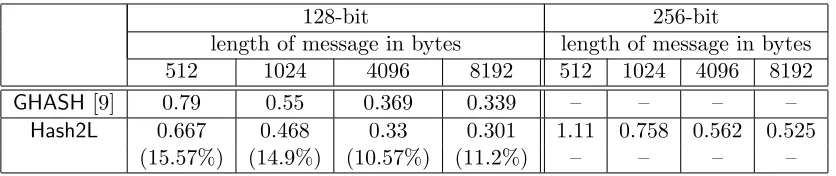
GHASH [9] 0.79 0.55 0.369 0.339 – – – – Hash2L 0.667 0.468 0.33 0.301 1.11 0.758 0.562 0.525
(15.57%) (14.9%) (10.57%) (11.2%) – – – –
Table 5: Cycles per byte for computing Hash2L and GHASH on Skylake. Forn= 128, schoolbook was faster than Karatsuba, while for n= 256, Karatsuba was faster.
Timing results on the Haswell and the Skylake processors are presented in Tables 4 and 5 respectively. The percentage figures indicate the percentage of speed improvement obtained by our implementation of Hash2L over GHASH. The implementation of GHASH is by Gueron and has been taken from [9]. The implementation uses a delayed reduction strategy whereby a single reduction is done per eight polynomial multiplications. This strategy requires pre-computing a table consisting of 8 consecutive powers of the hash key. The code in [9] has been very carefully optimised. Both intrinsics and assembly codes are provided and it is mentioned that the performance of both the codes are similar. Since, we have implemented in intrinsics, we chose to compare to the intrinsics implementation in [9]. We measured the time required by the intrisics implementation of GHASH in [9] on the same machines where we measured the time required by Hash2L.
For timing bothHash2LandGHASH, the hash key was updated in each iteration. This ensured that the timing measurements included the time for pre-computing the powers of τ in case of Hash2L and the pre-computed table in Gueron’s implementation of GHASH.
From the results in Tables 4 and 5 we find that Hash2L is about 15% to 19% faster than GHASH on the Haswell processor and is about 10% to 15% on the Skylake processor. In theory, the number of multiplications required by Hash2Lis slightly more than half the number of multiplications required by GHASH. This does not directly turn into a roughly two times speed improvement for the following reasons.
speed improvement obtained using the pre-computed table cannot be just explained by the algorithmic improvement of delayed reduction. It shows a very deep understanding of how the Intel processor executes the instructions.
To summarise, the speed improvements that we are able to achieve are indicative of the algorithmic superiority ofHash2L overGHASH. We do not claim that our code provides the fastest possible timing forHash2L. Experts on intrinsics and assembly programming should be able to tune the code to achieve even higher speeds. Further, we have considered onlyη= 31 for implementation. It would be interesting to explore the speed achievable using other values ofη. We leave these as interesting work for the future.
6
Implementation Strategy Without Using
pclmulqdq
Forn= 256, Bernstein and Chou [4] have provided a description of how to implement binary field arith-metic using the Fast Fourier Transform (FFT) algorithm. The method does not require thepclmulqdq
instruction. The following counts of number of bit operations are provided in [4]. Forward Fourier trans-form: 4068−656 = 3412 bit operations without radix conversions; pointwise multiplications: 64·110 bit operations; inverse Fourier transform: 5996 bit operations; reduction: 992 bit operations.
In the FFT based polynomial multiplication, the inverse Fourier transform is applied to the pointwise product. As pointed out in [4], to compute an expression of the type a1a2 +b1b2, it is equivalent to compute the pointwise multiplications for a1, a2 and b1, b2; add the vectors; and then perform a single inverse Fourier transform. So, whenever a sum of products of polynomials is to be computed, a single inverse Fourier transform suffices. In the present context, this means that the number of inverse Fourier transforms to be computed is equal to the number of reductions.
We consider the use of this strategy for computing Hash2L. The polynomial multiplication and reduction procedures used in [4] can be directly considered in the present context.
Supposeη= 2r+1−1≥3. From Table 3, computingBRWτ(m1, . . . , mη) requires 14·2r−2−4 256-bit
XORs; 2(2r−1) forward Fourier transforms (each polynomial multiplication requires two forward Fourier transforms); 2r−1 pointwise multiplications; 2r−1inverse Fourier transforms; and 2r−1 reductions. The total number of bit operations for computing BRWτ(m1, . . . , mη) comes to
256(14·2r−2−4) + 2·3412·(2r−1) + (64·110)(2r−1) + 5996·2r−1+ 992·2r−1
= 18254·2r−14888. (11)
The number of bits in (m1, . . . , mη) is 256η = 256·(2r+1−1) and so the number of bit operations per
bit for computing BRWτ(m1, . . . , mη) is
Br+1=
18254·2r−14888 256·(2r+1−1) .
We have B2 ≈28.2,B3 ≈32.4,B4 ≈34.2,B5 ≈34.9,B6 ≈35.3,B7≈35.5.
operations are required for evaluatingHorner. Since there are a total ofη` 256-bit blocks, the number of bit operations per bit for evaluating Horner is (17696`+ 3412)/(256·η`) = 69.125/(2r+1 −1) + 13.22/(`(2r+1−1)).
There is an additional cost for computing the powersτ2, τ4, . . . , τ2r+1. Each of these is a squaring and requires 17440 bit operations for a total of 17440·rbit operations to compute all the powers. Amortised over the entire computation, the cost per bit for computing the powers is (17440·r)/(256·η`).
So, the total number of bit operations per bit for computing Hash2L on η` 256-bit blocks with
η= 2r+1−1 is
Cr+1=Br+1+ 69.125/(2r+1−1) + (68.125·r+ 13.22)/(`(2r+1−1)).
We haveC2 ≈51.2 + 27.1/`,C3≈42.3 + 21.4/`,C4 ≈38.8 + 14.5/`,C5 ≈37.2 + 9.2/`,C6 ≈36.4 + 5.6/`, C7 ≈36.0 + 3.3/`.
Choosingη= 31 = 25−1 shows that the number of bit operations per bit for computing Hash2Lis 37.2+9.2/`≤46.4 By choosingη= 63 or 127, it is possible to lower the number of bit operations per bit though this is still greater than the 29 bit operations per bit required for the pseudo-dot product [4]. The main reason behind the cost of Hash2Lbeing higher than that of the pseudo-dot product is that in the later case, there is a single inverse Fourier transform and a single reduction for the entire computation. The problem with the pseudo-dot product, however, is that the hash key is as long as the message. The cost of securely generating this key will be significant and has not been considered in [4].
Remark: The complete Hash2Lrequires an additional multiplication to process the block containing the message length. The above cost measure does not include this multiplication. The reason is that a complete hash function based on the pseudo-dot product will also require such a multiplication and this is not covered by the figure of 29 bit operations per bit reported in [4].
7
Message Authentication Code
A well known method for constructing a nonce-based MAC scheme from a hash function is the follow-ing [24]. LetF :K × N → {0,1}nbe a mapping and{H
τ}τ∈TwithHτ :M → {0,1}nbe a hash family.
The key space for the MAC scheme isK ×T, the nonce space isN and the message space isM. Given a nonceN and a message M, the output of the MAC scheme under a key (K, τ) is
(N, M)(−→K,τ)FK(N)⊕Hτ(M). (12)
It is possible to instantiate the hash function H using Hash2L. In this case, the message M is a binary string. More generally, it is possible to instantiateH using vecHash2L in which case the messageM is a vector where each component is a binary string. The function FK can be either a block cipher or a
stream cipher.
Analysis of this scheme under the assumption thatF is either a pseudo-random function (PRF) or a pseudo-random permutation (PRP) has a long history starting from [24] with the best known bounds appearing in [2]. IfF is instantiated using a stream cipher, then security is based on the assumption that
F is a PRF while ifF is instantiated using a block cipher, then security is based on the assumption that
Instantiation at the 128-bit security level: It is possible to use a 128-bit block cipher such as AES to instantiate FK. The size ofK could be any of the options allowed for AES and the size of N
will be 128 bits. It is also possible to instantiateF using a stream cipher whose key size is at least 128 bits.
Instantiation at the 256-bit security level: A 128-bit block cipher such as AES cannot be directly used to instantiate F at the 256-bit security level. Instead, a stream cipher supporting a 256-bit key can be directly used to instantiate F.
8
Comparison to Some Previous Works
We consider some of the important universal hash functions and corresponding MAC schemes that have been proposed. The discussion is divided into two parts. In the first part, we consider schemes for which the keys to the hash function are long and in the second part, we consider schemes for which the keys to the hash functions are short.
8.1 Comparison to Schemes Using Long Hash Keys
UMAC [5] and VMAC [11]: The core of the MAC schemeUMAC is the hash function NHT which is based on integer arithmetic. This hash function processes an `-block message with each block being
w-bit long to produce a digest of size 2tw for some parameter t ≥ 1. The construction is essentially the pseudo-dot product. The collision probability is 2−tw. The hash key consists of`+ 2(t−1) w-bit blocks. So, the length of the hash key is longer than the length of the message to be hashed. The core of VMAC is the hash functionVHASHwhich is also based on integer arithmetic and requires a key which is longer than the message.
Auth256 [4]: The core ofAuth256is the hash functionHash256. This hash function uses arithmetic over
GF(2256) to compute a pseudo-dot product. The key is as long as the message which results in collision probability being at most 2−256 and differential probability being at most 2−255. The work [4] reports an implementation of Hash256 using a tower field representation and a new FFT-based algorithm for field multiplication. It does not use thepclmulqdq instruction on Intel processors.
A more recent proposal of a hash function which uses a long key is [14]. The idea of this construction is based on that of VHASH, except that the computation is overF264. The hash function produces 64-bit outputs. We note that more than 10 years ago, Bernstein had commented [23] that a 64-64-bit digest provides inadequate security.
For hash functions using long keys, in practice, the key has to be generated using either a stream cipher or a block cipher mode of operation. This leads to both efficiency and security issues as mentioned below.
Efficiency: Generation of the key can be either done on the fly, or, it could be pre-computed and stored. Both the approaches have problems. Generating the key on the fly requires significant additional time which should be included in the total time for hashing. However, the above mentioned schemes do not report this time. On the other hand, pre-computing and storing a large key has its own problems. To quote Bernstein [2], the large key “creates a huge speed penalty: cache misses become much more common and much more expensive.”
generated using a mode of operation of a block or a stream cipher, then there are two issues. If the key for the mode of operation used to generate τ is the same as that of F, then the indepen-dence condition is violated. Even if the key for the mode of operation is independent of the key for F, using a mode of operation to generate τ violates the uniform distribution property of τ. Consequently, if τ is generated using a mode of operation, the analysis and the bounds provided in [2] do not direcly apply and a fresh analysis and security bound need to be worked out. In fact, there has been a lengthy discussion on this issue [23] in the context of UMAC where Bernstein had strongly argued for the necessity of precise security statement and proof for UMAC. By the same reasoning, a precise security statement and proof is also required for Auth256 which is not available in [4].
While the above issues are relevant for hash functions which use long keys, we note below two issues which are particularly relevant to Hash256and Auth256.
1. Hash256avoids using pclmulqdq under the rationale that not all processors provide this instruc-tion. Consider this issue in conjunction with the requirement of generating the hash key using AES in counter mode. Processors which do not provide an instruction similar topclmulqdq are unlikely to provide support in the instruction set for AES. So, on such processors, the generation of the hash key will take significantly more time than the actual hashing. This time is neither reported nor considered in [4].
2. The digest size of Hash256is 256 bits and so the goal of Auth256 is the 256-bit security level. It is suggested in [4] that the hash key can be generated using counter-mode AES. Since AES is a 128-bit block cipher, a direct use of counter-mode AES will not provide security at the 256-bit level. So, a combination ofHash256with counter-mode AES is unlikely to provide 256-bit security. A further issue is that of instantiatingF in (12) using AES. The output ofF is required to be 256 bits long and since AES is a 128-bit cipher, it cannot be directly used to instantiate F. Since [4] does not provide a clear description of how the hash key forHash256is to be generated and how
F is to be instantiated, the acutal security claim of Auth256at the 256-bit level is unclear. In terms of efficiency, [4] reports a cost of 29 bit operations per bit for computingHash256along with a hidded cost of generating the hash key. Any secure method for generating the long hash key will have a significant cost. In Section 6, we have shown that choosing η= 31 leads to a cost of at most 46.4 bit operations per bit. There is, however, no associated hidden cost of generating the hash key. The cost can be made lower by choosing a higher value of η. While the comparison in terms of bit operation counts is indicative, it would have been better to obtain the actual speed measurements. Since the code forHash256is not (yet) publicly available, we were unable to do this.
8.2 Comparison to Schemes Using Short Hash Keys
Poly1305 [1]: This is a usual univariate polynomial hashing using Horner. The arithmetic is over the prime field Fp with p= 2130−5. Clever use of floating point techniques are made to provide efficient
implementation. For Haswell, the best reported speed we could find is 0.65 cycles/byte using 64-bit AVX2 instructions2. For Skylake, we were unable to locate a speed report.
GHASH[15]: This is also a usual univariate polynomial hashing usingHorner. In this case, the arithmetic is over the fieldF2128. Since this hash function forms a part of the NIST standard there has been much research in efficient implementation of this function. In fact, one of the reasons for Intel to include the
pclmulqdq instruction is to be able to efficiently implementGHASH. The best known highly optimised implementation of GHASHusing pclmulqdq is by Gueron [9].
BothPoly1305and GHASHare usualHorner evaluations and hence, require`−1 multiplications for evaluating an`-block message. The design approach proposed here, on the other hand, requires a little more than `/2 multiplications. So, inherently this approach is faster than GHASH or Poly1305. We have instantiated this approach over binary fields to develop Hash2L. On the other hand, if one wishes to work over prime fields, it is equally possible to instantiate the approach over any appropriate field such asF2130−5.
The hash key for Poly1305, GHASH and also Hash2L is a single field element. So, in terms of key agility, there is no difference between these three algorithms. The collision probabilities for Poly1305 and GHASHare those obtained from the usualHornerstyle hash and hence are only slightly lower than that ofHash2L. See Table 1 for more details.
BothPoly1305 and GHASH are designed for the 128-bit security level. The instantiation ofHash2L at the 128-bit security level turns out to be faster than both these functions on Haswell processor of Intel; it is faster thanGHASHon Skylake; and we were unable to locate a speed report for Poly1305on Skylake. We expect the 128-bit version ofHash2L to be faster thanGHASH on any platform and to be faster than Poly1305 on any processor which supports the pclmulqdq instruction. The comparison of Hash2L to Poly1305 on processors which do not provide support for pclmulqdq cannot be determined without getting into the details of a particular processor.
9
Conclusion
In this work, we have shown how to combine theBRWfamily of polynomials with theHornerbased poly-nomial evaluation to design a new hash function. The number of multiplications required for computing the digest is a little more than that for BRW polynomials. The advantage is that the implementation difficulties of BRWpolynomials for variable length messages are eliminated. The combination is a two-level hash with BRW at the lower level and Horner at the higher level. The hash key is a single field element and has been appropriately used to work for both the levels. Concrete instantiations of the hash function over binary fields have been reported. The idea, on the other hand, is quite general and applies to other fields as well. A possible future work is to explore this idea to build concrete hash functions over other finite fields.
References
[1] Daniel J. Bernstein. The Poly1305-AES message-authentication code. In Henri Gilbert and He-lena Handschuh, editors, FSE, volume 3557 ofLecture Notes in Computer Science, pages 32–49. Springer, 2005.
[2] Daniel J. Bernstein. Stronger security bounds for Wegman-Carter-Shoup authenticators. In Ronald Cramer, editor,EUROCRYPT, volume 3494 ofLecture Notes in Computer Science, pages 164–180. Springer, 2005.
[3] Daniel J. Bernstein. Polynomial evaluation and message authentication, 2007. http://cr.yp.to/ papers.html#pema.
International Conference, Montreal, QC, Canada, August 14-15, 2014, Revised Selected Papers, volume 8781 ofLecture Notes in Computer Science, pages 92–111. Springer, 2014.
[5] John Black, Shai Halevi, Hugo Krawczyk, Ted Krovetz, and Phillip Rogaway. UMAC: Fast and secure message authentication. In Michael J. Wiener, editor, CRYPTO, volume 1666 of Lecture
Notes in Computer Science, pages 216–233. Springer, 1999.
[6] Larry Carter and Mark N. Wegman. Universal classes of hash functions. J. Comput. Syst. Sci., 18(2):143–154, 1979.
[7] Debrup Chakraborty, Cuauhtemoc Mancillas-L´opez, Francisco Rodr´ıguez-Henr´ıquez, and Palash Sarkar. Efficient hardware implementations of BRW polynomials and tweakable enciphering schemes. IEEE Trans. Computers, 62(2):279–294, 2013.
[8] Edgar N. Gilbert, F. Jessie MacWilliams, and Neil J. A. Sloane. Codes which detect deception.
Bell System Technical Journal, 53:405–424, 1974.
[9] Shay Gueron. AES-GCM-SIV implementations (128 and 256-bit). https://github.com/ Shay-Gueron/AES-GCM-SIV, 2016.
[10] Shay Gueron and Michael E. Kounavis. Efficient implementation of the galois counter mode using a carry-less multiplier and a fast reduction algorithm.Inf. Process. Lett., 110(14-15):549–553, 2010. [11] Ted Krovetz and Wei Dai. VMAC: Message authentication code using universal hashing. http:
//www.fastcrypto.org/vmac/draft-krovetz-vmac-01.txt, 2007.
[12] Ted Krovetz and Phillip Rogaway. Fast universal hashing with small keys and no preprocessing: The polyr construction. In Dongho Won, editor,ICISC, volume 2015 ofLecture Notes in Computer
Science, pages 73–89. Springer, 2000.
[13] Ted Krovetz and Phillip Rogaway. The software performance of authenticated-encryption modes. In Antoine Joux, editor, Fast Software Encryption - 18th International Workshop, FSE 2011,
Lyngby, Denmark, February 13-16, 2011, Revised Selected Papers, volume 6733 of Lecture Notes
in Computer Science, pages 306–327. Springer, 2011.
[14] Daniel Lemire and Owen Kaser. Faster 64-bit universal hashing using carry-less multiplications.
J. Cryptographic Engineering, 6(3):171–185, 2016.
[15] David A. McGrew and John Viega. The security and performance of the Galois/Counter Mode (GCM) of operation. In Anne Canteaut and Kapalee Viswanathan, editors,INDOCRYPT, volume 3348 of Lecture Notes in Computer Science, pages 343–355. Springer, 2004.
[16] Mridul Nandi. On the minimum number of multiplications necessary for universal hash functions.
In Fast Software Encryption - 21st International Workshop, FSE 2014, London, UK, March 3-5,
2014. Revised Selected Papers, pages 489–508, 2014.
[17] Wim Nevelsteen and Bart Preneel. Software performance of universal hash functions. InAdvances in Cryptology - EUROCRYPT ’99, International Conference on the Theory and Application of
Cryptographic Techniques, Prague, Czech Republic, May 2-6, 1999, Proceeding, pages 24–41, 1999.
[18] Michael O. Rabin and Shmuel Winograd. Fast evaluation of polynomials by rational preparation.
[19] Palash Sarkar. Efficient tweakable enciphering schemes from (block-wise) universal hash functions.
IEEE Transactions on Information Theory, 55(10):4749–4759, 2009.
[20] Palash Sarkar. A trade-off between collision probability and key size in universal hashing using polynomials. Des. Codes Cryptography, 58(3):271–278, 2011.
[21] Palash Sarkar. A new multi-linear universal hash family. Des. Codes Cryptography, 69(3):351–367, 2013.
[22] Douglas R. Stinson. Universal hashing and authentication codes. Des. Codes Cryptography, 4(4):369–380, 1994.
[23] UMAC. CFRG discussion on UMAC. http://marc.info/?l=cfrg&m=143336318427068&w=2, 2005.
[24] Mark N. Wegman and Larry Carter. New hash functions and their use in authentication and set equality. J. Comput. Syst. Sci., 22(3):265–279, 1981.