Article
1
Lightweight Cipher for H.264 Videos in the Internet of
2
Multimedia Things with Encryption Space Ratio
3
Diagnostics
4
Amna Shifa 1, Mamoona Naveed Asghar 1,2,*, Salma Noor 3, Neelam Gohar 3 and Martin Fleury 4
5
1 Department of Computer Science & IT, The Islamia University of Bahawalpur, 63100, Pakistan;
6
7
2 Software Research Institute, Athlone Institute of Technology Ireland; [email protected]
8
3 Department of Computer Science, Shaheed Benazir Bhutto Women University, Peshawar, Pakistan;
9
[email protected], [email protected]
10
4 School of CSEE, University of Essex, Colchester, Essex, UK; [email protected]
11
* Correspondence: [email protected] or [email protected] or [email protected]
12
Abstract: Within an Internet of Multimedia Things, the risk of disclosing streamed video content,
13
such as arising from video surveillance, is of heightened concern. This leads to the encryption of
14
that content. To reduce the overhead and lack of flexibility arising from full encryption of the
15
content, a good number of selective-encryption algorithms have been proposed in the last decade.
16
Some of them have limitations, in terms of significant delay due to computational cost, or excess
17
memory utilization, or, despite being energy efficient, do not provide a satisfactory level of
18
confidentiality, due to their simplicity. To address such issues, this paper presents a lightweight
19
selective encryption scheme, in which encoder syntax elements are encrypted with the innovative
20
EXPer (EXtended Permutation with exclusive OR). The selected syntax elements are taken from
21
the final stage of video encoding that is during entropy coding. As a diagnostic tool, the Encryption
22
Space Ratio measures encoding complexity of the video relative to the level of encryption so as to
23
judge the success of the encryption process, according to entropy coder. A detailed comparative
24
analysis of EXPer with state-of-the-art algorithms confirms that the EXPer provides significant
25
confidentiality with a small computational cost and negligible encryption bitrate overhead. Thus,
26
the results demonstrate that the proposed security scheme is a suitable choice for constrained
27
devices in an Internet of Multimedia Things environment.
28
Keywords: Encryption Space Ratio; Entropy coding; H.264/AVC; Internet of Multimedia Things;
29
lightweight cipher; selective encryption
30
31
1. Introduction
32
An Internet of Things (IoT) is a networked architecture [1], of which the Internet of Multimedia
33
Things (IoMT) [2] is an emerging sub-set, integrating many devices and sensors at the Internet edge.
34
In IoMT applications, video-surveillance devices might be deployed in various scenarios, such as
35
within public transport management systems (managing buses, airplanes or road traffic), health
36
management services (for patient or child monitoring), personal asset protection (within homes or
37
construction sites) and many more [3]. The aim is to make these devices intelligent by allowing them
38
to interact with each other, that is they become smart objects. Storage and later analysis of data [4]
39
can be on remote cloud data centers. However, even more so than within the traditional Internet, the
40
IoT architecture [5] has inherent security weaknesses of which this paper focuses on confidentiality.
41
Furthermore, the adoption of multimedia rich content, within videos or images, has increased
42
considerably in IoT environments, with the result that the Motion Pictures Experts Group (MPEG) is
43
now standardizing audio-visual and other media data formats [6] as part of an IoMT. The devices in
44
the IoMT, usually rely on Raspberry Pi and the CMOS platforms with limited computing and
45
communication capabilities, hence, are not powerful enough for complex computations. The
46
adaptation of these limited resource devices in IoMT, particularly, in surveillance and monitoring
47
systems are constantly increasing. Therefore, these require adequate security measures to keep the
48
information secure. However, in an IoMT in which devices have limited resources in terms of
49
processor power and memory and may well be battery powered, there is a requirement for simplified
50
and computationally less complex ciphers. There is also a need to reduce the latency of
51
communication by reducing the overhead arising from full encryption of all the contents. Because
52
full encryption requires decryption at each intermediate point [8], for example if transcoding, splicing
53
of content, adding logos or watermarks needs to take place, not only is there an added computational
54
burden but there is a risk of key disclosure at unsupervised intermediate devices. Thus, full
55
encryption is also an inflexible form of encryption. To cope with these challenges, the technology of
56
lightweight cryptography has been utilized to provide efficient solution for securing information.
57
Thus, this paper proposes a new lightweight stream cipher which is designed to be implemented
58
easily on surveillance cameras operated with Raspberry Pi and the CMOS sensor platform.
59
This paper assumes that: confidentiality for video sensor networks [8] is integrated into the IoMT
60
and that application-layer encryption is used. The alternative is to rely on any underlying end-to-end
61
security protocol such as Transport Layer Security (TLS) (RFC 6176) with the overhead of full
62
encryption and an associated Public Key Infrastructure (PKI) network of servers. Consequently, a
63
lightweight encryption cipher, EXtended Permutation with exclusive OR (EXPer), is proposed, which
64
combines statistically random output with speed of encryption, especially if only selected video
65
syntax elements are encrypted. Those video syntax elements, encrypted as part of a Selective
66
Encryption (SE) scheme, also preserve decoder format compliance, in the sense that the encrypted
67
video can still be processed even if the selected syntax elements are not decrypted [9]. Notice also
68
that if the authors’ contribution in [10] is applied, keys may alternatively be embedded within the
69
encrypted video itself through the joint application of steganography and cryptography, though that
70
aspect is outside the scope of the current paper.
71
To judge the protection afforded by EXPer, the Encryption Space Ratio (ESR) is calculated as the
72
ratio of the encrypted bits to all the bits of a compressed video bitstream. The ESR has previously
73
been used as one way to judge the effectiveness of SE. In a Variable Bit-Rate (VBR) stream, the bitrate
74
is dependent on the various configuration factors but if these are held constant across a number of
75
test videos then both the spatial and temporal coding complexity change according to the content.
76
For example, the presence of high spatial frequencies or textures within objects increases the coding
77
complexity and likewise rapidly moving objects across video frames increases the temporal
78
complexity. The Quantization Parameter (QP) also affects the bits allocated, with a low QP implying
79
a higher compressed bitrate. The SE bitrate depends on the syntax elements that are selected for
80
encryption. These syntax element bits may be fully encrypted, typically by a block cipher such as the
81
Advanced Encryption Standard (AES) [11] operating in a streaming mode such as Cipher Feedback
82
(CFB), but herein by EXPer for reduced latency. As an example of using the ESR to judge the
83
effectiveness of SE, in [12], nine test videos each encoded with QPs at 16, 24, and 28 (High Efficiency
84
Video Coding (HEVC)) with an ESR ranging from 12.42% to 20.11% and an average of 16.54%, which
85
was judged to be sufficient. In [13] also, the ESR was calculated for a QP of 18 and found to vary from
86
16.96% to 20.08% depending on the content of six benchmark videos, when using a SE scheme for
87
HEVC. In [13], which provides an analysis of different influences on the ESR such as the impact of
88
background or HEVC codec profile, the ESR was examined for its diagnostic value. However, the
89
following research questions arise from previous SE-based studies:
90
Q1. Are those encryption schemes computationally efficient (in terms of execution/encoding time)
91
enough to employ in an IoMT communication environment?
92
Q2. Is the analyzed ESR is effective enough for applying SE to visually secure the videos encoded
93
with one or other of the two common entropy coders in common codec use, i.e. Context Adaptive
94
Variable Length Coding (CAVLC) and Context Adaptive Binary Arithmetic Coding (CABAC)
95
(see Section 3.2)?
96
The focus of this paper is to answer these questions by experimentation. In the case of full
97
overhead and the space ratio is at a maximum, which causes a bit-rate overhead too. Herein, such
99
weaknesses are addressed by proposing a complete lightweight security scheme for IoMT
100
applications on a standardized H.264/AVC encoder for constrained surveillance devices. Notice that
101
HEVC is currently too resource intensive to be used in an IoMT environment, see [14]. In the
102
proposed scheme, SE is applied through proposed encryption algorithm EXPer, over identified ESR
103
for effective visual protection. The point wise contribution of the paper is given in the succeeding
104
sub-section 1.2.
105
The remainder of this paper is organized as follows. In Section 2, prior efficient lightweight
106
schemes proposed by researchers of IoT are discussed. Section 3 presents the proposed lightweight
107
cipher scheme EXPer, the adopted SE methodology, and diagnostics through ESR. Section 4 describes
108
the promising results over tested videos. Section 5 is a comparative analysis of EXPer with
state-of-109
art ciphers, including Advanced Encryption Standard (AES) [11]. Finally, Section 6 rounds off by
110
considering the implications for those planning IoMT video applications with a concern for
111
confidential video content.
112
1.2. Context
113
SE already has a potential role in consumer electronics applications [15] and also can support
114
interoperability [16], when multiple encryptions of the same video stream are transported.
115
Alternatively, Region-of-Interest (ROI) encryption of some parts of a video frame such as the face or
116
people within a frame [17][18] may reduce the encryption overhead. However, ROI encryption is
117
application specific, while SE potentially offers a more general solution. Compared to full (or naïve)
118
encryption, both SE and ROI encryption can reduce computational and bitrate overhead [19]. SE may
119
be carried out on the most significant information (as regards distortion) at a choice of different stages
120
of the codec, such as on the original pixels, the transform coefficients, the quantization indexes, the
121
bit-planes, the entropy coder, or the final output bitstream [20]. However, some forms of encryption
122
alter the video statistics, resulting in the issues of encryption bitrate overhead and format compliance
123
at the decoder. Applying encryption at the entropy coding stage minimizes these problems [17] [18],
124
which is why this form of encryption is chosen for this paper.
125
Entropy coders are a feature of standardized hybrid video encoders [21]. H.264/Advanced Video
126
Coding (AVC) [22] and its Scalable Video Coding (SVC) extension [23-25] employ the same entropy
127
coding modes: variable length coding (VLC) or binary arithmetic coding (BAC). Both of these modes
128
operate in a context-adaptive (CA) manner, leading to the names CAVLC [26] and CABAC [27]
129
entropy coders. Within H.264/AVC either CABAC or CAVLC entropy coders can be selected, as the
130
two coders trade-off computational complexity against compression efficiency. The High Efficiency
131
Video Coding (HEVC) [28] CABAC encoder is a slightly modified version of the H.264/AVC CABAC
132
encoder and, thus, entropy-integrated SE can be configured [29] to work with either codec. However,
133
using HEVC for an IoT is questionable owing to its high computational complexity, except possibly
134
when coding takes place at a cluster head with maximum energy [30].
135
The H.264/AVC codec is selected for implementation of lightweight encryption because, in both
136
the CCTV industry and for smart monitoring in IoT, surveillance devices (cameras) mostly operate
137
on microprocessors, especially the Raspberry Pi (RasPi), which only supports video compression in
138
the H.264/Advanced Video Coding (AVC) format [31]. In an IoT, the RasPi is an economical and
139
privileged platform because it offers a complete Linux server on a tiny platform. To the best of the
140
authors’ knowledge, the SE utilized with ESR diagnostics is a novel contribution in securing IoMT
141
communication. The contributions of the paper are:
142
1. A joint crypto-compression scheme is implemented on the selected video syntax elements in the
143
entropy engine of H.264 encoder. The selective encryption is applied by keeping in mind the IoT
144
constrained devices operated with Raspberry pi and CMOS camera sensors. The compatibility of
145
the proposed cipher was prior tested on the Raspberry Pi cameras.
146
2. Selection of careful video syntax elements for applying selective encryption, which do not crash
147
3. The Encryption Space Ratio (ESR) for two entropy coders, CAVLC and CABAC, is evaluated over
149
10 tested videos. ESR is used as a tool for applying efficient SE to visually secure the videos,
150
directly recorded through IoMT constrained RasPi cameras.
151
4. For effective visual degradation of videos, it is found that the ESR estimated for CABAC is less
152
than CAVLC, so CABAC entropy coder is suitable for IoT based camera devices.
153
5. A single round lightweight Cipher “EXPer” (with five sequential steps of bit level permutation
154
and XOR) is proposed for the H.264/AVC videos in IoMT.
155
6. Series of experiments are done over H.264 encoder (JSVM reference software) (Section 4 and 5)
156
with the proposed lightweight cipher on estimated ESR, and in comparison with two
157
implemented state-of-the-art algorithms (XOR, AES). Therefore, three different ciphers are
158
extensively tested (from different angles) on multiple videos with varying color and motion
159
characteristics. The perceptual strength of implemented ciphers is compared through different
160
quality metrics and their computational efficiency is evaluated in terms of execution time on
161
tested videos.
162
7. Adopted methodology with experiments proved that the proposed lightweight security scheme
163
(EXPer applied on calculated ESR for selective encryption) is secure against key guessing,
164
perceptual, statistical and inference attacks in IoMT environment.
165
2. Related Studies
166
The heterogeneity of the communication technologies across an IoMT, deriving from the
167
assortment of devices, sensors, and protocols, is a cause of security concern. Messages that are
168
transmitted from smart objects will usually be stored and forwarded through several nodes (devices,
169
video sensors, video relay or intermediate devices …) to reach their endpoint [7]. An endpoint might
170
be a message sink or base station (BS), which passes data to the next layer of the architecture, as occurs
171
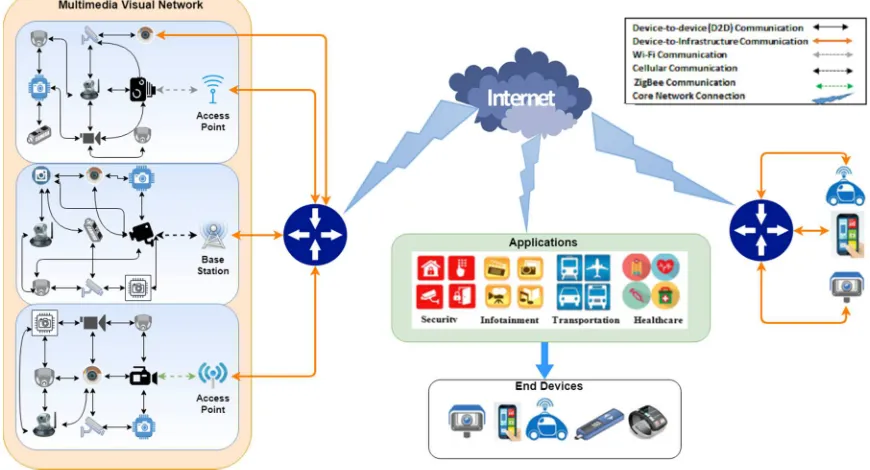
in traditional sensor networks when a sink communicates over a satellite link. Figure 1 shows
end-172
to-end communication of multimedia sensor networks within an IoT. Again, there is a need to
173
preserve confidentiality over that link but there is also a need to optimize energy consumption and
174
reduce latency.
175
176
Figure 1. End-to-end communication over multimedia sensor networks in an IoT
177
To ensure confidential communication of information in an IoT, many schemes have been
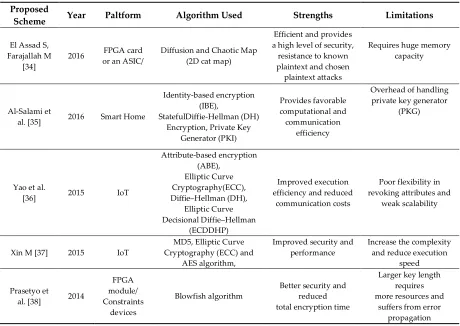
178
proposed, schemes which employ existing state-of-art encryption algorithms [32-38]. A summary of
179
Besides encryption, researchers have also proposed authentication schemes for IoT with existing
181
standardized algorithms. Lee et al. [39] proposed a lightweight authentication protocol for RFID
182
systems. In the proposed protocol, privacy protection and anti-counterfeiting is achieved by an
183
encryption algorithm based on XOR manipulation. Mahalle, et al. [40] proposed Identity
184
Authentication and Capability-based Access Control (IACAC). The proposed scheme provided both
185
authentication and access control for an IoT. However, the proposed scheme presents extra overhead,
186
due to its key-management procedures. The authors [41] employed encryption and hash algorithms
187
in their proposed solution to achieve confidentiality and message integrity in an IoT. However, their
188
solution fails to deal with large amounts of multimedia data because of the proposed encryption
189
algorithm’s ability to encrypt only 64 bits per block; hence, it suffers from slow operation.
190
Table 1. Summary of recently proposed security schemes for IoT by using existing standardized
191
encryption algorithms
192
Proposed
Scheme Year Paltform Algorithm Used Strengths Limitations
El Assad S, Farajallah M
[34]
2016 FPGA card
or an ASIC/
Diffusion and Chaotic Map (2D cat map)
Efficient and provides a high level of security,
resistance to known plaintext and chosen
plaintext attacks
Requires huge memory capacity
Al-Salami et
al. [35] 2016 Smart Home
Identity-based encryption (IBE),
StatefulDiffie-Hellman (DH) Encryption, Private Key
Generator (PKI)
Provides favorable computational and
communication efficiency
Overhead of handling private key generator
(PKG)
Yao et al.
[36] 2015 IoT
Attribute-based encryption (ABE), Elliptic Curve Cryptography(ECC), Diffie–Hellman (DH), Elliptic Curve Decisional Diffie–Hellman (ECDDHP) Improved execution efficiency and reduced
communication costs
Poor flexibility in revoking attributes and
weak scalability
Xin M [37] 2015 IoT
MD5, Elliptic Curve Cryptography (ECC) and
AES algorithm,
Improved security and performance
Increase the complexity and reduce execution
speed
Prasetyo et
al. [38] 2014
FPGA module/ Constraints
devices
Blowfish algorithm
Better security and reduced total encryption time
Larger key length requires more resources and
suffers from error propagation
193
Although, the encryption schemes given in Table 1 provide higher security, the authors did not
194
consider multimedia content when evaluating the performance of their proposed schemes. Moreover,
195
traditional encryption algorithms, such as AES and Triple Data Encryption Standard (DES)
196
encryption, as used in the proposed schemes are inefficient for an IoMT because of their
197
computationally intensive nature. Hence, those schemes appear to be unsuited to the requirements
198
of real-time IoMT applications, due to their relatively high bitrate overhead, computational overhead,
199
and bandwidth utilization. Consequently, lightweight encryption algorithms are required to alleviate
200
these overheads for low-cost, low-power devices. Recently, there has been much interest shown by
201
researchers and standardization bodies in designing lightweight algorithms for secure end-to-end
202
communication in an IoT. All cryptographic algorithms are based on three principles 1) Substitution
203
2) XOR and 3) Permutation. Thus, the newly proposed algorithms by other researchers are also based
204
on these principles. Recently, the authors of [47] proposed one round cipher (implemented on static
205
images) for IoMT in which substitution and permutation principle have been selected for the
206
caution over videos, especially for the resource-limited devices in the IoMT. Thus, in this study, the
208
lightweight cipher is employed with the single round of five (3 XOR and 2 Permutation) sequential
209
steps over videos. It has been tested that the substitution rounds cannot be efficiently computed over
210
videos in the resource-limited device used in IoMT. An overview of some recently proposed
211
lightweight encryption algorithms in comparison with our proposed encryption algorithm for IoMT
212
communication is given in Table 2.
213
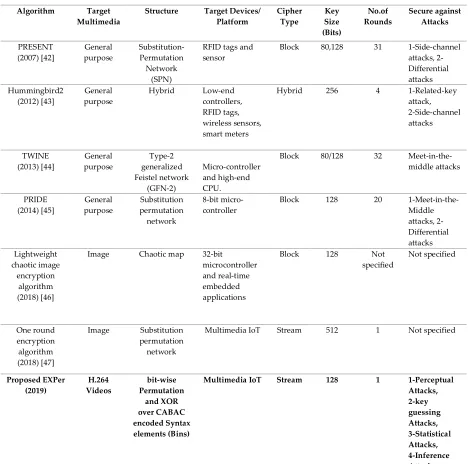
Table 2. Overview of recently proposed lightweight ciphers for constrained devices
214
Algorithm Target
Multimedia
Structure Target Devices/
Platform Cipher Type Key Size (Bits) No.of Rounds Secure against Attacks PRESENT (2007) [42] General purpose Substitution- Permutation Network (SPN)
RFID tags and sensor
Block 80,128 31 1-Side-channel
attacks, 2-Differential attacks Hummingbird2 (2012) [43] General purpose
Hybrid Low-end
controllers, RFID tags, wireless sensors, smart meters
Hybrid 256 4 1-Related-key
attack, 2-Side-channel attacks TWINE (2013) [44] General purpose Type-2 generalized Feistel network (GFN-2) Micro-controller and high-end CPU.
Block 80/128 32 Meet-in-the-
middle attacks PRIDE (2014) [45] General purpose Substitution permutation network 8-bit micro-controller
Block 128 20
1-Meet-in-the-Middle attacks, 2-Differential attacks Lightweight chaotic image encryption algorithm (2018) [46]
Image Chaotic map 32-bit
microcontroller and real-time embedded applications
Block 128 Not
specified Not specified One round encryption algorithm (2018) [47]
Image Substitution
permutation network
Multimedia IoT Stream 512
1 Not specified
Proposed EXPer (2019) H.264 Videos bit-wise Permutation and XOR over CABAC encoded Syntax elements (Bins)
Multimedia IoT Stream 128 1 1-Perceptual
Attacks, 2-key guessing Attacks, 3-Statistical Attacks, 4-Inference Attacks
215
Likewise, to avoid extra computational overhead and bitrate control, chaos theory is also utilized
216
to implement the encryption process for IoMT systems [48][49]. Chaos theory has proved attractive
217
because of its simplicity and statistical qualities leading to randomized output. Generally, chaotic
218
algorithms are based on a chaotic map and s-box substitution, with multiple rounds to create
219
randomization. However, in the substitution process, multiple rounds to create the desired random
220
output increase the execution time. In fact, in [50] doubt has been cast upon the computational gain
221
from employing chaotic encryption, compared to traditional block-based encryption such as through
222
AES. Indeed, statistical tests often used to verify the confidentiality of chaotic encryption fail to
223
In general, researchers have proposed ciphers for general-purpose applications and do not consider
225
the specific ESR required to provide effective visual protection especially in images and videos.
226
3. Materials and Methods
227
This section explains the approach of the proposed security scheme for devices in IoMT
228
environment. The security scheme is comprised of four components:
229
230
1. Selection of Syntax Elements for two Entropy Engines i.e. CAVLC and CABAC.
231
2. EXPer, an innovative lightweight cipher based on a combination of eXclusive OR (XOR) and
bit-232
level permutation rounds with three different 128-bit keys.
233
3. ESR is calculated according to the selected syntax elements of CAVLC and CABAC, as a way of
234
diagnosing the effective visual protection. (Section 4)
235
4. SE is applied by utilizing EXPer, according to the guidance given by ESR. (Section 4)
236
237
3.1. Syntax Elements Selection of Entropy coders
238
There are two forms of entropy engines for efficient compression in H.264/AVC video encoder,
239
CAVLC [21] and CABAC [22]. Both CAVLC and CABAC are a lossless form of coding (after earlier
240
lossy encoding stages of the hybrid codec) in which there is a tight data dependency between
241
elements in the output bitstream. CAVLC employs the concatenation of Unary and Exp-Golomb
242
coding for a number of parameters, such as macroblock (MB) type (i.e. the prediction method — inter
243
or intra), coded block pattern (CBP) (which records which blocks within an MB contain Non-Zero
244
(NZ) Transform Coefficient (TC) residuals), delta QP, reference frame index, and Motion Vector
245
Differences (MVDs). Quantized transform block coefficients (residuals) are VLC coded after
246
extraction (normally through zig-zag scanning) from a block. CABAC gains in efficiency over CAVLC
247
as syntax elements are first converted to a binary format. This allows binary arithmetic coding to be
248
utilized. Arithmetic coding leads to sub-integer probability estimation (unlike CAVLC) but is
249
computationally expensive.
250
In this paper, for the convenience of implementation the focus is not on a newly proposed SE
251
encoder technique. Therefore, we have employed our previous SE schemes, e.g. as reported in [51],
252
with one newly identified parameter for enhanced visual protection of videos. For the convenience
253
of new researchers, we give simple names to these selected parameters, i.e. (1) motion, dealing with
254
the movement of objects in videos including camera zooming etc. (2) texture data for pixels
255
information, and a new parameter (3) difference of Quantization Parameters (deltaQP). Their details
256
can be found in [26] and [27].
257
It is also worth mentioning here that these mentioned three types of parameters are produced
258
only from residual information, as presented to the final entropy coding stage of a hybrid encoder
259
and are proven to be format compliant in experiments. Textural residuals are taken from both
260
homogeneous and heterogeneous areas within a video. For motion encryption, the arithmetic signs
261
of motion vector difference (MVD) are encrypted while textural syntax elements are different for both
262
CAVLC and CABAC (given in the top grey box of Figure. 2), and the absolute values of dQP are
263
selected for encryption. The selected syntax elements of CABAC will be referred as Bins in the
264
subsequent sections of this paper. A block diagram of the proposed security scheme is given in Figure
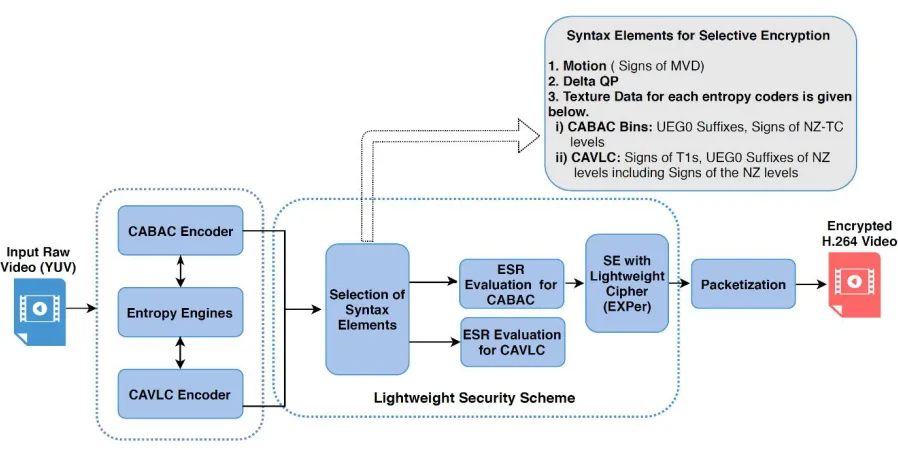
265
267
Figure 2. Block diagram of the Proposed lightweight security scheme
268
3.2. Lightweight Cipher
269
The proposed lightweight cipher, EXPer, provides both diffusion and confusion primitives,
270
through XORing and permutation. Because the normal substitution process (in mainstream ciphers
271
such as AES) is computationally intensive, so it is not included in the proposed cipher. Moreover, the
272
different forms of XOR are also not computed over videos, because their adoption can be effective
273
for a computation over single image rather than a whole video with large quantity of surveillance
274
frames. Although permutation is applied on bit-level within selected byte to effectively secure the
275
camera captured videos.
276
EXPer encryption consists of five steps/stages with a single iteration over those steps. In each
277
step, XOR is performed using a secret key (ks), and the bit-wise permutation by the shift operation.
278
Permutation is performed with a randomly-selected offset value (V) ranging from 1 to 8.
279
Additionally, permutation is performed on the output from the previous stage to approach statistical
280
randomness with a reduced computational complexity. The permutation is applied on the bit-level,
281
re-orders the bits within byte which is not easy to cryptanalyze for large volume of video data.
282
The symmetric secret keys: secret_key (ks), sub_key1 (k1), sub_key2 (k2) are dynamically
283
generated at run-time for the input bitstream, by using a Pseudo-Random Function (PRF). To keep
284
the procedure simple, three dynamic keys are generated per video sequence and stored in a registry.
285
Key security can be enhanced by using any standardized key management scheme [52]. Additionally,
286
three 128-bit secret keys have been utilized with XOR operation. The key space greater than 2100 is
287
considered resilient to key guessing or brute force attacks over keys [53]. Furthermore, the selective
288
encryption on the selected syntax elements within large volume of videos data has proved to be
289
strong, hence cannot be cryptanalyzed [54]. Moreover, the selected offset value will permute the bits
290
within the byte only. We consider the proposed algorithm to be a stream cipher because of byte level
291
encryption. In fact, the encrypted bitstream is obtained by combining the elements of the plaintext
292
bitstream bit-by-bit with secret keys.
293
Working of EXPer:
294
The five steps of the proposed algorithm are discussed in more detail below:
295
Step 1: In the first step, the input bitstream is encrypted by performing an XOR operation with
296
the 128-bit secret key (secret_key). Let X be the chosen “Bins”, which are the syntax elements of the
297
CABAC entropy coder. Then, the secret key, ks, is XORed with X. Mathematically:
f(ks)=X⊕ks (1)
299
X⊕ks = X' (2)
300
where
⊕
is the XOR operator, X is any input bitstream, and X' is the resulting output bitstream.
301
Step 2: In the second step, re-ordering of bits within selected bytes of syntax elements is
302
performed by applying a permutation to previously encrypted output X' derived from f(ks). The
303
elements of X'’ are cyclically shifted initially by offset value vi using a shift operator. The
right-304
shift operator shifts a bit pattern to the right by an offset value:
305
f(ks) ↦ f (ks+vi) = (x1, x2, x3…) ↦ (x2, x3, x4…)
(3)
306
where “↦” is a transformation symbol. It this case it signifies transforming X' into the X''
307
bitstream through a right-shift of the bits of X'=(x1, x2, x3…xn), to become X''= (x2, x3, x4…..xn). The
308
vi denotes an offset value and V represents a finite set of possible offset values that can be expressed
309
as V= {1, 2, 3,...,m}, where n is the number of possible offsets. The initial value of offset vi can be
310
selected dynamically to attain greater security. Mathematically,
311
X' >> vi= X'' (4)
312
where >> is a shift operator.
313
Step 3: In the next step, the resulting output of the previous step, which is X'', is again
314
transformed by an XOR operation with the 128-bit sub-key1(k1), as:
315
X''⊕k1 = X''' (5)
316
As already mentioned, k1is derived from ks.
317
Step 4: In the fourth step, the previously encrypted output X''' is permutated again with offset
318
value vj, again by a right-shift operator:
319
X''' >> vj = X'''' (6)
320
while vj = (vi+2) (7)
321
Step 5: In the final step, the resulting bitstream, X'''', is XORed with the 128-bit sub_key2 (k2),to
322
produce encrypted bitstream Eoutput:
323
X''''
⊕
k2 = Eoutput (8)324
The proposed algorithm is simple and, thus convenient to implement even on videos directly
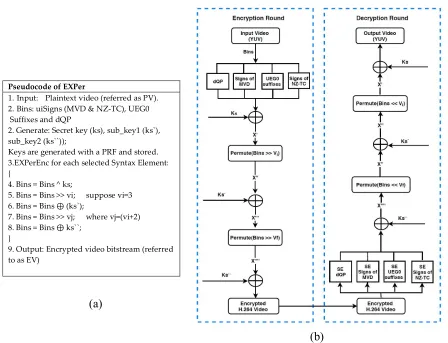
325
taken from RaspPi Cameras. The pseudocode and flowchart in Figure 3 demonstrates the simplicity
326
of a software implementation with encryption and decryption rounds.
327
(a)
Pseudocode of EXPer
1.Input: Plaintext video (referred as PV). 2.Bins: uiSigns (MVD & NZ-TC), UEG0
Suffixes and dQP
2. Generate: Secret key (ks), sub_key1 (ks`), sub_key2 (ks``));
Keys are generated with a PRF and stored. 3.EXPerEnc for each selected Syntax Element: {
4. Bins = Bins ^ ks;
5. Bins = Bins >> vi; suppose vi=3 6. Bins = Bins ⊕ (ks`);
7. Bins = Bins >> vj; where vj=(vi+2) 8. Bins = Bins ⊕ ks``;
}
9. Output: Encrypted video bitstream (referred to as EV)
(b)
Figure 3. (a) Pseudocode and (b) the graphical flowchart of proposed EXPer Cipher
329
4. Experimental Results and Discussion
330
In order to evaluate the performance, experiments were performed on ten well-known [55] test
331
videos with varying characteristics, such as slow/fast motion and light/dense colours. The tested
332
videos configurations were based upon Common Intermediate Format (CIF) (352 × 288 pixels/frame)
333
at 30 fps, 4:2:0 chroma sampling, IBBP… Group of Pictures (GoP) frame structure and an intra-refresh
334
period of length 16, with H.264/AVC. The videos are evaluated on different QP values. (The
335
H.264/AVC the range of QPs is from 0 to 51, corresponding to higher compression with lower QPs).
336
All experiments were performed on a 64-bit operating system with 2.30 GHz Core i5-6200U processor
337
and 8 GB RAM. The algorithm was developed using the C/C++ programming language by modifying
338
the JSVM reference software with a single layer [56].
339
4.1. Calculation of ESR for Entropy coders
340
Before applying SE with EXPer on test videos, the focus of this paper is to analyze the ESR of
341
two entropy coders over which the SE is applied. ESR is basically the amount of data within each
342
video (calculated in terms of percentages) over which the SE produces acceptable visual protection
343
results (see also Section 1’s introduction to ESR). The ESR percentage is directly proportional to the
344
computational cost of applying SE over videos i.e. more ESR, more computational cost for SE and
345
vice versa. The ESR for videos calculated on the bases of selected syntax elements (as specified in
346
Section 3.2). The tested videos are listed in Table 3 and configured as described at the beginning of
347
this Section.
348
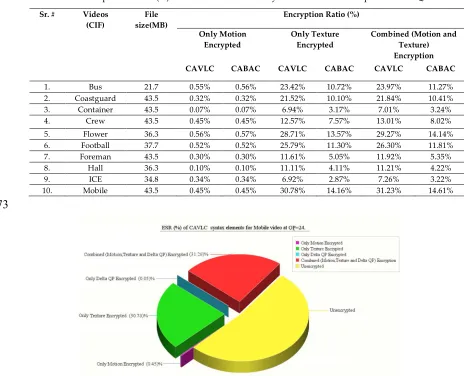
Taking the ESR percentages for CAVLC first in Table 3, it is apparent that there is a considerable
349
content dependency, probably linked to the spatial complexity of individual video frames and the
350
temporal complexity, due to the level of motion activity within sequences. The ESR percentage of
351
However, from the observations of Section 6.1, the ESR value calculated for motion parameter SE
353
elements alone is insufficient in itself to guarantee encryption confidentiality. However, the ESR
354
value for motion and texture SE elements, when those syntax elements are derived from CAVLC can
355
be considerable with a maximum ESR of 29.27% for the Flower test video. It is also the case, that
356
despite the view that SE syntax elements/parameters can be chosen so that in a statistical sense there
357
is little impact on the bitrate overhead, in fact, from experimental evidence, the encryption ratio
358
appears to be considerable.
359
Compared with SE of CABAC syntax elements in Table 3, the ESR value is considerably lower
360
for CABAC, with an average (arithmetic mean) of 12% for CAVLC and 7.5% for the CABAC encoded
361
test videos. Additionally, the maximum encryption ratio drops to 14.61% for CABAC and for Mobile
362
rather than the Flower video. Given that CABAC already has an advantage in terms of compression
363
efficiency (refer back to Section 3), so CAVLC must be adopted with caution for IoT applications. This
364
is unfortunate given the reduced computational overhead arising from CAVLC and its inclusion in
365
H.264/AVC’s Baseline-type profiles. The pictorial comparison of ESR calculated for CAVLC and
366
CABAC is illustrated in Figure. 4.
367
It is also worth noticing in Table 3 and Figure. 4 that for all tested samples, CAVLC produces
368
more texture information than CABAC. This property consequently provides more texture ESR for
369
encryption and, hence, produces more computational overhead than CABAC. For this reason, the
370
EXPer experiments were performed with ESR on CABAC in the next section.
371
Table 3 Comparative ESR (%) of CAVLC and CABAC syntax elements for sample videos at QP=24.
372
Sr. # Videos
(CIF)
File size(MB)
Encryption Ratio (%)
Only Motion Encrypted
Only Texture Encrypted
Combined (Motion and Texture) Encryption
CAVLC CABAC CAVLC CABAC CAVLC CABAC
1. Bus 21.7 0.55% 0.56% 23.42% 10.72% 23.97% 11.27%
2. Coastguard 43.5 0.32% 0.32% 21.52% 10.10% 21.84% 10.41%
3. Container 43.5 0.07% 0.07% 6.94% 3.17% 7.01% 3.24%
4. Crew 43.5 0.45% 0.45% 12.57% 7.57% 13.01% 8.02%
5. Flower 36.3 0.56% 0.57% 28.71% 13.57% 29.27% 14.14%
6. Football 37.7 0.52% 0.52% 25.79% 11.30% 26.30% 11.81%
7. Foreman 43.5 0.30% 0.30% 11.61% 5.05% 11.92% 5.35%
8. Hall 36.3 0.10% 0.10% 11.11% 4.11% 11.21% 4.22%
9. ICE 34.8 0.34% 0.34% 6.92% 2.87% 7.26% 3.22%
10. Mobile 43.5 0.45% 0.45% 30.78% 14.16% 31.23% 14.61%
373
(b) ESR calculated for CABAC syntax elements
Figure 4. Comparison of calculated ESR over (a) CAVLC and (b) CABAC Syntax Elements of Mobile
374
video
375
4.2. Performance of EXPer
376
For the evaluation of results with EXPer, the experiments were performed on several test video
377
sequences with the selected parameters such as those based on motion, texture, delta QP, and
378
together with their combinations. The SE is applied with CABAC on all tested videos because CABAC
379
is more compression efficient (refer back to Section 3) and produces less ESR as compared to CAVLC.
380
Another reason for choosing CABAC is that the encryption of the by-pass syntax elements in CABAC
381
does not affect the context models and encrypting at the entropy coder stage does not affect bitstream
382
compliance at the decoder, which is why by-pass CABAC syntax elements are more appropriate for
383
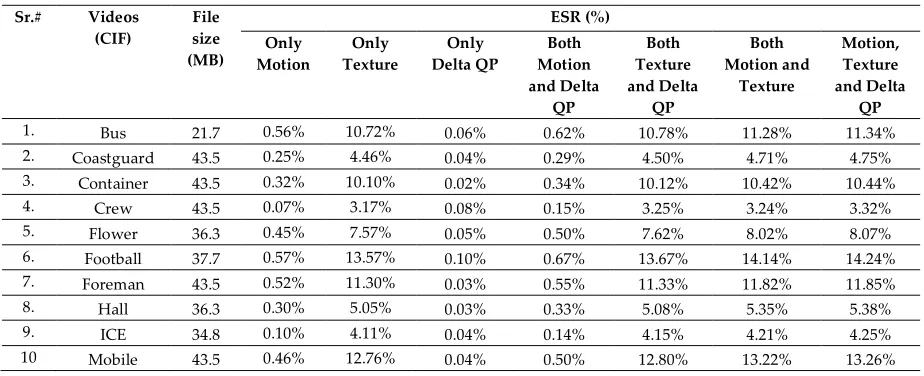
SE in IoMT. Table 4 shows the calculated ESR (ratio) for CABAC syntax elements.
384
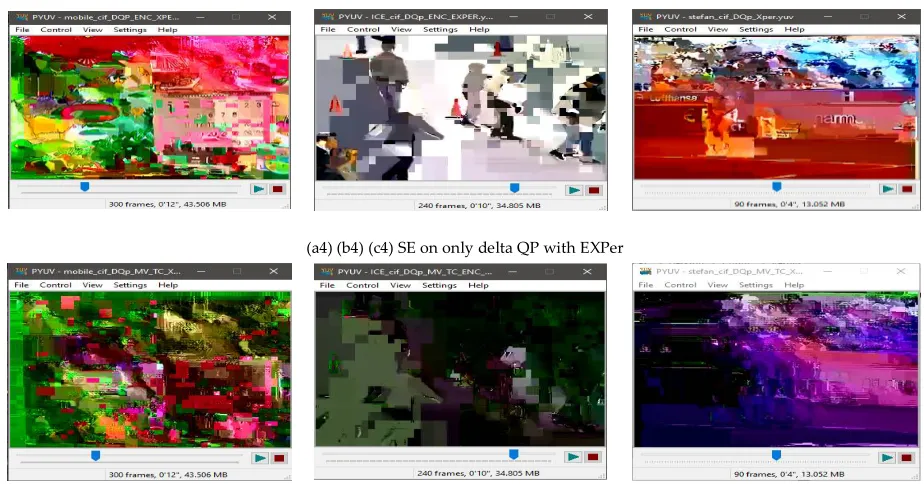
The visual results with the proposed encryption algorithm EXPer on CIF video sequences
385
Mobile, ICE and Stefan are presented in Figure. 5, which imply that sufficient confidentiality is
386
achieved without generating encryption overhead. The ESR with CABAC for ten videos is depicted
387
in Table 4. The ESR of delta QP is only 0.04% while 0.34% and 6.92% with only motion and texture
388
respectively for the ICE video. The ESR for all parameters for ICE video is 4.25% with the CABAC
389
coder, which is 95.75% less than the data for naïve encryption. The average ESR for test videos with
390
all parameters combined (i.e. motion, texture and delta QP) is 8.69% which is minimal and can be
391
adopted by IoT devices.
392
Table 4. ESR in terms of percentage over which SE applied on CABAC bin-strings
393
Sr.# Videos
(CIF)
File size (MB)
ESR (%) Only
Motion
Only Texture
Only Delta QP
Both Motion and Delta
QP
Both Texture and Delta
QP
Both Motion and
Texture
Motion, Texture and Delta
QP
1. Bus 21.7 0.56% 10.72% 0.06% 0.62% 10.78% 11.28% 11.34%
2. Coastguard 43.5 0.25% 4.46% 0.04% 0.29% 4.50% 4.71% 4.75%
3. Container 43.5 0.32% 10.10% 0.02% 0.34% 10.12% 10.42% 10.44%
4. Crew 43.5 0.07% 3.17% 0.08% 0.15% 3.25% 3.24% 3.32%
5. Flower 36.3 0.45% 7.57% 0.05% 0.50% 7.62% 8.02% 8.07%
6. Football 37.7 0.57% 13.57% 0.10% 0.67% 13.67% 14.14% 14.24%
7. Foreman 43.5 0.52% 11.30% 0.03% 0.55% 11.33% 11.82% 11.85%
8. Hall 36.3 0.30% 5.05% 0.03% 0.33% 5.08% 5.35% 5.38%
9. ICE 34.8 0.10% 4.11% 0.04% 0.14% 4.15% 4.21% 4.25%
Furthermore, as previously mentioned it is also worth noticing that the ESR with delta QP is
394
comparatively lower than the ESR of only motion or only texture parameters for all tested videos.
395
Thus, the ESR of delta QP combined with motion (0.50% for Mobile video and 0.14% for ICE video)
396
or delta QP combined with texture (12.80% for Mobile video and 4.15% for ICE video) is also less as
397
compared to the encryption ratio with combined motion and texture (13.22% for Mobile video and
398
4.21% for ICE video). The important point to note here is that the SE on the absolute values of dQP is
399
not possible with complex cipher algorithms, because the number of rounds in complex ciphers
400
makes these values out of range which destroys the format compliance and compression efficiency
401
of the bitstream, and consequently crashes the decoder [48].
402
However, in this paper, visual results in Figure 5 (a4, b4, c4) show the effectiveness of EXPer
403
algorithm, as the SE on dQP syntax elements is implemented in a way that their absolute values do
404
not go out of range and, as a result, the compression efficiency and format compliance of videos are
405
both maintained. This format compliance cannot be achieved through the AES algorithm. Overall,
406
the results in Figure 5 indicate that EXPer encryption provides sufficient visual protection with a
407
lower computational and encryption cost than conventional AES encryption.
408
(a1)Original MOBILE Video (b1) Original ICE Video (c1) Original STEFANVideo
(a2) (b2) (c2) SE on only Motion with EXPer
(a4) (b4) (c4) SE on only delta QP with EXPer
(a5) (b5) (c5) SE on Combined (Motion, Texture and Delta QP) parameters with EXPer
Figure 5. Visual protection of tested videos with EXPer encryption on selected syntax elements
409
4.3. Computational Cost Analysis
410
To analyze the performance of the EXPer, the absolute encryption time in seconds was measured
411
for CIF videos. Table 5 shows that the time is negligible compared to the compression time. Thus, the
412
results show that EXPer encrypts the videos with a low computational cost, which is on average 3.1
413
% of the H.264/AVC compression time (when encoded with CABAC) without encryption. Notice that
414
the absolute encryption time is taken separately to the Encoding time (Table 5, col 4)
415
416
Computational Cost = Encoding Time + Absolute Encryption Time (9)
417
Table 5. Absolute encryption time (s) with H.264/AVC CABAC entropy coding on selected
418
parameters (motion, texture, delta QP and their combination) with EXPer.
419
Sr. #
Videos (CIF)
File size (MB)
Encoding time with H.264/AVC using CABAC (Compression
without encryption)
Absolute encryption time by applying SE on CABAC (sec.)
Only Motion
Only Texture
Only Delta QP
Motion and Texture
Motion and Delta
QP
Delta QP and Texture
Motion , Textur
e and Delta QP
1. Bus 21.7 73.697 s 1.896 1.044 1.195 1.249 0.342 1.433 2.431
2. Coastguard 43.5 133.828 s 1.622 0.177 4.045 3.655 3.831 3.528 4.012
3. Container 43.5 116.386 s 2.687 2.691 2.656 3.217 3.058 2.666 3.947
4. Crew 43.5 156.804 s 1.601 1.803 4.151 2.928 3.373 3.079 4.512
5. Flower 36.3 107.977 s 1.849 2.745 1.059 2.908 0.143 3.561 3.772
6. Football 37.7 143.975 s 1.154 1.149 2.995 1.866 0.129 0.989 2.958
7. Foreman 43.5 134.769 s 2.419 2.285 2.793 0.993 5.483 3.603 5.988
8. Hall 36.3 118.614 s 1.198 3.267 3.554 3.141 3.611 3.25 3.984
9. ICE 34.8 105.232 s 0.947 2.694 3.54 3.4 2.998 2.625 3.229
10. Mobile 43.5 129.394 s 1.786 2.773 2.809 0.893 3.683 2.038 3.186
Average absolute encryption time 1.715 2.062 2.879 2.226 2.639 2.677 3.801
4.4. Security Analysis of EXPer
421
The results obtained from various experiments in this Section validate the robustness of EXPer.
422
4.4.1. Perceptual Security
423
Perceptual quality is considered an important check on the strength of encryption algorithms.
424
An encryption algorithm is considered robust if it succeeds in distorting a video sequence in such a
425
way that an observer visually fails to detect any useful information from the encrypted bitstream.
426
Clearly, the term ‘useful’ is dependent on the purpose that the video is to be put to, which, herein, is
427
assumed to be IoMT purposes. The visual results of Figure. 5 already show that the video sequences
428
encrypted with EXPer produce distorted results compared to the original video sequence.
429
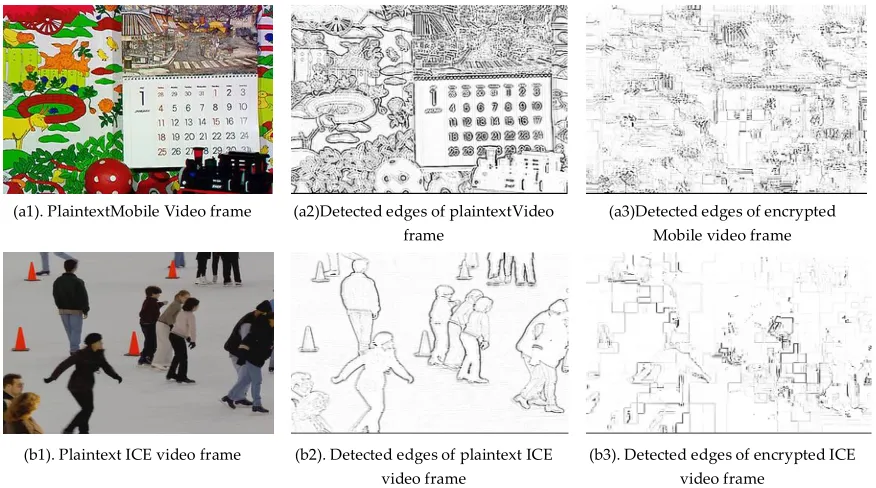
Furthermore, to evaluate the structural distortion of the proposed algorithm, 3 × 3 Laplacian edge
430
detection [57] was performed. The detected edges of the plaintext video and encrypted video frames
431
are illustrated in Figure. 6. The comparative results in Figure.6.a2, b2 with those of Figure. 6.a3, b3
432
show that the SE with EXPer distorts the video in a way that the attacker cannot easily acquire
433
similarity information from edges of the encrypted video.
434
(a1). PlaintextMobile Video frame (a2)Detected edges of plaintextVideo frame
(a3)Detected edges of encrypted Mobile video frame
(b1). Plaintext ICE video frame (b2). Detected edges of plaintext ICE video frame
(b3). Detected edges of encrypted ICE video frame
Figure. 6. The comparative visual impact of EXPer on ICE and Mobile video sequences after Laplacian
435
edge detector
436
Peak Signal to Noise Ratio (PSNR)
437
PSNR [58] measures the maximum possible absolute differences between the original bitstream
438
and the encrypted bitstream in decibels and is calculated as:
439
440
PSNR = 10. log MaxErr ∑ ,, X. − Y, 2
(10)
441
442
where ‘m’ and ‘n’ are the width and height of the video frame under consideration, while ‘X’
443
and ‘Y’ represent the pixel’s intensity values of the two frames being compared. For a video sequence,
444
the PSNRs of the frames are averaged across the sequence. A lower value of PSNR indicates less
445
similarity between an original video sequence and the video sequence reconstructed from a
446
compressed and encrypted bitstream.
447
Table 6 (col. 2, 3) demonstrates the average (arithmetic mean) PSNR of test video sequences after
448
PSNR value is much lower. Hence, the proposed SE with EXPer encryption produced the highly
450
distorted video. Thus, EXPer can be considered for video protection in IoMT.
451
Pixel-correlation analysis
452
Another statistical method to compute the similarity between the original and encrypted pixels
453
of the video frame is cross-correlation. The cross-correlation coefficient, r, is calculated as:
454
455
r = ∑ ∑ ( )( )
(∑ ∑ ( ) )(∑ ∑ ( ) ) (11)
456
457
where X, Y are the mean intensity values of pixels the original and distorted video frames. The
458
values of the r ranges from 1 to -1. When two frames are the same, the correlation index is at a
459
maximum, which is 1. Therefore, a lower value of correlation coefficient indicates higher distortion
460
as a result of encryption. Table 6 (cols. 4 and 5) presents calculated cross correlations between
461
encrypted and compressed video frames. The average value of the pixel correlations among the
462
plaintext and encrypted video frames is near to zero, confirming that video sequences encrypted with
463
EXPer are considerably distorted in a statistical sense, thus providing good confidentiality.
464
Table 6. Comparison of average PSNR (dB) and pixel cross-correlation of SE at QP= 36 with EXPer
465
for the videos encoded with CABAC
466
Video sequence
Average PSNR Average pixel cross-correlation
Compressed Encrypted Compressed Encrypted
Football [Y:31.63,U:37.45 V: 39.01] [Y:10.56,U:18.97,V:19.25] 0.9816 0.04708
ICE [Y:29.18,U:34.16,V: 33.47] [Y:6.27,U: 14.99,V: 11.64] 0.9991 -0.0173
Mobile [Y:32.86 ,U:38.06,V:39.47] [Y:6.00,U: 21.97,V: 27.32] 0.9923 0.014
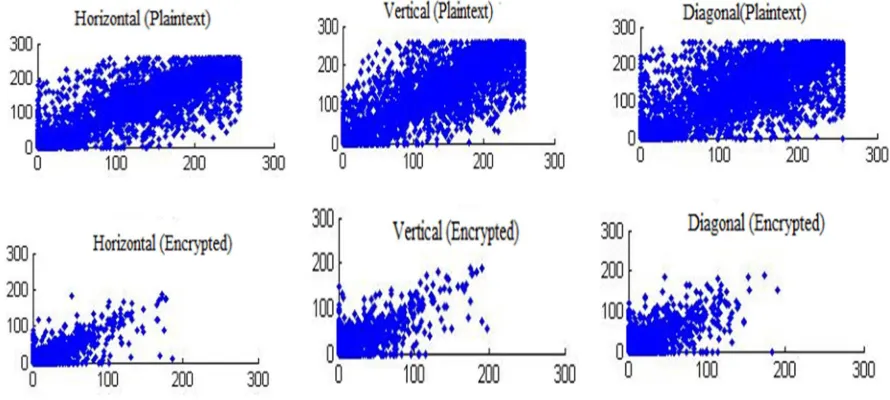
The correlation between adjacent pixels within video frames in the different directions
467
(horizontal, vertical and diagonal) for plaintext and encrypted Mobile video are shown in Figure 7.
468
The correlation test is performed by taking randomly N = 6000 pairs of adjacent pixels from the
469
original and selectively encrypted test video frames.
470
Figure 7. Pixels correlation (horizontal, vertical and diagonal) for the plaintext and encrypted Mobile
471
Video with EXPer
472
Structural Similarity Index (SSIM)
473
The SSIM index [58] is a metric which gauges the structural similarity between original and
474
less structural similarity between the plaintext and the reconstructed encrypted bitstream, which
476
means greater distortion has occurred. Values nearer to 1 means more structural similarity. The SSIM
477
values on videos by applying SE with EXPer are reported in Figure. 8. The SSIM plots make clear that
478
videos are drastically changed when EXPer is applied on selected combined parameters and that it
479
would be extremely difficult to extrapolate the encrypted parts.
480
481
Figure. 8. Average SSIM values for EXPer on different combinations of motion, texture and deltaQP
482
parameters on test videos
483
5.Comparison of EXPer with state-of-art ciphers
484
To confirm the worth of the EXPer, a comparison with the most commonly used encryption
485
algorithms XOR and AES was performed. XOR can be considered the most suitable encryption
486
algorithm for IoT applications due to its simplicity and lower computational complexity. However,
487
XOR provides limited confidentiality for images, due to potentially high cross-correlations, and
488
therefore AES can be utilized to provide greater confidentiality. Though AES is robust against
489
known-plaintext, brute force, and statistical attacks, it incurs a higher encoding and decoding
490
overhead, which is expensive for resource-constrained IoMT devices.
491
The results were taken with both state-of-art ciphers to compare their performance with EXPer.
492
Comparative visual results with XOR, AES-CFB [11], and EXPer with CABAC coding are presented
493
in Figure 9. Figure 9 (b1–b3), (c1 – c3) and (d1 – d3) depict SE of the videos with three ciphers. The
494
comparative results in Figure 9 (c vs. d) imply that the EXPer provides the same level of visual
495
protection and robustness as AES. It is worth mentioning here that dQP encryption is not applied in
496
these comparative results as AES rounds make the dQP encrypted video non-format compliant.
497
(a1) Original Raw Mobile Video (b1). Encryption with XOR (c1). Encryption with AES-CFB (d1). Encryption with EXPer
(a2) Original Raw ICE Video (b2). Encryption with XOR (c2). Encryption with AES-CFB (d2).Encryption with EXPer
(a3) Original Raw Football Video
(b3). Encryption with XOR (c3). Encryption with AES-CFB (d3).Encryption with EXPer
Figure 9. Comparative visual effects of selective encryption (on I, P and B frames) on combined
499
motion + texture syntax elements with XOR, AES-CFB and EXPer on test videos at QP= 36 encoded
500
with CABAC
501
5.1. Comparative Visual Quality Analysis
502
For video quality analysis of these three ciphers, PSNR and SSIM results were also taken. A
503
PSNR comparison among XOR, AES-CFB, and EXPer with combined motion and texture parameters
504
encryption on different QPs is given in Table 7. The luminance (Y)-PSNR of the Mobile video
505
sequence is 7.18 dB, 6.07 dB, and 6.27dBwith XOR, AES and EXPer respectively. While a noticeable
506
point here is that EXPer is able to encrypt additional syntax element in implemented SE (Section 4),
507
so the Y-PSNR of EXPer is 6.00 B (Table 7 (row 4, col. 3), less than AES-CFB, which is 6.07 dB for the
508
Mobile video. The comparative PSNR results confirm that the proposed algorithm produces PSNR
509
values almost equivalent to AES.
510
The SSIM of the encrypted video with combined motion and texture parameters is illustrated in
511
Figure 9. The comparative results show that video sequence encrypted with EXPer and AES-CFB has
512
smaller SSIM values than encryption with XOR. Lower SSIM values indicate more content protection.
513
Furthermore, from the evidence of Figure 10, EXPer provides almost the same level of confidentiality
514
as AES-CFB.
515
Hence, the PSNR and SSIM results imply that the encryption applied with EXPer provides
516
Table 7. Comparison of average PSNR (dB) of SE with XOR, AES-CFB and EXPer at four different QP
518
levels
519
Videos QP Encoded Without SE SE with XOR SE with AES-CFB SE with EXPer
Y U V Y U V Y U V Y U V
Football 12 43.9 46.71 47.65 9.72 13.08 20.92 9.52 18.25 21.13 9.53 19.25 22.13
24 37.03 41.55 42.76 8.67 13.28 20.75 10.04 18.06 19.36 10.16 19.06 20.36
36 31.63 37.45 39.01 9.94 13.19 20.87 10.36 17.97 18.24 10.56 18.97 19.25
48 28.72 34.99 37.1 10.63 12.94 21.07 11.31 17.38 16.9 11.51 18.4 17.96
Mobile 12 42.72 45.18 44.96 7.05 13.26 13.95 6.06 12.47 10.46 6.26 13.47 11.46
24 34.69 38.46 38.03 7.09 13.2 14.04 6.07 13.18 10.79 6.19 14.18 11.79
36 29.18 34.16 33.47 7.18 13.09 14.16 6.07 13.98 10.62 6.27 14.99 11.64
48 24.96 31.89 31.01 7.54 14.83 13.97 7.05 15.3 11.83 7.08 16.35 12.84
ICE 12 44.74 48.77 49.56 7.91 18.82 25.85 5.74 20.39 26.43 5.94 21.39 27.43
24 38.78 43.21 44.02 7.73 18.33 26.64 5.8 20.97 26.32 6 21.97 27.32
36 32.86 38.06 39.47 7.93 18.74 27 6.01 21.98 23.75 6.07 22.98 24.77
48 29.09 36.03 37.58 8.25 18.21 27.66 5.9 18.54 19.25 5.98 19.57 20.27
520
521
Figure 10. Comparison between SSIM values for XOR, AES-CFB and EXPer for selective encryption
522
with combined motion and texture parameters at QP= 36 on 10 tested videos
523
5.2. Comparative Computational Efficiency
524
In addition to the visual content protection, the efficiency of an encryption algorithm for
real-525
time processing is dependent on the execution/encoding time. Therefore, to evaluate the efficiency of
526
EXPer, a comparison with the encoding time of standard algorithms XOR and AES-CFB have been
527
performed. The comparative results of Figure 10 show that the absolute encoding time for only
528
motion parameters encryption and only texture parameters encryption with EXPer is 91.35 s and
529
87.34 s respectively, which is less than AES-CFB for the ICE video. Likewise, the encoding time for
530
combined motion and texture parameters encryption is 89.41 s, lower than AES-CFB. The graphical
531
results of Figure 11 indicate that the absolute encoding time with EXPer encryption is nearly
532
equivalent to encryption with XOR. Thus, the efficiency of EXPer in terms of execution time is
533
distinctly better than AES-CFB. EXPer provides an almost similar level of protection to that provided
534
536
Figure 11. Comparative absolute encoding time of EXPer with AES-CFB and XOR
537
5.3. Comparative Security Analysis
538
For the security analysis of EXPer, a comparison with the correlation coefficient of standard
539
algorithms XOR and AES-CFB has been performed. Figure. 12 shows comparative correlation
540
coefficients of plaintext Mobile video frame and encrypted mobile video frame. The results show that
541
frame encrypted with the EXPer has pixels correlation coefficient value ρ= 0.06905118369984 which
542
is almost equivalent to the pixels correlation value of the frame encrypted with AES-CFB that is
543
0.068235502062. This implies that EXPer has achieved the same level of randomness as AES-CFB and
544
outperform the XOR with correlation value ρ=0.511745682734. This demonstrates that the proposed
545
EXPer has greater potential to resist against the statistical attacks.
546
(a) XOR (b) AES-CFB
(c ) EXPer
5.4.Comparative Entropy analysis
548
Entropy defines uncertainty or the chaos level within the video frames. It measures the amount of the grey
549
level and the probability corresponding to the total information inside all other pixels and determines which
550
pixels carry most of the information. It is calculated as:
551
( ) = − ∑ ( ) log ( )
(12)
552
where ‘f’ is the amount of gray level and ‘p(f)’ is the probability of ‘f’. Figure 13 illustrate comparative
553
entropy histogram of Mobile video frames encrypted with XOR, AES and EXPer. This entropy is
554
evident in the spreading of more black and sharp colours (shown in Figure 5 and 9) across the video
555
frames compared to the original histogram (Figure 13 (a)) values prior to applied SE with three
556
ciphers over Mobile Video. This finding implies that, if the videos are selectively encrypted by EXPer
557
and AES, it is difficult to infer the presence of an object in any one of the R, G, B and luminance
558
domains. The results also illustrate that the EXper has attained the security against inference attacks
559
equivalent to the AES-CFB.
560
(a). Original Frame (Frame# 123) (b)Encrypted with XOR
(b)Encrypted with AES (b)Encrypted with EXPer (Proposed)
Figure 13. Comparative entropy of plaintext and encrypted Mobile video
561
6. Conclusion
562
Various classes of IoMT devices are utilized for multiple services i.e. stored video streaming
563
(YouTube, online lectures), live video streaming in the cases of video conferencing, online gaming
564
etc., with the most confidential being real-time interactive video streaming in the form of surveillance
565
applications. It is crucial to modern IoMT nodes to provide data confidentiality in the form of data
566
encryption. The most reliable cipher is AES with 128/192/256 bit keys. However, AES is still not an
567
optimal choice for low powered surveillance devices with simple hardware. In this paper, by keeping
568
in view current security needs, we propose an ESR-validated security scheme for IoMT devices.
569
Within a security scheme, the contribution of the paper is to examine two alternative entropy coders