Project Report
Global Potable Reuse Case Study 4:
Windhoek, Namibia
A report of a study funded by the
Australian Water Recycling Centre of Excellence
Global Potable Reuse Case Study 4: Windhoek,
Namibia
This report has been prepared as part of the National Demonstration Education and Engagement
Program (NDEEP). This Program has developed a suite of high quality, evidence-based information, tools and engagement strategies that can be used by the water industry when considering water recycling for drinking purposes. The products are fully integrated and can be used at different phases of project development commencing at “just thinking about water recycling for drinking water purposes as an option” to “nearly implemented”. The information contained in this Case Study was first published on the Public Health pages of a University of New South Wales Wiki website in 2012.
Stream 1.1 Leader
Partners
Dr James Wood Public Utilities Board, Singapore
School of Public Health & Community Medicine Seqwater
Faculty of Medicine OCWD
University of New South Wales Water Corporation P/L Sydney, NSW, 2052, AUSTRALIA
Telephone: +61 403704794
Contact: Dr James Wood [email protected]
About the Australian Water Recycling Centre of Excellence
The mission of the Australian Water Recycling Centre of Excellence is to enhance management and use of water recycling through industry partnerships, build capacity and capability within the recycled water industry, and promote water recycling as a socially, environmentally and economically sustainable option for future water security.
The Australian Government has provided $20 million to the Centre through its National Urban Water and Desalination Plan to support applied research and development projects which meet water recycling challenges for Australia’s irrigation, urban development, food processing, heavy industry and water utility sectors. This funding has levered an additional $40 million investment from more than 80 private and public organisations, in Australia and overseas.
ISBN: 978-1-922202-40-6
Citation:
Onyango, L., Leslie, G. and Wood, J.G. (2014). Global Potable Reuse Case Study 4: Windhoek, Namibia, Australian Water Recycling Centre of Excellence, Brisbane, Australia.
© Australian Water Recycling Centre of Excellence
This work is copyright. Apart from any use permitted under the Copyright Act 1968, no part of it may be reproduced by any purpose without the written permission from the publisher. Requests and inquiries concerning reproduction right should be directed to the publisher.
Date of publication: November, 2014
Publisher:
Australian Water Recycling Centre of Excellence Level 5, 200 Creek St, Brisbane, Queensland 4000 www.australianwaterrecycling.com.au
This report was funded by the Australian Water Recycling Centre of Excellence through the Australian Government’s National Urban Water and Desalination Plan.
Disclaimer
T
ABLE OFC
ONTENTS1. Scheme Overview ... 4
Background ... 4
The New Goreangab Water Reclamation Plant (NGWRP) ... 4
2. Scheme Infrastructure ... 5
Operational Processes ... 5
Treatment & Multiple Barriers ... 5
3. Water Quality & Public Health ... 6
Assessments of Water Quality ... 6
NGWRP water quality data ... 8
Health effects study ... 9
4. On-going research ... 9
5. Engagement & Education Strategies ... 10
1. Scheme Overview
Background
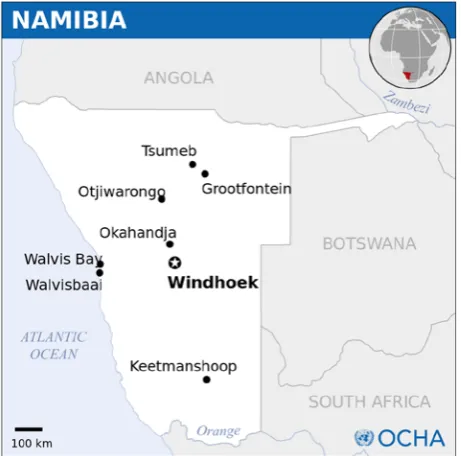
The wastewater reclamation plant in Windhoek, Namibia (Figure 1) is the longest running DPR
plant in the world. The scheme has been in operation since 1968 previously known as the
Goreangab Water Reclamation Plant (GWRP). Prior to this, reuse of sewage effluent in Namibia had only been considered for supply to power stations, but even then, reuse was never
implemented. A combination of factors (drivers) forced the water utility in Windhoek to seek
other water alternatives to meet the demand. These drivers included:
• the water crisis in 1957;
• rise in population growth;
• significant decline in annual rainfall; and
• increased evapotranspiration.
With the lack of perennial rivers in Windhoek and the impractical costs of water
transportation from other regions, wastewater effluent was again considered, but this time for potable purposes. The GWRP was commissioned and after rigorous pilot testing (1960-1968), in 1968, secondary treated sewage effluent was reclaimed, blended with dam water, and added
directly into the city’s water supply to meet up to 12% of the daily demand [1].
Figure 1: Location of Windhoek, Namibia.
The New Goreangab Water Reclamation Plant (NGWRP)
Over the years, the treatment train of the old plant underwent four upgrades before a new plant was commissioned in the early 1990s. Pilot testing of the new operational processes was conducted at the old site (while concurrently serving the Windhoek community). Design and
construction costs estimated at €12.5 million were sponsored by:
• the European Investment Bank;
• the City of Windhoek (COW); and
• Kreditanstalt fuer Wiederaufbau.
In 2002, the New Goreangab Water Reclamation Plant (NGWRP) was opened in a widely
publicised ceremony inaugurated by the Namibian president. This facility currently supplies 5.5
million gallons per day (mgd) of high quality potable water to a population of about 350,000
Windhoek residents. The scheme is widely accepted by the public who take pride in knowing
that their country is leading the world in DPR. The scheme has not been nominated for any
awards so far. Depending on seasonal demand, up to 35-50% of reclaimed water is used to
augment surface water supplies. The purified water is also used for aquifer recharge and
irrigation.
Further information on Windhoek’s New Goreangab Water Reclamation Plant can be found on
the Global Connections Map on the Water360 website.
2. Scheme Infrastructure
Operational Processes
The NGWRP is operated and maintained by the Windhoek Goreangab Operating Company
(WINGOC) [2] following quality compliance guidelines stipulated under the Private Management
Agreement (PMA). The NGWRP operates under a stringent permit instituted under the PMA between the COW and the WINGOC. This agreement stipulates plant operations and water quality assessments; and even levies financial penalties applicable to water quality after each unit process should quality guidelines/standards be breached based on online instrument readings and laboratory analyses.
At the time the NGWRP was commissioned, Namibia was the only country in the world proposing to practise DPR, and as such, there were no potable reuse guidelines locally and internationally by which they could base their water quality standards. Consequently,
combinations of existing guidelines (Namibian, WHO, USEPA, and South African water
quality criteria) were consulted and guidelines unique to the Namibian situation compiled. The NGWRP utilises an online SCADA system as well as composite water quality monitoring. Automated processes sample and refrigerate water after every process step (every 24 hours). Manual sampling for microbiological samples also occurs concurrently. As an additional measure of public health protection, the final product water is continuously monitored and sampled at multiple locations of the distribution network. The NGWRP also operates a manual computer and paper-based maintenance system to schedule and track any maintenance being undertaken at the plant.
Since 2005, regulatory surveillance of the NGWRP operations has been performed by Bureau
Veritas (BV) – an independent regulatory body - based on ISO 9001 Quality Management System (QMS) standards and a Hazard Analysis and Critical Control Point (HACCP) framework. Independent auditing occurs yearly while certification of the scheme is performed every 3 years.
Treatment & Multiple Barriers
The NGWRP employs a multiple barrier approach which combines 9 treatment,
non-treatment, and operational processes instituted throughout the reclamation process, from source water acquisition all the way to water delivery at the consumer’s tap. The multi-layered approach provides a redundancy throughout the system that continually protects public health in the event one of the other barriers fail. Included in this multi-layered system is a comprehensive treatment train unique to NGWRP (Figure 2) and adapted over time to handle the changes in source water, optimise reclamation, and provide the Windhoek public with water of high quality.
The NGWRP reclaims tertiary-treated domestic and commercial wastewater supplies only for
potable reuse. As part of the initiative to control source water pollution, industries in Windhoek
are localised separately from the city and the resulting industrial waste is treated at the Ujams wastewater treatment facility. The effluent is used for irrigation purposes or released into the Klein Windhoek River.
Figure 2: Windhoek’s New Goreangab Water Reclamation Plant treatment train.
Operators of the NGWRP also factor in that flow changes resulting from seasonal factors can occur (despite the arid climate). In the event that source water quality is higher than raw water design parameters, the plant is shut down and further measures taken. This has never
happened in the history of the plant.
3. Water Quality & Public Health
The NGWRP has a comprehensive water safety plan to protect the public in the event
something goes wrong and water quality is compromised. Based on the PMA contract, financial penalties are incurred when target water quality values not met. Water delivery is halted when absolute values for any criteria are surpassed. If any inconsistencies in water quality
parameters or operational processes are detected through their online SCADA monitoring system, the plant goes into recycle mode until values are restored below threshold. Recycle pipelines connected to the plant’s two CCPs pump water to the Goreangab dam for
reprocessing. Water distribution ceases unless all prescribed standards are met. If breaches occur post-distribution, the community is immediately notified and the plant goes into shut-down.
Assessments of Water Quality
The NGWRP performs a range of chemical, microbiological, and aesthetic assessments on its purified water as it passes through the treatment processes. The quality of the final product water produced by the NGWRP is monitored and approved by:
• COW laboratory; and
• Department of Infrastructure, Water and Technical Services.
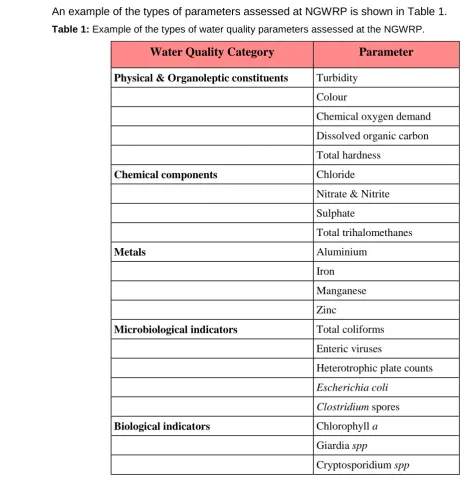
An example of the types of parameters assessed at NGWRP is shown in Table 1.
Table 1: Example of the types of water quality parameters assessed at the NGWRP.
Water Quality Category
Parameter
Physical & Organoleptic constituents Turbidity
Colour
Chemical oxygen demand
Dissolved organic carbon
Total hardness
Chemical components Chloride
Nitrate & Nitrite
Sulphate
Total trihalomethanes
Metals Aluminium
Iron
Manganese
Zinc
Microbiological indicators Total coliforms
Enteric viruses
Heterotrophic plate counts
Escherichia coli
Clostridium spores
Biological indicators Chlorophyll a
Giardia spp
Cryptosporidium spp
The NGWRP publishes internal water quality reports which are occasionally made public upon
request. Other sources of performance data include publications in scientific papers [3] [4] [5],
thesis documents [6], and water quality certificates that are provided quarterly to industrial
consumers.
NGWRP water quality data
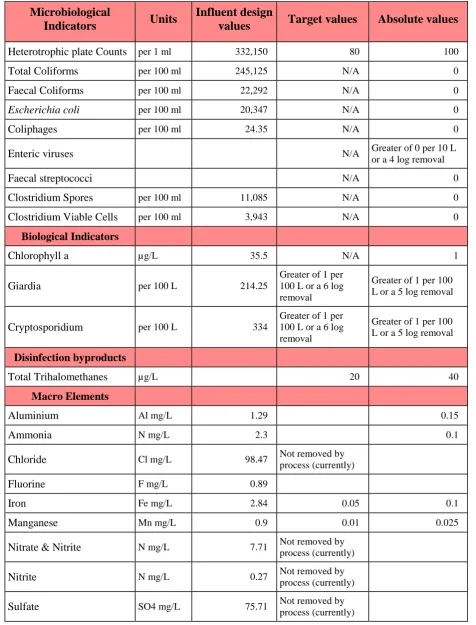
A summary of the influent design, target and absolute values for key microbial indicators for the NGWRP is presented in Table 2.
Table 2: Water quality influent design, target and absolute values for key microbial indicators for the NGWRP†.
Microbiological
Indicators
Units
Influent design
values
Target values
Absolute values
Heterotrophic plate Counts per 1 ml 332,150 80 100
Total Coliforms per 100 ml 245,125 N/A 0
Faecal Coliforms per 100 ml 22,292 N/A 0
Escherichia coli per 100 ml 20,347 N/A 0
Coliphages per 100 ml 24.35 N/A 0
Enteric viruses N/A Greater of 0 per 10 L or a 4 log removal
Faecal streptococci N/A 0
Clostridium Spores per 100 ml 11,085 N/A 0
Clostridium Viable Cells per 100 ml 3,943 N/A 0
Biological Indicators
Chlorophyll a µg/L 35.5 N/A 1
Giardia per 100 L 214.25
Greater of 1 per 100 L or a 6 log removal
Greater of 1 per 100 L or a 5 log removal
Cryptosporidium per 100 L 334
Greater of 1 per 100 L or a 6 log removal
Greater of 1 per 100 L or a 5 log removal
Disinfection byproducts
Total Trihalomethanes µg/L 20 40
Macro Elements
Aluminium Al mg/L 1.29 0.15
Ammonia N mg/L 2.3 0.1
Chloride Cl mg/L 98.47 Not removed by process (currently)
Fluorine F mg/L 0.89
Iron Fe mg/L 2.84 0.05 0.1
Manganese Mn mg/L 0.9 0.01 0.025
Nitrate & Nitrite N mg/L 7.71 Not removed by process (currently)
Nitrite N mg/L 0.27 Not removed by process (currently)
Sulfate SO4 mg/L 75.71 Not removed by process (currently)
Physical and Organoleptic Constituents
Chemical Oxygen Demand mg/L 43.32
Calcium carbonate precipitation potential
CaCO3
mg/L N/A Lie in range 0 -8
Colour mg/L Pt 8 71.88
Dissolved Organic Carbon mg/L 3 15.1
Total Dissolved Solids mg/L Greater of 1000 or 200 above raw water
Greater of 1200 or 250 above raw water
Turbidity NTU 0.1 0.2 52.96
Alkalinity mg/L 217.7
Total Trihalomethane
Formation Potential µg/L 168.75
UV254 abs/cm 0.06 0.36
Note:
†
unfortunately no actual WQ data was able to be provided by the NGWRP.
Health effects study
Shortly after the old plant began operations, an epidemiological study was commissioned to assess whether there were any adverse health effects resulting from potable reuse within the
Windhoek community. The 10-year long epidemiological study [7] examined the relationship
between diarrhoeal disease and potable reuse between consumers and non-users in Windhoek. The following conclusions were drawn:
• potable reuse was safe for human consumption based on bacteriological and virological
water quality results; and
• potable reuse did not increase incidences of diarrhoeal disease from water-borne
pathogens.
With no adverse health effects detected, the study was terminated in 1983. Improvements in treatments and technologies over the years coupled with consistent high WQ results have not required additional epidemiological studies. Nonetheless, the NGWRP has an on-going health research monitoring program which conducts research projects in areas of virology, toxicity, mutagenicity, pharmaceuticals and many more. On-going research at the NGWRP is overseen by a research steering committee that convenes yearly to assess research needs. There have been no reported outbreaks related to potable reuse since inception of the plant.
4. On-going research
The plant has been involved in other health research (past and ongoing) projects:
•
2001-current: A health research monitoring program instituted to investigate
health issues
•
2000-2008: EDC program using biological indicators and viral monitoring
•
2002: Research steering committee established to oversee/suggest research to
be conducted by WINGOC and COW (convenes once a year)
•
2002-current CCP monitoring.
5. Engagement & Education Strategies
6. References
1. ↑ P. du Pisani, J. Menge, Direct potable reclamation in Windhoek: a critical review of the
design philosophy of new Goreangab drinking water reclamation plant. Water Science & Technology: Water Supply, 2013. 13(2): p. 214-226.
2. ↑ http://www.wingoc.com.na/index.html
3. ↑ G. Iiputa, K. Nikodemus, J. Menge. Strategic drinking water quality monitoring for drinking
water safety in Windhoek. in Proceedings of the Water Institute of Southern Africa (WISA). 2008. Sun City: Unpublished report.
4. ↑ P. du Pisani, Direct reclamation of potable water at Windhoek's Goreangab reclamation plant. Desalination, 2006. 188: p. 79-88.
5. ↑ J. Menge, Treatment of wastewater for re-use in the drinking water system of Windhoek, in City of Windhoek, Namibia, http://www.wastewater.co.za/ , 2010.
6. ↑ M. Forss, H. Ander, Microbiological Risk Assessment of the Water Reclamation Plant in Windhoek, in Department of Civil and Environmental Engineering, 2011, Chalmers University of Technology: Goteborg. p. 106.
7. ↑ M. Isaacson, A. Sayed, Health aspects of the use of recycled water in Windhoek,
SWA/Namibia, 1974-1983. Diarrhoeal diseases and the consumption of reclaimed water. S Afr Med J, 1988. 73(10): p. 596-9.