Tensor pomeron, vector odderon and diffractive
produc-tion of meson and baryon pairs in proton-proton collisions
PiotrLebiedowicz1,∗,OttoNachtmann2,∗∗, andAntoniSzczurek1,∗∗∗
1Institute of Nuclear Physics Polish Academy of Sciences,
ul. Radzikowskiego 152, PL 31-342 Kraków, Poland
2Institut für Theoretische Physik, Universität Heidelberg,
Philosophenweg 16, D-69120 Heidelberg, Germany
Abstract.We review some selected results of the tensor-pomeron and vector-odderon model of soft high-energy proton-proton scattering and central exclu-sive production of meson and baryon pairs in proton-proton collisions. We dis-cuss the theoretical aspects of this approach and consider the phenomenological implications in a variety of processes at high energies, comparing to existing experimental data. We consider the diffractive dipion and dikaon production including the continuum and the dominant scalar and tensor resonance contri-butions as well as the photoproduction processes. The theoretical results are compared with existing CDF experimental data and predictions for planned or current LHC experiments, ALICE, ATLAS, CMS, LHCb are presented.
1 Introduction
There is a growing experimental and theoretical interest in understanding diffractive pro-cesses at high energy in proton-(anti)proton collisions. A particularly interesting are central exclusive production (CEP) processes where all centrally produced particles are detected. In the CDF [1] and the CMS [2] experiments only large rapidity gaps around the centrally produced dimeson system are checked but the forward and backward going protons are not detected. Preliminary results of similar CEP studies were presented by the ALICE [3] and LHCb [4] Collaborations at the LHC and by the STAR [5] Collaboration at RHIC. Although such results will have diffractive nature, further efforts are needed to ensure their exclusivity. These measurements are important in the context of resonance production, in particular, in searches for the gluon bound states (glueballs). Future experiments at the LHC will be able to detect all particles produced in CEP, including the forward and backward going protons. Feasibility studies for the pp → ppπ+π−process with tagging of the scattered protons as
carried out for the ATLAS and ALFA detectors are shown in [6]. Similar possibilities exist with the CMS and TOTEM detectors; see, e.g. [7].
It was known for a long time that the frequently used vector-pomeron model has problems from the point of view of field theory. Taken literally it gives opposite signs forppand ¯pp total cross sections. A way how to solve these problems was discussed in [8] where the
∗e-mail: [email protected]
∗∗e-mail: [email protected] ∗∗∗e-mail: [email protected]
pomeron was described as a coherent superposition of exchanges with spin 2+4+6+.... The same idea is realised in the tensor-pomeron model formulated in [9] where the soft pomeron exchange can effectively be treated as the exchange of a rank-2 symmetric tensor. In [10] it was shown that the tensor-pomeron model is consistent with the experimental data on the helicity structure of proton-proton elastic scattering at √s=200 GeV and small|t|from the STAR experiment [11]. In Ref. [12] the tensor-pomeron model was applied to the diffractive production of several scalar and pseudoscalar mesons in the reaction pp → ppM and it was shown that this model does quite well in reproducing the data when available. In [13] an extensive study of the photoproduction reaction γp → π+π−p in the framework of the
tensor-pomeron model was presented. The resonant (ρ0 → π+π−) and non-resonant
(Drell-Söding) photon-pomeron/reggeonπ+π−production inppcollisions was studied in [14]. The
central exclusive diffractive production ofπ+π−continuum together with the dominant scalar
f0(500), f0(980), and tensor f2(1270) resonances was studied by us in [15]. The experimental data on central exclusiveπ+π−production measured at Fermilab [1], CERN [2], and RHIC
[5] all show visible structures in the π+π− invariant mass. As we discussed in Ref. [15]
the pattern of these structures has mainly resonant origin and is very sensitive to the cuts used in a particular experiment (usually these cuts are different for different experiments). Theρ0meson production associated with a very forward/backwardπNsystem in thepp→ ppρ0π0andpp→pnρ0π+processes was discussed in [16]. In [17], the exclusive diffractive production of the K+K− in the continuum and via the dominant scalar f0(980), f0(1500), f0(1710), and tensor f2(1270), f20(1525) resonances, as well as theK+K−photoproduction contributions, were discussed in detail. In [18] thepp → pppp¯reaction was studied. Also the central exclusive π+π−π+π− production via the intermediate σσandρ0ρ0 states in pp collisions was studied in [19].
2 Formalism
We discuss central exclusive production of π+π− pairs in proton-proton collisions at high energies
p(pa)+p(pb)→ p(p1)+π+(p3)+π−(p4)+p(p2), (1)
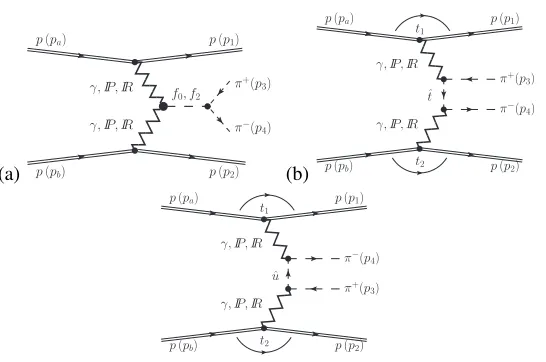
wherepi, indicated in brackets, denote the 4-momenta of the particles. The generic diagrams for diffractive exclusivepp → ppπ+π−reaction are shown in Fig. 1. At high energies the
exchange objects to be considered are the photonγ, the pomeronP, the odderonO, and the
reggeonsR. Their charge conjugation andG-parity quantum numbers are listed in Table I
of [15]. We treat theC = +1 pomeron and the reggeonsR+ = f2R,a2Ras effective tensor exchanges while theC =−1 odderon and the reggeonsR− =ωR, ρRare treated as effective vector exchanges. Note thatG-parity invariance forbids the verticesa2Rππ,ωRππandOππ.
The total amplitude for the pp → ppπ+π− reaction is a coherent sum of continuum
amplitudes and the amplitudes with thes-channel scalar (JPC =0++) and tensor (JPC =2++) resonances. The photoproduction contributions, discussed in detail in [14], must be also added coherently at the amplitude level and in principle could interfere.
For example, the PP-exchange “Born-level” amplitude (without absorption effects) for
π+π−production through a tensor resonance f
2 →π+π−can be written as
M(PP→f2→π+π−)
λaλb→λ1λ2π+π−=(−i) ¯u(p1, λ1)iΓ
(Ppp)
µ1ν1 (p1,pa)u(pa, λa)i∆
(P)µ1ν1,α1β1(s
1,t1)
×iΓ(PPf2)
α1β1,α2β2,ρσ(q1,q2)i∆
(f2)ρσ,αβ(p
34)iΓ (f2ππ)
αβ (p3,p4)
×i∆(P)α2β2,µ2ν2(s
2,t2) ¯u(p2, λ2)iΓ (Ppp)
(a)
γ, IP, IR γ, IP, IR f
0, f2
p(pa) p(p1)
p(pb) p(p2)
π+(p 3)
π−(p4)
(b)
γ, IP, IR γ, IP, IR
π+(p3)
π−(p4)
p(pa) p(p1)
p(pb) p(p2)
ˆ t t1
t2
γ, IP, IR γ, IP, IR
π−(p4)
π+(p3)
p(pa) p(p1)
p(pb) p(p2)
ˆ u t1
t2
Figure 1.The diagram (a) shows the double-pomeron/reggeon and photon mediated central exclusive IGJPC = 0+0++ and 0+2++ resonances production and their subsequent decays intoπ+π−
in proton-proton collisions. Two diagrams in panel (b) show exclusive continuumπ+π−
production.
whereλi∈ {+1/2,−1/2}denote the helicities of the nucleons,t1=q21 =(p1−pa)2,t2=q22= (p2−pb)2,s1 = (pa +q2)2 =(p1+p34)2, s2 =(pb+q1)2 = (p2+p34)2, p34 = p3+p4. The amplitude for diffractive exclusiveπ+π−continuum production can be written as the sum M(PP→π+π−)
=M(ˆt)+M(ˆu),
M(ˆt)λ
aλb→λ1λ2π+π−=(−i) ¯u(p1, λ1)iΓ
(Ppp)
µ1ν1 (p1,pa)u(pa, λa)i∆
(P)µ1ν1,α1β1(s
13,t1)iΓ (Pππ)
α1β1( ˆpt,−p3)i∆
(π)( ˆp t)
×iΓ(Pππ)α
2β2(p4,pt)ˆ i∆
(P)α2β2,µ2ν2(s
24,t2) ¯u(p2, λ2)iΓ (Ppp)
µ2ν2 (p2,pb)u(pb, λb),
(3)
M(ˆu)λ
aλb→λ1λ2π+π−=(−i) ¯u(p1, λ1)iΓ
(Ppp)
µ1ν1 (p1,pa)u(pa, λa)i∆
(P)µ1ν1,α1β1(s
14,t1)iΓ (Pππ)
α1β1(p4,pˆu)i∆
(π)( ˆp u)
×iΓ(Pππ)α
2β2( ˆpu,−p3)i∆
(P)α2β2,µ2ν2(s
23,t2) ¯u(p2, λ2)iΓ (Ppp)
µ2ν2 (p2,pb)u(pb, λb),
(4)
where ˆpt=pa−p1−p3and ˆpu=p4−pa+p1,si j=(pi+pj)2,∆(π)( ˆp)=( ˆp2−m2π)−1. For extensive discussions we refer to [9]. The pomeron-proton vertex function, supplemented by a vertex form factor, taken here to be the Dirac electromagnetic form factor of the proton for simplicity, has the form
iΓ(Ppp)
µν (p0,p)=iΓµν(Pp¯p¯)(p0,p)
=−i3βPNNF1 (p0−p)2
(
1 2
h
γµ(p0+p)ν+γν(p0+p)µi−1 4gµν(p/
0+
p
/)
) , (5)
withβPNN=1.87 GeV−1. For thePππvertex we have
iΓ(Pππ)µν (k0,k)=−i2βPππ
"
(k0+k)µ(k0+k)ν−1
4gµν(k
0+
k)2
#
FM((k0−k)2), (6)
with βPππ = 1.76 GeV−1 and we use the pion electromagnetic form factor in a simple parametrizationFM( ˆp2) = (1−pˆ2/Λ20)−1, Λ2
0 = 0.5 GeV
2. The off-shellness of the inter-mediate pions in (3) and (4) is taken into account by the inclusion of form factors. The
form factors are parametrised in the monopole form ˆFπ( ˆp2) =(Λ2o f f,M−m 2
π)/(Λ2o f f,M−pˆ 2)
or, alternatively, in the exponential form ˆFπ( ˆp2)=exp( ˆp2−m2π)/Λ2o f f,E
, whereΛo f f,M(or
Λo f f,E) could be adjusted to experimental data. Here the normalisation condition ˆFπ(m2π)=1 is clearly satisfied.
Our effective pomeron propagator reads
i∆(P)µν,κλ(s,t)= 1
4s gµκgνλ+gµλgνκ− 1 2gµνgκλ
!
(−isα0P)αP(t)−1 (7)
and fulfills the following relations:
∆(P)
µν,κλ(s,t)= ∆ (P)
νµ,κλ(s,t)= ∆ (P)
µν,λκ(s,t)= ∆ (P) κλ,µν(s,t),
gµν∆(P)
µν,κλ(s,t)=0, gκλ∆(P)µν,κλ(s,t)=0. (8) Here, the pomeron trajectoryαP(t) is assumed to be of standard linear form, see e.g. [20],
αP(t)=αP(0)+α0
Pt, αP(0)=1.0808, α
0
P=0.25 GeV
−2. (9)
ThePPf2vertex can be written as
iΓ(PPf2)
µν,κλ,ρσ(q1,q2)=
iΓ(PPf2)(1)
µν,κλ,ρσ |bare + 7
X
j=2
iΓ(PPf2)(j)
µν,κλ,ρσ(q1,q2)|bare
˜ F(PPf2)(q2
1,q 2 2,p
2
34). (10)
A possible choice for the PPf2 couplings, denoted by j = 1, ...,7 terms, is given in Ap-pendix A of [15]. Our attempts to determine the parameters of pomeron-pomeron-meson couplings as far as possible from experimental data have been presented in [12, 15, 17]. Other details as form of form factors, the tensor-meson propagator∆(f2) and the f
2ππvertex are given in [9, 15, 17].
The ansatz for the C = +1 reggeonsR+ = f2R,a2R is similar to (5) - (9). The f2R -anda2R-proton vertex functions are obtained from (5) with the replacements (M0=1 GeV) 3βPNN →
gf2Rpp
M0 ,gf2Rpp = 11.04, and 3βPNN →
ga2Rpp
M0 ,ga2Rpp = 1.68, respectively. The f2R
-pion vertex function is obtained from (6) with the replacement 2βPππ→ gf2Rππ
2M0 ,gf2Rππ=9.30.
TheR+propagator is obtained from (7) with the replacementsαP(t)→αR+(t)=αR+(0)+α0R+t,
αR+(0) = 0.5475, α0
R+ = 0.9 GeV
−2. The
R−-proton vertex (for the C = −1 reggeons
R−=ωR, ρR) reads
iΓ(R−pp)
µ (p0,p)=−iΓµ(R−p¯p¯)(p0,p)=−igR−ppF1 (p
0−p)2γ
µ, (11)
withgωRpp=8.65 andgρRpp=2.02. For theρR-pion vertex we write
iΓ(ρRπ+π+)
µ (k0,k)=−iΓ(ρRπ −π−)
µ (k0,k)=−i
2gρRππFM (k
0−k)2(k0+k)
µ, (12)
withρRππ=15.63. We assume an effective vector propagator
i∆(R−)
µν (s,t)=igµν 1 M2
−
(−isα0R−)αR−(t)−1, (13)
withαR−(t)=αR−(0)+α 0
R−t,αR−(0)=0.5475,α 0
R−=0.9 GeV
−2, andM
−=1.41 GeV.
Our ansatz for the odderon follows (3.16), (3.17) and (3.68), (3.69) of [9]:
i∆(O)µν(s,t)=−igµνηO M2 0
(−isα0 O)
αO(t)−1, (14)
iΓ(Opp)
µ (p0,p)=−iΓµ(Op¯p¯)(p0,p)=−i3βOppM0F1 (p
0−p)2γ
µ. (15)
We take here what we think are representative values for the odderon parameters in light of the recent TOTEM results [21],ηO=−1,αO(t)=αO(0)+α0
Ot,αO(0)=1.05, α
0
O=0.25GeV
−2,
βONN = 0.2 GeV−1. All numbers for the parameters listed above should be considered as default values to be checked and – if necessary – adjusted using relevant experimental data. Some estimates of the present uncertainties of the parameters are discussed in Sec. 3 of Ref. [9].
In reality the Born approximation, e.g. for the amplitude (2), is not sufficient and ab-sorption corrections (rescattering effects) must be taken into account, see [22, 23]. A Monte Carlo generator containing a various processes and including detector effects (acceptance, efficiency) would be useful in theory-data comparison. TheGenExMonte Carlo generator [24] could be used in this context.
3 Selected results
3.1 ppandpp¯ elastic scattering
In [10] we confronted three hypotheses for the soft pomeron, tensor, vector, and scalar, with current experimental data on polarised pp elastic scattering [11]. For the vector-pomeron case a big problem arise if we considerppand ¯ppscattering. Taken literally it gives opposite signs for pp and ¯pptotal cross sections. Thus, we shall not consider a vector pomeron further. In order to discriminate between the tensor and scalar cases we turn to the experiment [11]. There a good measurement of the ratio of single-flip to non-flip amplitudes at √s = 200 GeV and for 0.0036|t|60.035 GeV2was performed. The relevant quantity isr
5(s,t)= 2mpφ5(s,t)
√
−tIm[φ1(s,t)+φ3(s,t)]. The complex r5 parameter is only weakly dependent ont. Therefore,
we can approximately sett = 0 and getrPT
5 (s,0) = (−0.28−i2.20)×10
−5 andrPS
5 (s,0) =
−0.064−i0.500 for the scalar- and tensor-pomeron model, respectively. In Fig. 2 we show the STAR experimental result [11] together with the scalar-pomeron and tensor-pomeron results. Clearly, the tensor-pomeron result is perfectly compatible with the experiment whereas the scalar-pomeron result is far outside the experimental error ellipse.
5 Re r
-0.05 0
5
Im r
-0.6 -0.4 -0.2 0
Stat.+Syst. Error scalar pomeron tensor pomeron
5 Re r
-0.01 -0.005 0 0.005 0.01
5
Im r
-0.05 0 0.05
Stat. Error Stat.+Syst. Error tensor pomeron
Figure 2.The experimental results forr5at
√
s=200 GeV from Fig. 5 of [11] together with the results for the tensor and the scalar pomeron from [10].
3.2 pp→ ppπ+π−and pp→ppK+K−reactions
In Fig. 3 we present the dipion/dikaon invariant mass distributions imposing experimental cuts. The short-dashed lines represent the purely diffractive continuum term including both pomeron and reggeon exchanges, discussed in [15, 17]. Exclusive production of light mesons both in thepp→ ppπ+π−andpp→ ppK+K−reactions are measurable at RHIC and LHC.
The pattern of visible structures in the invariant mass distributions is related to the scalar and tensor isoscalar mesons and it depends on experimental kinematics. For example, for the pp → ppK+K− reaction presented in Fig. 3, the solid lines represent the coherent sum of
the diffractive continuum, and the scalar f0(980), f0(1500), f0(1710), and tensor f2(1270), f0
2(1525) resonances. The lower red lines show the photoproduction term including the dom-inantφ(1020)→ K+K−and the continuum (Drell-Söding) contributions. The narrowφ res-onance is visible above the continuum term. It may, in principle, be visible on top of the broader f0(980) resonance. The coupling parameters of the tensor pomeron to theφmeson was fixed based on the HERA experimental data for theγp→φpreaction.
One can expect, with our default choice of parameters, that the scalar f0(980), f0(1500), f0(1710) and the tensor f2(1270), f20(1525) mesons will be easily identified experimentally in CEP processes. The absorption effects lead to a huge damping of the cross section for the purely diffractive contribution and a relatively small reduction of the cross section for theφ(1020) photoproduction contribution. Therefore we expect that one could observe theφ resonance term, especially when no restrictions on the leading protons are included. We note that central exclusive production ofφ offers also the possibility to search for effects of the elusive odderon, as was pointed out in [25].
(GeV) 34 M
0.8 1 1.2 1.4 1.6 1.8 2
b/GeV)
µ
(
34
/dM
σ
d
4 −
10
3 −
10
2 −
10
1 −
10 1 10
= 1.96 TeV, CDF data s
| < 1
34
| < 1.3, |y
4
η |, |
3
η |
> 0.4 GeV
t,4
, p
t,3
p
-π
+
π
-K
+
K
(GeV)
34
M
0.8 1 1.2 1.4 1.6 1.8 2
b/GeV)
µ
(
34
/dM
σ
d
3
−
10 2
−
10 1
−
10 1 10
> 0.1 GeV t,4 , p t,3 | < 1, p 4 η |, | 3 η = 13 TeV, | s
-π + π
-K + K
Figure 3.The invariant mass distributions for centrally producedπ+π−
(the black top lines) andK+K− (the blue bottom lines) pairs with the relevant experimental kinematical cuts specified in the legend. Theoretical results including both the non-resonant continuum and resonances are represented by the solid lines, respectively. The short-dashed lines represent the purely diffractive continuum term alone. The CDF experimental data from [1] in the left panel for thepp¯→pp¯π+π−
reaction are presented. For thepp→ppK+K−
reaction the solid and long-dashed blue lines correspond to the results forφf0(980)=
0 and π/2 in the coupling constantgf0(980)K+K−eiφf0 (980), respectively. The lower red line represents theφ(1020) meson plus continuum photoproduction contribution. Absorption effects were taken into account effectively by the gap survival factors,hS2i=0.1 for the purely diffractive contributions and
hS2i=0.9 for the photoproduction contributions.
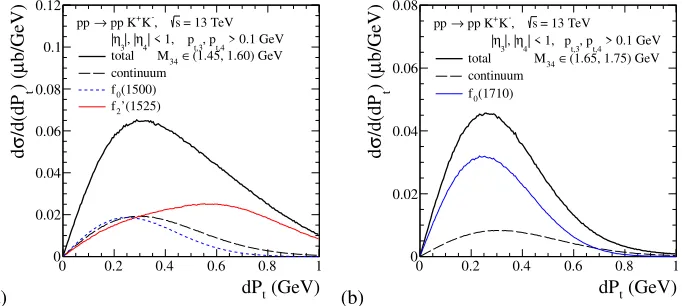
In Fig. 4 we present distributions in a special "glueball filter variable"dPt[26] defined by the difference of the transverse momentum vectorsdPt=|d Pt|,d Pt=qt,1−qt,2=pt,2−pt,1. Results for the ALICE kinematics and for two MK+K− regions are shown. No absorption
effects were taken into account here. We see that the maximum for theqq¯ state f20(1525) is around dPt = 0.6 GeV. On the other hand, for the scalar glueball candidates f0(1500) and f0(1710) the maximum is arounddPt =0.25 GeV, that is, at a lower value than for the
f0
2(1525) resonance. This is also in accord with the discussion in Refs. [27, 28].
(a) dPt (GeV)
0 0.2 0.4 0.6 0.8 1
b/GeV)
µ
) ( t
/d(dP
σ
d
0 0.02 0.04 0.06 0.08 0.1 0.12
= 13 TeV s ,
-K
+
pp K
→
pp
> 0.1 GeV
t,4
, p
t,3
| < 1, p
4 η
|, |
3 η
|
(1.45, 1.60) GeV
∈ 34
total M continuum (1500)
0
f ’(1525)
2
f
(b) dPt (GeV)
0 0.2 0.4 0.6 0.8 1
b/GeV)
µ
) ( t
/d(dP
σ
d
0 0.02 0.04 0.06 0.08
= 13 TeV s ,
-K
+
pp K
→
pp
> 0.1 GeV
t,4
, p
t,3
| < 1, p
4
η
|, |
3
η
|
(1.65, 1.75) GeV
∈
34
total M continuum
(1710)
0
f
Figure 4. The differential cross sectionsdσ/d(dPt) as a function of thedPt “glueball filter” variable
for thepp→ ppK+K−
reaction. Calculations were done for √s=13 TeV,|ηK|<1,pt,K >0.1 GeV,
and in two dikaon invariant mass regions: (a)M34∈(1.45,1.60) GeV and (b)M34∈(1.65,1.75) GeV.
3.3 pp→ pppp¯reaction
In Fig. 5, we show the invariant mass distributions for centrally producedπ+π−,K+K−and pp¯ systems (the left panel) and the distributions in rapidity difference ydi f f =y3−y4 (the right panel) at √s = 13 TeV. In our calculations we include both the tensor-pomeron and the reggeonR+andR−exchanges. We predict a dip in the rapidity difference between the
antiproton and proton for ydi f f =0. This novel effect is inherently related to the spin 1/2 of the produced hadrons. We have checked that for thepp¯production the ˆt- and ˆu-channel diagrams interfere destructively for (C1,C2) = (1,1) and (−1,−1) exchanges and constructively for (1,−1) and (−1,1) exchanges. For the π+π− production, we get the opposite interference
effects between the ˆt- and ˆu-channel diagrams.
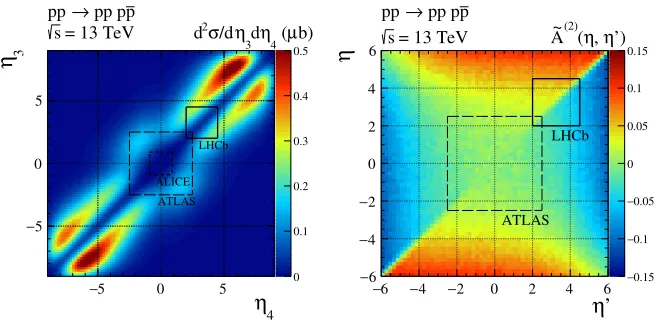
In our calculations we have included both pomeron and reggeon exchanges. The reggeon exchange contributions lead to an enhancement of the cross section mostly at large rapidities of the centrally produced hadrons. For the production of the dipion continuum, the cross section is concentrated along the diagonalη3 =η4. For the production of pp¯pairs, the dip extends over the whole diagonal in (η3, η4) space, see the left panel in Fig. 6. In the right panel of Fig. 6 we show the asymmetry defined for two pseudorapiditiesηandη0
e
A(2)(η, η0)= d2σ
dη3dη4(η, η
0)− d2σ
dη3dη4(η 0, η)
d2σ
dη3dη4(η, η
0)+ d2σ
dη3dη4(η
0, η). (16)
(GeV) 34 M
0 1 2 3 4 5 6
b/GeV) µ ( 34 /dM σ d -3 10 -2 10 -1 10 1 10 2 10 3 10
= 13 TeV, no absorption s -π + π pp →
pp
-K + pp K
→
pp
= 1.0 GeV off,E Λ , p pp p → pp
= 0.8 GeV off,E Λ , p pp p → pp (spin-0 protons) p pp p → pp
| < 2.5 4 η |, | 3 η |
> 0.1 GeV t,4 , p t,3 p 4 - y 3 = y diff y
-4 -2 0 2 4
b) µ ( diff /dy σ d -4 10 -3 10 -2 10 -1 10 1 10 2 10 3 10 4 10 5 10
= 13 TeV, no absorption s -π + π pp → pp
-K
+
pp K → pp
= 1.0 GeV
off,E Λ , p pp p → pp
= 0.8 GeV
off,E Λ , p pp p → pp (spin-0 protons) p pp p → pp | < 2.5
4 η |, | 3 η |
> 0.1 GeV
t,4
, p
t,3
p
Figure 5.In the left panel we show the invariant mass distributions for centrally producedπ+π− ,K+K− andpp¯systems for a typical LHC experimental conditions at √s=13 TeV. Results for the combined tensor-pomeron and reggeon exchanges andΛo f f,E =1 GeV are presented. For thepp¯production we
show results also forΛo f f,E = 0.8 GeV. In the right panel we show the distributions in the rapidity
difference between the centrally produced hadrons. No absorption effects were included here.
are predicted to come out typically with a higher absolute value of the (pseudo)rapidity than protons. The asymmetry is caused by interference effects of the dominant (P,P) with the sub-dominant (R−,P+R+) and (P+R+,R−) exchanges. We have checked that in the limited range
of pseudorapidities corresponding to the ATLAS and LHCb experiments the effects of the secondary reggeons are predicted to be in the ranges of 2 - 11 % and 5 - 26 %, respectively. The addition of an odderon with the parameters of (14)et seq.has only an effect of less than 0.5 %.
4
η
5
− 0 5
3
η
5 − 0 5 0 0.1 0.2 0.3 0.4 0.5 p pp p → pp b) µ ( 4 η d 3 η /d σ 2 = 13 TeV d s LHCb ATLAS ALICE’
η
6− −4 −2 0 2 4 6
η
6 − 4 − 2 − 0 2 4 6 0.15 − 0.1 − 0.05 − 0 0.05 0.1 0.15 p pp p → pp ’) η , η ( (2) A~= 13 TeV s
LHCb
ATLAS
Figure 6.The two-dimensional distribution in (η3, η4) for the diffractive continuumpp¯production for the full phase space and the asymmetryAe(2)(η, η0) [see Eq. (16)] at
√
s=13 TeV. In addition, regions of the coverage for the ALICE, ATLAS and LHCb experiments are shown.
In [18] we have discussed a first qualitative attempt to “reproduce” the experimentally observed behavior of the pp¯ invariant mass (M34) spectra observed in [29, 30]. Our calcu-lation shows that the diffractive production of pp¯through thes-channel f0(2100) resonance leads to an enhancement at lowM34 and that the resonance contribution is concentrated at
|ydi f f| <1. In general, more resonances can contribute, e.g., f0(2020), f0(2200), f0(2300), f2(1950). Also, the subthresholdmR<2mpresonances that would effectively generate a con-tinuum pp¯contribution should be taken into account; see [31]. Interference effects between the continuum and resonant mechanisms certainly will occur. We leave this interesting issue for future studies.
4 Conclusions
When considering ppand ¯ppelastic scattering and the ratio of helicity-flip to non-flip am-plitudes we found that only the tensor pomeron, introduced in [9], is a viable option for the soft pomeron. In terms of elementary exchanges this should be viewed as a coherent sum of exchanges of spin 2+4+6+.... This is the structure obtained in [8] within nonperturbative QCD investigations. Investigations of the pomeron using the models of AdS/QCD also prefer a tensor nature for pomeron exchange [32].
We have given a consistent treatment of continuum and resonance production for different processes in central exclusive ppandpp¯ collisions in an effective field-theoretic approach. We have analysed the central exclusive production ofπ+π−andK+K−pairs at high energies.
We have taken into account purely diffractive and diffractive photoproduction mechanisms. For the purely diffractive mechanism we have included the continuum and the dominant scalar f0(980), f0(1500), f0(1710) and tensor f2(1270), f20(1525) resonances. The amplitudes have been calculated using Feynman rules within the tensor-pomeron model [9]. The effective Lagrangians and the vertices forPPfusion into the scalar and tensor mesons were discussed
in [12, 15, 17]. Some model parameters (PPMcouplings, the off-shell dependence of form
factors) have been roughly adjusted to CDF data [1] and then used for predictions for the STAR, ALICE, ATLAS, CMS and LHCb experiments. The distributions, in the so-called glueball filter variable dPt, show different behavior in the K+K− invariant mass windows around glueball candidates with masses∼1.5 GeV and∼1.7 GeV than in other regions. The dPtdistribution may help to interpret the relative rates between the f0andf2resonances.
The photoproduction and purely diffractive contributions have different dependences on the proton transverse momenta. Furthermore, the absorptive corrections for the photoproduc-tion processes lead to a much smaller reducphotoproduc-tion of the cross secphotoproduc-tion than for the diffractive ones. It can therefore be expected that theρ- andφ-photoproduction will be seen in exper-iments requiring only a very small deflection angle for at least one of the outgoing protons. However, we must keep in mind that other processes can contribute in experimental studies of exclusive photoproduction where only large rapidity gaps around the centrally produced vector meson are checked and the forward and backward going protons are not detected. Ex-perimental results for this kind of processes were published by the CDF [1] and CMS [2] collaborations. We refer the reader to Ref. [16] in whichρ0production inppcollisions was studied with one proton undergoing diffractive excitation to aπNsystem.
Recently, in [18] we discussed exclusive production ofpp¯andΛΛpairs in proton-proton collisions. At the present stage, we have taken into account mainly the diffractive production of thepp¯continuum. For our predictions for the LHC we have used the off-shell proton form factor parameter in the range 0.8 GeV<Λo f f,E <1 GeV. The invariant mass distribution for pp¯pairs is predicted to extend to larger dihadron invariant masses than for the production of
π+π−or K+K−. Especially interesting is the distribution in the rapidity difference between
centrally produced antiproton and proton. For continuumpp¯production, we predict a dip at
ydi f f =0, in contrast toπ+π−andK+K−production in which a maximum of the cross section occurs at ydi f f =0. The dip is caused by a good separation of ˆt and ˆu contributions in (η3, η4) space and destructive interference of them along the diagonalη3 =η4characteristic for our Feynman diagrammatic calculation with correct treatment of spins. Any experimentally ob-served distortions from our continuum-pp¯predictions may therefore signal the presence of resonances. This could give new interesting information for meson spectroscopy.
To describe the relatively low-energy ISR and WA102 data [29, 30] for the pp →
pppp¯ process we find that we must include also subleading reggeon exchanges in addi-tion to the two-pomeron exchange. Then we made predicaddi-tions for the LHC energy. The reggeon exchange contributions lead to enhancements at large absolute values of thepand ¯p (pseudo)rapidities, see Fig. 6. A similar effect was predicted for thepp→ ppπ+π−reaction
in [33]. We have predicted asymmetries in the (pseudo)rapidity distributions of the centrally produced antiproton and proton. The asymmetry should be much more visible for the LHCb experiment which covers a region of larger pseudorapidities where the reggeon exchanges become more relevant. Also the odderon will contribute to such asymmetries. However, we find for typical odderon parameters allowed by recent ppelastic data [21] only very small effects, roughly a factor 10 smaller than the effects due to secondary reggeons.
This work was supported by Polish Ministry of Science and Higher Education under the Iuventus Plus grant (IP2014 025173) and by Polish National Science Centre under the grants 2014/15/B/ST2/02528 and 2015/17/D/ST2/03530.
References
[1] T.A. Aaltonen et al. (CDF Collaboration), Phys. Rev.D91, 091101 (2015)
[2] V. Khachatryan et al. (CMS Collaboration), CMS-FSQ-12-004, CERN-EP-2016-261 (2017), hep-ex/1706.08310
[3] R. Schicker (ALICE Collaboration) (2012), hep-ex/1205.2588 [4] R. McNulty, PoSDIS2016, 181 (2016)
[5] R. Sikora (STAR Collaboration) (2018), hep-ex/1811.03315
[6] R. Staszewski, P. Lebiedowicz, M. Trzebi´nski, J. Chwastowski, A. Szczurek, Acta Phys.Polon.B42, 1861 (2011)
[7] M. Albrow et al. (CMS, TOTEM Collaboration), CERN-LHCC-2014-021, TOTEM-TDR-003, CMS-TDR-13 (2014)
[8] O. Nachtmann, Annals Phys.209, 436 (1991)
[9] C. Ewerz, M. Maniatis, O. Nachtmann, Annals Phys.342, 31 (2014)
[10] C. Ewerz, P. Lebiedowicz, O. Nachtmann, A. Szczurek, Phys. Lett.B763, 382 (2016) [11] L. Adamczyk et al. (STAR Collaboration), Phys. Lett.B719, 62 (2013)
[12] P. Lebiedowicz, O. Nachtmann, A. Szczurek, Annals Phys.344, 301 (2014)
[13] A. Bolz, C. Ewerz, M. Maniatis, O. Nachtmann, M. Sauter, A. Schöning, JHEP1501, 151 (2015)
[14] P. Lebiedowicz, O. Nachtmann, A. Szczurek, Phys. Rev.D91, 074023 (2015) [15] P. Lebiedowicz, O. Nachtmann, A. Szczurek, Phys. Rev.D93, 054015 (2016) [16] P. Lebiedowicz, O. Nachtmann, A. Szczurek, Phys. Rev.D95, 034036 (2017) [17] P. Lebiedowicz, O. Nachtmann, A. Szczurek, Phys. Rev.D98, 014001 (2018) [18] P. Lebiedowicz, O. Nachtmann, A. Szczurek, Phys. Rev.D97, 094027 (2018) [19] P. Lebiedowicz, O. Nachtmann, A. Szczurek, Phys. Rev.D94, 034017 (2016)
[20] A. Donnachie, H.G. Dosch, P.V. Landshoff, O. Nachtmann, Camb. Monogr. Part. Phys. Nucl. Phys. Cosmol.19, 1 (2002)
[21] G. Antchev et al. (TOTEM Collaboration), CERN-EP-2017-335 (2017) [22] L.A. Harland-Lang, V.A. Khoze, M.G. Ryskin, Eur.Phys.J.C74, 2848 (2014) [23] P. Lebiedowicz, A. Szczurek, Phys. Rev.D92, 054001 (2015)
[24] R.A. Kycia, J. Chwastowski, R. Staszewski, J. Turnau (2014), hep-ph/1411.6035 [25] A. Schäfer, L. Mankiewicz, O. Nachtmann, Phys.Lett.B272, 419 (1991) [26] F.E. Close, A. Kirk, Phys.Lett.B397, 333 (1997)
[27] D. Barberis et al. (WA102 Collaboration), Phys.Lett.B397, 339 (1997) [28] D. Barberis et al. (WA102 Collaboration), Phys.Lett.B462, 462 (1999) [29] A. Breakstone et al. (ABCDHW Collaboration), Z.Phys.C42, 387 (1989) [30] D. Barberis et al. (WA102 Collaboration), Phys. Lett.B446, 342 (1999)
[31] M. Kłusek-Gawenda, P. Lebiedowicz, O. Nachtmann, A. Szczurek, Phys. Rev.D96, 094029 (2017)
[32] I. Iatrakis, A. Ramamurti, E. Shuryak, Phys. Rev.D94, 045005 (2016) [33] P. Lebiedowicz, A. Szczurek, Phys.Rev.D83, 076002 (2011)
![Figure 2. The experimental results for √ r5 ats = 200 GeV from Fig. 5 of [11] together with the resultsfor the tensor and the scalar pomeron from [10].](https://thumb-us.123doks.com/thumbv2/123dok_us/8010776.1331609/5.482.88.396.457.598/figure-experimental-results-gev-resultsfor-tensor-scalar-pomeron.webp)